Episode 898: The keeper of the book

A cult devoted to the service of supernatural beings known as “the Leviathan people” is secretly establishing itself in and around Collinsport, Maine. Antique shop owners Megan and Philip Todd are members of the cult. Its acting leader, old world gentleman Barnabas Collins, has entrusted them with several items sacred to the cult. The Todds are responsible for a scroll, a box, a book, and a baby. Now the book has gone missing, and the baby is sick. Yesterday, Barnabas responded to this situation by brainwashing Philip into killing Megan. Today, we open with Philip entering the antique shop and choking Megan.

Megan is Marie Wallace’s third character on Dark Shadows. Her first, fiancée of Frankenstein Eve, was strangled by her intended spouse Adam in #626. Her second, madwoman Jenny Collins, was strangled by her estranged husband Quentin in #748. The murder of Eve came at the end of the Monster Mash period of the show that stretched throughout most of 1968, while the murder of Jenny marked a turning point in the eight-month costume drama segment set in the year 1897. The Leviathan arc is just beginning, and Miss Wallace’s character is already being strangled by her husband. If we were hoping for fresh new story ideas, we couldn’t be more disappointed.

Until, that is, the strangulation is called off. Philip is holding Megan by the neck, reiterating that “There is no margin for error! Punishment is necessary!,” when strange and troubled boy David Collins appears on the staircase and announces “punishment is no longer necessary.” Philip releases Megan, and David informs them that he is now “the keeper of the book, and the protector of the baby.” He gives Megan and Philip medicine that will cure the baby of his illness. He tells them that if they need him, he will know and will appear.

Barnabas was a vampire when he joined the cast of characters in April 1967. As a villain he was unrivaled at giving everyone else things to do, whether as his victims, his accomplices, or his would-be destroyers. In March 1968, his curse was put into abeyance and he became human. He set out to be the good guy, but still had the personality of a metaphor for extreme selfishness. As a result, Barnabas the would-be hero created at least as many disasters as Barnabas the monster ever did. He thus remained the driving force of the show, as well as its star attraction.

While Barnabas can keep things going from day to day, Philip’s attack on Megan suggests that he cannot take the story in new directions. From episode #1, that has been David’s forte. The series began when well-meaning governess Vicki was called to Collinwood to take charge of David’s education, took its first turn towards grisly tales when David tried to murder his father, became a supernatural thriller when David’s mother the undead blonde fire witch came back for him, began its first time travel story when Barnabas was planning to kill David in November 1967, and was launched into both the “Haunting of Collinwood” that dominated the show from December 1968 through February 1969 and the 1897 segment that followed it by David’s involvement with the ghost of Quentin Collins. David was not always a highly active participant in the stories that began with him; indeed, he sometimes disappeared altogether for months at a time. But even from the outside, he is the instrument by which the basic architecture of the show is reshaped. Now that he is, apparently, the leader of the Leviathans, we can renew our hopes that something we haven’t seen before is still in store for us.

David is still in the shop when a gray-haired man enters. David greets him as “Mr Prescott,” the name by which he heard his cousin Carolyn address the man when he met her in the shop the other day. David has a smug look on his face that suggests he knows this is an alias. Indeed, we already know that the man is connected with the Leviathan cult, so the leader of the cult may well recognize him as Paul Stoddard, Carolyn’s long-missing father.

Paul asks the Todds to give a note to Carolyn. David says that he will be going home to the great house of Collinwood in a few minutes, and volunteers to take the note to her there. Paul gladly hands it to him.

At Collinwood, permanent houseguest Julia Hoffman is conferring with mysterious drifter Chris Jennings. Yesterday, Jenny’s ghost appeared to Chris and told him that Quentin could help him with his big problem, which is that he is a werewolf. Jenny did not identify herself, and Chris had no clue who she was.

Julia shows him a Collins family photo album. She shows him a picture of maidservant Beth Chavez and asks if that is who he saw. He says it wasn’t, and they keep turning pages. It is interesting for regular viewers that they take a moment to put Beth’s picture on the screen and to make some remarks about her. Beth appeared several times during the “Haunting of Collinwood” segment, and was a major character during the 1897 flashback. The sight of her picture is the first reason we have had to suspect that either she or actress Terrayne Crawford will be back.

Chris and Julia look through a Collins family photo album. Screenshot by Dark Shadows Before I Die.

When Chris recognizes Jenny’s picture, Julia breaks the news to him that Jenny and Quentin were his great-grandparents, and that Quentin was the first to be afflicted with the werewolf curse. We know that Quentin and Jenny’s daughter was named Lenore, and that she was raised by a Mrs Fillmore. Chris confirms that his grandmother’s maiden name was Lenore Fillmore. Wondering how Quentin could help Chris, Julia decides they will hold a séance and contact Quentin’s spirit.

David enters, looking for Carolyn. Julia asks him to participate in the séance. He agrees, with the blandness appropriate in a house where séances have become almost routine. When Julia tells him that the spirit they are trying to reach is that of Quentin Collins, David becomes alarmed. As well he might- we left 1969 at the beginning of March, but in #839, broadcast and set in September, we saw that the haunting continued in the absence of the audience, and that Quentin’s ghost had killed David. That episode took place on the anniversary of an event in 1897 that was changed by time travelers from the 1960s, and so David came back to life and the haunting ended. But everyone at Collinwood still remembers the ten months that Quentin exercised his reign of terror, and David does not want to return to it.

Julia assures David he has nothing to be afraid of. She says that the past was changed as of September 1897/ September 1969, and that Quentin’s ghost was laid to rest forever. This doesn’t fit very well with her plan to disturb that rest, but David is still ready to go along with the plan.

When they have the séance, David goes into the trance. He speaks, not with Quentin’s voice, but with that of Jamison Collins, his own grandfather and Quentin’s favorite nephew. Jamison says that Quentin’s spirit is no longer available for personal appearances. He doesn’t know more than that, and excuses himself. When David comes to and asks what happened, Julia says she will tell him later and sends him to bed. Once he is gone, she tells Chris that she thinks Quentin may still be alive.

Quentin was a big hit when he was on the show as an unspeaking ghost during the “Haunting of Collinwood,” and became a breakout star to rival Barnabas when he was a living being during the 1897 segment. So the audience is not at all surprised that he will be coming back. But David’s behavior before, during, and after the séance is quite intriguing. He is not simply possessed by some spirit that is part of whatever it is the Leviathan cult serves. He is still David, is still afraid of Quentin’s ghost, and is still fascinated by séances. During the 1897 segment, Jamison was a living being; like David Collins, he was played by David Henesy. That Jamison can speak through his grandson and not express discomfort at the unfamiliarity of the atmosphere suggests that there are sizable expanses inside David which are still recognizably him.

There is a similar moment between Philip and Megan. She smiles at him and in a relaxed voice says she understands why he had to do what he did. Philip has no idea what she is talking about. She reminds him that he tried to strangle her earlier in the evening, and he suddenly becomes highly apologetic. She tells him he has nothing to apologize for, that it was his duty as a servant of their cause. He is still anguished about it. They share a tender embrace. Again, while the force that animates the Leviathan cult may have the final say over what Megan and Philip do, their personalities are still there, and the loving couple we met a not so long ago still exists. There is still something for us to care about concerning them.*

Paul also has a lot of activity today. He goes to the cairn in the woods that is the ceremonial center of the Leviathan cult and that only people associated with it can see. He wonders why he keeps being drawn to it. When he first returned to Collinwood in #887, he was watching when the cairn materialized in its place out of thin air. He didn’t react at all, but merely turned and continued on his stroll. That led us to believe he knew a great deal about the cult, enough that he not only expected to see this extraordinary sight, but knew he need take no action regarding it. But evidently his connection is more subtle, and he does not understand it himself.

In his hotel room, Paul goes into a trance and circles the date 4 December 1969 on his calendar. That was when the episode was first broadcast, so the original audience would have assumed he was merely circling the current date. But when it was taped, the makers of Dark Shadows had expected the episode to be shown on 3 December. In between, there had been a pre-emption when the ABC television network gave its news department the 4:00 PM timeslot to cover the end of the Apollo 12 lunar landing mission. So the intention had been that we would share Paul’s puzzlement as to what was so special about the next day.

Paul is already worked up because some unknown person left him a note at the antique shop reading “Payment Due, 4 December 1969.” By the end of the episode, he notices that a tattoo has appeared on his wrist. It is a symbol that the show refers to simply as “the Naga,” a group of intertwined snakes that represent the Leviathan cult. All of this combines to get him into quite a state.

* I should mention that Danny Horn made the same point in his post about the episode on his great Dark Shadows Every Day: “And then they kiss, and the creepy thing is that I think they’re actually in there… So far, I’ve been critical of Chris Bernau, but he’s the one who pulls this moment together. As far as he’s concerned, the unpleasant incident is entirely forgotten — but when Megan brings up the fact that he was seconds away from killing her, his apology is entirely sincere.” Danny Horn, “Episode 989: Executive Child,” on Dark Shadows Every Day, 12 July 2016.
Episode 897: Restore our flesh and bones

The Trouble with David

Yesterday we saw strange and troubled boy David Collins (David Henesy) go to a mysterious cairn in the woods, the ceremonial center of the cult of the Leviathan people, and announce that he was now one of the cult. The cairn then opened, revealing a little gap. David crawled into the gap. The gap was not quite big enough for him, so that the episode ended with an extended sequence of David Henesy wiggling his rear end at the camera while he tried to wedge himself into place.

Today we learn that the carpenters were not the only ones who haven’t caught on that Mr Henesy isn’t nine years old anymore. David has followed the gap to an underground chamber with a steaming cauldron. He takes some vegetation out of the cauldron and recites a cryptic poem, all the while staring portentiously off into space. His manner, words, and actions would be effective as part of a creepy little kid sequence, but the thirteen year old Mr Henesy looks mature enough that we just chalk him up as one more member of the Leviathan cult.

The Trouble with Chris

Heiress Carolyn Collins Stoddard calls on drifter Chris Jennings in his cottage. They talk about someone named Sabrina who has told Carolyn that while Chris is a nice enough guy, he will, in spite of himself, kill her if she keeps hanging around him. Chris tells Carolyn that this is true and that he is “a monster.” He does not explain. She leaves, and he takes out a pistol. First-time viewers will wonder if Chris has a compulsion to fire his pistol at people. Regular viewers know that he is a werewolf, and that his particular case of lycanthropy is so advanced that he sometimes transforms even when the moon is not full. We can assume that he plans to use the pistol to put himself out of his misery.

Regular viewers also know that Chris was safely confined to a mental hospital until he checked himself out recently. When he returned to the great house of Collinwood, he told his psychiatrist, permanent houseguest Julia Hoffman, that he just couldn’t stand the conditions at the hospital. Since leaving the hospital means that Chris will resume killing at least one random person a month, this decision just about completely erased any sympathy we might have for him as a character. It also undercuts his motivation in this scene. If Chris really wants to stop killing, he is free to go back to the hospital at any time.

The ghost of Chris’ great-grandmother, Jenny Collins (Marie Wallace,) appears. She tells him not to commit suicide. Dark Shadows was a costume drama set in 1897 from March to November 1969; in those days, we got to know Jenny as “Crazy Jenny,” who played nothing but one mad scene after another. She was sane and well-put-together just once, when she appeared as a ghost in #810 and #811. In this second postmortem appearance, Jenny is extra mad, wearing a disheveled wig that reaches heights few hairpieces have dared. She does not tell Chris to return to the hospital, but to find his great-grandfather, Quentin Collins. She says that she cannot help him, but Quentin can.

This confirms what the show has been hinting, that Quentin is alive. Chris doesn’t know that, nor does he know of his relationship to Quentin. He is left bewildered and helpless by Jenny’s pronouncement. His response would no doubt be more complex if he were up to date, but he has been so ineffective at managing his curse and so irresponsible generally that we can’t imagine he would do anything constructive even if he knew everything we do. The character seems to have reached a dead end.

The Trouble with Barnabas

Upset by her conversation with Chris, Carolyn goes to her distant cousin, old world gentleman Barnabas Collins. She enters his home, the Old House on the estate of Collinwood, and finds the front parlor empty. She hears Barnabas’ voice coming from behind a bookcase, repeating over and over that “There is no margin for error. Punishment is necessary.”

Longtime viewers know, not only that a room is hidden behind this bookcase, but that Carolyn knows about that room. Her friend, David’s well-meaning governess Vicki, was held prisoner there by a crazy man in December 1966, several months before Barnabas joined the show. Carolyn is moving her hands, as if she is looking for the release that makes the bookcase swing open, when Barnabas comes downstairs.

When Carolyn says that she heard his voice, Barnabas explains that he was simply keeping busy by “conducting an experiment in electronics.” The candles around the room will suffice to show that the house doesn’t have electricity, and even if Barnabas weren’t so resolutely technophobic it would still require explanation that the text he set his speakers to reproduce over and over was “There is no margin for error. Punishment is necessary.” Moreover, Carolyn knows Barnabas well, and she can’t have overlooked that he is not his usual self these days. He is distant, calm, and utterly self-possessed, a far cry from the fussy, excitable chap who so often stumbles over his words. He remains formidably well-composed as he reiterates his position that Chris is a dangerously unstable person whom Carolyn should avoid, and that she has a bright future ahead of her. He gently but firmly guides her to the front door, and she is out of the house in record time.

Carolyn does not know that Chris is the werewolf, but at least she knows that there is a werewolf. She does not know that the Leviathan cult exists, and so it is understandable that she does not suspect that Barnabas is acting as its leader. But as the story unfolds, others will no doubt catch on that something is up, and so many people have spent so much time with Barnabas that it is difficult to see how they can all fail to notice the drastic change in his personality and to connect it with the strange goings-on. Putting him in this position makes it likely that the writers will have a harder time managing the story’s pace than they would if his involvement were more subtle.

Once Carolyn has exited, Barnabas opens the bookcase and reveals Philip Todd, antique shop owner. He rewinds a reel-to-reel tape and replays “There is no margin for error. Punishment is necessary.” Philip and his wife Megan are members of the cult, entrusted with the care of many of its most sacred items. Yesterday Barnabas found out that one of these, a book, had gone missing. He summoned Philip to the cairn, and it seemed he might be about to kill Philip. But now, he sends Philip off to administer the punishment to someone else, presumably Megan.

The Trouble with Megan

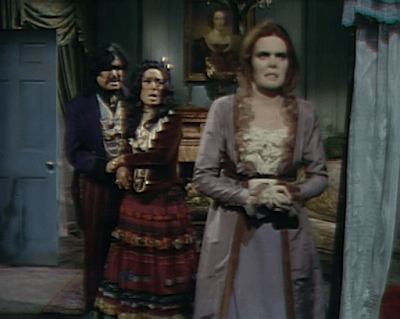
Megan (Marie Wallace) has been in an extremely overwrought state ever since she found that the book was gone. Today’s episode ends with a long scene in which she is alone in the shop, feeling that someone is coming to kill her, reacting sharply to every noise.

Danny Horn devotes most of his post about the episode on his great Dark Shadows Every Day to reasons why this scene does not work, among them the fact that a depiction of a person descending into madness requires that the person start off as something other than over-the-top loony. Megan has been so frenzied for the last few days that Miss Wallace has nowhere to go when she hears the ominous noises. Moreover, her first two characters on Dark Shadows, fiancée of Frankenstein Eve and Crazy Jenny, were both intense, overbearing characters who were so inflexible that they had little opportunity to respond to anything their scene partners might do. Longtime viewers therefore expect to see Miss Wallace screaming and carrying on by herself, so nothing she does here will unsettle us. They lampshade this iconography problem by showing us Crazy Jenny’s ghost today, but that doesn’t help at all.

Many fans compare this scene to episode #361. Most of #361 is devoted to a one-woman drama in which Julia is tormented by sights and sounds in her bedroom, suggesting that her mind is collapsing. I don’t think that episode is a success, but because Julia had always been in control of herself up to that point we can see what is supposed to be at stake in it. That’s more than we can say for Megan’s fearful turn.

In John and Christine Scoleri’s post about the episode on Dark Shadows Before I Die, Christine points out the prominence of the taxidermied animals in the background, and speculates that the scene is an homage to The Night of the Living Dead. I wouldn’t have guessed that director Lela Swift or writer Violet Welles would have studied that film, but Christine provides screenshots from it and from the episode, and the parallels are so striking that I can’t see how she could be wrong.

Closing Miscellany

I think the tape recorder is the same one we saw in the summer of 1968, when it was part of the Frankenstein story. It also appears to be the one that parapsychologist Peter Guthrie brought to Collinwood early in 1967.

Her haunting of Chris marks Jenny’s final appearance. Miss Wallace reprised the role decades later in a couple of the Big Finish audio dramas.

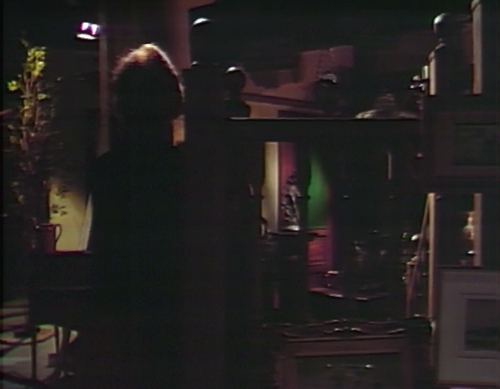
During Megan’s big scene, the camera swings a bit to the left and we can see beyond the edge of the antique shop set. We get a good look at a tree that stands near the cairn in the woods. Making matters worse, when they turn the camera away from the tree they go too far right, showing a stage light on the other side.

The antique shop and the cairn. Screenshot by Danny Horn, Dark Shadows Every Day.

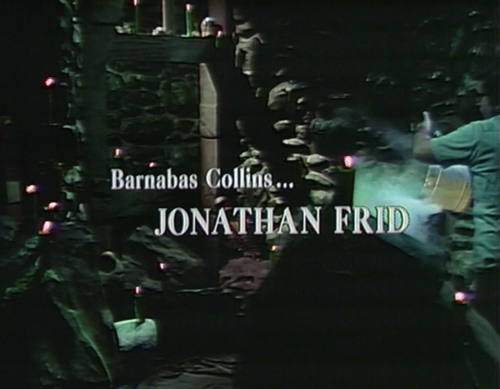
As the opening credits begin to roll, the camera is pointed a bit too far to the right and a stagehand is visible, adding dry ice to the steaming cauldron in the underground chamber.

Closing credits blooper. Screenshot by Danny Horn, Dark Shadows Every Day.

Episode 811: A man’s investment in the future

In #797, the ghost of Rroma maiden Julianka appeared and placed a curse on her fellow grievous ethnic stereotype, Magda Rákóczi. Julianka blamed Magda for her death, and decreed that everyone Magda loved would die. Today, Magda is trying to prevent Julianka’s curse from taking the life of her desperately ill infant niece Lenore, daughter of her late sister Jenny. Magda goes to Lenore’s crib in company with Lenore’s father, Quentin Collins. Magda and Quentin try to conjure up Julianka’s ghost to plead for Lenore’s life, but instead they get the ghost of another Rroma woman- Jenny.

Jenny assumes physical form. She picks up Lenore and sings the lullaby “All the Pretty Little Horses.” We’ve heard Jenny sing this almost every time she has been on the show. It appears to be the only song she knows. For his part, Quentin has a phonograph and only one record, which he plays obsessively over and over. When they lived together, their home must have been a pretty grim place, playlist-wise.

Jenny lifts Lenore’s illness, and says that if Quentin looks into his heart he will know what he must do to ensure that Lenore has a bright future. She vanishes, and Quentin mutters dismissively at the idea that his heart will be a source of useful information.

Later, Quentin will have a dream while sleeping in the drawing room at the great house on the estate of Collinwood. Jenny visits and tells him that he must have nothing to do with Lenore and that she must grow up far from Collinwood. So far, dream sequences on Dark Shadows have always represented visits from the supernatural, but this one might be an exception. Jenny did say that the information Quentin needed to help Lenore was already in his heart. He is clearly not the stuff of which good fathers are made, and as Jenny explicitly says in the dream no one has ever been happy at Collinwood. So the advice she gives does seem to be correct. Perhaps this is just Quentin’s own knowledge taking a shape he can recognize.

Quentin goes on dreaming that his brother Edward is choking him. He wakes up to find that Edward is in fact choking him. This might seem like a prophetic dream, but it too might just be a natural expression of Quentin’s own unprocessed knowledge. Edward, because of a magic spell not directly connected with today’s events, is under the mistaken impression that he is a valet formerly in the service of the Earl of Hampshire. Quentin has followed the Collinses’ long-established protocol for dealing with mentally ill family members, and locked Edward up in the room on top of the tower in the great house. He knows this makes Edward miserable, and it is reasonable to suppose that he would expect Edward to express anger about it. Strangulation is Quentin’s own preferred method of expressing anger, especially towards members of his immediate family, so it can’t have been hard for him to see that coming.

Edward’s motivation is not as simple as Quentin’s would be if their positions were reversed. The evil Gregory Trask has been visiting Edward in the tower room, and has told him that Quentin is determined to keep him imprisoned in that room forever. He asks him to kill Quentin. Edward apparently has decided to comply.

Earlier in the episode, Edward had been more punctilious about cooperating with Trask. Trask presented him with a document to sign, promising that by signing it he would secure his freedom. Edward read the document, even after Trask very loudly insisted that it was unnecessary to do so. When Edward saw that it involved making Trask guardian of his son, Edward protested that he had no son. Trask said that this did not matter, but Edward would not be moved. Edward later tells Quentin about this encounter.

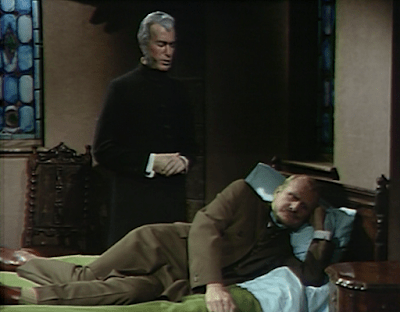
The tower room is a re-dress of the set used as the bedroom of strange and troubled boy David Collins in the parts of Dark Shadows set in the 1960s. Today it includes the bed from that set, and we see Edward trying to sleep in it. This is a powerful image for longtime viewers. Louis Edmonds plays Edward in this costume drama segment and David’s father Roger in contemporary dress. Edward is the father of Jamison, who like David Collins is played by David Henesy. Not only has the spell robbed Edward of the memory of Jamison and of his role as a father, it has reduced him to curling up in a bed made for a boy rather than a man.

Edward in the child’s bed. Screenshot by Dark Shadows Before I Die.

Roger was, for the first year of Dark Shadows, a spectacularly bad father. He openly hated David and exploited David’s miseries to try to manipulate him into doing his own criminal dirty work. He was indifferent to the family’s name and the fate of its businesses, would go to any lengths to hide from the consequences of his actions, had killed someone, and was an alcoholic. Edward shares none of these shortcomings. On the contrary, he goes to the opposite extreme. He is as brave as Roger is cowardly and tenderly loves his children, Jamison and Nora. But he is also stuffy, name-proud, and money-grubbing. The contrast with Roger shows these failings, not simply as negatives, but as the overgrowth of the virtues that separate Edward from Roger. Though Louis Edmonds and Jerry Lacy are such accomplished comic actors that Edward’s scenes with Trask are funny enough to be worthy of a staging of the Jeeves and Wooster stories, Edward’s loss of his identity as father of Jamison and Nora is a genuine tragedy.

Quentin is fond of Jamison, and once he learns that his children exist he seems to wish them well. Nonetheless, he shares most of the other vices of early Roger. As Edward shows us what Roger might have been had he had stronger moral fiber, Quentin is Roger with his vices magnified by black magic. When Jenny tells Quentin that he must not raise Lenore, longtime viewers remember Roger as he was when first we knew him, and remember how grim David’s future seemed at that time. It was only after well-meaning governess Vicki became the chief adult influence in his life that we could have hopes for David. So we cannot doubt that Jenny is right.

This is the last of 21 episodes of Dark Shadows directed by executive producer Dan Curtis. When Curtis first took the helm in #457, he had no experience as a director, and it showed. But he learned very quickly. This one looks great and the scenes play very smoothly. He would later direct the feature films House of Dark Shadows and Night of Dark Shadows, as well as six episodes of the 1991 prime time revival of Dark Shadows and many other productions.

Episode 810: Not with pity

Charity Trask is in the drawing room of the great house on the estate of Collinwood trying to call the police when her abusive step-uncle, Quentin Collins, comes out of a secret panel and takes the telephone from her. He tells her that there is no longer any point in telling the police about Tessie, the injured woman upstairs. Tessie won’t be telling them anything. She has died. Apparently the sheriff of Collinsport is the same in 1897 as are his counterparts in other periods when Dark Shadows has been set- if you’re already dead, it’s too late for them to take an interest in you.

Charity says that Quentin killed Tessie. Charity knows that Quentin is a werewolf. He locks the door to the room and asks “Are you afraid to be locked in alone with a beast, a murderer, a creature of the supernatural?” This would seem to be rather an odd question, especially since he spent yesterday’s whole episode threatening to kill her.

Charity says that her father, Gregory Trask, will see to it that Quentin is brought to justice. Quentin takes a paper from his pocket and shows it to Charity. It is a confession to the murder of Charity’s mother, signed by her father. Charity claims that it was fabricated by Satan, which is what her father told her when she first saw it, and that Trask repeatedly tried to destroy it. This only convinces Quentin that the confession is true. He says that if either Charity or her father tells the police about him, he will hand over the paper. He adds “Now, Charity, I may hang for murder, but your father will be dancing at the end of a rope, too.”

Dark Shadows is set in the state of Maine, which in our universe abolished capital punishment in 1887. That used to be true in the show’s universe, as well. In #101, broadcast and set in November 1966, high-born ne’er-do-well Roger Collins told his son, strange and troubled boy David, that “They don’t hang people anymore. Not in this state, anyway.” But by the time the show left the 1960s for its first costume drama segment a year later, characters were already afraid of being sentenced to death. The morbid fascination of the gallows is so much of a piece with the show’s exaggerated melodrama that there must be a death penalty, no matter when or where the action is supposed to be taking place.

Quentin tells Charity that there is a chance- a small chance, he concedes- that he will be cured of lycanthropy before the next full Moon, so that she need not feel that she is an accessory to murder if she doesn’t turn him in right away. Miserable, frightened, and confused, she takes this seriously enough that she remains quiet at least through this episode.

We cut to a hiding place where a man known as Aristide is looking at himself in a mirror and primping his hair, moving his fingers through it with an exaggerated daintiness. We pan to broad ethnic stereotype Magda Rákóczi , who impatiently asks “Did you send for me so there would be two of us to admire you?” Aristide has some business to discuss relating to plot points not directly involved in this episode, and he and Magda trade menacing insinuations about the danger each faces from the various supernatural forces at work in the area. Magda says that what the ziganophobic Aristide calls her “Gypsy cunning” will protect her, and Aristide says that an amulet he wears around his neck will protect him.

Magda replies “All right, we’ve both got something to protect us. I go now,” and starts to leave. Aristide stops her, and says that she must recover the severed hand of Count Petofi. She says that a man named Tim Shaw stole the hand and ran off with it, and she has no way of knowing where Tim is. Aristide says she must find out and bring it soon, “before time runs out.” She asks “Before time runs out for who? You mean when Petofi comes back!” In fact, Aristide means more than that- his master, 150 year old sorcerer Count Petofi, will die in a matter of days unless he is reunited with the hand that was cut from his right arm a century before, in 1797. If he does recover the hand in time, he will become immortal. Magda fears Petofi and hates him, and would doubtless make any sacrifice to keep the hand away from him if she knew these were the stakes. So Aristide is mortified that he let slip the phrase “before time runs out,” and is anxious to avoid saying anything else.

Back at Collinwood, Quentin confers with a Mrs Fillmore. Mrs Fillmore has been looking after the twin children Quentin’s wife Jenny bore him after he left her and before he murdered her. This is the first time we have seen Mrs Fillmore. It is also the first confirmation we have had that Quentin has seen Mrs Fillmore. He didn’t know about the twins until #798, when the boy twin was already dead as the result of a curse that a woman named Julianka placed on Magda, who is Jenny’s sister. Now Mrs Fillmore tells Quentin that the girl is suffering the same symptoms the boy showed before he died, and that the doctor is at a loss what to do for her. Quentin says he will look for someone who might be able to help, and they both exit.

Charity is alone in the drawing room, making an earnest effort to get drunk. Magda enters and expresses surprise that the unbendingly prudish Charity has been drinking. Charity replies that she merely ate some chocolates that were filled with brandy. At the sight of an empty snifter, she says that after eating the chocolates she poured herself a small brandy. She then picks up and drinks another, regular-sized brandy. Charity starts talking about how terrible life at Collinwood is. Magda mentions Tim Shaw, who was once Charity’s fiancé and who was framed for her mother’s murder. Charity wonders if Magda can use the Tarot cards to find Tim and bring him back. She asks if Tim will have to tell the truth if he comes back, and Magda assures her that he will. Magda may assume that the truth Charity wants is about the end of her relationship with Tim; she does not know that Charity is desperate to revert to believing that Tim, not her father, murdered her mother.

Magda asks Charity to tell her as much as she can about Tim. Charity says that when Tim was a boy, his closest friend was named Stephen Simmons, and that “He and Stephen Simmons used to always say they would go to San Francisco when they grew up.” Magda asks where Stephen Simmons is now, and Charity says she thinks he lives in Worcester, Massachusetts. She goes to her bedroom to look for a Christmas card Stephen sent her last year, hoping it may have his current address.

Quentin returns and finds Magda. He asks Magda how she knew about his daughter. She asks what he means. When Quentin tells her that the girl is suffering the same symptoms that her brother showed immediately before his death, they rack their brains to come up with a potential defense against Julianka’s curse. Magda remembers Aristide’s amulet. It is capable of warding off vampires and witches- perhaps it will defend against Julianka as well. Magda tells Quentin where Aristide is hiding, and he decides to go to Aristide and rob him of the amulet.

Aristide is asleep when Quentin arrives. He awakens before Quentin can take the amulet, and declares “This pendant protects me from witches, warlocks, and unnatural spirits.” Quentin asks “How does it do against flesh and blood, Aristide?” Aristide draws a curvy piece of wood with no sharp edges and replies “For flesh and blood, I have The Dancing Lady.” The piece of wood is supposed to be a knife. When Aristide first displayed it in #792, he called it “The Dancing Girl.” Perhaps this is a case of Soap Opera Rapid Aging Syndrome, and in a couple of weeks it will be The Dancing Dowager, then The Dancing Crone. At any rate, Quentin replies “Then let her dance, Aristide, let her dance.” Quentin wins the subsequent fistfight. He knocks Aristide senseless, then takes the amulet from him.

Quentin and Magda go to Mrs Fillmore’s house, the first time we have seen this set. Appropriately for a member of the Collins family, the baby sleeps in a cradle shaped like a coffin.

Collins coffin cradle. Screenshot by Dark Shadows Before I Die.

Quentin talks with Mrs Fillmore about little “Lenore,” a name we have not heard before today. The only other girl of Lenore’s generation in the Collins family is the daughter of Quentin’s brother Edward, and she is named Nora. Since the name “Lenore” became popular outside Greece because speakers of English and French thought it was an alternative form of “Nora,” that would suggest rather a limited imagination regarding girl’s names on the part of whoever chose them.

But it is appropriate that Quentin and Edward have children with similar names. They are two variations on Dark Shadows’ first archvillain, Roger, whose evil largely expressed itself in his amazingly bad parenting of David. Edward’s attentive and caring interactions with Nora and her brother Jamison show that he is a less villainous Roger, while Quentin’s frequent assaults on his adult family members are among the evidence that he is an even worse version of the same character. Jamison is the only child we have seen Quentin interact with, and he is fond of him. But while we were still in the 1960s, Quentin’s ghost was possessing and killing the children at Collinwood, and in #710, only two weeks into the 1897 flashback, he and his fellow Satanist Evan Hanley used Jamison as a “sacrificial lamb” in a ritual meant to exploit his innocence for their own sinister purposes. Clearly, Quentin is no more to be trusted with the care of a child than was the early Roger.

Quentin asks Mrs Fillmore to leave him and Magda alone with Lenore. They apply the amulet, and it does not seem to work. Magda tries to raise the spirit of Julianka. After some pleadings and whatnot, there is thunder, wind, and other signs of ghostly presence. Magda cries out in hope that Julianka has come with pity. A figure materializes and says “Not with pity, Magda.” But the figure is not Julianka. It is Jenny.

In #804, we saw a photograph of Jenny in Quentin’s room. It was a full length picture in a period-appropriate costume, not just Marie Wallace’s professional headshot, raising a hope that we would see Miss Wallace again before too long. But after a week and a half, those hopes had begun to fade. Perhaps they took the picture months ago and never got around to using it when Jenny was on the show. If they had done that, they wouldn’t be above sticking in a scene of Quentin looking at the picture and discussing it with his distant cousin Barnabas the vampire so that they could get their money’s worth out of it. When Miss Wallace does in fact return, the show sends us out on a high note.

Episode 748: Here in the past

Madwoman Jenny Collins is hiding in the quarters of her formerly devoted servant, Beth. Beth enters with Jenny’s estranged husband, libertine Quentin. Jenny eavesdrops as Beth tearfully tells Quentin that she was once very close to Jenny, but that now she wishes her ill, because she is in love with him. Quentin and Beth embrace, and Jenny lunges at them with a kitchen knife.

Quentin disarms Jenny and strangles her. We were introduced to Quentin as a murderous ghost haunting the great house of Collinwood in 1969, and when we first came to the year 1897 to meet him as a living being it was a matter of minutes before he was squeezing his grandmother’s throat and threatening to kill her. Quentin has been going around the house announcing for days and days that he plans to kill Jenny, so it comes as no surprise to the audience that he puts his hands around her neck even though she has already been disarmed, fights off Beth’s attempts to stop him, and keeps choking Jenny until some time after she has stopped moving. We have been well-prepared for this unambiguous image of intentional homicide.

Once Quentin has finished his work, he runs out of the room. Beth goes to the foyer and, between sobs, tells Quentin’s stuffy brother Edward that Jenny is in her room, dead.

In Beth’s room, Edward feels Jenny’s wrist and says that she is indeed dead. Once Beth has given him a few of the salient details of the murder, he declares that he has heard enough. He orders Beth to take the knife back to the kitchen and put it where it belongs. They talk briefly about Jenny and Quentin’s children, whose existence has previously only been hinted to the audience and has been denied to other characters as recently as yesterday.

We cut to the foyer. Quentin comes creeping down the stairs, holding a bag and looking from side to side. When Quentin reaches the foot of the stairs, Edward seizes the bag and orders him to stay in the house. In the drawing room, Edward tells Quentin and Beth what story they will put about to cover up the murder and save the family name. Beth is to say that she found Jenny lying at the foot of the stairs, stunned. She helped Jenny to her room, then left her there for a moment while she went to look for help. Finding no one, she came back and saw Jenny lying on the bed. When she could not wake her, she realized she had died of the injuries she sustained in her fall.

Quentin says that the story will not work. He tells Edward that earlier in the evening, Jenny’s presence at Collinwood was revealed to three more people, distant cousin Barnabas Collins and ethnic stereotypes Magda and Sandor Rákóczi. Edward says that as a member of the family, Barnabas will not question the story, and that as “Gypsies,” Sandor and Magda will do anything in return for money. Quentin says that Magda and Sandor will not be so easy to deal with. When they learned that Jenny was in the house, Magda told Quentin something which he tells Edward and Beth “None of us ever knew,” that Jenny was her sister.

Edward is thunderstruck, and exclaims “You married a Gypsy!” Yesterday it seemed that Edward and Quentin’s sister Judith, the owner of the house, had known Jenny’s origin for some time, and that it was why she locked Jenny up in the house when she went insane rather than sending her to a mental institution where Sandor and Magda might be among her visitors. And as far back as #701, it seemed likely that Beth knew secrets relating to Jenny, to Magda, and to Romani heritage. In that episode, Quentin marveled that Beth was still around Collinwood when Jenny, who had brought her to the house as her servant, had left, and Magda taunted Beth by bringing up a bit of Romani folklore and laughing “But you wouldn’t know anything about that, would you?” So while Jenny’s background is news to Quentin and Edward, it may not be true that “None of us” knew.

Magda and Sandor come to the house. On their previous visits to the great house, they have acted like servants or like stage Gypsies come to tell fortunes and sing songs. But now that the word is out about Jenny’s true identity, they come in with their heads up and look Edward in the eye. They say that they have come to see Jenny. Edward turns away from them, and says that there has been an accident. Jenny is dead. Horrified, Magda asks where she is. Edward says that she is in Beth’s room, and offers to have Beth show them the way. Magda says that she knows where it is, and that she and Sandor want to go by themselves. Edward says “Of course,” very much in the tone a gentleman uses with his equals.

In the room, Magda notices that Jenny is holding a button in her hand. She concludes that she pulled it off the coat of a man with whom she was fighting for her life. Sandor notices heavy bruising around her neck.

Meanwhile, Edward is drilling Beth and Quentin in the stories they are to tell. Beth recites the whole thing, and he tells her to remember every word. Quentin is less cooperative, but still seems to have learned his part. He tells them not to speak until they are spoken to.

Sandor and Magda enter. She asks some questions; Edward answers, and shows offense when she tries to direct them to Beth. Before he can proceed to the next act of the little drama he has prepared, letting first Beth and then Quentin corroborate his account with the stories he has given them, Magda looks at Quentin’s coat. She can see that a button is missing and that the ones that remain match the one she found in Jenny’s hand. She calls him a murderer, and says that the police will hear of it.

Edward says that Quentin might have lost the button anywhere at any time. He asks her what the authorities in the village of Collinsport would do if asked to choose between a Romani person’s word and that of a Collins. Magda drops the idea of going to the police, and tells Quentin that she will place a curse on him that will make him suffer as Jenny suffered, but that his suffering will not be subject to the release that death has brought Jenny. Quentin is terrified, Edward dismissive.

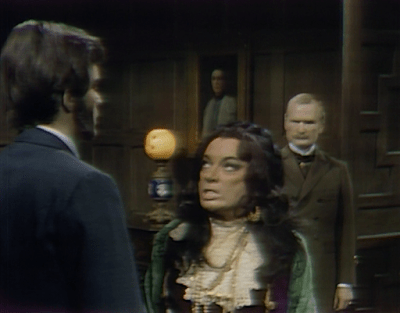
Magda tells Quentin she will curse him. Screenshot by Dark Shadows Before I Die.

From the very beginning, one of the main themes of Dark Shadows has been denial, the psychological defense mechanism. In this one, we see that denial is, among other things, the wish that time would stop moving forward. Quentin says that he is not going to go to jail for something he did not mean to do. He obviously did mean to kill Jenny, but he does not want to accept any of the consequences that follow from that act. He wants to be frozen in his comfortable, carefree life, without punishment from the law or vengeance from Magda. Edward wants the family name to be frozen in the lofty regard in which it was held before Quentin murdered Jenny.

For her part, when Magda tells Quentin it will not be possible for him to die, she is promising to give him and Edward what they want, but not in the way they want it. A curse is a way of freezing time. The suffering it brings persists, unchanged, from year to year. It cannot be explained, it cannot be escaped, it falls on one person after another whatever their deserts. Its only logic is to renew itself endlessly.

Episode 747: Triumphant life behind a locked door

Madwoman Jenny, estranged wife of libertine Quentin Collins, is on the loose again, and she is the object of a madcap search by Quentin’s sister, spinster Judith, his girlfriend, maidservant Beth, and his distant cousin, secret vampire Barnabas. Quentin makes two contributions to the process. The less important is to serve as the bait in a cockamamie trap Barnabas and Judith lay for Jenny. The more important is to keep up a running commentary mocking the other characters for the silliness of their activities.

The trap itself involves a moment of intentional humor. Barnabas has returned to the year 1897 to prevent Quentin becoming a ghost who will ruin things for everyone on the great estate of Collinwood in 1969. One of the things Quentin did in that year that terrified the characters and tried the patience of the audience was to cause the strains of a sickly little waltz continually to resound from the walls of the great house. When the show became a costume drama and we got to know the living Quentin, we found that he too played a gramophone record of that same tune incessantly, annoying all and sundry. The trap requires Quentin to play the recording over and again until Jenny hears it and comes. After it has been going for half an hour, Barnabas tells Quentin that the plan didn’t work and they should stop playing the waltz. Quentin asks “Are you tired of hearing this music?” Barnabas speaks for all of us when he replies “Frankly, yes.”

Not only is this a successful comedy, it also gives the cast an opportunity for some of their best dramatic acting. As Judith, Joan Bennett at one point stops, looks at Barnabas, and asks “Can we trust you? Really trust you?” She apologizes for the bluntness of that question, then admits that she has long been busy putting a prettier face on the Collins family than the dark secrets Barnabas has discovered make plausible. “I’m not really very trusting. I try to pretend we’re nicer than we really are.” In the parts of Dark Shadows set in the 1960s, Bennett plays matriarch Liz, whose whole personality is about denial and the pretense that the Collinses are nicer than they really are. Liz latched onto Barnabas as soon as she saw him, and refuses to see any evidence that he is not quite normal. Nor does she ever really face her own habits of concealment and their implications. In this little exchange, we see Bennett playing a character whose superficial similarities to Liz point up her profound differences from her.

“Can we trust you? Really trust you?”

Joan Bennett had one of the most distinguished careers of any American actress of the twentieth century. Terrayne Crawford stands at something of the opposite pole, and her performance as Beth leads most fans to declare that she is the weakest of all the members of the cast of the portion of Dark Shadows set in the year 1897. I don’t really disagree with that, but she is fine today. Miss Crawford’s great limitation was that she could play only one emotion at a time, and she was on the show in a period when the scripts gave every character complex motivations in almost every scene. But today, all Beth has to play is Anguish, and Miss Crawford does a fine job.

Beth took care of Jenny during the year Quentin was away from Collinwood, and became very close to her. In the nine and a half weeks since Quentin’s return, she has fallen in love with him. In a scene at the close of today’s episode, Beth tearfully admits to Quentin that she wishes something would happen to Jenny so that he would no longer have a wife. Beth collapses into Quentin’s arms. Jenny has been hiding in a corner, eavesdropping; she comes out, holding a knife. There have been occasions when we might have rooted for Jenny to succeed in killing Beth, just to spare us the embarrassment of Miss Crawford’s flat, tedious performances. But this time, we want to see more of her, and the prospect that Beth might die makes for an effective cliffhanger.

Episode 746: Madness in her background

Vampire Barnabas Collins rises from his coffin in the basement of the Old House on the estate of Collinwood and calls for his unwilling sidekick, ethnic stereotype Magda Rákóczi. Magda has news for him. She has found madwoman Jenny Collins, estranged wife of libertine Quentin Collins, locked in an upstairs bedroom. Barnabas is not surprised about that. He was the one who locked Jenny there, and before dawn he left Magda a note telling her where Jenny was and instructing her to look after her until he came back to life. But Magda never saw the note. Quentin came to the house and read it before Magda came home. He tried to kill Jenny and was stopped by the timely intervention of his girlfriend, maidservant Beth Chavez. He came back later with another plan to kill Jenny, and that time Magda herself stopped him and threatened to place a curse on him unless he gave up.

Magda and her husband Sandor figured out that Quentin’s siblings, stuffy Edward and spinster Judith, have been keeping Jenny locked up in the great house ever since Quentin left her and she went mad over a year ago. They have also figured out that she escaped from the great house, made her way to the Old House, and that Barnabas saw that she was dangerous and trapped her in the room. They wanted to keep her there until they could make arrangements to take her to a Romani caravan where she could be taken care of. Magda and Sandor felt a responsibility to do this, because Jenny is Magda’s sister.

When Magda interrupted Quentin’s second attempt of the day to kill Jenny, she told him that Jenny was her sister. He was stunned. He had no more idea of this relationship than the audience did until we learned of it yesterday. He was so utterly shocked that his wife was a member of an ethnic group he despises that he went almost two full minutes before making a flip remark about it. That’s a record for Quentin.

Barnabas is also quite surprised to learn that Magda is connected to the Collins family by marriage, but it does nothing to change his plans. He has come to the year 1897 to prevent Quentin becoming a ghost who will ruin things for everyone at Collinwood in 1969, and he says that he dare not change anything that would prevent the events of the years in between from taking the shape they did originally.

This does not make much sense. Barnabas does not know why Quentin became a malevolent ghost, so he has no way of knowing how much history will have to change to prevent that outcome. Moreover, he has been quite reckless with the timeline in many other ways. In #704, Barnabas bit a girl named Sophie Baker, evidently killing her. Sophie wasn’t his only victim- in #740, Magda mentioned that Barnabas’ bite marks had been found on “girls”- plural- in the nearby village of Collinsport. Presumably those girls were dead when the marks were found. So he has already committed more than one homicide, ending the lives of people who would otherwise have worked, had children, and made who knows what other kinds of contributions to the history of central Maine. And he is continually picking fights with people and meddling in matters that don’t seem to have anything to do with Quentin’s future ability to rest in peace.

What Magda does not tell Barnabas is that Jenny at one point during the morning got away from her and Sandor, went downstairs, and saw him in his coffin. Magda frantically tried to persuade Jenny to keep this secret, but Jenny has so little contact with the world everyone else lives in that it would seem unlikely she will remember she promised not to talk about what she saw.

Barnabas is about to climb the stairs to go talk to Jenny when a knock comes at the door. It is Judith. Quentin has told her that Jenny and Magda are sisters. Judith and Magda have a testy exchange, ending when Barnabas orders Magda to go upstairs and see to her sister.

Judith probes to see what Barnabas knows and what he is planning to do. She says that he has seen the family at its worst, and knows all its most horrible secrets. He assures her that he is not interested in passing judgment. He mentions Jenny’s children; Judith tells him she has none, and he says that he thought she did only because she claims to have. The audience has known since #707 that Judith is sending money to a woman named Mrs Fillmore to take care of a problem relating to Jenny; it seems likely that this money is going to care for Jenny and Quentin’s twin children. After a few moments, it is clear to Judith that Barnabas has not penetrated very deeply into the secrets surrounding Jenny, and she begins to relax.

Joan Bennett plays Judith’s behavior very subtly. She is calm, quiet, a bit weary. She moves her eyes slightly from side to side, and occasionally purses her lips at the corners. Judith does not look like someone who has just learned shocking news, but like someone who is trying to figure out how to keep the rest of an old secret once part of it has leaked out. Bennett invites us to conclude that Judith has known of Jenny’s family background for a long time.

Judith getting her story straight.

Jenny bursts in, sees Barnabas, and declares that he is dead. She saw him in his coffin, she exclaims. This is not much of a cliffhanger ending. Jenny’s whole life is one long mad scene. If anyone starts to doubt whether Barnabas is quite what he seems, all he or Magda or anyone else who might be on his side now has to do is point out that the doubter is echoing Jenny, and they will be instantly discredited. This winds up as another in the long series of strokes of luck that have enabled Barnabas to keep operating for so long.

Episode 745: What I am is what I will be

Broad ethnic stereotypes Sandor and Magda Rákóczi are in the parlor of their home, the Old House on the great estate of Collinwood, quarreling about a locket. Shortly before, Magda found maidservant Beth Chavez and libertine Quentin Collins in the parlor, and she noticed Beth snatch a locket from a table and try to hide it. Beth claimed that the locket was hers, but Magda declared that it was not, and that she knew who it really belonged to. Now Beth and Quentin have left, Magda has the locket, and Sandor is pleading with Magda to stop trying to figure out what it means that the locket is in the house. “She is far away!” he protests.

Returning viewers know that the locket belongs to madwoman Jenny, Quentin’s estranged wife. Unlike Magda, we also know that Quentin’s brother and sister, with the assistance of Beth and another servant, have been keeping Jenny prisoner in a series of cells deep in the great house ever since Quentin left her the previous year. Yesterday Jenny had a strong reaction to Magda’s name, in the course of which she started muttering about Sandor as well, hinting that the Rákóczis are of some importance to Jenny.

Sandor and Magda hear a voice from an upstairs bedroom. They go there, and are astonished to find Jenny. They ask her where she went when Quentin left her; she denies that Quentin ever did leave her, and talks about being locked up in a room. It dawns on Magda and Sandor that the Collinses locked Jenny up in the house and have been keeping her there. Jenny angrily says that yesterday she was horrified when Sandor and Magda’s caravan pulled up at the home she and her husband share, and that she told them never to speak to her again; they tell her that happened years ago. She is shocked and disbelieving.

Sandor and Magda are distressed by Jenny’s madness. Screenshot by Dark Shadows Before I Die.

Jenny sneeringly calls Magda and Sandor “Gypsies.” Magda replies “You are a Gypsy, too.” Jenny replies that “What I was is not what I am.” After a few more moments, Magda and Jenny embrace and Magda calls her sister.

The revelation that Jenny is Magda’s sister is one of the most effective twists in the whole series. When Mrs Acilius and I first watched the show through, we were thunderstruck by it. The most amazing thing is that it makes so much sense we couldn’t believe we hadn’t figured it out. The Collinses have disdain for Jenny, not only because their black sheep brother brought her into the family, but also because she is of obscure birth. So when she became mentally ill, why didn’t they just ship her off to an institution and have done with it? The answer is racism. They are not simply embarrassed that Quentin chose an unsuitable wife; they are frozen with horror that a Romani person now bears their family name. They cannot take the chance that anyone, even the staff of a discreet, high-end sanitarium, will learn of this shame, and so they hide her away in their own house.

In #701, the first episode of the part of Dark Shadows set in the year 1897, it was established that Beth came to Collinwood as Jenny’s maid and that it is surprising she stayed after Jenny ceased to be a visible member of the family. In the same episode, Magda mentioned some Romani folklore to Beth, said, “But you wouldn’t know anything about that!,” and laughed tauntingly while Beth looked alarmed. The implication that Beth has been trying to conceal her own Romani heritage, combined with her association with Jenny, was something else we were surprised we didn’t pick up on the first time through the show. Perhaps that is because of the visuals. As Sandor and Magda, Thayer David and Grayson Hall wear heavy brownface makeup and dark curly wigs. As Beth, the tall, wasp-waisted Terrayne Crawford has her own light blonde hair, pale skin, and blue eyes. So it was easy to take Magda’s line as a reflection of something that was in the flimsies months before they cast the part of Beth Chavez with an obviously Anglo actress, and to assume that we would never hear of it again.

There are some flaws on screen today. Early on, Quentin walks in front of a green-screen with a picture of the Old House, and it is ludicrously fake even by the standards of special effects on Dark Shadows.

The real house in this photo burned down about this time, perhaps because it couldn’t stand the disgrace of having appeared in this shot. Screenshot by Dark Shadows Before I Die.

Later, there are three goofs in thirty seconds. Sandor leaves Magda alone in the room with Jenny. Jenny is supposed to slam a book down on Magda’s head to stun her, but we can clearly see that the book sweeps through a space several inches to Magda’s left. When Magda falls and Jenny runs out, Sandor isn’t supposed to see Jenny, but the two of them are on screen together and their shoulders actually brush against each other. Once downstairs, Jenny is supposed to try the front door, find it locked, and look for a hiding place. But when she touches the door, it opens, and she has to pull it shut before she can play her scene about being unable to get out.

Episode 744: Sometimes he makes himself invisible

The House by the Sea

In September and October 1967, well-meaning governess Vicki and her depressing boyfriend Burke wanted to buy a long-disused property that everyone referred to as “The House by the Sea.” Collinsport is a coastal village, so many of its houses would lie by the sea, but at that point only that one was so designated on Dark Shadows. It was important that The House by the Sea lay on the other side of Collinsport from the great estate of Collinwood. When it was first introduced, matriarch Liz was eager to go there, signaling that the show was done with an old and unproductive theme presenting Liz as a recluse. And Burke was willing to live there with Vicki, whom he is determined to get away from Collinwood and the Collins family.

The house belonged to the Collinses, and the show suggested that it might be haunted in such a way that if Burke and Vicki lived there they would become possessed by the unquiet spirits of its former occupants, Caleb Collins and his wife, whom we know only by the initials “F. McA. C.” When Liz found in #335 that for legal reasons she would not be able to sell Vicki and Burke the house for a few years, the whole story vanished without a trace. We did not hear the phrase “The House by the Sea” again until #679, in January 1969.

At that point, the show was in fact running a story about ghosts taking possession of the living, a coincidence that leads me to wonder if the writers were making an inside joke about a story that was in the flimsies early in 1967, that was reflected in the talk about “The House by the Sea” that autumn, and that went nowhere. At the beginning of January 1969, strange and troubled boy David Collins was intermittently possessed by the ghost of his Aunt Liz’ great-uncle Quentin, and when Liz questioned him about some of his odd doings he made up a story about The House by the Sea to persuade her that he was just being silly.

In between those two stories, we did hear a great deal about another place called “A House by the Sea.” From #549 in August 1968 until #633/634 in November, this house was rented by suave warlock Nicholas Blair. At first it was said to be located at some distance from Collinwood, and it seemed that it might be the house Burke and Vicki had been interested in. But as we saw it, we could see that it was in quite a different architectural style. And as time went on, the house moved closer and closer to Collinwood. After a while, the opening narrations referred to it as “Another house on the same great estate.” That did not stop Big Finish Productions from conflating Vicki and Burke’s “The House by the Sea” with Nicholas’ “A House by the Sea” in their 2012 drama The House by the Sea, but the houses remained distinguishable on the show as of early 1969.

Now, Dark Shadows has become a costume drama set in the year 1897. Well-meaning time-traveler/ bloodsucking fiend Barnabas Collins has gone to that year, when Quentin was a living being, in hopes of preventing the events that made him into the all-destroying evil spirit of 1969. Barnabas does not have the slightest idea what those events were, and in the absence of that information he has decided that the best course of action is to antagonize as many people as possible.

Among the enemies Barnabas has made is the evil Rev’d Gregory Trask, head of a boarding school/ abusive cult called Worthington Hall. Another of Barnabas’ new enemies has, for reasons of her own, burned Worthington Hall to the ground. Trask has captivated the current mistress of Collinwood, spinster Judith Collins, and in #739 Judith offered Trask the use of a “small house on the estate” as a temporary base for the school until she can finance the restoration of the previous site. Today, Judith instructs a servant to take steps to prepare “the house by the sea” for this purpose.

Perhaps this means that Trask’s cruelty center will occupy the house Burke and Vicki wanted to buy. That Judith said it was “on the estate” would suggest that it is the one where Nicholas lived, and they have decided that so few people remember the dead-end storyline of autumn 1967 that they no longer need to keep the two houses distinct by calling only one of them “The House by the Sea.”

No More Knife

While Quentin was haunting Collinwood in late 1968 and early 1969, he showed himself to be a peculiarly corporeal sort of ghost. In addition to the usual ghostly business of materializing and dematerializing inside closed rooms, possessing children, and making noises resound from everywhere and nowhere all at once, he also poisoned one person, choked another, and came and went through a secret passage. Occasionally this served to show that Quentin’s power started small and grew steadily until he was irresistible, but it also left the impression that Quentin simply enjoyed feeling like he had a body. Now that we see Quentin as a living being, the impression that he revels in the flesh is frequently confirmed.

Quentin’s estranged wife Jenny has gone mad and is being kept prisoner in the great house by Quentin’s sister Judith and brother Edward, with the assistance of a couple of the servants. Quentin learned of Jenny’s continued presence at Collinwood only when she escaped and stabbed him a few weeks ago, and he still can’t figure out where in the house she is locked up. He has vowed to kill her once he does find her.

Jenny is on the loose again today. Judith has a close call in the drawing room. She finds Jenny there. Jenny menaces Judith with a knife; just as she gets Judith into a helpless position and it looks like she is about to stab her to death, Jenny picks up a candlestick and knocks Judith unconscious. Shortly after, Quentin comes in and finds Judith recovering from the blow. Judith tells him what happened. He gets a gun and goes out to hunt Jenny down.

Jenny makes her way to the Old House on the estate. She knocks on the door, and Barnabas answers. They introduce themselves to each other. His name means nothing to her; he arrived only nine weeks ago, long after she lost her marbles and was consigned to a hidden cell. No one has told her that Judith invited a distant cousin from England to stay in the Old House. But Barnabas knows exactly who Jenny is, and he listens to her every word and watches her every move with vivid interest.

Jenny announces that she has come to find Quentin. Barnabas says that Quentin is not there, and invites Jenny to search the house. As she walks through the front parlor, Jenny announces that “Sometimes he makes himself invisible.” That line will strike a chord with regular viewers who remember the ghostly Quentin of the 1960s, though Jenny is apparently thinking of a psychotic break she had earlier in the episode when she hallucinated his voice coming from various pieces of furniture in the drawing room. Nonetheless, Jenny is confident that she will know if Quentin is nearby.

Jenny talks about her “children”; Barnabas visited one of her former cells, and saw that there were dolls there. He asks twice if the children she is talking about are dolls, and each time she angrily insists that she has real live children and that they are in her room at Collinwood. She sings a lullaby in a minor key; she forgets the lyrics halfway through, and asks Barnabas if he knows them. She has a lovely voice, and he seems to be sincere when he says he is sorry that he cannot help her finish the song.

As Jenny talks about her children, it dawns on Barnabas that she may in fact have had children who were taken from her. His reaction to this is an important moment. In 1969, Barnabas learned that in 1897 a baby died and was buried in an unmarked grave on the grounds of Collinwood with an amulet meant to ward off werewolves. So far in his trip back to that year, he has found no babies and there is no werewolf. His response to Jenny’s talk of her children looks like a man making a wild surmise. If the baby in the unmarked grave was one of Jenny’s children, the werewolf must be coming very soon.

Barnabas makes the connection.

Jenny is sitting on the staircase for part of this conversation with Barnabas. Ever since Barnabas first met David in #212, he has had his most human moments while standing on the floor and talking to people on that staircase, and his talk with Jenny is an outstanding example. He talks to her very gently. Perhaps he has the presence of mind to try to befriend someone who might be useful to him, but whatever he is thinking he shows a real warmth.

Jenny tries to stab Barnabas; he takes the knife from her. She cowers in a heap on the floor, wailing that now he will kill her. He throws the knife in the fire and tells her she has nothing to fear. Of course, a metal blade could not harm a vampire, so it was easy enough for Barnabas to remain unruffled during the attack.

Barnabas vetoes Jenny’s demand to search the basement, where his coffin is, and takes her upstairs to a bedroom once occupied by his lost love Josette. In 1967, he restored that bedroom to the condition it was in when Josette lived there, and for some reason he has done the same this time. By the time they get to Josette’s room, Jenny thinks that she and Quentin are on their honeymoon and that Barnabas is a bellhop. She apologizes that she has no money to give him as a tip.

Jenny looks into the mirror and is revolted by the terrible person she sees there. Barnabas points to an assortment of lady’s toiletries and assures her that the terrible person will go away if she uses them. He locks her in the room and calls for his servant Magda.

Jenny is so crazy we can never be sure what she will make of any set of facts she encounters, and Barnabas is, for once, keeping his thoughts to himself throughout his scene with her. But however much ambiguity may be built into Barnabas and Jenny’s interactions with each other, there is no question what Marie Wallace and Jonathan Frid are doing. She is supposed to play Jenny without restraint, and she makes the most of that opportunity to be larger-than-life. He also seizes his chance to show what he can do when he has time to really learn his part. He is not only letter-perfect with his lines, but also subtle and precise in his characterization of Barnabas’ reactions and intentions. It is a fascinating performance.

Jenny hears Barnabas calling Magda’s name. She not only repeats it, but also says the name of Magda’s husband Sandor. Magda and Sandor have been in the Old House for quite some time, well before Barnabas showed up and forced them into his service, so it is no surprise that Jenny remembers them. It is interesting that she seems to have strong feelings about them, though. Before she left the great house, Jenny was talking to herself, saying that her father was “a king in India.” Sandor and Magda are Romani, and the Romani people originated in India. Their ethnicity may be what brought that part of the world to Jenny’s mind.

Magda and Sandor are out. The sun is rising. Barnabas leaves a note for Magda, and goes to his coffin for the day. Quentin enters, brandishing his pistol. He finds the note and a key, and goes upstairs. We close with him standing outside Josette’s room. He and Jenny talk to each other through the locked door. He tells her that he is coming to her and that they will never be separated again.

In a comment about Danny Horn’s post about this episode on Dark Shadows Every Day, David Pierce makes an interesting observation:

My favorite line was from Quentin to Judith when he wants to know how Jenny escaped: “What, did she leave by fasting and prayer?” He was misquoting Jesus from the New Testament, Matthew Chapter 17, verse 21 “Howbeit this kind goeth not out but by prayer and fasting.”

David Pierce, comment left at 12:01 PM Pacific time 13 January 2021 on Danny Horn, “Episode 744: Crazy Little Thing,” Dark Shadows Every Day, 9 October 2015

Quentin does paraphrase the Bible quite often, a habit which, combined with his penchant for Satanist ceremonial practice and his gleeful libertinism, suggests that he won’t pass up any potential source of delights.

Episode 728: Mother is coming home

Repressed patrician Edward Collins enters his study in the great house on the estate of Collinwood and finds his brother, libertine Quentin, riffling through his desk. Quentin does not feel an obligation to apologize for going through Edward’s things since Edward is among the conspirators holding Quentin’s estranged wife, madwoman Jenny, prisoner somewhere in the house. Quentin learned that Jenny was around only when she escaped from her cell and stabbed him. He is looking for information about where she is now so that she will not get another chance at him. Edward says that Quentin does not need to know where Jenny is, since he is confident she will not escape again.

Quentin is not at all reassured by Edward’s promise. He brings up another topic, Edward’s own estranged wife. For the first several weeks of the portion of Dark Shadows set in the year 1897, the audience was led to believe that Jenny was Edward’s wife, and the mother of his children, twelve year old Jamison and nine year old Nora. When we found out that Jenny was Quentin’s wife, we wondered not only who Edward was married to, but also whether Jenny had borne children by Quentin. After all, she is obsessed with her “babies,” and in #707 we learned that the enterprise of concealing Jenny’s presence in the house involved taking substantial sums of money into the village of Collinsport and giving them to a Mrs Fillmore. Perhaps Mrs Fillmore is taking care of Jenny and Quentin’s children.

Today, Quentin mentions that Edward’s wife, whom Edward said in #705 and says again today “no longer exists” as far as he is concerned, is named Laura. This rings a very loud bell for longtime viewers. The first supernatural menace to dominate the plot of Dark Shadows was Laura Murdoch Collins, estranged wife of high-born ne’er-do-well Roger Collins. That Laura was on the show from December 1966 to March 1967. In the first week of the show, newly hired governess Vicki was surprised to learn that Roger’s wife was still alive, and was told in no uncertain terms that she was not to be discussed. In #705, during the first week of the 1897 portion, newly hired governess Rachel Drummond was surprised to learn that Edward’s wife was still alive, and was told in no uncertain terms that she was not to be discussed. Like Roger, Edward is played by Louis Edmonds. When we learn that Edward’s wife, too, is named Laura, we can only assume that she, too will prove to be an undead fire witch out to incinerate her children for the sake of her own immortality.

Quentin reminds Edward that Laura followed him the year before when he was banished from Collinwood. Indeed, Laura followed Quentin all the way to Alexandria, Egypt. The other day, Quentin admitted to Jamison that he had been a police spy in that city. Edward does not want to hear about any of it.

Nora enters. She asks Edward if she can use his desk to draw with crayons. Edward says that he was just leaving, and she can do what she wants. Quentin stays behind with her for a moment. Nora asks her uncle if he thinks her mother will come back. He looks uncomfortable, says he doesn’t know, and exits.

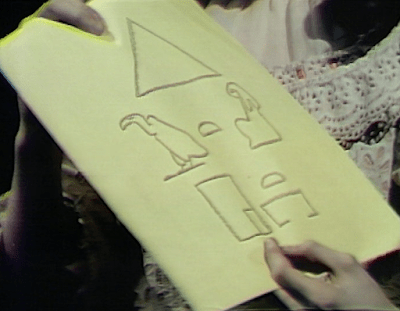
Barnabas Collins, a distant cousin recently arrived from someplace far away, enters. He looks at what Nora has drawn and recognizes Egyptian hieroglyphics. He asks if she copied them out of a book; she says that they just popped into her head. He says he wonders what they mean; she looks directly into the camera and tells the audience she knows exactly what they mean. They say that her mother is coming home soon. And indeed, they do include actual hieroglyphic symbols for “Mother,” “Come,” and “Home.”

Nora is quite the scribe. Screenshot by Dark Shadows Before I Die.

Nora starts talking about her mother. Barnabas encourages her to continue with the topic, and Edward enters. Edward is quite stern with Barnabas; he had made it clear that his wife was not to be discussed with anyone in the house, least of all with his children. Barnabas explains that Nora brought her mother up. He goes on to show Edward the drawing and tell him that he finds it profoundly disturbing. Edward accepts that as a sufficient excuse for going along with Nora while she talks about her mother, but he attributes the drawing to Quentin’s influence.

Whenever we saw Laura alone indoors during the “Phoenix” storyline, she was staring blankly into a fire burning in a hearth. She kept urging her son, strange and troubled boy David, to join her in this pastime, and every time he did we were led to believe that she had taken a sizable step towards her terrible goal. Now we see Nora in the drawing room, staring into the fire that always burns in its hearth.

Nora hears gurgling noises, like indistinct voices rising from below or behind the fire. Frightened, she runs into the foyer, into her father’s arms. She tries to explain to Edward what she heard, and he insists there is nothing to be afraid of. He carries her into the drawing room, where he declares they will look into the fire together and will both realize that nothing out of the ordinary is going on. His plan fails when Nora sees a face wearing a blonde wig starting to take shape in the flames. Nora cries out that it is her mother’s face. We pan to Edward. He is also looking into the fire, and he looks shocked. We wonder whether he is shocked because he can also see the face, or if he is merely alarmed by Nora’s reaction.

Roger and his sister Liz, the adults in the generation of Collinses who live at Collinwood in the 1960s, are Jamison’s children. So Edward and Laura are their grandparents. If this Laura is indeed the same immortal humanoid Phoenix who was David’s mother, Roger therefore married his own grandmother. In #313, Roger had a line about his “ancestors,” which Louis Edmonds bobbled. When he said “incestors,” he giggled, repeated the misspoken word, then corrected himself, calling the maximum possible attention to his error. Many fans bring that rather bizarre blooper up when we come to this story. The writing staff picked up ideas wherever they could, and I suppose the cast’s line difficulties might have been as good a source as any.