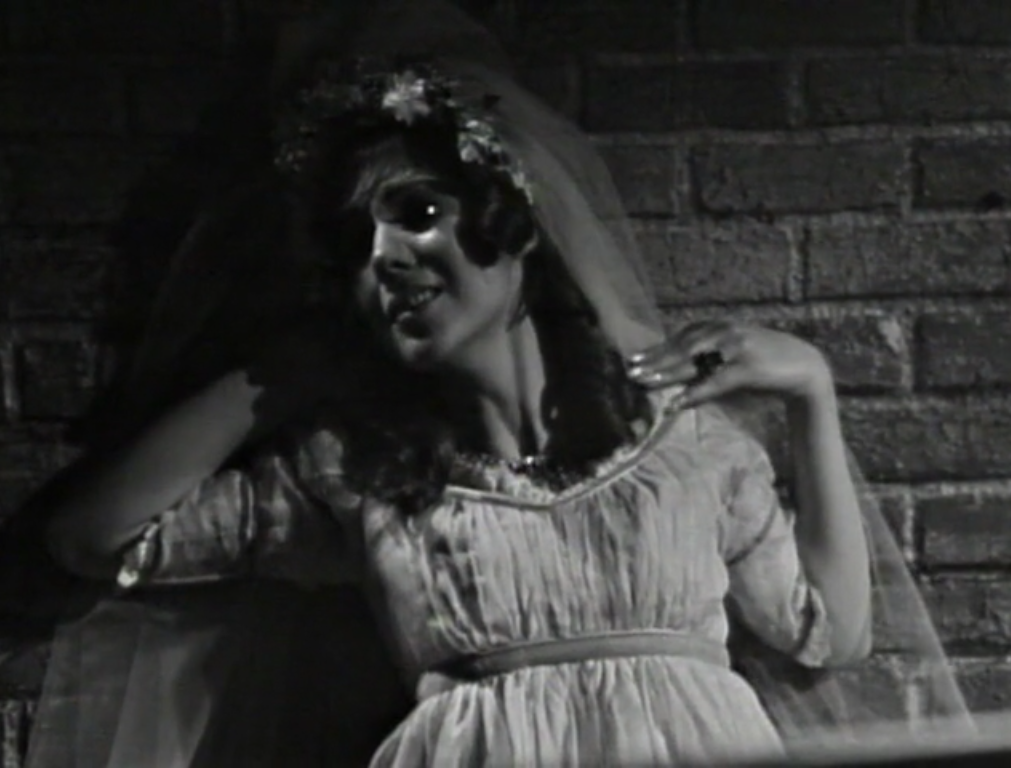
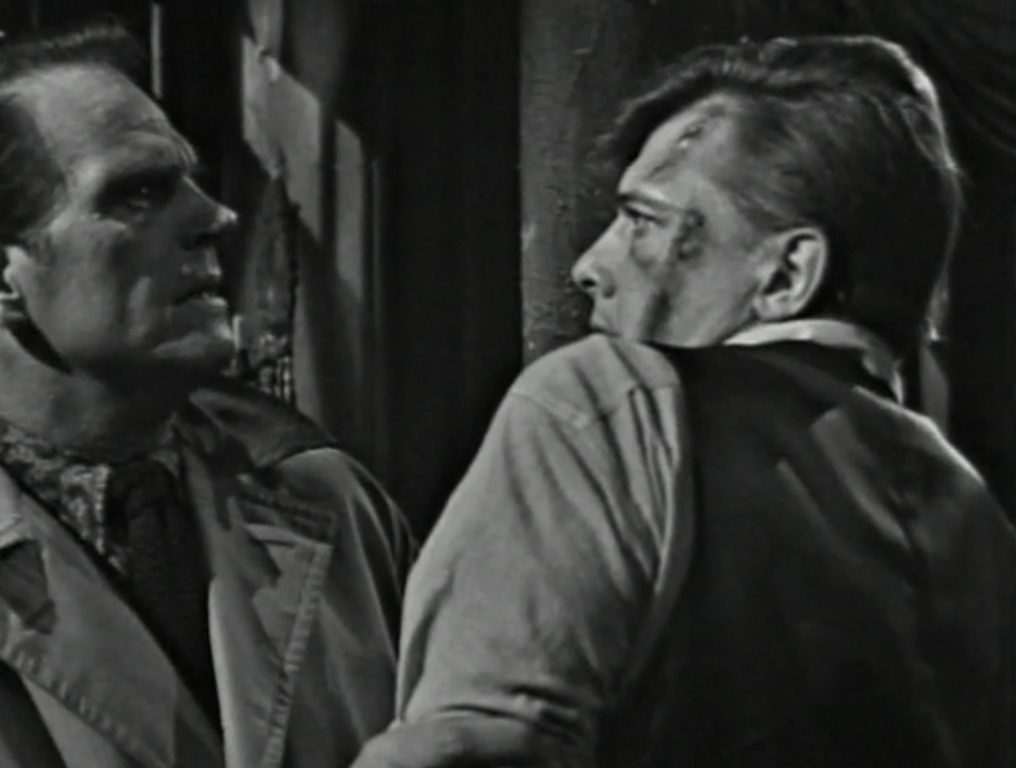
Episode 341: A fatal curiosity

Mad scientist Julia Hoffman and vampire Barnabas Collins are visiting Dr Dave Woodard in his office. Woodard has stolen the notebook in which Julia has recorded the truth about Barnabas and is planning to hand it over to the sheriff. At Barnabas’ insistence, Julia has prepared a hypodermic with a potion that will induce a heart attack. He orders her to give Woodard the lethal injection.

In her reluctance to kill her onetime friend, Julia suggests that Barnabas turn Woodard into a vampire. Julia believes she will soon find a cure for vampirism. So, Woodard will just be one more patient who will benefit from her imminent success. Neither he nor Barnabas receives her brainstorm with any great enthusiasm.

Woodard claims that, even if he became a vampire, he would have free will and would be able to fight Barnabas and destroy himself. He then asserts that Barnabas, too, has the ability to do the right thing. As viewers of drama, we are predisposed to believe that characters whom we hear talking and who have motivations we can understand are at liberty to choose what they will do, so we may believe that Woodard is right. But we haven’t seen any evidence to support his contention.

Julia keeps trying to postpone the killing. Exasperated with her procrastination, Barnabas tells her to hand him the hypodermic. She does so. As he is about to give the shot, Woodard claims to see the ghost of Barnabas’ little sister Sarah. Barnabas is so desperate to see Sarah that he falls for this and lets Woodard go. Julia calls out “Stop him!”

Barnabas is furious that Woodard has hit him at his most sensitive spot. As he regains his grip on Woodard, he jabs him in the shoulder with the needle. While Woodard crumples at his feet, Barnabas picks up on the words Woodard had earlier used to describe him, exclaiming “Loathsome I am, and evil! You can mock me for that, but leave my pain alone!” Even after that exclamation, Barnabas asks Julia if Sarah really was there. We don’t see her, but we do hear the strains of “London Bridge,” a song that has always before told us that Sarah is present.

Barnabas places Woodard’s corpse in the desk chair. He appears to be enjoying himself hugely while he taunts Julia for her squeamishness. He asks her, as a medical doctor, to verify that Woodard is dead; she can’t bring herself even to look at the body. She wants to leave immediately; he asks if she plans to leave the needle on Woodard’s desk. Once she puts the murder weapon in her purse, she again wants to rush out; he asks if she is planning to leave the notebook in Woodard’s pocket.

Even after they return to his house, Barnabas continues tormenting Julia. He tells her she will soon grow accustomed to her new identity as a murderer. She resists the label, and he magnanimously agrees to share half the responsibility for the killing. She says she will stop trying to cure him and go away; he tells her that will no longer be possible. They need each other more than ever now. When he tells her that he is her only friend, she hears Woodard’s voice saying “You no longer have friends.” As those words sound, so do the notes of “London Bridge.”

Barnabas is at his most compelling in these scenes, thanks to the actor who plays him. Jonathan Frid’s style of acting was rather old-fashioned even in 1967, but his achievement today is extraordinary. He takes us on a dizzying ride from horror at the brutal killing of Dr Woodard, to pity for the vastly lonely man longing for his little sister, and back to horror at Barnabas’ glee in bestowing the title of murderer on Julia. I can’t imagine any performer doing a better job.

The killing of Dr Woodard is quite a shock. It is only the second premeditated murder we see on Dark Shadows. Undead fire witch Laura Murdoch Collins used black magic to cause parapsychologist Peter Guthrie to have a fatal car crash in #186. There’s no magic this time- this is a plain old death by poisoning. We also saw Barnabas kill seagoing con man Jason McGuire, but that was not a premeditated act. Jason opened Barnabas’ coffin at sunset, and Barnabas, apparently by reflex, strangled him. That’s a reflex many of us might understand, I’m certainly not at my best when I first wake up. So when Barnabas wrestles with Woodard and jabs him with the needle, we are entering new territory.

When Julia and Barnabas are back in his house, she throws the needle into the fireplace. The Dark Shadows wiki disapproves of this action:

The destruction of the murder weapon was taken more lightly in this scene than it would have been in real life. The heat from a normal fireplace would not be hot enough to melt glass. The metal needle would have been blackened, and if someone looked through the ashes thoroughly, it would have been discovered. Had the syringe been discovered, Woodard’s death would have been ruled a homicide.

Dark Shadows wiki, episode 341.

I don’t see why the presence of a warmed-over medical sharp in Barnabas’ fireplace would mean that “Woodard’s death would have been ruled a homicide.” The police haven’t made any connection between Woodard’s death and Barnabas’ house. Even if they had, they would have no reason to suppose a hypodermic needle in his fireplace would have anything to do with Woodard. Julia is keeping it quiet that she is a medical doctor, but it isn’t a secret from the authorities. She spends most of her time at Barnabas’ house and is treating him for what she believes to be a rare blood disease, so she’s likely to have all sorts of medical supplies there. It is never specified what the chemical was that caused Woodard’s death, but if it was potassium chloride, it would have had the effects Julia describes and the heat of the fireplace would be sufficient to cause it to disappear without a trace in a little flash of dark purple flame. And of course potassium chloride dissolves in the bloodstream so completely that even a large dose of it cannot be detected in a normal postmortem examination. Unless they had dripped some of it into Woodard’s ashtray, Julia and Barnabas would have no reason to believe that the police would be looking for potassium chloride.

Julia moves to throw her notebook into the fire after the needle. Barnabas intercepts it in a move that looks so much like what you’d see on a basketball court that I count it as a blooper.
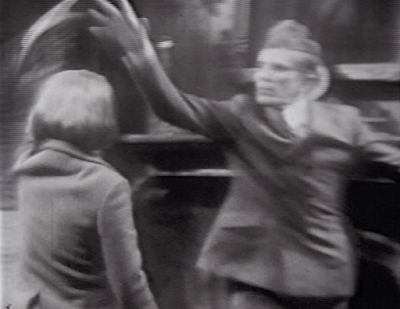
“Hoffman goes up, and is DENIED by Collins!” Screenshot by Dark Shadows Before I Die.

In between the scenes with Barnabas and Julia, there is some stuff with the sheriff and artist Sam Evans. The sheriff ambles into The Blue Whale tavern and finds Sam starting his fourth shot of whisky. They talk about Woodard, and Sam insists they go to his office to look for him. For the first 40 weeks of Dark Shadows, Sam’s alcoholism was a substantial story element, part of the “Revenge of Burke Devlin” arc. When that arc finally dried up in #201, Sam’s alcoholism went away. He’s a social drinker now. Still, he used to be the town drunk, and apparently that’s a higher post than sheriff. The sheriff follows Sam’s orders and accompanies him to Woodard’s office.

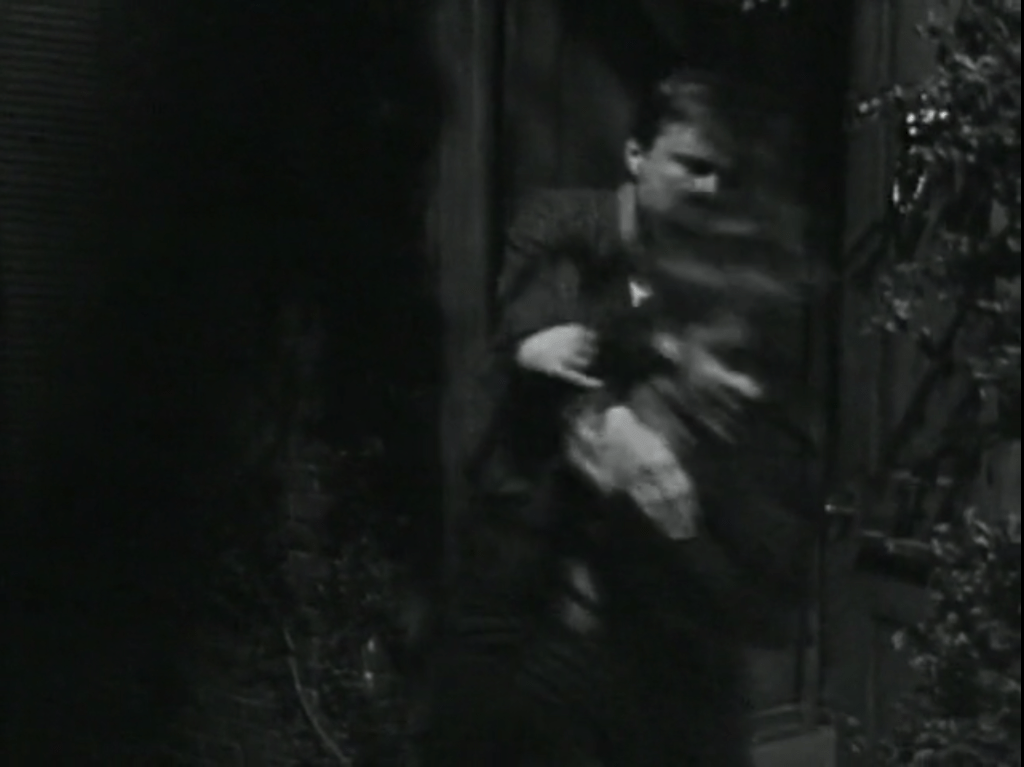
They knock on the office door. There is no answer. Sam suggests they break the door down. They haven’t tried to turn the knob, so they have no reason to suppose it is locked. Returning viewers will recall that yesterday Julia just walked into the office, without even knocking, and she and Barnabas did not lock the door behind them. So we can be fairly sure it is not locked. Still, orders are orders, so when the Town Drunk (Retired) says it’s time to break the door down, the sheriff watches him respectfully. Of course the whole set is made of a sheet of plywood, so when Sam “flings himself” against the door, he has to maintain a ludicrous gentleness to keep any part of it standing.

Inside, they find Woodard dead in his chair. Their response is bewildering. At first they are going to call for help, but then decide that because Woodard is dead there is no point. Eventually the sheriff remembers that he ought to call the coroner. They also take turns declaring that they believe Woodard’s death was the result of foul play.

Episode 281: All the unhappiness of all my ancestors

Vampire Barnabas Collins is giving a costume party in his home at the Old House on the great estate of Collinwood. His distant relatives, the living members of the Collins family, are dressed as their ancestors from Barnabas’ own time as a living being. The whole thing was impossibly dull until the mischievous and witty Roger Collins suggested they have a séance. Now well-meaning governess Vicki is in a trance, channeling the spirit of Josette Collins.

The last time Josette took possession of Vicki at a séance was in #170 and #171. At that time, Josette delivered her message in French. Since Vicki could not speak French (but Alexandra Moltke speaks it fluently,) that was evidence enough to convince even the most skeptical that something was going on. Today Josette speaks English. The characters are all sure that she is the one speaking, but it doesn’t have the same effect on the audience as did that earlier irruption of a language we had not expected to hear.

I do wonder if the decision not to use French came at the last moment. Even though Vicki/ Josette’s voice is loud and clear, the others make a show of struggling to understand what she is saying and seize on a word here and there (“Something about ‘run!'”,) as people do when they are listening to someone speak a language they don’t quite understand. Perhaps writer Joe Caldwell wasn’t quite up to writing in French, and the Writer’s Guild wouldn’t let Alexandra Moltke Isles or any other Francophones on set make a translation. Or maybe they thought that the switch to French wouldn’t be as effective the second time as it was the first.

Josette is telling the story of her death. A man was chasing her, and fleeing him she threw herself off the peak of Widow’s Hill to the rocks below. Barnabas interrupts and breaks Vicki’s trance.

When the others scold him for stopping Josette before she could reveal the name of the man who ran her off the cliff, Barnabas says that the name could not have been of any importance, since whoever it was who drove Josette to kill herself must have been dead for “almost 200 years.” The others do not suspect that he was that man. They do not know that he is a reanimated corpse; they think he’s just English.

When Dark Shadows started, the stories of the tragic death of Josette and of the building of the great house of Collinwood were set in the 1830s. In the weeks before Barnabas’ introduction in April of 1967, they implied that Josette’s dates were much earlier, sometime in the 18th century. Last week, they plumped for the 1830s again. But Barnabas’ line about “almost 200 years ago” puts us back to the 1700s.

After the séance ends, we have evidence that this bit of background continuity might start to matter. Vicki looks at the landing on top of the staircase and sees the ghost of Barnabas’ 9 year old sister Sarah watching the party.

Sarah watches the party. Screenshot by Dark Shadows Before I Die

It seems that when Barnabas was freed to prey upon the living, he unknowingly brought Sarah with him. Sarah has been popping in and out quite a bit the last few weeks, and she has already made some important plot points happen. We’re starting to wonder just how many more beings will emerge from the supernatural back-world into the main action of the show. The opening voiceover today tells us that “the mists that have protected the present from the past are lifting,” so perhaps they will have to nail these dates down sooner rather than later.

The whole party had accepted instantly that Vicki was channeling the spirit of Josette and none of them ever comes to doubt it. But when she says that she saw a little girl at the head of the stairs, they get all incredulous. By the end of the episode, Vicki will have encountered so much disbelief on this point that she herself will decide that she must have been hallucinating.

Back in the great house, Roger is still overjoyed that the séance turned out to be so exciting. His sister Liz and Liz’ daughter Carolyn consider this to be in terrible taste. But Roger won’t give an inch. He has some great lines, exiting with “I think that all of the unhappiness of all of my ancestors is my rightful heritage, and you shouldn’t try to keep it from me. Good night, ladies.” Both Patrick McCray, in his Dark Shadows Daybook post about this episode, and Danny Horn, in his Dark Shadows Every Day post, make insightful remarks as they analyze the fun Louis Edmonds has playing Roger.

Carolyn approaches Vicki to speak privately. She tells her that she isn’t bothered that fake Shemp Burke Devlin is dating Vicki. Vicki’s response to this is “What?” Carolyn reminds Vicki that she used to be interested in Burke and was initially jealous of Burke’s interest in her. But she assures her she doesn’t feel that way any longer. Vicki smiles, nods, and looks away. Carolyn then says “He’s really very nice!” Vicki answers “Who?” “Burke!” says Carolyn. Again, Vicki smiles, nods, and looks away.

This is probably supposed to tell us that Vicki is coming under some kind of spell associated with Barnabas, but in fact it is likely to suggest something quite different to the audience. Burke was originally a dashing action hero played by Mitch Ryan. Dark Shadows never really came up with very much for a dashing action hero to do, but Ryan’s skills as an actor and his charismatic personality always made it seem that he was about to do something interesting. Several weeks ago, Ryan was fired off the show after he came to the set too drunk to work.

Since then, the part of Burke has been played by Anthony George. George was a well-trained actor with an impressive resume, and by all accounts was a nice guy. But he cannot dig anything interesting out of the character of Burke as he stands at this point in the series. The only scene in which George has shown any energy so far was in #267, when Burke had lost a dime in a pay phone. The rest of the time, he has blended so completely into the scenery that it is no wonder Vicki can’t remember him from one line to the next.

Back in the Old House, Barnabas talks to Josette’s portrait. In the months from #70 to #192, it was established that Josette can hear you if you do this. Several times she manifested herself either as a light glowing from the surface of the portrait or as a figure emerging from it. In #102, we saw strange and troubled boy David Collins having a conversation with the portrait- we could hear only his side of it, but it was clear that Josette was answering him.

The first time we saw Barnabas in the Old House, in #212, he spoke to the portrait. At that point, Josette was not yet his lost love. It seemed that she was his grandmother, and that she had sided against him in some terrible fight with his father Joshua. He ordered Josette and Joshua to leave the house to him. The next time David tried to talk to the portrait, in #240, it seemed that they had complied- David could no longer sense Josette’s presence in it.

Barnabas had spoken briefly to the portrait the other day, but today he makes his first substantial address to it since banishing Josette and Joshua in #212. Again he entreats her to go, but for a very different reason. Now he says that she is lost to him forever, and must allow him to live in the present. Since he has been scheming to capture a woman, erase her personality, replace it with Josette’s, and then kill her so that she will rise from the grave as a vampiric Josette, this sounds like he has decided to make a big change in his relations to the other characters.

It turns out that he hasn’t, but the writers have decided to change their relationship to their source material. Barnabas’ original plan was identical to that which Imhotep, the title character in the 1932 film The Mummy, had pursued in his attempt to replicate his relationship with his long-dead love Princess Ankh-esen-amun. Imhotep met Helen Grosvenor, whom he regarded as the reincarnation of Ankh-esen-amun because they were both played by Zita Johanns, and subjected her to the same treatment Barnabas first inflicted on Maggie Evans, The Nicest Girl in Town, and now plans to try on Vicki.

Maggie is played by Kathryn Leigh Scott. The audience in 1967 would not have known that Miss Scott also played the ghost of Josette in some of her most important appearances. However, they would have noticed when David saw Maggie dressed as Josette in #240 he assumed it was the ghost, because her face was “exactly the same” as it had been when she manifested herself to him previously. So we have the same reason to believe that Maggie is the reincarnation of Josette that Imhotep had to believe that Helen was the reincarnation of the princess, and we therefore assume that Barnabas, like Imhotep, was trying to take possession of both the ghost and the living woman.

But after Barnabas tells Josette to go away, he declares that if he is to have her, she must be someone from the present. This sequence of words is nonsensical in itself, but harks back to a theory he had laid out to his sorely bedraggled blood thrall Willie in #274: “Take the right individual, place her under the proper conditions and circumstances, apply the required pressure, and a new personality is created.” Jonathan Frid would always sound and move like Boris Karloff, but now his project of Josettery is inspired less by Imhotep than by the various “mad doctors” Karloff played in the 1940s. Of course, in the 1960s real-life mad scientists such as Stanley Milgram and John Money were performing experiments on human subjects for which Barnabas’ statement might have served as a motto. So Barnabas is coming to be less a merger of Dracula and Imhotep than of Dracula and Dr Frankenstein.

One of the devices by which Barnabas tries to place women “under the proper conditions and circumstances” for Josettification is a music box which he bought for the original Josette and may or may not have given her.* He gives this to Vicki. To his satisfaction, she is reduced to a complete stupor when she hears it play. She is in that state when the episode ends.

* In #236, he says he never had the chance to give it to her. In subsequent episodes, he implies the opposite.

Episode 271: A secret you had no right to keep

A wedding is being held in the drawing room of the great house at Collinwood. Matriarch Liz is marrying seagoing con man Jason. Carolyn, Liz’s daughter by her first husband, Paul Stoddard, has a pistol in her purse, which she is planning to use to shoot Jason before the ceremony can be completed. Well-meaning governess Vicki is distressed, because Liz confided in her in #259 that she is marrying Jason only because he is blackmailing her. Liz killed Stoddard long ago and Jason buried the body in the basement, facts he will reveal if she does not comply with his demands. The other guests hate Jason, but they share neither Vicki’s understanding of the situation nor Carolyn’s sense of initiative, so they just stand around and scowl.

When the judge asks Liz if she takes Jason to be her lawful wedded husband, she exclaims that she cannot. She points to him and declares “I killed Paul Stoddard and that man was my accomplice.” Carolyn drops the gun, Vicki flashes a defiant look at Jason, and everyone else is stunned.

Vicki triumphant

The judge excuses himself. He claims that he might be required to act as a judicial officer in a case that could arise from what Liz is about to say. That may not make sense in terms of the laws or canons of judicial conduct actually in effect in the State of Maine in 1967, where what he has already heard would be far too much to avoid being called as a witness. But it fits nicely with the logic of Soap Opera Law, in which neither the police nor the courts may be notified of any criminal matter until the prime suspect has completed his or her own investigation.

Carolyn says “You killed my father.” Before Liz can say much in response, Carolyn announces that she was about to kill Jason. Vicki’s boyfriend, Fake Shemp Burke Devlin, finds Carolyn’s gun. For some reason, Burke holds the gun up. He points it at whomever he is facing. When Jason announces he will be leaving the room, Burke is pointing the gun at him and forbids him to go. Again, giving orders to a person on whom you have a deadly weapon trained may be a felony in our world, but it is all well and good under Soap Opera Law.

Liz mentions that Vicki already knows that she killed Stoddard and that Jason has been blackmailing her. This prompts Liz’ brother Roger to tell Vicki “That was a secret you had no right to keep.” Liz responds that, had Vicki told anyone, she would have denied it and sent her away. Liz then describes the events of the night eighteen years before when she and Stoddard had their final showdown. We see them in flashback, on this same set.

Stoddard told Liz he was leaving her, never to return. She replied that she did not object to his going, but that the suitcase full of bonds, jewels, and other valuable assets he was planning to take was Carolyn’s property and would have to stay.

When the show started, just over a year ago, Stoddard’s disappearance had been 18 years in the past. So it still is, moving its date from 1948 to 1949. At that time, Stoddard was last seen six months before Carolyn was born. Later, they would say she was a newborn when her father vanished. In the flashback today, he answers Liz’ assertion of Carolyn’s right to the contents of the suitcase by saying that he has been putting up with the child for two years. We saw her birth-date as 1946 the other day, so apparently they are planning to stick with the idea that she was a toddler when Stoddard was last seen.

Stoddard and Liz quarrel over the suitcase. He confirms that he and his friend Jason have a plan to convert its contents into a big bundle of cash. He is walking away from her when she takes a poker from the fireplace and hits him on the back of the head. This may be another deed entirely unjustifiable by real-world law, but under Soap Opera Law any act committed against a man who openly despises his two-year old daughter and tries to steal from her is outside the jurisdiction of the courts.

Stoddard fell to the floor, bled, and remained very still after Liz hit him. Shocked by what she had done, she reeled out of the drawing room and closed the doors behind her. As she stood in the foyer wishing she were dead, Jason entered the house. Liz sent him into the drawing room to look at Stoddard. He came out, told her Stoddard was dead, and offered to bury him for her. After all, everyone in town knew he was leaving- there need be no scandal to cloud Carolyn’s future.

Liz asks why Jason wants to help her- he was Stoddard’s friend, planning to help Stoddard steal from her. Jason explains that Stoddard is beyond help now. Liz goes along with his plan.

In this flashback, Jason’s Irish accent is convincingly realistic. It sounds like he’s from Antrim, or someplace else in Norn Iron. That’s a contrast with what we’ve heard so far, when he’s been more than a little reminiscent of this guy:

Hearts, moons, clo-o-overs

My in-universe, fanfic theory is that Jason hadn’t been home or spent much time with other Irishmen in the years between 1949 and 1967, and so his accent drifted into a music hall Oyrish. My out-of-universe theory is that Dennis Patrick spent some time with a dialect coach after joining the show, but by the time he had learned to sound plausible Jason’s silly accent was already such an established part of the character that he couldn’t change it.

When Jason was done with his work downstairs, he showed Liz the storage room where he buried Stoddard in the floor. We got a long, long look at that floor in #249, when it was clean and tidy and there were many boxes and crates on it. When Jason left it to Liz “18 years ago,” there was dirt piled up all over the floor, a shovel in the corner, and few boxes or crates. Evidently Liz cleaned it up herself and organized its contents at some point. That doesn’t fit with the idea she had before #249, that a person entering the room would immediately discover her secret. Since Liz had often gone into the room in the early months of the show, it never had made sense she would believe such a thing, but it is annoying to be reminded of it.

In voiceover, Liz tells us that when Jason left her with the key to the room she knew she would be a prisoner of the house forever. The episode then ends, after less than 18 minutes of scripted content. That’s the shortest installment so far. The closing credits roll slowly, so slowly that they run out of music. The names scroll by in silence for 25 seconds before ABC staff announcer Bob Lloyd says “Dark Shadows is a Dan Curtis production.”

That cannot have been Plan A. This episode has eight speaking parts, two segments of events set in different decades, voiceover narration, a costume change, etc. So there was plenty of stuff that might have proven impossible in dress rehearsal, requiring a quick rewrite that might have left them running a little short. But they’ve been ambitious before, and have never ended up like this. So I suspect that the late script change that got them into trouble was more complicated than that.

Art Wallace’s original story bible for Dark Shadows, titled Shadows on the Wall, called for the mystery of Vicki’s parentage to be resolved at the same time as the blackmail plot. Wallace’s first idea was that Vicki would be shown to be the illegitimate daughter of Paul Stoddard, and that Liz’ interest in her well-being began with guilt after she responded to the news of Vicki’s existence by attacking Stoddard. Wallace also said that if it were more story-productive, they could say that Vicki was Liz’ illegitimate daughter.

Casting Alexandra Moltke Isles as Vicki committed them to that second course of action. Famously, when Joan Bennett first saw Mrs Isles on set she mistook her for her daughter, and the show has often capitalized on their resemblance to present Vicki as a reflection of Liz. For example, notice how the two women stand in this shot from today’s episode:

Pay particular attention to their legs- it’s the same posture

Moreover, the ghost of Josette Collins took a lively interest in Vicki in the first 39 weeks of the show, and Josette is specifically a protector of members of the Collins family. If Vicki is Paul’s illegitimate daughter, she is not a Collins and not linked to Josette.

The only advantage we’ve ever seen of establishing Vicki as a non-Collins would be the possibility of a romance between her and Roger. Since Vicki the foundling-turned-governess is Jane Eyre and Roger the father of her charge is Mr Rochester, this is an obvious direction to go. The show took a few feints towards such a relationship in the early days, but those clearly led nowhere. Vicki came to town in #1 on the same train as Burke, so they are fated to get together. Roger and Burke openly hate each other and often seem to secretly love each other, making for a potentially explosive love triangle if Vicki comes between them, but neither Roger and Burke’s much-advertised enmity nor their barely concealed homoerotic connection ever developed into a very interesting story. The whole thing fizzled out completely months ago. So there doesn’t seem to be a point in resolving the question of Vicki’s parentage any other way than with Liz admitting maternity.

So the first question is, when did they decide that this episode would not include that admission? The short running time would seem to suggest that it was only a few days before taping.

The second question is, why did they make that decision? Liz’ line today that she would fire Vicki if she had betrayed her secret, coupled with all the remarks she has been making to Vicki in the last few weeks about how Carolyn is the one and only person she really cares about, would suggest that the producers and writers are thinking of moving away from the idea of Vicki as Liz’ natural daughter. But the directors are still committed to it, as are the actresses.

We begin to suspect that the producers and writers are hoping that the viewers who have joined the show since the vampire came on in April won’t care about Vicki’s origin, so that they can just drop the whole thing. Since the only storylines they have going are the blackmail arc, which Liz is bringing to its end with her confession today, and the vampire arc, in which nothing at all is happening at the moment, you might think they would be glad to fill some screen time with Vicki and the rest of them reorienting themselves around a newly revealed family relationship. But, maybe not!

Episode 265: Unusual as doctors go

Maggie Evans, The Nicest Girl in Town, has escaped from vampire Barnabas Collins, but not before Barnabas put the zap on her brains. She is being treated at Windcliff Sanitarium, under the care of Dr Julia Hoffman.

Windcliff Sanitarium. Screenshot by Dark Shadows Before I Die

Dr Hoffman’s old acquaintance Dr Dave Woodard shows up with Maggie’s father Sam and boyfriend Joe. Woodard and Hoffman are Dark Shadows ‘ current versions of Bram Stoker’s Dr John Seward and Professor Abraham Van Helsing. As Seward called Van Helsing in when he needed help solving the mystery he encountered treating the victims of Count Dracula, so Woodard has called the expert Dr Hoffman in to help him solve the mystery he has encountered treating Barnabas’ victims. As Van Helsing refuses to answer any of Seward’s questions when they first start working together, so today Dr Hoffman refuses to answer any of Woodard’s questions about the case. There is one departure, in that Dr Hoffman combines Seward’s occupation as chief physician at a sanitarium with Van Helsing’s role as mysterious expert from out of town.

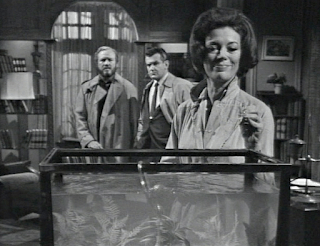
Dr Hoffman tells Dr Woodard that she believes it will be bad for Maggie to see Sam and Joe, but she consents to the visit as a way of discouraging them from trying to come back. When Sam and Joe join them in her office, she attends to her aquarium. In the post about this episode on Dark Shadows Before I Die, Christine Scoleri points out that this is a rather direct way of telling us that there is something fishy about Dr Hoffman.

Fishy doctor. Screenshot by Dark Shadows Before I Die

When Sam and Joe go to Maggie’s room, she has a mad scene. She starts singing “London Bridge,” gets to an obscure verse running “Take the key and lock her up,” and starts screaming “Lock her up!” over and over. It’s magnificently terrifying.

In his post on Dark Shadows Every Day, Danny Horn raves about Grayson Hall’s performance as Julia Hoffman. Rightly so, she will quickly make herself indispensable to the series. He includes a lot of screenshots of her face, showing the wide variety of expressions she uses. I have a more complicated response to this aspect of her style.

As many screenshots as Danny gives of Grayson Hall’s face in his post, I presented even more screenshots of Lovelady Powell’s face in my post about #193, where Powell plays art dealer Portia Fitzsimmons. What impressed me about Powell’s performance is that she takes one of the most basic rules of screen acting- choose one of your eyes and look at your scene partner only with it- and builds a whole character around it. Her left eyelid is all she needs to command the stage and leave an indelible impression.

Hall was at the opposite extreme. She ignores the one-eye rule, and virtually every other piece of guidance professionals give about how to create a character on camera. She uses every muscle at every moment. Her broad, stagy approach works well for Dark Shadows, and the three actors with whom she shares her shots today stay out of her way. Still, she does make me miss Powell’s dominating simplicity.

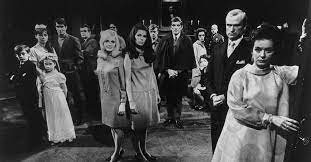
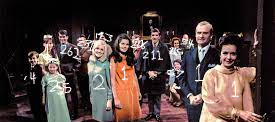
With Julia’s introduction, all of the actors in the photo I use as the header for this blog have joined the cast of Dark Shadows. There is also a version of the picture where the actors are frowning.

Gloom in the shadows

Here’s the smiley version. I’ve marked each player with the number of the first episode in which s/he appeared:

Episode 262: Hand the world over to madmen and murderers

On Thursday, reclusive matriarch Liz admitted to well-meaning governess Vicki that she is being blackmailed. Eighteen years ago, Liz killed her husband, Paul Stoddard. Seagoing con man Jason McGuire then buried Stoddard in the basement. Now, Jason is threatening to expose this secret unless Liz marries him.

Today, Liz asks Vicki to be the legal witness at her wedding to Jason. Vicki demurs, saying that she might be compelled to speak up when the officiant asks if there is anyone who present who knows why these two people should not be joined in matrimony. The conversation then shades off into Vicki urging Liz to share her secret with her daughter, flighty heiress Carolyn. Liz won’t look directly at Vicki when Carolyn’s name is mentioned.

Word is spreading that Maggie Evans, The Nicest Girl in Town, is dead. Vicki had just received that news when Liz brought up the wedding. Alexandra Moltke Isles does a fine job of expressing Vicki’s emotional tumult as she reels from one kind of shock to another. When Vicki breaks the news of Maggie’s death to Carolyn and then quarrels with Carolyn about her plan to marry motorcycle enthusiast Buzz, Mrs Isles reprises this transition from fresh bereavement to festering conflict, again quite effectively.

Carolyn goes out with Buzz, and Vicki goes for a walk on the beach with her boyfriend, Burke Devlin. Each episode begins with a voiceover which Mrs Isles delivers in character as Vicki. Typically, these consist of remarks about the sea and the weather which have some vaguely metaphorical connection to what’s happening on the show. While Vicki sits with Burke and stares out at the water, she launches into one of these monologues. In response, my wife, Mrs Acilius, started laughing so hard we had to pause the streaming. When Burke joins in with the observation that it is getting dark and “may get darker”- sometimes that happens as the evening goes on, seems to be some kind of pattern there- we both burst out laughing and had to pause it again. Before we restarted it that second time, Mrs Acilius asked “What does it say about us that we are sitting here watching this? That we choose to watch it when we’ve seen it before?” I’m not sure I want to know the answer to that one.

Vicki and Fake Shemp. Screenshot by Dark Shadows Before I Die

Vicki gets home shortly before Carolyn. Carolyn tells Vicki and Liz that after she saw Maggie’s boyfriend Joe walking down the street looking sad, she just wanted to go home and mourn. After Carolyn leaves them alone together, Vicki again urges Liz to tell her the truth. Vicki judges that Carolyn would listen to her sympathetically in the mood she is in now. Liz says she might tell Carolyn tomorrow, Vicki says that Carolyn might not be in the same frame of mind tomorrow, Liz says she can’t do it now.

In fact, Maggie is alive- her doctor decided to promote the story that she is dead as a lamebrained scheme to keep the person who tried to kill her from trying again. The blackmail plot, on the other hand, has barely shown a sign of life since it first arrived on the show ten weeks ago.

Jason is supposed to sweep away the last non-paranormal story elements left over from the period before Dark Shadows became a supernatural thriller/ horror story in December 1966. So far he has managed to disclose to the audience, but not to the other characters, why Liz hasn’t left home since the night Stoddard was last seen. That wasn’t an especially interesting question, as they have never shown us anyplace she would want to go, and it’s the only thing he has cleared up.

Another unanswered question is the one that led Vicki to come to Collinwood in the first place. She grew up in a foundling home, with no idea of who her parents were. The show has been hinting heavily that Liz is Vicki’s mother. Indeed, when Jason was brought on the show, the plan was that the grand finale of his storyline would confirm this. If that is still the plan, then the relationships among Vicki, Liz, and Carolyn are due for a drastic upheaval. That prospect lends a certain interest to the scenes among these characters today.

Closing Miscellany

This episode originally aired on 27 June 1967, the first anniversary of the broadcast of #1.

From #1 until #248, dashing action hero Burke Devlin was played by Mitchell Ryan. Ryan showed up at the set too drunk to work when they were supposed to tape #254 and was fired off the show. Today announcer Bob Lloyd tells us that “The part of Burke Devlin will be played by Anthony George.” There was never very much on Dark Shadows for a dashing action hero to do, and now that the most popular character on it is a vampire there isn’t going to be. It was only Ryan’s star quality that kept the character on the show so long.

Anthony George had appeared in feature films in the 1950s, had guest-starred in several prime-time shows, had been a regular cast member on the hit series The Untouchables, and had played one of the leads on a series called Checkmate. When the original audience saw him, many of them would have recognized him as a famous actor and would have expected the character to go on to do something important. Evidently they haven’t given up on Burke yet. But they had better come up with a story for him- George may have had a terrific resume, but he doesn’t have any fraction of Ryan’s charisma.

Unfortunately, they have given up on Buzz. He is on screen only briefly today, and we don’t see him again. Worst of all, while his first three episodes left us with the impression that he could not fail to be hilarious, he manages not to be even a little bit funny in this final appearance. He is just nasty and inconsiderate, demanding that Carolyn forget about whatever it is that’s bothering her and come to the loud party he’s planned.

Getting Buzz off the show the day Anthony George comes on as Burke does solve one problem. As of this episode, the three young women on Dark Shadows all have boyfriends. Maggie has Joe, played by Joel Crothers; Vicki has Burke, played by Anthony George; and Carolyn has Buzz, played by Michael Hadge. Those three actors were all gay. That wasn’t widely known at the time (except perhaps in the case of Mr Hadge, who really does not seem to be making an effort to keep the closet door shut while playing Buzz,) but now that everyone knows all about it, it does seem to be a sign that the show was spending a lot of energy on things that aren’t going anywhere.

Episode 254: As much fun as a bag of spiders

Reclusive matriarch Liz and well-meaning governess Vicki are in the drawing room of the great house of Collinwood. Liz is depressed because her daughter Carolyn is dating motorcycle enthusiast Buzz. She asks Vicki if she has any idea how to break Carolyn and Buzz up, then answers her own question. Liz knows that Carolyn is protesting her engagement to seagoing con man Jason McGuire, and that only by breaking it off with Jason can she change things with Carolyn.

When Liz claims that she is marrying Jason because she wants to, Vicki says it’s none of her business. Vicki has seen abundant evidence that Jason is blackmailing Liz, and won’t pretend she hasn’t. She manages to be quite respectful to her employer without backing down an inch. Despite herself, Liz is impressed with Vicki’s firmness and diplomacy.

Alexandra Moltke Isles was cast as Vicki because she and Joan Bennett looked so much alike, and this is one of the scenes that uses their resemblance to show Vicki as a reflection of Liz. As Vicki is finding tactful ways to express her suspicions, she says things that we have heard Liz say and that we know she is thinking. Each time she does so, Joan Bennett does a quarter turn one direction from the shoulders and a quarter turn the other direction from the neck, as if she were being twisted open. When Liz tells Vicki to stop, she calls her “Victoria,” a name we haven’t heard her use since 1966, and when Vicki asks permission to leave the room she responds, in a near-whisper, with the usual “Vicki.” This alternation also suggests twisting, and to regular viewers who remember that Liz has a secret connected with the fact that “Her name is Victoria” it is another twisting open.

Meanwhile, Jason is entering the Blue Whale tavern with his former henchman, Willie Loomis. Jason wants to confront Willie with the fact that he saw him in town earlier in the day selling a piece of jewelry. Willie says that he was selling it on behalf of his employer, wealthy eccentric Barnabas Collins. Jason knows of Willie’s obsessive fascination with jewels and his tendency to steal them, and does not believe that Barnabas would entrust him with such a task. What Jason does not know is that Barnabas is a vampire and Willie is his sorely bedraggled blood-thrall. As such, Barnabas has a power over Willie that makes it rational to entrust the most remarkable tasks to him.

Carolyn and Buzz enter. They almost leave when Carolyn sees Jason and Willie. Jason and Willie rise and meet them at the door. Jason assures Carolyn that they were just going. Before they do, he taunts Carolyn with his engagement to Liz.

On Tuesday, Carolyn and Buzz started dancing together in the drawing room. Buzz made a few very graceful moves, saw Carolyn going into the Collinsport Convulsion, and sat down to observe. Today, Buzz sees two background players twitching awkwardly while the jukebox plays and declines Carolyn’s invitation to join her on the dance floor. He wants to stop drinking, saying that he is looking for something that will make him feel like he’s never lived before, while “drinking only makes you feel drunk.” It sounds a little bit like he’s going to offer Carolyn a drug stronger than alcohol, but by the end of the scene he just wants to get back on his bike. Liz’ fears to the contrary, Buzz seems pretty darned wholesome.

While Carolyn and Buzz are on their way out of the tavern, hardworking young fisherman Joe comes in. Carolyn asks Buzz to wait outside while she talks with Joe. Buzz reluctantly agrees to spend a few minutes alone with his bike.

Carolyn and Joe were dating when the show started, and there was a whole storyline about how they were tired of each other and couldn’t get themselves sufficiently organized to break up. Their scenes together reminded us that the 1960s were the decade in which Michelangelo Antonioni used the cinema to explore the nature and significance of boredom.

But they are far from boring today. After he and Carolyn finally called it quits, Joe started seeing Maggie Evans, The Nicest Girl in Town. Maggie is now missing and feared dead. Carolyn sits next to Joe at the bar and expresses her sympathies. When I say that Nancy Barrett’s acting style was to throw herself unreservedly into whatever the script gave her character to do that day, it may sound like I’m saying she was undisciplined or that she lacked subtlety. That is not at all what I mean, and in this scene she does one of the most delicate drunk acts I’ve ever seen. Carolyn sits a fraction of an inch too close to Joe, tilts her head back a fraction of a degree too far, opens her eyes the tiniest bit too wide, and speaks ever so slightly too slowly. No one of those signs would even be noticeable by itself, but together they make it very clear why Buzz was anxious that he and Carolyn should leave their drinks unfinished.

Back in the drawing room, Jason is badgering Liz into setting the date for their wedding. Carolyn and Buzz come back, and Jason tells them he and Liz will be married two weeks from tonight. Carolyn says that she and Buzz ought to get married the same night. Buzz is delighted when she first says this, and is still smiling when she insists she is being serious.

Buzz delighted with Carolyn’s proposal.
Screenshot by Dark Shadows Before I Die

My wife, Mrs Acilius, urged me to call this one “A piece of that action,” something Jason says to Willie. Trekkie that she is, that seemed irresistible to her. But Joe’s line that Buzz seems to be “about as much fun as a bag of spiders” is the funniest of the many witty lines in today’s script, and when you remember that Dark Shadows has, since December of 1966, been basically a horror story, you have to think that in its terms a bag of spiders might be a lot of fun. So that had to be the title.

Episode 253: Ring cycle

Vampire Barnabas Collins is keeping Maggie Evans, The Nicest Girl in Town, in a prison cell in his basement. He won’t let her out until she discards her personality and adopts that of his long-lost love Josette. That would seem to rule Maggie out as a source of plot development for quite some time.

Writer Joe Caldwell knew that he was not the first dramatist to have to tell a story in which one of the main female characters is cooped up. In ancient Athens, women of citizen rank were supposed to be immured in the house, hidden away from all men outside their immediate families. While the reality was a great deal more complicated, audiences at the city’s dramatic festivals liked to see plays set in a world that approximated that ideal. So tragedians like Euripides, and after him the Greek and Roman playwrights of the New Comedy, devised a whole repertoire of ways that ladies could send messages to their boyfriends without leaving home.

One of the most prominent of these methods was the dispatch of an identifiable token by a household servant. Since many people, both men and women, wore rings with unique decorations, rings were very often used for this purpose. In plays where the heroine has been captured by pirates and is being held prisoner by someone to whom the pirates made a gift of her, as in Plautus’ Miles Gloriosus (sometimes translated into English as The Swaggering Soldier,) the heroine and her accomplices will use the villain’s greed or that of his servant to trick them into taking a valuable ring and showing it to someone who will be able to help her. Plautus would have been relatively familiar to audiences in 1967, and very much front-of-mind for the Broadway-oriented people involved in making Dark Shadows, because of the success of the 1962 show A Funny Thing Happened on the Way to the Forum and its 1966 film version, both of which end with a recognition prompted by the sight of an unusual ring.

Maggie doesn’t seem to be up on her New Comedy. In the first part of the episode, she asks Barnabas to take her ring to her father to let him know she is still alive. Barnabas is insulted that she would think he was dumb enough to do that.

There is some good dialogue in this scene, and Kathryn Leigh Scott and Jonathan Frid are always fun to watch together, but we have to share Barnabas’ reaction. Until today, Maggie had been one of the few characters on the show who had never done or said anything inexplicably stupid, and asking Barnabas to give her father the ring breaks that streak. Barnabas’ complaint lampshades the problem, which does help a bit- it gives us time to think that maybe Maggie is trying to distract Barnabas from another plan she is cooking up, or maybe the script is telling us that she is so desperate she doesn’t know what she’s doing.

Later, Barnabas’ sorely-bedraggled blood thrall Willie Loomis comes to check in on Maggie. Willie is so obsessed with jewels that when Maggie offered him a diamond necklace on Friday, he turned his back on Barnabas’ coffin while she stood there preparing to stab him through the heart. Maggie persuades Willie to take her ring as a token of her gratitude for keeping Barnabas from killing her on Monday. That marks a good recovery from the earlier dumbness, and gets us off to a fresh start.

Strange and troubled boy David Collins sneaks into Barnabas’ house through an unlocked window. He often visited the house in the months before Barnabas was introduced to Dark Shadows, when the ghost of Josette was the principal supernatural presence on the show and the house was her stronghold. David can’t feel her presence there now, and calls for her forlornly as he wanders through the front parlor.

Willie catches David and demands to know why he is in the house. David tries to defend his indefensible behavior, and when that fails he goes on the attack. He says that he knows what Barnabas and Willie are doing. Willie tenses and asks what it is they are doing. David says they are hurting Josette. Willie listens until he is sure that David is talking only about the ghost, not about Maggie. Then he picks David up and throws him out the front door. There is so much hilarious stuff in this part that not even the bit in the middle when Willie briefly thinks he may have to murder David dampens the mood.

Willie picks David up…
…and throws him down.

In the course of bodily ejecting David from the house, Willie drops the ring. David finds it on the ground while he is getting back onto his feet. He calls to Willie and tries to return the ring, but Willie has already locked the door and will give no response but shouts of “Go away!” David takes a good long look at the ring and goes home to the great house of Collinwood.

Well-meaning governess Vicki greets him there, scolding him for having gone so far from the house. She notices the ring in his hand. This moment comes straight out of ancient comedy- David’s clothes have pockets, after all, but this scene is written for an actor wearing a pallium and a terracotta mask. David won’t tell Vicki where he found the ring, and she examines it. She has seen that there is an inscription in it and is just about able to read it when a knock comes at the door.

It is Barnabas. He tells David that he wants to apologize for Willie’s forcible ejection of him from his house. Vicki turns to David and asks if that’s where he was. The boy has little choice but to admit it, and suggests that the ghost of Josette invited him. Vicki asks if he found the ring at Barnabas’ house. Barnabas, startled by the mention of a ring, asks to see it. He claims that it is a family heirloom which he gave Willie to sell. He takes it, and in a genial voice suggests David steer clear of Willie.

Back home, Barnabas returns to Maggie’s cell. She pretends to be coming around to believing that she is Josette. Barnabas shows her the ring and shatters her hopes. He leaves. Rather than end the episode with a shot of her staring helpless through the barred door, we follow Maggie into the cell and see her slam shut the lid of Josette’s music box. We see her thwarted, but no less able to take action than she was when we began.

Caldwell deserves credit for a fine script, aside from the awkwardness in Maggie’s early scene with Barnabas. Director John Sedwick keeps it looking clean and crisp, and the final shot of Maggie in her cell is a triumph of timing. Best of all, the actors all liked each other and were having fun working together today, and that gives an irresistible energy to the finished product. The result is the fourteenth episode, and the first since #182 early in March, that I would label “Genuinely Good.”

Episode 250: A servant’s name

Maggie Evans, the Nicest Girl in Town, has been the prisoner of vampire Barnabas Collins for some time. At rise, she is in front of her mirror, struggling to remember who she is. Her name and her father’s come back to her, but then the music box Barnabas gave her starts playing, and she begins to believe that she is Barnabas’ long-lost love Josette. This scene takes about a minute more than is necessary.

She renews the struggle later, and this time overcomes the hypnotic power of the music box. She decides to pretend that she believes that she is Josette in order to trick Barnabas and Barnabas’ sorely bedraggled blood thrall Willie into giving her enough freedom to escape. She fools them, only to hear Barnabas tell Willie that her compliance means that the time has come for the final part of his plan.

Maggie hears carpentry work, and sneaks down to the basement. She finds Barnabas watching Willie build a coffin. It sits next to the coffin in which Barnabas spends his days. It becomes clear that once Maggie is fully Josettified, she will be a vampire as well. Unfortunately, Jonathan Frid has a great deal of trouble with his lines in this scene. I don’t usually mind Frid’s bobbles, but his line troubles here take us out of what needs to be a terrifying moment.

In the morning, Maggie goes back to the basement. Willie finds her there. He is not convinced that she believes she is Josette. He presses her, and she finally breaks down and gives up the act.

Maggie shows Willie the diamond necklace Barnabas gave her as a present for their wedding, and tells him it will be his if they destroy Barnabas and escape. Willie’s fascination with jewels was what led him to undertake the grave-robbing expedition that freed Barnabas in the first place, and the necklace does distract him for a little while. But then he hears Barnabas’ heartbeat. He heard that sound before, in #208, #209, #210, and #217, but in those episodes no one else could hear it. Maggie can, since Barnabas has been drinking her blood too, but she can still resist the vampire’s spell. She is holding a large awl, ready to drive it into Barnabas’ heart, but Willie cannot overcome his urge to protect his master. He disarms Maggie.

We see Maggie in her room and hear Barnabas’ voice on the soundtrack going over what she heard him say in the basement. This is the first time an interior monologue has played quotes from another character. They aren’t the lines Jonathan Frid actually delivered, but cleaned-up, intelligible lines, presumably the ones that were in the script.

As sunset nears, Willie takes Maggie back to the basement. He leaves, telling her that she and Barnabas must be alone when he completes “the ceremony.” She finds the awl, picks it up, and opens the coffin. Before she can drive it into Barnabas’ heart, he awakens and shows his fangs. She screams and presses herself against the brick wall behind her.

Back to the wall

This is the second episode credited to writer Joe Caldwell, and is certainly the best teleplay Dark Shadows has seen since Francis Swann left the show in November of 1966. Like Swann and Art Wallace, Caldwell understood what actors could do and knew how to give them a platform to show their stuff.

Aside from Frid’s one bad scene, the actors excel. In 1967, Kathryn Leigh Scott was already a highly trained actress. Maggie Evans, on the other hand, has never acted before. When Maggie is pretending to believe she is Josette, Miss Scott shows her giving a crude imitation of Barnabas’ high-flown style, mixed with some prancing movements you might see from a little girl playing the princess in a school play. Barnabas is so desperate to believe that his lunatic scheme is working that he falls for it completely. When he and Maggie are in the front parlor together, he responds to her amateur performance as a sign that she is matching his pomposity, which of course thrills him.

When Willie and Maggie are in the basement, John Karlen plays his earthy skepticism with a simplicity that makes Maggie’s pretending look ridiculous. When Maggie gives up her act and whispers a plea for Willie to help her, Miss Scott matches the force of Karlen’s performance and the resulting encounter is as powerful as anything the show ever achieves.

The episode is good enough that we barely noticed some major lapses in story logic. If Maggie can sneak down to the basement to eavesdrop on Barnabas and Willie, why can’t she slip out the front door? She knows how to get from Barnabas’ house to the great house of Collinwood, where she has friends and there is a telephone to call the sheriff.

And when did she learn that you can destroy vampires by driving stakes through their hearts? She’s lived in Collinsport all her life, and no one in that town has ever heard of vampires. Granted, the show would move a lot faster and could have more layers of irony if the characters had read Dracula and seen movies from Universal and Hammer, but this is the first hint that any of them has.

My wife, Mrs Acilius, was very interested in the fact that Maggie calls herself “Maggie, or Margaret” in this one. First time we hear the name Margaret! I’m not sure why that impressed her so much, but she’s very bright, so I’m sure it’s important. All I can think of is that “Maggie” waits tables in the diner, cleans up after her Pop has had one drink too many, and is everybody’s pal, while “Margaret” is a saint’s name, and a queen’s name. So Margaret might have a bigger destiny than we’ve seen.

Episode 245: Microscopic views of hideous malignancies

Two of the best blogs about Dark Shadows share the same web address. One is Dark Shadows Every Day, a series of more than a thousand well-crafted, insightful, often hilarious essays by Danny Horn about episodes #210 through #1245 and related topics. The other is the group blog that Danny’s readers maintain in the comment threads under each of his posts. The commenters outdid themselves in their remarks on Danny’s post about this episode.

At the beginning of the episode, addled quack Dr Woodard has figured out that the two victims of vampire Barnabas Collins, sorely bedraggled blood thrall Willie Loomis and missing local girl Maggie Evans, have something in common. He hopes that if he can compare a sample of Willie’s blood with Maggie’s he will figure out what that is. Willie is terrified that this will lead to the exposure of Barnabas. Puzzlingly, Barnabas is unworried and orders Willie to cooperate. Only after Willie has given the blood and the doctor has left do we learn that Barnabas switched Willie’s sample with a normal one. “DS Willie” comments:

Barnabas is seriously messing with Willie’s mind in this one. So much of what Barnabas says has double meanings, even triple. Of course he’s playing with Woodard too, but Woodard never realizes it.

For one thing, just after Willie’s blood is taken, Barnabas makes creepy blood comments, ending with “…surrendering your utmost self” and his next line “Now, you had no choice.” I suspect this is all meant more for Willie than for the doctor. Willie had no choice but to surrender his utmost self.

Barnabas delights in repeatedly demonstrating his control over Willie, all to the doctor’s approval. When Willie flares up momentarily at Dr. Woodard’s remark about understanding being frightened, Barnabas immediately brings Willie to heel with a harsh word and harsher look.

Later Barnabas jerks Willie’s chain some more, just because he can, and to tighten his control even more. It’s classic Stockholm syndrome type stuff. The victim is abused and in absolute fear for his life, and yet any lessening of the captor’s threats or violence can be perceived as mercy, bonding the victim to his captor.

His shirt in Barnabas’ menacing grasp, Willie swears he would never, never betray Barnabas. He is only thrown to the ground instead of being choked or beaten. Barnabas proceeds to make Willie feel stupid and disloyal and dishonorable and undeserving of future protection. Add enthrallment on top of that. Oh, and the police having Willie as their top suspect, and Jason having beaten and threatened to kill Willie, even though Willie was trying to protect him.

It is actually pretty amazing that Willie has held up under the strain. He is in full-on survival mode, and yet still has the decency to try to shield Maggie and others insofar as he can, given his powerlessness.

Hey, what was up with Barnabas saying Willie’s blood is a “delicate little flower painted on glass”? He says it twice (once to Woodard and once to Willie) while looking directly at the slide. That doesn’t come across as a remark about blood in general.

“DS Willie,” on Dark Shadows Every Day, 13 October 2018 at 12:38 AM Pacific time

He adds another comment:

Oh. Barnabas was using yet another method to get Willie under his thumb: verbally emasculating him with the “delicate little flower” reference to Willie’s blood on the slide. But I think Willie was so relieved that he missed the diss.

“DS Willie,” on Dark Shadows Every Day, 26 December 2018 at 5:57 PM Pacific time

I made a contribution of my own to the thread. In response to Danny’s unfavorable comparison of Dr Woodard with Bram Stoker’s Professor Van Helsing, I commented:

Screenshot by Dark Shadows Before I Die

I don’t think Woodard is Van Helsing at all. He’s Dr John Seward, treating Lucy and Renfield and baffled by the whole thing until he calls in his brilliant old professor. The mysterious Hoffman, one of the best men in the field, that’s the expert who is going to shake things up.

Seward is young, dynamic, and ready for adventure, while Woodard is middle aged, pudgy, and ready for an afternoon tee-time at the local country club. But that change is necessary. Readers of the novel have plenty of time to think about the sort of group that might go on the expedition Van Helsing organizes, and will expect a bunch of high-spirited youths. On a soap, a character like Seward would be the heroine’s new love interest, and Dark Shadows is flailing about trying to figure out what to do with the love interests Vicki and Maggie have now. The last thing they want right now is another bold, handsome young man who is apparently under a vow of celibacy.

“Acilius,” on Dark Shadows Every Day, 19 May 2023 at 7:26 PM Pacific time

In response to Danny’s remark that Jonathan Frid’s bobbles make it hard to guess what lines the script originally gave vampire Barnabas Collins, commenter “TD” replies:

#1. “Now, in a way, isn’t that understandable?

#2. “After all, blood is the life force.

#3. “It reaches into the deepest recesses of both the heart, and the brain.

#4. “It is the familiar of our complete being.

#5. “To surrender even one drop of it is to suggest a partial surrender of one’s utmost self.”

I’m not so sure this is actual Fridspeak. Yes, it’s kind of gibberishy, but it does make grammatical sense and some sort of syntactical sense. Frid delivers it smoothly and with confidence, unlike his halting fumblings when he can’t remember his lines. When he says this, it’s in a close-up shot, and he’s looking down. My guess is that he is reading it directly from a script. Also, this is Joe Caldwell’s first script (or first credited script–he did some writing on earlier Ron Sproat scripts, if another website is accurate). Maybe this is Caldwell exhibiting the enthusiasm of a first solo outing. Dr. Woodard has a couple of hi-falutin’ and rhetorically “poetic” (and gibberishy) speeches of his own in this episode.

Also, might this episode be marked as the first one to demonstrate the “reluctant” or “sympathetic” vampire in Barnabas’s character? In this episode (in another speechy series of lines), when Dr. Woodard and Barnabas are discussing the “madman” who broke into Woodard’s office and stole the blood sample, we get this exchange:

Dr. Woodard: You know, it’s the peculiar magnificence of the human spirit that’s required to provide the potential for such corruption. [See? This is like the Barnabas “blood is the life force” speech–who talks like this???]
Barnabas: Yes, I know what you mean. Whoever he is, he must certainly be, at one and the same time, more than a man…and less than a man.
Dr. Woodard: You seem almost sorry for him.
Barnabas: Sorry? No, I’m not sorry. The truth is, I loathe him. I loathe him very, very deeply.

“TD” on Dark Shadows Every Day, 2 June 2017 at 11:06 AM Pacific time

I agree with “TD” that today’s dialogue is marred by purple passages; I would go so far as to say that none of the lines would have survived a rewrite. Not among the lines delivered by the human actors, anyway- our beagle was fascinated when the hound howled on the soundtrack.

I should mention that at least one perceptive critic of Dark Shadows disagrees with me and “TD” about the script. Patrick McCray’s Dark Shadows Daybook is in its own way the equal of the two blogs at Dark Shadows Every Day. Patrick wrote two posts about this episode. In one from 2016, he wrote that “The language is poetic and evocative. Barnabas has moments of self-loathing and ambiguity that are gorgeously, hauntingly phrased, and the same can be said for Woodard’s exploration of science and mystery.” In 2019, he went so far as to call it “the best written episode of the series.”

John and Christine Scoleri also include some interesting material in the post about this episode on their recap-heavy blog Dark Shadows Before I Die. I particularly liked the series of screenshots at the end of the post captioned with some of the purple prose from today’s dialogue.

Episode 232: One quick day

Maggie Evans, The Nicest Girl in Town, has been sick in bed. As long as the sun is up, she is very weak, has no memory of what’s been going on, and can sleep. When darkness comes on, she has wild mood swings and has to be physically restrained from running out into the night.

Moreover, the people who have spent the most time trying to help Maggie have no idea what is wrong with her and don’t seem to be making any progress towards finding out. Her doctor is as ignorant of medicine as are the writers, which is to say completely. The parts assigned to her father Sam and her boyfriend Joe consist of variations on the theme of helplessness.

As this episode begins, Maggie is still in bed, Joe is still sitting with her, and they are still at a loss to understand the situation or develop any plans. After yesterday’s episode, in which the actors labored mightily to inject three minutes of nonverbal storytelling into the half hour window Dark Shadows filled, things are looking pretty grim for the audience.

But then we get a sign of hope. Joe calls well-meaning governess Vicki and asks her to sit with Maggie. At the end of #229, Vicki realized that Maggie’s condition is the same as that which befell the luckless Willie Loomis a few weeks back. Moreover, Vicki is our point-of-view character, and she has consistently been the first to catch on to information after it has been shown to the audience. In the storyline centering on blonde fire witch Laura Murdoch Collins, Vicki led the team that opposed Laura’s attempt to burn her son David to death, and ultimately rescued David as Laura vanished in the flames. So if a battle is going to be waged for Maggie’s sake, we expect Vicki to be a central figure in it.

When Vicki takes Joe’s call, she is in the foyer of the great house of Collinwood. Seagoing con man Jason McGuire is in the same space, and asks her about Maggie. Vicki hates Jason, who is flagrantly blackmailing reclusive matriarch Liz. Vicki keeps trying to excuse herself without answering his questions, and won’t make eye contact with him. But Jason insists, and she tells him enough that he, too, recognizes that Maggie is suffering from the same thing that happened to Willie.

If we remember the ending of #229, this is a poignant moment. If Vicki and Jason could work together, they could solve the puzzle and discover that the mysterious Barnabas Collins is in fact a vampire who has enslaved Willie and is preying on Maggie. But Vicki’s eminently justified loathing of Jason, combined with Jason’s own shortcomings, makes this impossible. As a result, Barnabas is free to go on wreaking havoc.

While Vicki makes her way to Maggie’s house,* Jason goes to the Old House on the grounds of Collinwood to call on Willie. He finds that his onetime henchman’s face is badly bruised and scraped. Regular viewers know that Barnabas used his heavy cane to give Willie a beating the other day, and these disfigurements confirm that Barnabas is quite uninhibited in his use of violence.

Jason discovers Willie’s wounds

Jason reminds Willie that he has found him a couple of times in Eagle Hill cemetery.** After one of those visits, Willie turned up very sick, with two little punctures in his skin and a great loss of blood. Though he was desperately weak during the day, at night he gained strength and ran out. Now, Maggie Evans has been found wandering in the same cemetery, and she exhibits the same symptoms.

Jason tells Willie that he won’t tolerate anything that might bring the police to Collinwood, and demands to know what is behind the troubles he and Maggie have had. Willie tells him it isn’t wise to probe into that matter. When Jason says that sounds like a threat, Willie replies that it is simply a warning. “Threat or warning, I don’t need either from you!” Willie has a strange faraway look as he replies “OK… but, at the moment, it’s all I have to give.” Willie then says “You’ll have to excuse me, but Mr Collins doesn’t like my entertaining guests.”

The reluctant host

The dialogue between Jason and Willie in this scene is spare and elegant, without a wasted word. The actors match it, giving delicate performances of a sort the scripts rarely support.*** As Willie, John Karlen begins it trying to conceal his wounds from Jason and scampering about the set looking for a place to hide. As Jason, Dennis Patrick begins in a stern but solicitous manner. When Jason cannot get Willie to tell him how his face was hurt, Jason finally declares “I’m not going to concern myself with what happened to you.” He then becomes more directly menacing, but with a faint undercurrent of panic as his fear that whatever is happening with Willie will upset his own plans grows. He loses his advantage, and Willie stops trying to hide. By the time the scene ends, Willie is in control. Jason promises to find out what Willie is up to, and Willie replies “Fortunately, you’re not a man who keeps his promises. Fortunately for you, that is.”

The scene is not only an improvement over the repetitious jabbering we heard in the episode Malcolm Marmorstein wrote yesterday, but such a departure from the usual standards of the show in this period that it’s hard to believe it was actually written by Ron Sproat, as the credits say it was. Joe Caldwell has been making uncredited contributions to the scripts for months now, and I believe this scene must have been one of his.

Vicki doesn’t know about Willie’s connection to Eagle Hill. She also doesn’t know that it was Willie who called to tell her where to find Maggie, something Jason figures out in his scene with Willie. Again, if it were possible for Vicki and Jason to pool their knowledge, things would start moving very quickly.

Back in the Evans cottage, Joe tells Vicki that Maggie is not herself. “I was in that room with her most of the day. I never missed her so much in my life.” I think that line was also one of Caldwell’s. Sproat was capable of writing the occasional lapidary epigram, as indeed was Marmorstein, but neither of them had much feeling for what the actors could do. So few people could deliver that line in as natural a tone as Joel Crothers achieves that it must have come from a writer who had Crothers’ voice in his head.

When Maggie was alone with Joe, she yelled at him to go away and never come back. Then, she sounded like a sick person who didn’t know what she was saying. With Vicki, she says very calmly that she and Joe must never see each other again as long as she lives. It leaves no doubt that she is protecting him, wanting him to stay away from her as she is absorbed into Barnabas’ world of the undead. That was clear enough to the audience yesterday, when she found herself receiving a transfusion of Joe’s blood and screamed that she didn’t want anyone’s blood, especially not his. If Vicki were able to add Jason’s information about Willie to what she already knows, she might begin to suspect something like it.

The thunder roars, the french windows swing open, and an ominous silhouette appears in the lightning. It is the figure of a man in a cape, holding a cane in his left hand.**** Vicki stifles a scream. The lightning illuminates the night again, and the figure is gone. Vicki rushes to close the windows, ignoring Maggie’s plea to leave them open.

Now you see him
Now you don’t

After closing the windows, Vicki turns to Maggie, bends over, and creaks out in a frightened voice “Ma-a-aggie!” Maggie responds “It’s all right… it’s all right now… it’s all right.” We cut to the closing credits, wondering just how wrong Maggie’s version of “all right” has become.

*How, I’d like to know? It’s unlikely she walked- Collinwood is miles from town, it’s a dark and stormy night, and several local women have been attacked by an assailant who is still unidentified and at large. But she doesn’t ask anyone to lend her a car, as she always has when she has wanted to go anywhere in previous episodes. Joe doesn’t say anything about coming to get her. And there hasn’t been any indication that she herself has acquired a car, or a bicycle, or a pogo stick.

**The show is still equivocating on the name of the cemetery. When it was first mentioned in #209, it was called “Eagle’s Hill.” Vicki and Sam still call it that, but the other characters who have mentioned it call it “Eagle Hill.” Eventually that latter form will become usual.

***John Karlen uses a vaguely Southern accent at some moments today. The first Willie Loomis, James Hall, is from Mississippi, and Karlen sometimes tries to make his version of the character sound like he also came from that part of the world. Eventually he will give up on that, and Willie, like Karlen, will be a native of Brooklyn.

****As a private joke,amusing only to me, I think of this as “Barnabas Collins #4.” Before the part was cast, producer Robert Costello was the model in the first stages of the painting of the portrait of Barnabas. Then stand-in Timothy Gordon played the hand that darts out of Barnabas’ coffin and grabs Willie’s throat in #210. Jonathan Frid first appeared in #211, making him Barnabas Collins #3. Today, stand-in Alfred Dillay becomes Barnabas Collins #4.