Dark Shadows became a hit after vampire Barnabas Collins joined the cast in April of 1967. Displaced from a previous era, Barnabas spent most of his time trying to con people into believing that he was a native of the twentieth century. The difficulties Barnabas encountered in his performance in the role of modern man dovetailed so neatly with those actor Jonathan Frid encountered in his characterization of a vampire that his every scene was fascinating to watch.
The audience’s main point-of-view character for the first year of the show or more was well-meaning governess Vicki. Now Vicki finds herself in a situation like that which made Barnabas a pop culture phenomenon. The ghost of Barnabas’ ten year old sister Sarah has sent Vicki back in time to 1795, when Barnabas and Sarah are both living beings and the vampire curse has not yet manifested on the estate of Collinwood. Vicki and Barnabas have traded places- she is now the time-traveler who must trick everyone into thinking she belongs in their period, while he is her warm-hearted, if uncomprehending, friend.
Unfortunately, the show has not chosen to write 1795 Vicki as a fast-thinking con artist. By the time the Collins family of 1967 met Barnabas, he was wearing contemporary clothing and telling them a story about being their cousin from England. Vicki shows up in her 1967 clothes and carrying a copy of a Collins family history printed in the 1950s. She goes around blurting out information she learned from reading that book and introduces herself to each character by telling them that they are played by actors who had other parts in the first 73 weeks of the show. Vicki’s natterings have convinced two ladies in the manor house, repressed spinster Abigail Collins and visiting aristocrat Countess DuPrés, that she is a witch.
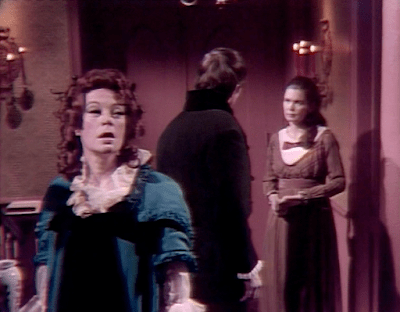
Today, we open with the countess setting a trap to expose Vicki. Haughty overlord Joshua Collins vanished from the front parlor yesterday, in the middle of an argument with his brother Jeremiah. Jeremiah looked away from Joshua for a moment, and when he looked back his brother was gone and there was a small house cat in his place. The countess insists Vicki come into the parlor and reenact Joshua and Jeremiah’s argument. Vicki keeps protesting that the whole idea is silly, but the countess will not be stopped.
The countess imitates Joshua. This is the first time we have seen Grayson Hall play one character mimicking another, and it is hilarious. I suppose it would have ruined the laugh if Vicki had shown that she was in on the joke, but at least it would have provided evidence that Vicki hasn’t left her entire brain in 1967.
The countess tries to get Vicki to speculate on what goes on behind closed doors between Joshua and his wife Naomi. Vicki says that “It’s not my place to judge their marriage,” managing to sound like a dutiful servant, if not like an eighteenth century English speaker. The countess goes on testing Vicki with provocations that seem unconnected with each other, and she tries not to say anything wrong. That goes on until the cat reappears.
Barnabas is Joshua’s son. He enters and sees the cat. Vicki leaves, and Barnabas tells the countess he doesn’t think he has ever seen the cat before. Caddish naval officer Nathan Forbes enters to confer with Barnabas about the search for Joshua. Nathan overhears the countess suggesting to Barnabas that Vicki is a witch and is responsible for making his father disappear.
Nathan finds Vicki. He tries to warn her that the countess suspects her of being a witch. This is the second time we have seen someone explicitly tell Vicki that she will have to do a better job of faking her way through her current situation, after a scene in #367 where the kindly Jeremiah told her in so many words that she would have to make up a better story to tell people about herself. No one had needed to do that for Barnabas when he was lying his way through 1967, and if they had he would have had a stake in his heart before he’d been on the show a week.
At least Vicki tried to absorb what Jeremiah told her in #367. When Nathan tells her today how bad she has made things for herself, she just gets uptight. There have always been times when the writers solved plotting problems by having Vicki do something inexplicable, but now it seems Dumb Vicki is the only side of the character we will be allowed to see.
The countess confronts Vicki again, inviting her to take a lesson in tarot card reading. As the countess probes Vicki for information, we hear Vicki’s voice in a recorded monologue, wondering if she could tell the countess the truth. She may as well- she has pretty well blown any chance she ever had at establishing a false identity for herself.
When the countess asks Vicki where she was trained to be a governess, she says that she was raised in a foundling home in Boston and was trained there. The only false part of this account is that the foundling home was in New York. Changing the location to Boston only makes it that much easier for people based in Maine to check her story and prove it false. When the countess asks when she was born, she says “March 4, 19-” and catches herself. The countess remarks on the strangeness of the slip, and Vicki is conscious enough not to fall into her trap when she invites her to put the wrong digits after “17.”
By the end of their encounter, it should be obvious even to Vicki that the countess suspects her of witchcraft. The countess presses Vicki about her knowledge of the supernatural, telling her that Barnabas regards her as clairvoyant. Vicki tries to dismiss that as “his joke.” When Vicki protests that she does not know why the countess keeps asking her questions about the supernatural, the countess impatiently tells her that she certainly does know. She declares that something terrible is happening in the house, and that she is determined to find out what it is.
Having made it clear that she thinks Vicki is a witch, the countess leaves her alone in the room with the layout of tarot cards she had been studying. Vicki decides to rearrange the cards. She thinks to herself that she will thereby warn the countess of the upcoming tragedies. But the countess will know that the cards are not where she dealt them, and it will be obvious that it was Vicki who moved them. She will know that she is receiving a message, not from whatever realm tarot cards are supposed to access, but from Vicki. If that message foretells disasters that in fact occur, she will only be confirmed in her suspicions. It is difficult to imagine a stupider act Vicki could have committed.
Difficult, but for a writer as imaginative as Sam Hall it is not impossible. In the next scene, Vicki is talking to Barnabas while the countess stands nearby. Vicki tells Barnabas that Joshua will return. She speaks with such assurance that Barnabas takes it as another sign of her clairvoyance, and the countess reacts with horror, hearing the witch declare that she is about to lift her spell.
The moment when Mrs Acilius shouted at the screen, “Vicki, SHUT! UP!” Screenshot by Dark Shadows Before I Die.
Alone with the countess, Barnabas admits that he is starting to think that she may have a point about witchcraft. The countess answers that he is becoming wise.
Closing Miscellany
The asthmatic Grayson Hall has a coughing fit during her scene with Vicki and the tarot cards. It is one of the less amusing bloopers, she really sounds like she’s suffering.
I chuckled a little when Vicki stops at “19-” in giving her birthdate. Alexandra Moltke Isles’ year of birth is given on various websites as early as 1943 and as late as 1949. I think it is only fitting that someone so central to a show like Dark Shadows should be a little mysterious, so I’m glad that all we really know about Mrs Isles’ birth is that it took place on 11 February 194-.
Vampire Barnabas Collins has been part of Dark Shadows at least since we first saw his portrait on the wall of the great house of Collinwood in #204, more properly since they went to great lengths to make it look like there was a portrait on that spot in #195. He is now the main force driving the action of the show, and pretty much the only reason people are tuning in to watch it. The ghost of Barnabas’ ten year old sister, Sarah, first appeared in #255; ever since, we’ve been waiting for the two of them to meet. At the end of yesterday’s installment, they finally did.
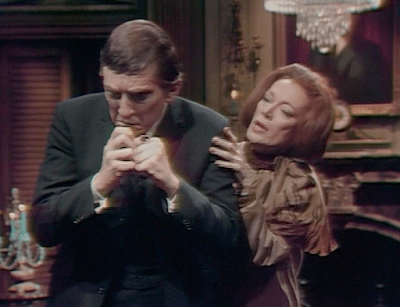
Barnabas was in his living room, trying to choke the life out of his only friend and would-be lover, mad scientist Julia Hoffman. Sarah materialized, and he let Julia go.
This echoes a scene in #341. Barnabas and Julia were in the act of murdering her medical school classmate and onetime friend, Dave Woodard, when Woodard claimed to see Sarah. At that, Barnabas almost let Woodard escape. Only when Julia called out “Stop him!” did Barnabas take hold of Woodard and kill him. Not only is he murdering a good-guy character, he has coerced Julia into taking part in the crime and will gloat over her new status as a murderer. But in the middle of all that loathsome cruelty, we see a flash of his longing for his baby sister. It is a tribute to actor Jonathan Frid that we can feel Barnabas’ loneliness and want to like him even in the middle of one of the character’s very darkest moments.
This time, Sarah really is there, and she really does stop a murder. There is a puzzle as to why. In #360 and #361, Julia knew that Barnabas wanted to destroy her, and appealed to Sarah for help. Sarah refused, saying that she liked Dr Woodard and knew what Julia did to him. We heard Sarah’s “London Bridge” theme on the soundtrack during the murder of Woodard, so it is clear that she witnessed that crime. But if she can stop Barnabas killing Julia, why couldn’t she stop him killing Woodard?
Today is only the second time Sarah has appeared to more than one person at a time. When Barnabas’ ex-victim Maggie Evans, The Nicest Girl in Town, wanted to escape from the hospital where Julia was keeping her locked up in #294, both she and her nurse could see and hear Sarah. Maybe it is difficult for Sarah to manifest herself to two people, and impossible for her to show herself to three. In that case, Julia’s presence would have stopped Sarah from saving Woodard.
It’s also possible that Sarah can’t do anything that will lead to Barnabas’ capture. She has appeared to many people and given all of them clues about the strange goings-on, but she has referred directly to Barnabas only when speaking to his partners in crime Willie and Julia. Time and again she has stopped short of giving information that would expose her big brother. When Barnabas and Julia moved against Woodard, he was calling the sheriff. Woodard might have placed himself beyond Sarah’s protection when he picked up the telephone.
Indeed, if Barnabas does kill Julia now, he will probably be caught. Julia has given a notebook full of incriminating evidence about Barnabas to a local attorney to be handed over to the authorities in case anything happens to her. Besides, everyone knows she spends a great deal of time at Barnabas’ house, so if she suddenly goes missing he will be investigated. By preventing Barnabas from killing Julia, Sarah is protecting him from exposure.
Sarah tells Barnabas that he taught her the first lessons she ever received in morality, and that he has now forgotten them himself. He begs her to stay, showing at length the vulnerability and need that have been so effective at recruiting our sympathy when we have glimpsed them before. She says she will never appear to him again, not until he learns to be good. We’ve known him long enough to know that this will be an extremely long wait.
Sarah vanishes. Julia sees her friend shattered. She approaches him. She addresses him, for the first time, as “Barnabas, Barnabas.” He recoils from her. He does not renew his attempt to strangle her, but he does tell her in the coldest imaginable voice that he could kill her as easily as he could crush a moth. It hasn’t been two minutes since his little sister reduced him to tears, and he has snapped back into his place as death itself.
Some say that Barnabas’ frequent references to his longing for Sarah during these weeks are meant to make him easier for the audience to sympathize with. I think this scene shows that the opposite is more nearly the case. They’ve undercut every other ground for liking Barnabas, leaving us only his love for Sarah. When we see that not even a visit from Sarah can thaw him out for any length of time, not only do we have to give up any hope that there is a nice guy hidden inside him, but we also hear the door slamming shut on any possibility that his character will develop in a way that will surprise us. Since he is the show, the closing of that door means that Dark Shadows 2.0 is all but over.
In the great house, matriarch Liz breaks the news to well-meaning governess Vicki learns that the authorities in Brazil have identified one of the corpses found in the wreckage of an airplane that crashed outside Belem as that of Vicki’s depressing fiancé, Burke Devlin. It has been clear for some time that Burke probably died in that crash, so Liz is worried that Vicki’s refusal to accept their verdict is a sign that she is in an unhealthy denial about the facts of the situation.
In the first 25 weeks of Dark Shadows, Burke was a major figure, the arch-nemesis of the Collins family. His storyline never really took off, though, and when undead fire witch Laura Murdoch Collins was on the show from #126-191 his issues were all absorbed into her arc. He formally renounced his grudge against the Collinses in #201, and has been surplus to requirements ever since.
There is just one thing I wish they had done differently about Burke’s death. During the early period of the show, there was a story about high-born ne’er-do-well Roger Collins trying desperately to hide a custom-made filigreed fountain pen of Burke’s. That dragged on for months, and dominated 21 whole episodes. It would have been a nice Easter egg for those of us who sat through those not-very-interesting installments if Liz had said the authorities were able to identify Burke’s body in part because that pen was on it.
There is a bit of intentional comedy this time that works very well. Telling Barnabas of Vicki’s refusal to accept Burke’s death, Liz exclaims “She can’t go on loving a dead man all her life!” Barnabas is clearly offended by this remark, quite understandably since he is deceased himself. He responds that “It has been known to happen.” But he manages to keep cool enough that Liz doesn’t notice.
This episode marks the last appearance of Sharon Smyth as the ghost of Sarah Collins.
Episode 1-274 of Dark Shadows each began with the words “My name is Victoria Winters,” delivered in voiceover by Alexandra Moltke Isles and leading into a few sentences vaguely related to the plot of the show. Beginning with #275, these voiceovers might be delivered by any actress with a speaking parts in that episode, and do not involve their character’s names. Many are written in the first person, however, as is today’s:
There has been a homecoming in the great house of Collinwood, and those who have returned have found that very little has changed. We still live within a ring of fear, a fear that is generated by the one who lives in the Old House, where on this night a kind of madness prevails, a madness that will lead to the threat of murder.
Every time this happens, the Dark Shadows wiki complains that “by this time in the series, the narrations are no longer spoken in character.” That complaint might have made sense if only a few of the episodes since #275 included first person pronouns, but dozens of them do. So we would have to say that they often are spoken in character, but that it isn’t always clear who the character is. The wiki editors will be glad from now on, because this is the last time a narrator says “we.”
Things have been happening fast on Dark Shadows for the last several days, and writer Ron Sproat was always aware of the need to let new viewers catch up. This is the first chance Sproat has had to write a Friday episode in some time, and since some people would watch daytime soaps only on Fridays, he goes in today for some extra heavy recapping about doings at the estate of Collinwood.
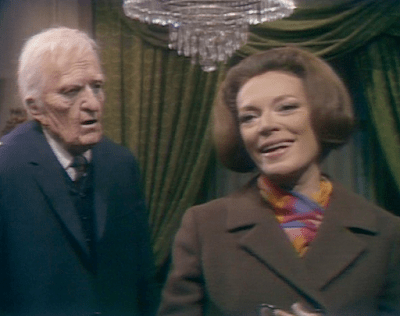
As a result, the first half of the episode is confusing to viewers who have been watching regularly. In recent days, the ghost of ten year old Sarah Collins gave a toy soldier to strange and troubled boy David to keep with him as a talisman against evil; David had a premonition that his cousin, heiress Carolyn, was in danger, and passed the toy soldier on to her; Carolyn saw Sarah, and gave the toy soldier back to David; and as we begin today, David brings the toy soldier back to Carolyn. David catches a glimpse of an extremely old man peering in through the window of the drawing room; he is gone by the time Carolyn turns to look. They talk about ghosts and visions, reenacting in one scene Carolyn’s whole progression from total rejection of David’s claims about the supernatural to total openness to them, and David’s from a desperate need to be believed to an even more desperate fear that Carolyn will be killed unless he can convince her he was lying about everything.
Carolyn tells her mother Liz that she doesn’t think David is lying, and decides to confront Liz’ aversion to the topic of ghosts and tell her that she has seen Sarah. Liz says she thinks David is mentally disturbed and must be sent away to an institution; eavesdropping, David reacts with horror. He meets Carolyn in the foyer afterward. He asks her if she thinks he is crazy. When she says she doesn’t, he says that maybe he is. He pleads with her to reject his stories as either delusions or lies.
The old man David saw looking at Carolyn is their distant cousin Barnabas, who is, unknown to them and the other residents of the great house on the estate, a vampire. Mad scientist Julia Hoffman has been trying to cure Barnabas of vampirism, but she inadvertently restarted the aging process which his condition had arrested. No longer does he look like a man in his forties- now he appears to be about ninety. He fears that if he does not start sucking people’s blood again tonight, he will soon turn into the pile of dust he would have been long ago were it not for his curse.
In Barnabas’ home at the Old House on the estate, we see him talking with Julia. His peeping at Carolyn might suggest that he has her in mind as his victim, but he does not mention her. Instead, he says he will go out into the town of Collinsport and find a stranger. Julia is disappointed that Barnabas is not planning to bite well-meaning governess Vicki, with whom she had hoped never to have another conversation. So she offers herself as a victim instead.
This offer stuns Barnabas so deeply that, for the first time, he addresses Julia by her first name. She smiles when he does this. He seems sincerely dismayed by the thought of enslaving Julia. When he tells her that if he bites her, she will have no will of her own, she smiles even more brightly. Evidently Julia believes that would be a price well worth paying if it kept Vicki from talking to her.
Julia contemplates enslavement. Screenshot by Dark Shadows Before I Die.
Barnabas declines the offer, saying that he might need to call on Julia for medical treatment at some point in the future and that as a blood thrall she wouldn’t be able to function as a doctor. Julia is hurt by Barnabas’ refusal, and asks him if the only reason he won’t enslave her is that he wants to use her professional services, and he assures her that it is.
Back in the great house, Carolyn stands in the foyer under the gaze of Barnabas’ portrait. She looks at the toy soldier and wonders about David. She decides to go to Barnabas’ house and look for evidence of the things David had claimed to see there. Oddly, she sets the toy soldier on the table and leaves without it.
Carolyn lets herself into Barnabas’ house, goes to his basement, and finds his coffin. Julia sees her there and tells her to leave immediately, “before it’s too late.” We hear Barnabas’ voice announcing “It is already too late.” Carolyn is baffled by Barnabas’ aged appearance. He moves in, bares his fangs, and bites her.
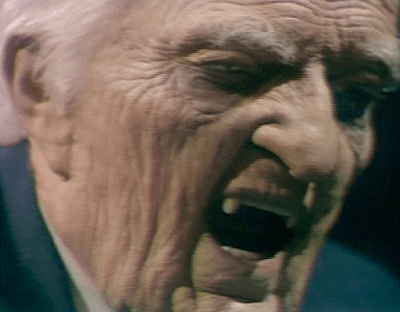
Barnabas’ old man makeup is phenomenally good, as all the Dark Shadows blogs mention. The show was very lucky to land Dick Smith, one of the pre-eminent makeup artists of all time, to do it. But I would add that Jonathan Frid’s acting takes Smith’s appliances and turns them to the best possible advantage. It is utterly absorbing to watch him as a man suddenly thrust into extreme old age, trying to figure out how to move his newly enfeebled limbs. In Frid and Smith, two artists at the top of their form collaborated to create a remarkable turn.
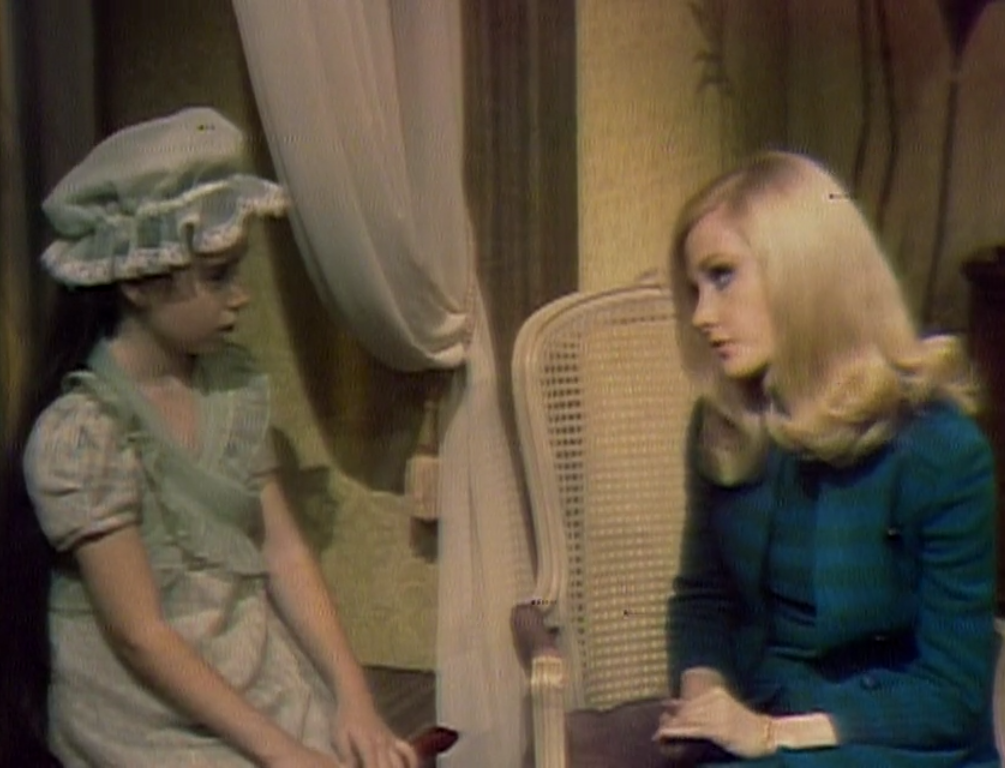
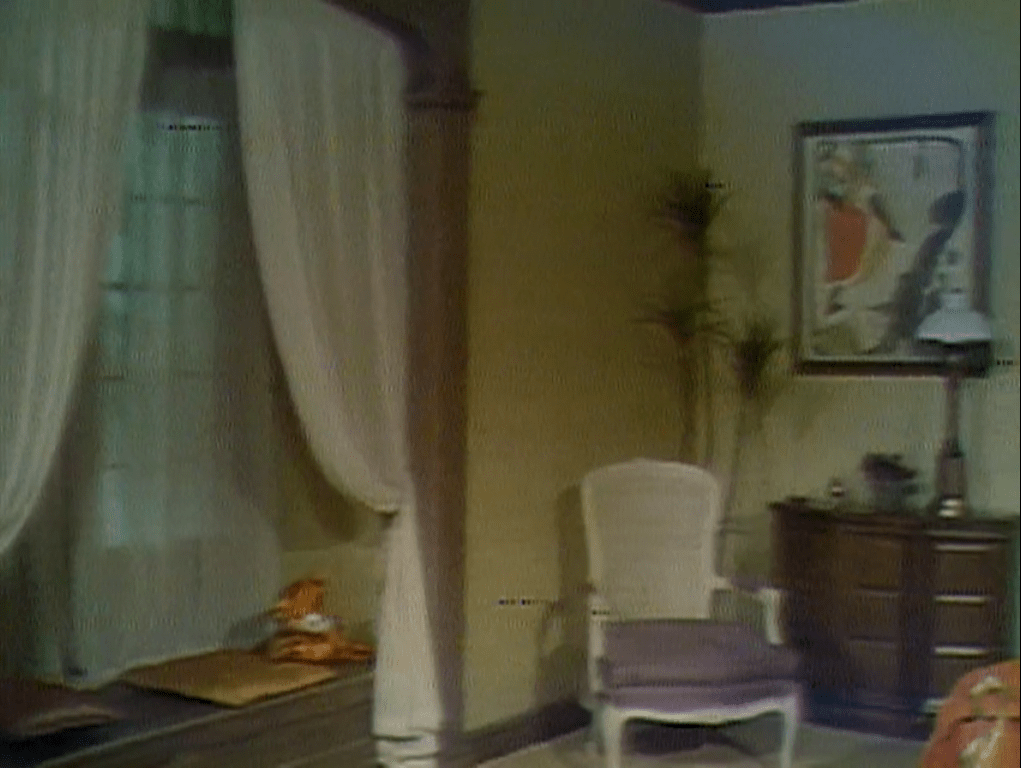
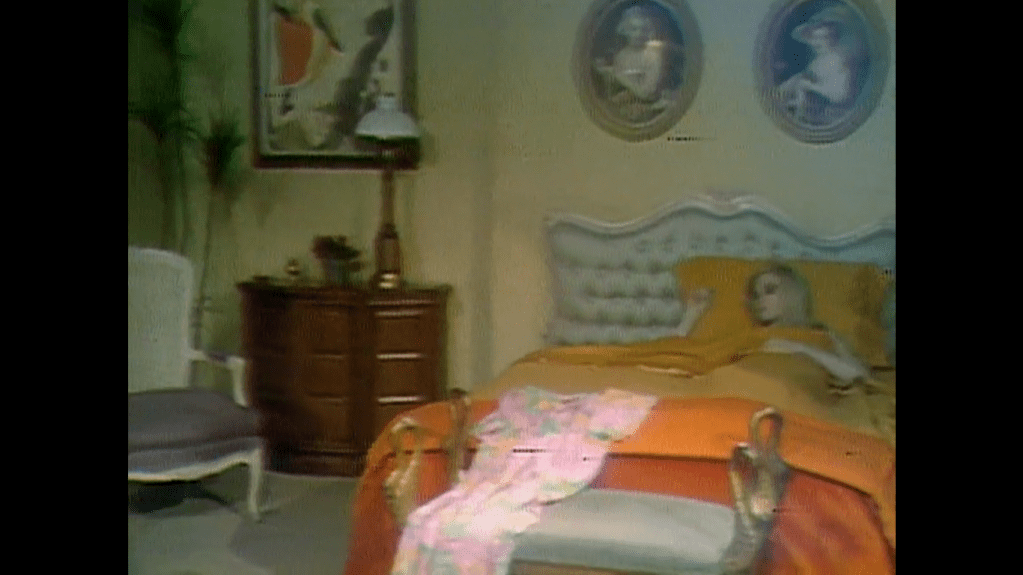
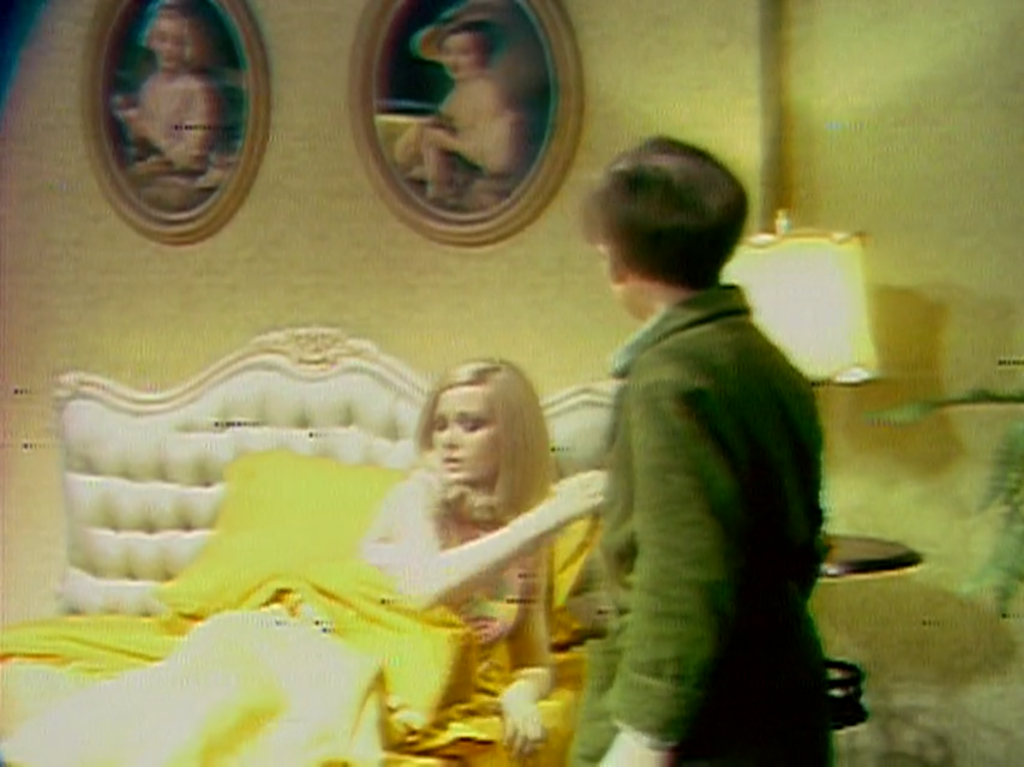
We open on a new set, the bedroom of heiress Carolyn Collins Stoddard in the great house of Collinwood. Dark Shadows has been in color since #295 in August. Though directors Lela Swift and John Sedwick were both ambitious visual artists, they haven’t been able to do much with color so far. With Carolyn’s bedroom, Swift and the staging team have accomplished one of their first real essays in color. It is composed mostly of shades of yellow, pink, and orange.
The color schemes of the other interiors we’ve seen up to this point run the gamut from sedate to subdued to drab to dank, so we already know we are in a unique space. The only other room in Collinwood that might have matched this one for brightness was the kitchen, but we haven’t seen that since #208.
Carolyn’s young cousin, strange and troubled boy David, lets himself into her room. He touches her, and she awakes with a scream. He explains that he just dropped in to make sure she wasn’t dead. When she turns on the light, the screen is so bright that I reflexively squinted, a reaction I’d never before had to an image on Dark Shadows.
Bright room.
David can’t quite explain why he was afraid Carolyn might be dead, but he does insist that she take an antique toy soldier, saying that she will be safe if she keeps it with her. Carolyn’s mother, matriarch Liz, comes into the room to investigate Carolyn’s scream. Liz wonders what David is doing there. Carolyn hastens to say that he was just making sure she was all right.
David goes, and Carolyn tells Liz she doesn’t think anything can be done for him at home. Liz is reluctant to send him away. Regular viewers will not be surprised by this. We know that Liz took David and his father, her ne’er-do-well brother Roger, into Collinwood at the beginning of the summer of 1966 and summoned her unacknowledged daughter, well-meaning governess Vicki, to come look after David starting with #1 on 27 June 1966, so that her conviction that the family ought to look after him got the whole show started. Nonetheless, Liz is so disturbed by David’s unusual statements and depressive affect that she agrees that he needs residential care.
We cut to the Old House on the estate. Vampire Barnabas Collins is sitting in a basement room where mad scientist Julia Hoffman maintains a laboratory. The room is full of electrical equipment, a bit odd since the Old House has no electricity; the laboratory itself is lit by flaming torches. But if we’ve ever seen a Universal Studios production from the 1930s, we know that where you find a mad scientist, you will find electrical currents, so naturally things start buzzing when Julia flips a switch.
Barnabas confined
Julia is trying to implement a medical cure for Barnabas’ vampirism. In the first shot of this scene, we see a visual metaphor for that project. Barnabas, an uncanny being, is confined to a small space in the middle of an elaborate collection of technology. If Julia succeeds, the supernatural will be vanquished altogether and scientific rationality will fill the whole world. The color scheme emphasizes the contrast between Julia’s optimistic goal and the terrain on which she operates. The walls and floor are dominated by the grays and browns of the basement, but the frames and tubing of her equipment are a bright metallic hue, light plays on the glass components, and the intense greens, reds, and blues of the potions are distributed in a slightly unbalanced, lively pattern. The irregular shapes of the frames and tubing emphasize this pattern, and contrast with the solid gray of the floor and the even grid of the brickwork on the walls.
This image not only represents Julia’s plans, but also one of the major themes the show is exploring at this period. Too many characters have encountered too much evidence of supernatural forces and beings for anyone to simply deny that such things exist. But even those who have been most heavily exposed to them keep reverting to a naturalistic frame of reference. Sure, Julia spends all her time hanging around with a vampire and has encountered a couple of ghosts, but she’s determined to ring all of those phenomena around with scientific explanations and technological interventions until they yield to rational control.
Julia’s project has hit its first major setback, as the latest treatment led Barnabas’ hands to age dramatically. He expresses the fear that time will catch up with him, and his apparent age will soon catch up with his actual age, something like 200 years. Julia’s hope that her experiment will not only free Barnabas of his curse, but found a new kind of medicine that will free everyone else of aging and death, will thus be defeated.
Barnabas gives a remarkable little speech about the situation he finds himself in:
I’ve been granted privileges given to few other men… For most men, time moves slowly, so very slowly. They don’t even realize it. But time has revealed itself to me in a very special way. Time is a rushing, howling wind raging past me, withering me in one relentless blast and then continues on. I have been sitting here passively, submissive to its rage, watching its work. Listen. Time, howling, withering.
Writer Joe Caldwell has a fine sense of what actors can do, and this odd little bit of purple prose is right in Jonathan Frid’s wheelhouse. It doesn’t make a whole lot of sense, but the sound of his voice delivering it is so gorgeous it may as well be Shakespeare. Well, maybe not Shakespeare, but Ben Jonson at least.
It is possible to read this speech as a programmatic statement. Daytime soap operas of the 1960s were famously slow-paced; the old joke was that a viewer saw an episode that ended with a character hearing a telephone ring, missed four months of the show, and tuned back in to see the episode that started with the same character saying “Hello.” Even by the standards of the period, the first months of Dark Shadows were notoriously leisurely, with action often as not playing out in real time. When we are watching the 21 episodes centering on Roger’s attempts to find a fountain pen he misplaced, it is indeed the case that “time moves slowly, so very slowly.” But those days are behind us. The show is whipping through plot points at a pace that many prime time series contemporary with it would have had a hard time matching.
If the speech is programmatic, it is also autobiographical on the part of the screenwriter. A fast pace promises excitement for the viewers, but makes life hard for a writing staff that never numbered more than three. Indeed, this is the last episode Joe Caldwell will write for two and a half years. Perhaps he felt the demands of the new pace as “a relentless blast” withering his talents, and had to bow out.
We return to Carolyn’s room. She is in front of her mirror, contemplating the toy soldier. She hears the strains of “London Bridge” playing on a wooden flute, which she has learned is a sign that the ghost of ten year old Sarah Collins is present. Carolyn grew up in this haunted house, so it may not be entirely surprising that her response is to lean back and enjoy the music. But she sits up when Sarah manifests herself in visible form.
Ghost in the mirror
Sarah speaks, and Carolyn sees her reflected in her mirror. The following scene is so extraordinary I’m going to transcribe all of the dialogue:
Sarah: David must have given you that.
Carolyn: Sarah!
Sarah: He told you my name.
Carolyn: Sarah, how did you get in here?
Sarah: Didn’t David tell you?
Carolyn: Tell me what?
Sarah: All about me.
Carolyn: I’m not sure I understand.
Sarah: I think I’m a ghost. Matter of fact, I’m sure I am.
Giving the facts
This is the first time Sarah has described herself in any terms, certainly the first time she has called herself a ghost. Her coyness about herself had left David confused about what she was; it was not until #325 that he finally concluded that she was a ghost. After that, she became more forthright with him. When he wasn’t sure what she was, she would wait until she was out of his line of sight to appear and disappear. But in #327, she fades away while he’s looking right at her.
Coming out to David not only allowed Sarah to relax around him, but has led her to discard her coyness altogether. She is startlingly blunt with Carolyn as this conversation goes on:
Carolyn: B-but- I don’t believe in-
Sarah: Yes you do. Or I wouldn’t have been able to come here. You’re not afraid of me, are you?
Carolyn: No…
Sarah: If you are, I understand.
This is the first confirmation that Sarah can appear only to those who are prepared to believe in her. It’s true that most of the people who have seen and heard her- David; Maggie Evans, The Nicest Girl in Town; Maggie’s father Sam; Vicki; Barnabas; Julia; Barnabas’ sometime blood thrall Willie; and local physician Dave Woodard- have either had extensive contact with the supernatural or had reasoned their way to the conclusion that she existed. But she also showed herself to Maggie’s nurse at the mental hospital Julia runs, and we don’t know anything about her background or beliefs. And local man Burke Devlin heard Sarah when she and David were talking in #327. While Burke has had plenty of contact with supernatural beings and in the early days of Dark Shadows, when he was fun, was willing to believe in them, he was at that point tearing around bellowing that there were no such things as ghosts. So this is new and unexpected information.
Carolyn’s denial that Sarah frightens her is given in a trembling voice that shows it to be a lie. Still, she isn’t as frightened as she might be. The other day, in #344, Carolyn was in David’s room when Sarah manifested there, not in the visible form of a little girl, but as the sound of “London Bridge” and as information appearing in David’s mind about Burke’s imminent death. Carolyn was terrified of Sarah when she came that way.
Carolyn: Well, what do you want?
Sarah: Don’t send David away.
Carolyn: How do you know about that?
Sarah: I don’t know, I just do.
At this point, we see Carolyn’s fear fading. She is starting to react to Sarah as if she really were a ten year old girl.
Carolyn urging Sarah to be reasonable.
Carolyn: But Sarah, we have to send David away. It’s the only way we can help him.
Sarah: But if you send David away, I won’t have anyone to play with.
Carolyn: Well, maybe it isn’t good for David to play with you.
Sarah: Why do you say that?
Carolyn: Because it leads him into believing all sorts of things that aren’t true.
Sarah: How do you know they’re not true?
Carolyn: Well, they’re just not, they couldn’t be.
Sarah: He wasn’t lying about me, was he?
Carolyn: No.
Sarah: Well.. then maybe David is acting the way he is because no one will believe him.
Carolyn: But… it isn’t possible.
Sarah: People say I’m not possible, but I am. Why doesn’t that make the rest possible?
Carolyn: Sarah, maybe you don’t know the stories David’s been telling!
Sarah: Why do you think that?
Carolyn: Because they’re too fantastic! And besides, they’ve all been proved false.
Sarah: How do you know they’ve been proved false?
Carolyn: Sarah, are you trying to tell me that Barnabas actually slee-
This exchange is the ultimate example of a character accepting the existence of a particular supernatural being and then snapping back into a frame of reference that does not allow for supernatural beings. Carolyn knows that Sarah is a ghost, and starts arguing with her about how fantastic the world is permitted to be.
There comes a knock at the door. Carolyn turns away from Sarah to look at the door, and when she looks back, Sarah has vanished. Regular viewers know that Sarah was Barnabas’ little sister, that she wants to keep him from doing horrible things to people she likes, but that she will not say anything against him. So when Carolyn says Barnabas’ name, we know that Sarah is about to vanish.
Sarah’s part is an outstanding example of writing to an actor’s abilities, even more so than was Barnabas’ speech. Caldwell knew that Jonathan Frid had a flair for making flowery gibberish appealing, because that is what he has been doing the whole time he’s been on Dark Shadows. What Sharon Smyth has been doing well as Sarah is being a cutie pie and creating a vague and mysterious impression. When she has more than a few lines to deliver, things tend to get very wobbly. Today, she has to maintain a commanding tone and an adult demeanor throughout an extended patch of rapid-fire dialogue. Absolutely nothing we have seen on screen would suggest that she could handle that. But she pulls it off, more than competently. There are a few glances at the teleprompter, but at no point does she break out of the patient and authoritative manner she has to adopt. It is an impressive job of acting by any standard.
The person at Carolyn’s door is Liz. Liz is Dark Shadows‘ queen of denial. Viewers who have been with the show from the beginning have seen a few cracks in her facade of disbelief in the supernatural. In #10, she dozed off in the drawing room and started talking in her sleep about ghosts. When Vicki insisted to her in #127 that she had seen a ghost, Liz said she believed her. And in #280 and #281, Liz reluctantly agreed to participate in a séance, and afterward agreed that Vicki had been possessed by a spirit. But even in those moments Liz was fighting to keep the topic of ghosts at bay, and the rest of the time she has presented a blank wall to any attempt to face facts about the strange goings-on. So it is not surprising that Carolyn tells her mother she was talking to herself while tidying up her room.
Having talked Liz into sending David away, she now has to talk her back out of it. She manages to get her to agree to wait a few days. “London Bridge” plays. Carolyn reacts to it, Liz does not.
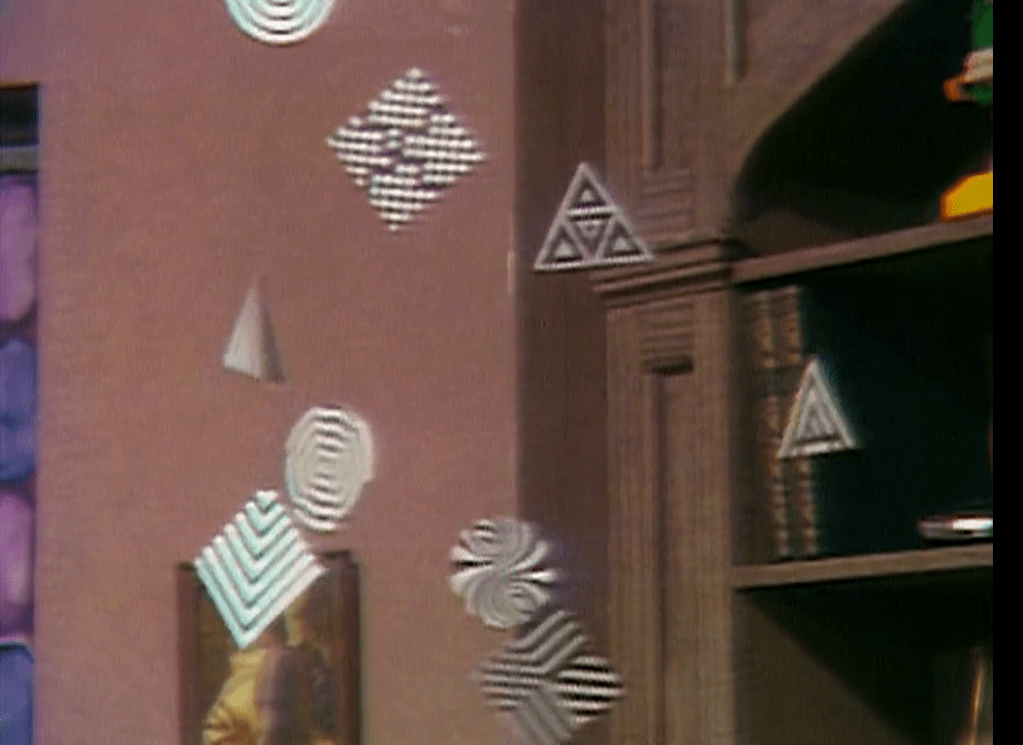
In his room, a distraught David is looking at a mobile. Its whimsical black and white markings suggest a puzzle and make a stark contrast with the vivid colors around them.*
Puzzling shapes.Back to the wall.
Carolyn comes in. She brings the toy soldier and tells David she doesn’t think she will need it. He insists that she will, but she explains that Sarah visited her and now she believes him and knows how to help him. David is horrified by this. He says that Sarah visited Dr Woodard, that Woodard believed him, and that led to his death. He begs Carolyn not to believe him and claims to have been lying. He sobs and clutches her.
Anguished embrace.
Back in the Old House, Julia prepares to give Barnabas another treatment. He snaps at her. She tells him that whatever happens, she wants him to know that she always wished him well. That prompts him to unload a further stream of sour remarks about her competence and intentions. Julia carries out the treatments, only to find that the aged appearance of Barnabas’ hands has spread to his head.
In his post about this episode on Dark Shadows Every Day, Danny Horn puts it well when he says that “This is just good soap opera construction. People that we care about, facing terrible danger, and desperate to help each other.” He’s referring specifically to the scenes between David and Carolyn and Liz, but it applies to everyone. We care not only about the good people in the great house (well, they’ve been relatively good, lately,) but also about Barnabas and Julia, evil people who are the terrible danger David and Carolyn and Liz are facing, but who make the show fun to watch. We care about Sarah too, and she’s desperately trying to accomplish exactly the result we most want to see, an outcome in which David, Barnabas, and everyone else we enjoy watching stays on the show.
*Evidently this mobile was a commercially produced item. One of the commenters on Danny Horn’s Dark Shadows Every Dayreports having had one like it as a child.
Vampire Barnabas Collins is in a chirpy mood. He and his associate, mad scientist Julia Hoffman, have just committed the premeditated murder of Julia’s medical school classmate Dave Woodard. As we saw when Barnabas made his sorely bedraggled blood thrall Willie to help him hide the corpse of seagoing con man Jason McGuire, nothing makes him happier than forcing someone to help with the killing of a former friend.
I think the actors were placed behind the laboratory apparatus intentionally, to highlight the characters’ helplessness and isolation.
Today, Julia wants to stop her attempt to cure Barnabas of vampirism, but he won’t hear of it. When she tells him she might try to kill him instead of curing him, Barnabas relishes telling her that he trusts her completely. She does knock him out of his blissful state when she suggests that if she manages to turn him into a real boy, he might have a conscience. He gives a little speech in which he says some brave things about being willing to accept the punishment fitting a man who had done the things he has done if he also gains the ability to love as a man can love. Jonathan Frid puts enough into this speech that it is possible to sympathize with Barnabas in the moment that he is delivering it.
That moment doesn’t last very long. By the end of the episode, we are back on this set, where Julia says that “someone” might love Barnabas as he is, and he takes delight in her humiliation as he makes it obvious that he knows she is referring to herself.
Some say that Barnabas’ speech about wanting to love is meant to make the character more likable, but it has the opposite effect when he so smoothly transitions back into this gleeful cruelty. The other day, Julia told Barnabas that she had wondered whether he was capable of feeling any emotions at all, but we see in this scene what we’ve seen all along, that he is nothing but emotion. Except when he is acting, trying to convince the living members of the Collins family that he is their long-lost cousin from England, his feelings are right on the surface. For a minute or two, he has some feelings about love and justice, and we see those very clearly. But that is a brief interlude in the middle of his entirely gratuitous torture of Julia. We are left in no doubt that he takes an utterly unmixed pleasure in causing her pain. We’ve already seen very cold villains on Dark Shadows and before the series ends we will see more, but by the end of this scene Barnabas claims the crown of most detestable character ever to appear on the show. It’s so hard to imagine how he could possibly sustain such a level of malignity that it’s no wonder viewers still keep tuning in to see what he will do next.
The main theme of the episode is the contrast between Barnabas’ relationship with Julia and his relationship with well-meaning governess Vicki. For the first 39 weeks of Dark Shadows, Vicki was the audience’s main point-of-view character; now Julia is the one who knows what we know, and who makes things happen when she learns new information. Seeing Barnabas first with one woman, then with the other, we see how the show has been changing since he joined the cast.
Barnabas eavesdrops on Vicki’s conversation with her depressing fiancé Burke on the terrace at the great house of Collinwood, then slides in and claims to have inadvertently overheard the last few words of their conversation. Burke gives Barnabas a dirty look, then excuses himself to do some telephoning while Vicki and Barnabas stay on the terrace and talk for a little while.
Barnabas has some vague idea of seducing Vicki, an idea he has been remarkably desultory about pursuing. In this scene, he does the only thing he has ever really got round to doing about it, which is to listen sympathetically while Vicki tells him her troubles. This time, she’s trying to convince herself that she wants what Burke wants, which is to get away from Collinwood and start a new life somewhere else. It isn’t an exciting situation, but Alexandra Moltke Isles delivers her lines with so much urgency that it holds our attention.
Vicki shares her anguish with her kindly friend Barnabas
Julia eavesdrops on this conversation. She looks miserable. Whatever she may have had in mind when she first came to Collinwood, Julia is stuck with Barnabas for the foreseeable future. Not only has Julia murdered one of her oldest friends for Barnabas’ sake, she has involved herself so deeply in so many of his activities that it is unclear how she would go back to the successful professional life she had before she met him even if he were destroyed. If he is going to spend his time hanging around other women, she faces a drab prospect.
Julia contemplates a lonely future
In the drawing room, Burke, Vicki, and Julia talk about the death of Dr Woodard. Julia can’t bear the topic, and excuses herself to go out to the terrace. There, she catches a glimpse of Woodard’s ghost. Julia screams, Burke and Vicki come, and all she can do when they ask what’s wrong is to keep jabbering that “he wasn’t there.”
There are some rough patches in the script today. For example, in the opening, Julia is touching the equipment when Barnabas exclaims “Don’t stop!” This is puzzling- she doesn’t appear to be stopping anything. And when Julia says “He wasn’t there,” Vicki has to ask “Who wasn’t there?” A person might reflexively say such a thing, and Mrs Isles’ rapid delivery of the line and simultaneous movement of the neck and the shoulders suggest such a reflex. That’s probably the best choice any actor could have made, but the line still gets a bad laugh. Barnabas and Julia’s successive eavesdropping expeditions also come off as some kind of joke, and all the scenes take too long. The whole thing could have used another trip through the typewriter. Still, writer Joe Caldwell was at his best with miniature character studies, and while he may not have had the time he needed to give this one his usual polish, the actors still have more than enough to show what they can do. It’s a fairly good outing, all things considered.
We open in the Old House on the great estate of Collinwood, home to courtly gentleman Barnabas Collins. In a bedroom there occupied by Barnabas’ servant Willie, Sheriff George Patterson and artist Sam Evans have found evidence that convinces them they have solved the case of the abduction of Sam’s daughter Maggie. They found Maggie’s ring hidden in a candlestick. The room is in Barnabas’ house and he has unlimited access to it. Further, the house is the only place Willie could possibly have kept Maggie if he had held her prisoner. But for some unexplained reason, they are sure that the ring proves that Willie and only Willie abducted Maggie. When Barnabas says that he feels somehow responsible, Sam rushes to tell him that he mustn’t blame himself.
The sheriff says that he will be going to the hospital, where Willie is recovering from gunshot wounds the sheriff’s deputies inflicted on him when they were looking for a suspect. Barnabas hitches a ride with him.
At the hospital, Willie’s doctor, addled quack Dave Woodard, is conferring with his medical colleague Julia Hoffman. When he steps out of the room for a moment, we hear Julia’s thoughts in voiceover. She is thinking about killing Willie before he can regain consciousness and tell a story that will make it impossible for her ever to practice medicine again. She thinks of Barnabas’ voice demanding that she kill Willie. She is reaching for the catheter through which Willie is receiving fluids when Woodard comes back in. She tells him she was checking it, and he is glad when she confirms it is working correctly.
Returning viewers know that Barnabas is the one who abducted Maggie and committed the other crimes of which Willie is suspected, that he is a vampire, that Julia is a mad scientist trying to cure him of vampirism, and that in pursuing her project she has become deeply complicit in Barnabas’ wrongdoing. We also know that she has several times told him that she will draw the line at killing anyone herself, but that she has involved herself in so many other evil deeds that it was just a matter of time before she found herself on the point of crossing that line.
Barnabas and the sheriff arrive at the hospital. In the corridor, Barnabas is bewildered to find that the sheriff will not allow him to be present while he questions Willie. The sheriff has been so careless about treating miscellaneous people as if they were his deputies- for example, enlisting Sam yesterday to help him search Willie’s room- that Barnabas’ puzzlement is understandable. The conversation goes on for quite a while.
Note the poster that reads “Give Blood.” That’s a message Barnabas could endorse. Screenshot by Dark Shadows Before I Die.
The sheriff enters Willie’s room, and greets Julia as “Dr Hoffman.” Woodard thinks Julia has come to Collinsport to investigate Maggie’s abduction, and so he has agreed to keep her professional identity secret from most people in town, including the sheriff for some reason. Therefore, she is startled at this form of address. Woodard explains that now that Maggie’s abductor has been identified, he doesn’t see a point in keeping law enforcement in the dark.
Julia meets Barnabas in the corridor. When she tells him that she didn’t kill Willie, he fumes and calls her a “bungling fool.” He says he will do the job himself, but Julia points out that Woodard and the sheriff are in the room with Willie now. They wind up staring at the clock for hours.
Willie regains consciousness. He doesn’t recognize Woodard. When the sheriff shows him Maggie’s ring, his eyes gleam and he claims that it is his. Returning viewers will remember that before Willie ever met Barnabas, he was obsessed with jewelry. He is terrified when he learns that it is night-time, and says that he knows why he is afraid.
The sheriff and Woodard go out into the corridor to talk with Julia and Barnabas. Woodard tells Julia that she was right- Willie is hopelessly insane. Apparently when they asked him what he was afraid of, he mentioned “a voice from a grave. Nothing else made more sense than that.”
Julia and Barnabas go into Willie’s room. He looks at Barnabas and asks “Who are you?” Barnabas shows surprise that Willie doesn’t know him. Willie asks if he is a doctor. “Yes,” replies Barnabas. “I am a doctor.”
Sheriff Patterson is played by Dana Elcar today. It is Elcar’s 35th and final appearance on Dark Shadows. He would go on to become one of the busiest and most distinguished character actors of his generation.
Elcar had his work cut out for him with the part of Sheriff Patterson. If a police officer on the show ever solved a case, or followed any kind of rational investigative procedure, or interpreted a clue correctly, the story would end immediately. So all the sheriffs and constables and detectives have to be imbeciles. Elcar reached into his actorly bag of tricks almost three dozen times, and always came out with some way to make it seem as if something more was going on in Sheriff Patterson’s mind than we could tell.
My wife, Mrs Acilius, exclaimed “I’m so glad Dana Elcar is playing this scene!” when Barnabas and the sheriff had their long conversation in the hospital corridor. This week’s episodes were shot out of sequence, so yesterday’s was made after Elcar had left. It featured Vince O’Brien as Sheriff Patterson. O’Brien was by no means a bad actor, but he didn’t make the character seem any smarter than the script did. Elcar seems so much like he has something up his sleeve that Jonathan Frid’s insistent pleading makes sense as a cover for a mounting panic. Without Elcar to play against, it might just have come off as whining.
With the conclusion of Willie’s story, this is John Karlen’s last appearance for a long while. Beginning shortly after Barnabas’ introduction to the show in April, his conversations with Willie have been the main way we find out what he is thinking and feeling. More recently, Willie and Julia have been having staff conferences in which they come up with new ideas and add a new kind of flexibility and dynamism to the vampire storyline. From time to time, Willie’s conscience gets the better of him, and he adds an unpredictable element to the story as he tries to thwart one of Barnabas’ evil plans. For all these reasons, removing Willie from the show drastically reduces the number of possible outcomes in any situation they might set up involving Barnabas. His departure, therefore, seems to signal that some sort of crisis is at hand.
In fact, Karlen wanted to leave Dark Shadows because he had a better offer from a soap called Love is a Many Splendored Thing. But the producers knew that no one else could play Willie after the audience had got used to Karlen, and so they wrote the character out until they could get him back. Still, losing Willie puts Barnabas’ story on a much narrower track. So far, each development has led us to speculate about an ever-growing list of directions the story might possibly take. From now on, we are entering a phase where we will often be stumped as to what might be coming next.
We open with the most spectacular dream sequence Dark Shadows has yet attempted. Strange and troubled boy David Collins is tossing and turning in bed. We cut to his dream, where he sees his distant cousin, old world gentleman Barnabas Collins, approaching. Barnabas gets closer and closer, grows enormous, and opens his mouth, exposing the fangs of a vampire. David screams and wakes up.
As it happens, Barnabas really is a vampire. He has heard a rumor that Maggie Evans, The Nicest Girl in Town, is recovering from amnesia. Since that amnesia was induced by his associate, mad scientist Julia Hoffman, in order to keep her from remembering that Barnabas is an undead ghoul who abducted her and held her prisoner, he is on the point of a panic attack.
Jonathan Frid turns in a bravura performance as Barnabas today. He plays Barnabas’ mounting anxiety compellingly when we see him in his house alone with his sorely bedraggled blood thrall Willie, waiting for Julia. When she does come, he rages at her and demands she go to Maggie at once to reinforce her memory loss. When Julia admits that she is no longer Maggie’s doctor, Barnabas’ rage mounts and he threatens to kill her. She keeps talking, and eventually he composes himself and suavely tells her that he won’t kill anyone tonight. She smiles, and goes off to her laboratory to resume meddling in God’s realm. Willie knows Barnabas better than Julia does and has none of her self-assurance; he doesn’t for a moment believe that Barnabas has relented. When he gets Barnabas to confirm that he is indeed going to kill Maggie, Frid moves from the cool suavity he had achieved just before Julia’s exit back to the near-panic he had displayed before she entered. The whole trip from panic to rage to suavity and back to panic is remarkably well executed.
In the outer room of the Tomb of the Collinses, Sam Evans and Dr Dave Woodard recap the story so far. In the hidden chamber on the other side of the wall, vampire Barnabas Collins and mad scientist Julia Hoffman eavesdrop on their conversation. When they hear how close Evans and Woodard have come to discovering their terrible secrets, Julia squirms and Barnabas looks shocked.
Busted.
When Dr Woodard mentions that Julia had used the word “supernatural” in a conversation with him, Barnabas nearly blows their cover. He grabs Julia by the throat and she lets out a yelp. Sam hears this, Woodard does not. Woodard suspects that there are ghosts at work in the area, but he cannot believe that Sam’s hearing is better than his, so he dismisses the idea.* He notices the plaque marking the burial site of Sarah Collins, 1786-1796, and says out loud that the little girl named Sarah whom everyone has been looking for lately is the ghost of that Sarah.
Evans and Woodard leave the tomb, and Barnabas resumes raging at Julia. He opens his old coffin and pushes her head into it, asking if she wants to spend eternity confined there. She talks him down with warnings of what would happen were he to kill strange and troubled boy David Collins.
Woodard goes to the great house of Collinwood, where he questions David. Woodard is much more forthcoming with what he knows than he has been in any previous conversation. David listens closely, trying to find out what he knows. But Woodard’s questions are all about David’s friend, Sarah. David doesn’t know that answers to many of Woodard’s questions, and Sarah has sworn him to secrecy about much of what he does know. So the only new piece of information Woodard learns from David is that Julia was lying to him the other day when she said that she hadn’t given much thought to Sarah. David tells him that she asks him about her all the time.
Julia comes in and tries to stop Woodard questioning David. He ignores her and asks another question, then warns him to stay away from the Tomb of the Collinses. When he tells David that whatever secret Sarah told him about the tomb is also known to someone else, and that that other person is very dangerous, David is horrified. When he was trapped in the hidden chamber last week, Barnabas and his servant Willie entered. David hid from them in Barnabas’ old coffin and eavesdropped on a conversation in which Barnabas dropped a huge number of clues about his secrets. Since Woodard started his questioning of David with a reference to the unknown person who has been terrorizing the area since April, David now has reason to believe that Barnabas is that person.
David leaves the room, and Woodard asks Julia what she was trying to prevent him from finding out. She refuses to answer any of his questions. She hears the sound of dogs howling, and knows that it means Barnabas is getting ready to kill someone. Knowing that she has very little time to try to prevent David’s murder, she cannot focus on Woodard’s questions. For once, she can’t think of any lies that will hold him off. Her reason for being in town, so far as Woodard is concerned, is that she is a doctor treating Sam Evans’ daughter Maggie, Barnabas’ former victim. When she won’t answer his questions, he takes her off Maggie’s case.
Julia goes to Barnabas’ house. She finds him on his way out the door, on a mission to kill David. She opposes him, and he declares that nothing can stop him. At that, the wind blows the doors open. It extinguishes some of the candles in the room. The strains of “London Bridge” begin playing, and Barnabas and Julia realize that Sarah, who in reality is the permanently nine year old ghost of Barnabas’ little sister, is in the room. Barnabas cannot leave. Julia says with satisfaction that nothing can stop him- “except one little girl.”
The whole episode is very strong from beginning to end. Julia is usually so much in charge that the only suspense is what she will choose to do, but throughout this one she is scrambling to bring Barnabas under control. When her final attempt fails, Sarah’s intervention comes as a thrilling surprise.
The performances of both Jonathan Frid and Grayson Hall stand out today. Hall is as powerful a presence playing a character who controls nothing as she usually is playing a character who controls everything. And few could match Frid’s ability to appall us with Barnabas’ plan to kill a ten year old and seconds later to elicit tears by calling out to his beloved little sister.
Vampire Barnabas Collins has an idea that well-meaning governess Vicki Winters ought to be his next victim. Vicki has given him one opportunity after another to advance this goal, and he has failed to take advantage of any of them. Now Vicki’s depressing boyfriend Burke Devlin has proposed marriage to her, and she is considering it seriously.
As we open today, Barnabas is telling his sorely bedraggled blood thrall Willie that he plans to kill Burke immediately. Willie talks him out of this plan, explaining the many difficulties of getting away with that particular crime. I was hoping he would bring up one of my favorite fanfic ideas, that Barnabas could bite Burke and enslave him. That would not only allow Barnabas to use Burke’s money and shady connections to establish his identity more securely, but would also give Burke, who after all used to be a very important character, a memorable storyline before he is written out of the show.
Barnabas says that “Devlin is an obstacle” who “must be destroyed.” Burke is indeed an obstacle to narrative development. Even in the first year of Dark Shadows, when Burke was a dashing action hero played by the charismatic Mitch Ryan, none of his storylines really worked. The show gave up on the last of those storylines forty weeks ago, when Burke formally renounced his pursuit of revenge against the Collinses in #201. Since then he’s been altogether surplus to requirements, and when the woefully miscast Anthony George took over the part in #262 he went from dashing action hero to hopeless schlub.
In recent months, Burke has been unpleasantly sullen whenever Vicki tries to connect herself to the vampire story, gaslighting her with angry demands that she deny the existence of supernatural phenomena he himself formerly knew to be real and infantilizing her with assertions that her imagination will run wild if he doesn’t control her. He is a blocking figure in a plot that is already moving too slowly. As an abusive partner to Vicki, who is still our main point of view character, he is quickly earning the audience’s hatred. So Barnabas is mistaken in saying that Burke “must be destroyed”- the character Ryan created has already been destroyed.
Barnabas goes to the Blue Whale tavern, where Burke is buying drinks for two old drunks who are laughing at his jokes. He and Burke sit at a table and have a conversation in which they compare their relationship to a contest. Burke compares it to a card game played for high stakes, Barnabas to a saber duel.
In later years, Jonathan Frid cited this as his favorite scene in all of Dark Shadows. I always like to see The Blue Whale, I like the moment when Barnabas objects that “You make me sound so evil,” and I’m glad Frid had a good time. But George is too bland for the scene to have a real impact. He was a cold actor who could excel when his character was driving the scene and knew more than he was telling. That ability doesn’t help him here. Burke simply reacts to Barnabas with bewilderment, and George had no real flair for reacting to his scene-mates.
The old drunks leave, and Bob the bartender starts setting chairs up on tables. Burke observes that it’s closing time. Barnabas goes, but Burke stays behind. Apparently he lives in the tavern now. He picks up the pay phone and asks for the international operator. He wants to talk to an agent of his in London. He is going to check on Barnabas’ “cousin from England” story.
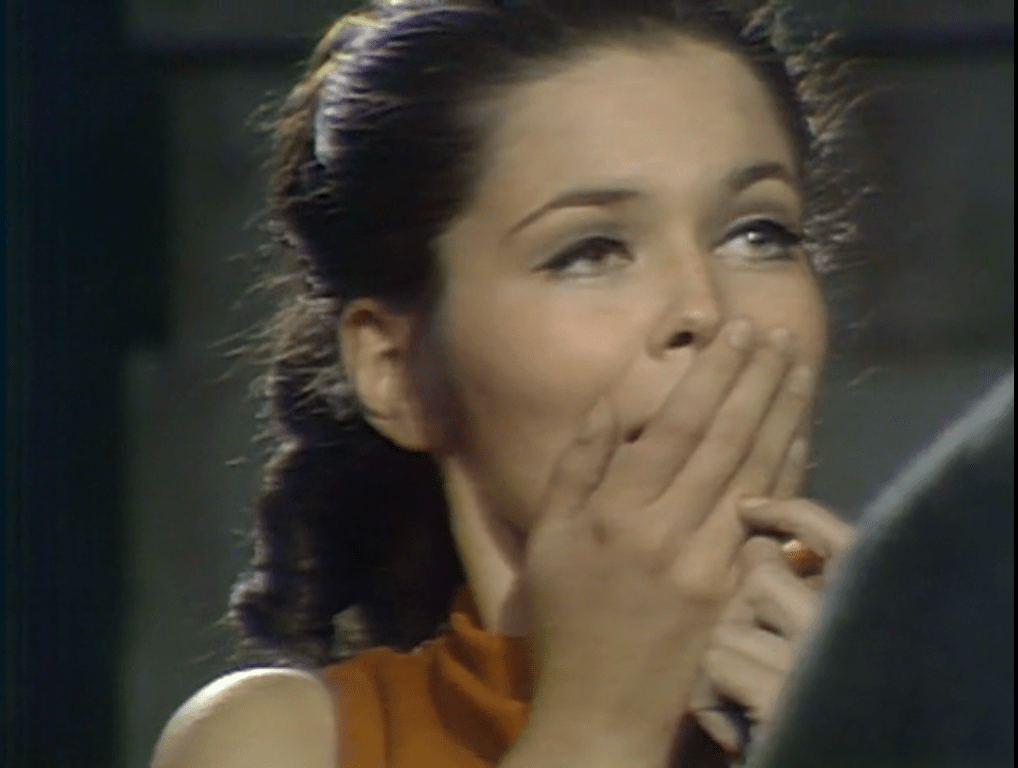
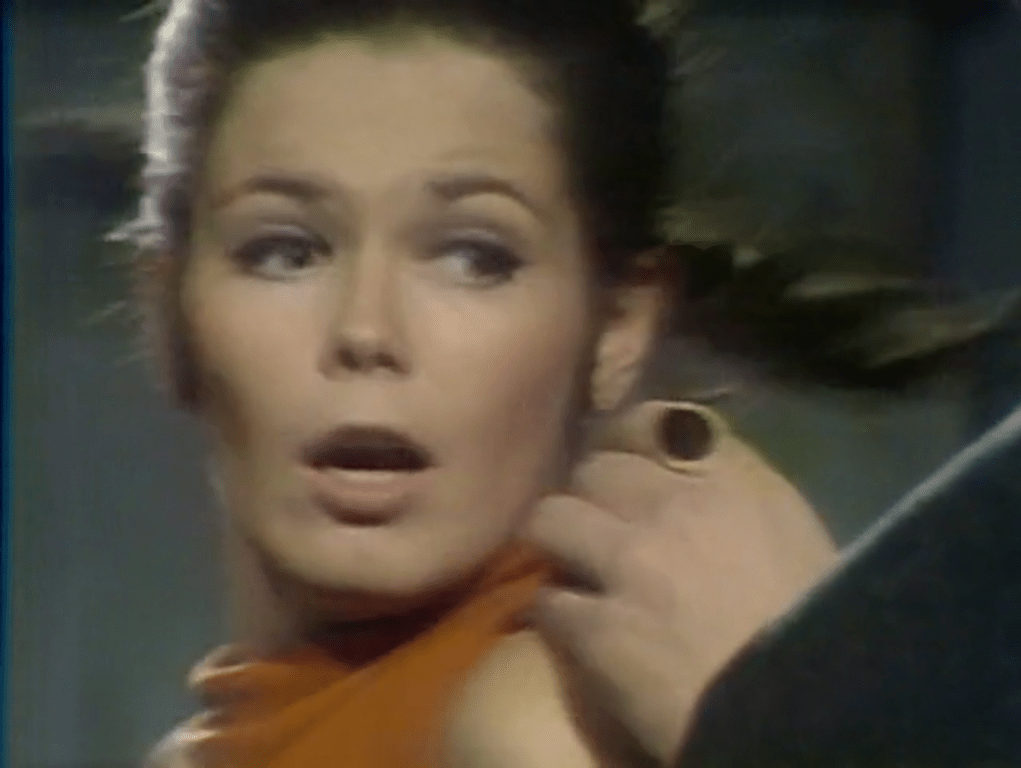
Vampire Barnabas Collins creeps up on well-meaning governess Vicki from behind. He touches her neck, and she is startled.
Stifling a giggle
This scene plays twice. First, before the opening title sequence, then again immediately after. The first time around, Vicki stifles a giggle when she sees Barnabas. The second, she seems frightened.
Frightened
Barnabas does not bite Vicki. He apologizes for startling her. She says that no apology is needed, and she stands very close to him. They talk about the Moon and the night and about what incredible romantics they both are.
Incredible romantics
In #285 and #286, Vicki contrived to get Barnabas to invite her to spend the night in his house. In #293, she invited Barnabas to tag along on a date she was having with her depressing boyfriend Burke, and while Burke stood there she had eyes only for Barnabas. In this conversation, Vicki reluctantly turns down an invitation from Barnabas so she can go on some more dismal dates with Burke.
Mad scientist Julia Hoffman interrupts Barnabas and Vicki. After Vicki excuses herself to get ready for her date, Julia demands that Barnabas leave her alone. Barnabas says that he means her no harm. This is all too believable- twice before today, we have seen Barnabas enter a room where Vicki was sleeping and leave without biting her. It’s starting to seem unlikely that she will ever have a place in the vampire story. Since the vampire story is the only plot going on Dark Shadows, that leads us to wonder why she is still on the show.
This scene takes place on a new set, a courtyard with a terrace and a fountain. It looks very much like a set in the 1965 film The Sound of Music, the one where the Countess who is supposed to marry Captain von Trapp has the conversations that remove her from the love triangle and leave the path open for von Trapp to marry Maria. That movie was such a big hit that it seems likely that they had it in mind when they designed this set for scenes concerned with the love triangle involving Vicki, Burke, and Barnabas.
Julia’s intervention leads some to believe that there is another love triangle budding in which she will vie for Barnabas’ affections, but I don’t see any trace of that in Julia’s stern manner today. She simply seems to be concerned that Barnabas stop preying on people while she performs the experiments that are supposed to cure him of vampirism.
In later years, Grayson Hall would claim that she decided on her own initiative to play Julia as if she were in love with Barnabas. She said that by the time the writers and directors caught on to what she was doing, they had received so much enthusiastic fan mail that they had to let her go on doing it. In response to this story, Danny Horn makes some uncharacteristic remarks in his post about this episode on Dark Shadows Every Day:
It’s a great story, especially because it appeals to the audience’s secret belief that the actors really are the characters that they play. We love to believe that, especially for daytime soap opera characters, who we spend time with every day.
But really, everybody who watches television believes that the characters are real. That’s why we love to hear about unscripted moments that were invented during rehearsal. As intelligent adults, we understand that writers and directors and producers create the characters, and then the actors show up and say the words. But there’s a little child inside of us, who wants to be told that Julia Hoffman is real, and she lives inside Grayson Hall.
Danny Horn, “A Human Life,” Dark Shadows Every Day, 2 Jaunary 2014.
As the blog went on, Danny put more and more emphasis on the chaotic process by which Dark Shadows was created. I suspect this passage was something he wrote in haste. Even at this early stage, he had made it clear that he knew that it was not true that “writers and directors and producers create the characters, and then the actors show up and say the words.” By the time he finished in 2021, his main theme had long been that the real subject of Dark Shadows was “a team of under-resourced lunatics desperately struggling every day to make the most surprising possible show.” That team most definitely included actors padding their parts in ways they could do only because the show was done live to tape, with edits never done if not absolutely necessary, and often not done even when they were.
Julia visits Vicki’s room and helps her choose an outfit for her date with Burke. Julia urges Vicki to avoid Barnabas, because he has a crush on her and it would hurt him to encourage him in it. Vicki says that she has never seen any sign of such a crush. Nor have we- he has talked with his sorely bedraggled blood thrall Willie about a plan to take Vicki as his next victim. Aside from giving her an enchanted music box that is supposed to brainwash her, he has been remarkably leisurely about the whole thing. If anything, she is the one who has been pursuing him.
Vicki and Burke are out by the fountain. He remarks that she has been very quiet, and she refers to having a lot on her mind. This raises our hopes that she is thinking about what Julia told her and is going to ditch Burke and go to Barnabas. They start talking about their wretched childhoods. Previously, we had heard that Burke’s mother died when he was young and that his alcoholic father supported the family by making lobster pots; now Burke tells us that when he was nine his father left the family. It’s hard to see much point in this retcon; most likely the writers had just forgotten about the earlier story.
Vicki mentions that there was one nurse at the Hammond Foundling Home whom she liked. In the early days of the Dark Shadows, she would often reminisce about her ridiculously bleak experiences growing up in this fictional orphanage. Usually she would get a faraway look in her eyes and smile, then tell some story that started with an appalling horror and got worse and worse as it went. This time, she again stares off into the distance and smiles, so that viewers who have been watching from the beginning brace themselves to hear that the nurse turned out to be the worst abuser of all, or that she was murdered in front of Vicki while the other children laughed, or that she ran the kitchen the winter they ran out of food and had to resort to cannibalism. But no, Vicki is just sharing a pleasant little memory. The show is a lot less hard-edged now that it’s about a vampire.
Not that they’ve stopped presenting horrible images altogether. No, they show us Burke kissing Vicki.
When Burke was played by Mitch Ryan, he was a great kisser, a talent he displayed with Vicki among others. But Anthony George does not appear to have seen anyone kiss before he attempts it. As he points his lips at Alexandra Moltke Isles, she stiffens her neck, a move that may have suggested excitement if her partner were doing something recognizable as a sign of affection, but that in this context looks like she’s suffering from whiplash. After his first failed effort, he rests his head on her shoulder and looks miserable.
Attempted kissAfter the failure
We pull back from Burke’s fumbling and see Barnabas at the gate to the courtyard, looking forlorn. I’m sure the writer and director wanted us to take this image as a sign that Barnabas is feeling sorry for himself, but the scene he’s been watching with us is so dreary that we would all have the same look on our faces.
Barnabas has seen the sorry spectacle
Some attribute George’s phenomenally bad kissing to his sexuality. I don’t buy it. Joel Crothers was also gay, and we’ve seen Joe Haskell give convincingly sultry kisses to two actresses. Louis Edmonds was gay too, and when Dark Shadows finally gives him an on-screen kiss two years from now he will do just as well. And the actresses unanimously testified that Jonathan Frid was the best kisser in the cast. Furthermore, the other conspicuously inept kisser on the show was the emphatically heterosexual Roger Davis (whom we have yet to see.) So George’s failures in this department are his alone, and do not reflect on any demographic group of which he was a member.
In the house, Vicki and Burke continue their vain struggle to kiss. Julia walks in and apologizes for intruding. She does not leave, nor does she take her eyes off Vicki and Burke. That makes sense- after all, she is still an MD, and it would appear that whatever is wrong with Burke might require some kind of medical intervention.
Vicki excuses herself to go to bed, and Burke asks Julia to join him in the drawing room. There, he denounces Vicki for her “vivid imagination,” a terrible quality that must be stamped out. He tells Julia that Vicki has experienced two hallucinations recently. We know that these were not hallucinations at all, but actual visitations from the ghost of Sarah Collins. Burke doesn’t know that. However, he does know of another sighting which led him to angrily accuse Vicki of being insane, when she saw Maggie Evans, The Nicest Girl in Town, walking in a cemetery. At the time, everyone thought Maggie was dead, but now that it has been revealed she is alive, he removes the incident from his bill of particulars against Vicki.
Burke is furious with Vicki for having an imagination and wanting to be part of the story
Burke and Vicki, like most of the other characters, believe Julia’s cover story that she is an historian researching the Collinses for a book about the old families of New England. He asserts that helping Julia with her project is having a bad effect on Vicki, because she must “live in the present.” Julia asks if this means that she must live with him. Burke agrees that it does.
To Burke’s surprise, Julia agrees that Vicki should stop helping her and stay away from anything suggestive of past centuries. The two of them talk about how Vicki must be watched and controlled lest her imagination “run wild.” Julia is a mad scientist in league with a vampire, so this sort of talk is to be expected from her, but Burke is supposed to be on Vicki’s side. His frank intention to crush her imagination, expressed alternately with undisguised rage and airy paternalism, is as repulsive as anything we have seen from Barnabas.
Upstairs, Vicki is asleep. Barnabas opens the door and walks into the room. Again he thinks about biting her, again he doesn’t. He opens the enchanted music box, looks at her a bit longer, and leaves the way he came. If Barnabas doesn’t get off the dime soon, Vicki may marry Burke and become useless forever.











 Dark Shadows Commentary