Adventurer Tim Shaw is in his hotel room with an apparently mute man, trying to get him to speak. The man is struggling to make a sound when artist Charles Delaware Tate enters and produces a revolver. Tate proclaims that the man will never speak. He fires, and the man falls dead to the floor.
The man’s body glows, then vanishes. Tim knows that Tate created the man earlier in the evening. Tate has a magical power that enables him to cause objects and people to pop into existence just by drawing them. Tim says that he ought to call the police, since Tate just murdered a man in cold blood in front of him. But there is no body, and the only other person who has seen the man is Tim’s traveling companion and occasional accomplice Amanda Harris, who turns out to be another of Tate’s creations. So instead Tim pours a drink, and Tate tells him all about how he gained his powers as the result of a bargain he struck with sorcerer Count Petofi.
Petofi is aware of several magical abilities he gave Tate, but does not know that he can bring his creations to life. Tim calls Petofi to his room and brings him up to date. He believes that this report will somehow establish a partnership between himself and Petofi. Since Tate made it clear that his powers are the result of Petofi’s own interventions, it is unclear why Tim would expect even a finder’s fee for this information. It certainly does not provide the basis for an ongoing relationship of any kind.
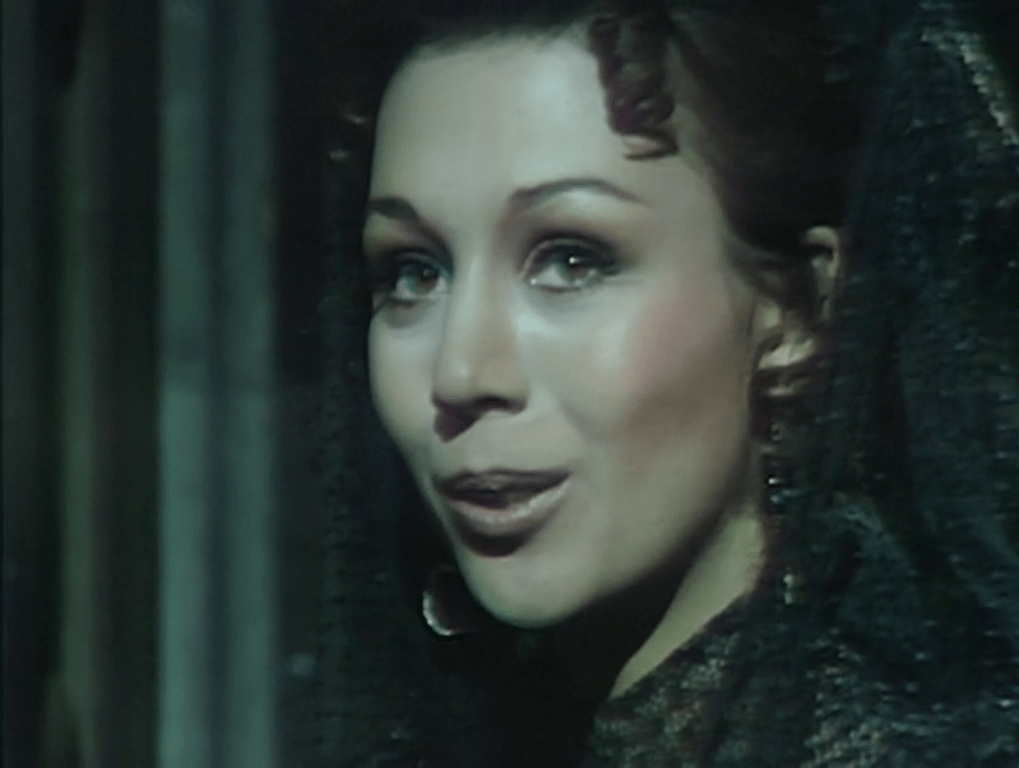
Meanwhile, a visitor is arriving at the great house of Collinwood. Her face is familiar to longtime viewers- she is played by Kathryn Leigh Scott, who has been in the cast from #1 as Maggie Evans, wisecracking waitress turned The Nicest Girl in Town. When from November 1967 to March 1968 the show was a costume drama set in the 1790s, Miss Scott played the gracious Josette; she had already played Josette’s ghost in some of the episodes in contemporary dress, and in the spring and summer of 1967 vampire Barnabas Collins had tried to brainwash Maggie into becoming Josette. We last saw Miss Scott from March to June in the first part of the still-ongoing segment set in 1897, when she was neurotic intellectual Rachel Drummond.
Before we know the name of this new character, we see that she is wearing widow’s weeds. There is also a first- we hear her thoughts in an interior monologue before she interacts with another character. Whoever she is, the widow is telling herself that she has come to her big moment and she shouldn’t chicken out now. “No one will know,” she assures herself.
Neither Maggie, Josette, or Rachel ever used that facial expression.
The unknown widow knocks, and rakish libertine Quentin Collins lets her in. He appreciates her beauty and asks who in the house is fortunate enough to know her. She says that she and her late husband were friends of the stuffy Edward Collins. Quentin says that Edward is away, and identifies himself as his brother. “Quentin or Carl?” asks the widow. Quentin says, with a sad note, that Carl is dead. This is the first time anyone other than his onetime fiancée Pansy Faye has mentioned Carl’s name in the three months since his death.
The widow finally identifies herself as Kitty Soames, Countess to the late Earl of Hampshire. She says that she is an American, and that after her husband’s death she felt that she was a stranger in England and ought to return home. Quentin invites her to stay in the house.
Kitty is alone in the foyer when Petofi enters. She is horrified to see him. It becomes clear that her husband’s death was a suicide, and that Petofi’s threats prompted it. She goes out to take a walk in the woods.
Along the way, she meets Barnabas, who has traveled back in time from 1969. They have a brief talk. When she exits, he says that she is Josette, returned to him at last.
Back in the great house, Quentin finds Kitty looking at the spot on the wall next to the front door where Barnabas’ portrait has long hung. Some weeks ago, Edward learned that Barnabas was a vampire and ordered the portrait removed. There is a mirror there now, the same mirror that hung in that spot in #195, when the ABC art department was painting Barnabas’ portrait and another portrait was reflected in it. Kitty asks Quentin why Barnabas’ portrait was removed. Since she has never been in the house before, this question perplexes him. He asks how she knows about the portrait and how she knows of Barnabas. At first she is amused by the idea that she would not know of him, but a second later she returns to herself. She insists she has never met anyone named Barnabas and has no idea what Quentin is talking about. Perhaps this time, Barnabas is right- maybe Kitty really is a revenant of Josette.
Miss Scott was one of the biggest stars on the show. She tells a story nowadays about a trip she and her then-husband took to Africa in the late 1960s, when they were on a photo safari deep in the bush. Some people happened by, took one look at her, and all started saying excitedly “Maggie Evans!” So it is inexplicable that today’s closing credits misspell her name as “Kathryn Lee Scott.”
Dark Shadows first developed its conception of the supernatural in depth when undead blonde fire witch Laura Murdoch Collins was on the show from December 1966 to March 1967. Laura was not so much one person as she was a complex of at least three distinct beings. There was a charred corpse in the morgue in Maricopa County, Arizona; a phantom that Laura’s son, strange and troubled boy David Collins, can sometimes see through his window as she flickers above the lawns of the estate of Collinwood; and a living woman who carries on conversations with people but is never seen eating or drinking. People who encounter Laura also experience dream visitations that resemble her and unaccountable compulsions to do things relating to her, but it is never clear which of those psychic phenomena come from Laura and which from her arch-nemesis, the ghost of the gracious Josette. It is clear that the various parts that make up Laura are not always aware of each other, and sometimes work at cross-purposes with each other.
Laura’s successor as Dark Shadows‘ chief supernatural menace was vampire Barnabas Collins, who joined the show in April 1967. Like Laura, Barnabas comes in several parts, not all of them working together harmoniously. For example, sometimes doors slam shut when he is in a house, and only he can open them. This is never shown as something he deliberately makes happen, and it does not always serve any intelligible purpose of his. Also, when he is active dogs start howling. Sometimes that immobilizes his targets with fear and confusion, but just as often it costs him the element of surprise and foils his plans. So whatever uncanny forces cause these things to happen are clearly not subject to Barnabas’ will. They accompanied him out of the darkness.
Shortly after Barnabas’ arrival, the show retconned Josette as his lost love and cast her as Princess Ankh-Esen-Amun to his Imhotep in a remake of the 1932 film The Mummy. In that film, the undead man tried to remake contemporary woman Helen Grosvenor in the image of the ancient Ankh-Esen-Amun. Taking that role in Barnabas’ attempt to recreate Josette was Maggie Evans, The Nicest Girl in Town. As in the 1932 film Zita Johanns played Helen in the contemporary scenes and Ankh-Esen-Amun in a flashback to ancient Egypt, so in #70 and #126 had Miss Scott already played the ghost of Josette.
While Barnabas pursued his crazed and evil plan to Josettify Maggie, the ghost of his little sister Sarah showed up. Sarah befriended Maggie and helped her escape from her “big brother.” Sarah did more and more, ultimately sending well-meaning governess Vicki back in time so that from November 1967 to March 1968, Dark Shadows was a costume drama set in the 1790s, when Barnabas and Sarah were alive.
Like Laura and Barnabas, Sarah may have looked like single person, but was in fact a complex of independent beings. In #325, she visits David in a dream and gives him information only she would have. In #327, David sees Sarah during waking hours and tells her about the dream, and it all comes as news to her. This daylight Sarah makes it clear to David that she does not want him to have the information the dream version of her gave him so shortly before.
Moreover, child actress Sharon Smyth was instructed to play Sarah as Barnabas’ conscience. When Barnabas is freed to prey upon the living, he unknowingly pulls Sarah out of the supernatural back-world behind the action of the show, the unseen realm where Josette’s ghost, the “Widows,” the ghost of Bill Malloy, and the rest of them lurk, and brings her with him into 1967. Sarah, however many of her there are, is part of the same complex that includes Barnabas and the forces that surround him.
In the 1790s portion, we met wicked witch Angelique and saw her place the curse that turned Barnabas into a vampire. Like the other supernatural forces, Angelique was a complex of multiple beings, some of which were opposed to each other. In her case, spellcasting was a matter of breaking off little bits of herself that took on lives of their own. Angelique was obsessed with the idea that Barnabas would fall in love with her. She could easily cast a spell to make him do that, but insisted to her helper that Barnabas must come to her “of his own will.” Those were the exact words Barnabas used when talking to his own thrall about Vicki, who succeeded Maggie as the object of his gruesome fantasies. When we heard Angelique take the same line, it dawned on us that the Barnabas we saw from April to November 1967 was not merely cursed by Angelique, he was possessed by her. His thoughts were her thoughts, his plans were her plans. When Barnabas fights Angelique, it is one of her replicas of herself coming back to oppose her, as the zombie version she created of Barnabas’ uncle Jeremiah came back to bury her alive in #396.
Now, Barnabas has traveled back in time to 1897. He has met governess Rachel Drummond, who is played by Kathryn Leigh Scott and whom he recognizes as a double of Josette. Angelique has also come to 1897, conjured up by some Satanists whom Barnabas has antagonized for no apparent reason. Angelique peered through the windows of the great house of Collinwood just in time to see Barnabas giving Rachel Josette’s music box. Dismayed, she went to the Old House on the estate, looked at Josette’s portrait, and declared “I am Angelique, and I hate you!” She, like Barnabas, looks at Rachel and sees another Josette.
Angelique’s motivation in the 1790s segment was ostensibly about her desire for Barnabas, but it was her hatred for Josette that drove her at every turn. Now we see that Barnabas is compelled to create another Josette whom he can love; Angelique is just as powerfully compelled to create another Josette to hate. Since Barnabas’ “love” involves killing its object and raising her as a vampire, it would seem to be as hateful as is Angelique’s overt hostility.
After Angelique proclaimed her hatred to the portrait, she took a cloth doll representing Rachel and strangled it. Rachel herself collapsed, unable to breathe. Angelique mouthed words; Rachel spoke them, leading Barnabas to believe that they were a message from Josette.
Today, Rachel is in the drawing room at the great house, recovering from her choking episode. Barnabas is holding her and looking longingly at her neck when stuffy Edward Collins enters. Edward demands to know what is going on, and Barnabas explains that Rachel had trouble breathing and fainted. Edward becomes concerned and wants to call a doctor; he becomes suspicious when Rachel, who he just met a few days ago, does not want to see a doctor. Barnabas manages to distract Edward from his suspicions with some chatter about the circumstances under which Rachel fainted.
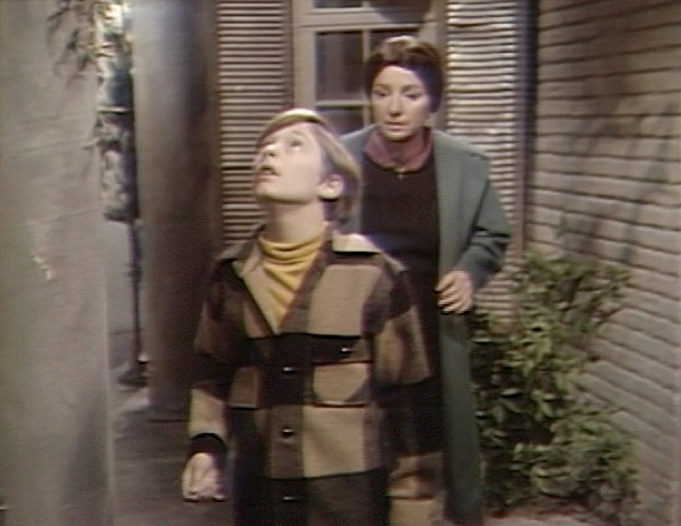
In the groundskeeper’s cottage on the estate, Angelique casts a spell to summon Rachel. Back in the great house, Rachel suddenly looks up, her eyes wide open and focused at a point in the middle distance. She stands up and walks with her neck very still, moving like a wind-up doll. She announces to Edward and Barnabas that she will be going outside for a breath of fresh air. She refuses Barnabas’ offer to accompany her. Edward and Barnabas watch her wonderingly as she marches out with her robotic gait.
Barnabas and Edward wonder what has got into Rachel all of a sudden
Rachel arrives at the cottage and finds Angelique. Angelique calls Rachel “Josette.” When she protests that her name is Rachel, Angelique echoes the Barnabas we first knew and tells her that, when she wills it, her name will be Josette. She tells Rachel that she will not understand what is happening to her, but that Barnabas will soon understand very well.
Back in the great house, a servant tells Edward that he found a woman in the cottage. Barnabas is there, and he reacts to the description with alarm. He goes to the cottage, clearly afraid that he will find Angelique there. Before he can complete a search, a rooster crows and Barnabas hastens back to his coffin in the basement of the Old House on the estate.
Barnabas opens the coffin, and finds Rachel lying in it, unconscious. This sets up a comedy of manners. He hardly knows her well enough to lie down with her, and he can’t very well wake her and ask her to make way for him. We end with him facing this problem in etiquette.
We may also remember #248, when Barnabas expressed his frustration with Maggie’s refusal to turn into Josette by forcing her into his coffin. Perhaps Angelique knows that he did that, and is taunting him with a memory of which he has since shown an ability to be ashamed. If so, the point of the taunt is that he is not different from her. Angelique called Rachel a “pawn” in the “cruel game” she is playing with Barnabas. Angelique, who when we first saw her in the 1790s segment was so monomaniacally devoted to her goals that she could not see events from any perspective other than her own, can now understand that what she is doing to Rachel is horrible. That’s why she is doing it, to show Barnabas that he is part of the same horror as herself and that he can never transcend it.
In the groundskeeper’s cottage on the estate of Collinwood, Satanists Evan Hanley and Quentin Collins call on the powers of Hell to send a demon to help them fight Quentin’s recently arrived and deeply mysterious distant cousin Barnabas. The call is answered by none other than our old friend Angelique the wicked witch.
Quentin and Evan have no idea who Angelique is, and she does not know them either. Evan introduces himself to her as a lawyer; he seems genuinely surprised that this does not impress her. Evan tells Angelique that he and Quentin summoned her from Hell and can send her back; she agrees that they summoned her, but is not so sure they can send her back. Quentin tells her that the year is 1897, that she is on an estate known as Collinwood, and that he and Evan have an enemy called Barnabas Collins. Angelique is intrigued by the year, familiar with the estate, and thrilled to hear about Barnabas. Evan starts making demands; Angelique causes him to choke and gasp. She is quite friendly to Quentin, and when Quentin suggests she let Evan breathe and speak again, she indulges him.
Angelique puts Evan in his place.
Evan is played by Humbert Allen Astredo, who in 1968 played suave warlock Nicholas Blair. He plays Evan with exactly the same bearing, tone of voice, and range of facial expressions he had brought to the role of Nicholas. Viewers who remember Nicholas have been bewildered by this. Barnabas knew Nicholas and fought him; when he met Evan the other day, his reaction left open the possibility that he recognized him as the same person. But Evan’s dabbling in the occult, as we saw it yesterday, shows only an infinitesimal fraction of Nicholas’ vast abilities in that field, and his buffoonish response when Angelique appears shows that he is no relation.
It is when Angelique strikes Evan dumb that we learn why Astredo played him in the same way he played Nicholas. Nicholas was introduced as Angelique’s boss, the master of magical powers much greater than hers. Since the main difficulty with fitting Angelique into a story was that she could easily accomplish any goal if she just kept her focus, adding a character who is even more powerful took the show to an absolute dead end. They had to box Nicholas up inside a lot of pointless business, and he quickly became a source of frustration to the audience. Seeing Astredo as another Nicholas reminds us of that frustration, and when Angelique brushes him aside with a flick of her finger our unease evaporates. We are assured that the plot will keep moving this time, and that Astredo will be free to show us what he can do as an actor.
At the end of Friday’s episode, it was Quentin who tried to stop the ceremony when Angelique’s visage began to take shape in the fire, fearing they had gone too far. Today Quentin realizes there is no turning back, but Evan keeps saying he wants to return Angelique whence she came. It’s hard to see what he expected- he was calling on the Devil to send a demon. I suppose he really is disappointed that Angelique is not excited to find herself in the company of a member of the bar.
Quentin goes home to the great house on the estate. He sneaks up behind governess Rachel Drummond while she is dozing on the sofa in the drawing room and puts his hand on her face. That wakes her. When she protests, he asks if he did it unpleasantly. She answers, “No… I mean, yes!… I don’t know.” That summarizes precisely the natural reaction to Quentin. His behavior is abominable in the extreme, but David Selby’s charisma and easy charm come through even in the character’s darkest moments, and the audience can no more want him to stay off-screen than the female characters can want him to leave them alone.
Quentin and Rachel sit together; his hands are on her face again when Barnabas shows up. Quentin gets up and twits Barnabas with his obvious closeness to Rachel, then excuses himself to go to bed.
Barnabas gives Rachel a music box that once belonged to the gracious Josette. This will induce further flashbacks in longtime viewers. Barnabas is a vampire, and as a living man in the 1790s he was in love with Josette. In May and June of 1967, Barnabas lived in contemporary times. He abducted Maggie Evans, who like Rachel in the portion of the show and like Josette in the portion set in the 1790s, is played by Kathryn Leigh Scott. He tried to erase Maggie’s personality, overwrite it with a copy of Josette’s, and to turn her into his vampire bride. The music box played a crucial part in this remake of the 1932 film The Mummy.
When Barnabas urges Rachel to listen to the music box, we pan to the window and see Angelique peeking in. As Angelique’s great power is the main difficulty with fitting her into a plot, so her single-mindedness is the main difficulty with making an audience enjoy watching her. This shot of her does as much to enlist the sympathies of longtime viewers as does the moment when she shuts Evan up. The whole time Barnabas and Rachel are involved with the music box, we are groaning. It was during the imprisonment of Maggie that Dark Shadows first became a hit, and it is a story that the show has been strongly identified with ever since. But we do not need to see it again. Angelique once married Barnabas and is maniacally possessive of him, and she does not want to see it either.
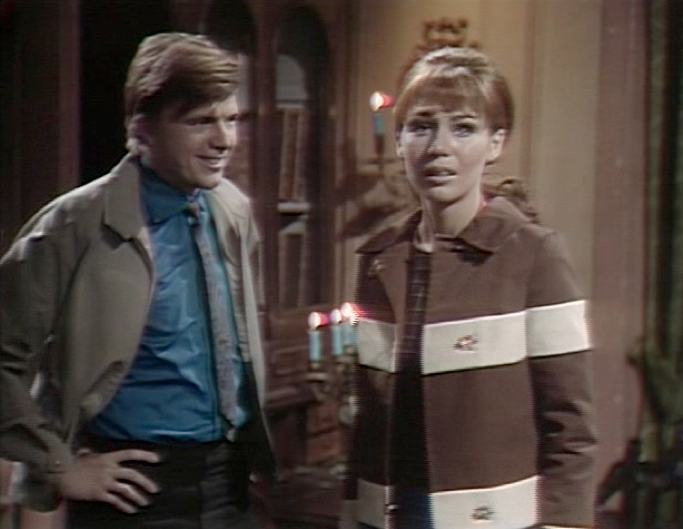
Angelique is as dismayed as we are, though for a different reason.
In the 1790s segment, which ran from November 1967 to March 1968, we saw that Angelique was motivated at least as much by her hatred of Josette as by her desire for Barnabas. After she has seen Barnabas getting up to his old tricks with Josette-lookalike Rachel, Angelique visits the portrait of Josette which hangs above the mantel in the parlor of the Old House on the estate. Longtime viewers know that Josette’s ghost inhabits the portrait. In #70, the portrait glowed, her ghost (also played by Miss Scott) emerged from it, then went outside and danced among the pillars. In #102, strange and troubled boy David Collins stood in front of the portrait and had a lively conversation with it. We could hear only his side, but it was clear the portrait was answering him. Today Angelique stands where David stood then. She scowls at the portrait and declares “I am Angelique, and I hate you!” She then goes back to the cottage where Evan and Quentin conjured her up and chokes a cloth doll, causing Rachel to collapse. She mouths words, and Rachel speaks them. Hearing Rachel talk about Josette’s death, Barnabas cries out in anguish.
This was the first episode credited to writer Violet Welles, who worked as a Broadway publicist before and after working on Dark Shadows. Ms Welles had been an uncredited collaborator with Gordon Russell on a great many of his projects, including several episodes of Dark Shadows prior to this one. She was by far the best writer of dialogue on the show. It is no wonder that the “Memorable Quotes” section of the Dark Shadows wiki entry for this episode includes whole scenes; the lines glitter with wit. Now that she is with Dark Shadows as a senior writer under her own name, the show enters its most successful period, both artistically and commercially.
Vampire Barnabas Collins has traveled back in time to the year 1897 where he hopes to prevent his distant cousin, libertine Quentin, from becoming a ghost who will ruin things for everyone in 1969. Barnabas knows that if events play out as they did originally, Quentin will die soon. He tells him today that it is his understanding that people become ghosts when they leave unfinished business behind them. He does not know what business Quentin originally left unfinished, or how he can keep him from dying without finishing it on this iteration of the timeline. So you might think that his first priority would be to get as close as possible to Quentin and learn as much as he can about what he wants.
Instead of doing this, Barnabas has gone out of his way to antagonize Quentin by accusing him of stealing his grandmother Edith’s will. Quentin and his siblings are all frenziedly searching for the will, but it is of no concern to Barnabas. Edith cannot possibly have left him any money, and he knows that the original timeline worked out so that the Collins family assets wound up in the hands of people who were oblivious to his sinister nature and happy to let him make his home on their estate. Showing interest in the will can do nothing but raise suspicions as to who this stranger really is and why he showed up when he did.
Quentin did in fact steal the will. Edith’s ghost may be at work in the house- her glove mysteriously shows up in the corridor near Quentin’s room, the furniture in the room is turned upside down, and before the end of the episode Quentin alone can hear the pounding of an enormously amplified heartbeat emanating from the walls of his room. But Quentin accuses Barnabas of planting the glove and disordering his room, and in #538 we saw that Barnabas is capable of making people with guilty consciences have hallucinations of just this kind. Barnabas is also frequently seen reading, and it is certainly possible he might have read Edgar Allan Poe’s “Tell-Tale Heart” and decided to make it come to life. He may not even have needed to read the story- we saw in #442 that in 1796, early in his career as a vampire, he bricked up an enemy of his in the style Poe would describe in his 1846 story “The Cask of Amontillado.” Evidently his imagination and Poe’s ran along similar lines.
Barnabas meets governess Rachel Drummond. He is immediately attracted to Rachel, unsurprising since she is played by the lovely Kathryn Leigh Scott. He tells Rachel that she strongly resembles the portrait of Josette Collins, and he relates some facts about Josette’s life and death that did not make it into the family history. Indeed, Miss Scott played Josette in the part of Dark Shadows set in the 1790s.
Yesterday, Barnabas met unethical lawyer Evan Hanley, played by Humbert Allen Astredo. His reaction to Evan was not inappropriate, but the same reaction would also have been fitting had Barnabas thought Evan was Astredo’s previous character, warlock Nicholas Blair. This may have reminded longtime viewers of the 1790s segment, when time-traveling governess Vicki alienated the audience by time and again telling the characters that they were being played by actors who had other parts in the first 73 weeks of the show. Do the characters not look alike to Barnabas, or does he simply have the presence of mind not to waste everyone’s time with tedious drivel about who used to be who? We now know that in Rachel’s case, at least, it is the latter.
Quentin has a scene with his sister Judith in which he tells her that he did not like to play with her when they were children, because she was a “scaredy-cat.” Joan Bennett was 31 years old when David Selby was born, a fact of which the original audience would have been well aware since she was already a major star of motion pictures at the time. Indeed, her father Richard Bennett had been so big on Broadway that her birth was announced on the front pages of the New York papers, so that she never bothered to be coy about her age. But she and Mr Selby are such strong actors that it doesn’t raise an eyebrow when we hear that Judith and Quentin were children together.
Not everyone we see today merits such high praise, alas. Executive producer Dan Curtis was friendly with a man called Roger Davis, and he often let Mr Davis come on the set of Dark Shadows and assault the actors while they were trying to work. Unfortunately this happens today. Mr Davis is usually presented as if he were himself an actor playing a part. His idea of acting is simple enough. For example, he was once supposed to play a character named Jeff Clark, and his approach involved shouting “My name is Jeff Clark!” every episode or two. More recently, he was credited with a role called Ned Stuart, and he went around saying “My name is Ned Stuart!” That’s one way of attempting characterization, I suppose.
Today he is supposed to be someone named Dirk Wilkins. Regular viewers keep waiting for him to yell “My name is Dirk Wilkins!,” but he neglects to do so. He has a mustache, perhaps he thought that was sufficient. He finds Terry Crawford playing maidservant Beth Chavez, grabs her and yells in her face. Mr Selby interrupts this encounter. In character as Quentin, he makes some flip remarks and walks away, and Mr Davis resumes abusing Ms Crawford. Later he finds Ms Crawford on another set and grabs her again. Finally he walks into the set representing Quentin’s room while David Selby is trying to show us Quentin’s panicked response to the sound of the heartbeat. Mr Davis makes some nasty remarks, and when Mr Selby tries to involve him in the scene by tussling with him as Quentin might under those circumstances, it looks like Mr Davis gives him a real punch in the midsection. Mr Selby goes on acting, but the assault takes the audience out of the story. The ABC network really should have posted security guards outside the studio to keep this sort of thing from happening.
Craig Slocum tops many fans’ lists of Dark Shadows‘ worst actors, so I would be remiss in my duty as a commentator if I did not mention that he does a genuinely good job today as unlovely ex-convict Harry Johnson. Harry brings a tray of food to the very tall, very strong Adam, who is in a dusty room in the long deserted west wing of the great house of Collinwood, hiding from the police as the guest of heiress Carolyn Collins Stoddard. Harry finds that Adam is trying to stab himself to death, and calmly talks him into giving up the effort and handing over his knife.
Harry goes to the drawing room in search of Carolyn, and finds the suave and mysterious Nicholas Blair. Nicholas tells him that Carolyn is out. He shocks Harry by asking if Adam is in trouble. Harry had no idea anyone but he and Carolyn knew Adam was in the house, and Carolyn has scared him out of his few wits with her orders to keep the secret.
Nicholas takes command of the situation. He insists Harry tell him what happened, and posts him in the foyer to wait for Carolyn to return while he goes up to talk to Adam. When Carolyn comes back, Harry tells her about Adam’s suicide attempt and about his encounter with Nicholas. She angrily reminds Harry that Collinwood is her house, not Nicholas’, and Harry had damn well better remember to take his orders from her and no one else. Harry is left with nothing to say but a meek “Yes, ma’am.”
Slocum is convincing as someone who is not intimidated by a physically imposing man with a knife, but who is entirely out of his league when confronted with people who outrank him in social class. So far as I can tell, none of the other fansites mentions his good work today. Dark Shadows fans are accustomed to ghosts and witches and vampires and Frankensteins and time travel, but a good performance by Craig Slocum is such an unexpected sight that they cannot bring themselves to admit that they have seen it.
Nicholas is a middle manager in Satan’s terrestrial operations, a member of Hell’s bourgeoisie.* He knows that Adam is a Frankenstein’s monster. The other day, he persuaded Adam to try to rape Carolyn. Adam’s attempt doesn’t seem to have got very far, but it has convinced Carolyn that she can no longer harbor Adam in her house. The audience knows that Nicholas has plans for Adam; presumably he knew that if Adam attacked Carolyn, she would want him to leave Collinwood, paving the way for him to take the big guy into his own house where he would have unlimited access to him. While Carolyn is downstairs chewing Harry out, Nicholas is up in Adam’s hiding place adding to the evil ideas he has planted in his impressionable mind.
Carolyn goes up to Adam’s room and finds Nicholas still there. Nicholas tells her that the crisis is past, then leaves the room. Carolyn finds that Adam is perfectly composed and looking forward to some improvement in his circumstances, but is unwilling to talk to her about anything substantial.
Carolyn goes down to the drawing room, where Nicholas is playing the piano. This is the first time we have seen anyone play the piano since #330, when sarcastic dandy Roger Collins banged out a few notes. Carolyn has been suspicious of Nicholas since she met him and was angry with him when she first learned he had gone into the west wing and found Adam, but can only thank him when she sees that he has talked the big guy out of suicidal despair.
Later, we see that Adam has left the great house of Collinwood and gone to the Old House on the same estate. The Old House is home to old world gentleman Barnabas Collins. Adam knows that Barnabas was present when he first awoke, in a laboratory, ten weeks ago, and that he spent the first weeks of his life as a prisoner in Barnabas’ dungeon. When he learned yesterday that he was an artificially constructed man, he jumped to the conclusion that it was Barnabas who created him.
Adam knocks on Barnabas’ door. Barnabas is astonished to see that Adam has returned. Adam announces that they will talk and walks in.
Barnabas marvels at Adam’s fluent speech. When last they saw each other, he could speak only a few words, such as “music!,” “food!,” “friend,” and, most importantly, “kill Barnabas!” Now, he tells Barnabas that he no longer plans to kill him, but says that he is right to be afraid of him. He has come for what he is entitled to. He wants Barnabas to make another creature like himself so that he will no longer be alone.
Barnabas tries to explain that he did not create Adam, that Dr Eric Lang did. Adam has never heard of Lang, and dismisses Barnabas’ statement as a lie. Barnabas goes on saying that he isn’t even a doctor, but Adam won’t listen. He will be provided with a mate, or he will take his revenge.
My wife, Mrs Acilius, pointed out that Adam’s demand for a woman who shares his nature should sound familiar to Barnabas. When Barnabas first came on the show in the spring and summer of 1967, he was a vampire, and was obsessed with turning a living woman into a vampiric replica of his lost love Josette. Adam, who came to life by an infusion of Barnabas’ “life force,” shares his longing for a female counterpart.
In 1973, Dark Shadows creator Dan Curtis produced an adaptation of Mary Wollstonecraft Shelley’s Frankenstein for ABC-TV. The second half of that long movie was devoted to the creature’s demand that Frankenstein build him a mate, and the terrible vengeance he exacted when the scientist refused to comply. The original audience of this episode can’t have known that that production was in the future, but they would have been aware of the 1935 Universal film Bride of Frankenstein and Hammer’s 1967 Frankenstein Created Woman. It seems likely they had assumed that Adam would sooner or later set aside his bachelor ways, and were waiting for a development such as this.
*Mrs Acilius has an advanced degree in sociology, and she coined the phrase “Hell’s bourgeoisie.”
In the eighteenth century, wicked witch Angelique loved scion Barnabas Collins. He betrayed her in those days, rejecting her in favor of the gracious Josette, and ever since she has been casting deadly spells on him and everyone close to him. Today she encounters him in the woods. After a brief confrontation, she is left thinking about the feelings of love for him that still linger in her and undermine her killing power.
A few months ago, Frankenstein’s monster Adam imprinted on Barnabas when he saw him at the moment he came to life. Barnabas betrayed Adam’s filial love time and again, chaining him to a wall in a windowless basement cell, leaving him alone for all but a few minutes a day, and entrusting his care to his abusive servant Willie. When Barnabas beat Adam with his cane to stop him retaliating against Willie, Adam’s love turned to hate and he adopted “Kill Barnabas!” as his motto.
Today, well-meaning governess Vicki stops by Barnabas’ house to update him on the progress of Angelique’s latest attempt to destroy him. Vicki is to be the next to have a nightmare that Angelique has sent to a series of people, and after she has it she will pass it to Barnabas. Vicki doesn’t know that Barnabas was a vampire from the 1790s until 1968, much less that Angelique is trying to turn him back into one, but she does know that if Barnabas has the nightmare he is supposed to die as a result.
While Barnabas and Vicki confer, Angelique raises the ghost of Sam Evans from his grave. Sam was supposed to tell Vicki the nightmare, causing her to have it, but died before he could do so. Sam resists Angelique’s commands, but finds that Angelique can prevent him from returning to his grave. His soul needs rest, so he complies.
Back at Barnabas’ house, the sound of a gunshot interrupts the conversation. Barnabas goes out to investigate while Vicki waits in the parlor. Sam materializes there. Evidently his need to rest is quite urgent, since he sits down in an armchair while he talks to Vicki. The dead must rest! Or at least take a load off, it’s very tiring being dead apparently.
Vicki pleads with Sam not to tell her the dream, since she does not want to bring death to Barnabas. Sam says that in Barnabas’ case, death might come as a welcome relief. He declines to explain to Vicki what he means, but longtime viewers will be intrigued. Sam now knows about Angelique, so presumably he knows about Barnabas’ vampirism as well. Sam was the father of Maggie, The Nicest Girl in Town, whom Barnabas attacked, imprisoned, tried to brainwash into thinking she was Josette, and set out to kill when his brainwashing plan failed. If Sam knows about that part of Barnabas’ career, you’d think he would be a bit more peeved with him than he seems to be. At any rate, Vicki can’t stop Sam telling her the dream. When Barnabas comes back, she tells him what happened, and tells him she is already tempted to tell him the dream. She must go far away for his sake.
Many people have already had the dream, and none of them had the compulsion to tell it until they awoke from it. Vicki’s relationship to Barnabas is an odd one; shortly after his attempt to Josettify Maggie failed, he decided to repeat the experiment with her. Yet he never made much of an effort to get close to her, even though she time and again went out of her way to present him with opportunities to have his way with her. She even invited herself to his house for a sleepover in #285, only to have him back off the opportunity to suck her blood. He finally bit her in #462, only for his vampirism to be put into remission less than a week later. In this scene, Vicki keeps looking at Barnabas with wide, longing eyes, while he reacts coolly. So perhaps Vicki’s compulsion suggests that her attachment to Barnabas causes the Dream Curse to affect her differently.
Back at the grave, Angelique asks Sam’s ghost whether he told Vicki the dream. He said he did. She heaves a sigh of relief and exclaims “Excellent!,” and lets him go back to his grave. She doesn’t ask any follow-up questions or require any evidence. Clearly she couldn’t read Sam’s mind, or she wouldn’t have had to ask the question in the first place. So he could just as easily have gone off to haunt someone else, then lie to her.
We cut back to Barnabas’ house. Evidently he went somewhere after Vicki left, because he is walking in the front door. He looks around, apparently sensing a presence. He calls for Willie and gets no response. He opens a closet door, and hardworking young fisherman Joe falls out, unconscious. He hears a loud dirty laugh and sees Adam at the window, jeering at him.
This episode marks the final appearance of Sam Evans and of actor David Ford. Ford brought a fresh energy to the show when he took over the part of Sam from the execrable Mark Allen in #35, prompting blogger Marc Masse to discern what he called “The David Ford Effect” in the brightened performances of all the cast in the weeks that followed. But ever since the major storyline he was part of fizzled out in #201, Sam has been at the outer fringes of the plotlines, and Ford has been coasting. He inhabits his characters comfortably enough that he is always pleasant to watch, but it’s easy to forget the verve he originally brought to the show.
A few months after leaving Dark Shadows, Ford would join many other Dark Shadows alumni in the original Broadway cast of the musical 1776. He played John Hancock on Broadway and in the 1972 movie, and John Dickinson in the national touring company. I’ve been in the habit of watching the movie every year on or around the Fourth of July since the 1980s, and so it’s oddly fitting that Ford should depart Dark Shadows early in July. Fitting too that Sam Evans’ grave should be decorated with what looks to be a red, white, and blue floral wreath.
Mrs Johnson, housekeeper in the principal mansion on the great estate of Collinwood, isn’t herself. She had a nightmare a week ago, and ever since has been plagued with a compulsion to tell its details to strange and troubled boy David Collins. She knows that if she does, David will have the same nightmare, the same compulsion to tell it to some third person, and that if he does that person will suffer the same complex. She doesn’t know that the nightmare is part of a curse sent by wicked witch Angelique, or that at the climax of the curse old world gentleman Barnabas Collins is supposed to revert to the vampirism that afflicted him from the 1790s until last month. But she does know that it is part of something horrible, and she has tried desperately to keep it from continuing.
Mrs Johnson spent a couple of days with her sister in Boston to stay far from David, but she kept having the nightmare there. She has given up, and has come back to Collinwood. She does not go straight home to the great house, but stops first at the Old House in the estate. Barnabas lives there, but it is Barnabas’ friend Julia Hoffman she sees. Julia had passed the dream to her. Julia urges Mrs Johnson not to tell David about it. She replies that she knows she should not tell him, but that she has no more choice in the matter than Julia had in telling her.
This scene will raise a question in the minds of regular viewers. Julia is a medical doctor doubly qualified in hematology and psychiatry; she also has developed a method of hypnosis so powerful that she can virtually rewrite a subject’s memory, confining even very intense recollections to the depths of the unconscious mind, sometimes after an acquaintance of only a few minutes. Why doesn’t she try to hypnotize Mrs Johnson into forgetting the dream? All she actually does is slap her and repeat her command to avoid David.
David turns up. His father has sent him to ask Julia to come to the great house at her convenience. Julia tries to manage the situation by sending Mrs Johnson home first and keeping David in the house for a while. After Mrs Johnson leaves, Barnabas’ servant Willie enters and tells Julia there is an emergency in the basement. David agrees to wait for her to come back, but once she is gone he shouts that he will be playing outside.
We follow David out the front door, and find that Mrs Johnson is there waiting for him. She comes up on him from behind and says she has something to tell him. This scene will startle regular viewers. For nineteen weeks, from #365 to #461, Dark Shadows was a costume drama set in the 1790s. In that period, Clarice Blackburn played repressed spinster Abigail Collins and David Henesy played Daniel Collins, heir to the Collins fortune. We first saw Daniel in #431, when his Aunt Abigail intercepted him on this very spot and scolded him for playing at the Old House. Abigail was enforcing rules and believed she was acting in Daniel’s best interests; now the same actors invert the scene, showing us Mrs Johnson doing something she knows to be wrong and harmful to David.
Maggie Evans, The Nicest Girl in Town, isn’t herself. Some emerald earrings mysteriously appeared in her purse the other day, and when she tried them on she got a faraway look on her face, began speaking in a voice different from her own, and a tinkling music played on the soundtrack. Today her boyfriend Joe tells her that he took the earrings and showed them to a jeweler and to the police. The jeweler valued them at $15,000* and the police said that they didn’t match the description of any jewelry that had been reported missing. Maggie was not only irked that Joe had taken the earrings without her permission, as anyone might be, but when he tries to get her to agree that such expensive things don’t just materialize out of thin air her usual level-headedness and cheerful disposition vanish and she becomes childishly defensive. Maggie does not know that Barnabas’ servant Willie placed the earrings in her purse as an attempt to reestablish the connection the two of them had when she was Barnabas’ prisoner in the Old House. As a result of Julia’s hypnosis, she does not even remember what Barnabas did to her. But after she runs Joe off, she is compelled to go to the Old House.
Again, regular viewers will recognize an echo of an earlier episode, in this case one that aired a year ago. When Maggie was Barnabas’ victim in May 1967, she snapped at Joe and drove him out of her house as she does today. Then too, she headed for Barnabas once Joe was gone.
Maggie doesn’t find Barnabas at the Old House. Instead, she sees Willie. Barnabas had framed Willie for his crimes against Maggie, and Willie was confined to the mental hospital Julia runs. Barnabas and Julia have brought him back to the Old House to help with their latest nefarious scheme. Willie had been Barnabas’ blood thrall; it is not clear to the audience just what effect it had on Willie when Barnabas’ vampirism went into remission. When we first see him today, he is playing with an unloaded rifle and grinning maniacally, reminding us of the dangerously unstable ruffian he was before Barnabas first bit him.
Maggie knocks on the door and asks Willie if she can come in. He falls over himself inviting her. He becomes the friend he tried to be to her during her imprisonment. She says she knows that he wasn’t the one who hurt her, and he is overjoyed. She seems blissful. He asks her out on a date; she says that Joe wouldn’t like it. Before Barnabas, Willie propositioned all the young women and threatened all their boyfriends, and at first this approach, like his gleeful handling of the rifle, suggests that dangerously unstable ruffian is back. He assures Maggie that he only wants friendship, but after she leaves he picks the rifle up again and says that Joe will be out of the way soon.
For her part, Maggie’s behavior does not represent a reversion to her time as Barnabas’ prisoner. Rather, the earrings seem to have done what Barnabas tried to do when he bit her, imprisoned her, and subjected her to a series of role-playing exercises. Her personality is showing signs of giving way to that of Barnabas’ lost love, gracious lady Josette. In #260, Barnabas told Maggie “You are Josette!”; in #370, we saw that he was right, inasmuch as Kathryn Leigh Scott played both characters, as Zita Johanns had played both Helen Grosvenor and Princess Ankh-Esen-Amun in the 1932 film The Mummy, from which Barnabas’ Josettification project was borrowed. The tinkling melody that plays on the soundtrack when Maggie wears the earrings is that of Josette’s music box; this could be a sign that her memory of what Barnabas did to her is coming back, since he forced her to listen to the music box for hours on end. But the voice she speaks in at those times is the voice Miss Scott used as Josette, and her blissfulness reminds us of Josette’s first scenes with her beloved Barnabas, not of Maggie’s captivity in the ghoul’s dungeon.
Back at Collinwood, Mrs Johnson watches David sleep. She tells him she is sorry for what she has done and for what he will suffer. Clarice Blackburn was always good, but she outdoes herself with this speech. It is a beautiful performance.
David has the nightmare. The first several dream sequences in the Dream Curse storyline ended with the dreamer opening a door, seeing something scary, and screaming. David’s goes a step further. There is a gigantic spider web behind the last door he opens. He not only sees it, but is tangled in it when he starts screaming. He awakes, still screaming, and Mrs Johnson holds him.
From #227 to #260, Maggie Evans, The Nicest Girl in Town, was under the influence of vampire Barnabas Collins. As Barnabas tried to brainwash Maggie so that her personality would disappear and that of his lost love Josette would take its place, she began to rebel against him. From #251 until she escaped in #260, Barnabas kept Maggie locked up in a prison cell in his basement.
Throughout this whole period, Barnabas’ sorely bedraggled blood thrall Willie Loomis tried to spare Maggie the worst. Willie anonymously telephoned Maggie’s friend Vicki in #230 so she and her friends could interrupt Barnabas’ first attempt to take Maggie into custody; while Maggie was Barnabas’ prisoner he several times pleaded with Barnabas to show her mercy; and when in #260 Barnabas had decided to kill Maggie with extreme cruelty, Willie brought a glass of poison to her cell so she could die painlessly.
Now, Barnabas’ vampirism is in remission. He has brought Willie back to work for him, arranging his release from the mental hospital where he was confined after Barnabas framed him for all of his crimes against Maggie. It is by no means clear what effect Barnabas’ loss of his vampire powers has had on Willie. At times he seems to be confused and childlike; at times, to be the dangerously unstable ruffian he was before he fell into Barnabas’ clutches. But he is still fascinated by Maggie, and still longs for her friendship. The very night Barnabas brought him home from the hospital, Willie sneaked off to visit Maggie and tell her he was innocent.
For her part, Maggie’s memories of her experience with Barnabas were excluded from her conscious mind when mad scientist Julia Hoffman hypnotized her. The other day, Maggie had a nightmare as part of the “Dream Curse,” and in the course of the nightmare she heard the sound of Josette’s music box, which Barnabas forced her to listen to while in captivity. She also saw a skull with eyes, suggesting that her deepest fear has to do with the dead watching her. Since Barnabas, as a vampire, was dead and yet kept Maggie under surveillance, this image combines with the music to suggest that Maggie’s memory might soon return.
Today, Willie is minding Adam, a Frankenstein’s monster whom Julia brought to life in a procedure meant to cure Barnabas of his vampirism once and for all. Barnabas and Julia have no idea what to do with Adam, and so they have chained him up in Maggie’s old cell. Barnabas’ jewel box is stashed behind the secret panel Maggie used to escape from the cell, and Willie shows Adam some of its shinier contents to calm him.
Among the shiniest are a pair of emerald earrings. Barnabas has been talking to Willie as if Willie remembers everything that happened when he was his blood thrall, yet Willie has not confirmed that this is so. When he sees the earrings, Willie gets very intense. He says that he saw Josette wearing them, then realizes that it was Maggie. Perhaps Barnabas, by modeling the conversations they used to have, is inadvertently providing the therapy Willie needs to recover his memory.
Willie decides to give the earrings to Maggie. He goes to Maggie’s house and peeks through the window. He sees her with her boyfriend Joe. When he came to the house the other day to tell Maggie he never meant to hurt her, she was terrified and Joe stated as a matter of fact that he would kill Willie if he ever came near Maggie again. Willie does not knock on the door to greet the two of them.
Instead, he slips into the house while they are out of the room. He plants the earrings in Maggie’s purse, and is gone by the time she and Joe come back. Maggie finds the earrings. The tinkling sound of Josette’s music box plays on the soundtrack while she looks at them. She is fascinated:
Maggie says that the earrings “remind me of something- something I’ve forgotten. I know they don’t belong to me yet. But somehow when I look at them, I seem to think they were meant for me- I mean from the start. They are lovely, a very beautiful and thoughtful gift. Only a man who has gazed into my eyes with deepest love would know they were meant for me.” As she delivers these lines, Kathryn Leigh Scott fades out of Maggie’s voice, into the tones she used while playing Josette from #370 to #430.
Barnabas’ attempt to turn Maggie into Josette would have reminded many viewers at the time of the 1932 film The Mummy, in which the undead Imhotep (played by Boris Karloff, whose voice Jonathan Frid often seems to be imitating as Barnabas) abducts the beautiful young Helen Grosvenor, whom he believes to be the reincarnation of his lost love, the Princes Ankh-esen-amun. In that movie, Helen and the Princess were both played by Zita Johanns, suggesting that Imhotep was onto something. From November 1967 to March 1968, Dark Shadows was a costume drama set in the 1790s and we saw that Maggie and Josette are both played by Kathryn Leigh Scott, suggesting the same about Barnabas. The bleakness and horror of Barnabas’ treatment of Maggie in the summer of 1967 makes this suggestion a daring one, and that Maggie makes a speech blissfully describing the one who looked at her and saw Josette as a “man who gazed into my eyes with deepest love” in the middle of an episode that begins and ends in the cell where he confined her and planned to torture her to death is more daring still.
I don’t think the risk pays off. Miss Scott was usually one of the most reliable performers on Dark Shadows. She found Maggie in her relationship to her father Sam, whose drinking problem was a major story point for the first 40 weeks of the show, and articulates the character as a series of very intelligent answers to the question “How would an Adult Child of an Alcoholic respond to this situation?” This scene presents her with a very complex challenge, as she is supposed to show that the earrings have jarred loose some fragment of a memory but to keep us guessing just what that fragment is. Joel Crothers plays Joe’s disquiet at the appearance of the earrings with a simplicity that sets Miss Scott up for a star turn. But she doesn’t seem to have any idea what to make of her lines. For the first time on the show, she is physically stiff and vocally overbearing. As a result of her atypical overacting, the scene does not deliver the sense of mystery and foreboding it requires. It just leaves the audience confused.
Nancy Barrett’s acting style is to throw herself unreservedly into whatever the script calls for her character to be doing on any given day, without regard for what the character may have done in past storylines. This turns out to be the perfect approach to playing Carolyn Collins Stoddard. In the first months of the show, flighty heiress Carolyn was fickle, capricious, and self-centered, traits that were all the more disturbing in someone who never showed any particular awareness of what she had said or done as recently as the day before.
That all changed when Carolyn shouldered responsibility for the Collins family business while her mother, matriarch Liz, was away for several weeks in February and March of 1967. After that period, her chief motivation was an earnest concern for the family’s well-being, and her chief difficulty was incomplete information. In her frustration, she tried to save her loved ones by doing just the wrong thing. So when Liz was going to marry seagoing con man Jason McGuire, Carolyn figured out that Jason was blackmailing Liz into the marriage. She also deduced that Liz’ fear was that her secret, if exposed, would ruin Carolyn’s chance at happiness. But Carolyn did not know what the secret was. So, she first tried to ruin her own happiness by dating motorcycle enthusiast Buzz, then when the prospect of Buzz as a son-in-law did not suffice to prompt Liz to stand up to Jason, Carolyn brought a gun to the wedding and planned to shoot Jason dead while he was saying his vows.
By Friday, Carolyn’s concern centered on her young cousin, strange and troubled boy David Collins. David was in touch with the supernatural, and had said that distant relative Barnabas Collins was an undead creature who posed a terrible threat to everyone. Carolyn thought Barnabas a fine and pleasant fellow, but she knew that much of what David had said was true. Though the boy kept pleading with her to forget everything he has said lest she die as the previous adult to believe him, Dr Dave Woodard, died, Carolyn could not do so. She decided to slip into Barnabas’ house to investigate David’s claims. There, she found Barnabas’ coffin. When he bit her and sucked her blood, she learned that he was a vampire.
Miss Barrett’s style usually produces a hot performance, in which she flings the character’s emotions directly before the audience. Today, though, she is playing a vampire’s newly acquired blood thrall. That is a part for a cold actor, one who keeps the audience guessing at the character’s feelings and intentions. On Friday, Barnabas told his co-conspirator, mad scientist Julia Hoffman, that if he bit her she would no longer have a will of her own; having heard that line, returning viewers are supposed to be unsure whether Carolyn even has an inner life now.
Miss Barrett rises to the challenge admirably. In her scenes with Julia at Barnabas’ house and with her mother and her uncle Roger at the great house of Collinwood, she manages to sound faraway and disconnected without seeming bored or confused; in her scenes with Barnabas, she sounds a note of unquestioning devotion without seeming robotic. All of the actors have been doing exceptional work the last few days, and with this eerie turn Miss Barrett is on a par with the very best.
Barnabas gives Carolyn two instructions. First, he tells her to convince everyone that David is mentally ill and that everything he has said should be disregarded. Carolyn smiles readily and says that this will not be difficult to accomplish. Since we have over recent months come to know Carolyn as the determined if maladroit protector of her family, and since she has been so focused on helping David, this easy acquiescence in Barnabas’ wicked plans for David comes as a heartbreak to regular viewers.
Barnabas’ second command is for Carolyn to encourage well-meaning governess Vicki to discard her personality, replace it with that of his long-lost love Josette, and come to him willingly as his bride. Carolyn is a bit puzzled by the Josettification project, but just a couple of days ago Vicki was telling her that she is “more than fond” of Barnabas. Besides, Vicki really is fascinated with Josette, and her current personality hasn’t given her much to do on the show lately. So Carolyn smiles again and says that she will see to it that Vicki comes to Barnabas.
The original videotape of this episode is lost, and the kinescope is particularly gray and scratchy. That is a happy accident. The very cheapness of its look adds to the Late Late Show quality of a story about a beautiful young blonde under the power of a vampire. The abstractness of black and white imagery also takes us out of the literal, workaday world of color pictures, into a realm of dreams and fables where we might expect to encounter vampires.
Most important, the kinescope makes a sharp contrast with images we saw last week. In #348, we got a look at Carolyn’s bedroom. It was the most brightly decorated set we have seen so far on Dark Shadows, so much so that I had to squint for a second when Carolyn switched a lamp on. In color, Barnabas’ house is drab enough, but in black and white it is so severely bleak that the idea of the resident of that glowing bedroom ending up there should give us a shudder. While Barnabas is on his way upstairs to see Carolyn, the camera lingers a bit on this shot of melted candles; for me, that was the moment that particular shudder comes hardest.
Smoldering in the ruins
Of course, a vampire’s bite is a metaphor for rape; of course, Barnabas’ investment in presenting himself as a member of the Collins family makes his attack on Carolyn a metaphorical incest. Every other Dark Shadows blogger who has posted about this episode has explored that theme- Danny Horn (and several of his commenters) here; Patrick McCray and Wallace McBride here and here; and John and Christine Scoleri here. All I have to add to that chorus of voices is that Carolyn’s role as doughty if misguided protector of her kindred makes her a particularly poignant victim of an incestuous assault.
In Dark Shadows #3, man of mystery Burke Devlin mentioned that he started on the path to riches when he was in a bar in South America. Since then, he has mentioned his business interests on that continent several times, and the old standard “Brazil” has emerged as his informal theme song. Yesterday’s episode, one of the finest in the series, called back to the early days of the show several times, and today they close the loop on Burke’s connection to Brazil. His plane crashes in that country, and he dies there.
We learn of Burke’s fatal accident when housekeeper Mrs Johnson tells her employer, Elizabeth Collins Stoddard, that she has heard a radio report of an aviation disaster in Brazil. Mrs Johnson first came to work in Liz’ home, the great house of Collinwood, in #81. At that time Burke had sworn to wreak a terrible vengeance on the Collinses and Mrs Johnson was his secret agent. Burke renounced his quest for vengeance in #201, which was just as well, since it was never very interesting anyway. But they never told us that he had stopped paying Mrs Johnson or that she had stopped funneling information to him. So viewers who have been watching all along may wonder if she really did just happen to be listening when the radio announced that a Varig flight had gone down outside Belém. Maybe she was in touch with some associate of Burke’s who told her more than she could repeat to Liz. Or maybe not, but in any case it is satisfying to be reminded of the connection.
Burke was engaged to marry one of Collinwood’s residents, well-meaning governess Vicki. When she is told that Burke is missing and presumed dead, Vicki declares that she is certain he will come back. Vicki was originally the audience’s point of view character, an outsider to whom everything we did not know had to be explained. We now know many things she does not, but in this declaration she once more seems to be closer to us than to the other characters in her knowledge. She knows, as we do, that she lives in a soap opera and no major character is likely to stay dead permanently, especially not when his death is supposed to be the result of a plane crash in a faraway jungle.
On the other hand, Burke has been fading in importance for a long time. After his revenge story fizzled, he never really found a new reason to be on the show. His relationship with Vicki might have made things happen when he was still in conflict with the Collinses. She would then have found herself torn between her lover and the family that had all but adopted her. But once Burke and the Collinses patched things up, there was no obstacle between him and Vicki. In the last few days, it has seemed that she might even be able to stay in the house and keep her job after marrying him. There has been a theme where Burke tried to gaslight Vicki out of believing in supernatural phenomena that he himself had plenty of evidence to suppose were real, but that was less a storyline than a speed bump. Burke’s part was recast after the charismatic Mitch Ryan showed up for #252 too drunk to work; since then he has been played by the woefully miscast Anthony George, and it has been obvious that the character needed to be written out of the show before he did permanent damage to George’s career. So maybe Burke won’t come back after all.
Meanwhile, in the Old House on the same estate, vampire Barnabas Collins is moping around while mad scientist Julia Hoffman works on her notes about her attempt to turn him into a real boy. When she asks if there is anything she can do to lighten his mood, he sarcastically suggests that they play a game of cards or of cribbage. She’s up for either one, but he says that he won’t be happy until Vicki comes to him. He doesn’t know about Burke’s accident, but has somehow convinced himself that Vicki’s personality will eventually disappear and be replaced with that of his long-lost love Josette, and that as Josette she will be his bride. Barnabas goes on so long about how wonderful it will be when the Josettified Vicki is in the house that we start to wonder just how the two of them will pass the time. The day may come when Barnabas is glad of a cribbage board.
Julia only recently committed her first murder. She and Barnabas killed her old medical school classmate Dave Woodard a week ago, and she is still reeling from the shock of it. One thing she has settled on is the fact that she is going to be linked to Barnabas for the rest of her life. It doesn’t seem likely that she will ever be able to tell anyone else about Woodard, and being a murderer is, like it or not, an important part of her identity. So no one other than Barnabas can ever really know her. She’s making the best of this by trying to fall in love with him, but his sick obsession with reenacting the plot of the 1932 film The Mummy with himself in the Boris Karloff role and a woman in her early twenties in Zita Johanns’ double role as the dead princess and her reincarnation would seem to leave her at an impasse.
Julia presses Barnabas about his relationship with Josette. When he keeps insisting that the Josettified Vicki will come to him of her own free will, she asks if the original Josette ever did that. Barnabas’ silent grimace answers her question. She goes on to ask why Josette is so important to him if he was never very important to her. He says he will explain it all to her, but that they must have the proper setting. He leads her to the place of Josette’s death, the cliff at Widows’ Hill.
Barnabas has given us at least two versions of his relationship with Josette. In #212, he gave a speech to her portrait which implied that she was his grandmother, and that she sided with his father her son when he and Barnabas had a fateful clash. Soon after, Josette was retconned into Barnabas’ lost love. In #236, Barnabas was trying to brainwash Maggie Evans, The Nicest Girl in Town, into thinking that she was Josette. He told her then that he had sailed with Josette from her home in the French West Indies to Collinwood, where she was to marry his uncle Jeremiah Collins. It was his task to teach her English on the voyage. Aboard ship, they fell in love. This reenactment of the tale of Tristan and Isolde ended as sadly as did the original, though the particulars of the story were not the same.
Now, Barnabas tells Julia that he met Josette for the first time when she arrived at Collinwood. He had taken no interest in his uncle’s betrothed until he saw her, but was stunned by her beauty and quickly fell in love with her. He found himself compelled to be “her good and faithful friend Barnabas,” a position he found humiliating. As a vampire, Barnabas is a metaphor for selfishness and cruelty, and so it is hardly surprising that he confines Julia to the same position with regard to himself and that he openly delights in her humiliation. It is a bit dizzying that she expresses so much sympathy for him, telling him in this scene that he never seems more human than when he talks about Josette.
In telling this latest version of the story, Barnabas says that as Josette came to feel that her youth was wasted on the elderly Jeremiah, it dawned on him that there was a way he could offer her eternal youth. This harks back to #233, when Barnabas told Vicki and Liz’ daughter Carolyn the story of Josette’s death, that she leapt off the cliff because she was being pursued by her lover. So we are to assume that Josette killed herself rather than let Barnabas turn her into a vampire. But it might suggest more than that. Whenever Barnabas met Josette, and whether it was aboard ship or on her arrival, he was not yet a vampire. We have not heard how he turned into one. Perhaps he involved himself in some kind of black magic in an attempt to keep himself and Josette young forever, and as a result he became a vampire and she fled from him to her death.
Vicki shows up and tells Barnabas and Julia about Burke. They are stunned. Julia’s reflex is to lean in and touch Vicki’s arm, Barnabas’ is to stagger back.
Shocked.
Barnabas quickly senses opportunity, and he shoos Julia away. He says that she was complaining of the cold and that for the sake of her health she ought not to stay. She is so obviously humiliated that only Vicki’s absorption in her own distress keeps her from noticing.
Barnabas plays the “good and faithful friend,” and Vicki looks over the edge of the cliff. She talks about the widows who have thrown themselves to their deaths from it over the years. She says that she had at first assumed that they were just “make-believe creatures,” but that if she thought Burke were really gone she would throw herself after them. Barnabas grabs her and urges her to stop such talk.
As this goes on, we hear the “Widows’ Wail,” a sound effect prominent in the early months of the show that the uninitiated mistake for wind, but that indicates something terrible is about to happen. When Vicki and Burke had their final conversation yesterday, they heard it, and he refused to admit its meaning. Vicki and Barnabas hear it now. The Widows bewail upcoming disasters, and Burke is already dead. Barnabas tells Vicki that she will be a bride very soon, and she nods and repeats, “A bride… very soon.” As she does, the Wail sounds louder than before.
“A bride… very soon.”
Closing Miscellany
This episode includes one of the most famous bloopers in the entire series. When Liz is on the telephone getting the news about Burke’s plane crash, she refers to “That place in Brazil… (long pause)… (separate, equally long pause)… (fidget)… (different kind of pause)… Belém!” It is a wonder to behold.
This episode was taped on 16 October 1967. On the 28th of that month, Alexandra Moltke married Philip Isles. So, whether or not Vicki was going to become “a bride very soon,” her player was. The wedding announcement in The New York Timesdoesn’t mention Dark Shadows; it does mention that “Mrs David Ford” was part of the bridal party. That Mrs David Ford was Nancy Barrett, who played Carolyn, and her Mr Ford played Maggie’s father Sam.
From The New York Times, 29 October 1967
Neither Mrs Isles’ marriage to Philip nor Miss Barrett’s to David Ford lasted very long. Mrs Isles is still known as Mrs Isles, even though she was married to a doctor named Alfred Jaretzki for 33 years, ending with his death in 2014. By the time she met Jaretzki, she was a nationally known documentary filmmaker, and there is her son Adam Isles, the father of her three grandchildren and a former high official of the US government. So I suppose it made sense to stick with that name. In any case, I doubt very much that the widows were wailing for her.
My wife, Mrs Acilius, mentioned that even though we have seen the whole series before, she fully expected Barnabas to push Julia off the cliff. The episode pulled her in so completely that she didn’t stop to tell herself that she would have remembered if he’d done that.






 Dark Shadows Commentary