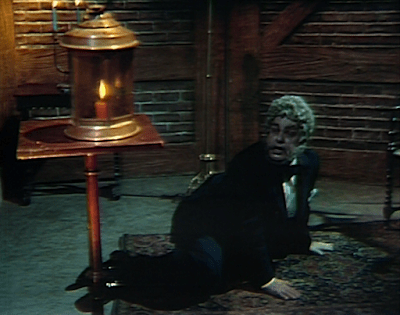
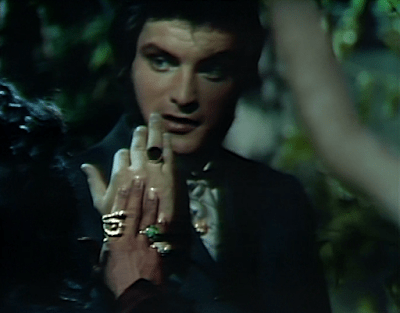
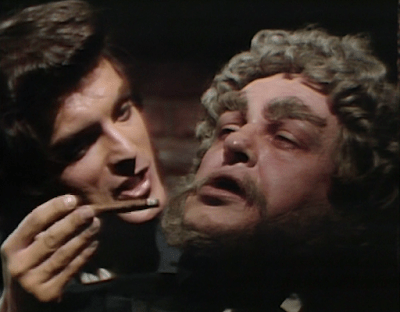
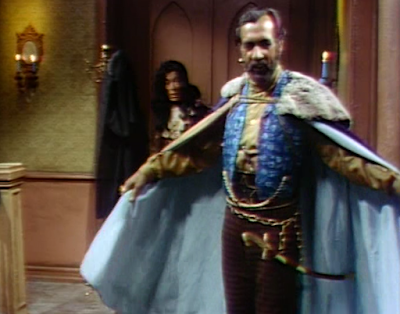
Evil sorcerer Count Petofi has cast a spell causing his mind to take over the body of rakish Quentin Collins, while Quentin is confined to Petofi’s own body. So David Selby begins playing a youthful and handsome Petofi, while Thayer David plays an aging and pudgy Quentin.
In their post about the episode on Dark Shadows Before I Die, John and Christine Scoleri use a wide variety of expressions to refer to the characters Thayer David and David Selby play today. I will just call Thayer David’s character P-Quentin and David Selby’s Q-Petofi.
P-QuentinQ-Petofi
Both of those actors give superb performances today; David Selby makes Q-Petofi’s preening arrogance suitably repellent, while the 42 year old Thayer David shows us P-Quentin reduced to the total helplessness of a despised man in extreme old age. There is a scene that Mrs Acilius and I found particularly hard to watch when Q-Petofi’s henchman Aristide takes the thick glasses without which P-Quentin is effectively blind and holds them away from him.
Q-Petofi and Aristide’s gleeful cruelty to P-Quentin make us wonder how the count and his henchman feel about the body they are looking at. The show’s earlier body swap story, in which vampire Barnabas Collins had hoped to die and come back to life in the form of Frankenstein’s monster Adam, led Adam to ask Barnabas in #587 “How could you hate yourself so much that you wanted to change your body?” We hadn’t known that that the count hated himself at all until we saw this scene, but he must have done to take such delight in tormenting P-Quentin, and Aristide’s revelry shows that he, too, harbors more hostility to his master than he ever dared expose.
P-Quentin staggers away from the lair of Q-Petofi and Aristide and meets broad ethnic stereotype Magda Rákóczi in the woods. He tries to explain his true identity to Magda, who has experience with magic and has for some time now been his ally. But Magda’s fear of the count keeps her from listening to the far-fetched tale, and she rushes off.
P-Quentin makes his way to the door of his home, the great house of Collinwood. He stands there, and we hear his thoughts, in David Selby’s voice. He tells himself he cannot go in, because no one there would believe him if he told them who he was. He slinks off to the caretaker’s cottage, where he meets maidservant Beth, who is his sometime fiancée. He tries to tell her the story, but she too is terrified of the count. When Q-Petofi shows up, she leaves with him.
Magda is a wonderful character, and what we have seen has given us every reason to hope she will be a substantial part of the show for a while yet. Unfortunately, this is her final on-screen appearance. We will hear her voice once more, six weeks from now. The show has always been visually ambitious, and lately they’ve managed to pull some neat tricks with videotape that led me to hope we would see at least one scene in which Grayson Hall appears opposite herself as both Magda and time-traveling physician Julia Hoffman. When Hall appeared in the 1970 film End of the Road, she said that it was a relief from playing Julia, to whom she apparently referred as “that tight-ass doctor.” Magda is earthy enough that it would have been fun to see how Hall would have used her to demonstrate the same attitude towards Julia, even if she had to stick to words approved by the ABC network’s Standards and Practices office, and Julia’s reaction to Magda would doubtless have been just as much fun.
Barnabas Collins went into a trance at the end of February 1969 and came to in March 1897, a time when he was a vampire. Barnabas took the audience with him, so that Dark Shadows has been a costume drama set in 1897 ever since. We’ve had a few glimpses of 1969- we can see that time is passing there, that twelve year old David Collins has been saved from death, that the ghosts of rakish libertine Quentin Collins and maidservant Beth Chavez have stopped haunting the great house of Collinwood, and that Barnabas’ physical body has vanished, leaving him no avenue of return to the 1960s. We’ve also had indications at several points that the show was about to put the 1897 segment into its climactic crisis, each of which was followed by a restart of that segment. Some of those false signs probably reflected long-range plans that were abandoned when they saw how popular 1897 was.
Now, they are in a position when they can go back to 1969 whenever they wish. There are only a few unresolved story points in 1897. Most of those can be wrapped up quickly, and the rest can be forgotten. If they wanted to, they could write a single slam-bang episode in which the evil Gregory Trask is forced to accept the annulment of his marriage to Judith Collins and to relinquish control of Collinwood, the family is persuaded that Barnabas never really was a vampire after all, and Kitty Soames, the dowager countess of Hampshire, turns into Barnabas’ lost love Josette and finds a way to leave him that will make him even more miserable than he already is. Sorcerer Count Petofi might be left watching helplessly as Barnabas, his friend Julia Hoffman, and the living Quentin all escape into the future. We could then assume that the rest of the characters just toddled off and led quiet lives.
They could equally well take another tack on their way back to contemporary dress. Barnabas and Julia came to 1897 separately; there is no reason why they, or any other characters, should have to go to 1969 together. Today, Petofi is performing some kind of mumbo-jumbo that is supposed to lead to a body swap that will cause him to trade forms with Quentin. After that, he is confident he will travel to 1969 and be safe from his foes, the Rroma people. He seems to be succeeding. So perhaps a Petofi who looks and sounds like Quentin will appear in 1969, in a Collinwood based on the events that have taken place so far in 1897.
In that pocket universe, Collinwood would be known as Traskwood. Its owner in 1969 would be Trask’s son by a subsequent marriage. Call him Gregory, Junior. It would be unclear at first what happened to Judith and to her presumptive heir, her twelve year old nephew Jamison. The revelation of their fates could set us up for some big twists and the introduction of new characters with familiar faces.
Since Gregory, Junior would be in his sixties, he could have a couple of adult children who would carry on some story points. Gregory III could be played by Jerry Lacy without old age makeup, and could be a morally ambiguous character who might emerge as a protagonist and would certainly become prominent in the pages of the fan magazines. None of the Trasks would have any legal obligation to let Quentin stay in any of their houses or to work for any of their businesses, nor would any surviving Collinses. Moreover, everyone in the area would know full well that there used to be a vampire on the estate named Barnabas Collins, and no one would ever have heard of Julia.
If the show goes that direction, we could spend half of each week with Petofi-as-Quentin while he makes a place for himself in that pocket universe version of 1969, while we would spend the other half with Barnabas and perhaps Julia back in 1897, where they are in an uneasy alliance with wicked witch Angelique as they try to set history right. Kitty’s Josettification would threaten to destroy this alliance, since Barnabas is obsessed with his love for Josette and Angelique is equally obsessed with her hatred for her.
The body-swap theme of today’s episode, along with the emphasis on the procedure Petofi is following, will remind longtime viewers of The Experiment, a theme that ran from April to May 1968. Barnabas and Julia built a Frankenstein’s monster with the intention of killing Barnabas and bringing him to life again in the new body. Some viewers may have wondered if Jonathan Frid was actually going to leave the show, and if the actor playing the monster was going to take over the role of Barnabas.
This time a larger fraction of the viewers are likely to think the transfer might work, since it would not require a popular star to leave the show. On the contrary, casting David Selby as Petofi in an altered twentieth century would give him the chance to wear up-to-date clothing, have magical powers, inflict cruel punishments on people who get in his way, run con games, hint at an ambiguous sexual orientation, and generally have a wonderful time. Since Mr Selby had by this point become the pin-up of a huge percentage of America’s teenaged and preteen girls, that sounds like a recipe for sky-high ratings. Meanwhile, casting Thayer David as a Quentin estranged from his body and his social environment would present an expert character actor with a challenge worthy of his skills.
It might sound like it would be too confusing to intercut between a parallel version of 1969 and a continuation of 1897, but the show will try almost exactly the same tactic a couple of years from now, as they set up for the storyline that carries the series through its final nine weeks. That closing bit is not widely regarded as one of the better phases of Dark Shadows, but the intercutting timelines that lead to it are an intriguing gambit. Maybe the idea for it came when they were trying to figure out how to get from 1897 back to 1969, in which case it is possible that the scenario I have outlined above may be very much like what the writers had in mind at some point in the development of the story.
Corridors of Trial and Error
We do get a few hints today about what we might see in the 1897 half of the show if it does split. Broad ethnic stereotype Magda Rákóczi shows up for the first time since #834, before Julia came to 1897. We had begun to fear we wouldn’t see her again. It’s good to have her back, but since Magda is also played by Grayson Hall, it raises the possibility that Julia might go away for a long time. Maybe the action will be split between 1897 and 1969 for some months, and during those months Julia will be in 1969, running her hospital, entirely unaware that there ever was a Barnabas Collins.
Beth is a servant of Petofi’s now, and she spends the episode bickering with her colleague Aristide. It turns out that she still has feelings for Quentin. At the end, she runs out of Petofi’s lair to try to help Quentin. This suggests that Beth’s conflicted loyalties will be a source of drama. Aristide shouts after her not to go, then says that “You’ll ruin everything.” He delivers this line in such a mild tone that the resulting laugh must have been intentional. This raises the possibility of Aristide emerging as a source of laughs. In the hands of actor Michael Stroka, that is a distinct possibility.
Quentin rambles into the Blue Whale, the tavern in the village of Collinsport. It’s after hours, and the only person in the barroom to tell him to stop knocking on the door is cabaret performer Pansy Faye, whose body Quentin first met when it was occupied by Trask’s daughter Charity. He still calls her Charity, which she overlooks because she has the hots for him. Pansy lets Quentin in, and invites him to her place.
Charity lived at Collinwood with her father, and after Pansy took over she stayed on there for some time. The other day she talked about wanting to leave Collinwood and go “home,” but it was not at all clear what that meant. Her invitation to Quentin is the first time she explicitly says that she has her own apartment now. Perhaps, if we stay in 1897, we will see that apartment. Maybe when Thayer David takes over the part of Quentin, Pansy’s psychic gifts will enable her to recognize who he really is, and she will take him in. In those days, of course, a man and a woman would have to get married to rent a lodging, so presumably that would have involved a wedding. Since Quentin would appear to be Petofi, Pansy would thereby become a countess, Kitty’s equal in rank. It already makes Kitty exceedingly uncomfortable to be around Pansy, so that would be an occasion for a great deal of comedy. Moreover, any viewer who saw that both women had the same title and both were involved in supernatural changes of personality would be convinced that the writers had planned that phase of their story all along.
Pansy goes into her act. She sings her song; Quentin is seized with a fit of brio. He gives a little speech addressed to the absent bartender, picks Pansy up, spins her around, kisses her passionately, then sits down at the piano and bangs out the tune of her song. She admires his piano playing and he says that he used to be able to play quite well, before “they” came. Then he suddenly sinks back into his previous depression. He denies that he ever played the piano in his life. We know that it was Petofi who had that moment of brightness, and that Petofi’s mood darkened when he remembered the Rroma who cut his hand off 100 years before. Quentin has no recollection of anything his body does or says when Petofi is using it.
A piano is prominently featured in the drawing room at Collinwood in the 1960s- perhaps there will also be one there when the estate is renamed Traskwood, and when Petofi, as played by David Selby, wangles an invitation to the great house, he will play it. That might set us up for a moment when Quentin returns to his proper body, tries to explain what has happened, and finds that his inability to play the piano marks him as an impostor. You could build a lot of story on that- you might make it look for a while like Quentin could find a home in the Traskwood universe, then show that no, the people back in 1897 have to reset the past before anything can work again.
Stuffy Edward Collins arrives at the cottage in the village of Collinsport which artist Charles Delaware Tate is currently occupying. He has come in response to an invitation apparently from Tate.
Tate lets Edward into the cottage, but he cannot explain what occasioned the invitation. Another man enters and says that it was he, not Tate who sent the invitation. Edward is visibly displeased.
Edward once knew the man as Victor Fenn-Gibbon, friend of the English aristocracy, but subsequently learned that he was actually Count Andreas Petofi, Hungarian nobleman and reputed sorcerer. When Edward tells Petofi that his brother Quentin Collins told him that he was the cause of the spells that have recently been cast on many members of the Collins family, including himself and his son, Petofi asks him if he believes everything Quentin says. That earns him a hearing.
Petoi tells Edward that he knows the greatest threat to the Collinses is one of their own number- Barnabas Collins. Edward insists on playing dumb, and Petofi has to say out loud that Barnabas is a vampire. We see Tate eavesdropping on this conversation, and wonder what effect it will have on the story that he now knows Barnabas’ secret.
Edward agrees to work with Petofi to find and destroy Barnabas. Meanwhile, we see that Barnabas is hiding out under Edward’s own roof, in the great house of Collinwood. He and broad ethnic stereotype Magda Rákóczi are in Quentin’s room. They know that Quentin is a werewolf, Quentin and Magda know that Barnabas is a vampire, and all of them are working together to frustrate justice and keep the show fun.
Barnabas and Magda see a portrait that Tate painted of Quentin. There is a full Moon tonight; Quentin did not change. But the portrait did. The year is 1897, and The Picture of Dorian Gray has been in the bookstores for seven years. Moreover, Barnabas is a time traveler from the 1960s, so he had even more opportunity to read it. He catches on right away, and explains to Magda that from now on it will be the portrait that changes, while Quentin remains the same.
Barnabas made his voyage from 1969 by accident. Collinwood was uninhabitable because Quentin’s ghost was haunting it so aggressively that everyone was dying. Barnabas went to Quentin’s old room, and found some I Ching wands. Under the guidance of occult expert Timothy Eliot Stokes, he cast the wands, meditated on them, and his “astral body” found itself animating the physical body that lay in a hidden, sealed coffin in 1897. Now Barnabas looks through the room again, searching for the wands. He finds them, and with Magda goes to the basement of the Old House on the estate. He explains that this is where he did his thing in 1969, and that he will do the same thing on the same spot in order to contact Quentin’s ghost in 1969 and ask him what’s going to happen next. He also says that his physical person will be sitting there motionless, perhaps for several days. Since Edward and Petofi are on their way, and they both know that the basement of the Old House is Barnabas’ very favorite hangout, this would seem to be rather a hazardous plan.
Sorcerer Count Petofi enters the great house of Collinwood, carrying a large painting covered with a cloth. He finds the hypocritical Rev’d Gregory Trask, who is at the moment master of the house, standing in the drawing room, dazed. Petofi realizes that Angelique the witch cast cast a spell on Trask, and that this spell is part of her effort to obstruct his own evil plans.
Petofi meets broad ethnic stereotype Magda Rákóczi in the foyer. He forces her to tell him that Angelique is upstairs, in Quentin Collins’ suite. He exits, taking the painting with him.
Angelique is casting a spell, ordering Trask to point a revolver at his temple. She is about to make him squeeze the trigger when Petofi surprises her. He overpowers her, both physically and in terms of the spell, and frees Trask.
Quentin is in the prison cell in the basement. Together with the scene between Petofi and Angelique, this circumstance will ring bells for longtime viewers. We first saw this cell in #401, when the show was set in 1795. In that part of the series, Thayer David played much-put-upon indentured servant Ben Stokes, who was a plaything in Angelique’s hands. Ben was the first prisoner confined to the cell, when haughty overlord Joshua Collins was punishing him for some or other things he had been powerless to prevent. Now, the dramatic date is 1897, and the same actor is playing Petofi, who stands at the opposite extreme from Ben. Angelique is not much better able to resist Petofi than Ben had been to resist her, and so far from being a place where he will be imprisoned the cell is just another place for him to exercise his power over everyone else.
Quentin is in the cell because he is a werewolf, and this is the night of a full Moon. The closing cliffhanger comes when Trask, released from Angelique’s spell, comes and tells him he will watch him transform into the animal, then go get the police.
We open in the woods on the estate of Collinwood, where a young woman in heavy makeup and bright clothing is crying. Another woman in even heavier makeup and even brighter clothing approaches and asks her what is wrong. The first woman says that she had a vision which told her that the rakish Quentin Collins will die of stab wounds twelve days from now, on 10 September 1897.
The first woman used to be Charity Trask, the miserably repressed daughter of the evil Gregory Trask. She is now possessed by the spirit of Cockney showgirl Pansy Faye. Charity knew that Quentin was a werewolf, and wanted nothing to do with him. Evidently Pansy did not acquire that knowledge when she took up residence in Charity’s body, and has decided that she will marry Quentin. Quentin has no interest in either Charity or Pansy, and already has two other fiancées, one of whom he loves, at least after his fashion, and the other of whom is sealed to him by a pact with the Devil. Yesterday Charity/ Pansy learned of the second engagement, and tried to kill Quentin to prevent it coming about; week before last, she tried to end the first engagement by killing the fiancée. Pansy had her faults, but she wasn’t inclined to physical violence. That part seems to be Charity’s contribution to the symbiont.
The other woman is broad ethnic stereotype Magda Rákóczi. Magda was the one who made Quentin a werewolf in the first place. She cursed him for murdering his wife Jenny, who was her sister. It was only after she had placed the curse that Magda learned that Jenny had given birth to Quentin’s twin children, a boy and a girl. Since the curse is hereditary, Magda is now desperate to lift it, and she and Quentin have become allies.
Some time ago, we learned that if Quentin dies, there will be no hope of lifting the curse. So Magda is terrified when Charity/ Pansy tells her of her vision of Quentin’s death. She takes her back home to the great house on the estate, where her father and Quentin are bickering while they recap yesterday’s story. Trask tries to deny that Charity/ Pansy is insane or that she is capable of killing, but when she enters and announces that she will murder the first person who comes between her and Quentin he has to admit that it might be time to find a place for her in residential care.
We turn our attention to the upstairs of the great house. We see Charity/ Pansy in bed, with Magda sitting in a chair beside. The gramophone is playing a record of Pansy Faye’s theme song. Regular viewers will wonder where Charity/ Pansy could possibly have found such a thing. Charity never met the living Pansy, who was killed the very evening she arrived at Collinwood. Perhaps Pansy’s fiancé, the childlike Carl Collins, bought the record when he met Pansy in Atlantic City and brought it back with him. Carl himself was killed well before the possession began, but perhaps Charity or Charity/ Pansy found it among Carl’s effects.
Charity asks Magda if she likes the tune. “I only like Gypsy music,” she replies. Charity/ Pansy and Quentin both reiterate their theme songs endlessly, but few other characters in the 1897 segment have so much as a dedicated entrance cue. This line of Magda’s makes us wonder what the show might have been like if they had given every major character a theme song.
Trask has a crisis in the drawing room. He hears a ghostly voice warning him that there will be another killing soon. He starts shouting the name “Minerva!” and pleading for mercy. First time viewers might not know what to make of this. Those who have been with the show for a while know that Minerva was Trask’s wife and Charity’s mother, and that he instigated a plot to murder her so that he could marry wealthy spinster Judith Collins and become master of Collinwood. When the voice starts to talk about “the beast that walks like a man,” Trask says “You’re… not Minerva?” Jerry Lacy is an expert comic actor, and his delivery of that line is laugh-out-loud funny.
The same ghost appears visibly to Quentin in his room. He recognizes it as that of Tessie Kincaid, a woman he killed in a recent fit of lycanthropy. He knows that she is appearing to him because tonight there will be a full Moon.
Magda enters and finds Quentin writing a suicide note. She tells him he must not kill himself. She chains him to a post in his room and stands by with a pistol. Trask enters and finds them in this compromising position. Mrs Acilius and I laughed as we imagined how Magda and Quentin might have claimed they were planning to spend the evening.
But there is no point in lying to Trask. Between what Tessie’s ghost told him and what he overheard while eavesdropping on a conversation Quentin and Magda had earlier in the drawing room, he has figured out Quentin’s problem. He takes the gun from Magda and recognizes the bullets with which it is loaded as silver. He announces that he will wait until the Moon rises and see what happens.
Tessie’s turn today marks Deborah Loomis’ third and final appearance on Dark Shadows. Miss Loomis didn’t get to do very much, but she made the most of all of it, and I wish we had seen more of her.
The dramatic date is 28 August 1897. On 23 July, in #803, sorcerer Count Petofi cast a spell on stuffy Edward Collins. Ever since, Edward has believed he was a valet recently separated from the service of the Earl of Hampshire. This led Edward’s brother, the rakish Quentin, to follow the Collinses’ long-established procedure for responding to mental illness and lock him up in the room on top of the tower in the great house of Collinwood.
In #816, broadcast on 11 August 1969 and therefore set on 11 August 1897, Petofi brought something even stranger on Edward’s twelve year old son Jamison. He called the spirit of Jamison’s grandson David to project itself from 1969 and to take possession of Jamison. In 1969, David is deathly ill because Quentin’s ghost had besieged him and everyone else at Collinwood. Now, Jamison too is dying, and in the moments he has been able to speak he has let the living Quentin in on the fact that he will eventually become a family-annihilating ghost.
Wicked witch Angelique has made a bargain with Quentin. She will try to restore Jamison and Edward to their usual selves, and if she succeeds Quentin will marry her. We see her beside Jamison, talking earnestly with him, praying loudly to “the Master of Darkness” to cure him and Edward so that she and Quentin can devote themselves to the service of that supernatural personage. In 1968, when the show was in contemporary dress, Angelique and others used a lot of euphemisms like “Master of Darkness,” but lately the ratings are high enough that the ABC network’s office of Standards and Practices has been letting them say the name “Satan.” I suppose Angelique’s persistence in the former phrasing shows that she’s still devoted to the old time religion.
Satan comes through, and Jamison and Edward are freed. This leads to a bit of awkwardness in each case. Quentin and Edward’s step-niece Charity Trask has lost her personality as the result of another of Petofi’s spells, and is now hosting that of the late Pansy Faye, Cockney showgirl and onetime fiancée of Quentin and Edward’s late brother Carl. Charity/ Pansy is exploring the great house when she comes to the locked door of the tower room. She hears Edward inside calling for help. He is still in his valet persona, and he is delighted with her when she promises to get a key and let him out. Edward returns to himself, with no memory of anything that has happened since 23 July, while Charity/ Pansy is away. When she comes back up and opens the door, she finds that he is in a foul mood and that he disapproves of her intensely. She is understandably miffed at his apparent fickleness and ingratitude.
For his part, Jamison’s quite different experience has left him with some memories. He tells Angelique of images that are floating around in his mind. She recognizes them as things associated with Petofi, and is distressed. She tells him he is better off not knowing what they are. Quentin is more distressed when Jamison looks at him and asks why he is trying to kill David Collins. Jamison can’t explain who David Collins is or how he learned that Quentin was trying to kill him, but this does confirm everything Quentin has gathered about his post-mortem destiny.
While Edward comforts Jamison in the study, Quentin and Angelique meet in the drawing room. She asks if he will honor his end of their deal; he says that he will, though he makes abundant protests about his reluctance to do so. Charity/ Pansy eavesdrops at the door. She has decided that she will marry Quentin, and is horrified to hear this conversation.
Edward enters and asks Angelique to excuse him and his brother. She exits, and Edward declares that the first order of business must be to hunt and destroy vampire Barnabas Collins. Quentin is appalled at this. He tries to tell Edward that Petofi is their most immediate threat; after he explains who Petofi is, Edward agrees that they will get around to fighting him at the appropriate time, but he insists that Barnabas is their main concern.
Edward exits, and Charity/ Pansy enters. She tells Quentin that she overheard his conversation with Angelique. She says that he will not marry Angelique. Quentin bitterly responds that he will, and that there is nothing she can do to stop it. At this, Charity/ Pansy picks up a knife and tries to stab Quentin. Quentin holds her at bay, and Edward enters in time to see what is happening and to get Charity/ Pansy off of Quentin. Quentin says that Charity/ Pansy’s condition is further evidence of the need to focus on fighting Petofi, but Edward will not swerve from his determination to concentrate on Barnabas. Moreover, he decides that he will now quiet Charity/ Pansy himself. He sends Quentin out of the room and prepares to give Charity/ Pansy a stern talking-to.
Charity/ Pansy’s attempt to prevent Quentin’s marriage to Angelique by stabbing him is of a piece with her attempt to break up Quentin’s relationship with maidservant Beth in #823/824 by poisoning Beth’s brandy. The original Pansy, whom we saw as a live person in #771, was not exactly nice. She was cold, hard, and cynical, trying to exploit the childlike Carl. But she didn’t seem to be bent towards physical violence. That appears to be Charity’s contribution to the composite being that the two of them now make up.
Before Edward can deliver whatever lecture he had planned to give Charity/ Pansy, she goes into a trance. The live Pansy had done a stage act as a “mentalist” and fortune teller, and was astonished in #771 when she tried to do her act at Collinwood and found herself actually channeling spirits from the great beyond. Now Charity/ Pansy routinely acts as a medium.
Charity/ Pansy announces that something terrible will happen on 10 September. Countdowns don’t usually work as a source of suspense on soaps. They might be all right in a play or a feature film, where we know that there will be a final curtain or a last frame after which the imaginary universe will cease to exist, but so long as the series is scheduled to come on every weekday at 4 PM, we know that there is always going to be room to move any deadline a little further out. Besides, since Dark Shadows was done virtually live to tape, they could rarely predict with any accuracy just how many ticks of the clock it would take to get all the movements made and dialogue spoken before the crisis is supposed to be reached. But “10 September” is in a slightly different category. Quentin explicitly says on screen that today is 28 August, which was indeed the original broadcast date in 1969. And when Edward says that his last memories are of 23 July, he is indeed referencing the original broadcast date of #803. So when Charity/ Pansy says “10 September,” she is committing the show to something in the real world. We may well sit up and take notice.
Charity/ Pansy has a vision of what will happen on that date. She sees Angelique looking at a portrait of Quentin in the drawing room. Red paint is dripping from the figure’s chest into a pool on the floor. That pool is next to a trail of other drops of red. In her mind’s eye, Charity/ Pansy follows the drops into the foyer, up the stairs, and into the tower. There, she sees Angelique opening the door to the tower room and finding Quentin sprawled, a sheet of red plastic, or perhaps construction paper, on his chest. Charity/ Pansy screams and runs out. From the dramatic music and Charity/ Pansy’s agitated reaction, I take it the object lying on Quentin’s chest is meant to suggest blood.
The acting is all very strong today. I was fascinated with Nancy Barrett’s use of her face to highlight Charity/ Pansy’s makeup. She relaxes her jaw muscles slightly more than usual, causing the dark treatment around her eyes to stand out. That in turn creates a visual metaphor labeling Charity/ Pansy a “painted lady.”
My wife, Mrs Acilius, was particularly impressed with Louis Edmonds’ realization of Edward. When the spell breaks and he becomes himself again, Edward is alone in an empty room. He has no dialogue, no props, and no scene partner to work with. Yet he instantly conveys what has happened. Even first time viewers will understand that the obliging servant has now become a stuffy authority figure.
Edward’s towering indignation when Quentin first tells him he was the one who locked him in the tower room gives way instantly when Quentin explains that he was under a delusion at the time. Edmonds executes that transition so smoothly that first time viewers will not notice the oddness of it, but longtime fans who remember the many previous occasions when the Collinses locked each other there as a response to mental illness will chuckle.
One of the prominent features of Edward’s personality is his warm relationship with his children. This sets him apart from the first two characters Louis Edmonds played on the show, high-born ne’er-do-well Roger Collins and haughty overlord Joshua Collins. Edward’s dialogue in his scene alone with Jamison involves several discrete points of information, and it would have been understandable if the affection he displays for Jamison while he getting all of those words across had been either perfunctory or mawkish. But he and David Henesy get the emotions exactly right while also delivering the lines very clearly.
Edward’s preoccupation with Barnabas is a delicious little bit of commentary on the show itself. Dark Shadows‘ ratings, chronically low during its first 42 weeks on the air, perked up when it added Barnabas to the cast in April 1967. That summer, schoolkids curious to see a vampire on daytime TV made it into a hit, and not long after Barnabas became one of the pop culture sensations of the 1960s, instantly recognizable to many millions of people who never watched the show. To this day, people who have heard of Dark Shadows are likely to refer to it as “the vampire soap opera from the 60s.” It was Barnabas who took us with him to 1897, when he traveled back in time in the course of his attempt to rescue David from Quentin’s ghost, and for the first months of the 1897 storyline he was the only character who knew what was at stake for the 1969 version of the Collinses in the events going on around him.
But now Barnabas is on the fringes of the story, and Quentin, Angelique, and Petofi all know about 1969. Edward’s idea that the action has to focus on Barnabas is evidence that he hasn’t been watching the show. Petofi is the principal antagonist now, Quentin the chief protagonist, and Barnabas can be absent for weeks at a time while they and others find all sorts of things to do. This represents, not Barnabas’ failure, but his ultimate success. Before he was introduced, every story revolved around well-meaning governess Vicki, the main character. A soap opera can’t really have a main character. It needs to keep multiple storylines running at once, occasionally intersecting with each other, often running for long periods with little or no interaction. When one person had to be at the center of every development, the result was slow and claustrophobic.
Barnabas blew that confining structure open, because as a vampire his function in the story was not to solve problems, but to create problems for other people to solve. So no matter how much time they spent focusing on him, he always directed our attention towards everyone else. We wondered who would catch on to his secret, who would fall victim to his malign intentions, who would find a way to fight him, etc. When a mad scientist managed to free Barnabas of the effects of the vampire curse, he retained his function as a problem-maker, even when he set out to be a problem solver. Every time he announced that he had a plan, we looked forward to seeing how the rest of the cast would react to that plan’s rapid and catastrophic collapse.
Barnabas is as hapless in 1897 as he has been in every other time period, as witness the fact that he has been exposed as a vampire and driven into hiding. But he isn’t even the show’s Screw-Up-in-Chief now. That title belongs to broad ethnic stereotype Magda Rákóczi. In #807, Petofi compelled Magda to review the preceding 22 weeks of the show and admit that she had precipitated every plotline. The first of those was the release of Barnabas into the world of 1897, so that his crimes and misadventures are just a subcategory of hers. Since Magda is played by Grayson Hall, who in her original role of Julia Hoffman is waiting for us in 1969, we can be confident she won’t be coming back to contemporary dress with us, but for the moment she has relegated Barnabas to the status of a secondary character.
Rroma chieftain/ New England crime boss King Johnny Romana and his Afro-Romani henchman Istvan have cornered broad ethnic stereotype Magda Rákóczi on top of the cliff at Widows’ Hill. King Johnny declares that he will now kill Magda. She is a major character, it’s a Tuesday, and this is the resolution of yesterday’s cliffhanger, so we have three reasons for expecting her to survive.
However, none of the three reasons is as strong as it might at first appear. First, while Magda precipitated every major storyline in the segment of Dark Shadows set in the year 1897, none of those stories needs any further action from her to continue right now. We’ve also had an indication that Grayson Hall’s original character, Julia Hoffman, will soon be returning to the cast. Second, Dark Shadows never followed the traditional soap opera format in which important developments were reserved for week-ending finales. Third, while the great majority of episode-ending cliffhangers fizzled out in the opening seconds of the next installment, occasionally they did go ahead and resolve one with a death. Besides, as my wife Mrs Acilius points out, Magda laid her husband Sandor’s ghost to rest at the top of the episode, and it is called Widows’ Hill because widows go there to die. So there actually is some suspense as to whether King Johnny will make good on his threat.
Time-traveling vampire Barnabas Collins shows up at the last moment and orders King Johnny to release Magda. King Johnny refuses and orders Istvan to throw Barnabas off the cliff. Barnabas looks into Istvan’s eyes, using his power of hypnosis. Once Istvan is under his control, Barnabas compels him to walk off the cliff. King Johnny then realizes who Barnabas is. He holds Barnabas at bay with a cross. Barnabas tells him that he can reclaim what Magda stole from him, but only if he lets her go. At that, King Johnny becomes cooperative. Too bad Barnabas didn’t open with that- Istvan could have lived. Fortunately for Barnabas and Magda, King Johnny forgets about Istvan instantly.
For a hundred years, King Johnny’s tribe kept as its most prized possession The Hand of Count Petofi. This was literally a severed hand, cut from a Hungarian nobleman. Count Petofi was a sorcerer, and when nine Rroma men severed his right hand in a forest one night in 1797, most of his power went with it. Magda stole the Hand in hopes that she could use that power to undo a spell she herself had cast, but found that the Hand would not obey her. Now Count Petofi himself, 150 years of age, has reclaimed the Hand, and it is once more attached to his wrist. He is hugely powerful and a great problem for Barnabas.
Barnabas tells King Johnny what has happened. King Johnny turns out to be the one person in the world over whom Petofi has no power. In return for Petofi’s location, King Johnny agrees to return with the Hand and lift the curse Magda regrets. In his purple robe, King Johnny goes to Petofi’s hiding place. He and Petofi have a long and rather pointless conversation. Finally, Petofi is strapped to his chair and King Johnny raises his sacred scimitar, ready to re-sever the Hand.
This is a less suspenseful cliffhanger than yesterday’s. Petofi is still generating story; in fact, he is the only character who is. The hideout is Petofi’s territory; we have seen him thwarted there, but the defeats he suffered only confirmed that it is not a place where major changes take place in the direction of the narrative. And the meandering dialogue between Petofi and King Johnny deflates all the dramatic tension. Returning viewers have plenty of time to remember that, while Petofi’s magic may be useless against King Johnny, Petofi’s henchman Aristide is somewhere around, and he is quick with a knife. Without Istvan to run interference for him, King Johnny will be vulnerable to Aristide the whole time he’s dawdling around.
As King Johnny, Paul Michael has a very hard job. Not only is the character an egregious stereotype, but he really is scandalously ill-written. Violet Welles was far and away the best writer of dialogue on the show, and she manages to give a few glittering lines even to King Johnny. Still, he is ridiculous from beginning to end, a lot of menacing poses held together with a sinister laugh. That he is watchable at all is a tribute to Michael’s mastery of his craft. In his facial expressions and body language, we can see evidence of thought that is entirely absent from his words.
Rroma chieftain/ New England crime boss King Johnny Romana puts broad ethnic stereotype Magda Rákóczi on trial in the secret room of the old Collins family mausoleum. Evidently King Johnny has considerable magic powers; he conjures up the ghosts of several notorious murderers to serve as the jury. He also brings in the ghost of Magda’s husband to serve as the one witness for the defense.
The scenario is a remake of The Devil and Daniel Webster, a play that debuted at the Martin Beck Theatre in 1939. But the makers of Dark Shadows were likely thinking of a more recent Broadway production as well. From November 1964 to June 1965, a musical with a book by Ernest Kinoy and music by Walter Marks ran first at the Shubert Theatre, then at the Lunt-Fontanne, for a total of 232 Broadway performances. Its title is one of King Johnny’s favorite words- Bajour.
King Johnny keeps complaining that Magda tried to “pull the bajour on me!,” by which he means that she gave him one thing disguised as another. In the show, based on Joseph Mitchell’s stories of life among Rroma in the New York metropolitan area, bajour refers simply to a confidence trick with a big payoff for its perpetrators. The cast, saddled with a bunch of instantly forgettable songs, sings as joyously as it can about how the Rroma, to whom they of course refer as “gypsies,”* love nothing more than cheating lonely old women out of their life savings. This uninhibited celebration of racism reported losses of nearly a million dollars, more than twice the total amount of money invested in it. Perhaps the fictional Rroma weren’t the only ones who enjoyed running a good scam. Perhaps, too, Mel Brooks’ 1967 film The Producers wasn’t entirely a work of fiction.
The cast of Bajour does not appear to have overlapped with that of any episode of Dark Shadows. The closest link I can find to the cast at this period of the show is Michael Bennett, who danced in Bajour and later married Donna McKechnie. Many very distinguished performers appeared in Bajour, but I’m not tempted to do any imaginary recasting. I’m sure Chita Rivera and Herschel Bernardi were wonderful as leads Anyanka and Cockeye Johnny Dembo, but they couldn’t have outdone Grayson Hall and Thayer David as Magda and Sandor. Herbert Edelman was good in everything, and I’m sure his turn as “The King of Newark” was no exception, but no one could have done more than Paul Michael does to make the cartoonish role of King Johnny watchable. Paul Sorvino had a great career, and even has a screen credit in common with Henry Judd Baker- they both appeared in the disastrous 1980 film Cruising. I’m sure Sorvino would have been interesting as a replacement for Baker as Istvan, the mute Black Rroma, but that part is all about physical presence, and as was the case with Baker’s part in Cruising he is effective in a way that Sorvino could not have matched. Nancy Dussault is another performer who never lets an audience down, but Diana Davila’s approach to the character of Rroma maiden Julianka was so cleverly conceived that I couldn’t bear to think of anyone else taking the part.
While I’m on the topic of the Rroma, I want to bring up an oddity about my favorite Dark Shadows blog, Danny Horn’s great Dark Shadows Every Day. When he was writing about these episodes, Danny often stopped to ridicule the idea of a Rroma tribe living in New England in 1897. Danny works for the Wikimedia Foundation; you’d think he’d be in the habit of checking Wikipedia, where the article “Romani People in the United States” would tell him that, while Rroma have been migrating to North America continually since 1498, the majority of the ancestors of the million or so Americans who now identify as Rroma came in the late nineteenth century. The new arrivals tended to take some time to assimilate to the ways of the USA; the article is, as of this writing, illustrated with a photo of a Rroma caravan near Portland, Oregon, in 1905:
Rroma caravan near Portland, Oregon, in 1905. Photograph by the Portland Oregonian, found on Wikipedia.
Most Romani-Americans are totally assimilated nowadays, so much so that many people in the USA don’t realize that there actually is such an ethnic group. But there are still Romani heritage festivals in many cities, and the last traditional caravans were still traveling the Great Plains as late as the 1940s. And in Maine in 1897, Romani caravans were a frequent sight, one that indeed aroused exactly the sort of zyganophobic** reactions Magda and Sandor encountered from virtually everyone in their first days on the show.
Even Istvan isn’t as hard to explain as Danny seems to think. In the early days of European settlement, Rroma were often brought across the Atlantic as slaves; that was the case for the people on Christopher Columbus’ third voyage in 1498. Some intermarried with enslaved people of African extraction. There are still Afro-Romani communities in Louisiana and Cuba.
I started writing about Dark Shadows in the comment sections on Danny’s blog. He made a great display of ignoring the first 42 weeks of the show, and consistently made the harshest possible judgments of the acting of Alexandra Moltke Isles, who played well-meaning governess Vicki. That created a space for me to point out when the show was harking back to its early days, and to defend Mrs Isles. I would be remiss in a post like this if I did not mention that Mrs Isles made a documentary feature in 2003 called Porraimos: Europe’s Gypsies in the Holocaust. I’ve never been able to get hold of a copy of the film, but the New York Times liked it when it was shown on PBS.
*Rroma sometimes call themselves Gypsies, but you can’t assume they’ll like it if an outsider uses that word.
A lot of action in this one. Rakish Quentin Collins bluffs sorcerer Count Petofi with a threat that his nemesis, Rroma chieftain/ New England crime boss King Johnny Romana, will be coming. At the last moment, Petofi gives in and releases Quentin’s distant cousin, time traveling vampire Barnabas Collins, whom he has been holding prisoner.
Back in the great house of Collinwood, broad ethnic stereotype Magda Rákóczi discovers maidservant Beth Chavez lying unconscious on the floor. Magda takes her pulse. She then picks up the snifter from which Beth had been drinking, holds it to her nose, and gives a look of discovery. All of a sudden, Grayson Hall looks very much like her first character on Dark Shadows, Julia Hoffman, MD.
Somehow Magda gets Beth back to her room and saves her life. Beth tells her that she was poisoned by a woman called Charity. Magda leaves the room to look for Charity. Before she gets more than a few feet into the hall, King Johnny’s henchman Istvan springs out from the Shadows’ and grabs her.
Quentin comes into the foyer of the great house. Beth is there. He sees that she is upset and weak and asks what is wrong, but she will not explain. He asks if Barnabas can sneak to her bedroom without being observed. She leads the way to make sure no one who is involved in the vampire hunt sees him.
After Beth, Barnabas, and Quentin do some recapping, we see Magda in the woods with Istvan. She tries to talk him into running away with her, but he ignores her. He is supposed to bind and gag her. As we have seen many times on Dark Shadows, Magda has to hold the gag in her teeth. At the very end, an unseen figure approaches with a lantern, and Magda reacts with terror.
Rroma chieftain/ New England crime boss King Johnny Romana has cornered broad ethnic stereotype Magda Rákóczi in her living room in the Old House on the estate of Collinwood. He turns his back on Magda, closes his eyes, and starts reciting a lot of nonsense. Magda sees an opportunity to escape, and creeps over to the front door. When she opens it, a large man enters, blocking her exit.
The man is King Johnny’s minion Istvan. He is played by Henry Judd Baker, who was the only Black man ever to appear on Dark Shadows. He does not have any dialogue; Istvan, King Johnny will tell us later today, lost his tongue as the penalty for a misdeed. We do hear him laugh and grunt. He also wears trousers from the Lilli Von Shtupp “It’s Twoo! It’s Twoo!`” collection.
After Dark Shadows, Baker would reunite with Jonathan Frid, manhandling him in the movie Seizure. He also had a memorable turn in the lamentable 1980 film Cruising as a scantily clad man who slaps the main character. He died in 2016; the funeral home’s website calls him “Judd Henry Baker.” Maybe that’s a mistake on their part, or maybe he flipped the two parts of his given name for his acting work.
Meanwhile, evil sorcerer Count Petofi is holding time-traveling vampire Barnabas Collins prisoner. Petofi threatens to burn the great house of Collinwood to the ground and kill its residents if Barnabas does not take him to the year 1969. Barnabas realizes that this is an empty threat, and refuses to comply. This is notable as one of the few times Barnabas actually outwits someone. Also, Petofi’s sidekick Aristide spends the scene showing off two big flaming torches, continuing the show’s longstanding mockery of the fire marshals of New York City.
King Johnny found a severed hand at Magda’s house, which he thinks is the one that was cut from Petofi’s right wrist long before. Little does he know that Petofi has taken that one and reattached it. When he and Istvan take Magda with them as their prisoner, what they actually have is a hand Petofi cut off a corpse he ordered Aristide to dig up. They haven’t got very far when the ghost of that man appears and reclaims the hand. King Johnny responds to this unusual sight with fury, realizing that Magda pulled a fast one on him. She manages to get away from him and Istvan.





 Dark Shadows Commentary
