One night in 1797, nine Rroma men trapped sorcerer Count Petofi in the forest of Ojden. They amputated his right hand, and with it took most of his magical powers. Some time after, Petofi learned that he had exactly one hundred years to reattach the hand. If he managed it within that time, he would become immortal. Otherwise, he would die on the anniversary of the amputation.
Now that anniversary has come, and Petofi has succeeded in regaining his hand with only minutes to spare. Time-traveling vampire Barnabas Collins and his distant cousin, desperately handsome werewolf Quentin, have decided that because Petofi’s spirit is in possession of Quentin’s twelve year old nephew Jamison and Jamison is as close to death as is Petofi himself, only by surrendering the hand to Petofi can they save the boy. Barnabas did get Petofi’s servant Aristide to promise to free Quentin of lycanthropy once he has the hand back, but he put little faith in that promise.
Now Petofi is jubilant and Jamison is still sick. Barnabas tells Petofi about the deal Aristide made, and also says that he wants Jamison and the rest of the Collinses to be freed from the ill effects Petofi has had on them. Petofi could not be less interested. Instead, he wants Barnabas to tell him how he traveled in time from 1969 and how he will travel back there.
Petofi lets slip that he is anxious to go to another period of history because he is afraid of the Rroma people who are still after him. We know, not only that it was Rroma who cut off his hand, but that when Petofi saw a young Rroma woman in a tavern in #794 he couldn’t get out fast enough. While it may have taken nine Rroma men to take his hand, evidently a single Rroma woman, and a tiny one at that, is capable of doing him considerable harm. Barnabas has a Rroma friend, broad ethnic stereotype Magda Rákóczi, who has considerable magic powers of her own, and he knows of a Romany band currently camped near Boston. So Petofi’s apparently well-founded ziganophobia is a sign that Barnabas may be able to defeat him, even though Petofi’s powers were formidable even before he was reunited with his hand.
Petofi says that he will cure Jamison only if Barnabas explains how he traveled to 1897 from 1969. Barnabas tells Petofi he has no idea how he made that journey. This is so. He meditated on some I Ching wands, a process which he was told might have any of an infinite number of effects, and found himself in 1897. Nor does he have any idea how to get back. He might have enlarged on the theme of his complete lack of useful knowledge in this area. In 1968, Barnabas traveled back to his original era, the 1790s, by going to the grave of a man named Peter Bradford on the anniversary of Bradford’s death. Bradford’s ghost had been haunting him, and Barnabas called for Bradford to take him back to the year 1796. After he did so, Barnabas found that he could return to the 1960s only by having himself sealed in his coffin and waiting inside it for 172 years until friends let him out. He doesn’t tell Petofi about that incident, but it does not seem likely to be of any more help to him than the story about the I Ching would be.
Petofi does not believe that Barnabas is so hapless. First he squeezes Barnabas’ hand, depriving him of the power to dematerialize. Then he opens a cupboard and tells Barnabas to look in it. It takes a while to warm up, but eventually it gets an ABC affiliate showing Dark Shadows. Barnabas sees the parlor of the Old House on the estate of Collinwood in 1969. His best friend, mad scientist Julia Hoffman, MD, is sitting there reading a book. We haven’t seen Julia since #700, but she might be on our minds today. At one point Aristide lights his cigar on a candle burning in a large candelabra. In #296, Julia very memorably did the same thing with her cigarette.
Barnabas sees strange and troubled boy David Collins come staggering downstairs, raving deliriously about Quentin. Julia tells him to reject Quentin, who in 1969 is a ghost haunting Collinwood and draining the life from David. David passes out, and Julia injects him with a powerful sedative, as you do with unconscious children.
The cupboard loses the channel, and Barnabas asks Petofi what else is happening in 1969. Petofi cannot answer any questions; it quickly becomes clear that he couldn’t see or hear the scene. Barnabas is intrigued to learn of another of Petofi’s weaknesses, and walks out.
Aristide then speculates that Barnabas might be telling the truth. Petofi rejects this at once, reveals more of his cupboard’s limitations:
No, he’s not a fool, Aristide. He thinks he can win, accomplish whatever he wants to do here, and disappear without me…
Had Petofi ever seen even one episode of Dark Shadows, it would not occur to him to say that Barnabas is “not a fool.” Nor would he surmise that Barnabas is pursuing a plan that includes a plausible method of escape. If Barnabas had a plan of any kind, Petofi would know all about it, since it would have failed spectacularly the moment he took the first step towards putting it into effect.
Petofi and Aristide then go to the Old House. They find Magda there. At the moment, she is under Petofi’s power. Like Julia, Magda is played by Grayson Hall. We may have thought the glimpse into 1969 was a videotaped insert, but evidently it was done live, because Magda is not wearing her usual heavy brownface makeup. She may have a bit of an artificial tan, but Julia’s blue eyeshadow is clearly visible through it.
Magda, looking more like an actual Rroma woman than she ever has before.
Petofi forces Magda to lead her to Barnabas’ hiding place. He has a cross and Aristide has a chain and a padlock. Petofi puts the cross inside the coffin, and orders Aristide to chain the coffin closed. Petofi declares that Barnabas is in for a long journey.
In #797, the ghost of Rroma maiden Julianka appeared and placed a curse on her fellow grievous ethnic stereotype, Magda Rákóczi. Julianka blamed Magda for her death, and decreed that everyone Magda loved would die. Today, Magda is trying to prevent Julianka’s curse from taking the life of her desperately ill infant niece Lenore, daughter of her late sister Jenny. Magda goes to Lenore’s crib in company with Lenore’s father, Quentin Collins. Magda and Quentin try to conjure up Julianka’s ghost to plead for Lenore’s life, but instead they get the ghost of another Rroma woman- Jenny.
Jenny assumes physical form. She picks up Lenore and sings the lullaby “All the Pretty Little Horses.” We’ve heard Jenny sing this almost every time she has been on the show. It appears to be the only song she knows. For his part, Quentin has a phonograph and only one record, which he plays obsessively over and over. When they lived together, their home must have been a pretty grim place, playlist-wise.
Jenny lifts Lenore’s illness, and says that if Quentin looks into his heart he will know what he must do to ensure that Lenore has a bright future. She vanishes, and Quentin mutters dismissively at the idea that his heart will be a source of useful information.
Later, Quentin will have a dream while sleeping in the drawing room at the great house on the estate of Collinwood. Jenny visits and tells him that he must have nothing to do with Lenore and that she must grow up far from Collinwood. So far, dream sequences on Dark Shadows have always represented visits from the supernatural, but this one might be an exception. Jenny did say that the information Quentin needed to help Lenore was already in his heart. He is clearly not the stuff of which good fathers are made, and as Jenny explicitly says in the dream no one has ever been happy at Collinwood. So the advice she gives does seem to be correct. Perhaps this is just Quentin’s own knowledge taking a shape he can recognize.
Quentin goes on dreaming that his brother Edward is choking him. He wakes up to find that Edward is in fact choking him. This might seem like a prophetic dream, but it too might just be a natural expression of Quentin’s own unprocessed knowledge. Edward, because of a magic spell not directly connected with today’s events, is under the mistaken impression that he is a valet formerly in the service of the Earl of Hampshire. Quentin has followed the Collinses’ long-established protocol for dealing with mentally ill family members, and locked Edward up in the room on top of the tower in the great house. He knows this makes Edward miserable, and it is reasonable to suppose that he would expect Edward to express anger about it. Strangulation is Quentin’s own preferred method of expressing anger, especially towards members of his immediate family, so it can’t have been hard for him to see that coming.
Edward’s motivation is not as simple as Quentin’s would be if their positions were reversed. The evil Gregory Trask has been visiting Edward in the tower room, and has told him that Quentin is determined to keep him imprisoned in that room forever. He asks him to kill Quentin. Edward apparently has decided to comply.
Earlier in the episode, Edward had been more punctilious about cooperating with Trask. Trask presented him with a document to sign, promising that by signing it he would secure his freedom. Edward read the document, even after Trask very loudly insisted that it was unnecessary to do so. When Edward saw that it involved making Trask guardian of his son, Edward protested that he had no son. Trask said that this did not matter, but Edward would not be moved. Edward later tells Quentin about this encounter.
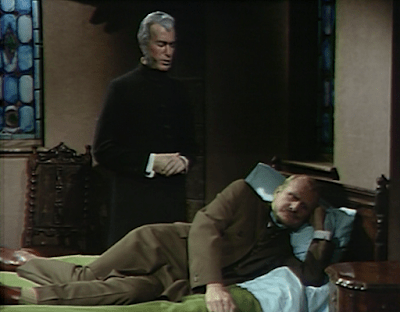
The tower room is a re-dress of the set used as the bedroom of strange and troubled boy David Collins in the parts of Dark Shadows set in the 1960s. Today it includes the bed from that set, and we see Edward trying to sleep in it. This is a powerful image for longtime viewers. Louis Edmonds plays Edward in this costume drama segment and David’s father Roger in contemporary dress. Edward is the father of Jamison, who like David Collins is played by David Henesy. Not only has the spell robbed Edward of the memory of Jamison and of his role as a father, it has reduced him to curling up in a bed made for a boy rather than a man.
Roger was, for the first year of Dark Shadows, a spectacularly bad father. He openly hated David and exploited David’s miseries to try to manipulate him into doing his own criminal dirty work. He was indifferent to the family’s name and the fate of its businesses, would go to any lengths to hide from the consequences of his actions, had killed someone, and was an alcoholic. Edward shares none of these shortcomings. On the contrary, he goes to the opposite extreme. He is as brave as Roger is cowardly and tenderly loves his children, Jamison and Nora. But he is also stuffy, name-proud, and money-grubbing. The contrast with Roger shows these failings, not simply as negatives, but as the overgrowth of the virtues that separate Edward from Roger. Though Louis Edmonds and Jerry Lacy are such accomplished comic actors that Edward’s scenes with Trask are funny enough to be worthy of a staging of the Jeeves and Wooster stories, Edward’s loss of his identity as father of Jamison and Nora is a genuine tragedy.
Quentin is fond of Jamison, and once he learns that his children exist he seems to wish them well. Nonetheless, he shares most of the other vices of early Roger. As Edward shows us what Roger might have been had he had stronger moral fiber, Quentin is Roger with his vices magnified by black magic. When Jenny tells Quentin that he must not raise Lenore, longtime viewers remember Roger as he was when first we knew him, and remember how grim David’s future seemed at that time. It was only after well-meaning governess Vicki became the chief adult influence in his life that we could have hopes for David. So we cannot doubt that Jenny is right.
This is the last of 21 episodes of Dark Shadows directed by executive producer Dan Curtis. When Curtis first took the helm in #457, he had no experience as a director, and it showed. But he learned very quickly. This one looks great and the scenes play very smoothly. He would later direct the feature films House of Dark Shadows and Night of Dark Shadows, as well as six episodes of the 1991 prime time revival of Dark Shadows and many other productions.
Charity Trask is in the drawing room of the great house on the estate of Collinwood trying to call the police when her abusive step-uncle, Quentin Collins, comes out of a secret panel and takes the telephone from her. He tells her that there is no longer any point in telling the police about Tessie, the injured woman upstairs. Tessie won’t be telling them anything. She has died. Apparently the sheriff of Collinsport is the same in 1897 as are his counterparts in other periods when Dark Shadows has been set- if you’re already dead, it’s too late for them to take an interest in you.
Charity says that Quentin killed Tessie. Charity knows that Quentin is a werewolf. He locks the door to the room and asks “Are you afraid to be locked in alone with a beast, a murderer, a creature of the supernatural?” This would seem to be rather an odd question, especially since he spent yesterday’s whole episode threatening to kill her.
Charity says that her father, Gregory Trask, will see to it that Quentin is brought to justice. Quentin takes a paper from his pocket and shows it to Charity. It is a confession to the murder of Charity’s mother, signed by her father. Charity claims that it was fabricated by Satan, which is what her father told her when she first saw it, and that Trask repeatedly tried to destroy it. This only convinces Quentin that the confession is true. He says that if either Charity or her father tells the police about him, he will hand over the paper. He adds “Now, Charity, I may hang for murder, but your father will be dancing at the end of a rope, too.”
Dark Shadows is set in the state of Maine, which in our universe abolished capital punishment in 1887. That used to be true in the show’s universe, as well. In #101, broadcast and set in November 1966, high-born ne’er-do-well Roger Collins told his son, strange and troubled boy David, that “They don’t hang people anymore. Not in this state, anyway.” But by the time the show left the 1960s for its first costume drama segment a year later, characters were already afraid of being sentenced to death. The morbid fascination of the gallows is so much of a piece with the show’s exaggerated melodrama that there must be a death penalty, no matter when or where the action is supposed to be taking place.
Quentin tells Charity that there is a chance- a small chance, he concedes- that he will be cured of lycanthropy before the next full Moon, so that she need not feel that she is an accessory to murder if she doesn’t turn him in right away. Miserable, frightened, and confused, she takes this seriously enough that she remains quiet at least through this episode.
We cut to a hiding place where a man known as Aristide is looking at himself in a mirror and primping his hair, moving his fingers through it with an exaggerated daintiness. We pan to broad ethnic stereotype Magda Rákóczi , who impatiently asks “Did you send for me so there would be two of us to admire you?” Aristide has some business to discuss relating to plot points not directly involved in this episode, and he and Magda trade menacing insinuations about the danger each faces from the various supernatural forces at work in the area. Magda says that what the ziganophobic Aristide calls her “Gypsy cunning” will protect her, and Aristide says that an amulet he wears around his neck will protect him.
Magda replies “All right, we’ve both got something to protect us. I go now,” and starts to leave. Aristide stops her, and says that she must recover the severed hand of Count Petofi. She says that a man named Tim Shaw stole the hand and ran off with it, and she has no way of knowing where Tim is. Aristide says she must find out and bring it soon, “before time runs out.” She asks “Before time runs out for who? You mean when Petofi comes back!” In fact, Aristide means more than that- his master, 150 year old sorcerer Count Petofi, will die in a matter of days unless he is reunited with the hand that was cut from his right arm a century before, in 1797. If he does recover the hand in time, he will become immortal. Magda fears Petofi and hates him, and would doubtless make any sacrifice to keep the hand away from him if she knew these were the stakes. So Aristide is mortified that he let slip the phrase “before time runs out,” and is anxious to avoid saying anything else.
Back at Collinwood, Quentin confers with a Mrs Fillmore. Mrs Fillmore has been looking after the twin children Quentin’s wife Jenny bore him after he left her and before he murdered her. This is the first time we have seen Mrs Fillmore. It is also the first confirmation we have had that Quentin has seen Mrs Fillmore. He didn’t know about the twins until #798, when the boy twin was already dead as the result of a curse that a woman named Julianka placed on Magda, who is Jenny’s sister. Now Mrs Fillmore tells Quentin that the girl is suffering the same symptoms the boy showed before he died, and that the doctor is at a loss what to do for her. Quentin says he will look for someone who might be able to help, and they both exit.
Charity is alone in the drawing room, making an earnest effort to get drunk. Magda enters and expresses surprise that the unbendingly prudish Charity has been drinking. Charity replies that she merely ate some chocolates that were filled with brandy. At the sight of an empty snifter, she says that after eating the chocolates she poured herself a small brandy. She then picks up and drinks another, regular-sized brandy. Charity starts talking about how terrible life at Collinwood is. Magda mentions Tim Shaw, who was once Charity’s fiancé and who was framed for her mother’s murder. Charity wonders if Magda can use the Tarot cards to find Tim and bring him back. She asks if Tim will have to tell the truth if he comes back, and Magda assures her that he will. Magda may assume that the truth Charity wants is about the end of her relationship with Tim; she does not know that Charity is desperate to revert to believing that Tim, not her father, murdered her mother.
Magda asks Charity to tell her as much as she can about Tim. Charity says that when Tim was a boy, his closest friend was named Stephen Simmons, and that “He and Stephen Simmons used to always say they would go to San Francisco when they grew up.” Magda asks where Stephen Simmons is now, and Charity says she thinks he lives in Worcester, Massachusetts. She goes to her bedroom to look for a Christmas card Stephen sent her last year, hoping it may have his current address.
Quentin returns and finds Magda. He asks Magda how she knew about his daughter. She asks what he means. When Quentin tells her that the girl is suffering the same symptoms that her brother showed immediately before his death, they rack their brains to come up with a potential defense against Julianka’s curse. Magda remembers Aristide’s amulet. It is capable of warding off vampires and witches- perhaps it will defend against Julianka as well. Magda tells Quentin where Aristide is hiding, and he decides to go to Aristide and rob him of the amulet.
Aristide is asleep when Quentin arrives. He awakens before Quentin can take the amulet, and declares “This pendant protects me from witches, warlocks, and unnatural spirits.” Quentin asks “How does it do against flesh and blood, Aristide?” Aristide draws a curvy piece of wood with no sharp edges and replies “For flesh and blood, I have The Dancing Lady.” The piece of wood is supposed to be a knife. When Aristide first displayed it in #792, he called it “The Dancing Girl.” Perhaps this is a case of Soap Opera Rapid Aging Syndrome, and in a couple of weeks it will be The Dancing Dowager, then The Dancing Crone. At any rate, Quentin replies “Then let her dance, Aristide, let her dance.” Quentin wins the subsequent fistfight. He knocks Aristide senseless, then takes the amulet from him.
Quentin and Magda go to Mrs Fillmore’s house, the first time we have seen this set. Appropriately for a member of the Collins family, the baby sleeps in a cradle shaped like a coffin.
Quentin talks with Mrs Fillmore about little “Lenore,” a name we have not heard before today. The only other girl of Lenore’s generation in the Collins family is the daughter of Quentin’s brother Edward, and she is named Nora. Since the name “Lenore” became popular outside Greece because speakers of English and French thought it was an alternative form of “Nora,” that would suggest rather a limited imagination regarding girl’s names on the part of whoever chose them.
But it is appropriate that Quentin and Edward have children with similar names. They are two variations on Dark Shadows’ first archvillain, Roger, whose evil largely expressed itself in his amazingly bad parenting of David. Edward’s attentive and caring interactions with Nora and her brother Jamison show that he is a less villainous Roger, while Quentin’s frequent assaults on his adult family members are among the evidence that he is an even worse version of the same character. Jamison is the only child we have seen Quentin interact with, and he is fond of him. But while we were still in the 1960s, Quentin’s ghost was possessing and killing the children at Collinwood, and in #710, only two weeks into the 1897 flashback, he and his fellow Satanist Evan Hanley used Jamison as a “sacrificial lamb” in a ritual meant to exploit his innocence for their own sinister purposes. Clearly, Quentin is no more to be trusted with the care of a child than was the early Roger.
Quentin asks Mrs Fillmore to leave him and Magda alone with Lenore. They apply the amulet, and it does not seem to work. Magda tries to raise the spirit of Julianka. After some pleadings and whatnot, there is thunder, wind, and other signs of ghostly presence. Magda cries out in hope that Julianka has come with pity. A figure materializes and says “Not with pity, Magda.” But the figure is not Julianka. It is Jenny.
In #804, we saw a photograph of Jenny in Quentin’s room. It was a full length picture in a period-appropriate costume, not just Marie Wallace’s professional headshot, raising a hope that we would see Miss Wallace again before too long. But after a week and a half, those hopes had begun to fade. Perhaps they took the picture months ago and never got around to using it when Jenny was on the show. If they had done that, they wouldn’t be above sticking in a scene of Quentin looking at the picture and discussing it with his distant cousin Barnabas the vampire so that they could get their money’s worth out of it. When Miss Wallace does in fact return, the show sends us out on a high note.
From #1 to #274, each episode of Dark Shadows began with a voiceover narration by Alexandra Moltke Isles, usually in character as well-meaning governess Vicki. This identified Vicki with our point of view and suggested that she would sooner or later learn everything we knew.
Jonathan Frid joined the cast as vampire Barnabas Collins in #211, and quickly became the show’s great breakout star. If the upright Vicki found out what we knew about Barnabas, one of them would have to be destroyed. Vicki was the favorite of longtime viewers and Barnabas was attracting new ones, so that was out of the question. Therefore, other members of the cast started taking turns reading the voiceovers, and doing so not as their characters, but in the role of External Narrator.
Today marks the first time Frid himself reads the narration. His training first in Canada, then at Britain’s Royal Academy of Dramatic Arts, and later at Yale School of Drama prepared Frid well in the art of dramatic reading, and in later years he would concentrate on that aspect of his craft. Several of his colleagues are his equals in these voiceovers- I would particularly mention Kathryn Leigh Scott, whose conception of The Narrator is always arresting, and Thayer David, who could consistently achieve the most difficult of all effects in voice acting, a perfectly simple reading. So I can’t say I wish Frid had done all of them, but he is always good, and today’s performance is among his most gorgeous.
The action opens on a set known to longtime viewers as the Evans cottage, where from 1966 to 1968 artist Sam Evans and his daughter Maggie served as Dark Shadows‘ principal representatives of the working class of the village of Collinsport. In those days, it was on this set that we saw how the misdeeds of the ancient and esteemed Collins family had consequences that spilled out of the estate of Collinwood and warped the lives of people trying to make a more or less honest living nearby.
Now the dramatic date is 1897, and Sam hasn’t been born yet. But the cottage is already an artist’s studio. It is temporarily occupied by the nationally famous Charles Delaware Tate, who is painting a portrait of rakish libertine Quentin Collins at the behest of evil sorcerer Count Petofi. Charity Trask, a resident of the great house of Collinwood, is visiting Tate in the cottage when she sees the face in the portrait change from that of Quentin. It takes on a great deal of fur and long fangs, and reminds Charity of a wolf.
By the time Tate looks at the painting again, it has resumed its normal appearance. He tells Charity that the transformation must have been in her imagination. She is willing to consider the possibility, but we know better. Quentin is a werewolf, a condition Petofi knows how to cure. Portraits on Dark Shadows have had supernatural qualities at least since #70, including portraits we saw Sam execute on this set in 1966, 1967, and 1968, and the show has borrowed from The Picture of Dorian Gray before. Moreover, Tate’s reaction to Charity is one of barely controlled panic. Nancy Barrett has to ramp up Charity’s own emotional distress to the limit to make it plausible she would not notice Tate’s extreme agitation. Perhaps if Tate were played by a better actor than the ever-disappointing Roger Davis, his response might have been ambiguous enough that Miss Barrett could keep the tone a bit lower, but his unequivocal display of alarm leaves her nowhere to go but over the top.
Mr Davis was under no obligation to play the scene transparently, since Tate later goes to Petofi’s henchman Aristide and lays out in so many words his precise relationship to Petofi’s operations and his knowledge of them. Tate’s career is his reward for selling his soul to Petofi, and he has already experienced great sorrow as a result of that bargain. Tate knows that the portrait changed to reflect the full Moon’s influence on Quentin and that Petofi is currently in possession of twelve year old Jamison Collins. Aristide tells us that Petofi’s own body is in suspended animation while he acts through Jamison. He also says that it was in 1797 that Petofi’s right hand was cut off, and that if he does not reclaim the hand in a few weeks, by the date of the one hundredth anniversary of the amputation, he will die and so will Tate.
Jamison/ Petofi is in the prison cell in the basement of the Old House on the estate of Collinwood. Barnabas has traveled back in time from the 1960s with some vaguely good intentions and is hanging around 1897 causing one disaster after another. Now, he is doing battle with Petofi and has locked him, in the form of Jamison, in the cell. Barnabas’ reluctant sidekick, broad ethnic stereotype Magda Rákóczi, guards Jamison/ Petofi during the day. Early in the episode, Jamison/ Petofi calls Magda and pleads with her to release him. He tells her that he is “just a little boy” and that she is a “rather heartless creature.” She says she wishes he were a little boy again, but that she isn’t stupid and he won’t fool her. Indeed, the phrase “rather heartless creature” and Jamison/ Petofi’s manner in delivering it sound so much like Thayer David as Petofi that they hardly count as an attempt to deceive Magda.
Later, Jamison/ Petofi casts a spell to summon Aristide, then calls to Magda again. When Magda arrives, Jamison/ Petofi gives himself a better script than the one from which he had acted in his previous scene with her. He pretends not to remember how he got into the cell and to be shocked that Magda knows he is there. Perhaps the utter transparency of his earlier pleadings was an attempt to get Magda to underestimate his abilities as a trickster.
In #803, we saw that when Petofi took possession of him Jamison’s right hand disappeared from his wrist, matching Petofi’s own mutilated condition. When Jamison/ Petofi feigns the amnesia that might come upon recovery from possession, we might therefore expect Magda to demand that he remove his gloves to prove that he is himself again. But he plays the part of Jamison so convincingly that we are not really surprised he does fool Magda. She goes into the cell, embraces Jamison/ Petofi, and he kisses her on the cheek. It is this kiss that spreads his magical power, and she realizes too late that she has been had.
Aristide arrives a moment later, and Jamison/ Petofi calls his portrayal of an innocent boy “an award-winning performance.” Indeed, if there had been daytime Emmys in 1969, David Henesy might have won one for his portrayal of Thayer David playing Petofi playing Jamison.
Aristide wants to kill Magda; Jamison/ Petofi forbids this. Under his power, she announces that she is responsible for all the evil that has happened in 1897. She was responsible for releasing Barnabas and therefore for all the murders and other harm he has done; she made Quentin a werewolf, and is to blame for his killings in his lupine form and for the curse his descendants will inherit; she stole Petofi’s severed hand and is at fault for the deaths of Rroma maiden Julianka and of her own husband Sandor that resulted from the hand’s presence. She even takes the blame for Quentin’s murder of her sister Jenny, the act for which the werewolf curse was meant as vengeance. Magda says she must be punished. Jamison/ Petofi tells her that he is not interested in punishing her. He has another use in mind for Magda She will lead him and Aristide to Barnabas’ coffin today, and they will destroy him.
Longtime viewers will perk up twice when Aristide says that Petofi lost his hand in 1797 and that he has exactly one hundred years to recover it. From December 1966 to March 1967, Dark Shadows’ first supernatural menace was undead blonde fire witch Laura Murdoch Collins, who at intervals of exactly one hundred years incinerated herself and a young son of hers, who was always named David, in an unholy ceremony that renewed her existence, but not that of the Davids. Since the usual laws of nature don’t apply, the show needs some other causal mechanism to create suspense, and anniversaries will do as well as anything else. Another iteration of Laura was on earlier in the 1897 segment. It was fun to see her again, but they could shoehorn her into that year only by retconning away the one hundred year pattern in her immolations. It’s reassuring in a way to see that Petofi is bringing centenaries back.
The date 1797 is also significant. It was in 1796 that Barnabas died and became a vampire. We flashed back to that period for the show’s first costume drama segment in November 1967 to March 1968, and Barnabas went back to 1796 for a week in January 1969. So we may go back again some day, and if Petofi was alive and in his prime in 1797, we might run into him there.
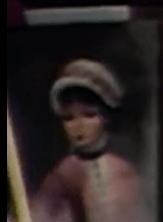
Barnabas and Petofi are not the only characters from the 1790s who might be on the minds of attentive longtime viewers. Barnabas’ little sister Sarah died in 1796, and as a ghost was an extremely important part of the show from June to November 1967. We’ve been getting reminders of Sarah for the last several days. In #792 wicked witch Angelique produced a toy soldier of Barnabas’ that Sarah gave to strange and troubled boy David in #331. In #805, Charity found Sarah’s recorder, a prop that often served as Sarah’s calling card in 1967, and talked about learning to play it. And today, we see a portrait standing on the floor of the Evans cottage, a set which Sarah visited in #260, depicting a girl wearing a bonnet very much like the one Sarah wore as a ghost in 1967 and a pink dress just like the one she wore when we saw her as a living being in the flashback to the 1790s.
Portrait at the cottage.
I wonder if, when they were making up the flimsies for this part of the show, they had thought of reintroducing Sarah. That would have required a recasting of the part- Sharon Smyth was noticeably older when we saw Sarah die in January 1968 than she was when Sarah was a ghost in June 1967, and by now we would wonder what she has been eating in the afterlife that has made her get so much taller. Besides, Miss Smyth* had stopped acting by this point.
The process of planning the stories was in two stages, a rough sketching of themes six months in advance, and a capsule of each episode written thirteen weeks ahead of time. There was a lot of flexibility when it came to putting those plans into effect. Some stories that were supposed to end within thirteen weeks were extended over years, while others that were expected to be a big deal petered out before they got going. In an interview preserved by Danny Horn at his great blog Dark Shadows Every Day, writer Violet Welles said that many of the moments on the show that made the least sense were those written when the plans hadn’t worked out: “toward the end of the cycle, you’d have characters who were really not a lot of interest who had to play scenes with other characters who really didn’t have a lot of interest, dealing with things that basically didn’t concern them. Those were hard to write.”
This episode was taped on 25 July 1969; thirteen weeks before that was 21 May. Six months before was 25 January. By 25 January, Denise Nickerson had been on the show for two months as Amy Jennings. Nickerson was actually born on 1 April 1957, but they several times say that Amy is nine years old. When the show goes to 1897, Nickerson plays Nora Collins, who is also nine. On 19 May, Nickerson taped #761, the last episode she would appear in until #782. She is currently in the middle of a second long absence from 1897, unseen between #783 and #812. Her characters were so important in the months leading up to the 1897 segment and she played them so well that we wonder what they were thinking leaving her in the background so long.
Maybe they were thinking of bringing her back as Sarah. Nickerson didn’t look all that much like Sharon Smyth, and was a far more accomplished young actress than was Miss Smyth, but she did have brown hair, and the show prioritized hair color above all else in recasting parts. For example, two actresses followed Mrs Isles in the role of Vicki, neither of whom had much in common with her either in acting style or in looks, but who both had black hair. So perhaps there was a time when they intended to travel between 1897 and the 1790s and to meet Sarah, played by Denise Nickerson. If Nickerson were still alive, perhaps someone would ask her if she posed for the portrait that is standing on the floor of the Evans cottage today.
*She’s been using her married name for decades now, but when talking about her as a child it’s pretty weird to refer to her as “Mrs Lentz.” Since I use surnames for people associated with the making of the show and attach courtesy titles to surnames of living people, I have to call her “Miss Smyth.”
Charity Trask walks into the drawing room of the great house on the estate of Collinwood and finds a paper on the desk. It is a full confession to the murder of her mother, the late Minerva Trask, signed by her father Gregory and by Collins family attorney Evan Hanley. It also bears a red seal.
Trask enters and Charity tells him what she has read. He rants and raves for a while, claiming that she must be under the Devil’s power if she believes the confession. He forces her onto her knees and orders her to pray, then tries to destroy the paper.
Later, Gregory Trask is alone in the drawing room. It goes dark, a violent storm suddenly breaks out, the windows blow open, and the flames surge much higher in the fireplace than we have ever seen them. Trask cries out for Minerva to leave him alone. When he calls himself an innocent man, the storm rages more fiercely than ever.
The storm ends as quickly as it began, and a man appears in the doorway. He asks who Trask was talking to, and Trask denies that he was talking to anyone. Trask mentions the storm, and the man says there hasn’t been a bit of wind all day. Trask turns and sees that the window is closed and there is no sign of a storm outside.
The man identifies himself as Charles Delaware Tate. Trask recognizes the name as that of a nationally famous painter. Tate explains that the late Edith Collins commissioned him to paint a portrait of her grandson, Quentin Collins, but that Quentin has refused to sit for him. He asks Trask for a photograph of Quentin. Trask remembers that there is such a photograph in a drawer in the desk. When he opens the drawer, the confession falls out, undestroyed.
Returning viewers know that Tate is associated with a 150 year old sorcerer known as Count Petofi. We also know that Petofi is currently residing in the body of twelve year old Jamison Collins and is casting spells to expose the secrets of various people connected with Collinwood. Jamison’s distant cousin Barnabas Collins the vampire is doing battle with Petofi, and has locked Jamison/ Petofi in the prison cell in the basement of the Old House on the estate. That has done little to curb his power; from the cell, he was able to project himself into a dream of Evan’s, cast a spell on him, and compel him to draw up the paper Trask keeps trying to destroy. Jamison/ Petofi does seem anxious to get out of the cell, however. He offers to cure Quentin of lycanthropy if he lets him out. When broad ethnic stereotype Magda Rákóczi talks Quentin out of accepting the offer, Jamison/ Petofi growls a threat at her.
We do not know why Petofi wants Tate to paint a portrait of Quentin, but we get a clue at the end of the episode. Tate has rented a house which longtime viewers will recognize as the Evans cottage. For the first two years of the show, the Evans cottage was a frequent set. It was home to artist Sam Evans and his daughter Maggie, The Nicest Girl in Town. In December 1966 and January 1967, an unseen force compelled Sam to paint portraits of undead blonde fire witch Laura Murdoch Collins. Those portraits had supernatural powers. They were not alone. Portraits have been a prominent part of the show’s set decoration from the very beginning, and have been a gateway between the world of the living and the world of the dead since #70. We may well assume, then, that Tate’s portrait of Quentin will also have uncanny powers.
Charity is visiting Tate in the cottage and looking at the portrait. He has only been working for a day or two, and he says it will take him about two weeks to finish. Yet the figure is almost finished now. As Charity studies it, Quentin’s face turns into that of the werewolf. In May and June of 1968, they did a story partly based on Oscar Wilde’s The Picture of Dorian Gray, and in #701, the very first episode in which he could speak, Quentin compared pictures and people, saying that one changes while the other stays the same. So we are prepared to see Quentin’s curse transferred from his body to his portrait.
In the Old House on the estate of Collinwood, broad ethnic stereotype Magda Rákóczi accuses a man who calls himself Victor Fenn Gibbon of being Count Petofi, a sorcerer who, a hundred years before, was cured of lycanthropy at the price of his right hand and most of his magical powers. Fenn Gibbon denies the charge, and fills the awkward silence with a story that Petofi’s saddest morning came when he awoke to find that his pet unicorn was dead, killed by the wolf. Also in the room is the desperately handsome Quentin Collins, who is himself a werewolf. Quentin says that after they return to human form, werewolves do not remember what they did the night before. Since Fenn Gibbon’s story reveals his knowledge of that fact, Quentin takes it as confirmation that he is indeed Petofi.
Petofi’s severed hand is still in existence, and still carries with it great power. Magda stole the hand from Romani tribal leader/ New England crime boss King Johnny Romana several weeks ago in hopes that she could use it to lift the werewolf curse from Quentin. Since then it has been stolen by one person after another, none of whom has much benefited from it. Now schoolteacher-turned-adventurer Tim Shaw has taken the hand and skipped town. Petofi threatens to use his remaining powers to harm Quentin and Magda unless they find the hand and return it to him by morning; they have to admit they have no idea where it is.
At the end of the episode, we are in the great house on the estate. Petofi makes a series of ominous remarks to Magda and Quentin as he takes his suitcase and goes out the front door. Quentin’s twelve year old nephew Jamison appears at the top of the staircase. He is speaking in a raspy voice, continually suppressing a chuckle at his own witty remarks, and squinting by tightening his eyelids in the middle. He addresses Quentin as “Mr Collins,” says he is not in the habit of being interrupted, and walks downstairs with a slow gait, raising himself slightly from the hips as he comes to each step. We recognize an imitation of Petofi, and Magda declares that the boy is possessed.
Regular viewers will be intrigued to see Jamison as a medium for Petofi. Jamison is played by David Henesy, who in the parts of Dark Shadows set in the 1960s plays strange and troubled boy David Collins. In #186, David Collins participated in a séance during which he channeled the spirit of David Radcliffe, a boy who was burned alive by his mother in March 1867, exactly one hundred years before. In December 1968, David Collins was intermittently possessed by the ghosts of Quentin and Jamison, and when Quentin was temporarily dead and his body was a zombie in April 1969 Quentin possessed Jamison. So by this time Mr Henesy has substantial experience playing a boy who is being used as the vehicle for another spirit.
Mr Henesy is also deeply familiar with the style and manner of Thayer David, who plays Petofi. Thayer David’s first role on the show was crazed handyman Matthew Morgan, who had many scenes with David Collins, and his second was much-put-upon indentured servant Ben Stokes, who when the show was set in the 1790s shared screen time with Mr Henesy’s character Daniel Collins. Thayer David’s third role, Ben’s descendant and occult expert Timothy Eliot Stokes, crosses paths with David Collins only occasionally, but he was on so much that all Mr Henesy would have to do to keep up his status as an expert on Thayer David would be to watch the show on his days off. So it is exciting to see what Mr Henesy’s interpretation of Thayer David’s Petofi will be.
David Collins is always on the minds of longtime fans when Mr Henesy appears, and is especially so today. Magda has a crystal ball into which she occasionally peers; she gets melodramatically frustrated with it shortly before we cut to Jamison and Petofi today. This ball originally belonged to David Collins. He received it as a gift from dashing action hero Burke Devlin in #48, and thereafter used it several times to get information to advance the plot and to establish himself as a link between the visible action of the show and the supernatural forces which at that point lurked in an unseen back-world. Magda’s failed attempt at scrying today may seem like a throwaway to relatively recent fans, but when those who have been with the show from the beginning see the ball and then see Jamison so shortly afterward, they will know that something spooky is coming.
Thayer David might never have been cast on Dark Shadows if he had acted under the name he was given at birth. He was originally called David Thayer Hersey. It’s hard to imagine a producer adding David Thayer Hersey to the cast of a show that had already for eight weeks featured David Thomas Henesy.
When broad ethnic stereotype Magda Rákóczi learned that her sister Jenny had been murdered, she placed a curse on the murderer, Jenny’s husband Quentin Collins. The curse makes Quentin and his male descendants werewolves. In #763, Magda learned that Jenny had given birth to Quentin’s twin children, and ever since she has been trying desperately to lift the curse. It was only this week Quentin found out about the children, after another witch’s curse had already claimed the life of the boy twin. Now he and Magda are debating what risks they should take in their further efforts to save Quentin and any descendants his infant daughter may have.
In #778, Magda returned to her home in the Old House on the estate of Collinwood. She had gone to Boston because she had heard that a Rroma group was in the area and that an old woman who knew how to cure werewolves might be among them. The woman wasn’t there, so Magda did the next best thing. She infiltrated the private quarters of a tribal leader/ organized crime boss known as King Johnny Romana and stole his prized possession. This is a severed hand in a wooden box. It is known as “The Hand of Count Petofi,” after a Hungarian nobleman from whom it was detached over hundred years before, and it has magic powers.
Neither Magda nor anyone she knows has the slightest idea how to control the hand. It has not cured Quentin, briefly disfigured him and his sometime friend Evan Hanley, led to the death of a young woman named Julianka, has been stolen by one person after another, and must soon bring an emissary of King Johnny tasked with Magda’s murder. Moreover, two mysterious and unsavory men known as Aristide and Victor Fenn Gibbon have come to town intent on stealing the hand; at Fenn Gibbon’s bidding, Aristide tortured Quentin and tried to kill him last week, and now he is trying to lure him into a deal.
Magda tells Quentin he is a fool to do business with Aristide and Fenn Gibbon, but Quentin says they have nothing to lose. Aristide implied that Fenn Gibbon can lift the curse; no one else can. They find Fenn Gibbon and Aristide ransacking the Old House. Magda recognizes a design on one of Fenn Gibbon’s buttons. Fenn Gibbon and Quentin struggle, and Fenn Gibbon loses a prosthetic right hand. We have known all along that he was not using his right name, and Magda tells us who he really is. He is Count Petofi himself, still alive more than a century after his mutilation, come to reclaim the hand and all its powers.
Quentin seizes, not the Hand of Count Petofi, but the Hand of Mr Fenn Gibbon. Screenshot by Dark Shadows Before I Die.
Magda and Quentin don’t actually have the hand or know where it is. It has been stolen yet again. This time it is in the possession of Tim Shaw, schoolteacher turned junior executive for the Collins family enterprises. Tim took the hand from the Old House when Magda was out. He takes it to Evan today. Evan is terrified of the hand. Tim threatens him with it. Evan tells Tim what he knows about the hand, and also confesses that he and the evil Gregory Trask brainwashed Tim some time ago and used him to murder Trask’s wife Minerva.
When Evan and Trask decided to use Tim for their evil scheme, he was an innocent. The audience may have known that Tim had the same last name as Raymond Shaw, the main character in The Manchurian Candidate, but nothing else about him suggested he was likely to be of use to sinister figures like Evan and Trask. With his theft of the hand and his interrogation of Evan, we see that Tim has lost his innocence. The stuffy and repressed pedagogue whom we first met was a better fit for Don Briscoe’s heavily interiorized acting style than were the parts he played when the show was set in 1968 and 1969, accursed brothers Tom and Chris Jennings. Briscoe often seemed to be at sea as a vampire or a werewolf, but when he has to show a tortured soul peeking out from inside a three-piece suit he does an expert job. Now that Tim is capable of driving the story, we have a chance to see what Briscoe can do with a starring role crafted for his particular strengths as an actor.
Broad ethnic stereotype Magda Rákóczi is in her home, the Old House on the estate of Collinwood. She takes a hatchet and chops a plastic model of a severed hand into two plastic models, each representing half of a severed hand. She then throws a handkerchief into the fireplace, all the while declaring that no further trouble will come from the hand. Later, she goes to the great house on the estate and tells handsome libertine Quentin Collins about this; to her surprise, he responds by flying into a rage and choking her.
Quentin’s rage abates when a huge image of the hand materializes in the room and floats towards Magda’s rear end. After she goes home, it materializes again and again drifts towards the same destination. With that, she runs outside.
Meanwhile, some activity is going on at The Blue Whale tavern. One man asks another for information about Quentin. The inquirer is named Aristide; the other, Tim Shaw. Tim identifies himself as an employee of the Collins family. Tim tells Aristide that all he knows about Quentin is that he is an arrogant jerk and that the only reason his family lets him live in their mansion is that their grandmother’s will requires them to. Aristide says that he already knew those things, and he asks Tim to carry a message to Quentin.
Tim is in the foyer of the great house while Magda and Quentin are in the drawing room. He eavesdrops on their conversation about the hand. He overhears them saying that the hand is magical, that properly used its powers are limitless, and that it is in a box at Magda’s. After the hand’s second attempt to grope Magda’s buttocks drives her from her house, Tim sneaks in, finds the hand, and tells it that it is just what he needs.
The message Tim brought from Aristide invited Quentin to meet at The Blue Whale. Quentin goes and brings up something that happened a few days ago, when Aristide tied him to a table and tried to kill him. Aristide agrees that this was not a good plan. Aristide says that Quentin can be “cured”; returning viewers know that Quentin is a werewolf, and that it is for this condition that he wants a cure. Aristide admits that he does not know what the cure is; Quentin says that if he had claimed he did know, he would have killed him. But he says that someone else does know. Quentin learned yesterday that Aristide is in the service of a man whom he knows as Victor Fenn Gibbon; evidently Aristide was not aware Quentin had picked up on that, because he is alarmed when Quentin drops Fenn Gibbon’s name. Nonetheless, Quentin does agree to meet Aristide again, and to give him proof that he has the magical hand. Once he has been cured, Quentin will surrender the hand to him.
Before Magda entered the drawing room at the great house, Quentin had been talking with Miss Charity Trask, his sister’s new stepdaughter. Returning viewers know that Charity’s father, the evil Gregory Trask, has decided she ought to marry Quentin. This scene is the first time we see Charity trying to follow this plan. She mentions that Quentin is a widower. It has not been clear to us whether this is generally known. His wife Jenny was hidden away the year before, after he left her, and she was buried very quickly after he murdered her in #748. For all we know, Charity may not know that Jenny is dead, or even that she ever existed. Quentin’s siblings have been holding information about Jenny very tightly; it was just yesterday that Quentin learned Jenny bore twins while he was away. At the same time, he learned that one of those twins has died. He tells Charity that he is a father, and she is confused.
I don’t suppose any of this sounds very exciting, but it is a remarkably fast half-hour. The script is crisp and rapid; even viewers who haven’t missed an episode and know all the background will appreciate the air of mystery that arises from leaving so much unsaid and unexplained. And the actors are uniformly excellent. I can imagine a first-time viewer seeing this one and making a note to watch again tomorrow.
In the first few decades of commercial television, ambitious shows tended to imitate live theater; since, they’ve tended to imitate feature films. Today’s episode is one of Dark Shadows’ stagiest, and it is a strong one.
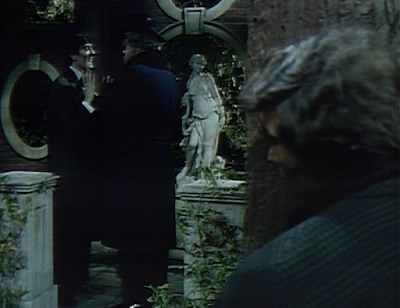
The rakish Quentin Collins has lost his hopes of being cured of werewolf-ism, and is moping in the gazebo on the grounds of the estate of Collinwood. He is staring at a revolver, trying to talk himself into committing suicide. He hears two men approaching, and takes cover in some nearby bushes. The men are known to Quentin by the names “Aristide” and “Victor Fenn Gibbon.”* The set is so small that the actors are only a few feet away from each other, but we are supposed to believe that Quentin can’t quite hear what Aristide and Fenn Gibbon are saying. So when the camera is placed at Quentin’s point of view, Michael Stroka and Thayer David vigorously mime the act of talking.
Quentin sees Fenn Gibbon slap Aristide’s face. Aristide responds, not with violence of his own, but with a continuation of the talking he had been doing before, showing Quentin that Fenn Gibbon is Aristide’s boss. The other day, Aristide tied Quentin to a table and tried to kill him by reenacting Poe’s “Pit and the Pendulum,” so this tells Quentin that Fenn Gibbon is his deadly enemy.
We hear some of Aristide and Fenn Gibbon’s dialogue. Fenn Gibbon and Aristide are based on Gutman and Wilmer from The Maltese Falcon. In their previous appearances, Aristide has been eager to connect with every attractive young woman he sees, suggesting that we would not see the strong suggestions of a sexual relationship that come with Gutman and Wilmer both in Dashiell Hammett’s 1930 novel and the 1941 film. But today, Aristide’s unshocked reaction to Fenn Gibbon’s slap shows that he is accustomed to robust forms of physical contact with him, and when Fenn Gibbon tells Aristide that “I’m aware of your charms, my dear Aristide, but I know only too well conversation is not among them,” we can see that there is going to be a substantial gay subtext.
Fenn Gibbon is one of two roles Thayer David plays today. He appears in the opening teaser as broad ethnic stereotype Sandor Rákóczi, husband of the even more offensively conceived Magda. Yesterday, Magda was placed under a curse. At that time, the curse was that everyone who loved Magda would die, but today it is that everyone she loves will die. When Magda talks about the curse with visiting vampire Barnabas Collins, he says that he is under the same curse, which is exactly true- in #705, he was told that everyone who loved him would die, and from the next episode on it was said that everyone he loved would die. Whichever way the curse is put, one would expect it to strike terror in Magda’s heart regarding Sandor. They are a happily married couple, the only one we ever see on Dark Shadows, and so one would expect him to be the first victim of the curse.
The curse was supposed to start when Magda heard three knocks on the front door of her home, the Old House at Collinwood. She hears the knocks, opens the door, and sees Sandor. She immediately falls into the same pattern she exhibits every time she sees Sandor, accusing him of infidelity, accusing him of coming back to her only because he has run out of money, telling him not to bother to lie to her, and generally having a wonderful time. But he is standing rigidly still, his eyes are glazed over, and he can speak only a few words, none of them the usual insults they exchange. He falls dead, a knife in his back. Barnabas touches his body, and says that it is cold, as if he had been dead a long time.
Later, Magda goes to Mrs Fillmore, a woman in the village of Collinsport. Quentin’s late wife Jenny was Magda’s sister. Unknown to Quentin, Jenny gave birth to twins after he left her, and his brother Edward decreed that the twins would be raised by Mrs Fillmore. Magda has never seen the twins, but she loves them nevertheless- the boy twin, anyway; she tells Barnabas that “Gypsies do not prize girls.” When she comes back to the Old House, Magda tells Barnabas and Quentin that the boy twin is dead. Mrs Fillmore said he was perfectly healthy that evening, then she heard a mysterious scream from the children’s bedroom and she found him dead in his crib. His body was cold, as if he had been dead a long time. Quentin is numb, bewildered to learn that he was a father and simultaneously to learn that he has outlived his son.
There have been other episodes in which an actor played one character as a living being and another as a ghost. There have also been episodes that jumped between two periods in history, and in those there were actors who played one character in one time frame and a different one in the other. Thayer David’s doubling as Sandor and as Fenn Gibbon makes this the first episode in which the same actor plays two living beings contemporary with each other in the same episode.
Sandor’s death and Fenn Gibbon’s ascent to prominence mark a transition in the show. They are in the middle of a bloodbath, killing off a great many of the characters who have defined the first twenty weeks of the 1897 flashback. Previously, that has meant they were getting ready to reset the show and go back to contemporary dress. But 1897 has been such a hit that a transition need not mean a return to the 1960s. There is still enough going on in this period that they can introduce a bunch of new characters, develop some new stories, and get a new phase of Dark Shadows started right here in the late Victorian era. Who knows- if they play their cards right, this period might be the new home base for the show, and the 1960s might be an afterthought.
The contemporary world does make one appearance today. Before their encounter at the gazebo, Fenn Gibbon meets Quentin in the drawing room of the great house at Collinwood. Quentin is studying the Moon. The two of them have a little exchange about Quentin’s fascination with the Moon; considering that this episode aired a few hours after Apollo 11 lifted off on the journey that would put the first crew on the Moon, that fascination must have been pretty widely shared by the original audience.
*In this episode, everyone says “Fenn Gibbons,” which we have heard before. But the credits read “Fenn Gibbon,” so I’m sticking with that version.
Quentin Collins has devoted himself to the pursuit of evil, and as a result he has two intractable problems. When Quentin murdered his wife Jenny, her sister, broad ethnic stereotype Magda Rákóczi, turned him into a werewolf. Magda later found out that Jenny had borne twins to Quentin, and since the curse is hereditary she tried to lift it. She placed the magical “Hand of Count Petofi” on Quentin before his transformation. That didn’t stop him becoming a wolfman, but it did cause his face to be severely disfigured when he returned to human form.
Now Quentin has made his way to the house of Evan Hanley, his onetime friend and partner in Satanism. Evan had recently been disfigured in the same way Quentin is disfigured, also as a result of contact with the hand, and Quentin knows that Evan stole the hand from Magda to use in an attempt to de-uglify himself. When Quentin sees that Evan is handsome again, Evan denies that he used the hand to restore his looks. He claims not to know what happened. That is as frustrating for the audience as it is for Quentin. We were sure Evan would start looking like himself again, and they went to enough trouble to show that he was not able to correct his appearance by himself that we were expecting the cure to involve a significant plot point. When Evan presents us with “It just happened” as his explanation of how he got his old face back, we are quite sympathetic to Quentin’s decision to grab a blunt instrument and knock him out.
Quentin finds the hand in a box in Evan’s desk, and a strange man immediately enters. He demands Quentin give him the hand at once. Quentin is willing to surrender the hand once he has used it to become his desperately handsome self again, but the man will not wait. He pulls a knife to underline his point. The knife is a flat piece of wood cut in a shape with some pronounced curves and no sharp edges, and the man holds it loosely at the end of an arm that is directly over the box Quentin could easily raise to disarm him. So the audience has to help a bit to make the confrontation credible. Still, the acting is very good, and the dialogue, in which the man combines lethal threats with apparently sincere expressions of sympathy for Quentin’s plight and jokes at his expense, is complex and lively enough that we are glad to make the effort. Besides, the man goes to the trouble of telling Quentin that the knife is named “The Dancing Girl” and that it was made long ago by a Persian swordsmith, so he’s giving our imaginations something to work with. I, for one, didn’t have any trouble keeping a straight face when Quentin lost the fight and the man left with the box containing the hand.
Kids, if you are going to rob someone at knife-point, do not imitate what Aristide is doing here. Screenshot by Dark Shadows Before I Die.
Quentin goes to Magda at the Old House on the estate of Collinwood and reports what happened. She is frightened, since she herself stole the hand from a Romani chieftain/ organized crime boss named King Johnny Romana. When he says that a strange man came to take the hand, she assumes that he is an emissary of King Johnny’s, and that his next stop will be to kill her. When Quentin says that the man was young, Magda is puzzled- the recognized norms dictate that King Johnny send “an elder of the tribe” to complete such a task. She sets aside her plan to flee, and agrees to help Quentin in his attempt to summon wicked witch Angelique.
Quentin and Evan conjured Angelique up in #711. In previous segments of the show, when it was set in the 1790s and in the 1960s, Angelique established herself as one of its principal sources of action. But she hasn’t had much to do in 1897. She had a showdown with fellow undead blonde fire witch Laura Murdoch Collins back in May, and has barely been seen since. Quentin and Magda speak for the audience when they wonder where she is and what she has been doing. They speculate that she might have gone home to the depths of Hell, and light some black candles to accompany an incantation meant to call her thence.
Angelique does appear, but not at the Old House. Evan finds her in his parlor when he comes to. One of the possible explanations for the restoration of Evan’s good looks was that he made some kind of bargain with Angelique; this is excluded, not only when he is surprised to see her, but when she asks questions that make it clear she knows nothing about the hand or anything that has happened since Magda brought it back with her. Angelique orders Evan to give her a complete briefing, and we cut back to the Old House.
Quentin is still in front of the black candles, fervently reciting his mumbo-jumbo, and Magda is telling him they have failed. After a moment, Angelique enters. Quentin jubilantly declares that he has succeeded in summoning her, and Angelique says that she is not aware of that. She tells him she was with Evan, and asks about the hand. Quentin tells her it was taken from him, and asks for her assistance. She says she is willing to help him, for a price, and that as a token of her good faith she will retrieve the hand. But first she insists he tells her everything he knows. We cut to the waterfront.
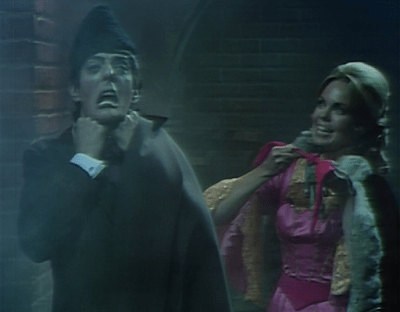
There, the man who took the hand from Quentin is standing alone in the fog. Angelique enters and flirts with him. He gives his name as Aristide. She says she is a puppeteer, and that if he lends her his handkerchief she will perform a trick. She wraps his handkerchief around the neck of a doll depicting a Continental soldier, a familiar prop from 1967 that became prominent during the 1790s segment, and squeezes it. Aristide begins choking, and Angelique orders him to give her the hand before he dies.
The closing credits bill Michael Stroka as playing “Aristede,” an unusual spelling. The following item, posted in the comments under Danny Horn’s post about this episode at Dark Shadows Every Day, confirms my resolution to stick to the conventional spelling:
Factoid… I have the original script for episode 808, and Aristede is spelled throughout as Aristide.
Comment left 3 September 2017 by “Isaac from Studio 16 on W 53rd” on Danny Horn, “Episode 792: Dances with Wolves,” Posted at Dark Shadows Every Day, 19 December 2015.
In the same comment thread, Carol Zerucha goes on at length about Stroka’s ethnicity. He was Slovak, as she is, and she had a big crush on him when she was a kid watching the show. The characters in today’s episode assume that Aristide is Roma, but Ms Zerucha points out that we have no reason to assume they are right, and that he, too, might be Slovak.
Also in that thread, FotB “Straker” says that Aristide looks like William F. Buckley, Jr. I agree. I wish they had at some point cast him as a character who leaned way back in his chair and used polysyllabic words.






 Dark Shadows Commentary