Vampire Barnabas Collins first appeared on Dark Shadows in #210 and quickly became the show’s main character and star attraction, but the word “vampire” was not uttered on-screen until #410, and thereafter was used quite sparingly for a long while. Those days are definitely behind us now; the characters say “vampire” eight times in this one.
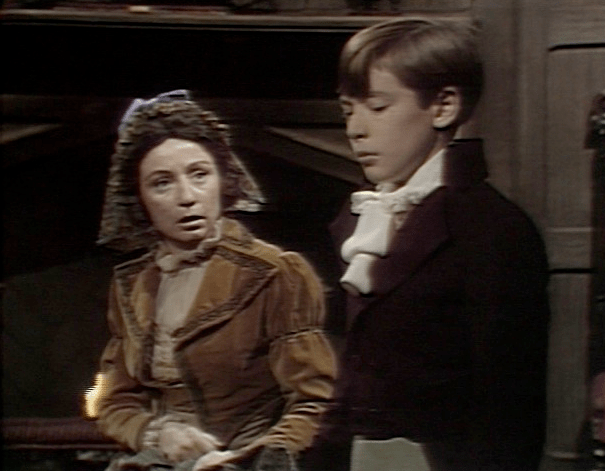
Barnabas has traveled back in time to the year 1897, and is embroiled in a great many storylines, none of which he fully understands or has any idea of changing for the better. Yesterday, crazed groundskeeper Dirk Wilkins told twelve year old Jamison Collins (David Henesy) that Barnabas was a vampire, and Jamison, checking on his story, found an empty coffin in Barnabas’ basement. Today, Jamison tells his father, the stuffy Edward (Louis Edmonds,) what Dirk said and what he saw.
Edward comes to Barnabas’ house, repeats Jamison’s story, and asks to see the basement. Barnabas has hidden the coffin, but Edward tells him that he cannot dismiss the story so easily. A few weeks before, Edward discovered that Jamison’s mother Laura was an undead blonde fire witch bent on incinerating her children to renew her own existence; since that experience, he can no longer disregard claims about the supernatural. There have been a number of attacks on the estate of Collinwood and in the village of Collinsport which have left victims drained of blood and showing bite marks on their necks; he must take Jamison’s claims seriously. He is alone with Barnabas in his basement while explaining this to him, rather a foolhardy position in which to lay out to a man one’s grounds for suspecting that he is a vampire.
Edward leaves. Barnabas is in a bind. Jamison’s children will be the adults at Collinwood in the 1960s, and they are the ones who accept Barnabas’ story that he is their distant cousin from England and give him the Old House on the estate to live in. If Jamison knows about him, it will hardly be likely that his children will be so welcoming. Even if he can reverse his journey through time, there will be no future for him to go back to. So he tells his blood thrall, maidservant Beth, that they must provide a vampire to take the blame for his earlier deeds and allay Jamison and Edward’s suspicions.
Barnabas thinks that he has already arranged a solution to this problem. He bit Dirk in order to shut him up and bring him under control, but apparently he over-ate. Dirk is not going to live through the night. When he dies, he will rise as a vampire. Barnabas and Beth will see to it that Dirk is caught and that he takes the fall for Barnabas’ crimes.
Barnabas has stashed Dirk in a secret room off the parlor of the Old House, a space behind the bookcase in the front parlor. Barnabas opens this space, intending to sit by Beth until they see Dirk die, only to find that it is too late- Dirk has wandered off.
Longtime viewers will find satisfactions in the reflections of earlier characters that run throughout this episode. The secret chamber in which Barnabas tried to keep Dirk is not a place which he has used before, but it first appeared on the show long before he did. In #115, another crazed servant, handyman Matthew Morgan, locked well-meaning governess Vicki up in the chamber, eventually attempting to kill her there. When Barnabas suddenly thinks of that chamber, he is emphasizing the echo of Matthew in Dirk’s rampage.
Edward’s fearlessness in standing alone before Barnabas in his basement and telling him that he suspects he may be a vampire is also something we have seen before. From November 1967 to March 1968, when Dark Shadows was set in the 1790s, Louis Edmonds played haughty overlord Joshua Collins. In #446, Joshua found his son Barnabas rising from his coffin in this same basement and confronted him about his bad behavior. When Barnabas moved to kill him, Joshua glared at him and Barnabas slunk away in shame. Edward is quite different from Joshua; on the one hand he lacks the earlier man’s sense of enterprise and drive for power, while on the other he is far more loving towards his children and quicker to set aside his individual pride for the sake of family unity. But we can see that he does share his kinsman’s ability to fend off vampire attacks by insisting on good manners.
The most fully developed echo is of #333. In that episode, set in contemporary times, strange and troubled boy David Collins (David Henesy,) had seen a coffin in Barnabas’ basement. Connecting that with an abundance of other readily available evidence, David concluded that Barnabas was a vampire. David’s father, high-born ne’er-do-well Roger Collins (Louis Edmonds,) refused to consider such a notion. When local men Burke and Dave went to Barnabas’ house and demanded to search the basement, he initially resisted. At length he led them downstairs. The coffin was not there. Burke and Dave went back to the great house of Collinwood, and Roger crowed with triumph that they had been so silly as to take David’s story seriously. Embarrassed, Burke and Dave asked David if he might have made the whole thing up.
Barnabas may have had this incident in mind, and with it a hope that by showing Edward the empty basement he would embarrass him as he had embarrassed Burke and Dave, perhaps turning him into the same kind of ally that Roger was in 1967. But Edward is made of sterner stuff, and he sheds light on what was in the minds of the makers of the show.
Laura was another iteration of the show’s first supernatural menace. From December 1966 to March 1967, we learned that David’s mother, Laura Murdoch Collins, was a humanoid Phoenix who had returned from the dead to incinerate him along with herself and thereby renew her existence. Roger eventually came face to face with that fact and made himself marginally useful in the effort to stop her. Afterward, he was shocked out of his habit of openly expressing hatred for David, and eventually even showed a modicum of affection and concern for the boy. But he quickly snapped back into the Collins family’s traditional attitude of denial that the supernatural could have any role in human events, and he would not be budged from this denial.
The Laura we saw in 1897 was a violent retcon of many of the most important features of the story we saw in 1966 to 1967, and as Jamison’s mother she implies that Roger married his own grandmother. So it seemed inexplicable that the makers of the show would choose to introduce her. It is when Edward explains that his experience with Laura has opened his mind to the possibility of dangers intruding from the world of the supernatural, that we understand why they did it. They are showing us that Edward is on a continuum about halfway between Joshua and Roger.
Joshua was in a way too strong for his world to support, so that he defeated his own aims and produced tragedies for all those he meant to elevate. By contrast, Roger is like one of Nietzsche’s “Last Men,” what nowadays some call “cage-stage,” a person who is so degenerated he cannot exist on his own or create anything lasting but can be happy in captivity. Edward does not have Joshua’s anomalous strength; like Roger, he lives in his sister’s house as her guest and works for her business as an employee. But neither does he have Roger’s cowardly inability to face facts or his vicious glee in the humiliation of others. He is brave enough and strong enough and fair-minded enough to represent a grave threat to Barnabas.
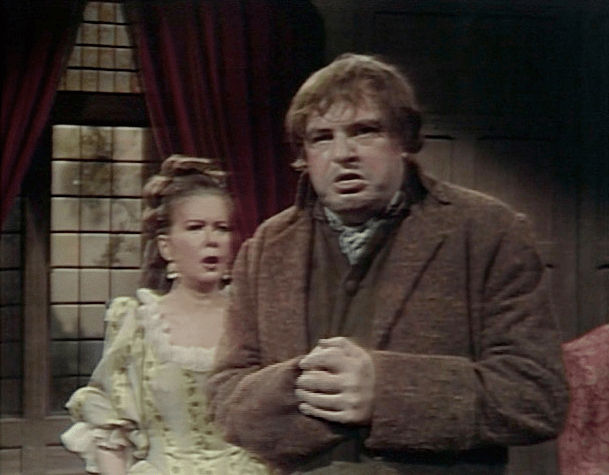
One of the first “Big Bads” on Dark Shadows was crazed handyman Matthew Morgan, played by Thayer David. Matthew was the most devoted employee of reclusive matriarch Elizabeth Collins Stoddard (Joan Bennett.) Matthew took his devotion to Liz to such an extreme that he was a menace to everyone else. In November and December of 1966, we learned that Matthew had decided that Liz’ second most dedicated employee, plant manager Bill Malloy, was a threat to her. Matthew had tried to put a stop to Bill’s doings. Not knowing his own strength, Matthew accidentally killed Bill. When well-meaning governess Victoria Winters discovered what had happened, Matthew abducted Victoria, held her prisoner in the long-deserted Old House on the grounds of the estate of Collinwood, and was about to murder her when a bunch of ghosts emanated from the show’s supernatural back-world and scared him to death.
In those days, Dark Shadows was a slow-paced “Gothic” drama set in contemporary times. From November 1967 to March 1968, it was a costume drama set in the 1790s, and its plot often moved at a breakneck speed. Among the characters then was much-put-upon indentured servant Ben Stokes, who like Matthew was played by Thayer David. At first Ben made a stark contrast with Matthew. He was as relaxed, friendly, and reasonable as Matthew was tense, forbidding, and paranoid. But when his one ally among the Collins family, scion Barnabas, was cursed to become a vampire, Ben’s devotion made him resemble Matthew ever more closely. In his development, we saw a retrospective reimagining of Matthew. The curses that were placed on Barnabas and the rest of the Collinses from the 1790s on had burdened the village of Collinsport, and people who grew up there labored under the consequences of those curses and of the Collinses’ attempts to conceal them. Ben was what Matthew might have been had he not been warped by the evil that began when black magic was first practiced in the area so many generations before.
In January 1969, the show briefly returned to 1796, to a time coinciding with the last days of the earlier flashback. We saw that by that point, the curses had already transformed life on and around the great estate. In that period, Ben’s efforts to protect Barnabas led him inadvertently to kill a man, not knowing his own strength, and then to cover that crime up by killing a woman, not at all inadvertently. He had become Matthew. The curse placed on Barnabas had become the curse of all those who work for the Collinses and all of those who live in the shadow of their wealth and power.
Before Matthew, Dark Shadows‘ chief villain was high-born ne’er-do-well Roger Collins (Louis Edmonds); after, it was Roger’s estranged wife, undead blonde fire witch Laura Murdoch Collins (Diana Millay.) In this episode, the makers of the show take a page from its 1790s flashbacks. They have Edmonds and Millay reconceive the Roger and Laura of that atmospheric, sometimes almost action-free soap as characters appropriate to the fast-paced supernatural thriller it now is.
Since #701, Dark Shadows has been set in the year 1897. Louis Edmonds plays Roger’s grandfather Edward; Diana Millay plays Edward’s estranged wife, undead blonde fire witch Laura Murdoch Collins. In his days as a villain, Roger’s defining characteristic was his unnatural lack of family feeling. He had squandered his entire inheritance, a fact which did not bother him in the least. When his sister Liz confronted him in #41 about the difficulties he had created by putting his half of the family business up for sale, he airily replied that he had enjoyed his inheritance. When in #273 Liz and Roger discussed a blackmail plot of which she had been the victim, Roger admitted that had he known her terrible secret, he probably would have used it to force her to give him her half of the estate so that he could squander that, as well.
It wasn’t only the family’s material possessions and Liz’ right to them to which Roger was indifferent. He openly hated his son, strange and troubled boy David Collins (David Henesy.) He continually insulted David, badgered Liz to send David away, and in #83 coldly manipulated David’s fears to lead him to try to murder Victoria.
In the 1897 segment, Edward is as stuffily serious about the family business as Roger was in 1966 nihilistically apathetic about it. Edward loves his children, twelve year old Jamison (David Henesy) and nine year old Nora, but his rage at Laura has come between himself and them. Laura left Edward the year before to run after Edward’s brother, breezy libertine Quentin (David Selby.) Edward tried to conceal the fact that his brother cuckolded him. He has repeatedly declared that Laura “No longer exists!” and has forbidden her name to be mentioned in the house.
Edward trapped between the enigmatic Laura and the exuberant Quentin. Screenshot by Dark Shadows Before I Die.
For his part, Quentin bears a striking similarity to the early, wicked Roger. He wants money only to spend it, a fact which he cheerfully admits. He tried to forge a will in his grandmother Edith’s name to cheat his sister Judith (Joan Bennett) out of her inheritance, having previously threatened to kill Edith. He does have great affection for Jamison, but since he often uses the boy as a pawn in Satanic ceremonies, his fondness for his nephew is not much of an improvement over Roger’s hatred for his son. Indeed, Quentin’s resemblance to Roger connects the 1897 segment not only to the early months of the show, but also to the weeks immediately preceding it. Early in 1969, Quentin’s ghost had taken possession of David Collins and was causing him to die. When we see that Quentin is now what Roger was originally, David’s ordeal takes on a new dimension. He is dying for the sins of his father.
In this episode, Laura has returned. Edward has offered her a great deal of money to go away and never come back; she refuses. She threatens to tell the world about her relationship with Quentin if Edward does not let her stay at Collinwood. Edward buckles to this blackmail. Laura tells him that “Family pride is your greatest weakness,” making him Roger’s exact opposite.
When Laura was at Collinwood from December 1966 to March 1967, her old boyfriend Burke Devlin kept pestering her with his suspicion that he, not Roger, was David Collins’ father. Burke was not the first character to bring this idea up. Roger had mentioned it to Liz in #32, when they were talking about an attempt David had made to kill Roger. At that time, Liz was horrified that Roger seemed to want to believe that David was Burke’s natural son.
It seems unlikely that Quentin is Jamison’s father. They have been firm about 1870 as Quentin’s date of birth, and in 1897 Jamison is quite plainly twelve. Laura may have gone on to marry her own grandson, but it would be a bit of a stretch for her to have started sleeping with her brother-in-law when he was fifteen, even if he did look like David Selby.
But Roger’s anger and jealousy about Burke and Laura do mirror Edward’s about Quentin and Laura. It was abundantly clear that Roger and Burke’s deepest pain regarding Laura was that their intense attachment to each other was disrupted when she left Burke for Roger; Diana Millay used her gift for dry comedy to make this explicit in a scene the three of them played in the groundskeeper’s cottage in #139. Likewise, Edward’s frustration with and disappointment in his brother is at least as deep a source of anguish to him as is his loss of Laura’s love.
Laura, too, is quite different this time around. The first Laura story took shape gradually over a period of weeks, as Laura herself emerged from the mist. Now Laura is a forceful presence from her first appearance. Originally we heard that Laura had married into several of the leading families of the Collinsport region; now they have given up on the idea of developing other leading families, and Laura just keeps coming back to the Collinses. In the first story, they laid great emphasis on the interval of precisely one hundred years between her appearances; now, the number of years doesn’t seem to have any particular significance. As we go, we will see an even more important difference. When we first met Laura, she was utterly determined to make her way into a pyre so that she could rise as a humanoid Phoenix; now she is unhappy about the whole thing, and angry with people who have helped her on her fiery way.
Edward lets Laura live in the cottage where Roger and Liz would put her in 1966. In the final scene, she goes there and finds Quentin, drunk and trying to conjure up an evil spirit. Quentin keeps telling Laura that she is dead. Frustrated with her persistent refusal to concur with this statement, Quentin puts his hands around her neck and announces that whether or not she is dead now, she will be by the time he gets through with her.
Roger was uncharacteristically sober at the beginning of his three-scene in the cottage with Burke and Laura in #139, but he did enter brandishing a fire-arm. So Quentin’s homicidal intentions on this set further cement his affiliation with his great-nephew in the eyes of longtime viewers.
Millay and Edmonds are not the only actors whose screen iconography the show turns to advantage today. We first saw Kathryn Leigh Scott and Don Briscoe together in #638, when she was playing ex-waitress Maggie Evans and he was playing mysterious drifter Chris Jennings. They met in the foyer at Collinwood. Maggie was angry with Chris, and Chris was guilt-ridden. Today, Miss Scott plays governess Rachel Drummond and Briscoe plays teacher Tim Shaw. They meet in the foyer at Collinwood. Rachel is angry with Tim, and Tim is guilt-ridden.
Though the same actors are playing the same basic emotions on the same set, the situations are different, and the characters are very different. Maggie is Dark Shadows‘ principal representative of the working class of the village of Collinsport. She speaks directly and bluntly, using the plainest language she can to dare Chris to try to excuse his inexcusable behavior. Chris occupies a lowly and unsettled place in the world, and he dodges her gaze and evades her questions, saying as little as he can, almost mumbling.
But Rachel is a neurotic intellectual, and she expresses her anger in complex sentences featuring vocabulary that only a very well-read person would have used in 1897 (for example, the word “sadist.”) Tim retreats from her anger into a defense of his job that quickly devolves into the tiredest platitudes imaginable. At one point he actually intones “It is better to light one candle than to curse the darkness.” Miss Scott makes Rachel’s highly literate onslaught on Tim as forceful as was Maggie’s unvarnished challenge to Chris, and Briscoe makes Tim’s pompous posturing as pitiable as was Chris’ broken burbling. Writer Gordon Russell must have been delighted that the actors did such good work with his ambitious pages.
Governess Maggie Evans forbids her charges, David Collins and Amy Jennings, from going outside. They ask her to play hide and seek. She agrees, and accepts the role of It. She searches for them for a long time, ultimately finding them outdoors. She points out that she had told them to stay indoors, and they pretend not to have understood that this applied to their hiding places.
Maggie does not punish Amy and David for this obvious insubordination. This establishes that Maggie is a squish who will not maintain discipline. That point had already been made in yesterday’s episode, when Maggie caught Amy hiding in David’s room, in defiance of orders from heiress Carolyn Collins Stoddard. At that time, Maggie lied to housekeeper Mrs Johnson to cover up what the children had done. Maggie’s irresolution bears repeated exposure, though, since the children are coming under the influence of the evil spirit of the late Quentin Collins and would not be very effective as his helpers if they were subject to even moderately competent adult supervision.
Today Mrs Johnson and her son Harry are under orders from Carolyn to fix up the caretaker’s cottage on the estate. Carolyn has invited mysterious drifter Chris Jennings, Amy’s big brother, to live in the cottage. In the opening, Mrs Johnson tells Maggie she objects to this idea on the grounds that the cottage is cursed. Maggie dismisses Mrs Johnson’s belief in such a curse, but she really shouldn’t. Mrs Johnson keeps calling it “Matthew Morgan’s cottage” after the crazed handyman who lived there for eighteen years. Matthew killed Mrs Johnson’s beloved employer Bill Malloy, then tried to kill Maggie’s dear friend and predecessor as governess at Collinwood, Vicki Winters. Maggie knows all about those incidents. Mrs Johnson also says that no good happened at the cottage after Matthew; the only resident of the cottage since Matthew’s death was David’s mother, undead blonde fire witch Laura Murdoch Collins. Maggie knows plenty about Laura as well, since her father Sam was deeply involved in the strange goings-on concerning Laura and Vicki led the fight against her.
Under orders from Quentin, the children contrive to trap Mrs Johnson in the cottage by herself. Quentin appears to her there. She is terrified. This is quite a surprise to regular viewers. Quentin has appeared on screen only once before, in #646. Moreover, the children have made it very clear that Quentin is confined to the little room hidden in the long-deserted west wing of Collinwood where they found him. We are left to wonder how he gained the ability to manifest himself in the cottage and even to walk outside it when no one is looking.
Perhaps we are to think that Quentin is in some way connected with the curse on the cottage, and with Chris. When the children first contacted Quentin, Amy could communicate with him before David could. This left David miffed, since “Quentin Collins is my ancestor.” That line of David’s led us to expect that we would learn that Quentin is also Amy and Chris’ ancestor. Tomorrow, David will tell Amy that Quentin is “quite pleased” that Chris is living in the cottage. Maybe it was Amy’s presence in the room in the west wing that activated the ghost of Quentin there, and Chris’ impending arrival in the cottage that activates it in that space.
This episode marks the last appearance of Harry. Until today, he was played by Craig Slocum. Edward Marshall takes Harry over the horizon. Mr Marshall must have been watching the show; he does a flawless imitation of Slocum’s very peculiar line delivery. His Harry is just as petulant and resentful as Slocum’s was, but he is so much more physically relaxed and so much more responsive to his scene partners that he is enjoyable to watch in a way Slocum never was. I can’t help but wonder if Harry would have caught on and become a bigger part of the show had Mr Marshall taken the part earlier. Harry’s personality made it impossible for him to figure in a romance of any kind, limiting his usefulness on a soap, but there’s plenty of room on Dark Shadows for comic relief in the form of an inept, grumbly, dishonest servant.
This is the first episode of Dark Shadows credited to a director other than Lela Swift or John Sedwick. It is also the first production of any kind directed by Dan Curtis, the series’ creator and executive producer. Curtis’ inexperience shows at several moments when the camera is in an awkward spot or the actors are unsure what to do, and in his post about the episode on Dark Shadows Every Day Danny Horn documents several of the more egregious examples with screenshots and detailed analysis. The impossible deadlines and tiny budget on which Dark Shadows was produced meant that even Swift and Sedwick, who were seasoned professionals and ambitious visual artists, sometimes had to turn in work that wasn’t much better than what first-timer Curtis manages today, and longtime viewers of the show will take even his worst stumbles in stride.
At the top of the episode, it is daytime, and much put-upon servant Ben Stokes (Thayer David) finds the lady of the house, Naomi Collins (Joan Bennett,) standing at an open coffin that holds the corpse of her son, Barnabas. Ben knows that Barnabas is a vampire who will rise at night to prey upon the living. Naomi has never heard of vampires. All she knows is that Barnabas is dead, and that his coffin has been moved from the family mausoleum to a room atop a tower in the mansion. Ben pleads with her to leave the room and to go with him back to the main part of the house.
Naomi questions Ben. Ben tells her that Barnabas has a “sleeping sickness,” and has been in a coma ever since the night he apparently died. Ben does not like to lie to Naomi, but her husband, haughty overlord Joshua, has judged that the truth would kill her, and Ben is governed by that assessment. He does tell her that the “sleeping sickness” is a symptom of a curse, that the wicked witch who placed the curse was Barnabas’ sometime wife Angelique, and that Joshua is in Boston trying to find someone who knows how to lift it.
Ben asks Naomi how she came to be in the tower room. She tells him that naval officer/ sleazy operator Nathan Forbes told her that Barnabas was being kept there, and also that Barnabas was responsible for the series of murders that had recently taken place in the town of Collinsport. At that, Ben vows to kill Nathan. To his chagrin, Naomi forbids him to do this.
In the part of Dark Shadows set between August and December of 1966, Bennett played reclusive matriarch Elizabeth Collins Stoddard and David played her fanatically devoted handyman Matthew Morgan. When well-meaning governess Vicki came unstuck in time and arrived in the late 1790s, she at first mistook Naomi for Liz and Ben for Matthew. This scene takes longtime viewers back to the days when Matthew was always on the lookout for someone who represented a threat to Liz’ interests and she was always sternly prohibiting him from murdering anyone for her sake.
Ben is a far saner man than Matthew ever was; the contrast between them shows the effect that growing up in Collinsport, a town suffering from the consequences of a curse that has been working its way for many generations, has had on Matthew’s personality. While Ben is a brave, kind-hearted fellow whose fierce loyalties sometimes overpower his good sense, Matthew is a paranoid ogre who kills Liz’ friend Bill Malloy and tries to kill Vicki. It isn’t just one family that will be warped by Angelique’s curse. It will breed monsters everywhere the Collinses’ influence prevails.
Naomi then turns her attention to the B-plot. Nathan has married fluttery heiress Millicent Collins, only to find that Millicent has signed her share of the Collins fortune over to her little brother Daniel. Nathan responded to that news by crafting a plot to murder Daniel. His first attempt failed when Noah Gifford, the henchman he hired to abduct Daniel and drown him, fell afoul of Vicki. Vicki found Noah strangling Daniel near the place where she was hiding, having escaped from gaol, and shot him to death. After that, Daniel and Vicki went back to the mansion and told Naomi what they knew. Naomi recognized Daniel’s description of his attacker as a man she had seen with Nathan earlier, and realizes that Nathan is trying to murder the boy. So she orders Ben to take Daniel into town to stay with the Rev’d Mr Bland, a clergyman who looks like a duck.
Naomi confronts Nathan, who keeps telling her that whatever Barnabas might look like during the day, he gets up at night and goes out to murder people. She tries to shut him up, but later she is still wondering whether she should go back to the tower room after dark to check his story out.
She sees Millicent standing in the foyer, staring at the portrait of Barnabas that hangs there. The portrait of Barnabas first appeared under the closing credits in #204, and from #205 on it figured as a means through which Barnabas could communicate with the living. Barnabas bit Millicent the other day, and she hears him summoning her.
Among the 1960s characters who receive their commands from the vampire while staring at the portrait is Liz’ daughter Carolyn, who like Millicent is played by Nancy Barrett. Millicent at times evoked an early version of Carolyn. Until the spring of 1967, Carolyn was tempestuous and irresponsible, sometimes friendly to point-of-view character Vicki, sometimes hostile to her. Millicent is as timid and overly dependent as that version of Carolyn was headstrong and self-centered. One way or another, each is a Spoiled Heiress, and evidently that’s a favorite meal of Barnabas’.
Naomi follows Millicent to the gazebo on the grounds of the estate. There, she sees Barnabas. She is stunned that the son whose corpse she was looking at just a few hours before is up and moving. He bites Millicent, and Naomi lets out a scream. Barnabas looks up, and realizes that his mother has caught him in the act.
The vampire’s bite affects each victim differently. The first victim we saw was Willie Loomis, whom Barnabas’ bite transformed from a dangerously unstable ruffian to a sorely bedraggled blood thrall. Willie was at first gravely ill, then ran to Barnabas like an addict desperate for a fix, and eventually settled into life as a sorrowful servant who could not run away from Barnabas but could resist him to the point where Barnabas occasionally found it necessary to keep him in line with beatings.
The second victim we saw was Maggie Evans, The Nicest Girl in Town. She reacted very much like the first victim in the 1790s segment, gracious lady Josette, who, like Maggie, was played by Kathryn Leigh Scott. At first, those two were alternately blissful and snappish, happy to be under Barnabas’ power and defensive with anyone who might interfere with it. But each recoiled from him by the time it became clear he planned to kill her and make her into a vampire herself. Each escaped from him to the shore below Widow’s Hill- Maggie by running through an underground tunnel that rose to the shoreline, Josette by flinging herself to her death from the top of the cliff.
Later, Barnabas bit Carolyn. She initially contemplated his most gruesome crimes with pure glee and showed great energy as his protector and enforcer. Soon her conscience reappeared, but she was still doing his dirty work faithfully when Vicki disappeared into the past.
Millicent differs from all those others in that she simply continues to go about her business in between Barnabas’ meal-times. Granted, she was already deeply disturbed by that point, so that her business was conducted mostly in show-stopping mad scenes. But it’s still odd that she can talk to Nathan as if their marriage were the main thing in her life.
When we finished watching this one, my wife, Mrs Acilius, wondered if these differences were simply the result of the victims’ personalities coming through or if the vampire can pick and choose how to apply the pressure. He wanted Willie as a slave, and the reaction he produced gave him that. He wanted to turn Maggie into a reincarnation of Josette, and wound up getting the same reaction from Maggie that he had got from Josette. He bit Carolyn in a moment of desperation, with no plan in mind, and her reaction is complicated and volatile. He bit Millicent to keep her quiet, and her reaction is remarkably inconspicuous. Maybe we’re just supposed to think that Barnabas is fabulously lucky, but there is an opening there to tell a story about how him deciding what he wants to do to a person when he sucks their blood.
In December 1966, crazed handyman Matthew Morgan (Thayer David) abducted well-meaning governess Vicki and held her prisoner in a secret room behind the bookcase in the front parlor of the Old House on the estate of Collinwood. Vicki had run into Matthew there when she saw his dusty footprints leading up to the bookcase in #115. Vicki’s charge, strange and troubled boy David Collins (David Henesy,) did not know that Matthew had abducted Vicki, and was convinced that he had gone into hiding because he was unjustly accused of murdering local man Bill Malloy. So when David found out Matthew was in the Old House, he brought him food and water. In #120, David heard Vicki’s muffled voice behind the bookcase; in #123, he pulled the bookcase back and found her; in #124, he was too frightened to help her escape.
Now, Vicki has come unstuck in time, and found herself in the late eighteenth century. She made a promising start, landing a position as governess to the children at Collinwood, among them Daniel (David Henesy.) But she has adapted poorly to her new surroundings, so poorly that she has been convicted of witchcraft and sentenced to death. Accompanied by her boyfriend, an unpleasant young man named Peter, she has escaped from gaol. Vicki was shot in the arm while escaping, and is still bleeding. She and Peter have made their way to the Old House. There, much put-upon servant Ben (Thayer David) at once gives Vicki and Peter such help as he can.
When a knock comes at the door, Ben tells Vicki and Peter he will hide them. He goes to the bookcase, and Vicki whispers “The secret room.” When Vicki first saw Ben, they were in this parlor, and she was frightened because she mistook him for Matthew. In her hushed voice and the look of awe on her face when she sees Ben trying to save her life by putting her in the room where his Doppelgänger will try to kill her in 1966, Alexandra Moltke Isles’ Vicki conveys the thought that Ben and Matthew really are two versions of the same guy. Ben is a kind-hearted sort whose fierce loyalties sometimes overcome his good sense; Matthew a paranoid ogre whose single-minded devotion to matriarch Liz leads him to kill and menace those dearest to Liz. The difference between the two men begins in the events that have been taking place around Vicki in the 1790s. Ben grew up in the ordinary world of day and night, where natural laws apply and there is hope for goodness. Matthew has spent his whole life in a town laboring under an ancient curse. Matthew’s crimes would be the fruit of Ben’s virtues, had Ben been warped by the evil of centuries that hangs over the Collinsport of the 1960s.
While Vicki and Peter huddle in the secret room, Daniel bursts into the parlor. Ben tries to hurry him out, but the lad notices a trail of bloodstains leading to the bookcase. Before Ben can stop him, Daniel opens the bookcase and finds the fugitives.
Daniel is as convinced of Vicki’s innocence as David will be of Matthew’s, and he is eager to help her and her friend. Ben says he will take the fugitives to a safer hiding place, and forbids Daniel to follow them. Of course Daniel does follow them, and sees them enter the Collins family mausoleum in the old cemetery north of town. He cannot see inside, where Ben opens a secret panel and ushers Vicki and Peter into the hidden chamber behind. This chamber will be hugely important in 1967. Vicki will hear about it in that year after David, who spent a week trapped there ending in #315, tells people about it in #334. But David will be unable to show the chamber to Vicki or anyone else, and most adults assumed it was just something he had imagined. Vicki is astonished to see it today.
Daniel goes home to the great house of Collinwood, where his brother-in-law, naval officer/ sleazy operator Nathan Forbes, handles him roughly and demands to know where he saw Vicki. When Daniel denies having seen Vicki, Nathan asks him how he came to have a bloodstain on his sleeve. He tells Daniel that Vicki was wounded when she escaped from gaol, and declares that it is her blood on Daniel. He warns Daniel that it is a crime to withhold information about a fugitive. Daniel keeps denying everything.
Back in the hidden chamber, Vicki is asleep. She dreams that Nathan is trying to kill Daniel. Returning viewers know that this is in fact true. Nathan married Daniel’s sister, fluttery heiress Millicent, because wanted her vast fortune. He found out on their wedding day that she had signed everything over to Daniel. It has occurred to him that if Daniel should die, it will all revert to Millicent, so he is scheming to bring that death about. Vicki has been in gaol since all of this started; nothing she has seen or heard could have led her to conclude that Nathan was a threat to Daniel. We must take it as a message from the supernatural world. This is not the first time we have seen Vicki receive such a message while in a concealed place. In #126, when Matthew was bringing an ax to decapitate her, Vicki was visited in the secret room behind the bookcase in the Old House by the ghost of gracious lady Josette bringing her good news.
The segment of Dark Shadows set in the 1790s is nearing its end. They have killed off most of the characters, have stopped introducing new ones, and those who remain are all facing crises that can be resolved only by further reducing the number of people available to participate in the action. The echoes of #123 and #124 will underline that point for viewers who have been with Dark Shadows from the start. Not only did those episodes tip Matthew into the final part of his storyline, they introduced David’s mother, undead fire witch Laura Murdoch Collins, marking a new phase of the show. Calling back to those installments, and condensing the action of #115 through #126 into a few minutes, they are telling us that the end of the 1790s segment is near, and that when it comes it will come fast.
In #70, the deserted Old House on the great estate of Collinwood was introduced as the favorite hangout of strange and troubled boy David Collins (David Henesy.) Several adult characters tried to keep him away from the house, notably crazed handyman Matthew Morgan (Thayer David,) and Willie Loomis, servant to David’s distant cousin, vampire Barnabas Collins. David’s visits to the house precipitated a number of crises, including one that began when he found that Barnabas and Willie kept the cellar door locked and became intensely curious as to why. We knew that they did this to conceal Barnabas’ coffin at the foot of the stairs. That was when the show was set in 1967.
Today, young Daniel Collins (David Henesy) is introduced as a boy whose favorite hangout is the deserted Old House on the great estate of Collinwood. He finds much put-upon servant Ben Stokes locking the cellar door. Ben is the friend and accomplice of Daniel’s second cousin, vampire Barnabas Collins. Daniel is intensely curious as to why Ben is locking the door. We know that it is to conceal Barnabas’ coffin at the foot of the stairs. Now the show is set in 1796.
Ben initially responds to Daniel’s curiosity with the same angry bluster Willie had used in his efforts to keep David away from the house. By the end of their scene together, he has engaged Daniel in conversation, as Matthew often did with David. Daniel confides in Ben that he is planning to run away. Ben points out that Daniel is in no way prepared to strike out on his own, and persuades him to go back to the great house and to make a list of the things he will need. Combining Willie’s responsibility for protecting Barnabas with Matthew’s ability to persuade a boy that he is his friend, Ben seems well-positioned to keep Daniel from coming into conflict with the vampire in the family.
Back in the great house, repressed spinster Abigail Collins, Barnabas’ aunt, finds Daniel’s list and asks him what it is. He evades that question. As it happens, it is not the one she most urgently wants answered. She sits him down in the drawing room and asks him about a charm bracelet she had found somewhere around the house.
Daniel confirms that the bracelet belonged to Victoria Winters, the governess who used to teach him and Barnabas’ little sister Sarah. Vicki is now standing trial on charges of witchcraft. Sarah is dead, and Abigail is convinced that Vicki’s evil spells caused her death, among many other recent tragedies. The bracelet seems to Abigail to be evidence against Vicki. Abigail points to a charm in the shape of a devil and asks Daniel what Vicki told him about it. He says blandly that Vicki told him and Sarah that it was a devil. She asks him if Vicki instructed him and Sarah to fall to their knees and worship the Devil, and he reacts scornfully, asking who ever heard of worshiping a devil.
Abigail presses Daniel for more information about Vicki. He keeps talking about how much he and Sarah liked her, and tries to paint her in a favorable light. He tells Abigail that Vicki used to say that the day would come when people could fly through the air, covering hundreds of miles in a single hour, that there would be machines that would pick up voices traveling through the air and make them audible with the turn of a dial, and that other machines would be able to solve arithmetic problems. We know that Vicki is a time-traveler displaced from the 1960s and that she is describing airplanes, radio, and electronic calculators, and we further know that her time-travel was not the result of a spell she cast, but that Sarah’s ghost yanked her back in time. But Abigail interprets her stories as promises of rewards from the Devil, and most of those whom Vicki has told of her chronological dislocation have taken it to be a confession that she is a witch.
It dawns on Daniel that everything he is saying in his attempt to defend Vicki is making matters worse for her. David Henesy does a marvelous job showing us how miserable this makes Daniel. Abigail tells him he must go with her to Vicki’s trial tomorrow and repeat to the judges what he has told her. He resists the idea. She breaks off their conversation to announce she will go to the Old House. Daniel has told her that he saw Ben locking the cellar door, and she has jumped to the conclusion that he was hiding evidence against Vicki behind it. Daniel pleads with her not to go, but she insists.
We cut to the front door of the Old House, where Abigail encounters Ben. He begs her not to go in. She accuses him of being in league with Vicki and declares that his own trial will begin before long. Ben may have been able to soft-soap Daniel, but Abigail responds with hostility no matter what he says. Finally, he watches her go in. She has said that whatever happens to her inside will be her own responsibility; after she is gone, Ben echoes this statement, a savage note of satisfaction in his voice.
Abigail unlocks the cellar door, goes down the stairs, and sees the coffin. Of course, it is sunset; of course, she is just in time to see the coffin open and Barnabas rise. She watches in terror. Clarice Blackburn does an extraordinary job of acting in the closeup of Abigail’s reaction; she gives the purest possible look of fear, and her scream is perfectly open and smooth.
Barnabas looks at her and asks “Abigail, what are you doing here?” The audience can’t be in much doubt how their reunion will end, though we will have to wait until tomorrow to see just what happens between them.
Dark Shadows was made with very little advance planning, though we do know that they had settled on the name “Daniel Collins” for David Henesy’s character well before the 1795 segment began. In #350, three full weeks before Vicki starts her uncertain and frightening journey to the past, heiress Carolyn slips and calls David “Daniel.” So it is inexplicable that they’ve waited until the segment has been going for more than thirteen weeks before bringing Daniel in. Vicki and David’s relationship was the only thing on the show that consistently worked in 1966, and David’s scenes with Sarah were among the highlights of 1967. So when in #372 haughty overlord Joshua tells Vicki that she will be tutoring both his daughter Sarah and his young cousin Daniel, the audience would have been excited to see the three of them together.
Presumably the makers of the show were unsure how long they would be able to stay in the eighteenth century before the ratings started to suffer and they came under pressure to get back to a contemporary setting. That might explain why they wanted to keep the number of characters to a minimum, so that they would be able to show the four necessary events- Sarah’s death, Barnabas’ transformation into a vampire, Josette’s leap from Widows’ Hill, and the chaining of Barnabas in his coffin- without starting a lot of threads they would have to hasten away and leave dangling. Even so, there were plenty of longueurs in the first weeks when they could have fitted in a few scenes of Daniel and Sarah together, if they had had the time to plan them.
As it happened, the ratings were great for the eighteenth century segment, so they were under no pressure at all to go back to the 1960s. But the breakneck pace of the early weeks and the lack of detailed planning has come back to haunt them. Three of the four big points have all been covered. All that is left is to chain Barnabas in his coffin and to send Vicki home, and they can do both of those things in any one episode. They are going to have their work cut out for them to fill the remaining time with stories that are anything like as interesting as some of those they passed up because they didn’t realize they would have time to tell them. The result will be that, while the last few weeks of the eighteenth century segment feature some great moments and several Genuinely Good Episodes, they also involve a lot of disappointment for the audience.
Like every other episode of Dark Shadows, this one opens with a voiceover delivered by a member of the cast. The voiceovers in the segment of the series set in the year 1795 usually begin thus:
A séance has been held in the great house of Collinwood, a séance which has suspended time and space and sent one girl on an uncertain and frightening journey into the past, back to the year 1795. There, each of the Collins ancestors resembles a present-day member of the Collins family. But the names and relationships have changed, and Victoria Winters finds herself a stranger in a sea of familiar faces.
The “sea of familiar faces” results from the same actors appearing in the parts of the show set in different periods. The emphasis the show places on this, both by the repeated use of “sea of familiar faces” in one opening voiceover after another and by the hapless Vicki’s (Alexandra Moltke Isles) exasperating habit of telling the characters that they are being played by actors who previously took other parts, gives the audience a reading instruction. Evidently we are meant to compare and contrast each actor’s twentieth century and eighteenth century roles.
The first face we see today is the only unfamiliar one that has bobbed to the surface of the 1795 sea. It belongs to wicked witch/ lady’s maid Angelique, played by Lara Parker. Angelique had a brief fling with young gentleman Barnabas Collins (Jonathan Frid) some time ago. They met when he first went to the island of Martinique and met her employers, the wealthy DuPrés family.
Barnabas had fallen in love with the gracious young Josette DuPrés (Kathryn Leigh Scott,) but was convinced Josette could never love him. Barnabas consoled himself in Angelique’s arms until he realized Josette did love him. Barnabas and Josette agreed to marry. Josette came to Collinwood for the wedding, accompanied by her father André (David Ford) and her aunt, the Countess DuPrés (Grayson Hall.) Angelique is the countess’ maid, but also attends Josette.
Angelique used her powers of black magic to make Josette and Jeremiah Collins (Anthony George,) Barnabas’ uncle, conceive a mad passion for each other. Josette and Jeremiah eloped, breaking Barnabas’ heart. Barnabas and Jeremiah fought a duel; consumed with remorse, Jeremiah let his nephew kill him. Even after all that, Barnabas realized he would always love Josette, a fact of which he apprised Angelique. Frustrated to find that she could never have Barnabas, Angelique yesterday announced in a soliloquy that she would punish him by forcing him to watch his beloved little sister Sarah (Sharon Smyth) suffer. At the top of the episode, Angelique is in her room in the servants’ quarters of Collinwood’s manor house with Sarah’s doll and some pins.
We cut to the front parlor, where Sarah is looking up adoringly at her mother Naomi Collins (Joan Bennett,) who is reciting a story. We cut back to Angelique, who drives a pin into Sarah’s doll. In the front parlor, Sarah clutches her chest and cries out in pain. Angelique sticks more pins into the doll, and Sarah cries out again.
In the parts of Dark Shadows set in the 1960s, Joan Bennett plays matriarch Elizabeth Collins Stoddard, owner of the great estate of Collinwood, of the Collins family enterprises, and of any other piece of property that they decide to tell a story about. In Liz’ time, the Collins family is much decayed from its eminence in 1795, but she is still the foremost figure in the town of Collinsport, and would have the authority to make just about anything happen. In fact, Liz can rarely bring herself to do very much that pertains to the plot, but when she does speak up we can see that she has great depths.
Naomi, by contrast, is utterly powerless, shut out by her husband, haughty overlord Joshua (Louis Edmonds) even from the management of the house. In today’s pre-title teaser, we see Sarah sitting on the floor of the front parlor, looking up adoringly while Naomi recites a story to her. That Naomi is reciting to Sarah rather than reading to her reminds us of what we learned when first we saw her in #366, that unlike most women in eighteenth century New England Naomi is altogether illiterate. Naomi occasionally bewails her inability to spend her time productively, and often drinks.
Sharon Smyth plays Sarah in 1795. In 1967, she was Sarah’s ghost, a frequent visitor to Collinwood and its environs. Sarah’s ghost was quite a different character than is the living Sarah. The little girl in the white bonnet who showed up in the oddest places and made the oddest remarks was only one aspect of a vast and mighty dislocation in time and space. It was Sarah’s ghost that started Vicki’s “uncertain and frightening journey into the past.”
Miss Smyth* nowadays describes her acting style when she was nine and ten saying “the first word that comes to mind is ‘clueless,'” but that works out surprisingly well for a ghost. It isn’t clear to us how the visible part of the Sarah phenomenon relates to the rest, much less how the whole thing works, and it can’t be clear- if a phenomenon stops being mysterious, it isn’t supernatural anymore. So it is gripping to see that the visible Sarah is herself in the dark about what she represents. That doesn’t work so well for living characters. When Miss Smyth can’t take her eyes off the teleprompter while delivering lines like “Help me, mother! It hurts!,” we can perhaps see one reason why the unfathomably mighty Sarah of 1967 was reduced to such a subordinate role in 1795.
But Miss Smyth’s limitations as a performer were not the only reason this development was inevitable. The whole idea of the supernatural is that something which appears to be very weak is in fact very strong. So children usually have fewer resources at their disposal than do adults, females are less likely to be found in positions of authority than are males, and the dead cannot rival the dynamism of the living. So the ghost of a little girl will of course be an immense force. The Sarah we see in 1795 is not yet a supernatural being, and so it would ruin the irony if even before her death she were already great and powerful.
In the part of the show set in 1967, Liz was one of the few major characters who never saw the ghost of Sarah. Liz was pretty firmly in denial about all reports of paranormal phenomena, and in #348 Sarah would declare that she could appear only to people who were prepared to believe in ghosts. So it is a bit startling for regular viewers to see these two actors together for the first time. Naomi is the same calm, indulgent presence to Sarah that Liz is to the children in her life, suggesting that though “the names and relationships have changed,” Liz and Naomi are two versions of the same person.
If the viewer’s main activity in watching the 1795 segment is contrasting the characters with those played by the same actors in the first 73 weeks, Angelique’s prominence is a puzzle. She is the only one who doesn’t fit into that scheme, yet she has driven all of the action so far. By the end of today’s episode, I think we can see a 1967 character with whom Angelique stands in juxtaposition. That character is Barnabas.
From April to November of 1967, Dark Shadows was largely the story of vampire Barnabas Collins (Jonathan Frid) and his attempt to impersonate a living man native to the twentieth century. It was so much fun to watch Barnabas scramble to keep this game going that the audience found it easy to put to one side the horrible evil he did and to look for reasons to think of him as good. But if we ever succeeded in doing that, Dark Shadows would be ruined. A deep-dyed villain allows a drama to be less serious overall than it might otherwise be, so that a thoroughly bad Barnabas lightens the tone. Make him relatable, or even forgivable, and everything gets terribly serious again. Yet a nonthreatening vampire is a purely comic character, like Count von Count on Sesame Street. So until they can establish another Big Bad, Barnabas has to be beyond redemption. If he is a lovable guy who just needs help dealing with his neck-biting problem, he has no place on the show, and it has no story left to tell. So they spent the fall systematically kicking away every possible mitigating factor and forcing us to behold Barnabas’ unrelieved evil.
The last hope of redemption for Barnabas in 1967 was his attachment to the late Sarah. Sarah had died when she was about ten, and her ghost started haunting the estate of Collinwood back in June, when Barnabas was holding Maggie Evans, The Nicest Girl in Town (Kathryn Leigh Scott,) prisoner in his basement. By November, many people had seen and talked with Sarah, but she had shunned Barnabas, even though he was desperately eager to reconnect with his baby sister. In his speeches about his longing for Sarah and in two moments when a suggestion he might see Sarah distracted him from a murder he was in the middle of committing, we saw the possibility that when Barnabas was finally reunited with her, he would change his ways.
That reunion finally took place in #364. Sarah walks in as Barnabas is strangling his only friend and sometime co-conspirator, mad scientist Julia Hoffman (Grayson Hall.) Barnabas does let Julia go, and has a heartfelt conversation with Sarah. Sarah says that she will not come back until Barnabas learns to be good. We can see just how long that is likely to be when, less than two minutes after Sarah has vanished, Barnabas tells Julia that, while he may not kill her tonight, her existence means no more to him than does that of a moth.
When even a direct encounter with Sarah cannot move Barnabas to find value in human life, we see that what Barnabas wanted when he was yearning for her to come near him was not to renew a relationship in which anything would be expected of him, but was something more like nostalgia. He has moved into the house where he spent his time when he was alive, and has restored it to its appearance in those days. He once persuaded his distant relatives, Liz and the other living members of the Collins family, to attend a party in that house dressed in clothing that belonged to their ancestors of his period and answering to their names. And he cherishes a fantasy that a young woman will discard her personality and replace it with that of Josette, then come to him and live out the life he had once believed he would have, long ago. His wishes for Sarah are of a piece with these attempts to recreate a past world. He wants to reenact the time he had with her, not to face the present alongside her. Barnabas is a damned soul, unable to love, unable to grow, unable to do anything for the first time.
Today, the show pushes Angelique into the same “Irredeemable” category where his reaction to Sarah’s visit had landed Barnabas. Again, it is an interaction with Sarah that represents the last straw. Josette and Barnabas made a sweet couple, but we knew before we ever saw them together that they were not fated to end up together. Jeremiah was likable enough, but we knew that he, too, had a sharply limited future. But Sarah is a child, a particularly adorable one, and is someone we have come to feel we know through her months as a ghost. When Angelique treats her so cruelly, we cannot imagine ever forgiving her.
And yet, there were times we felt that way about Barnabas, too. Angelique’s insane fixations are remarkably close to those vampire Barnabas exhibited in 1967, so much so that we keep wondering if whatever she does that turns Barnabas into a vampire will also put her personality into his body. We have come to be attached to the vampire; perhaps we will eventually discover it is Angelique we were watching until Vicki came to the past.
That isn’t to deny that the human Barnabas we have seen so far has points of contact with the ghoul from 1967. He was selfish enough to take advantage of a servant girl in Martinique when he didn’t think he could win the love of the grand lady he wanted and to discard her when he learned he could. He is cowardly enough that it never occurred to him to tell Josette that he had a past with Angelique at a time when doing so could have prevented Angelique casting the fatal spells on her and Jeremiah.
Real as these vices are, they are endemic to soap opera characters. Few daytime serials would have any stories to tell if they were about people who had a gift for monogamy, and we are supposed to find ourselves yelling at the screen “Just tell her!” and “Just tell him!” at regular intervals. Even the power differential between Barnabas the scion of the wealthy Collins family and Angelique the servant girl, problematic** as it would be in real life, is less troubling in the soaps, which take place in worlds where heirs and heiresses marry servants and their relatives all the time. Of course, most viewers know that Barnabas is destined to become a vampire, a metaphor for selfishness, and will be inclined to see in his use of Angelique the seeds of his subsequent damnation. And Angelique has enough lines about Barnabas’ selfishness that even viewers who joined the show during the 1795 segment can’t let him off the hook altogether.
Still, there is a great deal of good in the living Barnabas. We see him at Sarah’s bedside, consumed with worry for his beloved little sister. The doctor has been to see Sarah, and he has nothing to offer. Sarah asks to see her governess Vicki, who is in hiding because a visiting witch-hunter named Trask has blamed her for a series of inexplicable misfortunes that have befallen the house since she showed up in #366. It was Vicki’s own odd behavior that first made her a suspect, and Angelique has taken advantage of Trask’s foolishness to fabricate evidence against Vicki. She has gone into hiding, and Barnabas is helping her.
When Sarah keeps asking to see Vicki, Barnabas promises to bring her. Naomi is surprised to learn that Barnabas knows where Vicki is, and is not at all sure Trask isn’t right about her. But when she sees her daughter with Vicki, she is sure that she is innocent.
Vicki was the audience’s main point-of-view character throughout 1966 and well into 1967. Major story developments took place after Vicki found out what was going on. Vicki was the chief protagonist in the most important story of that period, the crisis represented by undead fire witch Laura Murdoch Collins. Vicki took charge of the household, organized a group to fight Laura, and rescued strange and troubled boy David from the flames when Laura tried to burn him alive. That intelligent, forceful character has been fading ever further into memory in recent months, and we haven’t seen a trace of her in the 1795 storyline. Sarah is happy to see Vicki and says she likes the stories she tells, but she is a passive witness to today’s events. She serves chiefly as a prop, used to demonstrate that the human Barnabas, whatever his faults, is capable of heroic action.
Barnabas’ compassion for Sarah and his valiant defense of Vicki do not negate his vices. As the heir to Collinwood, Barnabas can express his self-regard both by gratifying his urge to treat some women badly and by earning admiration for treating other women well. In her low station, the same trait leads Angelique directly to the “Dark Triad” of Narcissism, Manipulativeness, and Psychopathy. As a vampire, Barnabas will exhibit the same three qualities in abundance, but for now, we still have license to hope for better from him.
As it was so much fun to watch Barnabas trying to pass as a modern man that we wanted to like him even after he had been terribly cruel to Maggie, a character we like very much, it was so much fun to watch Angelique twist Trask around her finger that we wanted to like her. Besides, her desire to remake Barnabas as her lover is understandable for those who have been watching the show and wanting him to be something other than a heartless murder machine. So, perhaps we will wind up liking Angelique after all.
Angelique has bewitched indentured servant Ben Stokes (Thayer David) and forced him to act as her assistant. Ben is devoted to Barnabas and miserable that he has been the instrument of so much evil done to him, but has been powerless to resist Angelique’s commands. When he realizes that Angelique is causing Sarah to sicken and perhaps die, he goes to her room and demands that she stop. He threatens to kill her if she does not relent. In response, Angelique causes him to have a heart attack. She lets his heart start pumping again when he promises to be quiet.
This is the second heart attack a character of David’s has had on screen. The first also prevented a servant in this same house from killing a young woman. That came in #126, when crazed handyman Matthew Morgan had been holding Vicki prisoner here and was about to decapitate her. The ghost of Josette led several other supernatural presences who scared Matthew to death before he could complete his fell purpose. Matthew and Ben are both devoted to the Collinses, and both are led astray so that they become parties to terrible crimes. As the benevolent spirit of Josette put a stop to Matthew’s crimes, so the malign Angelique prevents Ben from putting a stop to her own.
Barnabas drops by Angelique’s room to ask if she has seen Sarah’s doll, which she calls Samantha. He tells her that Sarah is very ill and has asked for the doll. It occurs to Angelique that she has some leverage over Barnabas. She says that she can brew a special kind of tea that might cure Sarah’s symptoms. He asks her to do so. She makes him promise to marry her if she does.
Several times, we have seen that Angelique is flying by the seat of her pants. She had no idea of using Sarah’s illness to gain a hold over Barnabas until he chanced to come into her room. Nor is she thinking ahead- as it stands, the witch-hunters have fastened on Vicki as their suspect, and are not thinking of her. If word gets out that she had the power to cure Sarah’s mysterious ailment and exercised it only after extorting Barnabas’ promise of marriage, that would seem to be proof positive that she is a witch.
In her own bedroom, Sarah sips the tea. At the same moment, Angelique, in the servants’ quarters, pulls the pins from the doll. How exactly Angelique got the timing just right isn’t exactly clear, but she must have had a way- she is perfectly confident when she tells the doll that it has served her well.
*Mrs Lentz now, but it’s strange to say “Mrs” when you’re talking about a ten year old.
**I know people don’t really say “problematic” anymore, but it seems to be the right word here.
Yesterday, the “Phoenix” story had its climax. Today is taken up with the denouement of that story. Throughout the thirteen weeks of this arc, there has been so much recapping and re-recapping that a denouement may not seem necessary, but this is a satisfying episode.
We open in the woods, where well-meaning governess Vicki and strange and troubled boy David are running from the flames engulfing an old fishing shack in which David’s mother, blonde fire witch Laura, has tried to lure him to a fiery death. Laura did not burn, but disappeared amid the flames.
Vicki holds David by the hand. He is no longer under the trance in which his mother held him while they were in the shack, but neither is he clear in his mind. When Vicki tells him she is taking him home, he looks at the fire and exclaims “That is my home!”
Dashing action hero Burke comes tumbling out of the woods. Vicki tells him what happened. He wants to rescue Laura from the fire, and leaves Vicki no choice but to explain that she saw Laura simply vanish. David is standing by them when they have this conversation, but evidently does not hear it. He is quiet for a while, then looks at Burke and asks if what he sees burning is the fishing shack.
Back home in the great house of Collinwood, Vicki tucks David into bed. He asks her if the fishing shack burned. She says yes. He is dismayed- he had a lot of fishing equipment there. He then asks if his mother left. Vicki says yes. He talks about the situation with her for a while, finally saying that he might visit her sometime. Vicki tells him that he should know that his mother loves him.
Downstairs in the drawing room, Vicki tells Burke that David doesn’t seem to remember anything of his terrible experience. She hopes he never will.
David’s father, high-born ne’er-do-well Roger, comes home. He reacts to the sight of Burke with distaste, indicating that the hiatus in their feud while they were working together to protect David is now over. Roger is complaining that he was having a pleasant evening in town until he had to come home because of some foolish talk about a fire at Collinwood. Vicki asks Burke to leave the room so that she can talk to Roger privately.
Roger is thunderstruck by the news that Laura is no more. He is even more shocked to learn that Vicki had to struggle to keep David from joining Laura in the flames. “She wanted to kill him? She wanted him to burn?” “You saved him?” “What can I say?” For the whole of the series until the last few days, Roger has openly hated his son and wanted to be rid of him. Now that David has come so close to death, Roger has begun to understand what he has thrown away by refusing to love his son.
Roger goes up to David’s room. David wakes up. Roger says he didn’t mean to wake him. David is bright, cheerful, polite. He makes a comment about Roger’s grammar, then apologizes for correcting his elders. He asks Roger if he heard about the shack, and says he will miss his fishing gear. He mentions a particular pole that groundskeeper Matthew Morgan made for him a long time ago; David’s acquaintance with Matthew ended under circumstances scarcely less traumatic than what he went through in the fishing shack in yesterday’s episode, but his reference to Matthew is as chirpy and upbeat as is everything else he says. David keeps asking Roger why he came and what he wanted. Roger, who is supremely fluent when the conversation consists of sarcastic, belittling remarks, can barely complete a sentence. He can’t even maintain eye contact with David. He finally stumbles through something about how there are things that are hard to understand. It is a beautiful, terrible, wonderful little scene.
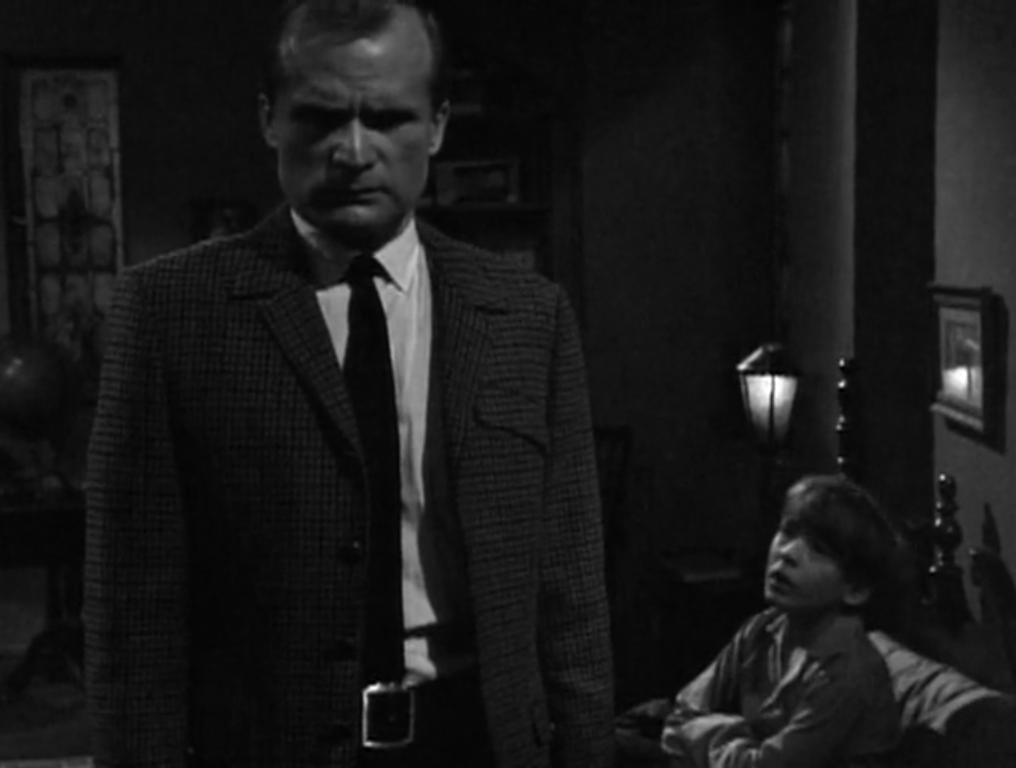
Roger realizes that his gigantic belt buckle is no compensation for what he and David have missed
In a hospital room in Boston, reclusive matriarch Liz has emerged from the catatonic trance in which Laura trapped her five weeks ago. Liz’ daughter, flighty heiress Carolyn, is overjoyed at her mother’s apparently complete recovery.
Carolyn telephones Collinwood with the good news. Vicki tells her what happened in the fishing shack. It dawns on them that Liz emerged from her trance as the flames were surrounding Laura. They don’t know what we saw yesterday, that David began to break from the trance in which Laura held him when he heard the sound of Liz shouting in her hospital room almost 300 miles away. They do realize that Laura’s power was at the root of Liz’ troubles, even if they never find out that Liz was able to exercise some power of her own. Carolyn wonders if all the strange goings-on have really finished going on, if the residents of Collinwood are now free to live quiet, uneventful lives.
Disturbingly for fans of the show, they really are free, at least for the time being. Liz is antsy today when she asks if a stranger has gone through the basement of the house. Carolyn is at one with the audience in finding this question completely uninteresting, but Liz was obsessed with keeping people out of the basement in the early weeks of the show, and the unexplained reason for that obsession is the closest thing they have to an unresolved storyline. Roger and Burke’s mutual dislike also ties into some unanswered questions that no one who isn’t desperate for a cure to insomnia really wants to ask again. So it is not at all clear where the show is heading. They could just stop here, say “They all lived happily ever after,” and that would be fine. But they’ve sold ABC another 65 episodes, so some misfortunes have to turn up in the next couple of days.
In the long-abandoned Old House on the estate of Collinwood, fugitive Matthew is sharpening the ax with which he plans to kill his prisoner, well-meaning governess Vicki. In the great house on the same estate, strange and troubled boy David is struggling with himself. His hated father, high-born ne’er-do-well Roger Collins, and his idol, dashing action hero Burke Devlin, are waiting for him to tell what he knows about Matthew and Vicki, and he keeps asking for assurances that he won’t be punished if he tells.
While David’s pathological fear of punishment keeps her rescuers at bay, Matthew finishes sharpening his ax. In the secret chamber where she is bound to a chair, Vicki receives a visitor- the ghost of Josette Collins. The ghost tells her she need not be afraid. Vicki asks why not. The ghost simply repeats herself and vanishes. It is by no means clear that the ghosts mean to save Vicki from Matthew, or that they could keep him from killing her if that is what they want.
David finally tells Burke and Roger where Vicki is, and they get some shotguns. David delays their departure still further by pleading to go along with them. Meanwhile, Matthew is in front of Vicki, starting to swing his ax at her head.
Matthew hears ghostly voices and breaks off in mid-swing. He runs out of the hidden chamber to the parlor, where the ghost of beloved local man Bill Malloy comes strolling in to the room, singing one of the more family-friendly verses of “What Do You Do With a Drunken Sailor?” Matthew starts swinging his ax wildly at the ghost, which laughs at him. Four more ghosts, representing the famed “Widows,” follow, and he swings at them.
In her place of confinement, Vicki can hear Matthew screaming, but cannot hear the ghosts plaguing him. She calls out to Matthew, who falls silent. Burke and Roger come in, she calls to them, they find her and release her from her bonds. Matthew in a chair in the parlor, dead of fright.
It is notable that Burke and Roger do not actually save Vicki- the ghosts of Bill and the Widows do. When Matthew first tried to kill Vicki in episode 111, it was reclusive matriarch Liz who saved her. Now, it is again a female-led effort, though as the victim of Matthew’s first homicide Bill does get a chance to help. I suppose that fits with the nature of the genre- daytime soaps are addressed to a predominantly female audience, so it only makes sense that female characters will drive most of the major plot points. It doesn’t bode well for the future development of Burke- he’s a dashing action hero, after all, and if all the dashing actions are going to be precipitated by women, girls, and feminine ghosts he’s likely to be left out in the cold.
A while back, Tumblr user “marcycaa” posted this cartoon summarizing the relationships well-meaning governess Vicki has with strange and troubled boy David and flighty heiress Carolyn in the 1966 episodes of Dark Shadows:
Art by marcycaa
Today, Vicki is being held prisoner by the fugitive Matthew, and Carolyn and David are off their leashes. Carolyn telephones dashing action hero Burke to complain that her mother and uncle don’t want her to see him. Burke reacts with disbelief that Carolyn is nattering on about that when Vicki is missing and might be dead.
David is the only one who knows where Matthew is. He is taking food and cigarettes to him. He has begun to suspect that Matthew has Vicki, and is afraid that he will kill her. This fear contends with his fear that he will go to jail for harboring a fugitive. He sneaks off to see Burke to seek reassurance. When Burke asks him what he wants, he says that he wants Burke to tell him that Matthew is innocent and that his hated father, high-born ne’er-do-well Roger, is responsible for everything Matthew has been accused of. When Burke can’t do that, David slips away.
Back in his hiding place in the Old House on the estate of Collinwood, Matthew lies down on a mattress next to the chair to which he has bound Vicki. Before he can get to sleep, he hears voices calling his name. The portrait of Josette Collins glows, eerie music plays, and one of the voices identifies itself as Josette. Vicki can hear none of this and tells Matthew that he must be dreaming. He wants to agree with her, fearing that the only alternative explanation is that he is going mad.
The audience knows that the ghosts are real, but we don’t know whether they mean anyone well. Matthew’s first action upon hearing the voices is to leap up and hold a knife at Vicki’s throat, so it doesn’t seem that they are protecting her. David considers them his friends, but nothing they have done for him has so far led him anywhere but deeper into his constant agony. The last time Vicki was locked up, the ghost of beloved local man Bill Malloy came and told her she would be killed unless she got away soon, but then vanished, leaving her trapped. While it seems likely the voices represent a power that will destroy Matthew, it is by no means clear they will do so before he kills Vicki. For all we can see, they may be about to drive him to do precisely that.
Vicki is our point of view character, but we’ve known Matthew since the second week of the show. As Carolyn tells David today, he’s always been gruff, but has seemed basically well-intentioned. Reclusive matriarch Liz seems to think that Matthew has some sort of cognitive impairment that would make it difficult for him to function in the world at large, and the sheriff’s manner of ordering him about when they have come into contact would suggest that he has the same idea. Matthew’s killing of Bill Malloy and crimes against Vicki have been desperate acts, committed with displays of reluctance and confusion. The idea that Matthew will end as the victim of a malign force that also spells doom for Vicki is therefore logically satisfying and dramatically compelling.









 Dark Shadows Commentary