Episode 886: One of the most terrifying tales ever told

In #701, broadcast at the beginning of March 1969, recovering vampire-turned-bumbling protagonist Barnabas Collins was trying to solve some problems his distant cousins were having, and inadvertently came unstuck in time. He found himself in the year 1897, where his vampirism was once more in full force. Barnabas spent the next eight months in that year, precipitating one disaster after another around the estate of Collinwood and the village of Collinsport.

As summer gave way to fall of 1897, Barnabas’ friends managed to put his vampirism back into remission. In #844, he met Kitty Soames, the dowager countess of Hampshire. Despite what her title would suggest, Kitty was an American woman in her twenties. Barnabas recognized her as the reincarnation of his lost love Josette. In February of 1796, Josette found out that Barnabas had become a vampire and that he wanted to kill her and raise her from the dead as his vampire bride. She flung herself to her death from the cliff on Widows’ Hill rather than let him do that to her.

In the eight weeks following Kitty’s first appearance, Josette’s personality irrupted into her conscious mind more and more frequently. Josette wanted to live again and to be with Barnabas. By last week, Kitty could hear Josette’s voice talking to her through the portrait of her that hangs in the Old House on the grounds of Collinwood. Josette suggested that if Kitty stopped resisting her, the two of them could both live, resolving themselves into a composite being.

In Thursday’s episode, the boundary between Kitty and Josette had become very indistinct. As Kitty, she agreed to marry Barnabas that night, later to wonder why she had done so. She was holding Josette’s white dress in her hand and struggling with the idea of putting it on when she abruptly found herself wearing it. Barnabas entered the room just in time to see her bodily assumed into the portrait. He reached up to the moving image of Kitty overlaid on the painted likeness of Josette, and both he and Kitty vanished at the same instant.

In Friday’s episode, Barnabas found himself lying on the ground, wearing clothes he had last put on in 1796. He learned that it was the night of Josette’s death. He is a vampire in this period, but he is confident he can again be free of the effects of the curse. He does not want to kill Josette, but to take her back to 1897 with him. His efforts to that end were not at all successful, and Friday ended with her on the edge of the cliff. She hears footsteps, which she and the audience have every reason to think are Barnabas’. If she sees him, she is prepared to jump.

Neither Kitty’s assumption into the portrait nor his own translation to 1796 prompt Barnabas to ask a single question about what forces are at work around him. Regular viewers would not expect him to. He lives in a universe where time travel is easy. Not only did he travel from March 1969 to 1897 without even trying to do so, but in #661 he managed to get from January 1969 to 1796 by standing in a graveyard at night and shouting for one of the residents to give him a ride. And in #365, he was present at a séance where the ghost of his little sister Sarah, speaking through well-meaning governess Vicki Winters, said that she would “tell the story from the beginning.” Vicki then vanished from the circle and Sarah’s governess, Phyllis Wick, materialized in her place. For the next four months the show was a costume drama set in the 1790s, where Vicki flailed about helplessly while Barnabas became a vampire, Sarah died of exposure, and Josette jumped off Widows’ Hill.

Barnabas and we also know that portraits are powerful in the universe of Dark Shadows. When he is in full vampire-mode, he communicates with his victims and potential victims through a portrait of him that hangs in the foyer of the great house of Collinwood. Much of the action in the 1897 segment had to do with a magical portrait that keeps Barnabas’ distant cousin Quentin from turning into a werewolf. Quentin had a romance with Amanda Harris, a woman who came to life when another magical portrait was painted.

Barnabas knows, not only that portraits in general have power, but also that Josette’s portrait in particular is powerful. In his second episode, #212, he went to the Old House and talked with strange and troubled boy David Collins, who often communed with Josette through her portrait. After David left him alone there, Barnabas addressed the portrait and told Josette that she would no longer function as the tutelary spirit of the Collins family. At that point Josette was supposed to be Barnabas’ grandmother who sided against him in a fateful family battle, but even after she was retconned as his lost love he felt the portrait’s power. So in #287, Vicki had invited herself to spend the night at Barnabas’ house. While she slept, Barnabas entered the room, intending to bite her. But he looked at the portrait of Josette and found that something was stopping him from doing so.

Barnabas would not have any way of knowing it, but in #70 Dark Shadows‘ first major special effect came when we saw Josette’s ghost take shape in front of her portrait and take three steps down from it to the floor of the room where it was hanging then, the front parlor of the Old House. She then turned, looked at the portrait, and went outside, where she danced among the columns of the portico. Longtime viewers will see Kitty’s assumption into the portrait as a reversal of this momentous little journey.

Most people nowadays who have been watching the show for some time will therefore take the strange goings-on as much in stride as Barnabas does. But viewers at the time may have had a different reaction. Friday’s episode and today’s originally ended with announcements over the closing credits. These announcements were not on the original master videotapes from which Amazon Prime Video and Tubi and the other streaming apps take their copies of the episodes, and so most viewers these days don’t hear them. But evidently one of the DVD releases reproduces them as they were preserved on some kinescopes. One promises that in Tuesday’s episode “one of the most terrifying tales ever told” will begin; the other, that it will be “one of the most unusual tales ever told.”

A terrifying tale suggests a mighty villain. By the end of the 1897 segment, all the villains have either turned into protagonists, as Barnabas, Quentin, and wicked witch Angelique had done; been heavily defeated, as sorcerer Count Petofi had been; or were dead and forgotten. So “one of the most terrifying tales ever told” would seem to require a new villain, or perhaps a new group of villains. And if it is also “one of the most unusual tales ever told,” those villains will have to be strikingly different from anything we have seen before.

So, having heard those announcements, we will be less inclined to chalk Barnabas’ latest adventure in anachronism up to the usual way things are on Dark Shadows. We will be looking for signs that some previously unknown and hugely formidable malevolent force is luring him into a trap.

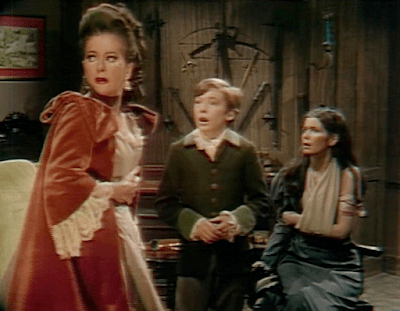
At first, no such signs seem to be forthcoming. The footsteps that alarm Josette turn out not to be Barnabas’, but those of her aunt, the Countess DuPrés. The countess talks Josette down and takes her back to the great house of Collinwood. Having saved Josette’s life, the countess takes her to a room occupied by fluttery heiress Millicent Collins. The countess asks Millicent to sit with Josette while she runs an errand.

Millicent means well, but always makes everything hilariously worse. Seeing that Josette is shaking, she observes that she is suffering a shock. She asks very earnestly “Was your shock a romantic one?” Josette responds by wailing. Millicent keeps talking about the dangers of love, causing Josette to get more and more upset. Longtime viewers will remember that Millicent will turn from a comic figure to a tragic one soon after this, when she falls in love with an evil man. That tinges our reaction with sadness, but Millicent’s total insensitivity to the effect she is having on Josette makes for an effective comedy scene. No matter how much the oblivious Millicent is worsening Josette’s mood, this hardly seems likely to be part of a grand evil scheme.

It turns out that the errand the countess had to run was a visit to Barnabas, who is waiting in Josette’s room. This time Barnabas has actually had a sensible idea. Rather than go to Josette on top of the cliff as he did the first time through these events, he asked the countess to go. The countess confronts him about his status as a walking dead man. Barnabas will not explain- how could he? He asks the countess if she thinks he is a ghost; she does not answer. He insists on seeing Josette; she says she will not allow it. He says he does not want to force her to help him; she declares that he cannot force her. Finally, he ends the exchange by biting her.

The countess goes to Millicent’s room and tells Josette to go back to her own room. Millicent is surprised the countess doesn’t go with her, protesting that Josette is in no condition to be left alone. The countess responds numbly.

The countess is one of three characters we have so far seen Grayson Hall play. The first, mad scientist Julia Hoffman, offered herself to Barnabas as a victim in #350; he declined the offer. Julia was motivated by a mixture of despair over the failure of her first attempt to cure Barnabas’ vampirism, an obligation to prevent him harming others, and her own unrequited love for him, so she was disappointed when he said no. The other, broad ethnic stereotype Magda Rákóczi, told Barnabas to “Bite me!” when they were at the grave of her husband, his onetime blood thrall. He refused to do that, too. Magda was angry and defiant, wanting to get something horrible over with, so her reaction was more ambiguous. The countess didn’t know Barnabas was a vampire until his fangs were in her neck, so she is just dazed.

That Hall’s other characters expected Barnabas to bite them, and in Julia’s case hoped he would do so, shows that no new force is needed to explain why he bites the countess. And bad as a vampire’s bite is, from what we have seen in previous segments of the show we can be sure that the countess will forget all about her experience as Barnabas’ victim once he leaves. Besides, when he came back in time in January Barnabas triggered a chain of events that led to the countess’ death- we can assume that whatever he has put in motion this time will have a different outcome for her. So while the bite still has its echoes of rape and is therefore a horror, it in no way shows the presence of any fresh villain that is about to set off “one of the most terrifying tales ever told.”

Josette is in her room. The secret panel opens, and Barnabas enters. She is shocked to see him. He assures her that he does not want to kill her and raise her as his vampire bride; after a bit of prodding, she gets him to admit that this was, at one point, his plan. He starts explaining to her that he has come to her after a sojourn in the 1890s. She reacts with disbelief and confusion. He keeps talking. He asks her if she remembers Kitty Soames. At first the name does not ring a bell, but as he goes on she recognizes what she had thought to be a dream in which she was talking with her portrait. He tells her that it was no dream, but that just a few hours before they were together in that other century.

Finally, Barnabas persuades Josette to meet him at the Old House. He says they must go separately, since he has to go to his friend Ben Stokes and ask him to stand guard for them while they disappear into the portrait. She wants to say goodbye to her aunt the countess, and Barnabas tells her to write a note. They kiss passionately. One wonders if Josette notices the taste of her aunt’s blood on Barnabas’ lips.

Barnabas’ decision to go to Ben and send Josette to the house on her own doesn’t make much sense. This is the first we have heard they need someone to stand guard, and there is no apparent reason why they should. Moreover, the countess is right there in the house with them, and she is under Barnabas’ power. The three of them can go to the house together, Josette can say goodbye to her there, and if they need someone to stand guard she can do it. Afterward she can tell Ben what she saw and tell lies to anyone else who has questions about where Josette went. Besides, regular viewers of Dark Shadows know that when two people are supposed to go to a place separately, they never actually meet there. A smart character who understood how things work in this universe would know that Barnabas’ decree that he and Josette must take their own paths to the house means that they are doomed. But contrary to the glimmers of brainpower Barnabas showed earlier, he has never been that smart. He is so much a creature of habit that his decision to send Josette to the Old House by herself bears no traces at all of any outside influence, least of all the influence of the new villain we are looking for.

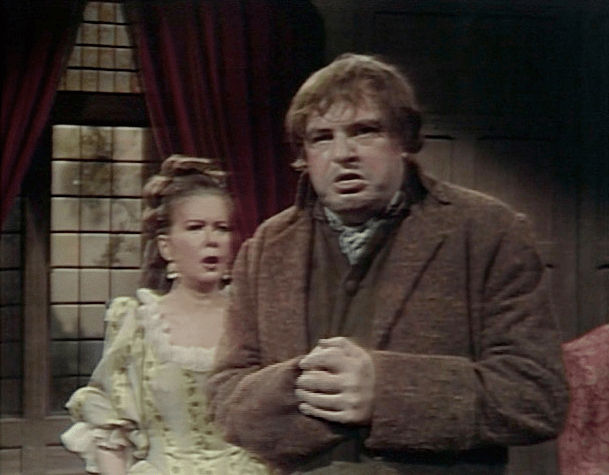
Barnabas is on his way across the grounds of Collinwood to meet Ben when it dawns on him that he is lost. This is the first thing he has done today that is out of character. He has been on the estate for centuries, and knows it surpassingly well. He looks around and sees a cairn, a large stone structure. The cairn has a flat surface in the middle and is flanked with torches and decorated with carvings resembling coiled serpents. Though he does not know where he is, he knows he has been following the same path he used shortly before, and that no such thing was there at that time or in the area ever before. Hooded figures approach, a man and a woman. They make gestures that he cannot understand. He cannot see or feel anything binding him, but neither can he move his feet or use his vampire powers to dematerialize. At last we have encountered the new presence that is supposed to deliver “one of the most terrifying tales ever told.”

Back in the great house, Millicent and the countess discover that Josette is gone. They read the note. When Millicent reads that Josette has gone to be with Barnabas, she is puzzled. All she knows is that Barnabas is dead. As a visitor from light comedy, she assumes that death is a full-time occupation. She tells the countess that to be with Barnabas, Josette will have to die. The countess replies that “Many have died for love.” Millicent is shocked by the countess’ resigned tone, and declares that she will not give up on Josette even if the countess does.

It would have been impossible for Barnabas to explain the situation to the countess while she was actively opposing him, but one might have thought that after he had bitten her and broken her will he might have tried to reassure her that his plans for Josette were now benevolent. The utter hopelessness in her voice when she says that no one can help Josette suggests he didn’t even try. Again, it wouldn’t have taken the influence of any outside force to cause Barnabas to skip this. As a vampire, he is a metaphor for extreme selfishness, and when he is pressed for time he is especially unlikely to take other people’s feelings into account in any way. Though it is a bit of a shame he didn’t try to smooth things over with the countess, there is nothing in his behavior that needs explaining, and too little at stake here for us to imagine that the mysterious forces launching “one of the most terrifying tales ever told” would care much about it.

In the Old House, Josette is looking at her portrait and wondering why Barnabas is late. She talks herself into believing that he was lying when he told her the story about 1897. She jumps to the conclusion that he really is going to turn her into a vampire, and declares she has nothing left to live for. She takes out a vial she had with her when she was with Millicent and drinks it. It is poison, and she dies.

Back in the mysterious clearing in the woods, Barnabas loses consciousness. The hooded figures say some prayers to Mother Earth, then lay him on the cairn. They place some foliage on him. This action recalls the sprinkling of grain on the necks of animals led to altars in ancient Indo-European paganism, an act known in Latin as sacrificium- it was this ritual act, not the killing of the animal, that made the animal sacer, that is, set aside for the gods. The man declares that when Barnabas awakens he will recognize him and the woman, and that he will then lead them “to a new and everlasting life.” My wife, Mrs Acilius, and I reacted to the idea of Barnabas as a guide to enlightenment the same way every regular viewer of Dark Shadows would, viz. with gales of laughter.

Oberon and Haza sacrifice Barnabas on the cairn. Screenshot by Dark Shadows Before I Die.

If the hooded figures represent the force that has directed the events of this episode and Friday’s, the force that we have been promised will bring us “one of the most terrifying tales ever told,” then something that happened in them must have been a necessary precondition for the sacrifice of Barnabas. After all, that force had him under its power when he disappeared from 1897 and found himself lying on the ground. He could just as easily have materialized on the cairn, accompanied by the hooded figures with their foliage.

The only development in these two installments that would seem to be significant enough to qualify as such a precondition is Josette’s poisoning of herself. That Josette jumped to her death from Widows’ Hill is one of the most firmly established parts of the show’s continuity. Artist Sam Evans told Vicki about it in #5. In #185, a very different version of Sam saw Josette’s portrait for the first time and identified her as “the lady who went over the cliff.” In #233, Barnabas gave a vivid and rather indiscreet account of Josette’s death to Vicki and heiress Carolyn. We saw Josette make her leap in #425, and in #876 the leap was reenacted with maidservant Beth Chavez in Josette’s role and Quentin in Barnabas’. So having Josette poison herself instead of taking the jump is an example of something Dark Shadows did several times in the later phases of the 1897 segment, making a retcon into a self-conscious plot point. That leaves us with a puzzle. Why does it matter so much just how Josette went about killing herself?

Josette’s original death was a desperate flight from vampirism. It barely qualified as a suicide at all. Josette was cornered at the edge of the cliff, seeing no way but a mortal leap to escape transformation into a bloodsucking fiend. She went over the cliff in a spontaneous act that prevented the killings and enslavements that she would have inflicted on others had Barnabas succeeded in making her into the same kind of monster he was. This time, she has been keeping a vial of poison with her, so that her suicide is a premeditated act. Moreover, she drinks it when she is still alone, motivated not by a clear and present danger but by her purely intellectual, and as it so happens faulty, analysis of the situation. She still has options, and she is helping no one. So it could be that “one of the most terrifying tales ever told” is supposed to begin with the audience disapproving of Josette’s suicide on moral grounds.

This doesn’t seem very promising, but we should mention that writer Sam Hall probably did not approve of suicide. He was a churchgoer, serious enough about his Lutheran faith that he insisted Shirley Grossman convert from Judaism before they married and she became Grayson Hall. Christians have traditionally regarded despair as a sinful state and suicide as a religious offense. And Hall does seem to have been in a religious mood at this period. Lately his episodes have shown evidence that he was reading the novels of George MacDonald, a nineteenth century Congregationalist minister whose works of fantastic fiction were enormously popular in their day, but which are suffused with such a heavily Christian atmosphere that by the late 1960s their readership was a subset of that of such self-consciously Christian fans of MacDonald’s as C. S. Lewis, J. R. R. Tolkien, and W. H. Auden. Indeed, the three priests who hosted the podcast God and Comics admitted in a 2022 installment of their show that MacDonald’s novels reminded them a little too strongly of their day jobs to count as fun reading for them.

If Hall was feeling pious enough to keep reading MacDonald, he may well have seen Josette’s intentional and unnecessary self-poisoning as a prelude to “one of the most terrifying tales ever told.” Still, nothing we have seen so far explains just how that would work. Maybe we will find out later that Josette’s soul is in need of some kind of intervention from the other characters to avoid damnation. Lutherans aren’t supposed to think in those terms, but not even MacDonald, churchy as he was, ever let any kind of orthodoxy get between him and a good story.

Today marks the final appearance of both Millicent and the countess. It is also the last time we will visit the 1790s.

The hooded figures Barnabas meets today are identified in the credits as Oberon and Haza. Oberon, King of the Fairies, was a figure in medieval and Renaissance folklore whom Shakespeare used as a character in A Midsummer Night’s Dream. Also, MacDonald mentioned Oberon occasionally in his novels. I don’t know where Hall came up with “Haza.” Bookish people pick up vocabulary items all the time, so any of the various words in the world that take that form might have popped into his head when he was writing this episode.

Oberon is played by Peter Kirk Lombard, Haza by Robin Lane. Miss Lane’s acting career seems to have peaked with her turn as Haza, but for the last six years she has been releasing videos on various platforms under the title Badass Women 50+. As of this writing, her bio on YouTube says that she is 89 years old. Until 2022, her videos ran on a cable TV service in NYC, where she was still living then and for all I can tell is still living now.

Peter Lombard died in 2015. He worked steadily on Broadway for a couple of decades. From the point of view of a Dark Shadows enthusiast, the most interesting work he did there was in the original production of 1776, a cast which also included Dark Shadows alums David Ford, Daniel F. Keyes, Emory Bass, and Virginia Vestoff. Those four were all principal members of the cast, while Lombard was a stage manager and Ken Howard’s understudy in the role of Thomas Jefferson. When the cast appeared on The Ed Sullivan Show, Howard was absent, but the part of Jefferson was played not by Lombard, but by Roy Poole. I think I can spot Lombard in the background in the costume worn by Poole’s main character, Stephen Hopkins of Rhode Island.*
The old age makeup makes it impossible to be sure, but I suspect this is Lombard as Stephen Hopkins.

Lombard bore a resemblance to Carel Struycken, the actor who played the very tall man in Twin Peaks. So much so that when I first saw this episode I was certain he was the same person. But they aren’t related. I do wonder if David Lynch or Mark Frost or casting director Johanna Ray saw this episode and had Lombard in mind when they cast Mr Struycken as “The Fireman,” who like Oberon appears unexpectedly and represents a remote and mysterious world.

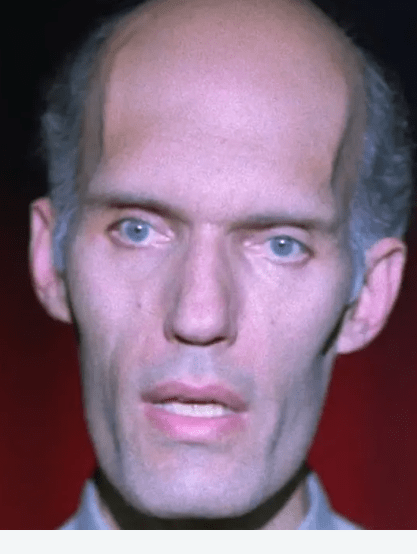
*Stephen Hopkins is not only a character in 1776, but also figures in H. P. Lovecraft’s “The Strange Case of Charles Dexter Ward.” Lovecraft says that (the fictional) Joseph Curwen had been a friend and supporter of his when (the historical) Hopkins was first governor of Rhode Island, but that when Curwen was exposed as a menace Hopkins personally took part in the raid on Curwen’s place. Since the story beginning today is based on another of Lovecraft’s tales, a connection between Lombard and Stephen Hopkins qualifies as a mildly amusing coincidence.
Episode 665: Burn, witch, burn!

Vampire Barnabas Collins has traveled back in time to the year 1796 in order to save well-meaning governess Vicki Winters from being hanged. To his disappointment, she was hanged yesterday, and now appears to be dead. The audience knows that wicked witch Angelique intervened so that Vicki would survive the hanging and appear to be dead so that she can be buried alive. Angelique explains at the beginning of today’s episode that she will lift the spell once Vicki is in the ground so that she can die a slow, painful, terrifying death.

When Barnabas left 1969 on his mission of mercy, matriarch Elizabeth Collins Stoddard had been dealing with the effects of a curse Angelique cast on her in 1968 that caused her to be obsessed with a fear of being buried alive. In fact, Liz appeared to have died, and was in a coffin. That story was unexciting when it was introduced, and had been dragging on for months and months.

Regular viewers may sigh when they see that Angelique is still hung up on the idea of live burial, but this time the whole thing moves very swiftly. Angelique goes to Barnabas in the tower room of the great house of Collinwood. She tells him Vicki is still alive and that if he goes away with her she will save her. He disbelieves her, and signals his servant Ben to rush in with a burning torch and immolate Angelique. Lara Parker enjoys the part of the burning Angelique so hugely that I laughed out loud watching it, but that didn’t detract from the episode. On the contrary, the joy Parker took in performance was one of the most appealing things about her.

Angelique’s dying screams attract the attention of a long-term guest in the house, the Countess DuPrés. The countess goes to the tower room to investigate, and catches sight of Barnabas. The countess had seen Barnabas die, and is shocked that he appears to be alive. She talks with perpetually confused heiress Millicent Collins, who has also seen Barnabas and who has discussed him with her husband, roguish naval officer Nathan Forbes. The countess gathers from what Millicent says that Barnabas is a vampire. This doesn’t quite fit with the previously established continuity- Barnabas returned to a night sometime after the events of episodes 449-451, when the countess helped Barnabas’ father Joshua in an effort to free Barnabas of his curse. It seems rather unlikely that it would slip the countess’ mind that Barnabas is a vampire. At any rate, this time she vows to destroy him at the first opportunity.

When Angelique is destroyed, her spell is broken and Vicki revives. Barnabas goes to the drawing room of the great house and is astounded that Vicki is alive. We may wonder if he would have gone away with Angelique had he known she was telling the truth when she said Vicki was not really dead. He urges Vicki and her boyfriend, the irksome Peter Bradford, to go away as quickly as possible, as far as possible. Vicki asks for a few seconds alone with Barnabas; Peter leaves them, and she tells Barnabas that she will always feel close to him. She gives him a little kiss, and rushes off. Barnabas was hung up on Vicki for a long time; his facial expression as he watches her leave with another man suggests that he has for the first time managed to perform a selfless act. It’s a lovely moment. I only wish Vicki had been played by Alexandra Moltke Isles, who played the part for the first 126 weeks of Dark Shadows, instead of Carolyn Groves. Miss Groves wasn’t a bad actress, but if the goal is to give the character some kind of closure it is unsatisfying to see her as someone who only had the part for three episodes as opposed to the person who was there in 335.

Barnabas sees Vicki go.

Barnabas sees that the time has come to return to 1969. Ben does not know that Barnabas has traveled through time; as far as he knows, he was there all along. But when Barnabas announces he will be leaving, Ben insists on following him. Ben stands by and watches while Barnabas stands in a graveyard and calls out to his friend Julia. Ben does not know who Julia is, any more than he knows that Barnabas was standing on this same spot in #661 when he left 1969. Neither he nor Barnabas knows that the countess and Millicent are spying on them from the bushes.

Barnabas keeps calling out to Julia, but nothing happens. Barnabas decides that he will have to make the trip to the 1960s the same way he did before- as a vampire chained in a coffin hidden in the secret room of the Collins family mausoleum. He takes Ben to that room, and tells him to chain the coffin up after dawn. He tells him they will never see each other again. In its own way, this farewell is as poignant as the one Barnabas shared with Vicki. It is also shadowed with menace, as we see the countess and Millicent still watching.

The next morning, the countess comes to the mausoleum with Nathan. It is a bit puzzling to see Nathan. The night before, Barnabas bit Nathan and forced him to confess to many serious crimes; we last saw him in gaol. Yet here he is, not only free but wearing his federal coat with officer’s braid. The countess says that she got him out of gaol to stake Barnabas. Even in Soap Opera Land, this is a bit of a stretch. It’s an even bigger stretch that, having been under Barnabas’ power, Nathan is now able to stake him.

Nathan is holding the stake over Barnabas’ heart and raising the hammer when the lights go down. We hear a loud bang, and the episode ends.

In his post about this one at the Collinsport Historical Society, Patrick McCray outlines its slam-bang plot, full of sudden reversals and poignant farewells. Patrick does such a great job of capturing the verve and joy of this Genuinely Good Episode that I wondered whether I should even bother writing a post about it. At the opposite extreme, Danny Horn’s post on Dark Shadows Every Day was so full of irritable complaints about continuity problems and other imperfections in Ron Sproat’s script that I was inclined to write a long and impassioned defense.

But I will leave the debate to the two of them. I’ll just say that if anyone is curious about what Dark Shadows is like and wants to watch a single episode to get the flavor of the thing, this would be as good a choice as any.

Episode 663: Forbes, capitalist tool

Barnabas Collins, on a quest to rescue well-meaning governess Vicki Winters and her boyfriend Peter Bradford from death by hanging, has traveled back in time to the year 1796, reverting to vampirism in the process. He bites roguish naval officer Nathan Forbes and compels him to go to the authorities with a confession of his role in framing Vicki and Peter. This leads them to order Peter’s release, but there is enough other evidence against Vicki that her hanging is still scheduled to go forward tonight.

Barnabas meets with his sidekick, much-put-upon indentured servant Ben Stokes, down at the docks. They confer about this situation. Barnabas says he may have to forcibly break Vicki out of gaol. He and Ben are discussing the difficulties of achieving this when a prostitute emerges from the fog. Barnabas’ eyes lock on her, and he sends Ben away.

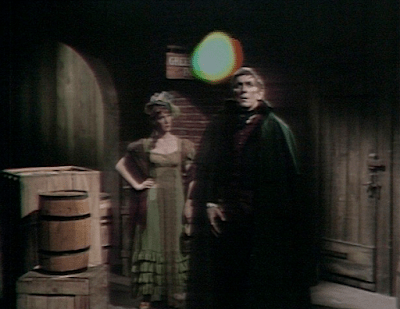
The following scene is a reworking of one we saw in #414. Then, Barnabas met Ruby Tate, another professionally agreeable lady, on this same set. As Ruby introduced herself to him, so Crystal Cabot introduces herself. As Barnabas struggled with his impulse to bite Ruby, so he struggles with his impulse to bite Crystal. As Ruby sealed her fate by eventually telling Barnabas she recognized him, so it dawns on Crystal that she is talking with the scion of the family that owns the town and she goes on about having seen Barnabas coming and going from his father’s offices. As Barnabas finally gave in and bared his teeth to Ruby, so he bares them to Crystal. He is a more experienced vampire now than he was then, so he gets Crystal in his grips repeatedly, something he never managed with Ruby. But he has also had several months respite from his curse, during which he has come to think highly of himself, and he is after all on a mission of mercy. So each time he grabs Crystal, his conscience stops him from biting her. In 1967, Barnabas kept trying to bite Vicki, but could not bring himself to do it. Longtime viewers will be reminded of that reluctance when Barnabas keeps holding back with Crystal. The scene returns to the model from #414 when Crystal breaks free of Barnabas and, like Ruby before her, she goes into the water. We hear the same splash we heard when Ruby fell, and Barnabas’ face again tells us that she will not come out of the water alive.

Barnabas goes back to the great house of Collinwood and tells Ben how sorry he feels for himself. He had forgotten what it was like to be a vampire, how overpowering the urge for blood would be. Ben does not know that Barnabas has returned from the future, much less that he had a vacation from the effects of his curse, and so does not know what he is talking about. Ben leaves Barnabas alone in the study, and Crystal’s drowned body materializes in an armchair.

Crystal appears in the study at Collinwood. Screenshot by Dark Shadows Before I Die.

This again harks back to Barnabas’ early days as a vampire. In #440, Barnabas killed yet another sex worker, the luckless Maude Browning. Barnabas took revenge on the fanatical Reverend Trask by planting Maude’s body in Trask’s apartment. The next day, Nathan helped Trask dispose of Maude and evade the police. Barnabas never found out who thwarted his evil plan for Trask.

Nathan is in gaol, and so does not seem available to help Nathan as he once helped Trask. Moreover, it seems Barnabas’ control over him is fading. Nathan’s wife, Barnabas’ feather-headed second cousin Millicent Collins, saw Barnabas and Ben frog-marching Nathan out of the great house of Collinwood. She goes to visit him in his cell and asks why he is there. He doesn’t give her a straight answer, but does try to tell her about Barnabas. She can’t follow his story, but does understand his instructions to go to Barnabas’ coffin in the morning and drive a wooden stake through his heart. It is hard to believe that the giggly Millicent, a character from light comedy whose mistreatment at Nathan’s hands turned her into a hopeless mental case, will actually take any such action. But it is clear that if Barnabas is going to call on Nathan to do any more work for him, he will not only have to get him out of gaol, but will also have to bite him again to renew his power over him.

Episode 457: I will meet you

This is the first episode of Dark Shadows credited to a director other than Lela Swift or John Sedwick. It is also the first production of any kind directed by Dan Curtis, the series’ creator and executive producer. Curtis’ inexperience shows at several moments when the camera is in an awkward spot or the actors are unsure what to do, and in his post about the episode on Dark Shadows Every Day Danny Horn documents several of the more egregious examples with screenshots and detailed analysis. The impossible deadlines and tiny budget on which Dark Shadows was produced meant that even Swift and Sedwick, who were seasoned professionals and ambitious visual artists, sometimes had to turn in work that wasn’t much better than what first-timer Curtis manages today, and longtime viewers of the show will take even his worst stumbles in stride.

At the top of the episode, it is daytime, and much put-upon servant Ben Stokes (Thayer David) finds the lady of the house, Naomi Collins (Joan Bennett,) standing at an open coffin that holds the corpse of her son, Barnabas. Ben knows that Barnabas is a vampire who will rise at night to prey upon the living. Naomi has never heard of vampires. All she knows is that Barnabas is dead, and that his coffin has been moved from the family mausoleum to a room atop a tower in the mansion. Ben pleads with her to leave the room and to go with him back to the main part of the house.

Naomi questions Ben. Ben tells her that Barnabas has a “sleeping sickness,” and has been in a coma ever since the night he apparently died. Ben does not like to lie to Naomi, but her husband, haughty overlord Joshua, has judged that the truth would kill her, and Ben is governed by that assessment. He does tell her that the “sleeping sickness” is a symptom of a curse, that the wicked witch who placed the curse was Barnabas’ sometime wife Angelique, and that Joshua is in Boston trying to find someone who knows how to lift it.

Ben asks Naomi how she came to be in the tower room. She tells him that naval officer/ sleazy operator Nathan Forbes told her that Barnabas was being kept there, and also that Barnabas was responsible for the series of murders that had recently taken place in the town of Collinsport. At that, Ben vows to kill Nathan. To his chagrin, Naomi forbids him to do this.

Naomi forbids Ben to kill Nathan. Screenshot by Dark Shadows Before I Die.

In the part of Dark Shadows set between August and December of 1966, Bennett played reclusive matriarch Elizabeth Collins Stoddard and David played her fanatically devoted handyman Matthew Morgan. When well-meaning governess Vicki came unstuck in time and arrived in the late 1790s, she at first mistook Naomi for Liz and Ben for Matthew. This scene takes longtime viewers back to the days when Matthew was always on the lookout for someone who represented a threat to Liz’ interests and she was always sternly prohibiting him from murdering anyone for her sake.

Ben is a far saner man than Matthew ever was; the contrast between them shows the effect that growing up in Collinsport, a town suffering from the consequences of a curse that has been working its way for many generations, has had on Matthew’s personality. While Ben is a brave, kind-hearted fellow whose fierce loyalties sometimes overpower his good sense, Matthew is a paranoid ogre who kills Liz’ friend Bill Malloy and tries to kill Vicki. It isn’t just one family that will be warped by Angelique’s curse. It will breed monsters everywhere the Collinses’ influence prevails.

Naomi then turns her attention to the B-plot. Nathan has married fluttery heiress Millicent Collins, only to find that Millicent has signed her share of the Collins fortune over to her little brother Daniel. Nathan responded to that news by crafting a plot to murder Daniel. His first attempt failed when Noah Gifford, the henchman he hired to abduct Daniel and drown him, fell afoul of Vicki. Vicki found Noah strangling Daniel near the place where she was hiding, having escaped from gaol, and shot him to death. After that, Daniel and Vicki went back to the mansion and told Naomi what they knew. Naomi recognized Daniel’s description of his attacker as a man she had seen with Nathan earlier, and realizes that Nathan is trying to murder the boy. So she orders Ben to take Daniel into town to stay with the Rev’d Mr Bland, a clergyman who looks like a duck.

Naomi confronts Nathan, who keeps telling her that whatever Barnabas might look like during the day, he gets up at night and goes out to murder people. She tries to shut him up, but later she is still wondering whether she should go back to the tower room after dark to check his story out.

She sees Millicent standing in the foyer, staring at the portrait of Barnabas that hangs there. The portrait of Barnabas first appeared under the closing credits in #204, and from #205 on it figured as a means through which Barnabas could communicate with the living. Barnabas bit Millicent the other day, and she hears him summoning her.

Among the 1960s characters who receive their commands from the vampire while staring at the portrait is Liz’ daughter Carolyn, who like Millicent is played by Nancy Barrett. Millicent at times evoked an early version of Carolyn. Until the spring of 1967, Carolyn was tempestuous and irresponsible, sometimes friendly to point-of-view character Vicki, sometimes hostile to her. Millicent is as timid and overly dependent as that version of Carolyn was headstrong and self-centered. One way or another, each is a Spoiled Heiress, and evidently that’s a favorite meal of Barnabas’.

Naomi follows Millicent to the gazebo on the grounds of the estate. There, she sees Barnabas. She is stunned that the son whose corpse she was looking at just a few hours before is up and moving. He bites Millicent, and Naomi lets out a scream. Barnabas looks up, and realizes that his mother has caught him in the act.

The vampire’s bite affects each victim differently. The first victim we saw was Willie Loomis, whom Barnabas’ bite transformed from a dangerously unstable ruffian to a sorely bedraggled blood thrall. Willie was at first gravely ill, then ran to Barnabas like an addict desperate for a fix, and eventually settled into life as a sorrowful servant who could not run away from Barnabas but could resist him to the point where Barnabas occasionally found it necessary to keep him in line with beatings.

The second victim we saw was Maggie Evans, The Nicest Girl in Town. She reacted very much like the first victim in the 1790s segment, gracious lady Josette, who, like Maggie, was played by Kathryn Leigh Scott. At first, those two were alternately blissful and snappish, happy to be under Barnabas’ power and defensive with anyone who might interfere with it. But each recoiled from him by the time it became clear he planned to kill her and make her into a vampire herself. Each escaped from him to the shore below Widow’s Hill- Maggie by running through an underground tunnel that rose to the shoreline, Josette by flinging herself to her death from the top of the cliff.

Later, Barnabas bit Carolyn. She initially contemplated his most gruesome crimes with pure glee and showed great energy as his protector and enforcer. Soon her conscience reappeared, but she was still doing his dirty work faithfully when Vicki disappeared into the past.

Millicent differs from all those others in that she simply continues to go about her business in between Barnabas’ meal-times. Granted, she was already deeply disturbed by that point, so that her business was conducted mostly in show-stopping mad scenes. But it’s still odd that she can talk to Nathan as if their marriage were the main thing in her life.

When we finished watching this one, my wife, Mrs Acilius, wondered if these differences were simply the result of the victims’ personalities coming through or if the vampire can pick and choose how to apply the pressure. He wanted Willie as a slave, and the reaction he produced gave him that. He wanted to turn Maggie into a reincarnation of Josette, and wound up getting the same reaction from Maggie that he had got from Josette. He bit Carolyn in a moment of desperation, with no plan in mind, and her reaction is complicated and volatile. He bit Millicent to keep her quiet, and her reaction is remarkably inconspicuous. Maybe we’re just supposed to think that Barnabas is fabulously lucky, but there is an opening there to tell a story about how him deciding what he wants to do to a person when he sucks their blood.

Episode 456: The little boy I brought with me

In 1966, the well-meaning Victoria Winters (Alexandra Moltke Isles) came to the great house of Collinwood to be governess to strange and troubled boy David Collins (David Henesy.) Throughout the first 25 weeks of Dark Shadows, Vicki gradually learned that David’s stories of ghosts and other paranormal phenomena were not signs of a disordered imagination, but were simple statements of fact. Once she came to terms with that reality, Vicki and David became the closest of friends.

Now it is 1796. Vicki has come unstuck in time. For a brief period she served at Collinwood as governess to the children there, including Daniel Collins (David Henesy,) with whom she became the closest of friends. Vicki’s signal failure to adapt to her new surroundings soon led her to be convicted of witchcraft and sentenced to death. She escaped from gaol and found a hiding place in the secret room of the Collins family mausoleum. Daniel joined her there.

Daniel, too, had been fleeing for his life. An unsightly man had abducted him. Daniel got away from him and made his way to the cemetery, where he had earlier seen Vicki duck into the mausoleum. When Daniel went out again, the man appeared and tried to strangle him. Vicki found out what was going on and shot the man to death.

Daniel and Vicki then left the cemetery and went to the great house. The lady of the house, Naomi Collins, believes that Vicki is innocent. Daniel is sure Naomi will help her.

In the study. Screenshot by Dark Shadows Before I Die.

Today, Daniel and Vicki arrive at the house, and Naomi does indeed hide them. The three of them are in the study when Daniel’s brother-in-law, naval officer/ sleazy operator Nathan Forbes, knocks on the door. Naomi hustles Vicki into a closet and lets Nathan in. Nathan dismisses Daniel’s claim that he was attacked, but when Daniel gives a description of his assailant Naomi realizes that it matches a man she saw Nathan with earlier. She is convinced that Nathan tried to do away with the boy.

She is correct. Nathan wooed Daniel’s sister Millicent for her money, only to discover after they were married that she had signed all of it over to Daniel. If Daniel dies, it reverts to her, which is to say to her husband. So Nathan set about scheming to have Daniel killed. As it was always dangerous to disbelieve David, so it would be dangerous to disbelieve Daniel.

When Naomi tells Nathan that the authorities will investigate Daniel’s story, he warns her against attracting the attention of the constable. He can see that she doesn’t know what he’s talking about. So he tells her that it is to do with her son Barnabas. Naomi declares that Barnabas is in England, repeating a lie that her husband Joshua commanded her to propagate. Nathan says that isn’t true. “So you know Barnabas is dead,” replies Naomi. Nathan denies that as well, and says that Barnabas has recently been murdering people in the town of Collinsport.

Naomi was in the house when Barnabas died and saw him in his coffin afterward, so she is not inclined to accept Nathan’s assertion. But Millicent keeps saying that she has seen Barnabas, Naomi thought she heard Barnabas’ voice the other day, and Joshua is obviously keeping some secret from her. So when Nathan tells her that Barnabas is in the room on top of the tower attached to the house, she can’t resist going up there to see for herself. At the end of the episode, Naomi is in the tower room, opening Barnabas’ coffin.

Episode 451: The pit of my soul

Haughty overlord Joshua Collins and good witch Bathia Mapes decide to take Joshua’s son Barnabas to the deserted Old House on the estate of Collinwood. Bathia has agreed to do battle with the ghost of wicked witch Angelique in hopes of lifting the curse whereby Angelique turned Barnabas into a vampire. Bathia warns Joshua that if she is interrupted, Angelique will defeat her. In that case, Barnabas will remain as he is, and Bathia will die. Joshua assures her that no one will come to the Old House.

Bathia, Joshua, and Barnabas before they go to the Old House. Screenshot by Dark Shadows Before I Die.

In the great house on the estate, Barnabas’ mother Naomi talks with fluttery heiress Millicent Collins and Millicent’s new husband, naval officer/ sleazy operator Nathan Forbes. Millicent’s mental health has always been fragile, and Nathan has been making a concerted effort to shatter it altogether so that he can get his hands on her share of the Collins fortune. Making matters worse, Barnabas bit Milllicent the other day. She has a beautiful mad scene today, one of several that Nancy Barrett knocks out of the park during this storyline. She insists on telling Naomi that she has seen Barnabas. This distresses Naomi, who knows that Barnabas is dead but does not know about the vampire curse.

Millicent gives Naomi enough details to stir her curiosity about what is going on at the Old House. She goes there, interrupting Bathia’s efforts. Joshua manages to hustle Naomi out of the house, but the damage is done. Bathia bursts into flames and dies. In keeping with his habit of covering up compromising information, Joshua has kept everything from Naomi. Once more, we see the cost of this habit. Had he leveled with her about Barnabas’ condition, Barnabas might have been freed.

There is a detailed comparison of the script for this episode with the finished product on a tumblelog called sights9. It is in five parts, the first of them here.

A very famous blooper occurs before Joshua and Bathia take Barnabas from the great house to the Old House. Bathia is supposed to be giving instructions, but falls silent, stares at the teleprompter, and squints helplessly for a long moment. Then we hear the line producer, Bob Costello, prompt her with “Then go to the house” and she picks back up.

Episode 450: That man who says he is Barnabas

Haughty overlord Joshua Collins and his long-term house-guest the Countess DuPrés have summoned good witch Bathia Mapes to lift the curse that has made Joshua’s son Barnabas a vampire. Meanwhile, Barnabas has bitten his second cousin Millicent and gone to the waterfront to find another victim. Bloggers Danny Horn, Patrick McCray, and John and Christine Scoleri have said so much so well about this episode that I have only a few points to add.

Millicent tells Joshua that it is wrong of him to have “that man who says he is Barnabas” in the house when he does such frightful things. Nancy Barrett’s performance as a woman made insane by her encounter with the undead is achingly beautiful. And her idea that Barnabas is an impostor is an intriguing one. Should Bathia succeed, Barnabas will need a story to account for the several sightings people made of him when he was cursed. That success seems unlikely- if Barnabas is freed from the curse now, what will we find when Dark Shadows stops being a costume drama set in the 1790s and returns to a contemporary setting? But it is something to file away for future use…

Bathia summons Barnabas away from the docks, where he is about to kill a prostitute, by sending the flame from a candle to him. The movement of the flame is an interesting effect, but what most held my attention was the scene between Barnabas and the woman he almost victimizes. Jonathan Frid and day player Rebecca Shaw play this scene in silence, with exaggerated movements, against a heavy musical score. The resulting balletic interlude is a striking departure from Dark Shadows’ previous form.

Barnabas disappoints his partner at the end of the ballet sequence. Screenshot by Dark Shadows Before I Die.

Bathia keeps Barnabas in place by showing him a cross from which he recoils. This is the first time we have seen this reaction. Barnabas routinely comes and goes through a cemetery where many of the grave markers are in the shape of the cross, and they don’t bother him a bit.

Not only is it the first time this particular symbol has been a problem for Barnabas, it is the first time Dark Shadows has suggested there might be something to Christianity. The representatives of the faith we have seen so far in the 1790s have been Barnabas’ Aunt Abigail, a disastrously repressed spinster; the Rev’d Mr Bland, of whom the best that could be said was said by the doomed Ruby Tate when she described him to Barnabas as the preacher who looked like a duck; and the Rev’d Mr Trask, a fanatical witchfinder who inadvertently became the handiest tool wicked witch Angelique had at her disposal. The 1960s characters, aside from one fleeting mention of the word “Christmas” in 1966, have not betrayed any awareness that there is such a thing as Christianity.

Bathia commands the spirit of Angelique to speak to them through Barnabas. When Angelique was first on the show, she very conspicuously kept doing many of the weirdest things Barnabas was in the habit of doing in 1967. So Barnabas exasperated his henchmen by fixating on well-meaning governess Vicki but refusing to bite her, insisting that Vicki would eventually come to him “of her own will.” Angelique exasperates her thrall, much put-upon servant Ben, by casting spells on everyone but Barnabas when her goal is to win Barnabas’ love, insisting that Barnabas would eventually come to her “of his own will.” When in 1967 Barnabas sends his thrall Carolyn to steal an incriminating document and she asks what will happen if she is caught, he replies “See that you don’t get caught.” When Angelique sends Ben to steal a hair ribbon from Abigail and he speaks of what will happen if he is caught, she replies “See that you don’t get caught.” Moments like these suggest that the vampire Barnabas is not simply cursed by Angelique, but possessed by her. Perhaps it was Angelique, wearing Barnabas’ body as a suit, that we saw in 1967, not the son of Joshua and Naomi at all.

Jonathan Frid as Angelique . Screenshot by Dark Shadows Before I Die.

This fits with the general idea of the supernatural developed in the first 73 weeks of Dark Shadows. The first supernatural menace on the show was undead fire witch Laura Murdoch Collins, who was on from December 1966 to March 1967. Laura was a complex of beings, made up of at least two material bodies and an indeterminate number of spirits, some of which seemed to be unaware of the other parts of the system and pursuing goals incompatible with theirs. From June to November of 1967, the ghost of Barnabas’ little sister Sarah kept trying to contain the damage her big brother was doing to the living characters. Sarah too turned out to be a complicated sort of phenomenon, and the form in which she visited people when they were awake was unaware of and at odds with the form in which she visited them in their dreams. If we go by Laura and Sarah, we would have to assume that supernatural beings are multifarious and fissiparous. So perhaps each time Angelique casts a spell, she splits a bit off of herself and the fragment springs up as another version of her, functioning independently of the rest. In that case, the vampire Barnabas is an avatar of Angelique. When Bathia compels Angelique to speak, she is compelling one of the Angeliques to drop a mask.

The given name “Bathia” is rare; the only person with it who ranks higher in Google search than Bathia Mapes is a musicologist named Bathia Churgin. Professor Churgin was born in New York in 1928, went to Harvard, and taught in the USA until she moved to Israel in 1970. So it is possible that someone connected with Dark Shadows may have heard of Professor Churgin and named Bathia Mapes after her, either as a tribute or just because the name stuck in their mind.

The surname “Mapes” is somewhat less rare; apparently “it is borne by around one in 903,601 people.” In 1963 and 1965, Frank Herbert published two novels that were later issued together under the title Dune; there is an elderly woman with a mystical bent named The Shadout Mapes in those. I’ve never taken much interest in Dune, and owe my awareness of this to comments on Danny Horn’s blog (from Park Cooper here and from “Straker” here.) There doesn’t seem to be much doubt that Bathia’s family name is a nod to The Shadout Mapes; whether it was Sam Hall or another of the writers or someone else who worked on Dark Shadows or one of their kids who had read Dune, I cannot say.

Episode 449: To provide a witch

In the parts of Dark Shadows set in the 1960s, Grayson Hall plays mad scientist Julia Hoffman, sometime confidant of ancient vampire Barnabas Collins. Now it is 1796, Barnabas has only recently become a vampire, and Hall is the Countess DuPrés. Like Julia, the countess is deeply versed in the supernatural, and like her she is a long-term guest at the great house on the estate of Collinwood.

Barnabas’ father Joshua has learned of his son’s curse, and is desperate to find a way to free him of it. Today, we open in the Old House on the estate. Joshua has summoned the countess to meet him there. Joshua brings the countess up to date about Barnabas’ condition. He also informs her that the one who played the curse was not the luckless Victoria Winters, who is currently in gaol awaiting execution on charges of witchcraft, but was in fact the countess’ one-time maid Angelique. At this, the portrait above the mantel vanishes and is replaced with one of Angelique.

Portrait of the wicked witch. Screenshot by Dark Shadows Before I Die.

This is the first we have seen the portrait of Angelique. As Danny Horn points out in his post about this episode on Dark Shadows Every Day, it is a message to the audience. Barnabas killed Angelique weeks ago, and her ghost, which was pretty busy on the show for a little while after that, has not been prominent lately. They are running out of unresolved storylines, and will be returning to the 1960s soon. When they show us that they have commissioned and paid for a portrait of Angelique, the makers of Dark Shadows are telling us that she will be back when they return to a contemporary setting.

Joshua asks the countess if she can help lift the curse. At first the countess shows incredulity that Joshua thinks she can “provide a witch” who will counteract Angelique’s spell, but she immediately follows this display by announcing exactly how they will go about summoning such a person.

Back in the great house, naval officer/ sleazy operator Nathan Forbes is continuing with his efforts to drive his new wife Millicent insane so that he can get his hands on her share of the Collins family fortune. Millicent has seen a light in the room on top of the mansion’s tower. Nathan denies having seen the light, and Millicent takes his denial, not as a sign that his vision is failing, but as a reason to fear that she is hallucinating. Nathan insists that she go to the tower room and prove to herself that no one is there.

Returning viewers will be startled by this insistence of Nathan’s. Nathan has deduced that Barnabas is in the tower room. He does not know that Barnabas is a vampire, but does know that he is responsible for the many killings that have taken place in the area recently. When he presses Millicent to go to the room, he is not only trying to unhinge her mind, but is sending her to surprise a crazed murderer in his lair.

Perhaps Nathan hopes only that Millicent will be shocked to see her cousin. But he has been using his knowledge of Barnabas’ presence on the estate to blackmail Joshua. Millicent is a compulsive talker. If she learns that Barnabas is at home, it will only be a matter of time before she tells everyone about it, making Nathan’s information worthless as leverage over Joshua. Unless Nathan does in fact calculate that Barnabas will kill Millicent, it is hard to see what he thinks will happen when Millicent goes to the room.

Joshua and the countess return to the great house. Joshua hustles everyone out, commanding them to go into town to attend a speech by the governor of Massachusetts.* Nathan resists; alone with Joshua, he asks if Barnabas will still be in the tower when everyone gets back. Joshua refuses to discuss the matter.

Joshua and the countess begin their summoning ceremony in the drawing room. Nathan eavesdrops at the door. Joshua finds him there and drives him from the house; the ceremony begins again.

Millicent goes to the tower room. She lets herself in. Barnabas confronts her. He tells her that he will let her go if she will promise never to tell anyone she saw him there; she cannot do that. Patrick McCray puts it well in his post on The Dark Shadows Daybook: “Millicent’s tragedy is that her nature compels her to tell the truth. She knows it will kill her and she knows that she is consigned to it. She is addicted to chatter and chatter will kill her. When she screams at Barnabas’ attack, I think she’s not so much screaming at the terror of the vampire as she is screaming at herself.”

In the drawing room, the countess and Joshua continue the ceremony. We hear the wind. One draft blows out the candle; another blows open the door. An old woman appears in the doorway. She enters the foyer, and says that it is too late- the man they have summoned her to help has already gone.

Enter the good witch. Screenshot by Dark Shadows Before I Die.

*In our time-band, Samuel Adams held that office in 1796. We might imagine that Adams had a counterpart in the universe of Dark Shadows. If so, it would have struck people odd that Joshua was not already committed to attending the speech, and indeed that he had not invited Governor Adams to spend the night at Collinwood. When Joshua first met the countess, he proudly claimed that the French Revolution was an imitation of the USA’s War of Independence; by that point in history, such a claim marked its maker as a supporter of the faction in American politics that the governor represented, the more militant wing of Thomas Jefferson’s party. In fact, much later in the series we will see a portrait of Jefferson prominently displayed at Collinwood. Joshua must surely have been the richest and most eminent Jeffersonian in the region, so much so that even though his family was in mourning they would still have been expected to host the governor in their mansion.

Episode 448: On their wedding day

Naval officer/ sleazy operator Nathan Forbes has succeeded in his scheme to marry fluttery heiress Millicent Collins, only to discover that Millicent has signed her vast fortune over to her little brother Daniel. Nathan comes up with a Plan B. Millicent is Daniel’s legal guardian, and he is Millicent’s husband. So if she is declared insane, he will be able to get his hands on the money.

Nathan drives Millicent out of her mind. Screenshot by Dark Shadows Before I Die.

From her first appearance, Millicent has been established as an extremely fragile person. So Nathan’s gaslighting project doesn’t take much work. She makes a remark in a calm voice, and he expresses dismay that she is so upset. Rather than dismiss this as a tiresomely dimwitted joke, Millicent becomes very agitated. She mentions that there is a light in a window across the way; Nathan denies that he sees it. Rather than wondering if his eyes are going bad, she is reduced to tears by the thought that she might be hallucinating. The whole process takes about three minutes. It’s fine for viewers who have been watching Millicent all along and know how precarious her mental balance is, but people tuning into Dark Shadows for the first time would probably think the scene was pretty silly.

Episode 443: Masculine details

Naval officer/ sleazy operator Nathan Forbes seemed to have lost his best chance at getting rich quick when his fiancée, fluttery heiress Millicent Collins, discovered that he was already married when they got engaged. Since then, he has figured out that Millicent’s second cousin, Barnabas Collins, did not go to England as the family has been telling everyone, but that he is still lurking about the village of Collinsport and has murdered several people there. Among Barnabas’ victims was Nathan’s wife Suki.

Widower Nathan has a plan to profit from this information. Today, we see the first step in Nathan’s plan. He persuades his henchman, commercial mariner Noah Gifford, to wear a mask, carry Barnabas’ cane, and assault Millicent while he lies in wait. Apparently he will rescue her, and she will tell her family both that Nathan was the hero of the incident and that the attacker carried Barnabas’ instantly recognizable cane.

The whole episode is full of comic moments, and the climactic scene of the assault at the gazebo had my wife, Mrs Acilius, laughing out loud and making comparisons to A Funny Thing Happened on the Way to the Forum. That reaction shows that Nathan and Noah are a more successful rewriting of Dark Shadows‘ first seagoing con man, Jason McGuire, and his henchman Willie Loomis. Jason was supposed to be a comic villain, but the writers never gave him much that was funny to do or say. Actor Dennis Patrick was such a talented comic that he could pad his part with facial expressions, tones of voice, and gestures that got laughs, especially in his scenes with Willie. But it was never at all clear why he needed Willie, and most of the time he was on camera Jason was grinding the other characters down with a depressing blackmail scheme. But Nathan keeps scrambling to find his way into his marks’ good graces, and he and Noah get up to all sorts of high-jinks. Regular viewers will be happy to see a demonstration of what Jason and Willie might have been had Dark Shadows been able to employ a better writing staff in 1967.

Another major improvement over the period when Dark Shadows was set in 1966 and 1967 is the show’s use of Joel Crothers. He did what he could with the part of hardworking young fisherman Joe Haskell, but since Joe’s only note is earnestness he always winds up as less of a character than a function. But Nathan is always working an angle, is never quite predictable, and is tremendously fun to watch. The prospect of seeing Crothers return to the role of Joe is one of the major reasons the audience might want to prolong our stay in the eighteenth century.

Closing Miscellany

Noah remarks on one of the odd quirks of the Collins family when he mentions that the vacant Old House on their property is still full of all sorts of valuable objects. From the first week of the show, we’ve seen that disused parts of their estate are heavily stocked with high-priced antiques. This acknowledgement of the oddness of that fact leaves us wondering if the show is going to change it.

Today marks the only appearance on Dark Shadows of actress Charlotte Fairchild. Fairchild plays a downstairs maid who tells Millicent that a man has brought her a fan. Her angular figure and pale complexion made her a perfect choice to play an eighteenth century servant, and she does a fine job with the dialogue.

Millicent and the downstairs maid. Screenshot by Dark Shadows Before I Die.