Episode 738: The rest of the truth

This episode ends with one of the most thrilling moments in all of Dark Shadows.

The show’s first supernatural menace was undead blonde fire witch Laura Murdoch Collins, who was on it from December 1966 to March 1967. Its second was vampire Barnabas Collins, who first appeared in April 1967. Laura herself was presented with many tropes that conventionally mark vampires; for example, they laid great emphasis on the fact that Laura was never seen eating or drinking. And Laura’s story was structured very much like Bram Stoker’s Dracula, with well-meaning governess Vicki taking Mina’s role as the driving force behind the opposition to her. Presumably, if Barnabas had been staked and destroyed as the original plan envisioned, Vicki would have led the fight against him as well, and in #275 driven the stake into his heart. But Barnabas brought the show a new audience, and so Vicki was never called on to go to battle with him. Her character withered and was written out, and he replaced her as its chief protagonist.

In early 1967, Vicki learned that Laura had appeared at least twice before, and had died in strikingly similar ways each time. In 1767, Laura Murdoch Stockbridge was burned to death with her young son David; in 1867, Laura Murdoch Radcliffe was burned to death with her young son David; and in 1967, Vicki found Laura Murdoch Collins beckoning her young son David to join her in the flames consuming a wooden building. At the last second, Vicki broke through David’s trance and he ran to her, escaping the flames.

In November 1967, the show established that Barnabas lived on the great estate of Collinwood as a human in 1795, and that he became a vampire as a result of the tragic events of that year. If Barnabas were the same age in 1795 that Jonathan Frid was in 1967, he would have been born late in 1752, meaning that he would have been a teenager when Laura Murdoch Stockbridge and little David Stockbridge went up in smoke. The Stockbridges were a very wealthy family, so they would likely have been on familiar terms with Barnabas and the other rich Collinses of Collinsport, and the deaths of Laura and David would have been one of the major events in the area in those days. So longtime viewers have been wondering ever since whether Barnabas knew Laura, and if so what he knew about her.

Now Barnabas has traveled back in time to the year 1897, and there he meets another incarnation of Laura. He is thunderstruck at the sight of her. In her bland, enigmatic way, she expresses curiosity about his reaction, and he collects himself sufficiently to make some flattering remarks about her beauty. As soon as he is alone with his blood thrall, Miss Charity Trask, he declares that Laura has been dead for over a hundred years. So has he, but apparently when a woman rises from the dead to prey on the living that’s different, somehow. We saw this same old double standard a couple of weeks ago, when libertine Quentin Collins expressed shock at Laura’s return from the dead, when he himself had died and been a zombie just the week before.

If Laura did know Barnabas when she was as she is now and he was an adolescent, it is no wonder she does not seem to recognize him. She knows that there is a Barnabas Collins on the estate, and has heard that he is a descendant of the eighteenth century bearer of the same name. She would expect him to resemble the boy she knew, but would not necessarily know what that boy looked like when he was in his forties.

This is the first time we’ve seen Charity since Barnabas bit her in #727. She lives in the town of Rockport, which in the 1960s was far enough away from Collinwood that in #521 it was worthy of note that you could dial telephone numbers there directly. In 1897, when automobiles were rare and roads weren’t made for the few that did exist, a long-distance relationship between vampire and blood thrall would seem quite impractical. Still, in #732 we saw a character make two round trips between Rockport and Collinwood in a single evening, so I suppose it could be managed.

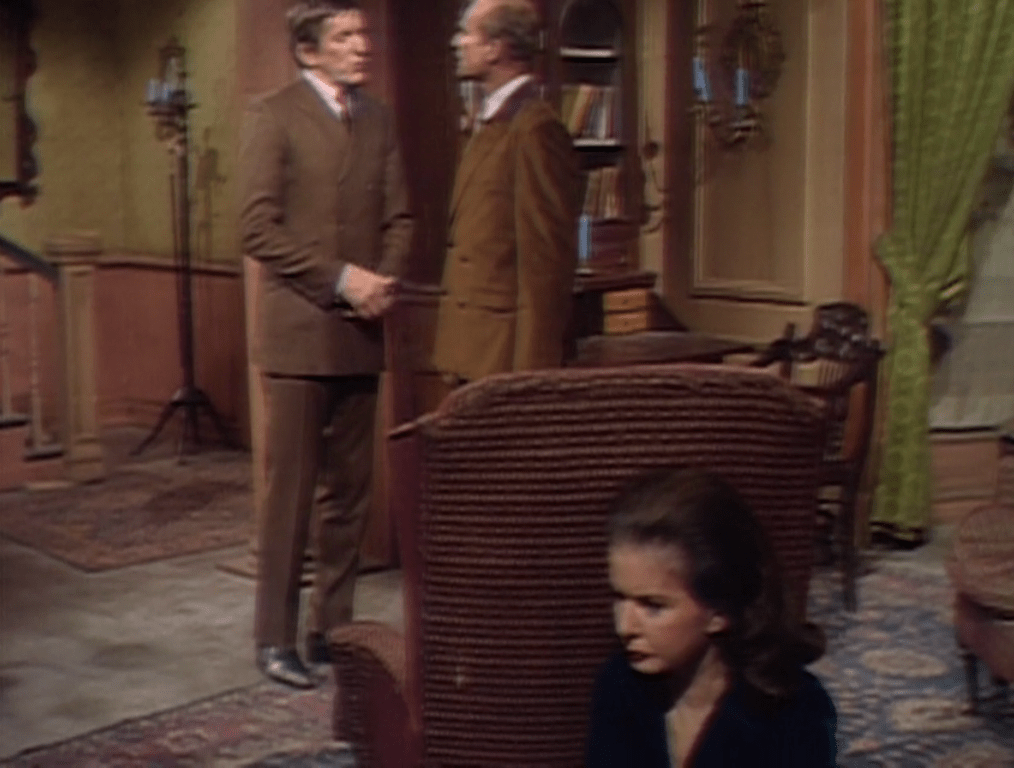
Barnabas’ recognition of Laura is a fitting conclusion to a fine episode. Much of it is devoted to a three-cornered confrontation between Laura, her twelve year old son Jamison Collins, and her brother-in-law/ ex-lover/ mortal enemy, Quentin. Danny Horn analyzes this in his post about the episode at Dark Shadows Every Day. I recommend that post highly. All I would add is that as it plays out today, the confrontation makes me suspect that the writers of the show may have done more planning than Danny usually credits them with. Jamison is the only person Quentin loves, and so far we have seen that Jamison loves Quentin back. When he learns that Quentin is his mother’s foe, Jamison turns against Quentin. Barnabas traveled back in time after Quentin’s ghost had made life impossible for everyone in 1969. The evil of Quentin’s spirit fell heaviest on David Collins, whom Quentin had possessed, turned into another version of Jamison, and was in the process of killing. Nothing yet has explained why Quentin’s ghost would focus its malignity on the image of Jamison. Actress Diana Millay used to claim that Laura was added to the 1897 segment at the last minute because she told Dan Curtis she wanted to work, but Millay famously enjoyed testing the credulity of Dark Shadows fans with outlandish remarks. I wonder if a falling-out between Quentin and Jamison over Laura was in the flimsies all along.

Charity makes her first entrance in the great house of Collinwood. Quentin is apologizing to her for some boorish behavior when he realizes she hasn’t been listening to him at all. She is completely absorbed in the eighteenth century portrait of Barnabas that hangs in the foyer. She excuses herself and wafts out the front door.

In Barnabas’ house, Charity says that he makes her feel beautiful, and that she wants to see herself in a mirror. Barnabas is a bit sheepish about the particulars of vampirism, and so he changes the subject. We cut from this exchange to Laura’s room in the great house, where she is with a servant named Dirk whom she has enthralled to serve as a source of body heat. That scene opens with a shot in a mirror, making the point that Laura’s relationship with Dirk is a reflection of Barnabas’ relationship with Charity. Earlier, there had been a clumsy attempt at an artsy shot of Laura reflected in Quentin’s sherry glass. That does show us that Laura casts a reflection and that her relationship with Quentin has been affected by his drinking, but it calls too much attention to itself to do much more than that.

The portrait in the foyer is hugely important to Barnabas. It made its debut on the show in #204, the day before his name was first mentioned and more than a week before he himself premiered. His thralls stare at it and receive his commands through it. He himself uses it as a passport, appealing to his resemblance to it as proof that he is a descendant of its subject and therefore a member of the Collins family. Today, Barnabas is surprised when Charity comes to his house; he wasn’t transmitting a message through the portrait summoning her. Instead, it was functioning as another mirror, in which Charity, who has become a part of Barnabas, could see the motivating force within her own personality.

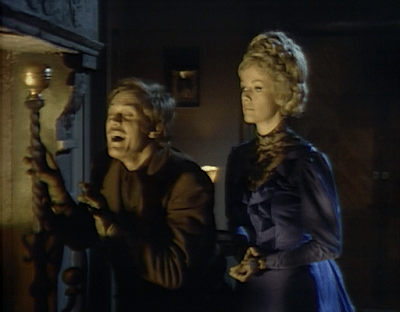
Dirk is played by Roger Davis, a most unappealing actor. At one point he makes this face while Dirk is involved in some kind of mumbo-jumbo:

Screenshot by Dark Shadows Before I Die.

At one point today, Quentin tells Jamison that he shouldn’t be afraid of telling the servants what to do, since after all he will someday be the master of Collinwood. Jamison takes this altogether too much to heart, and spends the rest of the episode ordering everyone around. David Henesy is a good enough actor to extract the comic value from this. For example, when he turns to Quentin, says “I’ll talk to you later!,” and keeps walking, we laughed out loud.

Episode 718: Spy school

The principal writer of the first seventeen weeks of Dark Shadows was Art Wallace, who was interested in characters as one another’s reflections. Many of his episodes were structured as diptychs, in which we would alternate between two small groups dealing with similar situations. In the comparison, we would see that people who were in some ways very different from each other or hostile to each other would make the same decisions when faced with the same circumstances.

Wallace left the show in October 1966, never to return, but his interest in mirroring comes up again and again. The current storyline centers on Barnabas Collins, who has traveled back to the year 1897. In the first months of 1969, the ghost of Quentin Collins was persecuting strange and troubled boy David, and it was to rescue David that Barnabas participated in a summoning ritual which, to his surprise, got him unstuck in time and brought him face to face with the living Quentin. It also turned Barnabas back into what he was for 172 years, a vampire.

This story is the inverted image of Dark Shadows‘ first costume drama insert, which ran from November 1967 to March 1968. In that period, well-meaning governess Vicki participated in a summoning ritual because she knew that some supernatural menace posed a mortal threat to David. She did not know who that menace was or in what way he was supernatural, but the audience knew that it was Barnabas the vampire. During the four months of that uncertain and frightening journey into the past, we learned how Barnabas became a vampire and that he could be interesting even if he were not one. Vicki didn’t learn anything, and would eventually be written out of the show.

Early in today’s episode, Barnabas is in the room on top of the tower in the great house on the estate of Collinwood. This room was introduced in the 1790s story as one of the places where Barnabas was hidden. In this period, a mentally ill woman named Jenny Collins is hidden there. Governess Rachel Drummond sneaked into the room because Barnabas’ unwilling associate, ethnic stereotype Magda Rákóczi, read Rachel’s palm and told her she had a deadly enemy who was hiding there, and that if she let that enemy choose the time of their first meeting she would have no chance of survival. Jenny sprang from the room, locked Rachel in it, went to the main part of the house, and set fire to the sheets of the bed in which the stuffy Edward Collins lay sleeping.

Barnabas heard about this from Rachel, who reminds him of his lost love Josette. He knows that Angelique, the wicked witch who turned him into a vampire in the first place, is operating in this period and that she has already targeted Rachel. He knows nothing about Jenny, and so he assumes that Angelique is lurking in the tower room. When he enters it, he opens an armoire and finds a doll’s head. The rest of the doll is not attached and the back of the head is caved in, but the face is undamaged. This is the first suggestion of a mirror, a device in which a face can be seen intact and functional even though it is separated from the rest of the person.

Barnabas calls for Angelique and she appears. Barnabas denounces Angelique’s crimes; Angelique brings up his. She asks what he sees when he looks in the mirror, then remembers that he casts no reflection. Angelique does not mention what we have seen ever since we first met her during the 1790s segment, that the vampire curse made Barnabas into her reflection. Today, for example, she gleefully taunts him with the murders he has committed, including those her curse compelled him to commit. This reminds longtime viewers of #341, when Barnabas pressured his friend Julia Hoffman into helping him kill a man named Dave Woodard and then gleefully taunted her with her new status as a murderer.

Angelique tells Barnabas that he has only to love her and she will cease to be his enemy. She makes it clear that she knows all about the mission that has led him to travel back in time from 1969, and offers to help him accomplish it. She suggests that it is his hatred for her that has led her to treat him and everyone around him so cruelly for so long. She says that she will return his love as abundantly as she has returned his hate. She claims to be his mirror, as we know he has long been hers, and offers to show him a pleasing reflection if he submits to her desires.

Barnabas angrily refuses, and Angelique conjures up an image of his impending destruction in the window. Barnabas will not look into this magic mirror, and when he seizes Angelique she vanishes from his arms.

Quentin is on his guard against Barnabas. In the course of an adorable scene in which Quentin and his twelve year old nephew Jamison pretend to be spies, he sends Jamison to steal something that belongs to Barnabas.

Spy school.

Jamison is leery of the whole thing; he says that Quentin doesn’t know any more about real spycraft than he does, forcing Quentin to admit that he was in fact a spy for the police in Egypt not so long ago. This too will get the attention of longtime viewers. Jamison is played by David Henesy, who in the parts of Dark Shadows set in the 1960s plays David Collins. Jamison and Quentin are in the groundskeeper’s cottage on the estate, which from December 1966 to March 1967 was home to David’s mother Laura Murdoch Collins. Laura often told the story of the Phoenix, usually setting the scene in an unnamed land which, she said in #140, “Some call… Paradise.” But she leans heavily enough on the existing mythology of the Phoenix that she reminds even readers who have never heard of Herodotus of ancient Greece and Egypt. Laura herself turned out to be a supernatural phenomenon consisting of several distinct beings reflecting themselves back to each other.

Quentin decides that Jamison must sneak into Barnabas’ house and bring his cane back to the cottage. After he does so, Quentin casts a spell that causes Jamison to speak with the voice of Ba’al, a title for various gods whose cults are remembered very unfavorably in Judaism, Christianity, and Islam. Among other grim associations the name of Ba’al brings to the minds of those who adhere to the great monotheistic religions is the practice of child sacrifice among the Phoenicians, a practice that often involved the burning of the body of the sacrificed child. Since “Phoenician” and “Phoenix” sound so much alike,* longtime viewers may well associate Ba’al with Laura.

Quentin has made a voodoo doll of Barnabas. Through Jamison, Ba’al says that only silver will work against Barnabas. Silver is of course used in making mirrors, and the piece of silver Quentin uses to inflict disabling pain on Barnabas is the head of Barnabas’ own cane. So once more Barnabas finds himself oppressed by a reflection, or perhaps by the absence of a reflection.

Barnabas is with Magda when he collapses under the pain Quentin is causing him. They discover that the cane is missing. Magda figures out what is happening, and rushes to the cottage. She confronts Quentin, jeering at his cowardice. Quentin is no man at all. He is using a child as a pawn in a black magic rite, and fighting an enemy using a doll. Magda looks at Quentin’s face and reacts with horror as the image of a skull is superimposed on it. She recognizes this as a sign that he will die soon.

Jamison has scenes with both Quentin and Magda today. David Henesy had such great chemistry with David Selby that it’s no wonder Mr Selby named his son “Jamison,” and Hall’s equally great chemistry with him leads me to suspect that if her son Matthew hadn’t already been born when she joined the show he might have been named for Mr Henesy as well. Hall and Jonathan Frid are always wonderful together, and today’s Barnabas/ Angelique confrontation is the best scene Frid and Lara Parker have shared so far. Angelique’s maniacal intensity has always set an upper bound to how responsive Parker could be to Frid’s performance. She is calm enough today that we see them for the first time really in the same space.

*As well they might- they both come from the ancient Greek Φοίνιξ, an adjective meaning “red.” Herodotus calls the legendary fire creature “red-bird,” and the Greeks named the northern Canaanites after the red dye they bought from them.

Episode 704: The sort of person relatives would want to meet

When vampire Barnabas Collins first came to the great house of Collinwood in April 1967, the living members of the Collins family were embattled, isolated, and desperate for friendship. In 1966, one of the major themes of Dark Shadows had been that the Collinses were running out of money and their nemesis, dashing action hero Burke Devlin, was using his own fortune to buy up their outstanding debts and alienate the people of the village of Collinsport from the Collinses. Everywhere they turned, they met hostility in one form or another. Their two most devoted employees had been plant manager Bill Malloy and handyman Matthew Morgan; in a fit of rage, Matthew killed Bill, and went on to abduct and try to kill well-meaning governess Victoria Winters. Roger Collins’ estranged wife, Laura Murdoch Collins, showed up; she turned out to be an undead blonde fire witch out to kill their son, strange and troubled boy David. No sooner had Victoria rescued David from Laura than seagoing con man Jason McGuire presented himself and set about blackmailing matriarch Elizabeth Collins Stoddard. Jason even forced Liz to give the bedroom next to her daughter Carolyn to his rapey sidekick, dangerously unstable ruffian Willie Loomis.

So when a man knocked on the door who looked exactly like the portrait of an ancestor who lived in a previous century and introduced himself as a distant cousin from England, a wealthy eccentric with courtly manners who wanted only to spend time on the estate where his forebears lived long ago, Liz and Roger were delighted to host him. Barnabas spent most of 1967 as a comic villain scrambling to maintain the pretense that he was native to the twentieth century, but as far as the adult residents of the great house were concerned his authenticity was established beyond doubt the first moment they saw him.

Now Barnabas has traveled back in time to the year 1897. In this period the Collinses of Collinwood are rich, powerful, and paranoid. Unknown to Barnabas, a woman named Magda Rákóczi, whom he had given a ruby ring as a bribe to secure her help after she learned that he was a vampire and that her husband Sandor was his blood thrall, had preceded him to the great house. Magda did not know why Barnabas had come to Collinwood, but she knew that he had some objective and that he would likely leave as soon as he had accomplished it. When Barnabas told Magda that he would keep giving her jewels as long as she helped him, he therefore gave her an incentive to slow him down as much as possible. She therefore told repressed spinster Judith Collins and Judith’s brother, libertine Quentin Collins, that they should beware of a “creature of darkness” who would be calling on them after sundown and who would claim to be “a friend, or perhaps a relative.”

Neither Judith nor Quentin has any respect for Magda, as much because of her Romani ethnicity as because of her mercenary ways. But when Barnabas introduces himself, Judith is deeply shaken. Quentin mocks her, suggesting that the resemblance between Magda’s prediction and Barnabas’ identification is as likely to be a coincidence as anything else, but as soon as he is alone with Barnabas Quentin pulls a sword, holds it at Barnabas’ throat, tells him he knows he is an impostor, and demands the truth within “five minutes” or he will run him through.

With this act, Quentin shows as little strategic nous as Barnabas had shown when he led Magda to believe that it was in her interest to make sure he stayed around for a while. Quentin does not know that Barnabas is a vampire, so that running him through with a sword would do nothing but give whoever saw it a story that he could not tell without branding himself a lunatic. But he does know that he is the black sheep of the family, and that his brothers and sister are eager to get him out of the way before their grandmother dies and her will goes into probate. If he kills a man in cold blood, they would have an excellent reason to have him committed to an asylum and whatever legacy he receives placed in a conservatorship they would control.

So Quentin’s threat is an empty one. Had Barnabas caved in and made a confession that he was a fraud, only Judith would have known of Quentin’s triumph, and she has made it clear that she is not about to yield a penny of her inheritance to him no matter what he does. At most, Quentin would have given Judith a new esteem for Magda, who herself has no use at all for him. And when Barnabas holds his ground, all Quentin can do is back down, losing face and making himself permanently ridiculous in his eyes.

The particulars of the scene are interesting, as well. Quentin tells Barnabas that he has “five minutes” to explain himself. When we heard that, my wife and I laughed out loud. Are we about to be treated to five minutes of silence while they hold their poses? Surely, we thought, it was a blooper- the scripted line must have been “five seconds.” But no! A moment later, Quentin says that “five minutes can go by rather quickly, when a man is about to die.” Had Barnabas been struck with terror at the sight of the weapon so close to him, he might have started confessing as soon as he saw it, but by the time Quentin doubles down on this “five minutes” it is obvious he has already lost the game.

Quentin tells Barnabas that he has just returned from a visit of about six months in England, during which time he discovered that he had no relatives there named Collins. This gives Barnabas an opportunity to insult Quentin, saying that his reputation may have preceded him and driven his relatives to make sure he did not find out about them. This stuns Quentin satisfactorily, but is not strictly necessary. There had been a great deal of migration from Ireland to England by the 1890s, more than enough that an Irish name as widespread as Collins would have been very familiar there. It is hardly likely that even if he had spent six months doing nothing but tracking down every Collins family in the country Quentin would have been able to have confidence that he had not overlooked some descendant of a Collins who had left Collinsport generations before. After all, they didn’t have ancestry dot com back then! It is clear that he must be lying.

Worst of all from Quentin’s perspective, he is still holding the sword at Barnabas’ throat when Judith comes in. At that sight, she has no choice but to set aside her own doubts about Barnabas. She demands Quentin apologize to Barnabas. Barnabas tells them that he can assure Quentin that he does not want any of the family’s money; in fact, he says, the English Collinses are quite comfortable financially and he plans to make some investments in local businesses while he is in Collinsport. Quentin perks up at this, no doubt seeing Barnabas as a possible mark for his next con game. Longtime viewers will remember that when Barnabas introduced himself to the 1960s iteration of the family, Roger was extremely interested in his apparent wealth and had several ideas about how he might help himself to a share of it.

Judith offers Barnabas a room at the great house. He says he would rather stay at the Old House on the estate. Judith breaks it to him that the current head of the family, dying nonagenarian Edith Collins, has let “Gypsies” live there. She makes it sound like a whole Romani clan has settled in, but in fact it is just Magda and Sandor. Barnabas feigns surprise, but still asks permission to inspect the house. Judith consents, and he sets out, alone

Danny Horn’s post about the episode on his Dark Shadows Every Day focuses on the ways it makes Quentin look like a child. I’d say it makes Judith look equally childish, even though she is clearly senior to Quentin. The two of them model one of Dark Shadows‘ signature pairings, that of Bossy Big Sister and Bratty Little Brother. Even when the big sister is in a position to exercise authority, as in the 1960s Liz was in a position to exercise authority over Roger, she winds up being merely bossy because however flagrantly he disobeys her, in the end she covers up his misdeeds and protects him from the punishment they merit. Longtime viewers suspect Judith will find herself doing the same.

In yesterday’s episode, Quentin entered maidservant Beth’s room and found her getting ready to go out. He asked if it was her day off; she said Judith gave her permission to run personal errands in town. He grabbed at her things and found an envelope with $300 cash. She claimed she saved this out of her salary, an obvious lie. He made leering insinuations about her relationship with his oldest brother Edward; she slapped his face.

Now, Beth is on her way back to Collinwood from her mysterious errand. Barnabas sees her in the woods and addresses her by name. She asks who he is and how he knows her. He introduces himself, and explains that he saw her photograph in an album at Collinwood. In fact, his friend Julia Hoffman saw such a photograph in 1969 and described it to him; Barnabas himself never saw it, but he did see Beth’s ghost. Evidently the photo had already been taken and put into the album, because Beth smiles when Barnabas talks about it. He asks Beth about the children at Collinwood. She mentions two; he asks about a third, and she says there is no third. He asks why he thought there was, and she seems uncomfortable. After she leaves, we hear his thoughts in a voiceover monologue. In 1969, Beth’s ghost led Barnabas’ friend Chris Jennings to an infant’s coffin; he wonders if that child has already died, and looks around, as if he might be standing on its grave.

Barnabas’ next stop is at the waterfront. When he was first a vampire in the late eighteenth century, Barnabas once found himself on the docks by chance and was overcome with thirst for the blood of the streetwalkers who worked there. This time he must have made a conscious decision to find a sex worker to drain of blood. Some wonder why he does not feed on Sandor and Magda, but longtime viewers know the answer to that one. When Barnabas was first on the show, Willie was his blood thrall, and each bite left Willie critically ill throughout the daylight hours. Barnabas needs Sandor and Magda to guard him during the day, so others will have to suffer to provide him with blood.

Barnabas picks up a small object from the pavement. He hears a soprano voice nearby, calling for an unseen “Charlie!” to help her find her lost makeup compact. The owner of the voice comes into view and introduces herself to Barnabas as Sophie Baker.* Barnabas gives her the compact. She thanks him and says it was a gift from a dear man, a Captain Strathmore. She asks Barnabas his name. He says he thinks it is best if he doesn’t give his name. “What an odd thing to say,” she responds. If she made her living the way Barnabas hoped the woman he found would make hers, it wouldn’t be odd at all; Sophie’s reaction is that of someone who has no idea that she is in a place where that trade is practiced. Evidently Sophie comes from a sufficiently comfortable background that prostitution does not impinge on her thoughts even as something other women do.

Barnabas tries to get away, and Sophie asks “Well, what’s the matter with me?” Charlie is hopelessly drunk, leaving Sophie without an escort. Barnabas is plainly alone, and the night is young. The pub is nearby- why don’t they stop in for a drink. Barnabas shows great reluctance, but finally agrees to walk Sophie to the door. She takes out her compact to freshen her face, looks in its mirror, and notices that Barnabas does not cast a reflection. She is stunned by this. Barnabas bares his fangs, and sates his bloodlust.

Sophie seals her fate. Screenshot by Dark Shadows Before I Die.

The compact with a mirror was apparently a new invention when one was advertised in the Sears & Roebuck catalogue in 1908, so it is an anachronism in 1897. But it is a perfect touch. Sophie’s discovery that Barnabas does not cast a reflection turns the scene from a little bit of farce into a tale of horror in a fraction of a second. That the compact allows such an efficient use of time makes it no wonder that they used the same prop in 1967, when Julia glanced in her compact to confirm her hypothesis about Barnabas’ nature in #288.

This time, the compact also goes a long way towards explaining Barnabas’ attitude towards Sophie. It shows that she can afford to buy the latest and most sophisticated trinkets, and that she expects to be seen using them. Barnabas picks the compact up and returns it to Sophie as a gentleman might a lady’s handkerchief. Sophie’s personality may have led her to match the outgoing and uninhibited manner that is a professional requirement for sex workers and that made them easy targets for Barnabas, but when he sees that she is not of their class he becomes reluctant to attack her. Thus we learn that snobbery Barnabas has shown in some of his darker moments is not just an occasional failing, but that his whole career as a vampire is primarily a war on poor people.

Back at Collinwood, Quentin spots Beth taking a tray of food upstairs. He waylays her, uncovers the tray, and demands to know who it is for. She says it is for Edith, and he declares that his grandmother is far too ill to eat so much. When he finally lets her go, Beth goes to Edith’s room and tells Judith about Quentin’s interrogation. They confer about the matter in urgent whispers. Judith tells Beth they will have to be far more discreet now that Quentin is back. She urges her to take care Quentin does not see her when she takes the rest of the food “upstairs.” Evidently there is someone in the house Quentin does not know about, and Judith and Beth are conspiring to keep it that way.

Judith leaves the room, and Quentin slips in. He pretends to be Edward. Edith is not fooled, and expresses her annoyance with him. She says she is not as far gone as he thinks she is, and he assures her that she is. She will die tonight, and will tell him the family secret before she does. He seems to be threatening to kill her himself by the time the episode ends.

Every episode of Dark Shadows begins with a voiceover delivered by a member of the cast. This one reuses yesterday’s opening voiceover. I believe this is the first time they have done this.

*The closing credits give her name as “Sophie Barnes,” but she very clearly says “Baker.”

Episode 602: Someone who will make you happy to be a vampire

Frankenstein’s monster Adam came to life in #485, and has been cooped up in one cage after another ever since. Last week a mate was created for him and given the name Eve. Eve hates Adam, and today tells him that she will kill him as soon as she can. Adam is getting pretty tired of the whole thing.

Adam’s latest keeper is suave warlock Nicholas. Nicholas masterminded the creation of Eve because he hopes she and Adam will make Frankenbabies, founding a humanoid species that will owe its creation to Satan. Adam doesn’t know about Nicholas’ allegiance to the Devil or about his plans, but he is sick of taking his orders. The two quarrel at the beginning of today’s episode. Nicholas quiets Adam by showing off one of his magical gimmicks. Hanging on his wall is a device that is usually a mirror, but that can be switched over to function as a closed circuit television focused on anyone he chooses. Today, he wants to know where his unruly subordinate, vampire Angelique, has wandered off to.

Nicholas and Adam look into the mirror, where we see Angelique at the bedside of an unpleasant man named Peter who prefers to be called Jeff. She is about to bite Peter/ Jeff, contrary to Nicholas’ rules for her diet. We zoom in, and the scene from the mirror takes over our own screen. After a moment, Nicholas is there too, stopping Angelique and scolding her for disobeying his nutrition guidelines. It’s too bad we didn’t see Nicholas step into the mirror, like Buster Keaton in Sherlock, Junior, but you can’t have everything.

After Angelique obeys Nicholas’ command to leave Peter/ Jeff’s apartment, Nicholas puts Peter/ Jeff back to bed. He casts spells on him to cause him to forget his encounters with Angelique and to heal from the effects of them. While he was doing this, my wife, Mrs Acilius, was talking to the screen, pleading with Nicholas to cast a spell on Roger Davis to give him some acting ability. Shortly after that, Mr Davis delivered some more lines, making it instantly clear that Nicholas had no such power.

Back at Nicholas’ house, Adam is fuming that Nicholas switched the mirror back to reflecting mode just as the show was getting interesting. In the room with him, and she is too bored for words. The two of them have a rough physical confrontation, and Adam locks her up in the basement. Eve has the memories and personality of Danielle Roget, an eighteenth century homicidal maniac whom Nicholas conjured up to animate Eve. He first brought her out of Hell in a ceremony he conducted in this basement; when Adam takes her there, she is terrified he will send her back. Eve is so impatient with Adam’s naivete that it is startling to see her overestimate his knowledge of the situation.

Adam and Eve fight. Screenshot by Dark Shadows Before I Die.

Nicholas comes home and has another chat with Adam. Angelique enters the room and announces that it is almost dawn. Nicholas dismisses Adam. Angelique expects to be punished for her unauthorized attacks on Peter/ Jeff, but Nicholas tells her that he has a job she will like. He wants her to bite old world gentleman Barnabas Collins and enslave him. Since Angelique has been obsessed with Barnabas since the 1790s, this assignment delights her.

*Peter/ Jeff is fully dressed, in a coat, tie, and shoes, by the way. That’s the bedtime uniform for young men in Collinsport, as for Angelique’s other victim, the recently unemployed Joe Haskell.

Episode 575: This rotten collection of death

How Revolting and Disgusting You Really Are

Suave warlock Nicholas Blair has a job for a woman. Talking to his subordinate, vampire Angelique, he says that the job must go to “the most evil woman who ever lived.” At this, Angelique breaks into a smile, then raises her head proudly. Nicholas then says, “Someone like Lucrezia Borgia.” At this, Angelique’s face falls, and she protests that Lucrezia is dead.

Angelique, flattered when she thinks Nicholas is describing her as “The most evil woman who ever lived.”

Nicholas brushes this objection off, saying that “The spirit of evil can be made to live again.” Longtime viewers may have been wondering whether Lucrezia Borgia would make an appearance, since her name has come up more than once. In #152, sarcastic dandy Roger insulted his sister, reclusive matriarch Liz, by comparing her to Lucrezia; in #178, Roger insulted his niece, heiress Carolyn, in the same way; and in #523, Carolyn brought up Lucrezia to insult Angelique, whom she knew when Angelique was calling herself Cassandra and was married to Roger. Perhaps we might have imagined some kind of story where Roger turns out to have some kind of supernatural connection to Lucrezia.

Nicholas continues teasing Angelique, bringing up the Countess Elizabeth Bathory, alleged serial killer and blood drinker of the 16th and 17th centuries. Angelique calls that lady “a vile woman,” in a tone that suggests she knew her personally. From November 1967 through March 1968, Dark Shadows was a costume drama set in the 1790s, and Angelique was its chief villain. She was not a vampire then, but a witch. Her spells were very powerful, but she was quite clumsy in her use of them, suggesting that she was a young woman new to witchcraft. Perhaps this line is meant to open the door to a retcon, one which will make it possible to tell stories about Angelique set in even earlier periods than the 1790s segment.

Nicholas agrees that the countess was “a vile woman,” and repeats that epithet as the first in a list of her qualifications for the job he has in mind- “ambitious, cunning, devious, unprincipled, decadent!” He finally concludes his teasing of Angelique and tells her that he will not hire her for the job. She is disappointed, as one of the benefits of the job is release from vampirism. She leaves the room. In the corridor, she flashes a smile which regular viewers recognize as a sign that she is going to defy Nicholas and try to seize what he would not give her.

The Only Filthy Way It Could Be Done

The job is an unusual one. Nicholas has persuaded Frankenstein’s monster Adam to confront old world gentleman Barnabas Collins and mad scientist Julia Hoffman with a threat. If Julia and Barnabas do not repeat the procedure that created Adam and produce a woman who will be his mate, Adam will kill everyone in and around the great house of Collinwood. Subjected to that extortion, they undertake the project.

The procedure not only involves building a body from parts of corpses and running electrical charges through it, but also requires that the body be somehow connected to a person who will serve as its “life force.” It is energy drained from this person that will animate the body. Barnabas was Adam’s “life force.” Before the procedure, Barnabas was a vampire. Serving as Adam’s “life force” put his vampirism into remission. Nicholas talked about this with Angelique, raising her hopes that he would let her escape from vampirism the same way, only to dash those hopes cruelly.

Julia completed the experiment that brought Adam to life after the death of another mad scientist, Eric Lang. Lang had built the body and the apparatus, and had left detailed notes. Julia had studied those notes for some time before she knew which switches to throw and which dials to turn. Under Adam’s threat, Julia has rebuilt the apparatus in Barnabas’ basement and she has a cadaver there which she is using for parts. Barnabas has ordered his servant Willie to help with the grave robbing. Barnabas has also enlisted the aid of Lang’s former grave robber, an unpleasant man named Peter who prefers to be called Jeff. The equipment needs a lot of tending, and Peter/ Jeff is the lab tech on that detail.

A Nice, New, Clean Slab of Flesh

Peter/ Jeff is by himself in the basement lab when Professor Timothy Eliot Stokes walks in. It’s news to Peter/ Jeff that Stokes is aware of the project, but he tells him that he knows everything about it. Stokes stays so calm as he examines the apparatus and looks at the cadaver that one supposes he must know a great deal.

Stokes asks Peter/ Jeff how the equipment runs when Barnabas’ house has no electricity. Peter/ Jeff says that Julia installed a generator. This must be some unusual kind of generator, since it runs in absolute silence. Later in the episode, Stokes will have a conversation with another character about how Barnabas doesn’t have a telephone.

When Barnabas was a vampire, he didn’t want meter readers or other workers dropping by unannounced and he had no use for modern conveniences. So of course he did not connect his house to the electric grid or to telephone service in those days. As for other utilities, it is a fairly prominent bit of lore that vampires cannot tolerate running water, so of course he wasn’t going to have any plumbing. But he’s been unvamped for almost six months now, so he may as well just update his house. Stokes’ lines today lampshade the problems he creates by refusing to do so.

Another unannounced visitor interrupts Stokes’ conversation with Peter/ Jeff. It is Adam. He is upset to find Stokes in the lab. Stokes once took Adam in and taught him English, and in those days Adam considered Stokes to be his best friend. But Stokes shocked Adam when he broke the news to him that he was an artificially constructed man, and has thoroughly alienated him by trying to talk him out of the violent lifestyle Nicholas has persuaded him to adopt.

Adam goes on a self-pitying rant when Stokes tries to reason with him. Peter/ Jeff interrupts and tells Adam something Stokes left out of his birds and bees talk, that he was built out of parts of dead bodies. Peter/ Jeff taunts Adam about this in a speech that is full of such gems that I suspect it was written, not by the credited author of today’s script, Gordon Russell, but by Russell’s frequent uncredited collaborator Violet Welles. Welles’ name will start to appear in the credits in 711, and fans of the show recognize the sparkle that marks her dialogue.

Peter/ Jeff tries to stab Adam. Adam easily disarms him and holds the knife at his throat. Stokes tells Adam that without Peter/ Jeff the project will be delayed. Adam then flings Peter/ Jeff to the floor. Peter/ Jeff is played by Roger Davis, an actor who had a big television career and was irritating in every part. Mr Davis is so annoying on Dark Shadows that Mrs Acilius and I can’t be the only ones who are disappointed when Adam doesn’t kill his character off the show and who cheer when he throws him to the floor.

Peter/ Jeff gets up and leaves the lab. Adam demands Stokes bring him back to resume working. Knowing how violent Adam is, Stokes follows Peter/ Jeff to the great house of Collinwood. Peter/ Jeff is meeting his fiancée, well-meaning governess Vicki, there, planning to take her out for a date. Stokes tells him that they will be in grave danger from Adam unless he goes back to the lab at once. Peter/ Jeff looks out the window, and sees Adam peering in. Adam actually opens the window and reaches into the drawing room while Vicki and Peter/ Jeff are there; it is hard to understand how Vicki doesn’t notice him. Peter/ Jeff makes an excuse, and goes back to the lab.

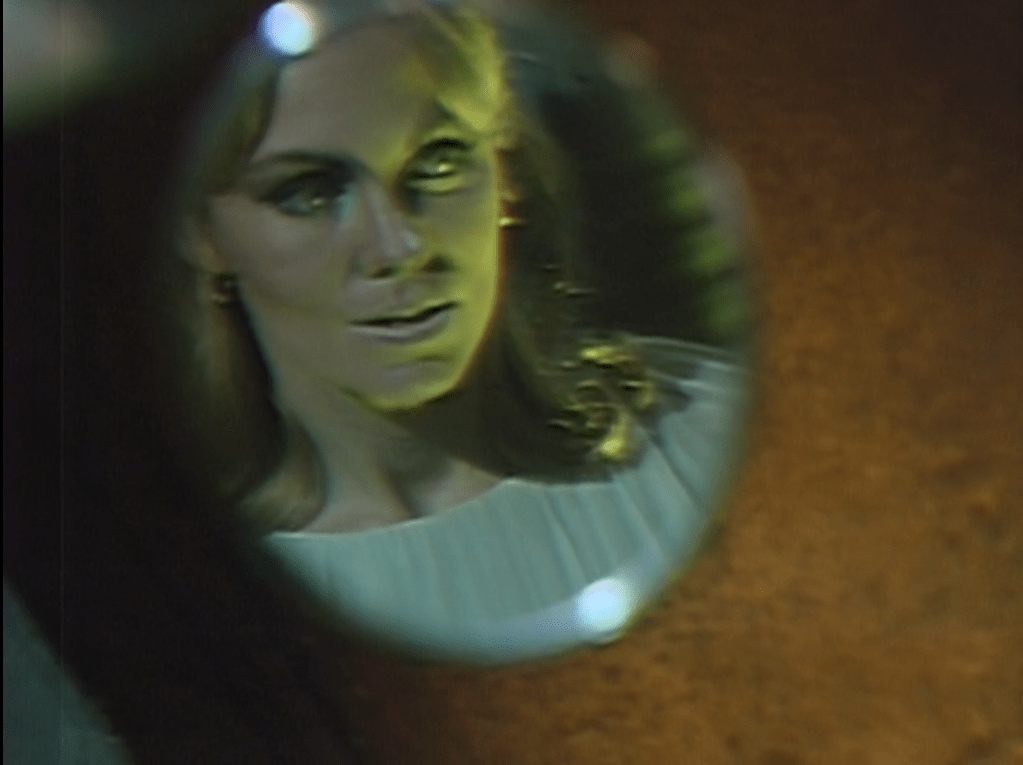
We see him back at work. The camera pans up to a mirror. It holds on the mirror for several seconds while we see Angelique’s reflection. Previously, they have stressed that vampires do not cast reflections. There have been several moments when actors have missed their marks or other production faults have occurred that left us seeing a vampire in a mirror, but this is obviously intentional, and it is jarring to regular viewers.

Angelique’s reflection

Angelique and Peter/ Jeff talk for a moment, then she bites him. Evidently she plans to enslave him and use his access to the laboratory to force her way into the role of “life force” for Adam’s mate. So far, almost every victim of a vampire we have seen has been left unable to do the work s/he was doing before being bitten, so regular viewers might suspect that Angelique’s ploy will simply incapacitate Peter/ Jeff from helping with the project. This expectation becomes all the more substantial when we remember the many times Angelique’s schemes have blown up in her face. The less likely it seems to us Angelique will succeed, the less effective this week-ending cliffhanger will be.

Episode 571: Bring me a mirror

In #210, dangerously unstable ruffian Willie Loomis found an old coffin and broke into it, hoping to reap a harvest of hidden jewels. Instead a hand darted out, and Willie became the sorely bedraggled blood thrall of vampire Barnabas Collins.

The next person to open Barnabas’ coffin was Maggie Evans, The Nicest Girl in Town. Barnabas was keeping Maggie prisoner in his house on the great estate of Collinwood as part of his plan to persuade Maggie to forget her personality and turn into his lost love, the gracious Josette. In #250, Maggie decided to drive a stake through Barnabas’ heart, but had the bad luck to set to work a moment before sunset. He awoke, and spent the remaining two weeks of her captivity treating her even more cruelly than he had previously.

In #275, Willie’s onetime friend, seagoing con man Jason McGuire, made his way to Barnabas’ basement and found the coffin. As Willie had done 13 weeks before, Jason jumped to the conclusion the coffin was full of jewels. Willie tried to tell him this was not the case, but could not stop Jason looking inside. As when Maggie made her attempt to stake Barnabas, it is sunset. Again Barnabas’ hand darts forth; this time, he strangles Jason to death.

The first time someone opened Barnabas’ coffin during the day was in #289. Mad scientist Julia Hoffman had collected substantial evidence indicating that Barnabas was a vampire. As final confirmation, she slipped into his house one morning, made her way to the basement, opened the coffin, and reeled away, simultaneously shuddering and giving a look of triumph.

From November 1967 to March 1968, Dark Shadows was a costume drama set in the 1790s. In #410, wicked witch Angelique had just turned Barnabas into a vampire. She went to his coffin with a stake and mallet, regretting her curse and trying to cut its effects short. As Jason and Maggie would do in 1967, Angelique waited until sunset to open the coffin. Barnabas awoke, demanded to know what was going on, and killed her.

Since then, Barnabas’ vampirism has gone into remission and he and Julia have become fast friends. As we begin today, Barnabas is engaged in a desperate battle for Julia’s sake. The new vampire on the block, Tom Jennings, has been feeding on Julia. She is near death, and will herself rise as a vampire unless Tom is destroyed and she is freed from his influence. Barnabas has found Tom in a crypt next to a coffin, and the two of them have an embarrassingly awkward fight scene. The sun rises, and Tom has to leave Barnabas and get into his coffin.

Barnabas stands over Tom’s open coffin with a mallet and stake. He wonders if anyone ever looked down on him in his coffin when he was a vampire. He tells himself no one could have, for they would have destroyed him if they had. This is a strange thing for him to think. Julia eventually told him that she had sneaked a peek at him in his coffin, and he must remember Willie, Maggie, Jason, and Angelique.

Julia is back at Barnabas’ house. Elizabeth Collins Stoddard, mistress of Collinwood and escaped mental patient, is watching over her. She is telling Julia that Barnabas left her to die and that she will be dead any moment. This cheery behavior is the consequence of Liz’ fixation on death and her obsessive fear that Julia and others are part of a conspiracy to bury her alive.

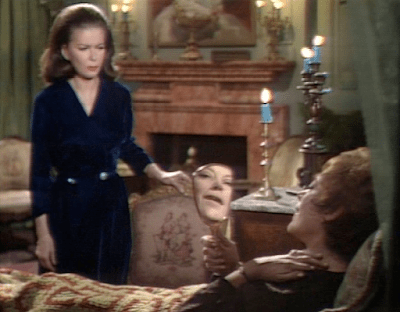
As Barnabas drives the stake through Tom’s heart in the crypt, Julia cries out from her bed, then suddenly gains strength. She asks Liz to bring her a mirror; Julia is delighted to see that Tom’s bite marks are gone.

Evidently Julia’s mirror is possessed by a far-right internet troll of the 2010s. Screenshot by Dark Shadows Before I Die.

Barnabas comes back, sends Liz away, and tells Julia that she will be safe from Tom now. Barnabas and Julia are starting to get uncharacteristically mushy over each other when we cut to the downstairs, where Liz looks out the window and sees her brother Roger approaching.

Roger wants to send Liz back to the psychiatric hospital from which she escaped. Liz believes Roger is part of the conspiracy to bury her alive, and that sending her to the hospital will further that goal. So she hides behind an armchair.

Liz hiding.

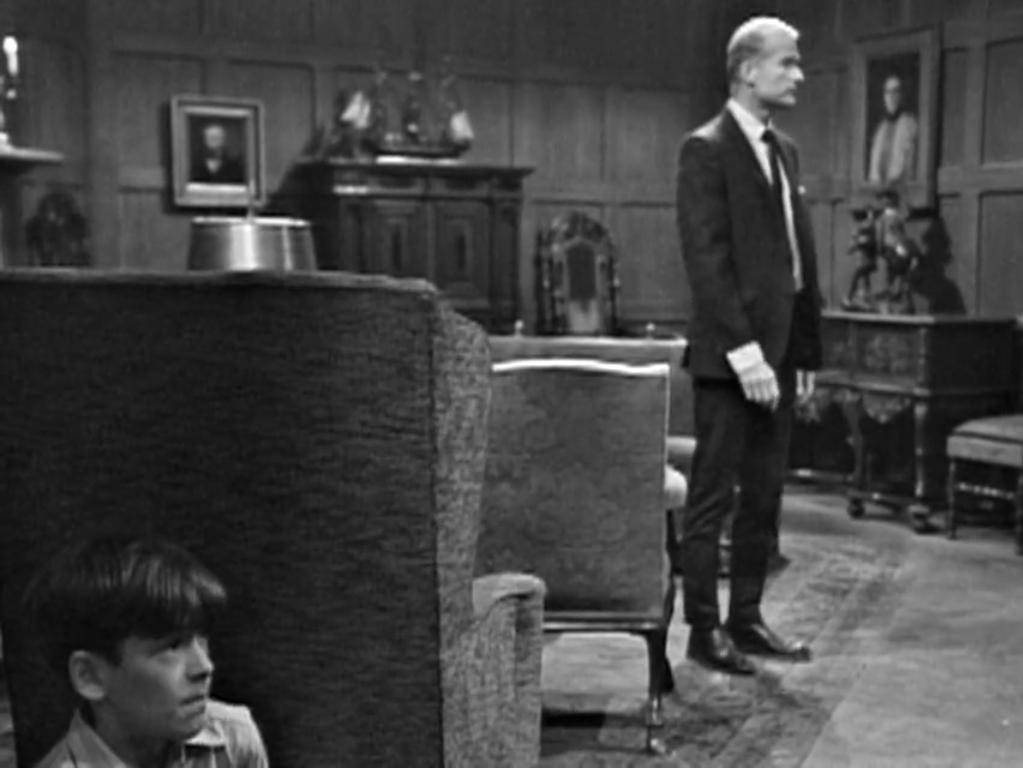
In #10, Liz and Roger had a conversation in the drawing room of the great house of Collinwood while Roger’s son David hid behind an armchair. In that conversation, Roger declared his belief that David should be sent to an institution, a plan which Liz forbade him to pursue. After Liz left the room, Roger caught David behind the armchair.

David found the prospect of institutionalization so terrifying that his next stop was the garage, where he tampered with the brakes of his father’s car in what very nearly turned out to be a successful attempt at patricide. Liz is too upset to develop such an intricate plan, and doesn’t seem to have David’s skills as an auto mechanic. But she shares her nephew’s horror of institutionalization. So after Roger and Barnabas have talked for a moment, she jumps up from behind the chair and starts making accusations.

Liz tells Roger and Barnabas that she saw Julia in a crypt in the family burial ground nearby, and that there was a coffin there. Barnabas is alarmed, since this is the coffin in which Tom’s staked remains now repose. Roger agrees to go to the crypt and to see if there is a coffin. Barnabas offers to go with him.

The suave Nicholas Blair shows up at the front door with a bouquet of flowers. We know that Nicholas is a warlock and that he is behind the renewed outbreak of vampirism, that he was watching while Barnabas staked Tom, and that he is also responsible for some other plots involving Barnabas and Julia. For their part, Barnabas and Julia have every reason to suspect that this is so, and have talked about their suspicions more than once. Nicholas tells Barnabas, Roger, and Liz that he has heard that Julia is ill and has come to visit her. At Liz’ insistence, Barnabas lets Nicholas see Julia while he and Roger go to the crypt.

Nicholas expresses his relief that Julia’s recovery will enable her to return to work soon. The only work Julia has done in the year she has been a houseguest at Collinwood has been in association with the supernatural goings-on she and Barnabas have been entangled in; currently, an agent of Nicholas’ is forcing them to build a Frankenstein’s monster. Nicholas may as well say explicitly that he is behind that scheme and the vampire troubles too. He tells Julia that he thinks he might fall ill and need her help as a doctor; she says that he seems indestructible, a word he receives with pleasure.

Barnabas comes back and tells Julia that the coffin has disappeared. He mentions that it is strange that Nicholas turned up when he did. Julia suggests that Nicholas may be the one who moved the coffin. All of a sudden Barnabas seems to forget everything he knows about Nicholas and dismisses that idea. It’s one of those frustrating moments when the characters seem to have the memory of a goldfish, and it ends the episode on a sour note.

Episode 559: I specialize in human relations

Suave warlock Nicholas is studying a mirror in his parlor. His subordinate, vampire Angelique, enters and comments on his vanity. He invites her to look at the mirror and tell him what she sees. “Only your reflection,” she replies. But the audience also sees the reflection of her hair and forehead. Her line, coupled with the fact that we do not see her whole face, suggests that her reflection was not supposed to be visible. In #288 the idea that vampires do not cast reflections was a crucial plot point. When old world gentleman Barnabas was a vampire, he several times cast the sorts of reflection Angelique casts today, usually as the result of Jonathan Frid missing his mark. Perhaps Lara Parker simply took half a step too many in this scene.

Angelique casts a reflection. Screenshot by Dark Shadows Every Day.

Nicholas’ mirror is no simple reflector. It functions as a closed circuit TV. He uses it to show Angelique the room in the attic where well-meaning governess Vicki is being held prisoner. He lets Vicki go, casts a spell to cause her to forget her captivity, and then tells Angelique that he will be going out.

Angelique asks what she is supposed to do while he is gone- sit in her chair and get bored? He says he couldn’t have put it better himself. When he returns, she is in fact in the chair, sitting still. It’s hilarious that she doesn’t pace, or get a book, or try to see if the mirror gets any other channels.

Nicholas was away visiting Maggie, The Nicest Girl in Town, on whom he has a crush. Maggie’s fiancé Joe dropped in while he was at her house. He tells Angelique that Joe is to be the next victim of her vampire’s bite.

Episode 550: Much given to melodrama

Professor Timothy Eliot Stokes is just the person to consult if you need to know what kind of amulet will ward off the spells of the nearest wicked witch, but as a committed bachelor and a workaholic, he does not have a very sensitive touch when called upon to give advice in matters of the heart. We saw this in #544. Stokes’ friend Adam had questions for him. Adam is a mysterious man who has no memories prior to ten weeks ago and no conception of human relationships beyond a vague happiness associated with the word “Friend!” and an intense rage associated with the word”Kill!” He wanted Stokes to explain what was wrong with his attempts to kiss his patroness, heiress Carolyn Collins Stoddard. Stokes, usually the most self-assured of men, reacted with a sudden display of insecurity, squirming a bit before admitting that his solitary lifestyle left him at a loss for answers to Adam’s questions.

Yesterday, Adam took the advice of suave warlock Nicholas Blair and assaulted Carolyn. He forcibly kissed her and pushed her to the floor of the room where she is hiding him from the police. We ended the episode unsure how far Adam took his attack. As we open today, we see Carolyn in the main part of her house looking shaken and with her hair mussed, but with her clothes intact. Perhaps she managed to stop Adam before he went beyond what we saw, or perhaps he didn’t try to go further. Not since the references to strange and troubled boy David Collins’ uncertain paternity in #32 and #147 has it been clear that sexual intercourse even exists in the universe of Dark Shadows, and it doesn’t seem that anyone would have told Adam about it. So he may have stopped with kissing because he doesn’t know there is anything more involved in a rape.

Carolyn telephones Stokes and asks him to come to the house at once. By the time he gets there, she is unavailable. Well-meaning governess Vicki greets him, explaining that Carolyn is in the kitchen mediating a dispute between housekeeper Mrs Johnson and Mrs Johnson’s son Harry. Vicki smiles, laughs a little, and describes this dispute sarcastically as a potential tragedy, suggesting a condescending attitude towards the Johnsons that doesn’t really fit with her character as it has been developed up to this point. Stokes flatly tells Vicki that he is not interested in her, and she turns to go. He apologizes, and she comes back. They talk a little about some recent plot points. When Carolyn comes in, she and Stokes dismiss Vicki.

Carolyn tells Stokes what Adam did, and he goes to the big guy’s room in the long deserted west wing of the house. Stokes decides that the time has come for a birds-and-bees talk. This is not the standard version. Adam does not have parents; he is a Frankenstein’s monster. When Stokes tells him what he knows of the circumstances of his creation, Adam is horrified. He tells Stokes they are no longer friends and orders him out of the room. Once he is alone, Adam looks in the mirror, focuses on the scars where he was stitched together, and pronounces himself ugly. He smashes the mirror, picks up a knife, and declares that because no one will ever love him, he must die.

Broken Adam. Screenshot by Dark Shadows Before I Die.

In 2020, Wallace McBride wrote that “On Dark Shadows, your reflection always tells the truth.” But the characters do not always interpret their reflections correctly, so that they sometimes miss the truth. When Dark Shadows began, Vicki was on a quest to find out who her parents were. As Wallace McBride points out, that story was hobbled from its beginning. In episode #1, reclusive matriarch Elizabeth Collins Stoddard opens the doors to Vicki, and the resemblance between Joan Bennett and Alexandra Moltke Isles is so strong that it looks like the two women are reflections of each other. Indeed, Mrs Isles was cast as Vicki largely because she looked so much like Joan Bennett, and Bennett famously mistook Mrs Isles for her daughter when she first saw her. As the show went on Liz came to treat Vicki so much like a daughter that it would have been hard to find a point in a story confirming that she really was, and so the whole question of Vicki’s parentage fizzled out.

As Vicki failed to interpret the reflection that told her the truth about her origins, so Adam misinterprets what his reflection means about someone who came into the world as he did. It’s true he has conspicuous scars and some odd coloring, but you get used to that pretty quickly, and aside from those he is movie star handsome. So “I am ugly!” is a misinterpretation. Stokes told Adam in so many words that at the rate he has been learning he will soon be indistinguishable from people who were born and grew to maturity; regular viewers have seen him acquire so many skills so rapidly that we cannot doubt this is true. His attempt at suicide, like his decision to take Nicholas’ advice and try to rape Carolyn, is the result of his underestimation of his own capacity to develop. That underestimation, in turn, is the result of his failure to fully absorb the information about himself his surroundings are reflecting back to him.

Adam’s plight is thrown into stark relief for us by a scene that took place before Stokes’ visit to him. He looks out the window of his room and sees the terrace, where Vicki is with her boyfriend, an unpleasant man named Peter who prefers to be called Jeff. Peter/ Jeff proposes marriage to Vicki, and she receives the offer warmly. Peter/ Jeff, like Adam, has memories that go back only a few months. As Stokes has told Adam of his unusual origin and elicited a deeply hostile response from him, so Vicki has told Peter/ Jeff that she has reason to believe he has a supernatural origin, and he reacted just as bitterly. Peter/ Jeff is surprised that Vicki would marry someone with his background, but she makes it clear it doesn’t bother her at all. If Peter/ Jeff could find love with Vicki, then there must be a woman somewhere who would love Adam.

Episode 538: Usually without reason

Professor Timothy Eliot Stokes, expert on the occult, finds himself laboring under the direction of Julia Hoffman, MD. Stokes does not understand why Julia insisted on leaving the long abandoned shack where a very tall, very mysterious man named Adam seemed to be suffocating, he does not understand why Julia has buried her friend Barnabas Collins in an unmarked grave in the woods, and does not understand why Julia has concluded that Barnabas is alive and they must dig him up. Julia tells Stokes she will answer his questions when the exhumation is complete. Stokes keeps digging. They reach a coffin. They open it to find Barnabas. Julia detects a faint “pulsebeat” in his wrist. Before Stokes can raise his questions, Julia says she wants to be alone with Barnabas and reminds Stokes that Adam needs attention.

Gravedigger in a three piece suit. Screenshot by Dark Shadows Before I Die.

Back in the shack, Stokes finds heiress Carolyn Collins Stoddard with Adam. Earlier, Carolyn was distraught, unable to find a “pulsebeat” in Adam’s wrist, but now he is up and moving, apparently quite well. Stokes says that Julia is on her way, and Adam becomes agitated. He hates Julia and Barnabas, but has never explained to Stokes or Carolyn why. Carolyn decides to hide him in the long-deserted west wing of her family’s home, the great house of Collinwood. Stokes sees many drawbacks to this plan, but can suggest no alternative.

Only Stokes is still in the shack when Julia comes. He will not tell her where Adam has gone, and she will not answer any of his questions. With a smile, he tells her that he looks forward to understanding Barnabas’ secret. At this, she looks uneasy, clearly not welcoming that prospect.

Barnabas was, for 172 years, a vampire. His curse went into remission earlier in 1968, and he has been virtually human since #490, when he took part in an experiment that brought Adam to life as a Frankenstein’s monster. Julia ordered Barnabas’ servant Willie to bury him the other day, because she was afraid he was about to become a vampire again, but yesterday she figured out that Adam’s existence was keeping that from happening.

When Barnabas is unearthed, he is afraid that he has reverted to vampirism. Julia shows him his reflection in her compact mirror, proving to him that he is still human. The first time they did the vampire/ mirror bit was in #288, when Julia saw that Barnabas did not cast a reflection in a compact mirror and thereby confirmed her suspicion that Barnabas was a vampire. That led him to try to kill her. Now they are fast friends, and the same gimmick, with the opposite result, brings them a moment of shared joy.

Barnabas goes to the great house, and sees wicked witch Angelique/ Cassandra standing on the terrace. She was the one who cast the spell that prompted Julia and Willie to think they ought to bury him, and Julia had told her that he was dead. She is rather surprised when he shows up. He taunts her with the failure of her attack on him, she pretends not to know what he is talking about, and he goes along his merry way. Alone, she vows that she will soon regain her power over Barnabas.

Episode 487: No homicidal tendencies

For its first 38 weeks, Dark Shadows was the story of well-meaning governess Vicki and her attempt to make her way through life on the great estate of Collinwood. One by one, Vicki’s problems were either solved or forgotten. From week 43 on, the show has focused on vampire Barnabas Collins. Barnabas has refused to involve Vicki in his life, leaving her confined to B plots at best.

The current B plot is about Vicki’s relationship with a man named Peter, who keeps trying her patience and ours by pretending to be named Jeff. Peter/ Jeff’s shouting voice, which he uses by default, makes him sound like he is suffering from severe gastrointestinal distress. He has a habit of manhandling people around him, causing them obvious discomfort. These bad habits, and several others, are less the product of the writing or direction than they are symptoms of the casting of Roger Davis as Peter/ Jeff. Alexandra Moltke Isles, like all the other actresses, is so ill at ease when she is in proximity to Mr Davis that it is impossible to believe that Vicki is in love with Peter/ Jeff.

Peter/ Jeff had been connected to the A plot through his boss, mad scientist Eric Lang. Peter/ Jeff has total amnesia. Lang released him from a mental hospital and told him that he was suspected of strangling two women by the waterfront in Portsmouth, New Hampshire. He used Peter/ Jeff as his assistant in an experiment that is supposed to free Barnabas from vampirism. Now Lang is dead, and Peter/ Jeff goes to his house to search for the file on his own background.

There, he meets Barnabas. The two of them display hostility to each other, but the scene fizzles out as it becomes clear that Barnabas has no motivation to oppose Peter/ Jeff’s goals and wouldn’t be in a position to stop him if he did. Peter/ Jeff finds a paper which proves that Lang was lying, and he is not a murderer after all. With that, he and Vicki both lose whatever reason they had to be on the show.

On his Dark Shadows Every Day, Danny Horn summed this up memorably:

 His file from the mental institution had those three magic words: “No homicidal tendencies.” As something to be proud of, that’s a pretty low bar, but he seems happy.

Unfortunately, that basically nerfs Jeff’s entire storyline. He’s not working for Dr. Lang anymore, and the secret that Lang was holding over him — the idea that he might be a murderer — has just dissolved.

This is just throwing a story point away, rather than advancing anything, and Jeff is left at a loose end. He has no job, no family, and no real connection to a story. Now he doesn’t even have homicidal tendencies. It wasn’t much, but it was all he had.

Danny Horn, “Episode 487: Precious Moments,” Dark Shadows Every Day, 24 September 2014

Peter/ Jeff goes to share this news with Vicki. It’s a tribute to Mrs Isles’ acting ability that she makes us believe Vicki is bewildered that Peter/ Jeff thought he had homicidal tendencies. Mr Davis usually seems angry enough to kill someone, as for example at various points in today’s episode when Peter/ Jeff’s joy leads him to wrap his hands around Vicki’s throat, plant a rather painful-looking kiss on her, pick her up, and point her underwear at the camera.

Screenshot by Dark Shadows Before I Die, whose caption was “No homicidal tendencies? Are we sure about that?”
Lip-wrestling isn’t usually a combat sport. Screenshot by Dark Shadows Before I Die.
Screenshot by Dark Shadows Before I Die.

The highlight of this episode is a scene between Julia Hoffman and Timothy Eliot Stokes. Julia is Barnabas’ best friend. She has decided to take over the experiment after the death of her fellow mad scientist Lang. Wicked witch Angelique is trying to prevent her helping Barnabas, and so Julia turns to Stokes, a sage in the ways of the occult.

Stokes is the second such character on Dark Shadows, after the ill-fated Dr Peter Guthrie. Vicki recruited Guthrie into her battle against undead fire witch Laura Murdoch Collins in #160 and Laura killed him in #185. We haven’t heard about Guthrie since the end of the Laura story, but the show went out of its way to remind him of us when it showed Lang’s death yesterday. Like Guthrie, Lang died as the result of an indiscreet word from housekeeper Mrs Johnson to an undead witch in the drawing room at Collinwood. Also like Guthrie, Lang is a paranormal researcher who is deeply involved with a tape recorder.

While these similarities served to remind us of Guthrie, they also reminded us of the radical differences between him and Lang. Guthrie was as sane and law-abiding as Lang is crazed and lawless. Seeing Stokes today, we recognize him as Guthrie’s successor, and wonder if his fate will be any different.

Julia is deeply troubled because of a dream she had last night. She was so very upset by it that she was up all night chain smoking.* It was no ordinary nightmare, but part of “The Dream Curse,” a piece of mental malware Angelique has sent to infect one character’s mind after another. Julia recaps the Dream Curse to Stokes while looking into a convex mirror. It’s a striking visual.

Julia recaps the Dream Curse. Screenshot by Dark Shadows Before I Die.

It doesn’t look good for Stokes. Angelique is a supercharged force of destruction, and Julia withholds several crucial pieces of information while recruiting him to the fight against her. Julia does not identify Angelique as the witch. She can’t tell him about Barnabas’ vampirism or about Lang’s experiment without incriminating herself in many felonies, including murder. When Vicki was recruiting Guthrie to the fight against Laura, a far less formidable adversary than Angelique, she held nothing back and ensured that her friends gave him their full support. If Stokes is going to survive, he will need more backing than Julia can offer him.

*Fans of Dark Shadows wince when they see Julia smoking; Grayson Hall had asthma.