Episode 870: Your Josette, always

In October 1897, the estate of Collinwood and all of the other assets of the Collins family are the property of Judith Collins Trask. Judith has just returned from a stay of more than thirteen weeks in a mental hospital, but even when she was having the breakdown that put her there she was not one of the show’s principal sources of that great motive force of Soap Opera Land, Crazy Lady Energy (CLE.)

In #819, sorcerer Count Petofi erased the personality of Judith’s stepdaughter Charity Trask and gave her body to the late Pansy Faye, Cockney showgirl/ mentalist. Since then, Pansy has been a reliable provider of CLE. But today, she serves as the baseline of sanity.

We open in a bedroom occupied by the mysterious Barnabas Collins. Months ago, the Collinses discovered that their distant cousin Barnabas was a vampire who originally lived in the 1790s. Pansy staked Barnabas in his coffin in #845, and for the four and a half weeks after the characters believed he was destroyed. Now a sickly man has shown up who looks and sounds just like Barnabas. He claims to have been the vampire’s victim. He lives in the daylight, casts a reflection, does not recoil from the sign of the cross, and eats food not derived from human blood. He has been seen alongside the staked vampire. So Judith’s brother Edward has accepted the sickly Barnabas’ story. At Edward’s invitation, he is a guest at Collinwood, resting after his ordeal. Edward wins Judith over to his point of view, and she is glad to welcome Barnabas as a dinner guest.

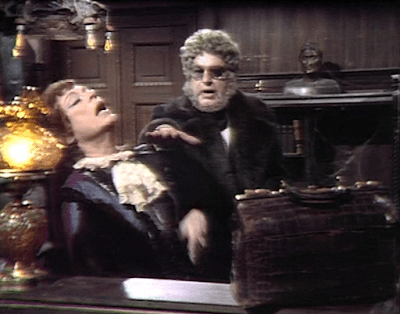
Another resident of the great house is not so sure. He appears to be Judith and Edward’s brother Quentin. He is in fact Petofi, who has cast a spell to hijack Quentin’s body and confine Quentin to his own aging and pudgy form. Q-Petofi has seen all the evidence that Edward has, including the two Barnabases side by side. But he also knows that Barnabas is a time traveler who came to 1897 from 1969, and that several magical beings and science fiction types are in his orbit. So he is looking for a trick. He has coaxed Pansy into the room, telling her that only she can make the final determination about who the man in the bed is. Pansy looks at Barnabas and declares that he is not the vampire. Q-Petofi is still unconvinced, and is about to put some kind of spell on Barnabas when Edward enters.

Downstairs, Pansy meets with Judith. Judith has figured out that her husband, Charity’s father Gregory Trask, gaslighted her into the breakdown that put her in the hospital, and that among his many misdeeds while she was there was his attempt to seduce a woman named Amanda Harris. In #864, Pansy bought a portrait of Amanda for an eye-wateringly large sum; yesterday, she set it up in the drawing room at Collinwood, causing Trask to fly into a rage. We learn in this scene that Judith put Pansy up to buying the portrait as part of a plan to get back at Trask. The two of them share some amusingly salty dialogue, showing us a worldly wise side of Judith that we have not seen before.

Today’s dose of CLE comes from a houseguest, Kitty Soames. Kitty is a young American woman who is the dowager countess of Hampshire. She is Edward’s guest, and she came to the house in #844 intending to lure Edward into a marriage that would relieve the financial distress she has been in since the late Earl’s bankruptcy. But since the day she arrived, she has been having fits of madness caused by the irruption into her consciousness of the mind of the late Josette, lost love of Barnabas. The conflict between Kitty/ Josette’s two personalities gives her one mad scene after another today.

Kitty enters the foyer, where a portrait of Barnabas hangs. She sees the portrait’s eyes glow and hears a heartbeat, something which has been happening to people under Barnabas’ influence since #205. She has a panic attack. Pansy and Judith come from the drawing room and cluster around her. Pansy walks her upstairs to her bedroom and tries to persuade her to have a cup of broth. Kitty raves about the danger that an antique music box in her room presents to her. After a bit, Edward enters and dismisses Pansy.

Kitty tells Edward that she thinks she ought to leave Collinwood, since she has been suffering from a severe mental illness throughout her stay. Edward says that he does not believe that the problem is psychological, since the music box and other objects that she finds disturbing have in fact materialized around her inexplicably. He says that to the extent that her problems are rooted in her feelings, a therapy he will suggest might be just the thing to cure them. He asks her to marry him. She agrees, and they kiss.

Edward kisses Kitty

Edward’s first wife was the former Laura Murdoch, an undead blonde fire witch. Laura was quite calm and rational in her way, but she embodied a principle of insanity in the universe. Quentin was married to a woman named Jenny, who may have seemed mentally healthy when they met but who went immensely insane after Quentin ran off with Laura. I suppose that, with that kind of family history, Edward is just cutting out some of the preliminaries by proposing to a lunatic while she is in the middle of a psychotic episode.

Edward and Kitty announce their engagement after dinner. Q-Petofi notices that Barnabas is shocked; he apologizes, smiles, and stands, a champagne glass in his hand and congratulations on his lips. He then excuses himself, saying that he still feels weak and thinks he ought to retire for the evening.

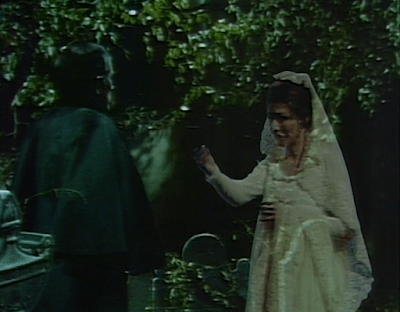
If any longtime viewers harbored doubts that Q-Petofi is right and this Barnabas is our old friend, they are dispelled when we see him in his room moaning about how he doesn’t want to lose Josette again. We end with a blissed-out Kitty entering his room, telling him she heard him calling, and declaring that she will be his Josette always. They share a passionate kiss.

Edward is the third major role Louis Edmonds has played on the show; he has been a principal member of the cast since episode #1. This is his first on-screen kiss on Dark Shadows. Some fans like to show off their knowledge of the actors’ sexual orientations by speculating about a correlation between their private lives and their on-screen kissing of opposite sex scene partners. This particularly settles on Anthony George, who was on the show for a while in 1967 and whose attempts to kiss women always went horribly wrong. But that is obvious nonsense. Jonathan Frid was gay, and the actresses all attested that he was the best kisser in the cast; Barnabas’ kiss with Kitty/ Josette today is a case in point. Joel Crothers, a regular from 1966 to 1968, was gay too, and he was another expert smoocher. Roger Davis is as straight as they come, and rivaled George for traumatic lip collisions. Kitty and Edward’s kiss shows that, while Edmonds might not have been interested in taking Kathryn Leigh Scott home, he was the equal of any heterosexual actor at playing love scenes with women when the cameras were rolling. I believe that what men like Edmonds, Frid, and Crothers did is known as “acting.”

Episode 849: You wouldn’t expect me to forget a vampire

Once upon a time, an American girl named Kitty moved to England, where she joined the household of the Earl of Hampshire as a governess. The Earl married her, and she became his Countess. Now it is 1897. The Earl is dead, driven to suicide by sorcerer Count Petofi. Kitty has returned to America, without the stepchildren who were once her charges and with so little money that she writes a letter apologizing to her mother that she cannot pay the train fare from Maine to her home in Pennsylvania. She is staying in the great house on the estate of Collinwood, home to her late husband’s friend Edward Collins. Her hope is that Edward will marry her and allow her to go on living in the style to which she has grown accustomed.

Her hopes would seem to be well-founded. Edward was so devoted to the late Earl that for a time he was under the delusion that he was his valet, and he is smitten with Kitty. But there are several flies in the ointment. For one thing, regular viewers know that Edward is in fact penniless. His sister Judith inherited the whole of their grandmother’s estate. He lives in Judith’s house as a guest and works in her business as her employee, and while she is in the mental hospital he must take orders from her husband, the odious Gregory Trask.

Second, Petofi is in the area. It was he who cast the spell that prompted Edward to reveal his true self-image as the Earl’s manservant, and he has evil plans for many of the people with whom Kitty must deal. She met Petofi at Collinwood the day she arrived there, but has kept her acquaintance with him secret from Edward and everyone else.

Third, vampire Barnabas Collins saw Kitty and believed she was his lost love Josette come back to life. Shortly after, she had a psychological break suggesting he was right. A music box that Barnabas has given to several women whom he wanted to turn into Josette appeared in Kitty’s room the other day, after a woman who used to be Trask’s daughter Charity but has now been transformed into Cockney showgirl/ mentalist Pansy Faye had warned her it was a sign of great danger.

It seems unlikely Barnabas put the music box on Kitty’s table. For one thing, Charity/ Pansy had staked him shortly before, so that he is apparently hors de combat. Further, it was placed there during the daylight hours, when he is always out of operation. Also, it appeared while Kitty was sitting a few feet away, and she did not see anyone else in the room. Petofi stripped Barnabas of his power to materialize and dematerialize at will some time ago, so he would not have been able to manage that trick. The explanation that will occur to longtime viewers is that Josette’s ghost did it. She was very active at Collinwood before Barnabas made his first entrance in April 1967, when the show took place in a contemporary setting. Perhaps she is active in 1897, as well.

Kitty doesn’t know about any of that, so she assumes that Petofi is responsible. She marches over to Petofi’s residence, an abandoned mill. Originally this was a hideout, but by now most of the principal cast have visited him there at least once, so she could have stopped just about anyone on the street and asked for directions. She accuses him of having Charity/ Pansy give her a chilling warning about a particular music box, and of then causing that music box to appear in her room. He has no idea what she is talking about. She produces the music box and they play it. She then has another mental flash onto images of Barnabas. Petofi finds all of this most interesting, and walks Kitty back to Collinwood.

There, Kitty finds the devastatingly handsome reprobate Quentin Collins moping over a glass of liquor. She asks him if she has him to thank for the music box. He is shocked to see it. He says that it looks just like one that belonged to a distant relative of his, but that he doesn’t believe it can be the same one. She asks if the relative is Barnabas Collins, and he is shocked again. He asks how she knows that name. In response, Kitty introduces Quentin to the concept of “learning”: “I collect information, Mr. Collins, and I remember what I hear… I listen when people speak.” Quentin reacts as if it is the first time anyone has described these activities to him, which, considering the world he lives in, is not so unlikely.

Back in his squat, Petofi sees his servant Aristide for the first time in several days. Aristide went absent without leave when Barnabas threatened to kill him, and has come back now that he has heard Barnabas has been safely disposed of. Petofi is irked, not only at Aristide’s unauthorized departure, but even more at his failure to carry out the task he had entrusted to him. They had captured Julia Hoffman, MD, Barnabas’ friend, who followed him after he traveled back in time from 1969 to 1897. Petofi wanted to know how they managed this journey, and was convinced Julia was withholding the information he needed. Aristide rigged up a death trap that Barnabas triggered when he came to Julia’s rescue. Aristide did not stay to make sure it actually killed her.

Aristide shows Petofi that the gun he pointed at Julia’s heart did fire a bullet through the back of the chair to which he tied her. One would think that even a sorcerer, seeing that bullet hole, would conclude that Julia got out of the ropes while Aristide wasn’t looking. But instead he looks with a wild surmise and goes to Julia’s hiding place, in the old rectory on Pine Road.

Before Petofi enters, we see Julia holding a hypodermic and preparing an injection. She hides the needle when she hears the knock on the door. Julia had been giving Barnabas a series of shots meant to put his vampirism into remission. That she is still preparing the shots suggests to regular viewers that Barnabas’ staking was a trick of some kind, and that he is still in operation somewhere.

There are rules of etiquette in the universe of Dark Shadows that people follow no matter how absurd it is to do so. Julia lets Petofi into the room, even though he has tried to kill her. One cannot refuse admittance to anyone who knocks! She accepts a snifter of brandy from him and drinks it. One cannot refuse to share liquor with anyone who offers it!

As it happens, Petofi has put cyanide in the brandy. Enough cyanide, he says, to kill ten women. When he tells Julia this, she briefly tries to pretend that she is ill, then gives up. He declares that she cannot die. She admits that this is true. He figures out that only her “astral body” is in 1897, while her physical person remained in 1969. She confirms this.

Julia tries to make Petofi think he has succeeded by faking the symptoms of cyanide poisoning. Screenshot by Dark Shadows Before I Die.

Later, Petofi concludes that if he is to go to 1969, he will need to have a physical body there. Barnabas the vampire originally died in the 1790s and was in 1897 a body sealed in a coffin, so when he traveled back in time he could animate that body and be subject to all the thousand natural shocks that flesh is heir to. Petofi decides that the body he wants is the best-looking available male one, which is Quentin’s. We have seen that Petofi can vacate his own body and take possession of another’s, as when in #801 he took up residence in twelve year old Jamison Collins. He has also, for reasons of his own, granted Quentin eternal youth. So it now seems logical to him that he should compel Quentin to make the exchange.

Of late, the editors of the Dark Shadows Wiki have taken to having discussions with each other in comments placed in parentheses and italicized. I couldn’t resist adding a comment myself to a discussion attached to the entry for this episode. My contribution is the fourth of the four below:

In 807Aristede tells Charles Delaware Tate that if Petofi got his hand back, he would be able to live forever. As Petofi got his hand back, he must have a body in the future, so why would he need Quentin’s?

(Who would you rather look like?)

(Isn’t the point of the body-switch to evade the gypsies?)

(Yes, that is the point of the body-switch — but surely he only needs to switch bodies? If he can switch bodies now, and become unrecognisable, why does he need to go to the future as well?)

(Petofi says that he has many ambitious plans. If he carries them out, they may attract widespread attention. The Rroma have been keeping track of him for a long time, and may become suspicious if a known associate of Petofi’s starts doing all sorts of spectacular things.)

I expect this whole discussion to be deleted soon- it isn’t really in keeping with the purpose of the site, which is just to serve as ready reference for basic facts about each episode. But it does address a theme that often comes up in online discussions of this storyline, so I wanted to preserve it here.

Episode 846: Advantage of an unfortunate creature

Tim Shaw was a poor put-upon fellow when first we met him in #731, an episode set in April 1897. He had spent his childhood among the pupils imprisoned at Worthington Hall, a dungeon masquerading as a school, and when he was of age the headmaster, the evil Gregory Trask, coerced him into staying on as a teacher. In company with another man, Trask contrived to use Tim as an unwitting instrument in his plot to murder his wife Minerva. Trask’s plan to frame Tim for the murder fell apart, and Tim managed to keep his freedom. Not only that- he stole the legendary Hand of Count Petofi and took it to New York City, where within weeks he used its magical powers to make himself very rich. In August, he returned to Collinsport determined to take revenge on Trask.

Shortly after coming back to his hometown, Tim lost the Hand. (Which, to be clear, was an actual human hand severed from a sorcerer named Count Petofi a century before.) The 150 year old Petofi himself reclaimed it, and reattached it to his wrist. The ill-fortune Tim suffered in his youth left him a weak and cowardly man, who betrayed his only friend when Trask was looking for her. But his good fortune when he was in possession of the Hand has corrupted him much more severely. He used to be kind to children and even risked his life to rescue nine year old Nora Collins when Worthington Hall burned down in #736, but in #816 he violently shook Nora when he found that she had let the box containing the Hand out of her sight. In his pursuit of another gimmick that will enable him to continue getting rich, he has developed a number of schemes, the worst of which do not stop at murder.

This morning, Tim is sitting at a table in the Blue Whale, Collinsport’s tavern. The place isn’t open yet, and Tim does not appear to have any connection with it, so it is simply a mystery how he got in and why he wants to be there. The only other person in the room is sitting at the bar. She is a woman who used to be Trask’s daughter Charity, but who has since been transformed into Cockney showgirl and sometime mentalist Pansy Faye, who died in June.

Pansy’s presence makes some kind of sense, as she works at the tavern doing her act. But returning viewers know that she isn’t still there from the night before. After closing, she went back to the great house of Collinwood, where Trask and she live, and talked with the rakish and profoundly drunk Quentin Collins. After dawn, Pansy followed Quentin from the house to a cave. In the cave, she found a mallet and stake Quentin left behind, and next to them the coffin occupied by vampire Barnabas Collins. She drove the stake into Barnabas’ heart. Now she wants a good stiff drink, and she doesn’t care if she has to pour it herself.

Tim stops Pansy’s attempt to pilfer her employer’s stock, and she tells him that she has destroyed Barnabas. Dollar signs flash in his eyes as he calculates what it is worth to the Collins family to know that their single most embarrassing relative is no longer going to be exsanguinating the locals. Pansy does not want to go back to the great house or even to tell the Collinses what happened, and she steadfastly declares she does not want any of their money. But Tim insists.

At the house, stuffy Edward Collins makes it clear he wants nothing to do with Tim and that he regards Pansy as a lunatic. When Tim makes him listen to the story, Edward dismisses it out of hand. But Edward finally agrees to go to the cave with Tim while Pansy stays in the drawing room.

Edward sees that Pansy was telling the truth, and returns to Collinwood in time to see the aftermath of a strange conversation. Pansy meets Edward’s guest, a young American woman named Kitty Soames who is the widow of the Earl of Hampshire. Pansy’s reaction when the dowager countess introduces herself as “Lady Hampshire” is a very characteristic “Well, la-dee-dah!”

Pansy’s delighted smile and relaxed manner suggest that in Kitty she has recognized a kindred spirit. Returning viewers know she’s onto something- we’ve heard Kitty’s interior monologue as she’s screwed up her courage to try to connect with the rich Collinses. We also know that she and her husband were mixed up with Petofi, who is not an individual who often attracts the innocent. And while she is so quick to deny to Edward that her husband’s suicide had anything to do with business reverses that he assumes she is still imposingly rich, later today we will hear the text of a letter in which she tells her mother that if she doesn’t get something going with Edward, she won’t be able to raise enough money to pay the train fare from Maine to Pennsylvania. So Kitty’s presentation of herself is misleading, and she is not so different from the living Pansy, who was what in the parlance of the 1890s might have been called an adventuress.

In her letter to her mother, Kitty mentions that she first came to the earl’s home as the governess. This circumstance reminds us of two other characters played by the same actress. In the parts of Dark Shadows set in 1969, Kathryn Leigh Scott’s Maggie Evans was the governess at Collinwood. And in the first part of the 1897 segment, she took the role of neurotic intellectual Rachel Drummond, who held the same job in that year.

Rachel was the friend whom Tim betrayed to Trask, and the contrast between her and Kitty reflects the change in Tim. Rachel and Tim were both well-meaning but helpless before Trask. They stood out in the 1897 segment as almost the only characters who weren’t playing an angle of their own. Rachel died in Tim’s arms, in the same room where he would later find the Hand. As his discovery of the Hand opened the way for Tim to become a schemer, so the death of Rachel allowed Miss Scott to return as a someone who could keep up with the quick-witted and merrily vicious characters who make 1897 such a delight. Moreover, we are in suspense as to what sort of person Kitty will turn out to be. She could end up being as innocent as Miss Scott’s previous roles, she could be as detestable as Tim has become, or she could land anywhere in between.

Pansy has a vision of a music box. She vocalizes its tune, and tells Kitty that if she ever receives one like it she must destroy it at once. If she does not, she will die. Kitty is upset by the whole conversation. Pansy tells Kitty that she ought to listen to her, because she has “powers.” “I guess… I didn’t use to have, but now I do.” Pansy often mentions this point, which harks back to her first appearance. In #771, the living Pansy came to Collinwood as the fiancée of the childlike Carl Collins. She was astounded to find that in the spirit-charged atmosphere of the estate her phony “mentalist” act really did conjure up a voice from the supernal realms. In turn, that echoed #400, when Charity’s ancestor, the fanatical Rev’d Mr Trask, was delighted that an exorcism he was performing seemed actually to work.

When Edward comes back, he assures Kitty that Pansy is mad and that he will “deal with her.” Kitty goes upstairs to her room, where she will later find that the music box Pansy described has materialized. This music box has a long history, and in 1967, when the show was set in contemporary times, Barnabas used it to try to convince girls that they were his lost love Josette. Even if Barnabas hadn’t been staked, we wouldn’t suspect him of planting the music box in Kitty’s room- it appears there during the daytime. Viewers who have been with the show from the beginning will remember that Josette’s ghost used to be quite active around Collinwood, and might wonder if she did it.

In the drawing room, Edward talks with Tim and Pansy. He refuses to call Pansy anything other than “Charity Trask”; she is indignant at being live-named, but he won’t relent. He asks her to stay in the house, and offers to provide her with the best possible mental health care. She angrily declares “I! Ain’t! Sick!”

Tim is sure his angle will open up any second now. Screenshot by Dark Shadows Before I Die.

Tim says that he will see to it that Pansy doesn’t tell anyone about Barnabas; Edward doesn’t bother to conceal his contempt for Tim, and makes it clear that he will not pay him for this or any other service he might offer to perform. Pansy tells Tim that it is time for them to leave. She invites Edward to catch her act at the Blue Whale; he says he doesn’t expect to find the time, but that he is sure Tim will come back to Collinwood when he wants something.

When Tim first came back to town, he had a girlfriend named Amanda whom he planned to use in the game he was going to run on Trask. Eventually we learned that this plan was to involve the murders of the former Judith Collins, who is now Trask’s wife, and of Trask himself. Amanda would marry Trask after she had incited him to kill Judith, they would then kill Trask, and Tim would marry Amanda, thereby becoming the master of Collinwood. Amanda was never fully sold on the homicides, and she and Tim now seem to have gone their separate ways. So Tim is left without friends and without a plan. Nor does he seem to understand how dangerous the people he is dealing with truly are. He thinks that he can bluff his way into partnership with the enormously powerful and thoroughly evil Petofi, and is only dimly aware of the other monsters lurking in the area. One might surmise that Tim’s happiest days are firmly behind him.

Episode 711: Our beautiful black-hearted child of the angels

In the groundskeeper’s cottage on the estate of Collinwood, Satanists Evan Hanley and Quentin Collins call on the powers of Hell to send a demon to help them fight Quentin’s recently arrived and deeply mysterious distant cousin Barnabas. The call is answered by none other than our old friend Angelique the wicked witch.

Quentin and Evan have no idea who Angelique is, and she does not know them either. Evan introduces himself to her as a lawyer; he seems genuinely surprised that this does not impress her. Evan tells Angelique that he and Quentin summoned her from Hell and can send her back; she agrees that they summoned her, but is not so sure they can send her back. Quentin tells her that the year is 1897, that she is on an estate known as Collinwood, and that he and Evan have an enemy called Barnabas Collins. Angelique is intrigued by the year, familiar with the estate, and thrilled to hear about Barnabas. Evan starts making demands; Angelique causes him to choke and gasp. She is quite friendly to Quentin, and when Quentin suggests she let Evan breathe and speak again, she indulges him.

Angelique puts Evan in his place.

Evan is played by Humbert Allen Astredo, who in 1968 played suave warlock Nicholas Blair. He plays Evan with exactly the same bearing, tone of voice, and range of facial expressions he had brought to the role of Nicholas. Viewers who remember Nicholas have been bewildered by this. Barnabas knew Nicholas and fought him; when he met Evan the other day, his reaction left open the possibility that he recognized him as the same person. But Evan’s dabbling in the occult, as we saw it yesterday, shows only an infinitesimal fraction of Nicholas’ vast abilities in that field, and his buffoonish response when Angelique appears shows that he is no relation.

It is when Angelique strikes Evan dumb that we learn why Astredo played him in the same way he played Nicholas. Nicholas was introduced as Angelique’s boss, the master of magical powers much greater than hers. Since the main difficulty with fitting Angelique into a story was that she could easily accomplish any goal if she just kept her focus, adding a character who is even more powerful took the show to an absolute dead end. They had to box Nicholas up inside a lot of pointless business, and he quickly became a source of frustration to the audience. Seeing Astredo as another Nicholas reminds us of that frustration, and when Angelique brushes him aside with a flick of her finger our unease evaporates. We are assured that the plot will keep moving this time, and that Astredo will be free to show us what he can do as an actor.

At the end of Friday’s episode, it was Quentin who tried to stop the ceremony when Angelique’s visage began to take shape in the fire, fearing they had gone too far. Today Quentin realizes there is no turning back, but Evan keeps saying he wants to return Angelique whence she came. It’s hard to see what he expected- he was calling on the Devil to send a demon. I suppose he really is disappointed that Angelique is not excited to find herself in the company of a member of the bar.

Quentin goes home to the great house on the estate. He sneaks up behind governess Rachel Drummond while she is dozing on the sofa in the drawing room and puts his hand on her face. That wakes her. When she protests, he asks if he did it unpleasantly. She answers, “No… I mean, yes!… I don’t know.” That summarizes precisely the natural reaction to Quentin. His behavior is abominable in the extreme, but David Selby’s charisma and easy charm come through even in the character’s darkest moments, and the audience can no more want him to stay off-screen than the female characters can want him to leave them alone.

Quentin and Rachel sit together; his hands are on her face again when Barnabas shows up. Quentin gets up and twits Barnabas with his obvious closeness to Rachel, then excuses himself to go to bed.

Barnabas gives Rachel a music box that once belonged to the gracious Josette. This will induce further flashbacks in longtime viewers. Barnabas is a vampire, and as a living man in the 1790s he was in love with Josette. In May and June of 1967, Barnabas lived in contemporary times. He abducted Maggie Evans, who like Rachel in the portion of the show and like Josette in the portion set in the 1790s, is played by Kathryn Leigh Scott. He tried to erase Maggie’s personality, overwrite it with a copy of Josette’s, and to turn her into his vampire bride. The music box played a crucial part in this remake of the 1932 film The Mummy.

When Barnabas urges Rachel to listen to the music box, we pan to the window and see Angelique peeking in. As Angelique’s great power is the main difficulty with fitting her into a plot, so her single-mindedness is the main difficulty with making an audience enjoy watching her. This shot of her does as much to enlist the sympathies of longtime viewers as does the moment when she shuts Evan up. The whole time Barnabas and Rachel are involved with the music box, we are groaning. It was during the imprisonment of Maggie that Dark Shadows first became a hit, and it is a story that the show has been strongly identified with ever since. But we do not need to see it again. Angelique once married Barnabas and is maniacally possessive of him, and she does not want to see it either.

Angelique is as dismayed as we are, though for a different reason.

In the 1790s segment, which ran from November 1967 to March 1968, we saw that Angelique was motivated at least as much by her hatred of Josette as by her desire for Barnabas. After she has seen Barnabas getting up to his old tricks with Josette-lookalike Rachel, Angelique visits the portrait of Josette which hangs above the mantel in the parlor of the Old House on the estate. Longtime viewers know that Josette’s ghost inhabits the portrait. In #70, the portrait glowed, her ghost (also played by Miss Scott) emerged from it, then went outside and danced among the pillars. In #102, strange and troubled boy David Collins stood in front of the portrait and had a lively conversation with it. We could hear only his side, but it was clear the portrait was answering him. Today Angelique stands where David stood then. She scowls at the portrait and declares “I am Angelique, and I hate you!” She then goes back to the cottage where Evan and Quentin conjured her up and chokes a cloth doll, causing Rachel to collapse. She mouths words, and Rachel speaks them. Hearing Rachel talk about Josette’s death, Barnabas cries out in anguish.

This was the first episode credited to writer Violet Welles, who worked as a Broadway publicist before and after working on Dark Shadows. Ms Welles had been an uncredited collaborator with Gordon Russell on a great many of his projects, including several episodes of Dark Shadows prior to this one. She was by far the best writer of dialogue on the show. It is no wonder that the “Memorable Quotes” section of the Dark Shadows wiki entry for this episode includes whole scenes; the lines glitter with wit. Now that she is with Dark Shadows as a senior writer under her own name, the show enters its most successful period, both artistically and commercially.

Episode 656: Mister Jonathan

The residents of the estate of Collinwood are under the impression that the mistress of the great house, Elizabeth Collins Stoddard, is dead. Her brother, Roger Collins, is on a business trip to London, and cannot be reached, even by the executives of the business he is there to represent. Liz’ daughter Carolyn is her heir, but she is apparently too doped up on sedatives prescribed by permanent houseguest Julia Hoffman, MD, to take any part in the action of today’s episode. So it falls to Barnabas Collins, Liz’ distant cousin and the master of the Old House on the estate, to move in and start making decisions.

Barnabas is the show’s chief protagonist and its main attraction, and he ran out of story three and a half weeks ago. The ongoing plot-lines both involve Amy Jennings, a nine year old girl who is staying at the great house as Liz’ guest. Amy’s brother Chris is a werewolf, and she and strange and troubled boy David Collins are under the power of the evil ghost of Quentin Collins. The urgent thing is to make Barnabas responsible for Amy so that he can take the lead in addressing both Chris’ lycanthropy and Quentin’s haunting. To that end, it is key that he should be in charge of the great house for a while.

A stranger comes to the door and asks housekeeper Mrs Johnson if he can speak to “Mister Jonathan.” Without batting an eye, she leads him to Barnabas. This proves that Barnabas has become such a breakout hit that even the other characters know that he is played by Jonathan Frid. Perhaps we are to imagine them reading about him in the fan magazines.

The stranger is a mortician who received a telephone call about Liz’ death. Barnabas informs him that they have made other arrangements, and his services will not be needed. Barnabas and Mrs Johnson are puzzled as to who made the call. It turns out that David did it at Quentin’s bidding; how this advances Quentin’s purposes is not clear.

Amy and David’s governess, the well-meaning Victoria Winters, vanished into a gap in the space-time continuum the other day and is not expected to return. Liz hired Maggie Evans, The Nicest Girl in Town, to replace her. Barnabas sticks up for Maggie when Mrs Johnson makes an unflattering comparison of her with Vicki, but he has evidently decided to eliminate her position almost immediately. He wants her to accompany him and the children on a trip to Boston where he will choose boarding schools for them to attend.

Barnabas has not spoken with Roger, who is David’s father. It is not clear who Amy’s legal guardian is. Her parents are dead, and her brother Tom was taking care of her before he died (the first time- he became a vampire and kept coming back.) Chris was away spending the nights of the full moon in the woods at that time, so Amy was sent to Windcliff, a sanitarium a hundred miles north of town. Julia is the nominal head of Windcliff and is Amy’s doctor, so it is possible she is Amy’s legal guardian. Julia is also Barnabas’ closest friend and most frequent accomplice, so it is possible she has agreed to his plan.

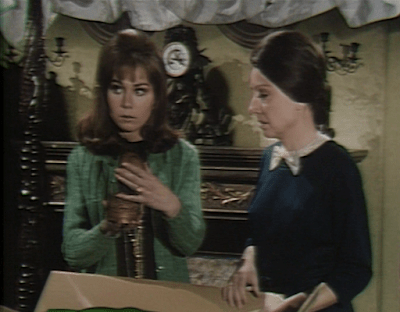
Even though Maggie’s job may not last for more than another week, she still needs a place to stay. So she, Mrs Johnson, and Barnabas clear Vicki’s stuff out of her room. Barnabas was hung up on the idea that he and Vicki might someday fall in love, an idea he did remarkably little to put into practice, and so he finds it distressing to be around her clothes. He demands that Mrs Johnson destroy them all. This shocks her. She finds an antique music box, and asks what to do with that. Barnabas orders her to destroy that too. Maggie takes the music box, listens to it for a second, grows wide-eyed, then hurriedly hands it to Mrs Johnson.

I can name that tune in three tinkles. Screenshot by Dark Shadows Before I Die.

This moment amounts to a programmatic statement. In May and June of 1967, Barnabas was a vampire and Maggie was his victim. He forced her to listen to the music box for hours on end, believing that it had a hypnotic power that would erase her personality and replace it with that of his lost love Josette. Several times it has seemed that her memory of what Barnabas was and what he did to her would come back, only for her to be subjected to one magical mind-wipe after another. That she is so quick to give Mrs Johnson the box when Barnabas has ordered her to destroy it, and that her relaxed and friendly attitude towards Barnabas does not change for one second, is a sign that the question “Will Maggie’s memory come back?” will not be coming up in Dark Shadows version 5.0.

Maggie looks for David and Amy and finds them in the drawing room. Amy is playing “London Bridge” on the piano. We have seen David interact with only one other child, the ghost of Barnabas’ nine year old sister Sarah. Sarah sang and played the recorder, and the only song she seemed to know was “London Bridge.” Evidently, David has a type.

Mrs Johnson can’t bring herself to destroy Vicki’s clothes. She tells Maggie she has closed them up in a storeroom in the basement. The only room we have heard referred to this way is the one that was kept locked for the first 54 weeks of the show because Liz was under the mistaken impression that the corpse of her husband Paul was buried there, so that must be the room she means. Longtime viewers will appreciate the reference; Vicki herself was intrigued by the room in the early days of the show, and now her things have found a home there.

They don’t stay there for long. Maggie goes to hang up her own clothes, only to find that Vicki’s are back in the closet. She asks Mrs Johnson what could have happened. In #69, her second appearance, Mrs Johnson declared that “I believe in signs and omens!” Ever since, she has shown an attitude that might be called superstitious in our world, but that in the universe of Dark Shadows is just plain common sense. She ends the episode with a monologue about how “no human hand” had moved the clothes, that it must have been some supernatural force announcing that Vicki will be coming back.

This is disappointing for a couple of reasons. First, the character of Vicki was played out at the end of #192, and the show refused to find anything interesting for her to do for the 90 weeks that followed. Alexandra Moltke Isles finally gave up and used her pregnancy as grounds to get out of her contract early, but they recast the part to continue wasting screen time on this exhausted figure. The second Vicki, Betsy Durkin, was condemned to be a fake Shemp, moping her way through utterly pointless activities unconnected with anything the audience could care about. It was a great relief when she finally vanished.

Second, the show has a poor record of using objects to evoke its themes. The music box was an exception, but most have been pretty bad. The most famous example is Burke Devlin’s filigreed fountain pen, which was the main focus of 21 episodes spread from August through November of 1966. It was supposed to be evidence in a homicide investigation and to suggest a number of things about Roger’s feelings towards his friend-turned-nemesis Burke, but at the end it was just a bunch of people looking for a pen. The most recent at this point was a wristwatch that fake Vicki gave to her husband shortly before his disappearance. It turned up after he was gone and would occasionally start ticking when his spirit was near. Miss Durkin had to play scene after scene with that watch as her main partner, and it is no reflection on her acting ability that the results were so uniformly dismal. There’s a definite sinking feeling when we see Vicki’s wardrobe presented as another symbolic object.

Episode 633/634: Now was the moment, or never at all

Suave warlock Nicholas has had bad news. His boss, Satan, will be recalling him to Hell, and does not plan to send him out to the world of the living again. Satan gave Nicholas two tasks to complete before his time runs out. He is to perform a Black Mass during which he will sacrifice Maggie, The Nicest Girl in Town, and afterward take her to Hell with him as his bride. He is also to complete the project he has been working on, forcing mad scientist Julia and old world gentleman Barnabas to resurrect Eve, the mate of Frankenstein’s monster Adam. Yesterday, we saw that Nicholas plans to make Barnabas and Julia use Maggie as the donor of the “life force” that will bring the mate back to life. It was entirely unclear how Maggie could both be sacrificed on Nicholas’ altar and used as the “life force.”

We open today with a reprise of yesterday’s closing sequence, showing Nicholas performing a rite while Maggie lies on his altar. We then cut to the basement of Barnabas’ house, where Eve’s body lies on a bed in a laboratory full of mad science equipment. Barnabas vows to Julia that this is the last time they will ever go through the vivification procedure; she asks “What’s the point of saying that? We’re at Nicholas’ mercy.” The other day, Barnabas confronted Nicholas with some demands, threatening to stop cooperating with his project unless he complied. Nicholas gave some ground in response, suggesting there might yet be some dramatic tension left in his relationship with Barnabas and Julia. But when Julia sounds this note of total defeat she is telling us that their conflict with Nicholas is exhausted, that the Frankenstein story has nowhere to go, and that Barnabas is therefore right and this is the last time we will see them run the experiment.

Julia looks at the body and expresses sympathy for “poor motherless Eve.” “There’s a poem about that,” she says. Indeed there is, and it is an apt reference here. Nicholas’ attachment to the ingenuous Maggie has always been jarringly out of character for him; Ralph Hodgson’s 1913 poem “Eve,” with its juxtaposition of the innocent Eve with the crafty serpent, not only tells a story that is as broadly melodramatic as any episode of Dark Shadows, but also dwells on the incongruity of Eve and the serpent, the sheer strangeness of the fact that they coexist at all. “Here was the strangest pair/ In the world anywhere.”

Yesterday we caught our first glimpse in a long time of a character who, like Maggie, was introduced in the first episode. He was Mr Wells, the innkeeper. Maggie has been with us through all of the show’s transformations, but we hadn’t seen Mr Wells since #61, when Dark Shadows was all about what went on among people while they were drinking coffee together. Seeing him again puts that 1966 show side by side with this dramatization of “The Monster Mash,” and that contrast is as jolting as anything Hodgson manages.

Visitors let themselves into the lab. First comes Nicholas. He is trying to seem cheerful. He comes down the stairs with a bounce in his step and greets Julia and Barnabas with a jokey “Why are my conspirators so reluctant?” He might be trying to evoke the same unholy jollity that we see at the end of Hodgson’s poem, “Picture the lewd delight/ Under the hill tonight/ ‘Eva!’- the toast goes round-/ ‘Eva’ again.” But the imminent prospect of his return to Hell has Nicholas in no jolly mood, and his mask of good cheer falls away the moment Barnabas complains of his untrustworthiness.

It is true that Barnabas’ complaint strikes Nicholas at a most sensitive spot. He tells him that “You seem to specialize in second chances” and gripes that he revived vampire Tom Jennings and left him to do the dirty work of ensuring Tom would never rise again. Giving second chances was the very habit for which Satan reproved Nicholas in #629 when he told him he would soon be returning to Hell. Stung by the echo of his master’s words in Barnabas’ mouth, Nicholas retorts that destroying a vampire must have been “traumatic” for Barnabas, who was until recently a vampire himself. Because of some magical business, Barnabas will revert to that condition if Adam dies, and it is Nicholas’ threat to kill Adam that has compelled him and Julia to assist in his diabolical plan. Having reminded Barnabas and Julia of the source of his power over them, Nicholas composes himself, agrees with Julia that there is no time for quarrels, and leaves the room.

A moment later, Adam enters. Adam hates Barnabas and Julia, believes that Nicholas is his friend, and looks forward to Eve’s resurrection. Barnabas tells Adam he doesn’t want him there, but Nicholas enters with the command “He stays, Mr Collins.” A third visitor follows and shocks Julia and Barnabas even more deeply. It is Maggie.

The rite on the altar dedicated Maggie to Satan, but it did not involve her death. When Julia and Barnabas see that Nicholas has brought Maggie, they declare that they will not go ahead with the procedure. But Maggie declares that she is there of her own free will. Quite calmly, she looks around the laboratory in Barnabas’ basement, and says “I’ve been here so often.” Indeed she has- in May and June of 1967, Barnabas was still a vampire, Maggie was his victim, and he kept her imprisoned in a cell here. Julia used her extraordinary hypnotic abilities to make Maggie forget her ordeal, but this line suggests that she now remembers what Barnabas did to her, and that she is, terrifyingly enough, happy about it.

When Maggie was Barnabas’ prisoner, he was trying to erase her personality and replace it with that of his lost love Josette. Later, the show took us back in time to the year 1795, where we saw Josette when she was alive and realized that she wasn’t on board with Barnabas’ plans then any more than Maggie was in 1967. But it looks like Nicholas has succeeded where Barnabas failed and remade Maggie as a companion fit for a demon. Barnabas is already miserable at being forced to toil in Satan’s cause, and now he goes nuts with jealousy.

Barnabas loudly protests that he will not be a party to the experiment. Nicholas silences him by causing Adam’s heart to beat dangerously fast. Their magic bond gives Adam and Barnabas the connection Alexandre Dumas’ Corsican Brothers had, so that Barnabas also suffers the pain. Julia was originally introduced as Maggie’s doctor, but she long ago betrayed her patient for Barnabas’ sake. She pleads with Maggie to stop Nicholas, but Maggie just smiles and asks “Why should I?” Julia tells her that otherwise Nicholas will kill both Adam and Barnabas. Perfectly relaxed, Maggie responds “Then you stop him. Do what he wants.” Julia capitulates, saying “We’ll use her.”

This glimpse of Evil Maggie is breathtaking for longtime viewers. In #1, Maggie premiered as a wisecracking waitress who was, in the words of the original series bible, “everybody’s pal and nobody’s friend.” Soon, we saw her with her father Sam, the town drunk, and she emerged very clearly as a classic Adult Child of an Alcoholic (ACoA.) In #20, Maggie left behind the short blonde wig she had worn in her first appearances, and from then on she was The Nicest Girl in Town.

When Barnabas first bit Maggie, she went through the phases the vampire’s victim usually experiences, including snappishness towards her loved ones when they try to get between her and the ghoul on whom she is becoming dependent. During her time in Barnabas’ house, her level-headedness and warm-heartedness reasserted themselves, and even when she was in the mental hospital as a psychological wreck after escaping from him she was never far from a display of kindliness. In the eighteenth century flashback, Kathryn Leigh Scott took on the part of Josette. Josette was so unfailingly virtuous that not even Miss Scott could find a way to make her interesting. This brief moment of a Maggie utterly indifferent to the value of human life, even her own, is such an extreme departure that we can immediately see a world of possibilities opening up for her as a character and for Miss Scott as a performer.

Maggie is strapped to a table and Julia and Barnabas get to work. We have seen the procedure often enough that it is far from fresh, but in-universe it is still highly experimental. The equipment doesn’t work as Julia and Barnabas expected; gauges indicate higher readings than they want, and the adjustments that are supposed to bring them down just make them go even higher.

Maggie cries out that she is dying; Eve barely moves. The readings get even worse; Barnabas shuts the apparatus down. Nicholas tries to cast a spell to immobilize Barnabas; he struggles against Nicholas’ power at first, but still smashes the equipment, and soon is free of the spell altogether. Nicholas calls out to his master and pleads “Don’t desert me now!” His powers gone, he runs to Adam and starts trying to choke him, but Adam brushes him aside easily. Nicholas runs away; Barnabas runs after him, saying that he will take the opportunity to kill Nicholas.

Adam is shocked that Nicholas attacked him. He and Julia find that nothing is left of Eve’s body but a skeleton with a wig. Adam sobs, declaring that now he has no one. Adam decides that Barnabas is to blame for Eve’s destruction. He goes upstairs, tells himself that Barnabas “doesn’t deserve to love,” then leaves the house. Later, we see him in the great house of Collinwood. Regular viewers know that Adam has in the past thought of punishing Barnabas by murdering well-meaning governess Vicki, in whom Barnabas does not actually take much interest but whom he frequently claims to love. So we can expect that Friday’s episode will involve some apparent danger to Vicki.

Julia is too busy with Maggie to take any notice of Adam’s doings. The last time Julia ran the experiment, the “life force” donor died. Julia is frightened when she cannot get Maggie to respond to any stimulus. She gives her a shot, and Maggie opens her eyes.

Longtime viewers wonder what Maggie will be like now. If Satan has lost interest in Nicholas, it seems unlikely that the heartless Maggie of a moment ago will stick around. If she returns to her usual sensibilities with her memories of Barnabas’ crimes restored, the show will no longer be able to use the sets representing the houses at Collinwood since Dark Shadows will become a prison drama about the activities of Barnabas and Julia on their respective cell blocks. If she just snaps back to the way she was before she got involved with Nicholas, it will feel like a cheat.

What they actually choose to do is to give Maggie total amnesia. She does not recognize her own name or Nicholas’, refuses to believe she has ever met Julia, and has no idea where she is. Julia tries desperately to reactivate Maggie’s memory. She takes her up to Barnabas’ living room. In a moment longtime viewers will find impossible to believe, Julia takes a music box and plays it for Maggie. She tells her that it once belonged to Josette and that Maggie has heard it many times. Indeed she has- Barnabas forced her to listen to it incessantly during the weeks when he was trying to Josettify her. Julia, who has gone to such great lengths to bury Maggie’s memory of what Barnabas did to her, is now trying to dislodge her recollection of his very worst crimes. When Maggie does not remember the music box, Julia takes her up to Josette’s bedroom, where Barnabas kept her for much of her time as his prisoner. It is simply impossible to imagine what Julia could be thinking at this point.

Meanwhile, Barnabas is skulking in the foliage near the peak of Widow’s Hill. He is eavesdropping on Nicholas, who is pleading with Satan to give him another week to get the Frankenstein project back on track. He dissolves into a process shot depicting flames, and Barnabas smiles the most evil grin anyone has ever managed.

Mr Warmth. Screenshot by Dark Shadows Before I Die.

Even though poor motherless Eve is on screen for only a minute or two, doesn’t open her eyes, has no lines, and moves only a couple of fingers and those just barely, they brought Marie Wallace back to play her. That was $333 well spent. Miss Wallace’s presence on screen convinces us that Eve is really dead and that she will not be back. Combined with Maggie’s amnesia, that leaves Nicholas without any connection to an unresolved storyline. The only former underling of his still at large is witch-turned-vampire Angelique, and she had broken from him decisively a couple of weeks ago. When he vanishes, we can accept it as a line drawn under the part of the show in which he was the principal villain.

Eve’s decomposition and Nicholas’ damnation are not the only departures today. This was the final episode directed by John Walter Sullivan. As “Jack Sullivan,” he was credited as an associate director on a great many episodes, from #15 to #549. When John Sedwick left the show in the summer of 1968, Sullivan took over his share of the directing duties, alternating with Lela Swift. He directed a dozen episodes as “Jack Sullivan,” from #504 to #580. He then took the name “Sean Dhu Sullivan,” and directed 50 more. Sullivan was not as accomplished a visual artist as either Swift or Sedwick, and the camera operators had more trouble keeping his episodes in focus than they did either Swift’s or Sedwick’s. But his scenes were never any more confusing than you would have expected, considering the ridiculously convoluted stories the scripts gave him to work with, and he seems to have been as good a director of actors as either of them. The period when he was helming segments happened to be the one when the show had its most explicitly Christian elements, which you might say made him a Sean Dhu for the Goyim,* but I doubt he had anything to do with that.

*This is my only chance to make this joke, please just let me have it.

Episode 478: Carried on the wind

Soap operas usually have multiple more or less independent storylines going simultaneously. Dark Shadows had trouble keeping that up, usually having an A story with all the action and a B story that never got off the ground and eventually dried up altogether. Now, in the spring of 1968, they have several equally dynamic arcs going at once. As a result, today’s episode is a bit of a jumble, as we catch glimpses of several loosely related events.

For the nineteen weeks stretching from #365 to #461, well-meaning governess Vicki came unstuck in time and found herself trapped in the 1790s. In that period, she met many people, among them gracious lady Josette and wicked witch Angelique. In the 1960s, one of Vicki’s closest friends is Maggie, The Nicest Girl in Town. Like Maggie, Josette is played by Kathryn Leigh Scott. When Vicki saw Josette, she realized that Maggie had some kind of metaphysical connection to her. This was a daring move on the part of the show, since it means that vampire Barnabas was onto something in the summer of 1967 when he abducted Maggie and tried to brainwash her so that her personality would vanish and Josette’s would appear in its place.

Angelique has followed Vicki to 1968. She calls herself Cassandra, wears a black wig, and has married sarcastic dandy Roger, thereby securing residence in the great house of Collinwood. Vicki and Barnabas recognize Angelique/ Cassandra, and each knows that she is a deadly threat to everyone in and around the estate. For her part, Vicki is trying to hide her knowledge from Angelique; Barnabas has taken a different tack, and the other day let Angelique into his house where he proceeded to give her all the information she could possibly need to realize her evil intentions towards him. This is not because Barnabas cannot keep a secret. Vicki has tried to enlist him in the battle against Angelique, but he, now in recovery from the vampire curse Angelique placed on him in the 1790s, does not want Vicki to know the truth about him, and so he will not cooperate with her in any way. It’s only his enemies with whom Barnabas compulsively shares damaging intelligence.

Maggie comes to the great house to have a tea party with Vicki today. Angelique/ Cassandra opens the door, and cannot hide her shock at Maggie’s resemblance to Josette. She so blatantly stares at her that she has to admit that she is unnerved because Maggie looks very much like someone she knew a long time ago.

Vicki comes in, and Angelique/ Cassandra asks her, not in her usual mid-Atlantic accent, but in Lara Parker’s sweetly musical Tennessee voice, if she and Maggie are planning to use the drawing room. Vicki at once offers to use a different space, not only as would be correct for a member of the household staff speaking to one of the family, but in a relaxed and friendly way that betrays nothing of her knowledge of Angelique/ Cassandra’s true identity. While returning viewers know that Angelique/ Cassandra remembers Vicki from the 1790s, the Southern accent is so much more natural than her usual way of speaking that it suggests Vicki has managed to get her to let her guard down to some degree.

While Vicki and Maggie settle into the drawing room, Angelique/ Cassandra goes to a portrait of Barnabas that hangs in the foyer of the great house and delivers a speech to it. She tells the portrait that Maggie is the very image of Josette, and will therefore be the first victim of her latest evil plan. She is going to spam people’s dreams with a series of nightmares, and when the last person has had the nightmare Barnabas will be a vampire again. Evidently the dreamers of Collinsport didn’t have anti-virus programs installed in their brains, because Angelique/ Cassandra expects them all to be helpless before this morphean malware.

In the drawing room, Maggie is too preoccupied with Angelique/ Cassandra’s strange reaction to her to hear when Vicki asks her how she takes her tea. When she tells Vicki that Angelique/ Cassandra was shocked by the sight of her, Vicki amazes her by saying that she is sure she did react that way, and giving her the details of the reaction before Maggie reports them. Maggie asks Vicki to explain how she knew and what it means. Vicki explains nothing.

This is something of a reversal. In #1, Vicki met Maggie. Vicki had just arrived in Collinsport, and went to the diner where Maggie was the waitress. While Maggie served Vicki, she told her that Collinwood was haunted and that it was unwise to go there. Vicki did not at that time believe in ghosts and told Maggie so. Now, Vicki is the one serving the tea, and she is the one who knows far more about the supernatural than does Maggie. At least, far more than is in Maggie’s conscious mind- she has amnesia about her experience as Barnabas’ victim.

Vicki and Maggie’s tea party

Maggie is far more upset by Angelique/ Cassandra’s reaction to her than circumstances would appear to warrant. Vicki’s reticence is understandable, given the extreme complexity and improbability of her story, but she has always been so forthcoming with her friends that when Maggie asks why she is being so mysterious it seems quite likely that Vicki will tell her everything. Together, these two facts suggest to regular viewers that Maggie will eventually hear herself compared to Josette, that the comparison will jar loose the memory of what Barnabas did to her, and that she will go to the authorities. As an audience, we hope Barnabas will get away with his crimes, because the show is most fun to watch when he does. Now that Angelique has come to 1968, we have a morally defensible in-universe reason for this hope. Angelique is even more evil than Barnabas is, and without his active participation there is no hope she can be stopped.

Vicki’s reticence brings up another question. In the months before her journey to the past, she saw a great deal of evidence that Barnabas was a vampire. While in the eighteenth century, she saw so much more that upon her return Barnabas was certain she must have figured out his secret, and bit her to keep her quiet. When his vampirism responded to medical treatment, the symptoms of his bite went away. We wonder what Vicki knew at each stage of the story, and what she remembers now.

One possibility is that she has known everything all along. That would put Vicki in an intriguing position if Maggie’s memory does come back. Vicki originally represented the audience’s point of view; if she turns out to have been aware of Barnabas’ crimes from the beginning, she will put us in the uncomfortable position of wondering what it tells us about ourselves that we are consistently on the vampire’s side.

Vicki changes the subject to her boyfriend, a man named Peter. Vicki met Peter in the 1790s, and like Angelique he has followed her into her own time. Also like Angelique, he keeps insisting that he has a different name. He wants to be called Jeff. Unlike Angelique, Peter/ Jeff is amnesiac, is under the control of mad scientist Dr Lang, and brings the show to a screeching halt every time he is on screen. Vicki asks if Peter/ Jeff can rent the spare room in the cottage Maggie shares with her father. Maggie has never met or heard of Peter/ Jeff, and wants more information before she commits to living with him. Vicki doesn’t have anything to tell her, inflaming Maggie’s curiosity to the point where she exclaims “I can’t stand it!”

Peter/ Jeff telephones from Lang’s laboratory, and Vicki gets Maggie to agree to meet him at her house in an hour. Unknown to Vicki, Lang is building a Frankenstein’s monster, and plans to download Barnabas’ personality into the body once it is completed. Peter/ Jeff has dug up graves and fetched body parts for Lang to use, but is tired of that sort of work and is eager to make a fresh start. Unfortunately for him, Barnabas requested that the body look like Peter/ Jeff. So Lang persuades Peter/ Jeff to call Vicki back to say he won’t be available to meet her and Maggie today after all. He then gives Peter/ Jeff a shot to knock him out, straps him to a table, and sets about cutting his head off. Peter/ Jeff comes to and complains about this; Lang, irritated, tells him he can’t very well have expected him to let him live, knowing what he knows.

Maggie has the dream Angelique has sent. It begins with Peter/ Jeff calling on her. Since they went out of their way to tell us Maggie has never seen Peter/ Jeff, this tells first time viewers that this sequence, as is typical of dream sequences on Dark Shadows, comes not from the character’s mind, but is the product of a supernatural agency. In the course of the dream, Maggie hears the sound of Josette’s music box; Barnabas made her listen to this when he was holding her prisoner. This again raises the prospect that Maggie’s memory will return. The rest of the dream is a concerto for fog machine. Technical director Lou Marchand is credited today; presumably he was the soloist. The fog immerses everything so completely that it is anyone’s guess what exactly Miss Scott is doing for most of the sequence.

Episode 464: Justice to history

High-born ne’er-do-well Roger Collins was Dark Shadows‘ first villain. Through the first 40 weeks of the show, dashing action hero Burke Devlin was determined to prove that Roger, not he, had been driving when his car hit and killed a pedestrian ten years before, and Roger would stop at nothing to keep Burke from succeeding. The Revenge of Burke Devlin storyline was never particularly exciting. By the time Burke formally gave up on his quest for vindication in #201, it had been running on fumes for some time. Roger hasn’t been central to a plot since then. The show has capitalized on actor Louis Edmonds’ unrivaled gift for sarcasm by having him deliver the occasional zinger, and otherwise has used him as a symbol of the inability of the Collins family to use its wealth and connections to solve any of its problems.

For nineteen weeks ending this past Monday, Dark Shadows was a costume drama set in the late eighteenth century and Edmonds played haughty overlord Joshua Collins. That performance was a triumph, and the entire segment turned out to be The Tragedy of Joshua Collins. So returning viewers will have an appetite to see more of what Edmonds can do, and will be excited when we come back from the opening title sequence to a scene focusing on Roger.

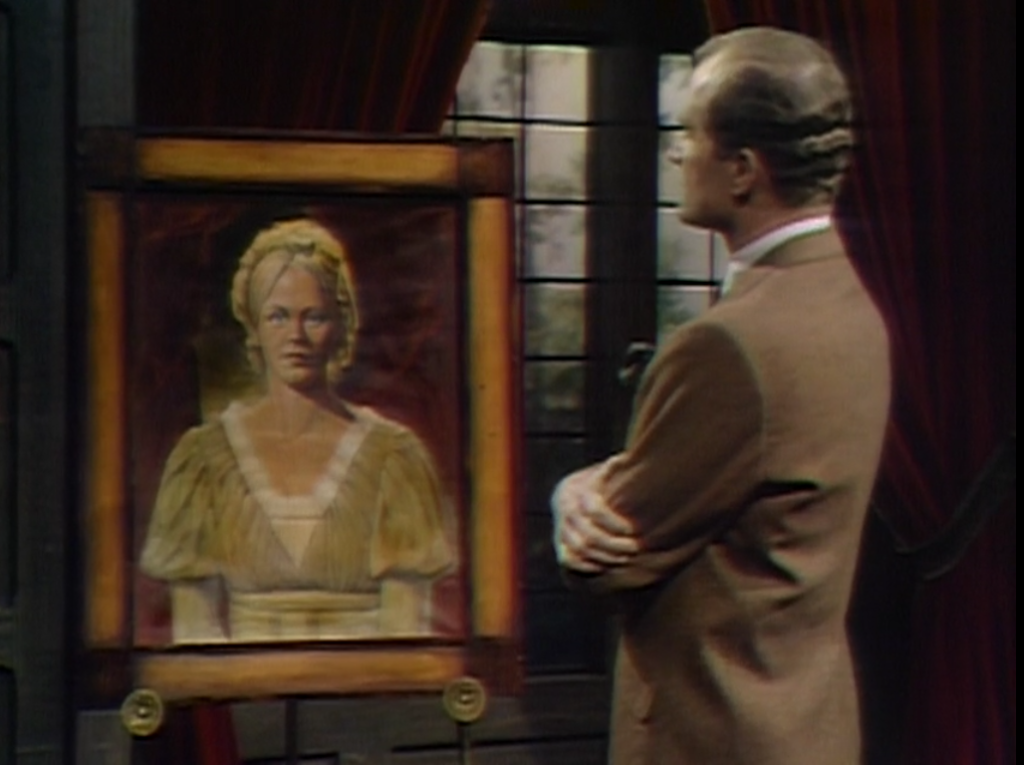
Roger spends this scene staring at a portrait and reciting poetry to it while various people enter the room and try to get his attention. That may not sound like a promise of thrills, but it is on this show. For example, Roger’s son, strange and troubled boy David, had a lively if somewhat one-sided conversation with the portrait of Josette Collins that hangs in the Old House on the estate in #102, and that conversation presaged danger for David and an important role for Josette’s ghost. The show’s first supernatural menace was Roger’s estranged wife, undead fire witch Laura Murdoch Collins, and several characters had important relationships with portraits of Laura during the four months she was in the cast. And dangerously unstable ruffian Willie Loomis once spent a week staring at the portrait of the late Barnabas Collins that hangs in the foyer of Collinwood. As a result, Willie wound up opening Barnabas’ coffin, finding that he was a vampire, and turning Dark Shadows into an entirely different kind of show.

Roger talks to the portrait of Angelique.

The portrait that has captured Roger’s attention is of Angelique, the wicked witch who turned Barnabas into a vampire in the first place. Well-meaning governess Vicki found this portrait in an antique store and brought it home yesterday. It was Vicki who took us to the 1790s when she became unstuck in time. While there, she met Angelique and the living Barnabas. Shortly after her return to the 1960s, Vicki found that her memory of her time in the past had become spotty. She can’t explain why she wanted the painting, but it does make sense to her that Barnabas reacts to it with violent dislike.

We first saw the portrait in #449, when it was clear that Vicki would be returning to the 1960s soon but unclear whether Angelique would follow her. Showing us that they had commissioned a portrait of Lara Parker was their way of telling us she would be back. Having Roger become obsessed with the portrait is their way of telling us that he will be the instrument of her arrival, as Willie was the instrument of Barnabas’.

We learn that Roger’s obsession will blur the distinction between him and Joshua when long-term houseguest Julia Hoffman approaches him and he speaks to her in Joshua’s voice, addressing her as the Countess DuPrés, who was a houseguest at Collinwood in Joshua’s time. Julia and the countess are both played by Grayson Hall. Vicki mistook the countess for Julia when she first met her in 1795, and since her return to 1968 has kept mistaking Julia for the countess. Now that Roger has made the same mistake, Julia must be trying to figure out what’s going on.

A man comes to the front door. Vicki answers it and sees a familiar face. It belongs to Professor Timothy Eliot Stokes. She hasn’t met him before, but she met his ancestor, much put-upon servant Ben Stokes, in the 1790s.

Like Ben and crazed handyman Matthew Morgan from 1966, Professor Stokes is played by Thayer David. Matthew and Ben were both major characters, so we can assume that Stokes will be as well. Matthew was a bad guy, Ben a good guy. When Ben was on the show, the contrast between him and Matthew was drawn very heavily to make the point that Matthew’s crimes are what Ben’s virtues would have led him to do had his personality been warped by the environment in which Matthew grew up. That environment was the consequence of the curse that Angelique placed on the Collinses in the 1790s. Burke expressed this idea in #64 when he said of Matthew that “Collinwood breeds murderers,” but he was understating the effect. Matthew grew up, not on the estate, but in the nearby village of Collinsport, and the curse leaves its mark on everyone who comes from there. Since Stokes is an out-of-towner, he is likely to be unaffected by the consequences of the curse, and so we do not know what we will find under his worldly and self-possessed exterior.

Stokes is researching his ancestor Ben, and wanted to buy the portrait because he thought it might depict a woman Ben knew. Stokes says that Ben wrote a memoir. Barnabas is in the room; in the 1790s, Ben was his closest friend, and knew all about his vampirism. So he is alarmed by the idea of a volume of memoirs by Ben. He can take some comfort when Stokes tells him that most of the manuscript was lost in a fire a few years ago.

The idea of a servant writing memoirs that might expose Barnabas’ secret first came up in #326. At that point, Willie was out of his control, and Barnabas told Julia, who is a mad scientist and his confederate, that he was afraid Willie might start “writing his memoirs!” That phrasing was meant to raise a laugh, since Willie is conspicuously not burdened with literary ambitions. But it planted a seed that flowers for the first time here, and that will flower again later.

Stokes offers Vicki $200 for the painting. Barnabas is eager to get the thing out of the house and urges her to take Stokes’ money, but before she can Roger bids $500. Stokes can’t afford that, and so it stays at Collinwood.

Stokes’ interest in family history establishes a contrast between him and Roger. Stokes, like Roger, appears to be a confirmed bachelor. But while Roger’s lack of interest in the responsibilities of marriage is of a piece with his indifference to all family ties, so that he was eager to divorce Laura and palm David off on her even after it had become clear to other characters that she was a danger to the boy, Stokes is an avid genealogist. He has renounced the prospect of marriage because he has other ways to be of service, not simply because he wants to wallow in his own crapulence as Roger does.

Suddenly Vicki remembers that the woman in the portrait is named Angelique, that Angelique was a witch, and that her spells caused all the misfortune that began at Collinwood in 1795. We hear all of this while Barnabas is in closeup, squirming gloriously. Stokes leaves with Barnabas and tells him he knew that the woman’s name was Angelique, but that it’s news to him that she was a witch. He is impressed by Vicki’s knowledge, and says that he can sense that she is attuned to paranormal phenomena. He wants to get to know her better.

Vicki suddenly remembers who Angelique was. Screenshot by Dark Shadows Before I Die.

Most characters we have met spend a long time slowing the story down by scoffing at the idea of the supernatural. That Stokes is a self-identified student of the occult and immediately receptive to Vicki’s identification of Angelique as a wicked witch tells us that he will serve to speed up the pace of events.

This again makes a stark contrast with Roger. When Vicki managed to get Roger away from the painting for a moment in Act One, he told her that he refused to believe that she traveled to the past and returned to the present. When she lists some of the abundant evidence he and everyone else saw that can be explained no other way, he says he attributes all of that to mass hallucination.

In his Dark Shadows Every Day post about this episode, Danny Horn at one point refers to Stokes as a character whose function is “to backfill Dr. Woodard’s spot in the cast,” referring to a stolid medico whom Barnabas and Julia murdered several months back. But in this contrast, we see that the character whose place Stokes is actually taking is Roger. When the show started, the Collinses of Collinwood were the central frame of reference for the action. But Roger and his sister, matriarch Liz, are for various reasons locked out of the supernatural storylines. Since those are the only storylines they have, the show needs to build another family to anchor the action, and that family is going to be defined, not by marriage and genealogy, but by a shared commitment to getting as deep as possible into the weirdest shit going.

Stokes tells Barnabas that there was a series of unsolved murders in Collinsport in the 1790s, and wonders if it might be possible to prove that Angelique was responsible for them. Barnabas suggests that it is too late to do justice in such an old case, to which Stokes replies that it is never too late to do justice to history. Not only does this reply deepen the contrast between Stokes and the amoral Roger, it has, by happenstance, a deep resonance for many who might see the episode today. It originally aired on 4 April 1968, just a few hours before the Rev’d Dr Martin Luther King, Jr, was assassinated. Millions are still unsatisfied with the official answers about who killed Dr King and why; they might cheer the idea that there is a species of justice that is still possible even after 56 years or more have gone by.

Barnabas bit Vicki the other day in an attempt to control her and keep her from revealing any information about him she may have acquired during her sojourn in the past. Disquieted by his conversation with Stokes, Barnabas stares out his window and summons Vicki to his house. In her bedroom, an enchanted music box Barnabas gave her as part of an earlier brainwashing attempt opens itself and begins to play. She rises from bed and goes to him listening to the music box all the way.

At Barnabas’ house, Vicki gives him the music box. He tells her that the next time he calls her, they will go away together forever. He bites her neck.

Barnabas has Vicki over for a bite. Screenshot by Dark Shadows Before I Die.

We cut to Vicki’s bedroom. The music box is back in its place and she is back in bed, asleep. Julia comes in to check on her. Vicki says she’d had a bad dream, and Julia finds the bite marks on her neck.

In the weeks leading up to Vicki’s visit to the past, Julia had alienated Barnabas by opposing his efforts to seduce Vicki. Now she marches over to Barnabas’ house and renews her opposition. She accuses him of having been in Vicki’s bedroom. He answers that he brought her to his house. This might seem to be a trivial distinction, but perhaps not to viewers who have been with the show from the beginning. Today’s focus on Roger might remind us of #4, when Roger tried to let himself into Vicki’s room while she was sleeping, obviously in search of some kind of sexual thrill that would not be preceded by her consent. Barnabas can’t deny that he is the moral equivalent of a rapist, but he isn’t going to miss an opportunity to differentiate himself from Roger.

Barnabas doesn’t seem very interested in anything Julia is saying. Even when she gives him an ultimatum, threatening to expose him if he doesn’t back off by tomorrow night, he reacts with a mild irritation. Regular viewers, remembering the displays of jeering contempt and seething rage which are typically the options from which Barnabas chooses his response to this sort of thing, will be startled by his relative blandness. Julia should be unnerved by it.

Episode 405: To love anyone

Gallant gentleman Barnabas Collins discovered that his wife, Angelique, was a wicked witch and a deadly threat to his true love, the gracious Josette. He did not tell anyone what he knew about Angelique, but did persuade Josette to flee. Today, Angelique discovers that Josette is beyond the range of her powers.

In her rage, Angelique takes a doll belonging to Barnabas’ little sister Sarah. She sticks pins in it; Barnabas has learned that this causes Sarah to become ill. Angelique is about to stick a pin into the doll’s heart when Barnabas takes a dueling pistol and shoots Angelique.

Angelique drops the doll; Barnabas takes the pins from it. Angelique presses her hand to her shoulder while delivering a long, bombastic speech. Barnabas has plenty of time to reload the pistol and shoot her again, but chooses just to stand there and listen to her. This turns out to be a bad decision when she ends the speech by placing a curse on him. He will spend all eternity unable to rest, and everyone who loves him will die. Having completed her death scene, she ostentatiously collapses.

We hear a window smashing. A bat appears. It approaches Barnabas. He yells at it, flails his arms, and walks backward. This is an echo of #330, which ended with strange and troubled boy David Collins reacting the same way when the same puppet appeared in his bedroom. David was a neurotic and isolated pre-teen who had been through a lot of trauma, so that was an effective scene. Barnabas is a grown man who has been trying to function as an action hero. Seeing him as the equivalent of a cartoon lady standing on a chair screaming because she saw a mouse rather undercuts this. Anyway, the bat bites Barnabas on the neck, so now he’s going to be a vampire.

The bite. Not Barnabas’ cloak in the background, playing the role of The Grim Reaper. Screenshot by Dark Shadows Before I Die.

In #330, it was Barnabas who sent the bat against David. This is one of many indications that the vampire Barnabas we knew from April to November of 1967 was not only under Angelique’s curse, but that he was in some sense a manifestation of Angelique. Maybe when she casts a spell, she breaks off a chunk of herself and that chunk goes about the world pursuing its own objectives. The image of a supernatural being as a complex of vaguely related but independent phenomena has been standard in Dark Shadows since undead fire witch Laura Murdoch Collins first appeared on the show in December of 1966, so regular viewers are prepared to learn that the vampiric Barnabas is a subcategory of the syndrome known as “Angelique.”

This episode explains how a couple of the more important props got to be in the places we are used to seeing them. Early in the episode, Barnabas gives Josette a music box. This music box figured heavily in the story from May to August 1967 as a symbol of Josette and as a vehicle for some kind of magic spell that was supposed to turn other people into her. A bit later, we see that Barnabas has hung the portrait of Josette over the mantle in the front parlor of the Old House. It was there when we first saw the Old House in #70, and was the focus of all supernatural phenomena on the show from then until Barnabas reclaimed the Old House in #212.

Episode 397: I’m not sure I should be here, either

Yesterday, the ghost of Jeremiah Collins started to bury wicked witch Angelique alive. Today, we see that he barely got her dress dirty. She’s lying on a mound next to the empty grave when we find her.

This is the one where Angelique marries Barnabas. It ought to be packed with incident. There is a lot of activity, but like the live burial, it doesn’t amount to much. It’s a real disappointment.

One particular weak spot in the episode is the officiant at the wedding, the aptly named Reverend Bland. Actor Paul Kirk Giles does what he can, but as soon as the Rev’d Mr B realizes that something unwholesome is going on he declares that he is getting out of the place. Apparently his conception of the duties of a pastor consists of avoiding people who might need help confronting the spiritual forces of darkness. It doesn’t matter- Bland’s squeamishness disappears after Barnabas orders him to stay and perform the wedding.

After the wedding, Angelique returns to her bedroom. There is a gift that hadn’t been there before. Opening it, she finds a music box. The music box was a big deal in 1967, when Barnabas was a vampire and he thought that a woman who listened to it would turn into his lost love, the gracious Josette. This is the first time we have seen the music box during the segment of Dark Shadows set in 1795. In 1967, Barnabas told various stories about the origin of the music box, but the one thing that remained consistent was that it was meant for Josette.

Angelique finds the music box. Screenshot by Dark Shadows Before I Die.

Barnabas and Josette were engaged when the 1795 segment began, but that ended when Josette and Jeremiah conceived a mad passion for each other and eloped. Unknown to Barnabas, that was the result of a spell Angelique cast in hopes of getting Barnabas for herself. Barnabas responded to the elopement by killing Jeremiah in a duel. He has told Angelique that he still loves Josette and always will, but that he knows there can never again be anything between them. Moments after he had told her that, Angelique agreed to marry him. Evidently it was to be a sham marriage.

Jeremiah’s ghost has been railing at Angelique for raising him from his grave, and apparently he wants to be avenged by making the sham marriage even shammier. When Barnabas comes into the room, he sees the music box, explodes in rage, and storms out.

In life, Jeremiah never knew that Angelique was behind his and Josette’s passion. He has evidently learned that and other of her secrets, and is using them against her. Perhaps Angelique put more of herself into him than she intended.

On The Collinsport Historical Society, Patrick McCray says that this is an important episode because Barnabas and Angelique’s wedding is the basis for some developments much later in the series. That’s true, but by the time he’s talking about the show isn’t very good any more. So I consign it to the ranks of the “Stinkers.”