Sorceror Count Petofi has taken possession of twelve year old Jamison Collins. He has also cast a spell on broad ethnic stereotype Magda Rákóczi, compelling her to lead him and his henchman Aristide to the hiding place of vampire Barnabas Collins.
Jamison/ Petofi and Aristide are ready to drive a stake through Barnabas’ heart. They open his coffin and find that he is away from home today. Magda does not know where his other hiding place is. Jamison/ Petofi becomes intrigued with Barnabas and decides to search through Magda’s home, the Old House on the estate of Collinwood, for papers that might give him information about Barnabas.
He and Aristide find a book published in 1965. Since the dramatic date is currently 1897, this seems to be a matter of some interest. Jamison/ Petofi calls for Magda, who tells him that Barnabas told her that the book had been brought back in time from the 1960s by “a girl named Vicki.” Barnabas’ utterance of the name “Vicki” in #797 was the first reference to well-meaning governess Victoria Winters in the 1897 segment, and this is the second. Vicki was the main character of the show for its first year, and remained in the cast for over a year after that. That the name “Vicki” would be heard only in rare and trivial echoes is not something longtime viewers would likely have predicted before she was written out of the show last year.
Magda goes on to explain that Barnabas himself traveled back in time from 1969. She has a vague idea that he was trying to save a dying child, and hasn’t the faintest clue how he made this remarkable journey. Jamison/ Petofi says that they will get the rest of the story from Barnabas himself. He also says that if he can travel in time, he will be able to live forever, a proposition which would seem to require further explanation.
Jamison/ Petofi is satisfied Magda is telling them everything she knows, but Aristide keeps making threats. The most intriguing refers to something Petofi might do to her: “You’ve heard of his powers. Hasn’t anyone in your tribe ever told you about the mysterious shadow he can cast? The shadow that isn’t your own that follows you?” Writer Sam Hall was probably familiar with a novel called Phantastes by George MacDonald, a bestseller of the nineteenth century that was influential among English fantasy writers of the first half of the twentieth century. It tells of a character named Anodos, who is tormented by a malicious shadow that moves by itself and won’t leave him alone. So perhaps Hall is planning to mine MacDonald’s works for an upcoming story.
Meanwhile, in the great house on the estate, Charity Trask has a dream. She sees Jamison/ Petofi with a portrait of rakish libertine Quentin Collins. The portrait is identical to the one she saw turn into a picture of a werewolf the night before, and she asks Jamison/ Petofi if he saw the same thing. He laughs, then tells her Quentin is a lost soul.
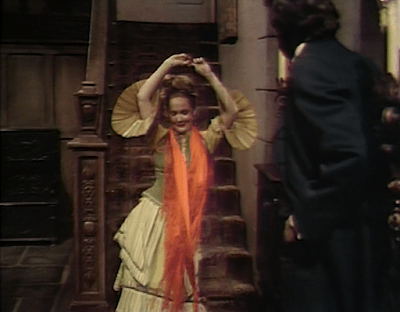
Quentin shows up. Charity’s father, the evil Gregory Trask, has directed her to marry Quentin, and she has set out to comply with this command. Quentin has never shown the slightest interest in her in their time awake together, and he isn’t much friendlier in this dream. He asks her to do something to lighten his mood. “Can’t you be happy? Can’t you be gay? Don’t you want to make me happy?” We’ve never seen her happy; as Gregory’s daughter, it’s hard to see how she could be. She has probably never tried to be gay, either, but it would have to be better than marrying Quentin. She does try to make him happy by imitating Cockney showgirl Pansy Faye, whom she never met or saw or heard, but whose spirit has been possessing her off and on for several days now. She sings Pansy’s theme song and does the highly suggestive dance that goes with it, only to find that Quentin has vanished.
Charity turns and finds Quentin embracing and kissing another girl. They are laughing. Quentin tells Charity that, as she can see, she has succeeded in cheering him up, and therefore she should run along. He and the girl then disappear and Magda enters. Magda tells Charity that she should forget Quentin, because he has a terrible secret. She leaves, and Quentin and the other woman reappear, still laughing at Charity.
Charity decides to ask Magda to explain the dream. Before she reaches the Old House, she finds Quentin and the girl from the dream lying on the ground in the woods. Quentin’s clothing is torn and he is unconscious, but he does not appear to be injured. The girl’s face is covered with what in black and white look like slash marks, but in color are obviously purple makeup. She opens her eyes and gasps Quentin’s name. Whether she was calling for Quentin because he was with her when they were attacked or crying out because he is the one who attacked her would not be clear to first time viewers, though returning viewers know that Quentin is a werewolf and will assume he was the attacker.
The 150 year old evil sorcerer Count Petofi has taken possession of twelve year old Jamison Collins. Jamison/ Petofi has been casting spells to make the various residents of the estate of Collinwood reveal their true selves. Jamison’s distant cousin, Barnabas the vampire, has locked Jamison/ Petofi in the prison cell in the basement of the Old House on the estate. When Barnabas says that he will let Jamison out once Petofi has vacated his body, Jamison/ Petofi replies “If that is what you intend to do, Mr Collins, I’m afraid that you are stupid and incompetent.” There is no need to cast a spell on Barnabas- Maker of Stupid and Incompetent Plans is his true self, and we love him for it.
The great house on the estate is currently under the legal authority of the evil Rev’d Gregory Trask, husband of Judith Collins, who is a patient in a mental hospital. Jamison/ Petofi’s spell has caused Trask’s daughter Charity to be intermittently possessed by the spirit of Cockney showgirl Pansy Faye. Trask is horror-stricken by the makeup, clothes, and hairstyle Charity wears when Pansy is in charge of her, and her East London accent, insouciant attitude towards him, and tendency to sing and dance escalate this horror further. Nancy Barrett and Jerry Lacy are both talented comic actors, and their scenes as Charity/ Pansy and Trask are hilarious.
Collins family lawyer Evan Hanley is at home. Barnabas appears in Evan’s drawing room and asks for some information which Evan denies having. Evan tells Barnabas he has renounced his former interest in black magic and Satanism. Barnabas is skeptical, and Evan replies that his latest forays resulted in a gruesome disfigurement of his face. This disfigurement was later relieved, how we (frustratingly) do not know. But he wants nothing more to do with the occult, since he values the ability to look at himself in the mirror. Barnabas reminds Evan that he cannot see himself in a mirror, implying that he will use his vampire powers against him if he does not cooperate.
Trask comes to Evan’s house. He asks him to draw up papers that will complete his plan to seize control of all the Collins family’s assets. He mentions in passing that Jamison thinks he is Petofi. Evan knows enough about Petofi to be terrified. He tells Trask that neither of them has a chance in a battle with Petofi, and refuses to draw up the papers. Trask responds contemptuously.
Alone in the cell, Jamison/ Petofi decides to have some fun with Evan. We see Evan dozing in his armchair. He has a dream in which Jamison appears. Jamison kisses him; it is by his kisses that Petofi spreads the “true self” spell. Later, Evan goes to the great house at Collinwood and presents Trask with a paper to sign. Trask signs it eagerly, assuming it is the document he asked Evan to bring him. Instead, Evan has prepared a full confession to the murder of Trask’s first wife Minerva. The two of them plotted this murder together, and Trask is horrified when he sees his signature on it. He throws the paper in the fire; after he leaves the room, it rematerializes on the desk, complete with signatures.
During Trask’s confrontation with Charity/ Pansy Faye, the picture suddenly changes from color to sepia tone. After about a half a minute, it changes back. Evidently there was a fault in the videotape master at this point, and an excerpt from the kinescope was used to patch it. The color comes back right after Trask slaps Charity/ Pansy, causing Pansy to release Charity for a bit. It creates the eerie feeling that Trask somehow fixed our TV set by slapping her.
Dark Shadows continually comments on itself as it goes along. In the early days, all the episodes were scripted by Art Wallace. Wallace’s favorite method of composition was a sort of diptych, in which two sets of characters faced similar situations and responded to them differently, highlighting the contrast between their personalities. Petofi’s “true self” spell is of course another way of creating similar contrasts between characters played by the same actor.
As the show came to focus on time travel stories, they could cast actors as characters who represent alternative versions of parts they played in other periods, again putting characters played by the same actors in contrast with one another. And as Wallace would juxtapose similar situations within a single episode, the multiple times periods allowed them to take themes that had been developed in one way in a story set in one year and develop them differently in a story set in another. So Jamison/ Petofi’s contagious curse is a reworking of the “Dream Curse,” which dragged on from April to July 1968. The Dream Curse involved a lot of repetition and very little variety of tone. Jamison/ Petofi’s spells all get right to the point, and are sometimes scary, sometimes bizarre, and often quite funny. So the second time is definitely the charm here.
At one point Charity holds a recorder and tells her father she wants to learn how to play it. The first time we saw this prop was in #260. That episode was set in 1967, and Barnabas was holding Maggie Evans, The Nicest Girl in Town, prisoner in the cell where Jamison/ Petofi is today. The ghost of Barnabas’ little sister Sarah befriended Maggie, and materialized in the cell playing “London Bridge” on that recorder. Over the next several months, the recorder came to be a symbol of Sarah, one that she occasionally left behind as a sign that she had been in a place. Longtime fans will likely remember that, and see it as an indication that what is happening to Charity is going to have permanent consequences, as Sarah’s haunting had permanent consequences.
The evil Count Petofi, a 150 year old sorcerer, has taken possession of twelve year old Jamison Collins and is wreaking havoc in the great house of Collinwood. Due to Petofi’s spells, Jamison’s father Edward thinks he is a valet recently separated from the service of the Earl of Hampshire. Edward’s brother Quentin tries to explain to him what is actually going on, but Edward merely concludes that he is Quentin’s valet now. When Quentin follows the Collinses’ long-established protocol for dealing with mentally ill family members and locks Edward in the tower room, Edward bangs on the door and protests that he won’t be able to do his job if he is locked up. “And I will do it!” he vows.
Charity Trask, disastrously uptight step-daughter of Quentin and Edward’s sister Judith, falls under Petofi’s influence and is possessed by the spirit of Cockney showgirl Pansy Faye. Pansy was on the show briefly in June. The childlike Carl Collins, brother to Judith, Edward, and Quentin, was engaged to marry Pansy before she was killed by vampire Dirk Wilkins. Pansy and Charity never met; when Carl asked Charity if she had seen Pansy, the scene was staged to make it seem absurd that the two women could exist in the same universe. Now, they exist in the same body.
If Petofi has caused startling changes in Jamison, Edward, and Charity, the change in Quentin is perhaps the most jarring of all. He has been a ghost, a homicidal maniac, a Satanist, a zombie, and a werewolf, but always and everywhere a source of total chaos, who destroys all recognized order and is perfectly at home in the midst of sheer madness. Today, Quentin keeps making earnest attempts to restore everyone to their right minds and reestablish the proper and respectable relations within the household.
First time viewers will immediately catch on that the preteen David Henesy is not the actor who would usually play a 150 year old Hungarian nobleman, and when Nancy Barrett suddenly takes on an East London accent and enters wearing a garish costume and doing a dance with lot of hip shaking and pelvic thrusts, they will know that Charity is turning into someone else. The dialogue in the scenes involving Edward explains what is happening to him. They may not know that Quentin is not supposed to be the defender of the status quo. That information is supplied in two scenes. Charity/ Pansy receives a psychic message from the world beyond telling her that Quentin was involved in the murder of Carl, and she announces this information. Also, Quentin calls for help, and the helper who materializes is his distant cousin, Barnabas Collins the vampire.
At the end of the episode, Barnabas lays hold of Jamison/ Petofi and drags him into the secret passage leading from the drawing room to the west wing. It is usually bad news when a vampire abducts a child and shoves him into a dark space, but David Henesy brings such joy to the role of Jamison/ Petofi that we can hardly doubt that what comes next will be equally fun to watch.
Meanwhile, a painter named Charles Delaware Tate has presented himself. Tate’s first appearance will cause a sinking sensation in longtime viewers; he is played by Roger Davis, a terrible actor who delivers much of his dialogue by shouting while clenching the sphincter muscles in his buttocks, and who routinely assaults the women and children in the cast while on camera. We may have hoped we had seen the last of Mr Davis when his most recent character, Dirk, was destroyed shortly after murdering Pansy. But evidently Pansy’s return in the form of another actress has come at the price of Mr Davis’ return in the guise of another character.
For much of 1968, Mr Davis played a man known variously as Peter Bradford and Jeff Clark. His approach to characterization consisted of shouting “My name is Jeff Clark!” When this technique was played out, he took to shouting “My name is Peter Bradford!” He doesn’t shout today, mercifully. But he does say the name “Charles Delaware Tate” quite a few times.
Today’s story about Tate is potentially interesting. Jamison/ Petofi finds him when he answers the front door. Tate asks to see Jamison Collins; Jamison/ Petofi confirms that despite his appearance, he is indeed the person Tate has come to see. Tate accepts this with a blandness that suggests that he knows he is dealing with a magical personage.
Jamison/ Petofi gives Tate a photograph of Quentin and says that he wants a portrait of him. When Quentin comes to the drawing room and finds Tate sketching, he asks who he is. Again, Quentin adopts a stern tone which suits someone defending the sanctity of private property against an unknown intruder. Tate introduces himself and shows him a handwritten letter which Quentin instantly accepts as the product of his grandmother Edith. He tells Tate that Edith has been dead for some time and that he is not interested in a portrait of himself. Tate says that he has already accepted the commission and the money that Edith sent with it, and so he will rent lodgings in the village of Collinsport and finish the job regardless. Quentin does what viewers have hoped everyone who shared a scene with one of Mr Davis’ characters would do, and throws him out.
The forged letter is a fascinating touch for returning viewers. Petofi made himself welcome as a guest at Collinwood by showing Edward forged papers creating the impression that he shared Edward’s friendship with the Earl of Hampshire. That he has also created papers that Quentin immediately accepts as coming from Edith, who died long before Petofi had any reason to come to Collinwood, suggests that his powers of forgery are very extensive indeed.
Tate not only seems to know that Petofi has magical powers; he also shows an acquaintance with Petofi’s henchman Aristide.* When Tate mentions Aristide, he calls him “Aristeedy,” a sort of pet name with a diminutive suffix. This is probably just a blooper on the part of Mr Davis, but since Petofi is continually telling Aristide how lovely he is and how he is more attractive when he doesn’t speak, it does remind us of the gay subtext that runs through their scenes together. We might suspect that Petofi and Aristide’s sexuality is in one way or another one of the reasons they are connected to Tate.
The script opens all of these questions about Tate. Had he been played by an actor who was capable of depicting depth and highlighting ambiguity, it could have been a lot of fun to speculate about just what their answers might be. In #137, future movie star Frederic Forrest was a featured extra on the dance floor at The Blue Whale tavern; it’s easy to suppose he would have taken a speaking part. So when the show puts Mr Davis in front of us, I like to make the time a little more tolerable by imagining what Forrest might have brought to the role of Tate.
*His name is spelled “Aristede” in the closing credits, but it was “Aristide” in the original scripts.
A lot happens in this one. Inveterate prankster Carl Collins realizes that his fiancée, Cockney showgirl Pansy Faye, is dead. He has a dream in which he meets Pansy backstage as she is preparing for her final performance, then sees her standing on stage before him, his sister Judith, and their distant cousin Barnabas; when he awakes from the dream, Carl is sure he has figured out what happened to Pansy, and he sets out for the very place where Barnabas is planning to rest during the day. This seems to imply that Carl will discover that Barnabas is a vampire.
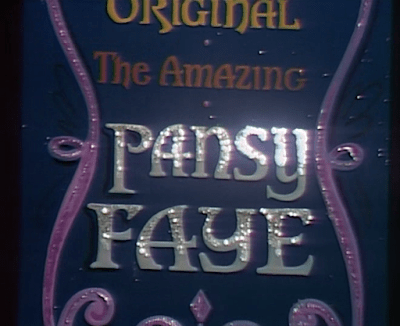
The dream sequence is like nothing we’ve seen before on Dark Shadows, though it is strongly reminiscent of the kind of thing you would have seen on near-contemporary shows like ABC’s prime-time horror anthology Night Gallery hosted by Rod Serling and the Paulist Fathers’ syndicated morality plays Insight hosted by the Rev’d Fr Ellwood Kieser. It starts with a closeup of a sign on which Pansy’s name is emblazoned in glittery letters, and plays over a soundtrack of an audience applauding thunderously. Pansy calls Judith, Barnabas, and Carl to join her on stage, each in their turn; their behavior in this drama-within-a-drama mirrors their behavior in the framing narrative.
Meanwhile, Barnabas’ unwilling sidekick, broad ethnic stereotype Magda Rákóczi, has returned from Boston. There, she met with a leading member of the Romani people, whose name she alternately pronounces as “King Johnny Romana” and “King Johnny Romano.” She shows Barnabas a box she took from King Johnny. It contains a severed hand wearing a ring, which Magda declares will solve their troubles. Magda has placed a curse on Judith and Carl’s brother Quentin, turning Quentin into a werewolf. After placing that curse, Magda learned that her sister Jenny had borne two children to Quentin, and since the curse is hereditary she is desperate to find a way to lift it. Barnabas traveled back in time to 1897 in the course of his own attempt to resist the effects Magda’s curse will have in 1969, so they are allied in this effort.
Barnabas is utterly unimpressed with the hand and with Magda’s plan to place it on Quentin as he is about to transform. He seems convinced that Magda is just trying to conceal the fact that she failed to find anyone in King Johnny’s camp who could actually help them. He doesn’t care about the original owner of the hand, a legendary nobleman named Count Petofi who was himself cured of lycanthropy, or about an incantation Magda says over the hand that is supposed to prepare it to draw the curse from Quentin. He isn’t even interested when she admits that she stole the hand from King Johnny and that if they don’t get it back to him before he realizes it is missing he will send someone to kill her. He reacts as if the whole thing is a show she is putting on to build up her cover story.
In a metafictional set of way, Barnabas is onto something. The original storylines the writers had prepared for the 1897 segment are coming to a head. Several of its major characters have already died, and others, such as Carl, would not be very attractive customers for a life insurance salesman. Apparently the original flimsies, written six months ago, gave only a few more weeks until Barnabas was to return to 1969 and take the show back to contemporary dress. But 1897 is a hit. The ratings are soaring, and there are some dynamics among the characters that they want to explore in a lot more depth. So they want to stay, but to keep the momentum going they need more story and a number of new characters, including a major villain whom Barnabas and Quentin can team up to fight together. So the writers find themselves in the same position with regard to us that Magda is in with regard to Barnabas, trying to sell us on their latest preposterous brainstorm.
Pansy’s farewell performance in Carl’s dream is, alas, Kay Frye’s final appearance on Dark Shadows. Some fans seem unable to look past Pansy’s own hilariously inept performance when we first see her doing her act, and to see that Miss Frye herself does a terrific job playing a cold, cynical working girl. She is good today, when Pansy is on stage and in her character as the “world-famous mentalist and singer,” but is also trying to tell Carl the truth about Barnabas. I only wish they could have brought Miss Frye back as someone else, either in the extended 1897 segment or in another time period.
The opening voiceover, delivered by Kay Frye, tells us that a vampire named Dirk Wilkins has been destroyed. We hear that Dirk was the pawn of someone called Barnabas Collins, who hoped to use him to conceal a secret of his own. The narrator also says that “certain things cannot be forgotten, as Judith Collins will learn this day.” This implies that the day’s action will center on challenges in information management.
Returning viewers may not recognize Miss Frye’s voice. We have seen her as Pansy Faye, Cockney showgirl, improbable fiancée of prankster Carl Collins, and victim of Dirk’s first murder. As narrator, Miss Frye forgoes Pansy’s rather uncertain East London accent. She also takes a different approach to the role of narrator than she had to that of Pansy. When we first saw her, Pansy was putting on an act for Carl’s benefit, and Pansy is a terrible actress. When Carl left, Pansy dropped her act and we could see that Miss Frye is as capable a performer as the character is a poor one. Today’s voiceover gives Miss Frye a still better role. The crass and cynical Pansy did not call for much nuance. But as narrator, Miss Frye speaks with a quiet urgency and subtle modulation of the voice that leaves us wondering what might have been had she been cast in a bigger part.
We cut to what regular viewers recognize as the drawing room of the great house of Collinwood in the year 1897, where a man in a cassock is talking tenderly with a woman in a colorful dress. The man is very affectionate, even stroking the woman’s neck with two fingers.
The woman is the Judith Collins mentioned in the opening voiceover; the man is the Rev’d Gregory Trask. It is not mentioned in the episode, but Trask is the keeper of a boarding school called Worthington Hall. Also unmentioned is that Trask conspired with a Satanist named Evan Hanley to brainwash a young man named Tim Shaw, one of the teachers at Worthington Hall, and that once he was under their control they used Tim to murder Trask’s wife Minerva. Trask wanted Minerva out of the way, evidently because he plans to marry Judith and take control of her vast fortune.
Judith is disconsolate at the thought that she was under Dirk’s control. While Trask is talking sweetly to Judith, Tim enters. Trask pulls a gun on him and instructs Judith to call the police and report that Minerva’s murderer has been captured.
Tim, who has up to this point ranged from mousy to timid to utterly defeated, is suddenly assertive. He tells Judith that she won’t want to telephone the sheriff. He says that there are two murderers at Collinwood, and she is one of them.
Tim says that he came upon Judith in the act of shooting neurotic intellectual Rachel Drummond to death. Returning viewers know that this is true; Tim, Judith, and Rachel were all under Dirk’s power at the time, and for reasons that made sense only to the dim-witted Dirk he ordered Judith to kill Rachel. A vague memory comes back to Judith and prompts her to confess; when Trask realizes that Tim will not back down from his accusation and Judith will not participate in a cover-up, he tells Tim he will make a deal with him.
Trask calls the sheriff. He addresses himself to “Sheriff Furman,” a name we have not heard before. It quickly becomes clear that we are not likely to hear it again. He tells the sheriff that Tim was out of town the night Minerva was poisoned and that, in his grief, he had forgotten this fact. Returning viewers know that Evan has told the sheriff that he saw Tim with Minerva while she was dying. One might assume that Trask would at least have to call Evan first to ensure that he gave the sheriff a story to account for this discrepancy, but Trask doesn’t bother to contact Evan at all. Evidently the sheriff is such an abysmal moron that Trask can safely assume he won’t think of any questions.
Sheriff Furman’s manifest incompetence prompts one of Danny Horn’s funniest posts at Dark Shadows Every Day, in which he writes a series of hypothetical police reports about the killings we have seen so far in the 1897 segment. One of Danny’s recurring themes is that law enforcement characters on Dark Shadows serve only to delay the plot. There is so much story in 1897 that the producers saw no need to slow things down, so it shouldn’t be surprising that neither Sheriff Furman nor any of his deputies appear on-screen.
For my part, I wish they had stayed in 1897 considerably longer, so I would have liked to spend one day a week or so without much forward narrative movement. That might have included some episodes when the police show up and you do a lot of recapping, some built around character studies of the type Joe Caldwell wrote so well in 1967, some in which we reconnect with Collinwood as it is on the night in 1969 when Barnabas left for the past, and so on. Not only would that have extended the show’s strongest period and helped new viewers catch up to what is going on, it would also have enabled them to make more use of the many fine actors whom we go weeks on end without seeing. Even David Selby, whose handsome rake Quentin Collins is breaking out as a pop culture sensation at this point, hasn’t been on the show since #768. Other fan favorites are in the midst of even longer unexplained absences; for example, Lara Parker’s wicked witch Angelique has not been seen since #760.
Tim, who was out of the room while Trask was on the phone, returns. He “gladly!” agrees to leave Trask’s employ, and at first says that he will “gladly” leave the village of Collinsport. But then it dawns on him that he needs a job, and he blackmails Judith into assuring him that she will find a place for him in her business.
This will remind longtime viewers of the spring and early summer of 1967. At that time, Dark Shadows took place in a contemporary setting, and there were two major storylines. One was the introduction of the vampire Barnabas Collins. The other was the blackmail of matriarch Elizabeth Collins Stoddard by seagoing con man Jason McGuire. Like Judith, Liz owns all of the Collins family’s assets; also like her, she is played by Joan Bennett. Threatening to expose the terrible secret that she was a murderer, Jason forced Liz to take him into her home, pay his debts, give him a job, and agree to marry him. When she finally balked rather than go through with the marriage, it turned out Liz wasn’t a murderer after all, the whole thing was a scam Jason cooked up.
Jason was a short-term character brought on to tie up the last non-supernatural narrative loose ends and fill time while Barnabas found his footing, as witness the casting of Dennis Patrick, who refused to sign a contract for the role since he wanted to be free to move to Los Angeles without giving more than 24 hours notice. But in those days, before the internet or soap opera magazines, the audience had no way of knowing that. They may well have thought that Barnabas would be destroyed and Jason’s oppression of Liz would become the show’s backbone.
In yesterday’s episode, a vampire was in fact destroyed. In May and June 1967, Barnabas’ chief victim was Maggie Evans, who like Rachel was played by Kathryn Leigh Scott. It was possible then that he would kill Maggie and that she would rise as a vampire, as Lucy Westenra did in Bram Stoker’s Dracula, compelling the good guys to stake her. Rachel doesn’t become a vampire, but Trask does tell the sheriff that it was the men hunting Dirk who shot her, accidentally. So when the final appearances of Dirk and Rachel lead to Judith both submitting to blackmail because of her mistaken belief that she is a murderer and taking steps towards marrying an overwhelmingly evil man, longtime viewers will remember a resolution that seemed to be on the horizon back in 1967.
Carl enters. Judith has no patience for her childish brother, and dismisses his concerns about Pansy. She tells Carl to go with Tim to the Old House on the estate. Tim took Rachel to the Old House when she was dying. Barnabas, who has traveled back in time to 1897, is staying there, and he had befriended Rachel. Tim had hoped Barnabas would help them, but it was daylight and he was not available. Rachel died in the Old House, and Tim left her corpse there when he came to the great house.
When Carl and Tim leave, Trask warns Judith that she almost gave herself away. “You must be more cautious, Judith! Even Carl was suspicious.” Judith agrees, showing that Trask is luring her into his world of lies.
We see Tim and Carl at the Old House. Rachel’s body is no longer there. Who took it, and why didn’t Tim and Carl leave with them? We are not told. Carl goes on about how wonderful Pansy is, and says he is going to the police because he thinks someone at Collinwood has done her harm. Evidently Carl’s suspicions are more highly developed than Trask realizes. Trask underestimates Carl because he is focused exclusively on Rachel and Tim. He never met Pansy, and knows nothing about her.
Carl leaves the house, and Pansy’s ghost appears to Tim. Tim is bewildered, and asks Pansy if she is looking for Barnabas. That is a natural assumption- after all, it is Barnabas’ house and Tim has no idea who Pansy is. When she vanishes into thin air, he shouts for Carl. He finds Carl not far outside the door, and describes the woman he saw. Carl jumps to the conclusion that she is Pansy, and starts calling for her. He sends Tim along to the great house, and continues searching for Pansy.
Evidently Carl’s search did not take long, because we see him standing next to Tim in the drawing room at the great house in the next shot. It is Rachel’s funeral.
Trask delivers a eulogy in which he says of Rachel that “The littlest angels have a new teacher.” Even first-time viewers are likely to laugh out loud at this ridiculous turn of phrase, and those who have been with the show for a while will see more in it than that. From childhood on, Rachel was Trask’s prisoner, first as one of the pupils imprisoned in his horrible school, then when he extorted her into staying on as a teacher with threats that he would have her prosecuted on false charges of theft and murder if she tried to leave. He made flagrant sexual advances to her as well, all the more hideous because he has been responsible for her since she was a small girl. In Rachel and Tim’s helpless personalities, we saw what can happen when a criminal like Trask is given an opportunity to turn a person into filet of human being, and an ominous sign of what might lie in store for Judith’s nephew and niece Jamison and Nora, who are currently among the inmates at Worthington Hall.
Tim and Carl bury Rachel themselves. My wife, Mrs Acilius, asked “Isn’t this usually handled by professionals?” Presumably whoever took Rachel’s body from the Old House would have been a better choice for the work than are Tim and Carl, but that isn’t the Collins way.
Tim announces his intention to get drunk. Carl brings up other things they might do, and Tim says that those will have to wait until after he gets drunk. After Tim leaves to pursue his eminently sound plan, Carl hears Pansy singing. He wonders if she is dead. He realizes that her voice is coming from the mausoleum which we know to have been Barnabas’ longtime home. Carl is played by John Karlen, who in the parts of Dark Shadows set in the 1960s plays the luckless Willie Loomis. It was Willie who inadvertently released Barnabas from the mausoleum, so longtime viewers who see this actor on this set will expect something important to happen in the story.
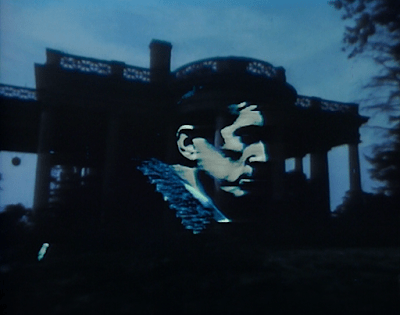
The opening voiceover plays over this image, a type of visual effect we have not seen before at the beginning of an episode:
A transparent sticker of Barnabas superimposed on the exterior of the Old House. Screenshot by Dark Shadows Before I Die.
Barnabas Collins has bitten dimwitted servant Dirk Wilkins, turning Dirk into a vampire like himself. Barnabas has been out all night, searching for Dirk’s hiding place. He hopes to expose Dirk and frame him for his own crimes.
Barnabas comes home to the Old House on the estate of Collinwood to find that Dirk seems to be trying to do the same thing to him. There is a blood-drained corpse in an armchair in his front parlor. It is that of Miss Pansy Faye, Cockney showgirl and Dirk’s first victim.
Barnabas’ distant cousins live in the great house on the estate. One of them, prankster Carl Collins, brought Pansy home with the intention of making her his bride. No sooner does Barnabas discover Pansy’s remains than Carl starts banging on the front door, shouting that he wants to speak with her.
Barnabas hides what’s left of Pansy in a secret chamber behind a bookcase, then lets Carl in. Grisly as the circumstances are, one person lying to another about the presence of a third nearby is a stock situation from farce, and John Karlen and Jonathan Frid play the scene with the particular brand of desperate seriousness that only works in farce. Barnabas persuades Carl to go away and search the grounds of the estate.
That takes a few minutes, starting from what the opening voiceover told us in so many words was “an hour before dawn.” In what remains of that hour, Barnabas takes Pansy’s body to a cemetery and buries her in a shallow grave between tombstones, telling her to “rest in peace.”
Barnabas comes home, and finds Carl, who has in the interval not only gone to the great house, the groundskeeper’s cottage, and a house on the estate which is currently occupied by a school, but has also gone into the village of Collinsport and made inquiries about Pansy. A speedy bunch, the Collinses.
Before Barnabas returned to the house, Carl had heard Pansy’s disembodied voice singing the song she had so memorably performed for Barnabas in yesterday’s episode. He had spoken to Pansy’s voice telling her that his grandmother’s will gave him a house to live in and that she could live there with him. This is puzzling for returning viewers. In #714, it was made perfectly clear that the will did not mention Carl at all. Edith Collins left her entire estate to Carl’s sister Judith, and the only one of the brothers who was mentioned was Quentin, who received no money or negotiable assets of any kind but who was guaranteed the right to stay at Collinwood as long as he pleased. Perhaps they are retconning that away, perhaps Carl is lying to Pansy, or perhaps Carl is losing his grip on reality.
Whether or not we are supposed to doubt Carl’s sanity, Barnabas talks Carl into suspecting that he might have hallucinated Pansy’s voice. Carl leaves, and Barnabas has time to return to his coffin before dawn.
The rest of the episode is taken up with doings at the school Carl had visited. We saw Carl questioning Charity Trask, daughter of the school’s master, the overwhelmingly evil Gregory Trask. The prim Charity was exasperated that Carl kept asking about Pansy after she had already denied having seen her. The scene is an interesting one- Charity and Pansy are such total opposites that it is a shame they never met. It would be amusing to see them juxtaposed.
Charity is engaged to marry Tim Shaw, a teacher at the school. Neither of them is happy about this situation. Tim was in love with Rachel Drummond, another of the teachers, and Charity is Barnabas’ blood thrall. But Gregory blackmailed Tim and bullied Charity into accepting the arrangement.
Charity’s mother, prudish Minerva Trask, does not like Tim or want him as a son-in-law. She urges Charity to set her sights on Carl. Charity says that she would rather marry Barnabas; Minerva says that her instincts are sound, but that she ought not to settle for a cousin of the rich Collinses when one of the brothers is available. Even if they have retconned Carl into owning a house, he is clearly not a rich man, so this reveals that Minerva knows as little about his financial position as she does about the curse under which Barnabas labors.
Charity tries to engage Tim in conversation, and is baffled that he is not willing to talk to her. Indeed, he does not seem like himself at all. Not only is he dismissive with Charity, but when Minerva confronts him he is bold and insolent, a far cry from the broken man we have seen interacting with the Trasks previously. When Charity tells him their engagement is off, he does not express the relief that she and we expect, but puts on a stagey voice we have not heard him use before and marches off to apologize to her mother.
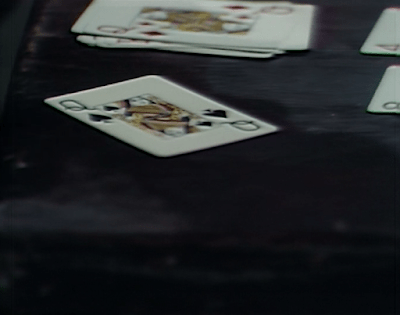
There is a reason for Tim’s behavior. Gregory enlisted warlock Evan Hanley to brainwash Tim so that he would kill Minerva. There is some business with the Queen of Spades, first when Tim mutters the phrase “Queen of Spades,” then when Evan sends him a note on which is scrawled “Queen of Spades,” and lastly when he walks in on Minerva playing solitaire and sees her turn up the Queen of Spades. Many viewers in 1969 would have remembered Richard Condon’s 1959 novel The Manchurian Candidate and its 1962 film version. In Condon’s novel, Raymond Shaw became a robot capable of murder when he saw the Queen of Hearts; in the film, the card was the Queen of Diamonds. Many first time viewers, seeing Tim Shaw’s reaction to the Queen of Spades, would have made the connection and understood why he ends the episode by poisoning Minerva’s tea.
Tim Shaw differs from Raymond Shaw in that he is under a spell for a long while, including the whole time we see him today, and he can talk and act independently while it operates on him. Raymond simply became catatonic when he saw the card and remained that way until he heard a command. He then executed the command and came back to himself once he was finished. Tim’s behavior may suggest a nod to another literary work, Pushkin’s story “The Queen of Spades.” That tale, which Tchaikovsky turned into an opera and which in 1949 was made into a feature film, is about a timid man who inadvertently kills a powerful woman and loses control of himself as a consequence. Like Tim, Captain Herman is coerced into marrying a woman he does not love. Presented with an opportunity to get out of the marriage, he finds himself making extraordinary efforts to go through with it, efforts which bring about his ultimate downfall.
Vampire Barnabas Collins is about to leave his house with his thrall, maidservant Beth Chavez, to look for Dirk Wilkins, a dimwitted servant whom he inadvertently turned into a vampire and let go. They are stopped when Barnabas’ distant cousin, inveterate prankster Carl Collins, comes in and insists on telling him about his recent trip to “Atlantic City, New Jersey, the Queen of the Boardwalk cities!”
Carl offers Barnabas some saltwater taffy, only to find that the tin is empty. He frets that “she” must have eaten it all on the trip back- “You know how women eat when they are nervous.” This leads to Carl’s second order of business, introducing Barnabas to Miss Pansy Faye. Carl met Pansy on the train, and he intends to marry her.
Carl opens the door, then stands before Barnabas and Beth and announces in his most booming voice “Presenting! Direct from her triumphs before Her Imperial Majesty, Queen Victoria of England, that world-famous mentalist and most beguiling songstress, Miss Pansy Faye!” Pansy enters, singing and dancing. In a vaguely Cockney accent, she intones:
I’m gonna dance for you! Gonna dance your cares away. I’ll do the Hoochie Koo, and the Ta Ra Boom De Ay! I’ll sing a happy song, as we dance the whole night long! When the music begins, I’ll give you some spins, I’ll even invent a step or two! So, on with the show! You’ll love it, I know! Oh, I’m going to dance for you!
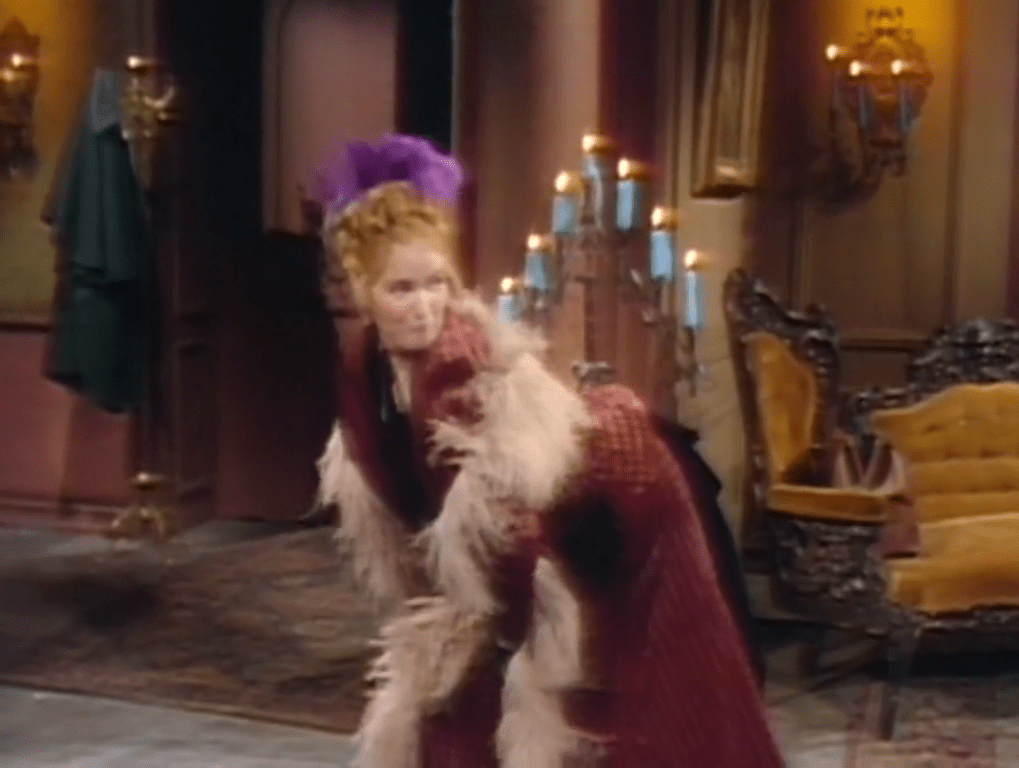
Pansy’s dance is not particularly elaborate; it is performed almost entirely below the waist, and ends with her bending over and thrusting her rear end upward. That is followed by a cut to Barnabas wearing a look of stupefaction that all the black magic and demonic intrusions he has witnessed over the centuries have not elicited. He turns to Beth, who is visibly struggling to keep a straight face.
Against the backing track of Dark Shadows super-solemn music, this scene is hilarious. Longtime viewers will savor it even more than others. Carl is played by John Karlen, who in the parts of Dark Shadows set in the 1960s plays the luckless Willie Loomis, Barnabas’ first blood thrall. When Barnabas first enslaved Willie in the spring and summer of 1967, the show was at its bleakest. Barnabas was able to fool his distant relatives in the great house into regarding him as a living being and letting him occupy the Old House, but that was only because they had been isolated and embattled for so many months before. When we saw Barnabas and Willie on this set in those days, Barnabas was as grim as death itself, beating Willie with his heavy cane whenever he dared do more than whimper. That Karlen is now here as the man who is introducing a character as exuberantly and preposterously alive as Pansy and that Barnabas’ current thrall is suppressing a laugh takes the despair of that period and packs it with joy.
The despair reasserts itself at the close of the episode. Pansy will go out into the woods, Dirk will take her as his first victim, and Barnabas will come home to discover her body propped up in a chair in the parlor. But the comedy in between is so strong that we can be confident that this will not be the last word. Carl tries to persuade his sister, spinster Judith, to accept his marriage to Pansy. He tells her that he is a new man thanks to Pansy’s influence; he has actually managed to go 48 hours without playing a practical joke. Judith is impressed by this new record, but still will not believe that Pansy is fit to become a Collins. She controls all the family’s wealth, and threatens to cut Carl off without a penny if he goes through with the marriage. He reacts with a series of facial expressions that the Three Stooges would have admired.
While Barnabas and Carl are out, Pansy stays in the Old House with Beth. Beth offers her a cup of coffee; Pansy says she would prefer sherry. Beth goes to look for sherry, and Pansy is caught off-guard that Beth doesn’t live there. When Beth says that she is based at the big house on the property, Pansy asks how big it is. Beth says that it is very big indeed; Pansy says that Carl had told her it was like a palace, and Beth confirms that it is indeed on that scale. Pansy is surprised that Carl was telling her the truth. She takes the drink at a single gulp. With Carl, Pansy was acting a part, and she was a terrible actress indeed. Alone with Beth, she drops the act. The Cockney accent is still not too well-developed, but Kay Frye is much more convincing as a hard-boiled working class woman than Pansy is in any of her roles.
Carl persuades Judith to sit still in Barnabas’ parlor while Pansy does her mentalist act, trying to locate Dirk. Pansy actually goes into a trance and announces that Dirk is dead and his murderer is in the room. When she comes to, Pansy is as surprised as anyone at what happened. Judith is demanding an apology, and Pansy is shocked when Barnabas tells her that she accused someone in the room of murder. A moment later, she is alone, wondering what came over her and lamenting that she “mucked that one up.”
The Old House is a dangerous place to be a fake practitioner of supernatural arts. In #400, set in the 1790s, fanatical but inept witchfinder the Rev’d Mr Trask performed an exorcism of the Old House, and was visibly delighted when that exorcism seemed to work. That time it was the intervention of wicked witch Angelique that gave Trask his apparent success, but now it seems that Pansy is simply getting it right for the first time.
That Dirk leaves Pansy in a chair in Barnabas’ front parlor is also something that will bring back memories for longtime viewers. In the 1790s segment, another brassy dame on the make brightened up the show for a little while before meeting a grisly demise on this spot. She was Suki Forbes, estranged wife of untrustworthy naval officer Nathan Forbes. Barnabas strangled Suki in #423, after she had discovered his secret. Suki took until #424 to die, but did not manage to disclose what she knew about Barnabas.
An even closer parallel is to #530. In that one, Frankenstein’s monster Adam hates Barnabas for making him what he is. Adam attacks a man called Joe Haskell and thinks he has killed him. At the end of the episode, Barnabas finds that Adam has planted Joe’s body in the front parlor. Any doubt that Adam was trying to frame Barnabas for Joe’s murder would be removed by consulting the novel Frankenstein, in which the Creature frames another character for the murder of his creator’s brother. Dirk knows that Barnabas made him into a vampire, and so has the same motivation to pin a murder charge on Barnabas that Adam had.
Adam was just a few months old when he tried to frame Barnabas for murder, and Dirk is a simpleton. Neither of them had the skills to get the police interested in Barnabas, no matter how many dead bodies they add to the decor of his house. On the other hand, Barnabas himself once very nearly managed to make such a plan work. In #440 and #441, part of the 1790s segment, Barnabas left the corpse of his victim Maude Browning in a bed belonging to Trask. It was only Nathan Forbes’ timely intervention that kept Trask from the gallows that time.





 Dark Shadows Commentary