The Leviathan People, a race of Elder Gods, are planning to retake the Earth from humankind. Step one in their plan was to bring old world gentleman Barnabas Collins under their sway and make him the leader of a secret cult headquartered in the village of Collinsport, Maine. Step two was to bring a shape-shifting monster from beyond time and space to life and put him up in a room above an antique shop in the village. Step three is to get heiress Carolyn Collins Stoddard, Barnabas’ distant cousin, to pair up with the monster and turn into a creature like him.
The monster usually takes the form of a young man. When he first appeared in this guise, he said he wanted to be called “Jabe” For all his powers and his willingness to kill, he can’t persuade anyone to use that name, so he answers to “Jeb.” Jabe has somehow succeeded in charming Carolyn, but his personality drove Barnabas away from the cult. Determined to prevent Jabe from having his way with Carolyn, Barnabas has enlisted another distant cousin, Quentin Collins, among his allies in this battle.
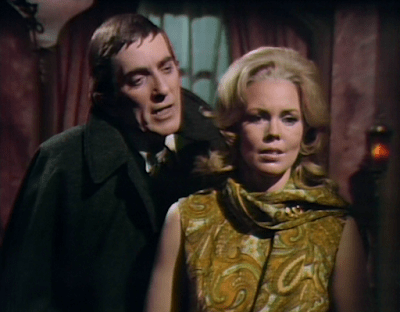
For the last few days, Barnabas has been telling Quentin and his other comrades that their only resource against the Leviathans is that Jabe and his loyalists still trust him. Today Jabe comes to the great house of Collinwood and has an argument with Barnabas and Quentin. Jabe accuses Barnabas of disloyalty, and Barnabas immediately declares that he never believed in the Leviathan cause and will do everything in his power to defeat it.
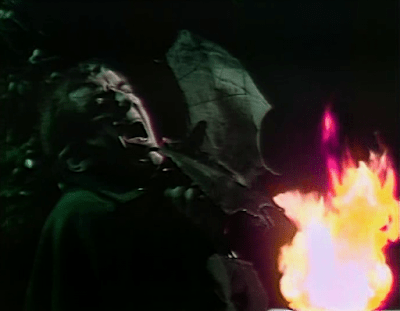
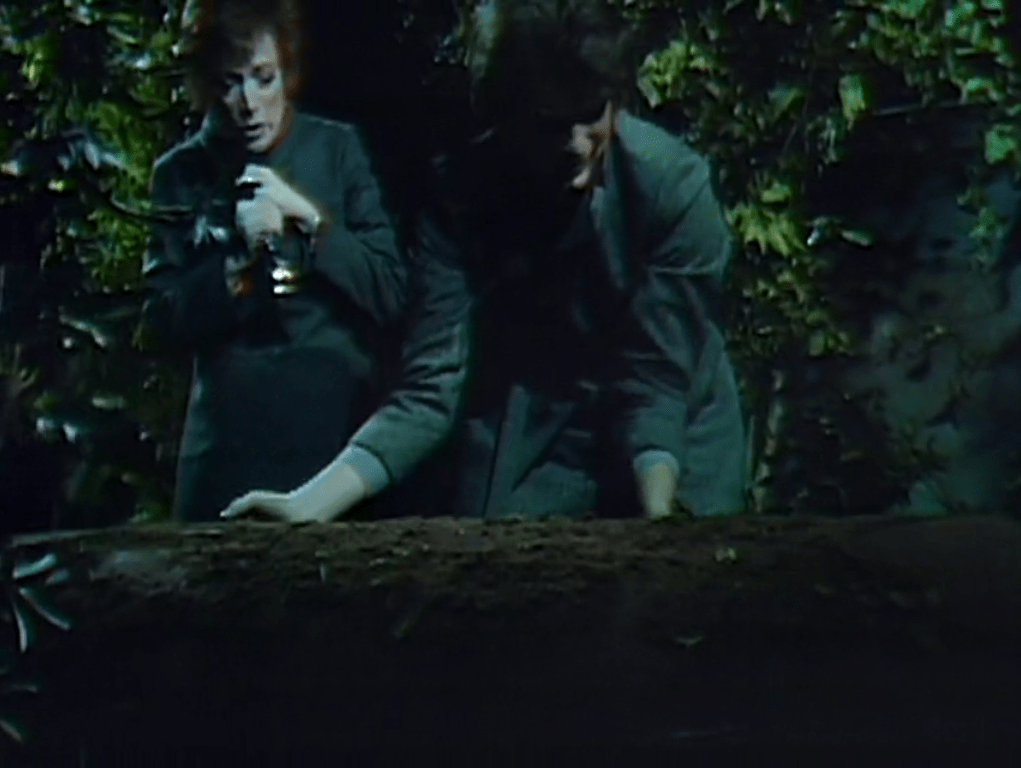
Barnabas intends to launch his attack by using two objects with great cultic significance to the Leviathans. One is a small wooden box that is kept in Jabe’s room. The other is a large stone altar in the woods on the grounds of Collinwood that only people associated with the Leviathan cult can see. With Quentin’s help, he steals the box. He forbids Quentin to accompany him to the altar. He sets the box on the altar and raises his cane to smash it. Suddenly the box opens, and he freezes. A bat comes flying out.
In the 1790s, Barnabas was cursed to become a vampire. He remained in that horrid condition until two mad scientists worked together to free him of the effects of the curse in 1968. Jabe has decided to make him a vampire again. He put the bat in the box, and it bites Barnabas, renewing the curse.
The bat was about the size of a real bat when Jabe put it in the box. Even at that, it must have been a pretty tight fit for the little fellow. But when it bites Barnabas, it is as big as a California condor.
Jabe calls Carolyn “honey” in their scene together. We’ve heard many endearments, most often “dear” and “darling,” but never before “honey,” not so far as I can recall. It makes Jabe seem a bit more up to date than the other characters.
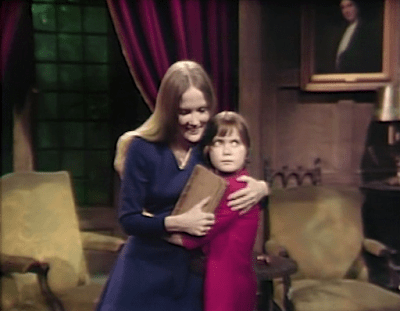
Ten year old Amy Jennings is at home in the great house on the estate of Collinwood. Evidently she’s in a literal mood- she’s in the drawing room, so she’s drawing. Heiress Carolyn Collins Stoddard sees Amy’s work and asks why she is doing it. Amy says she thinks the design is “pretty”; Carolyn replies that “pretty” is the last thing she would call it. That may seem rather rude, but as Amy hasn’t been seen since #912 I suppose she’ll take what she can get.
The design is one which on Dark Shadows is called simply a Naga. It is the secret emblem of a secret cult serving the Leviathan People, a race of Elder Gods. Secret cultist Megan Todd wears the Naga on a large pendant around her neck; Megan’s husband, secret cultist Philip, wears it on a shining ring; Carolyn’s mother, secret cultist Elizabeth Collins Stoddard, wears it as an oversized broach. Amy herself is a secret member of the secret cult, but she hasn’t yet acquired any conspicuous jewelry emblazoned with the secret symbol, leaving her to do her own artwork. Carolyn wonders aloud why so many people are so preoccupied with the design.
Quentin Collins enters. Amy is terrified. Starting in December 1968, Quentin’s ghost haunted Collinwood. By March, the house was uninhabitable and strange and troubled boy David Collins was near death. Old world gentleman Barnabas Collins tried some mumbo-jumbo in hopes of communicating with Quentin; he came unstuck in time and found himself in the year 1897, where he remained for eight months. While Barnabas was flailing about in the late Victorian era, time continued to pass in 1969, and Quentin’s obsession of David finally killed him in September. But a sequence of events with which Barnabas had a tenuous connection changed the circumstances on the night in September 1897 when Quentin originally died, causing him to survive. That night, as it happened, was exactly 72 years before David’s death. On Dark Shadows, anniversaries have the power that laws of nature have in our world, so that caused the haunting to break and David to come back to life. Due to a series of spells cast on him during Barnabas’ sojourn in the past, Quentin is still alive and still apparently in his late twenties in 1970. But the haunting still happened between December 1968 and September 1969, and everyone who lived through it still remembers it.
Quentin has introduced himself to Carolyn as his own great-grandson. Since Carolyn never actually saw his ghost, she is willing to accept this. But Amy had more dealings with the ghost than anyone but David, and it is obvious to her that they are one and the same. She clings to Carolyn.
Carolyn laughs at Amy’s fear and tells her that this Quentin is not the ghost, but is “a cousin of ours.” This is intriguing to regular viewers. It was during the 1897 segment that the audience learned that Quentin was the great-grandfather of Amy and her brother Chris, and just a few weeks ago that Chris learned about that relationship. It is through their descent from Quentin that Amy and Chris are cousins to Carolyn. So if Amy knows she is a Collins, she must have been told that the ghost that tormented her and David was that of her great-grandfather. A scene in which someone gave her that information might have been a good use of Denise Nickerson’s considerable acting talent, but they didn’t bother to produce one.
Quentin tells Carolyn to leave him alone with Amy. Still chuckling, she complies. Once they are alone in the drawing room, Quentin kneels and touches Amy’s face, assuring her that he is “not that Quentin Collins.” David Selby brought immense charm to the role of Quentin, so this scene isn’t as revolting as it might have been, but it is still pretty bad, and we can’t be surprised that Amy is not satisfied.
Amy goes to the village of Collinsport to seek guidance from her spiritual advisor. He is a shape-shifting monster from beyond space and time who usually takes the form of a very tall young man. When he first assumed that form, he invited people to “Call me Jabe,” but no one did. They call him “Jeb” instead, and he answers to it.
Jabe lives in a room above Megan and Philip’s antique shop, and when Amy enters the shop she finds him looking after the place. Apparently shape-shifting monsters from beyond space and time aren’t above doing a little work in retail now and then. She tells Jabe about her encounter with Quentin, and then tells him about a dream she had. In the dream, she went into the long-disused room where she and David first met Quentin. Quentin’s theme song, a sickly little waltz, was playing; she exclaims “It was terrible!” Longtime viewers know the feeling. The tune played incessantly during the “Haunting of Collinwood” period, and when they went back to 1897 characters kept complaining to the living Quentin that he was making them miserable by playing it on his phonograph all the time.
In the dream, Quentin appeared to Amy wearing the nineteenth century clothing and the angry scowl that he wore when he was a ghost. But when he was a ghost, he never spoke words the audience could hear. The only exception was a dream sequence in #767, when Quentin’s ghost spoke to David. That was also the only other dream sequence to be presented as this one is, in flashback as the dreamer is recounting it after the fact. That sequence marked a watershed, the first attempt to explain how Quentin the cranky ghost emerged from Quentin the charming scoundrel we had got to know in the 1897 segment.
This episode, also, has to do with the relationship between these two iterations of Quentin. Amy tells Jabe that Quentin’s ghost in the dream warned her against him by name, and says that she is therefore convinced that the living man she met in the drawing room today is in some way identical to the ghost who haunted the house for those ten months. Amy’s dream marks the final appearance of Quentin’s ghost, but we can see the ghost will not be forgotten.
A state police investigator named Lawrence Guthrie is in town looking into two murders Jabe has committed, those of Carolyn’s father Paul and of a law enforcement officer whose gravestone revealed that his given name was “Sheriff Davenport” (we never learn what Mr Davenport’s title was.) Jabe orders Philip to kill Guthrie. Philip calls Guthrie and asks him to come to the antique shop when Jabe will be out. Once Guthrie is there, Philip tells him that the upstairs room where Jabe stays is an important part of the story of the murders. He shows Guthrie into the room. He stays outside, and locks Guthrie in. Guthrie encounters Jabe there in his true form; Jabe kills him. This is quite effectively handled. My wife, Mrs Acilius, was completely caught off guard by the killing. She believed Philip really was trying to break free of the Leviathan cult, and wondered what Guthrie was supposed to find in the room.
Neither Jabe nor Philip is an especially well-developed character, but Christopher Bernau and Christopher Pennock were both fine actors, and they play off each other very well today. It is a tribute to their performances that Guthrie’s death scene comes as a surprise.
At the end, Quentin is at Collinwood trying to tell Carolyn that it was Jabe who killed her father and Mr S. Davenport. Inexplicably, Carolyn is interested in dating Jabe, and is unwilling to listen to this. Jabe bursts in and announces that there has been another murder, that the murderer is in custody, and that he has confessed to it and to the killings of Paul and Sheriff. That murderer, Jabe says, is Philip. That’s another surprise- after the murder of Guthrie, Jabe did tell Philip that he had another task to perform, and once we hear that he has confessed to the killings it makes perfect sense that that would have been what Jabe meant. But I don’t think anyone could have predicted it. It makes for a strong ending.
Danny Horn’s post about this episode on his great blog Dark Shadows Every Day is a lovely little bit of fanfic proceeding from the assumption that Lawrence Guthrie is the brother of Dr Peter Guthrie, the parapsychologist whom undead blonde fire witch Laura Murdoch Collins killed in March 1967.
The closing credits again misspell writer Violet Welles’ name as “Wells.” They started doing that last week, around the same time the misspelling of wardrobe house Ohrbach’s as “Orhbach’s,” a frequent goof in the show’s first year, reappeared after a long absence.
Yesterday and today, a clock stopped at 8:00 featured prominently in shots when it was pivotal to the story that it was not 8:00. The clock is part of the merchandise in an antique shop, so it is understandable it does not run, but it is rather odd to see someone telling people that he didn’t wait for 8:00 when a clock face displaying that time looms over his shoulder. Today, it is important that a scene in the shop is taking place after 10:00. We open that scene with a view of a different clock, one that reads 10:20, but before long the stopped clock is back in full view.
At the great house of Collinwood, old world gentleman Barnabas Collins is rushing to the front door. Governess Maggie Evans asks him where he is going. He says that he is going to the village of Collinsport. She says she is going there as well and that she will ride in with him. He says that he can’t take her. He refuses to explain why. The other day, Maggie and Barnabas held hands and leaned in close to each other, talking softly about how important their friendship was. This sudden refusal to communicate pulls Maggie up short. She demands to know whether Barnabas trusts her. He says he does. She marches up to him and orders him to “Prove it!” The tight aspect ratio of old time TV combines with director Henry Kaplan’s habit of putting the actors as close to the camera as he can get them to make it seem, in the moment, that the feelings Maggie expects Barnabas to prove are of an erotic nature.
Maggie has been the governess at Collinwood for over a year now. Her predecessor, the well-meaning Vicki Winters, was written out of the show for a number of reasons, not least their inability to figure out an intelligible relationship between her and Barnabas. There was a long period when Vicki the character seemed to know that she was on a show starring Barnabas and she kept trying to involve herself in his storyline, even inviting herself to spend the night at his house. In theory, Barnabas was in love with Vicki and yearned for her, but no matter how flagrantly she threw herself at him he never did anything about it. Eventually they paired her off with an intolerable jerk, and the two of them disappeared into a rift in the space-time continuum.
Vicki never did take quite as direct an approach with Barnabas as Maggie does today. No matter how deeply Vicki drove the ball into his court, she always counted on him to show at least a little initiative. Maggie knows better than to rely on Barnabas, and she corners him into agreeing to see her and give some kind of explanation when he is done with the mission he is concealing from her, at 10:00 sharp.
Fans often fret about the “Vickification” Maggie undergoes while she is serving as governess. When it became clear that Vicki wasn’t going to matter to Barnabas, she couldn’t be allowed to affect the A story in any way. To keep her on the sidelines, she was written as an ever greater ninny.
Maggie is pretty bad at her job- she’s a squish when the children don’t want to do their lessons, which is every time we’ve seen her with them. But she’s still good with grownups, she’s smart, and she’s emphatically sexy. So she isn’t going to go down into irrelevance without a fight.
Maggie isn’t the only character insisting on her place in the story. A few weeks ago, it seemed that matriarch Elizabeth Collins Stoddard would be a part of the main plot for the first time in ages when she was inducted into a secret cult serving a mysterious race of Elder Gods who are trying to regain control of the Earth. But she has drifted back to the sidelines, and has yet to meet the cult’s leader in his current form.
Barnabas was Liz’ preceptor in the cult, and she is indignant with him for the decline in her part:
Liz: Barnabas, I must speak to you.
Barnabas: Not now, Elizabeth.
Liz: Have I done something wrong? Just tell me that.
Barnabas: No, nothing at all.
Liz: I’ve tried to follow the rules, as many as I know. You yourself can testify to my faithfulness. But David sees our leader, you’ve seen him.
Barnabas: Jabez?
Liz: Is that what he calls himself now? Well, no matter what name, he’s the same boy who used to play here. Surely he must remember me with some affection.
Barnabas: He is only recently matured enough to appear to us.
Liz: Why have I been ignored? Barnabas? You haven’t answered my question.
Barnabas: You’ll meet him soon enough but now is not the time.
Liz: Does the book specify when I am to meet him? Is that why you’re against it now?
During the show’s costume drama segments, Joan Bennett got to play dynamic roles, but she has been excluded from the action in the contemporary parts for so long that she has a tremendous amount of passion to bring to this scene. It is great to see her cut loose for once.
A shape-shifting monster from beyond time and space has assumed the form of a young man and decided to marry heiress Carolyn Collins Stoddard. Carolyn’s distant cousin, old world gentleman Barnabas Collins, knows all about the monster and wants to prevent the wedding.
The other day, the monster mentioned to Barnabas that when he is not in human form, nothing can kill him. That would seem to imply that when he is in human form, at least some of the things that kill humans can kill him. So Barnabas slips some poison in a drink and gives it to the monster. The plan is logical enough, but like all of Barnabas’ plans it fails. Whatever the monster’s vulnerabilities are, that particular poison is not one of them. It does not harm him at all, though it does affect the drink’s flavor sufficiently to damage the monster’s confidence in Barnabas’ bar-tending abilities.
Barnabas’ next plan is less sensible. His ex-wife, wicked witch Angelique, is living nearby with her new husband. He goes to Angelique and asks her to take Carolyn in for a while. Angelique reminds Barnabas that Carolyn knows her and dislikes her. She was married to Carolyn’s uncle Roger for a while in 1968, when she was using the alias Cassandra. By the end of that period, she had alienated Carolyn and everyone else at the great house of Collinwood. Barnabas exclaims “But she won’t recognize her; you had dark hair!” Presumably the scripted line was “But she won’t recognize you; you had dark hair!”
Which doesn’t really make all that much more sense- the black wig Angelique wore when she was calling herself Cassandra was the entirety of her disguise. She didn’t need to conceal her identity any more thoroughly than that, since the only people who could recognize her were Barnabas and time-traveling governess Vicki. Barnabas couldn’t afford to admit that he had lived in the 1790s and married a witch, and Vicki was at that point not allowed to do anything that would affect the course of the A story, so the wig was plenty. To say now that the difference in hair color will keep Carolyn from recognizing Angelique as Cassandra is to lampshade the absurdity of Barnabas’ idea.
Barnabas tells Angelique that the monster is affiliated with mysterious supernatural beings known as the Leviathan People. This alarms Angelique sufficiently that she agrees to hide Carolyn.
This is also the episode in which rakish libertine Quentin Collins reintroduces himself to the family at Collinwood. They had known him as the ghost who drove them from their home in November 1968, and Carolyn met the living Quentin in late 1969, when he went by the name Grant Douglas.
Quentin is at loose ends, so he agrees when Barnabas and mad scientist Julia Hoffman ask him to help them in their battle against the Leviathans. The plan is for him to use the power of his handsomeness and charm to distract Carolyn from the monster. This would seem to be quite a sensible idea, since he has been the big attraction of the fan magazines since he joined the show.
We cut to the great house of Collinwood, where the piano is being played very well. We see that Carolyn is the pianist. This is puzzling to longtime viewers. The piano has been a prominent part of the drawing room set from the beginning of the show, an echo of the deep prehistory of Dark Shadows, which was originally based in part on old teleplays Art Wallace wrote about a lady who gave piano lessons. We have seen Carolyn poke at the keyboard a couple of times, in a manner that made it clear she could not play at all.
Quentin knocks at the front door and Carolyn lets him in. He gives his right name, and claims to be his own great-grandson. When Carolyn asks why he said his name was Grant Douglas, he claims to be a writer who used that among other pseudonyms. That doesn’t explain anything, but Carolyn settles for it, for some reason. He tells her that, since they are only third cousins, their family relationship is no bar to them spending a great deal of time together. She says she is busy tonight, but eagerly volunteers that she is free tomorrow.
The monster enters. He meets Quentin, and they take an instant dislike to each other. That doesn’t mean much, since the monster is extremely obnoxious and everyone not under the power of the Leviathans dislikes him. For that matter, some who are under their power can’t stand him, either. For example, Barnabas was a devotee of theirs until he had to deal with the monster, and his personality broke the spell. So it remains to be seen what contribution, if any, Quentin will make to this story.
Quentin doesn’t try to persuade Carolyn to break her date with the monster. He, Julia, and Barnabas are at Collinwood when the monster calls. He tells her Carolyn is on her way, two hours earlier than originally planned. The monster and Carolyn share a drink; he slips her a mickey. Once she is passed out, he carries her up to the room in which he assumes his true form, declaring that her new life is about to begin.
Up to this point, drugging drinks has chiefly been a source of comedy on Dark Shadows. Barnabas tried to poison Angelique in #402, when they were married; that led to a farce scene when his mother showed up, Angelique passed the poisoned drink to her, and he had to scramble. For a while in 1968, a warlock calling himself Nicholas Blair hung around and functioned as Angelique’s boss; in #528, she asked him to slip some poison to Vicki, prompting him to complain that “I am much too talented to spend my time drugging drinks.” By the time he was done, he had not only complied with Angelique’s request, but drugged a couple of other people’s drinks on his own initiative. He may as well have kept his pride, since none of those poisonings got him what he wanted. So the monster’s use of that tactic might lead us to suspect that Carolyn’s odds are better than they appear.
A monster from beyond space and time has taken the form of a vicious man-child and asked people to call it “Jabe.” A cult devoted to the Leviathan People, mysterious Elder Gods who brought the monster to Earth, have decided to put up with its murders and depredations, but even they draw the line at calling the monster “Jabe.” It answers to “Jeb” instead.
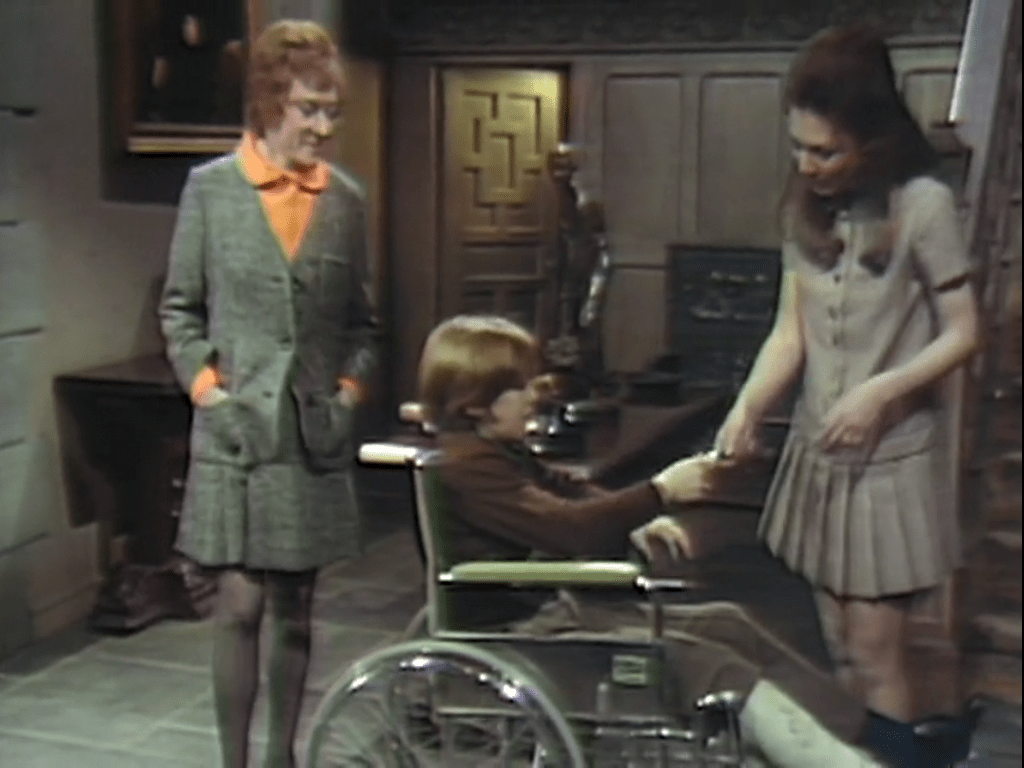
Jabe’s latest pointless act of cruelty was to break the leg of one of his faithful servants, thirteen year old David Collins. A couple of times today, Jabe is about to explain why he broke David’s leg, and each time they cut away to some other scene. At one point we cut back to Jabe telling David that “Now you know why I had to do that, don’t you?,” to which David agrees that he does. That just lampshades the fact that the writers couldn’t come up with a reason.
David wants Maggie to be the first to sign his cast.
The actual reason David Collins is wearing a cast and using a wheelchair is that actor David Henesy took a nasty spill on the ice. And since Jabe’s untrammeled violence is the big menace on the show right now, it makes sense that they would have him be at fault. It certainly makes more sense than does the fact that the family insists on David climbing the stairs to his bedroom with crutches, when they have a whole disused wing of servants’ bedrooms on the first floor in any one of which he could stay while he recuperates. On the other hand, that insistence does produce a moment of real hilarity. The instant David begins his ascent, governess Maggie Evans (Kathryn Leigh Scott) and permanent houseguest Julia Hoffman start talking as if he weren’t there. He must be lumbering up the stairs a couple of feet from them the whole time they are carrying on this conversation.
For his part, Jabe doesn’t generate any laughs. Nor is he pursuing any goals that lead us to wonder what he will do next. We just know that if he has a chance to do something nasty, he’ll probably take it.
If they want Jabe to be a character in whom we take an interest, they ought to give him some kind of cockamamie motivation that is intelligible only to him. That’s what they did in 1967, when vampire Barnabas Collins held Maggie prisoner and tortured her. They showed us that Barnabas thought he was going to turn Maggie into his lost love Josette. That idea, borrowed from the 1932 film The Mummy, was so utterly bonkers the show eventually decided to run with it, casting Miss Scott as Josette when they went back in time to explain how Barnabas became a vampire. Meanwhile, the ever-mounting zaniness kept viewers tuning in, wondering if they would ever expose a layer of Barnabas’ psychology that was composed of something other than nonsense.
The opening voiceover today labels Jabe “evil”; that’s no problem, all the most popular characters, including David, started off as appallingly evil, and they have retained their popularity to the extent that they stayed in touch with their roots. But Jabe is not only evil, he is monotonous, and that makes him a deadly threat to the show’s entertainment value.
Barnabas is not currently subject to the effects of the vampire curse, and Julia long ago used her powers as a mad scientist to erase Maggie’s memory of his crimes against her. Barnabas was the original leader of the Leviathan cult, but has become disaffected. Jabe tells Barnabas today that he wants to kill just about everyone at Collinwood, including ten year old Amy Jennings, who is a faithful member of the cult. He also wants to marry heiress Carolyn Collins Stoddard. Barnabas goes to Collinwood and warns Maggie that Carolyn is in danger. He asks her to keep an eye on Carolyn and to urge her to go away. He does not mention Amy. At least Amy’s name comes up in this episode- when she is on camera she is often the best thing in the show, but throughout her long absences she usually goes unmentioned.
Julia goes to Amy’s great-grandfather, centenarian Quentin Collins, who has recently returned to Collinsport after an absence of many decades and who, because of a series of spells that were cast on him, looks like he is not quite 29 years old. Julia recruits Quentin to dig up the grave of Michael Hackett, Jabe’s previous incarnation. This gives us the first exhumation scene on Dark Shadows since, if I recall correctly, #820. It’s the longest the show has gone without digging up a coffin since the first exhumation scene, in #179. It feels like a homecoming when Quentin sticks his shovel in the plot. Of course they find an empty coffin.
As is usual when digging up a coffin, Quentin wears a three-piece suit with dress shoes, none of which is smudged in the process. Less typically, his coat appears to be somewhat wrinkled.
Afterward, Julia confronts Barnabas. When she tells him how much she already knows, he gives in and says he will tell her everything. With that, we have the promise that Barnabas and Julia will resume the partnership that has been the single most dynamic narrative element on Dark Shadows.
We open with a reprise of the end of yesterday’s episode. Quentin Collins and Amanda Harris are reenacting the myth of Orpheus and Eurydice. As in the ancient Greek story, they will live together if they can escape all the perils on the road from the realm of the dead to that of the living. Unlike that story, they are allowed to look at each other along the way, but they are not allowed to touch.
The teaser ends where Wednesday’s episode ended, with Amanda falling through a gap in a footbridge and Quentin crying out in anguish. After the opening title, we are surprised to find ourselves at the same scene. Amanda is not yet lost. Quentin pulls her up from the ravine she fell into. But that involves touch, so the ceiling of the cavern collapses and buries her. Suddenly, Quentin finds himself lying on the ground, in the upper world, with no sign of any way back to the place from which he just came.
Amanda’s demise marks Donna McKechnie’s final appearance on Dark Shadows. Miss McKechnie left to be in the original cast of Stephen Sondheim’s Company, paving the way for her enormous success on Broadway in the 1970s. Much later, Miss McKechnie would reprise the role of Amanda in a couple of Big Finish Productions’ Dark Shadows audio dramas, and nowadays she appears at the Dark Shadows conventions.
Any account of Donna McKechnie’s last day at 433 West 53rd Street would be incomplete without this story from Hamrick and Jamison’s book Barnabas and Company:
In rehearsal, we went through the scene with a few Styrofoam boulders and a little peat moss, no big deal. Nobody told me there was going to be ten times as much dropped during the taping. So, when it was time to tape the scene, I was looking up, and I just got buried. I got peat moss in my eyes and in my mouth and ears and nose… and I was covered in rocks. The way things worked at the studio, at the end of that scene, the lights went out, and the camera and crew and actors all moved on to the next scene, in another part of the studio. So there I was, laying under all those Styrofoam rocks and peat moss, and nobody helped me get out. I had to dig myself out, and that was my last experience on Dark Shadows.
Craig Hamrick and R. J. Jamison, BARNABAS AND COMPANY: THE CAST OF THE TV CLASSIC DARK SHADOWS (2nd edition, 2012) page 245.
They’ve been doing a bit of videotape editing recently, as several awkward cuts have made clear. One might think that the whole Underworld sequence, pre- and post-title, was edited in from tape left over from yesterday’s shoot. But Miss McKechnie’s story proves that is not so. The episodes were done in sequence, so if the last bit of tape they shot yesterday had been the crushing of Amanda there wouldn’t have been any next scene to run off to and Miss McKechnie would have had plenty of help digging herself out from under.
Some Sort of Monster was After Him
Meanwhile, the sheriff is at the home of occult expert Timothy Eliot Stokes. Stokes and his friend, mad scientist Julia Hoffman, have called him in because a monster wrecked Stokes’ bedroom, in the process killing a man named Paul Stoddard.
No law enforcement officer on Dark Shadows has yet solved a case, and Sheriff Davenport seems likely to prove the most useless member of the fraternity yet. At no point does he interrogate Stokes and Julia, or even show much interest in what they were doing while Paul was being killed. He refuses to believe Julia when she says that he should be looking for a monster, even though Collinsport has been overrun with monsters for years now and he has acknowledged that the wreckage at Stokes’ is like nothing he has ever seen. Julia tells him that the monster lives in the room at the top of the stairs in the antique shop operated by Megan and Philip Todd. In response, he flatly states that “They wouldn’t have anything to do with his death.” He finally agrees to get a search warrant for the Todds’ place, but when he presents it to Philip he says that he will execute it “unless of course, you don’t want me to?”
The meatiest part of the episode is a long scene between Megan and Philip. She is exultant that the monster has killed Paul and certain that it will go on to do other, even more wonderful things. He’s scared to death of what the monster will do to them if it is not defeated and of the retribution that will come to them if it is. She sneers at him as a coward. He admits that he is a coward, but insists that they run away and count themselves fortunate if they can escape with their lives.
In her first role on Dark Shadows, as Eve, The Fiancée of Frankenstein, Marie Wallace was called upon to show an unbending, unvarying contempt for Adam, the patchwork man she was supposed to marry. Since that was the only feeling Eve had ever shown for Adam, it wasn’t very interesting. But Megan loved Philip when we first met them. The other day, when she told the monster that she had loved Philip for a long time, we could believe her. So her scorn today does carry some force, and no one knows better how to play scorn and play it to the hilt than does Miss Wallace.
The part of Philip has not been a particularly congenial one for Christopher Bernau up to this point, but he too excels in the scene. He has lots of lines you would expect a man to find it hard to say, calling himself a coward and so on, but he speaks them smoothly and fluently. He shows his hesitancy and anguish not in his delivery of the lines, but in his facial expressions and movements while Megan is speaking. You can see him deciding to put aside all male ego and say something that might get through to Megan, no matter how humiliating it is for him to say it. With lines proclaiming his cowardice, Bernau creates the image of a remarkably brave Philip.
That in turn makes it possible for the episode to end on a suspenseful note. The closing cliffhanger has Sheriff Davenport turning the doorknob to the monster’s room, while Philip is frenziedly trying to come up with a way to talk him out of entering it. When we watched that, my wife, Mrs Acilius, said to the screen “If you don’t tell him what’s in there, it’s murder,” in a tone that suggested she thought Philip actually might tell the sheriff the truth. That such an idea could even form is a testament to Bernau’s outstanding performance in this episode.
In the middle of The Odyssey, Odysseus and his companions enter a certain cave and follow a path that leads to the realm of the dead. There, Odysseus talks with several people whom he knew when they were alive, then comes back to the upper world. This passage, known in Greek as the νέκυια (nekyia,) led many subsequent epic poets to include journeys to and from the Underworld in their works. In the Aeneid, his Latin language response to the Iliad and the Odyssey, Vergil put Aeneas’ voyage to the Underworld in the same halfway spot where the nekyia stands in the Odyssey. The words of warning the Cumaean Sibyl speaks when she gives Aeneas directions to reach the Underworld by way of a path leading through the crater in Mount Avernus are quite famous:
Facilis descensus Averno: Noctes atque dies patet atri ianua Ditis; Sed revocare gradum superasque evadere ad auras, Hoc opus, hic labor est.
The road down through Avernus is easy.
The doors of dark Dis lie open by day and by night.
But to reverse your stride and escape to the air above,
This is the achievement, this is the feat.
(Vergil, Aeneid 6:126-129, my translation.)
It wasn’t only warrior princes like Odysseus and Aeneas who had to go to the realm of the dead and back in the mythology of the ancient Mediterranean. The legendary poet Orpheus was so disconsolate when his wife Eurydice died that he journeyed to the Underworld to plead with the gods of the dead to let him take her back with him. As Ovid tells the story in Book 10 of his Metamorphoses, Orpheus made his case in a song that was so beautiful that the whole pantheon of deities who dwell among the ghosts of humans wept. Their chief, known by a long list of names including Pluto, Dis, and Hades, was no exception. Through his tears, he agreed to release Eurydice. But the god knew his business too well not to make conditions. First, Orpheus and Eurydice would have to take the hard and treacherous road that separates the shades of the dead from the world of the living. Second, they would have to complete the whole journey without once looking at each other.
They made it through all the ruggedness and the many snares. At the moment Orpheus felt the warmth of the sun on his cheeks once more, he became so excited that he forgot everything. He turned his head to face Eurydice and exclaim that they had succeeded. But she was still in the shadows. He saw only her silhouetted figure, and that only for an instant. She shrank from him at impossible speed, disappearing forever into the darkness of death.
Dark Shadows steals from every writer, sooner or later, and they’ve stolen a woman named Amanda Harris from a story that comes later in Book 10 of Ovid’s Metamorphoses. A sculptor named Pygmalion was a sour misogynist, who sought a substitute for the companionship of the real live women he so disliked by making a statue of a woman he thought he could get along with. Much to his surprise, the statue came to life and they fell in love, more or less.
In 1969, we learned that an artist named Charles Delaware Tate, who was every bit as unpleasant a person as Ovid’s Pygmalion, had painted a portrait of an imaginary woman and that, because of some magic powers Tate was unaware he had, that woman had popped into existence and started calling herself Amanda Harris. It was a couple of years after her inception that Amanda met Tate. Unlike Pygmalion’s statue, Amanda was as repulsed by her creator as one would expect her to be. Instead, she fell in love with the boundlessly charming, albeit none too admirable, Quentin Collins.
Now Amanda has died, and Quentin is willing to do anything to be reunited with her. A god of death named Mr Best has offered him a sporting proposition. If he and Amanda can walk the whole of the hard and treacherous road that separates the shades of the dead from the world of the living without once touching each other, they can share an eternal life. But if they do touch, or if either of them falls victim to one of the many traps along the way, they will be separated forever.
Their journey almost ends before it begins. Amanda sees Quentin looking out the door that opens on the road home, and reaches out to touch him. At the last second he tells her not to, explaining the conditions Mr Best had laid down. They set out. Along the way, Amanda is caught in a giant web where she is menaced by a giant spider, twists her ankle when she trips over some rocks, has to walk over a rickety rope bridge, and experiences a series of phobic reactions. She is just about to make it when, not looking down lest her fear of heights get the better of her, she puts her foot through a gap in the rope bridge and falls into oblivion.
It’s unclear what this will mean for Quentin. He has no direct connection to any other unresolved story, and while there are characters who care about him he isn’t particularly interested in having anything to do with them. He has been one of the show’s great breakout stars, second only to Jonathan Frid as occasional vampire Barnabas Collins, so it is hard to believe they won’t come up with something new for him to do, but it is not at all clear what that might be.
Book 10 of Ovid’s Metamorphoses does not seem like it will be very helpful. When Orpheus loses Eurydice, he can no longer stand the sight of any other woman, so to pass the time he invents male homosexuality. He has great success popularizing his invention throughout his homeland of Thrace. When the Thracian women find that many of their menfolk have lost interest in them, they signal their displeasure by killing Orpheus. I very much doubt that the American Broadcasting Company’s office of Standards and Practices would have been too happy at the idea of dramatizing that story five days a week at 4 PM in 1970. Besides, Dark Shadows has been so antiseptically sexless that the women of Collinsport wouldn’t be any worse off if the men devoted all their eroticism to each other, so you couldn’t use that ending.
The Orpheus and Eurydice story only takes up half of today’s episode. The rest recounts the final hours of the life of Mr Paul Stoddard. Paul has found out that a group of people in and around the village of Collinsport are in the service of invisible supernatural beings known as the Leviathans. Earlier this week he encountered a nonhuman creature that is central to the Leviathan cult. Contact with the creature caused his clothes to rot and stink and left him dazed and unable to speak.
Paul is currently sitting and staring into space in the apartment of Professor Timothy Eliot Stokes, expert on the occult. When we cut to Stokes’ apartment from Quentin and Amanda on the way back to the world of the living, we see a bust of the poet Dante, reminding us that Christian poets followed ancient pagans in writing epics about visits to the realms of the dead. It also suggests that Quentin’s experience in Mr Best’s domain may give him some knowledge or power that will allow him to join Stokes and mad scientist Julia Hoffman in their battle against the Leviathans.
Dante watches over Paul and Stokes.
Stokes tries to get Paul to tell him what happened when he encountered the creature, but he will neither speak nor move. Stokes leaves the room for a moment, and Paul gets up to call the police. Stokes stops him doing that, for some reason. Paul runs to Stokes’ bedroom and locks himself in. Julia enters, and they try to persuade him to come out. Julia pretends to call the sheriff. A loud noise comes from the room, and Paul comes reeling out. He falls down and dies. Stokes reports that the room is entirely destroyed. Its ruins are covered with a slime that emits an unbearable stench. In a mild tone, he adds that perhaps it might now be a good idea to call the police after all.
This episode marks the final appearance of Dennis Patrick on Dark Shadows. We will see an extraordinary still photograph of Paul in #953, but the actor is gone. Patrick left to produce and appear in the movie Joe, which was quite an event in its day. Patrick got out of his contract by offering to punch Dan Curtis in the face; evidently Curtis didn’t take offer that too seriously, because he gave Patrick a small part in the feature film House of Dark Shadows later in 1970.
For most of 1969, Dark Shadows was a costume drama set in the year 1897. Among the characters we got to know were Quentin Collins, Charles Delaware Tate, Count Petofi, and Amanda Harris. Quentin was a rakish libertine and occasional murderer who was cursed to be a werewolf. Tate was an artist. Petofi was a sorcerer who had, for reasons of his own, given Tate the power to paint portraits with magical effects. Tate painted a portrait of Quentin that cured him of the effects both of lycanthropy and of aging. He painted a portrait of an imaginary woman, and she popped into being and became Amanda.
The story of Quentin’s portrait is borrowed from Oscar Wilde’s 1895 novel The Picture of Dorian Gray. The story of Amanda is borrowed from the story of Pygmalion and Galatea that Ovid told in Book 10 of his Metamorphoses. While Pygmalion’s statue of the ideal woman loved him when it came to life, Amanda can’t stand Tate. That’s understandable; like all characters played by Roger Davis, Tate had an intolerable personality. Amanda fell in love with Quentin, who is cruel and evil, but very charming.
Now it is 1970. Quentin has come back to the village of Collinsport, still young and handsome, but suffering from amnesia and unwilling to believe that he is a hundred years old. Amanda is back too. She is also young, not because of the painting, but because a god of death named Mr Best gave her several decades to reconnect with Quentin, get him to say he loves her, and then live with him ever after, perhaps happily.
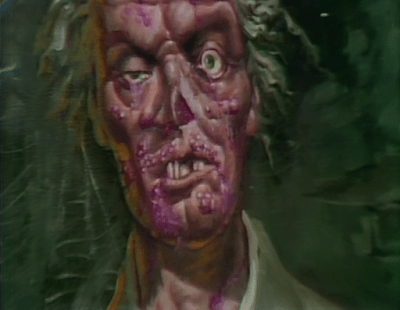
Mad scientist Julia Hoffman has been working with Amanda to restore Quentin’s memory. Julia, Amanda, and Quentin go to see Quentin’s portrait, which Julia has just had restored. It is suitably gruesome, and Amanda runs out screaming when she sees it. But Quentin examines it, and his memory comes back to him. Julia tells him about Amanda’s deal, and says that Mr Best is on his way. He could catch up with Amanda at any time. Quentin runs out to tell Amanda that he loves her, but gets to the scene a moment too late.
Quentin’s portrait, a face only a fan of EC Comics could love. Screenshot by Dark Shadows Before I Die.
Mr Best takes Amanda to a hotel lobby. She described this lobby to Julia in #922 when she explained her arrangement with Mr Best, but he has to explain it to her today. In #922 he called it “The Stopping-Off Place”; today he calls it “A Passing-Through Place.” He excuses himself, since he has other souls to harvest.
Amanda is alone for a moment with a bellhop in a white costume with an accent that is supposed to be sort of Cockney, or perhaps Australian. The bellhop makes it clear that he used to be alive, and that his current job makes him nostalgic for his days as a human. When he mentions things he can’t do anymore, he looks Amanda up and down for a half second. The wistfulness of his tone, the frankness of his look, and the sadness with which he turns away from her leaves no doubt what he misses. It’s a surprisingly lovely moment, and a much more adult one than we expect from the show at this point.
Back in the land of the living, Quentin and Julia have a scene in Amanda’s suite at the Collinsport Inn. Julia leaves, and Quentin tries to kill himself. Mr Best stops him. He tells him that he knows he is alive “by courtesy of Count Petofi”; this is the first time we have heard Petofi’s name since the show came back from 1897, and the first vague hint that Petofi might have survived the fire that appeared to have killed him in #884. He says that it is not Quentin’s time to die.
Quentin says he doesn’t want to live without Amanda, and Mr Best gets a bright idea. He says he likes experiments, and he has one he will run with the two of them. He takes Quentin to The Stopping Off/ A Passing-Through Place. He explains his idea. As befits Amanda, it is derived from the tale of Orpheus and Eurydice which Ovid tells earlier in Book 10 of the Metamorphoses. As Orpheus was allowed to bring his wife Eurydice back from the realm of the dead so long as they could make the long, arduous journey without looking at each other, so Quentin will be allowed to bring Amanda back so long as they do not touch each other until they return to the sunlight. The episode ends with Quentin deep in thought about this proposition while Amanda walks up behind him, stretching her hand towards him.
Mr Best tells Quentin that if he and Amanda can make their way through the countless traps and perils of the journey back to the upper world, they will be together “for eternity- whatever that means.” It’s intriguing he doesn’t know- he explicitly identifies himself as an immortal being today, and he has such a wide range of discretion that he can only be called a god. Apparently writer Sam Hall is imagining a cosmos where even the gods are left guessing about the answers to the big questions.
The story of Orpheus and Eurydice has long been a popular favorite. In the 1960s, Jean Cocteau’s 1950 Orphée and the 1959 Brazilian hit Black Orpheus were both staples of art cinema and would have been familiar to NYC theater people like the makers of Dark Shadows, so it is hardly surprising that when they start looking to classical antiquity as a source of material that was one of the first stories to come to mind.
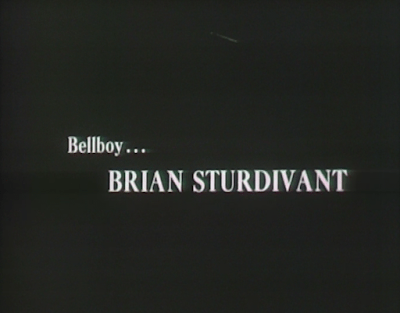
This is Emory Bass’ final appearance as Mr Best, and Brian Sturdivant’s only appearance as the bellboy from Hell. Each will return in another small part later this year.
The closing credits roll over an image of Quentin’s portrait. Most of them do, anyway. Sturdivant’s was cut into the middle of the roll over a black background. Apparently they forgot about him until the last minute.
For most of 1969, Dark Shadows was a costume drama set in the year 1897. In that year, we got to know rakish libertine Quentin Collins, who brought upon himself and his male descendants the curse of the werewolf. For reasons of his own, sorcerer Count Petofi ordered one of his underlings, a repellent little man named Charles Delaware Tate, to paint a portrait of Quentin. As long as the portrait is intact, Quentin is immune from the effects both of the curse and of aging.
Now the show has returned to a contemporary setting. Quentin has come back to the village of Collinsport, still alive, still youthful, still human on nights of the full moon. However, he suffers from total amnesia, and is unwilling to listen to anyone who tells him that he is 99 years old and is enmeshed in a long line of supernatural occurrences.
Mad scientist Julia Hoffman, MD, knows all about Quentin, in part because she traveled back in time from September 1969 to September 1897 and befriended him then. Julia has been trying to help Quentin’s great-grandson Chris Jennings to overcome his own lycanthropy, and when a couple of weeks ago she learned that Tate was still alive she hoped he would be able to paint a portrait that would do for Chris what Quentin’s portrait did for him. Tate refused. Chris subsequently went to Tate’s house on a day when the moon was full enough to turn him into the wolf. He locked himself in a room with Tate and ordered him to start painting. If he finished the painting before sunset, perhaps Chris would not become the animal and Tate would escape the murder he is threatening to commit.
When the 1897 segment ended in #884, Petofi appeared to have died. It was unclear what this meant for the spells he had cast. That his portrait has continued to protect Quentin would suggest that at least some of his powers have lived after him. Perhaps Tate, too, will prove to have kept the ability Petofi gave him to work magic by painting portraits.
But this turned out not to have been so. At the end of yesterday’s episode, Tate had completed a picture of Chris, but come nightfall Chris turned into the wolf and slashed him. Today, Quentin comes into Tate’s studio, finding the artist bleeding to death and the beast still in the room. Looking for a weapon, he turns from a heavy bronze statue to a small silver candlestick. The wolf runs away.
Tate calls Quentin by name and pleads with him for help. Tate doesn’t want him to leave, but Quentin points out that he cannot do anything for him himself. Since Tate has no telephone, he will have to go to a neighbor and call a doctor from there.
Quentin was not the only beneficiary of Tate’s magical paintings whom we met in 1897. Tate had painted many pictures of his ideal woman. Unknown to him, these paintings had caused the woman to pop into existence one day in 1895. The woman took the name Amanda Harris and found her way to Collinsport shortly after Tate took up residence there. When he met Amanda, Tate became obsessed with her and kept shouting in her face that she was his property and must come away with him. Amanda also met Quentin, who is not all that great a person but who is a lot easier to take than Tate, and she fell in love with him. The two of them were going to run off together to New York City, but when Quentin could not find his portrait he had to stay in Collinsport. In #884, we saw a brief encounter between Quentin and Amanda in NYC, during which he told them they could not be together until he found the portrait.
Now Amanda, too, has come back to Collinsport. She has been using the name Olivia Corey, and has become a big star on Broadway. Amusingly, she is played by Donna McKechnie, who would a few years later actually become a big star on Broadway. One wonders if Miss McKechnie felt she had to model herself on Amanda/ Olivia when she achieved that success.
Julia and Amanda met because they have both been collecting paintings by Tate in hopes that they will lead them to Quentin. Julia recognized Olivia as Amanda right off when she met her, rather oddly since they never met when they were both in 1897. We see Julia visiting Amanda in her suite at the Collinsport Inn, getting impatient with her continued refusal to admit her identity, when the phone rings. It is Quentin, asking Julia to come to Tate’s. Amanda volunteers to go along with her, which Julia says is a very good idea. Julia pauses to tell Amanda the alias Tate has been using in recent years, Harrison Monroe.
When Julia and Amanda arrive at Tate’s, Julia takes Quentin aside and very ostentatiously whispers in his ear. He replies that he does not understand what she has in mind, but that he will follow her directions anyway.
Julia goes to Tate. She asks him to tell her where Quentin’s portrait is; he says he will do so only if she saves his life. She looks sad, and he says that if she cannot do that, she has nothing to offer him in exchange for what she wants. She then calls Amanda in, and tells her to address “Harrison Monroe” by his first name- Charles. When he hears her voice and sees her face, he calls her Amanda, and says that she has come back to him. Before he can turn his attention back to Julia, he loses consciousness.
Julia pronounces Tate dead. Julia is in some ways the ablest doctor who ever lived- she has built Frankenstein’s monsters, cured vampirism, etc. But her death pronouncements are so often inaccurate that longtime viewers will expect Tate to spring up and contradict her. Only the fact that the opening voiceover said in so many words that Tate “has no future” allows us to believe that we really won’t be seeing him again.
Overwhelmed by emotion, Amanda bolts out Tate’s door and wanders into the woods. The werewolf comes at her; for some reason that is apparently none of the audience’s business, he decides not to attack her.
Back in Amanda’s suite, Quentin tells Julia that he reached for the small silver candlestick rather than the heavy piece of metal when confronted with the wolf. Julia declares that this proves his identity. Somewhere in his mind, beneath the amnesia, he knows that werewolves are averse to silver. He can’t disagree.
Later, Amanda returns to the suite and gives a soliloquy. Julia emerges from the bedroom where she has been eavesdropping. Amanda briefly protests at the invasion of her privacy, then admits her identity. She tells Julia a story about the last time she and Quentin saw each other in the nineteenth century.
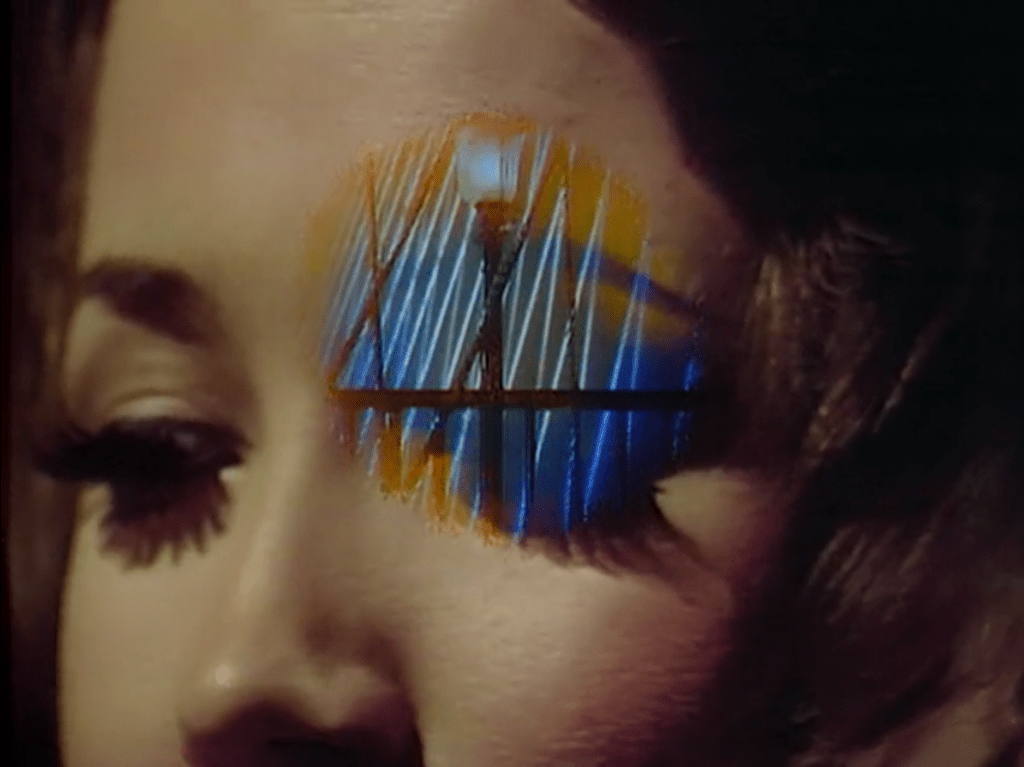
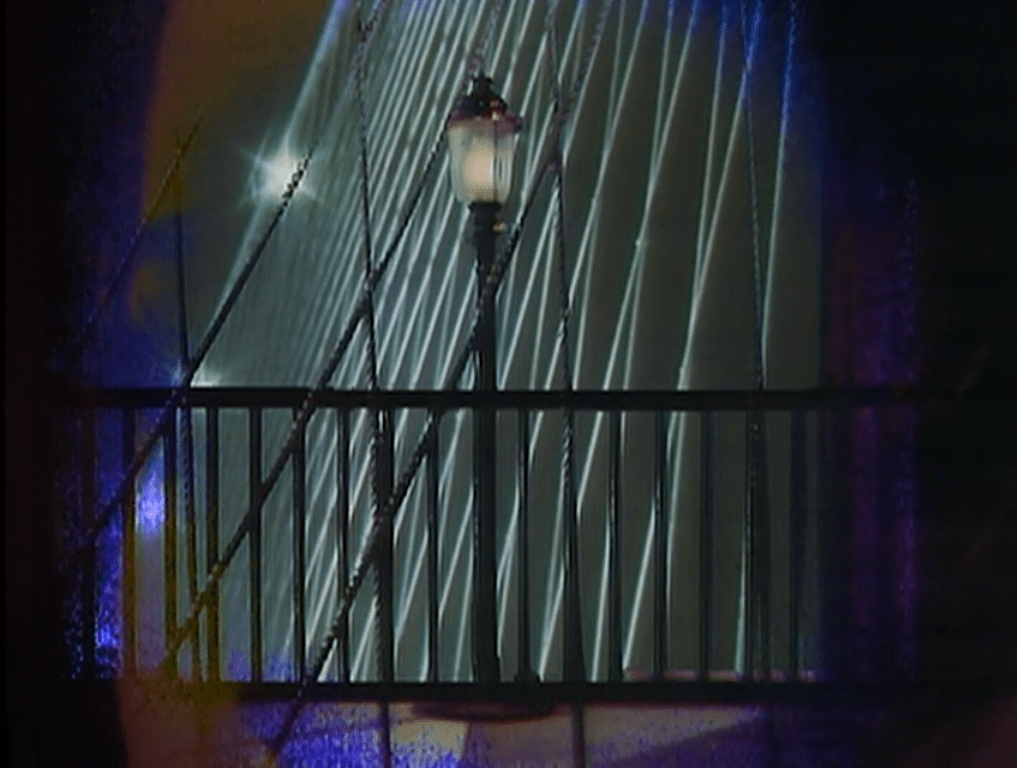
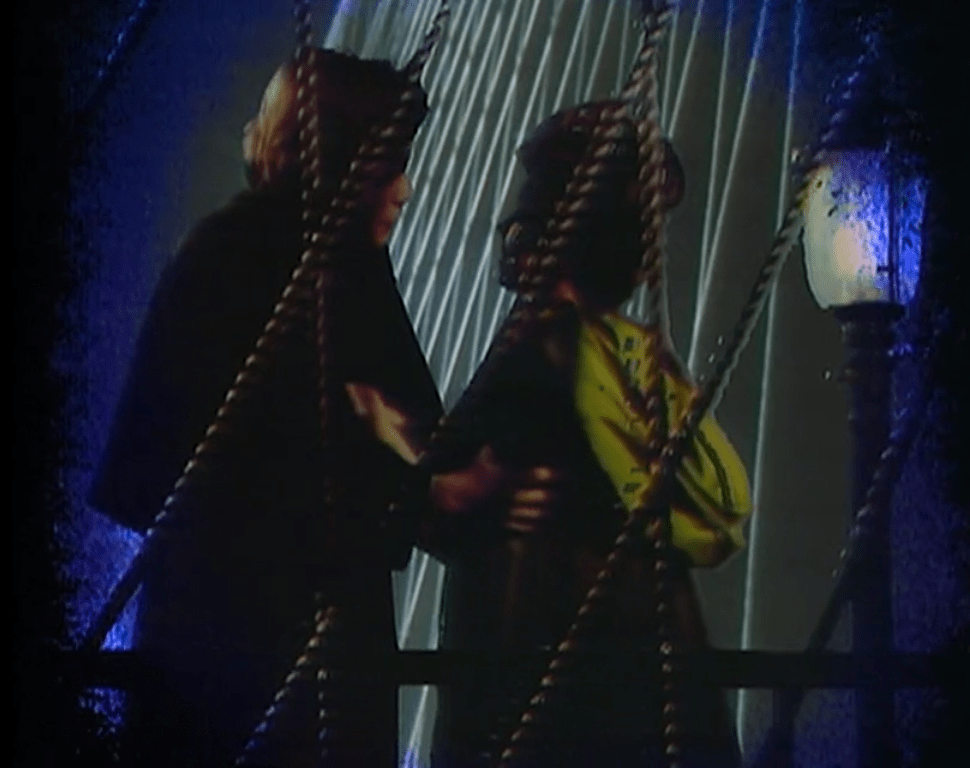
When Amanda gets to the meat of her story, we zoom in on her face for an extreme closeup. An iris wipe starts from her left eyelid, growing into a stage set representing a bridge in New York City. She and Quentin have a conversation that covers the same ground as the one we saw in #884, and he leaves her alone on the bridge.
A man we have not seen before enters and tells Amanda that she ought not to jump from the bridge. He says that she is very beautiful, and that other men will love her. He says that “If I were… different… I’d love you myself.” The words of this kindly confirmed bachelor mean nothing to Amanda, who throws herself off the bridge.
The wipe does not fill the entire screen; the edges of the main image are covered with flickering little blue squares, and we can make out an image of Amanda’s suite on the right-hand side of the screen. This effect becomes distracting while the confirmed bachelor is talking to Amanda, when they are adjusting the camera for the shot that will follow the end of the insert. Not only does the image of the suite wobble jerkily, but it continues as we cut from the two shot to a closeup on the man, taking our attention away from his face at a crucial moment.
Amanda tells Julia that after she jumped off the bridge, she found herself in a hotel lobby. The confirmed bachelor, whom she calls “Mr Best,” met her there and explained that he wants her to live out the long life that she was originally destined to have. He says that she will have all of those years, and will remain young throughout them. If she can find Quentin again before she reaches the time she was meant to die, the two of them will go on living forever. If not, he will return for her at the appointed time. Julia leaves, determined to cure Quentin of his amnesia and return him to Amanda. A moment later, a knock comes at the door. It is Mr Best, telling Amanda her time is up.
A few days ago, Julia brought Amanda one of Tate’s portraits of her. She made no effort to buy it, saying it was of no interest to her. The story of Mr Best explains this indifference. Amanda believes that her supernatural youth is due to his intervention, not to the portrait. She does not know why Quentin has remained young, and has no reason to connect her situation with Tate’s works.
Mr Best is played by Emory Bass, who was at this time playing James Wilson in the original Broadway production of 1776. That cast, to be reunited in the 1972 film version of the musical, also featured Dark Shadows alums David Ford (Sam Evans #2, Andre DuPrés) as John Hancock, Daniel F. Keyes (Cemetery Caretaker) as Josiah Bartlett, Peter Lombard (Oberon) as a stage manager and understudy for the parts of Thomas Jefferson and Stephen Hopkins, and Virginia Vestoff (whom we will see several months from now as Samantha Collins) in the major role of Abigail Adams. With all that overlap, I tend to think of the whole cast of 1776 as having been available for parts on Dark Shadows, and vice versa. Whenever I get unhappy with a cast member, I wonder who from 1776 could have done a better job. Bass was great in 1776, and his arrestingly deliberate phrasing is perfectly suited to an angel of death, especially one like Mr Best who has far more discretion and a more idiosyncratic personality than do the angels described in the orthodox theological statements of the great monotheistic traditions.
Mrs Acilius and I did our first watch-through of Dark Shadows on streaming starting in the spring of 2020, when there was no live theater to attend. When we got to the episodes introducing Barnabas Collins the vampire, I found Danny Horn’s Dark Shadows Every Day, which picks up with those and follows the series to its conclusion. I enjoyed Danny’s blog very much, and soon became one of his regular commenters. When we started this watch-through to coincide with the 56th anniversary, I looked for someplace to leave my comments on the episodes Danny didn’t cover, and found that all I could do was to start this blog of my own.
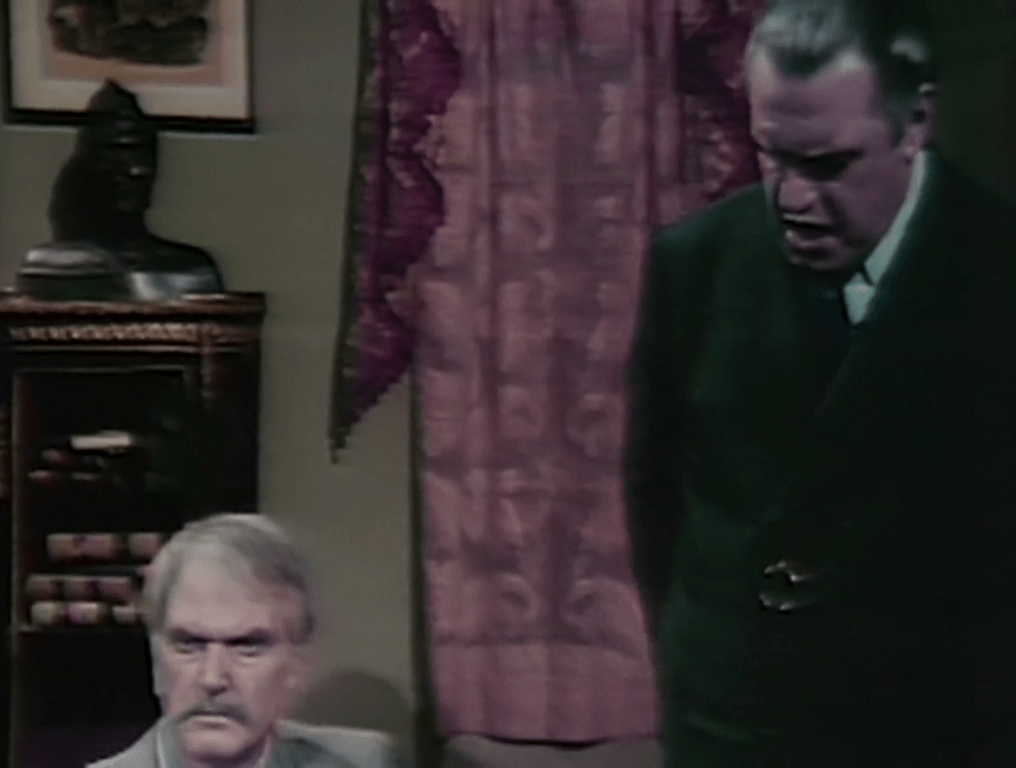
In his post about #412, Danny wrote: “This actor, Roger Davis, plays five roles on Dark Shadows, and they just get more and more angry. By the time we get to Harrison Monroe in late 1969, his character is literally an automaton sitting behind a desk, who yells at people nonstop until his head falls off. That is actually true.” I remember reading that in 2020 and doubting that it was actually true, but by the time we got to this episode and saw it happen, we had learned not to underestimate Dark Shadows. It is far and away the best Roger Davis moment on Dark Shadows. In fairness to Mr Davis, he is a highly trained actor who can do good work, but he chose to do so only a handful of times on the show. When we see that the writers are as sick of his obnoxiousness as we are, it’s an occasion to stand up and cheer.
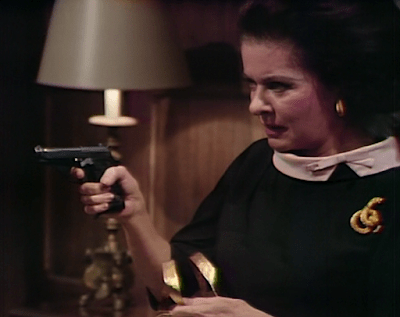
Much of the episode is taken up with some business about whether matriarch Elizabeth Collins Stoddard and her thirteen year old nephew David Collins are going to murder permanent houseguest Julia Hoffman. Liz and David have been absorbed into a secret cult devoted to unseen supernatural beings called the Leviathans, and Julia, who cannot be absorbed into the cult, is on track to uncover its existence. Liz takes a pistol and aims it at Julia’s back. Julia is absorbed in another crisis, and by the time she notices that someone else is in the room, Liz has put the pistol down.
Liz tells David she can’t bring herself to kill Julia, who has been very helpful to the family in the past. David sternly tells her that they must put aside all such considerations and think only of their duty to the Leviathans. They consult a sacred book the Leviathans have entrusted to them, and read that they must not kill anyone, since the ghosts of their victims are more formidable to them than are living people. Since most of the principal characters on the show, including Julia, Liz, and David, have committed or at least attempted homicide, this prohibition would seem to imply that the Leviathans are the good guys.
There is also a story about Quentin Collins and his great-grandson Chris Jennings. Quentin was a werewolf in the nineteenth century and Chris has inherited that curse. In 1897, a repellent little man named Charles Delaware Tate painted Quentin’s portrait. The portrait had magical powers, relieving Quentin of the effects both of lycanthropy and of aging. Quentin recently came back to town, suffering from amnesia and refusing to listen to Julia or Chris when they try to tell him he is 99 years old. Julia and Chris hope that Tate will be able to do for Chris what he did for Quentin, and they have figured out that he is still alive and using the name Harrison Monroe.
The moon was full enough last night to trigger the werewolf transformation, and will be again tonight. Chris turns up. She had taken him to a mental hospital she controls, to be locked up securely while he is in his lupine form; he checked himself out, and says he can’t stand being caged. Since the alternative is killing at least one person at random, it is rather difficult to sympathize with Chris’ insistence on letting himself out.
For her part, Julia was already afraid that a werewolf was on the loose before she knew Chris had left the hospital. She suspects Quentin may have reverted to lycanthropy. She goes to the apartment of the woman who has been keeping Quentin and finds him there, his face soiled and his clothing tattered as it might be the morning after a fit of werewolfery. It turns out that he did not transform- he simply got into a bar fight. When she tells Chris about this, he goes to his great-granddad and demands he accompany him to Tate/ Monroe’s house. Quentin isn’t interested in Chris or his problem or Tate/ Monroe, but he is too drunk to hold his ground for long.
Tate/ Monroe doesn’t want to let anyone in, but when Quentin announces himself he opens the door. Chris and Quentin see a young man sitting at a desk in a darkened room. The young man sees Quentin’s apparent youth and yells “Liar!,” shouting that he is too young to be Quentin. Quentin points out that Tate/ Monroe looks just as young as he does, and Tate/ Monroe responds by shouting something about being a genius. Within seconds, he is shouting that of course he recognizes him as Quentin. Confusing as this transition is, I don’t think it is a flaw in the writing, but in the acting. I suspect Mr Davis was supposed to put some sort of inflection on the lines in between to show that Tate has figured something out, but doing that would not be compatible with his technique of delivering all of his lines in an unvarying petulant shout.
Quentin can’t take Tate’s personality any more than the audience can. He throws a vase at him and runs out of the room. It’s when the vase hits the automaton that the head falls off.
The Leviathan story is based on some of H. P. Lovecraft’s stories. Chris and Quentin do not appear to have a direct connection to the Leviathans, but Harrison Monroe, and today’s closing revelation that he is a pile of junk arranged to look like a person, are taken from Lovecraft’s novella The Whisperer in Darkness. So perhaps werewolves and Leviathans have something to do with each other after all.


 Dark Shadows Commentary