Episode 557: Unannounced visitors

Act One consists of recovering vampire Barnabas and mad scientist Julia standing around Barnabas’ front parlor recapping various ongoing storylines.

Danny Horn devotes his post about this episode to a detailed analysis of this scene. He shows that Jonathan Frid’s performance and Grayson Hall’s are open to many objections. They fall short in such technical categories as “knowing their lines” and “standing on their marks” and “having the slightest idea what is going on.” But they are fascinating to watch nonetheless. Danny declares that “[t]he point of these scenes is to see how long two adults can stand around in a room saying preposterous things to each other.” Frid and Hall operate at such a high level of tension that the prospect of either of them breaking character generates enough suspense to keep us on the edge of our seats.

Patrick McCray wrote two separate posts about this episode. In the one that went live 13 September 2017, he too focuses on the performances in Act One. He writes:

Poor Jonathan Frid. He must have had a rough night. I am usually oblivious to his infamous (and completely understandable) line trouble, but in this one, it is so palpable that I totally understand why he retired from TV after DARK SHADOWS left the air. In his early dialogue with Grayson Hall, you can see sheer terror in the eyes of both performers as Barnabas haltingly recalls a trip to the hospital. This is followed by the “Frid Surge,” where Barnabas becomes far more committed and energetic when he turns to face the teleprompter. Of course, this gives him that great sense of vulnerability that was the secret to Barnabas’ success. 

Patrick McCray, “The Dark Shadows Daybook: August 13,” posted on the Collinsport Historical Society, 13 September 2017.

This is the only post on the Collinsport Historical Society tagged “Frid Surge”; that’s too bad, I’d like to see that phenomenon tracked throughout the series. I should also mention that Patrick goes on in this post to express his “confidence that Frid could have acted the doors off the collected ensemble had the poor guy just been given another frickin day to study his sides.”

Barnabas and Julia’s recap scene ends when an unexpected visitor barges in. He is an unpleasant man named Peter, who prefers to be called Jeff. Peter/ Jeff is fiancé to well-meaning governess Vicki, whom Barnabas and Julia know to have been abducted by Frankenstein’s monster Adam. Adam came to Barnabas’ house yesterday and threatened to kill Vicki unless Barnabas and Julia created a mate for him.

Peter/ Jeff was assistant to Eric Lang, the mad scientist who created Adam, and he knows that Barnabas and Julia were connected to the experiment. He does not know for sure that Adam is Lang’s creation, that Barnabas and Julia brought Adam to life after Lang’s death, or that Adam has abducted Vicki. He does, however, have grounds to suspect that each of these things might be true. In this scene, he announces his suspicions to Barnabas and Julia. They huddle in one corner of the room while he shouts his lines in his singularly irritating voice. They deny all three of his points. One of the commenters on Danny’s post, “Straker,” summed up their reaction admirably:

Frid and Hall were too professional to show it but I sensed they were both annoyed when Roger Davis marched in and started yelling. It’s kind of like how you feel when you’re at a party and the host’s five year old son throws a tantrum. Sort of an embarrassed tolerance.

Comment left by “Straker” at 6:21 am Pacific time 31 July 2020 on “Episode 557: A Race of Monsters,” by Danny Horn, Dark Shadows Every Day, 1 January 2015
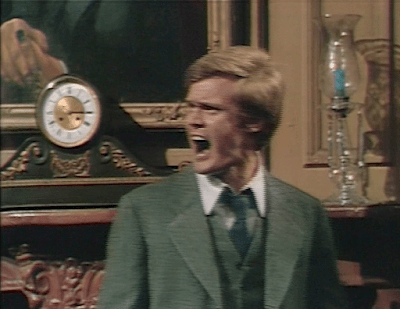
Roger Davis as Peter/ Jeff, in one of the most subtle moments of his performance. Screenshot by Dark Shadows Before I Die.

After Peter/ Jeff’s scene, it is Barnabas’ turn to be an unwelcome guest. He calls on occult expert Timothy Eliot Stokes. Barnabas and Julia suspect that Stokes may be the evil mastermind who has turned the previously gentle Adam toward evil plans. When Stokes hears Barnabas knocking on his door, he looks up and rasps to himself “Go away… No one is home…” This is one of my favorite lines in the whole series. Stokes was quite cheerful when he first involved himself in the strange goings-on, but as he has found himself drawn deeper and deeper into the unholy world of Collinsport he has come to regret his decisions.

Stokes is quite impatient with Barnabas’ demands that he tell him what he knows and his refusal to reciprocate with information about himself. It is only because Vicki is in danger that Stokes tells Barnabas anything at all.

Stokes already knows how Adam came into being, and Barnabas tells him about Adam’s conversation with him. This brings up a question about the scene with Peter/ Jeff. Why couldn’t Barnabas and Julia have trusted Peter/ Jeff with as much information as Barnabas here gives Stokes? Peter/ Jeff can no more go to the police than Stokes can, he will not tell Vicki anything about Lang’s experiment, and Barnabas and Julia have no reason to suspect him of being behind Adam’s turn to evil. These questions don’t come to mind during the scene with Peter/ Jeff, partly because he is so disagreeable a presence that we want him off screen as soon as possible, and partly because it has long been Barnabas’ habit to tell his enemies everything he knows while he zealously guards his secrets from potential helpers.

Patrick McCray’s second post about this episode, published 30 July 2018, includes an analysis of Thayer David’s portrayal of Stokes:

Professor Eliot Stokes gains fascinating dimension in 557. Normally, jovial and helpful, we see his protectiveness of Adam reveal an irascible and sternly just man within. Anton LaVey extolled “responsibility to the responsible,” and there are few other places where Barnabas gets both barrels of that. Stokes is perhaps the most inherently good man in Collinsport since his fellow freemason, Bill Malloy, took his last diving lesson. (Ironically, at the hands of Thayer David’s first character.) Stokes’ prime reason for siding with Adam and not Barnabas? The former vampire and Julia have withheld vital information for months. Yes, they have necessary trust issues, but this is Stokes we’re talking about. Adam may be a wildly unpredictable man-beast, capable of leveling Collinsport to sand before breakfast, but he’s also (until later in the episode) a prime graduate of Rousseau’s Finishing School for Noble Savages. He’s nursed greedily on the milk of morality that spurts abundantly from the ripe and straining teat of of Eliot Stokes’ moral tutelage. It takes a Nicholas Blair — so often Stokes’ foil — to teach him the less savory lessons in humanity. Stokes knows that there’s only so much danger in which Adam can find himself… Victoria Winters is another matter.

Patrick McCray, “The Dark Shadows Daybook: Episode 557,” published on The Collinsport Historical Society, 30 July 2018

Barnabas passes the baton to Stokes, who becomes the third character in the episode to pay an unwelcome visit. He goes to Adam. He asks the big guy who has taught him to be cruel and amoral, and gets nothing but lies in return. He tries to persuade him that he must not hurt an innocent person, and Adam angrily declares that it is “fair” for him to make Barnabas watch him kill Vicki if Barnabas will not make a mate for him.

In Patrick McCray’s 2017 post, he praises Robert Rodan’s performance as Adam:

Robert Rodan issues a highly cerebral, emotionally packed performance. Rodan never receives the credit he deserves. Much of Adam’s stint on the show finds him equipped with an eloquent, even sesquipedalian command of the language. His inner conflict is as existential as it gets… Where do you turn? Rodan balances this absurd chimera of conflicts with effortless aplomb that makes Cirque du Soleil look as clumsy as a Matt Helm fight scene.

Patrick McCray, “The Dark Shadows Daybook: August 13,” posted on the Collinsport Historical Society, 13 September 2017.

Patrick amplifies that praise in his 2018 post:

Robert Rodan is an unsung hero of an actor, delivering his existential angst with passion and truth. It’s a shame that his identification with an eventually unpopular character was probably a factor in Rodan not being recycled by Dan Curtis, despite being the dark-haired, blue-eyed “type” that typified the ruggedly handsome, DS norm (such as Selby, Lacy, Crothers, George, Ryan, Prentice, Storm, Bain, etc.)

Patrick McCray, “The Dark Shadows Daybook: Episode 557,” published on The Collinsport Historical Society, 30 July 2018

While I always found the sight of Conrad Bain a guarantee of a fine performance, I can’t say it ever occurred to me to class him as “ruggedly handsome” in the way that one might class the other men Patrick lists. There’s no accounting for taste, I suppose.

Episode 553: The five captivities of Victoria Winters

The First Captivity

In #83, strange and troubled boy David Collins repaid his governess, the well-meaning Vicki, for her determined attempts to befriend him by locking her in a room where he hoped she would die. The room was located deep in the long-deserted west wing of the great house of Collinwood, and Vicki found that she could neither open the door nor reach the window.

Vicki had two visitors during her time trapped in this dusty chamber. In #85, the ghost of local man Bill Malloy appeared and sang to her; this was the first sustained and direct interaction between a living person and a supernatural being on Dark Shadows, and it left Vicki terrified and confused. In #87, David’s abusive father, high-born ne’er-do-well Roger Collins, knocked on the door and pretended to be a ghost, scaring Vicki further. When Roger then opened the door and rescued Vicki, she threw her arms around him, sobbing and saying that he was right and David really was a monster. In those days, Vicki’s attempt to win David over was the only storyline on the show that worked; when it seems that she will join all the other grownups in giving up on the little guy, the audience’s hearts break.

The Second Captivity

In #108, Vicki had come to the conclusion that Roger killed Bill. Unsure where to go, she stopped in the cottage on the estate where handyman Matthew Morgan made his home. Talking to him, she prompted him to make an indiscreet remark that revealed that he, not Roger, pushed Bill off the cliff from which he fell to his death.

Matthew would not let her leave the cottage. He acknowledged that she had done nothing wrong, but said that he would have to kill her now that she knew his secret. She tried to dissuade him, but it was only a chance visit from matriarch Elizabeth Collins Stoddard that prevented the murder. Matthew ran away, and Vicki was free.

The Third Captivity

In #116, Vicki went to look for David in the long-deserted Old House on the estate. She did not find him, but instead found Matthew, a wanted fugitive with a grudge against her. Until #126, Matthew kept her bound and gagged in the secret room behind the bookcase in the front parlor.

Others came and went. David, no longer homicidal, is convinced Matthew is innocent of Bill’s death and unaware he is holding Vicki, and he sneaks Matthew food he has stolen from the kitchen in the great house. Vicki’s friends Burke and Joe search the Old House, and she can only listen while Matthew hides with her in the secret room.

Matthew was fetching an ax with which to kill Vicki when the ghost of the gracious Josette Collins appeared to her and told her not to be afraid. When he came back, Josette led the ghosts of Bill Malloy and of the legendary Widows of Widows’ Hill as they surrounded Matthew and scared him to death.

The Fourth Captivity

From #365 to #461, Dark Shadows was a costume drama set in the late eighteenth century. Vicki had come unstuck in time, and found herself at Collinwood as it was in those days. Her total failure to adapt to her new environment led to her arrest, trial, and condemnation as a witch. From #401 on, she was in gaol, with a couple of brief and disastrous excursions.

Vicki had several visitors during her time in gaol, most of them people who had at some point wished her well but whom she alienated by her compulsive sharing of information she had learned when she was in the 1960s. By the time she had been sentenced to hang, she had only two friends left. One was her gaoler/ defense attorney/ boyfriend/ co-conspirator/ fellow prisoner, an unpleasant man named Peter Bradford. The other was Barnabas Collins, a vampire. Neither was able to do her much good, so in #460 and #461, Vicki mounted the gallows, was hooded, a noose placed around her neck, and the lever pulled to open the trap door under her feet. She then found herself restored to her own time, mere moments after her departure, but wearing the clothes she wore in the 1790s and bearing the marks of the wounds she sustained then, including the rope burns on her neck.

The Fifth Captivity

Shortly after Vicki returned to 1968, Barnabas’ vampirism went into remission. Peter also turned up, suffering from total amnesia and calling himself Jeff Clark, but still disagreeable to look at or listen to. Vicki and Peter/ Jeff became engaged the other day. Yesterday, Vicki left Peter/ Jeff to wait for her in the great house while she went to the Old House, which is now Barnabas’ home. She wanted to give him the news.

What freed Barnabas of the vampire curse was the creation of Frankenstein’s monster Adam. Now, Adam wants a mate, and is under the mistaken impression that Barnabas can create one for him. He has decided to extort Barnabas’ cooperation by taking Vicki as his hostage.

Adam is wanted by the police for abductions and assaults he committed before he learned to talk. Heiress Carolyn Collins Stoddard, who is acting as mistress of Collinwood while Liz is in the hospital, took pity on Adam and has been hiding him in a dusty room in the west wing. It is not the room Vicki was trapped in back in 1966; there is a window within reach. But when she comes to and finds herself there, she tells Adam she knows where she is. He responds “No!” She says that it’s the west wing, and she has been there before Most of the audience joined the show long after Vicki’s first captivity, so it will be as much news to them as it is to Adam that Vicki is on familiar ground.

Adam agrees that Vicki has done nothing to harm him, but tells her that he may nonetheless have to kill her. In this, he reminds us of what Matthew said to Vicki when he held her prisoner in his cottage.

Peter/ Jeff is still waiting for Vicki in the foyer of the great house when Carolyn finds him. He tells her Vicki went to Barnabas’ house more than two hours before, promising to return in an hour. Carolyn smiles and, with a mischievous twinkle in her eye, tells Peter/ Jeff that Barnabas and Vicki are “such good friends” it’s no wonder the two of them would lose track of time when they were alone together. This bothers Peter/ Jeff almost as much as it was obviously intended to do, and he goes to the Old House.

Peter/ Jeff arrives and demands Barnabas take him to Vicki. Barnabas is taken aback by Peter/ Jeff’s tone, and for good reason. When actor Roger Davis shouted his lines, which he did most of the time, he projected his voice not from the muscles of the pelvic floor, as singers are often taught to do, but from the sphincters in his buttocks, with the result that he sounded like he was trying to defecate. Barnabas has some nice rugs on his floor, so an angry Peter/ Jeff is an alarming visitor.

While Peter/ Jeff yells at him, Barnabas remembers that Adam had been in the house just moments before Vicki came, and that he had threatened to make Barnabas “very sorry” for not doing what he wanted. It was odd that Barnabas didn’t offer to walk Vicki home after that, a fact which has apparently dawned on him. He rounds on Peter/ Jeff and says that they are both to blame if anything happened to Vicki, since neither of them should have let her walk through the woods alone. Peter/ Jeff agrees with that, and his yelling moderates a bit. They get some flashlights and go out to search for her.

As they are searching, Peter/ Jeff proves that he is a true member of the Dark Shadows cast when he shines a flashlight directly into the camera. Barnabas tells him they should split up. This may or may not be a logical step towards finding Vicki, but it definitely will reduce Barnabas’ exposure to Peter/ Jeff, so it is no wonder he is eager to do it.

Peter/ Jeff carries on the tradition. Screenshot by Dark Shadows Before I Die.

Barnabas goes to the great house and talks to Carolyn. He tells her that Vicki is missing, that he and Peter/ Jeff have searched the woods thoroughly, and that he suspects Adam has abducted her. He insists that she tell him where Adam is, and she denies knowing. He tells her he does not believe her, and says that if Adam harms Vicki, she “will be held responsible.” Jonathan Frid and Nancy Barrett were always interesting to watch together, and this is the first time they have played a scene where their characters were adversaries facing each other down. The dialogue is nothing special and the situation is all too familiar, but their performances make for a few fresh and exciting minutes.

Carolyn goes to Adam’s room. As Barnabas had been reading when Peter/ Jeff called on him, so Adam, who shares a mystical connection with Barnabas, has a book in his hand when Carolyn stops by. As David sneaked food from the kitchen to Matthew at the Old House, so Carolyn has been sneaking food from the kitchen to Adam in the west wing.

Adam is very slow to let Carolyn into the room. She notes that he has always invited her in before, and does not go away when he claims to have been asleep. He lets her in. As Burke and Joe had searched the Old House when Matthew was hiding Vicki in the secret room there, so Carolyn looks around the room while we know Vicki is somewhere inside it. Adam denies having been out of the room, and tells her Barnabas was lying when he said he had gone to his house. Adam has not lied to Carolyn before, so she accepts what he says. After she leaves, Adam opens the door to his own secret room, a closet in which Vicki is bound and gagged as Matthew had once bound and gagged her.

This is the twelfth episode directed by John Walter Sullivan, but the first credited to him as “Sean Dhu Sullivan.” The name “Jack Sullivan” appeared on the previous installments.

Episode 526: Tell me now

In the woods, an unpleasant man named Peter finds his girlfriend, well-meaning governess Vicki, wandering about in a trance. He thinks she has been sleepwalking, and takes her home to the great house of Collinwood.

In her bedroom, Vicki tells Peter that she has never walked in her sleep before. He tells her that he had a dream which persuaded him that she has been right all along. He now believes that the two of them lived in the 1790s, that they were lovers then, and that they were both unjustly sentenced to die. He describes a dream he had that broke down his resistance to this idea. Vicki tells him that the events in the dream did not take place, and wonders if she has been wrong about him all along. Perhaps he just dreamed about the stories she has been telling him. It does not occur to either of them that the dream was one Peter might have had while awaiting execution, so that even if it did not match what he would have seen during his waking hours, it still might have been an experience he had in the eighteenth century.

Peter tells Vicki about his dream. Screenshot by Dark Shadows Before I Die.

My wife, Mrs Acilius, was very much impressed with Alexandra Moltke Isles’ performance as Vicki in this scene. Every time Roger Davis speaks, and certainly every time he shoves his face into hers for a kiss, we recoil from Peter and expect Vicki to do the same. Yet Mrs Isles conjures up a look in her eyes and a tone in her voice that makes us believe Vicki loves Peter. She has to do that every time they have a scene together, and she pulls it off again and again. Mrs Acilius marveled that Mrs Isles could do this as convincingly with Mr Davis as if she were playing opposite an appealing actor.

Episode 523: Back to Hell, from whence thee came!

The first episode of Dark Shadows, broadcast on ABC-TV on 27 June 1966, was a moody, atmospheric Gothic drama, characterized above all by its hushed tone. For months afterward, the show was almost an essay on the theme of quietness. Now we come to the second anniversary of that premiere, and quietness is the last thing we hear.

This installment marks the final farewell of the show’s single loudest character, revenant witchfinder the Rev’d Mr Trask. In #519, Trask performed an exorcism on the witch variously known as Angelique Bouchard Collins and Cassandra Blair Collins. The exorcism seemed to be a great success; it ended with Angelique/ Cassandra vanishing into thin air, and she has not been seen since. That might have left someone watching Dark Shadows for the first time with the impression that it is a specifically Christian show and Trask is one of its heroes.

Today, they take steps to correct that impression. A man calling himself Nicholas Blair and claiming to be Angelique/ Cassandra’s brother has turned up on the great estate of Collinwood. In the basement of the Old House on the estate, he finds Trask’s skeleton. He conjures Trask up and interrogates him. Trask declares Nicholas to be a tool of the devil. Regular viewers know that this is something Trask says to all the fellas, but this time he is obviously correct. He goes into the same exorcism rite that produced such spectacular results with Angelique/ Cassandra. Nicholas simply turns around and gives him a sarcastic little round of applause. Nicholas keeps making demands of Trask. Trask takes a cross from under his cloak. Nicholas recoils from that. Trask vanishes, but his skeleton is still missing, suggesting that he has not found peace.

Trask draws his secret weapon. Screenshot by Dark Shadows Before I Die.

That Trask’s exorcism worked on Angelique/ Cassandra but not on Nicholas suggests that it is not a means through which God acts in the world, but is just another magical weapon that can be wielded with greater or lesser effect depending on the skill and strengths those involved. His loyalty to “THE ALMIGHTY!!!” has given Trask enough power to defeat Angelique/ Cassandra, but Nicholas ranks higher than she does in the hierarchy of “THE DE-VILLL!!!,” high enough that Trask’s mumbo-jumbo cannot reach him. The cross has its effect, but with that Trask is setting aside his own efforts and calling directly on the boss. Nicholas is quite certain that he can undo the effects of the exorcism, so for all we know, he might be able to call his own home office for help sufficient to overcome his aversion to the sign of the cross.

The show not only puts Christianity and the spiritual forces of darkness on a par as sources of magical power, they aren’t even the only such sources. Though we don’t hear about any of them today, scientists and doctors Peter Guthrie, Julia Hoffman, Eric Lang, and Timothy Eliot Stokes apparently acquired supernatural abilities along with their advanced degrees. We even know that Guthrie was a professor of psychology at Dartmouth College. So the Dartmouth Department of Psychological and Brian Sciences joins Christianity and diabolism as reservoirs of uncanny might.

In the great house on the estate, heiress Carolyn Collins Stoddard tells Nicholas that Angelique/ Cassandra alienated the Collins family by her dalliance with local attorney Tony Peterson. Nicholas goes to the village of Collinsport and calls on Tony, whom he realizes Angelique/ Cassandra ensorcelled into serving as her cat’s paw. Angelique/ Cassandra put Tony into a trance by having him strike his cigarette lighter; Nicholas achieves the same effect by opening his cigarette case. Tony really needs to stop smoking.

When he first sees Tony, Nicholas is stunned by his resemblance to Trask. They are both played by Jerry Lacy, and Angelique/ Cassandra told him that she chose him because he reminded her of her old acquaintance. We already know that there is a mystical connection between Tony and Trask; Tony was the medium through whom Trask spoke at the séance which led to his return to the world of the living. While he has Tony entranced, Nicholas extracts information from him that only Trask could have known. This suggests a notion of reincarnation that would have reminded viewers of what many of them probably thought Hindus and Buddhists believed, and would thus suggest a syncretistic approach to religion that would represent another step away from the Sunday-morning flavor that the ending of #519 might have left.

We return to the great house. Well-meaning governess Vicki opens the front door and finds her boyfriend, an unpleasant man named Peter who prefers to be called Jeff. With this, a Christian world-view is pushed still further into the background, as a scene featuring Peter/ Jeff is enough to make anyone doubt the existence of a just and loving God.

Vicki and Peter/ Jeff talk about various events that don’t have anything to do with the show. He paws her awkwardly, and his hands dart to her neck as if he were about to strangle her. While he is out of the room for a moment, Trask materializes and tries to warn Vicki that “THE DE-VILLL!!!” is nearby. Before he can tell her that it’s Nicholas she should be worried about, Peter/ Jeff comes back in and starts yelling. At the sight of Peter/ Jeff, Trask wrinkles his nose and fades into nothingness, never to be seen again. Peter/ Jeff probably got a lot of that.

Episode 487: No homicidal tendencies

For its first 38 weeks, Dark Shadows was the story of well-meaning governess Vicki and her attempt to make her way through life on the great estate of Collinwood. One by one, Vicki’s problems were either solved or forgotten. From week 43 on, the show has focused on vampire Barnabas Collins. Barnabas has refused to involve Vicki in his life, leaving her confined to B plots at best.

The current B plot is about Vicki’s relationship with a man named Peter, who keeps trying her patience and ours by pretending to be named Jeff. Peter/ Jeff’s shouting voice, which he uses by default, makes him sound like he is suffering from severe gastrointestinal distress. He has a habit of manhandling people around him, causing them obvious discomfort. These bad habits, and several others, are less the product of the writing or direction than they are symptoms of the casting of Roger Davis as Peter/ Jeff. Alexandra Moltke Isles, like all the other actresses, is so ill at ease when she is in proximity to Mr Davis that it is impossible to believe that Vicki is in love with Peter/ Jeff.

Peter/ Jeff had been connected to the A plot through his boss, mad scientist Eric Lang. Peter/ Jeff has total amnesia. Lang released him from a mental hospital and told him that he was suspected of strangling two women by the waterfront in Portsmouth, New Hampshire. He used Peter/ Jeff as his assistant in an experiment that is supposed to free Barnabas from vampirism. Now Lang is dead, and Peter/ Jeff goes to his house to search for the file on his own background.

There, he meets Barnabas. The two of them display hostility to each other, but the scene fizzles out as it becomes clear that Barnabas has no motivation to oppose Peter/ Jeff’s goals and wouldn’t be in a position to stop him if he did. Peter/ Jeff finds a paper which proves that Lang was lying, and he is not a murderer after all. With that, he and Vicki both lose whatever reason they had to be on the show.

On his Dark Shadows Every Day, Danny Horn summed this up memorably:

 His file from the mental institution had those three magic words: “No homicidal tendencies.” As something to be proud of, that’s a pretty low bar, but he seems happy.

Unfortunately, that basically nerfs Jeff’s entire storyline. He’s not working for Dr. Lang anymore, and the secret that Lang was holding over him — the idea that he might be a murderer — has just dissolved.

This is just throwing a story point away, rather than advancing anything, and Jeff is left at a loose end. He has no job, no family, and no real connection to a story. Now he doesn’t even have homicidal tendencies. It wasn’t much, but it was all he had.

Danny Horn, “Episode 487: Precious Moments,” Dark Shadows Every Day, 24 September 2014

Peter/ Jeff goes to share this news with Vicki. It’s a tribute to Mrs Isles’ acting ability that she makes us believe Vicki is bewildered that Peter/ Jeff thought he had homicidal tendencies. Mr Davis usually seems angry enough to kill someone, as for example at various points in today’s episode when Peter/ Jeff’s joy leads him to wrap his hands around Vicki’s throat, plant a rather painful-looking kiss on her, pick her up, and point her underwear at the camera.

Screenshot by Dark Shadows Before I Die, whose caption was “No homicidal tendencies? Are we sure about that?”
Lip-wrestling isn’t usually a combat sport. Screenshot by Dark Shadows Before I Die.
Screenshot by Dark Shadows Before I Die.

The highlight of this episode is a scene between Julia Hoffman and Timothy Eliot Stokes. Julia is Barnabas’ best friend. She has decided to take over the experiment after the death of her fellow mad scientist Lang. Wicked witch Angelique is trying to prevent her helping Barnabas, and so Julia turns to Stokes, a sage in the ways of the occult.

Stokes is the second such character on Dark Shadows, after the ill-fated Dr Peter Guthrie. Vicki recruited Guthrie into her battle against undead fire witch Laura Murdoch Collins in #160 and Laura killed him in #185. We haven’t heard about Guthrie since the end of the Laura story, but the show went out of its way to remind him of us when it showed Lang’s death yesterday. Like Guthrie, Lang died as the result of an indiscreet word from housekeeper Mrs Johnson to an undead witch in the drawing room at Collinwood. Also like Guthrie, Lang is a paranormal researcher who is deeply involved with a tape recorder.

While these similarities served to remind us of Guthrie, they also reminded us of the radical differences between him and Lang. Guthrie was as sane and law-abiding as Lang is crazed and lawless. Seeing Stokes today, we recognize him as Guthrie’s successor, and wonder if his fate will be any different.

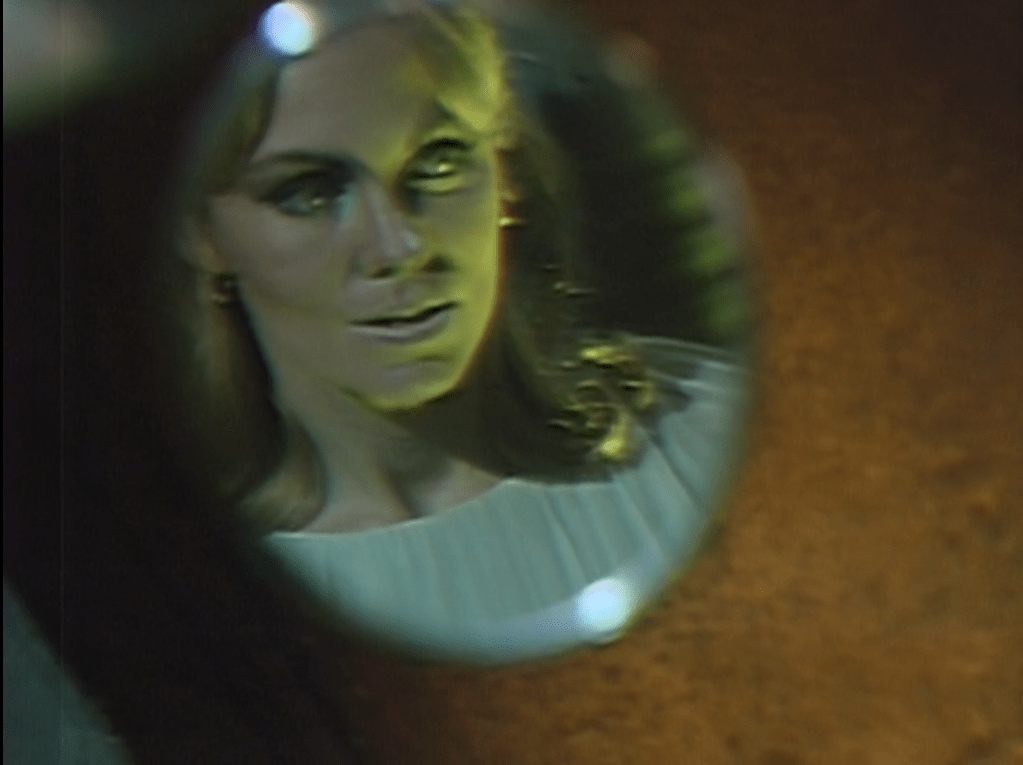
Julia is deeply troubled because of a dream she had last night. She was so very upset by it that she was up all night chain smoking.* It was no ordinary nightmare, but part of “The Dream Curse,” a piece of mental malware Angelique has sent to infect one character’s mind after another. Julia recaps the Dream Curse to Stokes while looking into a convex mirror. It’s a striking visual.

Julia recaps the Dream Curse. Screenshot by Dark Shadows Before I Die.

It doesn’t look good for Stokes. Angelique is a supercharged force of destruction, and Julia withholds several crucial pieces of information while recruiting him to the fight against her. Julia does not identify Angelique as the witch. She can’t tell him about Barnabas’ vampirism or about Lang’s experiment without incriminating herself in many felonies, including murder. When Vicki was recruiting Guthrie to the fight against Laura, a far less formidable adversary than Angelique, she held nothing back and ensured that her friends gave him their full support. If Stokes is going to survive, he will need more backing than Julia can offer him.

*Fans of Dark Shadows wince when they see Julia smoking; Grayson Hall had asthma.

Episode 482: Someone you hate

Recovering vampire Barnabas Collins hopes that mad scientist Eric Lang will be able to free him of his curse once and for all. Since wicked witch Angelique, who put the curse on Barnabas in the first place, has come back to the great estate of Collinwood, Barnabas found a twelfth century Sicilian talisman with the power to protect against witches and gave it to Lang with instructions that he was to keep it on his person at all times. Several days ago, Angelique drove Lang to the point of death, and he survived only because he managed to touch the talisman at the last moment. Even so, Lang refuses to wear the talisman or even to keep track of it. Now Barnabas is with Lang in his study, whence they discover that the talisman has been stolen. Lang asks Barnabas if he can get another one for him. Barnabas looks at Lang as if he were the world’s stupidest man, and tells him that such objects are extremely rare.

The whole business with Lang and the talisman is a prime example of what Roger Ebert called Idiot Plot, in which the story would end immediately if the characters showed as much intelligence as the average member of the audience has. If Lang were played by a good actor, he might be able to hold our interest through a few of these inexplicable actions. Both Alexandra Moltke Isles, as well-meaning governess Vicki, and Dana Elcar, as Sheriff George Patterson, were cast as the Designated Dum-Dum in a number of episodes, and each managed to survive longer than one might have expected. Mrs Isles kept the audience on board for Vicki by making us wonder how anyone could absorb the torrent of bizarre information drowning her. Elcar made the sheriff watchable by making speculate he might only be pretending to be clueless. But as Lang, Addison Powell is just dismally bad. Not only does he not invent a way to make Lang seem like he might be secretly smarter than the script makes him out to be, he does not show any sign of ever having acquired even the most basic acting skills. When Lang seems to think Barnabas can take him to Talismans-Я-Us to replace the priceless object he has lost, the audience loses whatever patience it may have had with him.

Lang’s assistant, a former mental patient named Peter who insists on being called “Jeff,” is quitting after months of helping Lang steal body parts from fresh graves. Peter/ Jeff tells Barnabas that he will be staying in town. That’s bad news for Barnabas, but much worse news for the audience. Peter/ Jeff is played by Roger Davis, who is a far more skilled actor than Addison Powell but, if anything, even less pleasant to watch. His characters are either full of rage or insufferably smug, he often manhandles his scene partners, and when he raises his voice he projects, not from the muscles of his pelvic floor, but from his anal sphincters, causing him to sound like he is suffering from severe constipation.

Lang tells Barnabas he needs a new assistant as soon as possible. Barnabas says he knows just the man. He is Willie Loomis. As Peter/ Jeff was a patient in an institution for the criminally insane when Lang found him, Willie is a patient in such an institution now. Willie was Barnabas’ servant for the first months he was in the 1960s, when Barnabas was a vampire rampaging through the village of Collinsport. Barnabas eventually took the heat off himself by pinning some of his crimes on Willie, packing him off to the mental hospital.

Willie was a fan favorite. Largely this was because actor John Karlen was as capable as Addison Powell was inept and as likable as Roger Davis is repellent. But the writers, too, always found fresh ways to make Barnabas’ conversations with Willie interesting, and when mad scientist Julia Hoffman teamed up with Barnabas she and Willie were great fun to watch together. The idea of Willie replacing Peter/ Jeff, in whatever capacity, is something to cheer for.

We cut to the cottage where Maggie Evans, The Nicest Girl in Town, lives with her father Sam. Maggie is wearing a pair of trousers which may well be the weirdest things ever shown on Dark Shadows. According to a blog called 1630 Revello Drive,* they are based on an article of women’s clothing traditional in India called a gharara. Surely no one in India ever made such things out of this brightly colored floral quilt. If this garment can exist, we would be foolhardy to rule out the possibility of ghosts or vampires or time travel or witches or anything else.

Maggie in her quilted pseudo-gharara. Screenshot by Dark Shadows Before I Die.

Maggie answers a knock on the door and finds Peter/ Jeff. Vicki had arranged for him to rent a room at the Evans cottage. Shortly after he arrives, Vicki comes. Peter/ Jeff tells her she doesn’t know much about him, and asks what she will do if it turns out he is someone she hates.

The next thing we see after that question is Peter/ Jeff with his shoe, a shoe he wears while robbing graves, on Maggie and Sam’s coffee table. Anyone who saw that might well conclude that Peter/ Jeff is such a clod that any civilized person would be tempted to hate him.

That isn’t an ottoman, buddy.

Again, there are actors who specialize in playing men who are compelling to watch when they do unpleasant things. Dark Shadows hit the jackpot in this regard when it cast Jonathan Frid as the vampire Barnabas. It narrowly missed doing so on other occasions. In the first year of the show, future movie stars Harvey Keitel (in #33) and Frederic Forrest (in #137) showed up as background players. Surely they would have taken speaking parts on the show at this point in their careers, and either of them could have made Peter/ Jeff almost as much of an asset as John Karlen made Willie, even if he did wantonly ruin people’s furniture.

*As cited by Christine Scoleri on Dark Shadows Before I Die.

Episode 437: It’s gone on too long

Bewildered time traveler Vicki tells her lawyer/ gaoler/ boyfriend/ accomplice/ therapist/ assailant Peter that her time in the late eighteenth century seems like a nightmare. She then does something she often did in the early months of Dark Shadows, reminiscing about her childhood as an inmate of the farcically horrible Hammond Foundling Home. She says that she had so many nightmares when she was there that she became a connoisseur of nightmares. When she realized she was having a bad dream, she would choose to remain asleep right up to the moment she was about to be killed so that she could see how the whole thing would play out. I suppose that might have been useful training for a career as a character in a horror story, but if so Vicki has not benefited from it. She’s done nothing but make matters worse for herself since she arrived in the year 1795, and she is now in her last day as the defendant in a witchcraft trial which has been going very badly for her.

During this scene, Vicki gets very upset. Peter demands that she calm down and slaps her in the face when she doesn’t. That was a time-honored form of treatment for anxiety in fiction back then. It’s always gross to see, but is especially bad when the actor administering the slap is Roger Davis. Mr Davis was, shall we say, uninhibited in his physicality when dealing with his female scene partners. In his post about the episode on Dark Shadows Every Day, Danny Horn includes screenshots of 10 distinct moments in this episode when Mr Davis aggressively rubs himself all over Alexandra Moltke Isles. Later in the series, he would, in separate incidents, hurt both Terrayne Crawford and Joan Bennett while on camera. His fake slap does not make contact with Mrs Isles today, but his sense of personal boundaries is so severely underdeveloped that we can hardly blame her for visibly ducking to avoid his hand.

Seriously, who needs that guy? Screenshot by Dark Shadows Before I Die.

Vicki takes the stand and says that she is a native of the twentieth century, whisked back in time by what force she knows not. Cross-examined by visiting witchfinder/ fanatical bigot/ prosecuting attorney Rev’d Trask, Vicki admits that her last memory of 1967 was when she was at a séance, and that this was not the first séance she had taken part in. Trask declares that this is an admission of witchcraft, which, if you think about it, it is. Vicki becomes upset, and we cut directly to a commercial break without a musical sting. This is a technique the show very rarely uses, and it is always effective when it does.

One of the witnesses against Vicki, untrustworthy naval officer Nathan, has a scene alone with Trask while they are waiting for the verdict. Nathan tells Trask he never thought he would meet a preacher whose specialty was blackmail. Trask denies that he blackmailed Nathan into testifying against Vicki. He has a point- it was more a matter of extortion, followed up with bribery. Anyway, actors Jerry Lacy and Joel Crothers were sensational together. Mr Lacy is exciting to watch when he’s wound up tight, the usual condition of a character on Dark Shadows, and Crothers always moved loosely and fluidly. The two of them strike an ideal balance.

The episode ends with the judges finding Vicki guilty and sentencing her to hang by the neck until dead. If we take her recollection of her childhood nightmares as a programmatic statement, we should expect her to mount the gallows and stick her head in the noose, then immediately find herself back at the séance.

Episode 434: No business to run

Some people have conversations relating to the ongoing witchcraft trial of bewildered time traveler Vicki Winters. The trial itself is a waste of time, so a half hour listening to people talk about what might happen during the trial is a grim prospect. Indeed, none of today’s scenes is necessary to the overall development of the plot or of any major themes. Still, they give the actors an opportunity to show us what they can do, and four of the five members of the cast turn that opportunity to good advantage.

The exception is of course Roger Davis as Vicki’s defense attorney Peter Bradford. Mr Davis was usually tolerable when he delivered his lines in a normal conversational tone, but when he had to raise his voice, as characters on Dark Shadows have to do very frequently, the results were painfully bad. Voice teachers sometimes tell their students to sing from way down in their bodies; the more indelicate among them have been known to tell boys’ choirs that “The music escapes from the testicles.” Such a teacher would be displeased with Mr Davis. When he raises his voice, the muscles he is tensing are not those around the pelvic floor, but the sphincters in his buttocks, with the result that he seems to be having difficulty evacuating his bowels. I realize this is rather a distasteful discussion, but the topic is impossible to avoid when you listen to Davis going through one sentence after another, in each case building up to one word and grunting it out loudly. Yesterday, young Daniel Collins mentioned that repressed spinster Abigail’s personality was that of someone suffering from indigestion, and when today we hear Peter ask untrustworthy naval officer Nathan Forbes (Joel Crothers) “Why did you LIE!” or tell him “You already DID!” he sounds so much like someone struggling with constipation that we can think of nothing else.

The episode opens with a long scene between Peter and Nathan. One of Crothers’ great strengths as an actor was his ability to relax. He stays loose and moves fluidly, never stiffening in response to Mr Davis’ muscular tension, much less reacting to his straining sounds with either a giggle or a misplaced expression of disgust.

Nathan and Peter’s scene involves a fistfight, the first we have seen on Dark Shadows since dashing action hero Burke Devlin fought dangerously unstable ruffian Willie Loomis in #207. The fight is well-choreographed and Crothers does a good job falling down and looking like he has been beaten, but that result stretches credibility. Not only was Crothers the taller man, but his easy physicality would have given him a great advantage in hand-to-hand combat against someone as rigid and awkward as Mr Davis.

Peter and Nathan do battle. Screenshot by Dark Shadows Before I Die.

We cut to the drawing room of the great house at Collinwood, where Naomi Collins (Joan Bennett) wants to talk to her husband, haughty tyrant Joshua Collins (Louis Edmonds.) Joshua is moping after the death of his sister Abigail, and doesn’t want to talk to Naomi or anyone else. At first they exchange a few words about Abigail. Naomi doesn’t try to hide her dislike of her late sister-in-law, saying that she led a senseless life. This of course offends Joshua, but Naomi stands her ground.

This part of the conversation includes two lines that are interesting to fans who are curious about the details of the characters’ relationship to their society. When Naomi says that it was because Abigail had too few responsibilities that she became a religious fanatic and a dangerous bigot, Joshua says that she did have some things to do. “She had her church,” he says. Not “the church,” not “our church,” but “her church.” This is not the first indication we have had that Abigail differed from the rest of the family in religion, but it is the most definite confirmation. As aristocratic New Englanders of the eighteenth century, presumably the family would be Congregationalists. Abigail might just have gone to the another, stricter meeting within the Congregationalist fold, or she might have joined a different group.

The other line marks Naomi as a remarkably advanced feminist for her time and place. She says that Abigail was “Like a businesswoman with no business to run.” The concept of “businesswoman” was hardly familiar in the days when this episode is set. Even the word “businessman” was not widely known then- the earliest citation of it in The Oxford English Dictionary dates to 1798, two years after this episode is supposed to be taking place, and its first appearance in the modern sense came several years after that. The same dictionary can find no use of “business-woman” until 1827, and then in only a strongly pejorative sense. But the audience, seeing Joan Bennett on this set, will think of her character matriarch Elizabeth Collins Stoddard, who in the parts of Dark Shadows set in the 1960s runs the family’s business enterprises from this room. Naomi is looking towards the future, and she sees Liz.

Edmonds and Bennett are both wonderful in this scene. She is steady and authoritative throughout; he is alternately gloomy, irritated, and sullen. It is as compelling to watch her hold her single mood as it is to watch him navigate from one to the other. Joshua at no point concedes anything to Naomi, and he ends by turning his back on her and going away. But he is not at all in command today, as he has always been in command before. He is hurting too deeply to give orders and compel obedience by the force of his presence.

In the village of Collinsport, Nathan meets with the Rev’d Mr Trask (Jerry Lacy,) visiting witchfinder. The other day, Nathan capitulated to Trask’s blackmail and testified against Vicki. Now he wants Trask to intercede with Joshua and to talk him out of informing the Navy of his many crimes. He tries to sell Trask a bill of goods, claiming that all the things he did wrong were simply the result of his pure and innocent love for fluttery heiress Millicent Collins. The audience knows that this is entirely false, but Trask doesn’t even let him start on it- he responds that “Physical love is beyond my comprehension.” Mr Lacy is an accomplished comic, and he doesn’t fail to get a laugh with this line. Trask realizes that Nathan’s testimony would lose much of its persuasiveness if he were exposed as the scoundrel he is, Trask agrees.

Joshua comes to meet with Trask. Mr Lacy is a great shouter, and Trask is always on full volume. When he insists that Joshua meet with Nathan and forswear his plan to send a letter to the Navy, he builds Trask into a tower of hypocrisy and repression, and we remember all of the scenes where Joshua has demolished people he disdains, Trask among them. But Joshua is not going to demolish anyone now, not while he is mourning everyone he ever loved. He mutters, frowns, and finally caves in to Trask’s demand. The contrast between the overweening Trask and the fusty Joshua is electrifying to returning viewers.

Joshua then consents to meet privately with Nathan. He tells Nathan that he will keep quiet on condition he secure a transfer to another port as soon as possible. Nathan tells some lies and makes some excuses that impress neither Joshua nor anyone who has been watching the show for any length of time, but again, the actors are fascinating to watch together. The chaos and evil Trask represents has turned the world upside down, weakening the strong Joshua and emboldening the degenerate Nathan.

More bad news awaits Joshua when he goes home. Unhappy as Joshua was with Naomi’s insistence on discussing the faults of his recently deceased sister, he is much more upset when she tells him she has decided to go to court and testify in Vicki’s defense. Joshua is appalled she would do this. He is sure Vicki is to blame for the deaths of both of their children, of both of his siblings, and of various other people, some of whom he cared about when they were alive. He threatens to lock Naomi up in her room to prevent her going to court, but she replies that if he does that she will escape, and he will never see her again. The children are dead and she has no work of her own; she has no reason to stay.

Episode 428: Witness for the defense

Fluttery heiress Millicent Collins thought that she had a bright future to look forward to when she became engaged to young naval officer Nathan Forbes. That prospect shattered when she discovered that Nathan was already married. Making matters worse, Nathan’s wife, Suki, had presented herself to the Collinses as his sister, and he had gone along with this imposture. Suki is now dead, strangled in an apparently empty house, her body discovered by Nathan when no one else was anywhere near and he had a great deal to gain by her death. For some reason, no one seriously suspects Nathan of the murder, but the whole thing rather tends to cast him in a poor light.

Millicent has recently seen her second cousin, Barnabas Collins. Barnabas’ father, haughty tyrant Joshua, has put the word about that Barnabas has gone to England. Like most people in and around the village of Collinsport, Millicent had believed this story. But the other night she spotted Barnabas in the cemetery. Now she is determined to find Barnabas and recruit him to avenge her honor by fighting a duel with Nathan. She is indignant that Joshua and his wife Naomi keep insisting that she did not really see Barnabas, and that he is not available to fight Nathan.

As it happens, Barnabas did not go to England. Joshua invented that story to cover up the fact that Barnabas had died. Joshua believed that Barnabas died of the plague, and that if that became known the men would not show up to work at the family’s shipyard.

Today, Millicent hears for the first time that Barnabas has died. The news comes from an unpleasant young man named Peter, who is acting as attorney for accused witch Victoria Winters. Peter comes to the great house of Collinwood looking for much put-upon servant Ben Stokes, hoping that Ben will testify for Vicki. Millicent is uninterested in Peter’s mission, but asks him to look for Barnabas. Peter has heard that Barnabas is dead, and passes that information along to Millicent. Since she has seen Barnabas with her own eyes, she simply laughs at this.

As it happens, Peter and Millicent are both right. Barnabas is dead, most of the time. At night he rises as a vampire and preys upon the living. No one but his friend Ben knows this.

In her scene with Peter, Nancy Barrett’s Millicent is slightly, cheerfully crazy. She doesn’t get much support from Roger Davis as Peter, and winds up playing the part a little bit bigger than she might have wished. In her next scene, she has a partner who helps her stay on firm ground.

Millicent answers the front door, as she had done when Peter knocked. This time she is appalled to find that it is Nathan. He puts his foot in the door and refuses to leave until she has heard him out.

Nathan spins a tale to Millicent that he and Suki were in the process of divorcing. We know this is false, and Millicent should as well. When they became engaged, Nathan insisted on the earliest possible wedding date. Since Suki did not show up with a final decree, Nathan could not have been sure that the divorce would be official by that date. Of course, we also know that there was no divorce in the offing; Nathan had abandoned Suki, she had tracked him down, and when she found out about Millicent, she planned to force Nathan to send as much of Millicent’s vast inheritance her way as possible.

Millicent doesn’t know about those details, but she is quite sure Nathan is lying. When he tries to embrace her, she takes a letter opener and tries to stab him.

Millicent takes matters into her own hands. Screenshot by Dark Shadows Before I Die.

Millicent is not supposed to be particularly brainy, but she is a smart character in every sense that matters. She absorbs the facts presented to her, interprets them reasonably, forms plans, and pursues those plans by means which, if her interpretations are correct, might well succeed. She believes, correctly, that Nathan has mistreated her and made her look like a fool. She believes, as a young lady of the late 18th century well might, that matters can be set right only by Nathan’s violent death. Having seen Barnabas and knowing that he once fought a duel, she hoped that he would be her avenger. Since Barnabas is being kept from her for no reason she can fathom, she has decided to take matters into her own hands. Her actions may not be the optimal response to the situation, but we can follow her train of thought at each point and are in suspense as to what it will lead her to do next.

Joshua interrupts Millicent before she can accomplish her purpose. He sends her out of the room and confronts Nathan. He tells Nathan he will soon inform the Navy department of what he has done, and that he is sure they will share his eagerness to resolve the issue discreetly. Joshua’s horror of scandal, which we have seen many times, most spectacularly in his cover-up of Barnabas’ death, explains his willingness to believe that Nathan is innocent of Suki’s murder. There would be no way to settle that entirely out of the public eye.

Joel Crothers brought a great deal of wholesome charm to the role of the scoundrel Nathan. We are impressed when Millicent does not give him an inch, even though we can see that she is tempted to do so. We can understand why Joshua several times seems to have to remind himself that he disapproves of Nathan. When, as Joshua, he says he does not believe Nathan killed Suki, Louis Edmonds gives a little smile which flashes real affection for the man he is condemning. It is a testament to Crothers’ talent that his partners are able to achieve these subtle effects in the scenes they share with him in the drawing room.

We cut to the cemetery, where Ben is digging a grave in a heavy fog. Peter shows up to shout at him about testifying for Vicki. Thayer David answers him with an impressive simplicity. Roger Davis is as loud and monotonous as he usually is, but David’s Ben doesn’t waste the tiniest energy on any uncalled-for displays with his voice or face or gestures. It really is a master class in acting under difficult circumstances.

Joshua shows up and shoos Peter away. Joshua insists on going with Ben into the secret chamber where Barnabas’ coffin is hidden. The other night he went into the chamber alone, opened the coffin, and found it empty. Today he goes in with Ben and opens the coffin again. Unaware of the vampire curse, he is as shocked to find the body there as he had earlier been to find it missing.

Episode 427: I object

The opening voiceover melds into a sequence in which we cut back and forth between repressed spinster Abigail Collins and the fanatical Rev’d Mr Trask standing in front of black backgrounds, looking directly into the camera, and declaring that the trial of bewildered time-traveler Vicki for witchcraft must begin at once.

Soap Opera Land famously does not observe the legal codes that prevail elsewhere. If that is going to bother you, you probably aren’t in the right frame of mind to enjoy the show at all. But there is an art to depicting a fictional trial. You can deviate as much as you like from the rules that prevail in the real world, but there have to be some kind of rules the audience can understand. We can either see those rules applied with the result that a disorderly world is reduced to order, or see them flouted so that our heroes’ hopes of justice are cruelly dashed. If we aren’t aware of any rules, there is no point in setting the play in a courtroom.

That’s the first problem with Vicki’s trial. Now and then her lawyer/ gaoler/ boyfriend/ etc Peter will object to some question or move that a statement be stricken, and once or twice the judges will agree with him. But they are just as likely to respond to identical protests by ordering him to stop interrupting. The witnesses respond to questions with extended free association sessions. Vicki herself interrupts testimony repeatedly, usually to make self-incriminating remarks, and no one tries to stop her. Trask is for some reason simultaneously the prosecutor and one of the witnesses. Opposing counsel periodically engage in shouting matches with each other while the judges watch. The whole thing is so chaotic that it may as well be taking place in a bar-room or at the county fair or on the waterfront after dark.

The second problem with the trial is that it requires Peter to raise his voice repeatedly. Actor Roger Davis can deliver dialogue more or less competently when he is speaking in a normal conversational tone, but his loud voice always tends toward an ugly snarl. This is a major limitation for any performer on a show as shouty as Dark Shadows, but the opposition of Peter to Trask puts Davis head to head with Jerry Lacy, who is a virtuoso of shouting. Next to Lacy’s, Davis’ shouting is not recognizable as a performance.

When I’m watching a scene on Dark Shadows that suffers because of an actor’s shortcomings, I sometimes try to make it bearable by imagining what it would have been like had someone else who may have been available for the part been cast instead. Harvey Keitel was an extra on the show in #33; no doubt he would have accepted a speaking part if offered. Roger Davis plays Peter as a deeply angry man, and Mr Keitel is one of the very best at making audiences empathize with such characters. So it’s interesting to try to picture him as Peter.

On the other hand, there’s nothing in the scripts that requires Peter to constantly seethe with barely contained rage. That was Mr Davis’ contribution. Had the show gone with a more amiable Peter, they might have been able to cast Frederic Forrest in the part. In #137, Forrest was a background player. While Forrest played his share of angry men over the years, he also excelled as goofily cheerful characters, most famously as Chef in Apocalypse Now. I would have liked to see Peter played that way. I think he would have had some real chemistry with Alexandra Moltke Isles’ Vicki, and that we would have had protective feelings for him as he went up against the formidable Trask.

There is a third problem with the trial that neither Harvey Keitel nor the late Frederic Forrest could have done any more with than could Mrs Isles. That is that Vicki and Peter are written as phenomenally stupid. Vicki hasn’t done a single intelligent thing since arriving in the late eighteenth century in November,* but she has become, if anything, even dumber since 1795 gave way to 1796. Peter’s behavior has also been deeply foolish, and today he hits rock bottom when he blurts out to the court that he abused his position as gaoler to help Vicki sneak out, to commit a burglary at the great house of Collinwood, and to steal evidence against her so that it could not be presented to the court. Even under Soap Opera Law, that’s three felonies.

Some claim that the phrase “Dumb Vicki” is ableist. I disagree. “Dumb” really does not mean “mute” anymore, so that using it isn’t ableist against people who do not have the power of speech. And the intelligence characters like Peter and this version of Vicki lack is not the intelligence that IQ tests are supposed to measure. One of the most interesting characters in the part of Dark Shadows set in the eighteenth century is fluttery heiress Millicent Collins, who would probably fall far short of a triple digit score on a Stanford-Binet scale, but whose behavior makes sense to us because we tell what she wants out of life and how she thinks her actions will help her get it. That’s really all we mean when we talk about a “smart character.” A well-crafted story about someone with profound developmental disabilities can depict that person as a smart character, in that sense, as easily as can one about a great sage or a brilliant scientist. Vicki and Peter are not smart characters, no matter how what kind of school we might suppose would best suit them as students, because there is nothing for us to learn by observing their behavior and no suspense as to what their several actions will add up to. They just do one damn thing after another.

Clarice Blackburn and Jerry Lacy do some fine acting today, as does Grayson Hall in a brief turn as the Countess DuPrés. The pre-title bit with Blackburn and Lacy in front of the black backgrounds is so specific to theater in the 1960s that I can’t help but smile at it, but I’m glad it’s there. It isn’t as though you could ever really forget that the show is 56 years old, and I like to see that they preserved something that would have been so typical of the off-Broadway productions that would have been such a big part of the working lives of the cast and other creatives in those days.

*In her testimony today, Abigail gives the dramatic date of Vicki’s arrival in the past as 12 October 1795. The episodes in which the events she describes happened were broadcast on 17 November and 20 November 1967. In the last few weeks, the show has explicitly told us that the day and month of the dramatic setting in 1796 is the same as the broadcast date in 1968, so it’s confusing.