Episode 389: Samantha

Like every other episode of Dark Shadows, this one opens with a voiceover delivered by a member of the cast. The voiceovers in the segment of the series set in the year 1795 usually begin thus:

A séance has been held in the great house of Collinwood, a séance which has suspended time and space and sent one girl on an uncertain and frightening journey into the past, back to the year 1795. There, each of the Collins ancestors resembles a present-day member of the Collins family. But the names and relationships have changed, and Victoria Winters finds herself a stranger in a sea of familiar faces. 

The “sea of familiar faces” results from the same actors appearing in the parts of the show set in different periods. The emphasis the show places on this, both by the repeated use of “sea of familiar faces” in one opening voiceover after another and by the hapless Vicki’s (Alexandra Moltke Isles) exasperating habit of telling the characters that they are being played by actors who previously took other parts, gives the audience a reading instruction. Evidently we are meant to compare and contrast each actor’s twentieth century and eighteenth century roles.

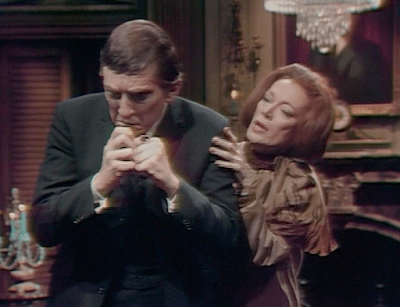
The first face we see today is the only unfamiliar one that has bobbed to the surface of the 1795 sea. It belongs to wicked witch/ lady’s maid Angelique, played by Lara Parker. Angelique had a brief fling with young gentleman Barnabas Collins (Jonathan Frid) some time ago. They met when he first went to the island of Martinique and met her employers, the wealthy DuPrés family.

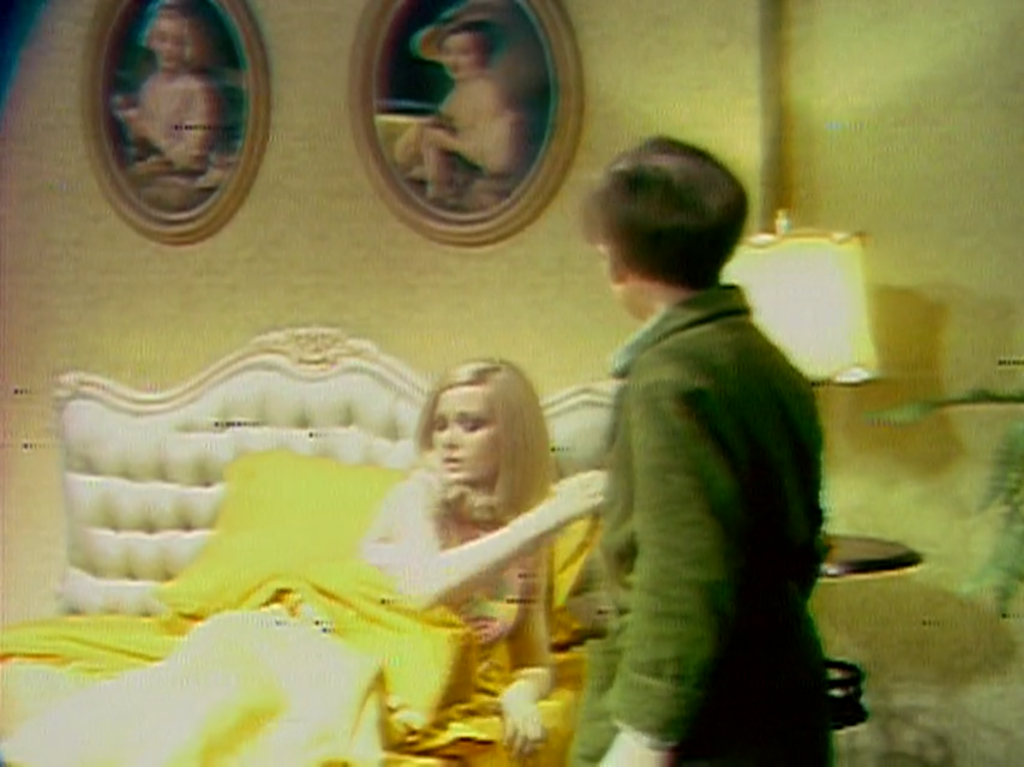
Angelique and Samantha. Screenshot by Dark Shadows Before I Die.

Barnabas had fallen in love with the gracious young Josette DuPrés (Kathryn Leigh Scott,) but was convinced Josette could never love him. Barnabas consoled himself in Angelique’s arms until he realized Josette did love him. Barnabas and Josette agreed to marry. Josette came to Collinwood for the wedding, accompanied by her father André (David Ford) and her aunt, the Countess DuPrés (Grayson Hall.) Angelique is the countess’ maid, but also attends Josette.

Angelique used her powers of black magic to make Josette and Jeremiah Collins (Anthony George,) Barnabas’ uncle, conceive a mad passion for each other. Josette and Jeremiah eloped, breaking Barnabas’ heart. Barnabas and Jeremiah fought a duel; consumed with remorse, Jeremiah let his nephew kill him. Even after all that, Barnabas realized he would always love Josette, a fact of which he apprised Angelique. Frustrated to find that she could never have Barnabas, Angelique yesterday announced in a soliloquy that she would punish him by forcing him to watch his beloved little sister Sarah (Sharon Smyth) suffer. At the top of the episode, Angelique is in her room in the servants’ quarters of Collinwood’s manor house with Sarah’s doll and some pins.

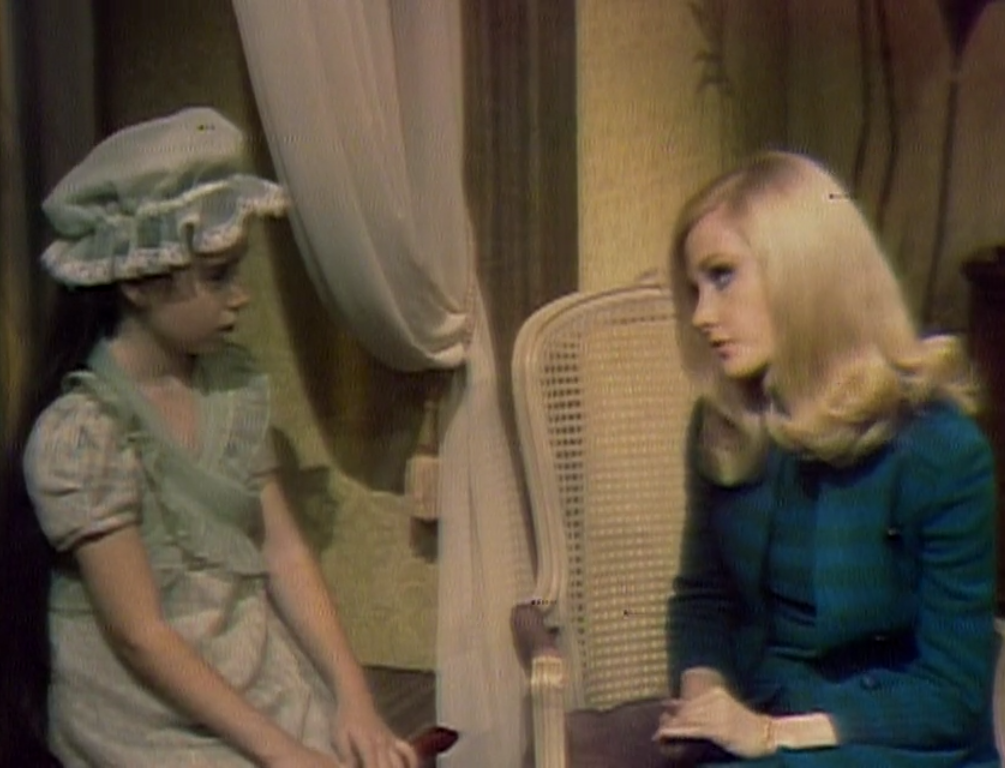
We cut to the front parlor, where Sarah is looking up adoringly at her mother Naomi Collins (Joan Bennett,) who is reciting a story. We cut back to Angelique, who drives a pin into Sarah’s doll. In the front parlor, Sarah clutches her chest and cries out in pain. Angelique sticks more pins into the doll, and Sarah cries out again.

In the parts of Dark Shadows set in the 1960s, Joan Bennett plays matriarch Elizabeth Collins Stoddard, owner of the great estate of Collinwood, of the Collins family enterprises, and of any other piece of property that they decide to tell a story about. In Liz’ time, the Collins family is much decayed from its eminence in 1795, but she is still the foremost figure in the town of Collinsport, and would have the authority to make just about anything happen. In fact, Liz can rarely bring herself to do very much that pertains to the plot, but when she does speak up we can see that she has great depths.

Naomi, by contrast, is utterly powerless, shut out by her husband, haughty overlord Joshua (Louis Edmonds) even from the management of the house. In today’s pre-title teaser, we see Sarah sitting on the floor of the front parlor, looking up adoringly while Naomi recites a story to her. That Naomi is reciting to Sarah rather than reading to her reminds us of what we learned when first we saw her in #366, that unlike most women in eighteenth century New England Naomi is altogether illiterate. Naomi occasionally bewails her inability to spend her time productively, and often drinks.

Sharon Smyth plays Sarah in 1795. In 1967, she was Sarah’s ghost, a frequent visitor to Collinwood and its environs. Sarah’s ghost was quite a different character than is the living Sarah. The little girl in the white bonnet who showed up in the oddest places and made the oddest remarks was only one aspect of a vast and mighty dislocation in time and space. It was Sarah’s ghost that started Vicki’s “uncertain and frightening journey into the past.”

Miss Smyth* nowadays describes her acting style when she was nine and ten saying “the first word that comes to mind is ‘clueless,'” but that works out surprisingly well for a ghost. It isn’t clear to us how the visible part of the Sarah phenomenon relates to the rest, much less how the whole thing works, and it can’t be clear- if a phenomenon stops being mysterious, it isn’t supernatural anymore. So it is gripping to see that the visible Sarah is herself in the dark about what she represents. That doesn’t work so well for living characters. When Miss Smyth can’t take her eyes off the teleprompter while delivering lines like “Help me, mother! It hurts!,” we can perhaps see one reason why the unfathomably mighty Sarah of 1967 was reduced to such a subordinate role in 1795.

But Miss Smyth’s limitations as a performer were not the only reason this development was inevitable. The whole idea of the supernatural is that something which appears to be very weak is in fact very strong. So children usually have fewer resources at their disposal than do adults, females are less likely to be found in positions of authority than are males, and the dead cannot rival the dynamism of the living. So the ghost of a little girl will of course be an immense force. The Sarah we see in 1795 is not yet a supernatural being, and so it would ruin the irony if even before her death she were already great and powerful.

In the part of the show set in 1967, Liz was one of the few major characters who never saw the ghost of Sarah. Liz was pretty firmly in denial about all reports of paranormal phenomena, and in #348 Sarah would declare that she could appear only to people who were prepared to believe in ghosts. So it is a bit startling for regular viewers to see these two actors together for the first time. Naomi is the same calm, indulgent presence to Sarah that Liz is to the children in her life, suggesting that though “the names and relationships have changed,” Liz and Naomi are two versions of the same person.

If the viewer’s main activity in watching the 1795 segment is contrasting the characters with those played by the same actors in the first 73 weeks, Angelique’s prominence is a puzzle. She is the only one who doesn’t fit into that scheme, yet she has driven all of the action so far. By the end of today’s episode, I think we can see a 1967 character with whom Angelique stands in juxtaposition. That character is Barnabas.

From April to November of 1967, Dark Shadows was largely the story of vampire Barnabas Collins (Jonathan Frid) and his attempt to impersonate a living man native to the twentieth century. It was so much fun to watch Barnabas scramble to keep this game going that the audience found it easy to put to one side the horrible evil he did and to look for reasons to think of him as good. But if we ever succeeded in doing that, Dark Shadows would be ruined. A deep-dyed villain allows a drama to be less serious overall than it might otherwise be, so that a thoroughly bad Barnabas lightens the tone. Make him relatable, or even forgivable, and everything gets terribly serious again. Yet a nonthreatening vampire is a purely comic character, like Count von Count on Sesame Street. So until they can establish another Big Bad, Barnabas has to be beyond redemption. If he is a lovable guy who just needs help dealing with his neck-biting problem, he has no place on the show, and it has no story left to tell. So they spent the fall systematically kicking away every possible mitigating factor and forcing us to behold Barnabas’ unrelieved evil.

The last hope of redemption for Barnabas in 1967 was his attachment to the late Sarah. Sarah had died when she was about ten, and her ghost started haunting the estate of Collinwood back in June, when Barnabas was holding Maggie Evans, The Nicest Girl in Town (Kathryn Leigh Scott,) prisoner in his basement. By November, many people had seen and talked with Sarah, but she had shunned Barnabas, even though he was desperately eager to reconnect with his baby sister. In his speeches about his longing for Sarah and in two moments when a suggestion he might see Sarah distracted him from a murder he was in the middle of committing, we saw the possibility that when Barnabas was finally reunited with her, he would change his ways.

That reunion finally took place in #364. Sarah walks in as Barnabas is strangling his only friend and sometime co-conspirator, mad scientist Julia Hoffman (Grayson Hall.) Barnabas does let Julia go, and has a heartfelt conversation with Sarah. Sarah says that she will not come back until Barnabas learns to be good. We can see just how long that is likely to be when, less than two minutes after Sarah has vanished, Barnabas tells Julia that, while he may not kill her tonight, her existence means no more to him than does that of a moth.

When even a direct encounter with Sarah cannot move Barnabas to find value in human life, we see that what Barnabas wanted when he was yearning for her to come near him was not to renew a relationship in which anything would be expected of him, but was something more like nostalgia. He has moved into the house where he spent his time when he was alive, and has restored it to its appearance in those days. He once persuaded his distant relatives, Liz and the other living members of the Collins family, to attend a party in that house dressed in clothing that belonged to their ancestors of his period and answering to their names. And he cherishes a fantasy that a young woman will discard her personality and replace it with that of Josette, then come to him and live out the life he had once believed he would have, long ago. His wishes for Sarah are of a piece with these attempts to recreate a past world. He wants to reenact the time he had with her, not to face the present alongside her. Barnabas is a damned soul, unable to love, unable to grow, unable to do anything for the first time.

Today, the show pushes Angelique into the same “Irredeemable” category where his reaction to Sarah’s visit had landed Barnabas. Again, it is an interaction with Sarah that represents the last straw. Josette and Barnabas made a sweet couple, but we knew before we ever saw them together that they were not fated to end up together. Jeremiah was likable enough, but we knew that he, too, had a sharply limited future. But Sarah is a child, a particularly adorable one, and is someone we have come to feel we know through her months as a ghost. When Angelique treats her so cruelly, we cannot imagine ever forgiving her.

And yet, there were times we felt that way about Barnabas, too. Angelique’s insane fixations are remarkably close to those vampire Barnabas exhibited in 1967, so much so that we keep wondering if whatever she does that turns Barnabas into a vampire will also put her personality into his body. We have come to be attached to the vampire; perhaps we will eventually discover it is Angelique we were watching until Vicki came to the past.

That isn’t to deny that the human Barnabas we have seen so far has points of contact with the ghoul from 1967. He was selfish enough to take advantage of a servant girl in Martinique when he didn’t think he could win the love of the grand lady he wanted and to discard her when he learned he could. He is cowardly enough that it never occurred to him to tell Josette that he had a past with Angelique at a time when doing so could have prevented Angelique casting the fatal spells on her and Jeremiah.

Real as these vices are, they are endemic to soap opera characters. Few daytime serials would have any stories to tell if they were about people who had a gift for monogamy, and we are supposed to find ourselves yelling at the screen “Just tell her!” and “Just tell him!” at regular intervals. Even the power differential between Barnabas the scion of the wealthy Collins family and Angelique the servant girl, problematic** as it would be in real life, is less troubling in the soaps, which take place in worlds where heirs and heiresses marry servants and their relatives all the time. Of course, most viewers know that Barnabas is destined to become a vampire, a metaphor for selfishness, and will be inclined to see in his use of Angelique the seeds of his subsequent damnation. And Angelique has enough lines about Barnabas’ selfishness that even viewers who joined the show during the 1795 segment can’t let him off the hook altogether.

Still, there is a great deal of good in the living Barnabas. We see him at Sarah’s bedside, consumed with worry for his beloved little sister. The doctor has been to see Sarah, and he has nothing to offer. Sarah asks to see her governess Vicki, who is in hiding because a visiting witch-hunter named Trask has blamed her for a series of inexplicable misfortunes that have befallen the house since she showed up in #366. It was Vicki’s own odd behavior that first made her a suspect, and Angelique has taken advantage of Trask’s foolishness to fabricate evidence against Vicki. She has gone into hiding, and Barnabas is helping her.

When Sarah keeps asking to see Vicki, Barnabas promises to bring her. Naomi is surprised to learn that Barnabas knows where Vicki is, and is not at all sure Trask isn’t right about her. But when she sees her daughter with Vicki, she is sure that she is innocent.

Vicki was the audience’s main point-of-view character throughout 1966 and well into 1967. Major story developments took place after Vicki found out what was going on. Vicki was the chief protagonist in the most important story of that period, the crisis represented by undead fire witch Laura Murdoch Collins. Vicki took charge of the household, organized a group to fight Laura, and rescued strange and troubled boy David from the flames when Laura tried to burn him alive. That intelligent, forceful character has been fading ever further into memory in recent months, and we haven’t seen a trace of her in the 1795 storyline. Sarah is happy to see Vicki and says she likes the stories she tells, but she is a passive witness to today’s events. She serves chiefly as a prop, used to demonstrate that the human Barnabas, whatever his faults, is capable of heroic action.

Barnabas’ compassion for Sarah and his valiant defense of Vicki do not negate his vices. As the heir to Collinwood, Barnabas can express his self-regard both by gratifying his urge to treat some women badly and by earning admiration for treating other women well. In her low station, the same trait leads Angelique directly to the “Dark Triad” of Narcissism, Manipulativeness, and Psychopathy. As a vampire, Barnabas will exhibit the same three qualities in abundance, but for now, we still have license to hope for better from him.

As it was so much fun to watch Barnabas trying to pass as a modern man that we wanted to like him even after he had been terribly cruel to Maggie, a character we like very much, it was so much fun to watch Angelique twist Trask around her finger that we wanted to like her. Besides, her desire to remake Barnabas as her lover is understandable for those who have been watching the show and wanting him to be something other than a heartless murder machine. So, perhaps we will wind up liking Angelique after all.

Angelique has bewitched indentured servant Ben Stokes (Thayer David) and forced him to act as her assistant. Ben is devoted to Barnabas and miserable that he has been the instrument of so much evil done to him, but has been powerless to resist Angelique’s commands. When he realizes that Angelique is causing Sarah to sicken and perhaps die, he goes to her room and demands that she stop. He threatens to kill her if she does not relent. In response, Angelique causes him to have a heart attack. She lets his heart start pumping again when he promises to be quiet.

This is the second heart attack a character of David’s has had on screen. The first also prevented a servant in this same house from killing a young woman. That came in #126, when crazed handyman Matthew Morgan had been holding Vicki prisoner here and was about to decapitate her. The ghost of Josette led several other supernatural presences who scared Matthew to death before he could complete his fell purpose. Matthew and Ben are both devoted to the Collinses, and both are led astray so that they become parties to terrible crimes. As the benevolent spirit of Josette put a stop to Matthew’s crimes, so the malign Angelique prevents Ben from putting a stop to her own.

Barnabas drops by Angelique’s room to ask if she has seen Sarah’s doll, which she calls Samantha. He tells her that Sarah is very ill and has asked for the doll. It occurs to Angelique that she has some leverage over Barnabas. She says that she can brew a special kind of tea that might cure Sarah’s symptoms. He asks her to do so. She makes him promise to marry her if she does.

Several times, we have seen that Angelique is flying by the seat of her pants. She had no idea of using Sarah’s illness to gain a hold over Barnabas until he chanced to come into her room. Nor is she thinking ahead- as it stands, the witch-hunters have fastened on Vicki as their suspect, and are not thinking of her. If word gets out that she had the power to cure Sarah’s mysterious ailment and exercised it only after extorting Barnabas’ promise of marriage, that would seem to be proof positive that she is a witch.

In her own bedroom, Sarah sips the tea. At the same moment, Angelique, in the servants’ quarters, pulls the pins from the doll. How exactly Angelique got the timing just right isn’t exactly clear, but she must have had a way- she is perfectly confident when she tells the doll that it has served her well.

*Mrs Lentz now, but it’s strange to say “Mrs” when you’re talking about a ten year old.

**I know people don’t really say “problematic” anymore, but it seems to be the right word here.
Episode 366: Who else could I be?

In 2021, I left a comment on Danny Horn’s blog post about episode 256. I found great significance in the introduction of the ghost of ten year old Sarah Collins:

I’d say Sarah’s introduction is the single most important moment in the whole show, more important than Barnabas coming out of the box, more important even than Barnabas’ first decision not to kill Julia.

From the beginning they’d been playing with the idea that there was another cast of characters hidden behind the characters we’ve been watching, supernatural characters who can make their influence felt at certain moments. The most prominent of these was the ghost of Josette. This ghost is a serene, distant, imperturbable. When her ghost and the ghosts of the widows rescue Vicki from Matthew in 126, there is an amused smile in Josette’s voice, the sound of someone for whom nothing very important is at stake in the affairs of this world.

When David sees Maggie in Josette’s clothes and mistakes her for the ghost of Josette in 240 and 241, it is clear that if the ghost of Josette returns, it will not be in that mode. After that sight, Josette’s ghost can return only as a terrifying spirit of vengeance. And David’s confrontation with Willie in 253 makes it clear that the protecting ghost will not return at all.

So the show has discarded the old supernatural realm of Josette and the widows, a realm that was, as you say, never more than slightly accessible. With Sarah’s appearance, we are introduced to an entirely new part of the show. Once again we have a set of characters hidden in the supernatural background, but they can interact with the characters from the main continuity more directly and at greater length than Josette and the widows ever could.

The puzzle of Sarah’s connection to Barnabas, and her talk about looking for the members of her family, indicates that this new order of supernatural beings have complex and unsettled relationships with each other, and that characters from the main continuity can have an influence on those relationships. We will have to figure those relationships out in the weeks and months to come, but as soon as Sarah demands Maggie not tell her big brother that she saw her, we know that they might come to enmesh the living beings. Every scene with Sarah, then, is a step leading directly to the time-travel and parallel universe storylines that will come to define the show.

“Acilius,” 15 September 2021, on Dark Shadows Every Day, Episode 256: Falling Down

By the end of last week, Dark Shadows had, for the second time in its 73 weeks on the air, run out of stories to tell. When Dark Shadows 1.0 ended with the disappearance of blonde fire witch Laura Murdoch Collins in #191 and #192, the way forward was clear- introduce another supernatural menace to succeed Laura. That came in the form of vampire Barnabas Collins. As people tuned in to see how a daily soap opera could fit a vampire into its pattern, Dark Shadows 2.0 became a bona fide hit and a major pop culture phenomenon.

The first version of the show came to an end because none of the non-Laura stories ever really took off and the only danger Laura presented was that she would incinerate her son David when she herself vanished in flames. Once that was prevented, her threat profile was closed and the show needed to start over.

The second version crackled along quite well for months. It’s true that a number of the storylines had reached their natural conclusions, but they made little to no effort to replace them. On the contrary, they went out of their way to close off possible narrative directions. While even the slowest parts of Dark Shadows 1.0 left us guessing what might come next, the final weeks of Dark Shadows 2.0 present us with nothing but a series of blank walls. The first time I saw the show, I watched #365 without a single idea as to what they could do in #366.

What they actually do is to launch Dark Shadows 3.0 by flipping the back-world of the dead past into the foreground, while the characters and events of 1967 are thrust behind the action into a realm only we and Vicki know anything about. Indeed, it is Sarah who executes the switch.

We had a glimpse of what that might look like in #280, when Barnabas hosted a party in the Old House on the estate of Collinwood, restored in an eighteenth century style, to which the living members of the Collins family came dressed as their ancestors of that period. In Friday’s episode, we saw a séance in the great house on the estate on a dark and stormy night. Sarah spoke through well-meaning governess Vicki and said she would “tell the story from the beginning.” At that, Vicki vanished from the table, her eighteenth century counterpart Phyllis Wick appeared in her place, and Vicki found herself outside the Old House on a sunny day in the year 1795. Today, she meets the living versions of Barnabas and Sarah, as well as some of those who were impersonated at Barnabas’ costume party.

The first person Vicki meets in 1795 is Barnabas. She has spent a great deal of time with him in 1967, so she assumes he is just in costume. He is startled by her clothing- she is still dressed as she was at the séance. He assures her they have never met, and when she keeps insisting they have he begins to suspect that she is insane.

Sarah meets them and declares that Vicki is her new governess. Evidently she had some kind of premonition as to what her new governess would look like, and Vicki meets the description. Barnabas brightens and asks Vicki if she is a governess. She acknowledges that she is. Before she can explain that she is governess to a boy who won’t be born for 160 years, he ushers her into the house.

Old friends? Screenshot by Dark Shadows Before I Die.

The writers faced a thorny problem with this segment of the series. Vicki has spent a great deal of time with Barnabas and has seen Sarah, so she must recognize them. On the other hand, most of the rest of the people she meets in 1795 will be played by the actors who have played characters she knew in 1966 and 1967. When Victoria is alone in the front parlor of the house, we find out how they have decided to handle this situation. Joel Crothers, who in the contemporary segment of Dark Shadows played hardworking young fisherman Joe Haskell, enters in the character of bon vivant naval officer Nathan Forbes. Vicki throws herself in his arms and gushes about how happy she is to see him. Nathan is quite happy to see her, since she is a remarkably beautiful young woman and extremely friendly, but he is puzzled that she insists on calling him Joe.

The scene between Nathan and Vicki is pretty funny, and it’s understandable that Vicki would react as she does. But it’s also ominous. When we see actors at work, we may remember other parts they have played, but we don’t expect their scene-mates to bring them up. They are just supposed to accept them as whoever they are supposed to be at that moment. When Joan Bennett enters, not as twentieth-century matriarch Elizabeth Collins Stoddard, but as Liz’ ancestor Naomi Collins, we wonder how Vicki will react to her. Indeed, she does slow things down with a lot of wailing about how she can’t believe she isn’t Mrs Stoddard, a person of whom Naomi has never heard. It then dawns on us that every time Vicki meets anyone, she’s going to drag us through this same business where she mistakes them for another character the actor has played. That’s going to annoy us and make the other characters think she is deranged.

One of the reasons Vicki’s yelling about the cast’s resumes annoys us so much is that we all know how to look at the various characters an actor has played and see how they illuminate each other. We don’t need her to tell us to do that. Academics put that into a category of practices called “iconography,” which is shorthand for the idea that we remember what we’ve seen more than once in various kinds of movies and shows and notice when we see it again.

As Liz, Joan Bennett was the sort of imposing matriarch she often played as a major star of feature films and the Broadway stage. Virtually every event we saw in the first 25 weeks of Dark Shadows had its origins in Liz’ reactions to the events around her, and she was still the single most powerful figure in the whole gallery of characters for 30 weeks after that, right up to the death of seagoing con man Jason McGuire in #275. Everyone else was dependent on her, in one way or another.

Naomi is the lady of the manor in 1795, as Liz is in the 1960s. But we quickly learn that she is at the opposite extreme from her descendant. When invitations come for Barnabas’ upcoming wedding, she asks Nathan to read them to her. While Liz dominates the family and the town from her desk, Naomi is entirely illiterate.

This is something of an anachronism. Colonial New England was founded by Puritans who thought everyone ought to read the Bible, and so provided elementary schooling for all children, boys and girls. Scholars estimate that by the end of the eighteenth century, over 90 percent of men and about half of women in that region would have been able to read the Bible easily. A woman as wealthy as Naomi would certainly have had this ability, and the basic literacy which Naomi lacks would have been a rarity at any level of society. Perhaps the writers and producers of Dark Shadows were unaware of this history. Perhaps they are suggesting that she, like her son’s fiancée Josette DuPrés, came from some part of the world that valued literacy less highly than did New England. In any case, they do show us how severely disadvantaged she is in any disagreement with the men in her life, and how narrowly the bounds of her activities are circumscribed.

Barnabas comes back with the news that the carriage bringing Sarah’s governess overturned. The governess herself is missing from the scene of the accident; the other three people aboard were killed. When Phyllis Wick appeared in Vicki’s place at the séance, she did indeed say that she had just been in a carriage wreck, so this news will not come as a complete surprise to returning viewers.

Messenger scene. Screenshot by Dark Shadows Before I Die.

This brings up a question and points to a missed opportunity. The question is whether Phyllis’ carriage had overturned in the original course of events. If so, perhaps she was killed along with the other three, and Sarah never did get a new governess. If not, then Sarah’s ghost killed three people when she sent Vicki back in time. Sarah has always been nice to people we liked, and has declared her allegiance to goodness. But she is also pretty clumsy, so she might have killed them inadvertently.

The missed opportunity is that Vicki could have entered 1795 at the scene of the accident. Had she been found in the wreckage, in Phyllis’ dress, with a wound that kept her from speaking for the first week of the segment, it would make sense that she was taken for the new governess. Of course, we wouldn’t have to see a carriage- some sound effects and a shot of Vicki on the ground, with some smudges on her face and the rim of a wagon wheel partly visible near her, would have been plenty. Surely the budget would have allowed that much.

Had Vicki been mute for the first week of the story, we could have seen her face and heard her thoughts in pre-recorded voiceovers as she saw Barnabas and Sarah and recognized them; we could have seen her face but not heard her thoughts as she saw other familiar actors in new roles, leaving it open whether she saw them as the same people she knew in the 1960s. By the time she had regained the ability to speak, she would have caught on that she had to pretend to be Phyllis Wick, to be a native of the eighteenth century, and to be new to Collinsport.

That way, she would start off with a reasonable chance of making a go of life in that era. Moreover, as we were drawn to Barnabas when we watched him trying to pass as a native of the twentieth century, we could be excited to see Vicki try to present herself as a native of the eighteenth. As it is, she is constantly drawing attention to herself as an alien, so much so that it is hardly likely the Collinses would want her in their house in any capacity, certainly not as tutor to their beloved daughter. Moreover, starting Dark Shadows 3.0 with Vicki doing what Barnabas did in Dark Shadows 2.0, while Barnabas would take the role Vicki played in their relationship then, as a benevolent if uncomprehending friend, would shed new light on both characters and on their stories. What she does instead is to annoy us and make it difficult to care about her at all.

We do get a brief inversion of Vicki’s relationship with her charge from the 1960s, strange and troubled boy David Collins. When Vicki first met David in #4, he greeted her with “I hate you!” and she assured him that they were going to be good friends. Vicki certainly does not hate Sarah, but she would appear to any observer who did not know what we know about her to be mentally ill, just as David appeared to be when first we saw him. It is little Sarah who cheerfully assures Vicki that they will be good friends. As her mental health is the least of Vicki’s problems now, so it turned out in 1966 that David’s difficulties stemmed, not from delusions, but from an all-too-accurate understanding of his metaphysical relationship to the world he lived in. Vicki rose to the challenge and became the companion and supporter David needed. In Sarah’s prediction that she and Vicki will be good friends, we therefore hear a promise that the show will develop a relationship between the two of them in which Sarah will emerge as Vicki’s confidant and protector.

The series was made with very little advance planning. Just a few weeks ago, we heard about a painting or drawing depicting Barnabas and Sarah as children of about the same age, yet today we see the forty two year old Jonathan Frid playing Barnabas as a fatherly figure to Sarah as played by ten year old Sharon Smyth. Still, they’ve put so much into the costumes and so much thought into the new characters that they must have meant for this segment to last more than a couple of weeks. Having Vicki insistently call everyone by the wrong names and then run around idiotically announcing information that she knows only because she is from 1967 puts her on the express train towards an insane asylum. If they don’t stop her doing those things right quick, they will have written themselves into a corner before they’ve got their money’s worth out of the work they have already done.

The episode looks very different from anything we’ve seen on Dark Shadows before. The series has been in color for months now, but there have only been one or two days when they managed to use color as anything more than an occasional special effect. Today, they are working from a palette of pinks and greens that give a sense of lightness and good cheer that is altogether new to the show. It doesn’t really play out in the visual strategy of the episode- the story they are telling in pictures is aimed chiefly at the majority of viewers who are watching on black and white sets. But for those who do have color television, it is unmistakable that this is not the same show that ended on Friday.

Episode 364: Barnabas, Barnabas

Vampire Barnabas Collins has been part of Dark Shadows at least since we first saw his portrait on the wall of the great house of Collinwood in #204, more properly since they went to great lengths to make it look like there was a portrait on that spot in #195. He is now the main force driving the action of the show, and pretty much the only reason people are tuning in to watch it. The ghost of Barnabas’ ten year old sister, Sarah, first appeared in #255; ever since, we’ve been waiting for the two of them to meet. At the end of yesterday’s installment, they finally did.

Barnabas was in his living room, trying to choke the life out of his only friend and would-be lover, mad scientist Julia Hoffman. Sarah materialized, and he let Julia go.

This echoes a scene in #341. Barnabas and Julia were in the act of murdering her medical school classmate and onetime friend, Dave Woodard, when Woodard claimed to see Sarah. At that, Barnabas almost let Woodard escape. Only when Julia called out “Stop him!” did Barnabas take hold of Woodard and kill him. Not only is he murdering a good-guy character, he has coerced Julia into taking part in the crime and will gloat over her new status as a murderer. But in the middle of all that loathsome cruelty, we see a flash of his longing for his baby sister. It is a tribute to actor Jonathan Frid that we can feel Barnabas’ loneliness and want to like him even in the middle of one of the character’s very darkest moments.

This time, Sarah really is there, and she really does stop a murder. There is a puzzle as to why. In #360 and #361, Julia knew that Barnabas wanted to destroy her, and appealed to Sarah for help. Sarah refused, saying that she liked Dr Woodard and knew what Julia did to him. We heard Sarah’s “London Bridge” theme on the soundtrack during the murder of Woodard, so it is clear that she witnessed that crime. But if she can stop Barnabas killing Julia, why couldn’t she stop him killing Woodard?

Today is only the second time Sarah has appeared to more than one person at a time. When Barnabas’ ex-victim Maggie Evans, The Nicest Girl in Town, wanted to escape from the hospital where Julia was keeping her locked up in #294, both she and her nurse could see and hear Sarah. Maybe it is difficult for Sarah to manifest herself to two people, and impossible for her to show herself to three. In that case, Julia’s presence would have stopped Sarah from saving Woodard.

It’s also possible that Sarah can’t do anything that will lead to Barnabas’ capture. She has appeared to many people and given all of them clues about the strange goings-on, but she has referred directly to Barnabas only when speaking to his partners in crime Willie and Julia. Time and again she has stopped short of giving information that would expose her big brother. When Barnabas and Julia moved against Woodard, he was calling the sheriff. Woodard might have placed himself beyond Sarah’s protection when he picked up the telephone.

Indeed, if Barnabas does kill Julia now, he will probably be caught. Julia has given a notebook full of incriminating evidence about Barnabas to a local attorney to be handed over to the authorities in case anything happens to her. Besides, everyone knows she spends a great deal of time at Barnabas’ house, so if she suddenly goes missing he will be investigated. By preventing Barnabas from killing Julia, Sarah is protecting him from exposure.

Sarah tells Barnabas that he taught her the first lessons she ever received in morality, and that he has now forgotten them himself. He begs her to stay, showing at length the vulnerability and need that have been so effective at recruiting our sympathy when we have glimpsed them before. She says she will never appear to him again, not until he learns to be good. We’ve known him long enough to know that this will be an extremely long wait.

Barnabas begs Sarah to stay while Julia looks on. Screenshot by Dark Shadows Before I Die.

Sarah vanishes. Julia sees her friend shattered. She approaches him. She addresses him, for the first time, as “Barnabas, Barnabas.” He recoils from her. He does not renew his attempt to strangle her, but he does tell her in the coldest imaginable voice that he could kill her as easily as he could crush a moth. It hasn’t been two minutes since his little sister reduced him to tears, and he has snapped back into his place as death itself.

“Barnabas, Barnabas.” Screenshot by Dark Shadows Before I Die.

Some say that Barnabas’ frequent references to his longing for Sarah during these weeks are meant to make him easier for the audience to sympathize with. I think this scene shows that the opposite is more nearly the case. They’ve undercut every other ground for liking Barnabas, leaving us only his love for Sarah. When we see that not even a visit from Sarah can thaw him out for any length of time, not only do we have to give up any hope that there is a nice guy hidden inside him, but we also hear the door slamming shut on any possibility that his character will develop in a way that will surprise us. Since he is the show, the closing of that door means that Dark Shadows 2.0 is all but over.

In the great house, matriarch Liz breaks the news to well-meaning governess Vicki learns that the authorities in Brazil have identified one of the corpses found in the wreckage of an airplane that crashed outside Belem as that of Vicki’s depressing fiancé, Burke Devlin. It has been clear for some time that Burke probably died in that crash, so Liz is worried that Vicki’s refusal to accept their verdict is a sign that she is in an unhealthy denial about the facts of the situation.

In the first 25 weeks of Dark Shadows, Burke was a major figure, the arch-nemesis of the Collins family. His storyline never really took off, though, and when undead fire witch Laura Murdoch Collins was on the show from #126-191 his issues were all absorbed into her arc. He formally renounced his grudge against the Collinses in #201, and has been surplus to requirements ever since.

There is just one thing I wish they had done differently about Burke’s death. During the early period of the show, there was a story about high-born ne’er-do-well Roger Collins trying desperately to hide a custom-made filigreed fountain pen of Burke’s. That dragged on for months, and dominated 21 whole episodes. It would have been a nice Easter egg for those of us who sat through those not-very-interesting installments if Liz had said the authorities were able to identify Burke’s body in part because that pen was on it.

There is a bit of intentional comedy this time that works very well. Telling Barnabas of Vicki’s refusal to accept Burke’s death, Liz exclaims “She can’t go on loving a dead man all her life!” Barnabas is clearly offended by this remark, quite understandably since he is deceased himself. He responds that “It has been known to happen.” But he manages to keep cool enough that Liz doesn’t notice.

“It has been known to happen.” Screenshot by Dark Shadows Before I Die.

Closing Miscellany

This episode marks the last appearance of Sharon Smyth as the ghost of Sarah Collins.

Episode 1-274 of Dark Shadows each began with the words “My name is Victoria Winters,” delivered in voiceover by Alexandra Moltke Isles and leading into a few sentences vaguely related to the plot of the show. Beginning with #275, these voiceovers might be delivered by any actress with a speaking parts in that episode, and do not involve their character’s names. Many are written in the first person, however, as is today’s:

There has been a homecoming in the great house of Collinwood, and those who have returned have found that very little has changed. We still live within a ring of fear, a fear that is generated by the one who lives in the Old House, where on this night a kind of madness prevails, a madness that will lead to the threat of murder.

Every time this happens, the Dark Shadows wiki complains that “by this time in the series, the narrations are no longer spoken in character.” That complaint might have made sense if only a few of the episodes since #275 included first person pronouns, but dozens of them do. So we would have to say that they often are spoken in character, but that it isn’t always clear who the character is. The wiki editors will be glad from now on, because this is the last time a narrator says “we.”

Episode 363: Very honorable guy

When Dark Shadows debuted in June 1966, it was a Gothic romance in which characters sometimes equivocated about whether they were using the word “ghost” metaphorically to refer to present troubles caused by past conflicts or literally to refer to things that go bump in the night.

That version of the series ended with the story of undead fire witch Laura Murdoch Collins. In Laura’s months on the show, her arc absorbed such major plot elements as the conflict between high-born ne’er-do-well Roger Collins and local man Burke Devlin, the psychological problems of strange and troubled boy David, David’s relationship with his well-meaning governess Vicki, and the tensions between the ancient and esteemed Collins family and the working class people of the town of Collinsport. By the time Laura went up in smoke in #191 and #192, there was no life remaining in any open narrative thread, and Dark Shadows 1.0 was at an end.

Dark Shadows 2.0 launched in #193 with the introduction of seagoing con man Jason McGuire. Jason was an in-betweener who would tie up the loose ends remaining from the 25 weeks before Laura joined the gallery of characters and facilitate the introduction of Laura’s successor as a major supernatural menace, vampire Barnabas Collins. Jason kept himself busy blackmailing reclusive matriarch Elizabeth Collins Stoddard, his sidekick Willie Loomis accidentally released Barnabas, and the show kept dropping hints that when Liz finally stood up to Jason all of the original secrets would be laid bare.

The makers of Dark Shadows didn’t do much advance planning, so they kept Jason on the show for 13 weeks after Barnabas premiered while they tried to come up with some other way to fill the time. When Jason’s plan finally blew up in his face, they even left some of the old secrets still buried, most notably the question of where Vicki originally came from.

Barnabas finally killed Jason in #275, and he hasn’t been mentioned in a while. But he is not forgotten. As we open today, lawyer Tony Peterson has caught heiress Carolyn Collins Stoddard in his office, rummaging through his safe. Tony has been dating Carolyn and is clearly very much attracted to her. He invites her to tell him a story that will give him an excuse not to call the police. She has to think fast to come up with one, and what she settles on is a version of the story of Jason and Liz.

Tony knows that Carolyn was trying to steal a notebook that he had put in his safe. This notebook was the property of his newest client, Julia Hoffman, a permanent guest at the great house of Collinwood. Carolyn tells Tony that Julia was blackmailing Liz. The notebook, she claims, is a diary kept by a man with whom Liz had an affair, and it contains proof that the man was Carolyn’s father. Julia knew the man and knew that he was planning to come to Collinwood to squeeze money out of Liz in return for his silence, but he died before he could do so. Julia took the diary and picked up where he left off.

Since Tony’s professional ethics will not allow him to be a party to blackmail, this is the one story that could give him a plausible reason not to report Carolyn’s crime to the police. It also gives him a reason to feel sorry for the Collinses, whom he hated when we first saw him, removing an obstacle to the possibility he might fall in love with Carolyn.

The echo of the Jason/ Liz story in the image of Liz forced to accept a blackmailer as a member of the household offers a great deal more than narrative convenience to regular viewers. The audience knew what Jason was threatening to tell if Liz did not submit to his demands, but the characters did not. One idea that some among them seemed to suspect was that Jason was Vicki’s father and Liz was her mother. Indeed, the makers of the show did plan to explain Vicki’s paternity at the end of the blackmail arc, a plan they abandoned so late that the climactic episode runs some minutes short. When Carolyn brings up the idea of her mother being blackmailed to keep it secret that she bore a child out of wedlock, those of us who have been watching all along will realize that she was among those who suspected that this was the secret that gave Jason his hold over her.

The audience knows that there will be no romance between Tony and Carolyn, because we know that she is Barnabas’ blood thrall. Barnabas sent her after Julia’s notebook, because it contains the records of an experiment in which she tried to cure him of vampirism. It would expose him were it to fall into the hands of the authorities. Since Barnabas wants to rid himself of Julia, perhaps by killing her, perhaps by driving her totally insane, he cannot leave such a document out of his possession.

Dark Shadows has come to as much of a dead end now as it had when Laura’s arc was ending. None of the ongoing stories has room for more than a few steps of further development, and if they keep running through those steps at the current pace everything will be resolved in a couple of days. Bringing up Jason, whose introduction marked the beginning of Dark Shadows 2.0, leads us to wonder if they have something up their sleeves that will launch Dark Shadows 3.0.

Tony takes Carolyn home to Collinwood, where he confronts Julia. He tells her what Carolyn told him. She denies it, and says that she will write a letter entrusting the notebook to him to remain unread unless something happens to her, in which case he will read it and hand it over to the authorities. That satisfies him that he isn’t a party to blackmail, and he agrees to her terms.

For the last couple of days, Barnabas has been using black magic in an attempt to break Julia’s grip on sanity. Her clear thinking and calm demeanor in this scene prove that this attempt has failed. The only open question in the only ongoing conflict is, therefore, whether Barnabas will try to murder Julia. She is such a valuable character that it is hard to feel any real suspense about whether he will succeed in killing her, but there is a chance that he will make an attempt.

David and Vicki have come home from a trip to Boston. David enters the drawing room, sees Julia, and greets her. She can barely pay attention to him long enough to say hello. He asks if she is all right; again, she is clearly not at all focused on him. She excuses herself, saying she has to go to Barnabas’ house.

David’s relationships to the other characters were the engine that drove Dark Shadows 1.0, and when Barnabas began to pose a danger to David that same engine accelerated the pace of Dark Shadows 2.0. Julia has been central to the plot for some time; that she can’t be bothered to take any notice of David tells us that that engine has fallen apart. Whatever they are planning to do next week, David won’t be at the heart of it.

David leaves the drawing room. He gets as far as the foyer. There, he sees his friend, the ghost of Barnabas’ ten year old sister Sarah. He tells Sarah that he has been on a trip. She asks where he went. He says he went to China. “Oh,” she responds, blandly. “You’re not impressed?” “No, my father’s friends used to go to China on their ships.” “Well, I didn’t really go to China. I went to Boston.” “BOSTON!!!” Sarah exclaims. “I went to Boston once!” She’s electrified. It’s adorable beyond belief.

Suddenly, Sarah looks disturbed and says she has to go. David asks why, and she says there is trouble brewing at the Old House. Again, David has been sidelined. If there is going to be any more action, it will have to come from fresh sources.

The Old House is Barnabas’ house, and that’s where we go next. We see Julia arriving there. She tells Barnabas that Vicki is back. He is mildly interested. She then tells him that she has seen Sarah. Barnabas longs to see Sarah, and is tormented that she will appear to others but not to him. He accuses Julia of lying. She insists that she is not, and taunts him with Sarah’s refusal to appear to him. He grabs Julia by the throat. He has done this before as a threat, but this time it looks like he really means to strangle her. Before he can, a wind blows the door open and the candles out, and Sarah walks in. She approaches her brother, glaring at him.

Sarah has had it with Barnabas. Screenshot by Dark Shadows Before I Die.

Episode 360: You would understand, if you understood

Vampire Barnabas Collins has decided that he will eventually kill his sometime accomplice turned bête-noire, mad scientist Julia Hoffman. Julia has decided that her only possible helper is the ghost of Barnabas’s ten year-old sister, Sarah.

Julia goes to Sarah’s grave in the Tomb of the Collinses and calls to her. She hears the strains of “London Bridge,” then sees Sarah. Sarah tells Julia that she will not help her, because she killed someone she liked, Dr Dave Woodard. Julia tries to put the blame for that crime on Barnabas, but Sarah declares that she helped him. We heard “London Bridge” in the background during the murder scene in #341, so we know that Sarah saw the crime and Julia will not be able to deceive her.

Sarah and Julia, Barnabas’ two sister-enablers. Screenshot by Dark Shadows Before I Die.

In this scene, Sarah says that she cannot act directly against Barnabas. This is a striking moment, because it is the first time Sarah has spoken her brother’s name out loud. Sarah’s statement explains why she watched as Barnabas and Julia killed Woodard, and also why so many of her attempts to protect her friends from him have ended up with them in worse shape than before and Barnabas insulated from all accountability.

When Julia was working with Barnabas, she too made desultory attempts to restrain his worst tendencies, while always protecting him from the consequences of his actions. The dynamic between them mirrored the Bossy Big Sister/ Bratty Little Brother pattern that matriarch Liz and her brother Roger have been modeling from the first day of the series. Seeing Julia with Barnabas’ literal sister, we see that this dynamic has defined the Collinses for centuries.

Episode 348: A matter of fact

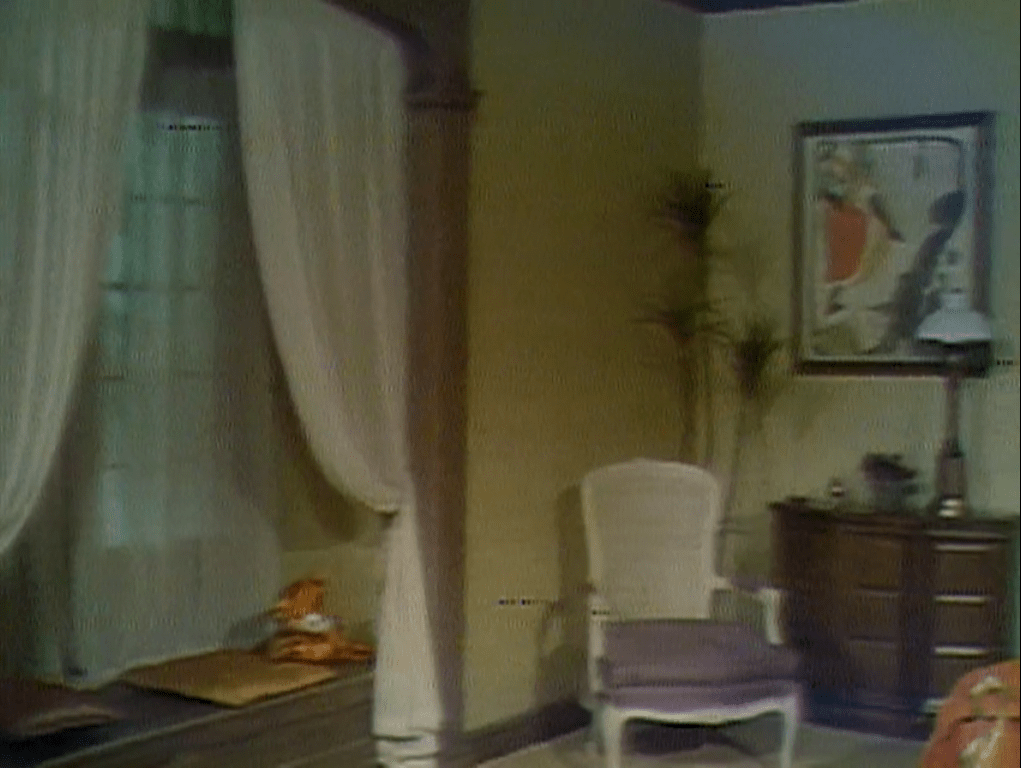
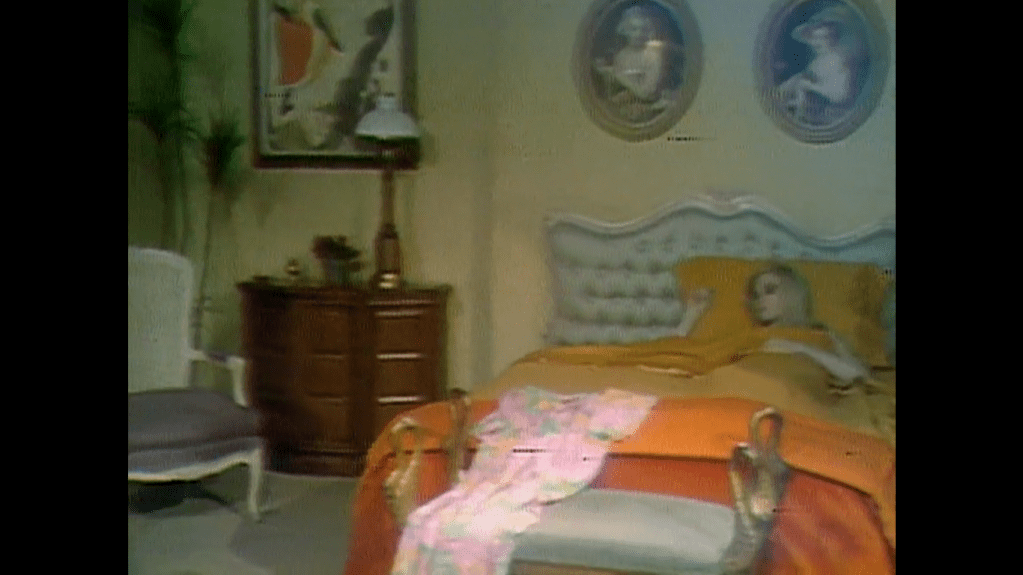
We open on a new set, the bedroom of heiress Carolyn Collins Stoddard in the great house of Collinwood. Dark Shadows has been in color since #295 in August. Though directors Lela Swift and John Sedwick were both ambitious visual artists, they haven’t been able to do much with color so far. With Carolyn’s bedroom, Swift and the staging team have accomplished one of their first real essays in color. It is composed mostly of shades of yellow, pink, and orange.

The color schemes of the other interiors we’ve seen up to this point run the gamut from sedate to subdued to drab to dank, so we already know we are in a unique space. The only other room in Collinwood that might have matched this one for brightness was the kitchen, but we haven’t seen that since #208.

Carolyn’s young cousin, strange and troubled boy David, lets himself into her room. He touches her, and she awakes with a scream. He explains that he just dropped in to make sure she wasn’t dead. When she turns on the light, the screen is so bright that I reflexively squinted, a reaction I’d never before had to an image on Dark Shadows.

Bright room.

David can’t quite explain why he was afraid Carolyn might be dead, but he does insist that she take an antique toy soldier, saying that she will be safe if she keeps it with her. Carolyn’s mother, matriarch Liz, comes into the room to investigate Carolyn’s scream. Liz wonders what David is doing there. Carolyn hastens to say that he was just making sure she was all right.

David goes, and Carolyn tells Liz she doesn’t think anything can be done for him at home. Liz is reluctant to send him away. Regular viewers will not be surprised by this. We know that Liz took David and his father, her ne’er-do-well brother Roger, into Collinwood at the beginning of the summer of 1966 and summoned her unacknowledged daughter, well-meaning governess Vicki, to come look after David starting with #1 on 27 June 1966, so that her conviction that the family ought to look after him got the whole show started. Nonetheless, Liz is so disturbed by David’s unusual statements and depressive affect that she agrees that he needs residential care.

We cut to the Old House on the estate. Vampire Barnabas Collins is sitting in a basement room where mad scientist Julia Hoffman maintains a laboratory. The room is full of electrical equipment, a bit odd since the Old House has no electricity; the laboratory itself is lit by flaming torches. But if we’ve ever seen a Universal Studios production from the 1930s, we know that where you find a mad scientist, you will find electrical currents, so naturally things start buzzing when Julia flips a switch.

Barnabas confined

Julia is trying to implement a medical cure for Barnabas’ vampirism. In the first shot of this scene, we see a visual metaphor for that project. Barnabas, an uncanny being, is confined to a small space in the middle of an elaborate collection of technology. If Julia succeeds, the supernatural will be vanquished altogether and scientific rationality will fill the whole world. The color scheme emphasizes the contrast between Julia’s optimistic goal and the terrain on which she operates. The walls and floor are dominated by the grays and browns of the basement, but the frames and tubing of her equipment are a bright metallic hue, light plays on the glass components, and the intense greens, reds, and blues of the potions are distributed in a slightly unbalanced, lively pattern. The irregular shapes of the frames and tubing emphasize this pattern, and contrast with the solid gray of the floor and the even grid of the brickwork on the walls.

This image not only represents Julia’s plans, but also one of the major themes the show is exploring at this period. Too many characters have encountered too much evidence of supernatural forces and beings for anyone to simply deny that such things exist. But even those who have been most heavily exposed to them keep reverting to a naturalistic frame of reference. Sure, Julia spends all her time hanging around with a vampire and has encountered a couple of ghosts, but she’s determined to ring all of those phenomena around with scientific explanations and technological interventions until they yield to rational control.

Julia’s project has hit its first major setback, as the latest treatment led Barnabas’ hands to age dramatically. He expresses the fear that time will catch up with him, and his apparent age will soon catch up with his actual age, something like 200 years. Julia’s hope that her experiment will not only free Barnabas of his curse, but found a new kind of medicine that will free everyone else of aging and death, will thus be defeated.

Barnabas gives a remarkable little speech about the situation he finds himself in:

I’ve been granted privileges given to few other men… For most men, time moves slowly, so very slowly. They don’t even realize it. But time has revealed itself to me in a very special way. Time is a rushing, howling wind raging past me, withering me in one relentless blast and then continues on. I have been sitting here passively, submissive to its rage, watching its work. Listen. Time, howling, withering.

Writer Joe Caldwell has a fine sense of what actors can do, and this odd little bit of purple prose is right in Jonathan Frid’s wheelhouse. It doesn’t make a whole lot of sense, but the sound of his voice delivering it is so gorgeous it may as well be Shakespeare. Well, maybe not Shakespeare, but Ben Jonson at least.

It is possible to read this speech as a programmatic statement. Daytime soap operas of the 1960s were famously slow-paced; the old joke was that a viewer saw an episode that ended with a character hearing a telephone ring, missed four months of the show, and tuned back in to see the episode that started with the same character saying “Hello.” Even by the standards of the period, the first months of Dark Shadows were notoriously leisurely, with action often as not playing out in real time. When we are watching the 21 episodes centering on Roger’s attempts to find a fountain pen he misplaced, it is indeed the case that “time moves slowly, so very slowly.” But those days are behind us. The show is whipping through plot points at a pace that many prime time series contemporary with it would have had a hard time matching.

If the speech is programmatic, it is also autobiographical on the part of the screenwriter. A fast pace promises excitement for the viewers, but makes life hard for a writing staff that never numbered more than three. Indeed, this is the last episode Joe Caldwell will write for two and a half years. Perhaps he felt the demands of the new pace as “a relentless blast” withering his talents, and had to bow out.

We return to Carolyn’s room. She is in front of her mirror, contemplating the toy soldier. She hears the strains of “London Bridge” playing on a wooden flute, which she has learned is a sign that the ghost of ten year old Sarah Collins is present. Carolyn grew up in this haunted house, so it may not be entirely surprising that her response is to lean back and enjoy the music. But she sits up when Sarah manifests herself in visible form.

Ghost in the mirror

Sarah speaks, and Carolyn sees her reflected in her mirror. The following scene is so extraordinary I’m going to transcribe all of the dialogue:

Sarah: David must have given you that.

Carolyn: Sarah!

Sarah: He told you my name.

Carolyn: Sarah, how did you get in here?

Sarah: Didn’t David tell you?

Carolyn: Tell me what?

Sarah: All about me.

Carolyn: I’m not sure I understand.

Sarah: I think I’m a ghost. Matter of fact, I’m sure I am.

Giving the facts

This is the first time Sarah has described herself in any terms, certainly the first time she has called herself a ghost. Her coyness about herself had left David confused about what she was; it was not until #325 that he finally concluded that she was a ghost. After that, she became more forthright with him. When he wasn’t sure what she was, she would wait until she was out of his line of sight to appear and disappear. But in #327, she fades away while he’s looking right at her.

Coming out to David not only allowed Sarah to relax around him, but has led her to discard her coyness altogether. She is startlingly blunt with Carolyn as this conversation goes on:

Carolyn: B-but- I don’t believe in-

Sarah: Yes you do. Or I wouldn’t have been able to come here. You’re not afraid of me, are you?

Carolyn: No…

Sarah: If you are, I understand.

This is the first confirmation that Sarah can appear only to those who are prepared to believe in her. It’s true that most of the people who have seen and heard her- David; Maggie Evans, The Nicest Girl in Town; Maggie’s father Sam; Vicki; Barnabas; Julia; Barnabas’ sometime blood thrall Willie; and local physician Dave Woodard- have either had extensive contact with the supernatural or had reasoned their way to the conclusion that she existed. But she also showed herself to Maggie’s nurse at the mental hospital Julia runs, and we don’t know anything about her background or beliefs. And local man Burke Devlin heard Sarah when she and David were talking in #327. While Burke has had plenty of contact with supernatural beings and in the early days of Dark Shadows, when he was fun, was willing to believe in them, he was at that point tearing around bellowing that there were no such things as ghosts. So this is new and unexpected information.

Carolyn’s denial that Sarah frightens her is given in a trembling voice that shows it to be a lie. Still, she isn’t as frightened as she might be. The other day, in #344, Carolyn was in David’s room when Sarah manifested there, not in the visible form of a little girl, but as the sound of “London Bridge” and as information appearing in David’s mind about Burke’s imminent death. Carolyn was terrified of Sarah when she came that way.

Carolyn: Well, what do you want?

Sarah: Don’t send David away.

Carolyn: How do you know about that?

Sarah: I don’t know, I just do.

At this point, we see Carolyn’s fear fading. She is starting to react to Sarah as if she really were a ten year old girl.

Carolyn urging Sarah to be reasonable.

Carolyn: But Sarah, we have to send David away. It’s the only way we can help him.

Sarah: But if you send David away, I won’t have anyone to play with.

Carolyn: Well, maybe it isn’t good for David to play with you.

Sarah: Why do you say that?

Carolyn: Because it leads him into believing all sorts of things that aren’t true.

Sarah: How do you know they’re not true?

Carolyn: Well, they’re just not, they couldn’t be.

Sarah: He wasn’t lying about me, was he?

Carolyn: No.

Sarah: Well.. then maybe David is acting the way he is because no one will believe him.

Carolyn: But… it isn’t possible.

Sarah: People say I’m not possible, but I am. Why doesn’t that make the rest possible?

Carolyn: Sarah, maybe you don’t know the stories David’s been telling!

Sarah: Why do you think that?

Carolyn: Because they’re too fantastic! And besides, they’ve all been proved false.

Sarah: How do you know they’ve been proved false?

Carolyn: Sarah, are you trying to tell me that Barnabas actually slee-

This exchange is the ultimate example of a character accepting the existence of a particular supernatural being and then snapping back into a frame of reference that does not allow for supernatural beings. Carolyn knows that Sarah is a ghost, and starts arguing with her about how fantastic the world is permitted to be.

There comes a knock at the door. Carolyn turns away from Sarah to look at the door, and when she looks back, Sarah has vanished. Regular viewers know that Sarah was Barnabas’ little sister, that she wants to keep him from doing horrible things to people she likes, but that she will not say anything against him. So when Carolyn says Barnabas’ name, we know that Sarah is about to vanish.

Sarah’s part is an outstanding example of writing to an actor’s abilities, even more so than was Barnabas’ speech. Caldwell knew that Jonathan Frid had a flair for making flowery gibberish appealing, because that is what he has been doing the whole time he’s been on Dark Shadows. What Sharon Smyth has been doing well as Sarah is being a cutie pie and creating a vague and mysterious impression. When she has more than a few lines to deliver, things tend to get very wobbly. Today, she has to maintain a commanding tone and an adult demeanor throughout an extended patch of rapid-fire dialogue. Absolutely nothing we have seen on screen would suggest that she could handle that. But she pulls it off, more than competently. There are a few glances at the teleprompter, but at no point does she break out of the patient and authoritative manner she has to adopt. It is an impressive job of acting by any standard.

The person at Carolyn’s door is Liz. Liz is Dark Shadows‘ queen of denial. Viewers who have been with the show from the beginning have seen a few cracks in her facade of disbelief in the supernatural. In #10, she dozed off in the drawing room and started talking in her sleep about ghosts. When Vicki insisted to her in #127 that she had seen a ghost, Liz said she believed her. And in #280 and #281, Liz reluctantly agreed to participate in a séance, and afterward agreed that Vicki had been possessed by a spirit. But even in those moments Liz was fighting to keep the topic of ghosts at bay, and the rest of the time she has presented a blank wall to any attempt to face facts about the strange goings-on. So it is not surprising that Carolyn tells her mother she was talking to herself while tidying up her room.

Having talked Liz into sending David away, she now has to talk her back out of it. She manages to get her to agree to wait a few days. “London Bridge” plays. Carolyn reacts to it, Liz does not.

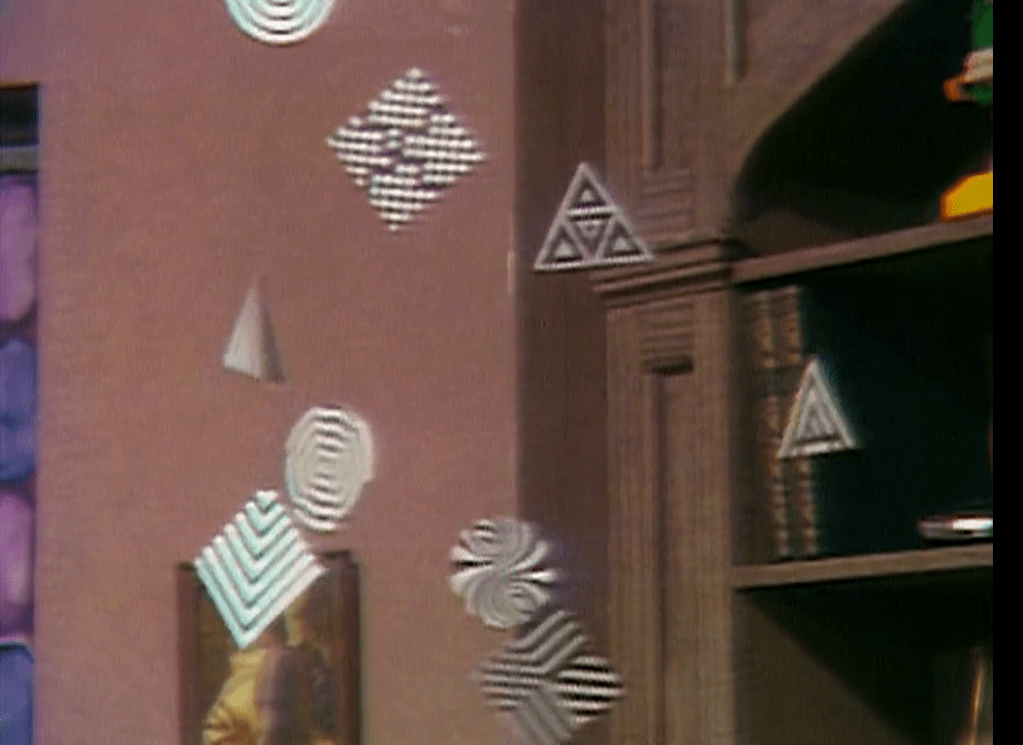
In his room, a distraught David is looking at a mobile. Its whimsical black and white markings suggest a puzzle and make a stark contrast with the vivid colors around them.*

Puzzling shapes.
Back to the wall.

Carolyn comes in. She brings the toy soldier and tells David she doesn’t think she will need it. He insists that she will, but she explains that Sarah visited her and now she believes him and knows how to help him. David is horrified by this. He says that Sarah visited Dr Woodard, that Woodard believed him, and that led to his death. He begs Carolyn not to believe him and claims to have been lying. He sobs and clutches her.

Anguished embrace.

Back in the Old House, Julia prepares to give Barnabas another treatment. He snaps at her. She tells him that whatever happens, she wants him to know that she always wished him well. That prompts him to unload a further stream of sour remarks about her competence and intentions. Julia carries out the treatments, only to find that the aged appearance of Barnabas’ hands has spread to his head.

In his post about this episode on Dark Shadows Every Day, Danny Horn puts it well when he says that “This is just good soap opera construction. People that we care about, facing terrible danger, and desperate to help each other.” He’s referring specifically to the scenes between David and Carolyn and Liz, but it applies to everyone. We care not only about the good people in the great house (well, they’ve been relatively good, lately,) but also about Barnabas and Julia, evil people who are the terrible danger David and Carolyn and Liz are facing, but who make the show fun to watch. We care about Sarah too, and she’s desperately trying to accomplish exactly the result we most want to see, an outcome in which David, Barnabas, and everyone else we enjoy watching stays on the show.

*Evidently this mobile was a commercially produced item. One of the commenters on Danny Horn’s Dark Shadows Every Day reports having had one like it as a child.

Episode 344: Listen to the music, listen!

Strange and troubled boy David Collins is sitting on his bed. The ghost of his cousin Sarah is with him, playing “London Bridge” on her flute. She has told him that local physician Dave Woodard is dead, and he is depressed. She explains that she thought she had to tell him.

Sarah says she thinks that Woodard’s death was a terrible one and that it shouldn’t have happened. She denies knowing any more than that, and when David presses her for further information she becomes uncomfortable and vanishes.

David’s aunt, matriarch Liz, comes into his room to break the news to him about Woodard. She is startled to find that he already knows. She is distressed at his attitude of complete resignation. Woodard was the only adult who believed all of the facts about the supernatural menace looming over the great estate of Collinwood and the town of Collinsport that David and Sarah have shared with each other, and when David last saw him Woodard was trying to do something about that menace. David takes Woodard’s death as the end of all hope.

Downstairs, Liz meets her daughter Carolyn and well-meaning governess Vicki. She tells them how sad David is, and Carolyn goes up to see him. She starts talking about imaginary friends, and David asks if she means Sarah. Carolyn says that she doesn’t think Sarah is imaginary, and David replies “You don’t have to pretend. I don’t care.” He isn’t the least bit angry with her- he means exactly what he says when he tells her he doesn’t care how she feels about him.

Viewers who have been with the show from the beginning could see that reaction coming. For the first 24 weeks or so, Carolyn was a flighty heiress, a self-centered young woman who took no interest at all in her little cousin. Since then they have discarded that theme and Carolyn has become a mature and caring person. She and David have had some moments where she has seemed like a big sister. Still, she is still far less involved with him than is Vicki, and David doesn’t have any hopes that even Vicki will listen to him when he tells the truth about the strange goings-on. So when David says “I don’t care,” Carolyn is hit by a freight train that we’ve seen coming for a long time.

This new Carolyn won’t give up on David. She confides that when she was nine years old, she had a friend named Randy, a little boy who always wore a red sweater and who may or may not have existed. Carolyn admits that Randy may have been a ghost, and there is a moment when, as Danny Horn puts it on his Dark Shadows Every Day, “David stands up, and he looks at her, as if they’re really seeing each other for the first time in a long while.” The first time ever, I’d say- David and his father Roger only moved into the house a month or so before the show started, and by that time Carolyn was the character we first saw.

This isn’t the first time the audience has seen this side of Carolyn. In the opening weeks of Dark Shadows, she was one of several characters who had brief conversations with Vicki about the legendary ghosts of Collinwood, and she was the most persistent about laughing those legends off. But before the show had been on the air for five weeks, Carolyn admitted to Vicki that the legends were all true, and that she had tried to downplay them only because she liked Vicki and wanted her to stay.

That development is recapitulated in this scene. Where Vicki had reacted with confusion, telling herself that she ought to be concerned about Carolyn’s mental health but unable to quash a sickly feeling that she might be right, David reacts with wonderment. He is beyond trying to do anything about the horrors that he knows are in progress, let alone appealing to anyone to join him in fighting them, but we can see him absorbing the information that Carolyn is not at all the person she had led him to believe she was.

Once Carolyn stops pretending she does not believe in ghosts, we see why she and the other adults in the family are so insistent about keeping the door shut on the supernatural back-world behind the main action. “London Bridge” starts playing on the soundtrack; Carolyn and David can both hear it. As it goes on, David declares that something terrible is about to happen. It will be an accident- no one will cause it, no one wants it to happen. But it can’t be stopped. Carolyn asks how he knows, and he says he just does.

David communes with the spirits. Screenshot by Dark Shadows Before I Die.

The little girl we saw in the opening is Sarah, but in this moment we realize she is not the whole of Sarah. The girl is only one manifestation of an unfathomably vast complex of phenomena. The world in which the action appears to be taking place is a tiny, fragile thing by comparison with forces like Sarah. If the characters stray from their little paths of denial and evasion the whole thing may at any moment dissolve altogether, thrusting the back-world into the foreground and leaving them adrift. After a few minutes of David’s soothsaying, Carolyn protests that “None of this is real, it can’t be!” But it’s too late- she knows that it is all too real, and the world of love affairs and hotels and motorcycles and dress shops and restaurants in which she has spent the last 69 weeks trying to find a place is a dream from which she is already starting to awaken.

Meanwhile, Vicki and her depressing fiancé Burke have declined Liz’ offer to live in the west wing of Collinwood when they are married. Liz had hoped to keep Vicki around so that she could help with David. When Burke asks if he should talk to David, Liz tells him not to bother. Carolyn already talked to him, Liz explains, and so far from calming David down she got herself upset too.

That response would suggest that Liz wants to tranquilize David, not to communicate with him. On the heels of the scene between David and Carolyn, it tells us more. Liz has lived in Collinwood longer than anyone, and she has struggled harder than anyone to keep the non-supernatural fore-world in operation. After Carolyn’s experiment in facing facts comes so close to sweeping the “logical explanations” away once and for all, we can see what Liz is trying to protect by keeping David quiet.

Burke is leaving the house, about to go on a business trip to South America, when David emerges from his room and says goodbye. David’s tone makes it clear that it is a final farewell. Burke keeps telling David that he will come back, but David is certain that Burke will die. Burke is shocked by David’s attitude, and says that perhaps they should live in the west wing after all. Vicki is thrilled by the idea.

Burke and Vicki go to a terrace outside the house. There, they hear the wind whistling through the rocks along the shore. On Vicki’s first night in the house, she heard from Liz’ brother Roger the legend of “The Widows’ Wail,” according to which this sound is a warning from the spirits of the widows who haunt the area. In those days, Vicki had little patience for ghost stories, and the “Widows’ Wail” seemed to be the easiest of all the legends to dismiss. But the wind blows every night, and she’s only heard it make that sound on a handful of occasions, usually right before something terrible happens. She’s also seen multiple ghosts, done battle with a humanoid Phoenix, and encountered what anyone with access to old movies would recognize as evidence that a vampire is operating in the vicinity. So she hears the Widows’ Wail the same way regular viewers of the show do, as the sound of the supernatural back-world blasting through and knocking everything else down.

Vicki hears the Widows’ Wail. Screenshot by Dark Shadows Before I Die.

When Vicki pleads with Burke not to go to South America, he replies “Don’t tell me you’re starting to believe all that stuff!” For months now, Burke has been gaslighting Vicki, pretending that she is crazy for believing in supernatural phenomena, including phenomena he himself witnessed and previously acknowledged. But hearing the Widows’ Wail, which was a prominent topic in the early days, and seeing the black and white imagery of the kinescope, we can remember a more appealing version of Burke. Back then, Burke was one of several longtime residents of Collinsport who used the word “ghost” figuratively in conversation with Vicki, each time prompting her to exclaim “Surely you don’t believe in ghosts!?,” to which he would reply that it was entirely possible that there were literal ghosts at Collinwood. For a moment, we see that Burke, and forget the gaslighting abuser. That moment lasts just long enough that we can share David’s sorrow and Vicki’s terror at Burke’s imminent death.

Episode 336: People don’t keep secrets anymore

Early in the story of vampire Barnabas Collins, local physician Dave Woodard decided to call in an expert from out of town. Dr Julia Hoffman was doubly qualified as a specialist in psychiatry and hematology, and so she seemed to be ideally suited to make sense of the baffling occurrences taking place around Collinsport. Readers of Bram Stoker’s Dracula will recognize Woodard as the counterpart of Dr John Seward and Julia as Professor Abraham Van Helsing.

Now, Woodard realizes that Julia has gone over to Barnabas’ side. So, crafted to be the stolid Seward, he must try to do the work of Van Helsing. Today, he manages to meet and talk with the ghost of Barnabas’ little sister Sarah, persuades her to show him the secret chamber in the tomb where her body is buried, and confronts Julia.

Sarah complains that “People don’t keep secrets anymore.” She’s had it with this damn century.

All of this would have been very powerful had Woodard been played by Robert Gerringer. Gerringer played the part starting in May. For most of that time, Woodard had little information and no power to advance the plot. He was largely confined to scenes that groaned under the weight of recapping. Gerringer made this thankless role as interesting as anyone could, managing to shade Woodard’s internal life so that we could see how confusing it would be for a trained scientist to confront facts that could be explained only by reference to the supernatural.

Gerringer’s acting style stands apart from those of his cast-mates. Most of the cast of Dark Shadows knew nothing at all about daytime serials when they joined the show, and they don’t sound or move in ways that are typical of the genre. But Gerringer’s voice is that of every doctor in the soaps my mother watched when I was a kid. His presence on Dark Shadows is a constant reminder of the incongruity of a vampire as a regular character on a soap opera in 1967.

Unfortunately, Gerringer is not in this one. The National Association of Broadcast Engineers and Technicians were on strike when this episode was made, and Gerringer refused to cross their picket line. So his part is being played by someone else, and the intended effect of the whole thing is badly blunted.

There’s also a scene between well-meaning governess Vicki and her depressing boyfriend Burke. There was some talk a while ago about them buying a “house by the sea,” and they make it clear today that we won’t be hearing much more about that. That never really amounted to a story, and it’s something of a disappointment that it is a dead end.

Episode 335: The imaginary Barnabas

Gordon Russell’s script contains an interesting scene. A psychiatrist brought in to examine strange and troubled boy David Collins gives a little speech attributing David’s fear of his cousin Barnabas to various unresolved traumas he has recently experienced. This speech sounds very plausible to the adults who listen to it, and might go some way towards explaining the appeal of Dark Shadows to its audience. But we know that David’s fears are entirely rational and that Barnabas really is a vampire. When the psychiatrist mentions that Barnabas had fangs in one of David’s dreams, family doctor Dave Woodard catches up with us and realizes that Barnabas really does have fangs and that he used them to inflict bite marks on some of his patients.

Episode 335 of Dark Shadows was a scab job done during the October 1967 National Association of Broadcast Employees and Technicians strike. In March of that year, at a time when Dark Shadows was at rock bottom in the ratings, the actors stayed out in support of the announcers and newscasters when they went on strike, and the show survived even though it went dark by the time the strike ended. Now, the vampire story is pulling in more viewers every week, making it a valuable property to ABC. But it is at this time that executive producer Dan Curtis told the cast that he would pay their union fines if they crossed the NABET picket line, and most of them did, with network executives and their stooges handling the equipment.

Sad to say, only two cast members did the right thing by the technicians. Robert Gerringer, who played Woodard, was one of those. Even if he had been a good actor, the scab stealing food from the mouths of Robert Gerringer’s children wouldn’t have been able to deliver on the moment when Woodard figures out that Barnabas is a vampire- we need Gerringer for that. He is the person we’ve grown used to seeing in the part, and his self-consciously soap operatic style of acting sets him apart from the rest of the cast and highlights the weirdness of this story playing out on a daytime serial in 1967.

But the scab isn’t a good actor. His most memorable moment comes when Joan Bennett, as matriarch Liz, bobbles a line, and he corrects her. She flashes a look of anger, but what does she expect? What she is doing is no better than what he is- if anything, it’s worse, because she was a big star and could have called a halt to the whole filthy disgrace if she’d lived up to her obligations as a member of AFTRA.

I’m writing this in September 2023, month three of the SAG-AFTRA actors’ strike and month five of the Writer’s Guild of America strike, so I’m even angrier about the whole thing than I usually would be. But I always find it hard to watch material produced under these conditions.

The character of Maggie Evans wasn’t in any of the episodes produced during the strike, so Kathryn Leigh Scott wasn’t involved in breaking it. She is walking a picket line today, and in her column she wrote about the particular issues at stake in the 2023 strikes. Different matters hung in the balance in 1967, but it’s always true that we live in a society, for the love of God, and if working people don’t stick together they don’t have anything.

Two actors who were too young to know better. Screenshot by Dark Shadows Before I Die.

Episode 331: Not always sure of the answers

Strange and troubled boy David Collins is at his wit’s end. A bat entered his room and menaced him. He can’t even convince the adults in the great house of Collinwood that the bat existed. Still less can he get a hearing for his correct surmises that his cousin, courtly gentleman Barnabas Collins, used magical powers to send the bat against him.

David’s aunt and father call the family doctor, addled quack Dave Woodard. Woodard gives David a sleeping pill, waits a few minutes, and starts asking him questions. David tells him about his friend, mysterious girl Sarah. He asks if Woodard believes that Sarah is a ghost. Several times, the audience has seen Woodard wrestle with evidence pointing in this direction, so we know that he is telling the truth when he answers David’s question with “I don’t know what I believe.” Robert Gerringer does a fine job of acting today, and draws the audience into Woodard’s struggle to come to terms with the idea that he lives in a world where supernatural forces are at work.

Later, Sarah wakes David up. She says she’s angry with him. In her last apparition, she specifically told him to stay away from Barnabas’ house, but the very next morning he went there, sneaked in through a window, and was trying to get into the basement when Barnabas’ co-conspirator Julia Hoffman caught him. He keeps asking for more information, and she complains that he asks too many questions. She keeps insisting that he stay away from Barnabas’ house.

The messenger. Screenshot by Dark Shadows Before I Die.

Sarah gives David an antique toy soldier and tells him to keep it with him. She says it belonged to someone who played with it long ago, and that it will keep David safe as long as he has it with him. Returning viewers know that Sarah is the ghost of Barnabas’ sister, so the “someone” must be Barnabas himself. Also, we saw Sarah give a doll of her own to Maggie Evans, The Nicest Girl in Town, with the same instructions, so we know this is her usual mode of operation.

When Sarah is complaining that David asks too many questions, she says that she isn’t always sure of the answers. This makes an interesting contrast with Woodard’s earlier remark that she seems to know everything. It also brings up a mystery from recent episodes. In #325, David had a dream in which Sarah led him to a basement where they saw Barnabas rise from a coffin. This must have been a dream visitation, since it includes information only she would have. But in #327, David sees Sarah in the woods and surprises her when he tells her about the dream. Later in that same episode, she makes it clear that she does not want him to know the information he gained from it.

The sight of Sarah in the corner of David’s room, lit from below, might cast the minds of regular viewers back to the first supernatural being to make an entrance in that spot. David’s mother, undead fire witch Laura Murdoch Collins, drove the story from #126 to #191. In the early part of the Laura arc, the show made a great deal out of the uncertainty about how the various events and appearances associated with her related to each other. There was a more or less substantial, apparently living woman who comes to stay in the cottage on the estate of Collinwood; an image of the same woman that occasionally flickers on the lawn of the estate; and a scorched corpse in the morgue in Phoenix, Arizona. These three, and an undetermined number of other phenomena, might all be aspects of the same being, or they may not. They may be pursuing the same objective, or they may be working at cross-purposes. They may be organs of a single mind, or they may be entirely unaware of each other. As the story went on, Laura became an ever-more dynamic personality, but it was never made altogether clear just how many of her there were.

The difference between the Sarah who led David to Barnabas in his dream and the Sarah who demands that he stay away from Barnabas when he is awake raises the same question. Sarah used to be a little girl, and she still looks and sounds like one. But she isn’t really that, nor is she anything else that belongs in our world anymore, and she can’t be expected to follow any rules we can understand. She is a focal point around which uncanny phenomena gather, and through which information passes into our world from an alien plane of existence. Sarah is not only a messenger- she is herself the message.

The uncertainty Sarah admits to today, along with our uncertainty about how her various manifestations fit with each other, show that David is wrong if he finds her a reassuring presence. She is part of a world in which the living have no place, and her irruption into David’s experience thrusts him into the company of the dead. David cannot fully understand Sarah’s world, much less control it. If he keeps trying to find his own way to safety, he will quickly meet his doom.