In the Old House on the estate of Collinwood, broad ethnic stereotype Magda Rákóczi accuses a man who calls himself Victor Fenn Gibbon of being Count Petofi, a sorcerer who, a hundred years before, was cured of lycanthropy at the price of his right hand and most of his magical powers. Fenn Gibbon denies the charge, and fills the awkward silence with a story that Petofi’s saddest morning came when he awoke to find that his pet unicorn was dead, killed by the wolf. Also in the room is the desperately handsome Quentin Collins, who is himself a werewolf. Quentin says that after they return to human form, werewolves do not remember what they did the night before. Since Fenn Gibbon’s story reveals his knowledge of that fact, Quentin takes it as confirmation that he is indeed Petofi.
Petofi’s severed hand is still in existence, and still carries with it great power. Magda stole the hand from Romani tribal leader/ New England crime boss King Johnny Romana several weeks ago in hopes that she could use it to lift the werewolf curse from Quentin. Since then it has been stolen by one person after another, none of whom has much benefited from it. Now schoolteacher-turned-adventurer Tim Shaw has taken the hand and skipped town. Petofi threatens to use his remaining powers to harm Quentin and Magda unless they find the hand and return it to him by morning; they have to admit they have no idea where it is.
At the end of the episode, we are in the great house on the estate. Petofi makes a series of ominous remarks to Magda and Quentin as he takes his suitcase and goes out the front door. Quentin’s twelve year old nephew Jamison appears at the top of the staircase. He is speaking in a raspy voice, continually suppressing a chuckle at his own witty remarks, and squinting by tightening his eyelids in the middle. He addresses Quentin as “Mr Collins,” says he is not in the habit of being interrupted, and walks downstairs with a slow gait, raising himself slightly from the hips as he comes to each step. We recognize an imitation of Petofi, and Magda declares that the boy is possessed.
Regular viewers will be intrigued to see Jamison as a medium for Petofi. Jamison is played by David Henesy, who in the parts of Dark Shadows set in the 1960s plays strange and troubled boy David Collins. In #186, David Collins participated in a séance during which he channeled the spirit of David Radcliffe, a boy who was burned alive by his mother in March 1867, exactly one hundred years before. In December 1968, David Collins was intermittently possessed by the ghosts of Quentin and Jamison, and when Quentin was temporarily dead and his body was a zombie in April 1969 Quentin possessed Jamison. So by this time Mr Henesy has substantial experience playing a boy who is being used as the vehicle for another spirit.
Mr Henesy is also deeply familiar with the style and manner of Thayer David, who plays Petofi. Thayer David’s first role on the show was crazed handyman Matthew Morgan, who had many scenes with David Collins, and his second was much-put-upon indentured servant Ben Stokes, who when the show was set in the 1790s shared screen time with Mr Henesy’s character Daniel Collins. Thayer David’s third role, Ben’s descendant and occult expert Timothy Eliot Stokes, crosses paths with David Collins only occasionally, but he was on so much that all Mr Henesy would have to do to keep up his status as an expert on Thayer David would be to watch the show on his days off. So it is exciting to see what Mr Henesy’s interpretation of Thayer David’s Petofi will be.
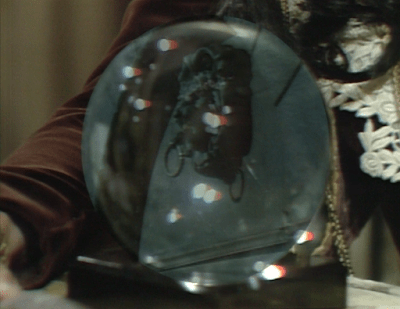
David Collins is always on the minds of longtime fans when Mr Henesy appears, and is especially so today. Magda has a crystal ball into which she occasionally peers; she gets melodramatically frustrated with it shortly before we cut to Jamison and Petofi today. This ball originally belonged to David Collins. He received it as a gift from dashing action hero Burke Devlin in #48, and thereafter used it several times to get information to advance the plot and to establish himself as a link between the visible action of the show and the supernatural forces which at that point lurked in an unseen back-world. Magda’s failed attempt at scrying today may seem like a throwaway to relatively recent fans, but when those who have been with the show from the beginning see the ball and then see Jamison so shortly afterward, they will know that something spooky is coming.
Thayer David might never have been cast on Dark Shadows if he had acted under the name he was given at birth. He was originally called David Thayer Hersey. It’s hard to imagine a producer adding David Thayer Hersey to the cast of a show that had already for eight weeks featured David Thomas Henesy.
Magda Rákóczi, preposterously broad ethnic stereotype, has discovered that the recently arrived Barnabas Collins is a vampire. Barnabas has bitten and enslaved Magda’s husband Sandor, and tells her that she, too will do his bidding. When she asks what has brought him to this conclusion, he tells her that as long as she is in his employ, he will give her jewels. He hands her a ruby ring, and she agrees.
Longtime viewers know well that Barnabas’ plans regularly backfire. Today, we see one of the reasons why. Barnabas does not tell Magda why he has come to the estate of Collinwood in the year 1897, but he does tell her that the following night he will be calling on the Collins family in the great house in order to win their acceptance of him as a distant cousin from England. For all she knows he might be able to complete his task and go back to where he came from shortly after the Collinses welcome him. That would leave her with no further jewelry. So Magda goes to the great house and tells spinster Judith Collins and her brother, libertine Quentin Collins, that a stranger will visit them after sunset. He will present himself as a “friend, perhaps a relative,” but they must not trust him. He is in fact a “creature of darkness” who means them harm.
Judith and Quentin are one of Dark Shadows‘ signature pairings of Bossy Big Sister/ Bratty Little Brother, and they bicker about whether to be disgusted or amused by what they take to be Magda’s transparently fraudulent warning. When Barnabas shows up, Judith is shaken and Quentin laughs at her for taking Magda seriously. In the last scene, Quentin does pull a sword on Barnabas and threaten to kill him on the spot unless he tells a more acceptable story, so apparently he placed a higher value on Magda’s words than he wanted to let Judith know.
Her dialogue is full of lines like “I don’t care” and “It’s none of your business,” and Terry Crawford decides that the best acting choice she could make would be to play it as if Beth sincerely means every word that she says. This is different from what a good actor would do in every respect.
She should be fencing with him, half-flirting and half-angry and half-guilty. Yes, she should be playing three halves right now; that’s the point of the scene. But Terry Crawford gives you what’s on the page, because somebody explained the concept of “subtext” to her once, while she was thinking about something else.
Alas, it is so. Appealing as David Selby’s personality is and lively as his interpretation of Quentin is, Miss Crawford’s literalism means that his efforts are largely wasted, at least in his scenes with her. With Joan Bennett’s Judith or with any of the other members of the cast, we can see that while Quentin’s behavior is inexcusable, his charm is irresistible. But Miss Crawford shows us Beth resisting it with no apparent difficulty, and that leaves him as just another jerk. As I put it in a comment on Danny’s post:
I agree about Terry Crawford. She has to do something very difficult- simultaneously show contempt for Quentin and attraction to him. She manages only the first, meaning that when he keeps at her after she tells him to leave her alone, it isn’t a game, it’s just sexual assault. That makes Quentin a lot harder to like than he needs to be.
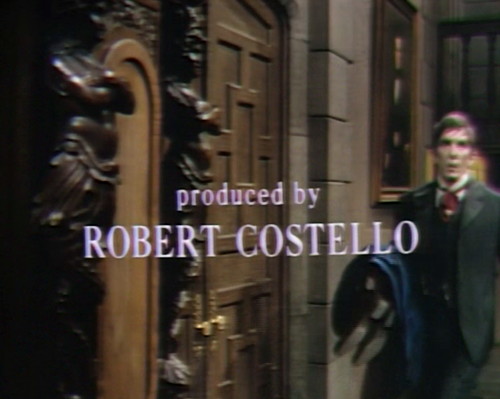
This episode ends with one of the all-time great screw-ups. A few times actors have come partly into view during the closing credits, usually just one arm briefly entering the shot. But this time Jonathan Frid comes walking right into the frame, gives a horrified reaction, and scurries off. It is a thing of beauty, enough to make you wonder how there can be people who are not fans of Dark Shadows.
A great moment in the history of television, or THE GREATEST moment in the history of television? You decide. Screenshot by Dark Shadows Every Day.
We begin the part of Dark Shadows set in the year 1897 with an episode featuring a glittering script, a strong cast, and a hopeless director. Henry Kaplan’s visual style consisted of little more than one closeup after another. The first real scene in the episode introduces us to Sandor and Magda Rákóczi, a Romani couple who live in the Old House on the estate of Collinwood. They bicker while Sandor throws knives at the wall. Thayer David really is throwing knives, but since we cut between closeups of the targets and of the actors we cannot see anything dynamic in that action. He may as well be whittling.
Magda ridicules Sandor’s pretensions as a knife-thrower and as a patent medicine salesman, and busies herself with a crystal ball. She tells him that when “the old lady” dies, they will have to leave Collinwood. He says he knows all about that. She wants him to steal the Collins family jewels so that they can leave with great riches. He eventually caves in and sets out for the great house on the estate, more to escape her nagging than out of greed.
Regular viewers will remember that we heard Magda’s name in December 1968. The show had introduced two storylines, one about the malevolent ghost of Quentin Collins and the other about werewolf Chris Jennings, and the characters were starting to notice the strange goings-on that Quentin and Chris generated. The adults in the great house had no idea that Quentin was haunting them or that Chris was a werewolf, so they held a séance in #642. Speaking through heiress Carolyn Collins Stoddard, Magda mentioned “My curse!” and said that “He must not come back!” It was clear in the context of the episode that the “He” who “must not come back” was Quentin. Chris was a participant in the séance, and he broke the circle before Magda could explain what she meant by her “curse.” Séances held in #170 and #281 were cut short by the person whose secret the medium was about to expose; that it is Chris who interrupts this one would suggest to longtime viewers that Magda not only knew Quentin, but that the curse she is about to explain was the one that made Chris a werewolf. Carolyn and her uncle Roger Collins talked a little about Magda in #643, and psychic investigator Janet Findley sensed the ghostly presence of a woman whose name started with an “M” in #648. We haven’t heard about Magda since.
As the living Magda, Grayson Hall manages rather a more natural accent than Nancy Barrett had when channeling her concerns about “my currrrrssssse.” The exaggerated costumes Hall and Thayer David wear make sense when we hear them reminiscing about the old days, when they made their livings as stage Gypsies with a knife-throwing act, Tarot card readings, and a magic elixir. Even the fact that Magda is peering into a crystal ball during this scene is understandable when they make it clear that they are staying in the Old House as guests of the mistress of the great house, an old, dying lady who enjoys their broadly stereotypical antics. But there is no way to reconcile twenty-first century sensibilities to Hall and David’s brownface makeup. Some time later, Hall would claim that one of her grandmothers was Romani. If that was a lie, it is telling that only someone as phenomenally sophisticated as Hall could in the 1970s see that she would need to invent a story to excuse playing such a character.
Objectionable as Sandor and Magda are, their dialogue is so well-written and so well delivered that we want to like them. Moreover, the year 1897 points to another reason fans of Dark Shadows might be happy enough to see Romani or Sinti characters that they will overlook the racist aspects of their portrayal. It was in 1897 that Bram Stoker’s Dracula was published, and it depicted the evil Count as surrounded by “Gypsy” thralls. The character who has brought us on this journey into the past is Barnabas Collins, and upon his arrival he found that he was once more a vampire.
In addition to the strengths of the dialogue, the acting, and the intertext, there is also a weakness in this episode that softens the blow of the brownface. Today the picture is so muddy that it is possible to overlook the makeup. That’s Kaplan’s fault. It would often be the case that one or the other of the cameras wasn’t up to standard, but when the director was a visual artist as capable as Lela Swift or John Sedwick, there would always be at least some shots in a scene using the good camera, and others where the lighting would alleviate some of the consequences of the technical difficulties. But Kaplan doesn’t seem to have cared at all. He had made up his mind to use a particular camera to shoot the Old House parlor with a subdued lighting scheme, and if that camera was not picking up the full range of color, too bad. He’d photograph a lot of sludge and call it a day.
Meanwhile, a man knocks on the door of the great house. He is Quentin, and the person who opens the door is Beth Chavez. We first saw these two as ghosts in #646. Beth spoke some lines during the “Haunting of Collinwood” story, but Quentin’s voice was heard only in his menacing laugh.
We already know Quentin as the evil spirit who drove everyone from the house and is killing strange and troubled boy David Collins in February of 1969. His behavior in this scene is no less abominable than we might there by have come to expect. He pushes past Beth to force his way into the foyer, does not bother to deny that he has come back to persuade his dying grandmother to leave him her money, pretends to have forgotten someone named “Jenny,” makes Beth feel uncomfortable by saying that her association with Jenny makes her position in the house precarious, orders Beth to carry his bags, twists her arm, and leeringly tells her that she would be much happier if she would just submit to his charms. David Selby sells the scene, and we believe that Quentin is a villain who must be stopped. But Mr Selby himself is so charming, and the dialogue in which he makes his unforgivable declarations is so witty, that we don’t want him to go away. He establishes himself at once as The Man You Love to Hate.
In an upstairs bedroom, the aged Edith Collins is looking at Tarot cards. Quentin makes his way to her; she expresses her vigorous disapproval of him. She says that “When Jamison brought me the letter, I said to myself ‘He is the same. Quentin is using the child to get back.'” Quentin replies “But you let me come back.” She says that she did, and admits that he makes her feel young. With that, Edith identifies herself with the audience’s point of view.
The reference to Jamison and a letter reminds regular viewers of #643, when Magda’s ghost caused a letter from Quentin to fall into Roger’s hands. It was addressed to Roger’s father, Jamison, and was written in 1887. It read “Dear Jamison, You must return to Collinwood. I need your help. You must intercede with Oscar. Only you can save me.” They’ve revised the flimsies quite a bit since then; now it is 1897, Jamison is 12, and we don’t hear about anyone named Oscar.
Not about any character named Oscar, anyway. Edith tells Quentin that “Men who live as you do will not age well.” Quentin tells Edith that she ought not to believe in the Tarot, because “This card always has the same picture and people change, even I.” On Dark Shadows, which from its beginning has taken place on sets dominated by portraits, these two lines might make us wonder what it would be like if it were portraits that changed while their subjects remained the same. Oscar Wilde’s Picture of Dorian Gray was published in serial form in 1890 and as a novel in 1891, and it was a sensation on both sides of the Atlantic. The dialogue is so witty that the characters must be well-read, making it quite plausible that Quentin’s remark was meant to remind Edith of the book. Especially so, since Wilde was released from prison in 1897, bringing him back to public notice in that year.
Edith tells Quentin that old and sick as she may be, she can still out-think him. She declares that all of her grandchildren will get what they deserve. All, that is, except Edward. Roger mentioned Edward in #697, naming him as his grandfather and Jamison’s father. Edith says that Edward is the eldest, and therefore she must tell him “the secret.” There is a note of horror in her voice as she says this; Quentin misses that note, and reflexively urges her to tell him the secret. She only shakes her head- the secret isn’t a prize to contend for, it is a burden to lament.
Isabella Hoopes plays this scene lying on her side in bed, a challenging position for any performer. Her delivery is a bit stilted at the beginning, but after she makes eye contact with David Selby she warms up and becomes very natural. I wonder if the initial awkwardness had to do with Kaplan. He held a conductor’s baton while directing, and he used to poke actresses with it. I can’t imagine a person in bed wearing a nightgown would have an easy time relaxing if her attention was focused on him. Once she can connect with Mr Selby, though, you can see what an outstanding professional she was.
Quentin goes to the drawing room, and finds Sandor behind the curtains. He threatens to call the police, and Sandor slinks back to the Old House. Magda berates him for his failure to steal the jewels, and he insists there are no jewels in the great house.
Meanwhile, Barnabas is in his coffin, trying to will someone to come and release him. In #210, dangerously unstable ruffian Willie Loomis had become obsessed with Barnabas’ portrait in the foyer of the great house, so much so that he could hear Barnabas’ heart beating through it. Barnabas called Willie to come to the secret chamber in the old Collins family mausoleum where his coffin was hidden. In his conscious mind, Willie thought he was going to steal a fortune in jewels. His face distorted with the gleeful expectation of that bonanza, he broke the chains that bound the coffin shut, and Barnabas’ hand darted out, choking him and pulling him down.
In the Old House, an image suddenly appears in the crystal ball. We can see it, the first time they have actually projected an image in such a ball since the first one made its debut in #48.
Magda notices the image, and tells Sandor to look. He recognizes the old mausoleum. She says that the jewels must be in “the room,” implying that they already know about the hidden panel and the secret chamber behind it. Sandor says it is absurd to imagine Edith going to and from the mausoleum to retrieve pieces of her jewelry collection. Magda ignores this, and urges him to go there. He reluctantly agrees to go with her.
The two of them are heading for the door when they hear a knock. It is Beth, come to say that Edith wants to see Magda. Edith wants what she always wants- to be told that Edward will return before she dies. Sandor says Magda can’t go, but Beth says she will regret it for the rest of her life if she does not. Magda tells Sandor to go on his way without her, and says that she will bring Edith some ancient Gypsy cards, cards older than the Tarot. When she talks about Romani lore, Magda taunts Beth- “but you wouldn’t know anything about that, would you?” Her sarcastic tone implies that Beth has tried to conceal her own Romani heritage.
Sandor opens the secret panel and looks at the chained coffin. He tells himself the jewels can’t be hidden there, then decides he may as well open it anyway- if he doesn’t, Magda will just send him back. Longtime viewers remembering the frenzy in which Willie opened the coffin in #210 will be struck by the utterly lackadaisical attitude with which Sandor performs the same task. Men’s lust for riches may release the vampire, but so too may their annoyance with the wife when she won’t stop carping on the same old thing.
When Willie opened the coffin, it lay across the frame lengthwise and he was behind it. When he raised the lid it blocked our view of his middle. We could see only his face when he realized what he had done, and could see nothing of Barnabas but his hand. The result was an iconic image.
Farewell, dangerously unstable ruffian- hello, sorely bedraggled blood thrall. Screenshot by Dark Shadows Before I Die.
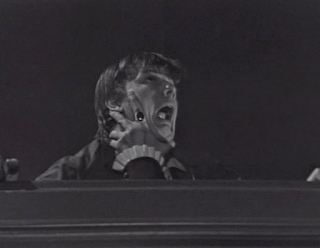
When Sandor opens the coffin, its end is toward us. We see Barnabas at the same time he does. Barnabas’ hand darts up, and also for some reason his foot. The camera zooms in as Barnabas clutches Sandor’s throat. Unfortunately, the shot is so dimly lit that not all viewers will see this. My wife, Mrs Acilius, has eyesight that is in some ways a bit below average, and she missed it completely, even on a modern big-screen television. It’s anyone’s guess how many viewers would have known what was going on when they were watching it on the little TV sets of March 1969, on an ABC affiliate which was more likely than not the station that came in with the poorest picture quality in the area. As a result, the image that marks the relaunch of Barnabas’ career as a vampire is nothing at all. There is so much good stuff in the episode that it easily earns the “Genuinely Good” tag, but Kaplan’s bungling of this final shot is a severe failure.
Suave warlock Nicholas Blair wakes Frankenstein’s monster Adam from a nightmare. As we have seen from night-time glimpses of fisherman Joe Haskell and the unpleasant Jeff Clark, it is standard for the young men of Collinsport to go to bed fully dressed, wearing coats, ties, and shoes. Adam is the youngest man around, having been brought to life just this May, but he is wearing pajamas.
Many commenters on fan boards assume that Adam has poor personal hygiene, perhaps because he has spent so much of his short life cooped up in hiding places without running water. But he lives in Nicholas’ house now, and unlike most characters, including Nicholas himself, he has two changes of clothing- the clothes that apparently came with the corpses from which he was assembled, a bright green sweater heiress Carolyn gave him, and his pajamas. So I think we ought to assume that he keeps himself clean.
Earlier this night, Nicholas sicced vampire Angelique on old world gentleman Barnabas Collins in order to keep Barnabas from interfering with his plans for Adam. But he discovers that Adam and Barnabas have a Corsican Brothers-type connection, so that puncture marks have appeared on Adam’s neck. Adam is also weakened, and afraid of Angelique. Nicholas concludes that Angelique will have to leave Barnabas alone. She is deeply disappointed when he tells her of this, but cannot argue, as it is almost dawn and she must get back in her coffin.
We then cut to the Blue Whale, where an unshaven Joe is drinking. Joe is another of Angelique’s victims, and as a result of her power over him has lost his job, his fiancée Maggie Evans, and his self-respect. We were first introduced to Joe in this room, back in #3. In those days, he was a hardworking young fisherman who was too sturdily honest to be tempted by a bribe to spy on the ancient and esteemed Collins family. We have seen him back on this set many times, usually as a stalwart representative of whatever is wholesome and rational. But today he is one of the old drunks leaning on the bar.
Maggie enters. She walks up to Joe. He does not react, and she starts to walk away. She turns back to him and says hello. They have a sad little chat. She says he almost seems to feel about her the way he used to; he says she has no idea how he feels. She tells him what she expects him to say, that he won’t be able to explain to her what’s going on with him; he confirms that it is so. He asks if she is there to meet Nicholas; she says she is, and asks if there is any reason she shouldn’t. He says he supposes not.
Nicholas enters. He asks Maggie if she would like to sit at the bar, but she indicates a table. Joe looks at them, and we hear his thoughts as he wishes he could explain what Angelique has done to him. This gains poignancy for regular viewers, not only because of the contrast between the broken-down figure we see today and the robust young man who so often modeled health and sanity on this same set previously, but also because less than two weeks ago, in #599, Maggie knew all about what Joe was going through. She and Joe were ready to run off together when Nicholas used his sorcery to mind-wipe their knowledge away and reset the story to its current dismal status quo.
Joe leaves the bar and goes to Nicholas’ house to call on Angelique. She is surprised to see him. She didn’t summon him, and she isn’t hungry. She tells him to go away. He says that he’s lost everything because of her, and that she is all he has left. She says he doesn’t have her either, because she is done with him. To make him even more miserable, she takes him to Nicholas’ magical mirror, which can be used to spy on whomever the user chooses, and shows Joe that Nicholas has walked Maggie home. Joe hears Maggie agree that she might fall in love with Nicholas, and watches them exchange a long, passionate kiss.
Joe asks Angelique if she cares that she has utterly ruined his life, to which she replies “Not particularly.” He says that he hates everything he has become, and that he despairs of ever being anything else. He picks up a letter opener intending to stab Angelique. Unable to bring himself to attack her, he sticks it into his own belly.
Joel Crothers was dissatisfied with the part of Joe and with Dark Shadows generally. In a couple of months, he will leave the show and take a role on another soap. Very few viewers would have been likely to know that was coming in 1968, but Joe was a popular character who was chronically underutilized. He would have had many fans who might have shared Joe’s fear that the show will leave him in the state to which this storyline has reduced him.
Frankenstein’s monster Adam came to life in #485, and has been cooped up in one cage after another ever since. Last week a mate was created for him and given the name Eve. Eve hates Adam, and today tells him that she will kill him as soon as she can. Adam is getting pretty tired of the whole thing.
Adam’s latest keeper is suave warlock Nicholas. Nicholas masterminded the creation of Eve because he hopes she and Adam will make Frankenbabies, founding a humanoid species that will owe its creation to Satan. Adam doesn’t know about Nicholas’ allegiance to the Devil or about his plans, but he is sick of taking his orders. The two quarrel at the beginning of today’s episode. Nicholas quiets Adam by showing off one of his magical gimmicks. Hanging on his wall is a device that is usually a mirror, but that can be switched over to function as a closed circuit television focused on anyone he chooses. Today, he wants to know where his unruly subordinate, vampire Angelique, has wandered off to.
Nicholas and Adam look into the mirror, where we see Angelique at the bedside of an unpleasant man named Peter who prefers to be called Jeff. She is about to bite Peter/ Jeff, contrary to Nicholas’ rules for her diet. We zoom in, and the scene from the mirror takes over our own screen. After a moment, Nicholas is there too, stopping Angelique and scolding her for disobeying his nutrition guidelines. It’s too bad we didn’t see Nicholas step into the mirror, like Buster Keaton in Sherlock, Junior, but you can’t have everything.
After Angelique obeys Nicholas’ command to leave Peter/ Jeff’s apartment, Nicholas puts Peter/ Jeff back to bed. He casts spells on him to cause him to forget his encounters with Angelique and to heal from the effects of them. While he was doing this, my wife, Mrs Acilius, was talking to the screen, pleading with Nicholas to cast a spell on Roger Davis to give him some acting ability. Shortly after that, Mr Davis delivered some more lines, making it instantly clear that Nicholas had no such power.
Back at Nicholas’ house, Adam is fuming that Nicholas switched the mirror back to reflecting mode just as the show was getting interesting. In the room with him, and she is too bored for words. The two of them have a rough physical confrontation, and Adam locks her up in the basement. Eve has the memories and personality of Danielle Roget, an eighteenth century homicidal maniac whom Nicholas conjured up to animate Eve. He first brought her out of Hell in a ceremony he conducted in this basement; when Adam takes her there, she is terrified he will send her back. Eve is so impatient with Adam’s naivete that it is startling to see her overestimate his knowledge of the situation.
Nicholas comes home and has another chat with Adam. Angelique enters the room and announces that it is almost dawn. Nicholas dismisses Adam. Angelique expects to be punished for her unauthorized attacks on Peter/ Jeff, but Nicholas tells her that he has a job she will like. He wants her to bite old world gentleman Barnabas Collins and enslave him. Since Angelique has been obsessed with Barnabas since the 1790s, this assignment delights her.
*Peter/ Jeff is fully dressed, in a coat, tie, and shoes, by the way. That’s the bedtime uniform for young men in Collinsport, as for Angelique’s other victim, the recently unemployed Joe Haskell.
When Dark Shadows began in June of 1966, hardworking young fisherman Joe Haskell was dating flighty heiress Carolyn Collins Stoddard. The two of them were bored beyond words with each other. They only kept going out because Carolyn’s mother, reclusive matriarch Elizabeth Collins Stoddard, was determined that they should get together, and neither of them wanted to disappoint her. For months, we were subjected to one scene after another of Joe and Carolyn having nothing to say to each other while we waited for Liz to give up on them.
Joe and Carolyn finally called it quits in #84, and shortly afterward Joe started seeing Maggie Evans, The Nicest Girl in Town. The audience has been rooting for Joe and Maggie ever since, but because there are too few obstacles to their romance for them to have a storyline of their own, we sometimes go months at a time without seeing them together.
Now, Joe has become the blood thrall of vampire Angelique, and Angelique’s master Nicholas has designs on Maggie. If Nicholas and Angelique were ordinary criminals and she were blackmailing Joe or had hooked him on drugs, this would be an archetypal soap opera situation. The supernatural twist makes it specific to Dark Shadows among the daytime serials of its period, but the story is still so deep in the genre’s wheelhouse that it is no wonder they’ve spent three days in a row luxuriating in it.
There’s a lot of emphasis on bachelor’s quarters this time out. Maggie lives alone, but we see so much of and hear so much about her late father’s paintings today that it feels as if the Evans cottage is still his house and Maggie is still his little buddy. That makes her relationship with Joe feel all the more urgent. She is waiting to make a home with him so that her adult life can begin.
We see Joe’s apartment as well. It is apartment 24, the default number for a Collinsport bachelor pad. Dashing action hero Burke Devlin lived in suite 24 at the Collinsport Inn in the first year of the show, and Humphrey Bogart-esque lawyer Tony Peterson lived in apartment 24, presumably in some other building, in the fall of 1967. Joe is sitting in his apartment 24 and staring at a glass of booze when Maggie knocks on the door. She tells him that his boss called her at home and told her that Joe hasn’t shown up at work lately. If Joe doesn’t call soon, he’ll have to fire him. Joe says he won’t call the boss, since he can no more explain the nature of his trouble to him than he can to Maggie.
We also see Nicholas’ house. Even though he is keeping Angelique on the premises, Nicholas is very much a bachelor. He peers into his magic mirror and sees Willie Loomis, servant to old world gentleman Barnabas Collins. Willie is asleep in his room in Barnabas’ house. The only other time we saw Willie’s room was in #328, when Barnabas framed Willie for terrible crimes he had himself committed against Maggie. Now, Nicholas uses his mirror for a magical video call with Willie. He interrogates Willie about an evil plan of his that is playing out in Barnabas’ house.
On Dark Shadows Before I Die, John and Christine Scoleri caught this screenshot of Nicholas making an unfortunate gesture while he is telling Maggie what he thinks of Willie:
Suave warlock Nicholas is studying a mirror in his parlor. His subordinate, vampire Angelique, enters and comments on his vanity. He invites her to look at the mirror and tell him what she sees. “Only your reflection,” she replies. But the audience also sees the reflection of her hair and forehead. Her line, coupled with the fact that we do not see her whole face, suggests that her reflection was not supposed to be visible. In #288 the idea that vampires do not cast reflections was a crucial plot point. When old world gentleman Barnabas was a vampire, he several times cast the sorts of reflection Angelique casts today, usually as the result of Jonathan Frid missing his mark. Perhaps Lara Parker simply took half a step too many in this scene.
Nicholas’ mirror is no simple reflector. It functions as a closed circuit TV. He uses it to show Angelique the room in the attic where well-meaning governess Vicki is being held prisoner. He lets Vicki go, casts a spell to cause her to forget her captivity, and then tells Angelique that he will be going out.
Angelique asks what she is supposed to do while he is gone- sit in her chair and get bored? He says he couldn’t have put it better himself. When he returns, she is in fact in the chair, sitting still. It’s hilarious that she doesn’t pace, or get a book, or try to see if the mirror gets any other channels.
Nicholas was away visiting Maggie, The Nicest Girl in Town, on whom he has a crush. Maggie’s fiancé Joe dropped in while he was at her house. He tells Angelique that Joe is to be the next victim of her vampire’s bite.
Gordon Russell’s script contains an interesting scene. A psychiatrist brought in to examine strange and troubled boy David Collins gives a little speech attributing David’s fear of his cousin Barnabas to various unresolved traumas he has recently experienced. This speech sounds very plausible to the adults who listen to it, and might go some way towards explaining the appeal of Dark Shadows to its audience. But we know that David’s fears are entirely rational and that Barnabas really is a vampire. When the psychiatrist mentions that Barnabas had fangs in one of David’s dreams, family doctor Dave Woodard catches up with us and realizes that Barnabas really does have fangs and that he used them to inflict bite marks on some of his patients.
Episode 335 of Dark Shadows was a scab job done during the October 1967 National Association of Broadcast Employees and Technicians strike. In March of that year, at a time when Dark Shadows was at rock bottom in the ratings, the actors stayed out in support of the announcers and newscasters when they went on strike, and the show survived even though it went dark by the time the strike ended. Now, the vampire story is pulling in more viewers every week, making it a valuable property to ABC. But it is at this time that executive producer Dan Curtis told the cast that he would pay their union fines if they crossed the NABET picket line, and most of them did, with network executives and their stooges handling the equipment.
Sad to say, only two cast members did the right thing by the technicians. Robert Gerringer, who played Woodard, was one of those. Even if he had been a good actor, the scab stealing food from the mouths of Robert Gerringer’s children wouldn’t have been able to deliver on the moment when Woodard figures out that Barnabas is a vampire- we need Gerringer for that. He is the person we’ve grown used to seeing in the part, and his self-consciously soap operatic style of acting sets him apart from the rest of the cast and highlights the weirdness of this story playing out on a daytime serial in 1967.
But the scab isn’t a good actor. His most memorable moment comes when Joan Bennett, as matriarch Liz, bobbles a line, and he corrects her. She flashes a look of anger, but what does she expect? What she is doing is no better than what he is- if anything, it’s worse, because she was a big star and could have called a halt to the whole filthy disgrace if she’d lived up to her obligations as a member of AFTRA.
I’m writing this in September 2023, month three of the SAG-AFTRA actors’ strike and month five of the Writer’s Guild of America strike, so I’m even angrier about the whole thing than I usually would be. But I always find it hard to watch material produced under these conditions.
The character of Maggie Evans wasn’t in any of the episodes produced during the strike, so Kathryn Leigh Scott wasn’t involved in breaking it. She is walking a picket line today, and in her column she wrote about the particular issues at stake in the 2023 strikes. Different matters hung in the balance in 1967, but it’s always true that we live in a society, for the love of God, and if working people don’t stick together they don’t have anything.
For the last eight weeks, Dark Shadows has been presenting a riddle about strange and troubled boy David Collins. In #288, he wondered if mysterious little girl Sarah might be a ghost. Since then, he has seen her several times, and every time she has given fresh evidence to corroborate that hypothesis. When he isn’t with Sarah, David is either looking for her or fielding questions from adults who are anxious to make contact with her, and in the course of every search and every question he finds still more reason to suppose that she is a ghost. David had always been the first character to believe in ghosts, yet he kept resisting the obvious conclusion that Sarah was one.
Friday, David had a dream in which Sarah told him that she died when she was ten years old. In that same dream, David saw his cousin Barnabas rise from a coffin, greet Sarah warmly, and threaten him with his cane. Yesterday, David woke up and told his well-meaning governess Vicki that he now understood everything about Sarah, because he knew that she was a ghost. Vicki listened carefully to his dream. Much to his frustration, she tried to talk him out of taking it literally. But today, when David is out of earshot, Vicki twice shows the other adults that she regards David’s dream with the utmost seriousness.
In the drawing room of the great house of Collinwood, mad scientist Julia Hoffman tries to hypnotize David so that he will stop making trouble for her co-conspirator Barnabas. Before she can induce the trance, David recognizes her medallion as the one a faceless woman held before his face in the dream. He flees from Julia and calls out for Vicki.
Vicki and matriarch Liz ask Julia what happened. Julia tries to play dumb, but Vicki recognizes her medallion both as the one David described when he was telling her about his dream and as the one Julia showed her and Maggie Evans, The Nicest Girl in Town, when she dropped in on them at Maggie’s house in #298. During that visit, Vicki briefly left Julia and Maggie alone together. Before she left the room, Maggie was about to remember who abducted her and held her prisoner; after she came back, Maggie’s amnesia had returned in full force. During the interval, Julia had used the medallion to do a little emergency hypnosis, restoring the memory block that keeps Maggie from identifying Barnabas as her captor and as a vampire. Julia has reason to squirm when she realizes that Vicki has connected the medallion both with that incident and with David’s dream.
Vicki goes to David’s room to again try to talk him out of a supernatural reading of his dream. She finds him gazing into his crystal ball, looking for Sarah. He pleads with her to allow him to go look for Sarah. She resists, but he tells her that he saw Sarah in the crystal ball and that it won’t take him long to find her. He promises to tell Vicki what he and Sarah talk about. She lets him go, on condition that he be back within an hour.
The riddle of David’s long refusal to acknowledge that Sarah is a ghost is matched by the riddle of Vicki’s attitude. She has seen and interacted with ghosts on many occasions, a fact that is no secret from David. Both her recognition of Julia’s medallion and her acceptance of David’s claim to have seen Sarah in the crystal ball show that she knows she is operating in a world where supernatural forces are at work. Yet she keeps urging David back into “logical explanation”-land. Perhaps she has read Henry James’ “The Turn of the Screw,” and doesn’t want there to be any ambiguity about whether the boy saw the ghosts himself or his crazy governess put the idea into his head.
David goes to the woods, hears the familiar strains of “London Bridge,” and sees Sarah. She tells him that she knows he saw her in his crystal ball. When he asks how she knows he was looking into his crystal ball, she answers only “I know lots of things.” He asks her about his dream; apparently that is not among the things she knows about, because it all comes as news to her. David tells her that in his dream, she told him that she was very sick when she was ten years old. She excitedly replies “That’s true!” He then says that she told him she died of that sickness. Even now, after the dream, after telling Vicki that Sarah is a ghost and shouting with frustration when she won’t agree, he follows up the idea that Sarah has died with “That isn’t true, is it, Sarah?”
Before Sarah can answer, Vicki’s depressing boyfriend Burke lumbers onto the scene. He hears David and Sarah’s voices and shouts “David!” Sarah then becomes alarmed and declares she has to go away. David asks her to stay, and goes to tell Burke to wait. By the time they turn around, Sarah has vanished.
Burke used to be an interesting character, back when he was a dashing action hero played by the charismatic Mitch Ryan. In fact, he was the one who gave David the crystal ball in the first place, back in #48. But he hasn’t had much to do on the show since his major storyline evaporated in #201, and now he is played by Anthony George, an actor whose cool, understated approach was the exact opposite of Ryan’s tendency to red-hot, larger than life reactions. In the scripts written by Ron Sproat, the part of Burke still depends on Ryan’s strengths, and George is entirely at sea with it. Today, Gordon Russell’s script takes advantage both of George’s actual abilities and of the dimwitted impression he has made previously.
David tells Burke that he doesn’t think Sarah will talk to anyone other than him from now on, not because she is shy, but because she doesn’t want anyone else to know that she is a ghost. Burke gives David a smug little speech about how foolish it is to believe in ghosts. David asks how Sarah got away so fast. Burke admits he doesn’t know. David gives Burke some details about Sarah’s way of vanishing into thin air, and he is left speechless.
Back in the drawing room, Burke tells Vicki and Liz that David thinks Sarah is a ghost. Liz reflexively asks if he ought to be taken to a doctor. Burke suavely says that he doesn’t believe it is as serious as all that, that David is just letting his imagination run away with him.
Vicki speaks up. She says that she disagrees with Burke on two points. First, she thinks the matter is very serious. Second, she doesn’t believe it has anything to do with David’s imagination. Sarah really is a ghost.
Burke starts giving another sanctimonious speech about how one oughtn’t to believe in ghosts. Some weeks ago, Sproat and recently-departed, never-lamented writer Malcolm Marmorstein had given Burke some angry speeches in which he demanded Vicki stop taking the supernatural seriously. Those speeches would have marked Burke as bad news had Mitch Ryan delivered them, but at least they might have suggested that he was going to become an interesting villain- coming from an actor as cold as Anthony George, they were just pointless nastiness. Vicki’s attempts to comply with Burke’s gaslighting campaign also did a lot of damage to her character in the audience’s eyes, presenting her as weak-willed and empty-headed.
But today, Gordon Russell doesn’t write Burke as a loudmouth or Vicki as an aspiring doormat. Instead, he lets George make a reasonable-sounding case in the quiet, detached manner in which he excelled, and he has Vicki surprise him with an equally quiet but unyielding disagreement. She tells Burke to hire all the private investigators he likes to use and tell them to search for Sarah. If they can produce the girl in the flesh, she will admit that she is mistaken. But she tells Burke that won’t happen, because “David is right- that little girl is a ghost.”
If we remember Vicki’s earlier attempts to submit to Burke’s gaslighting, this scene answers the riddle about her. She knows that there are a lot of Burkes and a lot of Lizzes in this world, and that if you want to get along with them you have to be able to present yourself as someone who doesn’t believe in ghosts. She is trying to teach David how to play the role of the practical-minded fellow who takes it for granted that what we can see in the plain light of day is all we have to concern ourselves with. If she and the other adults can shelter him from enough of the uncanny doings that she knows full well are afoot all around them, perhaps he might get through his childhood actually being something like that fellow. It worked out that way when David’s mother, undead fire witch Laura Murdoch Collins, came to Collinwood to claim him- the storyline around her drew him deeper and deeper into the world of the occult, but once Vicki had rescued him and it was all over he didn’t remember anything about that side of it.
Upstairs, David is trying to sleep. Sarah appears in the corner of his room, lit from below. Laura stood on the same spot, in the same lighting, when she visited David while he slept in #150. His mother had called his name in a whispering voice and had a subtle message for him, but Sarah yells “David!” and says she’s ready to answer more questions.
David doesn’t ask her if she died. Perhaps when he told Burke that she doesn’t want anyone to know that she is a ghost, he meant that he has realized it is a sensitive subject for her. He does ask about the coffin he saw in his dream. She says she doesn’t know what he’s talking about. He says it was in a room that he felt he’d been in before, and she says maybe it was. He says he doesn’t know where it is, and she tells him that’s good- she doesn’t want him going anywhere near it.
David keeps talking about the coffin, and it dawns on him that it is in the basement of Barnabas’ house. She insists that he stay away from Barnabas’ house, that it isn’t safe for him there. She won’t answer any of his questions about that, but she keeps insisting that he stay away from Barnabas’ house.
David asks Sarah if Barnabas’ servant Willie really was the man who abducted Maggie, as the police think. Sarah answers, “Oh no, poor Willie only went to Maggie’s house to warn her.” David asks what he was trying to warn Maggie of, and Sarah says that she has to go away. She repeats that he must stay away from Barnabas’ house. He pleads with her to stay, but she dematerializes in front of him. This is the first time we’ve seen a ghost vanish in this way since #85, when the ghost of Bill Malloy appeared to Vicki, sang a sea shanty, and then disappeared. It’s also the first time Sarah has let David see her dematerialize. Evidently, she’s more relaxed about these things now that she’s out to him.
Closing Miscellany
There is a particularly funny blooper 14 minutes and 20 seconds into the episode, when Burke comes out of the door that leads to the bedrooms at Collinwood, an off-camera voice calls out “Go in!,” he turns around, goes back in the door, then comes out again with exactly the same expression on his face.
Burke and Vicki have a little conversation about why Julia spends so much time at Barnabas’ house. Burke guesses Julia might have “a mad crush on Barnabas.” Vicki reacts as if this is absurd. The same idea had occurred to Julia’s old acquaintance Dave Woodard, MD, in #324, and Julia had been delighted to find that she had inadvertently acquired a cover story. That Burke came up with the notion independently leads us to wonder if we will be hearing more about it, and that Vicki regards it as so self-evidently preposterous reminds us of the times she has seemed more interested in Barnabas than in Burke. Perhaps the Vicki/ Burke/ Barnabas love triangle has a future after all.
Strange and troubled boy David is peering into his crystal ball.* David’s cousin Carolyn tells him it is time to go to dinner. He tells her he is looking for his friend, mysterious little girl Sarah. Sarah has been driving the story of Dark Shadows for weeks now, and the ratings keep going up. Not only does she get viewers to tune into their television sets, she even gets Carolyn to start watching the crystal ball.
Hazel Roy is billed as costume designer for this episode. Mrs Roy died in 2010, no doubt still embarrassed by David’s shirt.
Hardworking young fisherman Joe comes to the house. Joe is also looking for Sarah, and asks if David can help find her. He explains that Sarah might know who abducted Maggie Evans, The Nicest Girl in Town. David says that he knows where Sarah is, but that it is a place he promised he would keep secret. He offers to go himself and bring her back. Joe is all for it, but Carolyn points out that it is after dark, David’s dinner is getting cold, and that his source of information is something he saw in his crystal ball. Joe backs down.
David recognizes the urgency of the situation. He sneaks out of the house and goes to the secret place, the Tomb of the Collinses in the old cemetery north of town. Sarah is indeed there. When David asks if she knows who abducted Maggie Evans, she replies that all she knows is that she has a friend named Maggie.
David takes that at face value. Regular viewers cannot be so sure. We know that Sarah is a ghost, and that she returned to the Earth after her brother, vampire Barnabas Collins, was loosed to prey upon the living. We do not know whether Sarah knows that she is a ghost or that Barnabas is a vampire. Nor do we know what she remembers from one apparition to the next. Clearly she remembers the people she has spent time with, but we can’t be sure if she remembers that Maggie told her that her father’s name was Evans and where she could find him. She might be telling the truth when she denies knowing anything more than Maggie’s first name, or she might be lying to protect Barnabas from exposure.
My wife, Mrs Acilius, compares Sarah to a superhero. Like a superhero, Sarah shows up, does what needs to be done to meet the immediate need, and disappears. You could almost say that she “lives in the moment,” if that were not the opposite of what ghosts do. Maggie needs a friend, Sarah shows up and befriends her. Maggie needs to escape from Barnabas, Sarah arranges her escape. Maggie needs to escape from mad scientist Julia Hoffman, Sarah breaks her out and leads her home. Barnabas needs to be stopped from killing Maggie, Sarah stops him.
Playing catch with David, Sarah throws the ball wide, and he ducks to look for it. When he looks up to complain that she threw it where he can’t find it, she has disappeared. Evidently all that needed to happen was that David had to go to the tomb- she has accomplished that, so she goes back to her rest.
David looks for her in the tomb and in the secret room. As he is about to leave, he hears voices approaching. He must honor Sarah’s secret, so he looks for a hiding place. The only place he can find is the tomb, so he stays inside.
The voices are those of Barnabas and his sorely bedraggled blood thrall Willie. Willie had seen Sarah through the window of their house** in the opening scene, and Barnabas has decided to come to the tomb where Sarah was buried in hopes that she will appear to him.
David realizes that Barnabas and Willie are coming into the tomb. He hides in the secret room. Little does he know that Barnabas is an expert on this room- he was trapped in a coffin there for a century or two, until Willie accidentally released him in April. That old coffin is still there, and when David hears Barnabas order Willie to open the panel he hides inside it.
We don’t know an in-universe reason why this was what needed to happen. We do know that Barnabas has been so harmless lately that the vampire story is running out of juice, so we can see why the writers would want to create a situation where Barnabas decides he has to kill David. But it is so mysterious what Sarah’s motives are or whether she is the kind of being who has what we could recognize as motives that the episode leaves us in suspense, not only as to how David will get out of danger, but what we will learn about her as a result of the incident.
*The crystal ball was a big deal for a while after dashing action hero Burke Devlin gave it to David in #48. He hasn’t really used it since #82, and Burke has since lost his connection to the plot, been recast with a less interesting actor, and turned into a hopeless schlub. It’s hard to see any way back into the story for Burke, but maybe there is hope that the crystal ball will again be a focus of interest.
**Willie was polishing the chandelier when he turned to the window and saw Sarah. Evidently he had seen her reflection in the crystal. So Sarah is twice detected today through scrying.






 Dark Shadows Commentary