Vampire Barnabas Collins has discovered that he can occasionally see into a parallel universe through a doorway in the long-disused east wing of the great house of Collinwood. He cannot enter that universe or get the attention of its inhabitants, but yesterday a book came flying out of it and landed at his feet. It is titled The Life and Death of Barnabas Collins, and its author is William Hollingshead Loomis.
The Barnabas of the book’s title is our Barnabas’ counterpart in the parallel universe. He never became a vampire, but married his great love Josette, enjoyed prosperity as head of the Collins family, and died a natural death in 1830. It sounds like Parallel Barnabas lived a quiet life of the sort that would make for a dull biography.
Author William Hollingshead Loomis is the counterpart of Willie Loomis, once Barnabas’ sorely bedraggled blood thrall. Willie is back in Barnabas’ house, not as a slave, but as a volunteer in the battles Barnabas and Julia recently waged against the Leviathan People, a race of Elder Gods who sort of wanted to retake the Earth and annihilate humankind, but who could never figure out a way to get started. The Leviathans have been defeated now, and Willie’s fiancée Roxanne expects him to leave with her. But Barnabas and Julia are still bullying Willie into sticking around while they clean up the messes they have made recently. Most notably, yesterday they made him stake Megan Todd, a victim whom Barnabas inadvertently made into a vampire. Today Willie is still talking about how traumatic it was for him to do that.
Parallel William H. Loomis is identified on the back of his book as the author of three best-selling novels that had been made into motion pictures, Pride of Lions, Gold Hatted Lover, and World Beyond the Doors. When Barnabas shows the book to our Willie, he reacts with panic. When he sees in the prefatory material that Parallel William dedicated the book to “the Clio who inspired” him, Willie declares that he doesn’t know anyone by that name. Barnabas contemptuously tells him that Clio was the Muse of History. Willie has never been represented as an especially literate fellow- when Frankenstein’s monster Adam began using standard grammar and diction in August 1968, Willie’s response was to ask “How come he talk so good?” While one suspects that a writer capable of publishing a book under the title Gold Hatted Lover is not exactly Thomas Hardy, Parallel William is clearly more bookish than is our Willie.
Barnabas tells occult expert Timothy Eliot Stokes about the room and takes him there. Stokes is excited by the possibility of examining this direct evidence for the many-worlds hypothesis, but alarmed by Barnabas’ apparent determination to cross over into the parallel universe he has glimpsed. He tells him of the dangers involved, and Barnabas does not want to hear it.
Meanwhile, heiress Carolyn Collins Stoddard is on her honeymoon with a man who once hoped people would call him Jabe. Like all his other hopes, that was summarily dashed, and he answers to Jeb. A leftover from the Leviathan arc, Jabe is plagued by an autonomous shadow that manifests itself to him in the manner of the shadow that plagues Anodos, the protagonist of George MacDonald’s 1858 novel Phantastes. Every time the shadow appears, Jabe insists on fleeing. Today, Carolyn sees the shadow herself, and finally understands why they haven’t been able to spend a whole night in any of the hotels they’ve checked into.
The shadow is not the most impressive special effect on Dark Shadows. In their post about the episode on their blog Dark Shadows Before I Die, John and Christine Scoleri said that the little dance the shadow does ought to be underscored with some Herb Alpert-style music, and they post a video to prove their point.
Yesterday, Barnabas Collins went to the long-disused east wing of the great house of Collinwood to search for the coffin that vampire Megan Todd occupies during the day. Barnabas is himself the vampire who ended Megan’s human life, passing his curse along to her. When his friend, mad scientist Julia Hoffman, makes a characteristic remark and tells him “you must not feel personally about Megan Todd,” Barnabas asks “How can I feel any other way?” Most of Barnabas’ feelings, in this or any other matter, consist of pity for himself, but there is a trace of sympathy for Megan in there someplace, probably.
Now, Barnabas has taken Julia to a spot that he happened upon while looking for Megan. While Julia was in the carriage house on the estate with matriarch Elizabeth Collins Stoddard, Barnabas saw two women who looked and sounded exactly like them in a brightly lit, fully furnished, heavily decorated room behind a pair of doors in the otherwise dark and empty east wing. Julia’s double was wearing a French maid outfit and giving orders to Liz’, which is probably someone’s fetish but which is totally out of character for the women Barnabas knows.
In #351, Barnabas was without a blood-thrall. Julia offered to guard his coffin during the day. They were not really friends at that point, and he reacted to her offer warily. Among his objections was that it was not suitable for her, as a medical doctor, to fill such a position. She assured him that she was not volunteering “to be your maid.” Longtime viewers might remember that line when they see Parallel Julia in her livery.
There was an invisible barrier in the doorway that Barnabas could not cross, and he was unable to attract the attention of the women who were so near to him, even when he shouted what he supposed to be their names. The doors closed, and when they opened again the barrier was gone, but so were the doubles of Julia and Liz, along with all the furnishings and lights that had surrounded them.
Thinking of what Barnabas has told her about the room, Julia hesitates to enter it with him. She dismisses her concern as “silly.” Regular viewers will perk up at this- labeling a fear as “silly” is the surest way of marking it as the basis of an upcoming major story point. Once inside the bare room, Julia starts thinking out loud:
JULIA: I was at Eliot Stokes’ house one night, oh, last spring. We were having a brandy after dinner and he started talking about time… He was complaining that we all simply accept it. We don’t have much choice, I thought.
But Eliot had been reading a theory. It sounded insane to me. A theory of parallel time… we live on this universe in 1970, right? We accept the fact that our time is the only time that we can truly know. Suppose time is like a road and parallel to it there’s another road. On one we live the lives we know, but on the other road our lives are different because we’re in a different time-band* and we’ve made different choices. For example, in that other band of time I could’ve made a different choice when I was at college. Instead of being a doctor I could’ve married and had children.
Barnabas, you don’t actually think through some warp in the time band that you have actually seen us living other lives?
BARNABAS: I don’t know, there’s got to be a more rational explanation.
JULIA: Must there?
So, now we know that we are about to launch a new kind of time travel story. The show has taken us back in time for long costume drama inserts, most notably from November 1967 to March 1968 when it was set in the 1790s and from March to November 1969 when it was set in 1897. Now they are going to travel sideways in time, and take us to a parallel universe where Julia is a maid and Liz is not the lady of the house.
At the end of the episode, Barnabas sees the room change again. Parallel Time Liz and Parallel Time Julia uncover a portrait that hangs there, the portrait of a woman whom PT Liz insists is dead and PT Julia insists is still the rightful mistress of the room. Barnabas recognizes the subject as the Parallel Time counterpart of his ex-wife, wicked witch Angelique.
With this, the behavior of PT Liz and PT Julia falls into place. We’re about to see a story derived from Daphne Du Maurier’s Rebecca. PT Julia is Mrs Danvers, the housekeeper maniacally devoted to Rebecca, the late wife of Maxim de Winter. PT Angelique is the one whose death and continued ownership of the room have been a point of contention between PT Julia and PT Liz. We’ve seen a photograph of Parallel Time counterparts of Barnabas’ distant cousin Quentin Collins and strange and troubled boy David Collins, signed “Your loving husband, Quentin.” PT Quentin is the one whom we have heard Liz say is returning with a new wife. In the main “time-band,” Quentin is a penniless rogue with a long supernatural backstory, but his counterpart is the master of Collinwood, and Liz ranks somewhere below the uniformed domestics in the household hierarchy. The David we know is the son of Liz’ brother Roger and a blonde fire witch named Laura Murdoch, but evidently his Parallel Time counterpart is the son of the counterparts of Quentin and Angelique. We have had no indication of who Quentin’s new wife is to be.
This is not the first reference to Rebecca on the show. When Clarice Blackburn joined the cast as housekeeper Mrs Johnson in September 1966, she was supposed to model the character on Mrs Danvers. Mrs Johnson came to Collinwood as a spy for Collins family nemesis Burke Devlin, driven by her certainty that Roger was responsible for the death of her beloved former employer Bill Malloy. Bill, like Rebecca, had drowned under suspicious circumstances, though he didn’t have much else in common with her. By the time the “Death of Bill Malloy” story played out, Mrs Johnson had taken on a new function as an inveterate gossip who made narrative progression possible by blabbing everything she knew to everyone she met. Blackburn’s outstanding talents made her a significant part of the show for quite some time; it’s a shame she isn’t going to be part of the upcoming segment.
Rebecca was not the only Du Maurier novel to inspire a story on Dark Shadows. Dangerously unstable ruffian Willie Loomis first freed Barnabas to prey upon the living after David and Mrs Johnson told him the plot of Du Maurier’s Frenchman’s Creek and claimed that it happened to one of the Collins ancestors. Searching for the treasure the pirate gave to the lady, Willie stumbled upon Barnabas’ coffin. He opened it, earning a bite that made him the vampire’s slave.
Willie’s mistake was that he did not know what kind of show he was on. When Dark Shadows began, executive producer Dan Curtis and ABC vice president for daytime programming Leonard Goldberg** meant for it to be the television equivalent of the “Gothic romance” novels that were so popular in those days. Du Maurier’s novels were among the cornerstones of the Gothic romance genre, and if it were still that kind of show in April 1967 Willie would have been on solid ground in his expectation that there might be a lot of jewels hidden in an unmarked coffin in the old mausoleum. But when Laura was on the show from December 1966 to March 1967, her story subsumed all the major plot threads into a tale of the supernatural. Willie and his sometime friend, seagoing con man Jason McGuire, were on the show as in-betweeners to sweep up the last non-paranormal odds and ends and help introduce the next uncanny menace.
Now, the show is heading in the opposite direction, and Willie is back to help take us there. In Parallel Time, Dark Shadows will finally do the Daphne Du Maurier adaptation that didn’t work out in the Bill Malloy story and that was never meant to work out for Willie. But Megan has to be destroyed before Barnabas can decamp for Parallel Time, and he and Julia order Willie to destroy her.
It was not a foregone conclusion that Julia and Barnabas would want to stake Megan. At the moment, Julia is giving Barnabas injections meant to relieve him of the effects of the vampire curse. Similar injections had worked in 1968 and again during the 1897 segment. Julia shows Barnabas the cross she wears to ward Megan off, and he does not recoil from it. That suggests the injections are having some effect on him, even though he keeps complaining that they aren’t doing anything to curb his bloodlust. When Julia and Barnabas find Megan in the east wing, she refuses the injections. When they find that she is feeding on Roger, they conclude that she cannot be allowed to see another night.
Willie is horrified by the command to drive a stake through Megan’s heart. He protests that he doesn’t even know her. As Barnabas and Julia tell him of the nightmare that awaits everyone if he doesn’t do as they say, he starts to talk about his fiancée Roxanne and the secrets he has been keeping from her. He worries about the image she will have of him if she finds out that he is the former blood-thrall of one vampire and the destroyer of another. “I mean, she’s gonna be thinkin’ I’m weird or somethin’!” I suppose that would be an occupational hazard for blood-thralls.
Willie is worried Roxanne might get the wrong idea about him. Screenshot by Dark Shadows Before I Die.
There is an odd moment when Julia is asking Liz about the east wing. Liz tells her that Roger knows more about the legends of the house than she does. When Julia was first on the show, she was posing as an historian looking into the old families of New England. In those days, Liz mentioned that Roger knew far less about the Collins past than she did, which fit with the original keynote of Roger’s character, an extreme lack of family feeling. But by this point, Roger has merged with the roles Louis Edmonds played in the 1790s and 1897 segments, both of whom were dedicated to the honor of the Collins name.
*The first appearance of this bit of Collinsport English.
**Not to be confused with his then-boss, network president Leonard Goldenson.
We open with a reprise of the end of yesterday’s episode. Quentin Collins and Amanda Harris are reenacting the myth of Orpheus and Eurydice. As in the ancient Greek story, they will live together if they can escape all the perils on the road from the realm of the dead to that of the living. Unlike that story, they are allowed to look at each other along the way, but they are not allowed to touch.
The teaser ends where Wednesday’s episode ended, with Amanda falling through a gap in a footbridge and Quentin crying out in anguish. After the opening title, we are surprised to find ourselves at the same scene. Amanda is not yet lost. Quentin pulls her up from the ravine she fell into. But that involves touch, so the ceiling of the cavern collapses and buries her. Suddenly, Quentin finds himself lying on the ground, in the upper world, with no sign of any way back to the place from which he just came.
Amanda’s demise marks Donna McKechnie’s final appearance on Dark Shadows. Miss McKechnie left to be in the original cast of Stephen Sondheim’s Company, paving the way for her enormous success on Broadway in the 1970s. Much later, Miss McKechnie would reprise the role of Amanda in a couple of Big Finish Productions’ Dark Shadows audio dramas, and nowadays she appears at the Dark Shadows conventions.
Any account of Donna McKechnie’s last day at 433 West 53rd Street would be incomplete without this story from Hamrick and Jamison’s book Barnabas and Company:
In rehearsal, we went through the scene with a few Styrofoam boulders and a little peat moss, no big deal. Nobody told me there was going to be ten times as much dropped during the taping. So, when it was time to tape the scene, I was looking up, and I just got buried. I got peat moss in my eyes and in my mouth and ears and nose… and I was covered in rocks. The way things worked at the studio, at the end of that scene, the lights went out, and the camera and crew and actors all moved on to the next scene, in another part of the studio. So there I was, laying under all those Styrofoam rocks and peat moss, and nobody helped me get out. I had to dig myself out, and that was my last experience on Dark Shadows.
Craig Hamrick and R. J. Jamison, BARNABAS AND COMPANY: THE CAST OF THE TV CLASSIC DARK SHADOWS (2nd edition, 2012) page 245.
They’ve been doing a bit of videotape editing recently, as several awkward cuts have made clear. One might think that the whole Underworld sequence, pre- and post-title, was edited in from tape left over from yesterday’s shoot. But Miss McKechnie’s story proves that is not so. The episodes were done in sequence, so if the last bit of tape they shot yesterday had been the crushing of Amanda there wouldn’t have been any next scene to run off to and Miss McKechnie would have had plenty of help digging herself out from under.
Some Sort of Monster was After Him
Meanwhile, the sheriff is at the home of occult expert Timothy Eliot Stokes. Stokes and his friend, mad scientist Julia Hoffman, have called him in because a monster wrecked Stokes’ bedroom, in the process killing a man named Paul Stoddard.
No law enforcement officer on Dark Shadows has yet solved a case, and Sheriff Davenport seems likely to prove the most useless member of the fraternity yet. At no point does he interrogate Stokes and Julia, or even show much interest in what they were doing while Paul was being killed. He refuses to believe Julia when she says that he should be looking for a monster, even though Collinsport has been overrun with monsters for years now and he has acknowledged that the wreckage at Stokes’ is like nothing he has ever seen. Julia tells him that the monster lives in the room at the top of the stairs in the antique shop operated by Megan and Philip Todd. In response, he flatly states that “They wouldn’t have anything to do with his death.” He finally agrees to get a search warrant for the Todds’ place, but when he presents it to Philip he says that he will execute it “unless of course, you don’t want me to?”
The meatiest part of the episode is a long scene between Megan and Philip. She is exultant that the monster has killed Paul and certain that it will go on to do other, even more wonderful things. He’s scared to death of what the monster will do to them if it is not defeated and of the retribution that will come to them if it is. She sneers at him as a coward. He admits that he is a coward, but insists that they run away and count themselves fortunate if they can escape with their lives.
In her first role on Dark Shadows, as Eve, The Fiancée of Frankenstein, Marie Wallace was called upon to show an unbending, unvarying contempt for Adam, the patchwork man she was supposed to marry. Since that was the only feeling Eve had ever shown for Adam, it wasn’t very interesting. But Megan loved Philip when we first met them. The other day, when she told the monster that she had loved Philip for a long time, we could believe her. So her scorn today does carry some force, and no one knows better how to play scorn and play it to the hilt than does Miss Wallace.
The part of Philip has not been a particularly congenial one for Christopher Bernau up to this point, but he too excels in the scene. He has lots of lines you would expect a man to find it hard to say, calling himself a coward and so on, but he speaks them smoothly and fluently. He shows his hesitancy and anguish not in his delivery of the lines, but in his facial expressions and movements while Megan is speaking. You can see him deciding to put aside all male ego and say something that might get through to Megan, no matter how humiliating it is for him to say it. With lines proclaiming his cowardice, Bernau creates the image of a remarkably brave Philip.
That in turn makes it possible for the episode to end on a suspenseful note. The closing cliffhanger has Sheriff Davenport turning the doorknob to the monster’s room, while Philip is frenziedly trying to come up with a way to talk him out of entering it. When we watched that, my wife, Mrs Acilius, said to the screen “If you don’t tell him what’s in there, it’s murder,” in a tone that suggested she thought Philip actually might tell the sheriff the truth. That such an idea could even form is a testament to Bernau’s outstanding performance in this episode.
In the middle of The Odyssey, Odysseus and his companions enter a certain cave and follow a path that leads to the realm of the dead. There, Odysseus talks with several people whom he knew when they were alive, then comes back to the upper world. This passage, known in Greek as the νέκυια (nekyia,) led many subsequent epic poets to include journeys to and from the Underworld in their works. In the Aeneid, his Latin language response to the Iliad and the Odyssey, Vergil put Aeneas’ voyage to the Underworld in the same halfway spot where the nekyia stands in the Odyssey. The words of warning the Cumaean Sibyl speaks when she gives Aeneas directions to reach the Underworld by way of a path leading through the crater in Mount Avernus are quite famous:
Facilis descensus Averno: Noctes atque dies patet atri ianua Ditis; Sed revocare gradum superasque evadere ad auras, Hoc opus, hic labor est.
The road down through Avernus is easy.
The doors of dark Dis lie open by day and by night.
But to reverse your stride and escape to the air above,
This is the achievement, this is the feat.
(Vergil, Aeneid 6:126-129, my translation.)
It wasn’t only warrior princes like Odysseus and Aeneas who had to go to the realm of the dead and back in the mythology of the ancient Mediterranean. The legendary poet Orpheus was so disconsolate when his wife Eurydice died that he journeyed to the Underworld to plead with the gods of the dead to let him take her back with him. As Ovid tells the story in Book 10 of his Metamorphoses, Orpheus made his case in a song that was so beautiful that the whole pantheon of deities who dwell among the ghosts of humans wept. Their chief, known by a long list of names including Pluto, Dis, and Hades, was no exception. Through his tears, he agreed to release Eurydice. But the god knew his business too well not to make conditions. First, Orpheus and Eurydice would have to take the hard and treacherous road that separates the shades of the dead from the world of the living. Second, they would have to complete the whole journey without once looking at each other.
They made it through all the ruggedness and the many snares. At the moment Orpheus felt the warmth of the sun on his cheeks once more, he became so excited that he forgot everything. He turned his head to face Eurydice and exclaim that they had succeeded. But she was still in the shadows. He saw only her silhouetted figure, and that only for an instant. She shrank from him at impossible speed, disappearing forever into the darkness of death.
Dark Shadows steals from every writer, sooner or later, and they’ve stolen a woman named Amanda Harris from a story that comes later in Book 10 of Ovid’s Metamorphoses. A sculptor named Pygmalion was a sour misogynist, who sought a substitute for the companionship of the real live women he so disliked by making a statue of a woman he thought he could get along with. Much to his surprise, the statue came to life and they fell in love, more or less.
In 1969, we learned that an artist named Charles Delaware Tate, who was every bit as unpleasant a person as Ovid’s Pygmalion, had painted a portrait of an imaginary woman and that, because of some magic powers Tate was unaware he had, that woman had popped into existence and started calling herself Amanda Harris. It was a couple of years after her inception that Amanda met Tate. Unlike Pygmalion’s statue, Amanda was as repulsed by her creator as one would expect her to be. Instead, she fell in love with the boundlessly charming, albeit none too admirable, Quentin Collins.
Now Amanda has died, and Quentin is willing to do anything to be reunited with her. A god of death named Mr Best has offered him a sporting proposition. If he and Amanda can walk the whole of the hard and treacherous road that separates the shades of the dead from the world of the living without once touching each other, they can share an eternal life. But if they do touch, or if either of them falls victim to one of the many traps along the way, they will be separated forever.
Their journey almost ends before it begins. Amanda sees Quentin looking out the door that opens on the road home, and reaches out to touch him. At the last second he tells her not to, explaining the conditions Mr Best had laid down. They set out. Along the way, Amanda is caught in a giant web where she is menaced by a giant spider, twists her ankle when she trips over some rocks, has to walk over a rickety rope bridge, and experiences a series of phobic reactions. She is just about to make it when, not looking down lest her fear of heights get the better of her, she puts her foot through a gap in the rope bridge and falls into oblivion.
It’s unclear what this will mean for Quentin. He has no direct connection to any other unresolved story, and while there are characters who care about him he isn’t particularly interested in having anything to do with them. He has been one of the show’s great breakout stars, second only to Jonathan Frid as occasional vampire Barnabas Collins, so it is hard to believe they won’t come up with something new for him to do, but it is not at all clear what that might be.
Book 10 of Ovid’s Metamorphoses does not seem like it will be very helpful. When Orpheus loses Eurydice, he can no longer stand the sight of any other woman, so to pass the time he invents male homosexuality. He has great success popularizing his invention throughout his homeland of Thrace. When the Thracian women find that many of their menfolk have lost interest in them, they signal their displeasure by killing Orpheus. I very much doubt that the American Broadcasting Company’s office of Standards and Practices would have been too happy at the idea of dramatizing that story five days a week at 4 PM in 1970. Besides, Dark Shadows has been so antiseptically sexless that the women of Collinsport wouldn’t be any worse off if the men devoted all their eroticism to each other, so you couldn’t use that ending.
The Orpheus and Eurydice story only takes up half of today’s episode. The rest recounts the final hours of the life of Mr Paul Stoddard. Paul has found out that a group of people in and around the village of Collinsport are in the service of invisible supernatural beings known as the Leviathans. Earlier this week he encountered a nonhuman creature that is central to the Leviathan cult. Contact with the creature caused his clothes to rot and stink and left him dazed and unable to speak.
Paul is currently sitting and staring into space in the apartment of Professor Timothy Eliot Stokes, expert on the occult. When we cut to Stokes’ apartment from Quentin and Amanda on the way back to the world of the living, we see a bust of the poet Dante, reminding us that Christian poets followed ancient pagans in writing epics about visits to the realms of the dead. It also suggests that Quentin’s experience in Mr Best’s domain may give him some knowledge or power that will allow him to join Stokes and mad scientist Julia Hoffman in their battle against the Leviathans.
Dante watches over Paul and Stokes.
Stokes tries to get Paul to tell him what happened when he encountered the creature, but he will neither speak nor move. Stokes leaves the room for a moment, and Paul gets up to call the police. Stokes stops him doing that, for some reason. Paul runs to Stokes’ bedroom and locks himself in. Julia enters, and they try to persuade him to come out. Julia pretends to call the sheriff. A loud noise comes from the room, and Paul comes reeling out. He falls down and dies. Stokes reports that the room is entirely destroyed. Its ruins are covered with a slime that emits an unbearable stench. In a mild tone, he adds that perhaps it might now be a good idea to call the police after all.
This episode marks the final appearance of Dennis Patrick on Dark Shadows. We will see an extraordinary still photograph of Paul in #953, but the actor is gone. Patrick left to produce and appear in the movie Joe, which was quite an event in its day. Patrick got out of his contract by offering to punch Dan Curtis in the face; evidently Curtis didn’t take offer that too seriously, because he gave Patrick a small part in the feature film House of Dark Shadows later in 1970.
Some invisible Elder Gods known as the Leviathans have taken control of a group of individuals in and around the area of Collinsport, Maine and formed them into a cult serving their plan to reclaim the Earth. Confusingly enough, the cultists are also known as Leviathans.
In 1949, deadbeat dad Paul Stoddard was leaving his family. On his way out of town, he stopped in a bar, where he ran into a Leviathan (whether one of the mortal or supernatural variety is never explained.) This being tricked Paul into selling his infant daughter Carolyn to the Leviathans. Late in 1969, Paul came back to town, where the leader of the new cult, old world gentleman Barnabas Collins, explained to him what he had done that night twenty years before. Since the deal was already made, it is unclear why Paul had to come back to Collinsport, why he had to be told what he had done, and why Barnabas had to be a big jerk to him about it.
Paul has been trying to warn people that something terrible is happening, and Barnabas has become disaffected from the cult. The Leviathans are based on concepts H. P. Lovecraft developed in his tales of cosmic horror, and the specific Lovecraft story from which they have been drawing most heavily is The Dunwich Horror. In that one, what appeared to be a rapidly-growing, unaccountably precocious boy named Wilbur Whateley turned out to be one half of an unearthly creature of vast destructive power. Their Wilbur analogue has been a series of children who live in the antique shop that cultists Megan and Philip Todd own. There is a room above the shop where the creature takes its true, invisible form. Yesterday Barnabas helped Paul escape from captivity, and Paul went directly to the shop where he let himself into the upstairs room. Barnabas and the Todds got Paul out of the room and locked him in the prison cell in the antique shop’s basement.* The episode ended with the creature approaching the door of the cell and Paul holding a chair to use as a weapon against it.
Today we open with the creature entering the cell. The metal door jumps off its hinges and disappears; the chair flies from Paul’s hands; and Megan looks down from the top of the stairs, a gleeful look on her face as she anticipates Paul’s grisly end.
Danny Horn devotes his post about the episode at his great blog Dark Shadows Every Day to a series of complaints about the invisibility of the creature, claiming that it is unsuitable to have something important on a television show that does not come with striking visuals, but I can’t believe that any monster effect would be as impressive as this sequence. Director Lela Swift really delivers with it.
Barnabas shows up in the nick of time and orders the creature to leave Paul alone. He wrangles it back to its room, then scolds Megan for letting it out. While this is going on, Paul staggers out of the shop.
In the street, Paul meets mad scientist Julia Hoffman. Julia knows that Barnabas is involved in an evil scheme. It is very unlike him to leave her out of those, so she is alarmed. She takes Paul to the apartment of her non-evil friend, occult expert Timothy Eliot Stokes.
Stokes and Julia comment on Paul’s appearance. His clothes are rotting away, as if they had been dipped in acid, and something is on him that emits a strong odor. This is a nod to The Dunwich Horror, in which the Elder Gods cannot be seen, but boy oh boy can they be smelled. “As a foulness you shall know them,” goes the refrain. Paul is in terrible shape and can’t talk. Julia vetoes Stokes’ suggestion that they call the police, and even after she notices Paul’s blood pressure dropping she does not suggest taking him to the hospital.
Stokes then shifts Julia’s attention to the B-story. He tells her that a friend of his is just about finished removing an overpainting from the portrait of Quentin Collins. Julia knows that this portrait, painted in 1897, freed Quentin of the effects both of the werewolf curse and of aging. Like the picture of Dorian Gray, it changes while Quentin himself remains the same. Quentin is back in town now, but he has amnesia. Julia believes that showing the portrait to him will jolt his memory back into place.
Julia lives as a permanent houseguest on the estate of Collinwood. We cut there, and see a woman named Amanda Harris pacing nervously in the foyer of the great house. Amanda was Quentin’s girlfriend in 1897, and was in that year granted more than 70 years of youth by a supernatural being named Mr Best. Mr Best said she could go on living even beyond that time if she could reunite with Quentin and get him to tell her her loved her. She has reconnected with Quentin, but since he doesn’t remember their past he doesn’t know he is in love with her. For some reason they don’t reveal to the audience she can’t tell him the truth. She has told Julia everything, and they have joined forces. We can assume Amanda is at Collinwood waiting for Julia to come back.
The telephone rings and Amanda answers it. It is Megan asking to speak with Elizabeth Collins Stoddard, owner of Collinwood and a member of the Leviathan cult. Amanda tells her no one is home. Megan asks who she is, and Amanda gives her current alias, Olivia Corey. As Olivia, she is a big star on Broadway, a fact which will be mentioned later today. There is quite a bit of overlap between antique dealers and Broadway fans, especially in the northeastern USA, and Amanda/ Olivia has been in Collinsport long enough that everyone must know she is in town. I try to imagine an antique shop owner in Bar Harbor or Kennebunkport asking a person on the telephone who they were, hearing “I’m Donna McKechnie,” and not getting excited. I suppose Megan’s continued focus on her own problem shows just how profoundly she is committed to the Leviathan cause.
Julia enters, and Amanda tells her that Mr Best will be coming for her in two hours. Julia replies that they must get Quentin to the portrait within that time.
They manage it. Quentin is noisily skeptical about the whole thing. He is frustrated that Julia keeps telling him he’s a hundred years old when he doesn’t look like he’s quite 29 yet, and even more frustrated that Amanda (who introduced herself to him as Olivia, and only today admits that isn’t her original name) won’t tell him when they met before and why she is so interested in him. Several times he threatens to leave the room before Julia can unveil the portrait. When she finally does, Amanda screams and runs out. Quentin reacts with fascinated horror.
Regular viewers, remembering the Dorian Gray bit, would have expected these reactions. If the moon is full enough, it will be the portrait of a wolf wearing an adorable little suit. Otherwise, it will show all the effects of 73 years of dissolute living. In neither case will it look much like the Quentin we know.
*That’s how people tell you they aren’t from Collinsport without saying they aren’t from Collinsport, they get all surprised when basements have prison cells.
Antique dealers Megan and Philip Todd have called Julia Hoffman, MD, to the apartment above their shop in the village of Collinsport. They have been looking after a boy named Michael, and Michael has suddenly been taken very ill. Julia examines Michael and picks up the telephone to call for an ambulance. Before she can finish dialing, Michael has a seizure. She gives the boy a shot, but it does not stabilize him. She pronounces him dead.
Julia has many abilities that far exceed those of any other doctor- she can build Frankenstein’s monsters and bring them to life, cure vampirism, rewrite people’s memories with a wave of her medallion, and, when the occasion calls for it, transcend time and space and treat patients located in bygone centuries. But she has a curious shortcoming regarding death pronouncements. She has pronounced at least a dozen people dead, and almost all of them turned out to be alive and well. The death toll on Dark Shadows is so high that no category of character has as good a chance of survival as those who have been pronounced dead by Julia. So it isn’t much of a surprise when Michael comes downstairs into the shop at the end of the episode, none the worse for his experience.
Philip and Megan are members of a cult devoted to serving a supernatural force of which Michael is an embodiment. They have plotted to fake his death, perhaps to involve the actual death of his body in preparation for his reemergence in another form, to allay the suspicions that Julia and others have started to show. As a further step in this plot, Megan mentions the town of Coleyville, where a woman named Mrs Hutchins lives. She tells Julia that Mrs Hutchins took care of Michael before he came to live with her and Philip, and Julia goes to see her.
Violet Welles, writer of today’s script, likes to take us out of town. All we see of Coleyville is Mrs Hutchins’ living room and the area around her front door, but even so it is good to get away from Collinsport for a little while.
Mrs Hutchins tells Julia that Michael’s family were “the Hacketts.” The name “Hackett” has a history on Dark Shadows. In #223, dashing action hero Burke Devlin met with matriarch Elizabeth Collins Stoddard in the study of the great house of Collinwood and tried to talk her out of selling some properties to a man called “Hackett,” never heard of before or since. We also saw the name on screen twice. A few weeks after Burke tried to talk Liz out of the Hackett deal, her daughter Carolyn started dating a motorcycle enthusiast identified in the credits for #252 and #257 as “Buzz Hackett,” though in his other appearances he was listed simply as “Buzz” and his surname was never mentioned in the dialogue. Hackett is hardly a rare name, but it isn’t so common that this is likely to be a coincidence. Maybe Dan Curtis was a fan of comic Buddy Hackett, he was a big deal in those days.
Returning viewers know that everything Mrs Hutchins tells Julia is a lie. Michael did not exist until he took shape in an upstairs room of Megan and Philip’s shop in #913/914. Therefore, we pay close attention to Camila Ashland’s acting. She is a bit larger than life, but that is nothing unusual on Dark Shadows. After Julia exits, Philip enters and pays Mrs Hutchins for her performance; she asks him if there really was a little boy who died, and he sternly reproves her for asking questions. Ashland tones her performance down for Mrs Hutchins’ scene with Philip, suggesting that with Julia she really had been playing the role of an actress at work.
Julia admires Mrs Hutchins’ acting, while we admire Camila Ashland’s.
Philip leaves by the front door, and of course Julia is waiting behind the shrubbery to see him go. She goes to her friend Professor Timothy Eliot Stokes and tells him what she has learned. Stokes later goes to the antique shop to meet the Todds. He tells them he is in a hurry, but they peek out their window a few minutes after he has gone and see him across the street, looking at them. No one on Dark Shadows has much of a flair for OpSec, so this isn’t a great surprise.
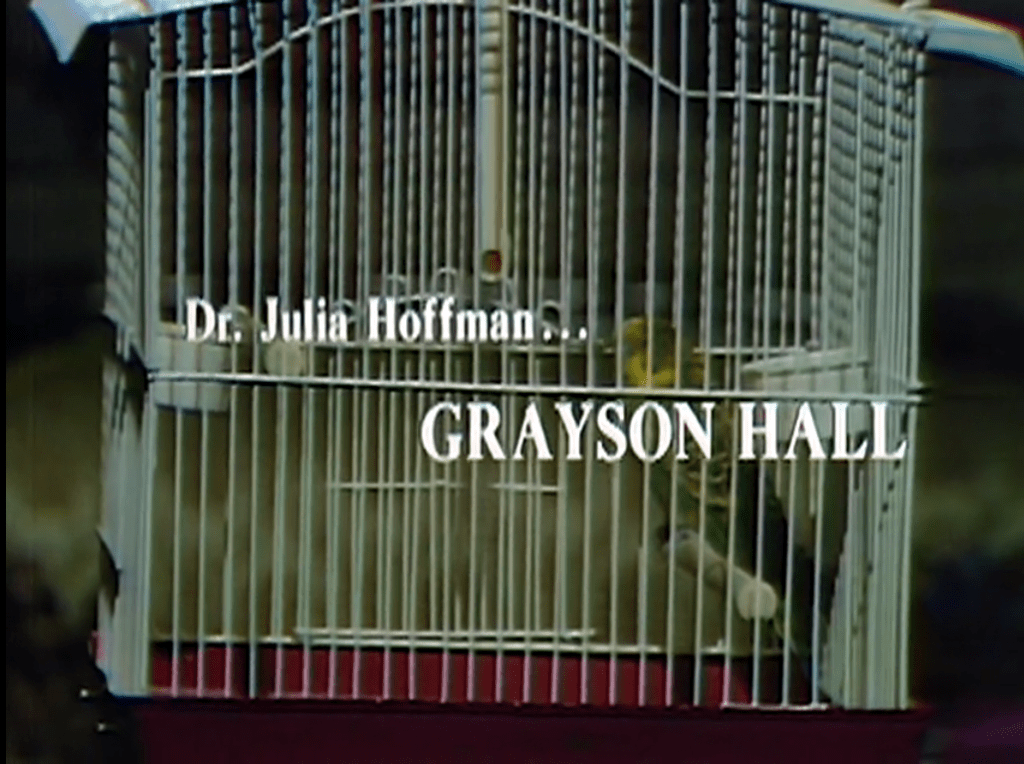
The closing credits run over a shot of Mrs Hutchins’ birdcage. The parakeet moves around as they roll. It is a charming shot, almost as good as the motorized puppets under the credits at the end of #904. That was another Violet Welles script, I suppose she was the one who decided to liven up the credits.
Professor Timothy Eliot Stokes has parked his car and is walking up to the great house of Collinwood, home to matriarch Elizabeth Collins Stoddard and her daughter Carolyn Collins Stoddard, among others. He sees a man lying on the ground and asks him what is wrong. The man pleads with Stokes to help him get away. Stokes asks him what he wants to get away from; the man responds “I can’t tell you.” Stokes asks who he is; he says his name is Stoddard. Stokes replies “You’re Paul Stoddard, Carolyn’s father.” Paul brightens momentarily at Carolyn’s name, but then draws up tight and asks “They sent you after me, didn’t they?” Stokes assures him that no one sent him, and tells him he will catch his death of cold if he continues lying on the ground.
Paul asks Stokes to take him to the police. Stokes nods to the house and says they can call the police from there. Paul cries out, “No! No, not to Collinwood. Please, Professor Stokes, you’ve got to take me to the police, it’s the only thing you can do for me. If you don’t, I’ll be dead. No, no, no, I am not being hysterical or melodramatic…” At this, Stokes turns to face his car. He gives Paul his arm, and says he will drive him to the police station.
The police station was a frequent set for about a year after its first appearance in August 1966. It hasn’t changed a bit when we see it today. The officer on duty is someone we haven’t seen before, but that doesn’t mean he is a new character. Four actors took turns playing Sheriff George Patterson between September 1966 and January 1969; this man is not named in the dialogue and there are no acting credits on screen today, so for all we can tell he might be a fifth. He is younger and slimmer than were any of the other incarnations of Sheriff Patterson, but maybe he’s been working out.
Stokes introduces Paul to the policeman, and explains that Paul will speak only to the authorities. The policeman sits Paul down, gives him some coffee, and assures him that everything will be all right.
Paul tells the policeman that “It will never be alright until they stop chasing me” and “They have been after me ever since I got here.” The policeman asks “What are these people doing to you?” and Paul replies that “At first, there were just little hints, phone calls, things like that- veiled threats. It was their way of making me know that I was under their control. And I was, too, because when I tried to get away they took me back to Collinwood.”
The policeman responds “I see,” and Paul bursts out with “No, you don’t see! You think I’m mad!” The policeman tries to reassure him that he will listen, and asks him if he can name any of his persecutors. “Yes, I’ll name one, all right! My [ex-]wife, Elizabeth Stoddard.” The policeman says “That’s a little hard to believe,” and Paul responds “It’s impossible to believe, and yet! You tell me why she took me back into Collinwood, after years of open hatred, unless they wanted me there! And you know this town, you know how they gossip. And you know my wife. Why, why would she risk all that gossip, unless they wanted her to do so?” He answers that even so, “It’s still a little hard to believe.”
Paul angrily says “Yes, and because it’s Elizabeth Stoddard who’s involved, you will do nothing!” The policeman responds “I didn’t say that. I intend to talk to Mrs Stoddard and the doctor and whoever else is involved. If you still feel you’re being held captive, well, we’ll have to do something about it.” Paul visibly relaxes.
Earlier in the episode, we saw Liz forcing medicine on Paul. Returning viewers know that Liz has been absorbed into an evil cult that is trying to do something terrible to Paul, and indeed to the whole human race. We saw today that Liz has assigned her housekeeper, Mrs Johnson, to trick Paul into taking the medicine. It quickly becomes clear that Mrs Johnson has no idea that Liz is involved in anything sinister- she simply trusts her employer to do the right thing, and she follows her orders. Liz owns most of the village of Collinsport, and most of its people would react as Mrs Johnson does.
When we saw the last Sheriff Patterson for the last time in #675, he told a prisoner that he was releasing him because Liz’ cousin Barnabas said he was with him when the crime was committed, and Barnabas is “just about the best alibi you can have in this town.” He shook hands with the prisoner and sent him on his way. Since we know that Barnabas is, off and on, a vampire, and that even when he is free from the effects of that curse he spends most of his time covering up murders, that left us with an impression of Collinsport law enforcement as hopelessly in the thrall of the Collinses. That reinforces the image left by Sheriff Patterson’s predecessor, Constable/ Sheriff Jonas Carter, who was last seen in #32, toddling off after taking Liz’ orders to accept an obvious lie as a way of closing a case against a family member. Paul has every reason to suppose that this new policeman will be as submissive to Liz and her family as were his predecessors.
Now that Paul can hope that the policeman will be different from the others, he asks him to lock him away, to put him under guard someplace where no one can get to him until his daughter Carolyn Collins Stoddard can come for him. Stokes agrees to telephone Collinwood and talk to Carolyn, and the policeman escorts Paul to a back room. Paul awakes from a nap, and smiles at the policeman. He tells him he can’t tell him how much better he feels. The policeman tells him someone has come to see him. Paul’s delight at the thought that Carolyn has arrived gives way to cries of terror when he sees Liz at Stokes’ side. She comes at him with a spoonful of the hated medicine while Paul tells Stokes and the policeman that they are traitors and killers.
This one is primarily a showcase for Dennis Patrick as Paul, but all of the acting is excellent. My wife, Mrs Acilius, found it very difficult to watch the episode to the end, saying that they did too good a job- she felt as trapped as Paul. It really is one of those episodes you could show to a person who had never before seen Dark Shadows with a reasonable confidence that they would understand why we like the series so much.
At the end of 1968 and beginning of 1969, two supernatural menaces were growing in tandem. The malign ghost of Quentin Collins was becoming steadily more powerful until it made the estate of Collinwood uninhabitable. As Quentin’s power grew, the curse that made Chris Jennings a werewolf also gained force, so that Chris could no longer be sure of keeping his human form even on nights without a full Moon. By the end of February, the Collins family had evacuated the great house on the estate, and Chris was in his lupine form permanently.
Trying to contact Quentin’s ghost, recovering vampire Barnabas Collins meditated on a set of I Ching wands. To his surprise, Barnabas found himself relocated in time to the year 1897, when he was a vampire and Quentin was a living being. Over the next eight months, Dark Shadows was a costume drama set in that year. Barnabas learned that Quentin had been a werewolf, and that he was Chris’ great-grandfather. He also learned that a magical portrait painted by an artist named Charles Delaware Tate had freed Quentin of the effects of the werewolf curse. In #839, we saw that the characters in the 1960s are aware of time passing in Barnabas’ absence; we also saw the haunting of Collinwood break in that episode. The characters remember what happened in the previous episodes, and are relieved that Quentin has found peace and they can now move back into the great house. We did not hear anything about Chris at that time. Last we saw him he was locked up in the hidden chamber inside the old Collins mausoleum in the cemetery north of town. For all we know, he’s still there.
When Barnabas went to the past, his entranced body remained in place sitting before the I Ching wands in the basement of his home, the Old House on the grounds of Collinwood. In September, mad scientist Julia Hoffman and Professor Timothy Eliot Stokes were visiting the basement and saw Barnabas’ body vanish before their eyes. Julia then sat down to meditate on the wands, and found herself transported back to 1897. She was there for a couple of weeks, during which time she initiated a treatment for Barnabas like the one that had freed him of the effects of the vampire curse for a while early in 1968. She snapped back to 1969 before the treatment was completed, but other friends of his were able to pick up where Julia left off and finish it successfully.
The portrait of Quentin would appear to have been destroyed in a fire in #883. Some unspecified supernatural agency whisked Barnabas out of the year 1897 at the end of #884, but it did not send him to 1969. Instead, he found himself in 1796, the year he first became a vampire. Amid some sinister doings, Barnabas found himself in a mysterious clearing in the woods where he saw a massive stone structure. Two hooded figures stood by this cairn. He was unable to resist or escape them. He lost consciousness, and they laid him on the cairn. They used it as an altar, covering him with foliage and consecrating him to whatever unknown beings they served. When he awoke, he knew all about the hooded figures and the cult they represented. They greeted him as their master. He spoke a ritual formula, gave some orders, and prepared to leave the eighteenth century.
The Returns
On Tuesday, we saw that Julia has been hanging around the Old House for the five weeks since she returned to 1969. She explained to heiress Carolyn Collins Stoddard that Barnabas would have to reappear in the place from which he disappeared. So she locked the basement from the outside, evidently expecting to hear Barnabas calling to be let out. There is another way out of the basement, a tunnel from the prison cell there to the beach outside, but Julia must have forgotten about that.
At the opening of today’s episode, we learn that Julia was right about Barnabas reappearing in the place from which he disappeared. But she does not know that the last place the audience saw him was at the cairn. The cairn opens, and Barnabas materializes in front of it. He delivers an incantation, and goes on his way.
We cut to the great house at Collinwood, where Julia is showing Stokes a painting she bought yesterday. It is one of Tate’s works, a landscape painted sometime around 1949. Seeing that Tate was still doing work as good as any he ever did only twenty years ago, Julia wonders if he might still be alive in 1969. Stokes scoffs at this possibility, since Tate would be a hundred years old or more, but Julia is determined to search for him. When Stokes asks why she is so interested, she says that she cannot tell him, because it is a confidential favor she is doing for a friend.
While Stokes knows about the haunting of Collinwood and about Barnabas’ trip back in time, he does not know that Chris is the werewolf. If he did, he would probably turn him in to the police. So Julia can’t very well tell him that she is hoping Tate will be able to paint a portrait that will do for him what Quentin’s portrait did 72 years earlier. Fortunately for her, Stokes readily accepts her refusal to explain herself.
Stokes tells Julia about a project of his own. He says that local physician Dr Reeves has enlisted him to help with a patient. Stokes is a scholar of occult lore, not a clinician or therapist of any kind. Reeves’ decision to enlist Stokes’ aid would admit of either of two possible explanations. It could be something that often happens on soap operas, a genre in which all forms of authority tend to become interchangeable with each other, so that scholars can function as doctors, doctors can function as lawyers, and anyone who dresses up for work can function as a cop. The other possibility is that Reeves has caught on that the village of Collinsport is rife with supernatural phenomena and has decided that Stokes’ expertise might enable him to diagnose his patient. Julia’s amused disbelief when Stokes announces that he is going to see “a patient” counts against the first possibility. She is closer than any other character in the parts of Dark Shadows to a representative of the audience’s point of view, so if she is still aware of Stokes as someone whose competence is limited to a specific field we are as well. So we can assume that Dr Reeves has concluded that there is something uncanny about what ails his patient.
Stokes identifies the patient to Julia as Sabrina Stuart, a young woman who, a few years previously, was discovered with a head of white hair and without the ability to speak. He says that he and Reeves have managed to get her to start saying words but that she cannot describe the origin of her trauma. Julia knows that Sabrina’s trouble began when she saw Chris transform into the wolf, and so she is alarmed at the prospect that she will begin talking. She tries to persuade Stokes to give up, but he is nothing daunted.
Stokes exits, and Chris enters. Julia scolds him for having checked himself out of Windcliff, the mental hospital she controls. This is the first we learn that he left the hidden chamber in the mausoleum; it is also the first we learn that he has reverted to human form. He acknowledged that he can change back to the wolf at any time, and that something has to be done, but he can’t take solitary confinement any longer. Longtime viewers, remembering that every time he changes he kills people, will find this to be a stupefyingly selfish decision. It alienates whatever sympathy we may have for Chris.
Chris tells Julia that even if he is cured, he will not be truly free so long as Sabrina is around. He does not say what he plans to do about Sabrina, but if he is willing to commit all the murders that will surely follow from his decision to leave the hospital we can’t help but suspect it won’t be good for her.
We cut to Sabrina’s room in the facility where she is staying. Stokes is providing her with a sort of therapy. The audience will be surprised to see Sabrina again. Sabrina, played by Lisa Blake Richards, appeared in episodes #692, #697, and #698. The show went to 1897 in #701; Miss Richards could easily have been cast in a part in the costume drama segment, but was not. Surely no one could have expected that she would be waiting for us when we returned to contemporary dress, but here she is.
Miss Richards is pleasant enough, but she bears an ill omen. Julia and Stokes talk about Sabrina’s brother Ned, to whom Stokes refers as “a rather surly fellow.” That’s putting it mildly. Not only does he shout at his scene partners and violate their physical space, traits common to all characters played by Roger Davis, but he had a habit of groping his sister’s breasts and rubbing his cheeks on her face. These habits led us to wonder how much of Sabrina’s catatonia was a symptom of the shock of seeing Chris’ transformation and how much was the result of her brother’s constant abuse. Julia is already threatening to bring back Tate, another of Mr Davis’ characters. If Roger Davis winds up playing two parts concurrently, the show might become entirely unwatchable.
Dr Reeves is another character we haven’t seen for a long time. Fred Stewart appeared as Dr Reeves in #17, where he treats Roger Collins after an auto wreck, and in #158, where he examines Elizabeth Collins Stoddard after she has fallen down the stairs. Actors have been returning from long absences lately; Miss Richards’ surprising reappearance today reminds us of all-time champ Alfred Hinckley, unseen since his turn as a train conductor in episode #1, who came back as a doctor in #868, and of John Harkins, who played a policeman in a scene set in Phoenix, Arizona in #174 and returned as a very different law enforcement officer from another faraway place in #878. Perhaps the reference to Dr Reeves means that Stewart will rejoin the cast. Stewart didn’t have much to offer, but I’ll take a thousand of him over one Roger Davis any day.
Be that as it may, what I really wonder about is where writer Gordon Russell found Dr Reeves’ name. Neither he nor any other member of the writing staff was connected with the show when Dr Reeves appeared, and line producer Peter Miner just started three weeks ago. Executive producer Dan Curtis and director Lela Swift were with the show from the beginning, but Curtis was busy getting ready to make the feature film that became House of Dark Shadows at this time, and Swift doesn’t seem to have interacted much with the writers. Even Harriet Rohr, Costello’s assistant who often attended table reads and seems to have helped with continuity, wasn’t around much at this period. So there must have been pieces of paper floating around listing seldom-seen characters and other points of trivia for the writers’ reference. I’m sure fandom would go nuts if those papers ever turned up!
During their therapy session, Sabrina suddenly looks at Stokes and asks him who Carolyn Stoddard is. She then declares that Carolyn is in danger, and demands to meet with her at once.
As it happens, Carolyn dated Chris for a while around New Year’s 1969. Stokes knows Carolyn well enough that he must have been at least dimly aware of this. Ned is obsessed with his hostility to Chris and is rarely far from Sabrina, so Stokes must have heard about Chris and Sabrina’s relationship. But Stokes does not make the connection. He can’t imagine why Sabrina is suddenly talking about Carolyn.
Back at the great house, Chris and Carolyn have a conversation. She is irked that he went away for so long without a word to her. It’s understandable he does not want her to know that he is the werewolf, but why can’t he tell her he was confined to a mental institution? It isn’t as if he is worried about making a good impression on her. On the contrary, everything he says to her is part of his effort to convince her he does not want to renew their relationship.
That terrible beating
By this time, Julia has moved on to her chief concern. She has heard a heartbeat pounding from the portrait of Barnabas that hangs in the foyer of the great house, a sign that he is near. Julia goes to the Old House and finds Barnabas coming down the stairs. She is delighted to see him, but puzzled he is not locked in the basement. He tells her he returned by means of the I Ching. She is sure this cannot be true.
Julia had already returned to 1969 when sorcerer Count Petofi used the I Ching to project himself into that year for a few minutes in #872 and #873 in a way altogether unlike the one Barnabas had used. No one in 1969 saw Petofi while he was then, nor did Barnabas or any of his allies know about the trip. But Julia herself went back to 1897 by yet another radically different I Ching-mediated path, and both of them really ought to be aware that they are dealing with forces that work unpredictably. So it does not make much sense that Julia is so certain whatever it is that is released when one contemplates the I Ching could send Barnabas only to the basement.
Barnabas does not return any of Julia’s warm emotional displays. When she bursts into a smile and hugs him, he stands still and stares icily ahead. This is quite startling to regular viewers, who have seen the two of them grow quite cozy over the last year and a half.
Barnabas also refuses to answer any of Julia’s questions about what happened in the last weeks of the 1897 story. This will be even more startling. Barnabas and Julia gave each other huge amounts of information even when they first met and he saw her as an enemy. Since they became fast friends in the summer of 1968, their conversations have been the heart of the show. The show burned through so much story in the final weeks of the 1897 segment that it brings us up very short when Barnabas declares that he is too tired to talk about any of it. He won’t even say that everything was settled- his only explanation of anything is that he returned because he wanted to. For all he tells Julia today, their enemies might have triumphed completely in 1897.
While Julia is looking at him, Barnabas picks up a box that he has placed on the mantel. This seems to be a way of calling her attention to it, so she politely asks what it is. He becomes flustered and demands she disregard it. Returning viewers know that it is the one thing he brought with him from his encounter with the hooded figures in 1796. In his conversation with them, he said that it must not be opened until the proper time, lest their whole vast eternal plan come to ruin. Barnabas’ function in the story is to make a mess of everything, so of course he leaves the box out in the open and waves it in front of the face of the world’s most inquisitive person.
Meanwhile, Carolyn visits Sabrina. Sabrina insists Stokes leave them alone; when he does, she insists Carolyn not repeat their conversation to Stokes. She tells Carolyn that Chris, even though he is good, will kill her if they stay together.
We would be hard put to defend the idea that Chris is good, or to regret it if Stokes or any other law-abiding person were in a position to end his reign of terror. It is also surprising that Sabrina, who can barely say her own name when Stokes is working with her, talks quite fluently once he is out of the room. Maybe Dr Reeves was not so wise to choose him as Sabrina’s therapist.
Back in the Old House, Julia tells Barnabas that “Today, I was given reason to believe that Charles Delaware Tate may still be alive.” Barnabas replies “There’s no reason to believe that’s true.” That flat contradiction, with the jarring repetition of the word “reason,” shows that Barnabas is not only evading Julia’s questions, he is rejecting her personally in a way that he did not do even before they became friends, when he kept plotting to kill her. At least in those days he always listened closely to what she said, knowing that her great intelligence made her a danger to him. In this exchange he is treating her as if her words were beneath notice.
Julia sticks with the topic, and Barnabas says that even if Tate were still alive he would be “a hundred and totally useless!” That’s pretty rich coming from Barnabas, who himself is at least twice that age and would be in an awkward spot if he had to explain what use he is to anyone. But Julia only says that they must look into the matter.
A careless lie
Chris enters. He is delighted to see Barnabas, on whom he has pinned all his hopes. Barnabas tells him that “In all the time I was in the past, I found no solution for you. I am afraid there’s nothing that I can possibly do.” He follows that with “I must ask you to excuse me, I’m very tired,” and toddles off to bed.
Julia and Chris leave the house together. She tells him why she thinks Barnabas was lying. Chris goes home, and Julia goes back into the house, through the unlocked front door. She picks up the box, which is still on the table in the middle of the living room. As she heard Barnabas’ heartbeat coming from his portrait in the great house, so she hears breathing coming from inside the box. One wonders what other bodily functions will audibly manifest in objets d’art around Collinwood.
From April to July 1968, Dark Shadows was bogged down in a repetitious story called “The Dream Curse.” Each of a dozen characters had the same nightmare, in which they were in a small room with several doors. Behind each door they saw something that was supposed to be frightening.
When occult expert Timothy Eliot Stokes (Thayer David) had the dream in #508, he defied its rules, caused wicked witch Angelique to appear in it, and brought the curse to a halt. Angelique had to cast another spell later to restart it.
Now the show has gone back in time and is a costume drama set in 1897. Thayer David plays sorcerer Count Petofi, who is among other things a vision of what Stokes might have been as a supervillain. Petofi has learned that both vampire Barnabas Collins and mad scientist Julia Hoffman have traveled to 1897 from 1969. Petofi is convinced that they would not have made this journey unless they knew exactly what they were doing and had a foolproof plan for getting home. Petofi does not know Barnabas and Julia very well.
Petofi and his servant Aristide are holding Julia prisoner in their home, an old mill. This might be called a hiding place, except that virtually everyone in the village of Collinsport and its environs has visited Petofi and Aristide there at least once. There’s so much foot traffic in and out of it someone could make a fortune if they set up a food cart outside the door.
Yesterday, Petofi forced Julia to tell him that she and Barnabas each came back in time by meditating on a set of I Ching wands. Petofi then cast the wands, and his “astral body” was transported to a room very much like that in which the nightmares of the Dream Curse took place. At first it seems that he will match Stokes’ performance when he had The Dream. There is in the world one person over whom Petofi has no power and who is sworn to kill him. All Petofi knows is that this person is Rroma by ethnicity, and is going to try to use a particular scimitar to cut off his right hand, where his magical powers are concentrated. As Petofi is entering the room, he sees the scimitar. When the unseen person holding the scimitar points it at Petofi’s throat rather than his wrist, he realizes that he is not in jeopardy, and he orders the wielder of the scimitar to be gone.
In the room, Petofi opens a couple of doors. Behind one is Barnabas baring his fangs; behind the other, a wall of fire. One of the notable features of the room are red velvet curtains hanging from the ceiling to the floor. Fans of Twin Peaks sometimes say that “Once you learn to see it, the Red Room is everywhere”; I guess they’re right.
Petofi keeps his cool when he sees the gimmicks behind Door #1 and Door #2, but he does seem uncomfortable when he hears the voices of a male chorus singing a Romani song. After a moment, he finds his magical right hand squeezing his throat. All of a sudden he is back in his physical body, with Julia and Aristide by him, strangling himself. Petofi’s powers are so great that there are times when it seems that he will overwhelm all opposition and leave the show without a story to tell; the image of him crushing his own windpipe with his right hand suggests that he will ultimately be a victim of his own power.
Petofi recovers. He is sure Julia created his experience; he cannot conceive of events taking place outside anyone’s control. This marks a contrast with Stokes. Stokes, an upright and decent man, knows that Barnabas and Julia are keeping many secrets from him. When he has to work with them, he grumbles about this and makes it clear that he has dark suspicions. But though Stokes wishes he knew more about them, he does not press them very hard to reveal what they are hiding. Further, he was the one who explained the I Ching to them, including that meditation is a process of giving up control. Unlike Petofi, Stokes can easily accept that there are things that happen whether or not anyone wants them to.
When Julia cannot answer any of his questions, Petofi tells her why he keeps Aristide around:
Look at Aristide here. In point of fact, I don’t need a servant. The boy himself is no intellectual giant. He detests all forms of culture. Why then do I keep him on? Because I am a man who by nature shuns all forms of violence. I loathe the sight of blood. Aristide, on the other hand, has no such scruples. He revels in every form of torture and bloodshed known to the mind of man. I believe he even invented a few himself. He kills without the slightest feeling for his victims. He will kill you, Dr. Hoffman, if you do not tell me what I want to know.
As Aristide, Michael Stroka’s reactions when Petofi delivers this speech are quite funny. He looks really wounded when Petofi says that he is “no intellectual giant” and that he “detests all forms of culture,” but when he starts talking about how sadistic he is, he brightens up. When Petofi tells Julia that Aristide will kill her unless she tells him what he wants to know, he looks positively blissful.
Since Julia has nothing to tell, Petofi leaves Aristide to do his worst. He ties her to a chair in the back room. He rigs a string to the trigger of a revolver so that turning the doorknob will fire a round into Julia. He tells Julia that he hopes Barnabas will come to her rescue and therefore be her executioner.
Barnabas does shows up and confront Aristide. He turns the knob. We hear a shot, and see Julia slumped over in the chair.
One of the recurring faults on Dark Shadows is that when people are bound and gagged, they often have to use their teeth to hold the gags in place. Today they don’t even bother wrapping the cloth around Grayson Hall’s head- Michael Stroka just tucks it into her mouth. The suspense as Barnabas approaches the door depends on Julia’s inability to warn him not to turn the knob, and the closing shot loses its shock value when we can see Julia still biting down on the cloth. So this time it really is a problem.
Stuffy Edward Collins was under a spell for several weeks that prevented him from keeping up with what has been happening on the estate of Collinwood in 1897. He knows that his distant cousin Barnabas is a vampire who originally died in the 1790s and has come back to prey on the living. From this, he has drawn the eminently logical conclusion that he is a character in a horror story, and that it is his responsibility to be the hero who destroys the undead ghoul.
In fact, Dark Shadows stopped being that kind of show long ago. Others know that it is chiefly about time travel now. That point is made when we flash forward to the year 1969, from which Barnabas has traveled to prevent a disaster that had its roots in 1897. Barnabas’ friends Julia Hoffman and Timothy Eliot Stokes talk about the intersection of past and present, so that the events of 5 September 1897 are somehow also taking place on 5 September 1969. The show has been using anniversaries as substitutes for natural laws in this way since #157, broadcast and set in January 1967, and they spin this out much further today. In his post about the episode at his great Dark Shadows Every Day, Danny Horn writes a big prose poem about the weirdness of the show’s conception of time at this point, it’s well worth reading.
When Barnabas first came on in the spring of 1967, it was set in contemporary times and the writers had a lot of fun with characters who mistook the genre of show they were on. Dangerously unstable ruffian Willie Loomis heard the plot of Daphne du Maurier’s Frenchman’s Creek, concluded he was part of a Gothic romance, and wound up freeing Barnabas and becoming his blood thrall. That mistake continued to shape Willie’s character. Willie was forced to be Barnabas’ accomplice in the abduction and attempted brainwashing of Maggie Evans, The Nicest Girl in Town. Willie listened to Barnabas’ own rantings about his motive being an attempt to recreate his lost love Josette, and kept imagining that he would somehow overcome Barnabas to rescue Maggie and become her lover. Willie also harbored a deep hostility towards Burke Devlin, who was left over from a period when the show really was inspired by Gothic romance.
Willie’s sometime friend Jason McGuire made a similar mistake, believing that the show was still the noir crime drama it was when it spent weeks on the question of where Burke’s fountain pen had got to. So he sleuthed out signs of where Willie went when no one was looking and where Barnabas got his money. All that Barnabas could contribute to that kind of story was murder, and so he unceremoniously strangled Jason in #275.
Local physician Dr Dave Woodard thought he was on the usual daytime dramas of the period. Actor Robert Gerringer had a lot of fun playing Woodard as if he were on The Guiding Light. There were whole episodes built around that conceit- for example, we spend #235 in the Collinsport Hospital, where everyone acts just as you would expect them to on any other soap, except for Maggie, who is there being treated for vampire bites. Woodard notices that his friend Julia is growing close to Barnabas, and in #324 comes to the logical daytime conclusion- they are having an affair. Eventually Woodard finds out that he has misidentified the genre of the show, but it is too late- Barnabas and Julia murder him in #341.
Today, that is to say 5 September 1897, Edward catches Barnabas and locks him in the prison cell in the basement of the Old House at Collinwood. Barnabas kept Maggie in that cell when she was his prisoner, and the ghost of his little sister Sarah helped Maggie find a secret panel that led to a tunnel to the beach. In #260, Maggie escaped through that tunnel at the last minute before Barnabas could kill her, and Barnabas himself later used the same tunnel to escape from the cell in #616. In #781, Edward made it clear that he knew all about the tunnel and expected everyone else at Collinwood to know about it as well. So it is no surprise when he tells Barnabas that he has blocked it off. In fact, he says that he has blocked “all” of the secret passages- we may wonder just how many escape routes there are.
Edward leaves Barnabas alone in the cell, saying he will be back before dawn. There is a writing desk in the cell; Barnabas remembers that Willie moved that desk to the front parlor for him in 1967, and so he describes his predicament in a letter to Julia and closes it in a secret compartment of the desk.
In 1969, nine year old Amy Jennings is in the parlor, playing with her dolls. One of the dolls is named “Amanda”; this will catch the attention of returning viewers. The 1897 story features a character named Amanda, who is an oil painting come to life. If artist Charles Delaware Tate could make his paintings come to life, as in Greek myth the sculptor Pygmalion made a statue come to life as a woman named Galatea, then perhaps we should find out who made Amy’s doll before we let it out of our sight.
Amy first came on the show in November 1968, at the beginning of the story that led from contemporary dress to the 1897 segment. Her very first night at Collinwood, Amy went straight to the room where the magic objects were hidden that would trigger that story. She often delivers her lines directly into the camera, as if she knows perfectly well where the audience is. Amy is at the opposite pole from Edward and such earlier characters as Willie, Jason, and Woodard- she not only knows what genre the show is, she’s read the flimsies for next month’s episodes and is getting a head start on them.
Amy looks in the desk for a book to read to her dolls, and inadvertently opens the secret compartment. She eventually gives the letter to Julia; this is what prompts Julia and Stokes to have their talk about the ontological status of past events and what philosophers call “the reality of tense.” They know all about the time travel aspect of the show; Julia, in fact, has for some time been the closest thing the audience has in the parts of Dark Shadows set in the 1960s to a point of view character, one who knows everything we do. She was certainly the first one to know that the show was transitioning from vampire horror to quasi-science fiction. She surprised Barnabas in #291 with a proposal to develop a medical treatment that might put his vampirism into abeyance.
In the letter, Barnabas refers to his “secret.” Stokes does not know what this is, and is not satisfied with Julia’s lame attempts to answer his questions about it. This makes sense to regular viewers; shortly after Stokes arrived in Collinsport, another mad scientist got hold of Barnabas and succeeded where Julia had failed in putting the symptoms of the vampire curse into remission. For all the time he has known Barnabas, Stokes has seen him moving about in the day, casting reflections in mirrors, eating food not derived from human blood, etc. In 1968 and 1969, his ignorance of his Barnabas’ past vampirism is not much more serious than his ignorance of the details of the automobile accident that killed Mr Hanson in 1956. But the vampirism came back in full force when Barnabas went to the past, so Stokes is at a loss as to what the letter means.
Julia decides that she will try to travel into the past using the same mumbo-jumbo that transported Barnabas there. While Stokes reads up on that, Julia and Amy make a stop at the great house on the estate, which is impenetrably haunted by the ghost of Quentin Collins. That errand seems to be going sideways when the episode ends.



 Dark Shadows Commentary