Rroma chieftain/ New England crime boss King Johnny Romana puts broad ethnic stereotype Magda Rákóczi on trial in the secret room of the old Collins family mausoleum. Evidently King Johnny has considerable magic powers; he conjures up the ghosts of several notorious murderers to serve as the jury. He also brings in the ghost of Magda’s husband to serve as the one witness for the defense.
The scenario is a remake of The Devil and Daniel Webster, a play that debuted at the Martin Beck Theatre in 1939. But the makers of Dark Shadows were likely thinking of a more recent Broadway production as well. From November 1964 to June 1965, a musical with a book by Ernest Kinoy and music by Walter Marks ran first at the Shubert Theatre, then at the Lunt-Fontanne, for a total of 232 Broadway performances. Its title is one of King Johnny’s favorite words- Bajour.
King Johnny keeps complaining that Magda tried to “pull the bajour on me!,” by which he means that she gave him one thing disguised as another. In the show, based on Joseph Mitchell’s stories of life among Rroma in the New York metropolitan area, bajour refers simply to a confidence trick with a big payoff for its perpetrators. The cast, saddled with a bunch of instantly forgettable songs, sings as joyously as it can about how the Rroma, to whom they of course refer as “gypsies,”* love nothing more than cheating lonely old women out of their life savings. This uninhibited celebration of racism reported losses of nearly a million dollars, more than twice the total amount of money invested in it. Perhaps the fictional Rroma weren’t the only ones who enjoyed running a good scam. Perhaps, too, Mel Brooks’ 1967 film The Producers wasn’t entirely a work of fiction.
The cast of Bajour does not appear to have overlapped with that of any episode of Dark Shadows. The closest link I can find to the cast at this period of the show is Michael Bennett, who danced in Bajour and later married Donna McKechnie. Many very distinguished performers appeared in Bajour, but I’m not tempted to do any imaginary recasting. I’m sure Chita Rivera and Herschel Bernardi were wonderful as leads Anyanka and Cockeye Johnny Dembo, but they couldn’t have outdone Grayson Hall and Thayer David as Magda and Sandor. Herbert Edelman was good in everything, and I’m sure his turn as “The King of Newark” was no exception, but no one could have done more than Paul Michael does to make the cartoonish role of King Johnny watchable. Paul Sorvino had a great career, and even has a screen credit in common with Henry Judd Baker- they both appeared in the disastrous 1980 film Cruising. I’m sure Sorvino would have been interesting as a replacement for Baker as Istvan, the mute Black Rroma, but that part is all about physical presence, and as was the case with Baker’s part in Cruising he is effective in a way that Sorvino could not have matched. Nancy Dussault is another performer who never lets an audience down, but Diana Davila’s approach to the character of Rroma maiden Julianka was so cleverly conceived that I couldn’t bear to think of anyone else taking the part.
While I’m on the topic of the Rroma, I want to bring up an oddity about my favorite Dark Shadows blog, Danny Horn’s great Dark Shadows Every Day. When he was writing about these episodes, Danny often stopped to ridicule the idea of a Rroma tribe living in New England in 1897. Danny works for the Wikimedia Foundation; you’d think he’d be in the habit of checking Wikipedia, where the article “Romani People in the United States” would tell him that, while Rroma have been migrating to North America continually since 1498, the majority of the ancestors of the million or so Americans who now identify as Rroma came in the late nineteenth century. The new arrivals tended to take some time to assimilate to the ways of the USA; the article is, as of this writing, illustrated with a photo of a Rroma caravan near Portland, Oregon, in 1905:
Rroma caravan near Portland, Oregon, in 1905. Photograph by the Portland Oregonian, found on Wikipedia.
Most Romani-Americans are totally assimilated nowadays, so much so that many people in the USA don’t realize that there actually is such an ethnic group. But there are still Romani heritage festivals in many cities, and the last traditional caravans were still traveling the Great Plains as late as the 1940s. And in Maine in 1897, Romani caravans were a frequent sight, one that indeed aroused exactly the sort of zyganophobic** reactions Magda and Sandor encountered from virtually everyone in their first days on the show.
Even Istvan isn’t as hard to explain as Danny seems to think. In the early days of European settlement, Rroma were often brought across the Atlantic as slaves; that was the case for the people on Christopher Columbus’ third voyage in 1498. Some intermarried with enslaved people of African extraction. There are still Afro-Romani communities in Louisiana and Cuba.
I started writing about Dark Shadows in the comment sections on Danny’s blog. He made a great display of ignoring the first 42 weeks of the show, and consistently made the harshest possible judgments of the acting of Alexandra Moltke Isles, who played well-meaning governess Vicki. That created a space for me to point out when the show was harking back to its early days, and to defend Mrs Isles. I would be remiss in a post like this if I did not mention that Mrs Isles made a documentary feature in 2003 called Porraimos: Europe’s Gypsies in the Holocaust. I’ve never been able to get hold of a copy of the film, but the New York Times liked it when it was shown on PBS.
*Rroma sometimes call themselves Gypsies, but you can’t assume they’ll like it if an outsider uses that word.
Vampire Barnabas Collins has stashed his coffin in its old hiding place, the hidden chamber inside the mausoleum where his parents and sister are buried. As dawn approaches, he tells his reluctant sidekick, broad ethnic stereotype Magda Rákóczi, that this is the last day he will have to leave the coffin there. The suspicions that had recently surrounded him have cleared, and he will move the coffin back to the basement of Magda’s home, the Old House on the estate of Collinwood, when he next arises.
The graveyard is immersed in a heavy fog. As Barnabas approaches the mausoleum, a familiar voice calls to him. His old nemesis and ex-wife, wicked witch Angelique, implores him to come with her and leave the year 1897. She warns him that he must return to 1969 now, or it will be too late. Barnabas tells Angelique that he has not accomplished the goals for which he came to the past, and that he will not leave until he has done so.
Longtime viewers may be puzzled when Angelique tells Barnabas that she has helped him before. In #757, Angelique did prevent her fellow undead blonde fire witch, Laura Murdoch Collins, from staking Barnabas, but that did not seem to be intended as a service to Barnabas. Rather, it recalled #417, in which Angelique prevented Barnabas’ friend Ben Stokes from staking him and freeing him of the effects of the vampire curse she had placed upon him. She told Ben that she wanted Barnabas to suffer forever, and nothing she says to Laura indicates that she has changed. Indeed, the only time she ever seemed to act out of goodwill towards Barnabas was in #410, when Barnabas was about to rise as a vampire for the first time and she, regretting the curse, tried to stake him herself. Perhaps there is a retcon coming up, in which it will be made possible for Barnabas and Angelique to join forces against some new enemy.
It certainly seems that the show is about to take a new turn of some kind. The major storylines with which the 1897 segment began are all approaching their natural conclusions, and a number of major characters have already been killed off. Longtime viewers will recognize an acknowledgement of these facts, not only in Angelique’s explicit statement that the proper time for Barnabas’ stay in the late nineteenth century is almost up, but also in the doings of another character in the graveyard.
Inveterate prankster Carl Collins suspects Barnabas of being a vampire, and in a dream visitation his late fiancée Pansy directed his attention to the mausoleum. Lurking outside it, he sees Barnabas open the secret panel and go into the chamber where the coffin is kept. Carl declares that “We’ll get him tonight! We’ll get cousin Barnabas… TONIGHT!”
Carl is played by John Karlen, who first appeared on Dark Shadows as the luckless Willie Loomis. It was Willie who, in a misbegotten attempt at jewel theft, inadvertently freed Barnabas to prey upon the living in #210. In consequence, Barnabas bit Willie and enslaved him. When Willie first served him, Barnabas would control him not only by the usual vampiric practices of blood-drinking and telepathic summoning, but also by frequent heavy beatings with his cane. Later, Willie would come to feel that Barnabas was his friend; it was never clear that Barnabas reciprocated this feeling.
Carl first met Barnabas in #706. He introduced himself by holding a gun to Barnabas’ head and threatening to shoot him if he did not admit that his story of being a long-lost cousin from England was a lie. The gun turned out to be loaded with a flag labeled “FIB,” and the whole thing was Carl’s idea of a joke. Barnabas’ icy response, starting with his incredulous tone while asking if “YOU are a COLLINS?,” set the tone for all of his subsequent dealings with Carl, in which his attitude ranged from undisguised contempt to barely disguised contempt. Yet Carl remained convinced that he and Barnabas were going to be great friends, and he even asked Barnabas to be the best man at his wedding to Pansy. Carl is much more enthusiastic about his supposed friendship with Barnabas than Willie is about his, and Barnabas is far more open about his hostility towards him, making the Carl/ Barnabas relationship a spoof of the Willie/ Barnabas one.
Ever since Pansy’s death, Carl’s thoughts about Barnabas have taken a darker cast. When we see him in the mausoleum, watching the panel open, we know that his plan to “get cousin Barnabas” will take him into the chamber where Willie forever lost his freedom. We know, too, that Willie’s misfortune revolutionized the show; when it puts this actor on this set, Dark Shadows is promising to make major changes.
We cut to the drawing room of the great house on the estate. Rakishly handsome Quentin Collins is talking with Magda. As Angelique cursed Barnabas to be a vampire, so Magda cursed Quentin to be a werewolf. Angelique placed her curse because she was upset that Barnabas did not love her and was under the impression she was about to die. Magda placed hers because Quentin had married and then murdered her sister Jenny. Magda did not know then that Jenny had borne twins to Quentin, a son and a daughter. Since the curse is hereditary, Magda has been trying desperately to reverse it ever since she learned of the children’s existence.
The children are still secret from Quentin, and so he does not understand why Magda is trying to help him. When he demands she tell him, she says “I. Did. Not. KNOWWW!” in exactly the same intonation she had used when she first heard about the children in #763. First time viewers don’t know any more than Quentin does what she is talking about- the children are not mentioned today. Magda makes up an obvious lie, saying that she hadn’t known how much Jenny loved him. That isn’t meant to fool the audience, and doesn’t fool Quentin. But when Carl enters, Quentin drops the subject and leaves new viewers in suspense about what Magda now knows that they do not.
Carl knows that Magda lives with Barnabas, and refuses to talk in front of her. She teasingly asks “Mr Carl” if he “don’t like me any more,” and walks out with a bold stride, suggesting that Carl may at some point have shown signs of liking her rather too avidly for her husband’s comfort. Once she is gone, Carl tells Quentin that there is a vampire in their midst. Quentin dismisses this out of hand, telling him that their brother Edward staked a vampire named Dirk and told him about it in vast and gory detail. Carl asks who made Dirk a vampire; Quentin says that it was Laura. No, says Carl, Barnabas made Dirk a vampire, and Barnabas is a vampire himself.
Quentin begins to laugh, but within seconds realizes that there is a great deal of evidence in plain sight to support Carl’s assertion. He agrees to go with Carl to the mausoleum, but we hear his thoughts as he reflects that Barnabas’ efforts to help him are the only hope he has of release from the werewolf curse.
In the mausoleum, Carl wonders aloud where Barnabas came from. Quentin supposes that he was there all along. Carl is horrified at the thought that he is “the real Barnabas- our ancestor! Oh God, that makes it worse!” Quentin orders Carl to open the panel, and Carl obeys. As my wife, Mrs Acilius, points out, John Karlen once again plays the servant’s role.
In the hidden chamber, the brothers open the coffin, finding the diurnally deceased Barnabas. Quentin tells Carl to hand over the gun he has brought; Carl obeys. Quentin asks Carl if he knows how to get out of the chamber. When Carl says that he does not, Quentin turns the gun on him and forces him to stay. Quentin shuts his brother up in the chamber with the vampire.
In #384, set in the 1790s, Barnabas shot and killed his uncle Jeremiah. Barnabas and Jeremiah were about the same age, and had been very close; they were often compared to brothers. Barnabas was not yet under a curse when he committed that fratricide; it was an act entirely of his own will. Angelique was also partly responsible; she had cast spells on Jeremiah and on Barnabas’ fiancée Josette, causing them to conceive a mad passion for each other and to run off and get married. Enraged, Barnabas broke from the customs of New England and challenged Jeremiah to a duel. Consumed with guilt, Jeremiah deloped and let Barnabas kill him.
Barnabas’ killing of Jeremiah was murder under the laws which prevailed at the time in Maine, which was until 1821 part of Massachusetts. Indeed, Massachusetts’ anti-dueling act of 1730 provided that anyone who had either been killed in a duel or been put to death for winning a duel would “be given an unchristian burial at a gallows or crossroads, with a stake driven through their body.” Since the audience knows that Barnabas is fated to become a vampire, there is a chilling irony in seeing him volunteer for a staked burial.
Dark as was the shadow the duel cast over the subsequent history of the Collinses, at least Barnabas’ act showed a kind of twisted courage. But when Quentin uses Barnabas as a weapon to kill his brother, he is acting from the most abject cowardice. In the century that they have been subject to black magic, the Collinses have sunk from tragic grandeur to infantile squalor.
Quentin goes to the Old House and tells Magda what he has done. Magda is horrified at another murder. “No! Too many people are suspicious now. We’ve got to stop it or we’ll all be found out!” Since Magda is not a member of the Collins family, she is often the straight man reacting to revelations of their misdeeds and monstrosities. And since she is played by the charismatic Grayson Hall, the audience tends to adopt her point of view. So it is easy for us to forget that she is a functional sociopath. Despite all the killings we know to have resulted from her actions, it is still startling that Magda’s only objection to Quentin’s attempt to murder his brother is that she is afraid of getting caught.
We cut to another scene on the same set. Magda has summoned Angelique to the front parlor of the Old House. She asks Angelique to erase Carl’s memory so that Barnabas will not choose to kill him. Angelique taunts Magda as an “amateur” in the occult arts, and declares that she is done helping Barnabas. Magda says that she has read the Tarot, and that the cards tell her that Angelique loves Barnabas. She renews her plea to prevent the killing of Carl, but Angelique will not yield.
The reference to the Tarot rings a bell for longtime viewers. In the 1790s segment, Hall played the Countess DuPrés, Josette’s aunt. Angelique was introduced in that segment; she was the countess’ maidservant, and appeared to be a beginner in witchcraft. The countess was oblivious to Angelique’s sideline, and in #393 declared her to be an uninteresting woman whom she had known ever since she was an uninteresting child. The countess spent most of her time in the front parlor of the Old House reading the Tarot. That Angelique speaks so haughtily to the Tarot reader and “amateur” witch Magda on the same set highlights the reversal of roles in this segment.
Meanwhile, Carl searches the hidden chamber for a way to escape. He finds that one of the stones in the steps slides and reveals a lever. He turns the lever, opening the panel. He runs out and vows to destroy Barnabas, in the process almost knocking over a large tombstone that wobbles as if it were made of Styrofoam.
In episodes #310-315, made and set in 1967, strange and troubled boy David Collins was trapped in the hidden chamber for a whole week. He never did find the release lever- the ghost of Barnabas’ little sister Sarah finally took pity on him, materializing and showing it to him. The show avoids the implication that David is drastically dumber than his great-great uncle Carl by showing that the stone concealing the lever is already slightly ajar.
We begin the part of Dark Shadows set in the year 1897 with an episode featuring a glittering script, a strong cast, and a hopeless director. Henry Kaplan’s visual style consisted of little more than one closeup after another. The first real scene in the episode introduces us to Sandor and Magda Rákóczi, a Romani couple who live in the Old House on the estate of Collinwood. They bicker while Sandor throws knives at the wall. Thayer David really is throwing knives, but since we cut between closeups of the targets and of the actors we cannot see anything dynamic in that action. He may as well be whittling.
Magda ridicules Sandor’s pretensions as a knife-thrower and as a patent medicine salesman, and busies herself with a crystal ball. She tells him that when “the old lady” dies, they will have to leave Collinwood. He says he knows all about that. She wants him to steal the Collins family jewels so that they can leave with great riches. He eventually caves in and sets out for the great house on the estate, more to escape her nagging than out of greed.
Regular viewers will remember that we heard Magda’s name in December 1968. The show had introduced two storylines, one about the malevolent ghost of Quentin Collins and the other about werewolf Chris Jennings, and the characters were starting to notice the strange goings-on that Quentin and Chris generated. The adults in the great house had no idea that Quentin was haunting them or that Chris was a werewolf, so they held a séance in #642. Speaking through heiress Carolyn Collins Stoddard, Magda mentioned “My curse!” and said that “He must not come back!” It was clear in the context of the episode that the “He” who “must not come back” was Quentin. Chris was a participant in the séance, and he broke the circle before Magda could explain what she meant by her “curse.” Séances held in #170 and #281 were cut short by the person whose secret the medium was about to expose; that it is Chris who interrupts this one would suggest to longtime viewers that Magda not only knew Quentin, but that the curse she is about to explain was the one that made Chris a werewolf. Carolyn and her uncle Roger Collins talked a little about Magda in #643, and psychic investigator Janet Findley sensed the ghostly presence of a woman whose name started with an “M” in #648. We haven’t heard about Magda since.
As the living Magda, Grayson Hall manages rather a more natural accent than Nancy Barrett had when channeling her concerns about “my currrrrssssse.” The exaggerated costumes Hall and Thayer David wear make sense when we hear them reminiscing about the old days, when they made their livings as stage Gypsies with a knife-throwing act, Tarot card readings, and a magic elixir. Even the fact that Magda is peering into a crystal ball during this scene is understandable when they make it clear that they are staying in the Old House as guests of the mistress of the great house, an old, dying lady who enjoys their broadly stereotypical antics. But there is no way to reconcile twenty-first century sensibilities to Hall and David’s brownface makeup. Some time later, Hall would claim that one of her grandmothers was Romani. If that was a lie, it is telling that only someone as phenomenally sophisticated as Hall could in the 1970s see that she would need to invent a story to excuse playing such a character.
Objectionable as Sandor and Magda are, their dialogue is so well-written and so well delivered that we want to like them. Moreover, the year 1897 points to another reason fans of Dark Shadows might be happy enough to see Romani or Sinti characters that they will overlook the racist aspects of their portrayal. It was in 1897 that Bram Stoker’s Dracula was published, and it depicted the evil Count as surrounded by “Gypsy” thralls. The character who has brought us on this journey into the past is Barnabas Collins, and upon his arrival he found that he was once more a vampire.
In addition to the strengths of the dialogue, the acting, and the intertext, there is also a weakness in this episode that softens the blow of the brownface. Today the picture is so muddy that it is possible to overlook the makeup. That’s Kaplan’s fault. It would often be the case that one or the other of the cameras wasn’t up to standard, but when the director was a visual artist as capable as Lela Swift or John Sedwick, there would always be at least some shots in a scene using the good camera, and others where the lighting would alleviate some of the consequences of the technical difficulties. But Kaplan doesn’t seem to have cared at all. He had made up his mind to use a particular camera to shoot the Old House parlor with a subdued lighting scheme, and if that camera was not picking up the full range of color, too bad. He’d photograph a lot of sludge and call it a day.
Meanwhile, a man knocks on the door of the great house. He is Quentin, and the person who opens the door is Beth Chavez. We first saw these two as ghosts in #646. Beth spoke some lines during the “Haunting of Collinwood” story, but Quentin’s voice was heard only in his menacing laugh.
We already know Quentin as the evil spirit who drove everyone from the house and is killing strange and troubled boy David Collins in February of 1969. His behavior in this scene is no less abominable than we might there by have come to expect. He pushes past Beth to force his way into the foyer, does not bother to deny that he has come back to persuade his dying grandmother to leave him her money, pretends to have forgotten someone named “Jenny,” makes Beth feel uncomfortable by saying that her association with Jenny makes her position in the house precarious, orders Beth to carry his bags, twists her arm, and leeringly tells her that she would be much happier if she would just submit to his charms. David Selby sells the scene, and we believe that Quentin is a villain who must be stopped. But Mr Selby himself is so charming, and the dialogue in which he makes his unforgivable declarations is so witty, that we don’t want him to go away. He establishes himself at once as The Man You Love to Hate.
In an upstairs bedroom, the aged Edith Collins is looking at Tarot cards. Quentin makes his way to her; she expresses her vigorous disapproval of him. She says that “When Jamison brought me the letter, I said to myself ‘He is the same. Quentin is using the child to get back.'” Quentin replies “But you let me come back.” She says that she did, and admits that he makes her feel young. With that, Edith identifies herself with the audience’s point of view.
The reference to Jamison and a letter reminds regular viewers of #643, when Magda’s ghost caused a letter from Quentin to fall into Roger’s hands. It was addressed to Roger’s father, Jamison, and was written in 1887. It read “Dear Jamison, You must return to Collinwood. I need your help. You must intercede with Oscar. Only you can save me.” They’ve revised the flimsies quite a bit since then; now it is 1897, Jamison is 12, and we don’t hear about anyone named Oscar.
Not about any character named Oscar, anyway. Edith tells Quentin that “Men who live as you do will not age well.” Quentin tells Edith that she ought not to believe in the Tarot, because “This card always has the same picture and people change, even I.” On Dark Shadows, which from its beginning has taken place on sets dominated by portraits, these two lines might make us wonder what it would be like if it were portraits that changed while their subjects remained the same. Oscar Wilde’s Picture of Dorian Gray was published in serial form in 1890 and as a novel in 1891, and it was a sensation on both sides of the Atlantic. The dialogue is so witty that the characters must be well-read, making it quite plausible that Quentin’s remark was meant to remind Edith of the book. Especially so, since Wilde was released from prison in 1897, bringing him back to public notice in that year.
Edith tells Quentin that old and sick as she may be, she can still out-think him. She declares that all of her grandchildren will get what they deserve. All, that is, except Edward. Roger mentioned Edward in #697, naming him as his grandfather and Jamison’s father. Edith says that Edward is the eldest, and therefore she must tell him “the secret.” There is a note of horror in her voice as she says this; Quentin misses that note, and reflexively urges her to tell him the secret. She only shakes her head- the secret isn’t a prize to contend for, it is a burden to lament.
Isabella Hoopes plays this scene lying on her side in bed, a challenging position for any performer. Her delivery is a bit stilted at the beginning, but after she makes eye contact with David Selby she warms up and becomes very natural. I wonder if the initial awkwardness had to do with Kaplan. He held a conductor’s baton while directing, and he used to poke actresses with it. I can’t imagine a person in bed wearing a nightgown would have an easy time relaxing if her attention was focused on him. Once she can connect with Mr Selby, though, you can see what an outstanding professional she was.
Quentin goes to the drawing room, and finds Sandor behind the curtains. He threatens to call the police, and Sandor slinks back to the Old House. Magda berates him for his failure to steal the jewels, and he insists there are no jewels in the great house.
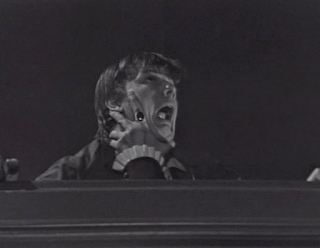
Meanwhile, Barnabas is in his coffin, trying to will someone to come and release him. In #210, dangerously unstable ruffian Willie Loomis had become obsessed with Barnabas’ portrait in the foyer of the great house, so much so that he could hear Barnabas’ heart beating through it. Barnabas called Willie to come to the secret chamber in the old Collins family mausoleum where his coffin was hidden. In his conscious mind, Willie thought he was going to steal a fortune in jewels. His face distorted with the gleeful expectation of that bonanza, he broke the chains that bound the coffin shut, and Barnabas’ hand darted out, choking him and pulling him down.
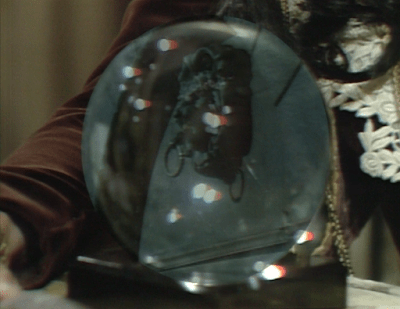
In the Old House, an image suddenly appears in the crystal ball. We can see it, the first time they have actually projected an image in such a ball since the first one made its debut in #48.
Magda notices the image, and tells Sandor to look. He recognizes the old mausoleum. She says that the jewels must be in “the room,” implying that they already know about the hidden panel and the secret chamber behind it. Sandor says it is absurd to imagine Edith going to and from the mausoleum to retrieve pieces of her jewelry collection. Magda ignores this, and urges him to go there. He reluctantly agrees to go with her.
The two of them are heading for the door when they hear a knock. It is Beth, come to say that Edith wants to see Magda. Edith wants what she always wants- to be told that Edward will return before she dies. Sandor says Magda can’t go, but Beth says she will regret it for the rest of her life if she does not. Magda tells Sandor to go on his way without her, and says that she will bring Edith some ancient Gypsy cards, cards older than the Tarot. When she talks about Romani lore, Magda taunts Beth- “but you wouldn’t know anything about that, would you?” Her sarcastic tone implies that Beth has tried to conceal her own Romani heritage.
Sandor opens the secret panel and looks at the chained coffin. He tells himself the jewels can’t be hidden there, then decides he may as well open it anyway- if he doesn’t, Magda will just send him back. Longtime viewers remembering the frenzy in which Willie opened the coffin in #210 will be struck by the utterly lackadaisical attitude with which Sandor performs the same task. Men’s lust for riches may release the vampire, but so too may their annoyance with the wife when she won’t stop carping on the same old thing.
When Willie opened the coffin, it lay across the frame lengthwise and he was behind it. When he raised the lid it blocked our view of his middle. We could see only his face when he realized what he had done, and could see nothing of Barnabas but his hand. The result was an iconic image.
Farewell, dangerously unstable ruffian- hello, sorely bedraggled blood thrall. Screenshot by Dark Shadows Before I Die.
When Sandor opens the coffin, its end is toward us. We see Barnabas at the same time he does. Barnabas’ hand darts up, and also for some reason his foot. The camera zooms in as Barnabas clutches Sandor’s throat. Unfortunately, the shot is so dimly lit that not all viewers will see this. My wife, Mrs Acilius, has eyesight that is in some ways a bit below average, and she missed it completely, even on a modern big-screen television. It’s anyone’s guess how many viewers would have known what was going on when they were watching it on the little TV sets of March 1969, on an ABC affiliate which was more likely than not the station that came in with the poorest picture quality in the area. As a result, the image that marks the relaunch of Barnabas’ career as a vampire is nothing at all. There is so much good stuff in the episode that it easily earns the “Genuinely Good” tag, but Kaplan’s bungling of this final shot is a severe failure.
Old world gentleman Barnabas Collins finds his distant cousin, strange and troubled boy David Collins, trying to pull the metal ring that opens the secret chamber hidden inside the old mausoleum.
Barnabas asks what David was doing. He says he was upset with his governess, Maggie Evans, and was hiding from her. Barnabas gestures around the publicly known part of the mausoleum and says “There’s no place to hide here.” David vigorously agrees, and says he didn’t expect Maggie to come there at all. Barnabas asks if David was trying to get into the hidden chamber.
Panicked, David claims not to know what Barnabas is talking about. Barnabas reminds him that he caught him at the mausoleum in #315. Longtime viewers will recall that he subsequently found part of David’s pocket knife in the hidden chamber and confronted him with it, and David seems to remember that as well. He drops his attempt to deny knowing about the chamber, and tells Barnabas he heard an animal inside it.
This goes to the heart of the issue that has brought Barnabas to the mausoleum. Barnabas has befriended mysterious drifter Chris Jennings and has learned that Chris is a werewolf. When Chris is in his beastly form, Barnabas locks him in the hidden chamber to keep him from hurting anyone. The werewolf is in there now. He was growling and snarling when David arrived, but fell silent when Barnabas entered.
Barnabas asks how an animal could have got into the hidden chamber; David admits he can’t think of a way. He then asks David if he can hear the noise now; he says he can’t. He asks if he might have imagined the whole thing; he doesn’t disagree.
Barnabas takes David back home to the great house of Collinwood. His governess Maggie is waiting up for him. She stays in David’s room until he seems to be asleep, then kisses him on the forehead and goes.
Yesterday, David told Maggie that she is a pretty girl. He’s twelve now, old enough to get excited about that very conspicuous fact, so when he opens his eyes immediately after she leaves the room returning viewers might think the reason he faked being asleep was that he was angling for the kiss.
David went to the mausoleum to release the werewolf because the evil spirit of the late Quentin Collins made him do it. Quentin has been dominating David lately. After Maggie goes, Quentin appears in the room and David confronts him. He says he does not want to be part of Quentin’s cruel schemes any longer. In response, Quentin causes David to suffer extreme pain. Passing by in the hallway, Maggie hears David’s scream and Quentin’s laugh, and she opens the door to find David curled up on the floor.
The laugh is noteworthy. Maggie hears it, and it is not a sound David could have made. She has already seen Quentin, but now she has further evidence that he exists. Moreover, it is the first time Quentin has broken his silence. We first met Quentin when he was in company with another ghost, a woman named Beth Chavez. Beth has spoken since then; we wonder when Quentin will have lines to deliver.
Chris Jennings turns into a werewolf when the moon is full, which it is about half the time in the universe of Dark Shadows. Old world gentleman Barnabas Collins has learned of Chris’ plight and decided to help him. As they make their way through an old cemetery to the hidden chamber where Barnabas will lock Chris up so that he doesn’t hurt anyone tonight, Barnabas asks Chris to confirm that he doesn’t remember anything he does in his lupine form. Chris does, saying that waking up and not knowing what he did the night before “is the most agonizing part of the whole thing.” You might think that he would find it even more agonizing to know that he has been killing one or two random human beings a month for the last seven years, but different things bother different people.
Chris asks how Barnabas knew that he didn’t remember what he did as the werewolf. Barnabas replies “Well, it’s obvious you’ve forgotten that you attacked me in this graveyard the night before last.” Chris says that “It’s a wonder you’re still alive.” To which Barnabas replies “No, it’s a wonder YOU’RE still alive!” For a moment we wonder how long this will go on, but Barnabas explains that werewolves can be killed by silver weapons. The head of the cane he carries is silver, and he struck him with it.
Barnabas shows Chris to the hidden room in the back of the old Collins family mausoleum. Barnabas himself was kept in a chained coffin in this room for over 170 years, when he was a vampire. He tells Chris that the room was originally constructed to hide ammunition from the British during the Revolution, which we have heard before. The coffin is still there; he tells him it is empty, and denies knowing anything about it. He says that the walls of the tomb are solid granite a foot thick; this is the first we’ve heard this detail. When Chris asks if anyone else knows about the room, Barnabas concedes that “A few” do. He assures him that none of them will be around tonight. Regular viewers will start making up a list of all the characters currently on the show who know about the room; Barnabas’s friend Julia Hoffman and his servant Willie Loomis know about it, as does strange and troubled boy David Collins. Barnabas can tell Julia and Willie to stay clear, and David has no reason to come to the cemetery tonight.
Barnabas explains that he will not show Chris the mechanism that unlocks the door from the inside, but promises to come back to release him after dawn. Chris urges Barnabas to leave at once; Barnabas insists on sticking around and asking more questions, saying that the moon isn’t up yet. Chris tells him that he first transformed shortly after he graduated from architecture school. “Oh, I was going to be an architect to be reckoned with, bold, imaginative, revolutionary. I thought nothing could stand in my way. Then something did.”
After Chris delivers a monologue about what a soulful and remorseful serial killer he is, Barnabas finally does close the secret panel. He sticks around until he hears the sounds of the werewolf snarling in the hidden room.
Chris’ nine year old sister Amy is staying at the great house of Collinwood. David finds her standing outside the front door, staring at the moon. She tells him that the moon scares her sometimes. His response is “Well, then don’t look at it,” which does seem logical. But she tells him that she can’t help it. David complains about how odd she is. We will hear more of this grumbling; it makes them seem like an old married couple, and is hilarious.
Amy and David are coming under the influence of the evil spirit of the late Quentin Collins. Quentin keeps trying to get them to set various members of the Collins family up for lethal traps; they haven’t succeeded yet in killing anyone, but housekeeper Mrs Johnson has caught on that there is something peculiar going on with the two of them, and she is frightened.
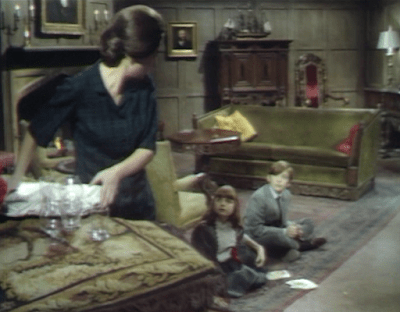
Mrs Johnson enters the drawing room to do some straightening up and finds the children playing a game with a deck of stage magician’s oversized cards. She and they stare silently at each other for a minute or two, and she protests. They say they were just watching her work, and she orders them to go to bed. They object that it isn’t bedtime yet. Of course it isn’t, Mrs Johnson doesn’t work around the clock. They get even more intensely on her nerves by bringing up a recent incident when she saw Quentin’s ghost, and in her exasperation she chases them out of the room.
There isn’t anything about Quentin in the episode prior to that scene, so I cannot imagine what viewers would make of it. It’s late in the day, a domestic is tired, and a couple of kids are trying to annoy her. That is a relatable situation, but it doesn’t match with the heavy, melodramatic Dark Shadows music and the terrified affect with which Clarice Blackburn plays Mrs Johnson. I suppose that by January 1969, Dark Shadows was so widely known as a supernatural thriller that most people tuning in for the first time would assume that something paranormal was going on, but if they turned the television on after the opening titles and didn’t realize what show they were watching, they could only have concluded that they were witnessing an utterly ludicrous case of exaggerated seriousness. After David and Amy are out of Mrs Johnson’s sight, we see them go upstairs laughing, but that proves only that they are trying to upset her, not that they are connected to a malign power greater than themselves.
Barnabas enters and sees that Mrs Johnson is upset. She begins to tell him why, but interrupts herself to declare that he won’t believe her. He assures her that he will, and keeps asking her to go on. After she has told him everything she and the audience both know, he asks her to start over. The scene cuts out, suggesting that Barnabas is taking pains to get as much information from Mrs Johnson as he possibly can.
The children go to the little room in the long-deserted west wing of the house where they first met Quentin. Quentin is there when they arrive. This is the first time we have seen Quentin waiting for them; previously, they have had to summon him. Quentin does not speak; David can sense that he wants Amy to go back to the main part of the house so that they can talk privately.
Alone with Quentin, David asks where “the bottle” is. Quentin opens a rolltop desk, and David sees a bottle. He is shocked to find that the bottle is labeled “strychnine.” He declares that he won’t hurt Chris, and he runs out of the room.
Downstairs, Amy is in the drawing room, where she presses a few keys of the piano. We heard her play “London Bridge” in #656, but this doesn’t seem to be a part of any song. She is just idly pecking at the keyboard. When David comes, Amy complains about how long he was gone. He is distant, refusing to maintain eye contact or to answer any of her questions. He says they won’t be playing tonight.
We cut back upstairs, where Quentin is picking up the bottle of strychnine. Mrs Johnson saw Quentin in Chris’ cottage, so we know that he can go there. If David won’t poison Chris, perhaps Quentin will do it himself.
Time-traveling fussbudget Barnabas Collins has completed the task he set for himself when he went to the year 1796, and has to find a way to return to 1969. He decides to deliberately subject himself to the process by which he was originally transferred from the 1790s to the 1960s. He is, at the moment, a vampire. He orders his servant Ben to chain him in a coffin hidden in the secret room in the back of the Collins family mausoleum, and hopes that he will be released from it in a period when he is human again.
On a sunny morning in 1969, Barnabas’ former blood thrall Willie and his best friend Julia have figured out his plan and gone to the secret room. Julia is a medical doctor; she is at once the best physician in the world, capable of assembling a human body from dead parts, bringing it to life, and thereby lifting the effects of the vampire curse from Barnabas, but simultaneously very unsteady on the question of whether any given patient she is examining is alive or dead. For example, matriarch Liz is entombed at the moment because Julia mistakenly declared her dead twice in a couple of months. Once he has opened the coffin, Willie demands Julia examine Barnabas’ body and tell him whether he is alive, and therefore human, or dead, and therefore condemned to rise at nightfall and prey upon the living. Before she can answer Willie’s question, Julia has to spend quite a bit of time going over Barnabas with a stethoscope, during which time we see his eyelids flutter and his chest move.
While Julia is trying to determine Barnabas if is alive, he sits up and starts talking. Julia and Willie urge him to lie back down, apparently concerned that if he is too active Julia won’t be able to arrive at a clear result. After a break, we see him out of the coffin, telling them about his experience in 1796. After quite a bit of back and forth, they arrive at the collective decision to continue the conversation back home, in the Old House on the great estate of Collinwood.
Barnabas, Julia, and Willie have emerged from the secret room into the publicly known part of the mausoleum and are starting to close the panel behind them when they hear the voices of people approaching. One might expect them to finish closing the panel and to greet whoever is coming as fellow pilgrims paying homage at the graves of Joshua and Naomi Collins and their daughter Sarah. After all, everyone knows that Barnabas is a direct descendant of Joshua and Naomi, that Julia has a lively interest in the past of the Collins family, and that Willie is Barnabas’ servant. They have as much right to be there as anyone.
Instead, they scurry back into the secret room and shut themselves in. They are a bit too slow. Entering are heiress Carolyn and child Amy. Amy sees the panel swinging shut. Carolyn, behind her, did not see this happen, and dismisses Amy’s claim that she did. They tap on the panel, and Amy decides that it is so solid that she may have been mistaken. The mausoleum is so dim that one can imagine a trick of the light causing a person to believe that the wall had moved, so this reaction of hers is plausible enough.
Dimness is not an exclusive property of the outer part of the mausoleum. The trio hiding in the secret panel embody dimness as they do an outstanding imitation of the Three Stooges. Willie is Larry, the universal victim; Julia is Moe, the self-appointed leader who is as lost as either of the followers; and Barnabas is Curly, the chaos agent. Willie left his bag of tools perched precariously on the steps immediately behind the panel; after Amy and Carolyn tap, the bag falls and makes a sound. Julia does not address Willie as “ya porky-pine!” and poke him in both eyes, but it would fit with the flow of the action if she did.
Carolyn and Amy both hear the sound. They puzzle over it. Carolyn suggests that the wind must be blowing a limb from a nearby tree against the outer wall. Amy can’t think of anything else it could be, and accepts the suggestion. They leave, having placed flowers on the sarcophagi.
The flowers are themselves interesting to longtime viewers. Early in the episode, we saw Carolyn arranging them on the writing table in the drawing room of the great house of Collinwood. The last time we saw someone handling flowers over that table was in #346. Barnabas grabbed those flowers out of Julia’s hand. In those days he was still a vampire, and they were enemies. After a few seconds in his grip, the flowers died. When Julia and well-meaning governess Vicki saw this, Barnabas looked embarrassed, for all the world as if he had broken wind. The analogy tends to raise a laugh, but it is apt- when he was a vampire, it was a natural function of Barnabas’ body to do things like that, and he would be expected to control that function so that others would not be aware of it. So when they show us flowers on this spot, they are telling us we ought to be in suspense as to whether Barnabas will be a vampire again.
Carolyn and Amy go back to the great house, where strange and troubled boy David is sulking. Again, longtime viewers might find this suspenseful. David found his way into the secret room in #311 and in #334 tried to show it to some adults. Barnabas had locked the panel, so they disbelieved him. If Amy tells David what she saw, he may well put two and two together and revive the stories that were in progress in those days.
But Amy doesn’t breathe a word of it, and David isn’t interested. He is preoccupied with the evil spirit of the evil Quentin Collins, who is gradually and evilly taking possession of him and Amy and, evil as he is, driving them to do something or other that has not yet been explained, but which will undoubtedly turn out to be evil. Quentin is still confined to a small room hidden in the long-deserted west wing of the house, and can only take full control of one child at a time. Today it is David who is acting as his agent; Amy flatly refuses when David tells her that Quentin wants them to “play the game.” In response, he twists her arm. Carolyn walks in on that act of violence, and orders David to go to his room and stay there for the rest of the day.
Amy speaks up for David and even asks to go to his room with him, but Carolyn stands her ground. She does leave the children alone together while she goes to tell housekeeper Mrs Johnson to take David’s meals to him on a tray.
David fumes and tells Amy that it is her fault that they won’t be able to “play the game” today. He is declaring his intention to “get even with Carolyn!” when Barnabas appears in the doorway.
Evidently David’s declaration did not bother Barnabas, because his only response is “Why so serious?” Barnabas has been pushing a plan to send David and Amy to boarding schools in Boston. Under Quentin’s influence, they have tried to thwart this plan by pretending to be all for it but secretly hanging clothes in the wrong closets. This apparently foolproof method has somehow failed, so they resort to another expedient. They tell Barnabas they would rather not go. He says that’s fine with him, and drops the whole thing.
Alone in his room, David looks angry. He throws a book to the floor. Carolyn comes in, and David tells her that he is sorry and she is right to punish him. She sees immediately that he is lying, and tells him so. The resulting brief scene is far and away the best of the episode.
Later, Amy slips in, and finds David sitting in a chair in a dark corner. In their post about the episode on Dark Shadows Before I Die, John and Christine Scoleri point out that the effect of this shot of David is a bit different on an audience now than it would have been before 1972, since it makes David look very much like Don Vito Corleone in the opening scene of The Godfather.
David is still furious about the whole situation. He tells Amy that they will “play the game” after all, and that Carolyn will play with them. The ominous music on the soundtrack is enough to tell us that this means they will try to kill Carolyn.
This episode shows something about the importance of directors in television drama. Actor Joel Crothers appeared on Dark Shadows for the last time yesterday; in an interview he gave to a fan magazine shortly after leaving the show, he complained that the directors had become so busy managing the special effects and practical effects that they didn’t have time to work with actors. Furthermore, the show never had more than three writers on staff, so scripts were sometimes delivered too close to taping for the actors to do much rehearsal on their own.
Today, each actor finds a note and sticks with it, but few performances mesh with each other sufficiently to seem to be part of the same scene. Denise Nickerson is calm and relaxed even when Amy’s arm is being twisted, David Henesy is angry and confrontational even when Barnabas is falling for David’s pretense that everything is normal, and Nancy Barrett is stern and impatient even when Carolyn is taking Amy’s claim to have seen the panel move seriously. Each of these performances is good, and Mr Henesy stands out when he gets to play “creepy.” But clearly no one gave them an idea of what they should work together to get across to the audience.
Aside from the scene where Carolyn sees that David is lying, there are just two exceptions, and they don’t really help. Committed fans may find it endearing to see the preposterous threesome hiding in the secret room of the mausoleum, but first-time viewers are likely to be put off by that scene of low comedy in the midst of an otherwise heavy and somber melodrama. Jonathan Frid is warm and inviting with the children, which does make sense when Barnabas is talking with the relaxed Amy, but their two-scene about whether he will ask Carolyn to let David out of his room is such a low stakes affair that unexcited actors cannot hope to hold our attention.
The director today was executive producer Dan Curtis. Curtis was a titanic personality and would later direct many TV movies and some features, but he seems never to have directed as much as a school play when he first took the helm of Dark Shadows for a week in 1968. This stretch of episodes marks his second time in the director’s chair. His extreme inexperience as a director of actors may well explain why the cast does not come together more cohesively.
Mysterious drifter Chris Jennings telephones the great house of Collinwood. Old world gentleman Barnabas Collins answers. Chris asks to speak to permanent houseguest Julia Hoffman, MD. Barnabas tells him Julia is busy with a patient, and Chris says that it is extremely urgent Julia call him back the moment she is free.
Julia comes downstairs. She had been tending to matriarch Elizabeth Collins Stoddard. Liz is mentally ill. She is deeply depressed and fixated on the idea that she will soon be buried alive. Barnabas starts talking about the witch whose spell started Liz’ illness; Julia points out that the origin doesn’t really matter. Indeed it does not. Liz’ condition is quite logical when we realize that she has been exposed to a long series of traumatic events of supernatural character. Of course she feels helpless- her world really does not make rational sense, and there really are forces beyond her control that are determined to bring misery to her and those she loves. And of course she is preoccupied with death- she is surrounded, not only by people in mortal jeopardy, but also by figures who are at once dead and alive. Unknown to her, Barnabas is one of these- he died in the 1790s, became a vampire, and was restored to humanity less than a year ago. The story of Liz’ depression is not really a tale of the supernatural, but of a person responding to her environment in a perfectly natural way.
Liz’ depression is not exactly a fun story, and the show hadn’t done anything with it for months. We might have hoped it was all over. What has brought it back is the disappearance of well-meaning governess Victoria Winters. The other day, Vicki embraced her husband, an unpleasant man known variously as Peter and Jeff, and vanished into thin air as Barnabas and Liz watched. She and Peter/ Jeff were traveling back in time to the 1790s, never to return. Liz was very close to Vicki; the show spent its first year hinting heavily that she was Vicki’s biological mother, though they never got round to saying so explicitly or telling us anything about Vicki’s father. Now that Vicki is gone, Liz is inconsolable.
That is the in-universe explanation for Liz’ trouble. There are two real-world reasons. First, Joan Bennett was going away for a few weeks to do a play in Chicago, and the show needed to explain why Liz wasn’t going to be around when so much of the action was taking place in her house. Second, the key figure in both of the ongoing storylines is Chris’ eleven year old sister Amy, who is staying at Collinwood. Barnabas is the show’s chief protagonist, and so far he does not have any particular connection to either of those stories. Plunging Liz into a paralyzing depression completes the task they started by sending her brother Roger on a business trip overseas. It means that Barnabas has a reason to camp out in the main house and act as a father figure to Amy.
Barnabas had a vague notion about a romance with Vicki, though he did almost nothing to develop such a relationship. His basic feeling towards her seems to have been that he might want her someday, and so he reacted with petulant anger to any person or event that made her unavailable to him. Thinking about Vicki’s departure with Peter/ Jeff, he spends several minutes pouting while Julia tries gently to reason with him.
Barnabas is very upset that Vicki was so inconsiderate as to move on with her life when he might someday have wanted her. Screenshot by Dark Shadows Before I Die.
At the end of his tantrum, Barnabas declares that he and Julia should go back upstairs and talk with Liz. As they are going, he sees the telephone and says “Oh. By the way, Chris Jennings called. He said it was urgent.” It’s even funnier that Barnabas remembers this call so late in the scene than it would be if he had forgotten it altogether. Chris may use words like “emergency” and “extremely urgent,” but in Barnabas’ world there is only one truly urgent matter, and that is whatever his feelings are at the moment.
Vampires are metaphors for extreme selfishness. Barnabas may not be a vampire anymore, but he is still very selfish. But perhaps is attitude towards Vicki is not so unsympathetic as I have made it out to be. When he was still under his curse, he thought he might be able to remake Vicki as an eighteenth century woman, then turn her into a vampire and take her as his bride. Vicki did indeed have an attachment to that era, so much so that she traveled back in time to the 1790s. And when he became human again, Barnabas was immediately embroiled with a succession of witches and monsters, to none of whom did he want to expose Vicki. He wanted to clear them out of the way so his life could start, and once it did he would be free to approach her. But her life was already underway, and of course his was too. The nemeses Barnabas and Julia fought together throughout 1968 are gone now, but so is Vicki, and it is the two of them who are alone together.
The other day, Chris dropped by to ask Julia for sedatives. She was unimpressed with his drug-seeking behavior, and so when Barnabas tells her about Chris’ call she says that he can wait. What she does not know is that Chris is a werewolf, and he was hoping that strong enough pills could knock him out throughout the night of the full moon.
Chris and Amy’s cousin Joe Haskell has been trying to fill in for Chris in the big brother role. He and Amy have gone to the movies, and we see them on their way back to the great house, looking at the moon. Amy tells Joe that she is terribly afraid of the moon, for reasons she can’t explain. Joe asks if she really saw a pentagram on his face in #648; she confirms that she did. Joe knows that someone else saw it too, visiting medium Janet Findley. He also knows that when he told Chris about it he was terribly upset. Neither Joe nor Amy knows what Chris and Madame Findley knew, that it is the sign that he will be the werewolf’s next victim.
Amy is alone in the foyer of the great house when Liz comes down the stairs, apparently in a trance. She does not respond when Amy calls out to her, but walks out into the night. Amy is standing in the open doorway, watching her, when Barnabas comes and asks what she is doing. She tells Barnabas what happened. He tells her to go to bed; she refuses. He then decides it will be good enough if she waits in the drawing room until he brings Liz back. She goes to the drawing room, but when he goes off to tell Julia what has happened she slips out to look for Liz. Barnabas learns that she has left when Julia, whom he has sent to sit with her, reports that she is not in the drawing room.
Barnabas is out looking for Liz and Amy when Chris comes to Collinwood. He is upset that Julia did not call him back; she is skeptical of him. He tries to give a reasonable-sounding explanation; if only he knew of her background treating vampires and Frankensteins, he would realize that he has everything to gain by telling her the truth. She finally gives him a bottle of sleeping pills, along with a wary look and an injunction to use the pills only as directed.
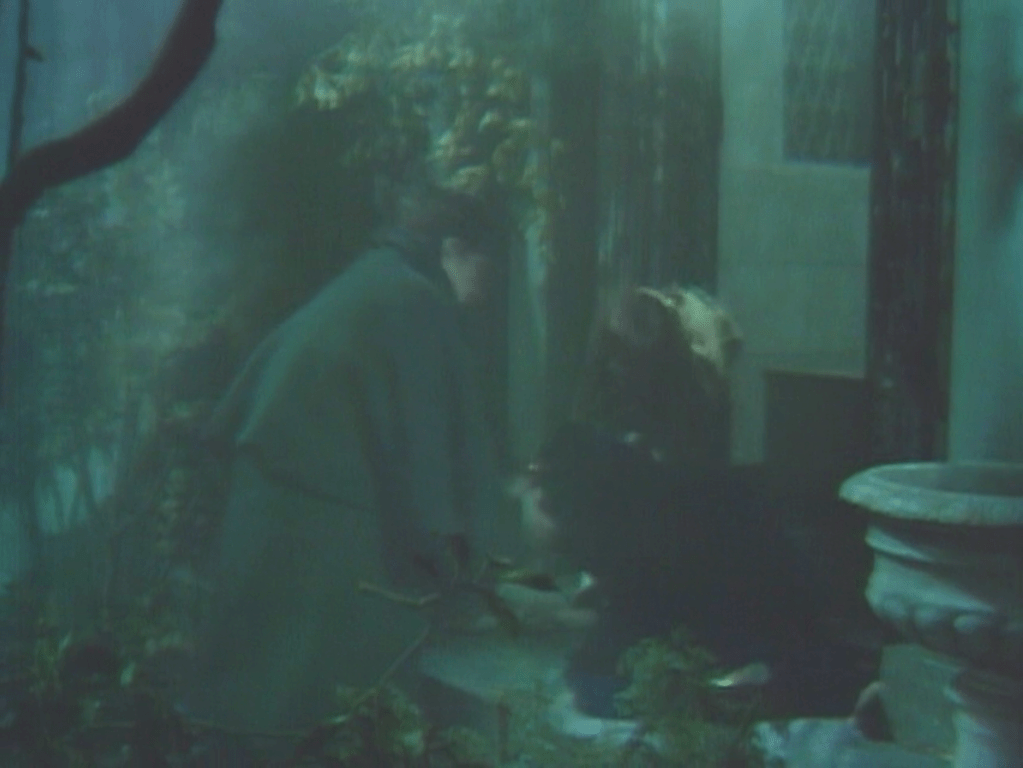
Liz goes to the old Collins family mausoleum. Barnabas’ parents and sister are buried there, and he was himself trapped there for 172 years when he was a vampire. She thinks of it now as her tomb, and tells herself that she is ready to be buried there now. She collapses. Amy finds her, fears that she is dead, and cries out. Her voice brings Barnabas, who tells Amy that Liz is alive. He also says that they must get her back to the house at once. Barnabas puts his arms under Liz’ left side, Amy puts hers under her right, and they lift her. This brief glimpse of the two of them working together goes a long way towards establishing Barnabas’ closeness to Amy.
I’ve altered the saturation and exposure a bit in this still. Though the original is darker and the fog machine was working overtime, in the moving image you can see what Amy is doing clearly enough.
Joe pays another visit to Chris’ room. Chris has taken a bunch of sleeping pills from the bottle Julia gave him. Joe scolds Chris for his failure to visit Amy. Chris knows that he could transform at any time, and is desperate to get Joe to leave. Joe does leave. Chris goes to bed. He falls asleep. The camera pans to his hand, which has already become a werewolf’s paw.
Occult expert Timothy Eliot Stokes is searching the room in the long-deserted west wing of the great house of Collinwood where heiress Carolyn has been hiding Frankenstein’s monster Adam since #539 in July. Strange and troubled boy David Collins saunters into the room and greets him with a casual “Hello, professor.” When a flustered Stokes makes up a story about Carolyn sending him to the room to look for some old books, David calmly replies, “Oh, I thought you might be looking for Adam.”
We haven’t seen David since #541. The only time we saw him interact with Adam was when they crossed paths in the woods in #495, and in none of the countless scenes featuring Adam cooped up in this dusty little room has David been mentioned. Yet today he tells Stokes that he visited Adam there many times, and that the two of them became great friends. I take that to mean that Ron Sproat, writer of today’s script, wanted to show us a lot of conversations between David and Adam and was overruled by the producers. It’s a major disappointment Sproat didn’t get his way. David Henesy and Robert Rodan would have been a wonderful pairing. David Collins tells Stokes that Adam told him last night that he would be leaving Collinwood before morning, and that he would never return.
Carolyn enters the room and tells David to go. He eavesdrops on her conversation with Stokes. He hears Stokes acknowledge that he is in the room without her permission, confirming that he was lying when he claimed Carolyn sent him there. He stays long enough to hear that Stokes is anxious to find Adam because he is afraid he is in danger. He goes off to look for the big guy.
During Carolyn’s conversation with Stokes, it becomes clear that she does not remember the events of the previous night. Since that night stretched over 13 episodes, that is quite a gap. During it, a mate was created for Adam; Carolyn participated in the first attempt at that procedure as the donor of the “life force.” She did that under the influence of suave warlock Nicholas Blair; Nicholas later enlisted her in another task, after which he erased her memory. Perhaps she forgot everything she did while his spell was upon her. That would explain why she doesn’t remember anything about Adam’s mate or about his passionate goodbye kiss. The show was so much more interesting during the little interval when Carolyn knew what was going on that it is almost as big a disappointment to learn of this mind-wipe as it is to hear that we were denied a chance to see a friendship develop between David and Adam.
David goes to Eagle Hill cemetery to look for Adam. He sees Willie Loomis, bedraggled servant of David’s distant cousin Barnabas Collins, emerge from the old Collins family mausoleum. David hides behind a tombstone until Willie is gone.
David wonders what Willie was doing in the mausoleum. He goes inside, and decides to open the panel to the hidden chamber. There, he finds Maggie Evans, The Nicest Girl in Town, bound and gagged. He calls her by name, and we cut to commercial.
This situation will be familiar to longtime viewers. In #124, David found his governess, the well-meaning Vicki Winters, bound and gagged in a secret room in the Old House on the estate. That time, he panicked and left Vicki still restrained.
After the commercial break, we spend some time with Willie and Stokes in the Old House, where Barnabas now lives. Thayer David plays Stokes. In #124, he played Matthew Morgan, the crazed handyman who was holding Vicki prisoner. Seeing him in this house with Willie at this point in the episode ensures that those of us who saw it will remember #124 and wonder how David’s response to the situation with Maggie will compare to his failure to help Vicki.
Willie then goes back to the mausoleum and finds David sitting on one of the coffins in the publicly known part. He asks David what he is doing there. David answers in a roundabout way. We start to wonder if he may have reverted to his old form and left Maggie where she was. But he eventually gets around to describing how Maggie behaved when he was untying her. Willie is terribly upset to find that Maggie is gone.
Willie abducted Maggie and locked her up in the mausoleum because Barnabas and mad scientist Julia Hoffman were planning to impose the role of “life force” donor on her. While there, she remembered that in May and June of 1967 Barnabas was a vampire who fed on her, imprisoned her, tried to replace her personality with that of his lost love Josette, and tortured her when she resisted. Willie doesn’t see any way to let her out when she has information like that. In the middle of today’s episode, Kathryn Leigh Scott and John Karlen have a big scene in the mausoleum as Maggie defies Willie and he begs her to be nice to him. They do an excellent job, but it is quite a relief to be out of that dungeon.
In April 1968, mad scientist Eric Lang promised Barnabas Collins that he could cure him of vampirism. The cure was an experimental procedure modeled on the one in Hammer Studios’ 1967 film Frankenstein Created Woman. A body constructed of parts salvaged from several fresh corpses was to be associated with Barnabas, and when the procedure was complete Lang expected Barnabas’ body to be dead and his mind to awaken in the constructed body. After Lang’s death, Barnabas’ friend, Dr Julia Hoffman, completed the experiment. To their surprise, the procedure ends with both Barnabas and the new man alive. Barnabas named the new man Adam. They take Adam to the dungeon in Barnabas’ house, and keep him there in horrifyingly bad conditions until he escapes. Adam of course hates Barnabas and Julia.
Lately, Adam has been hiding out in a long-deserted part of the great house of Collinwood. Heiress Carolyn Collins Stoddard took pity on him and has been looking after him there. He has fallen in love with Carolyn, to her embarrassment and his frustration. Carolyn has delegated the day-to-day responsibility for looking after Adam to unsightly ex-convict Harry Johnson. Adam’s former protector, occult expert Timothy Eliot Stokes, visits from time to time. Adam’s most frequent and most influential visitor is suave warlock Nicholas Blair. Carolyn and Stokes are good, Nicholas is evil, and Harry is just distasteful.
When Nicholas found out about Adam, he forgot about whatever plans he may previously have had and focused on the goal of founding a new humanoid race. He has talked Adam into demanding Barnabas and Julia repeat the experiment to build a mate for him. Adam threatened to kill well-meaning governess Vicki Winters unless they complied. Now there is a patchwork female corpse and a lot of scientific equipment in Barnabas’ basement. All that is missing is a woman to donate her “life force.”
Barnabas and Julia were plotting to use Maggie Evans, The Nicest Girl in Town. When Barnabas was a vampire in May and June of 1967, he abducted Maggie and tortured her in an attempt to erase her personality and replace it with that of his lost love, the gracious Josette. When that evil scheme collapsed, Maggie escaped and Julia used her preternatural powers of hypnosis to block her memories. Ever since, Maggie has had no idea of what happened during those two months, and she has thought of Barnabas as a wonderful person. Barnabas wants Julia to use those same powers first to bring Maggie to the basement lab, and then to block her memory in case she survives.
Barnabas’ much-put-upon servant, Willie Loomis, overheard this plan. Willie has a crush on Maggie. He tried to talk Barnabas and Julia out of their fell intentions, and when they would not listen he tried to persuade Maggie to leave town. She wouldn’t listen either, so he took it upon himself to abduct Maggie. He stole some chloroform from the lab, broke into her room, and took her to the hidden chamber inside the old Collins family mausoleum.
We open today in the front parlor of the Old House, where Adam is coolly explaining to Barnabas that he does not want Maggie to donate the “life force” for his mate. Barnabas angrily explains that it must be Maggie, because Julia has proven that she can control her. Besides, Maggie lives alone, so she can go missing for several days before anyone knows she is gone. Barnabas is the chief protagonist of this show, by the way.
Adam says that the only woman whose “life force” he wants to animate his bride is Carolyn. Barnabas says that this is impossible. Adam has been gradually learning the details of the experiment that brought him to life; only now does Barnabas tell him that in the original plan, he would die and come back to life in his body. Adam is bewildered by this. “How could you hate yourself so much that you wanted to change your body?” Barnabas does not want to confess his his former vampirism, so Adam doesn’t get an answer.
Adam meets Nicholas at the gazebo on the grounds of the estate. Nicholas wants him to ignore everything Barnabas said, but Adam is giving deep thought to all of it. It was Nicholas’ idea that Carolyn should provide the “life force,” and Adam enthusiastically agreed, believing this meant that his mate would be like her. He says now that he and Barnabas do not recognize themselves in each other, and Nicholas tries to brush this very apt observation off by saying that Barnabas would hide his similarities. Adam demands Nicholas assure him that Carolyn will not be subjected to any violence. She must want to participate in the experiment. As my wife, Mrs Acilius, pointed out, that condition is indeed a similarity with his “life force” donor- Barnabas had been preoccupied with the idea that Maggie and his other female victims would eventually come to him of their own will. While Nicholas is trying to quell the big guy’s concern, Willie happens by.
Adam starts to figure everything out, and wants to reason with Nicholas.
Adam hides while Nicholas confronts Willie. He puts a magic zap on Willie to compel him to release Maggie. After Willie goes, Nicholas tells Adam he will use the same painless technique to cause Carolyn to cooperate. Adam is skeptical, but Nicholas assures him that his doubts will be settled when he sees that Maggie is free before daybreak.
That may not quite work out. Willie made the worst possible choice of hiding place when he stashed Maggie in the hidden chamber of the mausoleum. Barnabas took her to that chamber for torture when she was his prisoner, and shortly after she awoke there her memory started to come back. By the end of today’s episode, she remembers that Barnabas was her captor. When Willie returns, he will find that he has quite a problem on his hands.
Recovering vampire Barnabas and mad scientist Julia are under pressure to create a female Frankenstein’s monster. The process they are using requires draining the “life force” from a woman into a constructed corpse. The other day, Barnabas announced they would force the role of donor onto Maggie, The Nicest Girl in Town and one of his former victims. When Barnabas’ servant Willie heard of this plan, he was horrified. Willie has a crush on Maggie, and is determined to spare her this fate.
Now, Willie has abducted Maggie and is hiding her from Barnabas and Julia. Barnabas is worried about what will happen if they cannot find another woman to use in the experiment. Julia says “If worse came to worst, I could do it.” Barnabas points out that only she is prepared to operate the equipment, and that she could not do that if she were serving as donor. She makes a feeble suggestion that their onetime lab tech, an unpleasant man named Peter who prefers to be called Jeff, might run the equipment. Barnabas says that Peter/ Jeff does not have her training. In any case, Barnabas had to fire Peter/ Jeff because he had reason to believe he was trying to sabotage the experiment, so he can scarcely trust him now.
This is not the first time Julia has offered to solve a problem by destroying herself, only for Barnabas to turn her down. In #350, when Barnabas was still a vampire and was desperately thirsty for blood, Julia volunteered herself as his victim. Barnabas was sufficiently moved to address her for the first time as “Julia” rather than with a distinctly contemptuous pronunciation of the title “Doctor,” but he still said the reason he was refusing was that he had use for her medical expertise. Barnabas’ cruel plan for Maggie suggested that he isn’t really any nicer now than he was as a vampire; this echo of that moment would suggest that he hasn’t even stopped seeing Julia, who after all loves him, as a kind of higher servant.
Willie has taken Maggie to the hidden chamber inside the old Collins family mausoleum. It was in this chamber that Barnabas was trapped in his coffin from 1796 until Willie inadvertently freed him to prey upon the living in #210. When she was his prisoner in #248, Barnabas took Maggie to that chamber and shut her up in the coffin there. While Willie tries to assure Maggie that she will be safe as long as she is with him, the memories that Julia used her preternatural powers of hypnosis to erase start coming back.
We see a flashback, not to Maggie’s time at Barnabas’ mercy, but to #283, when she was Julia’s patient at Windcliff Sanitarium. Julia took her on a trip to the old cemetery north of Collinsport, and they went into the mausoleum. Julia did not know about the hidden chamber, and did not understand why Maggie became upset when they were in the publicly known part of the mausoleum. Maggie remembers visiting the mausoleum with Julia, and cannot remember why it frightened her to be there. But the fact that she recognizes the chamber as part of the mausoleum means that her memory of what Barnabas did to her is coming loose.
This creates a truly suspenseful situation. Maggie is an audience favorite with connections to several other characters, and so it seemed unlikely anything Barnabas and Julia did would result in her leaving the show. But if she remembers what they did to her and tells the police about it, they will go to prison. Since Barnabas and Julia are the source of all the action on Dark Shadows, that would mean the end of the series. So her memory coming back sets up a crisis that might be resolved with a significant change.
Perhaps Barnabas and Julia will force Maggie to donate her “life force” with the consequence that her body dies and she wakes up in the newly created woman, who just so happens to look exactly like her but to have a drastically different personality. That seems plausible, since the long-running storyline of her romance with hardworking young fisherman Joe seems to be over, the minor theme of her relationship with her hard-drinking father Sam had been resolved long before Sam died a few months ago, and we have reason to expect her to move out of her house, which has long served as our window into the working class of Collinsport. If Maggie is running out of story, they may very well decide to keep Kathryn Leigh Scott on as another character.
Closing Miscellany
The flashback is not made of tape cut from #283. It couldn’t be- the show was in black and white then, and is in color now. So they recreate it. It’s kind of adorable to see Julia in her old wig.
This was not the episode they intended to shoot. It was the dress rehearsal. Shooting the flashback scene put them so far behind schedule they didn’t have time to do the episode, and they had to send this footage to the network. I believe that is the only occasion they ever resorted to that desperate expedient. The camera is out of focus much of the time and occasionally does not seem to be pointed in the right direction, the microphones are misplaced so that it sounds at one point like Julia is referring to Maggie as “Greg,” booms and other equipment intrude into the shots, and the actors frequently blow their lines. In other words, it is in no way different from any other episodes.









 Dark Shadows Commentary
