Episode 738: The rest of the truth

This episode ends with one of the most thrilling moments in all of Dark Shadows.

The show’s first supernatural menace was undead blonde fire witch Laura Murdoch Collins, who was on it from December 1966 to March 1967. Its second was vampire Barnabas Collins, who first appeared in April 1967. Laura herself was presented with many tropes that conventionally mark vampires; for example, they laid great emphasis on the fact that Laura was never seen eating or drinking. And Laura’s story was structured very much like Bram Stoker’s Dracula, with well-meaning governess Vicki taking Mina’s role as the driving force behind the opposition to her. Presumably, if Barnabas had been staked and destroyed as the original plan envisioned, Vicki would have led the fight against him as well, and in #275 driven the stake into his heart. But Barnabas brought the show a new audience, and so Vicki was never called on to go to battle with him. Her character withered and was written out, and he replaced her as its chief protagonist.

In early 1967, Vicki learned that Laura had appeared at least twice before, and had died in strikingly similar ways each time. In 1767, Laura Murdoch Stockbridge was burned to death with her young son David; in 1867, Laura Murdoch Radcliffe was burned to death with her young son David; and in 1967, Vicki found Laura Murdoch Collins beckoning her young son David to join her in the flames consuming a wooden building. At the last second, Vicki broke through David’s trance and he ran to her, escaping the flames.

In November 1967, the show established that Barnabas lived on the great estate of Collinwood as a human in 1795, and that he became a vampire as a result of the tragic events of that year. If Barnabas were the same age in 1795 that Jonathan Frid was in 1967, he would have been born late in 1752, meaning that he would have been a teenager when Laura Murdoch Stockbridge and little David Stockbridge went up in smoke. The Stockbridges were a very wealthy family, so they would likely have been on familiar terms with Barnabas and the other rich Collinses of Collinsport, and the deaths of Laura and David would have been one of the major events in the area in those days. So longtime viewers have been wondering ever since whether Barnabas knew Laura, and if so what he knew about her.

Now Barnabas has traveled back in time to the year 1897, and there he meets another incarnation of Laura. He is thunderstruck at the sight of her. In her bland, enigmatic way, she expresses curiosity about his reaction, and he collects himself sufficiently to make some flattering remarks about her beauty. As soon as he is alone with his blood thrall, Miss Charity Trask, he declares that Laura has been dead for over a hundred years. So has he, but apparently when a woman rises from the dead to prey on the living that’s different, somehow. We saw this same old double standard a couple of weeks ago, when libertine Quentin Collins expressed shock at Laura’s return from the dead, when he himself had died and been a zombie just the week before.

If Laura did know Barnabas when she was as she is now and he was an adolescent, it is no wonder she does not seem to recognize him. She knows that there is a Barnabas Collins on the estate, and has heard that he is a descendant of the eighteenth century bearer of the same name. She would expect him to resemble the boy she knew, but would not necessarily know what that boy looked like when he was in his forties.

This is the first time we’ve seen Charity since Barnabas bit her in #727. She lives in the town of Rockport, which in the 1960s was far enough away from Collinwood that in #521 it was worthy of note that you could dial telephone numbers there directly. In 1897, when automobiles were rare and roads weren’t made for the few that did exist, a long-distance relationship between vampire and blood thrall would seem quite impractical. Still, in #732 we saw a character make two round trips between Rockport and Collinwood in a single evening, so I suppose it could be managed.

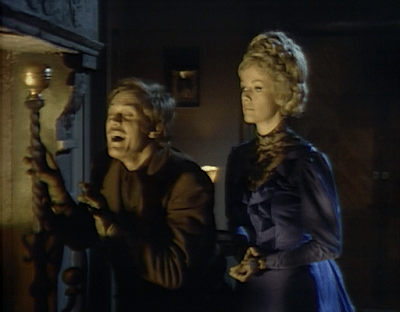
Barnabas’ recognition of Laura is a fitting conclusion to a fine episode. Much of it is devoted to a three-cornered confrontation between Laura, her twelve year old son Jamison Collins, and her brother-in-law/ ex-lover/ mortal enemy, Quentin. Danny Horn analyzes this in his post about the episode at Dark Shadows Every Day. I recommend that post highly. All I would add is that as it plays out today, the confrontation makes me suspect that the writers of the show may have done more planning than Danny usually credits them with. Jamison is the only person Quentin loves, and so far we have seen that Jamison loves Quentin back. When he learns that Quentin is his mother’s foe, Jamison turns against Quentin. Barnabas traveled back in time after Quentin’s ghost had made life impossible for everyone in 1969. The evil of Quentin’s spirit fell heaviest on David Collins, whom Quentin had possessed, turned into another version of Jamison, and was in the process of killing. Nothing yet has explained why Quentin’s ghost would focus its malignity on the image of Jamison. Actress Diana Millay used to claim that Laura was added to the 1897 segment at the last minute because she told Dan Curtis she wanted to work, but Millay famously enjoyed testing the credulity of Dark Shadows fans with outlandish remarks. I wonder if a falling-out between Quentin and Jamison over Laura was in the flimsies all along.

Charity makes her first entrance in the great house of Collinwood. Quentin is apologizing to her for some boorish behavior when he realizes she hasn’t been listening to him at all. She is completely absorbed in the eighteenth century portrait of Barnabas that hangs in the foyer. She excuses herself and wafts out the front door.

In Barnabas’ house, Charity says that he makes her feel beautiful, and that she wants to see herself in a mirror. Barnabas is a bit sheepish about the particulars of vampirism, and so he changes the subject. We cut from this exchange to Laura’s room in the great house, where she is with a servant named Dirk whom she has enthralled to serve as a source of body heat. That scene opens with a shot in a mirror, making the point that Laura’s relationship with Dirk is a reflection of Barnabas’ relationship with Charity. Earlier, there had been a clumsy attempt at an artsy shot of Laura reflected in Quentin’s sherry glass. That does show us that Laura casts a reflection and that her relationship with Quentin has been affected by his drinking, but it calls too much attention to itself to do much more than that.

The portrait in the foyer is hugely important to Barnabas. It made its debut on the show in #204, the day before his name was first mentioned and more than a week before he himself premiered. His thralls stare at it and receive his commands through it. He himself uses it as a passport, appealing to his resemblance to it as proof that he is a descendant of its subject and therefore a member of the Collins family. Today, Barnabas is surprised when Charity comes to his house; he wasn’t transmitting a message through the portrait summoning her. Instead, it was functioning as another mirror, in which Charity, who has become a part of Barnabas, could see the motivating force within her own personality.

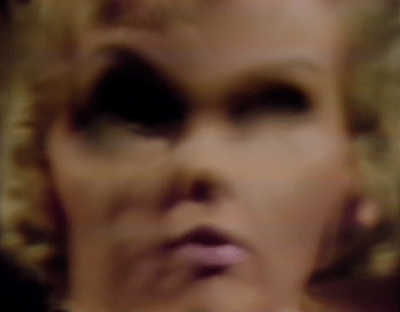
Dirk is played by Roger Davis, a most unappealing actor. At one point he makes this face while Dirk is involved in some kind of mumbo-jumbo:

Screenshot by Dark Shadows Before I Die.

At one point today, Quentin tells Jamison that he shouldn’t be afraid of telling the servants what to do, since after all he will someday be the master of Collinwood. Jamison takes this altogether too much to heart, and spends the rest of the episode ordering everyone around. David Henesy is a good enough actor to extract the comic value from this. For example, when he turns to Quentin, says “I’ll talk to you later!,” and keeps walking, we laughed out loud.

Episode 696: Not anywhere at all

The ghost of Quentin Collins drove all of his living relatives out of the great house on the estate of Collinwood the other day, and now he has fetched two of them back. They are twelve year old David Collins and nine year old Amy Jennings. Today, governess Maggie Evans, old world gentleman Barnabas Collins, and Barnabas’ bedraggled servant Willie Loomis search the great house looking for the children.

When they find Amy, she is possessed by the evil spirits and insists that the house is where she belongs. She willingly leaves with Willie. When they get back to Barnabas’ house, she calmly tells Willie that he will never again have reason to worry about Maggie. “Maggie is not anywhere anymore… anywhere at all. You’ll see.” In the great house, Barnabas finds that Maggie has been dressed in clothing appropriate to the period when Quentin lived, the 1890s. She does not recognize him or respond to her own name. When he asks who she is, she struggles, then faints.

Barnabas finds Maggie. Screenshot by Dark Shadows Before I Die.

Dark Shadows first became a hit in May and June of 1967, when Barnabas was a vampire trying to erase Maggie’s personality and overwrite it with that of his lost love Josette. Since then, Maggie’s memory has been wiped, Barnabas has been cured, and the show has made it clear they will not be revisiting the question of whether he will have to pay for his crimes against her. They are great friends now. It is ironic that Barnabas is the one trying to get Maggie to return to herself, but it does further confirm that Maggie’s memory of her days in his dungeon is gone for good.

In a comment about John and Christine Scoleri’s post about this episode on their Dark Shadows Before I Die, someone known as “D. Wor” points out that the dress Maggie is wearing when Barnabas finds her harks back to his attempted Josettification of her:

I remember this episode well. At first I thought the Victorian dress Maggie suddenly was wearing didn’t add up to anything Josette-essential until I took a good look at the colours. I thought the dark green sash was horribly out of place, and then? I realized all three of those colours are representative of Josette’s bedroom at The Old House. The green sash represented her drapes. Wild, eh?

Comment left 25 February 2019 by “D. Wor” on “Dark Shadows Episode 696: 2/24/69” (25 February 2019) at Dark Shadows Before I Die, John and Christine Scoleri.

In Friday’s episode, Barnabas meditated on the idea that he and Quentin never knew about each other. Longtime viewers, seeing Maggie out of touch with her own identity and her proper time, might wonder if Quentin now knows what Barnabas did to her in 1967 and if he is taunting him with a reminder of it.

Episode 632: A new mate

Two arcs overlap today. Suave warlock Nicholas Blair is in one that is coming to its end, while mysterious drifter Chris Jennings is in one that is beginning.

The fansites I consult when I write these posts vary in how much detail they give about what happens in the episodes. At one pole is John and Christine Scoleri’s Dark Shadows Before I Die, which gives detailed summaries of every plot point, usually illustrating each with at least one screenshot. Their post about this one is no exception.

At the other pole is Patrick McCray and Wallace McBride’s Dark Shadows Daybook. They typically present a brief essay about one key point in an episode. Halfway between the two is Danny Horn’s Dark Shadows Every Day, which occasionally drifts towards one or the other of those extremes and occasionally disregards the episode altogether to focus on some other Dark Shadows related topic, but which as a rule focuses on two or three points and weaves them together as it runs through an overview of the day’s narrative outline. It’s a sign of the thickness of today’s story that not only Danny’s post, but even Patrick’s, approaches a Scoleri-esque level of retelling.

Nicholas is under orders from his boss, Satan, to do two things in a very short time. He must sacrifice Maggie Evans, The Nicest Girl in Town, in a Black Mass. For this, he will be rewarded with Maggie’s eternal companionship in Hell. He doesn’t exactly seem happy about this, but he does drug Maggie, dress her up, and put her on an altar, so it seems like he’s going to comply.

Nicholas’ other task is to create a humanoid species entirely subject to the spiritual forces of darkness. This would seem like a big project, but he already has a start on it. A male Frankenstein’s monster known as Adam lives in his house, and at Nichol;as’ bidding Adam has coerced mad scientist Julia Hoffman and her friend, old world gentleman Barnabas Collins, to revive a female of the same breed known as Eve. As their names suggest, Adam and Eve are to be the parents of this new race of people.

Nicholas finds that Adam has grown reluctant. Eve needs reviving because Adam killed her the first time she was brought to life. She hated Adam and rebelled against Nicholas’ command that she mate with him, and at the end the big guy murdered her. Adam says that if Eve comes back to life with the same personality, he will kill her again. Nicholas tells Adam that the reason Eve was so hard to live with was that the woman who donated the “life force” Julia used to animate her was evil, and that the woman who takes that role when Eve is brought back to life will be very sweet and loving. When Adam is skeptical, Nicholas tells him that Maggie will donate the “life force.” Knowing Maggie, Adam finds this acceptable.

Nicholas doesn’t have time to recruit any other woman, since the experiment must take place tonight. It seems he must be telling Adam the truth about Maggie. Perhaps he will take her to Barnabas’ basement and tell Julia to hook her up to the machinery. But even before the end of the episode, when we see her on the altar, her throat apparently about to be cut, it puzzles returning viewers how this can be. Yesterday Barnabas forced Nicholas to promise he would not harm Maggie in any way, and said that he and Julia would not continue working to revive Eve unless he honored that promise. So it is a mystery how he can expect them to cooperate if he shows up with Maggie and tells them to subject her to a procedure that is more likely than not to kill her.

Meanwhile, Chris is visiting his little sister in the hospital. The hospital is Windcliff, a sanitarium about a hundred miles north of Collinsport; Julia is its nominal head. The sister was first mentioned in #627; her name was “Molly” then. It’s “Amy” now. There’s good precedent for such an identity change. When Julia was first mentioned in #242, she was simply “Dr Hoffman,” and she was “one of the best men in the field” of rare blood diseases. A change from “Molly” to “Amy” isn’t so drastic as that.

Amy reacts blankly to Chris. He offers her a box of paints. He tries to get her to say something in response; at length, she replies “Why didn’t you come before?” He doesn’t have a satisfactory answer to that, and she says “You did what you had to do. You brought me the present. You can go now.” He looks for words to express his wish that he could be with her, and all she hears is that he is about to go away again. He breaks down and promises to stay “right here in Collinsport.” Regular viewers will recognize that as a continuity error, but if we imagine it to be a slip on Chris’ part it is intriguing- he has been so far away for so long that any location in Maine seems like Collinsport. He repeats his promise, and finally she throws her arms around him, bursts into tears, and pleads with him to stay.

This is our introduction to Denise Nickerson. In the hands of another actress, Amy’s transition from suspecting Chris to embracing him could have seemed very pat indeed, but she is so utterly cold to him in the first part of the scene, so subtle in showing signs of hope in the middle of it, and so abrupt when time comes to warm up, that the whole thing plays as a real surprise. When we see that she has those skills, we can be confident that the show will be in good hands as long as Nickerson is part of the cast.

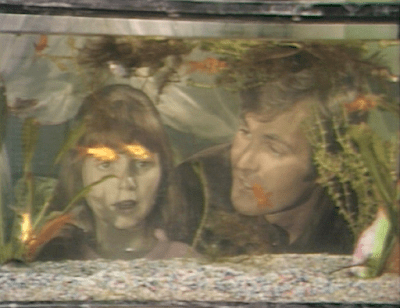
Nickerson and Don Briscoe play part of their scene behind an aquarium. We last saw that aquarium in #276. In that one, we were supposed to be uneasy about Windcliff and about Julia as its director. When we saw her feed the fish, it was a metaphor for her role as the mistress of a strange, self-contained little world whose inhabitants were at her mercy. Julia has been living on the estate of Collinwood for well over a year now, and the only member of Windcliff’s staff whom we see today is a nurse whose bit part was a prize given to beauty contest winner Bobbi Ann Woronko. So our attention is directed not to whoever is in charge of the place, but to Nickerson and Briscoe’s faces distorted in the water as the goldfish pass in front of them. This is rather a heavy-handed way of telling the audience that they are, each in their own way, as much prisoners as are the fish.

In the tank. Screenshot by Dark Shadows Before I Die.

Chris has seen the weather report in the newspaper and realized that the moon will be full tonight. This alarms him. Back at the Collinsport Inn, he asks the innkeeper, whom longtime viewers met in #1 and know as Mr Wells, if he can change his room. He wants the most isolated room in the place. He also wants Mr Wells to lock the door from the outside and to leave the door closed no matter what he hears inside. Mr Wells is reluctant, but agrees to all of these conditions.

Even viewers who stumbled onto Dark Shadows never having heard of it would know from what we have seen between Maggie and Nicholas that it is a horror story. Those who have been to the movies will add Chris’ status as a mysterious drifter to his alarm at the full moon and his request to be locked up and left alone no matter what Mr Wells may hear and will come up with the irresistible conclusion that he is a werewolf. They will also be sure that Mr Wells will eventually decide the sounds coming from behind the door are so terrible he cannot leave Chris alone, and that when he unlocks it Chris will kill him. Of course this is exactly what does happen. Our last shot of Mr Wells shows his face streaked with red and blue markings. The red ones presumably signify blood, and the others signify that most TV sets in the USA in 1968 received only in black and white, so blue lines would look like bruises.

Blue and red. Screenshot by Dark Shadows Before I Die.
The same shot in black and white.

Mr Wells, played by veteran character actor and future TV star Conrad Bain, had last appeared in #61. That was one of the longest gaps between appearances by a cast member, though the record belongs to Albert Hinckley, who like Bain appeared in #1. Hinckley, a train conductor in that one, will return playing a doctor in #868. That’s quite an extended absence from the show, but a remarkably short period to make it all the way through medical school, he must have been very bright.

Also in #1 was Alexandra Moltke Isles as well-meaning governess Victoria Winters; Mrs Isles left the show three days before this episode was taped. Victoria was Dark Shadows’ chief protagonist for its first year, and Mrs Isles’ presence in the cast was a powerful reminder of the show’s history even after the character was relegated to the sidelines of the action. Combining her departure with Mr Wells’ on-screen death, it might seem plausible that Maggie, another survivor from the first episode, might really die on Nicholas’ altar.

Episode 616: When a woman has a man in her power

In June 1967, vampire Barnabas Collins locked his victim Maggie Evans, The Nicest Girl in Town, in the prison cell in the basement of the Old House on the estate of Collinwood. The ghost of Barnabas’ little sister Sarah appeared to Maggie several times while she was in the cell. Sarah told Maggie that no one could know she had been to the cell, and particularly warned her not to tell her “big brother” she had seen her. With some reluctance, Sarah eventually gave Maggie a clue that led her to a hidden passage. Sarah’s father had sworn her to secrecy about the passage, and that not even her big brother knew about it. Maggie finally puzzled out the clue, enabling her to escape just moments before Barnabas came to the cell with the intention of killing her. When Barnabas chased Maggie through the hidden passage in #260, the wondering expression on his face confirmed that he had never had any idea the passage was there.

From November 1967 to March 1968, Dark Shadows was a costume drama set in the years 1795 and 1796, the period when Barnabas and Sarah were living beings and the Old House was their home. We saw how cruelly their father, haughty overlord Joshua, treated his indentured servant Ben, and we saw that Joshua had the great house of Collinwood built with a prison cell in its basement. Joshua confined Ben to that cell in #401. With that, we could be sure that Maggie’s cell was already in the basement of the Old House when Barnabas and Sarah lived there, and could surmise that Joshua really did forbid the living Sarah to share with Barnabas or anyone else what she had found about the hidden passage.

The show never explained how Sarah found out about the passage. We might imagine her hiding and watching Joshua or someone else do maintenance on the cell. But the fact that Joshua kept the existence of the escape hatch from Barnabas suggests he wanted the option of locking his son in the cell. Why not his daughter as well? Perhaps Sarah found the passage while confined in the cell herself. Or perhaps some other, older ghost appeared to her while she was there and told her about it. That the clue she gives Maggie is in the form of a rhyme (“One, two, away they flew…”) would suggest this latter possibility. Sarah may have memorized the rhyme as she memorized the lyrics to “London Bridge” and may have solved the riddle as Maggie solves it.

Shortly after Dark Shadows came back to a contemporary setting in March 1968, Barnabas was cured of vampirism. That cure was stabilized in May, when he donated some of his “life force” to the creation of Frankenstein’s monster Adam in an experiment completed by his friend, mad scientist Julia Hoffman. Barnabas and Julia locked Adam up in the basement prison cell for the first weeks of his life. Vampires and mad scientists are metaphors for selfishness, so it is hardly surprising that they are horribly bad parents. But if Joshua was in the habit of locking his children in that same cell, the moments when Barnabas takes fatherly pride in the imprisoned Adam take on a special pathos. It really does seem like a normal situation to him.

Adam escaped from the cell in #500, demolishing the doorway in the process. Today we see that it has been rebuilt. Perhaps to Barnabas, a house just isn’t a home unless it has a prison cell in the basement.

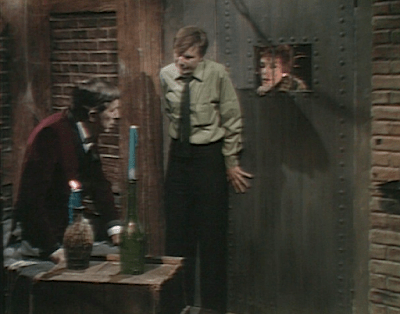
Now, Barnabas has himself become the blood thrall of a vampire, his ex-wife Angelique. Discovering the bite marks, Julia decides to address the situation by locking Barnabas and his servant Willie in the cell. Barnabas won’t be able to get out to heed Angelique’s summons, and Willie hangs a cross over the door to keep her from materializing inside it.

Left to right: Barnabas Collins (Jonathan Frid); Willie Loomis (John Karlen); Julia Hoffman (Lady Elaine Fairchilde.) Screenshot by Dark Shadows Before I Die.

We cut to Maggie’s house. Maggie’s memory of her ordeal as Barnabas’ victim has been wiped from her mind a couple of times. She receives a visitor, the suave Nicholas Blair. Unknown to Maggie, Nicholas is a warlock and Angelique’s master. He has a crush on Maggie which has distracted him from his managerial responsibilities, which to be frank he had not been handling very diligently in the first place. Maggie gives Nicholas several pieces of news that he really ought to have been aware of for some time. She tells him that her ex-fiancé, Joe Haskell, is still alive; that she visited Joe twice while he was at the Old House recovering from some injuries; that Joe is now in the hospital under police guard; and that Joe tried to kill Barnabas and keeps vowing that he will try again, since he believes Barnabas is trying to kill him. Nicholas is flummoxed by all of this, and meekly goes along when Maggie insists on visiting the Old House to pay a call on dear, sweet Barnabas.

The scene in Maggie’s house has an odd feature. We’ve just had a closeup of Willie hanging a cross above the door in the cell to keep Angelique away. In the early days of the vampire storyline, it was not at all clear that the cross would deter vampires in the world of Dark Shadows, since Barnabas was often seen strolling comfortably through a cemetery where half the grave markers were cross-shaped. It was not until #450, during the 1790s flashback, that we saw Barnabas recoil from a cross. In #523, we learned that the cross also immobilizes Nicholas. Yet Maggie is today wearing a dress the front of which is dominated by a red cross, and it doesn’t bother Nicholas a bit. The show is drifting into a spot where it may have to stop and spend time explaining its theurgy. Does the cross only work against a demonic creature if it is specifically aimed at that creature? Or if the person setting it up knows about the creature? Or is there some other qualification? It’s getting confusing.

At the Old House, Julia tells Maggie and Nicholas that they cannot see Barnabas, because he is resting. Maggie keeps insisting, and Julia shifts her ground, claiming that Barnabas went out, she knows not where. When Julia says this, Maggie is incredulous, but Nicholas brightens. Evidently he wants to believe that Barnabas has gone off to respond to Angelique’s call, and accepts Julia’s statement happily. Maggie apologizes for demanding to see Barnabas, and she and Nicholas leave.

Meanwhile, Barnabas is scheming to get out of the cell. While Willie is complying with his request to pour a glass of water, Barnabas bashes him on the head with an empty bottle. He then goes to the hatch for the secret panel, remembers that “Maggie found it a long time ago!” and figures out how to open it. Since we saw Willie open the hatch and show Adam Barnabas’ jewel box in #494, you would think Barnabas already knew how it worked. At that time, it also seemed that the passage behind the hatch had been sealed up, so that it no longer led to the beach. Apparently we aren’t supposed to remember that. Barnabas crawls out and closes the hatch behind him before Julia comes back.

As Barnabas, Jonathan Frid usually moves in the stateliest possible manner. When he escapes from the cell today, the camera lingers on him crawling, driving home the contrast with his typical gait. That is quite different from what we saw in #260, when he followed Maggie into the hatch- then, we saw him move toward the opening, but cut away before he had to take an ungainly position. Today, the makers of the show want us to hold the image of a crawling Barnabas in our minds.

Crawling suggests Barnabas’ weakness under Angelique’s power, certainly, but in this setting it suggests more. This is the house where he was born, and what he is crawling into is a lightless passage that it looks like he will have to squeeze through to emerge outside. He has regressed not only to infancy, but all the way back to birth. If Joshua did indeed confine him to this cell in his childhood, Barnabas would likely have experienced that same regression in those days as well.

The sign of the cross reminds us of one who said that we must be born again to receive a life in which our hopes will be fulfilled more abundantly than we can ask or imagine; Barnabas labored for 172 years under a curse that compelled him to die at every dawn and revive at every sunset, but perhaps even before that he was the prisoner of a cycle of abuse that forced him to experience the trauma of birth over and again, each time finding himself in the same narrow space, a stranger to all hope. Indeed, when Barnabas first became a vampire in the 1790s, he put his coffin in this basement, near the cell, and he persisted in putting it there even after it became obvious that it was very likely to be discovered. That persistence made no logical sense in terms of Barnabas’ need for operational security, but if he saw his vampirism as a continuation of his childhood experience of confinement in the basement cell, it would make all the sense in the world. That is his place, that is where he belongs, that is his reality.

Episode 607: Bedtime

Suave warlock Nicholas Blair wakes Frankenstein’s monster Adam from a nightmare. As we have seen from night-time glimpses of fisherman Joe Haskell and the unpleasant Jeff Clark, it is standard for the young men of Collinsport to go to bed fully dressed, wearing coats, ties, and shoes. Adam is the youngest man around, having been brought to life just this May, but he is wearing pajamas.

Many commenters on fan boards assume that Adam has poor personal hygiene, perhaps because he has spent so much of his short life cooped up in hiding places without running water. But he lives in Nicholas’ house now, and unlike most characters, including Nicholas himself, he has two changes of clothing- the clothes that apparently came with the corpses from which he was assembled, a bright green sweater heiress Carolyn gave him, and his pajamas. So I think we ought to assume that he keeps himself clean.

Earlier this night, Nicholas sicced vampire Angelique on old world gentleman Barnabas Collins in order to keep Barnabas from interfering with his plans for Adam. But he discovers that Adam and Barnabas have a Corsican Brothers-type connection, so that puncture marks have appeared on Adam’s neck. Adam is also weakened, and afraid of Angelique. Nicholas concludes that Angelique will have to leave Barnabas alone. She is deeply disappointed when he tells her of this, but cannot argue, as it is almost dawn and she must get back in her coffin.

We then cut to the Blue Whale, where an unshaven Joe is drinking. Joe is another of Angelique’s victims, and as a result of her power over him has lost his job, his fiancée Maggie Evans, and his self-respect. We were first introduced to Joe in this room, back in #3. In those days, he was a hardworking young fisherman who was too sturdily honest to be tempted by a bribe to spy on the ancient and esteemed Collins family. We have seen him back on this set many times, usually as a stalwart representative of whatever is wholesome and rational. But today he is one of the old drunks leaning on the bar.

Maggie enters. She walks up to Joe. He does not react, and she starts to walk away. She turns back to him and says hello. They have a sad little chat. She says he almost seems to feel about her the way he used to; he says she has no idea how he feels. She tells him what she expects him to say, that he won’t be able to explain to her what’s going on with him; he confirms that it is so. He asks if she is there to meet Nicholas; she says she is, and asks if there is any reason she shouldn’t. He says he supposes not.

Nicholas enters. He asks Maggie if she would like to sit at the bar, but she indicates a table. Joe looks at them, and we hear his thoughts as he wishes he could explain what Angelique has done to him. This gains poignancy for regular viewers, not only because of the contrast between the broken-down figure we see today and the robust young man who so often modeled health and sanity on this same set previously, but also because less than two weeks ago, in #599, Maggie knew all about what Joe was going through. She and Joe were ready to run off together when Nicholas used his sorcery to mind-wipe their knowledge away and reset the story to its current dismal status quo.

Joe leaves the bar and goes to Nicholas’ house to call on Angelique. She is surprised to see him. She didn’t summon him, and she isn’t hungry. She tells him to go away. He says that he’s lost everything because of her, and that she is all he has left. She says he doesn’t have her either, because she is done with him. To make him even more miserable, she takes him to Nicholas’ magical mirror, which can be used to spy on whomever the user chooses, and shows Joe that Nicholas has walked Maggie home. Joe hears Maggie agree that she might fall in love with Nicholas, and watches them exchange a long, passionate kiss.

Joe asks Angelique if she cares that she has utterly ruined his life, to which she replies “Not particularly.” He says that he hates everything he has become, and that he despairs of ever being anything else. He picks up a letter opener intending to stab Angelique. Unable to bring himself to attack her, he sticks it into his own belly.

Angelique makes Joe feel like Mickey Mouse. Screenshot by Dark Shadows Before I Die.

Joel Crothers was dissatisfied with the part of Joe and with Dark Shadows generally. In a couple of months, he will leave the show and take a role on another soap. Very few viewers would have been likely to know that was coming in 1968, but Joe was a popular character who was chronically underutilized. He would have had many fans who might have shared Joe’s fear that the show will leave him in the state to which this storyline has reduced him.

Episode 601: Neither of us is a match

Recovering vampire Barnabas Collins and mad scientist Julia Hoffman are wearing complementary gray outfits today. Julia has a yellow blouse under her gray jacket; Barnabas’ shirt is white, but his tie is flecked with yellow florets that match Julia’s top. Barnabas and Julia have been inseparable for some time, but this is the first time they have coordinated their outfits. I suspect director Lela Swift and wardrobe mistress Ramse Mostoller collaborated to emphasize Barnabas and Julia’s bond.

I don’t know how Julia’s blouse shows up on your screen, but I assure you it is yellow and it matches the bits in Barnabas’ tie.
As Julia’s outfit mirrors Barnabas’ so the ring in his portrait above the mantel mirrors the one on his finger.

In separate scenes, we see heiress Carolyn and Frankenstein’s monster Adam. Adam is in love with Carolyn, and she has recently started admitting that she has deeper feelings for him than she had once believed herself capable of. Each of them wears a bright green sweater today. Adam’s sweater was a gift from Carolyn; perhaps she bought them as a matching set.

There’s also some back and forth involving unsightly ex-convict Harry Johnson and suave warlock Nicholas Blair. Their outfits are unique, which is no surprise. They are disconnected not only from each other, but also from the other characters, because they stand at opposite extremes in the story. Nicholas has the most complete understanding of what is going on and the most ability to affect events, Harry the least of both those things. Harry tries to sell Nicholas some information; Nicholas isn’t interested in paying him. A threat on his lips, Harry goes to leave Nicholas’ house. He finds that he can’t open the door. Within seconds of trying to frighten Nicholas into submission, Harry starts begging him to come open the door. That leads to some magic tricks which show just how ridiculously far out of his depth Harry is in his attempt to strong-arm Nicholas. Granted, Harry was out of his depth earlier in the episode when he tried to play hardball with Carolyn, so you’d think he’d have developed a sense of his limitations by now.

Episode 554: What must be

Recovering vampire Barnabas Collins is in the woods on the estate of Collinwood, searching for well-meaning governess Vicki Winters. He hears dogs howling, as they used to howl when he was in the grip of bloodlust. He goes to pieces at the memory.

Barnabas’ fellow searcher, Vicki’s fiancé Peter Bradford, sees him standing petrified. Barnabas asks him if he can hear the dogs. Peter says he can, and is puzzled that Barnabas was afraid he was hallucinating their sounds. Peter asks Barnabas if he is all right. Barnabas insists that he is just worried about Vicki, and resumes searching.

Shortly after, Barnabas finds himself in the foyer of the great house on the estate, slumped in a chair under his own portrait. He makes a sad contrast with the haughty figure in the painting. His friend Julia Hoffman enters, and he gives her a pleading look that emphasizes the contrast between his present weakness and the arrogant power he wielded when he posed for the portrait, more than 170 years before.

Barnabas tells Julia that he does not know how he got into the house. The last he remembers, he was in the woods and heard the dogs howling. She suggests that their noise may not mean anything, but he is sure there is some unearthly horror afoot.

Barnabas tells Julia something else he is sure of. Earlier this evening, Frankenstein’s monster Adam came to his house. Adam mistakenly believes that Barnabas created him, and demanded that he build a woman to be his mate. When Barnabas told him that would be impossible, Adam vowed to make him sorry, then left. Shortly after, Vicki came by for a brief visit. Barnabas is certain that Adam abducted Vicki to use as a hostage, and that the only ransom he will accept is the artificially created woman he has no way of supplying.

Barnabas goes to the telephone and announces he is going to tell the police what he knows about Adam. Julia objects that Adam can tell the police enough about the two of them to expose them both to prosecution. Barnabas says that he is willing to take that risk for Vicki’s sake, and begins dialing. Julia says she is not, and places her finger on the telephone receiver to end the call.

Julia has never been able to entirely conceal her dislike for Vicki, rolling her eyes when Vicki talks to her and making sarcastic remarks when Barnabas praises her, so regular viewers can hardly be surprised that Julia does not volunteer to go to prison for her sake. Still, Julia has often enough shown a troubled conscience about the many crimes she has committed during her association with Barnabas that her utter coolness represents a new step in the character’s development. The other day she wanted to shoot wicked witch Angelique, but Angelique was not really human and was enormously dangerous. Even so, Julia was deeply upset when she made up her mind to kill her, and she backed down when she came face to face with Angelique. But Vicki is resolutely, unfailingly, rather tediously good, Good with a capital G. That Julia is so blandly willing to consign her to death at Adam’s hands suggests that her sense of right and wrong will no longer serve as a brake on any sinister plans that might advance whatever goals she and Barnabas are pursuing.

Barnabas looks at Julia, shocked. Perhaps her coldness shocks him. Perhaps what shocks him is that he is so dependent on her that he does not resume dialing.

Meanwhile, another drama has played out not so far away. Electrician Tom Jennings was inspecting the wiring in a house that suave warlock Nicholas Blair is renting from the ancient and esteemed Collins family. Tom told Nicholas that he wanted to inspect the cellar to make sure the foundation was in good repair. Nicholas replied that this would not be necessary, but Tom insisted. He opened the cellar door, and found a coffin. Nicholas told him that the coffin was there when he moved in. Tom asked if he’d called the police, and Nicholas replied there was no need, since the coffin was empty.

On his way home, Tom told himself that the Collinses wouldn’t leave a coffin in the basement of one of their houses. That shows what he knows- for the first 55 weeks of the show, matriarch Elizabeth Collins Stoddard thought that her husband was buried in a box in the basement of the great house, and when he was a vampire Barnabas kept his coffin in the basement of his house. It wouldn’t be a Collins house if it didn’t have a coffin in the basement, and a dungeon too.

Tom sees someone and asks who it is. The part of the other person is played by the camera, so we do not know. The camera zooms in, and Tom collapses.

Later, Peter finds Tom propped against a tree. He touches Tom, and Tom falls over, apparently dead. He has two bloody wounds on his neck. Peter goes back to the great house. He tells Barnabas and Julia that he must use the telephone. They hear him describe Tom’s wounds to the police. Afterward, Barnabas and Julia realize that there is another vampire operating in the area.

Tom’s appearance is the debut of Don Briscoe, who would be a big part of Dark Shadows for almost two years. On his Dark Shadows Every Day, Danny Horn told an amazing story about Briscoe:

Many years ago, when I was in high school, my mother walked into the room while I was watching Dark Shadows.

She looked at the guy on the screen, and said, “Is his name Don?”

I said, yeah, that’s Don Briscoe, and she said, “I thought so. I knew him, when I was in grad school. He asked me out once.”

Seriously, true story. She said that they were both getting a master’s in English — he was at Columbia University, and she was at Barnard, which is right across the street. He asked her out on a date, and he was very handsome, and very nice, but he wasn’t Jewish, so she said no.

At the time, I had no way to verify this, and I never really knew what to think about it. I mean, she knew the guy’s first name, but maybe she confused him with some other brown-haired guy named Don.

But now I have this excellent book called Barnabas & Company, which has extensive bios on everybody in the cast. It turns out that he really did get a master’s degree in English at Columbia University, and that means that Don Briscoe is kind of my dad.

Danny Horn, “Episode 565: Weird Science,” Dark Shadows Every Day, 10 January 2015

Granted, hundreds of actors had parts on Dark Shadows over the five years of its run, a great many people have blogged about the show, and I’m sure Danny’s mother was a very attractive young woman who had offers from lots of fellows. But Briscoe was one of the more important members of the cast, and Danny is as good as any of the bloggers. So it really is a noteworthy coincidence that they are connected to each other in that particular way.

Episode 528: Old girl

In his post about this episode on Dark Shadows Every Day, Danny Horn remarks on the recapping that permeates the dialogue and reckons it as writer Sam Hall’s critique of the ongoing storylines. That assessment will be familiar to those who, unlike Danny, have been watching the show from the beginning. When Ron Sproat joined the writing staff in October 1966, his first several scripts featured a systematic inventory of the available narrative material, with each plot very explicitly marked as suitable or unsuitable for further development.

In its first year, very little happened on Dark Shadows; now, it has swung to the opposite extreme, and there is a climax at every commercial break. But the result is oddly similar. They don’t take the time to explore the overall situation, so that little seems to be at stake even when a spectacular event takes place. No matter how much happens per minute of screen time, it feels like the pace is slow. We see suave warlock Nicholas in the gazebo on the grounds of the estate of Collinwood summoning his subordinate, the wicked witch known variously as Angelique and Cassandra, and hear him complain that she has spent weeks attempting to do what she should have accomplished in minutes. Thus Hall assures us that the pace will be picking up.

Angelique/ Cassandra comes to the gazebo, to which Nicholas refers as a “ga-ZAY-bo” in a bit of Collinsport English Angelique/ Cassandra herself introduced in #489. There, the two of them quarrel about her dilatory approach. They stand behind columns and look like debaters at podiums.

The debaters. Screenshot by Dark Shadows Every Day.

Danny Horn’s commenter “lakeplacidskater” made an interesting observation about the moment screenshotted above:

Maybe I’m reading too much into the set design, but in one of the photos Angelique and Nicholas are sperated by a statue of a Goddess (I assumed Venus). Wouldn’t it be awesome if it was Venus and that statue between them was to represent Angelique’s love for Barnabas blocking her efforts at villainy? More likely that the shot just looked better composed with the statue in the middle but how awesome if it was meant to be subtle symbolism! 🙂

“lakeplacidskater,” posted 25 February 2015 on Danny Horn, “Episode 528: This Tawdry Affair,” 21 November 2014.*

The statue appears to me to represent not Venus, but a harvest goddess. She is fully clothed, and there is a sack at her feet which seems to be full of grain. That makes a lot less sense than does the suggestion “lakeplacidskater” made. The Collinses derive their wealth from fishing and shipping, not from farming, so it is surprising that they would put a symbol of agriculture in such a prominent place. Perhaps she stands for wealth in general, but not for so much wealth that the family could afford to commission a statue of a sea goddess. And neither a bountiful harvest in particular nor wealth in general is any sort of obstacle between Nicholas and Angelique/ Cassandra. I suppose the visual metaphor might be emphasizing the image of the two of them as debaters, with the goddess serving as moderator.

Nicholas dominates Angelique/ Cassandra thoroughly and rather cruelly. Viewers who remember her from the portion of Dark Shadows set in the late eighteenth century may be taken aback by this. In those days, her power often seemed to be limited only by her own carelessness. That made for something of a shapeless narrative, since no one could oppose her effectively. Not only does Nicholas reduce her to a lowly state today, but he himself bungles a simple task when he sets out to do something nasty to well-meaning governess Vicki. Thus we see that the villains will have their work cut out for them.

Later, Vicki is in bed at her friend Maggie’s house. She has gone there to escape a curse Angelique/ Cassandra has placed that has caused several people to have the same nightmare. Since Maggie was at home when she was the first person to have the nightmare, and Vicki’s boyfriend Peter was sleeping there when he had it, it is hard to understand why Vicki thinks it is a place of safety.

We have several closeups of the face of the clock while Vicki goes to sleep. It’s an Ingraham eight day clock, apparently they wanted to make sure we knew that. When Vicki finally nods off, Angelique/ Cassandra materializes in the room with a jar of rose water that is supposed to make Vicki have the nightmare. Ever since the days when humanoid Phoenix Laura Murdoch Collins was on the show, we’ve been seeing undead witches materialize in people’s bedrooms while they sleep. This time, Maggie walks in and sees Angelique/ Cassandra. She screams at the sight. All of the women in the cast were required to scream frequently, so frequently that fans become connoisseurs of screaming. Kathryn Leigh Scott was one of the better screamers, not far behind Clarice Blackburn, so that makes for a satisfying ending.

*I can’t help but point that when “lakeplacidskater” left her post, all the members of the cast were still alive. Humbert Allen Astredo would die in 2016 and Lara Parker in 2023; Alexandra Moltke Isles, Roger Davis, and Kathryn Leigh Scott are still with us.

Episode 505: Prepare yourself for an ordeal

Sheriff Patterson, leading his deputies through the woods in search of a very tall man named Adam who has escaped from gaol, finds a scrap of Adam’s clothing on a tree. He looks ahead and sees the Old House on the estate of Collinwood. He remarks “That’s the old Collins house. Every time anything goes wrong around here, that’s where all roads seem to lead.” He takes his party toward the house. Once they are gone, Adam comes out from behind a tree, and goes in another direction. Unknown to the sheriff and his men, Adam is a Frankenstein’s monster. He is four weeks old and has a vocabulary of fewer than a dozen words, but he easily outwits Collinsport’s entire law enforcement community.

The Old House is home to Barnabas Collins, whom the audience knows to be a recovering vampire. The sheriff calls on Barnabas and recaps the story for his benefit. In his post about the episode, Danny Horn ridicules every part of this preposterous scene, getting half a dozen genuine laughs. I won’t compete with him, but I do want to point out that while in both Wednesday’s episode and yesterday’s, the sheriff said it took twenty men to subdue Adam and take him into custody, today he says it took six. Maybe by next week it will be down to one deputy and a mynah bird.

Adam has abducted heiress Carolyn Collins Stoddard. When he eludes the police, he goes to the abandoned structure where he has cooped her up. He had left her there to go look for food. That mission was interrupted by his arrest. Now, she asks to go home. He is carrying her back there when they meet the sheriff, his deputies, and Barnabas at the top of Widows’ Hill. From the second episode, we have known that people plunge to their deaths from this hill. We’ve heard stories about several such incidents, have seen a number of characters come close to falling from it, and in #425 we saw gracious lady Josette make the fatal leap. Carolyn slips from Adam’s arms to the edge of the cliff; the deputies see him pull her up. She runs into Barnabas’ arms, and Adam falls.

After Adam’s fall, we hear a message that is very familiar to us, but that Barnabas and his friends have never heard. Adam was created in an experimental procedure that was meant to relieve Barnabas of his vampirism. His creator, mad scientist Eric Lang, died shortly after recording an audiotape explaining that as long as Adam lives, Barnabas will be human, but that he will become a vampire again if he outlives Adam. This message plays out over images of the waves crashing into the rocks of the shore. It’s an effective visual complement to the message, a metaphor for the overwhelming power that will engulf Barnabas and the rest of them if Adam is in fact dead.

Episode 483: The three faces of Willie

In April 1967, dangerously unstable ruffian Willie Loomis inadvertently freed vampire Barnabas Collins to prey upon the living. Barnabas made Willie his blood thrall, and reduced him to a sorely bedraggled state. As spring turned to summer, Barnabas added Maggie Evans, The Nicest Girl in Town, to his diet. When Barnabas first held her captive in his house, Maggie was dazed and submissive, but as he tried to brainwash her so that her personality would disappear and that of his lost love Josette would take its place, she began to rebel. Maggie and Willie formed a strange friendship as he did what he could to protect her from Barnabas. Eventually she escaped, and mad scientist Julia Hoffman erased her memory of what Barnabas did to her. When Willie tried to warn Maggie that Barnabas might attack her again, the police jumped to the conclusion that it was he who had abducted her. They shot him. He was declared insane and sent to Windcliff, a mental hospital of which Julia is the director.

A few weeks ago, another mad scientist, Eric Lang, gave Barnabas a treatment that put the symptoms of his vampirism into remission. At the time he was feeding on two women, heiress Carolyn and well-meaning governess Vicki. When Barnabas gained the ability to go around in the sunlight, cast a reflection, and eat solid food, Carolyn and Vicki’s bite marks disappeared. It is unclear whether either of them remembers that Barnabas was a vampire, but their personalities certainly went back to what they were before he bit them. That leaves us wondering about Willie. When Barnabas responded to Lang’s treatment, did Willie revert to the violent personality he had in his first full week on the show, when on Tuesday he menaced Maggie in a barroom, on Wednesday he cornered Vicki in the study at Collinwood, and on Thursday would have raped Carolyn if she hadn’t drawn a gun on him? Did he become some version of the deeply troubled young man who was desperate to help Maggie but powerless to resist Barnabas? Or did he become something else entirely?

Today, in furtherance of Lang’s evil plans, Barnabas wants to free Willie from Windcliff and bring him back to his house on the great estate of Collinwood. Julia has become Barnabas’ best friend, but she is firmly opposed to his association with Lang. So Barnabas lies and tells her that he wants to free Willie because his conscience is plaguing him. Julia knows that isn’t true, and points out that he never visited Willie at Windcliff. Barnabas replies that when he was in the full grip of the curse, he could move about only after dark, and says that he could hardly show up at the hospital to visit Willie in the middle of the night. Julia says that she would have arranged it had he asked. He doesn’t have an answer to this, and she doesn’t fall for any of Barnabas’ other fabrications. But she can’t figure out what he really is doing. She plays along with him, and the two of them go to see Willie at Windcliff.

This is the first time we have seen Barnabas outside of a little orbit composed of Collinwood, the village of Collinsport, and the cemetery north of town. Not only was Barnabas’ ability to travel limited while the symptoms of the curse were manifest, he often lost interest in people when they left the area. So in the fall of 1967 he was obsessively hostile to strange and troubled boy David and obsessively indecisive about Vicki until the two of them went to Boston, at which point he seemed to forget they existed. It’s too bad the set representing the waiting area at Windcliff isn’t more visually striking- Barnabas’ first trip out of the Collinsport area marks a significant change in the character’s possibilities, and it would be good if it came with an image that would stick with us.

While Barnabas waits, a glossy magazine catches his attention. He picks it up and leafs through it. Since we are about to see Willie for the first time in several months, there is a good chance that this little bit of stage business will remind regular viewers of a peculiar remark Barnabas made shortly before the last time we saw Willie. Shifting the blame for his own crimes onto Willie, Barnabas planted Maggie’s ring in Willie’s room. When he came up with this plan, Barnabas remarked that the cheaper sort of tabloids say that criminals sometimes hold onto morbid mementos of their crimes, prompting us to picture Barnabas reading a cheap tabloid. That incongruous image comes to life here:

Julia joins Barnabas in the waiting room. They talk for a moment, then a nurse ushers Willie in.

At first, Willie is silent, a confused look on his face. He walks slowly towards Barnabas. Barnabas asks Willie if he recognizes him. In this moment we pick up exactly where we left off in #329, when Willie was a patient in another hospital and did not remember who Barnabas was.

This time Willie does recognize Barnabas. But as he did at the end of #329, he seems happy and untroubled. He is positively childlike in his eagerness to go back to Barnabas’ house and work for him again. He says that he and Barnabas were friends and that he always enjoyed their time together, a statement that dumbfounds Julia, as it dumbfounds anyone who remembers the show from April to September 1967. Even when Barnabas wasn’t bashing Willie across the face with his cane, Willie was miserable beyond words and hated everything Barnabas forced him to do.

Julia sends Willie back to his room, and Barnabas proclaims that Willie is entirely cured. Julia sarcastically thanks him for his diagnosis, calling him “DOCTOR Collins!” This too harks back to #329, which ended with Willie asking Barnabas if he were a doctor, to which Barnabas replied, “That’s right. I am a doctor!”

Barnabas takes Willie back to his house and tells him that for the time being, he must not so much as go outside by himself. Willie accepts Barnabas’ explanation that many people in the area will have to be prepared for his return before they see him. Willie gladly agrees to stay in the house. Barnabas leaves him alone, and he immediately slips out. He is heading for Maggie’s place.

Maggie’s father Sam is a painter, a fact advertised by the canvases around the cottage they share. When we cut to the cottage, she is making a frame. This is rather an obvious visual metaphor. The last time Willie came to the cottage, he inadvertently framed himself for Barnabas’ crimes against Maggie.

Of course Maggie is horrified to see Willie at the door; of course she demands he leave; of course she threatens him with her hammer when he insists on staying and telling her he is innocent; of course she cries for help when her boyfriend Joe comes to the door; of course Willie runs off when Joe enters. Willie puts himself in the frame again, this time as an ongoing threat to Maggie and all the women of Collinsport.

Joe goes to Barnabas’ house and demands to see Willie. At first Barnabas plays dumb, but Joe doesn’t give an inch. Barnabas then admits that he persuaded Julia to let Willie out of the hospital, but assures Joe that Willie is no longer dangerous and tells him that he will see to it that Willie behaves himself. Joe says that Barnabas has already failed in his responsibility, since Willie just went to Maggie’s house and scared her. Joe says that he will kill Willie if he goes near Maggie again. He repeats that assurance, and his voice is pure steel.

Joe exits the house. We see him outside, walking away. Willie emerges from the shadows with a rifle. He takes aim at Joe and squeezes the trigger. The gun isn’t loaded, so Willie makes nothing more than a click. Apparently that was enough for him. He grins maniacally.

On their Dark Shadows Every Day, John and Christine Scoleri point out that the the gleeful face Willie flashes after he clicks his rifle at Joe is the same expression he showed in the frenzied crimes he committed before he came under Barnabas’ power. They back this observation up with a pair of screenshots, one of Willie immediately after he pretended to kill Joe, one from his last moment before he released Barnabas and lost his freedom:

Indeed, the whole episode replays Willie’s character arc from April to September in reverse. He starts as the crushed little thing we had seen at the end of #329, becomes Maggie’s tormented and misunderstood would-be protector, then ends as the dangerously unstable ruffian who followed seagoing con man Jason McGuire to town. If the episode were a few minutes longer, John Karlen might have had to take a break and let James Hall play the last scene. This recapitulation heightens the initial suspense generated by the question of how Willie would be after Barnabas had lost his vampire powers. Whatever effect the change in Barnabas has had on Willie has certainly not made him less complex or more predictable. We can’t tell when he is being sincere and when he is faking. Based on what we see today, it’s possible he is being sincere the whole time, but that he is just extremely impulsive, and equally possible that everything he does and says is a fake meant to cover up something we don’t yet know enough to guess at.

The actors are uniformly excellent today. John Karlen has to recreate the three faces of Willie in quick succession, and executes each of them clearly and memorably. Almost all of Grayson Hall’s dialogue is expository, but while delivering it she shows us all of Julia’s complicated feelings about Barnabas and lets us into her attempt to solve the riddle of his plans for Willie. Kathryn Leigh Scott is only on screen for a few minutes, beginning with her absorbed in carpentry and proceeding directly to screaming and running around and clutching at her male scene partners, but still makes it clear that Maggie is a strong and level-headed person who has been forced into frantic behavior by circumstances no one should have to face.

In the confrontation with Barnabas, Joel Crothers shows us a new side of Joe. Always loyal, always honest, always hardworking, Joe has up to this point been soft-spoken and self-effacing, deferential towards members of the ancient and esteemed Collins family. The only time he broke that deference was when he spoke some harsh words to matriarch Liz in #33, and he had to get thoroughly drunk to manage that. There is no trace of drink in him now, and he does not regard himself as anything less than Barnabas’ equal. For the first time since Burke Devlin lost his connection with the plot and shriveled so drastically that he ceased to be Mitch Ryan and became Anthony George, Dark Shadows has a plausible action hero in its cast.

The part of Barnabas is especially challenging today; he tries and fails to fool Julia in the beginning and Joe at the end, and in between may or may not have fooled Willie. So Jonathan Frid must show us what it looks like when Barnabas does an unsuccessful job of acting. He chooses to do that by having Barnabas overact. My wife, Mrs Acilius, pointed out that Frid’s own performance in the role of a man who is severely overacting is in fact exceptionally restrained and precise. Frid bobbles his lines as he usually does, but never makes a wrong physical move, and not for one second does he miss the perfect tone for Barnabas’ lines. The result is simply outstanding.