
Dark Shadows spent a few months trying to put a story together from some themes drawn from the works of H. P. Lovecraft. A race of Elder Gods known as the Leviathan People wanted to escape from their long captivity in the underworld, retake the Earth, and destroy humankind. To that end, they controlled the minds of several people in and around the village of Collinsport, formed them into a cult, and entrusted them with the care of a fast-growing, shape-shifting monster. When the monster was able to assume the form of a grown man, he was supposed to be joined to heiress Carolyn Collins Stoddard in an unholy ceremony that would transform Carolyn into the same sort of being he was, and mark the beginning of the Time of the Leviathan People.
In #965, the unholy ceremony was underway. But the monster, who when he first appeared as an adult invited people to “Call me Jabe,” had decided he would rather become a human than turn Carolyn into a Leviathan. So he called to Carolyn’s distant cousin, old world gentleman Barnabas Collins, to whisk her away from the scene while he used the Leviathan sceptre to smash the Leviathan box, causing the Leviathan altar to explode and the Leviathan high priest to declare that the time of the Leviathans was over. He told Jabe that he had not only ruined the Leviathans’ grand design, but had doomed himself. His squamous, rugose, and paleogean form was his only true form; the tall young man is just a projection that cannot survive on its own.
Evidently, the original plan was that Jabe’s rebellion would begin a second half of the Leviathan arc. In that half, the chief villain would be a Leviathan who had been roaming the Earth for centuries and who wielded powers as great as Jabe’s even though he could not fulfill Jabe’s intended role as harbinger of Leviathan world dominion. The battle that Barnabas, Jabe, and their allies waged against that villain would involve a trip back in time to the 1790s, during a brief visit to which period Barnabas had first encountered the Leviathans. That return to the 1790s would tie the Leviathans into the tales that have become basic to the show’s backstory, including the stories of the gracious Josette, well-meaning governess Vicki, and Barnabas’ first vampire curse.
They abandoned that plan in some haste. The Leviathan arc never came together as a coherent story, and it was a flop in the ratings. So they never introduced the second Leviathan villain. In his place, they brought back suave warlock Nicholas Blair, who had been one of the villains in 1968, and made him the high priest of the cult and Jabe’s supervisor. When we hear about past deeds that Nicholas could not have done, they nonsensically attribute them either to Mr Strak, a character whose whole point was that he was only on the show once and could never be seen or heard of again, or to Jabe himself, who is four months old. The ghost who was supposed to usher in the return to the eighteenth century turns up in two episodes, does some shouting, then meets wicked witch Angelique, who tells him that he is irrelevant to the story and causes him to disappear forever.
Now, the show is gearing up to tell a story about a parallel universe that Barnabas has found in the east wing of the great house of Collinwood. But all the actors we need to kick that story off are in the cast of the film House of Dark Shadows, which had started principal photography by the time this episode was taped. So we have to find a way to take the characters left over from the Leviathan arc and make a story out of whatever it is they are doing.
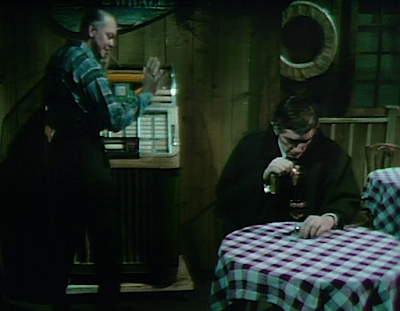
Even though Nicholas has said in so many words that the Leviathan segment is over, he and his henchman Bruno are still hanging around Collinsport. They are joined by a third stooge, Angelique’s estranged husband Sky Rumson. Sky had been a fabulously successful publisher because of the deal he made when he met Nicholas and sold his soul to him, but now that the Leviathans have been defeated his enterprises are going under. Sky has apparently been crashing at Bruno’s place.
Bruno and Sky are holding a young woman named Sabrina Stuart prisoner. Sabrina had shown up and offered Bruno a packet of cash to leave Collinsport and forget about her fiancé, Chris Jennings, whom he knows to be a werewolf. Bruno refused to leave, saying that he hopes to exploit Chris’ curse for his own evil purposes. Sabrina then drew a gun on him. Before she could shoot, Sky bumbled in and distracted her. Bruno ordered Sky to guard Sabrina while he contacted Nicholas. Sky resented Bruno’s commands, but obeyed them anyway.
When Sky gets Sabrina into Bruno’s back room, she asks him what they are going to do to Chris. Sky lampshades the fact that there is no reason for him to be on the show when he says that he has never heard of Chris and has no idea what is going on. After Bruno and Nicholas have conferred, Sabrina tells Sky that they seem to have forgotten about him. Sky protests that this is impossible, since Nicholas had promised to talk with him about his future. He goes out to the front room, and sees that Sabrina was right. Bruno and Nicholas have in fact left without him.
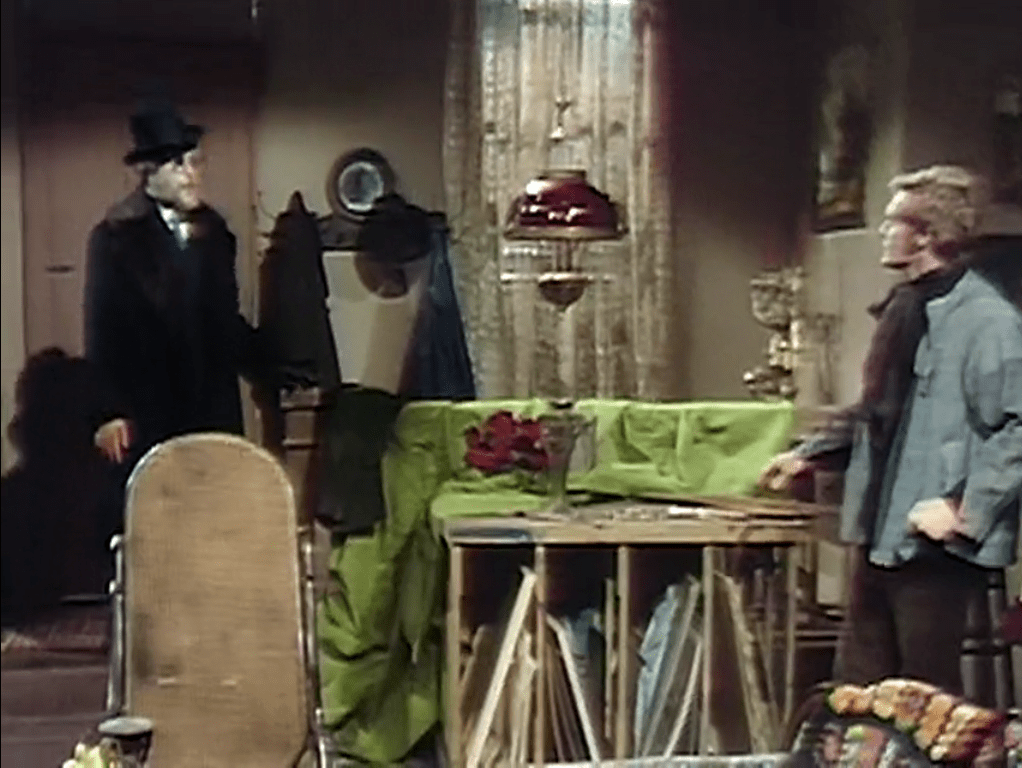
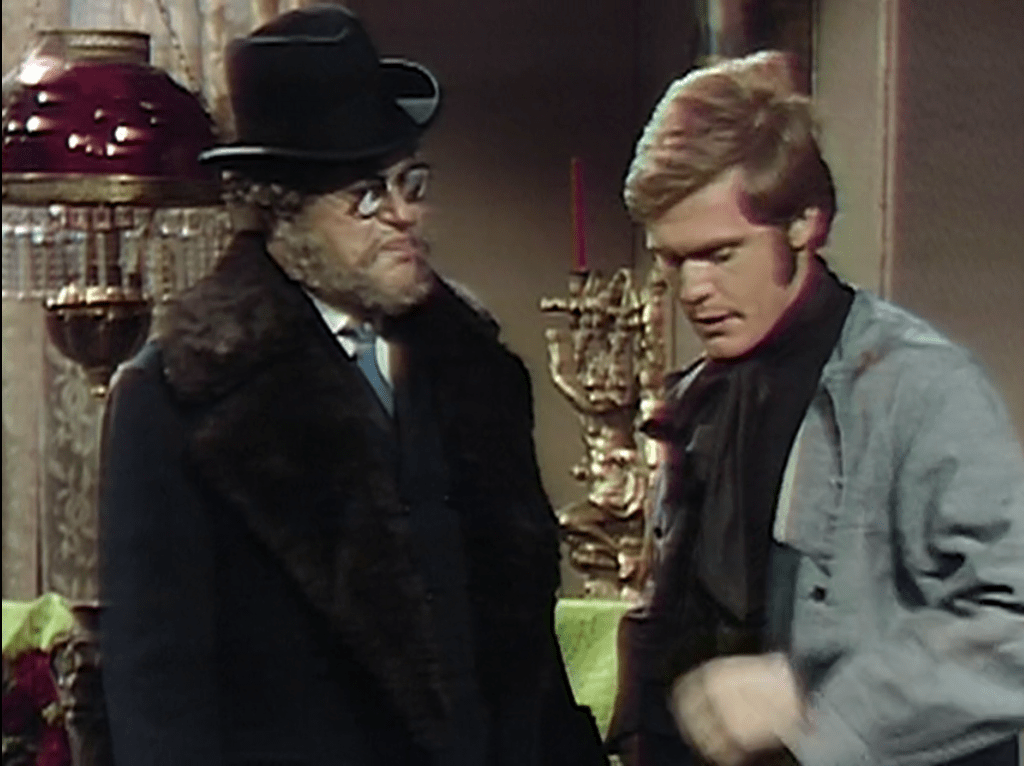
Sky finds Angelique sitting in the corner, waiting for him. She left him when she learned that he was a pawn of the Leviathans and he tried to set fire to her. She taunts him for his reduced circumstances:
ANGELIQUE: From tycoon to lackey. My, how the mighty are fallen.
SKY: Angelique, what are you doing here?
ANGELIQUE: Oh, I came to see you, Sky.
SKY: How did you know where to find me?
ANGELIQUE: Oh, I’ve been keeping a very close watch on your activities. Tell me-how does it feel to be a has-been?
SKY: What are you talking about?
ANGELIQUE: That’s what you are, you know.
SKY: I said, what are you talking about?
ANGELIQUE: Every one of your business ventures is a disaster. There’s nothing you can do about it, because all you are now is Nicholas Blair’s slave.
SKY: That’s not true! I’m very important to him!
ANGELIQUE: Oh, don’t be absurd. Consider right now, what you’re doing- what he has you doing. Keeping guard over a helpless young girl. You’re not important to Nicholas. He doesn’t care anything about you.
SKY: That’s not true.
ANGELIQUE: What does Nicholas plan to do with that girl anyway? Or hasn’t he consulted you?
SKY: Angelique, shut up!
ANGELIQUE: What’s the matter, Sky? Am I making you unhappy?
SKY: Get off my back!
ANGELIQUE: [Chuckling] Oh, you’ve grown quite thin-skinned in your declining days, haven’t you?
Shall I tell you how it’s all going to end? Nicholas is going to find some ingenious way of doing himself in, he always does. And then you’re going to be alone. All alone. With no one to turn to. And then… Someone’s going to put you out of your misery. Who knows? It may even be me. Well, I better not keep you any longer. I know you have an important job to do in the next room.
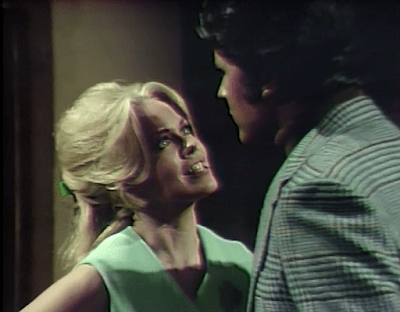
Angelique’s sarcastic characterization of guarding Sabrina as “an important job” not only reflects the lowly status of the work compared to the executive responsibilities Sky recently had as the head of a big business. The story has passed Sabrina and Chris by as completely as it has passed by Sky, Nicholas, and Bruno. Chris knows that on nights of the full moon, he will become an animal who, if not restrained, will kill at least one random person. Both magical and scientific means to relieve him of his curse have failed, but he has friends who will keep him cooped up on those nights so that he doesn’t hurt anyone. Yet he persistently refuses to let them do so. He is deliberately choosing to be a serial murderer. Not only is there no moral ambiguity about him, he has no plans or goals to draw our curiosity and win our sympathies in spite of ourselves. He is a simply and tediously bad person, and to the extent that livelier characters go along with him we like them less. Since Sabrina has no interest in anything other than her relationship with Chris, the two of them are both useless.
Nicholas is puzzled that Jabe continues to exist. He thinks that Jabe’s love for Carolyn, whom he has married, is giving him such a strong will to live that he has managed to hold onto his humanoid form for so long. As Angelique indicated when she told Sky that “Nicholas is going to find some ingenious way of doing himself in, he always does,” Nicholas’ run on the show in 1968 ended with the total failure of all his efforts and his abrupt recall to Hell. But he hopes that he can turn things around for himself. He was only seconded to the Leviathans by his real boss, Satan. He thinks he might be able to get his career back on track in Satan’s organization if he can be the one to destroy Jabe. To that end, he wants to use the werewolf to kill Carolyn, thereby depriving Jabe of his zest for life and making him fade away.
Siccing the werewolf on Carolyn is a typical Nicholas scheme. Even in his monstrous form, Jabe was defenseless against werewolves. So all Nicholas has to do is set the werewolf on him. Bringing Carolyn into it only increases the chances of failure. Moreover, Jabe is likely to be killed off soon, so we might have been willing to believe Nicholas would be the one to do it. But Carolyn has been a core member of the cast since the first week, so once Nicholas promulgates a scheme that involves her death, regular viewers know nothing will come of it.
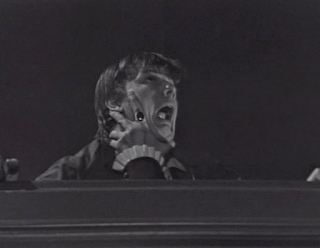
Moreover, Nicholas has only a short time to make good his designs on Jabe. Angelique blames Jabe for Sky’s involvement with the Leviathans, and has taken a page from George MacDonald’s 1858 novel Phantastes by plaguing him with an autonomous shadow that occasionally appears to him. The shadow that attached itself to Anodos, MacDonald’s protagonist, was an allegory for anxiety as a consequence of unredeemed sin, but the shadow Angelique imposes on Jabe is a direct threat to his physical survival. It grows in size and intensity at each appearance, and when it engulfs Jabe entirely it will kill him.
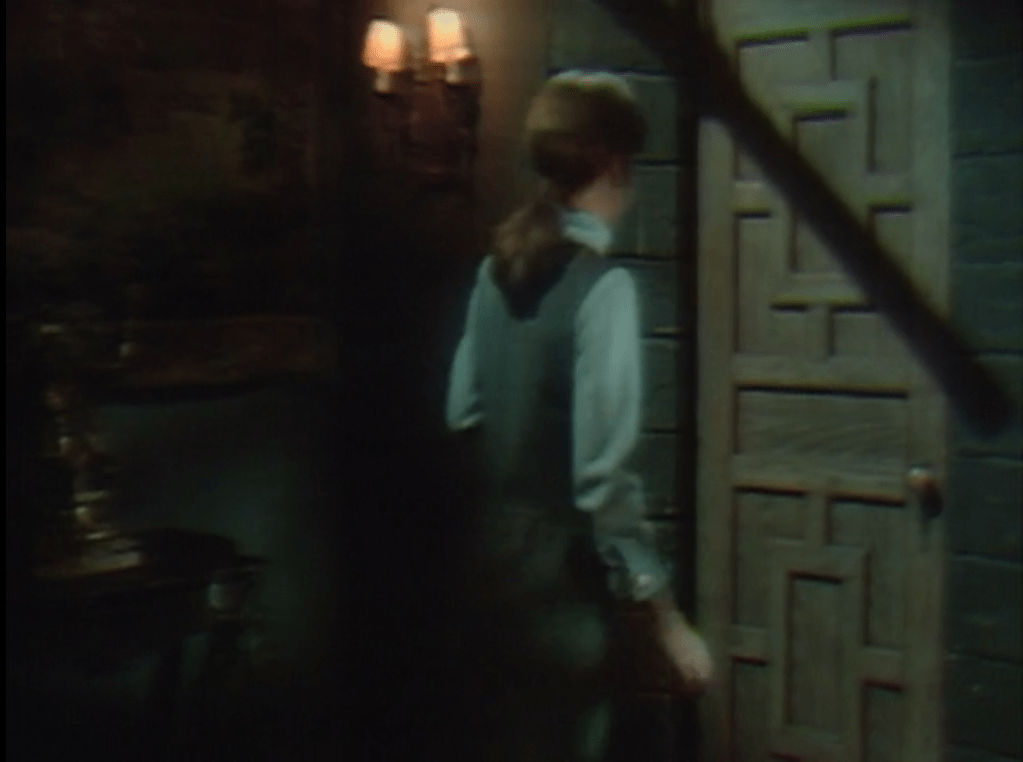
In the drawing room of the great house of Collinwood, Jabe calls on Angelique to relieve him of the shadow. Nicholas comes instead. Jabe asks him for help against the shadow. He refuses. He does say that he very much hopes that he, not Angelique, is the one who finishes Jabe off, but he will not try to remove the shadow even to improve his own odds of success. Again, we are left wondering why the camera keeps settling on Nicholas if he won’t take action to change the direction of the plot.
Angelique appears to Jabe after Nicholas has gone. Jabe pleads with her to lift the shadow, and she says no. He tells her he had nothing to do with Sky’s recruitment to the Leviathan cult, and that he barely knows Sky. Angelique knows these things to be true, so she pauses before she answers him. She tells him he was the center of the Leviathan conspiracy, so she blames him for everything done in the course of it.
We end up at Bruno’s place. Sky has told Chris that Sabrina is being held prisoner there, and has given him the key. Chris lets himself in and opens a closet. He finds Sky in it, strung up by his wrists and bleeding. Sky begs for help, and Bruno appears. He holds a gun on Chris and greets him with “Good evening, Mr Jennings! Sabrina and I have been waiting for you.”
Writer Gordon Russell deserves a lot of credit for taking this unpromising material and coming up with a well-constructed script with a fast pace and intelligent dialogue. The actors also do a good job, all of them except the woefully inept Geoffrey Scott as Sky.
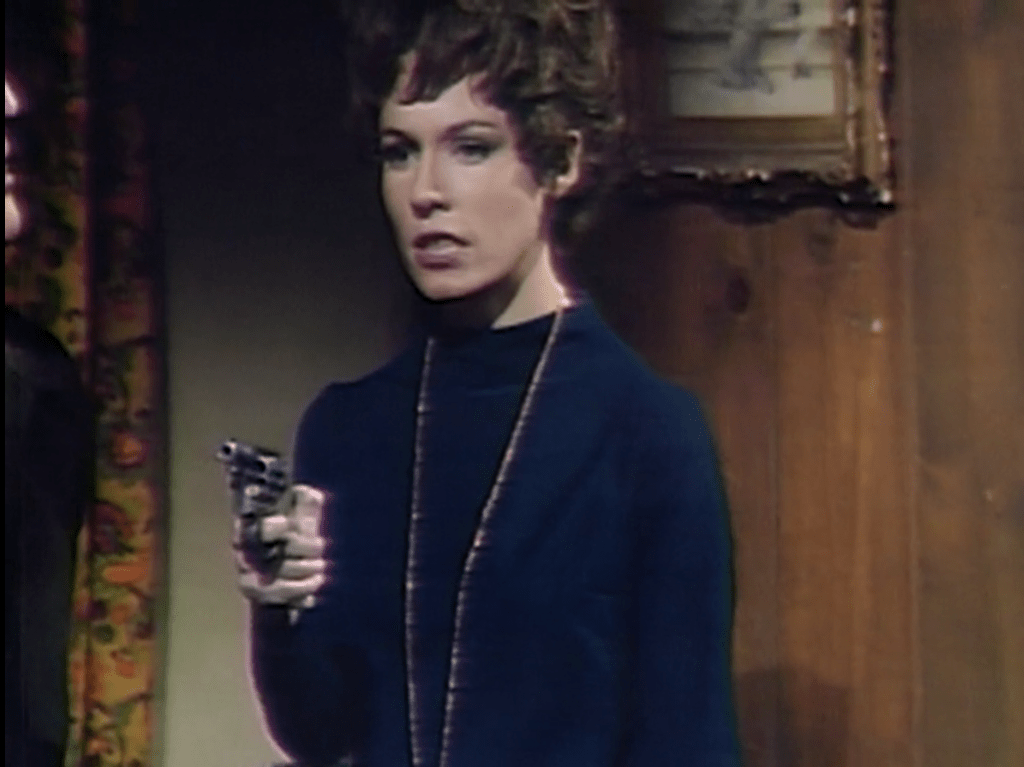
But director Henry Kaplan really does let everyone down. The episode starts with a fantastically bad job of blocking. Bruno and Sabrina are standing at right angles to each other, enabling us to see both of their faces.
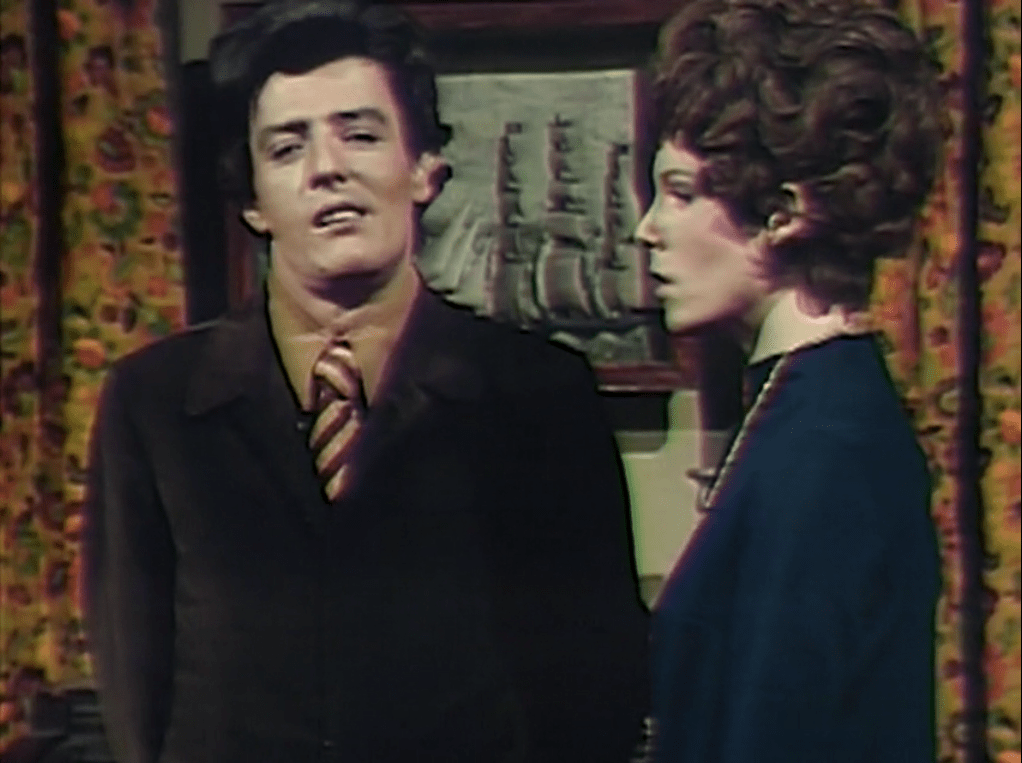
Unfortunately, this pose means that when Sabrina draws her gun, she is not pointing it at Bruno, but holding it in front of him and threatening to fire it into the wall. Kaplan’s habit of relying heavily on closeups in lieu of a visual strategy does nothing to obscure this, and viewers who missed yesterday may be genuinely puzzled as to who or what Bruno is afraid Sabrina will shoot.














 Dark Shadows Commentary