Episode 439: Whose cane this is

The opening voiceover is delivered by Vala Clifton, who makes her debut today as Maude Browning, a young lady whose profession it is to make herself agreeable to the gentlemen she meets. This marks the first time since episode #1 that the first voice we have heard was that of someone we had not seen previously. The rule lately has been that the introduction is always delivered by a woman who appears in the episode. Today, that leaves Ms Clifton as the only candidate.

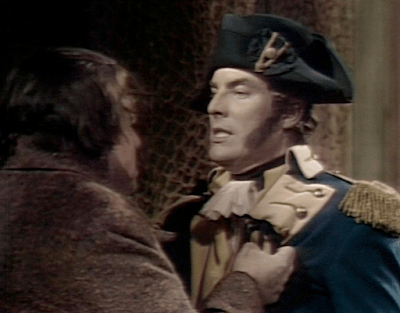
At the top of the episode, vampire Barnabas Collins tells his friend, much put-upon servant Ben Stokes, of his plans for revenge on the Rev’d Mr Trask, a visiting witchfinder responsible for much misery and injustice. When he makes it clear that he plans to murder Trask and to do it in an especially atrocious manner, Ben puts his foot down and says that he will no longer help Barnabas in any way. Barnabas threatens to kill Ben if he doesn’t come back with the implements he has ordered. Ben says that he may as well kill him right away. He stands still and squeezes his eyes shut, evidently expecting Barnabas to accept the invitation. Barnabas does put on his strangling face and move towards Ben, but at the last second he relents.

We then see Ben at The Eagle tavern, demanding “More rum!” Maude is at his table, trying to engage him in conversation. He warns her against going out at night, bringing up Ruby Tate, a woman who died on the docks some nights before. Maude has already said that she arrived in town the day of Ruby’s death, but when she is explaining why she isn’t afraid to go out alone at night she suddenly becomes the expert on Ruby’s ways. “She talked to anyone. I don’t.” This is a delicious little moment, reminding us of all the people we’ve known who make up little stories to persuade themselves that they are immune from the misfortunes that have befallen others.

Untrustworthy naval officer Nathan Forbes enters the tavern accompanied by a man in sailor’s togs. Maude gives up on Ben and leaves his table; she chats with Nathan for a moment, her eyes on the bulge in his pants most of the time. That’s understandable, it’s rather a conspicuous bulge.
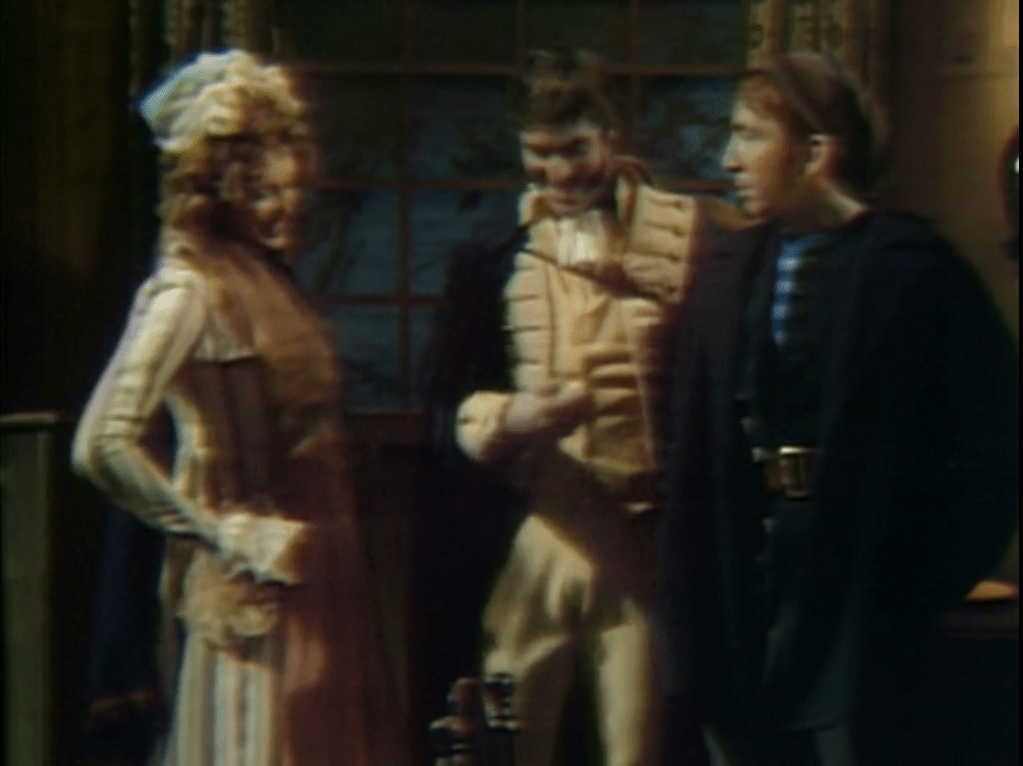
Maude leaves the tavern, and Nathan directs his companion to sit with Ben and to get information from him about Barnabas Collins. The man introduces himself to Ben, giving his name as Noah Gifford. Noah claims to be looking for work on the great estate of Collinwood. Ben tells Noah to stay away from there and to go back to the sea. He is drunk enough to mention Barnabas’ name, but doesn’t say much about him. He says that he wishes he could go to sea himself. He says that he likes tea, and wants to go to China to get a nice strong cup of it.

In #363, the ghost of Barnabas’ little sister Sarah mentioned that her father and his friends were always going to China on their ships. When Ben brings up China, regular viewers might remember that, and take it as confirmation that the Collinses were involved in trade with China in the 1790s.

Right before we watched this episode, I was reading an article by Amitav Ghosh in the 23 January 2024 issue of The Nation magazine about trade between the USA and China. Mr Ghosh says that between 1784 and 1804, the USA shipped a wide variety of products to China, but that from 1805 on Americans sold nothing to China but opium. He likens the label “China trade” for that commerce to calling Pablo Escobar’s business “the Andean trade.” Right up to the beginning of the flashback in #365 the show was equivocating on whether Barnabas, Sarah, and the rest of them lived in the eighteenth century or in the 1830s. Choosing 1795-1796 as the setting for this segment turns out to be a way of lightening one of the darker shadows the history we know from our time-band might otherwise have cast over the world of the show.

Nathan’s connection with Noah will sound another echo in the minds of longtime viewers. The first unsavory mariner on the show was seagoing con man Jason McGuire, who spent several months in 1967 blackmailing reclusive matriarch Liz. Jason was accompanied by a henchman, dangerously unstable ruffian Willie Loomis. Nathan at first seemed to be a good-natured and likable fellow, if a bit free with the servant girls and regrettably mercenary in his engagement to marry heiress Millicent Collins. But ever since it turned out that he already had a wife and that she was blackmailing him into splitting Millicent’s inheritance with her, Nathan has been reminding us more and more of the sinister Jason. When he turns up with Noah in tow, the resemblance is complete. We can only wonder if Noah will follow Willie’s lead and get into some kind of terrible trouble at the Collins family mausoleum in the cemetery north of town.

On the docks, Barnabas meets Maude. He goes through the same struggle to keep himself from biting her that he had gone through with Ruby in #414. He is so slow to move in for the kill that she has time to scream and attract Nathan’s attention. Barnabas hears someone running towards them, drops his cane, and runs off.

Nathan sends Maude back to the tavern. He finds the cane and recognizes his old friend Barnabas’ signature wolf’s head handle. In the tavern, he asks Maude to describe her assailant. She mentions that the man wore a gold ring with a large black stone. Knowing that Barnabas always wore such a ring, Nathan is convinced that he did not go to England as his family has been telling everyone, but that he is in Collinsport and is the strangler who has been terrorizing the community.

Nathan seemed most virtuous when Barnabas was alive and he was his more or less loyal friend. So it is a jolt that his reaction to the idea that Barnabas might be a serial killer is to tell Ruby that, lucky as she was to escape the Collinsport Strangler, she “may not be the only lucky one tonight.” Since he has not made any move to contact the authorities, there can be little doubt that his luck is not an opportunity to stop the killings, but the discovery of information he can use to blackmail the Collins family out of every penny they have. He has completed his transformation from a good guy with a rakish side into a deep-dyed villain.

Closing Miscellany

As Nathan enters the waterfront scene, we see a sign behind him labeled “Greenfield Inn.” We saw weeks ago that the Collinsport Inn, familiar from the first year of the show, already exists in the 1790s, so evidently this is a different hostelry. In #214, when Barnabas had returned to Collinsport in 1967, high-born ne’er-do-well Roger Collins did mention that any place in town other than the Collinsport Inn where there were rooms for rent would hardly “qualify as a flophouse”; perhaps the Greenfield Inn is the ancestor of one of these frightful places.

Greenfield Inn. Presumably not the front entrance.

Originally broadcast on 29 February 1968, this was the only episode of Dark Shadows to air on a Leap Day. One of the reasons I started the episode summaries this blog when I did is that the calendars for the years 2022-2027 match those for 1966-1971, so that I can post on the 56th anniversary of each original broadcast, matching not only the date but also the day of the week.

Episode 438: A night he will never forget

Dark Shadows often signaled a commercial break by playing an ominous three note motif on the soundtrack. Even in 1968, DUN DUN DUNNNN! was a pretty corny way to punch up your dramatic values. It was even cornier when, as was often the case, it followed a three syllable clausula. So today’s first act ends with vampire Barnabas Collins vowing that he will kill the Rev’d Mr Trask, a visiting witchfinder whose fanatical pursuit of bewildered time-traveler Vicki has helped precipitate many disasters. After Barnabas says Trask is “Going To Die!,” Mrs Acilius and I sang along with the motif- “Going- To- Die!” The missus pointed out that many among the 8-13 year olds who made up so much of the show’s original audience probably sang exactly the same refrain when the episode was first broadcast.

There are a couple of missing transitions in quick succession today. The opening scene between Barnabas and Ben takes place in the Old House on the estate of Collinwood; they take care to show a clock to establish the time of this scene as 4:00 AM. We then cut to the great house on the same estate, where it appears to be dark out. A knock comes at the door; the mistress of the house, Naomi Collins (Joan Bennett,) answers and finds Trask. It isn’t 4:00 AM anymore- Ben enters after a moment, and mentions that the sun is about to set. Inserting a still photo of a daytime scene would have been enough to tell us that many hours have passed, and the lack of that insert really is confusing.

Trask has come demanding the keys to the Old House so that he can gather Vicki’s things and burn them. A different kind of transition is omitted in the scene this demand initiates. Lately, Naomi has become assertive and independent, primarily in her refusal to go along with the persecution of Vicki. She does that for a while in her response to Trask, ordering him to leave, telling him he disgusts her, slapping him in the face, and daring him to hit her. But when Trask threatens to go to her husband, haughty tyrant Joshua, and enlist him against her, she gives in immediately, without any visible change in affect. That is puzzling, and not at all in keeping with Joan Bennett’s usual style. Typically, she makes the most of every chance she gets to show us why she was one of the biggest movie stars of the late 1930s.

Rough patches like these, along with the many many line bobbles from all the actors throughout the episode, make me wonder if writer Gordon Russell was late delivering the script. The show never had more than three credited writers at a time, and there must have been occasions when they couldn’t get the documents to the directors and actors early enough that they could get everything nailed down. It would take considerable thought for any performer to choose the best way to play a brief moment within which Naomi moves from fearless defiance to capitulation. Perhaps the reason she wound up doing nothing was that she didn’t have time to think about the question.

Ben accompanies Trask to the Old House. While Trask goes to Vicki’s old room, Ben meets Barnabas emerging from the basement and apprises him of the situation. We see Trask upstairs and hear Ben and Barnabas’ voices in the distance. Trask reacts, but goes ahead with his mission. He waits until he is downstairs with all of Vicki’s stuff in a bundle before confronting Ben and demanding to know who else is in the house. Ben claims that he was talking to himself. Trask is unconvinced.

Later, we see Trask in his own room at a nearby inn. He hears the rattling of chains and the disembodied voice of Barnabas taunting him. After a while, Barnabas’ hand comes floating towards him. When this happened, Mrs Acilius called out “Got your nose!” We both burst out laughing and were still laughing hard when the closing credits started to roll.

Trask talks to the hand. Screenshot by Dark Shadows Before I Die.

Despite the rough spots and the bad laugh at the end, this installment was a lot of fun. I can’t give it the “Genuinely Good Episode” tag, but we won’t be tempted to skip it if we do another watch-through of the series someday.

Episode 437: It’s gone on too long

Bewildered time traveler Vicki tells her lawyer/ gaoler/ boyfriend/ accomplice/ therapist/ assailant Peter that her time in the late eighteenth century seems like a nightmare. She then does something she often did in the early months of Dark Shadows, reminiscing about her childhood as an inmate of the farcically horrible Hammond Foundling Home. She says that she had so many nightmares when she was there that she became a connoisseur of nightmares. When she realized she was having a bad dream, she would choose to remain asleep right up to the moment she was about to be killed so that she could see how the whole thing would play out. I suppose that might have been useful training for a career as a character in a horror story, but if so Vicki has not benefited from it. She’s done nothing but make matters worse for herself since she arrived in the year 1795, and she is now in her last day as the defendant in a witchcraft trial which has been going very badly for her.

During this scene, Vicki gets very upset. Peter demands that she calm down and slaps her in the face when she doesn’t. That was a time-honored form of treatment for anxiety in fiction back then. It’s always gross to see, but is especially bad when the actor administering the slap is Roger Davis. Mr Davis was, shall we say, uninhibited in his physicality when dealing with his female scene partners. In his post about the episode on Dark Shadows Every Day, Danny Horn includes screenshots of 10 distinct moments in this episode when Mr Davis aggressively rubs himself all over Alexandra Moltke Isles. Later in the series, he would, in separate incidents, hurt both Terrayne Crawford and Joan Bennett while on camera. His fake slap does not make contact with Mrs Isles today, but his sense of personal boundaries is so severely underdeveloped that we can hardly blame her for visibly ducking to avoid his hand.

Seriously, who needs that guy? Screenshot by Dark Shadows Before I Die.

Vicki takes the stand and says that she is a native of the twentieth century, whisked back in time by what force she knows not. Cross-examined by visiting witchfinder/ fanatical bigot/ prosecuting attorney Rev’d Trask, Vicki admits that her last memory of 1967 was when she was at a séance, and that this was not the first séance she had taken part in. Trask declares that this is an admission of witchcraft, which, if you think about it, it is. Vicki becomes upset, and we cut directly to a commercial break without a musical sting. This is a technique the show very rarely uses, and it is always effective when it does.

One of the witnesses against Vicki, untrustworthy naval officer Nathan, has a scene alone with Trask while they are waiting for the verdict. Nathan tells Trask he never thought he would meet a preacher whose specialty was blackmail. Trask denies that he blackmailed Nathan into testifying against Vicki. He has a point- it was more a matter of extortion, followed up with bribery. Anyway, actors Jerry Lacy and Joel Crothers were sensational together. Mr Lacy is exciting to watch when he’s wound up tight, the usual condition of a character on Dark Shadows, and Crothers always moved loosely and fluidly. The two of them strike an ideal balance.

The episode ends with the judges finding Vicki guilty and sentencing her to hang by the neck until dead. If we take her recollection of her childhood nightmares as a programmatic statement, we should expect her to mount the gallows and stick her head in the noose, then immediately find herself back at the séance.

Episode 436: Thin air

Bewildered time traveler Vicki Winters is on trial for witchcraft, and it is not going well. Her lawyer/ gaoler/ boyfriend/ whatever else they don’t have the budget to hire another actor to play, an unpleasant young man named Peter, says that he wants the judges to see her as he does, as “a lovely girl who isn’t capable of witchcraft or anything else.” Unfortunately, Peter is right about Vicki’s capabilities- ever since she came unstuck in time and found herself in the year 1795, Vicki hasn’t done a thing worth mentioning.

Later, Peter catches up to much put-upon servant Ben Stokes. He persuades Ben to take him to the unmarked grave of wicked witch Angelique. Peter digs up the grave, but Angelique isn’t in at the moment, and there is no place to leave a message. Peter goes back to Vicki’s gaol cell and tells her that she may as well take the stand at her trial and tell the judges that she is a refugee from the 1960s.

In between these scenes, untrustworthy naval officer Nathan Forbes finds Ben and tries to pay him for information about a man who was once their mutual friend, Barnabas Collins. Ben indignantly refuses the money. When Nathan keeps trying to talk him into it, Ben handles him roughly, then stalks off.

Ben shows Nathan he is not for sale. Screenshot by Dark Shadows Before I Die.

This exchange will be of some interest to those who have been watching Dark Shadows from the beginning. Nathan is played by Joel Crothers, who in the parts of Dark Shadows set in the 1960s plays hardworking young fisherman Joe Haskell. In #3, hard-charging businessman Burke Devlin found Joe and tried to pay him for information about the Collins family. Joe indignantly refused the money.

It’s interesting to see Crothers reprising the situation, playing the opposite role. Burke had poured on a heavy display of oily charm in response to Joe’s quiet stiffening, telling a rather alarming story about the beginning of his rise to wealth and inviting Joe to adopt him as a father figure. By contrast, Nathan retreats rather quickly in response to Ben’s angry outburst, but then rephrases the offer in a hale and hearty tone, trying to assure Ben that he sees him as an equal and wants to be his buddy.

Neither Burke nor Nathan gets anywhere with his persistence, but each man’s approach is typical of him. As a man born into the working class of Collinsport who became a millionaire, Burke proceeds from an ironclad certainty that every wage earner in town wants to follow his example. He cannot doubt that Joe will jump at the chance to take his money and his advice. As a self-involved navy officer, Nathan believes that enlisted sailors will be sincerely grateful to him if he acts like their friend, and extends that belief to include governesses, ladies’ maids, bartenders, streetwalkers, indentured servants, and everyone else he sees as his inferior.

Ben’s angry response to Nathan’s proposition also echoes the early days of the show. When Dark Shadows was set in 1966, Thayer David played violently irritable handyman Matthew Morgan. When Ben lunges at Nathan today, he is the very image of Matthew lunging at Burke in #64. But where Matthew had to be restrained by bystanders and threatened by the sheriff before he settled down, Ben quickly backs off.

The contrast between Matthew and Ben goes to the heart of the eighteenth century flashback. Each is a formidable fighter. Each is excessively devoted to a member of the Collins family, Matthew to reclusive matriarch Elizabeth Collins Stoddard, Ben to Barnabas. Each lands himself in trouble because of that devotion. But Matthew grew up in a Collinsport that had been laboring under a curse for many generations. He is unstable, irrational, dangerous. But for Ben, the curse just began a few months ago, long after his adult personality was fully formed. He is a sane man, and a good one. We can hope that he will emerge from Barnabas’ shadow and make a bright future. In that hope, we can see what the curse will cost not only the Collinses, but all the people of Collinsport.

Episode 435: No next witness

For the second Friday in a row, the identity of the actress delivering the opening voiceover ruins what is supposed to be the big surprise at the end of the week. Last Friday, we were supposed to be shocked when the ghost of gracious lady Josette appeared at the end, but when we heard Kathryn Leigh Scott at the beginning we knew she was coming. Today, we are supposed to be surprised that a phantom of wicked witch Angelique manifests at the trial of bewildered time traveler Vicki, but when Lara Parker gives the narration we know she will be along.

Until #274, all the opening voiceovers were delivered by Alexandra Moltke Isles in character as Vicki. From #275, other actresses would deliver them if Mrs Isles was not in the episode, and they were usually given in the third person. Mrs Isles lost her place as the show’s default narrator starting with #332, in which she appeared but which Grayson Hall narrated. Not until #459 will a man read the opening voiceover. Vicki and Angelique are both in this episode; Mrs Isles does sound like she has a cold, but surely it would be better to have her deliver the introduction even if she were struggling than it is to spoil the surprise by giving it to Parker.

Angelique shows up at Vicki’s trial to undercut a witness for the defense. Much put-upon servant Ben Stokes, once Angelique’s unwilling catspaw, has testified that he knows Vicki is not a witch, because he saw Angelique casting the spells for which Vicki is being blamed. He explains to the court that he went along with Angelique because he was himself subject to one of her spells. When he is asked why he is free of her power now, he finds himself in a tricky position. Ben knows that Angelique is dead. Barnabas Collins killed Angelique when he realized she had turned him into a vampire, and as Barnabas’ loyal friend Ben buried her body. Ben doesn’t want to expose Barnabas, so he can’t tell that story. He says that he supposes that he is free of her because she “went away.”

Angelique materializes outside the courtroom and enters. Shocked to see Angelique, Ben points at her and shouts that she is dead. She takes the stand as a witness for the prosecution and recaps some plot points from the episodes where Vicki was arrested. Everything she says is true, and she shows no animus towards Vicki, but her appearance both discredits Ben and adds to the case for the prosecution. She leaves the room and dematerializes. When everyone is gone, she rematerializes and laughs merrily.

Angelique takes satisfaction in a job well done. Screenshot by Dark Shadows Before I Die.

When Angelique was alive, she never took much interest in Vicki. It wasn’t even her idea to frame Vicki for her crimes- Vicki stumbled into the witchcraft charge by her own foolish behavior, and Angelique just helped the prosecution along a couple of times. So it is a bit odd that she bothers to come back from the dead, however briefly, to ensure Vicki’s conviction. No doubt we are supposed to think she is doing it because Barnabas wants Vicki to be acquitted, and she wants to deny Barnabas any happiness. But a more intriguing interpretation is possible. In a comment on Danny Horn’s post about this episode on Dark Shadows Every Day, “Jason” writes:

I don’t really understand the confusion over Angelique”s motive. This Angelique is from the future. She knows that Barnabas is in love with Victoria in 1967. In fact I would argue that is the entire reason Vicki went back in time. Angelique orchest rated it to get rid of Vick either as part of curse or to get Barnabs when she return’s to 1968.

Comment by “Jason,” left at 12:30 AM Pacific time 10 September 2019 on Danny Horn, “Episode 435: Next Stop Kansas,” Dark Shadows Every Day

This idea was enlarged in a followup comment, apparently by the same person:

The reason it has to be Angelique from the future is this never happened the first time. So obviously thI’d Angelique is from the future. The only way this storyline makes sense!

Comment by “Jas,” left at 12:36 AM Pacific time 10 September 2019 on Danny Horn, “Episode 435: Next Stop Kansas,” Dark Shadows Every Day

When Vicki went back in time in #365, the ghost of Barnabas’ little sister Sarah was speaking through her at a séance, saying that she ought to “tell the story from the beginning.” In the months leading up to that episode, we had seen that Sarah was the face of an enormously powerful complex of supernatural phenomena, so it made sense that she would be the one to rend the fabric of time and space and turn the show into a costume drama set in the late eighteenth century. But we won’t be seeing Sarah again, not least because the actress isn’t ten years old anymore and ghosts aren’t allowed to grow up. So we’re going to tend towards other ways of thinking about the temporal disruptions. Angelique can stick with the show for the long term, and she’s already been built up as the biggest of all the Big Bads. So “Jason’s” theory is likely to become more appealing as we go.

Episode 434: No business to run

Some people have conversations relating to the ongoing witchcraft trial of bewildered time traveler Vicki Winters. The trial itself is a waste of time, so a half hour listening to people talk about what might happen during the trial is a grim prospect. Indeed, none of today’s scenes is necessary to the overall development of the plot or of any major themes. Still, they give the actors an opportunity to show us what they can do, and four of the five members of the cast turn that opportunity to good advantage.

The exception is of course Roger Davis as Vicki’s defense attorney Peter Bradford. Mr Davis was usually tolerable when he delivered his lines in a normal conversational tone, but when he had to raise his voice, as characters on Dark Shadows have to do very frequently, the results were painfully bad. Voice teachers sometimes tell their students to sing from way down in their bodies; the more indelicate among them have been known to tell boys’ choirs that “The music escapes from the testicles.” Such a teacher would be displeased with Mr Davis. When he raises his voice, the muscles he is tensing are not those around the pelvic floor, but the sphincters in his buttocks, with the result that he seems to be having difficulty evacuating his bowels. I realize this is rather a distasteful discussion, but the topic is impossible to avoid when you listen to Davis going through one sentence after another, in each case building up to one word and grunting it out loudly. Yesterday, young Daniel Collins mentioned that repressed spinster Abigail’s personality was that of someone suffering from indigestion, and when today we hear Peter ask untrustworthy naval officer Nathan Forbes (Joel Crothers) “Why did you LIE!” or tell him “You already DID!” he sounds so much like someone struggling with constipation that we can think of nothing else.

The episode opens with a long scene between Peter and Nathan. One of Crothers’ great strengths as an actor was his ability to relax. He stays loose and moves fluidly, never stiffening in response to Mr Davis’ muscular tension, much less reacting to his straining sounds with either a giggle or a misplaced expression of disgust.

Nathan and Peter’s scene involves a fistfight, the first we have seen on Dark Shadows since dashing action hero Burke Devlin fought dangerously unstable ruffian Willie Loomis in #207. The fight is well-choreographed and Crothers does a good job falling down and looking like he has been beaten, but that result stretches credibility. Not only was Crothers the taller man, but his easy physicality would have given him a great advantage in hand-to-hand combat against someone as rigid and awkward as Mr Davis.

Peter and Nathan do battle. Screenshot by Dark Shadows Before I Die.

We cut to the drawing room of the great house at Collinwood, where Naomi Collins (Joan Bennett) wants to talk to her husband, haughty tyrant Joshua Collins (Louis Edmonds.) Joshua is moping after the death of his sister Abigail, and doesn’t want to talk to Naomi or anyone else. At first they exchange a few words about Abigail. Naomi doesn’t try to hide her dislike of her late sister-in-law, saying that she led a senseless life. This of course offends Joshua, but Naomi stands her ground.

This part of the conversation includes two lines that are interesting to fans who are curious about the details of the characters’ relationship to their society. When Naomi says that it was because Abigail had too few responsibilities that she became a religious fanatic and a dangerous bigot, Joshua says that she did have some things to do. “She had her church,” he says. Not “the church,” not “our church,” but “her church.” This is not the first indication we have had that Abigail differed from the rest of the family in religion, but it is the most definite confirmation. As aristocratic New Englanders of the eighteenth century, presumably the family would be Congregationalists. Abigail might just have gone to the another, stricter meeting within the Congregationalist fold, or she might have joined a different group.

The other line marks Naomi as a remarkably advanced feminist for her time and place. She says that Abigail was “Like a businesswoman with no business to run.” The concept of “businesswoman” was hardly familiar in the days when this episode is set. Even the word “businessman” was not widely known then- the earliest citation of it in The Oxford English Dictionary dates to 1798, two years after this episode is supposed to be taking place, and its first appearance in the modern sense came several years after that. The same dictionary can find no use of “business-woman” until 1827, and then in only a strongly pejorative sense. But the audience, seeing Joan Bennett on this set, will think of her character matriarch Elizabeth Collins Stoddard, who in the parts of Dark Shadows set in the 1960s runs the family’s business enterprises from this room. Naomi is looking towards the future, and she sees Liz.

Edmonds and Bennett are both wonderful in this scene. She is steady and authoritative throughout; he is alternately gloomy, irritated, and sullen. It is as compelling to watch her hold her single mood as it is to watch him navigate from one to the other. Joshua at no point concedes anything to Naomi, and he ends by turning his back on her and going away. But he is not at all in command today, as he has always been in command before. He is hurting too deeply to give orders and compel obedience by the force of his presence.

In the village of Collinsport, Nathan meets with the Rev’d Mr Trask (Jerry Lacy,) visiting witchfinder. The other day, Nathan capitulated to Trask’s blackmail and testified against Vicki. Now he wants Trask to intercede with Joshua and to talk him out of informing the Navy of his many crimes. He tries to sell Trask a bill of goods, claiming that all the things he did wrong were simply the result of his pure and innocent love for fluttery heiress Millicent Collins. The audience knows that this is entirely false, but Trask doesn’t even let him start on it- he responds that “Physical love is beyond my comprehension.” Mr Lacy is an accomplished comic, and he doesn’t fail to get a laugh with this line. Trask realizes that Nathan’s testimony would lose much of its persuasiveness if he were exposed as the scoundrel he is, Trask agrees.

Joshua comes to meet with Trask. Mr Lacy is a great shouter, and Trask is always on full volume. When he insists that Joshua meet with Nathan and forswear his plan to send a letter to the Navy, he builds Trask into a tower of hypocrisy and repression, and we remember all of the scenes where Joshua has demolished people he disdains, Trask among them. But Joshua is not going to demolish anyone now, not while he is mourning everyone he ever loved. He mutters, frowns, and finally caves in to Trask’s demand. The contrast between the overweening Trask and the fusty Joshua is electrifying to returning viewers.

Joshua then consents to meet privately with Nathan. He tells Nathan that he will keep quiet on condition he secure a transfer to another port as soon as possible. Nathan tells some lies and makes some excuses that impress neither Joshua nor anyone who has been watching the show for any length of time, but again, the actors are fascinating to watch together. The chaos and evil Trask represents has turned the world upside down, weakening the strong Joshua and emboldening the degenerate Nathan.

More bad news awaits Joshua when he goes home. Unhappy as Joshua was with Naomi’s insistence on discussing the faults of his recently deceased sister, he is much more upset when she tells him she has decided to go to court and testify in Vicki’s defense. Joshua is appalled she would do this. He is sure Vicki is to blame for the deaths of both of their children, of both of his siblings, and of various other people, some of whom he cared about when they were alive. He threatens to lock Naomi up in her room to prevent her going to court, but she replies that if he does that she will escape, and he will never see her again. The children are dead and she has no work of her own; she has no reason to stay.

Episode 433: Quite enough bickering

Today is taken up with the witchcraft trial of bewildered time-traveler Victoria Winters. That is to say, the actors stand around the courtroom set and shout random nonsense at each other until it is time for the closing credits.

Two of the good actors whose talents are wasted in this episode. Screenshot by Dark Shadows Before I Die.

The only line of dialogue that made an impression on me was Vicki shouting “That’s! Not! TROOOO!” when untrustworthy naval officer Nathan Forbes was on the stand falsely accusing her of something or other. In the first months of the show, Vicki often shouted that to strange and troubled boy David, usually in response to David saying something that the audience knew was perfectly true. In those days, the show’s slow pace and its focus on the budding friendship between Vicki and David gave Alexandra Moltke Isles and David Henesy a chance to overcome the crummy writing of their scenes together and show us what it looks like when two people learn to trust each other. But the part of the show set in the late eighteenth century moves at a rapid clip, and nothing human is at stake in the witchcraft trial. So when we hear another “That’s! Not! TROOOO!” this time, we miss the days when Mrs Isles was in a position to rescue us from the writers’ delinquencies.

When Nathan makes his entrance, we hear some music I don’t believe we have heard before. Christine Scoleri of Dark Shadows Before I Die identified it as a piece that it is on Dark Shadows: The Soundtrack Music Collection as “Cue 157: Dramatic Curtain.” It doesn’t fit the situation. It’s a busy little tune, suggestive of fidgety nervousness. It’s true that the whole trial is just so much fidgeting on the part of the show, but the background music really isn’t the place to complain about that.

Episode 432: Cousin Abigail’s religion

In the deserted Old House on the great estate of Collinwood, repressed spinster Abigail Collins has stumbled upon the coffin in which her nephew Barnabas spends his days. She arrives just as he is rising for the evening. Abigail knows that Barnabas is dead, but she has never heard of vampires, so she has no idea what to make of what she sees.

Barnabas taunts Abigail. When she cries that the Devil is trying to touch her, he cynically asks why she thinks that the Devil always wants to touch her. The broadcast date is 1968, when Freudianism was riding high in the circles frequented by the sort of people who wrote and produced Dark Shadows. The dramatic date is 1796, when that school of thought was undreamed of. Still, there were various strands of folk wisdom about the adverse psychological effects of celibacy, so Barnabas’ smirking comment undoubtedly means exactly what the original audience would have taken it to mean.

From the moment Barnabas saw Abigail at the end of yesterday’s episode, we’ve wondered how he would go about killing her. She is his aunt, after all; the vampire’s bite is so widely recognized a metaphor for the sexual act that we could hardly expect the ABC censors to have allowed him to make a meal of her. In the end, he simply bares his fangs and she dies of fright.

Barnabas scares Abigail to death. Screenshot by Dark Shadows Before I Die.

Abigail has been a villain; even the opening voiceover refers to her as “a woman who has been responsible for much grief.” During their confrontation, Barnabas tells Abigail many truths that, had she known them earlier, would have kept her from causing that grief. If she accepts them now, she will be remorseful. To the extent that we want Abigail to know what she has done, we identify with Barnabas during this scene. That might lead us to think that her death by fright is a way of letting us see Barnabas as the good guy, since he does not kill her by physical contact. But throughout the confrontation he has been telling her that she is about to die. Before he bares his teeth, he makes a dramatic announcement that clearly tells us that he is bringing matters to their climax, and when he sees her die he does not look the least bit unhappy. He seems to have known that the sight of his teeth had the power to kill his aunt, and to have deliberately used that power.

Abigail is the sister of Barnabas’ father, haughty overlord Joshua Collins. Before he even became a vampire, Barnabas killed Joshua’s brother Jeremiah in a duel. By his clumsiness, Barnabas inadvertently caused the death of his own sister, little Sarah Collins. Things are getting rather lonesome for Joshua.

In the great house on the same estate, young Daniel Collins is trying to slip out into the night. Yesterday, he arranged to meet secretly with much put-upon servant Ben so Ben could give him pointers on how to run away from this depressing house. The lady of the house, Joshua’s wife Naomi, intercepts Daniel. She asks if he plays whist, and he complains that he isn’t allowed to play cards because that is “against cousin Abigail’s religion.” Naomi says that so long as it isn’t against his religion, it’s no problem for her.

This isn’t the first indication that Abigail’s religion is different from that of the rest of the family. As rich New England landowners in the eighteenth century, we can assume they are all Congregationalists, but the loose polity of Congregationalism left room for a lot of variation from one congregation to another. She may well have attended a stricter meeting than did the other members of the family, though she seems to have taken her greatest satisfaction in imposing her austere ways on the other members of the household.

Naomi suggests that Daniel and his older sister Millicent might stay at Collinwood with her and Joshua indefinitely. Daniel is clearly not a fan of this idea, and struggles to find a polite way to say that he is desperate to go back home to New York City. He is still struggling when a knock comes at the door. It is the Rev’d Mr Trask, whom Abigail called in from out of town to find witches. Trask is currently prosecuting Victoria Winters, former governess to Daniel and the late Sarah. Abigail asked Trask to meet her because she thought she would find evidence against Vicki in the Old House. Since she found Barnabas instead, she will not be keeping the appointment.

While Naomi goes to look for Abigail, Trask takes the opportunity to work on Daniel. At first Trask seems to be far more agreeable than we have ever seen him before. So when Daniel apologizes for telling him that he looks like the Devil and that he sees no reason they should exchange any words, Trask smiles and calmly says that he appreciates his honesty. Trask holds Abigail up as an exemplar of Christian virtue; Daniel says that he cannot bring himself to want to emulate Abigail, since she “is always so, so unhappy, as if whatever she has eaten doesn’t agree with her.” Trask takes this remark in good turn.

Daniel keeps insisting that Vicki is not a witch, but is very nice. Trask takes everything he says as evidence against Vicki. For example, when he tells Trask that Vicki extolled the virtues of curiosity, Trask exclaims that “Curiosity is the Devil’s money! What you buy with it is disbelief in everything it is right to believe in!” Even in this portion of their encounter, Trask seems far smoother than the screaming fanatic we’ve seen up to now. Daniel complains that Trask keeps talking about the Devil when “I want nothing to do with him.” At that, Trask leans in and says that if Daniel feels that way, he can still be saved. When Daniel asks how he can be saved, we can see how Trask might have managed to win a new follower, if he hadn’t gone straight to a demand that Daniel testify against his friend Vicki.

Trask and Daniel have a man-to-man talk. Screenshot by Dark Shadows Before I Die.

Trask finally loses his temper. Naomi returns and is appalled when she hears Trask telling Daniel that he bears the mark of the Devil. Daniel runs out into the night, and Naomi tells Trask he is to blame for that.

Daniel wanders about in the woods, looking for Ben. He quickly concludes that he must have missed Ben, and he thinks of going back to the house. Remembering that Trask is there, he chooses to stay outside.

Naomi is in the woods looking for Daniel; Trask joins her, much to her displeasure. Daniel sees Abigail’s corpse propped against a tree. He shouts for Naomi. She and Trask come, and he points the corpse out to them.

Daniel shares his gruesome discovery. Screenshot by Dark Shadows Before I Die.

Abigail is the second character Clarice Blackburn has played on Dark Shadows. She joined the cast in #67 as housekeeper Mrs Johnson. In her first months on the show, Mrs Johnson was out to get revenge on the Collins family for their treatment of her former employer and the object of her unrequited love, the late Bill Malloy. Blackburn was told to think of the character as if she were Mrs Danvers, the terrifying housekeeper in Daphne DuMaurier’s Rebecca. After the Death of Bill Malloy storyline ended, Mrs Johnson transformed into a warm-hearted old biddy whose wildly indiscreet chatter gave the other characters just the information they could use to advance the plot.

Mrs Johnson was always fun to watch, and one of the reasons to look forward to the show’s return to a contemporary setting is that she is waiting for us in 1968. But after her first few weeks, her appearances were rare and usually brief. Abigail gave Blackburn her first chance to show viewers of Dark Shadows what she could do when she had the chance to work on a big canvas. In later storylines, she will have more such opportunities, but we will always miss Abigail.

Episode 431: Never learn to leave the past alone

In #70, the deserted Old House on the great estate of Collinwood was introduced as the favorite hangout of strange and troubled boy David Collins (David Henesy.) Several adult characters tried to keep him away from the house, notably crazed handyman Matthew Morgan (Thayer David,) and Willie Loomis, servant to David’s distant cousin, vampire Barnabas Collins. David’s visits to the house precipitated a number of crises, including one that began when he found that Barnabas and Willie kept the cellar door locked and became intensely curious as to why. We knew that they did this to conceal Barnabas’ coffin at the foot of the stairs. That was when the show was set in 1967.

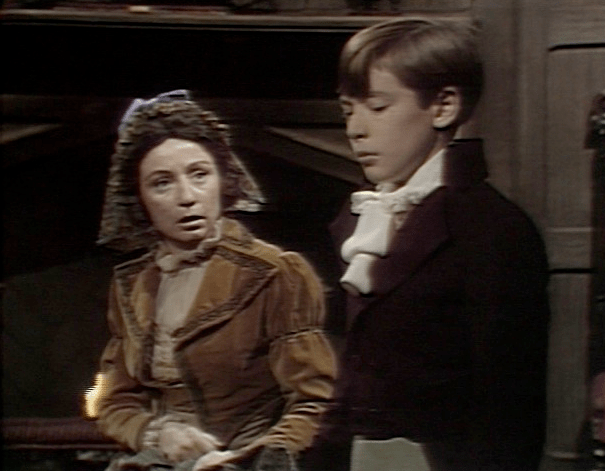
Today, young Daniel Collins (David Henesy) is introduced as a boy whose favorite hangout is the deserted Old House on the great estate of Collinwood. He finds much put-upon servant Ben Stokes locking the cellar door. Ben is the friend and accomplice of Daniel’s second cousin, vampire Barnabas Collins. Daniel is intensely curious as to why Ben is locking the door. We know that it is to conceal Barnabas’ coffin at the foot of the stairs. Now the show is set in 1796.

Ben initially responds to Daniel’s curiosity with the same angry bluster Willie had used in his efforts to keep David away from the house. By the end of their scene together, he has engaged Daniel in conversation, as Matthew often did with David. Daniel confides in Ben that he is planning to run away. Ben points out that Daniel is in no way prepared to strike out on his own, and persuades him to go back to the great house and to make a list of the things he will need. Combining Willie’s responsibility for protecting Barnabas with Matthew’s ability to persuade a boy that he is his friend, Ben seems well-positioned to keep Daniel from coming into conflict with the vampire in the family.

Ben wins Daniel over. Screenshot by Dark Shadows Before I Die.

Back in the great house, repressed spinster Abigail Collins, Barnabas’ aunt, finds Daniel’s list and asks him what it is. He evades that question. As it happens, it is not the one she most urgently wants answered. She sits him down in the drawing room and asks him about a charm bracelet she had found somewhere around the house.

Daniel confirms that the bracelet belonged to Victoria Winters, the governess who used to teach him and Barnabas’ little sister Sarah. Vicki is now standing trial on charges of witchcraft. Sarah is dead, and Abigail is convinced that Vicki’s evil spells caused her death, among many other recent tragedies. The bracelet seems to Abigail to be evidence against Vicki. Abigail points to a charm in the shape of a devil and asks Daniel what Vicki told him about it. He says blandly that Vicki told him and Sarah that it was a devil. She asks him if Vicki instructed him and Sarah to fall to their knees and worship the Devil, and he reacts scornfully, asking who ever heard of worshiping a devil.

Daniel shocks Abigail. Screenshot by Dark Shadows Before I Die.

Abigail presses Daniel for more information about Vicki. He keeps talking about how much he and Sarah liked her, and tries to paint her in a favorable light. He tells Abigail that Vicki used to say that the day would come when people could fly through the air, covering hundreds of miles in a single hour, that there would be machines that would pick up voices traveling through the air and make them audible with the turn of a dial, and that other machines would be able to solve arithmetic problems. We know that Vicki is a time-traveler displaced from the 1960s and that she is describing airplanes, radio, and electronic calculators, and we further know that her time-travel was not the result of a spell she cast, but that Sarah’s ghost yanked her back in time. But Abigail interprets her stories as promises of rewards from the Devil, and most of those whom Vicki has told of her chronological dislocation have taken it to be a confession that she is a witch.

It dawns on Daniel that everything he is saying in his attempt to defend Vicki is making matters worse for her. David Henesy does a marvelous job showing us how miserable this makes Daniel. Abigail tells him he must go with her to Vicki’s trial tomorrow and repeat to the judges what he has told her. He resists the idea. She breaks off their conversation to announce she will go to the Old House. Daniel has told her that he saw Ben locking the cellar door, and she has jumped to the conclusion that he was hiding evidence against Vicki behind it. Daniel pleads with her not to go, but she insists.

We cut to the front door of the Old House, where Abigail encounters Ben. He begs her not to go in. She accuses him of being in league with Vicki and declares that his own trial will begin before long. Ben may have been able to soft-soap Daniel, but Abigail responds with hostility no matter what he says. Finally, he watches her go in. She has said that whatever happens to her inside will be her own responsibility; after she is gone, Ben echoes this statement, a savage note of satisfaction in his voice.

Abigail unlocks the cellar door, goes down the stairs, and sees the coffin. Of course, it is sunset; of course, she is just in time to see the coffin open and Barnabas rise. She watches in terror. Clarice Blackburn does an extraordinary job of acting in the closeup of Abigail’s reaction; she gives the purest possible look of fear, and her scream is perfectly open and smooth.

Abigail screams. Screenshot by Dark Shadows Before I Die.

Barnabas looks at her and asks “Abigail, what are you doing here?” The audience can’t be in much doubt how their reunion will end, though we will have to wait until tomorrow to see just what happens between them.

Dark Shadows was made with very little advance planning, though we do know that they had settled on the name “Daniel Collins” for David Henesy’s character well before the 1795 segment began. In #350, three full weeks before Vicki starts her uncertain and frightening journey to the past, heiress Carolyn slips and calls David “Daniel.” So it is inexplicable that they’ve waited until the segment has been going for more than thirteen weeks before bringing Daniel in. Vicki and David’s relationship was the only thing on the show that consistently worked in 1966, and David’s scenes with Sarah were among the highlights of 1967. So when in #372 haughty overlord Joshua tells Vicki that she will be tutoring both his daughter Sarah and his young cousin Daniel, the audience would have been excited to see the three of them together.

Presumably the makers of the show were unsure how long they would be able to stay in the eighteenth century before the ratings started to suffer and they came under pressure to get back to a contemporary setting. That might explain why they wanted to keep the number of characters to a minimum, so that they would be able to show the four necessary events- Sarah’s death, Barnabas’ transformation into a vampire, Josette’s leap from Widows’ Hill, and the chaining of Barnabas in his coffin- without starting a lot of threads they would have to hasten away and leave dangling. Even so, there were plenty of longueurs in the first weeks when they could have fitted in a few scenes of Daniel and Sarah together, if they had had the time to plan them.

As it happened, the ratings were great for the eighteenth century segment, so they were under no pressure at all to go back to the 1960s. But the breakneck pace of the early weeks and the lack of detailed planning has come back to haunt them. Three of the four big points have all been covered. All that is left is to chain Barnabas in his coffin and to send Vicki home, and they can do both of those things in any one episode. They are going to have their work cut out for them to fill the remaining time with stories that are anything like as interesting as some of those they passed up because they didn’t realize they would have time to tell them. The result will be that, while the last few weeks of the eighteenth century segment feature some great moments and several Genuinely Good Episodes, they also involve a lot of disappointment for the audience.

Episode 430: Do not disturb

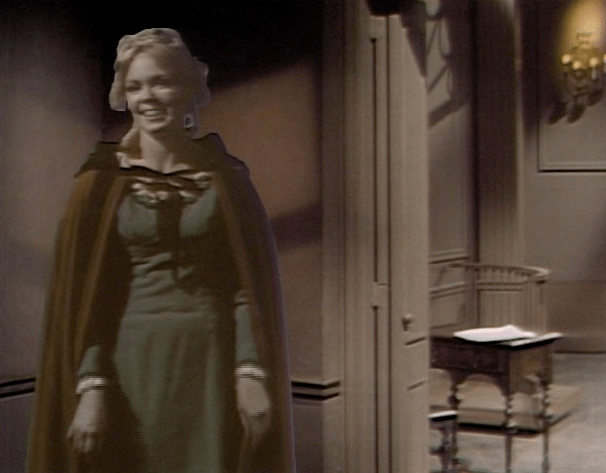
Barnabas Collins became a vampire just a few weeks ago, and he doesn’t yet know what powers his new condition has brought him. On the chance that he might be able to raise the dead, he goes to the fresh grave of his ex-fiancée Josette. He whines about how much he misses her until the sound of her sobbing can be heard. She begs him to let her rest. Later, she appears to him in her former bedroom in the Old House on the estate of Collinwood, and shows him that in her ghostly form her face bears the severe disfigurement inflicted when she fell to her death while fleeing from him.

Screenshot by Dark Shadows Before I Die.

The audience is supposed to be in suspense at whether Barnabas will reach Josette. Unfortunately, the show ruins the surprise right at the outset, when Kathryn Leigh Scott delivers the opening voiceover. These monologues are spoken by an actress who appears in the episode, so we know that we will be seeing Miss Scott, and therefore Josette. It’s true that Miss Scott uses a very different voice for the opening monologues than she does for Josette or any of her other characters, but fans will recognize her right off.

Viewers who have been with Dark Shadows from the outset will recognize some connections with earlier episodes. Josette’s sobbing sounds more than a little like the mysterious sobbing heard several times in the basement of the great house of Collinwood in the first months of the show. They strongly hinted that the ghost of Josette was the source of this sobbing, only to give another explanation for it later.

Josette tells Barnabas that “the dead must rest!” This was a catchphrase of one of the funniest characters on the show, the Caretaker of the old cemetery. When we heard it from Josette, my wife and I laughed out loud.

Josette also commands “Do not disturb my rest.” A “Do Not Disturb” sign hung on a tombstone would be an apt symbol of Dark Shadows‘ view of the afterlife, since death on the show is usually about as temporary and as subject to interruptions as a stay at a cheap motel.

When Josette convinces Barnabas that she must not rise from the dead, not because she would have to prey upon the living as he does, but because she is ugly now, Mrs Acilius and I remembered two things. It’s true that when we saw Josette’s ghost in the first 73 weeks of the show, when it was set in 1966 and 1967, her face was almost always at least partly obscured. There were some brief exceptions, but in her most important appearances, when Miss Scott played her in #70 and #126, her face was completely veiled. So perhaps she bears her wounds then as well.

Our other recollection was not of Dark Shadows at all, but of the original Star Trek. And I do mean the original one, the first pilot, shot in 1964. At the climax of that one, our heroes commit themselves to die rather than stay on the planet where they have been trapped, as conditions there are such that no human being could possibly live a worthwhile life. When one woman says she wants to stay behind, they see that she is, contrary to the illusory appearance they have seen so far, severely disfigured. At that, the captain instantly accepts that she is right to stay. No uggoes allowed in space! Usually I’m reluctant to bring up the labels that end in “-ism,” but that ending and this one seem to be examples of looks-ism so extreme that they would be frankly genocidal if taken as a guide to real-world action.