For months, the evil ghost of Quentin Collins has been gaining strength, secretly manipulating children Amy Jennings and David Collins as he prepares to drive everyone from the great house of Collinwood so that he can have the place to himself. Now he has cast aside all secrecy and he openly menaces the adult residents of the house. Today, they give up and leave. Once they are all gone, Quentin stands on the walkway at the top of the staircase in the foyer and laughs heartily.
Collinwood belongs to matriarch Elizabeth Collins Stoddard. Liz’ brother Roger, David’s father, lives there as her guest. Up to this point, Liz and Roger have served primarily as blocking figures. Each is devoted to denial as a way of life. Occasionally a fact bursts upon them that is so enormous that one or the other of them has no choice but to face it for a little while. Usually they snap back into their characteristic mode of willful ignorance the moment the crisis is past, and even while it is going on the other responds by digging even deeper into the insistence that nothing is happening. When I first watched Dark Shadows, I could imagine the characters fleeing Collinwood one by one, then venturing back to get Liz and Roger, only to find them sitting serenely in the drawing room, assuring their would-be rescuers that everything was all right while leather-winged demons fluttered about their heads.
On Monday, Liz saw enough of Quentin’s power that she gave up her attitude of denial, apparently forever. Today, Roger does what we have been led to expect, and loudly declares that the whole issue is imaginary and that the other adults should be ashamed of themselves for encouraging the children to be afraid of ghosts. When the whole house starts to resound with the crepuscular tones of an old-timey waltz Quentin plays when he is exercising power, Roger declares that it is a trick the children are playing on them. The others go to pack their things while Roger stays in the drawing room.
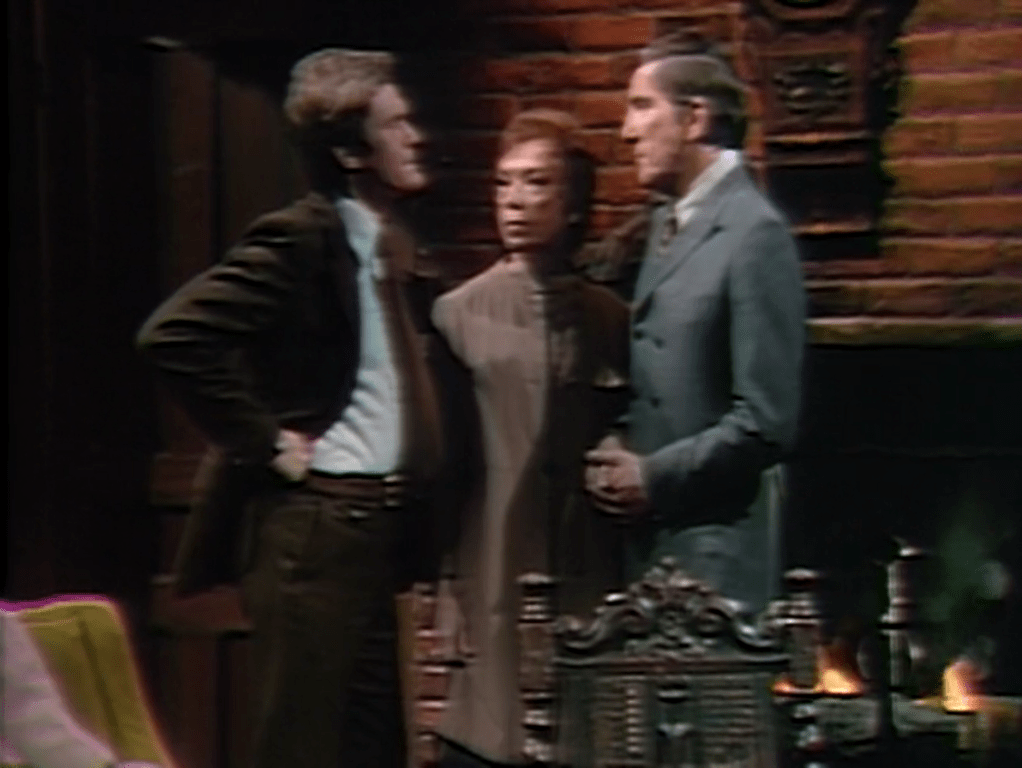
Alone there, Roger sees Quentin materialize before him. On their way out, Liz and occult expert Timothy Eliot Stokes check the drawing room one last time, and find Roger sitting motionless in a chair. For a moment we wonder if he will fall over dead. He starts speaking, though, and admits that he was wrong. As they leave, Roger looks back into the house and shouts a defiant pledge to return. Apparently the makers of Dark Shadows have decided they no longer need two major characters whose primary function is to put the brakes on the action.
After everyone has gone, the camera pans across sets representing several rooms in the great house. This must have taken some doing. The foyer and drawing room were the only standing sets; the others were built as needed. The show was done live to tape, so these sets must all have been standing simultaneously. The studio was not very big at all. I wonder if they crammed some of these into space that was not generally used for action.
The walkway at the top of the foyer stairs is a commanding position, and the show has been sparing in its use of it. Quentin’s triumphant laugh is the first time we see a villain stand there and exult in his new position as Master of Collinwood. In the early days of the show, the dashing and enigmatic Burke Devlin threatened to take control of the house. He never came very close to doing that, but it could have been interesting to see him stand on the walkway, survey the foyer, and think about the day when the house would be his. For a long period in 1967, seagoing con man Jason McGuire was bossing Liz around; there were several days when he might have stood on the walkway, looked around with smug satisfaction, and chuckled.
Yesterday’s episode ended with the drapes in a bedroom in flames. That was a real fire, not a special effect, and you could see it spreading rapidly and putting out a lot of smoke. Having failed in that attempt to murder everyone in the building, the technical staff in today’s reprise of the sequence settles for lighting some gas burners behind a window dressing.
Dark Shadows showed its first exorcism in #400. At that point the show was a costume drama set in the 1790s. The fanatical Rev’d Mr Trask was convinced that time-traveling governess Victoria Winters was a witch and that she was hiding in the Old House on the estate of Collinwood. He stood outside that house with a forked stick. He set the points of the stick on fire and shouted commands for the forces of darkness to come out.
Vicki was indeed hiding in the house, but she was not alone there. The actual witch, the wicked Angelique, set a fire of her own. She built a house of cards and burned it to cast a spell that caused Vicki to see flames in her room and respond by running out into Trask’s clutches. What surrounded Vicki were special effects superimposed on the screen, but what was in Angelique’s room was real fire, and it flared alarmingly close to actress Lara Parker’s lovely face. You’d think they’d have learned from #191, when an on-camera fire went out of control and nearly killed the entire cast, or perhaps from #290, when an off-camera electrical mishap led to fire extinguisher noise almost drowning out some dialogue. But apparently the prevailing philosophy was no injuries, no problem, so they went right on playing with fire.
Today we have another unsuccessful exorcism, and its failure leads them to make another attempt to burn down the set. Occult expert Timothy Eliot Stokes is informed that the evil spirit of the late Quentin Collins is haunting the great house of Collinwood and taking possession of strange and troubled boy David Collins. Stokes follows Trask’s rubric of standing outside the house, pointing a forked stick at it, and shouting inhospitable remarks at the spirits, but he doesn’t set fire to the points of the stick as Trask had done. There is a lot of excitement while he is performing the ritual, and once he finishes all of it dies down. Unsure of the outcome, he arranges to stay the night; while he is getting ready for bed, the curtains in his room catch fire. These are not special effects images; the curtains are really on fire, they are burning rapidly, and they are putting out a lot of smoke. The little building at 442 West 54th Street where Dark Shadows was made was packed with sets made of plywood and crammed with props, many of them highly flammable. Several sets were draped with huge fake cobwebs; I’m not sure what those were made of, but I doubt it was anything that would make a fire marshal very happy. It’s just amazing anyone who worked on the show lived to see 1971.
There is a lot of very good stuff in this one. All of the acting is top-notch. David Henesy and Thayer David had scenes together as several characters, first as David Collins and crazed handyman Matthew Morgan in 1966, then as young Daniel Collins and much put upon indentured servant Ben Stokes when the show was a costume drama set in the 1790s, and now in 1969 as Ben’s descendant Professor Stokes and David. Those scenes all crackled, and today when Stokes catches David hiding behind the secret panel in the drawing room, demands he tells him the truth about what is happening to him, tricks him into admitting that he is afraid of Quentin, and warns him of the dangers ahead, the two make the exchange work magnificently.
There is also a scene in the drawing room between David Collins, his cousin Carolyn Collins Stoddard, and permanent houseguest Julia Hoffman while Stokes is performing the exorcism. He has to shout and writhe around a lot during this scene, very difficult things for child actors to do convincingly. But Mr Henesy had been acting professionally for four years before he joined the cast of the show in 1966, at the age of nine, and had studied acting under several distinguished teachers, among them Uta Hagen.
That background pays off; violent as the symptoms of the incipient possession are, Mr Henesy does not overplay them. It helps that he has support from Grayson Hall and Nancy Barrett; Hall plays Julia as firmly in control of herself, but obviously uneasy with the situation, while Miss Barrett shows Carolyn’s anxieties mounting until she shouts that David might be in real trouble. Since he is in convulsions and the crepuscular sound of the creaky old waltz that plays when Quentin is exercising power is emanating from the walls of the house, it would seem obvious that David is in real trouble. The line shows that Carolyn is starting to panic. When we see that neither the determinedly calm Julia nor the increasingly anxious Carolyn is having any particular influence on David’s emotions, we know that they are coming from someplace far removed from his visible surroundings.
There are two ongoing narrative threads in this part of Dark Shadows. One is the story of mysterious drifter Chris Jennings. Mad scientist Julia Hoffman knows Chris to be a werewolf and she is trying to help him. The other is the story of Quentin Collins, a ghost who is gradually gaining power and planning to drive everyone away from the great estate of Collinwood so that he can have the place to himself. Chris’ story had been the fast-paced A plot that kept expanding to involve more and more characters, while Quentin’s was the slow-paced B plot that consistently involved only Chris’ nine year old sister Amy, strange and troubled boy David Collins, and their governess Maggie Evans, with intermittent small parts for other established characters and the occasional chance for a day player to act a death scene. That changed yesterday, when Quentin decided that he had grown so strong he no longer needed to conceal himself from matriarch Elizabeth Collins Stoddard or the other adults in the great house. Quentin’s story is now the main topic, and Chris is the secondary feature.
We open today with Liz telling Julia what happened the night before. Julia tells Liz that she and old world gentleman Barnabas Collins had suspected that an evil ghost was at work in the house, and that they have seen another spirit that seems to be opposed to it. Liz says she has called occult expert Timothy Eliot Stokes. Stokes arrives and questions everyone.
Liz is alone at the desk in the drawing room when a secret panel leading to a passage to the long-deserted west wing opens. A cutout meant to suggest a disembodied hand appears on the screen. It picks up a letter opener from the desk and is about to stab her when Stokes enters.
Stokes shouts. The hand drops the letter opener and vanishes. He tells Liz what he saw. He notices the panel is open, and asks Liz about it. She says that it leads to the west wing, but that, as far as she knows, no one has used it in years. That answers a question that has been on the audience’s minds since October 1966. In that month, we saw Liz’ brother, high-born ne’er-do-well Roger, use the panel to play a dirty trick on well-meaning governess Victoria Winters. The panel was not seen or mentioned again until David and Amy started using it to do Quentin’s bidding several weeks ago. This line is our first confirmation that Liz knows that the panel and the passage behind it exist. Stokes asks Liz’ permission to perform an exorcism.
Meanwhile, Julia gets a telephone call from Chris. Liz’ daughter, heiress Carolyn Collins Stoddard, has taken a fancy to Chris and installed him in a cottage on the estate. Chris tells her that he is facing an emergency. Someone has come to the village of Collinsport who might know his secret.
In the cottage, Chris tells Julia that an unpleasant man named Ned Stuart has brought his sister Sabrina to the village and that he is demanding Chris meet with Sabrina. Chris had assumed Sabrina was dead, because she was in the room with him one night two years before when he underwent the transformation into his lupine form. Ned had told Julia and Barnabas that he was looking for Chris because he wanted to know what happened to his sister; he had always referred to Sabrina in the past tense, leading them to assume she was dead. Now Chris is in a panic, convinced that Sabrina will tell the police about him and that he will be punished for the many, many homicides he has committed as the werewolf.
Julia points out that if Sabrina were going to do that, she could have done so at any time. He would already have been arrested. Sabrina must not have told Ned or anyone else what she saw, and Ned must be telling the truth when he says he does not know what happened the last time Chris and Sabrina were together. She persuades Chris to go to visit the Stuarts in their suite at the Collinsport Inn.
Julia accompanies Chris on the visit. Ned is irritated that Chris did not come alone. His remarks are uncomfortable to hear, chiefly because of actor Roger Davis’ habit of clenching his anal sphincters when he raises his voice, making him sound like he is suffering from agonizing constipation.
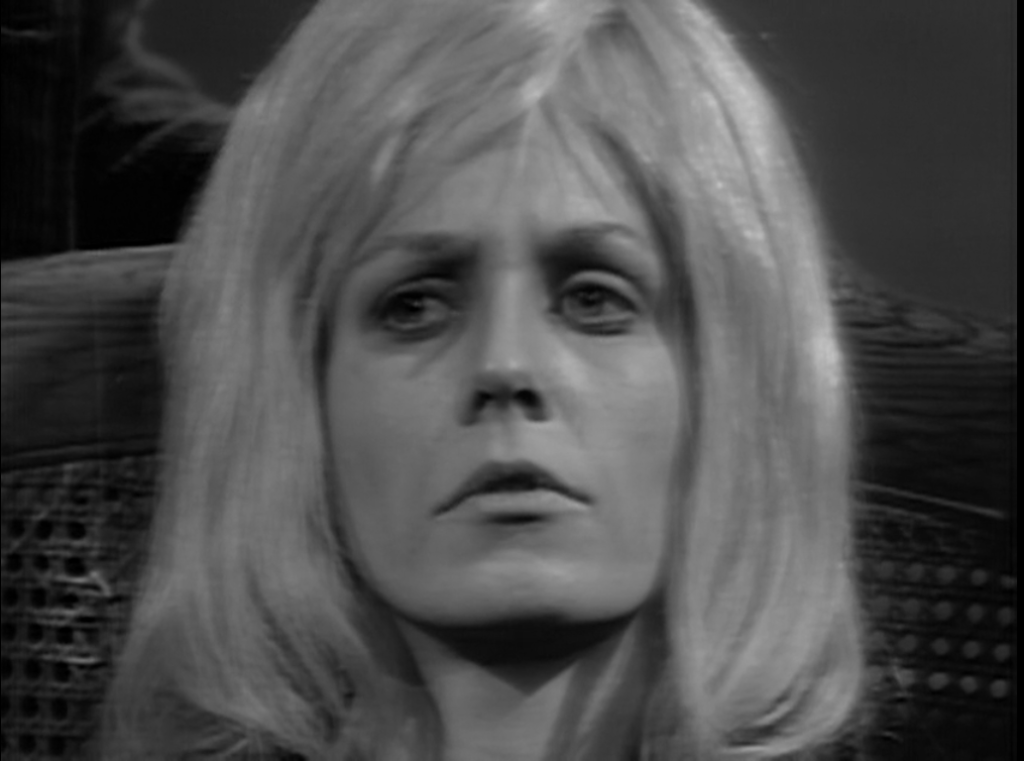
After Ned makes this fingernails-on-a-blackboard noise for a couple of minutes, he lets Chris and Julia into Sabrina’s room. She is in a catatonic state. Her hair is white, and her face is tinged with light blue makeup. The makeup makes her look haggard in color, but most TV sets in the USA in the 1960s received only in black and white. In black and white, the makeup is not very effective.
Ned says that Sabrina was like that when he found her, the morning after she paid her last visit to Chris’ apartment. Several takes of a framed copy of actress Lisa Blake Richards’ professional headshot invite us to imagine the before-and-after. Ned calls Sabrina’s attention to Chris; she rises from her chair, starts towards him, and collapses.
Throughout its first 73 weeks, Dark Shadows was usually very slow-paced, even by the standards of a 1960s daytime soap. Major characters like matriarch Liz and her brother, high-born ne’er-do-well Roger, often seemed to exist solely for the purpose of refusing to accept the facts in front of their faces and thereby slowing down the progression of the plot. Even characters who did face facts would often as not have the memory of goldfish, so that weeks of character development would evaporate with a sudden display of inexplicable ignorance.
That changed when well-meaning governess Vicki came unstuck in time in #365. For the next few months, Dark Shadows was a costume drama set in the 1790s, and events came thick and fast. When Vicki returned to the present and Dark Shadows returned to contemporary dress in March 1968, the show was a genuine hit. They tried to sustain the breakneck pace of the 1790s segment throughout 1968, with mixed success. That period was a Monster Mash, featuring multiple witches, vampires, mad scientists, Frankensteins, ghosts, and the Devil himself, or perhaps one of his middle managers. That attracted a new audience of preteen viewers, but all too often left the characters spinning their wheels as they tried to make room for each other within one small fishing village near Bangor, Maine.
A few months ago, they dumped all of those larger than life but ultimately unproductive figures and started concentrating on two storylines. The A story so far has been that of werewolf Chris and the efforts old world gentleman Barnabas and mad scientist Julia have made to keep him from killing quite so many people. That one has been moving along at a steady clip.
The B story has not progressed nearly as fast. At times, it has matched the leisurely pace of the show’s early days. Today is dedicated to that story, and in today’s pre-title teaser it appears that it has brought narrative progression to a total halt.
Maggie is the new governess in the great house of Collinwood, charged with the education of Chris’ nine year old sister Amy and of strange and troubled boy David. As usual, we open with a reprise of the previous episode. This time, the reprise is 5 minutes and 45 seconds of Maggie wandering around the house looking for the children and hearing voices, while doors open themselves. That was OK at the end of Friday’s installment, but on its own it is stupefying.
The story is that the evil spirit of the late Quentin is taking possession of David and Amy in order to destroy the Collins family and have the house to itself. It made sense that that story would start slow. Quentin was at first very weak. He existed only in a sealed chamber the children stumbled upon while exploring the long deserted west wing, and could influence events outside that chamber only by persuading them to do his bidding. He gradually gained the power to control one child at a time, and to manifest himself outside his little room. A while ago he was able to put strychnine into Chris’ drink; by the end of Friday’s episode he had Amy and David under his power simultaneously.
Once the action finally gets underway in today’s episode, Quentin is about to strangle Maggie and the children are screaming at him to stop. Housekeeper Mrs Johnson and Liz enter the room. Mrs Johnson sees Quentin, Liz does not. Maggie is unconscious and the children are in a state. By the end of the episode, Liz, Maggie, and Mrs Johnson know Quentin’s name, his plan, and his power. He has managed to create some kind of bubble around the house so that the people inside it cannot hear the rain. The children pass out. David comes to, and announces that it is too late to be afraid. He laughs maniacally, and in the background we also hear Quentin’s laughter.
With this slam-bang ending, the Haunting of Collinwood takes over as the A story and Liz forever sheds her role as a blocking figure. This phase of the show is approaching its climax, and there is a chance that what comes next will be exciting.
We open with governess Maggie Evans entering the bedroom of strange and troubled boy David Collins. She had heard David’s screams and a man’s laughter coming from the room; the man is gone, and David is unconscious on the floor. He has a nasty burn on his arm, and as he is coming to he pleads with “Quentin” not to hurt him.
Once David is fully awake, Maggie asks who Quentin is. David frantically denies that there is any such person, and claims that the laughter she heard was his own voice as he was playing a make-believe game. She says that she knows he couldn’t have made those sounds. He points out that they are the only people in the room. Maggie does not even try to explain how anyone could have left the room unseen; she seems already to have concluded that Quentin is a supernatural being. Maggie identifies Quentin with a strange and frightening man she and housekeeper Mrs Johnson have both seen. David keeps trying to deny everything, and Maggie keeps telling him she wants to help. David sobs, and Maggie holds him.
Maggie holds David.
Quentin is indeed a ghost who is taking possession both of David and of Maggie’s other charge, nine year old Amy Jennings. With their help, Quentin has so far killed two people, tried to kill two others, and set about trying to drive everyone off the estate of Collinwood. Up to this point, Maggie has failed completely to represent any sort of obstacle to Quentin. She is a poor disciplinarian who lets the children run rings around her even when they are themselves, and is altogether at sea when they are doing Quentin’s bidding. This scene promises a breakthrough. Maggie is the first of the adult characters to learn Quentin’s name, she does not flinch from the evidence of his uncanny nature, she vows to fight him, and David finds comfort in her arms.
The breakthrough does not come today, however. After a moment, David declares that no one can help him, and he rushes out of the room. He goes downstairs to the foyer and hears a knocking at the door. He opens it and sees notoriously abusive actor Roger Davis standing there. He reacts to that sight as anyone might, running away without a backward glance.
Maggie follows David downstairs. There is again some question as to how much of the body language in the next scene is the blocking the director gave as an interpretation of Maggie’s response to the character Ned Stuart and how much is Kathryn Leigh Scott’s reaction to Mr Davis. Maggie tells Ned she can’t talk because she must go out in search of David; as she prepares to exit, she circles around with as much space as possible between her and him, never quite making eye contact but glancing back every time he moves towards her. This is not a pattern of movement we have seen before on the show, even when a character was dealing with a vampire or some other murderous foe. Miss Scott looks very much like a woman alone with a man whom she does not trust not to assault her. If he had, it wouldn’t be the first time he has physically abused a castmate on camera.
She keeps her eyes on his hands
A child’s voice is heard, singing the song “Inchworm.” It is Amy, and she is working a jigsaw puzzle in the drawing room. The drawing room brings out Amy’s musical side. She played “London Bridge” on the piano there in #656 and tapped a few random keys on the same instrument in #676. She is quite a good singer, perhaps not surprising since actress Denise Nickerson had been in the cast of the short-lived James Lipton/ Laurence Rosenthal Broadway musical Sherry! in 1967.
Ned enters and introduces himself to Amy. His lines are all perfectly polite and friendly. Amy is supposed to gradually sense that Ned is hostile to her big brother Chris and to become uncomfortable around him, but that is supposed to come at the end of their time together. As it plays out, she already seems uncomfortable when he first enters. A minute or so into the scene, Amy smiles at Ned. Nickerson was remarkably good at flashing quick smiles, but it doesn’t work this time. She looks like she is displaying her teeth to the dentist. When Amy is supposed to start edging away from him, Nickerson turns around and proceeds to her next mark at full speed. The camera pans back, but does not capture her movement- she has gone clean out of the shot, leaving Mr Davis alone in the frame.
She goes as far as she can as fast as she can.
Ned approaches Amy; he grabs her by the shoulders and pulls her back into the shot. Chris enters. Amy starts to warn him against Ned, and he tells her not to be afraid for his sake. Indeed, Chris is safe. It is only women and children who have to be afraid of Roger Davis.
Ned confronts Chris. Evidently something bad happened to Ned’s sister Sabrina. She can’t tell Ned what it was, but he thinks Chris is responsible and wants him to go with him to the Collinsport Inn to see her. Returning viewers know that Chris is a werewolf and that Sabrina saw him transform. He assumed that he had killed her while in his beastly form, and he is surprised to learn from Ned that she is still alive. Chris is a character we are supposed to sympathize with, so it is a bit disturbing that he does not seem particularly relieved to find that he did not kill Sabrina.
In the woods, Amy finds David. She learned some days ago that Quentin wants to hurt Chris, and she has been resisting Quentin’s influence ever since. She and David talk about ways they can work together to fight him. David says that he has decided to tell Maggie what has been happening; Amy objects that this is too dangerous. They seem to be getting somewhere when Quentin appears to them. They are terrified, and then resign themselves to their fate.
Later, the children are in the drawing room with Maggie. Amy is still working her jigsaw puzzle, and David is staring into the fireplace. Longtime viewers will remember that this is something his mother used to do. She was the show’s first supernatural menace and tried to lure David to his doom. Maggie’s predecessor, well-meaning governess Vicki, led the other characters in the campaign that saved David then. We wonder if Maggie will be able to match her success.
Maggie admires the puzzle and calls David over to look at it. David makes a show of being bored, leading Amy to remark airily that boys don’t like jigsaw puzzles. David complains that there is nothing to do. Maggie suggests the three of them sit down together for a heart-to-heart talk, an idea the children reject. They suggest a variety of games they might play. Maggie notices that their manner is quite different than it was earlier in the day. David is more assertive, Amy supercilious. She finally agrees to let them play dress-up.
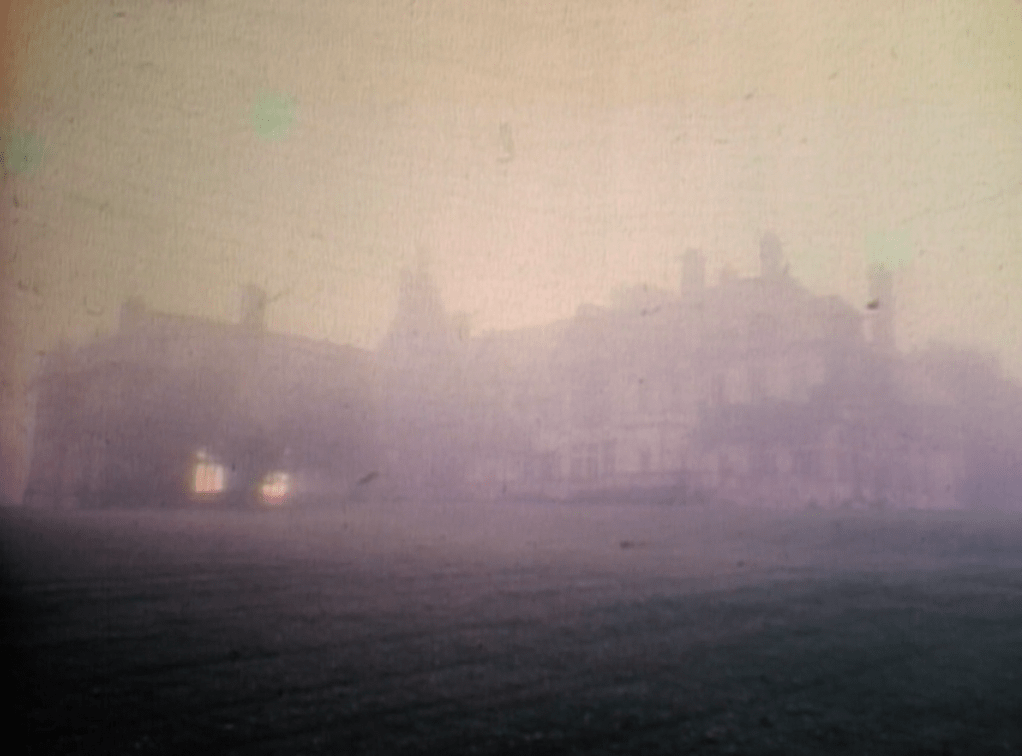
In the first year of the show, the opening voiceovers often involved a weather report. “A cold wind blows from the sea to the great house of Collinwood, but the fog still hangs heavy on its vast lawns” that sort of thing. They stopped doing that some time ago, but today they slip in an almost comically detailed bit about atmospheric conditions- “Soon dark, threatening clouds will gather over Collinwood, and long, ever-lengthening shadows will creep menacingly toward the great house. By late afternoon, rain will come, a rain that will begin slowly but steadily increase into a raging storm.” You expect them to go on with “Expect cooler temperatures and clear skies after 8 PM, with a chance of frost in the morning.” But the rain, at least, plays a part in the story. It explains why David and Amy have to stay indoors, and a roar of thunder gives Amy a chance to sneeringly ask Maggie if she is frightened. It also occasions the use of this still of the exterior of the house, one which I do not believe we have seen before:
We don’t usually see that much of the lawn.
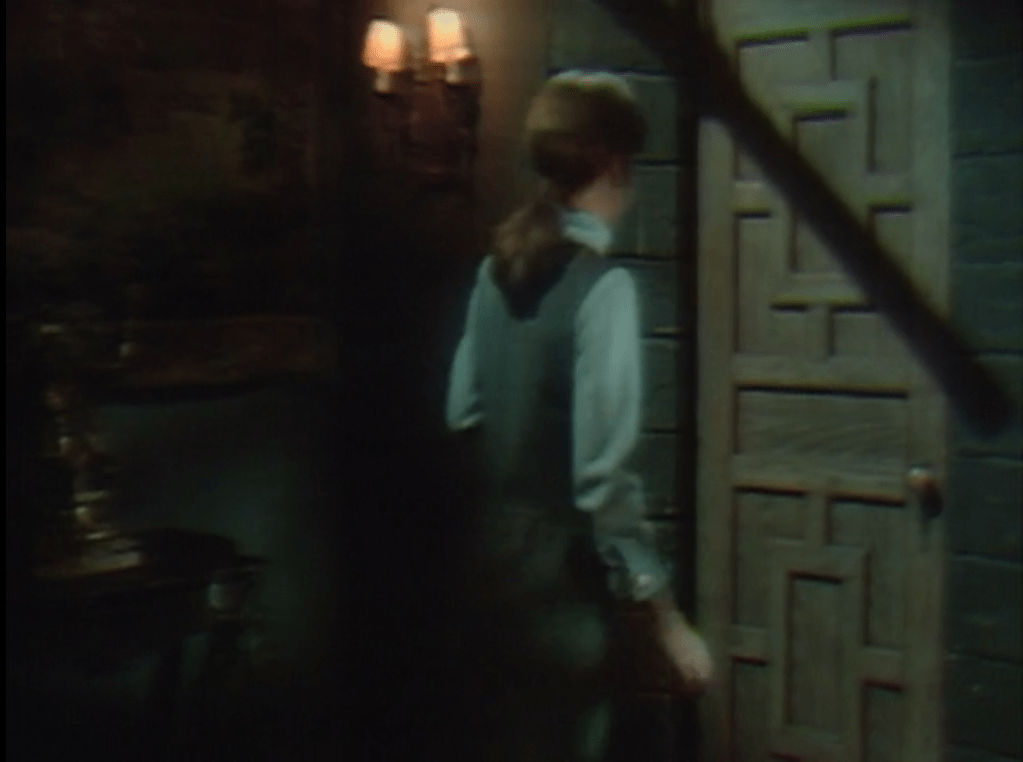
Later, Maggie goes to look for the children. She enters the study. This set has been familiar since early 1967, but today is the first time we see the outside of its door. Lately we have been seeing more of the little spaces that are supposed to join one room to another, part of a strategy to make the house seem like a bigger place.
The sequence before this suggests Maggie is heading into the long-deserted west wing, but once she goes through the door it is clearly the study.
Once in the study, Maggie hears Amy and David calling to her from no particular direction while Quentin laughs. She is bewildered, then the children join Quentin in laughing. His laughter is hearty, theirs is maniacal. Maggie goes out into the corridor, sees something frightening, and retreats into the study. She is only there for a moment when the doorknob starts turning. We end with Maggie staring directly into the camera, its lens representing the point of view of whatever it is that is terrifying her.
Maggie terrified.
This is the first of only two episodes credited to writer Ralph Ellis. Dark Shadows never had more than three writers on staff at any time. I often wish they had had many more. Ellis is one of those whom I would have liked to see as a senior writer on the show right the way through. The episode is well-paced, the characters are clearly defined, and the dialogue is smooth with just a touch of wit. If he had been in charge of, let’s say, every Monday’s script, the whole series would have been a cut above what it actually was. Since he only contributed two scripts, it is especially sad that Roger Davis had to crap on one of them, but even when Mr Davis is on camera you can still tell that Ellis did his job well.
Old world gentleman Barnabas Collins finds his distant cousin, strange and troubled boy David Collins, trying to pull the metal ring that opens the secret chamber hidden inside the old mausoleum.
Barnabas asks what David was doing. He says he was upset with his governess, Maggie Evans, and was hiding from her. Barnabas gestures around the publicly known part of the mausoleum and says “There’s no place to hide here.” David vigorously agrees, and says he didn’t expect Maggie to come there at all. Barnabas asks if David was trying to get into the hidden chamber.
Panicked, David claims not to know what Barnabas is talking about. Barnabas reminds him that he caught him at the mausoleum in #315. Longtime viewers will recall that he subsequently found part of David’s pocket knife in the hidden chamber and confronted him with it, and David seems to remember that as well. He drops his attempt to deny knowing about the chamber, and tells Barnabas he heard an animal inside it.
This goes to the heart of the issue that has brought Barnabas to the mausoleum. Barnabas has befriended mysterious drifter Chris Jennings and has learned that Chris is a werewolf. When Chris is in his beastly form, Barnabas locks him in the hidden chamber to keep him from hurting anyone. The werewolf is in there now. He was growling and snarling when David arrived, but fell silent when Barnabas entered.
Barnabas asks how an animal could have got into the hidden chamber; David admits he can’t think of a way. He then asks David if he can hear the noise now; he says he can’t. He asks if he might have imagined the whole thing; he doesn’t disagree.
Barnabas takes David back home to the great house of Collinwood. His governess Maggie is waiting up for him. She stays in David’s room until he seems to be asleep, then kisses him on the forehead and goes.
Yesterday, David told Maggie that she is a pretty girl. He’s twelve now, old enough to get excited about that very conspicuous fact, so when he opens his eyes immediately after she leaves the room returning viewers might think the reason he faked being asleep was that he was angling for the kiss.
David went to the mausoleum to release the werewolf because the evil spirit of the late Quentin Collins made him do it. Quentin has been dominating David lately. After Maggie goes, Quentin appears in the room and David confronts him. He says he does not want to be part of Quentin’s cruel schemes any longer. In response, Quentin causes David to suffer extreme pain. Passing by in the hallway, Maggie hears David’s scream and Quentin’s laugh, and she opens the door to find David curled up on the floor.
The laugh is noteworthy. Maggie hears it, and it is not a sound David could have made. She has already seen Quentin, but now she has further evidence that he exists. Moreover, it is the first time Quentin has broken his silence. We first met Quentin when he was in company with another ghost, a woman named Beth Chavez. Beth has spoken since then; we wonder when Quentin will have lines to deliver.
Actor Roger Davis rejoined the cast yesterday, after an absence of not nearly long enough. He has an interminable scene with Grayson Hall and Jonathan Frid, during which he thrusts his arm onto the mantel immediately behind Hall, effectively putting his arm around her shoulders. She visibly flinches at this invasion of her personal space. When he exits she sighs “Oh, I thought we’d never get rid of him.” Frid says that he thought the same thing. They then get back into character and play out the scene in the script.
Roger Davis imposes himself on Grayson Hall and Jonathan Frid.
Later, Kathryn Leigh Scott is on a set representing the woods, and she sees Mr Davis. She reacts with a shout of “Don’t come near me! Stay where you are!” When she demands to know “Why have you come back?,” he reminds her that the camera is on and he is playing a character named “Ned Stuart.” She goes into character and says her lines, keeping as much distance from him as the 4:3 aspect ratio of 1960s US television would allow.
The parts of the episode that are not ruined by Mr Davis’ odious presence tell a story about ghosts and werewolves. Frid and Hall play Barnabas Collins and Julia Hoffman, friends of werewolf Chris Jennings. The other day Barnabas and Chris dug up an unmarked grave and found that it contained the remains of a baby wearing an apotropaic device meant to ward off werewolves. We saw the ghost of Quentin Collins watching as they did so, a sad look on his face. Later, we learned that Quentin paid for the apotropaic device, proving that there was a werewolf in the area when he was alive and that he had some connection with the baby.
Strange and troubled boy David Collins is under Quentin’s influence. After Quentin imposes himself on him, David writes a story about a werewolf who tried to keep from hurting anyone by locking himself in a room, but who was let out of that room and killed by a hunter. Barnabas has indeed locked Chris in the secret room of the old Collins family mausoleum.
Julia finds the story and shows it to Barnabas. They fear that David has somehow learned of Chris’ secret. As Barnabas and Julia are aware, David is one of the few people who know about the secret room. And indeed, at the end of the episode, we see him about to open the panel that leads to it.
But that may not be the story’s whole meaning. Regular viewers know something that Julia and Barnabas do not. David and his friend, Chris’ nine year old sister Amy, first came into contact with Quentin when they made their way into a room hidden behind a wall in the long-deserted west wing of Collinwood. They found a decayed skeleton seated in a chair there, wearing Quentin’s clothes. Evidently Quentin was locked in that hidden room, and Amy and David let him out. Perhaps the story David wrote is a suggestion that Quentin was a werewolf, and that by letting him out he and Amy exposed him to hunters.
Werewolf Chris Jennings finds that his curse is no longer effective only on the nights of the full Moon, but that he can transform on other nights as well. Also, the evil ghost of Quentin Collins takes steps to foil the efforts of old world gentleman Barnabas Collins and permanent houseguest Julia Hoffman to prevent him from destroying the living members of his family.
So far, so much fun to watch. But there is also bad news. Actor Roger Davis rejoins the cast. Mr Davis ruined dozens of episodes in 1968, many of them by whining angrily when people called his character “Peter,” saying he preferred the name “Jeff.” Now he is greeted as “Jeff,” only to respond with a demand that he be called “Ned.” The character has some different story around him than did Peter/ Jeff, but he has the same irritating voice, the same uptight walk, the same handsiness with his female cast-mates, and the same incessantly violent temper Mr Davis showed in his previous role.
Ned shows up at the great house of Collinwood at 1:10 in the morning. He walks past heiress Carolyn Collins Stoddard when she opens the front door and takes up a position in the foyer, peppering her with his questions and refusing to answer hers. When she objects to his aggression, he sneers about the unfriendliness of New Englanders. He tells her he wants to see Chris. She reaches for the telephone to call Chris at his cottage. Ned rushes over and puts his hand on hers, keeping the receiver on the hook. She gives him a startled look, but does not raise an explicit objection to this violation of her autonomy.
Carolyn is befuddled by Ned’s jerkiness.
In #684, Quentin took the same telephone from the hand of twelve year old David Collins, who vigorously protested that he had no right to do so. Indeed, restraining a person from calling for help can be an element of kidnapping, and Ned has every reason to believe that Carolyn wants to enlist help dealing with his intrusion. Both Quentin’s relationship to David and Ned’s presence in the house at this moment have strong kidnap vibes.
The last time someone tried to confine Carolyn within the main part of the house was in #204, when dangerously unstable ruffian Willie Loomis blocked the door and kept her from leaving the drawing room. Carolyn responded to that move by pulling a loaded gun on Willie, with salutary results. We might hope she will use the same weapon to bring Mr Davis’ return to the show to an abrupt conclusion, but alas, it is not to be.
When Dark Shadows began in June 1966, we were introduced to Roger Collins as a high-born ne’er-do-well with no sense of responsibility to anyone or anything. Roger had squandered his entire inheritance; his sister, reclusive matriarch Elizabeth Collins Stoddard, nearly bankrupted herself trying to buy up his half of the family business to keep it from falling into outside hands. Roger and his son, strange and troubled boy David, lived in Liz’ house as her guests. Roger drew a salary from the business, but barely pretended to do any work for it. He made absolutely no pretense of concern for David; on the contrary, he expressed his hatred for his son openly, tried to persuade Liz to send him to a boarding school or an institution or any other place that was far away, and speculated out loud that David might be the natural son of his sworn enemy, dashing action hero Burke Devlin.
David’s mother, Roger’s estranged wife Laura Murdoch Collins, was on the show from December 1966 to March 1967. Roger schemed to get her to leave and take David with her. When he discovered that Laura was an undead fire witch whose plan was to burn David alive in order to secure her own peculiar immortality, he was shocked into a display of fatherly tenderness. He’s never been quite himself since.
By April 1968, the show had long since erased all signs of the financial crisis Roger’s crapulent youth had brought upon the family. Further, Roger had by that time shown so many signs of mature responsibility in his attitudes both towards his son and towards his work that we might have wondered if they were going to retcon away all of his vices. It was a genuine surprise when, in #474, Liz told Roger’s new wife Cassandra that Roger lived in her house as her guest, worked in her business as her employee, and owned nothing himself. Roger’s spendthrift past seemed to have no place in the story by that point.
Today, Roger is at his most conventionally respectable. He comes home from a long business trip, indicating his sober devotion to the work of Collins Enterprises. He finds David in his room, struggling with distant cousin Barnabas Collins and permanent houseguest Julia Hoffman. After a commercial break, Roger says that he has heard about the many complicated events that took place while he was away. Barnabas explains that David had told him that silversmith Ezra Braithwaite came to the house to see him, bearing a ledger with information he wanted. David found Mr Braithwaite in the drawing room, dead of a heart attack. The ledger was nowhere to be found. Barnabas and Julia have come to David to ask if he can shed any light on what may have happened to the ledger, and the boy became violently upset. Roger insists Julia and Barnabas leave the room. He talks soothingly to David and tells him he does not believe any accusations against him.
Later, Roger confronts Barnabas and Julia in the drawing room. He finds the ledger on the desk where Mr Braithwaite was sitting when he died; he does not accept Julia and Barnabas’ assurance that it was not there earlier. He dismissively asks if they are suggesting that “a ghost” put it there. He demands they apologize to David, making it a condition for their continued presence in the house that they do so.
Barnabas is shocked when Roger threatens to revoke his great house privileges. Screenshot by Dark Shadows Before I Die.
As it happens, Barnabas and Julia strongly suspect that a ghost did put the ledger back on the desk, and the audience knows they are right. Roger has seen quite a bit of evidence of supernatural forces at work in and around Collinwood, as has Liz. But both of them consistently refuse to acknowledge this evidence. Each of them has had moments when the wall of denial started to crumble; notably in #88, Roger said to Liz, “I’ve seen and felt things, things I couldn’t actually explain. You can’t tell me it hasn’t happened to you, because I know better.” But they always snap back to form sooner or later, no matter how obvious the truth is, and there would obviously be no point in laying the facts before Roger when he is in this mood.
Julia and Barnabas have asked Liz to show them the old family archives. It is the middle of the night, everyone is very tired as the result of the fuss and bother that occurs when a corpse has to be removed from the house by lawful means, they will not tell her what topic they are researching, and they insist on starting work immediately. She asks if they expect her to go along with them on this basis, prompting Barnabas to smile as genially as he can and say “Of course!” You can’t expect to persuade crazy people to behave reasonably, so she gives in.
The archives are a dusty room somewhere in the great house that Julia somehow failed to enter during the months when she was staying at the house under the pretense of being an historian looking into the early years of the Collins family. The first book Julia picks up is an old photo album, and one of the first pages she turns to is a photograph of a woman whose ghost she and Barnabas saw the other night. The photo is dated 1897. The woman looks just as she did in her ghostly form, suggesting that she died not much later than that. There is some business with doors slamming shut and windows blowing open to fill the last thirty seconds of the episode, and the closing credits roll.
My wife, Mrs Acilius, pointed out that Roger’s defensiveness concerning David serves the same purpose in the plot as does Barnabas and Julia’s ludicrously cack-handed approach to questioning him. The evil ghost is still quite weak, the ghost of the woman opposes him, and David and his friend Amy Jennings are desperate to escape from his influence. If any of the adults caught on to what was happening at this point, they could cut the Haunting of Collinwood story short. But it is just getting interesting, and there is only one other plot ongoing now. So we don’t want that. Roger and Liz have to be in full denial mode, Julia and Barnabas have to be terrible at talking with kids, and governess Maggie Evans has to be a squish who doesn’t know the first thing about discipline for the plot to work.
Fortunately, we have ample foundation for each of these character developments. Roger’s origin as a shockingly indifferent father makes it understandable that he would swing to the opposite extreme and treat David with excessive indulgence. As a former vampire and a mad scientist, Barnabas and Julia are metaphors for extreme selfishness, and when they were called upon to act as parents to Frankenstein’s monster Adam in April 1968 they did the worst possible job. Maggie is brand new to governessing; she has been on the show since #1, so we know that she was good at running the coffee shop in the Collinsport Inn, at containing the damage her father did by his alcoholism, at escaping from vampires and mad scientists, and at miscellaneous other tasks involving other adults. But she has never been responsible for children or trained as a teacher, and so it neither surprises us nor alienates us from her that she is bad at the job.
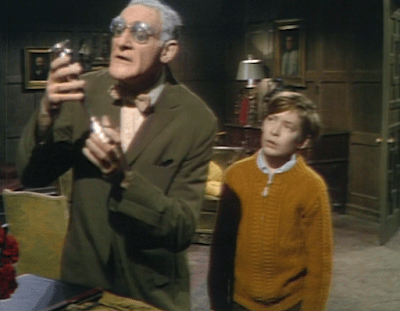
Silversmith Ezra Braithwaite comes to the great house of Collinwood, bearing a ledger with information that old world gentleman Barnabas Collins wants. Barnabas is in the study, so twelve year old boy David Collins lets Mr Braithwaite into the house and escorts him to the drawing room. The two of them play a scene that may not have looked like much on the page, but as delivered by talented comic actors Abe Vigoda and David Henesy the lines are hilarious.
For example, Mr Braithwaite has two pairs of glasses, which he describes to David as his glasses for looking at things and his glasses for looking at people. David asks if the ones he is wearing are his “thing glasses.” We laughed out loud at that whole exchange. Mr Braithwaite asks David to go get “Uncle Barnabas”; David replies “He’s my cousin,” to which Mr Braithwaite answers “Ah, yes.” Again, that wouldn’t be a hit in a joke book, but Vigoda and Mr Henesy sell it. The purest example comes when Mr Braithwaite starts to change his glasses as he turns to the pages of the ledger and says out loud to himself “Oh, Ezra, Ezra, you already got on your reading glasses.” That is a laugh line entirely because of the way Vigoda stresses the words “got” and “on.”
There is a little exchange between Ezra and David that will stand out to longtime viewers:
Ezra: David is it? Well, I don’t remember a Collins being named David before. Now, my name is Ezra, as my father was and his father before him. You find a name like Ezra and you don’t give it up.
David: I guess not.
Ezra: Yes, now, David’s kind of a new-fangled name.
David: No, there’s King David in the Bible.
Ezra: Oh, of course, yes, yes. A good man, too.
In #153, it was established that no Collins ever bore the name “David” until undead blonde fire witch Laura Murdoch Collins insisted that her husband Roger go along with her plan to name their son “David Theodore Collins.” That turned out to be hugely important as evidence of Laura’s evil intentions. In #288, it sounded like they had decided to retcon that away when David looked in a family album, saw a portrait of a “David Collins” from a previous century, and wondered aloud if he had found his namesake. Nothing has come of that potential namesake in the 79 weeks since, and Ezra’s line that he didn’t “remember a Collins being named David before” would suggest that they’ve gone back to the original idea.
Mr Braithwaite, in his thing glasses, examines a piece of silver. David examines him. Screenshot by Dark Shadows Before I Die.
Each time Mr Braithwaite looks at someone through his “thing glasses,” we get a point of view shot showing that his eyesight is blurry. They then cut back to the other actor in regular focus. These shots are brief enough that the repetition isn’t a big problem, but it results in a series of exchanges the actors deliver to the camera rather than to each other. Those don’t work at all. Mr Henesy and Abe Vigoda had such a fine comic rhythm going that it’s a shame to break it up with this clunky stuff.
Reading the ledger, Mr Braithwaite says that the silver pentagram Barnabas wants to know about was bought in April 1897 by Miss Beth Chavez and paid for by Quentin Collins. We have seen Beth’s ghost. She is very tall and so thin you could clasp your fingers around her waist. Her complexion is pale as can be, her hair blonde, her eyes blue. I’ve met a fair number of Chavezes in my time, including a couple of Elizabeth Chavezes, and none has met this description. I have nothing to say against slender blondes, and actress Terrayne Crawford is movie-star beautiful. Still, if a fellow were excited about a blind date with a girl known to him only by the name “Beth Chavez,” he’d probably be a bit disappointed if the person who showed up met her description.
We have also seen Quentin’s ghost. Quentin is manipulating David into helping him with a number of murders he intends to commit. Beth has thwarted one of these murders so far, and is trying to prevent Quentin from achieving other evil plans of his. But Quentin is apparently more powerful than she is.
While Mr Braithwaite is alone in the drawing room, Quentin enters through a secret panel. Earlier in this episode, they made it clear Quentin can choose whether he is visible to the living people in the spaces he occupies; there is no need for him to hide. Why does he use the panel?
Longtime viewers may be able to make a surmise. We saw this panel for the first time in #87, when David’s father Roger used it for a sneaky errand. We didn’t see it or hear of it again until #643, when David told nine-year old Amy Jennings that there was a passage “very few people” knew about, and used it to lead her to the room in which Quentin was at that point confined. Quentin’s use of it will therefore suggest that he knows all the secrets of the house. It also suggests that when he dwelt there as a living being he was a naughty fellow who was in the habit of using its secret passages for the sort of underhanded mischief Roger got up to in #87 and #88.
Quentin strolls up to Mr Braithwaite and smiles at him. Mr Braithwaite is wearing his “thing glasses” and cannot see Quentin clearly. He asks Quentin if he is the friend Barnabas spoke of when he asked him about the pentagram. Quentin nods. Mr Braithwaite says that he himself made the pentagram in April 1897, when he was “fifteen and a half.” It is now February 1969, so we know that Mr Braithwaite is 87. He recognizes Quentin. Shocked to see a man who has been dead for decades apparently alive, well, and in his twenties,* Mr Braithwaite dies of a heart attack.
It’s a shame we won’t be seeing more of Abe Vigoda as Mr Braithwaite. At least they spelled his name correctly in the credits this time; yesterday he was “Abe Vigodo.”
*Two days past his 28th birthday, to be exact. Happy belated 84th to David Selby!








 Dark Shadows Commentary