
No episode of Dark Shadows debuted on ABC-TV 56 years ago today, since that was Christmas Day. So in place of an episode commentary, I’ll share a link to Smartphone Theatre’s 2022 production of “The Gift of the Magi,” starring Kathryn Leigh Scott and David Selby.
Episode 652/653: Someone to take care of them immediately
Well-meaning governess Victoria Winters has vanished into the past, sarcastic dandy Roger Collins is on a long business trip overseas, and matriarch Elizabeth Collins Stoddard is in the grips of a paralyzing depression. That leaves a shortage of adults in the great house of Collinwood, and old world gentleman Barnabas Collins has left his own house on the estate to be of assistance. He is fussing over Liz and insisting that she take the sedatives permanent houseguest Julia Hoffman, MD, prescribed for her. Liz says that all she cares about is that someone take Vicki’s place in the lives of the children in the house, Roger’s son David Collins and houseguest Amy Jennings. To address that concern she orders Barnabas to telephone Maggie Evans, The Nicest Girl in Town, and ask her to replace Vicki starting tonight.
Maggie is in her house talking with her ex-boyfriend Joe Haskell about his plan to move out of town soon when the telephone rings. Soon the two of them are in the drawing room at the great house, where Barnabas fills them in about recent developments.
Joe is Amy’s cousin. He has been doing what he can to fill the void left in her life by the deaths of her parents and her brother Tom, and more particularly by the puzzling refusal of her brother Chris to settle down and live with her. Amy comes downstairs and sees Joe; she is delighted to spend time with him while Maggie is upstairs with Liz, accepting the offer.
Amy’s delight gives way to alarm when she sees a pentagram superimposed on Joe’s face. She does not know what the returning viewers do, that Chris is a werewolf and the pentagram is the mark of his next victim, but she does know that it is a sign that Joe is in great danger. She pleads with him not to go to Maggie’s house and collect her things; she tells him that if he stays at Collinwood tonight, he will be safe. Joe dismisses her concerns as the result of staying up past her bedtime.
Joe enters the Evans cottage. While he is looking over the list Maggie gave him, he hears growling noises outside the window. He turns to look, and sees the window shatter and the werewolf jump through the glass.
The episode has a definite high point and an equally definite low point. The high point comes when Amy is staring at the full moon, which she senses is associated with something very bad. She cries as she does so. That is a powerful enough image that the following scene, when Barnabas sees her tears, asks her what is wrong, and she hugs him, is quite effective.
The low point comes when we see the werewolf sleeping on his bed. A werewolf can be terrifying if you catch only brief glimpses of him, and then only when he is in the middle of attacking someone. But this furry little fella isn’t scary at all. You keep expecting him to start flopping his legs because he’s dreaming about chasing a bunny. It generates a bad laugh that undercuts the final scene of the attack on Joe.

Amy has a couple of great one-word lines, too. Barnabas asks, “Amy, what are you doing with the door open?” To which she replies, “Nothing.” Later, Joe asks “Well what was all that you two were talking about?” To which she replies, “Nothing.” She really is a kid!
Episode 651: The tomb is ready, and I am ready
Mysterious drifter Chris Jennings telephones the great house of Collinwood. Old world gentleman Barnabas Collins answers. Chris asks to speak to permanent houseguest Julia Hoffman, MD. Barnabas tells him Julia is busy with a patient, and Chris says that it is extremely urgent Julia call him back the moment she is free.
Julia comes downstairs. She had been tending to matriarch Elizabeth Collins Stoddard. Liz is mentally ill. She is deeply depressed and fixated on the idea that she will soon be buried alive. Barnabas starts talking about the witch whose spell started Liz’ illness; Julia points out that the origin doesn’t really matter. Indeed it does not. Liz’ condition is quite logical when we realize that she has been exposed to a long series of traumatic events of supernatural character. Of course she feels helpless- her world really does not make rational sense, and there really are forces beyond her control that are determined to bring misery to her and those she loves. And of course she is preoccupied with death- she is surrounded, not only by people in mortal jeopardy, but also by figures who are at once dead and alive. Unknown to her, Barnabas is one of these- he died in the 1790s, became a vampire, and was restored to humanity less than a year ago. The story of Liz’ depression is not really a tale of the supernatural, but of a person responding to her environment in a perfectly natural way.
Liz’ depression is not exactly a fun story, and the show hadn’t done anything with it for months. We might have hoped it was all over. What has brought it back is the disappearance of well-meaning governess Victoria Winters. The other day, Vicki embraced her husband, an unpleasant man known variously as Peter and Jeff, and vanished into thin air as Barnabas and Liz watched. She and Peter/ Jeff were traveling back in time to the 1790s, never to return. Liz was very close to Vicki; the show spent its first year hinting heavily that she was Vicki’s biological mother, though they never got round to saying so explicitly or telling us anything about Vicki’s father. Now that Vicki is gone, Liz is inconsolable.
That is the in-universe explanation for Liz’ trouble. There are two real-world reasons. First, Joan Bennett was going away for a few weeks to do a play in Chicago, and the show needed to explain why Liz wasn’t going to be around when so much of the action was taking place in her house. Second, the key figure in both of the ongoing storylines is Chris’ eleven year old sister Amy, who is staying at Collinwood. Barnabas is the show’s chief protagonist, and so far he does not have any particular connection to either of those stories. Plunging Liz into a paralyzing depression completes the task they started by sending her brother Roger on a business trip overseas. It means that Barnabas has a reason to camp out in the main house and act as a father figure to Amy.
Barnabas had a vague notion about a romance with Vicki, though he did almost nothing to develop such a relationship. His basic feeling towards her seems to have been that he might want her someday, and so he reacted with petulant anger to any person or event that made her unavailable to him. Thinking about Vicki’s departure with Peter/ Jeff, he spends several minutes pouting while Julia tries gently to reason with him.

At the end of his tantrum, Barnabas declares that he and Julia should go back upstairs and talk with Liz. As they are going, he sees the telephone and says “Oh. By the way, Chris Jennings called. He said it was urgent.” It’s even funnier that Barnabas remembers this call so late in the scene than it would be if he had forgotten it altogether. Chris may use words like “emergency” and “extremely urgent,” but in Barnabas’ world there is only one truly urgent matter, and that is whatever his feelings are at the moment.
Vampires are metaphors for extreme selfishness. Barnabas may not be a vampire anymore, but he is still very selfish. But perhaps is attitude towards Vicki is not so unsympathetic as I have made it out to be. When he was still under his curse, he thought he might be able to remake Vicki as an eighteenth century woman, then turn her into a vampire and take her as his bride. Vicki did indeed have an attachment to that era, so much so that she traveled back in time to the 1790s. And when he became human again, Barnabas was immediately embroiled with a succession of witches and monsters, to none of whom did he want to expose Vicki. He wanted to clear them out of the way so his life could start, and once it did he would be free to approach her. But her life was already underway, and of course his was too. The nemeses Barnabas and Julia fought together throughout 1968 are gone now, but so is Vicki, and it is the two of them who are alone together.
The other day, Chris dropped by to ask Julia for sedatives. She was unimpressed with his drug-seeking behavior, and so when Barnabas tells her about Chris’ call she says that he can wait. What she does not know is that Chris is a werewolf, and he was hoping that strong enough pills could knock him out throughout the night of the full moon.
Chris and Amy’s cousin Joe Haskell has been trying to fill in for Chris in the big brother role. He and Amy have gone to the movies, and we see them on their way back to the great house, looking at the moon. Amy tells Joe that she is terribly afraid of the moon, for reasons she can’t explain. Joe asks if she really saw a pentagram on his face in #648; she confirms that she did. Joe knows that someone else saw it too, visiting medium Janet Findley. He also knows that when he told Chris about it he was terribly upset. Neither Joe nor Amy knows what Chris and Madame Findley knew, that it is the sign that he will be the werewolf’s next victim.
Amy is alone in the foyer of the great house when Liz comes down the stairs, apparently in a trance. She does not respond when Amy calls out to her, but walks out into the night. Amy is standing in the open doorway, watching her, when Barnabas comes and asks what she is doing. She tells Barnabas what happened. He tells her to go to bed; she refuses. He then decides it will be good enough if she waits in the drawing room until he brings Liz back. She goes to the drawing room, but when he goes off to tell Julia what has happened she slips out to look for Liz. Barnabas learns that she has left when Julia, whom he has sent to sit with her, reports that she is not in the drawing room.
Barnabas is out looking for Liz and Amy when Chris comes to Collinwood. He is upset that Julia did not call him back; she is skeptical of him. He tries to give a reasonable-sounding explanation; if only he knew of her background treating vampires and Frankensteins, he would realize that he has everything to gain by telling her the truth. She finally gives him a bottle of sleeping pills, along with a wary look and an injunction to use the pills only as directed.
Liz goes to the old Collins family mausoleum. Barnabas’ parents and sister are buried there, and he was himself trapped there for 172 years when he was a vampire. She thinks of it now as her tomb, and tells herself that she is ready to be buried there now. She collapses. Amy finds her, fears that she is dead, and cries out. Her voice brings Barnabas, who tells Amy that Liz is alive. He also says that they must get her back to the house at once. Barnabas puts his arms under Liz’ left side, Amy puts hers under her right, and they lift her. This brief glimpse of the two of them working together goes a long way towards establishing Barnabas’ closeness to Amy.
Joe pays another visit to Chris’ room. Chris has taken a bunch of sleeping pills from the bottle Julia gave him. Joe scolds Chris for his failure to visit Amy. Chris knows that he could transform at any time, and is desperate to get Joe to leave. Joe does leave. Chris goes to bed. He falls asleep. The camera pans to his hand, which has already become a werewolf’s paw.
Episode 650: I must see to my luggage
Version 4.0 of Dark Shadows began in #466 when old world gentleman Barnabas Collins was cured of vampirism and ended in #637 when Barnabas and his friend, mad scientist Julia Hoffman, found that witch-turned-vampire Angelique had departed the scene. That version was a Monster Mash in which the main attractions of all Universal Studios horror hits of the 1930s found their counterparts. Version 5.0 is focused on just two monsters, a werewolf and a ghost. The werewolf is Chris Jennings, brother of nine year old Amy. The ghost is Quentin Collins, who is obsessing Amy and her friend, strange and troubled boy David Collins.
Today is taken up with two problems of plot mechanics. First, Barnabas is the undisputed star of the show, and he does not have any particular connection to either of the ongoing stories. Second, well-meaning governess Vicki is too familiar with the supernatural, too secure in her place in the great house of Collinwood, and too familiar to the audience to permit Amy and David to figure in a story based on Henry James’ The Turn of the Screw, even if that story is inverted so that it is the children who see the ghosts and the governess who doubts them.
Today, Vicki’s husband, a repellent man known variously as Peter and Jeff, returns from the dead and takes her with him. He materializes in her bedroom, takes her by the hands, and they both vanish while Barnabas and matriarch Elizabeth Collins Stoddard look on. That solves the second problem.

Liz’ brother Roger solves the first problem when he asks Barnabas to hang around the house while he is away on a business trip to London. Barnabas will therefore be on the spot while the children cope with “The Haunting of Collinwood.”
The opening narration is delivered by Roger Davis, who plays Peter/ Jeff. This not only produces a sinking feeling in regular viewers who recognize Mr Davis’ voice and realize that his absence these last few weeks was only a temporary reprieve, it also spoils the surprise when Peter/ Jeff shows up.
This is the last of Betsy Durkin’s 10 appearances as Vicki. The part originated in #1 as the audience’s main point of view character; then and for the next 126 weeks, she was played by Alexandra Moltke Isles. By the time Mrs Isles left the show, Vicki had long since run out of story, and was saddled with the hopelessly unappealing Mr Davis as her primary scene partner. Inheriting those difficulties, Miss Durkin never had a chance to establish herself as part of the show.
Episode 649: Why did that music stop?
Cavada Humphrey plays Madame Janet Findley, a medium who has come to the great house of Collinwood and is doing battle with the ghost of Quentin Collins. This battle takes the form of Humphrey alone in a room arguing with a series of inanimate objects. The only bipedal presence with whom she shares any of the ten minutes she is on camera is that ever-faithful member Dark Shadows’ supporting cast, a skeleton wearing a wig. Her most intense scenes are with Quetin’s record player.

Humphrey’s style was more like pantomime or puppetry than it was like anything native to screen acting; she strikes a series of poses, and tells the story through them, producing the dialogue as a sort of incidental accompaniment. She has such a complete mastery of this approach that she could hold the audience’s interest for any length of time, regardless of what she had to do or with whom she had to do it. Unfortunately, today is her final appearance- at the end of the episode, Madame Findley falls down the stairs in the foyer of Collinwood, dead.
Madame Findley’s scenes give Humphrey about half the episode’s running time. Most of the rest is taken up with chatter between matriarch Elizabeth Collins Stoddard, who is worried about Madame Findley, and permanent houseguest Julia Hoffman, MD, who is not.
There are also two scenes with mysterious drifter Chris Jennings. In the first, Chris is in his apartment, dreading the upcoming full moon and feeling guilty about a barmaid he killed during the last one. We know that Chris is a werewolf. Chris’ cousin Joe Haskell knocks on the door and insists he be let in. He tells Chris that he will be leaving town soon, probably forever. Joe chastises Chris for spending so little time with his little sister Amy, who has been staying at Collinwood. Joe mentions that when he was visiting Amy earlier to pass on Chris’ message that he was yet again too busy to see her, she saw a pentagram on his face. Chris knows this means that he will be the werewolf’s next victim, and he is horrified.
Joe has been on the show since #3. From November 1967 to March 1968, Dark Shadows was a costume drama set in the 1790s, and actor Joel Crothers played roguish naval officer Nathan Forbes. Both as Joe and as Nathan, Crothers has been a mainstay of the show’s appeal, even more so than the bewigged skull. He is about to leave the cast, and he deserves a spectacular exit followed by a huge and long-lasting display of grief. A fatal werewolf attack would fit the bill, especially since the werewolf is, in his human form, one of Joe’s closest relatives and dearest friends. If they play their cards right, Chris could be mournful and racked with guilt about Joe’s death for the rest of the show’s run, even if that goes for decades.
Later, Joe drops by Collinwood to see Julia. Julia specializes in treating monsters, vampires and Frankensteins particularly, so if Chris had disclosed his lycanthropy to her she may well have had a prescription handy. Unfortunately, he doesn’t know about that, so he just demands that Julia give him a super-powerful sedative right away. Julia routinely dispenses sedatives to address any and all conditions, including sleepiness, but she draws the line here. She has never examined Chris, looked at his medical records, or talked with a doctor who has. Still, she does finally agree to prescribe something, though apparently not the knockout drops he was hoping for.
Episode 648: Her name is Madame
This is the second of three episodes featuring Cavada Humphrey as Madame Janet Findley, a medium called in to investigate the strange goings-on at the great house of Collinwood. Humphrey’s performance so utterly dominates the segment, and I have so little to add to what I said about her style in yesterday’s post, that all I can do is make a series of more or less miscellaneous observations about its other aspects.
Today Madame Findley meets children David Collins and Amy Jennings. Amy and David are coming under the influence of evil spirit Quentin Collins. She questions them in the drawing room, and finds a hidden panel that leads to the long-abandoned west wing of the house. Over the children’s objections, she enters the secret passage. As soon as she is in, they hurriedly close the panel, locking her in. Evidently their objections were part of a ruse designed to lead her to Quentin’s stronghold. All too often on Dark Shadows, the audience knows too much about what characters are trying to do. This scene stands out, because they really do keep us guessing whether the children want Madame Findley to go into the secret passage. We don’t really know what their goals are until we see them shut her in.

Earlier in the episode, Amy’s brother Chris dropped in. He was very eager to see permanent houseguest Julia Hoffman, MD. Amy mentioned to Chris that there was another visitor in the house. When Chris asked who it was, Amy replied, “Her name is Madame- Madame something- at least that’s what they call her.”
I heard these lines in the voice of T. S. Eliot. The rhythm is reminiscent of a section of his poem The Waste Land, which in 1968 was an extremely familiar text to people with literary ambitions:
Madame Sosostris, famous clairvoyante,
Had a bad cold, nevertheless
Is known to be the wisest woman in Europe,
With a wicked pack of cards. Here, said she,
Is your card, the drowned Phoenician Sailor,
(Those are pearls that were his eyes. Look!)
Here is Belladonna, the Lady of the Rocks,
The lady of situations.
Here is the man with three staves, and here the Wheel,
And here is the one-eyed merchant, and this card,
Which is blank, is something he carries on his back,
Which I am forbidden to see. I do not find
The Hanged Man. Fear death by water.
I see crowds of people, walking round in a ring.
Thank you. If you see dear Mrs. Equitone,
Tell her I bring the horoscope myself:
One must be so careful these days.
It was indeed a mysterious Tarot card that prompted matriarch Elizabeth Collins Stoddard to call for help, and that call brought Madame Findley to the house. The card she interprets is the Tower of Destruction, which unlike the cards Eliot’s Madame Sostris describes actually appears in existing Tarot decks. She doesn’t have a cold, and she isn’t in the business of selling horoscopes door to door. On the contrary, as Humphrey plays her she is a dazzling presence.
Liz did not call Madame Findley directly. She telephoned occult expert Timothy Eliot Stokes, who introduced her to La Findley. At first sight, Stokes appears to be a stuffy academic with an impossible Anglophile manner, but as we get to know him he turns out to be very much at home in the bizarre netherworld in which the show takes place, so much so that his supernatural adversaries fear that he may have powers surpassing theirs. T(homas) St(earn)s Eliot was so much like T(imothy) Eliot St(oke)s in the first impression he made, so highly regarded by the sort of people who wrote Dark Shadows, and so generally famous in the 1960s that it is very likely that Stokes’ name was at least partly inspired by him.
It’s true that Madame Findley’s name lacks the exotic glamour Eliot gave his character. I suppose if you have all of Europe to choose from, you can take your stray Tarot cards to someone named “Madame Sosostris,” but if you are limited to central Maine, you have to settle for “Janet Findley.”
I made a remark about Madame Findley’s name in the comments on Danny Horn’s post about episode #647 on his great Dark Shadows Every Day:
It’s just delightful that they introduce an otherworldly, mystical character, played with an actress who brings a genuinely eerie note to her performance, and her name is… “Janet Findley.” It’s like Monty Python and the Holy Grail, when they meet the wizard who is known as “Tim.”
I wonder if there’s any connection between the name “Janet Findley” and the name “Janet Fisher,” whom Carolyn mentioned as a friend once of twice in the first season. Seems like a lot of Janet Fs. For that matter, I wonder if there’s a connection between Tim the Wizard from Monty Python and Tim(othy Eliot) Stokes, who a couple of episodes back had to tell Vicki that he isn’t a wizard.
–Comment left by Acilius, 8 October 2020, on Danny Horn, “Episode 647: The Wire,” Dark Shadows Every Day, 12 May 2015
That remark drew a response from a commenter who posts as “Mary”:
Findley is a popular name on Dark Shadows. In addition to Janet, Margaret Findley is one of the ghostly widows, Thomas Findley is one of Jeb’s zombies in the Leviathan storyline and Findley’s cove is the location of Carolyn’s cottage in 1995.
Comment left by “Mary,” 18 February 2021, on Danny Horn, “Episode 647: The Wire,” Dark Shadows Every Day, 12 May 2015
When Madame Findley asks about the closed-off parts of the house, Liz tells her about both the west wing and an east wing. The phrase “east wing” had come up a couple of times in the first year of the show, but it always seemed to be either a case of the writers not having made up their minds which side of the house the deserted wing was on or a slip of the tongue by the actors. This is the first time the show makes it clear that the house really does have two deserted wings.
Humphrey was too perfect for Dark Shadows to play only one role. In a comment on Danny’s post about this episode, I indulged in a little fanfic about another part that would have been right for her:
Cavada Humphrey looks quite a bit like Jonathan Frid. I wonder what 1795 would have been like if Barnabas had had an older sister who bossed him around, stood around during his ridiculously childish fits of petulance, occasionally acted as his conscience, and time and again serve as his enabler and protector. It would have been funny to see Grayson Hall’s Countess express disapproval of such a relationship.
Heck, that older sister could have been Sarah. Just because she’s a child in her ghost form doesn’t mean she has to have died at that age. Maybe she comes back in the form in which her relationship to her brother took its permanent shape, when she was about nine and he was about seven. Of course, that possibility is foreclosed at Sarah’s first appearance, when she tells Maggie not to let her “big brother” know she saw her, but I suppose they could have retconned that away with a phony flashback where she says “little brother.”
Comment left by Acilius, 8 October 2020, on Danny Horn, “Episode 648: Astral Disturbances,” Dark Shadows Every Day, 14 May 2015.
I’m very fond of Sharon Smyth, and Sarah’s last appearance in the 1795 segment was so poignant it would have been a substantial loss for her not to have been in it. On the other hand, she had so much less to do when she was playing a living being than she did in the preceding months when Sarah was a ghost, and so much of what she did get to do was outside her rather sharply limited range, that it is not difficult to imagine a different kind of Sarah making the eighteenth century insert a more compelling drama.
Episode 647: Her own sensitivities
This is first of three consecutive episodes featuring Cavada Humphrey as Madame Janet Findley, a medium recruited to investigate the strange goings-on at the great house of Collinwood. Humphrey’s performance dominates these segments completely. Her style is more akin to pantomime than to anything native to spoken drama; she uses every muscle of her body to strike a series of exaggerated poses. Since that includes the muscles of the vocal tract, words occasionally come out in the course of her performance. The result is as bizarre as it sounds like it would be, and on Dark Shadows it is magnificent.
Granted, it is a shock when Humphrey reads the opening voiceover. Without seeing her, it is difficult to know what to make of her speech. When we watched it this time, I tried to make Mrs Acilius laugh by mimicking the poses a person might strike while speaking that way. So far from making the monologue sound silly, that just made it clear to us what Humphrey was doing, and left us both taking her performance seriously.
I’ll make a couple of random remarks about the non-Cavada Humphrey parts of the episode. Under the influence of the ghost of Quentin Collins, children David Collins and Amy Jennings have tried to murder David’s father Roger. Yesterday David took the lead in setting the trap that caused Roger to fall down the stairs while Amy showed reluctance in helping him. Today, the children see that Roger is not seriously hurt. David is relieved and wants to stop doing Quentin’s bidding, while Amy insists that they continue. Denise Nickerson delivers one of Amy’s monologues with her eyes fixed on the camera; the effect is unsettling in the extreme, suggesting as it does that Amy and David have taken leave of the other characters and are now in a dramatic space of their own where they may as well communicate directly with the audience.

On his great blog Dark Shadows Every Day, Danny Horn derides David and Amy’s exchange of roles in their conspiracy. He says that the reason they take turns being “Executive Child” is merely sloppiness on the part of the writing staff:
You can handwave and say that seeing his injured father shocked young David out of his temporary hypno trance, but really the explanation is that Gordon Russell wrote yesterday’s episode and Sam Hall wrote today’s, and they didn’t really bother to synch up on David’s emotional throughline. It happens. This is the “good enough for rock ‘n roll” approach to soap opera dramaturgy.
Danny Horn, “Episode 647: The Wire,” posted 12 May 2015 on Dark Shadows Every Day.
I disagree. There’s nothing hand-wavey about an appeal to David’s motivation. However little attention Hall paid to yesterday’s episode, David’s visit to his father, during which he all but begs for a way to help him in his recovery, leaves no doubt that he meant for us to think that David was relieved that he failed to kill his father and that, having seen where Quentin’s spell would lead, he wanted to break free of it.
And the actual effect of seeing the children waver back and forth in the intensity of their subjection to Quentin, alternating between attempts to break free and turns as “Executive Child” enforcing Quentin’s will on the other, is to show us that we are early in the process of obsession and to create suspense as to whether it will progress all the way to possession. So far, Quentin can dominate only one of the children at a time, while he just tugs at the other. In Madame Findley’s intervention, and for that matter in David’s scene with Roger, we can see paths still open that would lead to breaking his power altogether before he grows strong enough to fully control Amy and David simultaneously.
There is a similarity between David and Amy’s relationship to Quentin at this point and Amy’s brother’s relationship to his curse. Chris has been a drifter for a few years, suggesting that he has been a werewolf for that long, but he is still looking for ways to keep himself from hurting anyone when the Moon is full. The supernatural menaces the show has presented up to this point were introduced as already fully committed to the destruction it was ordained they would cause. David’s mother, undead fire witch Laura Murdoch Collins, was an collection of several entities, some of them more purposeful than others, when she joined the show in December 1966, but it was always her fate to lure David to a fiery death. Vampire Barnabas Collins would eventually become a nuanced character and has now been freed of his curse and become human again, but when he first showed up in April 1967 he was all-in on being a creature of the night. Wicked witch Angelique started her murderous rampage shortly after her arrival in November 1967, and all of the various villains of the Monster Mash period that ran from mid-April to early December 1968 showed up loaded and ready to do their thing. But Chris’ curse has only drawn him halfway into monsterdom, as Quentin’s obsession has only drawn Amy and David halfway into his world of evil.
One inconsistency that may be most profitably explained by carelessness comes when Amy tells David that Quentin calls him by the name “Jamison.” Jamison was the name of David’s grandfather, who was Quentin’s nephew. Earlier, David had, under Quentin’s influence, told Amy to call him “Quentin.” It might have been better if they had decided in advance just who it was whose personality was supposed to overwrite David’s, though I don’t think it is a major flaw.
Episode 646: Morbid games children play
The ghost of Quentin Collins has lured children Amy Jennings and David Collins to the room in the long deserted west wing of the great house of Collinwood where his skeleton is hidden. For the first time, Quentin appears. Later, a woman in a white dress will also materialize.

An old gramophone starts playing a sickly waltz, and David snaps into an odd mental state. He is slow to respond when Amy calls him by name, and tells her she knows that the waltz is his favorite piece of music. She does not know this, and is puzzled to hear it, since he hadn’t heard the waltz until the night before. Soon it becomes apparent that David is coming to be possessed by Quentin. He tells Amy that they have things they must do, including a conversation with “Roger.” Roger is David’s father; this is the first time we have heard him refer to him by name, and it makes it clear to regular viewers that David is not himself. Later, they are wearing clothes of the same period as those Quentin and the woman in the white dress wore, and they decide to address each other as “Quentin” and “Beth.”
Longtime viewers will also recognize the motif of a piece of music as a device with the power to overwrite a character’s personality. In #155, David’s mother, undead fire witch Laura, gave him a music box, apparently as part of her plan to prepare him to follow her to a fiery doom.
Another music box became much more famous a little later. In the summer and fall of 1967, David’s distant cousin Barnabas was a vampire, and he was determined to re-create his lost love, the gracious Josette. His plan involved forcing a young woman to listen to Josette’s music box incessantly. Barnabas hoped that someone who spent enough time listening to the box would forget her old habits and memories and turn into Josette. The music box did seem to have some measure of the power Barnabas had in mind. First Maggie, The Nicest Girl in Town, then Vicki, David’s well-meaning governess, did spend substantial amounts of time listening to the music box with a vacant look on her face. Episode #303 ended with Vicki’s boyfriend Burke listening to the music box and staring off into space; Mrs Acilius wondered if that meant Burke was going to think he was Josette. Burke wouldn’t have looked so good in the dress that comes with the part, but who knows, maybe he and Barnabas would have been happy together.
David and Amy carry a chest out the front door of the great house. Roger and his sister, matriarch Liz, see them do this and ask what is in the chest. David says that it is full of his toys, and that he and Amy want to play with them outdoors. Roger points out that David has never taken a chest full of toys outdoors before, and asks what has led him to do so now. David tells him it is a military secret. Amy explains that one of David’s toy soldiers is broken and they are going to bury him with full military honors. Amused by this idea, Roger holds the front door open and salutes the children as they carry the chest past. In fact, the chest holds, not a toy soldier, but Quentin’s skeleton. It is that which Amy and David bury.
At night, Roger is about to go to sleep when a knock comes on his bedroom door. It is Amy, telling him she heard from sounds from the downstairs that made her suspect someone might be trying to break into the house. Roger takes this concern seriously enough that he retrieves a pistol from his nightstand and carries it as he goes to investigate.
David ties a wire across the second stair from the top of the case from the bedrooms to the foyer, opens the front door, then hides. Roger enters. He is alarmed to see that the front door is open. He stumbles on the trap David has set. He lies unconscious and bleeding at the foot of the stairs. Amy and David enter, see his condition, and nod at each other gravely.
This is the second time David has tried to kill Roger. The first time, in #15, he had sabotaged the brakes on Roger’s car. As he watched the car pull away, he called to his mother. Laura was not physically present, and would not be for another 22 weeks, but when those who watch the show from the beginning learn of her supernatural character they will ask if she influenced David to patricide. Today there is no doubt that David and Amy are doing the bidding of the ghosts, and so we wonder again if David was under Laura’s power when he took the bleeder valve from the wheel cylinder of Roger’s car.
I don’t know how much of a spoiler it is to tell someone reading a Dark Shadows blog that in the spring of 1969 Quentin would become a major breakout star, rivaling Barnabas’ popularity. Quentin would be such a big part of the show’s appeal that Dan Ross would give the last 16 of the 32 original Dark Shadows novels he wrote under his wife Marilyn’s name titles beginning with the words “Barnabas, Quentin, and the.” They were:
- Barnabas, Quentin, and the Mummy’s Curse, April 1970
- Barnabas, Quentin, and the Avenging Ghost, May 1970
- Barnabas, Quentin, and the Nightmare Assassin, June 1970
- Barnabas, Quentin, and the Crystal Coffin, July 1970
- Barnabas, Quentin, and the Witch’s Curse, August 1970
- Barnabas, Quentin, and the Haunted Cave, September 1970
- Barnabas, Quentin, and the Frightened Bride, October 1970
- Barnabas, Quentin, and the Scorpio Curse, November 1970
- Barnabas, Quentin, and the Serpent, December 1970
- Barnabas, Quentin, and the Magic Potion, January 1971
- Barnabas, Quentin, and the Body Snatchers, February 1971
- Barnabas, Quentin, and Dr Jekyll’s Son, April 1971
- Barnabas, Quentin, and the Grave Robbers, June 1971
- Barnabas, Quentin, and the Sea Ghost, August 1971
- Barnabas, Quentin, and the Mad Magician, October 1971
- Barnabas, Quentin, and the Hidden Tomb, December 1971
- Barnabas, Quentin, and the Vampire Beauty, March 1972
My first choice is always to title these entries after lines of dialogue from the episodes, and “morbid games children play” was so perfect that I couldn’t pass it up. But Barnabas, Quentin, and the Bleeder Valve was also very tempting, and I do suspect I will use at least a few Barnabas, Quentin, and the titles in the next two and a half years.
Episode 645: We’ll go downstairs and be ourselves again
The ghost of the mysterious Quentin Collins has trapped children David Collins and Amy Jennings in a storeroom in the long-deserted west wing of the great house of Collinwood. Unable to open the door to the corridor, David and Amy have found another room hidden behind a panel in the storeroom. A room inside another room is often referred to as a “closet,” and this is the perfect soap opera closet- there is literally a skeleton in it.
On Dark Shadows, a fashion-conscious skeleton is never seen without a wig. This one is no exception. It is seated in a chair that swivels towards the children, revealing its face. This swivel reminds us of one of the most famous reveals of a bewigged skeleton in cinema, that of Norman Bates’ mother in Alfred Hitchcock’s Psycho.
Amy and David conclude that the skeleton in the closet must be Quentin’s. The skeleton sits beside an antique gramophone that plays a sickly old waltz over and over; Amy wonders how it started playing. David has been living in the house for two and a half years, so his experience with ghosts is already very extensive, and the gramophone is the least of his concerns.
The adults in the great house have noticed David and Amy’s absence and have gone looking for them. Matriarch Elizabeth Collins Stoddard calls at the other residence on the estate, the home of her distant cousin Barnabas Collins. She tells Barnabas that she wonders if they may have slipped in while he was sleeping. Barnabas tells Liz that he locked all the doors before going to bed, to which she responds “Barnabas, a locked door never kept David Collins out.” In 1967, Barnabas was a vampire and David kept endangering himself by sneaking into his house. In those days, David’s father Roger once made a similar remark. Barnabas isn’t a vampire anymore, but everyone other than Dark Shadows‘ hardcore fans will always think of him as one. David’s inability to get out of the room where Quentin kept him and Amy would suggest that he too has changed, and is now at a loss before locked doors. But for Liz, her nephew will always be a master burglar.
Barnabas searches his house and does not find the children. He and Liz leave for the great house. Hiding nearby, the children see them go and sneak in. As per Quentin’s orders, they go upstairs and take a wooden cradle. Later, we will see them put the cradle in the room with the skeleton and interact with Quentin’s ghost there. Their activities in the room don’t make any sense to the audience; they clearly are not meant to. They come after Amy and David have agreed to “play the game,” using a phrase we hear for the first time today. Those familiar with the mysterious atmosphere of ghost stories can assume it will be some time before we will get enough information even to guess what sort of game it is.
For longtime viewers, the highlight of today’s episode comes when Amy meets Barnabas and gives him a hug. Amy has dominated the show since her first appearance in #632; Barnabas has been its undisputed star since he joined the cast in #211. It turns out that the two of them became friends when they were both patients at Windcliff, a mental hospital a hundred miles north of town.
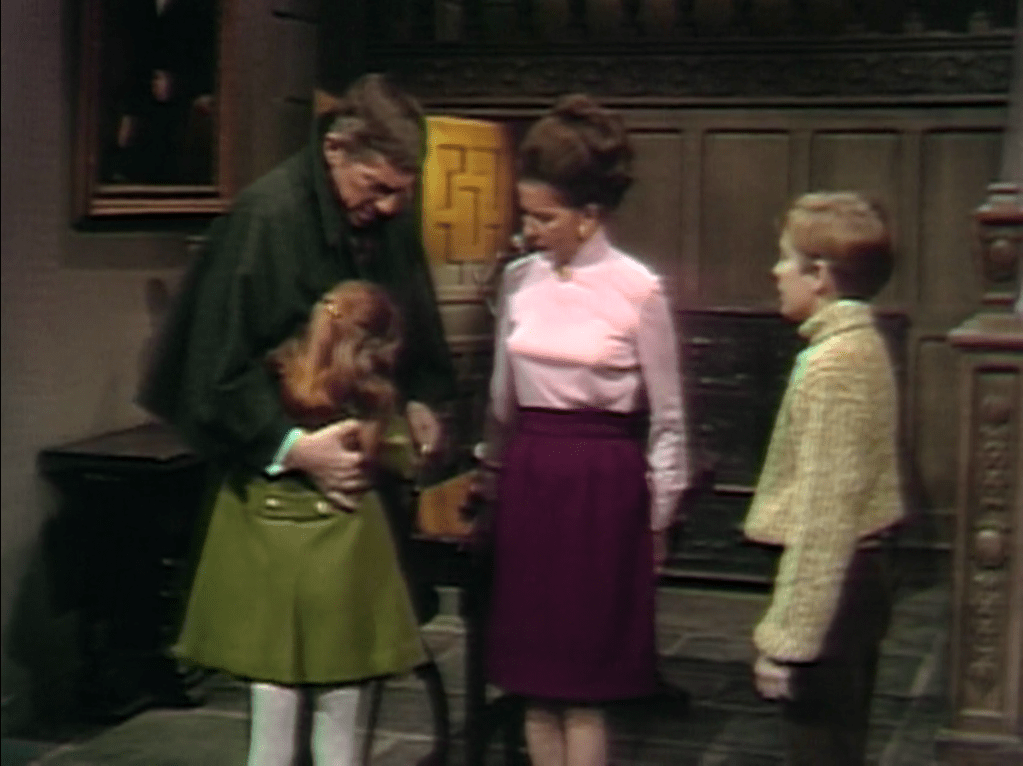
The director of Windcliff is Julia Hoffman, MD. For almost a year and a half, Julia has been a permanent houseguest at Collinwood; as 1968 has gone on, she has become Barnabas’ inseparable friend. She hugged Barnabas for the first time in #635, to his evident discomfort. But as we saw when he interacted with the ghost of his little sister Sarah in #364 and again when we saw him with the living Sarah in the extended flashback to the 1790s that ran from November 1967 to March 1968, Barnabas gets along well with little girls, so it isn’t such a surprise that he returns Amy’s embrace.
In #629, Liz told Julia that Barnabas was miserable at Windcliff. If Barnabas were still a vampire, it would be easy to imagine his evil overwhelming the scientific rationality at the heart of a psychiatric facility, as it has long since overwhelmed Julia’s professional ethics. But his curse is in abeyance now. They’ve had to work to keep us thinking that he is exotic and uncanny and dangerous; one look at him in a group therapy session would undo all that work so abruptly that we would never stop laughing. Of course we never see him as a patient there. It was daring of them even to include Liz’ line, inviting us to imagine him in such a mundane setting.
In a comment on Danny Horn’s great Dark Shadows Every Day, Stephen E. Robinson wonders about the image Amy conjures up when she says that she and Barnabas spent time together as patients at Windcliff:
There’s an implication that Barnabas and Amy hung out at Windcliff, because apparently exposing small children, in shock over the deaths of family members, to middle-aged mental patients is part of the healing process. The Barnabas/Amy scene makes me laugh at loud because it’s as if the writers think Windcliff is a vacation resort and Barnabas and Amy met by the pool.
Stephen E. Robinson, comment left 11 May 2015 at 6:59 AM Pacific time, on Danny Horn, “Episode 645: Spirited Away,” 10 May 2015, Dark Shadows Every Day.
Stephen is being generous- Barnabas was in the hospital because he had himself been the victim of a vampire, and Amy was there because her brother Tom had died. She did not know, but Julia did, that Tom had also come back as a vampire, and it was Barnabas who destroyed him, first by driving a stake through his heart, later by forcing him into the sunlight. I’m no psychiatrist, but with that history of closely related but non-discussable traumas I wouldn’t think the two of them ought to spend much time together.
But of course none of that matters. Barnabas and Julia are the show’s principal protagonists, and they ran out of story two weeks ago. Ever since Amy took over, we’ve been waiting to see how she will connect with them. Now that we know she is Barnabas’ substitute sister and Julia’s sometime patient, they are ready to rejoin the action.
Episode 644: Well that was a waste of time
There is some reason to believe that writer Ron Sproat was disaffected from the rest of the production staff at this time. Today’s script is so unbelievably bad that it is tempting to think he wrote it as an act of protest.
Children Amy and David have gone looking for the ghost of Quentin Collins and are now trapped in a room in the long deserted west wing of the great house of Collinwood. David’s father Roger, his aunt Liz, and his cousin Carolyn are moving about the house in a conga line trying to find them.
Quentin’s ghost is keeping the children locked up; the ghost of someone named Magda is trying to lead the adults to rescue them. At one point the adults watch a mirror while letters appear on it spelling out “Jamison,” the name of Liz and Roger’s father. This is plainly a supernatural manifestation, but it advances neither Magda’s goal nor Quentin’s. Perhaps Jamison’s ghost can’t rest with all the racket Quentin and Magda are making, and he just wants to say hello.

In the locked room, David bangs on a wall, finds it is hollow, and speculates about what is on the other side. Amy protests “We can’t go through a wall!” In response, he again bangs on the wall, again finds it hollow, again speculates about what’s on the other side, and Amy again protests “We can’t go through a wall!” Later in the episode, they start this scene a third time, but they stop before Amy has another chance to say “We can’t go through a wall!” It’s just as well she does stop short of saying this a third time. By the end of the episode, they’ve found a crowbar, which enables them to pry the paneling open and go through the wall quite easily.
Meanwhile, the adults have progressed to the drawing room, where they argue about whether to search the west wing. They troop upstairs and find the door to that part of the house locked. This leads them to conclude that David and Amy can’t have gone in there, and the parade goes back to the drawing room. There, they again argue about whether to search the west wing. They again troop upstairs, this time unlocking the door and conducting the search. After they fail to find the children, they return to the drawing room again, where Roger speaks for all of us when he says “Well, that was a waste of time.”
When the adults were shuffling around huddled in their little clump, I found it hard not to look at Liz’ face and see Joan Bennett thinking that she used to be a big movie star and now she’s reduced to this stage business that would have embarrassed the Three Stooges. This week’s episodes were directed by a mysterious figure billed as “Penberry Jones”; whoever Jones was, I don’t think s/he was to blame for the weird little parade the adult characters keep making through the house. The script calls for the actors to talk with each other constantly while walking together through narrow, awkward spaces such as stairways, darkened corridors, and a cluttered store-room, and so it would have taken more time than they had to choreograph a more fluid set of movements.
David and Amy hear a waltz. It has a creaky sound to it, as though it were being played on an old gramophone. This is introduced as a special effect. Unfortunately, Dark Shadows introduces special effects by ramping up the background music, so when the children first talk about the waltz we can barely hear it. After a commercial break, the background music calms down and the waltz is more audible. We will hear it a great many times over the next several months, so often that it will be ironic to think that there was a time when we wanted to hear it but could not. I suppose Penberry Jones probably did have the discretion to tone down the accompaniment, so that would be one strike against him or her.
Longtime viewers will notice a small deviation from continuity when David tells Amy that ghosts come out only at night. In the first year of the show, David often saw the ghost of the gracious Josette in the Old House of Collinwood during the day, and from June to November 1967 he and the ghost of nine year old Sarah played together in the sunlight several times.
 Dark Shadows Commentary