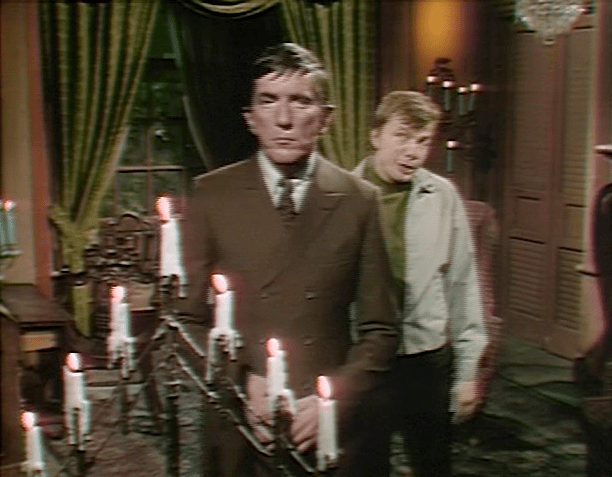
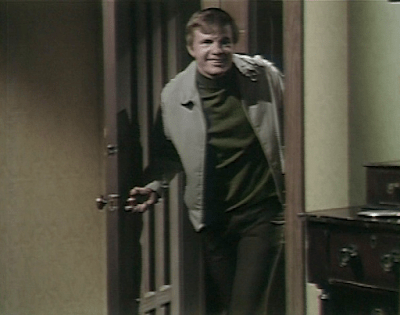
Unloved Frankenstein’s monster Adam has survived a plunge from the cliff at Widow’s Hill and made his way into the home of blind ex-artist Sam Evans. Sam realizes that Adam is badly hurt and cannot speak much English; with great kindness, he tries to clean and bandage Adam’s wounds.
Sage Timothy Eliot Stokes comes in. Adam, who in his few weeks of life has had little but hostility from humans, is alarmed by the sight of another one, and flees. Stokes explains to Sam who Adam is, and Sam’s sympathy for the big guy only deepens. This retelling of the creature’s encounter with the blind hermit in The Bride of Frankenstein is affectingly done.
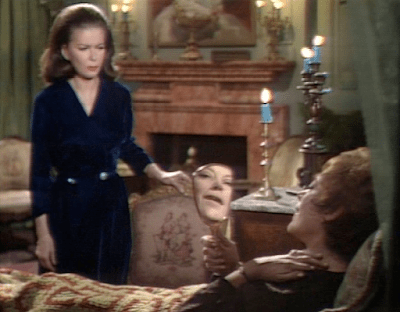
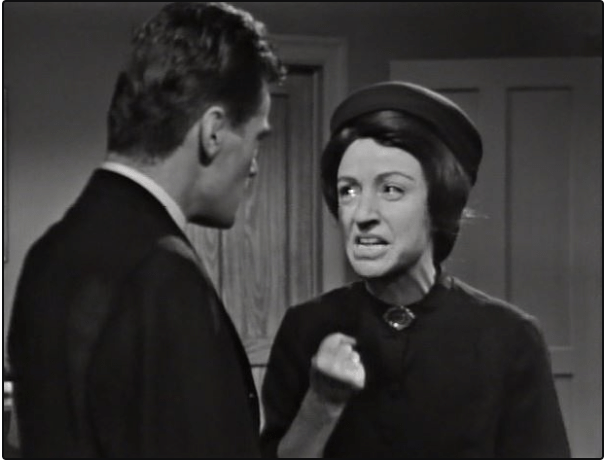
Wicked witch Angelique, calling herself Cassandra, has made her way into the apartment of local man Tony Peterson. Tony is agitated by the presence of Angelique/ Cassandra and keeps telling her he wants her to go home to her husband and leave him alone. She tells Tony he is “Quite a Puritan,” reminding us that when Dark Shadows was a costume drama set in New England in the 1790s, actor Jerry Lacy played the Rev’d Mr Trask, a fanatical but utterly inept witchfinder who inadvertently served Angelique’s darkest purposes. Mr Lacy plays Tony quite differently than he did Trask, but Angelique/ Cassandra told Tony in #481 that she chose him as her cat’s paw because he reminded her of Trask. She gets him to strike his cigarette lighter, sending him back into the trance in which he can deny Angelique/ Cassandra nothing.
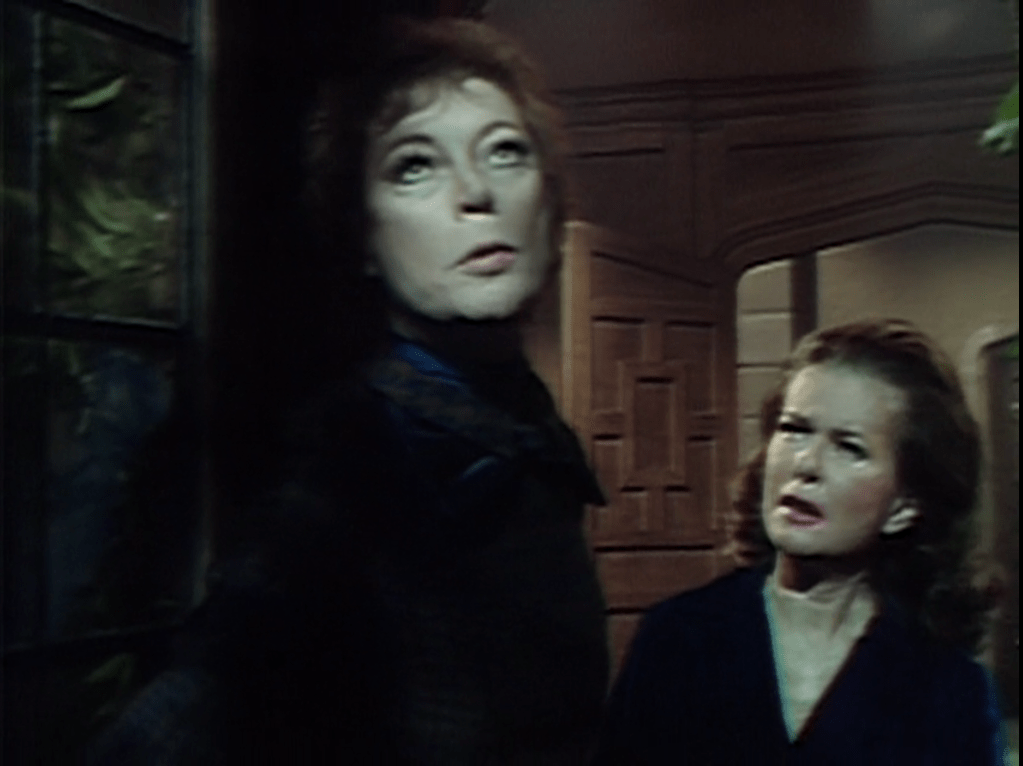
Well-meaning governess Vicki has made her way to Stokes’ apartment. It was Vicki who took Dark Shadows back in time to the 1790s, when she came unstuck in time during a séance in #365. It seemed at the beginning of the costume drama segment that Vicki would regain the position she held in the first months of the show as our point of view character, that she would again provide the emotional anchor of the show in her scenes as governess alone with the young children of the house, and that she would drive the action as she had to think on her feet and come up with plausible lies to secure a place in an unfamiliar century. As it happened, she did none of those things. She was shut out of all the main action, was never seen giving a lesson to either of her charges, and when she was on camera spent her time telling everyone she met that they were played by an actor who had another part in the first 73 weeks of the show. Long before Vicki came back to the 1960s in #461, the character had become all but insupportable.
The action now revolves around recovering vampire Barnabas Collins, and Barnabas steadfastly refuses to include Vicki in his life. Faced with that blank wall, Vicki has spent some time hanging around with a man named Peter whose only story point is that he wants to be called Jeff. This does not make for much drama. Vicki learned a great deal in the 1790s, and recognized Angelique/ Cassandra as soon as she showed up in 1968. But she can’t fight her by herself, and so she has responded to Barnabas’ aloofness by trying to forget what she knows.
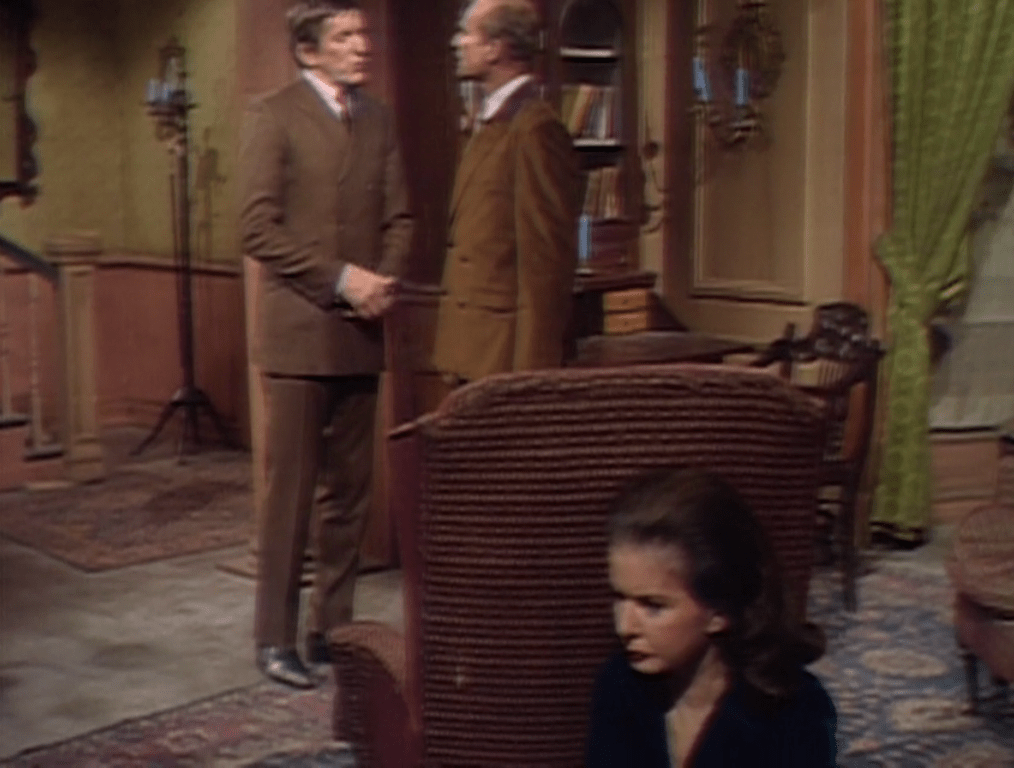
Stokes has called Vicki to his apartment to enlist her help against Angelique/ Cassandra. Longtime viewers will remember that Vicki led the fight against Dark Shadows’ first supernatural menace, undead blonde witch Laura Murdoch Collins, and that for support in that battle she was the one who recruited the services of the show’s first sage, parapsychologist Peter Guthrie. This much diminished Vicki is now subordinated to the sage. He calls her in, he commands her to tell her story, he tells her that her story is true, and he requires her services. He shows her a silhouette of Trask and insists she overcome her reluctance to look at it. When a knock comes at the door, he even sends her out the back way and tells her that his next visitor must not know of her connection with him, as if he were dismissing a prostitute.
Stokes tells Vicki he can’t afford to be seen with her.
Oddest of all, Stokes already seems to know everything Vicki does before they talk. In #507, he laid out a theory that would be plausible to someone who knew exactly what Vicki knows about the strange goings-on, but not to anyone who knows one thing more or less than she does. Yet today we see that he is talking with Vicki about them for the first time. It is unclear what he could learn from her, or what contribution she could make to his efforts.
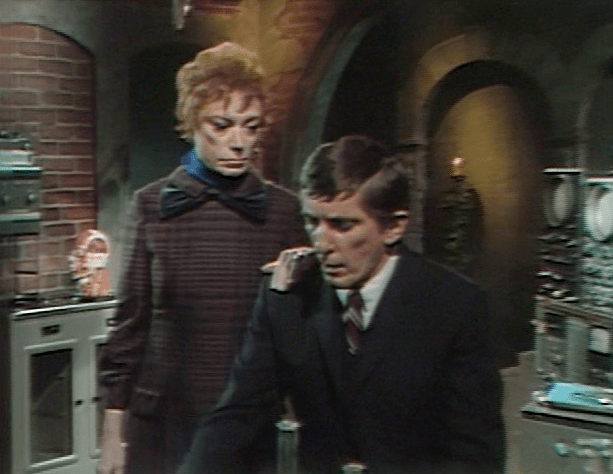
The visitor from whom Stokes wants to hide Vicki is Tony, giving his name as “Arthur Hailey,” perhaps in honor of the novelist whose Airport was topping the bestseller lists when the episode was made. Stokes is quite relaxed around Tony, offering him first brandy and then cheese. Tony accepts both. He exclaims “I like cheese!” in an awkward voice that makes it clear we are listening, not to Jerry Lacy’s acting, but to Tony’s. While Stokes is out of the room fetching the cheese, Tony sprinkles a powder Angelique/ Cassandra gave him into Stokes’ glass. Tony looks away from the table before they take their drinks. When they do, it is Tony who chokes and collapses, not Stokes.
This is the second time we’ve seen that staple of farce, “The Old Switcheroo.” In #402, Barnabas tried to poison Angelique, and had to think fast when she passed her glass to his mother. That use of the trope confirmed that, while Barnabas is undeniably a villain, he is a comic villain who endears himself to us as we watch him scramble through one failed scheme after another, while Angelique is a menace to be taken seriously. Now, Angelique has settled in for the long term, and the show will quickly run out of characters if she maintains the kill rate she had in the eighteenth century. They have to dial her threat level down considerably. One way of doing that is to give her a henchman who is, most of the time, unaware of her power over him, and who is consistently luckless when she activates him; another is for her to use comically unreliable means to pursue her evil ends. She does not yet cut the Wile E. Coyote-esque figure that Barnabas does, but neither is she in imminent danger of vaporizing the whole story and leaving ABC with thirty minutes of dead air on weekday afternoons.
This was the first episode directed by John Weaver. Except for one week in March 1968 when executive producer Dan Curtis took the helm, directing duties for the first 497 episodes of Dark Shadows alternated between Lela Swift and John Sedwick. Now Sedwick is about to leave the show. Associate director Jack Sullivan stepped up to direct #504 and will direct dozens more; Weaver, an associate director on some early episode, will only be credited as director four times before leaving in July. Several more directors will have similarly brief stints as fill-ins before Henry Kaplan joins the show as Swift’s alternate in December.
Episode 509 of Dark Shadows did not air on ABC-TV as scheduled on 6 June 1968. The network instead broadcast news coverage related to the assassination of US Senator Robert F. Kennedy.
At this point, one of Dark Shadows’ storylines was a loose adaptation of Frankenstein. Five years later, Dan Curtis, the show’s executive producer, would bring another adaptation of the novel to the small screen, as part of ABC-TV’s late night programming that ran under the umbrella title Wide World of Mystery.
Originally presented in two parts, each filling a 90 minute window, Dan Curtis’ Frankenstein is now available on Tubi in a 2 hour, 6 minute cut. It is more faithful to Mary Wollstonecraft Shelley’s original novel than were any previous adaptations, a point Curtis frequently made.
The main theme is made clear in the opening. Dr Victor Frankenstein is supposed to give a talk to a classroom of students in white coats, but they keep shouting him down. The professor identifies Frankenstein* as the winner of an academic prize and urges his unruly pupils to give him a hearing. That gets Frankenstein enough time to tell the class that they don’t understand what he has been saying, to make a little speech about the scientist’s obligation to create a superhuman life form in the laboratory, and to look frustrated when they walk out on him. The professor stays behind and tries to reason with Frankenstein, who doesn’t seem to be listening to a word he says.
Frankenstein can’t get a hearing.
No communication occurs in that scene, and very little occurs in any scene that follows. That’s a natural basis for a drama about the Frankenstein story. The mad scientist is disconnected from any voices of sanity, and the being he creates does not initially understand any language and has no frame of reference in common with anyone he might meet.
Frankenstein goes to his laboratory, where his friends Hugo and Otto are wearing funny hats and preparing to celebrate the prize he won. Hugo and Otto quickly gather that Frankenstein is uninterested in a party, but the heavy, ominous music on the soundtrack** tells us that more is going on in Frankenstein’s mind than his friends know.
Frankenstein insists that the experiment go on, an idea Otto resists. Otto wants to stop “while there is still time”; Frankenstein says that they have already passed the time when stopping was possible. Frankenstein seems to be talking about the danger that the body they have assembled will decompose, while Otto seems to be talking about the consequences of continuing to forage for organs and of bringing the body to life. Again, neither man reaches the other.
Frankenstein, Hugo, and Otto go shopping in the graveyard, where the caretaker shoots Hugo. Frankenstein and Otto get Hugo back to the laboratory. Frankenstein wants to call for help, even if it means prison, but Hugo insists that he and Otto use his heart to complete the experiment. He dies. Frankenstein decides to honor his wish. They will tell people that Hugo went climbing in the mountains, and after a while searching for his body people will simply give up. So Frankenstein and Otto will tell a false story, on the basis of which people will make and follow pointless plans. They then prepare to complete the experiment.
The preparations are interrupted when unexpected visitors arrive. They are Alphonse, father of Frankenstein; Elizabeth, fiancé of Frankenstein; and Henry, brother of Elizabeth and friend of Frankenstein. Frankenstein greets them, flustered, and says that they have come at a bad time and must stay at the inn. Alphonse and Henry wonder why Frankenstein did not receive Elizabeth’s note informing him of the date of their arrival; Elizabeth sees the note, unopened, on a table. Yet again, the emphasis is on a lack of communication.
Frankenstein and Otto resume the experiment. After a long display of flashing sparks, they cannot get any vital signs from the body. Frankenstein declares that the experiment has failed and orders Otto to burn “all the books, every journal!” They are out of the room when the body starts to move. Frankenstein comes in by himself, sees what’s happening, and says, in a voice too quiet to be heard outside the door, “He’s alive.” This unheard “He’s alive” is an obvious contrast with Colin Clive’s manic cry of “It’s alive!” in the 1931 film, emphasizing that while Clive’s Frankenstein may have been alienated from others by his obsessions, Robert Foxworth’s is simply unintelligible to the people he knows. The aftermath of the experiment is a recreation of the equivalent scene in episode 490 of Dark Shadows, but the idea of destroying the records of the experiment is added to show that Frankenstein is fighting against communication as such.
Once Frankenstein and Otto realize that the big guy has come to life, they help him up off the table. The experimenters handle their creation with a gentleness and good cheer that makes a striking contrast with the extreme callousness patchwork man Adam received from his self-pitying creators in Dark Shadows, and comes at a moment when both the immediate aftermath of the experiment and John Karlen’s presence as Otto have brought that story to the forefront of our minds.
Frankenstein and Otto are surprised that the big guy doesn’t have the memories of the professor whose brain they implanted in his head. Frankenstein speculates that the electric shocks they used to animate him may have wiped out his memories, but also thinks that those memories might eventually come back. Their attempts to communicate with him, therefore, are based not so much on listening as on an effort to conjure up the late Professor Lichtman. Still, Frankenstein is happy to note that the big guy has the reactions, not of a newborn, but of a four year old.
Frankenstein leaves Otto alone with the big guy while he goes off to placate his father, Elizabeth, and Henry. Otto teaches the big guy to play catch. Delighted with this, the big guy hugs Otto. He doesn’t know his own strength, nor does he understand what Otto means when he gasps out “Stop!” When Frankenstein comes back to the lab, he finds the big guy standing over Otto’s corpse, pleading “Play, Ot-ta, play!”
The big guy begs Otto to play
Frankenstein takes out a pistol, but cannot bring himself to kill the big guy. Instead, he orders him to get back on the table. He readily complies, and Frankenstein straps him in place. He takes Otto’s body from the lab. As soon as Frankenstein has left the room, the big guy easily breaks the straps and goes to the door. Finding it locked, he smashes some lab equipment.
Frankenstein takes Otto’s body to his room above what appears to be a tavern. He sets up Otto’s telescope by an open window and drops his body to the ground. By the time he returns to the lab, the big guy is gone.
The big guy wanders about and has some poignant moments when children see him and react with fear. He makes his way to a house occupied by the de Laceys, a blind girl named Agatha and her elderly father. He hides unnoticed in a closet there for, apparently, several months. Shortly after he takes up residence, Agatha’ brother, a sailor, drops his fiancée off at the house. She speaks only Spanish, and Agatha and her father speak only the language of Ingolstadt, which in this movie is identified explicitly as “inglés,” even though Ingolstadt is in Germany. In one of the first English lessons Agatha gives her sister-in-law to be, she says that the storm outside is “a summer rain”; in a later scene, while the big guy is still undetected in the closet, she mentions that October is almost over. Both the dramatized difficulties of language teaching and the unremarked failure of Agatha and her family to detect a huge man crouching a few feet away from them for so long stress the theme of non-communication.
The big guy makes a crude doll and talks to it while Agatha gives her sister-in-law English lessons. He speaks quietly, but not so quietly that it isn’t absurd that they fail to notice him. I suspect that absurdity is as intentional as is the doll’s inability to talk back.
The big guy and his doll.
One autumn night, the big guy comes out of his closet and walks around the vacant living room. He starts talking. He maintains a warm smile throughout, uses sophisticated grammatical constructions and a wide variety of phrases, and acts out a scene full of pleasantries, apologizing for the roughness of his manner and explaining that he has known little kindness from people. He catches a glimpse of himself in a mirror, the first time he has seen such a thing. He recoils from his face, and exclaims “Ugly!”
In the morning, he goes outside and knocks on the front door. When Agatha enters, he tells her he is “a friend you do not know.” She is puzzled by this expression, but lets him in anyway. She jumps to the conclusion that he is a traveler; he tells her that he wishes the whole world were blind. He may have become capable of speech, but now he is terrified of nonverbal communication. The conversation goes quite well until she wants to touch his face. He refuses. She insists, and chases him around the room. At that moment, her father, brother, and sister-in-law to be enter. Misunderstanding, they jump to the conclusion that the big guy is the one chasing Agatha. They fight him, and he injures her brother.
Mr de Lacey, with Agatha and his daughter-in-law to be in tow, brings the injured young man to Frankenstein’s house. When Frankenstein hears their description of the big guy, he mutters a few words about how to tend the patient’s wounds, and sets out with a gun to hunt his creation. They are bewildered that the doctor has rushed off after giving them so little information, and Elizabeth is left to try to smooth things over with them.
That night, Frankenstein catches a glimpse of the big guy and shoots him in the forearm. The big guy gets away. He has no idea who Frankenstein is or why he would shoot him. He finds himself on the grounds of Frankenstein’s house. Frankenstein’s little brother William is outside. They meet at the fountain there. William is unafraid of the big guy and makes a tourniquet to stop the bleeding from his gunshot wound. The big guy and William are quite happy together until William sees Elizabeth and decides to call her over. The big guy tells him not to call anyone, but William ignores him. Panicked, the big guy covers William’s mouth. He still doesn’t know his own strength, so he accidentally breaks William’s neck, killing him instantly. Unlike with Otto, the big guy now knows what he has done, and so his plea is not “Play!” but “Don’t be dead!”
Frankenstein finds William and realizes what has happened. He resumes his hunt. When he finds the big guy, he fails to kill him. The big guy asks Frankenstein who he is and why he hates him. Frankenstein explains enough to draw the big guy’s full rage. He is furious that he was created to be alone, and complains that “I don’t even have a name.” He insists that Frankenstein create a mate for him. When Frankenstein demurs, the big guy threatens to kill everyone who crosses his path. This again echoes Dark Shadows, where Adam insisted that Barnabas and Julia build a “Friend” for him and responded to their protests with a similar threat. Unlike Adam, who was put up to demanding a bride by warlock Nicholas Blair and who didn’t appear to have any idea what sex was, the big guy has seen Frankenstein and Elizabeth together and says that he wants what Frankenstein has.
Frankenstein tries to comply with the big guy’s demand. He has built a womanly body, put it on his table, and hooked it up to wires that will conduct the charges from an electrical storm raging outside. Henry, furious that Frankenstein has paid so little attention to his sister, barges into the lab and sees the body of the Bride. Before he can tell anyone about it, the big guy kills him.
Frankenstein tries to complete the experiment. The big guy lets himself in and watches as the lightning makes the Bride arch her back, open her eyes, and scream. This is far more activity than the big guy showed before Frankenstein and Otto disconnected him, but Frankenstein leaves the Bride hooked up while the electric charges surge into her. She dies on the table. The big guy says that Frankenstein deliberately killed her. He doesn’t bother to deny it, but says that his conscience wouldn’t let him repeat the misdeed he committed in bringing the big guy to life. At that, the big guy vows to stalk Frankenstein for the rest of his life. He tells him that he will be there on his wedding night.
Frankenstein finally tells Elizabeth the truth. She resolves to stick with him regardless. They leave town. They check into an inn, where the innkeeper brings his friend the Burgomaster over to perform a wedding ceremony. The innkeeper and the Burgomaster explain that Frankenstein must go across the square to sign the registry to make the marriage legal. For some reason Elizabeth must remain in the room by herself while he does this. He resists, but Elizabeth and the Burgomaster insist it will be all right. Of course Elizabeth is dead when Frankenstein returns to the room a few minutes later.
Once more Frankenstein takes his gun to hunt the big guy; once more he fails to kill him. This time the big guy kills him. Frankenstein winds up dying cradled in the big guy’s arms, in a Pietà pose, while the big guy expresses his remorse for his killings. He speaks of “the pain I felt when I killed little William, the hate I felt for myself when I left Elizabeth dead,” and begs Frankenstein not to die. He does anyway, and the big guy walks off, encountering some policemen who shoot him to death.
The big guy wants forgiveness.
For a quarter century before this movie was made, feature films had spent a great deal of time exploring non-communication. Filmmakers like Michelangelo Antonioni, Jean-Luc Godard, and above all Alain Resnais had made dozens of movies about people who simply could not get through to each other. The result was a pervasive sense of tentativeness, as potential relationships were outlined but could not develop and potential events were envisioned but could not occur. The same tentativeness dominates this movie.
*Throughout the movie, people call the scientist “Frankenstein,” while his creation is known only as “The Giant.”
**Recycled from Dark Shadows and other collaborations between Curtis and composer Robert Cobert, as is nearly all the music.
In #473, we saw that wicked witch Angelique had traveled from the eighteenth century to the year 1968 to reimpose the vampire curse she had once placed on old world gentleman Barnabas Collins. In a single day, Angelique met Barnabas’ distant cousin Roger, bewitched him, and married him. This secured her a home in the great house on the estate of Collinwood. Barnabas lives in the Old House on the same estate. Calling herself Cassandra and wearing a black wig, she pretends not to understand why Barnabas doesn’t like her.
In #477, Angelique appeared to Barnabas in a dream and told him and the audience how she would go about turning him back into a vampire. Her approach would essentially be a distributed malware attack on the wetware inside the heads of the people of Collinsport. One person after another would have the same basic nightmare. Each nightmare would begin with a visit from a person who had not yet had it, and after the dreamer awoke they would feel an uncontrollable compulsion to describe the dream to that person. Once they had done so, that person would have the nightmare, and the cycle would repeat. When the dream got back to Barnabas, he would become a vampire again.
Yesterday, heiress Carolyn Collins Stoddard had the dream. Carolyn met with occult expert Timothy Eliot Stokes and mad scientist Julia Hoffman at the Old House. Stokes managed to insert himself into Carolyn’s dream as the person to whom she must tell it. Today, Stokes has the dream. He sets out to function as an antivirus program. He has learned what the dreamer usually does, and consciously makes himself defy all those rules. His hack-back works sufficiently to force Angelique/ Cassandra to appear in the dream herself and get into an argument with him.
Angelique/ Cassandra addresses Stokes by the name of his eighteenth century ancestor Ben, an indentured servant whom she ensorcelled and used for her own nefarious purposes. She refuses to believe that Stokes is not Ben, and does not react strongly when he tells her that he knows her name is Angelique. When he later addresses her as Cassandra Collins, she is horrified and vanishes. It’s a staple of stories about magic that the act of calling adversaries by their true names can defeat them; Mrs Acilius brought up the story of Rumpelstiltskin. That the name “Angelique” has no effect while “Cassandra” drives her away suggests that she was using a pseudonym when we first knew her, and she really is Cassandra.
The power of naming also explains what Barnabas may have been thinking when he kept confronting Angelique/ Cassandra and telling her exactly what he did and did not know about her. Perhaps he hoped that simply by addressing her as “Angelique” he would make her vanish.
When Stokes awakens, he tells Julia he is confident that he has stopped the curse. That confidence is put to the test immediately when a knock comes at the door. Stokes opens it, and sees the man from his dream. He does not know the man, but we do. He is Sam Evans, an artist recently blinded by one of Angelique/ Cassandra’s spells. He is accompanied by Joe Haskell, fiancé to Sam’s daughter Maggie. They mention that Maggie is spending the evening in the nearby city of Bangor, Maine. Sam says that he heard the name “Stokes” in his head earlier in the evening, and that he also felt an urge to come to the Old House. He has a strong feeling that Stokes has something to tell him, and insists that he do so.
Stokes is disquieted to see Sam, but feels no compulsion to tell the dream. Sam is furiously dissatisfied. It is unclear whether his frustration at not hearing the dream will be as intense or as persistent as is the upset previous dreamers felt when they resisted telling it.
Sam and Joe leave. In front of Sam’s house, Joe reaches to open the front door. Sam is irritated with him. He not only insists on opening the door himself, but won’t do so until Joe leaves. Joe explains that Maggie made him promise to keep an eye on him, to which Sam replies with a threat to forbid their marriage unless he backs off. Joe mentions that a strange, very tall man who recently abducted Carolyn might still be at large; Sam replies that the man jumped off Widows’ Hill, which means certain death to “anything human.”
Inside the house, Sam finds that a window Joe had closed before they left is open. He hears someone in Maggie’s room. It turns out to be the strange, very tall man, badly cut from his recent fall and wielding a kitchen knife.
They don’t explain what Maggie is doing in Bangor. From episode #1 until she was attacked by Barnabas in #227, Maggie was the principal waitress at the restaurant in the Collinsport Inn. After some time as Barnabas’ prisoner and a longer period as a patient in Julia’s hospital, she returned to town in #295. For all they’ve told us since then, Maggie may have got her job back or taken another one. But if she had, they would have told us today that she was working the night shift, not that she was on some unexplained trip out of town. So now we know that nobody in the Evans house is gainfully employed.
Mad scientist Julia Hoffman has summoned sage Timothy Eliot Stokes to the Old House on the great estate of Collinwood, home of her friend, recovering vampire Barnabas Collins. Julia and Stokes talk about the ongoing Dream Curse, a distributed attack on the mental software of a series of people who are more or less connected with Barnabas. The curse takes the form of a nightmare that afflicts one person after another. When Julia declares that Stokes must stop the dreams, he says that she makes it sound like he is responsible for them. She replies that in a way, he is- he was the one who introduced Cassandra Blair to Roger Collins. Roger married Cassandra, giving her a home in the great house on the same estate. Stokes does not dispute the assumption that Cassandra set the curse, but he does deny that he had any influence over Roger’s decision to marry Cassandra.
In #488, Barnabas told Stokes that Cassandra is the witch, and his reaction to Julia’s remark shows both that Julia knows that Stokes is aware of this fact and that he has accepted it. Yet when Julia refers to the witch as “she” later in the episode, Stokes responds as if this were jumping to a conclusion.
Stokes puzzles us again when he says that in the eighteenth century, Josette DuPrés was “a love of Barnabas Collins.” We’ve known that for some time, since Barnabas keeps dwelling on his experiences in the 1790s. But Barnabas doesn’t let on about his past when Stokes is around, nor did his relationship with Josette make it into any written records or any of the legends that circulate in the town of Collinsport. How does Stokes know about it?
The obvious explanation would be that Stokes has been talking with well-meaning governess Vicki. Vicki came unstuck in time in #365 and was marooned in the 1790s until #461. She saw in those days that Barnabas and Josette had been lovers, a fact which Barnabas had inadvertently revealed to her in #233. Neither Vicki nor Stokes has been on the show much lately, leaving them plenty of time for off-camera consultations.
Vicki could also be a source of another piece of information Stokes surprises us with. So far as Stokes knows, the Barnabas of the 1960s is a descendant of another man with the same name. Vicki believes this too, even though she has seen a great deal of evidence that he was a vampire, as for example when he used to bite her on the neck and suck her blood. She did notice that the Barnabas of the 1790s looked, sounded, and moved exactly like his namesake of the 1960s. Today Stokes says that the two Barnabases are “interchangeable” in appearance and behavior, just what Vicki would have told him.
Vicki might possibly have contributed to another bewildering proclamation of Stokes’. He tells Julia that when Barnabas is under great stress, the dream comes to a person who is very close to him, while it settles on people who have no particular connection to him when he is relaxed.
This theory doesn’t work at all. The dreamers whom Stokes classifies as “comparative strangers” to Barnabas are Maggie Evans, The Nicest Girl in Town; Mrs Johnson, housekeeper in the great house; strange and troubled boy David; and an annoying man named Peter who keeps insisting people call him “Jeff.” Of these, only Peter/ Jeff is less than essential to Barnabas. Maggie was the first victim Barnabas sought out. It was his abuse of Maggie that defined Barnabas as a monster the audience should fear, as a lonely guy the audience can feel sorry for, as a bridge between past and present who is pulling the show deeper into the supernatural and towards time travel, and as a figure who will drive stories that bring the residents of Collinwood together with the townsfolk of Collinsport. Mrs Johnson was the first person we saw speak to Barnabas and was the one who invited him into the great house, at a time when the show was putting heavy emphasis on the idea that vampires can enter only where they are invited. David was the first we heard speak Barnabas’ name, and Barnabas was obsessed with killing him for eleven weeks, an obsession that led directly to Vicki’s trip back in time.
Vicki doesn’t know anything about the vital roles these three characters have played in shaping Barnabas’ relationship to the audience and to the structure of the show’s universe, so if Stokes were dependent on her for his information he may have believed they were “comparative strangers” to him. The most puzzling thing is Julia’s reaction. Julia has taken over the function Vicki had at the beginning of the series as the audience’s point of view. She knows what we know and learns what we need to learn. Julia is also supposed to be super-smart, so that when she reacts to Stokes’ theory with excited agreement the show is telling us that he is right.
Barnabas’ servant Willie had the dream the other night, and is supposed to pass it on to heiress Carolyn. He was foiled in his effort to do so yesterday, when Carolyn bit him before he could tell her how it went. Willie got off easy- the last time he was aggressive with Carolyn was in #204, when she pulled a loaded gun on him. He did manage to get enough through to her that she has the first minute of the dream, and she is filled with dread of it from the time she wakes up.
Today, Carolyn is in the Old House with Julia and Stokes. She doesn’t want to have the dream, Stokes believes that if she does he can take control of it and break the curse, and Julia mediates between them. Carolyn goes along with the plan, and it looks like it might succeed. That’s the whole story, which doesn’t add up to much, but Nancy Barrett, Grayson Hall, and Thayer David are all superb actors, and they maintain a fierce intensity that makes it work.
All of the storylines in the part of Dark Shadows set in 1968 bear a heavy weight of repetitious elements. The “Dream Curse” consists of countless reenactments of the same dream sequence, almost all of them followed by at least one scene in which the character who had the dream struggles with a compulsion to tell it to someone else, and then by a speech in which we hear the details of the dream yet again. That curse was set by wicked witch Angelique, who for no particular reason keeps insisting that her name is Cassandra. Angelique is a time traveler from the eighteenth century, as is shouting man Peter, who for no particular reason keeps insisting that his name is Jeff.
Mad scientist Eric Lang tried to cure Barnabas Collins of vampirism by an experimental procedure that involved the creation of a Frankenstein’s monster. Angelique killed Lang before he could finish the experiment, but fortunately for Barnabas his best friend Julia is also a mad scientist, and she completed it. Barnabas named the creature Adam. Lang left behind an audiotape explaining that Barnabas will be free of vampirism as long as Adam lives, but that he will revert if Adam dies. Barnabas and Julia have not heard this message, but it has been played for the audience many times. Yesterday’s episode closed with yet another replay of the message, and today’s opens with still another. Since the message is nearly a minute long, it will soon have accumulated a full episode’s worth of airtime.
After the message, we see a new set. It represents the rocky shore below the cliff on Widows’ Hill. Barnabas is there with his servant Willie, looking for Adam. Adam jumped off the cliff yesterday. Since episode #2, that plunge has always been shorthand for certain death, so the opening voiceover introduces a new idea when it tells us that Adam’s leap merely “appeared to be” his self-destruction. Barnabas believes that Adam is still alive, though Willie does not. The two of them stand around and shout Adam’s name over and over; after the fifth or sixth repetition, Mrs Acilius and I cracked up laughing. At least they could have broken it up a little, and alternated “ADAM!!!” with “STELLA!!!”
The rocky shore below Widows’ Hill.
Willie had the dream last night, and now feels compelled to tell it to heiress Carolyn. Adam had abducted Carolyn and held her for a couple of days before he dove from the cliff; she is now at home in the great house of Collinwood. Willie wants to sneak into Collinwood to talk to Carolyn. Barnabas points out that Willie was only recently released from the mental hospital where he was confined after he took the rap for Barnabas’ abduction of another young woman, Maggie. If he sneaks into Carolyn’s bedroom it will go badly for him. Barnabas directs Willie to search for Adam inland, prompting Willie to flash a grin. The very first night Willie was back from the hospital, he disobeyed Barnabas’ orders and ran off to visit Maggie. So his grin tells us to expect that he will disobey Barnabas’ orders again, this time to visit Carolyn.
Willie goes to the great house. We see him standing by the wall, below the second-storey window of Carolyn’s room. In her room, Carolyn talks with her mother, matriarch Liz. She explains to her mother that she is neither frightened of Adam nor angry with him, but that she pities him, because he seemed like an inarticulate and lonely little child. After this conversation, Liz leaves the room. Willie scales the wall, slips in through Carolyn’s window, grabs Carolyn, holds her mouth shut, and forces her to listen while he starts to tell the dream. Carolyn bites Willie, screams, and Liz comes.
Willie flees through the window. Carolyn explains to her mother that she is neither frightened of Willie nor angry with him, but that she pities him, because he seemed to be deeply terrified by his dream. She says that she is afraid that she, too, will have the dream.
Three people who live in the house have already had the dream. One of them is Julia, who is careful about who she talks to. The others are strange and troubled boy David, who regularly confides in both Carolyn and Liz, and housekeeper Mrs Johnson, who tells everyone everything. It is surprising that neither of them has mentioned it to either Carolyn or Liz.
Sheriff Patterson, leading his deputies through the woods in search of a very tall man named Adam who has escaped from gaol, finds a scrap of Adam’s clothing on a tree. He looks ahead and sees the Old House on the estate of Collinwood. He remarks “That’s the old Collins house. Every time anything goes wrong around here, that’s where all roads seem to lead.” He takes his party toward the house. Once they are gone, Adam comes out from behind a tree, and goes in another direction. Unknown to the sheriff and his men, Adam is a Frankenstein’s monster. He is four weeks old and has a vocabulary of fewer than a dozen words, but he easily outwits Collinsport’s entire law enforcement community.
The Old House is home to Barnabas Collins, whom the audience knows to be a recovering vampire. The sheriff calls on Barnabas and recaps the story for his benefit. In his post about the episode, Danny Horn ridicules every part of this preposterous scene, getting half a dozen genuine laughs. I won’t compete with him, but I do want to point out that while in both Wednesday’s episode and yesterday’s, the sheriff said it took twenty men to subdue Adam and take him into custody, today he says it took six. Maybe by next week it will be down to one deputy and a mynah bird.
Adam has abducted heiress Carolyn Collins Stoddard. When he eludes the police, he goes to the abandoned structure where he has cooped her up. He had left her there to go look for food. That mission was interrupted by his arrest. Now, she asks to go home. He is carrying her back there when they meet the sheriff, his deputies, and Barnabas at the top of Widows’ Hill. From the second episode, we have known that people plunge to their deaths from this hill. We’ve heard stories about several such incidents, have seen a number of characters come close to falling from it, and in #425 we saw gracious lady Josette make the fatal leap. Carolyn slips from Adam’s arms to the edge of the cliff; the deputies see him pull her up. She runs into Barnabas’ arms, and Adam falls.
After Adam’s fall, we hear a message that is very familiar to us, but that Barnabas and his friends have never heard. Adam was created in an experimental procedure that was meant to relieve Barnabas of his vampirism. His creator, mad scientist Eric Lang, died shortly after recording an audiotape explaining that as long as Adam lives, Barnabas will be human, but that he will become a vampire again if he outlives Adam. This message plays out over images of the waves crashing into the rocks of the shore. It’s an effective visual complement to the message, a metaphor for the overwhelming power that will engulf Barnabas and the rest of them if Adam is in fact dead.
Well-meaning governess Vicki was the main character of Dark Shadows for its first year, but has been receding further and further to the margins since. Today she returns after a 14 day absence, the first time she has been off screen so long.
Vicki is in the drawing room of the great house of Collinwood with her employer, matriarch Liz. Liz is distraught because her daughter Carolyn has been abducted by a strange man. Liz fears that Carolyn is dead or dying; Vicki urges her to set those fears aside. The police telephone; they have captured the man, but Carolyn was not with him, and he has not answered any of their questions. Liz and Vicki set out for the gaol to see him.
They are accompanied by a sheriff’s deputy. The Collinsport police are exceptionally useless, but even by their standards this deputy is a low performer. Though the man is so strong that it took twenty men to subdue him and bring him in, the deputy enjoys taunting him. He sticks his service revolver in the cell; the man is shackled to the wall, but he is so tall he sweeps his hand into contact with the gun. If the script didn’t say otherwise, he could easily take it from the deputy. Liz orders the deputy to stand back out of the man’s line of sight. Since she owns most of the town, he grudgingly obeys.
The deputy puts his weapon within Adam’s reach.
Yesterday, Liz went looking for Carolyn at the Old House on the estate, home to her distant cousin Barnabas. She found Barnabas’ servant Willie on the ground, suffering from a fresh head wound. Willie told her that the man had been by a few minutes before, and that he had been carrying the unconscious Carolyn. He also referred to the man as “Adam.” When Liz asked him why he used that name, he denied that he did and began jabbering about some bad dream that had frightened him. Today, Liz addresses the man as Adam, and he responds, proving that Willie does in fact know more about him that he will admit.
Liz and Vicki tell Adam that they will treat him as a friend if he tells them where Carolyn is. Adam knows the word “friend.” He repeats it, and adds “food!” Again he says “Friend, food!” The women do not know what he is driving at. They give up and go home.
Returning viewers know that Adam has stashed Carolyn in an abandoned structure that looks exactly like Fred and Wilma Flintstone’s house, that he calls Carolyn “Friend,” and that he had gone out to look for food for her when he was captured. He is dejected when he cannot make it clear that she is hungry.
Liz and Vicki return to Collinwood. They spend several seconds taking off their coats in unison. In the early days of the show, there were a number of scenes designed to emphasize Liz and Vicki’s resemblance and to present each as the other’s reflection in support of a storyline that led us to believe that Vicki was Liz’ unacknowledged daughter. That storyline was forgotten long ago, and it isn’t entirely clear what director Jack Sullivan is getting at here.
Back in the drawing room, Liz tells Vicki her reasons for believing that Barnabas knows a great deal about Adam. Apparently the doors separating the drawing room from the foyer amplify sound, because as the camera takes us from the drawing room to the foyer Liz and Vicki’s conversation only becomes more audible. Liz’ new sister-in-law is in the foyer. This woman calls herself Cassandra, but regular viewers know that she is in fact wicked witch Angelique. Vicki knows that perfectly well. Vicki traveled back in time in #365 and spent nineteen weeks living under the same roof as Angelique while Angelique wrought havoc on the Collins family of the 1790s and framed Vicki for her crimes. Angelique’s only disguise as Cassandra is a black wig- otherwise, she looks, sounds, and moves exactly as she had when Vicki knew her in the eighteenth century. As a result, Vicki is very much on her guard around her.
Angelique/ Cassandra enters the drawing room. Liz excuses herself, and Angelique/ Cassandra demands to know why Vicki doesn’t like her. When Vicki says that she resembles someone she didn’t get along with, Angelique/ Cassandra proclaims that she isn’t that person, bursts into tears, and runs out. Vicki stays in the drawing room, but the camera follows Angelique/ Cassandra to the staircase, where we see her smile gleefully.
Liz returns, and Vicki tells her she may have misjudged Cassandra. It doesn’t speak well of Vicki’s brainpower that a single display of crocodile tears would override the memory of their long and painful acquaintance, but since Barnabas and the others who are doing battle with Angelique/ Cassandra refuse to accept Vicki’s help, she may as well forget everything she knows. Liz tells her that she doesn’t think she misjudged Cassandra, and says she doesn’t trust her either.
Back in the gaol, the idiotic deputy goes back to Adam’s cell to taunt him some more. When Adam protests, the deputy opens the door and waves his baton at him. He places himself within easy reach of Adam, who grabs him and knocks him unconscious.
Yesterday, the high sheriff said “I’m not a stupid man.” He may not have been as stupid as is this grinning imbecile, but it is on his responsibility that he has a badge and a gun.
Another deputy enters. He sees his moronic colleague on the floor, the bars twisted in the window, and no sign of Adam.
Window.
Adam is 6’6″, so it’s difficult to see how he could fit through this opening. Perhaps he is not only tremendously strong, but is also a contortionist.
Adam the Frankenstein’s monster has abducted heiress Carolyn and taken her to an abandoned structure. Carolyn says the structure looks like a root cellar. She doesn’t have a television, or she would have recognized it at once. It’s the old Flintstone place.
Adam was created in an experimental procedure mad scientist Julia Hoffman completed, an experiment that Julia’s late colleague Eric Lang designed to free old world gentleman Barnabas Collins from vampirism. The experiment was a success, but Barnabas and Julia are the world’s worst parents. They have kept Adam chained to the wall of the prison cell in the basement of Barnabas’ house for the first three and a half weeks of his life. As far as Adam is concerned, it is normal for people to confine one another in underground spaces.
The cell was in the basement of the house when Barnabas and his little sister Sarah were growing up there in the eighteenth century; in #260, we found that Sarah had found a secret passage leading out of the cell, suggesting she must have spent a lot of time there in her nine years of life. Perhaps the cycle of abuse that Adam is perpetuating goes back a very long way.
Barnabas is out searching for Adam and Carolyn. Julia is in his house, along with his servant Willie. Julia finds that Willie has had a nightmare and is compelled to tell Carolyn about it. The nightmare is part of The Dream Curse. One person after another has the same dream, which the audience sees dramatized every time. Then that person wrestles with a compulsion to tell the nightmare to someone else. We usually see that, too. Finally, the person does tell the dream, giving a speech to repeat the material to us yet again. This time-waster will go on indefinitely, and is supposed to end with Barnabas reverting to vampirism.
Julia knows all about this. She had the dream herself, and has interacted with others who have had it since. Today, she tries to hypnotize Willie into forgetting the dream.
It is very strange Julia hasn’t tried this before. She has a phenomenal ability to use hypnosis to erase memories, so regular viewers would expect her to turn to that right away. When she starts giving Willie the instructions, kaleidoscopic colors pulse on the screen, suggesting that she will have yet another great triumph. Willie does have a vision of Carolyn in the Flintstone house, so Julia must have unlocked his capacity for extrasensory perception. But he still remembers the dream, and is still driven to tell it to Carolyn.
The sheriff comes by. He tells Julia and Willie about evidence that Adam has a connection with the house. They deny everything. Willie is a panicky mess. He is still upset because of the dream, and the barking of the police tracking hounds outside triggers his memories of the nights when Barnabas’ bloodlust prompted dogs to howl. Julia is able to parry all of the sheriff’s questions and observations, but she is too shaken to produce her usual stream of perfectly plausible lies.
Adam comes to the house. He is hungry, and it is the only place he has ever seen food. The sheriff sees him, threatens to shoot him unless he stops, and opens fire immediately. Adam isn’t killed; in fact, he is so healthy that it takes twenty (20) men to subdue him and take him to gaol.
The sheriff sticks around and tells Julia and Willie that Adam gave them a look of recognition. Julia dismisses that, and the sheriff protests “I’m not a stupid man!” Regular viewers know that he is in fact an utterly stupid man, and that Julia is extraordinarily intelligent. Typically, she wouldn’t need more than five seconds to distract him from whatever was on his mind and get him chasing after an imaginary squirrel. But she is so run down from the ongoing crises that she is reduced to challenging him to “Prove it!”
Yesterday, matriarch Elizabeth Collins Stoddard and her daughter Carolyn were in their drawing room quarreling about some family matters when a strange man stumbled into the house. The man was 6’6″ tall, his face was scarred, he trailed a length of chain from a shackle he wore on one ankle, and could speak only a few words. When Carolyn tuned the radio to an Easy Listening station, the man found that the listening was not at all easy for him. Saying “Not music!,” he smashed the radio. This prompted Liz to threaten him with a letter opener. Frightened, the man clutched at Carolyn. The situation escalated when Liz’ distant cousin Barnabas burst in and pointed a rifle at the man. Finally, the man ran out of the house, carrying Carolyn with him.
Today, Liz is moping in the foyer. Local man Tony Peterson, who had gone on a few dates with Carolyn some months ago, comes to the door. He and Liz discuss the situation. Liz laments the harsh tone she took with Carolyn during their argument. She tells Tony that she supposes there is a generational difference between them. He and Carolyn hide their feelings, while Liz expresses hers. This is an exceedingly strange thing for Liz to say- the whole foundation of her character is denial. In the first months of Dark Shadows, Liz was a central character, and the show was largely a study of that psychological defense mechanism and its consequences. She has moved to the margins of the action since then, but hasn’t changed her personality. Indeed, Liz’ conversation with Carolyn took a harsh turn precisely because she refused to face the unpleasant facts Carolyn was reporting to her.
Liz and Tony go to the Old House on the grounds of Liz’ estate, home to Barnabas. They find Barnabas’ servant Willie on the ground by the front door of that house; the door is open, and Willie is nursing a recent head wound. He confirms that the man had been there and that he was carrying Carolyn in his arms. He says that Carolyn appeared to be unconscious. Tony announces that he will go after them, and Willie tells him he will need a gun. “He’s strong, that Adam,” says Willie.
Liz demands to know why Willie called the man “Adam.” Willie denies that he did. That only irritates Liz, who insists that Willie tell her what he knows about the man. Willie repeats his denial, and says that he is worried about a nightmare. He keeps going on about this topic, to which Liz angrily responds “I don’t want to hear any more about your dream!”
Adam has taken Carolyn to an abandoned root cellar somewhere in the woods. This is a new set. Regular viewers, knowing what a rarity new sets are on a show with this one’s budget, will expect something important to happen there. What happens there today is that Adam and Carolyn struggle to communicate with each other. She asks him what he wants; he manages to say “Kill Barnabas!,” a goal which people who have been watching for the last several weeks will agree he has excellent reasons to pursue. He holds a burning pine cone and is surprised to find that it hurts when the fire reaches his hand; she is startled to find that he didn’t know that, and says that he is like a baby. She tries to leave the root cellar, but he won’t let her get to the door.
Liz spoke for the audience when she said she didn’t want to hear any more about Willie’s dream, but it is dramatized for us anyway. It ends with the image that frightens Willie the most, a wolf’s head. Longtime viewers can well understand why this might be a terrifying symbol to Willie. When Willie first worked for Barnabas, Barnabas habitually beat him with his heavy wooden cane topped with a metal handle in the shape of a wolf’s head. In those days, Barnabas was a vampire, and when he felt bloodlust dogs would howl. As Barnabas’ blood thrall, that sound would therefore tell Willie that either he himself would soon be drained of more blood, or that he would be forced to help Barnabas prey on someone else. So it makes sense that for Willie, terror has a canine face.
Virtually every episode of Dark Shadows begins with one of a handful of still images of the exterior of a mansion in Newport, Rhode Island, known in those days as Seaview Terrace.* Before the series went into production, Dan Curtis took the cast up to Newport and shot some video of them on the grounds of the mansion. In 1966 and the first half of 1967, bits of that footage were occasionally inserted to give the show a more spacious and less static feeling. When they started shooting episodes in color at the end of July 1967, they could no longer use those inserts, and they had neither the time nor the budget to go back to make more.
Now, Dark Shadows uses green screen effects to create the illusion of exterior shots. Twice today, they show us actors in front of the still of Seaview Terrace that most frequently appears at the opening, with foliage hanging next to them to give an illusion of depth. The result isn’t as satisfactory as the location inserts were, but it’s nice to know the makers of the show are trying to broaden their canvas.**
Frankenstein’s monster Adam has escaped from the Old House at Collinwood and finds his way to the principal mansion on the same great estate. There, he stands outside the windows and listens to a conversation in the drawing room between matriarch Liz and her daughter Carolyn. Carolyn tells her mother that she saw Cassandra, Liz’ brother Roger’s new wife, having a romantic moment with local man Tony. Liz’ keynote has always been denial, and true to form she refuses to believe Carolyn. They go on with this until Adam stumbles through the front door and terrifies them.
Adam can only speak a few words. He smiles when he says one of his favorites, “music.” Carolyn turns on a radio we have never seen before and we hear Francois Lai’s theme to the movie “A Man and a Woman,” an instrumental hit of the 1960s which played on the jukebox at the Blue Whale tavern in #307. Adam scowls, declares it “not music,” and smashes the radio. I’ve always had a fondness for the tune, but listening to this arrangement I have to admit he has a point.
Liz reacts to Adam’s violent act by grabbing a letter opener and threatening him. Panicked, he grabs Carolyn. Two more residents of the estate burst in. They are old world gentleman Barnabas Collins, master of the Old House, and Julia Hoffman, permanent houseguest in the great house. Barnabas has a rifle and threatens to shoot Adam if he doesn’t put Carolyn down immediately. Adam flees into the woods, still carrying Carolyn.
Julia stays in the drawing room with Liz. It dawns on Liz that Barnabas must have been hunting Adam. Julia denies this, and Liz asks why Barnabas had a gun. In response, Julia talks very fast and says very little. That gives us a wonderful little scene. It’s always exciting when a brick falls out of the wall Liz built between herself and reality, and Julia is one of the most accomplished liars in drama.
Liz realizes that Barnabas and Julia know more about Adam than they are letting on. Screenshot by Dark Shadows Before I Die.
*A family named Carey bought the place in 1974, so these days it is usually referred to as the Carey mansion.
**The screenshots are from John and Christine Scoleri’s post on their blog Dark Shadows Before I Die.