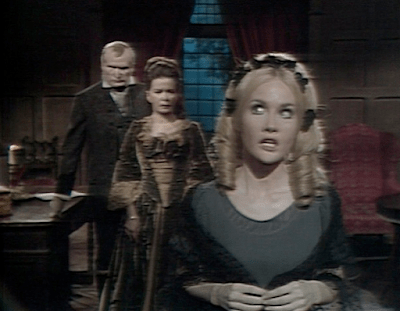
Episode 434: No business to run

Some people have conversations relating to the ongoing witchcraft trial of bewildered time traveler Vicki Winters. The trial itself is a waste of time, so a half hour listening to people talk about what might happen during the trial is a grim prospect. Indeed, none of today’s scenes is necessary to the overall development of the plot or of any major themes. Still, they give the actors an opportunity to show us what they can do, and four of the five members of the cast turn that opportunity to good advantage.

The exception is of course Roger Davis as Vicki’s defense attorney Peter Bradford. Mr Davis was usually tolerable when he delivered his lines in a normal conversational tone, but when he had to raise his voice, as characters on Dark Shadows have to do very frequently, the results were painfully bad. Voice teachers sometimes tell their students to sing from way down in their bodies; the more indelicate among them have been known to tell boys’ choirs that “The music escapes from the testicles.” Such a teacher would be displeased with Mr Davis. When he raises his voice, the muscles he is tensing are not those around the pelvic floor, but the sphincters in his buttocks, with the result that he seems to be having difficulty evacuating his bowels. I realize this is rather a distasteful discussion, but the topic is impossible to avoid when you listen to Davis going through one sentence after another, in each case building up to one word and grunting it out loudly. Yesterday, young Daniel Collins mentioned that repressed spinster Abigail’s personality was that of someone suffering from indigestion, and when today we hear Peter ask untrustworthy naval officer Nathan Forbes (Joel Crothers) “Why did you LIE!” or tell him “You already DID!” he sounds so much like someone struggling with constipation that we can think of nothing else.

The episode opens with a long scene between Peter and Nathan. One of Crothers’ great strengths as an actor was his ability to relax. He stays loose and moves fluidly, never stiffening in response to Mr Davis’ muscular tension, much less reacting to his straining sounds with either a giggle or a misplaced expression of disgust.

Nathan and Peter’s scene involves a fistfight, the first we have seen on Dark Shadows since dashing action hero Burke Devlin fought dangerously unstable ruffian Willie Loomis in #207. The fight is well-choreographed and Crothers does a good job falling down and looking like he has been beaten, but that result stretches credibility. Not only was Crothers the taller man, but his easy physicality would have given him a great advantage in hand-to-hand combat against someone as rigid and awkward as Mr Davis.

Peter and Nathan do battle. Screenshot by Dark Shadows Before I Die.

We cut to the drawing room of the great house at Collinwood, where Naomi Collins (Joan Bennett) wants to talk to her husband, haughty tyrant Joshua Collins (Louis Edmonds.) Joshua is moping after the death of his sister Abigail, and doesn’t want to talk to Naomi or anyone else. At first they exchange a few words about Abigail. Naomi doesn’t try to hide her dislike of her late sister-in-law, saying that she led a senseless life. This of course offends Joshua, but Naomi stands her ground.

This part of the conversation includes two lines that are interesting to fans who are curious about the details of the characters’ relationship to their society. When Naomi says that it was because Abigail had too few responsibilities that she became a religious fanatic and a dangerous bigot, Joshua says that she did have some things to do. “She had her church,” he says. Not “the church,” not “our church,” but “her church.” This is not the first indication we have had that Abigail differed from the rest of the family in religion, but it is the most definite confirmation. As aristocratic New Englanders of the eighteenth century, presumably the family would be Congregationalists. Abigail might just have gone to the another, stricter meeting within the Congregationalist fold, or she might have joined a different group.

The other line marks Naomi as a remarkably advanced feminist for her time and place. She says that Abigail was “Like a businesswoman with no business to run.” The concept of “businesswoman” was hardly familiar in the days when this episode is set. Even the word “businessman” was not widely known then- the earliest citation of it in The Oxford English Dictionary dates to 1798, two years after this episode is supposed to be taking place, and its first appearance in the modern sense came several years after that. The same dictionary can find no use of “business-woman” until 1827, and then in only a strongly pejorative sense. But the audience, seeing Joan Bennett on this set, will think of her character matriarch Elizabeth Collins Stoddard, who in the parts of Dark Shadows set in the 1960s runs the family’s business enterprises from this room. Naomi is looking towards the future, and she sees Liz.

Edmonds and Bennett are both wonderful in this scene. She is steady and authoritative throughout; he is alternately gloomy, irritated, and sullen. It is as compelling to watch her hold her single mood as it is to watch him navigate from one to the other. Joshua at no point concedes anything to Naomi, and he ends by turning his back on her and going away. But he is not at all in command today, as he has always been in command before. He is hurting too deeply to give orders and compel obedience by the force of his presence.

In the village of Collinsport, Nathan meets with the Rev’d Mr Trask (Jerry Lacy,) visiting witchfinder. The other day, Nathan capitulated to Trask’s blackmail and testified against Vicki. Now he wants Trask to intercede with Joshua and to talk him out of informing the Navy of his many crimes. He tries to sell Trask a bill of goods, claiming that all the things he did wrong were simply the result of his pure and innocent love for fluttery heiress Millicent Collins. The audience knows that this is entirely false, but Trask doesn’t even let him start on it- he responds that “Physical love is beyond my comprehension.” Mr Lacy is an accomplished comic, and he doesn’t fail to get a laugh with this line. Trask realizes that Nathan’s testimony would lose much of its persuasiveness if he were exposed as the scoundrel he is, Trask agrees.

Joshua comes to meet with Trask. Mr Lacy is a great shouter, and Trask is always on full volume. When he insists that Joshua meet with Nathan and forswear his plan to send a letter to the Navy, he builds Trask into a tower of hypocrisy and repression, and we remember all of the scenes where Joshua has demolished people he disdains, Trask among them. But Joshua is not going to demolish anyone now, not while he is mourning everyone he ever loved. He mutters, frowns, and finally caves in to Trask’s demand. The contrast between the overweening Trask and the fusty Joshua is electrifying to returning viewers.

Joshua then consents to meet privately with Nathan. He tells Nathan that he will keep quiet on condition he secure a transfer to another port as soon as possible. Nathan tells some lies and makes some excuses that impress neither Joshua nor anyone who has been watching the show for any length of time, but again, the actors are fascinating to watch together. The chaos and evil Trask represents has turned the world upside down, weakening the strong Joshua and emboldening the degenerate Nathan.

More bad news awaits Joshua when he goes home. Unhappy as Joshua was with Naomi’s insistence on discussing the faults of his recently deceased sister, he is much more upset when she tells him she has decided to go to court and testify in Vicki’s defense. Joshua is appalled she would do this. He is sure Vicki is to blame for the deaths of both of their children, of both of his siblings, and of various other people, some of whom he cared about when they were alive. He threatens to lock Naomi up in her room to prevent her going to court, but she replies that if he does that she will escape, and he will never see her again. The children are dead and she has no work of her own; she has no reason to stay.

Episode 428: Witness for the defense

Fluttery heiress Millicent Collins thought that she had a bright future to look forward to when she became engaged to young naval officer Nathan Forbes. That prospect shattered when she discovered that Nathan was already married. Making matters worse, Nathan’s wife, Suki, had presented herself to the Collinses as his sister, and he had gone along with this imposture. Suki is now dead, strangled in an apparently empty house, her body discovered by Nathan when no one else was anywhere near and he had a great deal to gain by her death. For some reason, no one seriously suspects Nathan of the murder, but the whole thing rather tends to cast him in a poor light.

Millicent has recently seen her second cousin, Barnabas Collins. Barnabas’ father, haughty tyrant Joshua, has put the word about that Barnabas has gone to England. Like most people in and around the village of Collinsport, Millicent had believed this story. But the other night she spotted Barnabas in the cemetery. Now she is determined to find Barnabas and recruit him to avenge her honor by fighting a duel with Nathan. She is indignant that Joshua and his wife Naomi keep insisting that she did not really see Barnabas, and that he is not available to fight Nathan.

As it happens, Barnabas did not go to England. Joshua invented that story to cover up the fact that Barnabas had died. Joshua believed that Barnabas died of the plague, and that if that became known the men would not show up to work at the family’s shipyard.

Today, Millicent hears for the first time that Barnabas has died. The news comes from an unpleasant young man named Peter, who is acting as attorney for accused witch Victoria Winters. Peter comes to the great house of Collinwood looking for much put-upon servant Ben Stokes, hoping that Ben will testify for Vicki. Millicent is uninterested in Peter’s mission, but asks him to look for Barnabas. Peter has heard that Barnabas is dead, and passes that information along to Millicent. Since she has seen Barnabas with her own eyes, she simply laughs at this.

As it happens, Peter and Millicent are both right. Barnabas is dead, most of the time. At night he rises as a vampire and preys upon the living. No one but his friend Ben knows this.

In her scene with Peter, Nancy Barrett’s Millicent is slightly, cheerfully crazy. She doesn’t get much support from Roger Davis as Peter, and winds up playing the part a little bit bigger than she might have wished. In her next scene, she has a partner who helps her stay on firm ground.

Millicent answers the front door, as she had done when Peter knocked. This time she is appalled to find that it is Nathan. He puts his foot in the door and refuses to leave until she has heard him out.

Nathan spins a tale to Millicent that he and Suki were in the process of divorcing. We know this is false, and Millicent should as well. When they became engaged, Nathan insisted on the earliest possible wedding date. Since Suki did not show up with a final decree, Nathan could not have been sure that the divorce would be official by that date. Of course, we also know that there was no divorce in the offing; Nathan had abandoned Suki, she had tracked him down, and when she found out about Millicent, she planned to force Nathan to send as much of Millicent’s vast inheritance her way as possible.

Millicent doesn’t know about those details, but she is quite sure Nathan is lying. When he tries to embrace her, she takes a letter opener and tries to stab him.

Millicent takes matters into her own hands. Screenshot by Dark Shadows Before I Die.

Millicent is not supposed to be particularly brainy, but she is a smart character in every sense that matters. She absorbs the facts presented to her, interprets them reasonably, forms plans, and pursues those plans by means which, if her interpretations are correct, might well succeed. She believes, correctly, that Nathan has mistreated her and made her look like a fool. She believes, as a young lady of the late 18th century well might, that matters can be set right only by Nathan’s violent death. Having seen Barnabas and knowing that he once fought a duel, she hoped that he would be her avenger. Since Barnabas is being kept from her for no reason she can fathom, she has decided to take matters into her own hands. Her actions may not be the optimal response to the situation, but we can follow her train of thought at each point and are in suspense as to what it will lead her to do next.

Joshua interrupts Millicent before she can accomplish her purpose. He sends her out of the room and confronts Nathan. He tells Nathan he will soon inform the Navy department of what he has done, and that he is sure they will share his eagerness to resolve the issue discreetly. Joshua’s horror of scandal, which we have seen many times, most spectacularly in his cover-up of Barnabas’ death, explains his willingness to believe that Nathan is innocent of Suki’s murder. There would be no way to settle that entirely out of the public eye.

Joel Crothers brought a great deal of wholesome charm to the role of the scoundrel Nathan. We are impressed when Millicent does not give him an inch, even though we can see that she is tempted to do so. We can understand why Joshua several times seems to have to remind himself that he disapproves of Nathan. When, as Joshua, he says he does not believe Nathan killed Suki, Louis Edmonds gives a little smile which flashes real affection for the man he is condemning. It is a testament to Crothers’ talent that his partners are able to achieve these subtle effects in the scenes they share with him in the drawing room.

We cut to the cemetery, where Ben is digging a grave in a heavy fog. Peter shows up to shout at him about testifying for Vicki. Thayer David answers him with an impressive simplicity. Roger Davis is as loud and monotonous as he usually is, but David’s Ben doesn’t waste the tiniest energy on any uncalled-for displays with his voice or face or gestures. It really is a master class in acting under difficult circumstances.

Joshua shows up and shoos Peter away. Joshua insists on going with Ben into the secret chamber where Barnabas’ coffin is hidden. The other night he went into the chamber alone, opened the coffin, and found it empty. Today he goes in with Ben and opens the coffin again. Unaware of the vampire curse, he is as shocked to find the body there as he had earlier been to find it missing.

Episode 426: Men change, and seldom for the better

For months now, fluttery heiress Millicent Collins has been staying at the great house of Collinwood as the guest of her cousin Joshua and Joshua’s wife Naomi. Tonight, she returns to the drawing room after a moonlight stroll and makes a series of statements that bewilder Joshua and Naomi.  

Joshua and Naomi wonder what Millicent could possibly be talking about. Screenshot by Dark Shadows Before I Die.

Millicent tells her hosts that she has seen their son Barnabas. Joshua and Naomi are shocked to hear this, because they know that Barnabas has died. Believing that Barnabas died of the plague and that this news would scare the workers away from the family’s shipyard, Joshua put the word out that Barnabas went to England. Millicent saw Barnabas standing in the graveyard, near the secret chamber where his coffin is hidden. This further shocks Joshua and Naomi.

Millicent says that she needs Barnabas. He is the only member of the family who has fought a duel, and there is a family matter that can be settled only by dueling. Joshua and Naomi have no idea what she is talking about. She tells them she has learned that naval officer Nathan Forbes, to whom she recently became engaged, was already married. That hits them so hard they almost embrace her, something characters on this show do not do. They are supposed to be New Englanders, after all. She shies away from them.

What neither his parents nor Naomi know is that Barnabas rises from the dead by night and walks the earth as a vampire. The only living person privy to this secret is Barnabas’ friend, much put-upon servant Ben Stokes.

Ben saw Millicent at the graveyard, moments after Barnabas vanished into thin air. He tried desperately to convince her that she did not see Barnabas, repeating Joshua’s story that he has gone to England. He tried to bargain with her, promising to look for Barnabas and tell her if he finds him. His insistent denials that she saw what she knows she saw frustrated her. She told him that she wants to be buried in the mausoleum, and that she thinks of herself as already dead, dead as of today, no matter how long her body may survive. She told him her grave marker should reflect this date of death. He begged her to let him walk her back to Collinwood. Irritated with him, she allowed him only to follow her at a distance.

Millicent complains to Joshua and Naomi that Ben kept telling her that Barnabas had gone to England. She says that he must be punished. Joshua has been telling Millicent she is ill, and he wants Ben to stick to the official story. But he is such a tyrant that he cannot help but warm to the idea of punishing Ben. He ends the episode by expressing his vigorous agreement with Millicent.

Ben and Millicent are both wonderful today. Millicent has dozens of lines, all of them quotable, and most of them quoted in Danny Horn’s post about this episode. Nancy Barrett developed a deliberately stagy style for Millicent that always works, and today it reaches its summit.

As Ben, Thayer David has a subtler part to play, and he does it perfectly in this one. In an opening scene with Barnabas, he begins with a gruff expression of distaste for the horrible things Barnabas does, and before we know it is pleading with him not to allow himself to be destroyed. In a tiny bit of time, with only a few lines to speak and only a few opportunities to show his face, he takes us from loathing for the vampire to devotion to his friend, and at no point does the transition feel forced.

Naomi and Joshua have recently lost both of their children, among other loved ones, and there doesn’t seem to be any end to the death that surrounds them. Joan Bennett and Louis Edmonds fully connect us to their grief today. Dark Shadows too rarely gives these two extraordinary actors a chance to show what they can do, and both of them make great use of this opportunity.

Barnabas’ part is somewhat ridiculous. Today, he outdoes himself in narcissism, describing the death of his true love Josette solely as a thing that happened to him. But we know going in that that’s his deal- as a vampire, he is a metaphor for selfishness, and he was pretty self-centered even when he was alive. By this time, Jonathan Frid’s performance has made this preposterous creature into a major phenomenon of the era’s pop culture, and when he is this deep in his wheelhouse he does not disappoint. The result is a surprisingly strong entry in the series.

Episode 416: Poor lost children

We open in the drawing room of the great house of Collinwood, where Naomi Collins (Joan Bennett) is drinking alone. Her husband Joshua (Louis Edmonds) enters, returning home after an absence of some days, and greets Naomi with a loud expression of scorn for her alcoholism. She looks up and recites these lines: “A little bird flew to the window. It hovered there for a moment, and then flew away. The first bird of the morning.” Many times, Joan Bennett found ways to show the viewers of Dark Shadows why she had been one of the biggest movie stars of her generation, but this is not one of those times. She delivers this little speech stiffly, as if embarrassed by it.

Joshua is about to leave the room when Naomi tells him that their daughter Sarah died the night before, on her eleventh birthday. He is thunderstruck and says that he cannot believe it. Naomi replies, “Yes, that is what we must do- not believe it!” With this line, Joan Bennett recovers her footing. As matriarch Elizabeth Collins Stoddard in the first 73 weeks of Dark Shadows, when the show was set in 1966 and 1967, Bennett created a character who had devoted her entire life to this motto. Now that the show is set in the late 18th century, we see that the Collinses had been living by it for hundreds of years. Once she starts playing a character who is wrestling with denial, Bennett is in familiar territory, and she is terrific to watch.

Joshua believes that the bewildered Victoria Winters (Alexandra Moltke Isles) is a witch, and that a spell she cast on Sarah caused her death. He goes to the gaol in the village of Collinsport where Vicki is being held, awaiting trial on witchcraft charges. We see her in her cell, the first time we have seen this set. Joshua confronts her there. She denies his accusation. She tells him she is a time-traveler displaced from 1967 and that she has been trying to use her knowledge of history to rescue people from the fates that she has read about. This is true, as it happens, but of course Joshua is not favorably impressed. He tells her to enjoy the few sunsets and sunrises that she will see between now and the day she is put to death.

A week before, Naomi and Joshua’s other child, their forty-ish son Barnabas (Jonathan Frid,) had died of a mysterious illness. Joshua decreed that no one must know that Barnabas had died. He had Barnabas’ body interred in a secret chamber hidden inside the Collins family mausoleum, and put out the word that Barnabas had gone to England.

Unknown to Joshua or Naomi, Barnabas has become a vampire. Joshua’s remark to Vicki about sunrises and sunsets thus carried an ironic charge for regular viewers. When Barnabas emerges from his coffin after this sunset, his friend, much put-upon servant Ben Stokes (Thayer David,) tells him Sarah has died. Barnabas blames himself for this. Sarah had seen him with blood on his face, and in her fear had run away. Alone in the night, she suffered from exposure. Barnabas tells Ben that he will go into the village of Collinsport, confess everything to the authorities, and let the sunlight destroy him. At least that will save Vicki. Ben pleads with him to find another way, but Barnabas insists.

Sarah’s remains have been deposited in a vault in the outer part of the mausoleum. Naomi comes in to look at the vault again; Joshua follows her. Naomi has many bitter words for Joshua; he is ready to lament the deaths of their children. Barnabas and Ben, hiding inside the secret chamber, listen to this painful conversation.

Joshua losing his grip on Naomi
Barnabas and Ben eavesdrop.

For viewers who have been watching Dark Shadows from the beginning, the scene of Barnabas and Ben eavesdropping on Joshua and Naomi evokes two earlier scenes with particular force. In #318, Barnabas and his associate, mad scientist Julia Hoffman, stood on the same spots where Barnabas and Ben stand now, listening as two local men talking in the outer chamber revealed knowledge that might expose their many crimes. In #118, crazed groundskeeper Matthew Morgan, also played by Thayer David, held Vicki prisoner in a different secret chamber, and the two of them listened as another pair of local men searched for Vicki just outside. In those episodes, Frid and David played men who were bent on murder, but whom we knew to be unlikely to kill their intended targets. Today, they are playing characters who are both desperate to stop killing, but we know that they are doomed to take more lives.

After Naomi and Joshua leave, Barnabas tells Ben he cannot turn himself in. The family must not be disgraced. He tells Ben to come back in the morning with a stake made of holly and to drive it through his heart. He gives him this command in just the same words the witch Angelique had used in #410. Ben had not at that time known what had become of Barnabas, and had complied only because he was under Angelique’s power. He resists Barnabas’ command now, saying that he cannot destroy one who has been a true friend to him. Barnabas tells him he is already destroyed, and that staking him will be a mercy. Ben reluctantly agrees.

Episode 408: My imperfect science

Late in 1966, the ghost of Josette Collins emerged from the supernatural back-world behind the action of Dark Shadows and rescued well-meaning governess Vicki from homicidal groundskeeper Matthew Morgan. Early in 1967, Vicki and several other characters worked closely with the ghost of Josette to thwart the evil plans of undead fire witch Laura Murdoch Collins. After these experiences, Vicki felt so close to the ghost that, to some, it seemed possible that her personality might disintegrate and she might become a sort of reincarnation of Josette.

In November 1967, the back-world and the foreground traded places. Vicki came unstuck in time and found herself in 1795, where Josette and others whom she had met as uncanny entities are alive and she is the alien interloper from another world. Vicki did not in any way adapt to her new surroundings, and immediately brought suspicion on herself. Now she is in jail, spelled “gaol,” awaiting trial on charges of witchcraft.

Josette visits Vicki today and begs her to lift the curse that has brought a mysterious and apparently terminal illness to gallant gentleman Barnabas Collins. Despite her situation, Vicki is shocked that Josette believes her to be a witch. Unable to persuade her of her innocence, Vicki tells Josette that she is a time-traveler and sends her off to look for a book she brought with her from the future. Josette interprets this as a confession of witchcraft, and when she finds the book makes it clear that she could not possibly have interpreted it as anything else.

Vicki makes Josette cry. Screenshot by Dark Shadows Before I Die.

If the show had kept the memory of Vicki’s friendship with Josette’s ghost fresh, this might have been a powerful scene. But Josette’s ghost receded from the action after the Laura story ended in #191, and in #223 and #240 it was made explicit that she is no longer a palpable presence on the estate of Collinwood. We’ve barely heard of Vicki’s connection to Josette in recent months. By this point, even viewers who have been with the show from the beginning are unlikely to make a connection between Vicki’s behavior in her scene with Josette and those old stories. Instead, we see yet another case of Vicki being a tiresome fool.

Disappointing as that scene is, it is not the low point of the episode. That came in the scene immediately before. Actor Jack Stamberger appears as a doctor called to treat Barnabas. Doctors on Dark Shadows are ineffectual figures brought on to fill time, unless they are mad scientists who take a bad situation that is troubling one or a few characters and make it so much worse that it can be a major narrative arc. Stamberger’s part is of the former sort.

It is a particularly objectionable specimen of the category. The other G.P.s usually started with at least a theoretical possibility that they might do something to advance the plot, or turn out to be old friends with established characters who could show a new facet of their personalities in interaction with them, or at least bring out some unusual medical equipment that would be fun to look at. They’ve already foreclosed all of those possibilities before this doctor appears, so the scene is advertised as a waste of time.

One of these is not like the others. Screenshot by Dark Shadows Before I Die.

Worse, watching Stamberger’s performance is like sticking your head in a bucket of itching powder. His scene partners, Kathryn Leigh Scott, Lara Parker, and Grayson Scott with dialogue, and Jonathan Frid with moans and anguished facial expressions, are all totally committed to the period setting, and really do seem like gentlefolk inhabiting a mansion in a previous century. Stamberger doesn’t even try to do what they are doing. He puts on a growly voice that might have been acceptable if he were playing a trail-boss in a Western, but that doesn’t have much place in any scene set indoors. It certainly doesn’t make sense for a man in genteel surroundings who talks about nothing but how helpless he is. He doesn’t maintain eye contact with any of the ladies long enough to put himself into the same space with them. He bungles most of his lines, and even those he speaks as written he follows by shuffling his feet, breathing heavily, and looking around. Dark Shadows was, for all practical purposes, done live; if videotape editing had been freely available, it’s hard to imagine director Lela Swift wouldn’t have stopped the scene and taken the time to smack him upside the head.

On his Dark Shadows Every Day, Danny Horn argues that Addison Powell was, as he stylizes it, THE WORST ACTOR EVER TO APPEAR ON DARK SHADOWS. I’m not sure who deserves that title, but today Stamberger locks up the award for Most Irritating Performance.

Episode 404: I forgot you were here

When I was a kid in the 80s, a friend of mine liked watching syndicated reruns of the tongue-in-cheek Western series Alias Smith and Jones on Saturday afternoons. I didn’t much care for it, but sat through a few of them with him. Eventually they got to some episodes in which the actor who played the character with the alias “Smith” was replaced by a man who was always smiling as if he had just said something terribly clever, even if he hadn’t said anything at all. After a few minutes of that bozo’s inane mugging, my friend couldn’t stand it either, and we could go back outside and play. So that worked out to my benefit.  

In those same years, I was a great fan of The Twilight Zone. The man whose pointless self-satisfied smile ruined Alias Smith and Jones for its fans showed up in one of those episodes, but he was used intelligently there. The episode was called “Spur of the Moment.” In it, a young woman has to choose between two lovers, one of them a prosperous fellow whom her father likes, the other a penniless dreamer whom the whole family hates. Any audience will have seen that story countless times and will assume that we are supposed to root for the penniless dreamer. But The Twilight Zone mixed that up for us by casting the likable Robert E. Hogan as daddy’s choice and the man with what we nowadays call an “instantly punchable face” as the poor boy. When the twist ending shows us that the woman was horribly wrong to marry the poor boy, it’s our dislike of the actor playing him that makes it a satisfying resolution.

So, when I first saw this episode of Dark Shadows some years ago, it was with some apprehension that I met the sight of that same repellent man on screen. His name is Roger Davis. In later years, Joan Bennett would look back at her time on Dark Shadows and would refer to Mr Davis as “Hollywood’s answer to the question, ‘What would Henry Fonda have been like if he had had no talent?'” Mr Davis’ head is shaped like Fonda’s, and his character turns out to be a defense attorney, a common occupation among the roles Fonda played.

The first line addressed to Mr Davis is “I forgot you were here,” spoken by bewildered time-traveler Vicki. When his character Peter, a jailer who is reading for the bar, tells her that he can hear her in her cell at night, she tells him she didn’t know he was there. Vicki’s repeated failure to notice Peter’s existence may not sound like an auspicious start to what is supposed to be a big romance, but it isn’t as bad as what happens when he is escorting her back to her cell. He puts his hand on her elbow, and she reflexively recoils.

Mr Davis is just awful in his scene today. He spits each of out his lines as if they were so many watermelon seeds, stops between them to strike poses almost in the manner of a bodybuilder, and looks at the teleprompter. The last was a near-universal practice on Dark Shadows, but I mention it for two reasons. First, because this is his debut on the show- even Jonathan Frid, whose relationship with the teleprompter is the true love story of Dark Shadows, didn’t start reading from it until he’d been on the show for a week or two. Second, in his attempts to defend what he did on Dark Shadows, Mr Davis has many times claimed that he “always” knew his lines, that he “never” used the teleprompter.

Mr Davis is going to be a heavy presence on the show for what will seem like a very, very long time to come. He, more than anyone else, prompted me to make a habit of what I call “imaginary recasting.” When Joan Bennett was stuck playing a scene with him, she evidently made the experience endurable by thinking back to the days when she was a movie star playing opposite the original, talented Henry Fonda. When I am watching him butcher a scene, I think of other actors who actually appeared on Dark Shadows or who would likely have accepted a part on it if offered, and try to visualize what they would have done in his stead.

Harvey Keitel was a background player in #33, and surely he would have accepted a speaking role on the show at this point in his career. Mr Davis’ invariably, pointlessly belligerent tone of voice makes Peter seem like a guy with a lot of anger. Mr Keitel is of course a master of playing men who have issues with anger but are still deeply sympathetic. When it’s time to sit through one of Mr Davis’ scenes as Peter, I have enough fun imagining what Mr Keitel could have done with the part that I am not too sorely tempted to give up.

Closing Miscellany

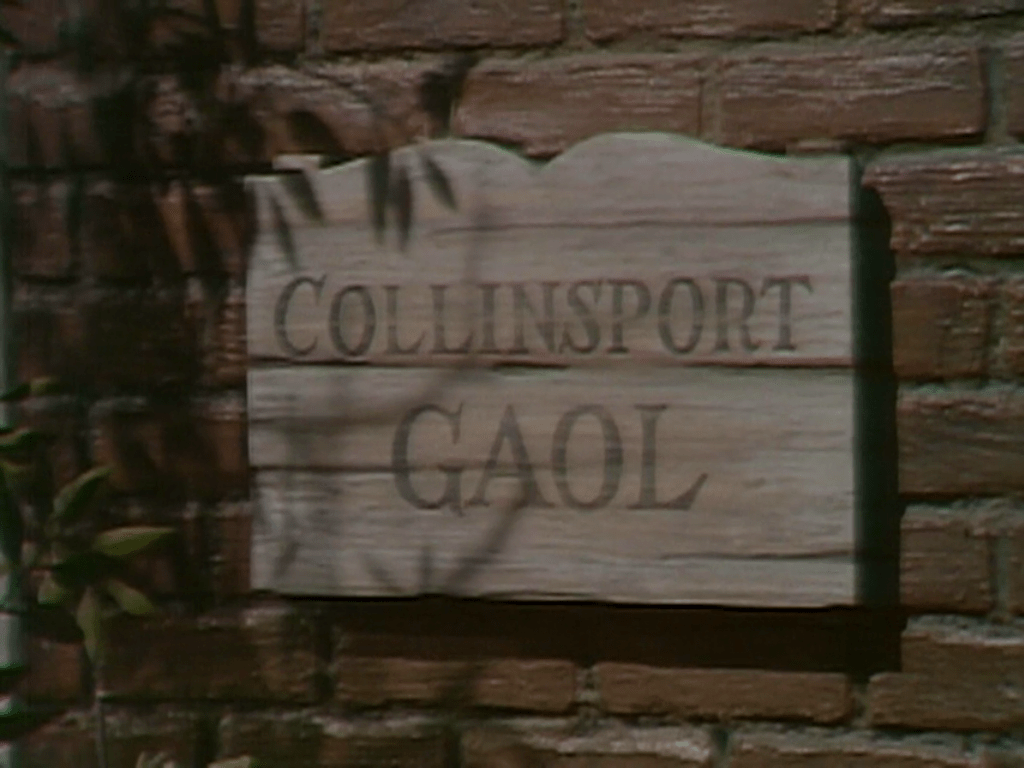
This is the first episode to show that the sign outside the town lockup is labeled, in a period-appropriate spelling, “Collinsport Gaol.”

Ballad of Collinsport Gaol.

The Bil Baird bat puppet appears in this episode, but is so close to the camera it looks like a felt cutout. Bit of a disappointment.

In his post about this episode on Dark Shadows Every Day, Danny Horn discusses the performance Addison Powell gives as a lawyer who meets with Vicki and decides he can’t take her case. He claims that Powell was THE WORST ACTOR EVER TO APPEAR ON DARK SHADOWS. Powell isn’t one of my favorites, but I don’t think he deserves that title. Of those we’ve seen so far, I’d say Mark Allen, who played drunken artist Sam Evans in the first weeks of the series, was the most consistently worthless performer, while Michael Hadge, who was motorcycle enthusiast Buzz for a while in 1967, was the most endearingly inept. Powell is awkward in his scene today, but Roger Davis is even more so, and he, unlike Powell, is so naturally unpleasant that he has to be flawless to earn the audience’s toleration.

Episode 379: Governesses are supposed to be trusting

Dark Shadows became a hit after vampire Barnabas Collins joined the cast in April of 1967. Displaced from a previous era, Barnabas spent most of his time trying to con people into believing that he was a native of the twentieth century. The difficulties Barnabas encountered in his performance in the role of modern man dovetailed so neatly with those actor Jonathan Frid encountered in his characterization of a vampire that his every scene was fascinating to watch.

The audience’s main point-of-view character for the first year of the show or more was well-meaning governess Vicki. Now Vicki finds herself in a situation like that which made Barnabas a pop culture phenomenon. The ghost of Barnabas’ ten year old sister Sarah has sent Vicki back in time to 1795, when Barnabas and Sarah are both living beings and the vampire curse has not yet manifested on the estate of Collinwood. Vicki and Barnabas have traded places- she is now the time-traveler who must trick everyone into thinking she belongs in their period, while he is her warm-hearted, if uncomprehending, friend.

Unfortunately, the show has not chosen to write 1795 Vicki as a fast-thinking con artist. By the time the Collins family of 1967 met Barnabas, he was wearing contemporary clothing and telling them a story about being their cousin from England. Vicki shows up in her 1967 clothes and carrying a copy of a Collins family history printed in the 1950s. She goes around blurting out information she learned from reading that book and introduces herself to each character by telling them that they are played by actors who had other parts in the first 73 weeks of the show. Vicki’s natterings have convinced two ladies in the manor house, repressed spinster Abigail Collins and visiting aristocrat Countess DuPrés, that she is a witch.

Today, we open with the countess setting a trap to expose Vicki. Haughty overlord Joshua Collins vanished from the front parlor yesterday, in the middle of an argument with his brother Jeremiah. Jeremiah looked away from Joshua for a moment, and when he looked back his brother was gone and there was a small house cat in his place. The countess insists Vicki come into the parlor and reenact Joshua and Jeremiah’s argument. Vicki keeps protesting that the whole idea is silly, but the countess will not be stopped.

The countess imitates Joshua. This is the first time we have seen Grayson Hall play one character mimicking another, and it is hilarious. I suppose it would have ruined the laugh if Vicki had shown that she was in on the joke, but at least it would have provided evidence that Vicki hasn’t left her entire brain in 1967.

The countess tries to get Vicki to speculate on what goes on behind closed doors between Joshua and his wife Naomi. Vicki says that “It’s not my place to judge their marriage,” managing to sound like a dutiful servant, if not like an eighteenth century English speaker. The countess goes on testing Vicki with provocations that seem unconnected with each other, and she tries not to say anything wrong. That goes on until the cat reappears.

Barnabas is Joshua’s son. He enters and sees the cat. Vicki leaves, and Barnabas tells the countess he doesn’t think he has ever seen the cat before. Caddish naval officer Nathan Forbes enters to confer with Barnabas about the search for Joshua. Nathan overhears the countess suggesting to Barnabas that Vicki is a witch and is responsible for making his father disappear.

Nathan finds Vicki. He tries to warn her that the countess suspects her of being a witch. This is the second time we have seen someone explicitly tell Vicki that she will have to do a better job of faking her way through her current situation, after a scene in #367 where the kindly Jeremiah told her in so many words that she would have to make up a better story to tell people about herself. No one had needed to do that for Barnabas when he was lying his way through 1967, and if they had he would have had a stake in his heart before he’d been on the show a week.

Nathan tries to talk sense into Vicki’s head. Screenshot by Dark Shadows Before I Die.

At least Vicki tried to absorb what Jeremiah told her in #367. When Nathan tells her today how bad she has made things for herself, she just gets uptight. There have always been times when the writers solved plotting problems by having Vicki do something inexplicable, but now it seems Dumb Vicki is the only side of the character we will be allowed to see.

The countess confronts Vicki again, inviting her to take a lesson in tarot card reading. As the countess probes Vicki for information, we hear Vicki’s voice in a recorded monologue, wondering if she could tell the countess the truth. She may as well- she has pretty well blown any chance she ever had at establishing a false identity for herself.

Vicki in over her head. Screenshot by Dark Shadows Before I Die.

When the countess asks Vicki where she was trained to be a governess, she says that she was raised in a foundling home in Boston and was trained there. The only false part of this account is that the foundling home was in New York. Changing the location to Boston only makes it that much easier for people based in Maine to check her story and prove it false. When the countess asks when she was born, she says “March 4, 19-” and catches herself. The countess remarks on the strangeness of the slip, and Vicki is conscious enough not to fall into her trap when she invites her to put the wrong digits after “17.”

By the end of their encounter, it should be obvious even to Vicki that the countess suspects her of witchcraft. The countess presses Vicki about her knowledge of the supernatural, telling her that Barnabas regards her as clairvoyant. Vicki tries to dismiss that as “his joke.” When Vicki protests that she does not know why the countess keeps asking her questions about the supernatural, the countess impatiently tells her that she certainly does know. She declares that something terrible is happening in the house, and that she is determined to find out what it is.

Having made it clear that she thinks Vicki is a witch, the countess leaves her alone in the room with the layout of tarot cards she had been studying. Vicki decides to rearrange the cards. She thinks to herself that she will thereby warn the countess of the upcoming tragedies. But the countess will know that the cards are not where she dealt them, and it will be obvious that it was Vicki who moved them. She will know that she is receiving a message, not from whatever realm tarot cards are supposed to access, but from Vicki. If that message foretells disasters that in fact occur, she will only be confirmed in her suspicions. It is difficult to imagine a stupider act Vicki could have committed.

Difficult, but for a writer as imaginative as Sam Hall it is not impossible. In the next scene, Vicki is talking to Barnabas while the countess stands nearby. Vicki tells Barnabas that Joshua will return. She speaks with such assurance that Barnabas takes it as another sign of her clairvoyance, and the countess reacts with horror, hearing the witch declare that she is about to lift her spell.

The moment when Mrs Acilius shouted at the screen, “Vicki, SHUT! UP!” Screenshot by Dark Shadows Before I Die.

Alone with the countess, Barnabas admits that he is starting to think that she may have a point about witchcraft. The countess answers that he is becoming wise.

Closing Miscellany

The asthmatic Grayson Hall has a coughing fit during her scene with Vicki and the tarot cards. It is one of the less amusing bloopers, she really sounds like she’s suffering.

I chuckled a little when Vicki stops at “19-” in giving her birthdate. Alexandra Moltke Isles’ year of birth is given on various websites as early as 1943 and as late as 1949. I think it is only fitting that someone so central to a show like Dark Shadows should be a little mysterious, so I’m glad that all we really know about Mrs Isles’ birth is that it took place on 11 February 194-.

Episode 374: A woman decides, and it happens

No two performers did more to pioneer what would become the Dark Shadows house style of acting than Thayer David and Lara Parker. When David first appeared as gruff groundskeeper Matthew Morgan in #38, he stood out in a cast of theater actors who tended to play their parts somewhat larger than life by his exceptional intensity. In the 1795 period piece, he brings the same quality to his portrayal of kindly indentured servant Ben Stokes. As wicked witch Angelique, Parker is the first member of the cast to find a kind of ferocity that outdoes even David. Today, the two of them are the main characters in the episode, yet each shows great restraint and understatement. Their performances are admirably precise.

Angelique is maidservant to Countess Natalie DuPrés, a French lady who took her to the island of Martinique when she fled the Revolution. The countess hasn’t been much in evidence, so that Angelique spends most of her time working for her niece Josette, fiancée of young gentleman Barnabas Collins. Before Barnabas and Josette became a couple, he had a brief affair with Angelique, to which Angelique attached great importance. When she finds that Barnabas does not love her and cares only for Josette, she sets about casting spells to ruin their happiness.

Today, Josette opens a gift box to find a skull wearing a wig. She is altogether undone by this. Barnabas confronts Angelique about it. While he does not seem to have any idea that Angelique is a witch, he is sure she is responsible for the nasty surprise. She denies everything, and he has no evidence against her.

The first bewigged skull to appear on Dark Shadows. Screenshot by Dark Shadows Before I Die.

Ben had tried to tell Barnabas and Josette about Angelique, but being under her power, he cannot. But Barnabas could tell Josette the truth about his past with Angelique. Because he does not, she goes on trusting Angelique, giving her full access to her things and to her person, enabling her to cast whatever spell she wishes. Had Barnabas trusted Josette with the truth, they might have been able to fight Angelique. Because he insists on hiding it from her, they are utterly helpless and will lose absolutely everything.

When Dark Shadows started, the 1960s version of the Collins family was isolated from the community, unable to make anything happen, and vulnerable to a wide variety of enemies, all because matriarch Liz and her brother Roger clung desperately to shameful secrets. When those secrets came to light, they lost nothing and found themselves with a new freedom. Now, in 1795, the Collinses are the lords of the town, running a dynamic business, and apparently unassailable in their wealth and prestige. But in Barnabas’ failure to come clean with Josette, we see the beginning of the process that will lead them to the precarious state in which they are trapped in 1966.

Today, Angelique completes a spell that causes Josette to conceive a mad passion for Barnabas’ uncle and best friend Jeremiah. After Josette sneaks into Jeremiah’s room and makes a fool of herself by propositioning him, she runs back to her own room and sobs on the bed. Angelique is there, feigning puzzlement and sympathy, quietly accepting the young mistress’ refusal to tell her what is wrong.

This is the first episode of the 1795 segment not to include time-traveling governess Vicki. While actors Kathryn Leigh Scott, Thayer David, and Anthony George all appeared in the main time frame (debuting in episodes #1, #38, and #262, respectively,) only Jonathan Frid, as Barnabas, is playing a character we had met there. There’s a heavy-handed moment of self-reference today when Josette tells Barnabas that sometimes he is “too modern,” and he thinks about it during a close-up. That close-up goes on so very long that there is no doubt they are giving us reading instructions, telling us that Barnabas, rather than Vicki, is now our point of view character.

Episode 370: Foreign to both of us

On Wednesday, we met a new arrival from Paris by way of the island of Martinique. She is Angelique, maidservant to the Countess DuPrés and onetime bedfellow of rich young gentleman Barnabas Collins. Barnabas is engaged to marry the countess’ niece Josette, and is anxious to keep Angelique in the background. Angelique does not share either of Barnabas’ goals.

At rise, Angelique meets Barnabas’ uncle Jeremiah in the front parlor of the manor house of Collinwood. She has found a toy soldier and asks Jeremiah about it. When he identifies it as one of the toys Barnabas was most fond of in his boyhood, he volunteers to take it to the playroom himself. She asks to keep it for a while, so that she can study its workmanship. He doesn’t object, and exits. Once she is alone in the parlor, Angelique starts talking to herself. She says that she will use it to cause Barnabas unimaginable pain. This is the first direct suggestion we have seen that Angelique is involved in witchcraft.

Time-traveling governess Vicki enters. She tells Angelique that they should be friends, because they are both servants in the house, and it is a foreign setting to both of them. Angelique asks what Vicki means by describing herself as foreign, since she is an American. Vicki realizes that she can’t tell someone she has just met that she is a time traveler thrust here from 1967 by the ghost of the little girl she is supposed to be educating, and so she mutters something about how Angelique wouldn’t understand. After they part, we hear Angelique musing that Vicki has no idea what she understands. At no point does Angelique show any interest whatever in becoming friends with Vicki.

Later, we see Angelique alone in her room with the toy soldier and Barnabas’ handkerchief. She is talking to herself about her evil plans again when she is interrupted by a knock at the door. She hides the things and answers it. Barnabas enters.

Barnabas renews the effort he made at the end of Wednesday’s episode to friendzone Angelique. Again, she isn’t having it. After he leaves, she takes the soldier and the handkerchief back out and tells them that she has decided to wait for Josette’s arrival to enact her revenge on Barnabas.

She won’t have to wait long. Josette’s father, André, is entering the parlor, grumbling about the lack of servants at Collinwood. He beckons his daughter, and she follows him into the house. She is played by Kathryn Leigh Scott.

A major cast member of the parts of Dark Shadows set in the 1960s as Maggie Evans, The Nicest Girl in Town, Miss Scott has played Josette’s ghost more than once. She created the part in #70, when she was the shimmery figure who emerged from Josette’s portrait in the very house we are in today and danced among its pillars. She reprised the part in #126, again in this house, when Josette led the other ghosts in rescuing Vicki from crazed handyman Matthew Morgan. For some months Barnabas, who is in 1967 a vampire, held Maggie prisoner here and tried to replace her personality with that of Josette. Barnabas often seemed convinced that Maggie really was Josette, and when strange and troubled boy David saw Maggie wearing Josette’s dress in #240 he said that her face was “exactly the same” as it was on the many occasions when he had seen Josette’s ghost.

Barnabas’ plan to Josettify Maggie is drawn from the 1932 film The Mummy, in which the undead Imhotep (Boris Karloff) is released from his tomb, holds Helen Grosvenor (Zita Johanns) prisoner, and tries to replace Helen’s personality with that of his lost love Princess Ankh-Esen-Amun. In that movie, there is a flashback to ancient Egypt, where we see that Zita Johanns also plays Ankh-Esen-Amun and we realize that Imhotep’s crazy plan was rooted in some supernatural connection between the two women. The connection between Josette and Maggie has been equivocal until now- Miss Scott was always veiled when she played Josette’s ghost, and stand-in Dorrie Kavanuagh was the one wearing the dress in #240. Moreover, after Maggie got away in #260, Barnabas soon turned his attentions to Vicki, and decided he would try the same gimmick with her. But now we see that Barnabas really was onto something with regard to Maggie, and we wonder where it will lead. I remember the first time we watched the show, my wife, Mrs Acilius, reacted with great excitement to Josette’s entrance in this episode and exclaimed “Of course! Maggie is Josette!”

Vicki spent the first three days of this week telling the actors what parts they played in the first 73 weeks of Dark Shadows, an annoying habit. But there is a reason for it. She knew Barnabas and Sarah as supernatural beings in 1967, so she will recognize them as the same people here. And Josette’s looks reveal her connection to Vicki’s friend Maggie, so she will recognize that. Since only Angelique, of the characters we have met so far in 1795, is played by someone who did not appear previously, the writers are in a difficult position with regard to all of the other members of the company.

I wish they had solved that problem by having Vicki show up in 1795 unable to speak. The suggestion I made in my post about #366 is that she could have materialized in the midst of the accident that upset the carriage bringing the original governess, Phyllis Wick.* Vicki could have sustained a slight injury that left her mute for a week or so, could have had voiceover monologues registering her recognitions of Barnabas, Sarah, and Josette/ Maggie, and would not have had audible monologues when she saw the others. By the time she could talk again, Vicki would know that she was supposed to pretend to be Phyllis Wick.

Clearly Vicki is supposed to get into some kind of trouble in 1795; she is still the heroine, and the first rule of all soap operas is that the heroine must always be in danger. But she is supposed to be seeing the events that started the phase of the Collins family curse that involves Barnabas’ vampirism, and those events did not involve a governess who went around calling people by the wrong names and blurting out information she learned from reading the Collins family history. The logic of the plot requires that whatever trouble Vicki gets into is more or less the same trouble Phyllis Wick would have got into, and the appeal of the character requires that the audience watch to see what kind of con artist Vicki might turn out to be. Both of those imperatives demand that she try to masquerade as Phyllis.

Vicki does manage to keep herself from telling André and Josette that they are being played by the actors who took the parts of Sam and Maggie Evans in other parts of Dark Shadows. She can’t help staring at Josette, however. Josette is quite cheerful when she asks Vicki why she is staring; André, a more conventional aristocrat than his relaxed daughter, is visibly annoyed with Vicki’s impertinence.

Josette asks Vicki why she is staring at her. Screenshot by Dark Shadows Before I Die.

There was an opportunity here for Vicki to show some quick thinking. She could have told Josette that Barnabas has gone on at length about her appearance, and that she is amazed at the accuracy of his descriptions. That would have endeared her to Josette as the bearer of the message that her fiancé is very much in love with her, and would have reassured her that, while Vicki is an attractive young woman who lives under Barnabas’ roof, she is not a rival for his affections. As it is, Vicki just mumbles something about not having known she was staring.

Angelique enters. She and Josette rush into each other’s arms and speak French. Miss Scott tells a funny story about that moment. She and Lara Parker had talked about the script and agreed that two Frenchwomen excited to see each other after a long separation ought to greet each other in French, and they persuaded the producer of their point. Only when they got the revised script with the dialogue in French did it dawn on them that neither of them could speak the language. Fortunately, several other members of the cast were fluent in it, and coached them through.

We can see that Josette really regards Angelique as a friend. Viewers who have been with the show from the beginning will remember Josette’s ghost as a powerful and stalwart force for good, and will also know that Maggie is The Nicest Girl in Town. So whatever grievance Angelique may have against Barnabas, and however unjust may be the social system that has exalted Josette and subordinated Angelique, when we see Angelique faking friendship for Josette while planning to make her watch her lover suffer, we know that she is really evil.

Barnabas enters. Josette tells him that her long, difficult journey was worthwhile now that she is with him. This is a very sharp retcon. In #345, mad scientist Julia Hoffman asked Barnabas if Josette ever came to him of her own free will, and he responded with a silent grimace that left no doubt as to the answer. Now, we see that she has gladly sailed from Martinique to central Maine in late autumn to be with him.

Barnabas and Josette are alone, and he wants to kiss her. She is bashful and says that their parents might be upset if they don’t wait for the wedding. He says they might pretend to be, but that in reality it is expected. That is a sweet little conversation, and it ends in a sweet little kiss.

Angelique is back in her room. She twists Barnabas’ handkerchief around the neck of his toy soldier.

Angelique casts a spell. Screenshot by Dark Shadows Before I Die.

Barnabas starts choking and collapses.

Barnabas collapses. Screenshot by Dark Shadows Before I Die.

The episode ends with Barnabas on the floor, apparently asphyxiating, while Josette looks on in horror.

Wednesday, Barnabas made it clear that he had his affair with Angelique because he didn’t think Josette could love him. That gives Angelique a perfectly understandable motive for seeking revenge on him. A rich man exploited his position to trifle with her, a servant, giving no thought to her feelings or interests.

The selfishness and entitlement Barnabas exhibited thereby is jarring in the mild-mannered, apparently egalitarian fellow we have seen so far this week, but it fits perfectly with his behavior as a vampire in 1967. Seen from another angle, his behavior is consistent with everything the Collinses have done to get themselves in trouble since we first met them. He was tempted to take advantage of Angelique because he had underestimated his own lovability and despaired of making a real connection with Josette.

Barnabas is still underestimating himself and Josette now. Never once does it occur to him to come clean to her about what he did with Angelique. While Josette would no doubt be saddened to learn that her beloved fiancé had dallied with her pet servant, as a rich French girl from Martinique she has after all lived her whole life among wealthy men surrounded by enslaved women, and so could hardly have been shocked by what Barnabas had done. Surely she would have decided to go ahead with the wedding, and she would have known to be wary of Angelique.

By failing to trust Josette with the truth about his misdeeds, Barnabas puts her and himself at Angelique’s mercy. We think of 1966, when matriarch Elizabeth Collins Stoddard and her brother, high-born ne’er-do-well Roger Collins, were both prisoners of shameful secrets they dared not share even with each other. In 1967, when those secrets were finally laid bare to the whole world, Liz and Roger found they were free to go on about their business as if nothing had happened. In Barnabas’ petrified silence, we see all of the shadows that have kept his relatives in darkness for so long.

*Whom Dorrie Kavanaugh played in her brief appearance at the end of #365.

Episode 367: Good and evil vibrations

Episode #359 included a recreation of a shot from #69, harking back to a long-forgotten storyline in which housekeeper Mrs Johnson was a secret agent spying on the ancient and esteemed Collins family for their arch-nemesis, Burke Devlin. In #69, Mrs Johnson followed Burke’s orders and eavesdropped on a conversation between him and blonde heiress Carolyn Collins Stoddard. In #359, Carolyn herself is a secret agent, spying on the household for vampire Barnabas Collins. She follows Barnabas’ orders to eavesdrop on a conversation between him and mad scientist Julia Hoffman. The reference showed just how drastically both Carolyn and the show itself had changed from week fourteen to week seventy-two.

The puzzle is why writer Sam Hall watched #69. He wasn’t connected to Dark Shadows in those days, and it would be very far down the list of episodes you would watch in an attempt to get up to speed on what was happening when he came aboard. That puzzle is solved today.

As Mrs Johnson, Clarice Blackburn had a big turn in #69. Angrily denouncing the Collinses, she twisted up her face in a lunatic expression and loudly declared “I believe in signs and omens!” She appeared as the sworn enemy of the people we have been following all along, and as someone who is superstitious even by the standards of the haunted house where most of the action takes place.

Today, we and well-meaning governess Victoria Winters have been transported back in time to 1795. Blackburn reappears in the role she will be playing in the segment of the show set in that year- Abigail Collins, unmarried sister of haughty overlord Joshua. Abigail is a Puritan busybody out of Nathaniel Hawthorne by way of The Crucible. She renews the promise of all the mischief we had hoped Mrs Johnson would make when we first met her, long ago.

Vicki wakes up in the manor house and sees Abigail. She thinks Abigail is Mrs Johnson and is relieved that she has awakened from a nightmare. Abigail quickly makes it clear that the year is still 1795, that she is not “the friendly housekeeper,” and that she finds everything about Vicki to be appalling. She loses no time in declaring that Vicki is possessed by the Devil. Vicki denies this, but does not convince Abigail.

Abigail confronts Vicki. Screenshot by Dark Shadows Before I Die.

When Abigail leaves Vicki’s room, she locks the door from the outside. The rooms in the servants’ quarters are surprisingly large and well-appointed for the 1790s, but when we see that they can double as jail cells it offsets the apparent luxury. Vicki escapes through the window.

The great house of Collinwood, where Vicki lives in 1967, is under construction, and she goes there. Danny Horn, on his Dark Shadows Every Day, often said that the real subject of the series was the house. This scene corroborates his interpretation. When the ghost of little Sarah Collins said she would tell “the story from the beginning,” she sent Vicki back to the time when the great house was being built.

Construction site. Screenshot by Dark Shadows Before I Die.

Vicki finds a man in the foyer played by Anthony George. George had been the second actor to play the part of Burke. You might think her experience with Abigail would break Vicki of her habit of telling her cast-mates what characters they played in the 1960s part of the show, but no such luck. She reacts to George’s new character as if he were Burke. After a moment, she tells him that she can see he isn’t the same man. This is a riddle- if the characters played by the same actor look so much alike that it makes sense for Vicki to keep mistaking them for each other, what does she see in this Anthony George character that sets him apart from the other?

As it happens, George is playing Jeremiah Collins, builder of the great house and brother of Joshua. In #280, Barnabas had given a costume party and George’s Burke had attended it dressed as Jeremiah. Barnabas, a native of the late eighteenth century, had been thunderstruck by the sight of Burke in that costume, unable to do anything but say “Jeremiah!” and glare at him. So there is a strong resemblance, perhaps suggestive of some spiritual linkage between the two men. Vicki’s constant confusion of the actors with their roles indicates that such linkages are to be found throughout the cast. Having her babble about the resemblances out loud so frequently is the most annoying possible way to make this point. If Barnabas had kept mistaking the 1960s characters for their 1790s counterparts, it’s hard to imagine that they would have accepted him and certain that the audience would not have.

Vicki tells Jeremiah that Abigail thinks she is a witch. Jeremiah makes it clear that he finds Abigail’s hostility to be a strong recommendation, and the fact that Sarah is a fan of Vicki’s clinches the deal. He takes her back to the main house.

Once Vicki is back in her room, Jeremiah brings her 1967 clothes. He asks her why she wants them so much, telling her that they will bring nothing but trouble if they are found. She tells him that she will need them when she gets home. Combined with her habit of blurting out remarks that could only strike people in the 1790s as bizarre, Vicki’s attachment to her belongings from her own time suggests that she will very soon find herself in huge trouble. That’s unwelcome- this voyage to the past is shaping up to be interesting, and it would be nice to stay here long enough to get to know all of the characters. If Vicki keeps acting like this, she’ll get herself kicked out of 1795 and drag us back to the 1960s before Dark Shadows has had a chance to show us what they can do with a period piece.

Vicki tells Jeremiah that she has amnesia about her life until her arrival at Collinwood the day before. He tells her that she will have to make up a better story than that. She is shocked that he is telling her to lie, and he says that she will never find a place in the world if she doesn’t.

When Barnabas left 1795 and showed up in 1967, we didn’t see anyone patiently explaining to him that he would have to conceal his true identity and maintain a convincing cover story. He had figured that out by the time we met him. Most of the time he was on screen in those first months, he was trying to play the role of a modern man, a distant cousin from England whom the Collinses had forgotten about. It was fascinating to watch him essay that part. Occasionally he would stumble and blurt out information only someone from an earlier century would know; Vicki caught him doing that more than once, most notably in #233, when it seems for a moment that he might be thinking of killing her to cover his indiscretion. Other times he would face questions he couldn’t answer, and we would wonder what he would set in motion with his attempts to evade them. Quite frequently actor Jonathan Frid would have trouble with Barnabas’ lines, and it would seem that Barnabas, not he, was the one groping for words. When we first realized yesterday that Vicki was taking Barnabas’ journey in reverse, we might have hoped that it would be as interesting to watch her trying to pass as a native of the eighteenth century as it was watching Barnabas trying to pass as a native of the twentieth. That hope took a beating before the day was done, and her conversation with Jeremiah reduces it to a still lower order of probability.

Downstairs, Abigail is telling Joshua and his wife Naomi that they ought to turn Vicki over to “the authorities.” Jeremiah opposes this plan. Naomi makes a great show of screwing up her courage and “for the first time” speaks out against Abigail’s ideas.

This is quite a reversal from what we saw in the part of the show set in the 1960s. Joan Bennett plays Naomi here and matriarch Elizabeth Collins Stoddard there; Louis Edmonds plays Joshua here and Liz’ brother Roger there. But where Joshua is an iron-willed, self-assured tyrant and Naomi his cowed and isolated dependent, Liz is the mistress of Collinwood and Roger a shameless, sybaritic wastrel who lives as a guest in her house and collects a salary from her business. We saw yesterday that Naomi is entirely illiterate; we see today that this inability, though it is an anachronism in a wealthy New England lady of the 1790s, is of a piece with her cramped position in the world. Not only is she supposed to obey her husband; she is supposed to defer to his sister, and is sidelined even in the management of her own household.

The show has been hinting heavily from the first episode that Vicki, played by Joan Bennett lookalike Alexandra Moltke Isles, is Liz’ unacknowledged daughter. It’s certainly no surprise when Liz goes out of her way to stick up for Vicki. Regular viewers, connecting Bennett’s two characters, may not be surprised that Naomi also takes Vicki’s side, but she doesn’t really have much reason within the story to do so. It might have been better if they had given the two of them more time together before this scene, and shown us why Naomi would be especially well-disposed towards Vicki.

Naomi carries her point, and Joshua offers Vicki a position as Sarah’s governess. Vicki is surprised when he asks if she can read; he says that “Many people can’t, these days,” a reference to yesterday’s demonstration of Naomi’s illiteracy. She is startled by his offer of four dollars a week; he angrily asserts he could get someone else for less, and she remembers herself sufficiently to agree that the pay is ample. Joshua is very much the haughty overlord, but he does have some closeups in which we see him looking vulnerable as he tries to figure out who Vicki is and why his wife and brother have taken her side against Abigail. It is a strong scene, and it raises our hopes that Joshua will make exciting things happen.