Magda Rákóczi, preposterously broad ethnic stereotype, has discovered that the recently arrived Barnabas Collins is a vampire. Barnabas has bitten and enslaved Magda’s husband Sandor, and tells her that she, too will do his bidding. When she asks what has brought him to this conclusion, he tells her that as long as she is in his employ, he will give her jewels. He hands her a ruby ring, and she agrees.
Longtime viewers know well that Barnabas’ plans regularly backfire. Today, we see one of the reasons why. Barnabas does not tell Magda why he has come to the estate of Collinwood in the year 1897, but he does tell her that the following night he will be calling on the Collins family in the great house in order to win their acceptance of him as a distant cousin from England. For all she knows he might be able to complete his task and go back to where he came from shortly after the Collinses welcome him. That would leave her with no further jewelry. So Magda goes to the great house and tells spinster Judith Collins and her brother, libertine Quentin Collins, that a stranger will visit them after sunset. He will present himself as a “friend, perhaps a relative,” but they must not trust him. He is in fact a “creature of darkness” who means them harm.
Judith and Quentin are one of Dark Shadows‘ signature pairings of Bossy Big Sister/ Bratty Little Brother, and they bicker about whether to be disgusted or amused by what they take to be Magda’s transparently fraudulent warning. When Barnabas shows up, Judith is shaken and Quentin laughs at her for taking Magda seriously. In the last scene, Quentin does pull a sword on Barnabas and threaten to kill him on the spot unless he tells a more acceptable story, so apparently he placed a higher value on Magda’s words than he wanted to let Judith know.
Her dialogue is full of lines like “I don’t care” and “It’s none of your business,” and Terry Crawford decides that the best acting choice she could make would be to play it as if Beth sincerely means every word that she says. This is different from what a good actor would do in every respect.
She should be fencing with him, half-flirting and half-angry and half-guilty. Yes, she should be playing three halves right now; that’s the point of the scene. But Terry Crawford gives you what’s on the page, because somebody explained the concept of “subtext” to her once, while she was thinking about something else.
Alas, it is so. Appealing as David Selby’s personality is and lively as his interpretation of Quentin is, Miss Crawford’s literalism means that his efforts are largely wasted, at least in his scenes with her. With Joan Bennett’s Judith or with any of the other members of the cast, we can see that while Quentin’s behavior is inexcusable, his charm is irresistible. But Miss Crawford shows us Beth resisting it with no apparent difficulty, and that leaves him as just another jerk. As I put it in a comment on Danny’s post:
I agree about Terry Crawford. She has to do something very difficult- simultaneously show contempt for Quentin and attraction to him. She manages only the first, meaning that when he keeps at her after she tells him to leave her alone, it isn’t a game, it’s just sexual assault. That makes Quentin a lot harder to like than he needs to be.
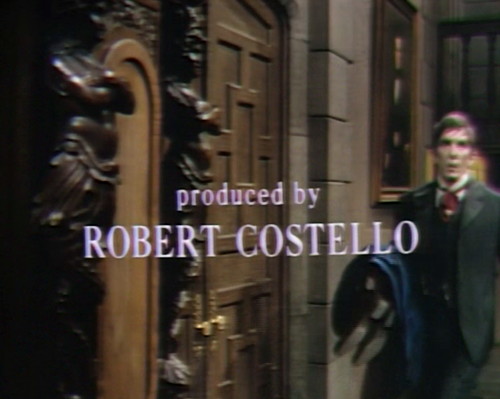
This episode ends with one of the all-time great screw-ups. A few times actors have come partly into view during the closing credits, usually just one arm briefly entering the shot. But this time Jonathan Frid comes walking right into the frame, gives a horrified reaction, and scurries off. It is a thing of beauty, enough to make you wonder how there can be people who are not fans of Dark Shadows.
A great moment in the history of television, or THE GREATEST moment in the history of television? You decide. Screenshot by Dark Shadows Every Day.
Barnabas Collins, old world gentleman extraordinaire, and Julia Hoffman, MD, are helping mysterious drifter Chris Jennings cover up the fact that he is a werewolf, responsible for a great many violent deaths. Lately Chris has started transforming into his lupine shape even on nights when the moon is not full, and this morning they find that he has not changed back even after dawn.
As if that did not present enough difficulty to Julia and Barnabas, one of Chris’ surviving victims is in town. She is his onetime fiancée, Sabrina Stuart. Two years ago, Sabrina saw Chris as the werewolf. She hasn’t told anyone about him, because she hasn’t been able to speak since. Her hair turned white, her skin turned pale, and she has been nearly catatonic.
Others have encountered the werewolf, and none has had this reaction. It’s true that Chris’ cousin Joe had to be taken to a mental hospital after he saw the transformation, but Joe had just been through a very long train of supernaturally induced traumas that had shattered his sensibilities and taken away everything he cared about. Seeing Chris change was just the last step in that process. Sabrina, as we see in a flashback segment today, was fine until she encountered Chris as the werewolf, and she didn’t even see the transformation itself. Yet here she is two years later, unspeaking, immobilized, and wearing the same makeup that Eli Wallach wore as Mr Freeze in the 1960s Batman TV show.
In a comment on Danny Horn’s post about this episode at Dark Shadows Every Day, “Cole” speculates that the show might have meant to tell us that the real reason Sabrina’s condition is less to do with what happened that on night in Chris’ apartment than with her brother and sole caretaker, Ned, played by Roger Davis:
I am once more getting through the Ned/Sabrina scenes thanks to this blog and the comments here; and although I still have to frequently avert my eyes from the screen to hold back the nausea, I keep concentrating on the dialogue while speculating further on JRM’s theory.
It does seem that we– and Julia– might be meant to feel especially concerned by Ned’s refusal to even consider allowing Sabrina to stay at Windcliff. He even says (or, rather, since it is Roger Davis, he SCREAMS), ”I won’t be separated from her!”
I don’t think his character is meant to be overly suspicious of Julia and Barnabas so the vehemence behind his already rather alarming declaration becomes more baffling unless the viewer concludes he has … extremely unnatural feelings of possessiveness towards sad, PTSD-afflicted Sabrina.
It is almost half as frustrating as it is disturbing because, with any other actors, we would surely know for certain how to interpret these scenes.
We would perhaps recognize that when Sabrina stares pleadingly at Julia once Ned leaves the room, that her muteness is caused as much by her horror at being an ongoing victim of her brother’s unspeakable abuse as by having once witnessed Chris’s transformation into a werewolf. We wouldn’t wonder, instead if the actress, Lisa Richards, is actually pleading with Hall to help her endure Davis’s deliberate act of molesting and assaulting her through out these scenes.
If it wasn’t Roger Davis in this role, we would know who Ned is really meant to be since there is no way any of the other regular male cast members would willingly subject their costars to type of abuse Davis is inflicting on Richards.
If it were … say, Jerry Lacy who was currently playing “Ned Stuart” in a manner even remotely similar to Roger Davis’s ‘interpretation’ of the role, we would recognize at once that the character of Ned is obviously scripted to be an incestuous rapist (and I am sure Lacy would still keep his hands professionally and respectfully away from Lisa Richards’s/”Sabrina’s” breasts, instead using actual acting techniques to portray his character’s warped nature). But with Davis ..
It really could be, as Mary commented below, that he is trying to get the poor actress to break character. And how could we expect other than that he would use his usual disgusting and violent Drumph-like/”‘you can grab them by the pussy” sense of Curtis-granted entitlement to assault her as “Ned,” regardless of the intent of the writer and director.
Either way, what a horrifically mistaken choice in casting.
Lisa Richards: fifty years later, I am thinking of you and hoping you weren’t forced to endure PTSD after filming these scenes with Davis.
Comment left 29 August 2021 by “Cole” on “Episode 698: Sister Act,” Dark Shadows Every Day, Danny Horn, 8 August 2015
When I mentally recast the many parts Roger Davis played on Dark Shadows, I divide them between two men who were background players in the show’s first months. I imagine Fredric Forrest playing the two characters with aliases, Peter Bradford (a.k.a. Jeff Clark) and Charles Delaware Tate (a.k.a. Harrison Monroe.) Forrest excelled both as a quietly intense man under pressure and as a sweet, goofy, overgrown kid. In the hands of an actor who, unlike Mr Davis, could project those qualities, those two unloved characters might both have become fan favorites. His other two parts, Ned Stuart and Dirk Wilkins, would have been perfect for Harvey Keitel, who is unsurpassed as a man who is agitated by a deep anger that he himself barely understands and that he certainly cannot explain to anyone else. Not that it’s any secret why Ned is angry at Chris, but when he takes a break from pawing at Sabrina’s face and breasts he handles her so roughly that he is obviously angry with her, and that is something he isn’t going to be giving any thought.
Mr Davis’ behavior wasn’t much better in episodes directed by Lela Swift and others, but it is little surprise director Henry Kaplan didn’t rein him in. Kaplan directed with a conductor’s baton, and actresses complain that he would jab them with it. When the person in charge has that light a regard for women’s personal space, it’s no wonder a creep like Mr Davis felt free to rub himself all over Ms Richards.
Dark Shadows showed its first exorcism in #400. At that point the show was a costume drama set in the 1790s. The fanatical Rev’d Mr Trask was convinced that time-traveling governess Victoria Winters was a witch and that she was hiding in the Old House on the estate of Collinwood. He stood outside that house with a forked stick. He set the points of the stick on fire and shouted commands for the forces of darkness to come out.
Vicki was indeed hiding in the house, but she was not alone there. The actual witch, the wicked Angelique, set a fire of her own. She built a house of cards and burned it to cast a spell that caused Vicki to see flames in her room and respond by running out into Trask’s clutches. What surrounded Vicki were special effects superimposed on the screen, but what was in Angelique’s room was real fire, and it flared alarmingly close to actress Lara Parker’s lovely face. You’d think they’d have learned from #191, when an on-camera fire went out of control and nearly killed the entire cast, or perhaps from #290, when an off-camera electrical mishap led to fire extinguisher noise almost drowning out some dialogue. But apparently the prevailing philosophy was no injuries, no problem, so they went right on playing with fire.
Today we have another unsuccessful exorcism, and its failure leads them to make another attempt to burn down the set. Occult expert Timothy Eliot Stokes is informed that the evil spirit of the late Quentin Collins is haunting the great house of Collinwood and taking possession of strange and troubled boy David Collins. Stokes follows Trask’s rubric of standing outside the house, pointing a forked stick at it, and shouting inhospitable remarks at the spirits, but he doesn’t set fire to the points of the stick as Trask had done. There is a lot of excitement while he is performing the ritual, and once he finishes all of it dies down. Unsure of the outcome, he arranges to stay the night; while he is getting ready for bed, the curtains in his room catch fire. These are not special effects images; the curtains are really on fire, they are burning rapidly, and they are putting out a lot of smoke. The little building at 442 West 54th Street where Dark Shadows was made was packed with sets made of plywood and crammed with props, many of them highly flammable. Several sets were draped with huge fake cobwebs; I’m not sure what those were made of, but I doubt it was anything that would make a fire marshal very happy. It’s just amazing anyone who worked on the show lived to see 1971.
There is a lot of very good stuff in this one. All of the acting is top-notch. David Henesy and Thayer David had scenes together as several characters, first as David Collins and crazed handyman Matthew Morgan in 1966, then as young Daniel Collins and much put upon indentured servant Ben Stokes when the show was a costume drama set in the 1790s, and now in 1969 as Ben’s descendant Professor Stokes and David. Those scenes all crackled, and today when Stokes catches David hiding behind the secret panel in the drawing room, demands he tells him the truth about what is happening to him, tricks him into admitting that he is afraid of Quentin, and warns him of the dangers ahead, the two make the exchange work magnificently.
There is also a scene in the drawing room between David Collins, his cousin Carolyn Collins Stoddard, and permanent houseguest Julia Hoffman while Stokes is performing the exorcism. He has to shout and writhe around a lot during this scene, very difficult things for child actors to do convincingly. But Mr Henesy had been acting professionally for four years before he joined the cast of the show in 1966, at the age of nine, and had studied acting under several distinguished teachers, among them Uta Hagen.
That background pays off; violent as the symptoms of the incipient possession are, Mr Henesy does not overplay them. It helps that he has support from Grayson Hall and Nancy Barrett; Hall plays Julia as firmly in control of herself, but obviously uneasy with the situation, while Miss Barrett shows Carolyn’s anxieties mounting until she shouts that David might be in real trouble. Since he is in convulsions and the crepuscular sound of the creaky old waltz that plays when Quentin is exercising power is emanating from the walls of the house, it would seem obvious that David is in real trouble. The line shows that Carolyn is starting to panic. When we see that neither the determinedly calm Julia nor the increasingly anxious Carolyn is having any particular influence on David’s emotions, we know that they are coming from someplace far removed from his visible surroundings.
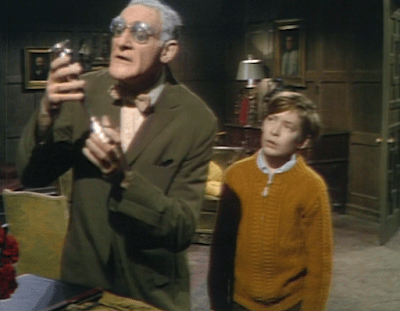
Silversmith Ezra Braithwaite comes to the great house of Collinwood, bearing a ledger with information that old world gentleman Barnabas Collins wants. Barnabas is in the study, so twelve year old boy David Collins lets Mr Braithwaite into the house and escorts him to the drawing room. The two of them play a scene that may not have looked like much on the page, but as delivered by talented comic actors Abe Vigoda and David Henesy the lines are hilarious.
For example, Mr Braithwaite has two pairs of glasses, which he describes to David as his glasses for looking at things and his glasses for looking at people. David asks if the ones he is wearing are his “thing glasses.” We laughed out loud at that whole exchange. Mr Braithwaite asks David to go get “Uncle Barnabas”; David replies “He’s my cousin,” to which Mr Braithwaite answers “Ah, yes.” Again, that wouldn’t be a hit in a joke book, but Vigoda and Mr Henesy sell it. The purest example comes when Mr Braithwaite starts to change his glasses as he turns to the pages of the ledger and says out loud to himself “Oh, Ezra, Ezra, you already got on your reading glasses.” That is a laugh line entirely because of the way Vigoda stresses the words “got” and “on.”
There is a little exchange between Ezra and David that will stand out to longtime viewers:
Ezra: David is it? Well, I don’t remember a Collins being named David before. Now, my name is Ezra, as my father was and his father before him. You find a name like Ezra and you don’t give it up.
David: I guess not.
Ezra: Yes, now, David’s kind of a new-fangled name.
David: No, there’s King David in the Bible.
Ezra: Oh, of course, yes, yes. A good man, too.
In #153, it was established that no Collins ever bore the name “David” until undead blonde fire witch Laura Murdoch Collins insisted that her husband Roger go along with her plan to name their son “David Theodore Collins.” That turned out to be hugely important as evidence of Laura’s evil intentions. In #288, it sounded like they had decided to retcon that away when David looked in a family album, saw a portrait of a “David Collins” from a previous century, and wondered aloud if he had found his namesake. Nothing has come of that potential namesake in the 79 weeks since, and Ezra’s line that he didn’t “remember a Collins being named David before” would suggest that they’ve gone back to the original idea.
Mr Braithwaite, in his thing glasses, examines a piece of silver. David examines him. Screenshot by Dark Shadows Before I Die.
Each time Mr Braithwaite looks at someone through his “thing glasses,” we get a point of view shot showing that his eyesight is blurry. They then cut back to the other actor in regular focus. These shots are brief enough that the repetition isn’t a big problem, but it results in a series of exchanges the actors deliver to the camera rather than to each other. Those don’t work at all. Mr Henesy and Abe Vigoda had such a fine comic rhythm going that it’s a shame to break it up with this clunky stuff.
Reading the ledger, Mr Braithwaite says that the silver pentagram Barnabas wants to know about was bought in April 1897 by Miss Beth Chavez and paid for by Quentin Collins. We have seen Beth’s ghost. She is very tall and so thin you could clasp your fingers around her waist. Her complexion is pale as can be, her hair blonde, her eyes blue. I’ve met a fair number of Chavezes in my time, including a couple of Elizabeth Chavezes, and none has met this description. I have nothing to say against slender blondes, and actress Terrayne Crawford is movie-star beautiful. Still, if a fellow were excited about a blind date with a girl known to him only by the name “Beth Chavez,” he’d probably be a bit disappointed if the person who showed up met her description.
We have also seen Quentin’s ghost. Quentin is manipulating David into helping him with a number of murders he intends to commit. Beth has thwarted one of these murders so far, and is trying to prevent Quentin from achieving other evil plans of his. But Quentin is apparently more powerful than she is.
While Mr Braithwaite is alone in the drawing room, Quentin enters through a secret panel. Earlier in this episode, they made it clear Quentin can choose whether he is visible to the living people in the spaces he occupies; there is no need for him to hide. Why does he use the panel?
Longtime viewers may be able to make a surmise. We saw this panel for the first time in #87, when David’s father Roger used it for a sneaky errand. We didn’t see it or hear of it again until #643, when David told nine-year old Amy Jennings that there was a passage “very few people” knew about, and used it to lead her to the room in which Quentin was at that point confined. Quentin’s use of it will therefore suggest that he knows all the secrets of the house. It also suggests that when he dwelt there as a living being he was a naughty fellow who was in the habit of using its secret passages for the sort of underhanded mischief Roger got up to in #87 and #88.
Quentin strolls up to Mr Braithwaite and smiles at him. Mr Braithwaite is wearing his “thing glasses” and cannot see Quentin clearly. He asks Quentin if he is the friend Barnabas spoke of when he asked him about the pentagram. Quentin nods. Mr Braithwaite says that he himself made the pentagram in April 1897, when he was “fifteen and a half.” It is now February 1969, so we know that Mr Braithwaite is 87. He recognizes Quentin. Shocked to see a man who has been dead for decades apparently alive, well, and in his twenties,* Mr Braithwaite dies of a heart attack.
It’s a shame we won’t be seeing more of Abe Vigoda as Mr Braithwaite. At least they spelled his name correctly in the credits this time; yesterday he was “Abe Vigodo.”
*Two days past his 28th birthday, to be exact. Happy belated 84th to David Selby!
At the estate of Collinwood, two ghosts are at odds over the fate of a werewolf. Caught in the crossfire are a mad scientist, a recovering vampire, and a couple of kids.
The ghosts are the evil Quentin Collins and a weepy woman so far known only as Beth. The werewolf is Chris Jennings, who is staying in the caretaker’s cottage on the estate. The mad scientist is Julia Hoffman, MD, a permanent guest in the great house. The recovering vampire is Julia’s inseparable friend Barnabas Collins, master of the Old House. The kids are Chris’ nine year old sister Amy and strange and troubled boy David Collins, who live in the great house.
Yesterday, Quentin went to the cottage and put strychnine in Chris’ whiskey. Beth appeared to Julia and led her and Barnabas to the cottage in time to save Chris; today, they figure out that Beth is a ghost.
Quentin has been exercising power over David and Amy, at first with Beth’s cooperation. Beth appears to Amy in a dream visitation. While she guides Amy to images of Chris and David and to the realizations that Quentin means to kill Chris and that David has tried vainly to stop him, we hear Beth speak for the first time. She says everything twice, giving her dialogue a lyrical quality that could be quite lovely. Unfortunately, Terrayne Crawford’s limitations as an actress keep that loveliness from coming through.
Barnabas and Julia know that Chris is a werewolf and have persuaded him to accept their help. They question Chris and are satisfied that he did not poison himself. When he mentions that David visited him the previous morning, Barnabas decides to go interrogate David. Longtime viewers know that David has extensive experience with ghosts, a fact of which Barnabas has at times been most uncomfortably aware. Once Barnabas has learned that Beth is a ghost, it will strike us as reasonable that he will be interested in David’s connection with the matter.
Amy goes to the cottage and sees Julia tending to Chris. They tell her he just had an upset stomach and will be fine. She does not believe them, and says she had a dream that convinced her Chris was in mortal danger. This intrigues Julia, who presses for more details about the dream. Amy clams up, but now Julia and Barnabas, the show’s two chief protagonists, have figured out that David and Amy have something to do with ghosts, and that those ghosts in turn have to do with Chris. The Haunting of Collinwood story hasn’t made any real progress for several weeks, but that can now change.
Back in the great house, Barnabas questions David about his visit to Chris. He doesn’t get any more information out of him than Julia had got out of Amy. There is a bit of intentional humor when Barnabas tells David he thought it would be pleasant to share breakfast with him and Amy. David says it isn’t so pleasant at breakfast- housekeeper Mrs Johnson is in a bad mood in the mornings. Barnabas suggests they ignore her, and David replies that it is not easy to do that. David Henesy delivers this line with perfect comic timing.
Amy shows up and responds favorably to Barnabas’ self-invitation to their breakfast. After Barnabas leaves the room, Amy confronts David about Quentin’s attempt to kill Chris. David has despaired of opposing Quentin, and is terrified when Amy tells him she will go tell matriarch Elizabeth Collins Stoddard everything that has been going on. He is convinced Quentin will kill them if she does this. He is pleading with her to come back when the episode ends.
This episode rests squarely on the shoulders of eleven year old Denise Nickerson, playing the role of nine year old Amy Jennings. A performer of any age could take pride in the results.
We first see Amy in the predawn hours of a night when a werewolf is prowling the grounds of the great estate of Collinwood. The werewolf has attacked heiress Carolyn Collins Stoddard; old world gentleman Barnabas Collins is out hunting him. In the opening sequence, Barnabas fired a shotgun at the werewolf without result, then hit him with his silver-headed cane and drove him off. Barnabas is still outside, still tracking the werewolf. Barnabas’ friend, mad scientist Julia Hoffman, is nervously pacing in the drawing room of the great house.
Amy comes downstairs. Julia sees her and demands to know why she is up and dressed at such an hour. Amy says she must go to the caretaker’s cottage on the estate, where her grownup brother Chris lives. Julia forbids her to go out. Julia saw the werewolf attack Carolyn, but says nothing about the incident. She tells Amy only that it is dangerous in the woods at night. Amy says that she had a dream from which she drew the conclusion that “Something is happening to [Chris,] and it’s happening now!” Neither Amy nor Julia knows that Chris is the werewolf, but they both know that Amy has a paranormal sensitivity to whatever is going on with Chris. Julia offers to go to the cottage if Amy will stay in the house. Amy gladly agrees, and Julia gets a gun and goes.
This quarrel could have been quite annoying. Julia is withholding vital information from Amy, who is in her turn insistent on doing something she could not possibly expect to be permitted. The actresses make it interesting. Amy stands very still, locks her eyes on Julia’s, and enunciates each word carefully, showing every sign of an earnest attempt to persuade her. When she cannot, she does not display anger or frustration or irritation. The only emotion she projects is a sense of urgency. Unlike children throwing tantrums, who make conflicting demands because they are in the grip of conflicting feelings, Nickerson leads us to believe that Amy is pursuing a single coherent objective. We expect her to be part of action that will advance the story.
Grayson Hall emphasizes Julia’s attentive response to Amy’s words and her reluctance to physically restrain her. It is still inexplicable that Julia fails to tell Amy about the attack on Carolyn and about the fact that Barnabas is walking around with a gun ready to shoot at figures moving in the darkness, but those failures don’t bother us as much as we might expect them to do. We see her taking seriously information which we know to be accurate, and this gives us grounds to hope that she will do something intelligent.
Julia gets to Chris’ cottage and back without being eaten by the werewolf or shot by Barnabas. At the cottage, she finds that the furniture has all been overturned and Chris is not in. Back home, she smiles and tells Amy that she saw Chris and he was fine. Julia’s lies convince Amy. She brightens immediately and happily goes back to bed. This really is an amazing moment of acting on Nickerson’s part; Amy’s mood switches in a second from dread and gloom to a big glowing smile. Executing that lift on command is the equivalent of faking a loud laugh and having the result sound natural.
The next morning, Amy mentions to Julia that she and Carolyn have plans to go into town. That leaves Julia no choice but to level with Amy about the werewolf attack. Amy is shocked that Carolyn was hurt, and even more shocked that she might have been killed. Julia assures her that the wounds Carolyn did suffer were minor and that she will be all right after some rest, but Amy is deeply affected. She looks directly into the camera and tells the audience that she did not want Carolyn to be harmed.
In the first months of Dark Shadows, strange and troubled boy David Collins was the only character who looked directly into the camera. He did it several times in those days, and actor David Henesy’s talent for the role of Creepy Little Kid always made it pay dividends. He stopped looking into the camera in the autumn of 1966 when David Collins stopped being a menace, and various other actors have been called on to break the fourth wall from time to time since. Since Amy joined the show, eye contact with the audience has become her province, and Nickerson manages to deliver a jolt every time they have her do it.
First-time viewers won’t know why Amy is so eager for us to know that she did not wish Carolyn ill, but the way she addresses herself to us leaves no doubt that Julia is missing the point when she makes conventional remarks about how no one wanted anything bad to happen to Carolyn, no one could have prevented it, etc etc. The camera stays on Amy as Julia burbles through these lines, and the particular sadness on her face confirms what she indicated by looking at us, that she knows more about the incident that Julia imagines.
Returning viewers know that Amy and David are falling under the power of the evil spirit of the late Quentin Collins, and that Quentin ordered them to send Carolyn out the night before so that she would no longer obstruct his plans. We also know that Quentin, who had for many weeks been confined to the little room in the long-deserted west wing of Collinwood where David and Amy first saw him several weeks ago, was the other day able to manifest himself in Chris’ cottage. He is gaining strength, and Amy and Chris’ presence on the estate is part of the reason.
Amy talks Julia into letting her go outside. Again, this could be an annoying scene. As Julia points out, the animal that attacked Carolyn has not been captured, and Barnabas has not returned. Further, regular viewers know that Amy’s promise to stay within sight of the front door is worthless, since she and David have often broken similar promises. But Julia knows that Amy has an extraordinary awareness of the situation, and she knows also that in #639 the werewolf ran away when he saw Amy. So all Grayson Hall has to do is look at Amy with a searching gaze and talk to her in a hushed voice, and we get the idea that she has come to the conclusion that the child will be able to take care of herself.
Amy wanders deep into the woods, and comes to a spot where we earlier saw the werewolf transform back into Chris. When that happened, the camera caught the hem of a white dress and panned up to show the face of the woman wearing it. At first it was a puzzle who that might be. Wicked witch Angelique often wore white dresses, but she is not connected to the ongoing stories, and the last time we saw her she was killed in a way that suggests she won’t come back to life at least until this thirteen week cycle is over. The ghost of the gracious Josette was known in the first year of the show as “the woman in white,” but we saw her quite recently, and she doesn’t have anything to do with Chris and Amy.
The figure turned out to be the ghost of someone named Beth. We have seen her only once before, in #646. She was with Quentin, and like him could exist only in a little room in the long-deserted west wing of the great house. But now she, too, is able to roam about the estate. When Amy comes to the spot where Chris transformed, Beth appears to her. She begins crying. Amy sounds like any other sweet little girl when she urges Beth not to cry, and then suddenly becomes quite a different person. Her face goes blank, and she declares in a flat voice that she knows what she must do. This isn’t such a tricky transition as the one Nickerson achieved when Amy cheered up in response to Julia’s lie, but it certainly is effective.
Amy goes to Chris’ cottage. He is out. She finds his bloodstained shirt, puts it in the fireplace, and sets it alight. Chris comes in and sees her. She embraces him, and tells him she must be going. He asks why, and she seems genuinely surprised by the question. “Can’t you hear her?” Chris says he can’t, Amy says she can, and she hurries away.
Chris looks at the fireplace. One sleeve of his shirt is hanging out, a fire hazard; he puts it into the center of the hearth. He examines it, and with dismay exclaims “My shirt!” Don Briscoe delivers that line with the timing and inflection of Jack Benny, and it is hilarious. Mrs Acilius and I laughed long and loud at it; we are convinced that the humor must have been intentional, at least on the part of actor Don Briscoe, probably on that of director Lela Swift, and possibly on that of writer Ron Sproat as well. The episode belongs to Nickerson, but that final line leaves us with a strong memory and a deep fondness for Briscoe as well.
Time-traveling fussbudget Barnabas Collins has completed the task he set for himself when he went to the year 1796, and has to find a way to return to 1969. He decides to deliberately subject himself to the process by which he was originally transferred from the 1790s to the 1960s. He is, at the moment, a vampire. He orders his servant Ben to chain him in a coffin hidden in the secret room in the back of the Collins family mausoleum, and hopes that he will be released from it in a period when he is human again.
On a sunny morning in 1969, Barnabas’ former blood thrall Willie and his best friend Julia have figured out his plan and gone to the secret room. Julia is a medical doctor; she is at once the best physician in the world, capable of assembling a human body from dead parts, bringing it to life, and thereby lifting the effects of the vampire curse from Barnabas, but simultaneously very unsteady on the question of whether any given patient she is examining is alive or dead. For example, matriarch Liz is entombed at the moment because Julia mistakenly declared her dead twice in a couple of months. Once he has opened the coffin, Willie demands Julia examine Barnabas’ body and tell him whether he is alive, and therefore human, or dead, and therefore condemned to rise at nightfall and prey upon the living. Before she can answer Willie’s question, Julia has to spend quite a bit of time going over Barnabas with a stethoscope, during which time we see his eyelids flutter and his chest move.
While Julia is trying to determine Barnabas if is alive, he sits up and starts talking. Julia and Willie urge him to lie back down, apparently concerned that if he is too active Julia won’t be able to arrive at a clear result. After a break, we see him out of the coffin, telling them about his experience in 1796. After quite a bit of back and forth, they arrive at the collective decision to continue the conversation back home, in the Old House on the great estate of Collinwood.
Barnabas, Julia, and Willie have emerged from the secret room into the publicly known part of the mausoleum and are starting to close the panel behind them when they hear the voices of people approaching. One might expect them to finish closing the panel and to greet whoever is coming as fellow pilgrims paying homage at the graves of Joshua and Naomi Collins and their daughter Sarah. After all, everyone knows that Barnabas is a direct descendant of Joshua and Naomi, that Julia has a lively interest in the past of the Collins family, and that Willie is Barnabas’ servant. They have as much right to be there as anyone.
Instead, they scurry back into the secret room and shut themselves in. They are a bit too slow. Entering are heiress Carolyn and child Amy. Amy sees the panel swinging shut. Carolyn, behind her, did not see this happen, and dismisses Amy’s claim that she did. They tap on the panel, and Amy decides that it is so solid that she may have been mistaken. The mausoleum is so dim that one can imagine a trick of the light causing a person to believe that the wall had moved, so this reaction of hers is plausible enough.
Dimness is not an exclusive property of the outer part of the mausoleum. The trio hiding in the secret panel embody dimness as they do an outstanding imitation of the Three Stooges. Willie is Larry, the universal victim; Julia is Moe, the self-appointed leader who is as lost as either of the followers; and Barnabas is Curly, the chaos agent. Willie left his bag of tools perched precariously on the steps immediately behind the panel; after Amy and Carolyn tap, the bag falls and makes a sound. Julia does not address Willie as “ya porky-pine!” and poke him in both eyes, but it would fit with the flow of the action if she did.
Carolyn and Amy both hear the sound. They puzzle over it. Carolyn suggests that the wind must be blowing a limb from a nearby tree against the outer wall. Amy can’t think of anything else it could be, and accepts the suggestion. They leave, having placed flowers on the sarcophagi.
The flowers are themselves interesting to longtime viewers. Early in the episode, we saw Carolyn arranging them on the writing table in the drawing room of the great house of Collinwood. The last time we saw someone handling flowers over that table was in #346. Barnabas grabbed those flowers out of Julia’s hand. In those days he was still a vampire, and they were enemies. After a few seconds in his grip, the flowers died. When Julia and well-meaning governess Vicki saw this, Barnabas looked embarrassed, for all the world as if he had broken wind. The analogy tends to raise a laugh, but it is apt- when he was a vampire, it was a natural function of Barnabas’ body to do things like that, and he would be expected to control that function so that others would not be aware of it. So when they show us flowers on this spot, they are telling us we ought to be in suspense as to whether Barnabas will be a vampire again.
Carolyn and Amy go back to the great house, where strange and troubled boy David is sulking. Again, longtime viewers might find this suspenseful. David found his way into the secret room in #311 and in #334 tried to show it to some adults. Barnabas had locked the panel, so they disbelieved him. If Amy tells David what she saw, he may well put two and two together and revive the stories that were in progress in those days.
But Amy doesn’t breathe a word of it, and David isn’t interested. He is preoccupied with the evil spirit of the evil Quentin Collins, who is gradually and evilly taking possession of him and Amy and, evil as he is, driving them to do something or other that has not yet been explained, but which will undoubtedly turn out to be evil. Quentin is still confined to a small room hidden in the long-deserted west wing of the house, and can only take full control of one child at a time. Today it is David who is acting as his agent; Amy flatly refuses when David tells her that Quentin wants them to “play the game.” In response, he twists her arm. Carolyn walks in on that act of violence, and orders David to go to his room and stay there for the rest of the day.
Amy speaks up for David and even asks to go to his room with him, but Carolyn stands her ground. She does leave the children alone together while she goes to tell housekeeper Mrs Johnson to take David’s meals to him on a tray.
David fumes and tells Amy that it is her fault that they won’t be able to “play the game” today. He is declaring his intention to “get even with Carolyn!” when Barnabas appears in the doorway.
Evidently David’s declaration did not bother Barnabas, because his only response is “Why so serious?” Barnabas has been pushing a plan to send David and Amy to boarding schools in Boston. Under Quentin’s influence, they have tried to thwart this plan by pretending to be all for it but secretly hanging clothes in the wrong closets. This apparently foolproof method has somehow failed, so they resort to another expedient. They tell Barnabas they would rather not go. He says that’s fine with him, and drops the whole thing.
Alone in his room, David looks angry. He throws a book to the floor. Carolyn comes in, and David tells her that he is sorry and she is right to punish him. She sees immediately that he is lying, and tells him so. The resulting brief scene is far and away the best of the episode.
Later, Amy slips in, and finds David sitting in a chair in a dark corner. In their post about the episode on Dark Shadows Before I Die, John and Christine Scoleri point out that the effect of this shot of David is a bit different on an audience now than it would have been before 1972, since it makes David look very much like Don Vito Corleone in the opening scene of The Godfather.
David is still furious about the whole situation. He tells Amy that they will “play the game” after all, and that Carolyn will play with them. The ominous music on the soundtrack is enough to tell us that this means they will try to kill Carolyn.
This episode shows something about the importance of directors in television drama. Actor Joel Crothers appeared on Dark Shadows for the last time yesterday; in an interview he gave to a fan magazine shortly after leaving the show, he complained that the directors had become so busy managing the special effects and practical effects that they didn’t have time to work with actors. Furthermore, the show never had more than three writers on staff, so scripts were sometimes delivered too close to taping for the actors to do much rehearsal on their own.
Today, each actor finds a note and sticks with it, but few performances mesh with each other sufficiently to seem to be part of the same scene. Denise Nickerson is calm and relaxed even when Amy’s arm is being twisted, David Henesy is angry and confrontational even when Barnabas is falling for David’s pretense that everything is normal, and Nancy Barrett is stern and impatient even when Carolyn is taking Amy’s claim to have seen the panel move seriously. Each of these performances is good, and Mr Henesy stands out when he gets to play “creepy.” But clearly no one gave them an idea of what they should work together to get across to the audience.
Aside from the scene where Carolyn sees that David is lying, there are just two exceptions, and they don’t really help. Committed fans may find it endearing to see the preposterous threesome hiding in the secret room of the mausoleum, but first-time viewers are likely to be put off by that scene of low comedy in the midst of an otherwise heavy and somber melodrama. Jonathan Frid is warm and inviting with the children, which does make sense when Barnabas is talking with the relaxed Amy, but their two-scene about whether he will ask Carolyn to let David out of his room is such a low stakes affair that unexcited actors cannot hope to hold our attention.
The director today was executive producer Dan Curtis. Curtis was a titanic personality and would later direct many TV movies and some features, but he seems never to have directed as much as a school play when he first took the helm of Dark Shadows for a week in 1968. This stretch of episodes marks his second time in the director’s chair. His extreme inexperience as a director of actors may well explain why the cast does not come together more cohesively.
The whole episode takes place within the great house of Collinwood. We start with conversations between heiress Carolyn Collins Stoddard, mysterious drifter Chris Jennings, and sarcastic dandy Roger Collins. They are trying to determine the significance of the events of a séance that took place yesterday, during which Carolyn was possessed by the spirit of someone named “Magda.” This name is unknown to anyone in the house.
Through Carolyn, Magda uttered a command to “Stop them!” because “My curse!” means that “He must stay where he is!” Returning viewers know that Chris’ little sister Amy and Roger’s young son David are in touch with the ghost of Quentin Collins, a great-uncle of Roger’s who lived in the late nineteenth century and whom the family history falsely records as having gone to France and died there. We can assume that Magda was a contemporary of Quentin’s, that he is the one who must remain where he is, and that she means the children when she says “Stop them!” But none of the adult characters knows what Amy and David are up to, and Magda’s words mystify them.
Roger is alone in the drawing room while Carolyn is showing Chris out of the house. He is about to take care of some work he brought home from the office when a book flies off the piano and lands on the floor. He finds a letter tucked in the book. Carolyn comes back, and he tells her what happened. He says that the letter is addressed to his father, Jamison Collins; this is the first time we have heard Jamison’s name. He says that it is dated 1887, when Jamison would have been a boy. And he tells her that it is signed “Quentin.” With a look of recognition, he says “We have a Quentin Collins as an ancestor. Actually, I didn’t know very much about him. I think he spent most of his time abroad.”
Roger reads the letter to her. The text is: “Dear Jamison, you must return to Collinwood. I need your help. You must intercede with Oscar. Only you can save me.” Considering how the book spontaneously leapt from the piano, Carolyn is sure that Magda’s ghost must have wanted them to read the letter, and that she is trying to warn them that someone in the house is in danger. It calls Quentin to their attention.
Roger goes upstairs to check on David. As it happens, Amy is in David’s room at the time, and they are about to go looking for Quentin’s ghost. They know that the adults will not tolerate this, and so David jumps into bed and Amy hides behind the door. There is some farcical business as Roger starts to go, Amy starts to come out, then he stops and she scurries back to her hiding place. Once his father is gone, David tells Amy that it was very unusual for him to drop in. “He never says good night to me.”
When Roger returns to the drawing room, Carolyn, who a few minutes ago announced that someone in the house- “It could be any one of us!”- was in imminent danger, asked Roger why he was “suddenly so concerned about David.” Even longtime viewers who remember Roger as the phenomenally bad father he was in the first 38 weeks of the show will think that this is overdoing it. After all, Magda’s warning to him and Carolyn came in the form of a letter addressed to a boy, and David is the only boy in the house. It is natural enough that the reference to Jamison would bring David to mind.
Amy had slipped into David’s room while he was sleeping. She woke him to say that Quentin was angry because “Something has happened.” She knows nothing about the séance or the conversations going on downstairs, and so cannot share our conjecture that Magda is an old enemy of Quentin’s and it is her activities that are disturbing him. David is at first reluctant to get up and irritated when Amy wants to contact Quentin. As he grumbles at her, they begin to sound like an old married couple, even though they only met on Monday and are eleven years old.
David grudgingly agrees to pick up the antique telephone through which he has heard Quentin’s breath and Amy has heard him speak. The breath is audible, and when he gives the receiver to Amy she hears Quentin says that “she would try to stop” them. He didn’t specify who “she” was, but Amy has drawn the conclusion that they should go to the room in the long deserted west wing of the house where they originally found the telephone and contacted Quentin. Every time David resists her ideas, Amy strikes exactly the note that will lead him to do what she wants. At one point, Amy tells David “You’re braaver than I am!” to which he bluffly replies “Because you’re a girl!” He then presses forward with the plan she had formulated.
The children find that the door they had previously used to get into the west wing is now locked. David says that there is another way in, but that it is a secret very few people know about. He leads her to the door of the drawing room, only to find that Roger and Carolyn are still in there. They hide. Once the coast is clear, David leads Amy to a secret panel behind a chair next to the fireplace. We have seen this panel before, in #87. On that occasion, Roger had used it to sneak into the west wing unobserved and release well-meaning governess Vicki from the room to which David had confined her, hoping that she would die. It was unclear whether anyone other than Roger knew of its existence. We haven’t seen it since. Dark Shadows‘ ratings were very low in October 1966, and most of the people watching now hadn’t heard of it then. So when David says that very few people know about the secret panel in the drawing room, his words apply to the audience as well as to the characters.
David opens the panel. He and Amy go into the passage. When the panel is closed behind them, we see the chair move itself back into place in front of it, suggesting an occult power is at work.
David and Amy encounter various signs of supernatural opposition as they make their way to the room. At one point Amy sounds genuinely frightened and suggests turning back, but she has done her work too well- David is now determined to prove his courage. Once they are in the room, the door slams shut and they find that they are trapped. Longtime viewers who remember what David did to Vicki way back when will see an irony in his captivity in the west wing.
Skillful as Amy is in her management of David Collins, Denise Nickerson and David Henesy haven’t quite figured out how to work together yet. They had very different styles of acting, his coming from inside out as he uses his lines and stage directions to project the character’s feelings and intentions, hers coming from outside in as she throws herself into whatever the character is doing at the moment and finding her inner life through those. She is on top of her form right from the start, but he keeps getting thrown off, atypically mangling his dialogue several times and putting the emphasis in odd places in the lines he does get right. That won’t last long- soon David and Amy will be a “supercouple,” as fun to watch together as any other pairing on the show. But this episode is a bad day at the office for Mr Henesy.
Danny Horn’s post about this episode on his Dark Shadows Every Day takes the bits and pieces of information that will fit well with continuity months down the line, contrasts them with the bits and pieces that won’t, and focuses on a case that the writers didn’t have any plan in mind when they were writing the show. I think Danny simultaneously goes too far and not far enough with this point.
In a 1991 interview that Danny himself put online, writer Violet Welles confirmed that the writing on Dark Shadows, as on other soaps, began with a six month story projection that the writers would break down into “flimsies,” day by day outlines of how it might all play out. No one was going to force them to stick with those projections, much less with the flimsies, but creating them meant that the writers spent a lot of time kicking ideas around for possible plots and possible characters. They also meant that there were stacks of paper recording those ideas, so if someone suggests in November that Quentin might have been enemies with a witch named Magda, it won’t require a feat of memory to recall that suggestion in January. So it is going too far to dismiss all thought of a connection between what the characters say today and what we will see next year.
But he doesn’t go far enough when he suggests that the pressure the writers were under to crank out five scripts a week would have kept them from planning for events we wouldn’t see for several more months. They were indeed subject to impossible deadlines, and they did indeed have to improvise at the last minute. So much so that they did not know whether any given event would happen next week, next month, six months from now, or not at all. They may well have planned a story out in detail thinking they might need it soon, only to have it sit on the shelf until next summer.
I always try to write these commentaries as if I hadn’t seen any of the subsequent episodes, so when I mention foreshadowing I try not to say whether or how it will pay off. I also try to write from a perspective that would have been more or less possible for someone watching the show when it was originally broadcast, so when foreshadowing does pay off or when in other ways an episode echoes something we had seen earlier I try to note that echo first and to speculate about what it might mean later, confining any references to information that became public afterward to the bottom of the post. So I won’t quote the particulars of Danny’s argument, or of my comment on it. I hesitated to say as much as I have about Magda, but when I tried to make the same point without using names the results looked like algebra (“Let x be a ghost and y be a witch. Suppose that x and y lived in the same period; call this period P.”) Since the episode leans so heavily into the relationship between Magda and Quentin today, I resigned myself to the spoiler.
The only story that consistently worked in the first year of Dark Shadows was well-meaning governess Victoria Winters’ quest to befriend her charge, strange and troubled boy David Collins. In #191, David’s mother, blonde fire witch Laura Murdoch Collins, was trying to immolate him and herself. At the climactic moment, David ran from the flames into Vicki’s arms. When David chose Vicki and life over Laura and death, their story was concluded, and Dark Shadows 1.0 came to an end.
Vampire Barnabas Collins would first appear on Dark Shadows in #211 and quickly become its main source of interest. The show never made up its mind how Vicki would relate to Barnabas’ story. The obvious move would have been to follow Bram Stoker’s Dracula and make Vicki the vampire’s first victim, rising from the dead like Lucy Westenra as “The Bloofer Lady,” a friend to children in life who in her undead afterlife feeds on the blood of children. In that case, Vicki would be destroyed as she was about to kill David. But Vicki had been an effective protagonist throughout the Laura story, which was itself in large part an adaptation of Dracula, and if as seemed likely the show was going to be cancelled with #265 they would have wanted Vicki to stake Barnabas at the end of that episode. So she was spared his bite, and instead he turned his fell gaze upon Maggie Evans, The Nicest Girl in Town.
With Vicki walled off from the vampire story, David’s contact with it was initially limited to the inconvenience he could make for Barnabas by sneaking into his house during the day. When Barnabas was keeping Maggie in his basement, a new character was introduced who would meet David and relate to him in a way that would bring him to the center of Barnabas’ concerns. This was the ghost of Barnabas’ little sister Sarah, a girl about David’s age.
David Henesy had been the only child actor on Dark Shadows until Sharon Smyth joined the cast as Sarah in #255. Miss Smyth had very little of the training and experience Mr Henesy brought to the show, but playing a ghost she didn’t really need them. Our main reaction to Sarah is puzzlement, puzzlement as to what she wants, what she can do, and whether she knows anything at all about herself and the world she finds herself in. Miss Smyth was just as puzzled as the audience about all of these questions, and that works to her advantage. In Sarah’s scenes with David Collins, Sharon Smyth’s feelings about David Henesy- a precocious crush mixed with fear of his propensity for playing rather nasty practical jokes on her- added a touch of urgency without erasing any of the character’s mystery. At the same time, Mr Henesy’s acting skills made it possible for us to believe that David Collins had gone a tremendously long time without catching on that Sarah was a ghost. Once David Collins finally did figure it out, David Henesy made the most both of scenes where he coolly presented skeptical adults with irrefutable evidence of Sarah’s true nature and of scenes where he became overwrought at his inability to convince them of the truth.
Sarah’s ghost hasn’t appeared since #364. A couple of weeks ago Alexandra Moltke Isles left the show and the part of Vicki was recast; Mr Henesy hasn’t shared a scene with the new actress, but he had barely shared a scene with Mrs Isles for a year. Throughout 1968, his appearances on the show have been few and far between. Today, for example, he makes his first appearance since #609, which was in turn only his second appearance since #541. That changes when he meets a new co-star who will change the trajectory of his character and of the show.
Amy Jennings is played by Denise Nickerson, whose preparation was fully equal to Mr Henesy’s. Her style was quite different from his- while he, like Mrs Isles, tended to play his characters from the inside out, figuring out what is in their minds and then using the dialogue and action to project that understanding, she tended to start with the action and find the character in the middle of it. Today she shows up on the grounds of the estate of Collinwood just as David’s aunt, matriarch Elizabeth Collins Stoddard, comes face to face with a werewolf. The werewolf was about to attack Liz, but he runs off at the sight of Amy. Liz takes her unlikely rescuer home with her to the great house on the estate.
There, Amy meets permanent houseguest Julia Hoffman, MD. Julia is the nominal head of Windcliff, a sanitarium from which Amy recently escaped. Liz describes the encounter with the werewolf, and Amy explains that she is looking for her brother Chris. Returning viewers know that Chris is the werewolf, but none of the characters knows this yet. The adults are mystified by Chris’ wandering ways and his refusal to take responsibility for his little sister, while Amy is convinced that he is ready to give that up and settle with her in the village of Collinsport.
Julia wants to ship Amy back to Windcliff at once, but Liz talks her into letting Amy stay the night. David strolls in; he meets Amy, and Liz sends the two of them to get housekeeper Mrs Johnson.
We see David and Amy looking out the window of a guest room during a storm. David is disappointed to hear that Amy won’t be staying through the next day, and talks about what they will do the next time she visits. He asks if the thunder and lightning frightens her, she says no, “It can’t hurt you.” To this he replies, “Sure can! Lightning can strike you dead.” After a brief pause, he adds “Well, if you’re not afraid, I guess you don’t need me.” That sequence of lines is so funny the humor must have been intentional.
Amy asks David to stay. They sit on the floor in front of the fireplace in her room, and at her suggestion they decide to explore the long-deserted west wing of the house. They go straight to a room in which they find an antique telephone. They decide to play a game in which they pretend to talk to the ghosts of the people who used to live in the house using the telephone. Amy actually gets through to one of them. David thinks she’s kidding him, and takes the phone. To his amazement, he hears breathing on the other end, even though the telephone’s line is cut.
David only heard the breathing, no words. Amy tells him that the voice identified itself as that of Quentin Collins. David, whose avid interest in Collins family history made it logical that he, in #205, would be the first character to mention the name “Barnabas Collins,” says he has never heard of Quentin.
Later, they return to Amy’s room and find Quentin’s picture in a family album. Liz comes in, and when David asks her about Quentin she tells him that he was her great-uncle, that he left for Europe when he was young, and that he died in Paris. Regular viewers will remember that when Barnabas became a vampire, the Collinses put about the story that he had gone to London, and when he came back in 1967 he introduced himself to Liz as a cousin from England. Thus the show suggests that Quentin may be its next attempt to match Barnabas’ breakout success.
Amy has taken the telephone to her room, and at the end of the episode she talks to Quentin again. He beckons her to return to the room in the west wing, and she goes. If Quentin is indeed going to succeed Barnabas as Dark Shadows‘ great supernatural menace, evidently it is Amy who is in danger of becoming his first victim.
In #636, occult expert Timothy Eliot Stokes remarked that he had never heard of a ghost communicating by telephone. During this period, the show was going through a lot of last minute rewrites; the Dark Shadows wiki reports on several flimsies and drafts that were cast aside and replaced with new scripts. So I can imagine that Stokes’ line may have inspired the idea of using the telephone to introduce Quentin, though perhaps it is likelier that they already had the prop and Stokes’ line was a private joke among the writers.
Well-meaning governess Vicki ran out of story in #191, and has been at the fringes of the show ever since. Since March, Vicki has been stuck in a relationship with an unpleasant man named Peter who preferred to be called Jeff.
As long as Alexandra Moltke Isles played Vicki, longtime viewers could hold onto some sliver of hope that she would eventually reconnect with an interesting plotline. Mrs Isles’ last episode was #627, and the part was taken over by Betsy Durkin, who stresses random words in her lines (such as, “Jeff, you’ve got to stop thinking about the past!,”) keeps looking at her scene partners with her face still for a few seconds too long after delivering her lines, and moves about awkwardly, as if she were afraid of tripping over her costume. For his part, Peter/ Jeff is played by Roger Davis, a highly trained actor who doesn’t do any of those things, but who routinely assaults actresses on camera and who clenches his rectal sphincters whenever he raises his voice, causing him to sound like he is struggling with constipation. Miss Durkin and Mr Davis are a difficult pair to watch, and since there is no reason in the story for either fake Vicki or Peter/ Jeff to be on the show their scenes are an unwelcome intrusion.
Today, fake Vicki and Peter/ Jeff get married. The morning after their wedding, he fades into nothingness while she watches, which considering his personality is the best case scenario for her.
We spend the middle of the episode with recovering vampire Barnabas and mad scientist Julia, who unlike fake Vicki and Peter/ Jeff are actually characters on Dark Shadows. Barnabas and Julia enter the great house of Collinwood. They have been at pains to keep the residents of the great house from finding out about any of the supernatural doings, yet when they walk in the front door they blab about everything in nice loud voices.
Matriarch Liz comes in and tells Barnabas and Julia that Vicki has married Peter/ Jeff. Once Liz leaves, Barnabas, stunned and dejected, moans “Julia, why did she do it? Why did Vicki marry him?” Barnabas has often claimed to be in love with Vicki, but in fact takes remarkably little interest in her, so it is no surprise that less than a minute goes by before he shrugs the whole thing off with “I’ll accept it and pray that she’ll be happy with it.”
Julia reacts to Barnabas’ reaction to the news of Vicki’s wedding. Screenshot by Dark Shadows Before I Die.
Barnabas and Julia go off to drive a stake through the heart of witch-turned-vampire Angelique. It’s a rule on Dark Shadows that a wedding scene leads to the exposure of an empty coffin, so it will be no surprise to longtime viewers that when Barnabas and Julia open Angelique’s coffin they find she isn’t in today. Barnabas fears that she has changed in some way that will make her even more dangerous when she eventually returns.
Angelique and Peter/ Jeff were the last loose ends left over from the big collection of storylines introduced in the spring of 1968; her absence and his vanishing wrap up the Monster Mash period that constituted Dark Shadows 4.0. The only indication we have had so far as to what version 5.0 will turn out to be was a scene in #632 between werewolf Tom Jennings and his sister Amy. It remains to be seen how the Jenningses will connect with the Collinses and what other characters will join them.





 Dark Shadows Commentary