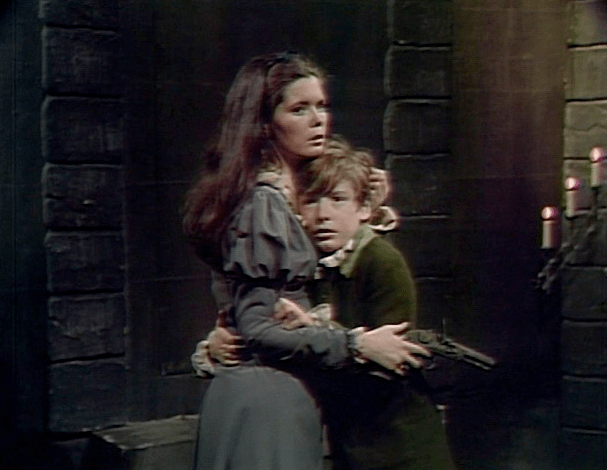
In the Old House on the great estate of Collinwood, vampire Barnabas Collins frets that his sorely bedraggled blood thrall, Willie Loomis, is failing to die. A couple of weeks ago, the police shot Willie and jumped to the conclusion that he was responsible for the abduction of Maggie Evans, The Nicest Girl in Town, among many other crimes that Barnabas actually committed. He’s been in a coma ever since, and if he dies, Barnabas will be off the hook.
Barnabas tells his co-conspirator, mad scientist Julia Hoffman, that he will go to the hospital and murder Willie. Her assurances that Willie will soon die of natural causes don’t stop Barnabas, but her news that the sheriff is on his way to the house does. Barnabas then orders her to go to the hospital and carry out the murder, but she refuses.
Meanwhile, Sheriff George Patterson, addled quack Dr Dave Woodard, and Maggie’s father Sam are hanging around Willie’s hospital room recapping the story so far. The sheriff wonders where Willie could have kept Maggie during the weeks she was held prisoner. Willie lives in Barnabas’ house and does not appear to have access to any other building. You might think this would be grounds for suspecting Barnabas of involvement, but no such thought crosses the minds of any of the three luminaries keeping Willie company. They just take it for granted that no crime could have taken place in Barnabas’ house.
George, Dave, and Sam, or their intellectual equivalents.
Back in the Old House, Barnabas has had an inspiration. He took a ring from Maggie in #253, and today he hides it in a candlestick in Willie’s bedroom. When the sheriff and Sam come to search that room (but no other part of the house,) Barnabas watches until they’ve given up, then knocks the candlestick over and exclaims in a ridiculously fake voice “Look! A ring!” Sam recognizes it as Maggie’s, and he and the sheriff are convinced it is conclusive evidence of Willie’s guilt.
For her part, Julia has made her way to Willie’s hospital room. She is there with Woodard when Willie shows signs of regaining consciousness. Woodard rushes out to tell the deputy to get the sheriff, and leaves Julia alone with Willie. She looks at Willie’s IV and remembers Barnabas urging her to kill him.
The sheriff and Sam are leaving Barnabas’ house with the ring when the deputy comes to the front door. He announces that Willie is coming to and is likely to start talking at any moment. We end with a closeup of a horrified Barnabas.
During the opening titles, announcer Bob Lloyd tells us that the part of Sheriff Patterson will be played by Vince O’Brien. This week’s episodes were shot out of broadcast sequence, so we will see Dana Elcar as Patterson one more time. O’Brien was on the show four times in January and February of 1967 as the second actor to play Lieutenant Dan Riley of the Maine State Police, an officer attached to an investigation concerning undead fire witch Laura Murdoch Collins. Patterson isn’t much of a character, and even an actor as distinguished as Elcar had trouble making him interesting. If we remember O’Brien from his time as Dan Riley Number Two, we know that he was a competent professional, but we won’t have much hope that he will outdo Dana Elcar.
O’Brien does show beyond all doubt that he belongs on Dark Shadows, though. While the closing credits are rolling, he strolls onto the set behind technical director J. J. Lupatkin’s name.
Maggie Evans, The Nicest Girl in Town, suffered from a mysterious illness beginning in episode #227; she was missing and feared dead beginning in #235; her father Sam found her on the beach in a state of complete mental and physical collapse in #260; she was confined to a sanitarium run by mad scientist Julia Hoffman until the permanently nine year old ghost of Sarah Collins helped her escape in #294; and in #295, Julia hypnotized her and induced a profound amnesia covering all of these events.
The author of Maggie’s woes is vampire Barnabas Collins, currently resident in the Old House on the great estate of Collinwood. Julia has come to Collinwood disguised as an historian studying the old families of New England. Her true goal is to cure Barnabas of vampirism. In the course of that project, she has time and again shown an extraordinary callousness towards Maggie. She keeps trying to dissuade Barnabas from killing Maggie, but whenever it looks like he might do it anyway she exclaims that he will ruin all her work.
Today, Barnabas has heard that Maggie’s amnesia is lifting, and he has resolved to go through with the murder. He opens the door of his house to depart for his fell mission, only to see Julia standing before him.
Julia tells Barnabas he will ensure his own destruction if he kills Maggie. Barnabas says that he won’t be caught, and Julia laughingly agrees that he could easily get away with the crime. But she claims to have left a letter with a friend that will be opened and sent to the authorities in case either she or Maggie dies. Barnabas acquiesces in Julia’s insistence that he let Maggie live unless her memory does come back. Yesterday, she thought that she had persuaded Barnabas and was so impressed with herself that his sorely bedraggled blood thrall Willie could barely get through to her that he was setting out to kill Maggie. When Barnabas tells her that she has again gained “the upper hand” at the end of this scene, she flashes another look of self-satisfaction.
Julia leaves the Old House for the great house on the same estate, where she is the guest of the living members of the Collins family. There, Willie is waiting for her on the terrace. She tells him of her success at deceiving Barnabas, relishing the details and exulting when she tells him that Barnabas was frightened when she told him about the letter.
Willie is unconvinced that Barnabas really believed Julia, and in a lengthy interior monologue debates with himself about what he can and will do. He grows more and more miserable as he contemplates the prospect that he will continue to serve Barnabas while he kills everyone around him.
Barnabas has his own long interior monologues. He ruminates on Julia’s story about the letter and is sure that she would not expose him and give up her project simply because he had murdered Maggie. He does think that she might have taken some sort of precaution to protect her own life, but remembers that Julia said nothing about a letter on the previous occasions when he threatened to kill her. He concludes that she was lying, and sets out to complete his task. Before he can leave the house, “London Bridge” plays on the soundtrack, indicating that Sarah is present. In life, Sarah was Barnabas’ beloved baby sister, and he is desperate to see her again. He transforms instantly from a remorseless murder machine to a lonely man pleading for his dear little one to come to him.
Unknown to Barnabas, Julia, or Willie, the story that Maggie’s amnesia is lifting is false. Her friends have spread it to bait a trap. They hope that her abductor will hear it, panic, come to the Evans cottage, attract the attention of the many police officers hiding on the lawn, and then… it gets kind of fuzzy what they hope will happen at that point, but it is supposed to end the threat to Maggie.
Maggie’s boyfriend Joe shows up today with an antique doll. He says that before he came within twenty feet of the front door he was surrounded by police. Sam happily says that they would have shot Joe if he hadn’t come out of the house to vouch for him. Having told Maggie that the police are so trigger-happy that they will shoot anyone approaching the front door, Sam urges her to go to sleep. Apparently that is the sort of news that is supposed to bring sweet dreams.
We see two policemen on the lawn. They see a figure approaching the house. He is creeping in the darkness, not going towards the front door as Joe had done, nor is he carrying an antique doll. So they wait to see where he’s heading.
The figure retreats from the windows, complying with that command. Evidently the reason they wanted him to stop was that they weren’t sure they could hit a moving target, because as soon as he does they open fire. A policeman comes into Maggie’s room and tells her she doesn’t have to worry any more, because they shot the man in the back at least five times.
So now we know what the plan was. Wait until someone wanders onto the Evans property, shoot him, and declare him to be the man who abducted Maggie. Case closed!
The episode leaves us in suspense as to who the police shot. Barnabas is presumably still at home pining for Sarah. The figure at the window didn’t look like Julia, and the policeman who enters refers to the victim as “he.” Joe and Sam are in the room with Maggie, and the police probably would have noticed if they’d shot one of their own men. So the only character who appears in the episode and is not accounted for is Willie. He wanted to warn Maggie, but thought he would be unable to do so. Perhaps he overcame Barnabas’ power and tried to go to her, or perhaps we will learn tomorrow that the man who has been shot is some other luckless schlub.
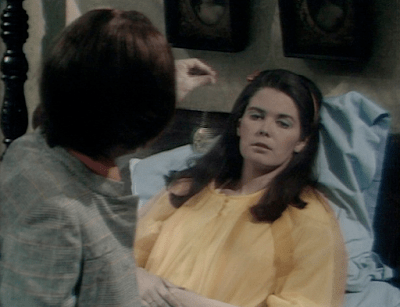
Maggie Evans, The Nicest Girl in Town, is not allowed to leave home. The yard outside her door is full of policemen. They are hoping that a rumor that her amnesia is breaking and she will soon remember who abducted her and held her prisoner will draw that person out of hiding. If he approaches the house, they will… it isn’t clear what they will do, exactly. Whatever they do, Maggie hopes that it will end the danger so that she can get back to her normal life.
Maggie and her father Sam talk about the situation. This conversation doesn’t advance the plot or give the audience new information, but it is somewhat interesting to people who have been watching the show from the beginning. For the first 40 weeks of the show, Sam was an alcoholic and Maggie’s attempts to keep him out of trouble were a substantial part of the story. Adult Child of an Alcoholic (ACoA, in the lingo of the twelve step movement) mannerisms such as advertising that she is happy by starting utterances with a laugh and stressing whatever syllables have a rising pitch are still a major part of Maggie’s characterization.
Father and daughter
But Sam isn’t an alcoholic anymore. Not only doesn’t his drinking cause him problems, but we’ve seen him function as a social drinker. He keeps a bottle of whiskey in the living room of the Evans cottage and occasionally takes a drink or two; he often goes to The Blue Whale tavern and enjoys happy hour there. But he declines drinks when they are offered at inconvenient times, doesn’t get drunk, doesn’t have trouble with his work, and Maggie doesn’t have any complaints. The other day, the show referred back to Sam’s drinking days. He and the sheriff went to The Blue Whale, where Sam started the rumor about Maggie’s memory. Sam pretended to be drunk and the sheriff pretended to hush him while he declared that Maggie would be leading the police to her captor any day now. But he was stone sober the whole time, even though he had had a drink at home before leaving for the tavern.
The show dropped the theme of Sam’s alcoholism when it gave up on the storyline of “The Revenge of Burke Devlin.” Sam had started drinking because of the events behind that storyline and his drunkenness made it unpredictable what role he would play in it. Since that ended in #201, the writers don’t seem to see a point in presenting Sam as an alcoholic, even as one in recovery. But I think that is a mistake. The actors and directors remember that Sam has that history, and it adds depth to both David Ford’s portrayal of Sam and Kathryn Leigh Scott’s of Maggie. You wouldn’t have to spend any more screen time presenting Sam as a recovering alcoholic than they spend now presenting him as a social drinker. All he’d have to do is reply to a remark about booze by saying that he never touches the stuff anymore, and you’ve made the point.
Viewers who have been with the show from the beginning will look at Sam and Maggie’s heart-to-heart talk and remember the scenes from the first 40 weeks where Maggie wound up playing the parent in the parent-child relationship. Seeing him really function as a father here will not only reassure us that they are free of that now, but will also explain why Maggie kept falling into all of the patterns of behavior that enabled Sam when he was a drunk. Today, he’s the Daddy she knew before alcohol got the better of him, the one she was always sure was still in there someplace.
Sam leaves the room, and Maggie gets a visitor. After Sam had assured Maggie that the house was so well-guarded no one could get in, we saw a shot of the permanently nine year old ghost of Sarah Collins outdoors, peering over a picket fence.
Looking for a friend
Maggie falls asleep, and wakes to find Sarah in the room with her. Maggie repeatedly asks Sarah how she got in, and Sarah keeps declining to answer. Maggie keeps trying to get her father into the room, and Sarah keeps telling her that if a third person comes in, she will have to go away. Sarah finds that Maggie is not in possession of the doll she gave her, and tells her that she will have to get it back as soon as possible and keep it with her at all times. Maggie asks more than one question about that as well, and Sarah again tells her that she can’t explain. Sarah gets to be quite exasperated that she has to keep reviewing the ghost rules with Maggie.
Sarah can not believe Maggie still doesn’t get it.
Several characters have entertained the possibility that Sarah might be a ghost, among them Maggie and Sam. They keep snapping back from really believing that she is. In the early months of the show, characters had speculated that there might be ghosts on and around the great estate of Collinwood, but they couldn’t let go of the idea that they lived in a world that basically made sense according to the usual natural laws. So no matter what they saw, they kept retreating from the full implications of the supernatural events that came to be a more and more obvious part of their experiences. Sarah’s impatience with Maggie today is reflected in the impatience many viewers of the show express when characters who have had encounter after encounter with the paranormal won’t stop droning on about how there must be a perfectly logical explanation.
Sarah keeps repeating herself and Maggie keeps missing the point. Maggie tells Sarah that she will like Sam, who likes little girls. That again is a poignant line to those who are thinking about the happy life Maggie had with her father before he started drinking and that has only recently resumed, though it is lost on newer viewers. We also know that Sarah already likes Sam- she visited him in this house in #260 and told him where to find Maggie.
But in the world of Dark Shadows, ghosts cannot appear to more than one person at a time. For example, in #141 strange and troubled boy David Collins took his mother, undead fire witch Laura Murdoch Collins, to the Old House on the grounds of Collinwood, hoping that the ghost of Josette Collins would appear to her. He left her alone in the house, explaining that Josette appears only to one person at a time. Josette did communicate with Laura after David left, though Laura concealed that fact from her son.
We’ve seen only two exceptions to the rule that ghosts appear to one person at a time. The first case was in #165, when Josette manifested herself in a room with David and Laura. The second time was in #294, when Sarah herself helped Maggie escape from the mental hospital where mad scientist Julia Hoffman was keeping her for evil reasons. Both Maggie and her nurse could see Sarah that time.
But those were special occasions. It was such a strain for Josette to present herself to two people that she could shimmer into view only when David was asleep, and a few words from Laura were enough to shoo her away before he could wake up, though he did feel her presence afterward. And Sarah’s appearance to Maggie and the nurse lasted for only a few seconds. Viewers reminded of Sarah’s earlier appearance to Sam will remember that she vanished before he finished a sketch of her that she very much wanted him to give her, so however great a power she might represent, we know that it is not entirely under her control. She can do what she is supposed to do and tell people what they are supposed to know, but she cannot simply do as she wishes, and when she has completed an assigned task or entered an uncongenial situation she will disappear.
Eventually Maggie insists on opening the door and calling to Sam. Of course Sarah has vanished when he enters, of course the men guarding the house didn’t see her, and of course Sam and Maggie fret that if Sarah could come and go unobserved so could the person they are trying to catch. Those bits bring on our frustration with characters who don’t get that they are living in a universe pervaded with supernatural beings. If they were proceeding from the premise that Sarah was a ghost and considering the possibility that Maggie’s captor may also have been some kind of uncanny being, that would indicate that the action is about to start moving a lot faster. As it is, it’s just filler.
Meanwhile, Julia has left her hospital and come to Collinwood, where she is in league with Maggie’s captor, vampire Barnabas Collins. Barnabas has heard the rumor that Maggie is recovering from her amnesia. Julia induced that amnesia to keep Maggie from exposing him and inconveniencing her.
In Friday’s episode, Julia tried to talk Barnabas out of killing Maggie. He had calmly and suavely told her that he had no choice but to yield to her arguments, and she had been satisfied that she had persuaded him. Today, he tells his sorely bedraggled blood-thrall Willie Loomis that he will set out for the Evans cottage as soon as the clouds cover the moon and give him a deep enough cover of darkness.
Willie sneaks over to the terrace at the great house of Collinwood, where he informs Julia of Barnabas’ intentions. Julia cannot believe that her powers of persuasion failed to win Barnabas away from his plan to kill Maggie. Willie has to repeat himself time and again, until he grows as exasperated with Julia as Sarah was with Maggie.
This is the first time we have seen Julia in denial. It’s understandable that she would overestimate her ability to bend Barnabas to her will- not only has she had a great deal of success so far at dominating their relationship, but she is usually able to manipulate people to a fantastic degree. When she induced Maggie’s current amnesia, she took her in a matter of minutes from a state in which she remembered everything that had happened to her to one in which an impenetrable mental block covered exactly the period in which Barnabas abused her. Someone who can do that might well have difficulty grasping the fact that she has not turned someone to her way of thinking.
Barnabas stares out the window of his house in the direction of the Evans cottage and thinks murderous thoughts about Maggie. My wife and I often laugh about the comment Danny Horn made on this scene in his post about this episode on his blog Dark Shadows Every Day:
Meanwhile, the dogs are howling, and Barnabas is standing at the window, staring out into the night.
“Goodbye, Maggie Evans,” he thinks. “I might have loved you. I might have spared you. Now… you must die.”
Man, what a diva. He even has backup singers.
Danny Horn, “Episode 321: What We Talk About When We Talk About Ghosts,” Dark Shadows Every Day, 3 February 2014
When the show dwells on the dog-noise, Mrs Acilius and I often turn to each other, say “the backup singers!,” and laugh. When we watched this episode yesterday, we laughed louder than usual because our beagle joined in with them, right on cue. He often looks up when the howling starts, the backup singers are the stars of the show as far as he is concerned, but it is unusual for him to sing along. They must be in particularly good voice in this one.
We open with the most spectacular dream sequence Dark Shadows has yet attempted. Strange and troubled boy David Collins is tossing and turning in bed. We cut to his dream, where he sees his distant cousin, old world gentleman Barnabas Collins, approaching. Barnabas gets closer and closer, grows enormous, and opens his mouth, exposing the fangs of a vampire. David screams and wakes up.
As it happens, Barnabas really is a vampire. He has heard a rumor that Maggie Evans, The Nicest Girl in Town, is recovering from amnesia. Since that amnesia was induced by his associate, mad scientist Julia Hoffman, in order to keep her from remembering that Barnabas is an undead ghoul who abducted her and held her prisoner, he is on the point of a panic attack.
Jonathan Frid turns in a bravura performance as Barnabas today. He plays Barnabas’ mounting anxiety compellingly when we see him in his house alone with his sorely bedraggled blood thrall Willie, waiting for Julia. When she does come, he rages at her and demands she go to Maggie at once to reinforce her memory loss. When Julia admits that she is no longer Maggie’s doctor, Barnabas’ rage mounts and he threatens to kill her. She keeps talking, and eventually he composes himself and suavely tells her that he won’t kill anyone tonight. She smiles, and goes off to her laboratory to resume meddling in God’s realm. Willie knows Barnabas better than Julia does and has none of her self-assurance; he doesn’t for a moment believe that Barnabas has relented. When he gets Barnabas to confirm that he is indeed going to kill Maggie, Frid moves from the cool suavity he had achieved just before Julia’s exit back to the near-panic he had displayed before she entered. The whole trip from panic to rage to suavity and back to panic is remarkably well executed.
In the outer room of the Tomb of the Collinses, Sam Evans and Dr Dave Woodard recap the story so far. In the hidden chamber on the other side of the wall, vampire Barnabas Collins and mad scientist Julia Hoffman eavesdrop on their conversation. When they hear how close Evans and Woodard have come to discovering their terrible secrets, Julia squirms and Barnabas looks shocked.
Busted.
When Dr Woodard mentions that Julia had used the word “supernatural” in a conversation with him, Barnabas nearly blows their cover. He grabs Julia by the throat and she lets out a yelp. Sam hears this, Woodard does not. Woodard suspects that there are ghosts at work in the area, but he cannot believe that Sam’s hearing is better than his, so he dismisses the idea.* He notices the plaque marking the burial site of Sarah Collins, 1786-1796, and says out loud that the little girl named Sarah whom everyone has been looking for lately is the ghost of that Sarah.
Evans and Woodard leave the tomb, and Barnabas resumes raging at Julia. He opens his old coffin and pushes her head into it, asking if she wants to spend eternity confined there. She talks him down with warnings of what would happen were he to kill strange and troubled boy David Collins.
Woodard goes to the great house of Collinwood, where he questions David. Woodard is much more forthcoming with what he knows than he has been in any previous conversation. David listens closely, trying to find out what he knows. But Woodard’s questions are all about David’s friend, Sarah. David doesn’t know that answers to many of Woodard’s questions, and Sarah has sworn him to secrecy about much of what he does know. So the only new piece of information Woodard learns from David is that Julia was lying to him the other day when she said that she hadn’t given much thought to Sarah. David tells him that she asks him about her all the time.
Julia comes in and tries to stop Woodard questioning David. He ignores her and asks another question, then warns him to stay away from the Tomb of the Collinses. When he tells David that whatever secret Sarah told him about the tomb is also known to someone else, and that that other person is very dangerous, David is horrified. When he was trapped in the hidden chamber last week, Barnabas and his servant Willie entered. David hid from them in Barnabas’ old coffin and eavesdropped on a conversation in which Barnabas dropped a huge number of clues about his secrets. Since Woodard started his questioning of David with a reference to the unknown person who has been terrorizing the area since April, David now has reason to believe that Barnabas is that person.
David leaves the room, and Woodard asks Julia what she was trying to prevent him from finding out. She refuses to answer any of his questions. She hears the sound of dogs howling, and knows that it means Barnabas is getting ready to kill someone. Knowing that she has very little time to try to prevent David’s murder, she cannot focus on Woodard’s questions. For once, she can’t think of any lies that will hold him off. Her reason for being in town, so far as Woodard is concerned, is that she is a doctor treating Sam Evans’ daughter Maggie, Barnabas’ former victim. When she won’t answer his questions, he takes her off Maggie’s case.
Julia goes to Barnabas’ house. She finds him on his way out the door, on a mission to kill David. She opposes him, and he declares that nothing can stop him. At that, the wind blows the doors open. It extinguishes some of the candles in the room. The strains of “London Bridge” begin playing, and Barnabas and Julia realize that Sarah, who in reality is the permanently nine year old ghost of Barnabas’ little sister, is in the room. Barnabas cannot leave. Julia says with satisfaction that nothing can stop him- “except one little girl.”
The whole episode is very strong from beginning to end. Julia is usually so much in charge that the only suspense is what she will choose to do, but throughout this one she is scrambling to bring Barnabas under control. When her final attempt fails, Sarah’s intervention comes as a thrilling surprise.
The performances of both Jonathan Frid and Grayson Hall stand out today. Hall is as powerful a presence playing a character who controls nothing as she usually is playing a character who controls everything. And few could match Frid’s ability to appall us with Barnabas’ plan to kill a ten year old and seconds later to elicit tears by calling out to his beloved little sister.
When Dark Shadows began, one of the most important relationships was that between matriarch Elizabeth Collins Stoddard and her brother, high-born ne’er-do-well Roger Collins. Liz and Roger each had a terrible secret to hide. In the work of hiding, they embodied opposite extremes. Liz was motivated to conceal her secret by a fear that she would damage the reputation of the Collins family and the fortunes of its members. Her morbidly intense concern for the family’s position both made her a prisoner in her home and gave her a certain air of nobility. Roger’s motives for hiding his secret were wholly selfish, and he was a symbol of lack of family feeling. So much so that he squandered his entire inheritance, jumped at a chance to sell the ancestral seat to his sworn enemy, and openly hated his own son.
Since Roger was living in Liz’ house as her guest and working in her business as an employee, it fell to her to rein in her impossibly irresponsible younger brother. But the very quality that led her to try to exercise authority over him undercut her efforts to do so. Liz’ devotion to the Collins family compelled her to try to keep Roger on the strait and narrow path, but that same devotion prevented her from taking any action against him so harsh that it might actually deter him from misconduct. Further, her own secret compromised her moral authority and kept her from engaging with anyone outside the family. So she wound up less as a commanding matriarch than as a bossy big sister.
Liz and Roger both let go of their secrets, Roger in #201, Liz in #270. Roger is still far from heroic, but he no longer gives Liz the nightmares he once did. Liz is still mindful of the family’s good name, but there is nothing keeping her from following through on whatever orders she might give. So Liz and Roger’s Bossy Big Sister/ Bratty Little Brother dynamic is no longer a productive story element.
Now, the show is reintroducing the same dynamic with another pair of characters. Mad scientist Julia Hoffman is conducting an experiment which she hopes will turn vampire Barnabas Collins into a real boy. When Barnabas threatens to murder her, she becomes impatient and tells him to stop being ridiculous. When he threatens to murder other people, she threatens to discontinue the experiment unless he starts behaving. He usually responds to Julia’s orders by pouting, sulking, and giving in to her.
In the opening scene, Julia was in Barnabas’ house. He told her that he was likely to kill Roger’s ten year old son David because he thinks David might know that he is a vampire. Julia demanded that he leave David alone, prompting him to walk out of his own house. She then followed him to the old cemetery north of town, where Barnabas heard her footsteps in the distance and she hid behind a tree.
This woman holds a medical doctorate and is qualified in two unrelated specialties.
Barnabas enters the Tomb of the Collinses. Julia confronts him there, insisting he tell her what secret about the place he is keeping from her. He demands that she leave and threatens to kill her if she does not. He tells her that he ought to stash her corpse nearby, “along with”- then interrupts himself. Regular viewers know that Barnabas killed seagoing con man Jason McGuire in #275 and buried him in the secret chamber inside the tomb in #276. Jason has barely been mentioned since, not once in any scene featuring Julia. When she asks Barnabas what he is talking about, he says “Never mind.”
Julia presses Barnabas with “You’ve shared all your other secrets with me. You have no choice but to share this one with me too.” The logic of this statement eludes me, but all Barnabas can do when Julia has made it is to walk backward away from her, staggering into a corner and pouting at her.
Barnabas, stunned by the force of Julia’s reasoning.
Meanwhile, Sam and Dave are walking through the cemetery.
No, not that Sam and Dave. Local artist Sam Evans and addled quack Dr Dave Woodard have noticed that a series of odd occurrences have taken place in the vicinity of the tomb lately and have come to the cemetery to investigate. They run into the old caretaker, who delays them with his usual warnings about the unquiet spirits of the dead.
Alas, the final appearance of Daniel F. Keyes as the Caretaker.
Back in the tomb, Barnabas is telling Julia everything she wants to know. He lets her into the secret chamber and explains that he was imprisoned there in a coffin for many years, freed only when the luckless Willie Loomis accidentally released him to prey upon the living. Julia listens, showing pity as Barnabas recounts his woes.
Barnabas finds David’s pocket knife, proving that the boy was in the chamber and convincing Barnabas that he must kill him. He takes the knife close to Julia in a gesture that might be threatening, were its blade intact. The broken blade negates the threat and emphasizes Barnabas’ powerlessness before Julia. Since 1967 was the heyday of Freudianism in the USA, it is likely that many in the original audience would have seen it not only as a useless tool, but also as a phallic symbol. As such, not only its brokenness, but also the fact that it was made to be carried by a little boy, would make the point that Barnabas brings no sexual potency to his relationship with Julia. Her own behavior towards him may be childlike, but in her eyes he is a smaller child than she is.
Julia protests, claiming that someone else might have left the knife there. Barnabas dismisses her assertions, but does not regain control of the situation. As they prepare to leave the chamber, he kneels and she stands over him, watching him open the panel.
On his knees before her.
They hear Sam and Dave approach. (Still not the cool ones.) They scurry back into the secret chamber, as David had done when he heard Barnabas and Willie approaching the tomb in #310. They listen to the men discuss the facts that have brought them to the tomb, and grow steadily more alarmed as they realize how close they are to discovering Barnabas’ terrible secret.
This is the first episode not to include any actors who were signed to the show at the time production began. The character of Sam Evans was at that time played by a loud man called Mark Allen; Allen’s last episode was #22, taped on 12 July 1966, and David Ford’s first was #35, taped on 29 July. The Caretaker was introduced in #154, Barnabas in #210,* Dave Woodard in #219,** and Julia in #265.
*As the hand of stand-in Alfred Dillay- Jonathan Frid wouldn’t appear until #211. Though the portrait he sat for was on screen in #204, and was identified as that of Barnabas Collins in #205.
**Played by Richard Woods. Robert Gerringer took over the part in #231.
Strange and troubled boy David Collins got himself trapped in the secret chamber of the old Collins mausoleum in #310, and everyone has been searching for him ever since. Most of them want to get him home safe, but his distant cousin, Barnabas, has a different agenda. He suspects that David has learned that he is a vampire, and is determined to be the first to find him so that he can kill him.
Friday, David got out of the secret chamber and walked outside, straight into Barnabas’ hands. Today, we open with a reprise of that scene. After Barnabas greets his young cousin with a richly sinister “Hel-lo, David!,” he questions him sharply. He expresses dissatisfaction with David’s answers, then tells him that because no one is at home in the great house of Collinwood, he will be taking David to his own house. David grows more and more uncomfortable. Just as he is coming to be really frightened, the voice of local man Burke Devlin calls his name.
When Burke reaches them, David throws his arms around him and Barnabas squirms guiltily. Burke dislikes Barnabas, and gives him a suspicious look while he and David explain what has happened. When Burke says that there are people at home in the great house, David flashes a look of alarm at Barnabas. Barnabas says that no one had answered when he knocked on the door earlier, so he assumed everyone had joined the search. The two men take David home.
There, David eats a sandwich in his room while his father Roger asks him where he has been. This conversation is just magnificent. Roger is trying to be stern, but is such a flagrantly neglectful father that David knows full well that he can’t be bothered to punish him. So while Roger puts a series of pointed questions to him, David ignores him and muses aloud about Barnabas. “Barnabas is mysterious, isn’t he, Father?…You know, we don’t know anything about him. He just showed up one night.” Roger keeps urging David to forget about Barnabas and start answering his questions, but gets nowhere. Louis Edmonds and David Henesy were both talented comic actors, and they worked well together, so it’s no surprise this scene is laugh-out-loud funny.
Along with the comedy comes the thrill of a potential change in the show. In his post about this episode, Danny Horn writes: “It’s a great moment. It’s like the ‘logical explanation’ spell was suddenly broken, and David just realized how bizarre his life is.” The structure of Dark Shadows’ storylines has been that someone has a terrible secret, they are deep in denial about the extent to which the secret is deforming their lives, and when they finally let go of their secrets they are free. So matriarch Liz had a terrible secret that kept her from leaving her house for over eighteen years, she revealed the secret in #270, and now she’s happy to go anywhere. She’s on an extended visit to Boston at the moment. Roger had a secret connected with an incident for which Burke went to prison years ago and he spent all his time making a fool of himself as he struggled to keep it hidden; he admitted the truth in #201, and since then he has been a carefree fellow who can make anyone laugh. So the Collins family curse that Barnabas embodies is made up chiefly of denial, and it can be defeated by facing facts. If David has seen through all the lies and is willing to reckon with the truth, he has the power to bring everything to a conclusion. So when he says that Barnabas “just showed up one night,” we catch a glimpse of what it would be like if the entire series came to its ultimate climax.
We end with David still in his room, telling well-meaning governess Vicki that he feels someone evil is watching him. We cut to Barnabas in his own house, staring out the window at the great house in the distance, thinking his sinister thoughts. David’s feeling should be familiar to him- when his mother, undead fire witch Laura Murdoch Collins, was staying in the cottage in the estate, she often stared out her window and caused David to have nightmares.
Laura was a threat to David because the basic conditions of her existence drove to kill her son. Barnabas’ threat to him is a result of circumstances that were always likely to arise, but that might not have, and that might yet be changed. So when Laura was on the show, the suspense was how she would be destroyed before she could kill David. Now with Barnabas, there is a question whether he will try to kill David at all. So the suspense is more complicated, and there are more options for pacing. The plot doesn’t have to be either glacial or rapid, as it did with Laura, but can move at any of a variety of speeds depending on which of the many possible directions they decide to take the story.
In our house, we watch Dark Shadows on Tubi, a free advertiser-supported streaming app. As we click on each episode, we see a summary reading “Freed from his grave after 200 years, a tormented vampire returns home to protect his loved ones in this classic gothic daytime TV series.”
That “tormented vampire” is Barnabas Collins. In the opening scenes of today’s episode, Barnabas is talking with Julia Hoffman, a mad scientist who is trying to cure him of vampirism. They are discussing the missing David Collins, the ten-year old boy who is the last bearer of the Collins family name. This ardent protector of family announces that he must be the first to find David, because he is going to kill him. He tells Julia that he’d been “getting very fond” of David, but that he is pretty sure the boy knows that he is a vampire, so he will have to choose survival over “sentiment.” When Julia objects, Barnabas smiles and tells her that he might also be killing her and his sorely bedraggled blood thrall Willie soon. He invites her to inform Willie of this fact.
Barnabas goes to the great house of Collinwood, where he visits well-meaning governess Vicki. Vicki is worried sick about David, to whom she is devoted. She regards Barnabas as a dear friend, and he enjoys spending time with her. He has some vague intention of killing Vicki so that she will rise as his vampire bride, and may get around to doing that once he has killed David, Vicki’s fiancé Burke, and maybe Julia and Willie. Perhaps what he is determined to “protect his loved ones” from is aging- with him around, it seems unlikely anyone is going to get much older.
Vicki unwittingly tips Barnabas off as to where David is. David is trapped in the secret chamber inside the Collins mausoleum in the old cemetery north of town. Vicki doesn’t know that this chamber exists, but Barnabas was confined there for 170 years. So when she tells him that the doddering caretaker of the cemetery thought he heard voices coming from behind the stone walls of the outer chamber, she thinks she is giving evidence that the old man has lost his mind. Barnabas, however, knows different.
David learned about the chamber from the permanently nine year old ghost of Barnabas’ sister Sarah. Sarah has been showing up a lot lately, and yesterday we saw several characters starting to admit that she must be a supernatural being. It is Sarah’s friendship with David that has led Barnabas to believe that he knows he is a vampire. In fact, she did not tell him about this, but David did overhear a conversation between Barnabas and Willie which gave him enough clues that he could probably figure it out.
When Barnabas arrives at the cemetery, he meets the caretaker and has a confusing conversation that is straight out of vaudeville. On his Dark Shadows Every Day, Danny Horn compares it to “a summer stock production of Abbott and Costello Meet Frankenstein, where Abbott is being played by Count Dracula.” At one point Barnabas is so exasperated with the caretaker that he nearly blurts out that he is Sarah’s brother. That’s the second time in the episode a character almost blurts out a word that would make a major change in the show- towards the beginning, Julia came within a breath of saying “vampire,” a word we have not yet heard on Dark Shadows.
Meanwhile, Sarah appears to David. He asks her how she got into the sealed chamber, and she replies “I can get in anywhere.” David is dissatisfied with this answer, but doesn’t really seem surprised to see her. He seems to know that she is a ghost, and to be holding off on using the word in her presence in the same way that Julia is holding off on using the word “vampire” with Barnabas. It’s just sort of indelicate to use a label people haven’t told you they like. Maybe Sarah prefers to be called a Phantom-American, and it would be this whole big thing if you called her a “ghost.”
Sarah shows David how to open the panel. He does, and when he looks back she is gone. He expresses irritation with her for “hiding,” which is rather strange- he was trapped in the chamber for days, so clearly she wasn’t hiding there the whole time. She must have made her way in through the solid walls. Even if David hasn’t figured out that she is a ghost, he must know that she can get out the same way.
David walks out of the mausoleum, directly into the hands of his cousin Barnabas. It was obvious that he would, but that obviousness is not a problem- on the contrary, it comes with a sense of inevitability that leaves us dreading what Barnabas is going to do to David.
I think that’s too simple an interpretation to cover everything we’ve seen Sarah do so far on the show. It is true that she never really gets anyone out of danger. She helped Maggie Evans, The Nicest Girl in Town, escape from Barnabas when he was about to kill her, but that escape led directly to her imprisonment in Julia’s hospital. She broke Maggie out of that hospital before Julia could complete her evil plan to keep her in a state of total psychological collapse, only to lead her directly to Barnabas. She prevented Barnabas killing Maggie in her bed, but left him determined to strike again if Julia failed to keep her memory from returning.
Some say that Sarah is really an avatar of Barnabas, that she is his conscience roaming free in the world. Julia explicitly proposed this interpretation on screen in #302, and Sharon Smyth Lentz says that it is direction she was given when she was playing Sarah. So it was an idea that the writers meant to develop, but I don’t think it covers everything either. A guilty conscience can lead a person to take actions that will lead to his own exposure, but the likeliest way Sarah’s latest actions will lead to Barnabas’ exposure will be if he kills David and is caught. That doesn’t really sound like “conscience.”
Dark Shadows is, in all its phases, the story of the great estate of Collinwood and the accursed family that lives there. I would say that, whatever else Sarah is, she is a symptom of the curse that Barnabas also embodies. For several weeks, Barnabas has had a tendency to lie low and keep quiet, letting the curse fester silently and pull the Collinses and the community around them deeper into its power by imperceptible steps. Sarah disrupts all of his plans, prompting him to act and forcing into the open more and more evidence that spiritual forces of darkness are at work.
But for all the inconvenience she represents to Barnabas, Sarah is no more an opponent of the curse itself than he is a protector of family and friends. On the contrary, she presents a different version of the curse. She confronts the living characters with facts they are desperate to avoid facing. If they continue on the form they have set so far, most of them will react to the evidence of otherworldly dangers by digging ever deeper into denial. If they do that, even Barnabas’ destruction would not really free them from the life-draining evil that engendered him.
Well-meaning governess Vicki and vampire Barnabas are on the terrace of the great house of Collinwood. Vicki’s charge, strange and troubled boy David, is missing, and she is upset. Vicki is weeping on Barnabas’ shoulder.
Heiress Carolyn and hardworking young fisherman Joe show up in the nick of time to prevent Barnabas biting Vicki and giving her a role in the main storyline. They report on their fruitless search for David. When they mention that David had been looking for mysterious girl Sarah, Barnabas becomes alarmed.
In recent episodes, many characters have been trying to find Sarah, in hopes that she will be able to tell them who abducted Maggie Evans, The Nicest Girl in Town. In two conversations about Sarah, Vicki has kept quiet about the fact that she saw a girl matching her description in Barnabas’ house. She is sure her friend Barnabas is innocent of any wrongdoing, and does not want anyone to suspect him in connection with what happened to Maggie. But her concern for David drives that thought out of her mind, and she tells Joe and Carolyn what she saw.
Meanwhile, Barnabas goes home and tells his sorely bedraggled blood thrall Willie that they must find David. Barnabas knows that Sarah is the ghost of his little sister, and he is afraid she may have told David that he is a vampire. When Willie asks what Barnabas will do if he finds David, Barnabas makes it clear that he plans to kill him.
David is about ten years old, and he is the last bearer of the Collins name. Dark Shadows fans sometimes ask what would happen if any of Barnabas’ plans had ever succeeded. I think his fell design for David answers that question- he would annihilate the Collins family and turn their estate into a hellscape cut off from the world of the living. In July of 1970, the show will give us an extended vision of what would happen were another supernatural menace to achieve that result. We will also get a glimpse of an alternate version of Barnabas driving towards the same objective when House of Dark Shadows hits theaters in October of 1970.
That was a possible outcome for a feature film, but a continuing series could hardly go down that road. And lately, Barnabas has seemed too harmless to bring it about. Even first-time viewers have already seen him fail to bite someone who was actively pressing her neck towards his fangs. So it doesn’t really seem that David is in all that much danger. Indeed, Barnabas is well on his way to becoming a comic villain. We see the action through his eyes as he scrambles to keep his lies in place, and see him devise one cockamamie scheme after another, all of which fall apart. He is something like Wile E. Coyote operating in extreme slow motion.
Before Barnabas and Willie can leave in search of David, there comes a knock at the front door. It is Joe and the sheriff asking to go through the place looking for David and Sarah. The episode becomes pure comedy from that point on. On his Dark Shadows Daybook, Patrick McCray analyzes it as situation comedy; on Dark Shadows Every Day, Danny Horn analyzes it as farce.
While Joe searches upstairs and the sheriff searches the main floor, Willie keeps jabbering about how awful it would be if they went into the basement, where they might discover Barnabas’ coffin. Barnabas keeps shushing him. Both Barnabas and Willie panic a little more visibly each time the rooster crows, reminding them that Barnabas is running out of time to get back into his coffin.
When Joe and the sheriff do ask Barnabas to unlock the basement door so they can search there, Barnabas is cornered into claiming that he lost the key. They are openly incredulous, and he squirms as he elaborates on his assertion. He gives even lamer excuses when Joe offers to break the door down and then repair it. Finally, Carolyn lets Barnabas off the hook when she comes running with word that a boy meeting David’s description has been seen on the beach. Joe and the sheriff rush out, just in time for Barnabas to find shelter from the sunrise.
Both Danny Horn and Patrick McCray wrote fine blog posts about this episode. I have a few things to add to what they’ve said.
When vampire Barnabas Collins and his sorely bedraggled blood thrall Willie approach the Tomb of the Collinses, strange and troubled boy David hears them talking about mysterious little girl Sarah. Since Sarah had made him promise to keep her connection to the place secret, he opens the panel to the concealed chamber she had shown him and hides there. To his horror, he hears Barnabas order Willie to open the panel. Still trying to keep Sarah’s secret, he hides in the coffin in the center of the chamber while Willie and Barnabas walk around it. He hears them talk about Barnabas’ relationship with Sarah and Willie’s discomfort with the chamber.
They don’t mention that Barnabas is a vampire, or that he was the one who imprisoned Maggie Evans, The Nicest Girl In Town. But they say enough that David should be able to figure out all of Barnabas’ secrets. Once he has heard Barnabas say that he was left to comfort Sarah after their dog was put down, it isn’t much of a leap to conclude that Sarah is his little sister. And once he’s heard Barnabas ask Willie if he is frightened by the “contents” of the chamber, he should know that there is something in there more than can be seen at a first glance.
In episodes #301 and #306, we were reminded of Jason McGuire, whom Barnabas killed and forced Willie to bury in the floor of this chamber. We also saw the chamber itself in #306, so that regular viewers would be sure to think of Jason’s grave. If David should repeat Barnabas’ comment about the chamber’s “contents” at the right time, Jason might yet be exhumed. So Barnabas has created an extreme danger to himself with his big mouth. Since it does not seem that Dark Shadows could continue if either Barnabas or David were to destroy the other, we are in suspense as to how they will get out of this situation.
After Barnabas and Willie leave, David gets out of the coffin and finds he cannot open the panel from the inside. Willie had used a gadget hidden in the stairs to open it, the first time we have seen this device. As David starts to panic, he hears the strains of Sarah’s signature tune, “London Bridge.” He turns away from the panel, looks at the blank walls of the chamber, and starts calling on Sarah.
In his post, Danny Horn asks “Has David just figured out that Sarah’s a ghost?” I think it’s more complicated than that. In #288, David happily considered the possibility that Sarah might be a ghost, and throughout the series he has been on easy terms with several ghosts. So I think he has assumed she was a ghost all along, and was just too tactful to bring it up when he was talking with her.
Back in the great house of Collinwood, well-meaning governess Vicki is on the terrace, worried about David’s disappearance. Barnabas peeks at her through the gate, as he would do if he were not allowed to look at her. Then he just walks up and starts a conversation with her, leaving us to wonder what the whole peeping-Tom act was about.
Vicki is so concerned for David that she starts crying. Barnabas tells her to put her head on his shoulder, which she does. He seems to be trying to restrain himself, but she has such a long, pretty neck, and it’s right there, and he’s so very thirsty…
As Barnabas lunges in to bite her, my concern and sympathy is challenged as I ponder her almost athletic lack of awareness. Of course, I’ll inevitably side with the person getting her throat ripped out… but it won’t stop me from wondering why she’s practically painting a landing strip on her neck. Vicki? You have a generation of young people idolizing you.
Today, the discussion isn’t even a metaphor. No, she’s not asking for it. No one is. So, what is the message that we’re supposed to take away from a dangerous conversation like this? For a person constantly asking questions about everything — and never understanding what she hears — Vicki is the picture of unawareness. Evil is evil. An attack is an attack. And awareness is power. Ironic that her would-be attacker, Barnabas, is frequently even more unaware than is she. However, if anyone on a soap paid attention at all, the stories would last ten minutes. But that’s the point. The more the characters lack focus, the more we learn its value. David is the most aware character on the show, and in this episode, he learns the most he ever will in one night. Pity it’s from inside a coffin.
That part of the discussion is too much metaphor to ignore.
Patrick McCray, “The Dark Shadows Daybook: August 22,” The Collinsport Historical Society, 22 August 2018.
Again, I think it’s a more complicated. I think we have to analyze Vicki’s behavior at three levels of intentionality. First, there’s the in-universe level, the sort of analysis of her motives another character in the same story might give if they had the same information we do. If that character saw Vicki’s depressing fiancé Burke angrily telling her she was crazy for saying that she had seen and heard things that we have also seen and heard, refusing to give her even the most basic information about himself and airily dismissing her questions as a morbid preoccupation with “the past,” and telling other people that her imagination will “run wild” unless he monitors and controls her, they might very well think that Vicki is tired of Burke’s abusive ways. To that character, there would be nothing “athletic” about Vicki’s failure to suspect Barnabas- it is perfectly natural for her to want to think the best of a man who has always been pleasant and respectful to her, unlike the blatant villain she is supposed to marry.
The second level of intentionality is of Vicki’s usual function in the narrative. Up to this point, every storyline has come to its climax when Vicki found out what was going on. She is still the audience’s main point of view character, and as such she naturally tends towards the center of the action. All of the action lately has been in the vampire story, so we expect her to involve herself deeply in it. In the first weeks, when it was possible that Barnabas, as the second in a parade of supernatural nemeses, would be destroyed and make way for a third as undead fire witch Laura Murdoch Collins had made way for him, we expected Vicki to be the one who drive the stake into his heart. Now that it is clear he is on the show for the long haul, we are expecting Vicki to become his victim, and presumably to become a vampire herself. As the protagonist, she is actively working to get more deeply involved with Barnabas. She hasn’t yet resorted to “painting a landing strip on her neck,” but she did invite herself to spend the night at Barnabas’ house in #285 and #286, and it wasn’t her fault she left in the morning still having all her blood.
Vicki the unappreciated fiancée wants only a friend who will respect her; Vicki the protagonist wants to be part of the main story. The tension between the incompatible goals of these two aspects of Vicki is expressed in the third level of intentionality, which Alexandra Moltke Isles expresses in the choices that make up her performance. Mrs Isles takes every opportunity to show that Vicki is more strongly drawn to Barnabas than to anyone else, most definitely including Burke. That attraction brings the character back to life. After a few days when she was trying to submit to Burke’s abuse and ignore “the past,” Barnabas asks her to intercede with Burke on his behalf and she comes roaring back, an assertive character who will not give an inch even when Burke makes some good points.
It is the sight of this strong Vicki that introduces a conflict into the audience’s feelings. On the one hand, we don’t want to lose her, and if she does not become a vampire, it’s hard to see a future for her on the show. On the other, it would be a terrible betrayal for Barnabas to repay her trust in him by doing such a thing to her. All the more so because we’ve spent so much time seeing Vicki become close to David, and if she follows the pattern set in Bram Stoker’s Dracula, vampire Vicki will be a threat to all children.
Our sadness at that betrayal would be a deep emotion of exactly the kind soap operas are supposed to create. That so shocking a crime would lead to a more meaningful and more suspenseful story and a richer part for our favorite character would guarantee that we would surprise ourselves by forgiving Barnabas for it and cheering when he and Vicki become a couple. So, I think a savvy audience watching Dark Shadows up to this point would have to expect to see just that story play out.