In the Old House on the great estate of Collinwood, vampire Barnabas Collins frets that his sorely bedraggled blood thrall, Willie Loomis, is failing to die. A couple of weeks ago, the police shot Willie and jumped to the conclusion that he was responsible for the abduction of Maggie Evans, The Nicest Girl in Town, among many other crimes that Barnabas actually committed. He’s been in a coma ever since, and if he dies, Barnabas will be off the hook.
Barnabas tells his co-conspirator, mad scientist Julia Hoffman, that he will go to the hospital and murder Willie. Her assurances that Willie will soon die of natural causes don’t stop Barnabas, but her news that the sheriff is on his way to the house does. Barnabas then orders her to go to the hospital and carry out the murder, but she refuses.
Meanwhile, Sheriff George Patterson, addled quack Dr Dave Woodard, and Maggie’s father Sam are hanging around Willie’s hospital room recapping the story so far. The sheriff wonders where Willie could have kept Maggie during the weeks she was held prisoner. Willie lives in Barnabas’ house and does not appear to have access to any other building. You might think this would be grounds for suspecting Barnabas of involvement, but no such thought crosses the minds of any of the three luminaries keeping Willie company. They just take it for granted that no crime could have taken place in Barnabas’ house.
George, Dave, and Sam, or their intellectual equivalents.
Back in the Old House, Barnabas has had an inspiration. He took a ring from Maggie in #253, and today he hides it in a candlestick in Willie’s bedroom. When the sheriff and Sam come to search that room (but no other part of the house,) Barnabas watches until they’ve given up, then knocks the candlestick over and exclaims in a ridiculously fake voice “Look! A ring!” Sam recognizes it as Maggie’s, and he and the sheriff are convinced it is conclusive evidence of Willie’s guilt.
For her part, Julia has made her way to Willie’s hospital room. She is there with Woodard when Willie shows signs of regaining consciousness. Woodard rushes out to tell the deputy to get the sheriff, and leaves Julia alone with Willie. She looks at Willie’s IV and remembers Barnabas urging her to kill him.
The sheriff and Sam are leaving Barnabas’ house with the ring when the deputy comes to the front door. He announces that Willie is coming to and is likely to start talking at any moment. We end with a closeup of a horrified Barnabas.
During the opening titles, announcer Bob Lloyd tells us that the part of Sheriff Patterson will be played by Vince O’Brien. This week’s episodes were shot out of broadcast sequence, so we will see Dana Elcar as Patterson one more time. O’Brien was on the show four times in January and February of 1967 as the second actor to play Lieutenant Dan Riley of the Maine State Police, an officer attached to an investigation concerning undead fire witch Laura Murdoch Collins. Patterson isn’t much of a character, and even an actor as distinguished as Elcar had trouble making him interesting. If we remember O’Brien from his time as Dan Riley Number Two, we know that he was a competent professional, but we won’t have much hope that he will outdo Dana Elcar.
O’Brien does show beyond all doubt that he belongs on Dark Shadows, though. While the closing credits are rolling, he strolls onto the set behind technical director J. J. Lupatkin’s name.
Strange and troubled boy David Collins was, for the first 39 weeks of Dark Shadows, the character most intimately connected to the supernatural back-world of ghosts and uncanny phenomena that would occasionally peek through the main action of the show. That changed in #191, when he chose life with well-meaning governess Vicki over death with his mother, humanoid Phoenix Laura Murdoch Collins. After that, he had little memory of his mother, and none at all of the paranormal experiences he had during her time with him on the great estate of Collinwood.
Not that David lost his connection to the supernatural all at once. When he first met his cousin Barnabas in #212, he cheerfully asked him if he was a ghost, and was disappointed to hear that he wasn’t. In #288, he speculated that his friend, mysterious little girl Sarah, might be a ghost, and he has taken it in his stride every time he has seen Sarah do something only a ghost could do. In #310, he took out his crystal ball, a gift he had received in #48 and hadn’t used since #82, and peered into it to try to find Sarah. He did see her in it, too.
Yet David seems to be resisting the idea that Sarah is a ghost, and indeed to be shying away from the whole concept of the supernatural. When she led him to the secret chamber in the Collins mausoleum in #306, she told him that the empty coffin there once had a body in it, but that the body got up and left. David objected that the dead don’t walk away, and was incredulous when she assured him that sometimes, they do. When David was trapped in the chamber in #315, Sarah materialized there and showed him how to get out. He had called on her to come, and was facing away from the only door when he did so, indicating that he knew she could pass through the walls. Yet when she did, he demanded a naturalistic explanation for her entrance, and when she vanished he asserted that she must be hiding in the chamber somewhere.
Now, David is terrified of Barnabas, much to the puzzlement of the adults he lives with. In the opening scenes, he is staring at the portrait of Barnabas in the foyer of the great house, and we hear Barnabas in voiceover, delivering the lines with which he frightened David in #315. He screams with terror, bringing his aunt Liz. She sees that David is upset, but he hurries away from her, upstairs to his bedroom.
There, we hear his thoughts in another voiceover. He remembers the events of #310, when he discovered that Barnabas and his servant Willie knew about the secret chamber in the mausoleum. In his agitation, he calls out to Sarah. He hasn’t admitted to himself that Sarah is a ghost, but evidently he expects her to materialize out of thin air. Sarah doesn’t come, but Vicki does, asking who he was talking to.
After David says he wants to work on his stamp collection, Vicki goes downstairs and finds Liz putting her coat on. She says that David is afraid of Barnabas for some reason, and that she is going to Barnabas’ house to ask him to help put the boy’s fears to rest. She says that David is more disturbed than he has been since his mother Laura was around; this is the first direct reference to Laura in months.
There is a knock on the front door. It is Barnabas, saving Liz the trip. Liz and Vicki explain how fearful David is, and Barnabas offers to have a talk with him.
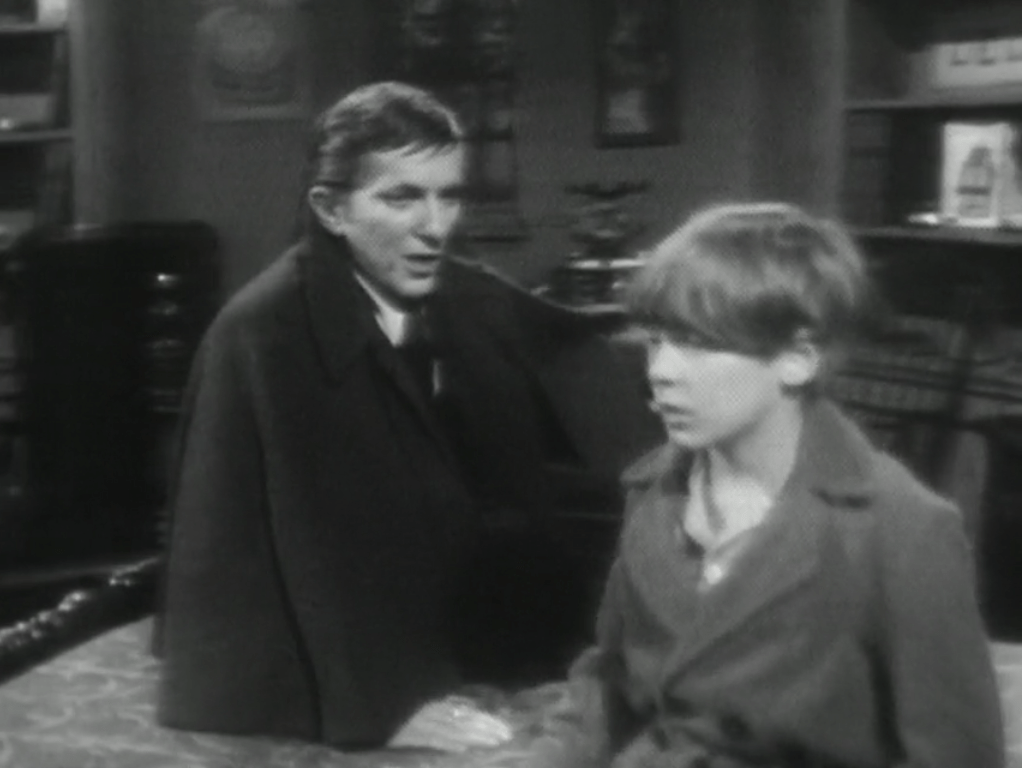
Liz ushers Barnabas into David’s room. Once the door is closed on the two of them, Barnabas questions David aggressively about Sarah and the secret chamber in the mausoleum. He asks him if Sarah told him about her family, twice mentioning her brother. When David says that Sarah hasn’t told him anything about herself, Barnabas accuses him of lying. He sits next to David on his bed. David doesn’t know that Barnabas is a vampire, but if he did he couldn’t look much more uncomfortable than he does when Barnabas assumes this position.
Barnabas sitting with David on his bed.
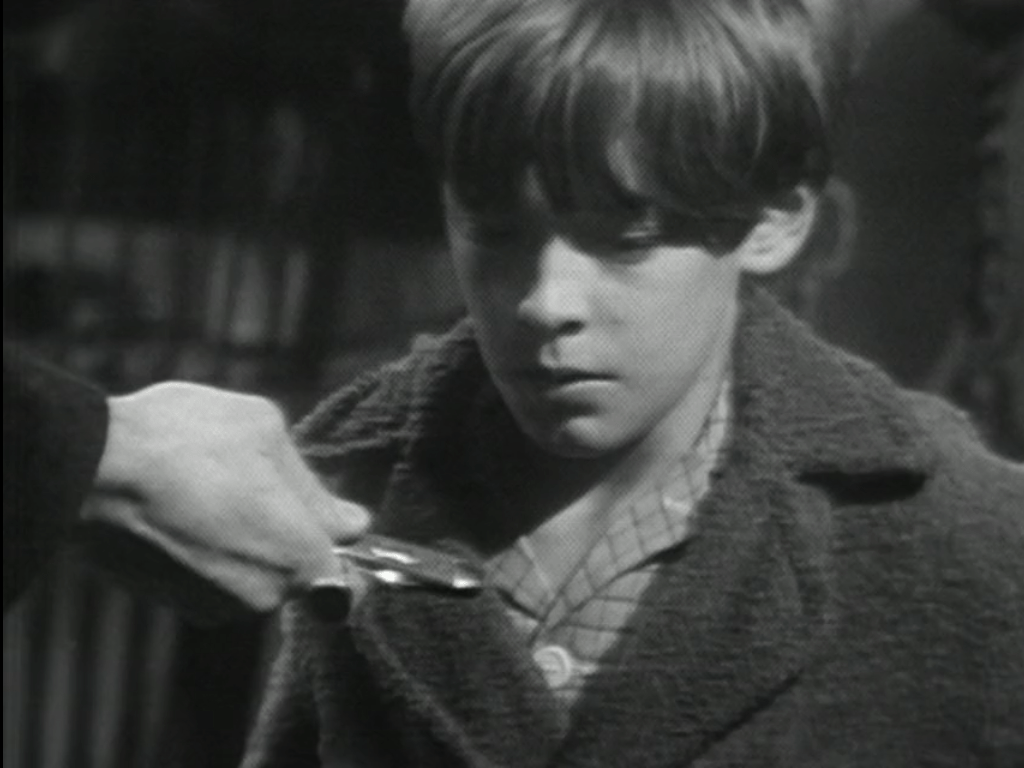
Barnabas tells David repeatedly that he knows he was in the secret chamber. David denies it, Barnabas again tells him he is lying, and to prove it shows him the knife he left there.
Barnabas confronts David with his knife
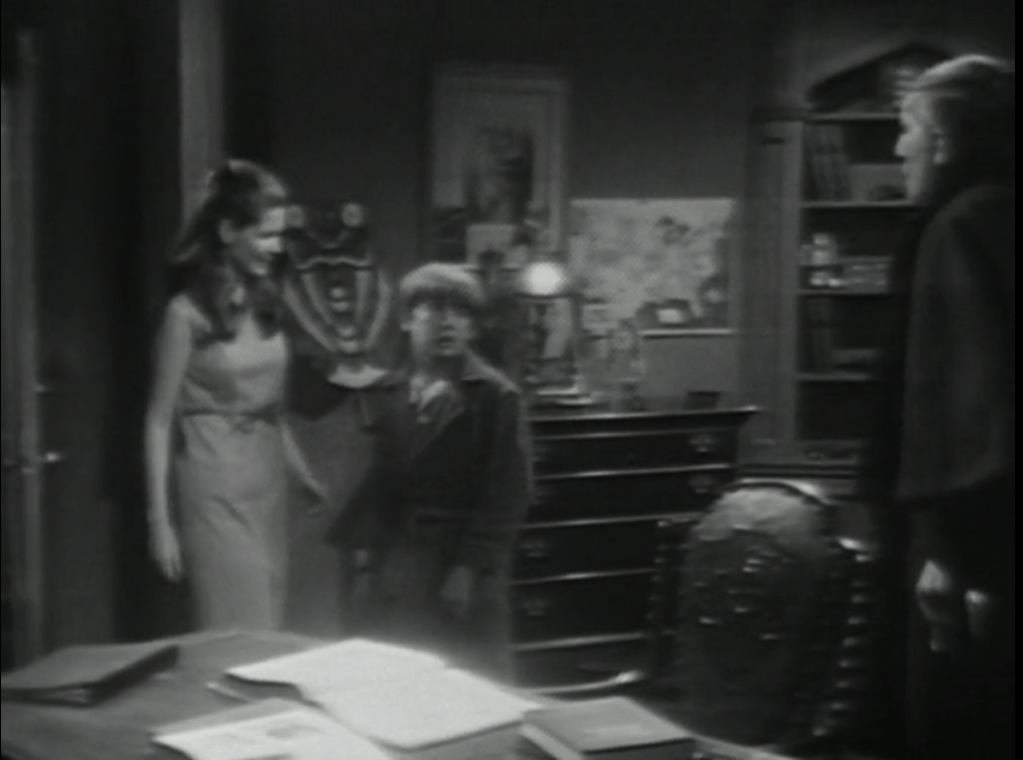
A knock comes at the door. It is Vicki. Vicki adores Barnabas, and the smile she wears when she enters the room shows her certainty that a heart-to-heart talk with him will have relieved David’s anxiety.
Smiling Vicki, sure everything will be all right
Vicki sees that David is still frightened, and her smile gives way to a look of confusion. Vicki was originally the audience’s point-of-view character; the audience is now composed chiefly of people who have tuned in wanting to see how they were going to fit a vampire into a daytime soap opera, and so of course she has to be Barnabas’ biggest fan at Collinwood. She and Barnabas leave David’s room together, and Barnabas wishes David “Pleasant dreams…”
We see David tossing in bed. He is talking in his sleep, calling out to Sarah. In yet another voiceover, we hear his dream. It is a bit of conversation from #306, when Sarah told him about the empty coffin.
We then see the beginning of another dream. It takes place amid a composite of decorations from the cemetery set and from the set representing Barnabas’ basement. David at first appears in a corridor like the ones we saw in the basement in #260.
The fog machine is working hard today.
He then encounters a faceless woman whom regular viewers will recognize as Barnabas’ co-conspirator, mad scientist Julia Hoffman.
David sees the faceless woman.
We see that she is wearing Julia’s wig and frock and holding the jeweled medallion she uses to hypnotize people:
Julia’s identifying marks.
David flees from the faceless woman, saying he has to find Sarah. He finds himself behind a grating like the one on the door to the Collins mausoleum:
Entering the tomb
He walks up a few stairs, and sees Sarah.
David finds Sarah
When David tells Sarah that she is hard to find, she denies it, saying that she is easy to find if you know where she is. David does not respond to this characteristically cryptic remark, but complains that she won’t tell him anything about herself. She asks what he wants to know, and says he wants to know who she is and where she comes from. She tells him:
Sarah: That’s easy. I was born the same place you were. I lived in a house on a hill until I was nine years old. Then I got very sick. Everyone came to see me, and they were very sad.
David: Because you were sick?
Sarah: No, because I died. I died, and everyone brought such pretty flowers.
“I died that time. I died, and everyone brought such pretty flowers.”
When David asks why she is around now if she died then, she tells him she doesn’t really know. All she knows is that she is looking for someone. David asks who that might be, and Sarah says she will show him. Suddenly he becomes frightened and does not want to go with her. She insists. She takes his hand and leads him.
Sarah leading David to her secret
The camera follows the children on their journey across the set. At first Sarah takes David down some stairs, leading him from depths to depths:
Sarah leads David down into the depths
The set is now unmistakably Barnabas’ basement, though with more candelabra casting more intricate shadows on the walls than we have seen there:
Vergil and Dante, junior edition
At last Sarah stops and looks straight ahead. They have reached their destination.
David is bewildered by the sight.
They see a coffin. David asks if this coffin is empty, as was the one in the secret chamber. Sarah tells him no. This one has a body in it. The lid starts to open. David points in astonishment, while Sarah looks on serenely.
The lid begins to open.
Barnabas rises from the coffin.
Barnabas rises.
David recognizes Barnabas and is stunned. Sarah has eyes only for her big brother.
David stunned.
Barnabas stands. He turns, and sees Sarah. He is glad to see her.
David watches Sarah’s reunion with Barnabas.
Barnabas notices David. He turns to follow him.
Barnabas blocks David from our view and from Sarah’s.
As Barnabas follows David, Sarah simply watches.
Sarah watching big brother.
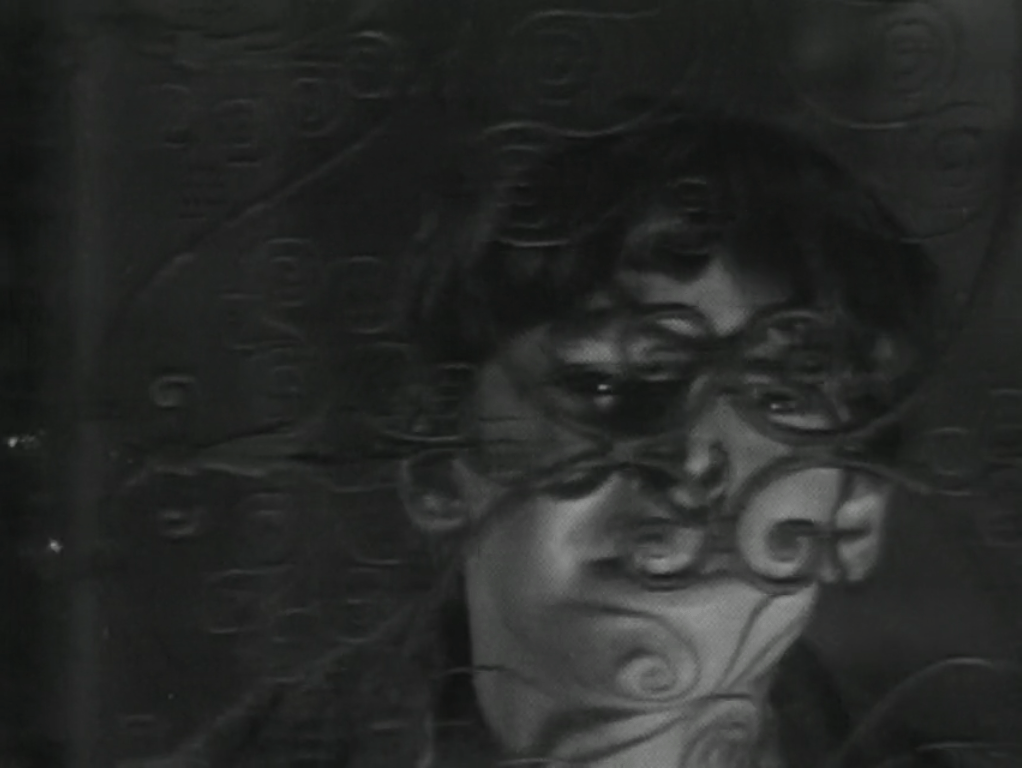
Barnabas follows David through another corridor. The shadows on the wall and floor form a design suggesting David is caught in a web. Readers of Gold Key comics’ Dark Shadows series will recognize the bend of Barnabas’ knees and the angle of his cane in this shot as their usual depiction of him:
David caught in Barnabas’ web.
David’s back is to the wall and Barnabas closes in on him.
Cornered.
Barnabas raises the cane he used to block David’s escape in #315 and which regular viewers several times saw him use to beat Willie. We zoom in on the wall, where we see the cane’s shadow rise and fall while we hear David cry out in distress.
Sarah’s fixation on Barnabas and her passivity when Barnabas follows David mark a pivotal moment in her development. She looks and sounds like a friendly little girl, and we have seen her rescue people from danger. She usually seems like a cross between Caspar the Friendly Ghost and the Powerpuff Girls. But she is not that at all. She is a symptom of the same curse that has brought Barnabas forth to prey upon the living, and she is leading David ever deeper into a world where only the dead belong. The show has given us no reason at all to think that she can bring him back to the realm of the living.
Even if Sarah wants to save David, she may still represent a deadly threat to him. We saw this in the Laura story. When Laura tried to lure David into the flames, she told him that he, like her, would rise from the ashes and live again. We had heard her say things like this before, and she may well have believed it to be true. But unknown to her, we saw a séance in which David spoke with the voice of a son Laura had in one of her previous incarnations. She had burned him with her, but while she gained a new life in the flames, he had become one of the unquiet spirits of the dead. Perhaps Sarah, too, is unwittingly leading David to his death.
Closing Miscellany
When Liz leads Barnabas into David’s room, she tells David that “Unc- Cousin Barnabas” wants to have a man-to-man talk with him. In later years, Jonathan Frid would refer to his character as “Uncle Barnabas” when he talked with interviewers about how the Collinses responded to him. I wonder if Joan Bennett’s blooper is a sign that he was already calling him that at this time.
There is a slight puzzle in Sarah telling David she was “born in the same place” he was. We’d heard in the early episodes that Laura and Roger never spent a night together in Collinwood as man and wife- the day of their wedding, they went to their new home in Augusta, Maine, and David was born a few months later. Perhaps Sarah’s remark is a retcon, and we are now to think of David as having been born at Collinwood. Or perhaps Sarah really was born where Augusta would stand- we know that her birth year was 1786, and that was the year the settlement that would become Augusta saw the establishment of its first public whipping post. Maybe her parents wanted to go there to celebrate the occasion.
When Sarah tells David she lived on the hill until she was nine, she interrupts herself and shouts “Ten!” This is an odd little blooper. Just a few days ago, David told Barnabas that Sarah was ten, and Barnabas jumped down his throat asking if she wasn’t “almost ten?” Now Sharon Smyth has been on the show long enough to have celebrated a birthday, and they aren’t done with Sarah yet. So they are retconning Sarah as having made it to ten.
Maggie Evans, The Nicest Girl in Town, has amnesia and can’t remember who abducted her in episode #235 and held her prisoner until #260. So the police started a rumor that her memory was returning, camped out in her yard, shot the first guy who strayed into it, and declared him to be the guilty party.
The man with five bullets in his back is Willie Loomis, servant to Old World gentleman Barnabas Collins. Sheriff Patterson tells Maggie, her father Sam, and her boyfriend Joe that he will be going to visit Barnabas and break the news to him about Willie. Maggie expresses sympathy for “poor Barnabas,” who will no doubt be heartbroken to hear ill-tidings about Willie. Sam is sorry to hear the sheriff will have to blight the dear fellow’s night, but the sheriff says Barnabas must be told. Willie lives in Barnabas’ house and, so far as anyone knows, has no access to any other building. So if he held Maggie prisoner for five weeks, you’d think the sheriff would have more to do on a visit to Barnabas’ place than simply deliver a message.
As it happens, Barnabas is the one responsible for Maggie’s plight. Willie was trying to get to Maggie to warn her that Barnabas had heard that her memory was coming back and was on his way to kill her. When the sheriff gets to Barnabas’ house, he finds him with his co-conspirator, mad scientist Julia Hoffman. Julia explains that she just came to the house to borrow a book. It’s four o’clock in the morning, by the way, but the sheriff takes that in stride and tells them what happened to Willie. He apologizes for disturbing them and says he can come back later if they would like. Barnabas says he wishes he could talk to Maggie, and the sheriff offers to take him and Julia to the Evans cottage. They accept this offer, and the sheriff goes outside to wait for them. Barnabas has long since cleaned up the evidence left over from Maggie’s weeks in his dungeon, so he doesn’t have to spend the time the sheriff so thoughtfully provides in tidying up. He and Julia can devote all of it to further conspiring.
Only Julia knows that Barnabas was the one who abducted Maggie in May, and only she knows that he has been planning to kill her ever since. But the sheriff and the Evanses drift into their own odd little conspiracy to shelter Barnabas from accountability.
Barnabas tells Maggie that he can’t help but “feel partly responsible” for what happened to her. She and Sam fall over themselves assuring him that he has nothing to feel bad about, that it was wonderful of him to try to rehabilitate Willie and that everyone was very impressed with how far he seemed to have got with that project.
Barnabas goes home. Julia accompanies him. She assures him that Willie will probably die, and urges him to relax, because he is “completely in the clear.” He bids her goodnight, by which I mean he grabs her throat and threatens to kill her if she is wrong. Once he is alone in the house, he thinks of the various people who might be able to bring his secrets to light. He settles on his ten year old cousin David, and resolves that “something must be done to keep him from exposing me, and it must be done soon!”
There is a touch of social satire in the deference everyone pays Barnabas. In #26, high-born ne’er-do-well Roger Collins wanted a particular service from Sheriff Patterson’s predecessor, the hapless Constable Jonas Carter. He told Carter that “My family is responsible for over half the jobs in this town,” and made a dark reference to an upcoming election. In #32, Carter went along with the Collins family’s cover-up of a case involving David, and in #272 and #273 Sheriff Patterson himself showed a mind-bending amount of solicitude to matriarch Elizabeth Collins Stoddard when she called to report that she had murdered her husband and that his body was buried in her basement.
Among the jobs for which the town has the Collinses to thank was an important one of Sam’s. In #222, Barnabas commissioned Sam to paint his portrait. When he offered to pay $1000, Sam and Maggie’s electrified reactions showed that this was more money than they had seen in a long time. They have good reason to think as highly of Barnabas as they possibly can.
Not only is Barnabas a member of the Collins family of Collinsport, but he is, again unknown to any of his protectors but Julia, a vampire. As such, he is a symbol both of extreme selfishness and of the dead past holding back people who want to make a new future. Dark Shadows does not often explore political themes in depth, to put it mildly. But today it does give us a glimpse of the way working people can find themselves defending the position and privileges of their very deadliest enemies.
Closing Miscellany
Barnabas looks at a “portrait” of his little sister Sarah, who died in 1796. We’ve seen this “portrait” many times, but usually it was at something of a distance from the camera, often at an oblique angle, and rarely shown for more than a brief moment. The typical TV set in 1967 would have allowed the viewer to believe it was a painting. But this time it fills the screen and is stationary for several seconds. Even though this episode only survives in an especially low-quality kinescope, it is impossible to overlook the fact that it is a photograph of Sharon Smyth, the child actress who plays Sarah’s ghost, taken at least 30 years before Joseph Nicéphore Niépce built his first camera.
Sarah Collins, d. 1796
This episode has an unusually large cast. In addition to the six regular actors, three of Sheriff Patterson’s deputies appear. None of them is credited, but the Dark Shadows wiki names them as Ed Crowley, Ted Beniades, and Dennis Johnson.
This one is an exercise in nostalgia for people who have been watching Dark Shadows from the beginning.
We remember the days when high-born ne’er-do-well Roger Collins was the show’s chief villain, a man with so little sense of family loyalty that he openly hated his own son. That son, strange and troubled boy David, repaid his father’s hatred by trying to murder him. Roger has been off-screen for over six weeks; when he comes back today, the first thing he sees is the sheriff’s car in the driveway, and the first thing he hears is that the sheriff has come about David. He stiffens, and in a voice dripping with distaste asks “What about David?” When well-meaning governess Vicki explains that David is not suspected of a crime, but is missing, Roger scolds her for failing to earn her pay by keeping track of the boy. He seems to be far more irked by the money wasted on Vicki’s salary than by David’s disappearance.
When heiress Carolyn and hardworking young fisherman Joe come to report on their fruitless search for David, Roger turns his disdain on them, berating them for letting him get away in the first place. Seeing Joe and Carolyn together brings back memories of the early months of the show, when the two of them were dating and there was a whole storyline about how bored they were with each other. For that matter, we were reminded of the first 40 weeks when Vicki hesitated to tell Roger that she had been on a date with her depressing fiancé Burke Devlin- Burke had been Roger’s sworn enemy until he decided to peace out in #201.
Roger agrees to go with Joe on a search of the countryside. When Vicki and Carolyn are left alone in the drawing room, they have a conversation about how tired they both are. Each of them urges the other to take a nap, and each responds that she can’t sleep. Writer Malcolm Marmorstein was fired off the show a few days ago; he was perfectly capable of taking a conversation like that and making a whole episode out of it. Today’s episode is filler from the point of view of the overall plot, but the ludicrous pointlessness of this conversation is a rarity in the post-Marmorstein era.
Roger and Joe’s search is represented in a couple of shots done in front of a green screen showing outdoor locations. That casts our minds back to the black and white episodes, which occasionally spliced in location inserts. Most of that footage was taken before the series started principal photography, and none of it can be reused now that the show is in color. The last of these inserts came in #275, when Carolyn took a walk on the beach. Now Dark Shadows is shut within the doors of 442 West 54th Street forever, and its only memory of the outside is in these green screen shots.
Roger continues his flagrant display of indifference to David throughout this sequence. When he sees men in blue uniforms searching for David, he makes some acerbic comments about the incompetence of the local police.* When Joe points out a nearby cemetery where odd events have been taking place of late, Roger remarks on its dreariness and on the generally low aesthetic standard of cemeteries in central Maine. When Joe suggests searching there, Roger is appalled, and joins him only with loud reluctance.
After Roger says “down” meaning “up,” which is a feature of Collinsport English we heard in #12, In the cemetery, we get another reminder of the show’s past. The Caretaker, a doddering old fool played hilariously by Daniel F. Keyes, had a significant part in the story of Roger’s ex-wife, undead fire witch Laura Murdoch Collins, appearing in #154, #157, #179, and #180, and appeared again in episodes #209 and #211, which dealt with the introduction of vampire Barnabas Collins.
When we find him today, the Caretaker is inspecting the area around the Tomb of the Collinses. Unknown to him, there is a secret chamber hidden inside this tomb. David is trapped in that chamber. The Caretaker opens the door to the visible part of the tomb and asks if anyone is there. He hears David’s voice calling for help from the other side of the wall, and jumps to the conclusion that he is hearing a bunch of ghosts. “There is no help for you!” he cries out. As he hurries away, he shouts, “You must rest!”
David is nothing if not obedient. A minute after the Caretaker told him he must rest, he sits down and falls asleep.
The Caretaker runs into Roger and Joe. He asks them if they are alive. As “You must rest!” harked back to his constant refrain in his previous appearances that “The dead must rest!,” so this greeting echoes his first line in his first scene, when he asked Vicki and her instantly forgettable boyfriend Frank if they were alive. Frank responded to that one calmly; with his personality, it was a question he probably got from a lot of people. By contrast, Joe is disbelieving and Roger scoffs.
When they tell the Caretaker they are looking for a boy named David, he replies “Yes, he is here,” then describes the death of a boy named David who is buried in one of the graves. His compulsion to tell us the circumstances of people’s deaths is another trait of his we remember from the Laura days, especially in his oft-repeated phrase “died by fire!”
The Caretaker tells them that he heard the voices of the dead in the tomb. He urges Roger and Joe to stay away from it. Roger tells him he will be happy to oblige, but Joe insists they search there. Roger declares that he is embarrassed by the very idea of going inside such a place, and says that if anyone finds out he did he will blame Joe. Again, Roger can barely restrain his eagerness to give up the search for David.
David is too deeply asleep to hear Roger and Joe in the outer chamber. Since they are there, Roger decides to take a moment and look at the plaques naming the people buried in the tomb. After all, they are his “incestors – incestors! I mean ancestors.” This is one of the most famous bloopers in the entire series. If Louis Edmonds hadn’t stopped, glanced back at Joel Crothers, repeated “incestors,” and corrected himself, I doubt many people would have noticed it. It was a suprisingly unprofessional moment, but who would have it otherwise? To the extent that the episode is a retrospective of Dark Shadows so far, it wouldn’t be complete without an attention-grabbing mess-up. If the camera isn’t going to drift away from the mark and show a crew member eating a sandwich, “incestors” is the least we can expect.
Since the episode is so much a review of the show’s bygone themes, it is understandable that some viewers are disturbed by a line in the first scene. Roger mentions to Vicki that, while he has just returned from a trip to Boston, matriarch Liz is staying on in that city a while longer. The Dark Shadows wiki objects: “Elizabeth has decided to stay in Boston. This is incredible, since she was still afraid to leave Collinwood a few weeks ago, even hesitant to go to the Old House.”
I don’t find it incredible. Liz’ hesitation about going out was last mentioned in #280, and by #298 she was not only quick to accept Burke’s suggestion that she go with him to inspect a property on the other side of town, but she was the one who talked Carolyn into coming along with them. Neither Carolyn nor Burke expressed surprise that Liz was the one who was enthusiastic about getting out of the house. With that, Dark Shadows told us that it had no further use for the “Liz is a recluse” theme. They may be taking us on a stroll down memory lane today, but they aren’t going to take us all the way to that particular dead end.
*In all fairness, the Collinsport police are exceptionally incompetent.
The only story on Dark Shadows at this point is the one about vampire Barnabas Collins. They’re trying to get a second one off the ground, about an old vacant house that has caught the fancy of well-meaning governess Vicki. Vicki’s depressing boyfriend Burke has interpreted her interest in the place as a marriage proposal. He wants to buy the house and live in it with her.
Today, we find out that the house is the property of the ancient and esteemed Collins family. That isn’t a big surprise, since Barnabas clearly knew something about it from his time as a human. It does suggest a partial answer to a question Vicki had when she, Burke, and Barnabas visited the house on Thursday. Barnabas found a handkerchief there bearing the initials “F. McA. C.” and gave it to Vicki. She expressed a determination to find out what those initials stood for. Now she should be able to look at the family’s records and search for a Mrs Collins whose maiden name had the initials “F. McA.”
Burke asks matriarch Liz if she is willing to sell the house to him, and she is perfectly agreeable. Liz’ daughter Carolyn joins them for a tour of the house. There is some startlingly sloppy writing in this scene. Carolyn remarks that the house has a special warmth and speculates that it is the result of so much light reflected into its windows from the sea nearby. A couple of minutes later, Liz complains that the house is terribly cold, and Carolyn says that’s because it is so close to the sea.
Both Liz’ glad willingness to sell the house to Burke and her trip to it signal that storylines from the first year of the show are now behind us once and for all. Burke was introduced in episode 1 as a dashing action hero returning to his home town to wreak vengeance on his old persecutors, the Collins family. The “Revenge of Burke Devlin” arc consisted so largely of talk about people, places, and events we never saw that it didn’t amount to much, and by the time Burke formally renounced his revenge in #201 it had long since fizzled. That left some chance it would flare back up, so in #223 Liz vowed she would never sell Burke any property at any price, but now the door is firmly closed on that old theme.
When Dark Shadows started, Liz was a recluse who hadn’t left home in eighteen years. Since they never showed us anyplace Liz might want to go, that story was an even more total dud than was The Revenge of Burke Devlin. Even after the reason for Liz’ seclusion was exposed as fraudulent in #273, she still made a show of reluctance when her brother Roger suggested she go to town in #277. Now she doesn’t hesitate to hop in a car and go to the house by the sea. In fact, she is the one who urges Carolyn to get out of the house. So that sends another non-starter to the narrative junk yard.
In this episode, the characters refer to “the house by the sea” as “Seaview.” That was an inside joke. The Newport, Rhode Island mansion used in the exterior establishing shots of the great house of Collinwood was known as Seaview Terrace. In 1974, Martin and Millicent Carey bought the house, and it came to be known as the Carey Mansion.
Meanwhile, Vicki is visiting Maggie Evans, The Nicest Girl in Town. Maggie has amnesia, a condition induced by her doctor, mad scientist Julia Hoffman. Julia is in league with Barnabas, and has damaged Maggie’s memory to keep her from recalling that Barnabas abducted her and tried to replace her personality with that of his lost love Josette. Vicki is trying to help Maggie regain her memory.
There is another instance of distressingly sloppy writing in this scene. Vicki tells Maggie that she thought she saw her in Eagle Hill cemetery during the period she cannot recall. She tells Maggie that Burke tried to convince her that she can’t have seen her. In response, Maggie asks if Burke saw her, and Vicki again says Burke tried to convince her she hadn’t seen her.
Vicki tells Maggie that she and Burke had gone to the cemetery to lay flowers at Josette’s grave. Maggie reacts strongly to Josette’s name, and Vicki starts telling her about Josette. When she mentions that Barnabas has restored Josette’s room, a light comes on in Maggie’s eyes and she grows very animated. She is about to say something when a knock comes at the door. It is Julia.
There is a strange blooper in the conversation between Vicki and Julia at the door. Julia asks “Would it be all right if I came in and waited?” Vicki responds “Not at all.” My wife, Mrs Acilius, is usually very forgiving of bloopers, but she laughed out loud at this one.
It could be that Julia’s line was “Would you mind if I came in and waited?” Alexandra Moltke Isles was famously accurate with her line delivery, even when her scene partners bobbled, and it could be that she just went ahead and said what Vicki was supposed to say even though it didn’t make sense. In view of Carolyn’s self-contradictory lines about the temperature of the house and Vicki’s repetitious lines about Burke’s attempt to gaslight her, both of which were obviously scripted, it could also be that the actors are working from Ron Sproat’s unrevised first draft.
While Julia looks at some of Maggie’s father’s paintings, Vicki sits back on the couch with Maggie. Julia hears Maggie exclaim “Barnabas!” and get very agitated. It seems she is about to tell Vicki all about what happened when she was missing.
Maggie, remembering
Julia swoops in, asking if they like antiques. Vicki looks bewildered at the interruption, but answers with a polite yes.
Julia interrupts
Julia presses her jeweled medallion on her. Vicki passes it to Maggie, and Julia asks for a cup of tea. Maggie volunteers to make the tea, but Vicki insists on doing it. In #143, the living room and kitchen in the Evans cottage were two parts of an undivided space, but now we hear Vicki close a door when she goes to make tea. Not only is that confusing to viewers who remember the earlier episodes, but since Vicki goes in the direction of the front door it seems for a moment that she is leaving the cottage altogether.
While Vicki is out of the room, Julia hypnotizes Maggie. She commands her to forget everything that happened while she was missing. When Vicki returns, Maggie has indeed forgotten everything.
It’s chiasmus week on Dark Shadows. Chiasmus is when the last thing that happens in a story resembles the first thing that happened. Usually that causes the audience to look back on that first thing in a new light. Sometimes chiasmus gets very detailed, and the first several things are mirrored by the last several things.
On Wednesday, we began with well-meaning governess Vicki asleep in vampire Barnabas Collins’ house on the estate of Collinwood. Barnabas crept into her bedroom and stood over her, but did not bite. Then it was morning, and Barnabas’ sorely bedraggled blood thrall Willie delayed Vicki as she was leaving the house. Vicki took our point of view with her to the great house on the estate, where we started to see events through the eyes of visiting mad scientist Julia Hoffman. That episode ended with Julia going to Barnabas’ house. Willie delayed Julia entering the house, and Barnabas and Julia met. Their scene was tense, but Barnabas did not use any of his powers against Julia. That chiasmus marked the transition from Vicki to Julia as the audience’s main character to identify with.
On Thursday, we began with Barnabas spying on Vicki through her window, then entering her bedroom and standing over her while she slept. He again left the room without harming her. We ended with Julia spying on Barnabas through his window, then entering his house, opening his coffin, and looking at him. The parallel is completed when we see today that she left the coffin room without harming Barnabas. That chiasmus showed that Julia is capable of turning the tables on Barnabas.
Today’s episode begins with a reprise of yesterday’s cliffhanger, showing Julia gasping when she opens the coffin. So returning viewers suspect that it is likely to end with Barnabas in Julia’s room, and the suspense comes as we try to figure out how he will get there and how she will escape his malign power.
We see Julia in the drawing room of the great house talking to her friend, addled quack Dave Woodard. Dr Woodard says that her failure to report to him on the progress she has made with their common patient, Maggie Evans, The Nicest Girl in Town, coupled with her presence at Collinwood, a hundred miles from the hospital where Maggie is, has forced him to remove Maggie from her care. Julia lies to him, claiming that she has no progress to report and that the whole thing is impossibly boring. This somehow convinces Dr Woodard to leave Julia on the case.
Julia is at Collinwood pretending to be an historian studying the old families of New England, and Vicki has volunteered to help her in her research. Now Vicki is terribly afraid that if she gets involved in what Julia is doing, she will become involved in things that are too interesting for her to handle, and she wants to withdraw before she forever loses contact with tedium and drabness.
Barnabas tells Vicki that she has nothing to fear from “the past,” which at this point on Dark Shadows means the plot. While he is reassuring her, the set catches fire. We hear fire extinguishers and other noises in the background, but Jonathan Frid and Alexandra Moltke Isles don’t break character for an instant. The scene is a dreary one, marking as it does the doom of Vicki as a major part of the show, and the lines are poorly written, but they are absolutely committed to their work.
Barnabas does not believe Julia’s cover story, and is quite sure she represents a threat to him. He meets with her in the drawing room to reiterate his refusal to cooperate with her project. When Julia says that she is particularly interested in his “namesake”- actually himself- Barnabas airily asserts that he was by all accounts a dull fellow. Julia may have been able to sell that line to Dr Woodard on this same set a few minutes ago, but Barnabas doesn’t make any impression on Julia with it. The two of them continue to argue as they pass from the drawing room through the foyer. The dialogue isn’t really any better than what Barnabas and Vicki had in the previous scene, but because Frid and Grayson Hall have a lively relationship to depict- two people who each of whom knows more about the other than they are willing to say, and each of whom knows that the other knows much of what they are holding back- they make their whole sparring match seem to glisten with wit and style.
Barnabas agrees to meet Julia at his house the next evening. After he leaves, Julia tells his portrait that she can’t wait that long for their next encounter, and she knows he can’t, either.
We cut to Julia in her bedroom. Vicki pays a visit, during which we hear another depressing conversation about Vicki’s newfound fear of narrative relevance. Julia assures her that “There is nothing for you to fear.” After Vicki leaves, Julia looks at her clock and sees it is a quarter to one in the morning. We dissolve to the foyer, where the hall clock reads 2:00. Barnabas appears in Julia’s bedroom and approaches the bed, where he prepares to uncover Julia. We then hear Julia greeting Barnabas by name. She emerges from the shadows on the other end of the room, and tells Barnabas she has been waiting for him a long, long time.
At the great house of Collinwood, well-meaning governess Vicki is in a stupor, staring out a window and dreaming of a time when she will again be central to the plot.
Ever since #191 when she rescued her charge, strange and troubled boy David Collins, from his mother, undead fire witch Laura, Vicki has been hanging on to narrative relevance by her fingernails. Now Dark Shadows is built around vampire Barnabas Collins, and Vicki longs to play a major role in his storyline. He plans to make her his next victim, but is moving so slowly towards that objective that we’ve started to wonder if he ever will strike.
David comes into the room and calls Vicki’s name several times. When she finally comes to, she admits that she has been zoning out a lot lately, and says that it is a habit she needs to break. David says that it frightens him when she gets that way. She doesn’t look like herself when those spells come over her. He gets the feeling that she’s turning into someone else. Vicki can’t deny that David is onto something, and only when he insists on sticking with the subject after she has clearly become uncomfortable does Vicki become defensive and retreat behind claims that David is letting his imagination run away with him.
Mad scientist Julia Hoffman has insinuated herself into the house, concealing her true identity and pretending to be an historian writing a book about the old families of New England. David shows her an album of family portraits. He identifies one portrait as his namesake, David Collins. In #153, it was established that he was the first member of the family to bear the name “David,” and that his mother Laura insisted on giving her son this name would ultimately become evidence that her evil plans for him were in place long before he was born. So David’s remark about a previous “David Collins” will strike longtime viewers as a significant retcon.*
Though David has looked through the book many times, he finds a portrait in it that he has never seen before. It depicts Sarah Collins, who lived from 1786 to 1796. Sarah’s ghost has been busy in the area in recent weeks, and the clear implication is that she inserted the page. That in turn would suggest that Sarah might have more powers than we have seen her use so far.
Julia and David find a photograph of Sarah Collins, d. 1796. Screenshot by Dark Shadows Before I Die
David has seen Sarah and played with her on more than one occasion, and he recognizes the portrait. He wonders aloud if the girl he has met is Sarah’s ghost. Julia laughs off the suggestion. Vicki returns. She also recognizes the picture of Sarah. The police circulated a drawing of her when Maggie Evans, The Nicest Girl in Town, was missing. Since Julia is actually a doctor who found out that supernatural doings were afoot at Collinwood when she was treating Maggie, she has heard several facts about Sarah, and by the end of her talks with David and Vicki she knows enough to be sure David is right about her.
We cut to the Blue Whale tavern, where Vicki is on a date with her depressing boyfriend, fake Shemp Burke Devlin. Burke sullenly complains about Vicki’s wish to help Julia with her project, complaining about Vicki’s “interest in the past.” “Interest in the past” is at this point synonymous with “a function in the story,” and Burke lost the last trace of that months ago. It’s as if Burke and Vicki know that they are fictional characters, and he resents her for holding on to a place in the action while he has settled in once and for all on the discard pile.
Vicki mentions that the night before, she had been awakened by the sound of a small girl singing. She says that after she got up and lit a candle, she could still hear the singing, but could not see the girl. Burke is too busy grumbling and making nasty remarks about Vicki’s mental health to ask her why she lit a candle rather than flipping the light switch. Vicki has to press on with more details and then volunteer that she wasn’t sleeping in her own room. She was sleeping in the Old House at Collinwood, home to Barnabas Collins.
Burke is upset by this news. Unfortunately Vicki doesn’t let him believe she went to bed with Barnabas. She tells him she was in a guest room, and that Barnabas was “a perfect gentleman.” Burke demands Vicki never go to the Old House again, and she refuses to make any such promise.
Julia takes the book of portraits to the Old House and insists that Barnabas look through it. While he grudgingly complies, Julia opens her compact. She finds that Barnabas does not cast a reflection in its mirror. This confirms her suspicion that Barnabas is a vampire. In #241 and #278, we had seen his reflection, but perhaps those were slip-ups and they were planning all along to use the idea that vampires do not cast a reflection.
Barnabas catches Julia studying her mirror and angrily asks what she is doing. She smiles and chirps that even historians have their share of feminine vanity. He glowers at her. The camera holds on his menacing look for quite some time, leading us to think that Julia has signed her own death warrant. But she doesn’t seem to think she is in any great danger. She is still smiling when she leaves.
Back in the great house, Vicki wanders up to the portrait of Barnabas that hangs by the front door. Apparently she is planning to stare at it as she resumes her dream of having something to do on the show. It worked for dangerously unstable ruffian Willie Loomis- after a couple of long sessions staring at the portrait, Barnabas summoned him and next thing he knew he was securely established as his sorely bedraggled blood thrall, a core member of the cast. So Vicki is trying to take a proven path to success.
Before Vicki can get any high-quality staring done, Julia enters. Vicki asks her how it went with Barnabas, and Julia exults that she may have learned everything she needed to know.
*My wife, Mrs Acilius, noticed this and had a lot to say about it. I will refer to her insights in later entries, as they would contain spoilers at this point in the run of the show.
The first major villain on Dark Shadows was high-born ne’er-do-well Roger Collins, played by Louis Edmonds. Edmonds was a master of the sarcastic remark, so that Roger was often funny. But no matter how often he made the audience laugh, Roger was never a comic villain. That requires a character we can empathize with as we watch them scheme and plot, scramble and improvise, in pursuit of goals that could not be achieved without ruining all the fun. We laugh when we recognize our own foibles in an outlandish character, and laugh again when we realize that our ability to feel with others encompasses even those whose feelings have led them to do dastardly deeds.
Roger’s personality was too cold, his motives too contemptible for us to empathize with him. Where a comic villain thinks fast and puts himself in ridiculous situations, Roger stuck with his fixed ideas, using the same tactics time and again to bully his unwilling co-conspirator Sam to stick with their plan. Even when he bumbled about with a damning piece of evidence, a fountain pen left at a crime scene, he was never the coyote caught in his own over-elaborate trap, but a criminal in a police procedural. He was a melodramatic villain who was only incidentally funny.
The first supernatural menace on the show was Roger’s ex-wife, undead fire witch Laura Murdoch Collins, played by Diana Millay. Millay was hilarious, every bit as funny as Louis Edmonds. It was a shame the two of them didn’t play a married couple in a long-running comedy. They could have raised sarcasm to heights previously unknown to humankind. But while Millay gets laughs every time the script gives her the least chance, Laura was even less of a comic villain than Roger.
It is clear that Laura is a malign presence from beyond the grave and that, if she is not stopped, she will burn her young son David to death. But everything else about her is an impenetrable mystery. She is not part of a familiar mythology, and even the most basic questions about her remain unanswered. We cannot empathize with her motives, since we cannot begin to guess what her motives are or even be sure if she has motives.
The first comic villain on Dark Shadows was seagoing con man Jason McGuire, played by Dennis Patrick. Jason had his first comic turns only after he had been on the show for weeks, during which time we had been subjected to many iterations of a dreary ritual in which he made a demand of reclusive matriarch Liz, Liz resisted, he threatened to expose her terrible secret, and she capitulated. When his henchman Willie slips out of Jason’s control and he starts scrambling to contain the damage Willie is doing to his plan, Patrick finally gets a chance to play Jason as a comic villain, and the result is very engaging. But those scenes are scattered too thinly through Jason’s long-running, relentlessly monotonous storyline to make him a success as a comic villain.
Now, the show has struck gold. Vampire Barnabas Collins is becoming a pop culture phenomenon and bringing the show the first good ratings it has ever had. They have to keep Barnabas on the show indefinitely, and he has to be the most important character. That presents a practical difficulty. Vampires usually figure in folklore and fiction as unstoppable killing machines. Daytime soap operas explore the shifting relationships among large casts of characters. It’s going to be hard to maintain that cast if Barnabas sets about murdering everyone. To square the circle, they try to redefine Barnabas as a comic villain.
Barnabas is giving a costume party for his distant cousins, the living members of the Collins family. He has invited well-meaning governess Vicki to attend and to wear the dress of the legendary Josette Collins. In the first 39 weeks of Dark Shadows, Vicki had developed a close friendship with Josette’s ghost, so she is excited about this. For his part, Barnabas has borrowed an evil scheme from the 1932 film The Mummy. He will erase Vicki’s personality and replace it with Josette’s, then kill her so that she will rise as a vampiric Josette. So he is glad she likes the dress.
Barnabas asks Vicki to come to his house and help him pick out the antique clothes that the family will wear at the party. She enthusiastically agrees, saying that she loves to go through trunks full of old clothes. The clothes are in a trunk in Josette’s old room, which Barnabas has restored.
In the room, we see the ghost of Barnabas’ 9 year old sister Sarah sitting on the trunk. She vanishes a second before Barnabas and Vicki enter. Both of them have a strong feeling that someone just left the room. Barnabas tries to dismiss the sensation as nervousness, but Vicki has had too much experience with ghosts to be put off so easily.
Vicki has been our point of view character for most of the series. At first, that was because she was a newcomer to the great estate of Collinwood and the nearby town of Collinsport, and so we would learn everything we needed to know as we listened to people explain things to her. Later, it was because she was the key protagonist in the stories, so that the action got going once she knew what was going on. So when Barnabas equals Vicki’s sensitivity to Sarah’s presence, he is presented to us as another possible point of view character.
Barnabas keeps talking about the Collinses’ eighteenth century ancestors in terms that make it obvious that he knew them, so that he more than once has to clean up after himself with remarks like “I would imagine.” He does alarm Vicki when he blurts out something about what will happen to her should she “become Josette.” He hastens to say that he means that Vicki will become her for the duration of the party.
“Become Josette?”
Vicki goes back to the great house and talks with Liz about the party. Liz smiles happily, the first time we’ve seen this expression on her face in the whole run of the series.
Happy Liz
Vicki goes on about Barnabas’ connection to the past, saying that he gives the impression of someone who really is misplaced in time. She has the feeling that he needs to recreate a bygone era, and that he is doomed to be unhappy because of the impossibility of traveling backward in time. Vicki does not know what Barnabas’ plans for her are, but she understands his motives perfectly and empathizes with him deeply. That Vicki, Barnabas’ intended victim, can feel this way suggests that we can, too.
Back in Barnabas’ house, Sarah reappears in Josette’s room and sees her blue dress. She is excited to find it. She looks at her reflection in the mirror and smiles. Her good cheer is emphasized when her musical cue, an excerpt from “London Bridge,” is for the first time played in a major key.
Sarah’s reflection looks like it has never seen a ghost before
The minor key was appropriate during Sarah’s previous appearances. The first several times we saw her, Sarah was associated with Barnabas’ imprisonment of Maggie Evans, The Nicest Girl in Town. Maggie was the victim of Barnabas’ first mad attempt at Josettery, and Sarah intervened just in time to keep Barnabas from killing her. The other day, Barnabas killed Jason, and we saw Sarah when Barnabas was forcing Willie to help him hide his old friend’s corpse. Barnabas isn’t killing anyone today, so Sarah can be a bit more cheerful.
Sarah helps to establish Barnabas as a comic villain. As the ghostly sister who returned to the upper world when Barnabas was loosed to prey upon the living, Sarah and he are part of the same eruption from Dark Shadows‘ supernatural back-world into its main continuity. Perhaps she personifies his conscience, certainly she gives him an occasion to make schmaltzy speeches about his days as a human. More important than either of these, when we see that Barnabas’ 9 year old sister is his most powerful adversary, we begin to wonder just how seriously we should take him.
Closing Miscellany
Yesterday and today, Alexandra Moltke Isles delivered the recorded voiceover monologue at the beginning of the episode. The first 270 times she did this, it was in character as Vicki. Now, they’ve given up the idea that Vicki or any other one character will eventually find out about everything that we see on screen, so the openings are delivered by whatever actress is available as a nameless external narrator.
In those first 270 outings, Mrs Isles sounded like Vicki. She adopted Vicki’s distinctive way of speaking, carefully articulating one word at a time and often ending sentences with surprising little inflections- a curl of uncertainty here, a touch of breathy optimism there, a falling note of despair in another place. The voiceovers were usually remarks about the weather or the sea that were supposed to involve some vague metaphor for events in the story, so that it is open to question whether it was really worth Mrs Isles’ time to put so much effort into creating a character with them. But I guess a pro is a pro, and it was a matter of course that she would do her best no matter how little she had to work with.
In these last two, she has used a relatively flat voice, with none of Vicki’s particular vocal traits. The pacing has been structured, not around sentences, but around an attempt to convey an overall sense of urgency. They sound very much like The Narrator. I wonder what Mrs Isles would have made of The Narrator if the voiceover passages had extended beyond the opening moments and run through the episodes.
There is a famous production error under the closing credits, when a stagehand shows up in the window, realizes he’s on camera, and makes himself all the more conspicuous when he tries to escape from his predicament.
Frustrated that her mother, reclusive matriarch Liz, has decided to marry seagoing con man Jason McGuire, flighty heiress Carolyn spends the day and night with motorcycle enthusiast Buzz Hackett.
Buzz is modeled on the biker dude villains of Beach Blanket Bingo. Some of his mannerisms, such as speaking in a Beatnik slang that was a decade and a half out of date by 1967 and wearing sunglasses when he rides his motorcycle at night, would have been a little too broadly comic even for that movie, and are ludicrously out of place on the rather solemn Dark Shadows. The very sight of Buzz therefore raises a laugh.
I mean really
Nancy Barrett’s acting style was to throw herself unreservedly into whatever the script had her character doing that day, and seeing her present Carolyn as a newly minted biker mama is hilarious from beginning to end. When Carolyn and Buzz show up at the Blue Whale tavern, she’s already sloppily drunk. They see well-meaning governess Vicki and hardworking young fisherman Joe at a table, and Carolyn insists they go over and greet them. Vicki and Joe give Buzz and Carolyn frosty stares, which are of course the main ingredients of drawing room comedy.
If Vicki put on a police uniform, Carolyn wore a big feathered headdress, and Joe were a construction worker, they could make beautiful music together
As Danny Horn points out in his post about the episode on Dark Shadows Every Day, Buzz is actually pretty nice. That’s a good comic move- the obvious outsider is the one who knows enough to be uncomfortable, while the one who has been a central member of the cast from the first week is oblivious to the social awkwardness surrounding her. If it were the other way around, we might feel sorry for Buzz or be angry with him, but since we know that Carolyn’s place is essentially secure we can laugh at her uninhibited behavior, no matter how much it may make others squirm.
Buzz takes Carolyn home to the great house of Collinwood, parking his motorcycle a few feet from the front door. That isn’t a sign of inconsideration- there only are a few feet in front of the door, they’d be off the set if he parked any further away. It’s still pretty funny to see.
Buzz and Carolyn
Inside the house, Buzz jokes about riding his bike up the main staircase. Carolyn laughs, then urges him actually to do it. He refuses, clearly appalled that she would want such a thing.
Carolyn shocks Buzz
They go into the drawing room. Carolyn picks up a transistor radio and finds some dance music. Buzz is ready to dance, but takes a seat when Carolyn goes into the violent, rhythm-less jerks people in Collinsport do when music is playing. Buzz watches her, apparently ready to provide first aid.
As Carolyn’s performance of the Collinsport Convulsion ends with her falling face first, Liz comes downstairs. She protests against Carolyn and Buzz making so much noise at 3 AM. For the first time, Buzz is rude. He does not stand up when Liz comes into the room, and when Carolyn introduces her as “Mommy,” he greets her with “Hiya, Mommy!” Liz orders him to go.
Before Buzz has a chance to comply, Carolyn starts taunting her mother, yelling at her that her name will soon be “Mrs McGuire!” Liz retreats up the stairs as Carolyn taunts her with repetitions of this name. When Liz is on the landing, Carolyn and Buzz clench and kiss passionately. While they kiss, we see Liz above and behind them, trying to exit the scene. As it happens, the door she is supposed to go out is stuck, so she has to struggle with the knob until she’s out of the frame. Thus, the longest period of intentional comedy on the show ends, not with a break into angry melodrama, but with a huge unintended laugh. It is one of the few truly perfect things ever seen on television.
Door’s stuck
As Buzz, Michael Hadge really isn’t much of an actor- he shouts his lines and goes slack whenever he isn’t speaking. That doesn’t matter so much today. Nancy Barrett’s high-energy performance, the other cast members’ skill at comedy of manners, and the mere sight of Buzz combine to keep the audience in stitches throughout.
Still, I can’t help but wonder what might have been. Yesterday, vampire Barnabas Collins threatened to murder his blood thrall, the sorely bedraggled Willie Loomis. Viewers watching on first run might have wondered if Buzz was going to be his replacement. They might have, that is, if Buzz were played by an actor in the same league as John Karlen. With Mr Hadge in the role, that suspense never gets off the ground.
One of the little games I play in my head when the show gets boring is to ask who else might have taken a part and to imagine how it would have changed with that other actor in the cast. So, if Harvey Keitel was available to dance in the background at the Blue Whale in #33, then surely Mr Keitel’s friend Robert De Niro would have taken a speaking part in #252. Actors inspire screenwriters, and if Mr De Niro had played Buzz I would have wanted to write this line for him to speak to Liz: “Mrs Stoddard, you got me all wrong. You think I want to hurt you, or take something from you, but that’s not the way it is. Me and Carolyn, we’re just trying to have a good time.” Mr Hadge’s shouting wouldn’t have made much of a line like that, but delivered by Mr De Niro to Joan Bennett it could have started a scene between Buzz and Liz that would have expanded his role beyond comic relief and earned him a permanent place in the cast.
It may be for the best that it didn’t work out that way. A De Niro-Buzz might have been such a hit that Dark Shadows never would have got round to becoming the excursion into sheer lunacy that we know and love. And Martin Scorsese might never have been able to get soap opera star/ teen idol Robert De Niro to answer his phone calls.
Closing Miscellany
There are some other notable moments today. We might wonder why Vicki and Joe are sitting together in the Blue Whale, when Vicki has been dating dashing action hero Burke. In fact, the script originally called for Vicki to be out with Burke, but actor Mitch Ryan showed up too drunk to work the day they taped this one and was fired off the show. Burke gave up on his big storyline over ten weeks ago and there hasn’t been a reason for him to be on the show since. Besides, the same cast of characters cannot indefinitely include one whose type is “dashing action hero” and another whose type is “vampire.” The vampire is already pulling in bigger audiences than anything else they’ve done, so Burke has to go. Still, Ryan was such a charismatic screen presence that he was a high point in every episode he appeared in, so it’s sad we’ve seen him for the last time.
The bartender brings drinks to Vicki and Joe’s table and Joe calls him “Bob.” They have settled on this name by now. The same performer, Bob O’Connell, has been playing the bartender since the first week, but in the opening months of the show he had a long list of names. My favorite was “Punchy.”
There is some new music in the jukebox at the tavern and more new music while Carolyn and Buzz are outside the front doors of Collinwood. In the tavern we hear something with brass, and at the doors we hear a low-key saxophone solo.
The closing credits give Buzz’ last name as “Hackett.” We heard about a businessman named Hackett in #223, but Buzz doesn’t seem to be related to him. In the Blue Whale, Carolyn says that her mother has more money than Buzz will ever see, to which Buzz laughingly replies “That isn’t much!”
The first shot of the first episode of Dark Shadows featured well-meaning governess Vicki sitting on a train next to a window in which we saw the reflection of dashing action hero Burke Devlin. Vicki was on her way to the great estate of Collinwood, where she hoped to learn who her birth parents were. Burke was on his way to the village of Collinsport, where he hoped to exact revenge on high-born ne’er-do-well Roger Collins and other residents of Collinwood.
Vicki’s quest to learn her origins never took off, and hasn’t been mentioned for months. Burke’s pursuit of revenge drove a lot of action in the first twenty-one weeks of the show, but has been fading ever further into the background in the nineteen weeks since. Today, it fizzles out altogether.
In his original story bible for Dark Shadows, titled Shadows on the Wall, Art Wallace had proposed that Burke’s pressure on Roger would culminate in Roger’s death. Roger was to inadvertently reveal to Vicki that he was guilty of the crime that sent Burke to prison long ago. Roger would then try to push Vicki off the cliff at Widow’s Hill, but would miss her and go over the edge himself. The show discarded this resolution when Roger’s relationships with several other characters proved to be consistently interesting, particularly the Bossy Big Sister/ Bratty Little Brother dynamic between him and reclusive matriarch Liz. Besides, Louis Edmonds had such a gift for comic dialogue that he could get a laugh out of even the lines in which Malcolm Marmorstein attempted to be funny. So they couldn’t afford to kill Roger off.
Further, they have gone over Roger’s crime so frequently and made all the details so clear to everyone concerned that a trial wouldn’t give the audience any new information about what happened or show us any characters reacting to shocking news. It would be like a real trial, where all the evidence has gone through a discovery process and there are no surprise witnesses. No one is going to put that on commercial television in 1967.
So when Burke shows up at the great house of Collinwood with drunken artist Sam Evans, who has finally admitted that he saw what happened and took Roger’s bribe to keep quiet about it, the only real question is how Burke can leave the status quo in place.
Burke demands that Roger and Liz meet with him and Sam in the drawing room. Burke demonstrates his mastery by closing the drawing room doors, something that Liz, the mistress of Collinwood, usually does, and that Vicki did several times during the weeks when Liz was away and she was effectively in charge of the place.*
Roger of course tries out a series of lies in his attempts to deny Burke and Sam’s charges, but Liz is convinced. When she picks up the telephone and calls the sheriff, Burke reaches in and disconnects her. He says that she doesn’t have to turn Roger in- it is enough for him to know that she really would do it. She declares that she won’t let Burke keep coming back and using Roger’s guilt to blackmail the family, apparently intending to place another call. Burke says that he will never bring it up again, provided Roger confesses here and now in front of the three of them. He does. Burke tells Roger that he used to want to see him rot in jail but that now he realizes that “People like you rot wherever they are.” Burke and Sam leave, and that’s that as far as they are concerned.
During a few scenes scattered throughout the first forty weeks of Dark Shadows, Burke had considered relenting from his quest for vengeance. Those scenes hadn’t been developed in any great depth, and hadn’t been connected to each other. Only in the climactic week of the “Phoenix” storyline, when Burke and Roger briefly joined forces to save Roger’s young son David from death at the hands of his mother, blonde fire witch Laura Murdoch Collins, did we have a sustained glimpse of something other than all-consuming enmity between the two men. That was such an extreme situation, and was followed so quickly by a renewal of their hostilities, that Burke’s decision to peace out cannot be said to have any foundation in what we have seen the characters do so far. It is simply a convenient way of discarding a story element that has outlived its usefulness.
Most episodes of Dark Shadows have a cast of five actors. The rest are almost evenly divided between casts of six and casts of four. Today is a rarity with eight on screen. Six of these eight have been deeply involved in the Revenge of Burke Devlin storyline, and are at loose ends now that it has reached its abrupt conclusion. Burke, Roger, and Sam suddenly find themselves with nothing in particular to do. Also, flighty heiress Carolyn had a mad crush on Burke that alarmed her mother Liz and terrified her uncle Roger; that ended months ago, and she’s been a utility player ever since. Vicki is starting to date Burke; if Burke is no longer a threat to the family, there’s no obvious drama in that relationship, and she doesn’t have much else going on. David was as fascinated by Burke as Carolyn was; now that Laura is gone and he is happy with Vicki as his substitute mother, he’s pretty well settled in too.
We don’t see wildly indiscreet housekeeper Mrs Johnson today. She had come to Collinwood as Burke’s secret agent. Now that Burke is satisfied, presumably that’s over. Nor does Sam’s daughter Maggie, The Nicest Girl in Town, appear. She’s been dating hardworking young fisherman Joe, rebuffing his suggestions that they think about marriage because she is worried about what is going on with her Pop. Now that Sam’s conflict with Roger has come to its conclusion, there isn’t any reason the two of them shouldn’t get married, or stay unmarried, or whatever. So today’s episode leaves nine of the eleven major characters with no specific connection to any unresolved storyline.
Indeed, there is only one ongoing narrative arc. Long before he wrote Shadows on the Wall, Art Wallace wrote “The House,” a 1954 episode of The Web, an anthology series produced for CBS by Mark Goodson and Bill Todman.** Wallace recycled the story of “The House” for a 1957 installment of an hourlong anthology, Goodyear Playhouse, on NBC. Alternating with Alcoa Theatre in a window known collectively as A Turn of Fate, Goodyear Playhouse featured many pilots. The only one that seems to have been picked up was My World and Welcome to It, which went to series after an interval of more than a decade. I haven’t seen Wallace’s Goodyear Playhouse episode, but the 1954 version is too thin to fill a half hour, so I can’t see that an hourlong reworking would have been likely to catch the eyes of networks that passed on so many other pilots presented in that series, including teleplays by Rod Serling and Paddy Chayefsky. Wallace incorporated the story of “The House” in Shadows on the Wall, and a couple of weeks ago Dark Shadows dredged it up.
Seagoing con man Jason McGuire presented himself at Collinwood, to Liz’ great dismay. So far, they have had five conversations, two of them in Friday’s episode. All have followed the same pattern. Jason and Liz meet in the drawing room; he makes a demand of her; she resists; he threatens to expose her terrible secret; she capitulates. It’s true that on Friday they varied this a bit. Roger was with them during the first session, so that they had to veil their meanings, and in the second session Jason finds that Liz is unable to meet his initial demand, so that he shifts to a second one. In the first scene, they have a lot to show us as Liz and Jason manage to communicate their usual messages without letting Roger in on anything, and in the second they show us that Jason puts a higher priority on keeping Liz under his control than on any particular item he might want her to give him, so they managed to be interesting that day.
Today, Jason and Liz have their sixth conversation. It isn’t in the drawing room this time, but in the basement. While looking for David, Vicki had caught Jason listening at the doors of the drawing room at the moment when Liz was talking about going to the police, and he had rushed up to his room and telephoned*** his associate Willie, telling him they should be ready to get out of town fast. This conversation lets the audience know that Jason’s threat to Liz is a bluff. David had then caught Jason trying to get into the locked room in the basement. David told Liz what he saw Jason doing. Liz then goes down to the basement herself and shines a flashlight directly into the camera. We can see her in the halo, but Jason cannot. He seems helpless while she shines the light at him.
Jason blinded by the light
Jason scrambles a bit to regain control of the situation. Liz tells him he must leave the house immediately. He finally puts into words what the audience has long since figured out is on Liz’ mind, that she killed her husband Paul Stoddard eighteen years ago, that Jason buried him in the room, and that Jason will take this information to the police if she does not comply with his demands. She yields.
Liz’ reaction is interesting in the light of her scenes with Roger. When Burke was in the room, she explained her determination to call the police by saying that blackmail is no life for anyone to live. After Burke and Sam have gone, Roger starts begging Liz to let him and David keep living in her house. She doesn’t seem to know what he is talking about. She says that “Everyone does terrible things,” a remark she had also made to Burke and that is certainly true of characters who last on soap operas. He wants to go on pleading with her, but she just walks off, deep in thought about something else.
Remembering those scenes, we see Liz not simply giving in to Jason, but making a decision to keep going along with him. That makes today’s iteration of Jason Threatens Liz a bit more worthwhile than were the first three, if not quite as lively as the two we saw Friday. We can see something going on in her mind that raises the possibility she might do something different next time.
Two actors have bad trouble with lines today. When Burke is supposed to be saying something very dramatic and powerful about “hypocrites,” Mitch Ryan is actually blabbering about “hippie-crippie… er… hippie-crizz.” And when David Collins meets his Aunt Liz on the stairs and tells her he saw Jason in the basement, David Henesy stumbles over so many lines he falls out of character. Eventually he gets enough of the words out that you can tell what he’s trying to say, but he never really recaptures David Collins’ rhythm and intonations.
This latter slip-up leads to a reminder that there are always people in the audience checking in to a series for the first time with any given episode, so that actors are subject to judgments that don’t take into account what they have done before. At the bottom of their post on this episode, John and Christine Scoleri transcribe a conversation with a friend of theirs who hadn’t seen any of the episodes before this one. He says “Those who think the kid playing David went to any kind of acting school, raise your hand. Now leave the auditorium, please.”
In fact, David Henesy had been working steadily as a professional actor for four years before joining the cast of Dark Shadows at the age of nine. During that time, he had studied under many teachers, among them Uta Hagen. Usually, that background shows through, even when a particular script gives him problems. For example, he had a lot of difficulty with his lines in #191, and I rated that one as one of his weaker efforts. But here’s what Patrick McCray said about it on his Dark Shadows Daybook:
The success of this installment rests on the narrow shoulders of David Henesy. At the end of a big Henesy episode or scene, it’s common to announce that the kid nailed it, and this episode is no exception. His scene partners have it easy. They have straightforward, high stakes objectives to pursue. Either David goes into the fire or he doesn’t. There are only so many ways that people can implore the kid to come to them. On the other hand, Henesy has to stretch out indecision and keep it fresh for twenty minutes… with the help of an “ancient legend” that he recites. Not only does he succeed like a champ, but he concludes one of his better Hagen Days with a tearful catharsis that reads as properly-uncomfortably authentic.
Patrick McCray, Dark Shadows Daybook, 7 March 2018
I disagree with McCray overall about #191- I think Henesy’s line troubles in that one are bad enough that he doesn’t “succeed like a champ,” but I do agree that there are also some good things in his performance, particularly the way he uses his eyes and his posture. And there is no doubt that the last two minutes are very good.
Not even McCray comes to Henesy’s defense regarding #201, though the scene in the basement is all right. David Collins has a pleasant little conversation with Jason, and David Henesy gives sufficient support to Dennis Patrick that we can see just how badly wasted that talented actor is in all of those scenes where Jason repeats his threat to Liz.
*When we were watching the episode, my wife, Mrs Acilius, noticed the significance of Burke’s closing the drawing room doors. She had a lot to say about it, I wish she could remember her WordPress password and write her observations here.
**Later to become game show specialists, Goodson and Todman would be the producers of Match Game, which in the 1960s was on CBS 4:00-4:30 PM Monday through Friday opposite Dark Shadows, and of Password, a version of which would replace Dark Shadows on ABC in that timeslot when the show was canceled in April 1971.
***Just a few weeks ago, Laura nearly succeeded in killing David because there were no telephones upstairs. Apparently that has led Liz to have some new lines installed.









 Dark Shadows Commentary