Episode 904: To have fun, like everybody else

Matriarch Elizabeth Collins Stoddard (Joan Bennett) was usually a blocking figure in the first 73 weeks of Dark Shadows, and when the pace of the stories picked up sufficiently that they didn’t need to slam on the brakes so often she drifted far to the margins. When she does show up, she is usually a talk-to for characters who might actually do something. The few times she has been the center of attention have been when she was so crushingly depressed she was a suicide risk. At one point she went beyond that, succumbing to a boredom so extreme that she lapsed into a catatonic state and was mistaken for dead.

Today, Liz is being atypically dynamic. She is trying to figure out what her nephew, strange and troubled boy David Collins, has been up to. Her investigations have shown her that David stole an old book from an antique shop and bought some clothes at a department store. These aren’t exactly the most thrilling discoveries of the age, especially when it appears that David has already returned the book to its rightful owners, but it represents a big step up from her usual activity level.

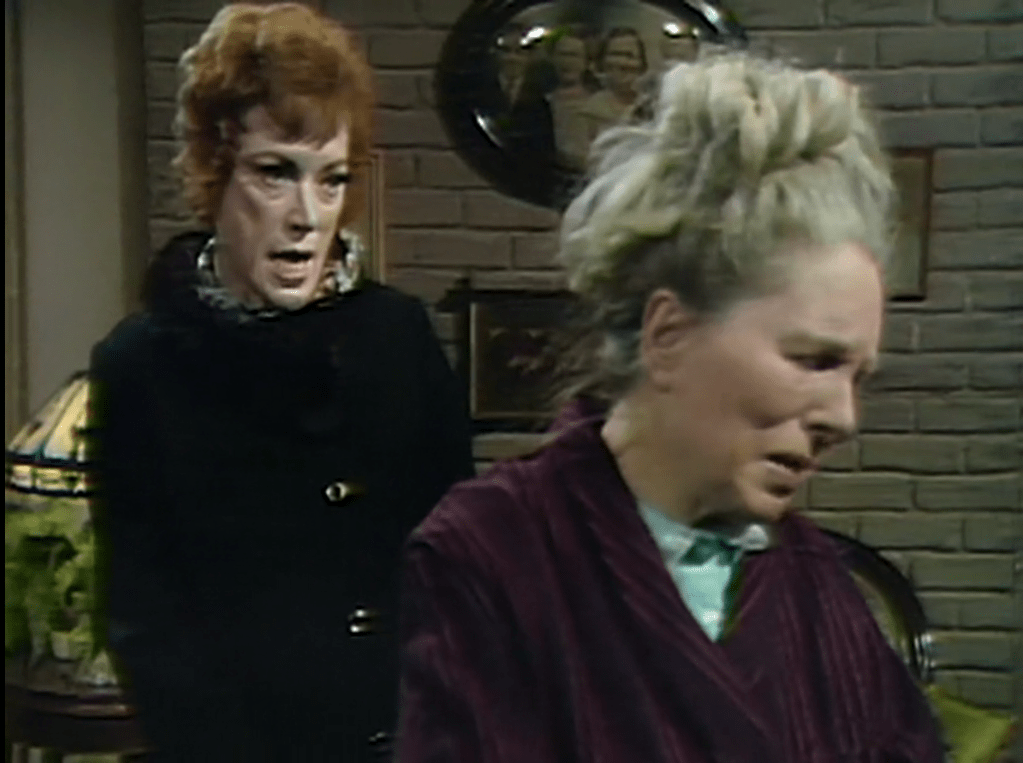
Liz walks in on David in his room, and finds him reading from a book. He denies that it is the book from the antique shop, but she doesn’t believe him. Later, Liz is poring over the book in her drawing room when her distant cousin Barnabas comes in. She tells him she doesn’t recognize the language or the script in which it is written, but that she has found certain blocks of text that are repeated throughout, in the manner of ritual language. She thinks it must be a religious book of some kind. Barnabas recognizes this as a remarkably intelligent observation. He offers to take the book to the antique shop himself. Liz happily accepts his offer, and goes upstairs to bed.

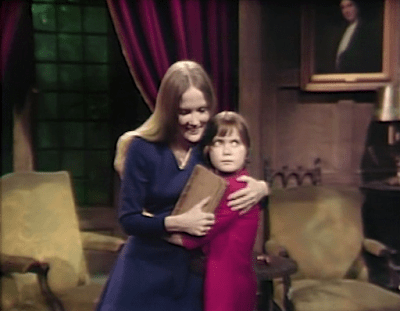
Liz has a dream. In the dream, David is wearing a fat suit. He takes her to a funhouse. At first the mirrors merely add to her chronic depression, but she brightens when she sees Barnabas in one of the mirrors. And when David recites a bit of doggerel- “Fat and Skinny had a race, all around the steeplechase./ Fat fell down and broke his face./ Skinny said, I won the race!” she laughs heartily. She wakes up. In her bed, she is staring into space, all jollity gone.

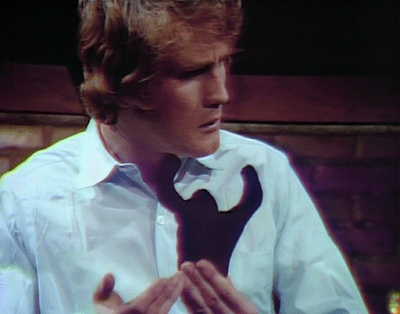
David’s fat suit. Screenshot by Dark Shadows Before I Die.

Most of the dream is shot in a kaleidoscopic style, splitting the screen into many copies of the same image. Regular viewers know that Dark Shadows puts kaleidoscopic patterns on the screen when it is showing people submitting to one or another form of mind control. For example, when mad scientist Julia Hoffman hypnotizes people, we often see pictures that seem to come from inside a kaleidoscope. Liz herself asks David at the beginning of the dream if the mirrors will show her “all the people I could have been”; he says that no, “They’ll show you all the people you really are.” Since the dream is full of odd looking dolls and puppets, that suggests all the people she really is are controlled by someone other than herself. The cut from her laughing face at the end of the dream sequence to her blank expression when she wakes up would also suggest a discontinuity between the Liz who had the dream and the Liz who will rise from bed.

Over the last few weeks, the show has been developing a story about a cult devoted to mysterious supernatural beings known as the Leviathan people. The cult is secretly absorbing one person after another, enabling the Leviathans to act through them. Barnabas and David have taken turns leading the cult, and the owners of the antique shop are members of it. If Liz is no longer herself, we must conclude that she has now been coopted into the cult as well.

Liz’ daughter Carolyn works at the antique shop. Early in the episode, she met a man whom we could see only from the chest down. He was wearing a belted overcoat. In #902, we had the same view of a man wearing the same overcoat as he wandered into Liz’ house, straightened a portrait of Barnabas, hid from Carolyn, and wandered out again. Evidently this is the same man. Later, Barnabas went to the shop, and Carolyn told him she was smitten by the man and that he would be coming back when the shop closed, after 10 pm.

The man does come back as promised, but doesn’t quite make it into the shop. He is between the streetlight and the door, in a space which we must interpret as representing a sidewalk, when Barnabas runs him down with his car. Carolyn comes out of the shop and Barnabas claims that the man just darted out of nowhere, giving him no chance to stop. It is unclear when Barnabas learned to drive. When he was first on the show in April 1967, he was a vampire who had been sealed in a coffin since the 1790s. He was cured of the effects of vampirism in March 1968, and in #687 we heard about him driving. Perhaps his training in the rules of the road was irregular. Still, you would think he would have a better excuse for driving into a pedestrian than failing to expect him to be on the sidewalk.

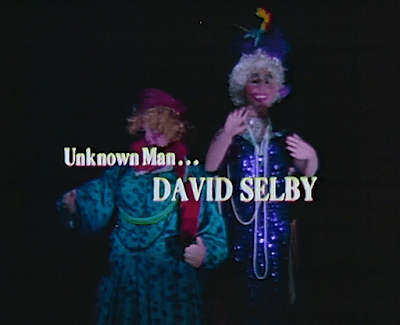
The camera zooms in on the injured man’s face. We don’t see enough of it to be sure who it is. The closing credits tell us that “Unknown Man” is played by David Selby. It must be a goof that we don’t see much of Mr Selby’s face. Over the year he has been playing the rakish Quentin Collins, Mr Selby has become a huge breakout star, rivaling the fame Jonathan Frid has gained as Barnabas. Surely they wouldn’t put him on unless they wanted us to recognize him.

Quentin first came on the show as a ghost at the end of 1968, and found his greatest success from March to November 1969, when the show was set in the year 1897. Since the show returned to a contemporary setting, we have been sure that Quentin will be back, but we haven’t had any reason to expect him to return at any particular time. In #887, the first episode set in November 1969, we saw the back of a man prowling about the estate of Collinwood; we might have suspected he was Quentin. But he turned out to be Liz’ ex-husband Paul Stoddard, who had never before been a real character on the show and who has been unmentioned for more than two years. So when we are kept from seeing the face of another prowler, he could be anyone at all. Perhaps Frank Garner is training to be a ninja, or Ezra Hearne is having a personal crisis.

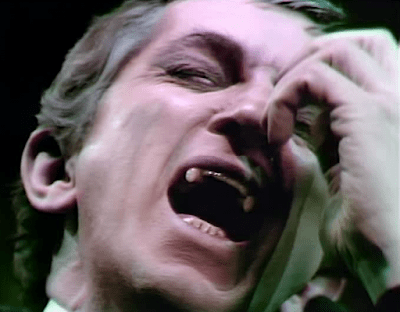
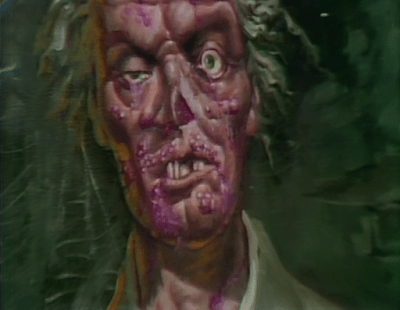
The closing credits run over this image from Liz’ dream. The dolls move while the credits are scrolling over them, the effect is hilarious. I didn’t think the dream sequence was particularly effective, but I wish every episode ended with these two figures doing their little act.

The real stars of today’s show. Screenshot by Dark Shadows Before I Die.

Episode 901: In Collinsport, where your only hope lies

Heiress Carolyn Collins Stoddard thinks that her recently returned father, Paul Stoddard, is mentally ill. She knows that her mother Liz and Liz’ brother Roger are deeply hostile to Paul, and thinks that her distant cousin Barnabas is friendly to him.

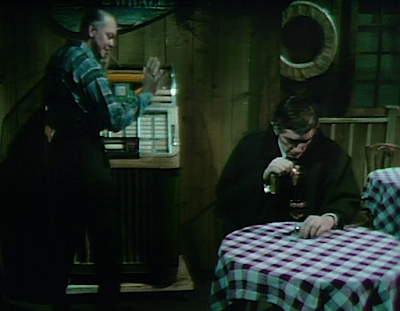
We open in the Blue Whale tavern, where Carolyn has been pleased to discover Paul and Barnabas sitting together at a table. Barnabas says that Carolyn is her father’s most precious possession, and she happily agrees. Paul angrily denies that this is the case, and jumps up. He asks Carolyn to go away with him, and leaves the tavern.

Carolyn is bewildered by this reaction, and annoyed when Roger enters. She exits to follow Paul, and Roger goes to the table to warn Barnabas that friendship with Paul would mean trouble with Liz. Barnabas assures him they are not friends.

In Paul’s hotel room, Carolyn tells her father that his troubles are all in his head. She says that she will try to help him, and mentions Julia Hoffman, a psychiatrist who is permanently in residence at the great house of Collinwood. Paul insists that he really does have enemies, and pleads with Carolyn to join him in running far away. She refuses, and insists that he must solve his problems where he is.

Carolyn goes home to the great house. She and Roger have a confrontation. He gives her a check for $5000, payable to Paul. He tells her that the only reason Paul has come back is that he wants to get money out of the Collinses, and that if she gives him that check, he will leave again.

Carolyn goes to the antique shop where she has been working for her friends Megan and Philip Todd. Megan is holding a baby, whom she identified to Carolyn as her nephew Joseph, her sister’s son. Barnabas is with Megan and the baby. Carolyn apologizes to Megan for being late to work, and tells Barnabas she has been late many times. Megan says that it isn’t a problem, that she couldn’t have got away from the shop any earlier even if Carolyn had been there. Barnabas exits.

Carolyn tells Megan that is strange to be reunited with a father who left when she was a newborn. Megan says that she was close to her own father growing up, and that she was an only child. Carolyn furrows her brow, looks at the baby, and asks if he isn’t her sister’s son. Megan scrambles for a second, then claims that Joseph’s mother is her stepsister, one of two daughters of the widow her father married.

Megan takes the baby to his bedroom upstairs. Carolyn answers the telephone, and tells Philip that she will have Megan call him right back. She waits a moment, then goes upstairs. She hears a loud breathing sound coming from the baby’s room, as if a gigantic obscene telephone call were in progress.

Unknown to Carolyn, her father’s troubles are not imaginary, and Barnabas is not his friend. Between her two scenes in the antique shop, we saw Paul in his room. A true Collinsporter, he was in bed fully clothed, wearing even his tie and his shoes, but still he had difficulty sleeping. Barnabas entered the room and told him it was odd to sleep on such a sunny day. To demonstrate the day’s sunniness, he turns a light on. He also ruffles the window-shades, but does not open them. Evidently that would be a little too on-the-nose.

Paul aims a revolver at Barnabas and says that he will kill him if he doesn’t leave him alone. Barnabas says that if he kills him, someone else will be sent in his place. Paul says that he will also kill that person, and he squeezes the trigger several times. That only makes a clicking sound. Barnabas tells him that “we” knew about the gun, as “we” know about everything Paul might do before he does it, and that the ammunition was therefore removed. He also tells Paul that if he leaves Collinsport without permission from whomever it is Barnabas represents, Carolyn will suffer.

The telephone rings, and Barnabas orders Paul to answer it. It is Carolyn. He tells her that he is feeling better, and that he does not want to go away. Barnabas praises him for beginning to see things “our way.”

Paul telling Carolyn that everything is just great with him. Screenshot by Dark Shadows Before I Die.

Today’s closing credits are the first headed by “Starring Jonathan Frid as Barnabas Collins.” From now on, Frid will get the “Starring” designation unless Joan Bennett is in the day’s cast, in which case she gets “Starring” and he follows with “Also Starring.”

Episode 897: Restore our flesh and bones

The Trouble with David

Yesterday we saw strange and troubled boy David Collins (David Henesy) go to a mysterious cairn in the woods, the ceremonial center of the cult of the Leviathan people, and announce that he was now one of the cult. The cairn then opened, revealing a little gap. David crawled into the gap. The gap was not quite big enough for him, so that the episode ended with an extended sequence of David Henesy wiggling his rear end at the camera while he tried to wedge himself into place.

Today we learn that the carpenters were not the only ones who haven’t caught on that Mr Henesy isn’t nine years old anymore. David has followed the gap to an underground chamber with a steaming cauldron. He takes some vegetation out of the cauldron and recites a cryptic poem, all the while staring portentiously off into space. His manner, words, and actions would be effective as part of a creepy little kid sequence, but the thirteen year old Mr Henesy looks mature enough that we just chalk him up as one more member of the Leviathan cult.

The Trouble with Chris

Heiress Carolyn Collins Stoddard calls on drifter Chris Jennings in his cottage. They talk about someone named Sabrina who has told Carolyn that while Chris is a nice enough guy, he will, in spite of himself, kill her if she keeps hanging around him. Chris tells Carolyn that this is true and that he is “a monster.” He does not explain. She leaves, and he takes out a pistol. First-time viewers will wonder if Chris has a compulsion to fire his pistol at people. Regular viewers know that he is a werewolf, and that his particular case of lycanthropy is so advanced that he sometimes transforms even when the moon is not full. We can assume that he plans to use the pistol to put himself out of his misery.

Regular viewers also know that Chris was safely confined to a mental hospital until he checked himself out recently. When he returned to the great house of Collinwood, he told his psychiatrist, permanent houseguest Julia Hoffman, that he just couldn’t stand the conditions at the hospital. Since leaving the hospital means that Chris will resume killing at least one random person a month, this decision just about completely erased any sympathy we might have for him as a character. It also undercuts his motivation in this scene. If Chris really wants to stop killing, he is free to go back to the hospital at any time.

The ghost of Chris’ great-grandmother, Jenny Collins (Marie Wallace,) appears. She tells him not to commit suicide. Dark Shadows was a costume drama set in 1897 from March to November 1969; in those days, we got to know Jenny as “Crazy Jenny,” who played nothing but one mad scene after another. She was sane and well-put-together just once, when she appeared as a ghost in #810 and #811. In this second postmortem appearance, Jenny is extra mad, wearing a disheveled wig that reaches heights few hairpieces have dared. She does not tell Chris to return to the hospital, but to find his great-grandfather, Quentin Collins. She says that she cannot help him, but Quentin can.

This confirms what the show has been hinting, that Quentin is alive. Chris doesn’t know that, nor does he know of his relationship to Quentin. He is left bewildered and helpless by Jenny’s pronouncement. His response would no doubt be more complex if he were up to date, but he has been so ineffective at managing his curse and so irresponsible generally that we can’t imagine he would do anything constructive even if he knew everything we do. The character seems to have reached a dead end.

The Trouble with Barnabas

Upset by her conversation with Chris, Carolyn goes to her distant cousin, old world gentleman Barnabas Collins. She enters his home, the Old House on the estate of Collinwood, and finds the front parlor empty. She hears Barnabas’ voice coming from behind a bookcase, repeating over and over that “There is no margin for error. Punishment is necessary.”

Longtime viewers know, not only that a room is hidden behind this bookcase, but that Carolyn knows about that room. Her friend, David’s well-meaning governess Vicki, was held prisoner there by a crazy man in December 1966, several months before Barnabas joined the show. Carolyn is moving her hands, as if she is looking for the release that makes the bookcase swing open, when Barnabas comes downstairs.

When Carolyn says that she heard his voice, Barnabas explains that he was simply keeping busy by “conducting an experiment in electronics.” The candles around the room will suffice to show that the house doesn’t have electricity, and even if Barnabas weren’t so resolutely technophobic it would still require explanation that the text he set his speakers to reproduce over and over was “There is no margin for error. Punishment is necessary.” Moreover, Carolyn knows Barnabas well, and she can’t have overlooked that he is not his usual self these days. He is distant, calm, and utterly self-possessed, a far cry from the fussy, excitable chap who so often stumbles over his words. He remains formidably well-composed as he reiterates his position that Chris is a dangerously unstable person whom Carolyn should avoid, and that she has a bright future ahead of her. He gently but firmly guides her to the front door, and she is out of the house in record time.

Carolyn does not know that Chris is the werewolf, but at least she knows that there is a werewolf. She does not know that the Leviathan cult exists, and so it is understandable that she does not suspect that Barnabas is acting as its leader. But as the story unfolds, others will no doubt catch on that something is up, and so many people have spent so much time with Barnabas that it is difficult to see how they can all fail to notice the drastic change in his personality and to connect it with the strange goings-on. Putting him in this position makes it likely that the writers will have a harder time managing the story’s pace than they would if his involvement were more subtle.

Once Carolyn has exited, Barnabas opens the bookcase and reveals Philip Todd, antique shop owner. He rewinds a reel-to-reel tape and replays “There is no margin for error. Punishment is necessary.” Philip and his wife Megan are members of the cult, entrusted with the care of many of its most sacred items. Yesterday Barnabas found out that one of these, a book, had gone missing. He summoned Philip to the cairn, and it seemed he might be about to kill Philip. But now, he sends Philip off to administer the punishment to someone else, presumably Megan.

The Trouble with Megan

Megan (Marie Wallace) has been in an extremely overwrought state ever since she found that the book was gone. Today’s episode ends with a long scene in which she is alone in the shop, feeling that someone is coming to kill her, reacting sharply to every noise.

Danny Horn devotes most of his post about the episode on his great Dark Shadows Every Day to reasons why this scene does not work, among them the fact that a depiction of a person descending into madness requires that the person start off as something other than over-the-top loony. Megan has been so frenzied for the last few days that Miss Wallace has nowhere to go when she hears the ominous noises. Moreover, her first two characters on Dark Shadows, fiancée of Frankenstein Eve and Crazy Jenny, were both intense, overbearing characters who were so inflexible that they had little opportunity to respond to anything their scene partners might do. Longtime viewers therefore expect to see Miss Wallace screaming and carrying on by herself, so nothing she does here will unsettle us. They lampshade this iconography problem by showing us Crazy Jenny’s ghost today, but that doesn’t help at all.

Many fans compare this scene to episode #361. Most of #361 is devoted to a one-woman drama in which Julia is tormented by sights and sounds in her bedroom, suggesting that her mind is collapsing. I don’t think that episode is a success, but because Julia had always been in control of herself up to that point we can see what is supposed to be at stake in it. That’s more than we can say for Megan’s fearful turn.

In John and Christine Scoleri’s post about the episode on Dark Shadows Before I Die, Christine points out the prominence of the taxidermied animals in the background, and speculates that the scene is an homage to The Night of the Living Dead. I wouldn’t have guessed that director Lela Swift or writer Violet Welles would have studied that film, but Christine provides screenshots from it and from the episode, and the parallels are so striking that I can’t see how she could be wrong.

Closing Miscellany

I think the tape recorder is the same one we saw in the summer of 1968, when it was part of the Frankenstein story. It also appears to be the one that parapsychologist Peter Guthrie brought to Collinwood early in 1967.

Her haunting of Chris marks Jenny’s final appearance. Miss Wallace reprised the role decades later in a couple of the Big Finish audio dramas.

During Megan’s big scene, the camera swings a bit to the left and we can see beyond the edge of the antique shop set. We get a good look at a tree that stands near the cairn in the woods. Making matters worse, when they turn the camera away from the tree they go too far right, showing a stage light on the other side.

The antique shop and the cairn. Screenshot by Danny Horn, Dark Shadows Every Day.

As the opening credits begin to roll, the camera is pointed a bit too far to the right and a stagehand is visible, adding dry ice to the steaming cauldron in the underground chamber.

Closing credits blooper. Screenshot by Danny Horn, Dark Shadows Every Day.

Episode 890: They will be strangers, but you will know them

Like many episodes of Dark Shadows, this one ran long and ended with credits only for the cast and for Dan Curtis Productions. The entry on the Dark Shadows wiki says that the director was Lela Swift. I am sure that it was in fact directed by Henry Kaplan. This shot of Nancy Barrett as heiress Carolyn Collins Stoddard is proof positive:

There is another flagrant Kaplanism in today’s first scene between antique shop owners Philip and Megan Todd (Christopher Bernau and Marie Wallace.) Philip enters from upstairs. He stops with his waist at the top of the frame. That’s where he stays for the first part of the scene, ending with Megan raising a paper that covers part of her face. Evidently what’s happening between the characters is none of the audience’s business.

Swift was a talented and ambitious visual artist, Kaplan a sloppy and unimaginative one. He relied heavily on closeups. When it dawned on him that it was dull to hold the frame just beyond the edges of an actor’s face, his response was to zoom in and give us an extreme closeup of some part of the actor’s face. It’s above average for him that the first shot above includes Miss Barrett’s eyes- he specialized in shots displaying the face from the nostrils down, and often held them even after the actors had to move, leaving us with the sight of an ear drifting out of our view.

Even when Kaplan’s tight little frames do not keep us from figuring out what is happening in a scene, they deprive us of the energy that comes from seeing the players interact with each other. We don’t get statements and reactions simultaneously, and we don’t see the actors using the space between them to tell us how the characters feel about each other. Kaplan was also a pretty bad director of actors, regularly poking them with a stick as his way of telling them he wanted them to play a scene differently and on one occasion fastening a handle to a child actor so that he could physically place him on his mark during rehearsal. So perhaps his mania for closeups reflected a lack of awareness of what actors do and how the choices they make contribute to the audience’s experience. As a result of his insensitivity to these and other visual aspects of the medium, Kaplan’s episodes would often be better suited to radio than to television.

Fortunately, the dialogue today is peppered with snappy lines. So Danny Horn devotes his post about the episode on his great Dark Shadows Every Day to a selection of memorable pieces of dialogue. That also makes me suspect the wiki is not entirely correct. It attributes the script to Gordon Russell, an able writer overall but one who is not at all given to bons mots. I use bits of dialogue whenever possible as the titles of these posts, and I often have to search very hard through Russell’s to find suitable ones. It was Violet Welles who excelled at producing those. Russell and Welles often collaborated, so it could be that he wrote a draft to which she added the quotable quotes.

The current story centers on a mysterious cult that has sent time traveler Barnabas Collins back to 1969 from a long sojourn in 1897, by way of a couple of days in 1796. Under the influence of the cult, Barnabas is being a real jerk to his friend, mad scientist Julia Hoffman. Barnabas was a vampire for a long time, and even when he is free of the effects of that curse he habitually resorts to murder to solve his problems. But the victims of those murders are imaginary, played by actors who will go on to find other work, so we don’t usually stay mad at him for any length of time when he commits them. His friendship with Julia, on the other hand, is the emotional core of the show. Barnabas’ coldness to her in yesterday’s episode and today’s leads us to see what the cult is doing to him as the greatest crime anyone has ever committed on Dark Shadows.

Barnabas was a pop culture phenomenon familiar to many millions of people who never saw a single minute of Dark Shadows. The show’s fanbase largely consisted of his devoted followers. So a story about a cult which co-opts him as its leader and changes his personality so that he is impossible to get along with directly addresses a fear that must have blacked out the mind of Dan Curtis every time the postal service truck loaded with Jonathan Frid’s fan mail backed up at ABC Studio 16.

Barnabas brought a box with him from his visit to the eighteenth century, and it is of the utmost importance to the vast eternal plan the cult is working on that the box not be opened until the right time. So Barnabas put it on the mantel in his living room, and when Julia was standing a few inches from him he lifted it from the mantel and placed it on a table in the middle of the room. When she asked what it was, he became flustered and refused to answer any questions about it.

When Julia left the house, Barnabas left the room, with the front door unlocked and the box still on the table. Today, we open with Julia coming back in, hearing the sound of breathing coming from the box, finding its key on the table next to it, and placing the key in its lock. Barnabas comes in just in time to stop her opening it, but we can see that the cult probably could have chosen an agent with a better sense of operational security. Barnabas’ function in the story is to make messes that other people will have to clean up, so as soon as we heard that the box must not under any circumstances be opened we expected him to leave it where it would inevitably fall into the hands of someone bent on opening it, though it is a bit disappointing he has done so this quickly.

After he has taken the box from her, Barnabas berates Julia, orders her from his house, and tells her he owes her nothing. He abruptly sweetens up and tells her that he is only carrying on that way because of some kind of temporal jet lag. He reminds her that when she traveled back in time in September, she was very ill for a while; he suggests that his surly mood might be the result of the same shock that caused that reaction. About a minute after he starts on this new tack, just as Julia has started smiling again, a knock comes at the door. It is Carolyn.

We don’t know what effect the cult’s co-optation of him has had on Barnabas, but regular viewers know that characters on Dark Shadows are always acquiring one magical power and losing another. For the last few months of the 1897 segment, the show’s main villain was sorcerer Count Petofi. One of Petofi’s signature moves was to become aware of visitors shortly before they arrived. It could be that the writers have decided to give the cultified Barnabas that power, and that it was because Carolyn was on her way that he wanted to put Julia in a good mood.

That interpretation is supported by what follows. Carolyn is delighted to see Barnabas; she hadn’t known he was back from his trip to 1897. She hugs him and he smiles, a stark contrast to his icy reaction when Julia hugged him yesterday. She wants to talk about Chris Jennings, a young man she dated a few times and whom she has been told is dangerous. Julia and Barnabas have befriended Chris and know that he is a werewolf. Julia thinks she can somehow control Chris’ transformations, and she urges Carolyn to think well of him. Barnabas tells her to trust her instincts and to avoid Chris. He keeps telling her that she is too important to be allowed to come to harm. Later, he visits Carolyn in her home, the great house on the estate of Collinwood, and he keeps going on and on about how important she is and how confident he is about her future. He also gives her a silver pentagram, an amulet to ward off werewolves, and urges her to wear it at all times. He subsequently has another scene with Julia in his own house, and he is just as cold and dismissive as he was in the first scene, exploding at her for being “irrational.” Evidently the cult has plans for Carolyn, but not for Julia.

Julia bought a painting from the Todds the other day, and now they have received a telegram offering to buy it regardless of price. Julia goes to their shop and discusses the telegram with them. She believes that the telegram, which is signed “Corey,” may actually be from Quentin Collins, a distant cousin of Barnabas’ whom he befriended during his time in 1897 and who may have been immortalized by a magical portrait painted by the same artist responsible for the picture Julia bought. She tells the Todds that she is not certain she wants to part with the painting, but that she would very much like to meet “Mr Corey,” and that she believes others in town would also like to do so. She urges them to reply to the telegram with an invitation.

Barnabas stands over the box. We hear his thoughts as he mulls over his questions about it. He suddenly declares “It is time!” Then he goes to his chair and sits down. Evidently, it is time to take a load off.

Barnabas has a vision of one of the hooded figures who inducted him into the cult. The figure, a man named Oberon, addresses him as “Master” and tells him that he is to give the box to people who wake him by knocking at his door. There is a knocking, he does awaken, and he goes to the door.

Episode 888: The place that he disappeared

The Prowler

Yesterday, we spent a lot of time watching an unidentifiable man wandering around the estate of Collinwood. We only saw him from the back; he was wearing a dark coat and hat, and had silver-gray hair. Evidently we were supposed to expect his face would mean something to us when it was finally revealed.

At the end of yesterday’s episode, permanent houseguest Julia Hoffman caught the prowler coming out of the Old House on the grounds of the estate, home of her friend, missing person Barnabas Collins. She did not recognize the man, and he refused to identify himself. We see him in today’s opening reprise. His face would not be familiar to her, but it is instantly recognizable to longtime viewers. It is that of actor Dennis Patrick, who from March to July 1967 played seagoing con man Jason McGuire. Jason blackmailed reclusive matriarch Elizabeth Collins Stoddard to the point of marriage. When Liz finally stood up to Jason, his scheme collapsed. On his way out of town, Jason went to the Old House hoping to steal jewels from Barnabas. That attempt also failed, and Barnabas strangled Jason.

We spend most of the episode wondering how Jason managed to rise from the dead. Near the end, Liz’ daughter Carolyn runs into the prowler. She gets a good look at him and talks to him for a few minutes, but does not recognize him. Carolyn would certainly recognize Jason, whom she was ready to shoot if Liz had gone through with the wedding. So Patrick must be playing another character. He does not give Carolyn his name, but his strong emotional reaction when she gives hers tells us that he has some kind of connection to her. We are again supposed to leave the episode wondering who he might be.

Unfortunately, word of that did not get to the people who make up the closing credits. Patrick is billed today as “Paul Stoddard.” Paul is Carolyn’s long-missing father, Liz’ ex-husband, and a close friend and partner in crime of the late Jason McGuire. This is not the first time on Dark Shadows the closing credits have identified a character whose identity was supposed to keep us guessing. For example, at the end of #124 we are supposed to be in suspense as to which of a few people a mysterious woman is, but the closing credits identify her as “Laura Collins,” a name which blows the secret completely for attentive longtime viewers. A mysterious little girl turns up in #255 and for a few episodes we are supposed to be in the dark as to who she is. But at her first appearance the character was billed as “Sarah Collins.”

It’s interesting to cast Patrick as Paul. Jason’s scheme was based on Liz’ belief that she had killed Paul, when in fact Paul and Jason had worked together to fake his death and swindle her of some money. Since Paul and Jason committed the two halves of the same crime, they merge together in the disastrous effects they have had on Liz’ life. So they may as well look and sound exactly alike.

Waiting for Barnabas

Barnabas vanished from his basement some time ago while he was involved with some supernatural doings. Julia has been hanging around the house for over a month, waiting for him to rematerialize. She explains to Carolyn that because he disappeared from the basement, it is the only place where he can reappear. They go into the house and Julia almost immediately suggests they leave. She is sure he isn’t there, because she locked the basement door. Evidently Julia has spent all this time waiting to hear Barnabas banging on that door demanding to be let out.

Carolyn points out that Barnabas might be unconscious, and if he is he would not be banging on the door even if he has come back. Julia exclaims “I hadn’t even thought of that! He- he could be down there now!” At this, my wife, Mrs Acilius, laughed and said “He could have been down there for a month!” By profession, Julia is a mad scientist. She knows how to cure vampirism, bring Frankenstein’s monsters to life, rewrite people’s memories at will, and travel back in time, but she has her blind spots.

Be that as it may, Julia checks the basement and finds Barnabas is not there.

The Antique Shop

Carolyn takes Julia to an antique shop that has just opened in the village of Colllinsport. Carolyn called the shop “divine” yesterday, and is still thrilled about it today. I suppose it reminds her of home- like all the unoccupied spaces in the great house of Collinwood, it is crammed with a lot of miscellaneous junk.

Carolyn may have a soft spot for the place, but she hasn’t lost all capacity for judgment. The proprietors, a young couple named Philip and Megan Todd, have just unpacked a painting they bought that morning. Philip says that when it came up for auction he couldn’t resist it. Carolyn widens her eyes, tilts her head back, and says in an incredulous voice, “Hmm, your taste must be quite different from mine, Philip. I could have resisted that.”

The painting Philip couldn’t resist.

Philip mentions that the artist’s name is Charles Delaware Tate. At that, Julia perks up. She asks Philip if he is certain that it is an authentic Tate; he assures her that he is. He astonishes her by saying that it was painted only about twenty years ago. Julia says that Tate would have been in his 80s then. Seeing that the painting is about as good as anything Tate ever did, she says that he was still at the height of his powers despite his advanced age. She wonders if, having been in such good shape so recently, he could still be alive. Philip doesn’t know about that.

Julia asks for the price. When Philip says he will part with the painting for $300, Julia takes out her checkbook. Carolyn looks on, amazed to see her shell out so much money so quickly for a mediocre picture. When it is time to go, Julia asks her if she is ready. Still agape, Carolyn replies “Yes.. for practically anything!”

For eight months, from #701 at the beginning of March to #884 last week, Dark Shadows was a costume drama set in the year 1897. In the second half of that segment, Tate was one of the minor villains. He had made a bargain with evil sorcerer Count Petofi. Petofi made him a nationally famous painter whose works were very much in demand. Many of his paintings also had magical powers. The magical powers were the result of Petofi’s spell, but it was never made entirely clear whether Tate’s fame was the result of a talent Petofi gave him to paint well or if Petofi’s intervention was more direct and he simply bewitched people into admiring Tate’s paintings and wanting to buy them. Indeed, if we had to classify the works of Tate that we saw, the most secure categorization would be “Nothing Special.” They certainly do not stand comparison to the best of the portraits that the ABC Network’s Art Department prepared for the Collinwood sets. Carolyn’s reaction today clearly suggests that once Petofi’s influence receded, the paintings lost their charm.

Julia’s interest in Tate is not aesthetic. Julia traveled back in time for a couple of weeks in September. She knows that Tate’s portrait of Quentin Collins prevented Quentin from turning into a werewolf. The prospect that Tate might still be alive leads her to hope that her friend Chris Jennings, a great-grandson of Quentin’s, might also be cured of lycanthropy.

The audience is unlikely to find much ground for optimism in the thought of more Tate. As is usual for characters played by Roger Davis, Tate is hard to watch. He delivers most of his lines in a shout, and he amplifies his voice by clenching his rectal sphincter muscles. The result is what Pauline Kael used to call an “anal screech.” He also has what we might tactfully call a poor sense of personal space; indeed, two of the tags that most often appear together on posts on this blog are “Roger Davis” and “Abusive Behavior on Camera.” So I would just as soon Julia give up her search for Tate.

The Todds

Megan and Philip exult over Julia’s purchase. They are in the middle of talking about how it is a good sign for their new business, when Megan is suddenly seized with a fit of foreboding. She wants to close the shop early; Philip protests that they still have time to make a few more sales. Megan then says she has a premonition that if they stay in Collinsport something terrible will happen to them. She says she wants to sell the shop and move away. Philip tries to soothe her. He puts his head against hers and kisses her. She just looks straight on, her eyes full of dread.

Philip working his way to Megan’s neck while it dawns on her that they are now characters on Dark Shadows.

Megan is the third role Marie Wallace played on Dark Shadows. Her first two were Eve, the Fiancée of Frankenstein, and Crazy Jenny Collins, Quentin’s estranged and deranged wife. Miss Wallace had a lot of fun with those parts, but neither of them gave her much opportunity to interact meaningfully with her scene partners. Eve was unyieldingly nasty to everyone, whatever they might say or do, and Jenny was just one long mad scene. As Megan, she gets to listen to Philip and react to what he says. That ends when she ignores his kissing her neck, but while it lasts it’s good to see.

Philip is played by Christopher Bernau. Some fans say that Bernau and Miss Wallace lacked “chemistry,” but their last shot today shows how misguided that criticism is. The key to chemistry is for one character to initiate a kiss and the other to kiss back. Megan is supposed to be too preoccupied with her premonition to notice anything in her environment, even her beloved husband kissing her. If she had responded to him at all, the whole point of the scene would have been lost.

It is true that Bernau does not perfectly embody a romantic lead in Philip’s scenes with Megan. As a happy couple, Philip and Megan constantly make little jokes with each other. The jokes in the script aren’t very good, and Bernau tries to put some life into them by imitating Jack Benny. In the 1920s and 1930s, Benny’s persona struck people as a spoiled rich kid, and in later years he was so famous that it just meant Jack Benny. But by the 1960s, any man other than Jack Benny would send a very different message if he were to speak with that drawl and walk with that mincing gait. When the man in question is an antique dealer wearing a belted sweater that looks suspiciously like a dress, it does not seem especially likely that he will passionately in love with his wife.

I think Philip borrowed this from Maggie Evans…

Several times in his career Bernau proved he could be effective in love scenes with women, most famously as ladies’ man Alan Spaulding on The Guiding Light. I mentioned that role in a comment on Danny Horn’s post about this episode on his great Dark Shadows Every Day:

I was a kid when Bernau joined GUIDING LIGHT. My mother watched that show, and I had several times attempted to watch it with her, but it always defeated me after 5 or 10 minutes. It just seemed like a window into the deepest level of Hell, the frozen cavern where absolutely nothing happens. But Bernau caught my imagination. I could watch entire episodes if he was in them.

Years later, when I watched DARK SHADOWS on the Sci-Fi Channel, I realized what made Bernau so compelling on GUIDING LIGHT. He was doing a Jonathan Frid imitation. Within moments of first seeing Barnabas, I exclaimed “Alan Spaulding!” It was only years later that I learned Bernau had been on DARK SHADOWS.

Comment left 10 December 2020 by Acilius, on Danny Horn, “Episode 888: Little Shop,” 26 June 2016, Dark Shadows Every Day.

I’m very fond of John Gielgud’s story that from the time he first saw Claude Rains give a performance, his acting style consisted of imitating Claude Rains. Gielgud went on to say that this represented a great improvement over his previous style, which consisted of imitating Noël Coward. I doubt Bernau’s style ever depended entirely on either Jack Benny or Jonathan Frid, but he certainly learned a great deal by watching each of them.

Episode 851: Common cause

Rakish libertine Quentin Collins races to the train station to meet his fiancée, the lovely and mysterious Amanda Harris. He thinks he sees her, but it is actually another young woman wearing a remarkably similar outfit. She tells him the train to New York City left a few minutes ago; Quentin knows Amanda was on it, and that she thinks his absence means that their relationship is over. The young woman was quite miffed when Quentin first approached her, but by the time he offers his second apology her look has gone from indignant to concerned to yearning. The guy’s got game, you have to grant him that.

It’s been less than a minute since he made a bad first impression on her, and she’s ready to run off with him. Screenshot by Dark Shadows Before I Die.

Quentin was detained by a fistfight with a repulsive little man called Charles Delaware Tate. Tate is an artist whose works sometimes have magical powers. His portrait of Quentin, for example, keeps Quentin from turning into a werewolf and ensures him against physical harm. Since Tate is obsessed with Amanda, he stole the portrait from Quentin when he learned Amanda was planning to leave with him. Quentin dared not leave without it, and went to Tate’s studio to demand its return. He very satisfyingly beat Tate senseless, but he did not find the portrait, and now he fears he has lost Amanda forever.

We cut to Tate’s studio. Tate is lying on the floor where he fell when Quentin finished hitting him. Unfortunately, he gets up. Sorcerer Count Petofi, who granted Tate the power to make magical artworks some years ago, enters. He tells Tate that it was stupid to steal Quentin’s portrait. Tate pretends not to know what Petofi is talking about, irritating him and us. Petofi says that he will have to be punished. After he forces Tate to draw a sketch of a pretty woman, he squeezes his wrists, helps himself to Quentin’s portrait, and says what sounds very much like a final goodbye. He exits, and Tate sits down with his pad and pencil. He discovers that he is no longer able to draw, not even a straight line.

These days, Dark Shadows is a costume drama set in 1897. Most of the time between 1966 and 1968, it took place in a contemporary setting. In those days, the set now used as Tate’s studio was the Evans cottage, home to artist Sam Evans, a drunken sad sack, and his daughter Maggie, The Nicest Girl in Town. In December of 1966 and January of 1967, the ghost of the gracious Josette compelled Sam to paint alarming images of Laura Murdoch Collins.

It turned out Josette was doing this because she knew the characters were not all that bright and she had to literally paint them a picture to explain that Laura was an undead fire witch bent on incinerating her young son David. Laura tried to thwart Josette’s plan by harming Sam. In #146, Laura caused a fire at the Evans cottage that burned Sam’s hands, temporarily depriving him of the ability to paint. Petofi’s disabling of Tate on the same set will bring this incident back to longtime viewers. Especially so, since Josette is in the air at this point in the show. In #844, a character named Kitty joined the cast. She keeps having mental flashbacks to things only Josette would remember, and Josette’s music box appeared on Kitty’s table at a time when Josette’s ghost seemed to be the likeliest agency to have put it there. Perhaps she will insert herself into Tate’s story for some reason.

When we were watching the scene between Tate and Petofi, my wife, Mrs Acilius, said that she very much wished someone else were playing Tate. Violet Welles’ script gives whoever is playing Tate a lot of opportunity to show what he can do in that scene. Roger Davis is a highly trained actor who has a long list of stage and screen credits, but he is almost always very unpleasant to watch on Dark Shadows, and he wastes the potentially fascinating dialogue Welles gave him. When Mr Davis is particularly trying, I usually try to make the scenes bearable by imagining what Frederic Forrest, who was a featured background player in #137, would have done in his place. But the echo of the story about Sam makes me wonder what David Ford would have done as Tate. Ford was in his forties, smallish and pudgy, so a David Ford Tate could not believably have had a fistfight with a character played by the very tall and fit 28 year old David Selby. But he might have been a subtle enough villain that such an exchange would not have been called for. Moreover, the incestuous undertone of Tate’s desire for Amanda, who is the product of one of his magical paintings and therefore a kind of daughter to him, would have been all the more disturbing had Tate been played by the man we knew as Maggie’s father in the 1960s and, when the show was set in the 1790s, as Josette’s.

Back home at the great house of Collinwood, Quentin receives a visit from Tim Shaw, Amanda’s ex and a would-be sleazy operator. He demands Tim tell him what he knows about Amanda’s life in New York before they came to Collinwood. Tim declares he will tell him nothing, to which Quentin responds by choking him and flinging him to the floor. Tim then burbles out everything he knows, which turns out to be nothing of the slightest use. Quentin picks Tim up and throws him out the front door in the most humiliating possible way. We cheer this on almost as joyously as we cheered Quentin’s beating of Tate Friday, but for the opposite reason. Mr Davis is a genuinely disagreeable person who ruins episode after episode, and it was him we were angry with. We chanted at the screen, not “Quen-tin! Quen-tin! Quen-tin!,” but “Da-vid! Da-vid! Da-vid!” hoping Mr Selby would pay him back for all his on-screen assaults on the women and children in the cast. But Don Briscoe was as nice a guy as Tim has become despicable, and he and Mr Selby enjoyed working together. You can see Briscoe’s joy in performance in the way he holds on to a little yellow piece of paper representing a note from Amanda all through the beating Quentin administers. Even the shot of Quentin shoving Tim out with his buttocks prominent is the product of Briscoe’s enthusiastic use of his body to demonstrate Tim’s total defeat.

Quentin throws Tim’s sorry ass out the door. Screenshot by Dark Shadows Before I Die.

Quentin’s other fiancée, wicked witch Angelique, comes downstairs to ask what the ruckus was about. Quentin makes up a transparent lie about having a financial interest in some firm in Boston, and says that he and Tim were quarreling about the details of it. Angelique lets him go on with this for a while and to say that he is leaving for Boston, then insists that they set a date for their wedding. He begs off, claiming not to know how long he will be away.

Petofi enters, and tells Angelique about Quentin’s plan to go to New York and look for Amanda. He also tells her that they now have a common cause, and proposes an alliance. Each of them is so powerful, and so evil, that this is a sobering prospect.

When Quentin returns to the foyer, it is his turn to be alone with Petofi. Quentin knows that Petofi gave Tate both the power to create the portrait that freed him of his curse and the commission to do so, and that he is therefore beholden to Petofi for his continued humanity. Part of his motivation for fleeing to New York with Amanda was his hope that he could escape the slavery Petofi has imposed on him as the price of that benefice. When Petofi tells Quentin he has come to see him before he goes, Quentin is momentarily stunned, and then makes a brave little noise to the effect that Petofi can’t stop him. Petofi assures him that he does not want to stop him. It doesn’t matter in the least to him where Quentin is- he can control him from anywhere.

Petofi calls on Tim at his room in the inn. He deepens Tim’s misery by pretending he doesn’t believe what Tim told him about Tate’s magical powers. As he leaves, he takes a brooch that belonged to Amanda.

Quentin is at the train station. Angelique appears there, and tells him not to go. He says that he doesn’t care if she kills him. It will be consolation enough to have died walking away from her. She says that she will not harm him in any way. This causes him to open his eyes wide in terror as it dawns on him what she means. She produces Amanda’s brooch and a doll. She positions the pin of the brooch over the doll’s chest and says that no matter where Amanda is, she will die a horrible death when the pin impales the doll.

Closing Miscellany

The actress who plays the young woman Quentin meets at the train station is billed in the credits as “Amy Yaekerson,” the only person known to Google ever to be called “Yaekerson” and known only for this appearance. But in a comment on Danny Horn’s post about the episode at his great Dark Shadows Every Day, a commenter known as “miles” pointed out that there are lots of people named “Yakerson.” He went on to identify an Amy Yakerson born in New York City on 1 April 1946, and to find a 1966 notice of a play featuring an actress of that name and probably of that age in the New York Daily News. I followed that up with some Googling of my own; the only Amy Yakerson I can find who is online today was born in Connecticut in 1954, so I don’t know where Amy Yakerson, star of stage and screen, is now.

We saw some of Sam’s paintings in Tate’s studio Friday and today, twenty-some years before Sam was born. Tate hides the portrait of Quentin behind one of Sam’s seascapes, and Sam’s portrait of Maggie’s mother is on the floor next to him when we see him lying there in the aftermath of the fight. John and Christine Scoleri have the details in their post about Friday’s episode at Dark Shadows Before I Die.

Episode 844: Some clean, fresh air

Adventurer Tim Shaw is in his hotel room with an apparently mute man, trying to get him to speak. The man is struggling to make a sound when artist Charles Delaware Tate enters and produces a revolver. Tate proclaims that the man will never speak. He fires, and the man falls dead to the floor.

The man’s body glows, then vanishes. Tim knows that Tate created the man earlier in the evening. Tate has a magical power that enables him to cause objects and people to pop into existence just by drawing them. Tim says that he ought to call the police, since Tate just murdered a man in cold blood in front of him. But there is no body, and the only other person who has seen the man is Tim’s traveling companion and occasional accomplice Amanda Harris, who turns out to be another of Tate’s creations. So instead Tim pours a drink, and Tate tells him all about how he gained his powers as the result of a bargain he struck with sorcerer Count Petofi.

Petofi is aware of several magical abilities he gave Tate, but does not know that he can bring his creations to life. Tim calls Petofi to his room and brings him up to date. He believes that this report will somehow establish a partnership between himself and Petofi. Since Tate made it clear that his powers are the result of Petofi’s own interventions, it is unclear why Tim would expect even a finder’s fee for this information. It certainly does not provide the basis for an ongoing relationship of any kind.

Meanwhile, a visitor is arriving at the great house of Collinwood. Her face is familiar to longtime viewers- she is played by Kathryn Leigh Scott, who has been in the cast from #1 as Maggie Evans, wisecracking waitress turned The Nicest Girl in Town. When from November 1967 to March 1968 the show was a costume drama set in the 1790s, Miss Scott played the gracious Josette; she had already played Josette’s ghost in some of the episodes in contemporary dress, and in the spring and summer of 1967 vampire Barnabas Collins had tried to brainwash Maggie into becoming Josette. We last saw Miss Scott from March to June in the first part of the still-ongoing segment set in 1897, when she was neurotic intellectual Rachel Drummond.

Before we know the name of this new character, we see that she is wearing widow’s weeds. There is also a first- we hear her thoughts in an interior monologue before she interacts with another character. Whoever she is, the widow is telling herself that she has come to her big moment and she shouldn’t chicken out now. “No one will know,” she assures herself.

Neither Maggie, Josette, or Rachel ever used that facial expression.

The unknown widow knocks, and rakish libertine Quentin Collins lets her in. He appreciates her beauty and asks who in the house is fortunate enough to know her. She says that she and her late husband were friends of the stuffy Edward Collins. Quentin says that Edward is away, and identifies himself as his brother. “Quentin or Carl?” asks the widow. Quentin says, with a sad note, that Carl is dead. This is the first time anyone other than his onetime fiancée Pansy Faye has mentioned Carl’s name in the three months since his death.

The widow finally identifies herself as Kitty Soames, Countess to the late Earl of Hampshire. She says that she is an American, and that after her husband’s death she felt that she was a stranger in England and ought to return home. Quentin invites her to stay in the house.

Kitty is alone in the foyer when Petofi enters. She is horrified to see him. It becomes clear that her husband’s death was a suicide, and that Petofi’s threats prompted it. She goes out to take a walk in the woods.

Along the way, she meets Barnabas, who has traveled back in time from 1969. They have a brief talk. When she exits, he says that she is Josette, returned to him at last.

Back in the great house, Quentin finds Kitty looking at the spot on the wall next to the front door where Barnabas’ portrait has long hung. Some weeks ago, Edward learned that Barnabas was a vampire and ordered the portrait removed. There is a mirror there now, the same mirror that hung in that spot in #195, when the ABC art department was painting Barnabas’ portrait and another portrait was reflected in it. Kitty asks Quentin why Barnabas’ portrait was removed. Since she has never been in the house before, this question perplexes him. He asks how she knows about the portrait and how she knows of Barnabas. At first she is amused by the idea that she would not know of him, but a second later she returns to herself. She insists she has never met anyone named Barnabas and has no idea what Quentin is talking about. Perhaps this time, Barnabas is right- maybe Kitty really is a revenant of Josette.

Miss Scott was one of the biggest stars on the show. She tells a story nowadays about a trip she and her then-husband took to Africa in the late 1960s, when they were on a photo safari deep in the bush. Some people happened by, took one look at her, and all started saying excitedly “Maggie Evans!” So it is inexplicable that today’s closing credits misspell her name as “Kathryn Lee Scott.”

Episode 836: The grownup world

It is 8 September 1969, and the ghost of Quentin Collins has rendered the great house of Collinwood uninhabitable. The family, including permanent house guest Julia Hoffman, have been staying at the Old House on the estate while recovering vampire Barnabas Collins is on a trip back in time to 1897, when Quentin was killed and the trouble started. But Julia has received a letter Barnabas wrote to her in September 1897 indicating that, as of that date, his mission was about to end in total failure, and so she decides to take matters into her own hands. First, she must learn exactly how and when Quentin died.

Julia goes to the great house and follows the sound of Quentin’s theme song to the tower room. There, she finds the ghost of maidservant Beth, who was one of Quentin’s many lovers. When Beth is in a shadowy corner, she puts on a ghostly voice and tells Julia that her name would mean nothing to her. As soon as she comes into the light, Julia says that they’ve met several times, and soon she is calling her by name. Along with the fact that, as Beth, Terrayne Crawford is just standing there in the same light as Grayson Hall, with no practical effect whatsoever to suggest ghostliness, this deflates whatever feeling we are supposed to have that we are witnessing an encounter with the supernatural.

Julia insists Beth tell her how Quentin died. When the ghost of Barnabas’ nine year old sister Sarah Collins was on the show from June to November 1967, she would often insist on the Ghost Rules and vanish if people put direct questions to her. But Beth just wanders around a little, moans to Quentin that she has no choice but to tell Julia what she wants to know, and starts dishing. Again, they aren’t making ghosts like they used to.

Beth tells Julia that on 10 September 1897, she found out Quentin was going to marry a woman named Angelique. Quentin did not tell her this news himself; he left it to Angelique to do so, making the blow fall all the more heavily. This will remind longtime viewers of #392, when Barnabas could not bring himself to tell his ex-fiancée Josette that he was engaged to Angelique, leaving Angelique to tell Josette herself in #393. Josette waited until #425 to leap to her death from the cliff at Widows’ Hill, but things move faster now. Beth went straight from her conversation with Angelique to her room, where she had a bottle labeled “Poison.”

Sensible shopper that she is, Beth buys her poison in the Generic section of the murder weapon store. Screenshot by Dark Shadows Before I Die.

Before she could do away with herself, Beth was interrupted by a knock on the door from twelve year old Jamison Collins. Jamison came in to show her a puzzle he had solved, then saw the bottle. He demanded to know what was going on, and she admitted that she was planning to kill herself because Quentin was going to marry Angelique. He stopped her doing that, but after he left to confront Quentin she took a loaded revolver out of her dresser.

Jamison found Quentin in the drawing room, in Angelique’s arms. Angelique at first dismissed Jamison, saying that his uncle was too busy to speak with him, but Jamison held his ground and insisted on seeing Quentin alone. Quentin obliged, but would answer Jamison’s questions only with airy assertions that he is too young to understand the situation. Jamison is so composed and forceful, and Quentin’s behavior is so flagrantly irresponsible, that we might expect Jamison to ask to be spared lectures on maturity from a man so much more childish than he. Instead, Jamison simply becomes angry and tells Quentin that after what he has done to Beth, he wants nothing more to do with him.

In #767, Jamison had a dream in which Quentin’s ghost said that his death was preceded by three events. The first two events happened shortly after. The third event was that Jamison rejected him. This has now happened, and in the dream Quentin said that once that took place “There was almost no time left for Quentin Collins.” Indeed, shortly after Jamison stalks off Beth shows up with her revolver and shoots Quentin. He staggers from the drawing room and goes upstairs. Since the staircase is made of eleven steps and is eight feet tall, that’s some pretty fancy staggering for a man who has just taken a round to the midsection. Quentin keeps staggering all the way to the tower room, where Beth shoots him a few more times.

We cut back to 1969, where Beth tells Julia she killed herself the day after she killed Quentin. She doesn’t seem to be done talking when Julia excuses herself. Say what you will about Sarah, she always left them wanting more.

Julia finds twelve year old David Collins, Jamison’s grandson, in the drawing room with Quentin’s ghost. Since Barnabas took us back in time with him in #701, we’ve got to know the living Quentin quite well, and he is a charming rascal who has very little in common with the silent, family-annihilating ghost we saw late in 1968. Beth’s story does very little to explain how the one turned into the other. The ghost has been draining the life from David; Julia orders David to come away from him, and he does. David lies down on the couch, and Julia examines him. She finds that he is weak, but resting comfortably.

Occult expert Timothy Eliot Stokes enters. Quentin’s ghost has vanished. Stokes calls Julia by her first name, something he had not done prior to this episode, and asks after David. She at first says he will be all right, then checks on him again. She cannot find a pulse, and declares him dead. Julia has performed wonders in her work as a medical doctor, but her death pronouncements are so often wrong that this does not give much grounds for alarm. However, we then hear Quentin’s voice laughing maniacally, darkening David’s prospects.

Terrayne Crawford seems to be such a nice person that it distresses me to point out that she was not a very good actress. But in this one, Beth’s lack of supernatural quality and Julia’s bland reaction to her make it seem like writer Gordon Russell and director Lela Swift were conspiring to vent their exasperation with Miss Crawford’s limits. She can play one emotion at a time, so that when Beth is shocked to learn that Quentin is going to marry someone else she is only and entirely Shocked. When Beth is suicidal, she is only and entirely Sad; when she decides to take Quentin’s life instead of her own, she is only and entirely Gleeful; when she tells Julia that her vengeance did not relieve her sorrow over Quentin, we can see that’s true, because she is only and entirely Sorrowful. The result is like looking at a series of wood block cuts illustrating various emotions. It’s all very clear and quite vivid, but there’s no sense of development from one scene to the next. Had Miss Crawford been able to lay one emotion over another and play two or more of them at a time, the grin on Beth’s face when she kills Quentin would have shown us that all the layers of complexity of feeling had finally been stripped away and only hatred was left. That would have been a tremendous climax for the character. But since there was never any such complexity to start with, it’s just another block cut.

Often when I see disappointing performances on Dark Shadows, I think of other actors in the cast and try to imagine what they would have done with the part. Gail Strickland, like Miss Crawford, is a tall, thin woman whose chin juts out on a horizontal line, and she was on the show as doomed schoolteacher Dorcas Trilling for a couple of episodes in May. Dorcas’ role would have been well within Miss Crawford’s competence, and in her long and distinguished career Miss Strickland proved she could do just about anything. So on a day like this, I envision a different, much more nuanced Beth. The episode in my imagination is really stellar, I wish you could see it.

Today, David Henesy plays both his 1897 character Jamison Collins and his 1960s character David Collins. He is not credited for either of those roles, but for Daniel Collins, whom he played when the show was set in the 1790s back in late 1967 and early 1968.

Episode 793: All the revolted spirits

When wicked witch Angelique first turned Barnabas Collins into a vampire in the 1790s, he went to the waterfront and preyed on the women he found spending their nights there. When Barnabas traveled in time from the 1960s to the year 1897, he again made his way to the waterfront. Whether he bit the women or not, he choked them to death, earning the sobriquet “The Collinsport Strangler.”

Once he had become a vampire, Barnabas displayed so many traits he had come to have in common with Angelique that we suspect he is not only cursed by her, but possessed by her. More precisely, it often seems that when Angelique made Barnabas a vampire she created a copy of her own personality and put it in his mind, where it took control of him. We have further support for that interpretation in today’s opening reprise. We see Angelique on the same set where Barnabas has several times been the last person a young woman would encounter. This time, she encounters a young man. He flirts with her, as the women flirted with Barnabas. Before long, he is choking and within seconds of death because of her action. In this case, she has taken his handkerchief and is tightening it around the neck of a toy soldier that once belonged to Barnabas. She is threatening to kill him unless he tells her where he has hidden the legendary “Hand of Count Petofi.”

The man’s name is Aristide. He capitulates, telling her he buried the hand at the old cemetery, in a grave marked with a stone bearing the name of Townsend. She gives the handkerchief another tug, and he falls down, unconscious.

Later, we are in the great house on the estate of Collinwood. Angelique comes down the stairs, carrying the box in which the hand is kept. Stuffy Edward Collins sees her. Regular viewers have seen the box on a table in the upstairs hallway many times, from the first week of the show onward. It is rather odd that Edward doesn’t ask her why she is carrying it around. Even if we decide to forget that the prop is familiar and decide to treat it as representing something Edward hasn’t seen before, people don’t usually walk around carrying wooden boxes in front of themselves.

Still, Edward does have other matters on his mind. Angelique had been introduced to the family as Barnabas’ fiancée, at a time when all the Collinses knew about Barnabas was that he was their distant cousin. She disappeared when he was exposed as a vampire. Edward tells her that the family’s lawyer, Evan Hanley, told him that he knew her before she met Barnabas, and that he believes that her association with him was innocent. Edward also says that he cannot believe that this is true. Angelique tells Edward a story about Barnabas biting her and making him her slave; Edward is convinced instantly, and declines her offer to leave at once. He urges her to stay at Collinwood until she can make new plans.

Meanwhile, we have learned that Aristide is alive and not seriously injured. A man in a set of whiskers that represent the aesthetic sensibilities of the late Victorian era developed to their uttermost extremity finds Aristide crumpled on the ground, rouses him from unconsciousness, and responds to his story about Angelique almost killing him with dismay that she stopped short. He tells Aristide not to do anything more. His own credentials are in order, and he will present them at Collinwood as he sets about his second attempt to get the hand.

The man does go to Collinwood. He gives Edward a letter from their “mutual friend,” the Earl of Hampshire. It attests to the good character of its bearer, Victor Fenn Gibbon. Edward insists that Fenn Gibbon stay in the house, and he accepts.

Angelique emerges from the drawing room, still carrying the box. Edward continues to ignore it; Fenn Gibbon can’t take his eyes off it. Edward introduces her as Angelique Duvall. This is the first time we have heard the name “Duvall” in connection with her; when we met her in the part of the show set in the 1790s, her name was Angelique Bouchard, and when she turned up in 1968 she called herself Cassandra Blair. Fenn Gibbon asks if she is French. She says that she was born in the USA, but that her forebears were French people who lived on Martinique. Indeed, when she was known as Angelique Bouchard she lived on that island, and it was there she met Barnabas. Fenn Gibbon tells her that lovely as France’s colonial possessions may be, none is as “exquisite” as she. She is charmed, and excuses herself. She leaves the house, taking the box with her.

While Fenn Gibbon regales Edward with tales of derring-do from the battle of Khartoum, Angelique takes the box to the Old House. There, she meets the rakish Quentin Collins, whose desperately handsome face has been severely disfigured by a previous encounter with the hand. Angelique dismisses Quentin’s girlfriend, maidservant Beth, telling her that she cannot be present during what she must now do for Quentin. Beth leaves, Angelique shows Quentin the hand, and Quentin demands that Angelique set to work curing him. She says there will be a price for her services. If she cures him, he will have to marry her. He has nothing to lose, and she looks exactly like Lara Parker, so of course he agrees.

Angelique picks up the hand and gets to work casting a spell, but the hand quickly escapes her control. She turns to find that it is on Quentin and he is in agony. He pleads with her to help, she cries out that she can do nothing, and we see Fenn Gibbon peering in through the window.

Fenn Gibbon looks on. Screenshot by Dark Shadows Before I Die.

Fenn Gibbon* is the fifth role Thayer David played on Dark Shadows. The first, second, and fourth were all closely associated with the Old House. They were crazed handyman Matthew Morgan, who holed up there after he killed local man Bill Malloy; much-put-upon indentured servant Ben Stokes, who lived and worked there; and broad ethnic stereotype Sandor Rákóczi, who with his even more offensively conceived wife Magda lives at the Old House in 1897. With this iconography behind David, regular viewers will know that when they see Fenn Gibbon in the window of the Old House, they are seeing a man who knows his way around the place.

David’s third role sheds even more light on Fenn Gibbon. In the parts of the show set in 1968 and subsequent years, he plays Professor Timothy Eliot Stokes, expert on the occult and descendant of Ben. Unlike most of the characters who made a splash on the show, Stokes has a functioning conscience. He does not always live within the law, but he always strives to do what is right. When we see that Fenn Gibbon knows about the hand and has orchestrated a criminal conspiracy to obtain it, we see that he is an evil version of Stokes. At once this makes him fascinating to regular viewers. Stokes himself is a reimagining of the show’s first academic specialist in the paranormal, Dr Peter Guthrie, who was killed by a witch in #186. He is a jovial and talkative eccentric, where Guthrie was a tight-lipped and understated Yankee. Fenn Gibbon seems to have inherited Stokes’ whimsical bent and exaggerated manner; we now have to wonder what Stokes would be like as a villain.

Even those who joined the show after it went to 1897 and who therefore do not know about Stokes will be intrigued when they see David as Fenn Gibbon. Sandor hasn’t appeared since #750, but he is still alive. This marks the first time Dark Shadows has cast the same actor as two living characters in the same time frame.** Sometimes an actor has doubled as a living character and as a ghost, or has appeared in two roles in parts of an episode set in different periods of history. But this is a new frontier for doubling on the show. Sandor is always a lot of fun, so we might hope that he will be back and that he and Fenn Gibbon just won’t have scenes together. But coming on the heels of his long absence, it does have an ominous ring.

In #758, Quentin backed Angelique against a wall and asked her why she preferred Barnabas to him. That was a very good question. The two of them are obviously attracted to each other, and have a lot of fun every time they are alone together. By contrast, the only emotions Barnabas has ever shown in response to Angelique are glumness and rage. Her maniacal insistence that Barnabas should love her drove Angelique to wreak immense havoc in the 1790s, and also motivated some story in 1968. But there is nothing to it beyond his misery and her self-absorption. When we see her turn her attentions to Quentin, longtime viewers will cheer at the hope that we are about to be freed from that dead end once and for all.

*He introduces himself today as “Fenn Gibbons,” which is how he is almost always addressed. But the closing credits leave the S off his name. The closing credits have been unreliable lately, identifying Edward as his grandson Roger and misspelling Aristide’s name. Still, “Fenn Gibbon” sounds better to me; “Fenn Gibbons” suggests a group of small apes found in a peat bog.

**Don Briscoe briefly played both werewolf Chris Jennings and Chris’ brother Tom, but that is only a partial exception- Tom was a vampire at that time.

Episode 792: No place. And every place.

Quentin Collins has devoted himself to the pursuit of evil, and as a result he has two intractable problems. When Quentin murdered his wife Jenny, her sister, broad ethnic stereotype Magda Rákóczi, turned him into a werewolf. Magda later found out that Jenny had borne twins to Quentin, and since the curse is hereditary she tried to lift it. She placed the magical “Hand of Count Petofi” on Quentin before his transformation. That didn’t stop him becoming a wolfman, but it did cause his face to be severely disfigured when he returned to human form.

Now Quentin has made his way to the house of Evan Hanley, his onetime friend and partner in Satanism. Evan had recently been disfigured in the same way Quentin is disfigured, also as a result of contact with the hand, and Quentin knows that Evan stole the hand from Magda to use in an attempt to de-uglify himself. When Quentin sees that Evan is handsome again, Evan denies that he used the hand to restore his looks. He claims not to know what happened. That is as frustrating for the audience as it is for Quentin. We were sure Evan would start looking like himself again, and they went to enough trouble to show that he was not able to correct his appearance by himself that we were expecting the cure to involve a significant plot point. When Evan presents us with “It just happened” as his explanation of how he got his old face back, we are quite sympathetic to Quentin’s decision to grab a blunt instrument and knock him out.

Quentin finds the hand in a box in Evan’s desk, and a strange man immediately enters. He demands Quentin give him the hand at once. Quentin is willing to surrender the hand once he has used it to become his desperately handsome self again, but the man will not wait. He pulls a knife to underline his point. The knife is a flat piece of wood cut in a shape with some pronounced curves and no sharp edges, and the man holds it loosely at the end of an arm that is directly over the box Quentin could easily raise to disarm him. So the audience has to help a bit to make the confrontation credible. Still, the acting is very good, and the dialogue, in which the man combines lethal threats with apparently sincere expressions of sympathy for Quentin’s plight and jokes at his expense, is complex and lively enough that we are glad to make the effort. Besides, the man goes to the trouble of telling Quentin that the knife is named “The Dancing Girl” and that it was made long ago by a Persian swordsmith, so he’s giving our imaginations something to work with. I, for one, didn’t have any trouble keeping a straight face when Quentin lost the fight and the man left with the box containing the hand.

Kids, if you are going to rob someone at knife-point, do not imitate what Aristide is doing here. Screenshot by Dark Shadows Before I Die.

Quentin goes to Magda at the Old House on the estate of Collinwood and reports what happened. She is frightened, since she herself stole the hand from a Romani chieftain/ organized crime boss named King Johnny Romana. When he says that a strange man came to take the hand, she assumes that he is an emissary of King Johnny’s, and that his next stop will be to kill her. When Quentin says that the man was young, Magda is puzzled- the recognized norms dictate that King Johnny send “an elder of the tribe” to complete such a task. She sets aside her plan to flee, and agrees to help Quentin in his attempt to summon wicked witch Angelique.

Quentin and Evan conjured Angelique up in #711. In previous segments of the show, when it was set in the 1790s and in the 1960s, Angelique established herself as one of its principal sources of action. But she hasn’t had much to do in 1897. She had a showdown with fellow undead blonde fire witch Laura Murdoch Collins back in May, and has barely been seen since. Quentin and Magda speak for the audience when they wonder where she is and what she has been doing. They speculate that she might have gone home to the depths of Hell, and light some black candles to accompany an incantation meant to call her thence.

Angelique does appear, but not at the Old House. Evan finds her in his parlor when he comes to. One of the possible explanations for the restoration of Evan’s good looks was that he made some kind of bargain with Angelique; this is excluded, not only when he is surprised to see her, but when she asks questions that make it clear she knows nothing about the hand or anything that has happened since Magda brought it back with her. Angelique orders Evan to give her a complete briefing, and we cut back to the Old House.

Quentin is still in front of the black candles, fervently reciting his mumbo-jumbo, and Magda is telling him they have failed. After a moment, Angelique enters. Quentin jubilantly declares that he has succeeded in summoning her, and Angelique says that she is not aware of that. She tells him she was with Evan, and asks about the hand. Quentin tells her it was taken from him, and asks for her assistance. She says she is willing to help him, for a price, and that as a token of her good faith she will retrieve the hand. But first she insists he tells her everything he knows. We cut to the waterfront.

There, the man who took the hand from Quentin is standing alone in the fog. Angelique enters and flirts with him. He gives his name as Aristide. She says she is a puppeteer, and that if he lends her his handkerchief she will perform a trick. She wraps his handkerchief around the neck of a doll depicting a Continental soldier, a familiar prop from 1967 that became prominent during the 1790s segment, and squeezes it. Aristide begins choking, and Angelique orders him to give her the hand before he dies.

The Collinsport Strangler strikes again? Screenshot by Dark Shadows Before I Die.

The closing credits bill Michael Stroka as playing “Aristede,” an unusual spelling. The following item, posted in the comments under Danny Horn’s post about this episode at Dark Shadows Every Day, confirms my resolution to stick to the conventional spelling:

Factoid… I have the original script for episode 808, and Aristede is spelled throughout as Aristide.

Comment left 3 September 2017 by “Isaac from Studio 16 on W 53rd” on Danny Horn, “Episode 792: Dances with Wolves,” Posted at Dark Shadows Every Day, 19 December 2015.

In the same comment thread, Carol Zerucha goes on at length about Stroka’s ethnicity. He was Slovak, as she is, and she had a big crush on him when she was a kid watching the show. The characters in today’s episode assume that Aristide is Roma, but Ms Zerucha points out that we have no reason to assume they are right, and that he, too, might be Slovak.

Also in that thread, FotB “Straker” says that Aristide looks like William F. Buckley, Jr. I agree. I wish they had at some point cast him as a character who leaned way back in his chair and used polysyllabic words.