In December 1966, crazed handyman Matthew Morgan (Thayer David) abducted well-meaning governess Vicki and held her prisoner in a secret room behind the bookcase in the front parlor of the Old House on the estate of Collinwood. Vicki had run into Matthew there when she saw his dusty footprints leading up to the bookcase in #115. Vicki’s charge, strange and troubled boy David Collins (David Henesy,) did not know that Matthew had abducted Vicki, and was convinced that he had gone into hiding because he was unjustly accused of murdering local man Bill Malloy. So when David found out Matthew was in the Old House, he brought him food and water. In #120, David heard Vicki’s muffled voice behind the bookcase; in #123, he pulled the bookcase back and found her; in #124, he was too frightened to help her escape.
Now, Vicki has come unstuck in time, and found herself in the late eighteenth century. She made a promising start, landing a position as governess to the children at Collinwood, among them Daniel (David Henesy.) But she has adapted poorly to her new surroundings, so poorly that she has been convicted of witchcraft and sentenced to death. Accompanied by her boyfriend, an unpleasant young man named Peter, she has escaped from gaol. Vicki was shot in the arm while escaping, and is still bleeding. She and Peter have made their way to the Old House. There, much put-upon servant Ben (Thayer David) at once gives Vicki and Peter such help as he can.
When a knock comes at the door, Ben tells Vicki and Peter he will hide them. He goes to the bookcase, and Vicki whispers “The secret room.” When Vicki first saw Ben, they were in this parlor, and she was frightened because she mistook him for Matthew. In her hushed voice and the look of awe on her face when she sees Ben trying to save her life by putting her in the room where his Doppelgänger will try to kill her in 1966, Alexandra Moltke Isles’ Vicki conveys the thought that Ben and Matthew really are two versions of the same guy. Ben is a kind-hearted sort whose fierce loyalties sometimes overcome his good sense; Matthew a paranoid ogre whose single-minded devotion to matriarch Liz leads him to kill and menace those dearest to Liz. The difference between the two men begins in the events that have been taking place around Vicki in the 1790s. Ben grew up in the ordinary world of day and night, where natural laws apply and there is hope for goodness. Matthew has spent his whole life in a town laboring under an ancient curse. Matthew’s crimes would be the fruit of Ben’s virtues, had Ben been warped by the evil of centuries that hangs over the Collinsport of the 1960s.
While Vicki and Peter huddle in the secret room, Daniel bursts into the parlor. Ben tries to hurry him out, but the lad notices a trail of bloodstains leading to the bookcase. Before Ben can stop him, Daniel opens the bookcase and finds the fugitives.
Daniel is as convinced of Vicki’s innocence as David will be of Matthew’s, and he is eager to help her and her friend. Ben says he will take the fugitives to a safer hiding place, and forbids Daniel to follow them. Of course Daniel does follow them, and sees them enter the Collins family mausoleum in the old cemetery north of town. He cannot see inside, where Ben opens a secret panel and ushers Vicki and Peter into the hidden chamber behind. This chamber will be hugely important in 1967. Vicki will hear about it in that year after David, who spent a week trapped there ending in #315, tells people about it in #334. But David will be unable to show the chamber to Vicki or anyone else, and most adults assumed it was just something he had imagined. Vicki is astonished to see it today.
Daniel goes home to the great house of Collinwood, where his brother-in-law, naval officer/ sleazy operator Nathan Forbes, handles him roughly and demands to know where he saw Vicki. When Daniel denies having seen Vicki, Nathan asks him how he came to have a bloodstain on his sleeve. He tells Daniel that Vicki was wounded when she escaped from gaol, and declares that it is her blood on Daniel. He warns Daniel that it is a crime to withhold information about a fugitive. Daniel keeps denying everything.
Back in the hidden chamber, Vicki is asleep. She dreams that Nathan is trying to kill Daniel. Returning viewers know that this is in fact true. Nathan married Daniel’s sister, fluttery heiress Millicent, because wanted her vast fortune. He found out on their wedding day that she had signed everything over to Daniel. It has occurred to him that if Daniel should die, it will all revert to Millicent, so he is scheming to bring that death about. Vicki has been in gaol since all of this started; nothing she has seen or heard could have led her to conclude that Nathan was a threat to Daniel. We must take it as a message from the supernatural world. This is not the first time we have seen Vicki receive such a message while in a concealed place. In #126, when Matthew was bringing an ax to decapitate her, Vicki was visited in the secret room behind the bookcase in the Old House by the ghost of gracious lady Josette bringing her good news.
The segment of Dark Shadows set in the 1790s is nearing its end. They have killed off most of the characters, have stopped introducing new ones, and those who remain are all facing crises that can be resolved only by further reducing the number of people available to participate in the action. The echoes of #123 and #124 will underline that point for viewers who have been with Dark Shadows from the start. Not only did those episodes tip Matthew into the final part of his storyline, they introduced David’s mother, undead fire witch Laura Murdoch Collins, marking a new phase of the show. Calling back to those installments, and condensing the action of #115 through #126 into a few minutes, they are telling us that the end of the 1790s segment is near, and that when it comes it will come fast.
Bewildered time traveler Vicki Winters is on trial for witchcraft, and it is not going well. Her lawyer/ gaoler/ boyfriend/ whatever else they don’t have the budget to hire another actor to play, an unpleasant young man named Peter, says that he wants the judges to see her as he does, as “a lovely girl who isn’t capable of witchcraft or anything else.” Unfortunately, Peter is right about Vicki’s capabilities- ever since she came unstuck in time and found herself in the year 1795, Vicki hasn’t done a thing worth mentioning.
Later, Peter catches up to much put-upon servant Ben Stokes. He persuades Ben to take him to the unmarked grave of wicked witch Angelique. Peter digs up the grave, but Angelique isn’t in at the moment, and there is no place to leave a message. Peter goes back to Vicki’s gaol cell and tells her that she may as well take the stand at her trial and tell the judges that she is a refugee from the 1960s.
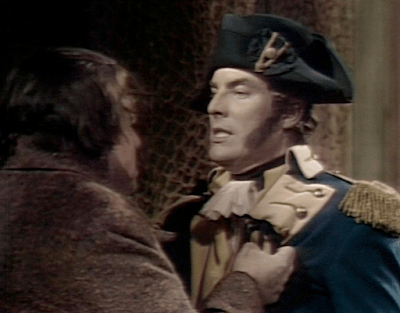
In between these scenes, untrustworthy naval officer Nathan Forbes finds Ben and tries to pay him for information about a man who was once their mutual friend, Barnabas Collins. Ben indignantly refuses the money. When Nathan keeps trying to talk him into it, Ben handles him roughly, then stalks off.
This exchange will be of some interest to those who have been watching Dark Shadows from the beginning. Nathan is played by Joel Crothers, who in the parts of Dark Shadows set in the 1960s plays hardworking young fisherman Joe Haskell. In #3, hard-charging businessman Burke Devlin found Joe and tried to pay him for information about the Collins family. Joe indignantly refused the money.
It’s interesting to see Crothers reprising the situation, playing the opposite role. Burke had poured on a heavy display of oily charm in response to Joe’s quiet stiffening, telling a rather alarming story about the beginning of his rise to wealth and inviting Joe to adopt him as a father figure. By contrast, Nathan retreats rather quickly in response to Ben’s angry outburst, but then rephrases the offer in a hale and hearty tone, trying to assure Ben that he sees him as an equal and wants to be his buddy.
Neither Burke nor Nathan gets anywhere with his persistence, but each man’s approach is typical of him. As a man born into the working class of Collinsport who became a millionaire, Burke proceeds from an ironclad certainty that every wage earner in town wants to follow his example. He cannot doubt that Joe will jump at the chance to take his money and his advice. As a self-involved navy officer, Nathan believes that enlisted sailors will be sincerely grateful to him if he acts like their friend, and extends that belief to include governesses, ladies’ maids, bartenders, streetwalkers, indentured servants, and everyone else he sees as his inferior.
Ben’s angry response to Nathan’s proposition also echoes the early days of the show. When Dark Shadows was set in 1966, Thayer David played violently irritable handyman Matthew Morgan. When Ben lunges at Nathan today, he is the very image of Matthew lunging at Burke in #64. But where Matthew had to be restrained by bystanders and threatened by the sheriff before he settled down, Ben quickly backs off.
The contrast between Matthew and Ben goes to the heart of the eighteenth century flashback. Each is a formidable fighter. Each is excessively devoted to a member of the Collins family, Matthew to reclusive matriarch Elizabeth Collins Stoddard, Ben to Barnabas. Each lands himself in trouble because of that devotion. But Matthew grew up in a Collinsport that had been laboring under a curse for many generations. He is unstable, irrational, dangerous. But for Ben, the curse just began a few months ago, long after his adult personality was fully formed. He is a sane man, and a good one. We can hope that he will emerge from Barnabas’ shadow and make a bright future. In that hope, we can see what the curse will cost not only the Collinses, but all the people of Collinsport.
There was a lunar eclipse on the night of 24 January 1796; it reached its maximum at 10:09:20 Eastern time. In our time-band, that eclipse was not easily visible in central Maine, but in this episode we see that in the universe of Dark Shadows, it was spectacular there. Caddish naval officer Nathan Forbes and fluttery heiress Millicent Collins come inside from the terrace of the great house of Collinwood after watching the eclipse.
In the drawing room, Nathan proposes marriage to Millicent. She gladly accepts. Matriarch Naomi Collins enters. Millicent is worried Naomi will disapprove of them being alone together so late, while Nathan wants to tell her of the engagement. Before they can say anything, Naomi tells them that her daughter Sarah, whose eleventh birthday is day after tomorrow on the 26th, has gone missing. Nathan volunteers to take charge of the search parties.
Sarah had been looking for her big brother Barnabas. Unknown to her, Barnabas has become a vampire and has been snacking on the women who frequent the waterfront of the village of Collinsport. In yesterday’s episode, Sarah caught a glimpse of Barnabas, followed him to the cemetery, and wound up in the outer room of the family mausoleum, near the secret panel behind which Barnabas’ coffin is hidden. At the top of today’s episode, the door out of the mausoleum slams itself shut and Sarah is unable to open it.
That moment suggests a solution to a riddle that has been part of Dark Shadows ever since Barnabas joined the cast of characters in April 1967, when the show was set in contemporary times. Doors in structures associated with Barnabas would close themselves and trap people. Sometimes this advanced Barnabas’ objectives, but just as often it was an inconvenience to him. Today, he most definitely does not want Sarah to be in the mausoleum. Part of the curse that made Barnabas a vampire is that everyone who loves him will die. Barnabas has killed the malign Angelique, the witch who placed the curse on him, but he is still a vampire- the curse lives on. So perhaps the curse itself has a power that makes the doors slam shut, keeping Sarah in this cold room until she falls ill.
At the waterfront, Barnabas meets a woman named Ruby Tate. Ruby is fashion-forward, to say the least; her outfit would become stylish nearly a century later. It’s the sort of thing that might have been admired by the women Jack the Ripper killed in the Whitechapel section of London in 1888-1891. Indeed, this foggy scene is a fairly obvious reference to the Whitechapel murders.
Barnabas is alarmed when Ruby recognizes him and calls him by name. He is befuddled when she tells him she had heard that he went to England- he doesn’t know that his father Joshua is spreading that story to conceal his death, which Joshua believes to have been the result of the plague. Ruby keeps saying that the other girls will be jealous when she tells them she spent the night with Mr Barnabas Collins, alarming him further.
In the early months of the show, the story of Burke Devlin’s quest for revenge on the Collinses had occasionally brought up the contrast between the working class village of Collinsport and the lordly family on the estate of Collinwood and suggested class conflict as a theme. Those suggestions were never very richly developed, and lately we have spent so much time holed up with the Collinses in their mansions that it is startling to see them through the eyes of the villagers. Ruby’s excitement at pairing off with one of the area’s grand aristocrats reminds us that the curse threatens the future of more than one family.
Ruby promises Barnabas not to tell anyone about him, but does notice him looking at her strangely. Something clicks, and she cries out “It’s you!” Barnabas draws closer. Fleeing him, she falls into the water. Barnabas calls Ruby’s name, but cannot stop her drowning.
Apparently Barnabas found someone else to attack after Ruby drowned, because his face is smeared with blood when next we see him. He returns to the mausoleum. Sarah sees him. He keeps his face turned away from her while she pleads with him to take her home. He keeps telling her to go without him. He finally turns to look at her. She sees the blood and shouts “You’re not Barnabas! You’re not, you’re not!” She runs out of the mausoleum, and dawn breaks.
Ruby Tate is played by Elaine Hyman. Hyman was busy as an actress in New York for decades before her death in 2020. She was in three plays that made it to Broadway, and her TV credits included episodes of The Sopranos, Broad City, and several iterations of the Law and Order franchise. She’s a sensation as Ruby, it’s a shame this is her only appearance on Dark Shadows.
In 1966 and the early weeks of 1967, the Collinsport Inn was an important place on Dark Shadows. The restaurant there, presided over by Maggie Evans (Kathryn Leigh Scott,) The Nicest Girl in Town, was a place where people could meet each other unexpectedly and characters new to town could be introduced. Dashing action hero Burke Devlin (Mitch Ryan) lived in a suite at the inn, and the place often represented his territory, the base from which he conducted his war against the ancient and esteemed Collins family.
We haven’t seen Burke’s room since #206, at which point he had given up his vendetta against the Collinses and proceeded far down the road to irrelevance. We haven’t seen the restaurant since vampire Barnabas Collins (Jonathan Frid) met Maggie there in #221. By the time Anthony George took over the part of Burke in #262, Burke seemed to live in the Blue Whale tavern. He made business calls from the pay phone there, and in one episode apparently stayed behind when the bartender locked the place up for the night.
The inn makes a return appearance at the top of today’s episode. It is 1795, and Jeremiah Collins (Anthony George) is sharing a suite with Josette DuPrés (Kathryn Leigh Scott.) They are on their honeymoon.
Jeremiah and Josette eloped from the estate of Collinwood on the night when Josette was supposed to marry Jeremiah’s nephew, kindly gentleman Barnabas Collins (Jonathan Frid.) Josette truly loved Barnabas and Jeremiah was his dearest friend, but they were under a spell cast by wicked witch Angelique, who wanted Josette out of the way so she could have Barnabas for herself. The power of the spell waxes and wanes. When Josette and Jeremiah are in the grip of it, a trident shaped mark appears on their hands; when they return to their senses, the mark disappears.
When the episode begins, the tridents are showing, and the newlyweds are inflamed with passion. Shortly after, Josette’s mark is gone, Jeremiah’s still showing. She is filled with regret, he is still ardent.
Back in the manor house of Collinwood, Barnabas has a conversation with Josette’s father André and his own father Joshua. He resists André’s suggestion that Josette and Jeremiah must have left together, and resists even more strenuously Joshua’s declaration that they did so because they are the victims of witchcraft. Joshua says that his sister Abigail and André’s sister, the Countess DuPrés, found a blasphemous trinket in the quarters of governess Victoria Winters, and that a witch-hunting divine, the Reverend Trask, is coming to investigate the matter. Barnabas is appalled at the notion of an inquiry into witchcraft, and vows to defend Victoria if Trask comes. Joshua forbids him to do so.
Barnabas’ reaction to the idea of a witchcraft trial, coupled with what we have seen of him so far in the 1795 segment, looks like a retcon. In #358, only a week and a half before we began this uncertain and frightening journey to the past, vampire Barnabas told a story about studying witchcraft under a warlock on Barbados who taught him “the secret magic number of the universe.” Events are moving so fast that it doesn’t look like Barnabas will have time to sail to the Caribbean before he becomes a vampire, and he won’t be crossing any waters after that. But now he is a man of the Enlightenment, who scoffs at the idea of witchcraft today as he scoffed at the tarot when the countess introduced him to it in #368/369.
Jeremiah returns to the house. There is an exquisite little scene with a servant, Riggs, who is uncomfortable at the sight of the disgraced Mr Jeremiah. Riggs stands in for the establishment of Collinwood and the whole working class of the town of Collinsport, and in his reaction we see the disquiet that bad news from the big house on the hill would spread among the people whose livelihoods are at stake when trouble comes to the family there. Riggs makes haste when Jeremiah tells him to go out and fetch Joshua.
When Riggs is gone, Josette enters. The audience sees that the mark is gone from Jeremiah’s hand, and Josette can tell that his passion for her is gone. She tells him that he no more loves her than she loves him. He begins with a protest against this remark, but ends by saying that they must be kind to each other.
Joshua and André enter. André embraces his daughter and tells her everything will be all right; Joshua looks at his brother with distaste and demands an explanation.
Jeremiah says that he and Josette are married. He further says he realizes they are not welcome, and that they will return to the inn. This raises the prospect of a recreation of the early days, with the inn as a territory separate from and opposed to Collinwood. Joshua rejects the idea at once. He will not have the scandal of Jeremiah and his new wife living in town because they have been estranged from the rest of the Collinses. He decrees that they will live at Collinwood and put on a happy face for the townsfolk.
Barnabas enters. Joshua tells him that Jeremiah and Josette are married. He refuses to believe it until Josette confirms it herself. He takes the glove from Jeremiah’s hand and slaps him in the face. He gives him a choice of weapons.
Dueling may have been as alien to the ideals of the Enlightenment as were Barbadian warlocks, but so too is Joshua’s plan of forcing the whole family to commit itself to a massive lie in order to preserve its hereditary privileges. Joshua, the proud apostle of Jeffersonian republicanism, is simply being a hypocrite, but Barnabas is a more complicated figure. Seeing his every hope turned to dust before him, his ideals have become useless. He has only a moment to choose among the evils the Enlightenment had promised to stamp out, and he chooses the most macho one available.
Joshua forbids the duel, but Barnabas disregards his father’s authority and insists on it. In 1795 and for some time after, dueling was widely practiced in much of the United States, and particularly in the South and West a gentleman lost face if he refused a challenge. No such stigma attached in New England, where dueling was condemned by law and religion. Had Joshua or Jeremiah gone to the police, Barnabas would have been arrested. In 1719, Massachusetts, of which Maine was a part until 1821, passed a law making it an offense punishable by a fine of £100 (equivalent to about $7000 today) to challenge someone to a duel. Massachusetts law already considered it murder to kill someone in a duel, and prescribed death by hanging as punishment. Of course, Joshua’s declaration that Jeremiah and Josette will live in the house and the family will present a “united front” to deter scandal makes it clear he will never turn his son over to the police, and the pattern of cover-up with the support of law enforcement we saw among the Collinses in 1966 and 1967 leads us to doubt that anything a member of the family does will ever be a matter for the courts to judge.
There is a missed opportunity in the show’s lack of interest in Massachusetts’ actual laws about dueling. The 1719 law was amended to be even stricter in 1730. Among the provisions added to the law at that time was a requirement that anyone who had either been killed in a duel or been put to death for winning a duel would “be given an unchristian burial at a gallows or crossroads, with a stake driven through their body.” Since the audience knows that Barnabas is fated to become a vampire, there is a chilling irony in seeing him volunteer for a staked burial.
A few times in the early months of Dark Shadows, writers Art Wallace and Francis Swann found themselves in a corner. The story could move forward only if a character took a particular action, but they couldn’t come up with a reason to explain why any character would take that action. So they had the character do whatever it was simply because it was in the script, and hoped the actors or director or somebody would come up with sleight of hand to conceal their desperation.
Since well-meaning governess Vicki was on screen more than anyone else, she was the one most often required to behave without motivation. Sometimes, Alexandra Moltke Isles finds a way to make Vicki’s behavior intelligible in spite of the writers. The scenes in which Vicki tries to befriend her charge, strange and troubled boy David Collins, are Dark Shadows‘ premier example of good acting trumping bad writing, and there are smaller examples as well. But there are three times in the Wallace/ Swann era- in episodes 26, 38, and 83– when Vicki simply looks like an idiot. This “Dumb Vicki” will appear more and more often as the series goes on, and will eventually ruin the character and do grave damage to the show.
Some weeks ago, Wallace and Swann were succeeded as the principal writers of the show by Ron Sproat and Malcolm Marmorstein. Sproat was a cut below Wallace and Swann, and Marmorstein was far less talented even than Sproat. Today, we get a succession of Dumb Vicki moments resulting from basic incompetence on Marmorstein’s part.
Vicki is visiting her friend Maggie Evans, The Nicest Girl in Town. Maggie has shown her a canvas that her father, drunken artist Sam, was possessed by an unexplained force to paint. Sam hates the painting and is surprised as he watches it take shape under his brush, but is powerless to stop working on it. It depicts Laura Collins, mother of David. Laura is shown as a winged figure, nude and engulfed in flames.
Sam has had several scenes in which he was shown in closeup delivering speeches about his hatred for the painting and going through convulsions while spooky music plays on the soundtrack. He has also had scenes with Maggie and with Laura’s husband, high-born ne’er-do-well Roger Collins, in which he tries to explain what is going on with him and the painting. Yesterday, Maggie recapped much of this to Vicki, sharing the suspicion that Laura is somehow responsible for Sam’s compulsion to paint the picture. Since the show has also given us loads of hints that Laura is connected to the supernatural, this all adds up to a very heavy-handed way of telling the audience that Sam is possessed.
Once you can say that your characters are possessed by unseen spirits, you get a lot of extra latitude as to what constitutes motivation. Once they have shown us that he is possessed, all we need to know about Sam for his actions to make sense is that he has some kind of connection to Laura and that Laura has some connection to the supernatural. The results of the possession hold our interest as we compare them with other events in the story and look for a pattern we can fit them into.
As far as the supernatural beings responsible for the possession go, we don’t need much information at all about their motivation. Far less than for human characters. Most audiences have more or less definite ideas as to what human beings are and what makes them do the things they do. We’re more flexible as to what supernatural beings are, and are willing to spend a long time searching for coherence hidden in story elements that don’t seem to have a logical connection once we have seen that there are uncanny forces in operation.
To get the benefit of that audience participation, a writer does have to show that supernatural forces are at work. Today, Vicki seems to be possessed, but there is no scene showing us that this has happened. Vicki looks at the painting and says she wants it. Asked why, she says she doesn’t know. Nothing she says makes much sense, or much impression.
Three seconds of Vicki staring at the painting while we hear a theremin cue on the soundtrack would have sufficed to tell us that she was falling under a spell. Not only don’t we get that, Mrs Isles never gets a chance to show us what is happening to Vicki. When Vicki first looked at the painting, she was partially obscured, standing behind Maggie; examining it later, she has her back to the camera. During her dialogue with the loudly agitated Sam, only a few brief shots focus on her. Sam gives Vicki the painting. When Maggie says she wonders how Laura will react when Vicki brings the painting into the house, Vicki mumbles that she doesn’t know.
Had we seen Vicki falling under the spell, the result could have been a powerful moment. As a supernatural storyline goes on, the mysterious forces behind it spread their influence from one character to another. The first moment in this one when we could see that sort of contagion at work is when the powers that have been controlling Sam take hold of Vicki. To hide that moment from us is to hide the whole development of the narrative arc.
Moreover, that this particular development takes place on this set among these characters is quite significant. When Vicki and Maggie first met, Maggie told her that she was a jerk for taking a job at the great house of Collinwood. She told Vicki that Collinwood was a source of trouble for the town of Collinsport. As the weeks went on, Maggie and other Collinsport natives made it clear that a big part of that trouble comes from the ghosts and ghoulies that are housed in Collinwood and that threaten to break out and take over the town. This will indeed become the major theme of the show in the years ahead.
Now Vicki has lived in Collinwood for over six months, and the only ghosts she has seen are the friendly, protective spirits of Josette Collins and beloved local man Bill Malloy. The first time a supernatural being does something frightening to Vicki is in the town of Collinsport, in Maggie’s own house.
Indeed, the Phoenix storyline is the only one in the whole series to invert the usual pattern of Collinwood as hell-mouth and Collinsport as a beleaguered outpost of normality. There are other storylines where evil powers came from far away, from across the sea or from another dimension, and settled in Collinwood before spreading out to threaten Collinsport, but in this story the source of the disturbance is Laura. While she may tell David in episode 140 that she comes from one of the realms described in the legends of the Holy Grail, that origin applies only to her uncanny side. When Laura first came to town, she had told Maggie that she was originally from Collinsport, and in episode 130, Laura’s estranged husband Roger, and Roger’s sister, reclusive matriarch Liz, had mentioned that Laura’s family had moved away from town.
The episode also leaves us on our own trying to figure out what Vicki is thinking. Regular viewers might take some time during the commercial break to puzzle it out, put it in the context of what we’ve seen previously, and wonder if Vicki is in a stupor because she too is possessed. That might help us to get through the rest of the episode, but if we are to feel a live connection to the character we have to understand what she is feeling while we are watching her. A theory we come up with after the fact is no substitute for empathy we experience during the scene. And of course people tuning in to Dark Shadows for the first time will simply think that Vicki is some kind of idiot.
Many fans of Dark Shadows, especially those who haven’t seen the first 42 weeks of the show or who didn’t see them until later episodes had given them fixed impressions, blame Alexandra Moltke Isles’ acting for Dumb Vicki. But today’s scene in the Evans cottage shows how deeply unfair that is. If an actor doesn’t have lines to deliver, she can’t use her voice to create a character. If the camera isn’t pointed at her, her body language is no use. And if the director is telling her to play the scene quietly while the others are going over the top, she’s likely to fade into the background. Without even a musical sting on the soundtrack to support her, there is nothing Mrs Isles could have done to communicate to the audience what Vicki is going through in this scene.
It is easy for me to denounce Malcolm Marmorstein, since his scripts are so often so bad. I am reluctant to place a share of the blame on director John Sedwick, since I am always impressed with Sedwick’s visual style and usually with his deployment of actors. But I can’t believe anyone would have stopped him pointing a camera at Mrs Isles at the appropriate moment, giving her a chance to play her part.
Back at the great house of Collinwood, David and Laura are sitting by the fire. David asks his mother about her old boyfriends. He wants to know if she ever dated dashing action hero Burke Devlin. She admits that she did. When David lets on that he wishes Burke, rather than Roger, were his father, Laura squirms. We’ve had a number of indications that Burke might in fact be David’s biological father, and Laura is alarmed that David is raising the topic.
The front door opens, and David and Laura are glad to see their friend Vicki. They are intrigued by the package Vicki is carrying. David begs to see what’s inside. Laura, in a light and cheerful voice, tells him that if Vicki wanted him to see it, she would have shown it to them. He continues to beg. Vicki says “All right!,” and unveils it. When we were watching the episode, Mrs Acilius exclaimed “All right!?,” appalled at Vicki’s nonsensical decision to yield to David’s pleas despite the cover Laura was giving her. Again, the idea that Vicki’s weird decisions and vague, distracted manner might be symptoms of possession was somewhere in our minds, but since nothing had been shown to give direct support to that idea our emotional reaction suited a Dumb Vicki moment.
As Maggie had suggested she might be, Laura is horrified to see herself depicted in this fiery image. David is thrilled- he had been plagued by a recurring nightmare, one he had described in detail to the deeply concerned Vicki, in which his mother stood in a sea of flames and beckoned him to join her. He asks how Sam knew about his dream- did he have the same dream? Vicki mumbles that he didn’t, that he didn’t know anything about the dream or even why he was painting the picture. The audience may have wondered why Vicki didn’t remember the dream until now- the explanation that fits best with the story is that she has been possessed by the same spirit that possessed Sam, but with so little attention given to Vicki as she was reacting to the painting some very insightful critics have taken it as another Dumb Vicki moment.
David points to a white space in the painting, one the shape of his own head, and asks what goes there. Vicki mumbles that she doesn’t know, and that Sam himself didn’t know. David is delighted with the painting and wants to hang it in his room. He asks Vicki to give it to him. Vicki tells him that his mother will have to rule on that question. Laura hates the painting and tries to talk David out of hanging it, but he is nothing deterred. She finally caves in.
While David goes upstairs with the painting, Laura asks Vicki what she was thinking bringing such a terrible thing into the house. Vicki says she doesn’t know- something just came over her. That goes to show that the writer wanted us to think that Vicki was possessed, which in turn makes it all the more exasperating that he didn’t let us in on it at the appropriate time. The fact that we know the writer wants us to have a reaction doesn’t mean that we actually have it. Confusion pushes people away from a story, and merely intellectual explanations offered after the fact don’t draw us back in.
Vicki, seeming to regain some of her brainpower, goes to David’s room and tries to talk him out of keeping the painting. He dismisses her concerns immediately, without even changing his delighted manner, and hangs it on his wall. Looking at it, Vicki admits that it looks like it belongs there.
Laura enters, and tells David she has changed her mind. She thinks it would be bad for him to have such an image on display, and asks him to get rid of the painting. David responds by threatening never to speak to her again. Laura has just been reunited with David after years of separation, and his initial reaction to her return was confused and traumatic. So it is understandable that she capitulates to this extortion.
It is more surprising that Vicki responds by turning away and wringing her hands after Laura leaves. Usually Vicki scolds David after he is nasty to people, and she has been on a particular mission to break down the barriers between him and his mother. If it were clear that Vicki was under the influence of a spirit and was not herself, this uncharacteristically diffident response might have carried a dramatic punch, at least for regular viewers. As it is, it slides past as yet another Dumb Vicki moment.
Back in the Evans cottage, Sam comes back from his usual night of drinking at the local tavern. Maggie is infinitely weary of her father’s alcoholism, but does smile to hear him reciting poetry and talking about a seascape he is planning to paint. At least he’s happy. Sam goes to his easel to start that seascape, only to recoil as he realizes that he is in fact painting another version of the picture of Laura in flames.
David is asleep in his room. The painting starts to glow. Then Laura’s painted likeness is replaced with a video insert of her face. The insert grows and grows, and David screams for it to stay away.
Maggie’s suspicion that Laura is behind the portrait fits with the many signs the show has given us of Laura’s uncanny nature. Laura’s reaction when Vicki brings the painting home, though, shows us that what has been happening to Sam does not serve Laura’s interests, any more than David’s nightmare did.
I think there are three possible explanations for the origin of the compulsion Sam had to paint the picture, the compulsion Vicki had to claim it, and David’s nocturnal disturbances. It could be that by exposing David time and again to the image of him following her into flames, Laura is gradually wearing down David’s resistance to a horrible idea that will lead to his destruction. In support of this interpretation, we remember the first night Laura was at Collinwood. She was calling David’s name in a quiet voice at the window of her cottage, far from the great house. Yet the sound of her voice penetrated David’s mind as he slept. He writhed on his bed, and went into the nightmare. Laura’s objection to the painting militates against this explanation.
When we were watching the episode, Mrs Acilius suggested a second reading. There might be a lot to Laura. Maybe in addition to the physical presence in the house that wants David to come away with her, there is also a ghostly presence that wants to warn him and everyone else of the danger that implies. That interpretation would fit with David’s sighting, the night Laura first came to the house, of a flickering image on the lawn that looked like Laura. David longed for that Laura to come to him, but reacted with terror when he saw the fleshly Laura in the drawing room. Perhaps there are two of her, and one is trying to protect David from the other. It is also possible that the two Lauras are not aware of each other, or even fully aware of themselves. So this interpretation is easier to reconcile with apparently contradictory evidence.
Vicki’s involvement suggests a third possibility. The ghost of Josette Collins appeared to her and comforted her in episode 126, and an eerie glow had emanated from the portrait of Josette when David left Laura alone in the Old House yesterday. Laura was alarmed to hear that David was interested in the ghosts of Collinwood, had not wanted to go to the Old House, and lies to David when he asks if he saw any sign of Josette’s presence. Perhaps Josette is intervening to thwart Laura’s plans, and it is her power that is benumbing Vicki today. Josette’s previous interventions have been intermittent and subtle, suggesting that it is difficult for her to reach the world of the living. So if she is preparing for a showdown with Laura, we might it expect it to take her some time to recruit her strength.
Again, this is the kind of search for patterns that an audience will gladly go into once you’ve let them know that there are supernatural forces at work in your story. Since Josette has been in the background of the show from week one, has appeared repeatedly, has a set devoted to her in the Old House, and has established connections with both Vicki and David, we might expect her to be the first of the uncanny presences we think of when we enter a supernatural storyline. That she is a tutelary spirit presiding over Collinwood brings it into sharp focus that the estate is under assault from a supernatural force emanating from the town of Collinsport. Today’s failure with Vicki kicks Josette’s ghost out of the spotlight, and that is one of the major faults with the episode.
In these early months of Dark Shadows, we hear that all the money made in the town of Collinsport finds its way to the old dark house on the top of the hill, where it does nobody any good.
The house itself is full of examples of wealth going to waste. Each of the last few episodes have involved long treks through abandoned corridors and visits to forgotten rooms. Everywhere you turn in these dank spaces, years of accumulated dust bury vases, paintings, antique furniture, oriental rugs, and other apparently valuable objects.
The Collins family is headed by a woman who hasn’t left the house in eighteen years. Reclusive matriarch Liz shares her home with her brother Roger, a spectacularly irresponsible man who squandered his entire inheritance and now holds a position in the family business which seems to involve little or no work. It is difficult to imagine that they run a dynamic enterprise that is taking advantage of the economic boom of the 1960s.
At the same time, Liz seems to have a vigilant concern for the security of her employees. Her only household servant, gruff caretaker Matthew, often brings up the fact that she gave him a cottage on the grounds of the great estate and assured him he would have it for the rest of his life. When plant manager Bill Malloy comes to the house to ask Liz to approve the acquisition of some new machinery for the cannery, her first question is how many men will lose their jobs as a result of it. Only when he assures her that the answer is zero does she agree to the purchase. So we might imagine that the attitude of local wage-earners towards the Collinses will be two-fold- on the one hand, gratitude that they go out of their way to ensure that the people working for them keep what they have, but on the other frustration with their failure to create opportunities for them to move ahead at a time when working people everywhere else in the USA were experiencing the fastest rise in real incomes in the nation’s history.
The relationship between hardworking young fisherman Joe and flighty heiress Carolyn occasionally seems like it will dramatize this situation. Joe is a local boy, and like everyone else in town, he works for the Collinses. Liz has taken a liking to him, and wants him to marry her daughter and have a career as an executive with the firm. He would be glad to marry Carolyn, but is not interested in that career- he wants to buy his own fishing boat and build his own business around it. Liz keeps trying to pull him deeper into her family’s firm, but he keeps insisting on his plan to go his own way. Joe mentions a friend with whom he wants to go into partnership. We never see this friend or anyone else who is working with Joe, and Carolyn doesn’t show the slightest interest in Joe’s plans. Since he doesn’t have anyone to talk to about his ideas, beyond a couple of scenes when he shakes his head at Liz and says “I’m sorry, Mrs Stoddard, but my mind’s made up,” the story of his attempt to diversify Collinsport’s economy doesn’t go anywhere. Earlier this week, the Joe/ Carolyn relationship met its long-awaited demise.
Joe has moved on to a relationship with Maggie Evans, The Nicest Girl in Town. The daughter of drunken artist Sam Evans, Maggie runs the restaurant in the Collinsport Inn. She and Joe are representatives of Collinsport’s working class. During their first date, Maggie demonstrated an encyclopedic knowledge of sail-rigging, which may not be the most useful thing for a commercial fisherman in the age of diesel, but her interest in the sea raises our hopes that she might be a partner to Joe in his ambitions. Together, they might show us what it has meant for the town that the Collinses control so much wealth and do so little with it.
In a comment on Danny Horn’s blog Dark Shadows Every Day, I mentioned another way the show could have done more with this theme. I imagined that they might have expanded the part played by the only African American actor to deliver lines on Dark Shadows, Beverly Hope Atkinson.
The opportunities they missed came into view in episode 563, when Beverly Hope Atkinson appears as the unnamed nurse who keeps Nicholas Blair out of Joe’s hospital room but lets Maggie in. Unnamed Nurse lights up when she sees Maggie and greets her by name; they seem to be old friends.
In the first 42 weeks of the show, when the supernatural was in the background and the stories were slow, it would have been easy to have a couple of tea party scenes at the Evans cottage where Maggie and her lifelong friend, Unnamed Nurse, recap whatever is going on. Those scenes could have led to a whole exploration of the tension between the working-class people in the village and the jerks in the big house on the hill. That in turn could have led to the introduction of Unnamed Nurse’s family, headed by Unnamed’s parents, Mr and Mrs Nurse, including her brothers, Young Mr Nurse and Master Nurse, and her sister, Miss Nurse. We could then have seen the ancestors of the Nurse family in each of the flashback segments and analogues of them in Parallel Time.
I try to keep my contributions to Dark Shadows fanfic modest, so I didn’t try to think up a new name for Unnamed Nurse. My point is that the makers of the show did not need any more sets or many more characters to create a much more spacious world in the imaginations of the audience. The Evans cottage by itself, as an instance of a working-class home in Collinsport, is almost enough to make us think of a whole town of people teeming with ambitions, resentments, plans, and frustrations. Just a few small scenes there shedding light on some underused themes could have got us the rest of the way.
Another character who brings the Collinses’ deficiencies as commercial leaders of Collinsport into view is dashing action hero Burke Devlin. Himself born into Collinsport’s poorest class, Burke has gone away and somehow made himself very rich. The whole time he was in Collinsport he was penniless. He left town when he was sent to prison. Only five years after his release from prison, he is a millionaire many times over, in a position to buy up the Collinses’ debts and claim all of their assets. The show has dwelt on this timeline often enough that they have started making awkward attempts to explain how he got so rich so quickly. But it seems that we are supposed to feel that it was simply getting clear of Collinsport that opened the doors to wealth for him. He went to South America, he went to New York, he went to an oil field, he went someplace, but all that really matters is that he went far from the stifling influence of the Collinses and their gloomy house.
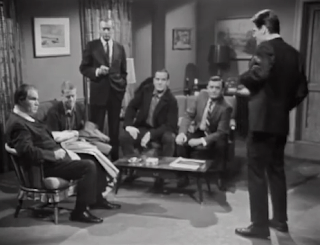
Now, Burke is moving to destroy the Collinses and supplant them at the head of local industry. Today, he and his lawyer meet with some of the key men from the Collins cannery and fishing fleet. He wants to recruit them to work for a competing firm he is buying. When the lawyer tells him the men may be too loyal to Liz to take his offer, Burke recites a list of the tired cliches that wealthy villains spout when boasting to their henchmen of the power their money gives them: “Money talks. Money buys loyalty. Everyone has their price. Name it and you can buy them. Some just come a little higher than others, that’s all, but everyone is for sale.” Too bad Cabaret didn’t get to Broadway until three weeks after this episode was broadcast, or he might have closed with a few bars of “Money Makes the World Go Around.”
The men are offended when Burke says he wants them to leave the Collinses and come to work for him. They pride themselves on their loyalty to the Collinses. If they feel that way, it’s a mystery why they agreed to come to a meeting with Burke in the first place- everyone in town knows about his vendetta against the Collinses. They start to leave, but stay long enough to hear Burke offer them higher wages than the Collinses can pay, and a profit-sharing plan.
The most senior of the men present, Amos Fitch, stops by the house to tell Liz and Roger about the meeting. Apparently the other men are more rational economic actors than Amos, and they are considering Burke’s offer.
After the meeting has broken up, Burke spends a few more minutes expounding to his lawyer on his theme that anyone will do anything if you dangle enough money in front of them. He interrupts himself before he can literally say that all people are whores and gives the lawyer a check, telling him that it’s always good to have some extra loyalty around. Apparently he decided that leaving a two-dollar bill on the night-stand might be too subtle. The lawyer reacts with distaste to Burke’s crassness, but takes the check.
Burke’s first attempt to buy someone’s loyalty took place all the way back in episode 3. He met Joe in the local tavern and offered him enough money to buy a fishing boat in return for information on the Collinses. When Joe refused, Burke told him that he himself got his start when a strange man approached him in a sleazy bar and offered him a lot of money to do something he wasn’t very specific about. He accepted, and that led him directly to great riches. That’s wonderful career advice, “A guy in a bar flashes some dough, you don’t ask no questions, honey, just leave with him.” Sounds like a guaranteed path to success. Anyway, it’s obvious in that one that Burke is trying to lure Joe into something dishonorable. We already care about Joe, so if he were to be tempted we would be in suspense until he proved his uprightness.
Contrast Burke’s attempt to buy Joe’s services back then with today’s attempt to hire this group. We’ve never seen or even heard of any of the men whom Burke is trying to lure. So if the conflict over control of the sardine-packing business is a test of their moral rectitude, it’s none of our concern. On the other hand, if it were a choice between a prosperous future for the town that does not include the Collins family or a stagnant future that does, there might be real suspense.
The Collinses are our point of view characters and the story cannot continue if they are thoroughly defeated, so if we enjoy watching the show we will root for them no matter how strong a case their antagonist may make for his position. On the other hand, we do care about Maggie and Joe, and are ready to care about characters who are friends of theirs. Therefore, if we see that a plan will be good for the working people in town, it won’t be easy for us to hope Liz and Roger will foil it. If the show can put us in that situation, we will feel suspense as we watch the events of the story and look for a way to resolve the tension that our mixed feelings have created. That’s how every thriller works- we may want the good guy to beat the bad guy eventually, but not until we’re done enjoying the contest between them.
Think again about Burke’s temptation of Joe in episode 3. Joe earns a few points with the audience by rejecting Burke’s offer out of hand. If he’d considered it, we would have paid attention to him until he made his decision, but only to him- a temptation story works only if the person or people being tempted find themselves isolated from everyone else. If he ultimately rejected the offer, the story ends and leads nowhere. If he’d accepted it, we would be disappointed in him and lose interest in his subsequent doings. He wouldn’t become interesting again until he either went through a redemption story, which would again tend to isolate him from the rest of the cast, or became a villain, which isn’t what they want the character for right now. But if, instead of a moral test, he had been presented with a plausible business decision, we could have had a story that would have given us a virtual tour of Collinsport and given us a feeling that we know the place, even if we didn’t actually see any new sets.
So that’s why I wish Dark Shadows had done more with the relationship between the Collinses and the rest of Collinsport. Not that I suppose the writers had deep political and sociological insights that I long to have heard, but that putting your characters in a bigger world allows you to tell bigger stories.
Friday’s episode ended, not with a cliffhanger, but with a visitation from the supernatural, as we saw the ghost of Josette Collins descend from her portrait and pirouette around the columns of the mansion she haunts. Today, Roger and Vicki sit in the diner, where he gives her a lecture about the sardine-packing business.
The apparition of Josette was the climax of an episode featuring more exterior footage than we have seen thus far. Today, we have several more location inserts, as we see Roger and Vicki walking around the village of Collinsport. As that one came to a climax with a new set- the Old House- this one also ends with our first look at a new set- the outside of the front doors of the great house of Collinwood.
These attention-getting moves prompt us to look for something big. The makers of the show tell us in so many words that the business story isn’t it.
After Roger has told Vicki a few facts about the sardine industry, she asks how the fishermen know where to look for sardines. He makes it clear that he has reached the limit of his willingness to discuss the topic with a dismissive, “Oh… luck. And experience.” Only when his enemy Burke comes in and he wants to look busy does Roger return to the subject with gusto. After Vicki has toured the cannery, Burke asks if Roger showed her “the place where they cut the heads off the fish.” Neither of those characters would watch a show about the sardine industry, or expect anyone else to do so. When they tell us that the business Burke is scheming to seize from Roger’s family doesn’t seem like exciting narrative fodder even to the two of them, the makers of Dark Shadows are telling us to forget about the business stories and focus on the sort of thing we saw at the end of Friday’s installment.
There is one bit of trivia that I hold onto from this episode. Vicki mentions to Roger that she finds it amusing that the family’s wealth began with the whaling industry and now comes from sardines- from the greatest giants of the sea to some of the tiniest fish in the ocean. An origin as whalers fits with the idea they have at this period of the show, that the Collins family first became wealthy in the 1830s.
Later, they will push them back in time, and present them as having already been rich long before then. That would rule out whaling as the first source of the Collinses’ riches. The New England whaling industry was a creation of the nineteenth century. The region’s wealth prior to that time was founded on cod fishing.
One of the major themes of the show in this period is that the Collinses are much less rich and operate on a much smaller scale than they did in the past. The transition from whales to sardines is an obvious metaphor for that decline. So obvious, in fact, that Vicki’s remark is rather a tactless one.
Most of this one consists of people worrying about each other’s attitudes towards Burke. Bill and Sam see each other, first in the Blue Whale, later in the restaurant, and in each place they share beverages while Bill needles Sam about Burke. In between these scenes, Joe and Carolyn are alone in the restaurant- completely alone, Joe apparently has to go behind the counter and prepare their meal himself- and they quarrel about Carolyn’s bold approaches to Burke before and during their date. At the end, Carolyn goes home, where her mother tells her about Roger’s wreck and about why she oughtn’t to be friendly with Burke.
Burke himself doesn’t appear in the episode, and none of the characters who do appear know as much about him as they think they do. What we get is a portrait of an isolated, gossipy little town, where rumors can start rapidly and grow in any direction. To the extent that “soap operas are approximately 90% information management,” as Danny Horn says, the typical setting of the gossipy little town, and its outgrowth, the false accusation, are the heart of the genre. As we watch these characters gossip and jump to conclusions, suspense forms as to how justice might miscarry if it isn’t stopped soon enough.





 Dark Shadows Commentary