The disastrously repressed Charity Trask knows that rakish libertine Quentin Collins is a werewolf, and she wants to warn everyone about him without actually saying the facts out loud. She corners maidservant Beth Chavez in the drawing room of the great house at Collinwood and urges Beth to end her romance with Quentin.
Charity keeps saying that there is something about Quentin that Beth does not know. In fact, Beth not only knows everything Charity does about Quentin’s curse, but a great deal more. She was the very first person to know that Quentin was a werewolf, before Quentin himself knew. She was with him the first time he transformed, and when he became human again in the morning she refused to tell him what she had seen. She had previously seen Quentin murder his wife Jenny, she knows that Jenny’s sister Magda placed the curse as vengeance for that murder, and she was the one who told Magda that Jenny had borne children to Quentin who would inherit their father’s curse. Beth is the foremost authority on Quentin’s condition. But she is protecting him anyway.
Charity then goes to a set known to longtime viewers as the Evans cottage. In the parts of Dark Shadows set between 1966 and 1968, this set is home to artist Sam Evans and his daughter Maggie, The Nicest Girl in Town. Today the dramatic date is 1897, but the cottage is already an artist’s studio. It is occupied by Charles Delaware Tate, a nationally renowned painter who was commanded by the evil sorcerer Count Petofi to execute Quentin’s portrait. When we first saw Tate in the cottage, he said that he rented it because he’d heard about it from a friend who had stayed there some time before.
The cottage is full of paintings and sculptures. This is odd for a rental. Several possible explanations come to mind. Did Tate bring a dozen or more of his own works to keep him company? Did his friend or other artists who had rented it leave their completed pieces behind? Did the landlords display their own collection there for the edification of their tenants? Easy as these explanations are to think of, none of them seems very likely, and the question is never addressed in the show. The out-of-universe explanation is of course that when the audience looks at an artist’s studio, it expects to see a lot of artwork, and the artwork here gives director Lela Swift a chance to make good use of color.
At any rate, the set is gorgeous today, full of bright greens and mixed reds. Swift was a highly ambitious visual artist, and she outdoes herself here. The first shot in the cottage begins with a closeup of the portrait of Quentin. It then pulls back further than any previous shot of this very familiar set, showing us a lattice that used to be part of the set representing the kitchen/ breakfast nook area at Collinwood. Behind it is a plant with some large, intensely green foliage. We then track around the set to see several sculpted pieces in black, paintings in a variety of tones, and a whole array of vivid colors in the furniture and other decorations. Dark Shadows has come a long way from the clumsiness that marked its use of color when it first switched from black and white in #295.
Charity is unaware that she and Tate are not alone. Tate’s master, Petofi, is in the next room eavesdropping. Charity is horrified to see the portrait of Quentin, and reminds Tate that she saw Quentin’s features in the portrait change into those of a wolf when she visited the cottage on the night of a full Moon. Tate tries to convince her she did not really see such a thing, but she will not have it. Charity gives Tate a warning somewhat less incoherent than the one she had given Beth. After she exits, Petofi and Tate talk. Tate had suspected Quentin was a werewolf, and now is sure. Petofi says that his plans for Quentin are none of Tate’s concern.
Petofi goes to the great house. Quentin confronts him there, demanding to know by what gods he swears. He replies “I have but one, and his name is Petofi!” Charity sees Petofi and vehemently demands he leave. I don’t know why she does this. As far as I can recall, Charity knows Petofi only as Victor Fenn-Gibbon, an honored guest of the Collins family. He did cast rather a nasty spell on her when he was using that alias, but I don’t see why she would realize that he was to blame for it, or for any of his other misdeeds.
Whatever the motive for Charity’s angry reaction to him, Petofi responds by magically robbing her of the power of speech. When he tells her that he has a healing touch, his manner and the background music indicate that after he touches her, what Charity will say will never again be up to her.
Mad scientists Julia Hoffman (Grayson Hall) and Eric Lang (Addison Powell) are conferring in Lang’s lab. Lang is putting the finishing touches on a Frankenstein’s monster into which he plans to transfer the “life force” of recovering vampire Barnabas Collins. Julia, Barnabas’ best friend, has been opposed to this experiment, but now has accepted that she can’t stop Barnabas and Lang from going through with it. She volunteers to assist.
Lang is having trouble concentrating because of a nightmare he had last night. Unknown to him, the nightmare was part of the Dream Curse, a dead end storyline about wicked witch Angelique sending a dream that each of a series of people will have. When the last person has the dream, Barnabas is supposed to revert to full-on vampirism.
Lang tells Julia about his nightmare. He says that she was in it. When he tells her that she did not speak, she smiles comfortably and says that that was proof that it was a dream. This is not only a genuinely funny line as Grayson Hall delivers it, but it is an extraordinary moment of self-awareness from Julia, a character who usually exists at the outer edge of heightened melodrama. It’s a shame that Addison Powell doesn’t know how to get out of Hall’s way for the half second it would take for it really to land with the audience.
Barnabas and his ex-blood thrall Willie are at home in the Old House on the great estate of Collinwood. Willie is smirking and Barnabas is rigid with embarrassment while the dogs howl outdoors. Willie laughs a little as he makes a remark about how Barnabas hasn’t changed as much as he thought he had. This exchange reminds us of the moment in #346 when Julia and well-meaning governess Vicki noticed that some fresh flowers Barnabas touched had died and shriveled up. Like the howling of the dogs when Barnabas feels bloodlust, the shriveling of the flowers was a consequence of his vampirism, effectively a bodily function that he cannot control. He squirmed when Julia and Vicki looked at him then, and he is stiff and flustered when Willie laughs at him now.
Barnabas orders Willie to take a letter to matriarch Liz at the great house on the estate. It will explain that he is going away on a long trip, and that Adam Collins, a young cousin from England, will be coming to stay in the Old House. Willie is alarmed by this.
Willie asks what Barnabas will do if Liz won’t let him stay in the Old House when he is in the form of Adam. Barnabas is sure she will, and dismisses Willie’s doubts. This is an interesting sequence to regular viewers. The show has never made it clear whether Liz still owns the house or has signed it over to Barnabas. A whole year ago, in #223, Liz was talking to strange and troubled boy David as if the Old House and its contents were Barnabas’ legal property. Since then, there have been moments that tend to confirm that impression, as when Barnabas takes Liz’ keys to the house away from David and does not give them back to her, and other moments that conflict with it. Willie’s question and Barnabas’ response would seem to prove that the house still belongs to Liz.
Another question we might ask is why Barnabas doesn’t go to Liz himself. Certainly she will be unhappy that he went away without saying goodbye to her. Moreover, when he showed up at the great house in April 1967, Barnabas told Liz that he was the only survivor of the English branch of the family. Liz will be skeptical if another member of this imaginary branch presents himself and expects to take possession of a big mansion on her property. She has had unpleasant experiences with Willie, so much so that a letter he delivers seems unlikely to allay that skepticism.
When Willie gets to the great house, Angelique herself opens the door. She is living there under the name Cassandra. She has cast a spell on Liz’ brother, sarcastic dandy Roger, and married him so that she will have a residence at Collinwood while she works to restore Barnabas’ curse to its full potency. Showing his typical degree of strategic ability, Barnabas has not bothered to tell Willie about any of this.
Angelique/ Cassandra ushers Willie into the drawing room, sits him down, and chats with him. Willie answers her questions about Barnabas, not realizing that he has any more reason to be discreet with her than with anyone else. He tells her that Barnabas has been spending his days with Lang. Angelique/ Cassandra already knows that it was Lang who gave Barnabas the treatments that put his vampirism into remission and that Lang is preparing further treatments for him. Barnabas should know that she knows this, since she went to Lang’s house and tried to kill him. Willie also tells her that sometimes Barnabas doesn’t seem to have changed as much as you might expect. Angelique/ Cassandra’s reaction makes it clear this is new information to her, and that it might help her in her efforts.
The scene raises yet another question. Barnabas had expressed the hope that once the experiment was complete, Angelique would see that his old body was dead, would assume that meant that he no longer existed in any form, and that she would then go away and leave him alone. But he knows that she knows about Lang, and now he is planning to come back to Collinwood, where she lives, as another “cousin from England.” The question is this- how dumb does Barnabas think Angelique is?
Back in the lab, Lang and Julia are preparing for the experiment. Barnabas shows up. When he talks with the doctors, his face is reflected in the mirror above Lang’s creature. Not only does this suggest the idea of his personality moving into the creature’s body, it also reminds us that until Lang gave him his first course of treatment, Barnabas did not cast a reflection. The whole idea of Barnabas’ reflection will remind longtime viewers of #288, when Julia first confirmed her suspicion that Barnabas was a vampire by peeking at the mirror in her compact and not seeing him. That draws a contrast between Lang, whose initial success with Barnabas appears to be leading to disaster because his impersonal, hyper-masculine approach leaves him unable to recognize the threat Angelique poses, and Julia, whose own attempts to cure Barnabas of vampirism did not match Lang’s spectacular results, but whose femininity, as symbolized by the compact, represents a fighting chance against the forces that really govern this universe.
Barnabas takes his place on a bed. He tells Julia he is glad she is with him, and she smiles at him with the sad tenderness of someone saying a final farewell to a loved one. As with her self-deprecating joke in the opening part of the episode, this smile shows a new side of Julia. For a time in October 1967 she tried to launch a romance with Barnabas, and he rejected her. Hall played Julia’s unrequited love in the same larger-than-life style that the rest of her action called for. Her feelings seemed to be an outgrowth of despair- she was by that point so deeply entangled with Barnabas that there was little hope she could ever make a life with anyone else, so even though he was an active vampire, she had little to lose by committing herself to him. But this sweet little exchange is played so gently that it opens a window on a more complex inner life for Julia.
As Lang starts the experiment, we cut to Angelique in the drawing room at Collinwood. She is talking to a clay figure, calling it “Dr Lang,” and saying that it cannot overcome her powers, for they were a gift to her from the Devil himself. She jabs at the clay figure. In the lab, Lang writhes in pain, interrupting the experiment.
It was not until #450 that Dark Shadows let on that there might be anything to Christianity. In that episode, good witch Bathia Mapes held Barnabas at bay by showing him a cross. Up to that point, Barnabas had many times strolled comfortably through the old cemetery north of town, where half the grave markers are in the shape of the cross, and they hadn’t bothered him a bit. The only representatives of the faith who figured in the story were repressed spinster Abigail Collins and fanatical witchfinder the Rev’d Mr Trask, both of whom were fools whom Angelique easily twisted to her own purposes. Now we have a character named Adam, a New Adam through whom a resurrection is supposed to take place, and he is wearing a headpiece that is photographed to look like a crown of thorns. Angelique’s reference to the Devil suggests that she can be defeated only through the aid of a being more powerful than the Devil, and since we haven’t heard about Ahura-Mazda or any other non-Christian deities who represented a supreme principle of good pitted against an otherwise irresistible evil, it looks like we’re drifting Jesus-ward.
It is daring to take that direction, even if it is only for a little bit. Vampire legends are pretty obviously an inversion of the Christian story, in which a man comes back from the dead, not having destroyed the power of death once and for all, but only to die again every time the sun rises. While Jesus feeds us with his body and blood in the Eucharist and thereby invites us to share in his eternal life, the vampire feeds himself on our blood and thereby subjects us to his endlessly repeated death. That’s why Bram Stoker’s Dracula has all those crosses and communion wafers, because it is a religious story of the triumph of the promise of resurrection in Christ over the parody of that resurrection that the vampire has settled for. It also explains why Dark Shadows so studiously avoided Christian imagery for so long. Christianity is such a powerful part of the culture that once you let any of it in, it tends to take over the whole story.
There are many reasons the makers of the show would want to avoid that fate. Not least is the tendency of religions to fracture and stories based on their teachings to become sectarian. Dracula itself is an example of that; the vampire is a Hungarian nobleman from Transylvania, connected with the Szekely clan. There really was such a clan, and like other Hungarian nobles in Transylvania its members were Calvinists, supporters of the same version of Christianity that Abigail and Trask represented. Stoker was a Roman Catholic from Ireland, a country where most Protestants are Presbyterians, a tradition that grew out of Calvinism, and so his depiction of the vampire is clearly driven by sectarian animus. The Collinses have an Irish surname, settled in New England when that region was officially Calvinist, and did very well there. So it would be easy to present their troubles as a cautionary tale about Calvinism. That would seem to be a surefire way to shrink the audience drastically. Not only are there millions of Calvinists whom it would offend, there are billions of people to whom Calvinism means nothing at all, and they would be utterly bored by a denunciation of it.
The episode is daring in several other ways as well. When Barnabas and Willie were first on the show, ABC-TV’s office of Standards and Practices kept worrying that viewers might interpret their relationship, which was founded on Barnabas’ habit of sucking on Willie and swallowing his bodily fluids, as somehow homosexual. Not only is the scene between them at the Old House reminiscent of the scenes that attracted memos from that office in the spring and summer of 1967, but the whole idea of Barnabas draining his “life force” into the body of Adam would seem to invite the same concerns.
The experiment scene would only intensify such concerns. The experiment is a medical procedure that is supposed to bring a new life into the world, which by 1968 was how Americans usually thought of the process of birth. Barnabas is the patient, he is lying down, and the doctors sedate him. Thus he takes on all the medicalized marks of a mother-to-be. Julia asked Lang if the process would be painful for Barnabas; he does not disappoint, but ends the episode screaming in response to labor pains. Not only does turning Barnabas into Adam’s mother invert the expected gender performance, but it also introduces a homosexual side to Barnabas’ relationship with Lang, who is Adam’s other parent.
Somebody ought to be there telling Barnabas he’s doing great and urging him to push. Screenshot by Dark Shadows Before I Die.
Christian imagery and gender-nonconformity would have been rather a queasy combination for most Americans in 1968. That’s unusual, in historical terms. Before modern times, Christians didn’t hesitate to discuss ways that familiar gender roles break down in the relationship of humans to Christ. The “Fathers of the Church,” the prominent Christian intellectuals of the fourth and fifth centuries, talked about that all the time, going into depth not just with the image of the Church as the Bride of Christ but of each human soul, whether male or female, as one of Jesus’ wives, and of the physical contact between humans and Jesus in the Eucharist as a consummation of their marriage.
For their part, Calvinists tended to be skeptical of the physical aspect of the sacraments, but that didn’t mean that they shied away from conjugal metaphors to describe the relationship between the soul and Jesus. John Donne, like most priests in the Church of England in the 16th and early 17th centuries, was basically a Calvinist, yet his sonnet “Batter my heart, three-person’d God” is one of the most vivid and uncompromising statements of the ancient idea of an erotic dimension to Christian life that transcends the binaries between masculine and feminine, male and female. That tradition makes today’s conjunction of Christian and homoerotic themes all the bolder- imagine if Dark Shadows wrote itself into a corner where they had no choice but to explain nuptial imagery and mystical eroticism in the writings of Saint Ambrose. The whole audience could fit into a seminar room.
Closing Miscellany
Lang and Julia wear white lab coats. This is the first time Julia has worn a white coat. Her previous lab coat was light blue, which looks white on the black and white TV sets most households had in 1968, but now that the show is being produced in color they are buying costumes and props for color televisions.
The idea of a machine that would cause a person to go to sleep in one body and wake up in another was a big deal on TV in the 1960s. Just today I saw this screenshot from The Avengers on Tumblr:
This episode marks the first appearance of Robert Rodan. When Adam was a nameless heap of flesh under a blanket, he was played by a stand-in named Duane Morris. Rodan had a few small parts on TV shows in 1963 and 1964 and was in a couple of commercials between 1964 and 1968. Adam was his first, and last, recurring role on a series. In 1969, he appeared in a little-seen feature film called The Minx, then spent the rest of his life selling real estate in Southern California.
In episode #2 of Dark Shadows, well-meaning governess Vicki first visited the precipice known as Widows’ Hill. She was standing near the edge when high-born ne’er-do-well Roger Collins crept up on her, breaking his silence with a loud voice in a deliberate attempt to startle her. He tells her that she wouldn’t be the first to jump to her death from Widows’ Hill. The precipice is thus established as a place of danger.
Roger surprises Vicki atop Widows’ Hill.
In #5, Vicki again stood atop Widows’ Hill, and again a man she had never met startled her there. He was drunken artist Sam Evans, and he told Vicki the story of Josette Collins, a grand lady of a previous century who leapt to her death from the cliff.
In the same episode, strange and troubled boy David Collins mentions the ghosts of “The Widows” to Vicki. Later, we will hear that these are the ghosts of women who jumped to their deaths from Widows’ Hill at various moments in the nineteenth century. In #12, we will learn of “The Widows’ Wail,” a peculiar sound that can be heard in the wind around Widows’ Hill on nights when the ghosts of these sad women are restless. We will hear the Widows’ Wail several times, most effectively in #344, when Vicki is trying to talk her depressing fiancé Burke out of going on an airplane journey from which he will never return, leaving her a widow before she can become a bride.
The association of Widows’ Hill with deadly danger is reinforced in #50, when Vicki and heiress Carolyn look down from it and see the corpse of beloved local man Bill Malloy on the rocks below.
Bill in the water, as seen from the precipice of Widows’ Hill. Screenshot by Dark Shadows Before I Die.
In #75, we hark back to Vicki’s first meeting with Roger. Vicki finds Roger standing on the spot where she had stood when he startled her in #2. She reenacts that scene with the roles reversed. He exclaims angrily that she might have caused him to fall; she reminds him that he had done the same to her. He laughs happily and apologizes. They have a sweet little moment together after that, but his protest shows that she really was in danger then, and that she is none too safe now.
The death of Bill set off a series of events that ended with crazed handyman Matthew Morgan abducting Vicki, holding her bound and gagged in the Old House on the estate of Collinwood, and bringing an ax with the express intention of chopping her head off. At the last moment, he is stopped from decapitating Vicki by the manifested ghosts of Josette, the Widows, and Bill. When Bill appears with Josette and the Widows, it ceases to matter that he died somewhere else and only washed up below Widows’ Hill. Thereafter he is joined with them, and like their deaths, his death belongs to that place.
The Dead of Widows Hill confront Matthew. Josette manifested earlier in the episode, and is represented here by her portrait above the mantel. Screenshot by Dark Shadows Before I Die.
In #266, the Widows briefly reemerged from the supernatural back-world implicit in the action into the story, this time associated with a malign intention towards the characters. Reclusive matriarch Liz heard their voices luring her to throw herself off Widows’ Hill. We haven’t heard about them since then.
Josette’s ghost was central to the action from #126 to #191, when she and Vicki together protected David from his mother, undead fire witch Laura Murdoch Collins. That Laura posed a danger to David was not clear to the characters in #139 and #140, when Laura startled David while he was at the edge of the precipice on Widows’ Hill. Vicki rescued him, then urged him to go to his mother.
In #185, Sam and Vicki visited the Old House, the seat of Josette’s power. Sam saw the portrait of Josette that hangs over the mantel. He asked if she was “the lady who went over the cliff.” Again, we join the image of Widows’ Hill with the concept of danger and the role of David’s protectress. Sam and Vicki came to the Old House to hold a séance. Josette speaks through Vicki at séances, suggesting that in sharing her role with regard to David, Vicki’s personality is coming to merge with that of Josette.
In April 1967, vampire Barnabas Collins succeeded Laura as Dark Shadows‘ resident supernatural menace. Barnabas was too dynamic an adversary for wispy presences like Josette and the Widows to oppose. In #212, he went to the Old House and told Josette’s portrait that her power there was at an end. In #223 and #240, David lamented that the family had lost its tutelary spirit.
With that, Josette ceased to be an active presence. She lost the role of David’s protectress, and with it her link to Vicki. But Josette is still an important element of the show. Instead of a guardian who intervenes in the story, she becomes the object of Barnabas’ obsession. Instead of a companion who acts with Vicki, speaks through her, and inspires her devotion, she becomes Barnabas’ motivation to victimize women, Vicki perhaps to be among them. Vicki’s personality may yet be replaced, not by a merger with Josette’s spirit, but by Barnabas’ insane plan to find a woman he can brainwash into becoming a facsimile of his long-lost, long-dead love.
The transformation of Josette from an active presence to the object of Barnabas’ delusions revolves around Widows’ Hill. In #233, Barnabas tells Vicki and Carolyn a story about Josette’s fatal leap. He says that she threw herself off the cliff to escape a lover with whom she quarreled there. Vicki was a bright person in those days, and she figured out that the lover must have been Barnabas Collins. She believes the Barnabas in question to have been the ancestor of the one she knows, but of course it is the man himself, as he was in that previous century. When Barnabas realizes that Vicki has picked up more information than he intended to disclose, he reacts apprehensively, and seems as if he is thinking about killing her. Barnabas would revise the story of Josette’s death many times, most notably in #345, when told it while standing on Widows’ Hill with his associate, mad scientist Julia Hoffman.
At the end of #365, the visible foreground and the implicit back-world traded places when Vicki came unstuck in time and found herself in the late eighteenth century. When she first arrived in the year 1795, Barnabas and Josette were living beings, as was Barnabas’ little sister Sarah, whose ghost haunted Collinwood in 1967. Sarah is dead and gone now; Barnabas is dead, but as a vampire he is not at all gone. He’s been sucking Josette’s blood, and today he plans to kill her so that she can rise as his undead bride.
Barnabas became the star of Dark Shadows and turned it into a hit with his efforts to scam everyone into believing that he was a living man native to the twentieth century. When Vicki first found herself in 1795, we may have hoped to see her running an equally suspenseful con game. But the show hasn’t given her any such thing to do. Instead, she flailed around helplessly. Lately, she’s taken to telling everyone how and when they will die. That has led to her imprisonment on charges of witchcraft. She told Josette and her aunt, the Countess DuPrés, that Josette would throw herself to her death off Widows’ Hill. The countess has been trying desperately to keep Josette off the hill, and Barnabas doesn’t want her to go there either. But the ghost of wicked witch Angelique tricks her into going there tonight.
Barnabas realizes what has happened. He races to Widows’ Hill. He sees Josette there. Angelique causes Josette to see a gruesome image of a vampiric version of herself, and brings it home that it reflects Barnabas’ plans for her. Barnabas approaches; terrified, Josette flees, and goes over the cliff.
For a scene that we’ve been hearing about for all 85 weeks Dark Shadows has been on the air, Josette’s death is not very impressive visually. Since they are going to pan from Josette and Barnabas over to the ghoul version of Josette, they have to put the camera very close to the action. The whole sequence also has to be in a low contrast color scheme for the ghoul version to have its effect. The tight frame and the drab palette make it impossible to create an illusion of space, leaving Jonathan Frid and Kathryn Leigh Scott looking like a couple of people monkeying around in a tiny television studio. At times we see so little of the set that it is not clear what’s happening. We don’t even see the edge of the cliff, blunting the effect of the climactic fall.
The introduction of the living Josette to the ensemble during the 1795 segment reduced the character’s importance in the show’s mythology. That is not any reflection on Miss Scott’s performance, or even of the scripts she had to work with or the direction she had to follow. It is the consequence of the whole idea of supernaturalism. To accept the idea of the supernatural is to believe that what seems to be weak is in fact strong. The dead, to all outward appearances, would seem to be utterly powerless, and the living would seem to have a monopoly on the means of making things happen in the world. But phantoms and revenants and zombies and vampires and the rest are supposed to have overwhelming advantages that we can defeat only by precise application of knowledge that only the rarest sort of people have. Likewise, people who are disadvantaged by the social order of the visible world are supposed to have access to powers in the supernatural realm that leave even the most eminent people at their mercy. So servant girl Angelique brought lofty aristocrats Barnabas and Josette to the very lowest of positions.
As a living person, Josette is charming, kindly, and beautiful. But she is not at all forceful. She cannot be. If she were, her ghost could not have gained the potency it would have in the 1960s. Our acquaintance with the living Josette has been a long anticlimax to the tales of her sovereign haunting of Collinwood. Her death scene is an anticlimax to that anticlimax. Widows’ Hill itself will continue to be a place of danger and death, but Josette will no longer be its patroness in the way she was before this episode.
In yesterday’s episode, Barnabas Collins extracted a promise from his friend, much put-upon servant Ben Stokes. Barnabas had decided that the curse that has made him a vampire and condemned whoever loves him to death must end. Ben reluctantly agreed to come back after dawn to the secret chamber in the Collins mausoleum where Barnabas’ coffin is hidden and drive a stake through his heart.
The curse was the work of wicked witch Angelique. Eight minutes after Barnabas discovered he was a vampire, he killed Angelique. But when Ben was about to keep his promise and end Barnabas’ curse, her disembodied head appeared before Ben’s eyes, her voice resounded in his ears, and the mallet and stake vanished from his hands. Angelique declared that the curse would be fulfilled in its entirety, and ordered Ben to take that word to Barnabas after dusk.
Every viewer who has seen even one episode of Dark Shadows knows that Barnabas will react to this news by choking Ben. If we’ve been watching the 11 weeks so far that the show has been set in the years 1795 and 1796, we know that he won’t kill Ben or seriously injure him, since that would leave the main character without anyone to talk to. So there is no need for today’s opening scene, in which Ben gives Barnabas the news, he chokes him for a little bit, then lets him go.
After Barnabas leaves Ben alone in the secret chamber of the Collins mausoleum, Angelique’s disembodied head floats into view again. The floating head gag was reasonably effective when it was used for undead fire witch Laura Murdoch Collins in late 1966 and early 1967, because there were so few special effects of any kind on Dark Shadows at that time that associating one with Laura set her apart from the other characters and showed that she was an invader in the world in which they operated. But double-exposures and Chromakey and puppetry and other gimmicks have become routine these last several months, so it isn’t very impressive now. It certainly isn’t powerful enough to justify its use in three scenes today.
While still with Ben in the secret chamber, Angelique says that she will cause the gracious Josette to go to Barnabas so that Barnabas may be the death of her. She starts calling Josette’s name, and her voice morphs into Barnabas’. They do an impressive job syncing her lips with his voice. We dissolve to Josette’s bedroom, where the voice of Barnabas continues to call her name. Then all of a sudden we hear Angelique’s laugh. Does Josette hear that part too? It messes up the only really effective part of the episode.
Angelique’s floating head appears again and gives an intricate explanation of a dream Josette is about to have. This echoes the sequences we saw in 1967 in which mad scientist Julia Hoffman hypnotized imperiled heroines and made them forget information that might have led to the exposure of the many crimes she and Barnabas have committed. After Angelique’s long preface, Josette finally has the dream. It is shown to us in a luridly colored sequence, and in it Angelique shows Josette the mausoleum where Barnabas’ coffin is hidden.
Apricot dream. Screenshot by Dark Shadows Before I Die.
As we might have predicted, Josette goes to the mausoleum when she wakes up. Just as predictably, she meets Ben on the way, and he tries to talk her out of going there. Of course Angelique’s floating head appears yet again and forces Ben to scurry off.
We’ve known since #5 that Josette will die by jumping off the precipice known as Widow’s Hill. In #185, we learned that in the 1960s she was still famous in the village of Collinsport as “the lady who went over the cliff.” In #233, Barnabas revealed that she jumped because he frightened her while she was up there. So when Barnabas finds Josette in the outer room of the mausoleum and tells her that she is in grave danger, there is no real suspense- we know that she is not going to die this way. Like everything else we see today, it is filler.
Frustrated by the failure of the episode to advance the plot, Danny Horn devotes his post about it to a discussion of the 1845-1847 serialized novel Varney the Vampire. I sympathize; I toyed with the idea of posting a two-sentence summary of the action followed by an essay about the greatest of all moving pictures about a floating head, John Boorman’s 1974 masterpiece Zardoz. But I don’t want to work that hard. Danny may have called his blog Dark Shadows Every Day, but he lavished so much effort on each post that they were often separated by weeks or months. I want the episode commentaries here to appear on the 56th anniversary of their original broadcast, and so I’m not going to do the kind of extra work Danny used to do.
In 2021, I left a comment on Danny Horn’s blog post about episode 256. I found great significance in the introduction of the ghost of ten year old Sarah Collins:
I’d say Sarah’s introduction is the single most important moment in the whole show, more important than Barnabas coming out of the box, more important even than Barnabas’ first decision not to kill Julia.
From the beginning they’d been playing with the idea that there was another cast of characters hidden behind the characters we’ve been watching, supernatural characters who can make their influence felt at certain moments. The most prominent of these was the ghost of Josette. This ghost is a serene, distant, imperturbable. When her ghost and the ghosts of the widows rescue Vicki from Matthew in 126, there is an amused smile in Josette’s voice, the sound of someone for whom nothing very important is at stake in the affairs of this world.
When David sees Maggie in Josette’s clothes and mistakes her for the ghost of Josette in 240 and 241, it is clear that if the ghost of Josette returns, it will not be in that mode. After that sight, Josette’s ghost can return only as a terrifying spirit of vengeance. And David’s confrontation with Willie in 253 makes it clear that the protecting ghost will not return at all.
So the show has discarded the old supernatural realm of Josette and the widows, a realm that was, as you say, never more than slightly accessible. With Sarah’s appearance, we are introduced to an entirely new part of the show. Once again we have a set of characters hidden in the supernatural background, but they can interact with the characters from the main continuity more directly and at greater length than Josette and the widows ever could.
The puzzle of Sarah’s connection to Barnabas, and her talk about looking for the members of her family, indicates that this new order of supernatural beings have complex and unsettled relationships with each other, and that characters from the main continuity can have an influence on those relationships. We will have to figure those relationships out in the weeks and months to come, but as soon as Sarah demands Maggie not tell her big brother that she saw her, we know that they might come to enmesh the living beings. Every scene with Sarah, then, is a step leading directly to the time-travel and parallel universe storylines that will come to define the show.
By the end of last week, Dark Shadows had, for the second time in its 73 weeks on the air, run out of stories to tell. When Dark Shadows 1.0 ended with the disappearance of blonde fire witch Laura Murdoch Collins in #191 and #192, the way forward was clear- introduce another supernatural menace to succeed Laura. That came in the form of vampire Barnabas Collins. As people tuned in to see how a daily soap opera could fit a vampire into its pattern, Dark Shadows 2.0 became a bona fide hit and a major pop culture phenomenon.
The first version of the show came to an end because none of the non-Laura stories ever really took off and the only danger Laura presented was that she would incinerate her son David when she herself vanished in flames. Once that was prevented, her threat profile was closed and the show needed to start over.
The second version crackled along quite well for months. It’s true that a number of the storylines had reached their natural conclusions, but they made little to no effort to replace them. On the contrary, they went out of their way to close off possible narrative directions. While even the slowest parts of Dark Shadows 1.0 left us guessing what might come next, the final weeks of Dark Shadows 2.0 present us with nothing but a series of blank walls. The first time I saw the show, I watched #365 without a single idea as to what they could do in #366.
What they actually do is to launch Dark Shadows 3.0 by flipping the back-world of the dead past into the foreground, while the characters and events of 1967 are thrust behind the action into a realm only we and Vicki know anything about. Indeed, it is Sarah who executes the switch.
We had a glimpse of what that might look like in #280, when Barnabas hosted a party in the Old House on the estate of Collinwood, restored in an eighteenth century style, to which the living members of the Collins family came dressed as their ancestors of that period. In Friday’s episode, we saw a séance in the great house on the estate on a dark and stormy night. Sarah spoke through well-meaning governess Vicki and said she would “tell the story from the beginning.” At that, Vicki vanished from the table, her eighteenth century counterpart Phyllis Wick appeared in her place, and Vicki found herself outside the Old House on a sunny day in the year 1795. Today, she meets the living versions of Barnabas and Sarah, as well as some of those who were impersonated at Barnabas’ costume party.
The first person Vicki meets in 1795 is Barnabas. She has spent a great deal of time with him in 1967, so she assumes he is just in costume. He is startled by her clothing- she is still dressed as she was at the séance. He assures her they have never met, and when she keeps insisting they have he begins to suspect that she is insane.
Sarah meets them and declares that Vicki is her new governess. Evidently she had some kind of premonition as to what her new governess would look like, and Vicki meets the description. Barnabas brightens and asks Vicki if she is a governess. She acknowledges that she is. Before she can explain that she is governess to a boy who won’t be born for 160 years, he ushers her into the house.
The writers faced a thorny problem with this segment of the series. Vicki has spent a great deal of time with Barnabas and has seen Sarah, so she must recognize them. On the other hand, most of the rest of the people she meets in 1795 will be played by the actors who have played characters she knew in 1966 and 1967. When Victoria is alone in the front parlor of the house, we find out how they have decided to handle this situation. Joel Crothers, who in the contemporary segment of Dark Shadows played hardworking young fisherman Joe Haskell, enters in the character of bon vivant naval officer Nathan Forbes. Vicki throws herself in his arms and gushes about how happy she is to see him. Nathan is quite happy to see her, since she is a remarkably beautiful young woman and extremely friendly, but he is puzzled that she insists on calling him Joe.
The scene between Nathan and Vicki is pretty funny, and it’s understandable that Vicki would react as she does. But it’s also ominous. When we see actors at work, we may remember other parts they have played, but we don’t expect their scene-mates to bring them up. They are just supposed to accept them as whoever they are supposed to be at that moment. When Joan Bennett enters, not as twentieth-century matriarch Elizabeth Collins Stoddard, but as Liz’ ancestor Naomi Collins, we wonder how Vicki will react to her. Indeed, she does slow things down with a lot of wailing about how she can’t believe she isn’t Mrs Stoddard, a person of whom Naomi has never heard. It then dawns on us that every time Vicki meets anyone, she’s going to drag us through this same business where she mistakes them for another character the actor has played. That’s going to annoy us and make the other characters think she is deranged.
One of the reasons Vicki’s yelling about the cast’s resumes annoys us so much is that we all know how to look at the various characters an actor has played and see how they illuminate each other. We don’t need her to tell us to do that. Academics put that into a category of practices called “iconography,” which is shorthand for the idea that we remember what we’ve seen more than once in various kinds of movies and shows and notice when we see it again.
As Liz, Joan Bennett was the sort of imposing matriarch she often played as a major star of feature films and the Broadway stage. Virtually every event we saw in the first 25 weeks of Dark Shadows had its origins in Liz’ reactions to the events around her, and she was still the single most powerful figure in the whole gallery of characters for 30 weeks after that, right up to the death of seagoing con man Jason McGuire in #275. Everyone else was dependent on her, in one way or another.
Naomi is the lady of the manor in 1795, as Liz is in the 1960s. But we quickly learn that she is at the opposite extreme from her descendant. When invitations come for Barnabas’ upcoming wedding, she asks Nathan to read them to her. While Liz dominates the family and the town from her desk, Naomi is entirely illiterate.
This is something of an anachronism. Colonial New England was founded by Puritans who thought everyone ought to read the Bible, and so provided elementary schooling for all children, boys and girls. Scholars estimate that by the end of the eighteenth century, over 90 percent of men and about half of women in that region would have been able to read the Bible easily. A woman as wealthy as Naomi would certainly have had this ability, and the basic literacy which Naomi lacks would have been a rarity at any level of society. Perhaps the writers and producers of Dark Shadows were unaware of this history. Perhaps they are suggesting that she, like her son’s fiancée Josette DuPrés, came from some part of the world that valued literacy less highly than did New England. In any case, they do show us how severely disadvantaged she is in any disagreement with the men in her life, and how narrowly the bounds of her activities are circumscribed.
Barnabas comes back with the news that the carriage bringing Sarah’s governess overturned. The governess herself is missing from the scene of the accident; the other three people aboard were killed. When Phyllis Wick appeared in Vicki’s place at the séance, she did indeed say that she had just been in a carriage wreck, so this news will not come as a complete surprise to returning viewers.
This brings up a question and points to a missed opportunity. The question is whether Phyllis’ carriage had overturned in the original course of events. If so, perhaps she was killed along with the other three, and Sarah never did get a new governess. If not, then Sarah’s ghost killed three people when she sent Vicki back in time. Sarah has always been nice to people we liked, and has declared her allegiance to goodness. But she is also pretty clumsy, so she might have killed them inadvertently.
The missed opportunity is that Vicki could have entered 1795 at the scene of the accident. Had she been found in the wreckage, in Phyllis’ dress, with a wound that kept her from speaking for the first week of the segment, it would make sense that she was taken for the new governess. Of course, we wouldn’t have to see a carriage- some sound effects and a shot of Vicki on the ground, with some smudges on her face and the rim of a wagon wheel partly visible near her, would have been plenty. Surely the budget would have allowed that much.
Had Vicki been mute for the first week of the story, we could have seen her face and heard her thoughts in pre-recorded voiceovers as she saw Barnabas and Sarah and recognized them; we could have seen her face but not heard her thoughts as she saw other familiar actors in new roles, leaving it open whether she saw them as the same people she knew in the 1960s. By the time she had regained the ability to speak, she would have caught on that she had to pretend to be Phyllis Wick, to be a native of the eighteenth century, and to be new to Collinsport.
That way, she would start off with a reasonable chance of making a go of life in that era. Moreover, as we were drawn to Barnabas when we watched him trying to pass as a native of the twentieth century, we could be excited to see Vicki try to present herself as a native of the eighteenth. As it is, she is constantly drawing attention to herself as an alien, so much so that it is hardly likely the Collinses would want her in their house in any capacity, certainly not as tutor to their beloved daughter. Moreover, starting Dark Shadows 3.0 with Vicki doing what Barnabas did in Dark Shadows 2.0, while Barnabas would take the role Vicki played in their relationship then, as a benevolent if uncomprehending friend, would shed new light on both characters and on their stories. What she does instead is to annoy us and make it difficult to care about her at all.
We do get a brief inversion of Vicki’s relationship with her charge from the 1960s, strange and troubled boy David Collins. When Vicki first met David in #4, he greeted her with “I hate you!” and she assured him that they were going to be good friends. Vicki certainly does not hate Sarah, but she would appear to any observer who did not know what we know about her to be mentally ill, just as David appeared to be when first we saw him. It is little Sarah who cheerfully assures Vicki that they will be good friends. As her mental health is the least of Vicki’s problems now, so it turned out in 1966 that David’s difficulties stemmed, not from delusions, but from an all-too-accurate understanding of his metaphysical relationship to the world he lived in. Vicki rose to the challenge and became the companion and supporter David needed. In Sarah’s prediction that she and Vicki will be good friends, we therefore hear a promise that the show will develop a relationship between the two of them in which Sarah will emerge as Vicki’s confidant and protector.
The series was made with very little advance planning. Just a few weeks ago, we heard about a painting or drawing depicting Barnabas and Sarah as children of about the same age, yet today we see the forty two year old Jonathan Frid playing Barnabas as a fatherly figure to Sarah as played by ten year old Sharon Smyth. Still, they’ve put so much into the costumes and so much thought into the new characters that they must have meant for this segment to last more than a couple of weeks. Having Vicki insistently call everyone by the wrong names and then run around idiotically announcing information that she knows only because she is from 1967 puts her on the express train towards an insane asylum. If they don’t stop her doing those things right quick, they will have written themselves into a corner before they’ve got their money’s worth out of the work they have already done.
The episode looks very different from anything we’ve seen on Dark Shadows before. The series has been in color for months now, but there have only been one or two days when they managed to use color as anything more than an occasional special effect. Today, they are working from a palette of pinks and greens that give a sense of lightness and good cheer that is altogether new to the show. It doesn’t really play out in the visual strategy of the episode- the story they are telling in pictures is aimed chiefly at the majority of viewers who are watching on black and white sets. But for those who do have color television, it is unmistakable that this is not the same show that ended on Friday.
We open on a new set, the bedroom of heiress Carolyn Collins Stoddard in the great house of Collinwood. Dark Shadows has been in color since #295 in August. Though directors Lela Swift and John Sedwick were both ambitious visual artists, they haven’t been able to do much with color so far. With Carolyn’s bedroom, Swift and the staging team have accomplished one of their first real essays in color. It is composed mostly of shades of yellow, pink, and orange.
The color schemes of the other interiors we’ve seen up to this point run the gamut from sedate to subdued to drab to dank, so we already know we are in a unique space. The only other room in Collinwood that might have matched this one for brightness was the kitchen, but we haven’t seen that since #208.
Carolyn’s young cousin, strange and troubled boy David, lets himself into her room. He touches her, and she awakes with a scream. He explains that he just dropped in to make sure she wasn’t dead. When she turns on the light, the screen is so bright that I reflexively squinted, a reaction I’d never before had to an image on Dark Shadows.
Bright room.
David can’t quite explain why he was afraid Carolyn might be dead, but he does insist that she take an antique toy soldier, saying that she will be safe if she keeps it with her. Carolyn’s mother, matriarch Liz, comes into the room to investigate Carolyn’s scream. Liz wonders what David is doing there. Carolyn hastens to say that he was just making sure she was all right.
David goes, and Carolyn tells Liz she doesn’t think anything can be done for him at home. Liz is reluctant to send him away. Regular viewers will not be surprised by this. We know that Liz took David and his father, her ne’er-do-well brother Roger, into Collinwood at the beginning of the summer of 1966 and summoned her unacknowledged daughter, well-meaning governess Vicki, to come look after David starting with #1 on 27 June 1966, so that her conviction that the family ought to look after him got the whole show started. Nonetheless, Liz is so disturbed by David’s unusual statements and depressive affect that she agrees that he needs residential care.
We cut to the Old House on the estate. Vampire Barnabas Collins is sitting in a basement room where mad scientist Julia Hoffman maintains a laboratory. The room is full of electrical equipment, a bit odd since the Old House has no electricity; the laboratory itself is lit by flaming torches. But if we’ve ever seen a Universal Studios production from the 1930s, we know that where you find a mad scientist, you will find electrical currents, so naturally things start buzzing when Julia flips a switch.
Barnabas confined
Julia is trying to implement a medical cure for Barnabas’ vampirism. In the first shot of this scene, we see a visual metaphor for that project. Barnabas, an uncanny being, is confined to a small space in the middle of an elaborate collection of technology. If Julia succeeds, the supernatural will be vanquished altogether and scientific rationality will fill the whole world. The color scheme emphasizes the contrast between Julia’s optimistic goal and the terrain on which she operates. The walls and floor are dominated by the grays and browns of the basement, but the frames and tubing of her equipment are a bright metallic hue, light plays on the glass components, and the intense greens, reds, and blues of the potions are distributed in a slightly unbalanced, lively pattern. The irregular shapes of the frames and tubing emphasize this pattern, and contrast with the solid gray of the floor and the even grid of the brickwork on the walls.
This image not only represents Julia’s plans, but also one of the major themes the show is exploring at this period. Too many characters have encountered too much evidence of supernatural forces and beings for anyone to simply deny that such things exist. But even those who have been most heavily exposed to them keep reverting to a naturalistic frame of reference. Sure, Julia spends all her time hanging around with a vampire and has encountered a couple of ghosts, but she’s determined to ring all of those phenomena around with scientific explanations and technological interventions until they yield to rational control.
Julia’s project has hit its first major setback, as the latest treatment led Barnabas’ hands to age dramatically. He expresses the fear that time will catch up with him, and his apparent age will soon catch up with his actual age, something like 200 years. Julia’s hope that her experiment will not only free Barnabas of his curse, but found a new kind of medicine that will free everyone else of aging and death, will thus be defeated.
Barnabas gives a remarkable little speech about the situation he finds himself in:
I’ve been granted privileges given to few other men… For most men, time moves slowly, so very slowly. They don’t even realize it. But time has revealed itself to me in a very special way. Time is a rushing, howling wind raging past me, withering me in one relentless blast and then continues on. I have been sitting here passively, submissive to its rage, watching its work. Listen. Time, howling, withering.
Writer Joe Caldwell has a fine sense of what actors can do, and this odd little bit of purple prose is right in Jonathan Frid’s wheelhouse. It doesn’t make a whole lot of sense, but the sound of his voice delivering it is so gorgeous it may as well be Shakespeare. Well, maybe not Shakespeare, but Ben Jonson at least.
It is possible to read this speech as a programmatic statement. Daytime soap operas of the 1960s were famously slow-paced; the old joke was that a viewer saw an episode that ended with a character hearing a telephone ring, missed four months of the show, and tuned back in to see the episode that started with the same character saying “Hello.” Even by the standards of the period, the first months of Dark Shadows were notoriously leisurely, with action often as not playing out in real time. When we are watching the 21 episodes centering on Roger’s attempts to find a fountain pen he misplaced, it is indeed the case that “time moves slowly, so very slowly.” But those days are behind us. The show is whipping through plot points at a pace that many prime time series contemporary with it would have had a hard time matching.
If the speech is programmatic, it is also autobiographical on the part of the screenwriter. A fast pace promises excitement for the viewers, but makes life hard for a writing staff that never numbered more than three. Indeed, this is the last episode Joe Caldwell will write for two and a half years. Perhaps he felt the demands of the new pace as “a relentless blast” withering his talents, and had to bow out.
We return to Carolyn’s room. She is in front of her mirror, contemplating the toy soldier. She hears the strains of “London Bridge” playing on a wooden flute, which she has learned is a sign that the ghost of ten year old Sarah Collins is present. Carolyn grew up in this haunted house, so it may not be entirely surprising that her response is to lean back and enjoy the music. But she sits up when Sarah manifests herself in visible form.
Ghost in the mirror
Sarah speaks, and Carolyn sees her reflected in her mirror. The following scene is so extraordinary I’m going to transcribe all of the dialogue:
Sarah: David must have given you that.
Carolyn: Sarah!
Sarah: He told you my name.
Carolyn: Sarah, how did you get in here?
Sarah: Didn’t David tell you?
Carolyn: Tell me what?
Sarah: All about me.
Carolyn: I’m not sure I understand.
Sarah: I think I’m a ghost. Matter of fact, I’m sure I am.
Giving the facts
This is the first time Sarah has described herself in any terms, certainly the first time she has called herself a ghost. Her coyness about herself had left David confused about what she was; it was not until #325 that he finally concluded that she was a ghost. After that, she became more forthright with him. When he wasn’t sure what she was, she would wait until she was out of his line of sight to appear and disappear. But in #327, she fades away while he’s looking right at her.
Coming out to David not only allowed Sarah to relax around him, but has led her to discard her coyness altogether. She is startlingly blunt with Carolyn as this conversation goes on:
Carolyn: B-but- I don’t believe in-
Sarah: Yes you do. Or I wouldn’t have been able to come here. You’re not afraid of me, are you?
Carolyn: No…
Sarah: If you are, I understand.
This is the first confirmation that Sarah can appear only to those who are prepared to believe in her. It’s true that most of the people who have seen and heard her- David; Maggie Evans, The Nicest Girl in Town; Maggie’s father Sam; Vicki; Barnabas; Julia; Barnabas’ sometime blood thrall Willie; and local physician Dave Woodard- have either had extensive contact with the supernatural or had reasoned their way to the conclusion that she existed. But she also showed herself to Maggie’s nurse at the mental hospital Julia runs, and we don’t know anything about her background or beliefs. And local man Burke Devlin heard Sarah when she and David were talking in #327. While Burke has had plenty of contact with supernatural beings and in the early days of Dark Shadows, when he was fun, was willing to believe in them, he was at that point tearing around bellowing that there were no such things as ghosts. So this is new and unexpected information.
Carolyn’s denial that Sarah frightens her is given in a trembling voice that shows it to be a lie. Still, she isn’t as frightened as she might be. The other day, in #344, Carolyn was in David’s room when Sarah manifested there, not in the visible form of a little girl, but as the sound of “London Bridge” and as information appearing in David’s mind about Burke’s imminent death. Carolyn was terrified of Sarah when she came that way.
Carolyn: Well, what do you want?
Sarah: Don’t send David away.
Carolyn: How do you know about that?
Sarah: I don’t know, I just do.
At this point, we see Carolyn’s fear fading. She is starting to react to Sarah as if she really were a ten year old girl.
Carolyn urging Sarah to be reasonable.
Carolyn: But Sarah, we have to send David away. It’s the only way we can help him.
Sarah: But if you send David away, I won’t have anyone to play with.
Carolyn: Well, maybe it isn’t good for David to play with you.
Sarah: Why do you say that?
Carolyn: Because it leads him into believing all sorts of things that aren’t true.
Sarah: How do you know they’re not true?
Carolyn: Well, they’re just not, they couldn’t be.
Sarah: He wasn’t lying about me, was he?
Carolyn: No.
Sarah: Well.. then maybe David is acting the way he is because no one will believe him.
Carolyn: But… it isn’t possible.
Sarah: People say I’m not possible, but I am. Why doesn’t that make the rest possible?
Carolyn: Sarah, maybe you don’t know the stories David’s been telling!
Sarah: Why do you think that?
Carolyn: Because they’re too fantastic! And besides, they’ve all been proved false.
Sarah: How do you know they’ve been proved false?
Carolyn: Sarah, are you trying to tell me that Barnabas actually slee-
This exchange is the ultimate example of a character accepting the existence of a particular supernatural being and then snapping back into a frame of reference that does not allow for supernatural beings. Carolyn knows that Sarah is a ghost, and starts arguing with her about how fantastic the world is permitted to be.
There comes a knock at the door. Carolyn turns away from Sarah to look at the door, and when she looks back, Sarah has vanished. Regular viewers know that Sarah was Barnabas’ little sister, that she wants to keep him from doing horrible things to people she likes, but that she will not say anything against him. So when Carolyn says Barnabas’ name, we know that Sarah is about to vanish.
Sarah’s part is an outstanding example of writing to an actor’s abilities, even more so than was Barnabas’ speech. Caldwell knew that Jonathan Frid had a flair for making flowery gibberish appealing, because that is what he has been doing the whole time he’s been on Dark Shadows. What Sharon Smyth has been doing well as Sarah is being a cutie pie and creating a vague and mysterious impression. When she has more than a few lines to deliver, things tend to get very wobbly. Today, she has to maintain a commanding tone and an adult demeanor throughout an extended patch of rapid-fire dialogue. Absolutely nothing we have seen on screen would suggest that she could handle that. But she pulls it off, more than competently. There are a few glances at the teleprompter, but at no point does she break out of the patient and authoritative manner she has to adopt. It is an impressive job of acting by any standard.
The person at Carolyn’s door is Liz. Liz is Dark Shadows‘ queen of denial. Viewers who have been with the show from the beginning have seen a few cracks in her facade of disbelief in the supernatural. In #10, she dozed off in the drawing room and started talking in her sleep about ghosts. When Vicki insisted to her in #127 that she had seen a ghost, Liz said she believed her. And in #280 and #281, Liz reluctantly agreed to participate in a séance, and afterward agreed that Vicki had been possessed by a spirit. But even in those moments Liz was fighting to keep the topic of ghosts at bay, and the rest of the time she has presented a blank wall to any attempt to face facts about the strange goings-on. So it is not surprising that Carolyn tells her mother she was talking to herself while tidying up her room.
Having talked Liz into sending David away, she now has to talk her back out of it. She manages to get her to agree to wait a few days. “London Bridge” plays. Carolyn reacts to it, Liz does not.
In his room, a distraught David is looking at a mobile. Its whimsical black and white markings suggest a puzzle and make a stark contrast with the vivid colors around them.*
Puzzling shapes.Back to the wall.
Carolyn comes in. She brings the toy soldier and tells David she doesn’t think she will need it. He insists that she will, but she explains that Sarah visited her and now she believes him and knows how to help him. David is horrified by this. He says that Sarah visited Dr Woodard, that Woodard believed him, and that led to his death. He begs Carolyn not to believe him and claims to have been lying. He sobs and clutches her.
Anguished embrace.
Back in the Old House, Julia prepares to give Barnabas another treatment. He snaps at her. She tells him that whatever happens, she wants him to know that she always wished him well. That prompts him to unload a further stream of sour remarks about her competence and intentions. Julia carries out the treatments, only to find that the aged appearance of Barnabas’ hands has spread to his head.
In his post about this episode on Dark Shadows Every Day, Danny Horn puts it well when he says that “This is just good soap opera construction. People that we care about, facing terrible danger, and desperate to help each other.” He’s referring specifically to the scenes between David and Carolyn and Liz, but it applies to everyone. We care not only about the good people in the great house (well, they’ve been relatively good, lately,) but also about Barnabas and Julia, evil people who are the terrible danger David and Carolyn and Liz are facing, but who make the show fun to watch. We care about Sarah too, and she’s desperately trying to accomplish exactly the result we most want to see, an outcome in which David, Barnabas, and everyone else we enjoy watching stays on the show.
*Evidently this mobile was a commercially produced item. One of the commenters on Danny Horn’s Dark Shadows Every Dayreports having had one like it as a child.
In the late 1960s and early 1970s, most households in the USA had television sets that received only in black and white. So the first requirement of any program’s visual strategy was that it look good on those sets. Prime-time programs with big budgets and long production schedules could sometimes look good in black and white and dazzling in color; the most noteworthy example was the 1966-1968 Batman series. But even most prime-time shows limited themselves to a palette that resembled a plate of processed baby food, with the green of strained peas next to the orange of puréed carrots and the purple of mashed prunes. The use of color on a show like Dark Shadows, which every week had to crank out five episodes on a total budget of $70,000, could rarely rise even to the level of a well-presented infant’s breakfast. Directors Lela Swift and John Sedwick were ambitious visual artists who sometimes managed to use color to advantage, but most of the time the color is a gimmick as worthless as any spear pointed at the viewer of a 3D movie.
Today begins with a reprise of the dream sequence that ended Friday’s episode so effectively. But where that episode survived only on a black and white kinescope, the original videotape of this one has come down to us. As a result, we see the dream in color today. Black and white images are abstract; color images, even when they are composed of only two or three flat colors, make everything literal. So while the dream we saw in Friday’s ending was a terrifying message from a mysterious realm, today’s opening is something that might trouble the sleep of someone who ate a big meal too soon before bedtime.
Strange and troubled boy David wakes up from his nightmare, and well-meaning governess Vicki tries to calm him down. David is frustrated that Vicki won’t take him seriously when he tells her that he learned from the dream that his cousin Barnabas is an undead ghoul and that his friend Sarah is a ghost. We know that he is right, but after the color version of the dream, we can understand why Vicki thinks all he needs is a warm glass of milk.
Meanwhile, Barnabas is at home, being unpleasant to his co-conspirator, mad scientist Julia Hoffman. He snaps at Julia for sitting in his house browsing through medical journals. This is unfair of him- since Julia is concealing her medical degree and pretending to be an historian studying the old families of New England, she can’t very well read medical journals anywhere else.
What is really bothering Barnabas is that his sorely bedraggled blood thrall Willie isn’t dead yet. The authorities have decided to blame Willie for the many unsolved crimes Barnabas himself committed, primarily because Willie is poor and unpopular, and if he dies of the gunshot wounds the police inflicted on him in #322, they will close all those cases. Yet Willie “clings to life with leech-like persistence.” Barnabas fears that Willie will make a miraculous recovery and set about “writing his memoirs.” Barnabas wants to break into the hospital and kill Willie, but Julia persuades him this would be counterproductive.
Barnabas then starts talking about his inclination to kill David. Julia persuades him that she can hypnotize David so that he will no longer be curious about him. In both parts of the conversation, Barnabas is a pouting child, Julia an authoritative figure, though because of her amorality ultimately a no less childish one. We see again the Bossy Big Sister/ Bratty Little Brother dynamic that has been at the heart of Dark Shadows since the first episode, when we were introduced to matriarch Liz and her brother, high-born ne’er-do-well Roger.
Back at the great house of Collinwood, Julia asks Liz and Vicki if she might talk alone with David about his fear of Barnabas. She explains that she has had some experience of child psychology. This led my wife, Mrs Acilius, to exclaim that Julia has forgotten her cover story and is presenting herself as what she actually is, a medical doctor dually qualified as a specialist in psychiatry and hematology. Liz remarks that Julia is “a woman of many talents.” This is not the first time Liz seems suspicious of Julia, but she nonetheless agrees to bring David to meet with her alone in the drawing room.
Julia and David sit on the couch, and she takes out the medallion she shows to people while she is hypnotizing them. David recognizes the medallion from his dream. He saw a faceless woman wearing Julia’s wig and coat showing him that medallion. He declares that the dream was warning him against Julia, and runs off, calling to Vicki.
The only story going on Dark Shadows is about the doings of vampire Barnabas Collins. So the only characters we will see in action are those connected to Barnabas. That puts the audience in the odd position of hoping that characters we like will become his victims or his accomplices.
Maggie Evans, The Nicest Girl in Town, has been an audience favorite since she was introduced in episode 1. Months ago, Barnabas bit Maggie and held her prisoner for a long time. After the ghost of Barnabas’ nine year old sister Sarah helped her escape him, Maggie had amnesia and became a patient at a mental hospital run by mad scientist Julia Hoffman, who is now in league with Barnabas. Sarah helped Maggie escape from the hospital and return to the town of Collinsport. Her amnesia lifted, but Julia erased Maggie’s memory before she could expose Barnabas.
The audience is tempted to accept Julia’s crime against Maggie as a convenient resolution of its own conflicting desires. On the one hand, we like Maggie and don’t want Julia to lock her up or Barnabas to kill her. On the other, Barnabas’ destruction would leave Dark Shadows without any stories to tell. That would lead to the show’s cancellation, taking Maggie and all the others with it. With Maggie’s memory mutilated, the show can stay on the air and Maggie can stay on it.
Our conflicting desires and divided loyalties create suspense. In his post about this episode on his blog Dark Shadows Every Day, Danny Horn analyzes a scene in which Sarah visits Maggie in her room today, and shows how it keeps us from simply accepting what Julia has done:
Maggie keeps making closing statements like, “Well, the important thing is that wherever I was, I’m back, and everything is going to be just like it was.” There’s an opportunity here to just wrap everything up in a bow and go do something else, the way they did with the blackmail storyline a month ago.
But then there’s Sarah, the weird little ghost girl who helped Maggie escape from the vampire’s dungeon, and then brought her home from the sanitarium…
It’s not clear whether Sarah actually has a plan to expose Barnabas as the vampire… But for today, at least, she seems to be dropping in purely for a social call.
She stands at the open French windows and watches Maggie read. Maggie looks up, and notices that she has a visitor.
Maggie: So, I see. Well, would you like to come in?
Sarah: Thank you.
And she strolls in, with a big smile…
Maggie is acting like a good-humored, friendly adult who’s meeting a strange child for the first time…
The penny drops. Maggie bends down, and looks Sarah in the eyes.
Maggie: Little girl… Sarah… Do you know anything about what happened to me?
Sarah: Will you tell me the truth?
Maggie: What truth?
Sarah: Do you remember me?
Maggie: The honest truth? No, I don’t.
Sarah pulls away.
She says, “You’ve forgotten me. Just like everybody else. You’ve forgotten me.”
Now, she’s not a great actress, and I’m not saying that she is. She’s nine years old and she has a strong Philadelphia accent,* and sometimes it sounds like she’s learned her lines phonetically. But right now, she’s a nine year old kid whose best friend suddenly doesn’t recognize her.
And it’s legitimately heartbreaking. Sarah is really important. She visited Maggie, and showed her how to escape, and told her father where to find her. Then she listened and concentrated for weeks, until she figured out where the sanitarium was, and then she helped Maggie escape from there, too. Sarah’s been faithful, and clever, and she truly believes that Maggie is her very best friend.
So Maggie’s memory loss isn’t just a magic reset button that wraps up this story thread. Sarah feels hurt, and with good reason. It really feels like a betrayal.
Sarah says she wants her doll back, and then she walks out, muttering, “Only my doll remembers me. Only my doll.”
…The important thing that happens in this episode is that Sarah is a lonely little girl who’s made one friend in the last hundred and fifty years, and Barnabas and Julia took her friend away.
That was a very bad mistake. Sarah is pissed. There will be consequences.
The reference to “the blackmail storyline a month ago” shows what is at stake for Maggie. When that story ended, Barnabas killed the character who drove it, seagoing con man Jason McGuire. Jason will be mentioned a couple of times in the next weeks, and then forgotten forever. If the show decides to “wrap everything up in a bow and go do something else,” there won’t be any way to fit Maggie into the only story they have. In the opening scene, Maggie’s father Sam and fiancé Joe are talking about leaving town. And rightly so- if Maggie no longer has unsettled business with Barnabas, either she and Joe will get married and move away, or they will simply fade into the background. Either way, they will be forgotten.
When Sarah goes away and takes her doll, we wonder if she will no longer protect Maggie. If so, we might see Maggie’s death very soon. Yesterday’s episode ended with Barnabas saying in a soliloquy that he didn’t believe Julia’s mumbo-jumbo would work, and that he would kill Maggie the following night. That night is tonight, and Barnabas is knocking on the door of the Evans cottage.
Sam and Maggie are happy to see Barnabas. Sam asks Barnabas to sit with Maggie while he goes to deliver a painting he has completed. Barnabas and Maggie chat about the gap in her memory. Barnabas says that he wishes people wouldn’t be so persistent with questions about it, a very credible statement. When Maggie says she thinks there is a chance her memory will come back bit by bit, he reacts with a look that tells us he has decided to come back later and go through with his plans.
Barnabas comes into Maggie’s room while she is sleeping. He picks up a pillow, intending to smother her. Why he doesn’t just drink her blood, I don’t know, maybe he’s on a diet or something. Suddenly Sarah’s voice rings out singing her signature song, “London Bridge.” Barnabas calls to Sarah and asks what she wants. She just keeps singing. He backs away from Maggie, then leaves. Sarah may be disappointed in Maggie and unwilling to let her keep the doll, but she is still watching over her.
In an entry in the “Dark Shadows Daybook,” Patrick McCray goes into depth about Sarah’s part today. I won’t quote any of it, because it is full of spoilers stretching right up to the final episode, but it is well worth reading if you have already seen the whole series.
*I don’t see any reason to object to Sharon Smyth’s accent. I’m sure a dialect expert could tell you all about the difference between the accents of eighteenth century Mainers and those of Baby Boomers from Philadelphia, but no one else could. Besides, the show gave up on having its actors sound like they were from Maine during its first month on the air.
Maggie Evans, The Nicest Girl in Town, has come back to Collinsport. This is a surprise to everyone. Months ago, Maggie had escaped from an unknown captor who drained her blood and deranged her mind. Maggie’s family doctor, addled quack Dave Woodard, had persuaded her father and her fiancé to join him in telling everyone that she was dead and to lock her up in a mental hospital a hundred miles north of town. Evidently, Woodard thought that if the captor believed he had got away with his crimes, he would turn into a solid citizen and a good neighbor.
The mental hospital where Woodard sent Maggie was administered by Dr Julia Hoffman, an MD whose specialties in psychiatry and hematology made her seem like the perfect person to oversee Maggie’s care. Unfortunately for Maggie, Julia is also a mad scientist. She has for years dreamed of finding a vampire on whom she can try an experimental treatment that will turn him back into a human. Julia quickly recognized Maggie’s condition as a symptom of vampire attacks, and eventually identified Barnabas Collins as the vampire who held Maggie prisoner. She has now met Barnabas and promised to keep Maggie in a state of amnesia so long as he cooperates with her experiments.
Yesterday, the ghost of Barnabas’ nine year old sister Sarah liberated Maggie from Julia’s hospital and transported her back to Collinsport. This had such a great effect on everyone that the show is now in color.
Barnabas goes to the great house of Collinwood and tells Julia that Maggie has come back. He declares that he will have to kill her. Julia forbids him to kill Maggie, on the grounds that doing so would ruin years of her work. Talented a liar as Julia is, she comes up with this so quickly and in such a tense situation that it is hard to believe it is not her true reason for wanting to leave Maggie alive.
Barnabas clarifies the matter further when he says that he will kill Julia first. He follows Julia around the drawing room, apparently thinking of strangling her then and there. She keeps talking, and he can’t resist responding. The telephone rings, and she answers. It is Woodard, calling her to come to his office and take over treatment of Maggie. Julia triumphantly assures Barnabas that once she has done her work, Maggie will never remember what he did to her.
In Woodard’s office, Maggie’s memory is rushing back. She tells her friend Vicki that when she was being held prisoner she spent time in a special room where she smelled a sweet, powerful fragrance and heard a special kind of music. She had told Julia about those sense impressions in a session in #282, and when in #289 Vicki told Julia about a special room in Barnabas’ house where there was a jar of jasmine perfume and an antique music box, Julia had reconstructed Barnabas’ entire plan. When she hinted to Vicki that Barnabas was trying to recreate the late Josette Collins, Vicki had become defensive and stormed off, indicating that Julia is casting an unflattering light on something Vicki has been looking at through a romantic lens.
The camera is tight on Vicki’s face when Maggie mentions the room, the fragrance, and the music. Vicki’s face darkens in response to each point, a little bit more each time. She seizes on the key word of each statement, rephrasing it as a question- “Special room?… Special scent?… Special music?” So far on Dark Shadows, every plot has come to its climax as a result of Vicki figuring out what’s going on. So each of these reactions generates its own little jolt of suspense.
Special room?Special scent?Special music?
By the time Julia gets there, Maggie is saying that she remembers everything. Julia hustles Woodard out of the room, and is alone with Maggie when Maggie says that Barnabas Collins was her captor. She describes him as a creature from the world of the dead. She allows that this description is difficult to believe, but Julia assures her that she believes everything she tells her. Julia then tells her that they must stabilize her memory so that she will not regress to the miserable state she was in when first they met. She takes out a jeweled medallion and hypnotizes Maggie.
Woodard waits outside his office while Julia works on Maggie. Finally, Julia opens the door and asks if he would like to see the change in her. Woodard eagerly goes into his office.
He asks Maggie how she is. As she answers, she sounds just like she did before she fell into Barnabas’ clutches. She has regained her Adult Child of an Alcoholic habits of advertising her happiness by starting every utterance with a laugh in her voice and putting exaggerated stress on almost every syllable with a rising pitch. She tells him that “Apparently, there was something wrong with my memory, but I’m fine now.” He asks what happened to her when she was gone, and she has no idea what he means. She remembers falling asleep in her own bed, and then she found herself here with Dr Hoffman. If he could just tell her what happened in between, she’s sure she will be just fine.
Woodard is shocked, but Julia flashes a look of glee. She does remember to put on her worried face after Woodard looks at her, but the smile never really leaves her eyes.
That Julia was able to achieve so precise and extensive a mutilation of Maggie’s memory in so short a time would suggest that she spent the whole period Maggie was under her care laying the groundwork for it. That would in turn tend to confirm that her only interest in Maggie is as a tool to gain access to Barnabas as a subject for her experiment.
Closing Miscellany
As the opening title sequence begins, an ABC staff announcer says he brings “Good news! This program, Dark Shadows, is now being presented in color.”
Opinions may vary as to how good this news was. In the 1960s and 1970s, most television sets in the USA did not receive in color. So even programming that was made in color had to be composed first to look good in black and white. It took a big budget and a relaxed production schedule to make a show that would also benefit from color, and Dark Shadows never had either of those things. When a sense of atmosphere is especially important, as it usually is early in a storyline, it is best to watch the show with the color turned off.
Still, directors Lela Swift and John Sedwick were ambitious visual artists, and before long there will be some moments when they find ways to turn the muddy, cruddy TV colors of the era to their advantage. The camera operators will learn their craft even more quickly. Today, only a few closeups really meet broadcast standards, while every other shot is badly out of focus. There aren’t many other episodes like that, at least not until the woeful Henry Kaplan becomes one of the directors in December 1968.
This is not only the first color episode, but also the first one where the words “Dark Shadows” swoop and swirl around on the screen during the opening titles. I’m sure that was a very impressive effect in 1967.
When we saw Julia hypnotize Maggie in their sessions in the hospital, she shone a penlight in her eyes. This is the first time she uses the medallion. That is an example of the use of color- the medallion wouldn’t have been anything special in black and white.

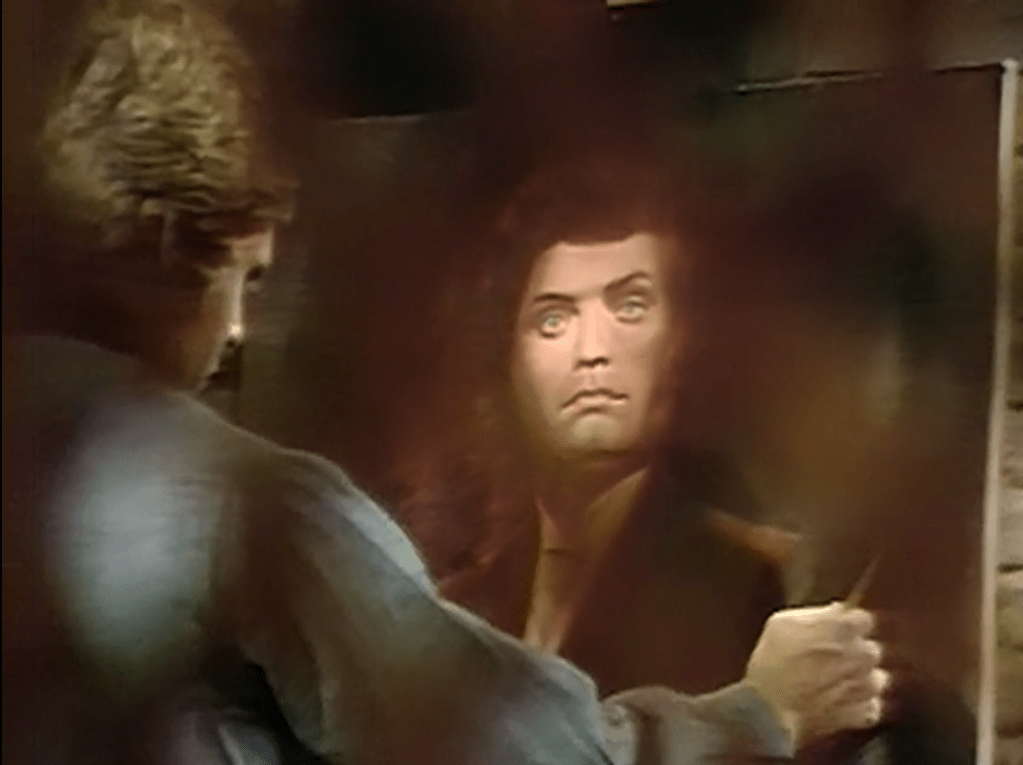
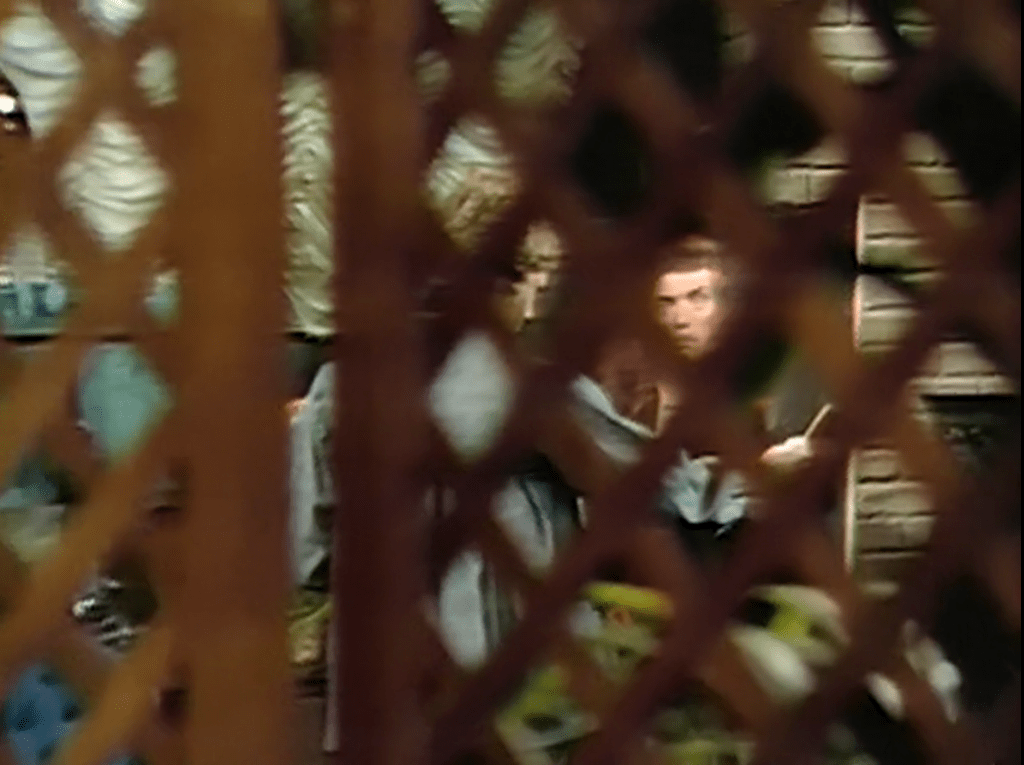


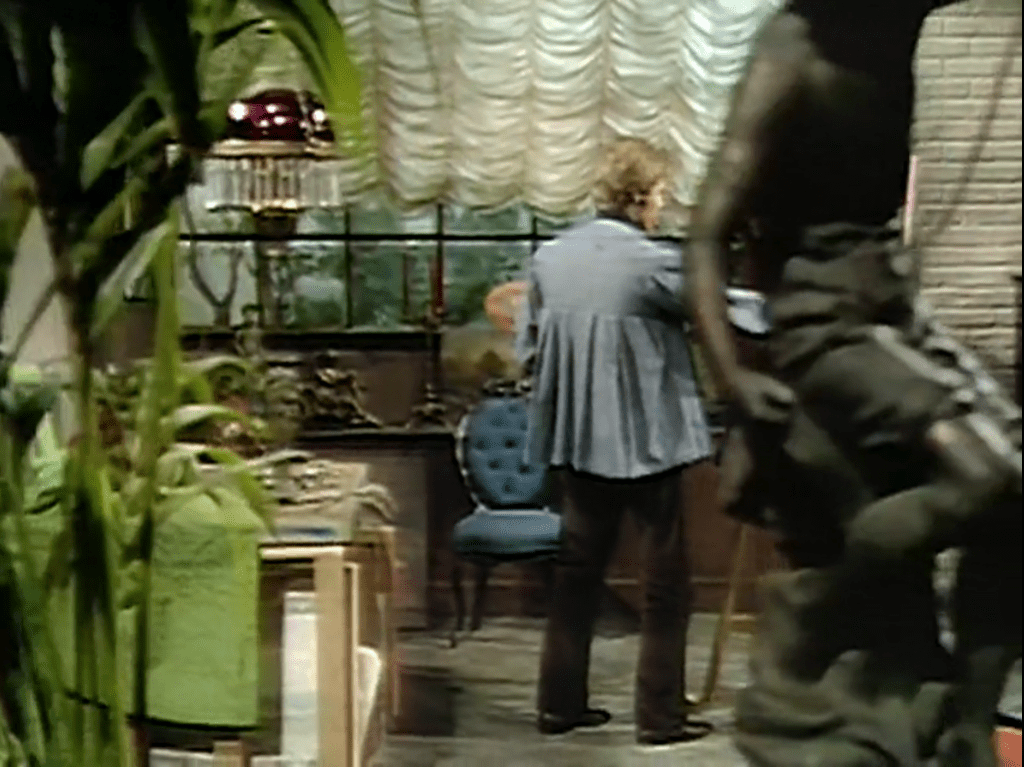
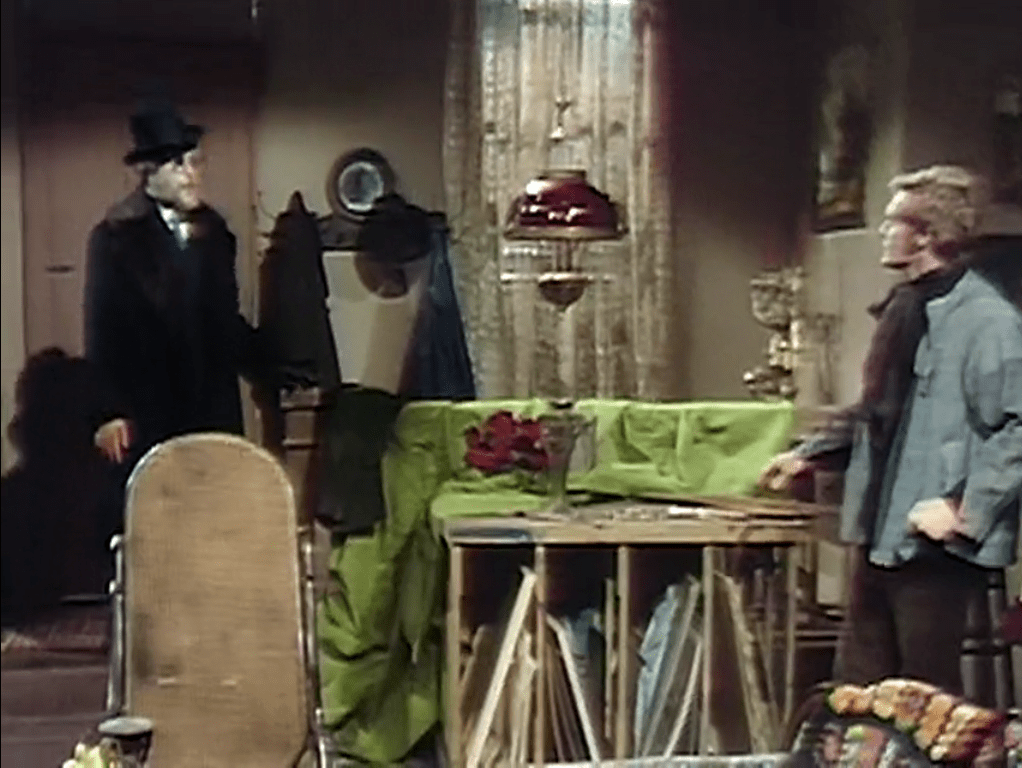
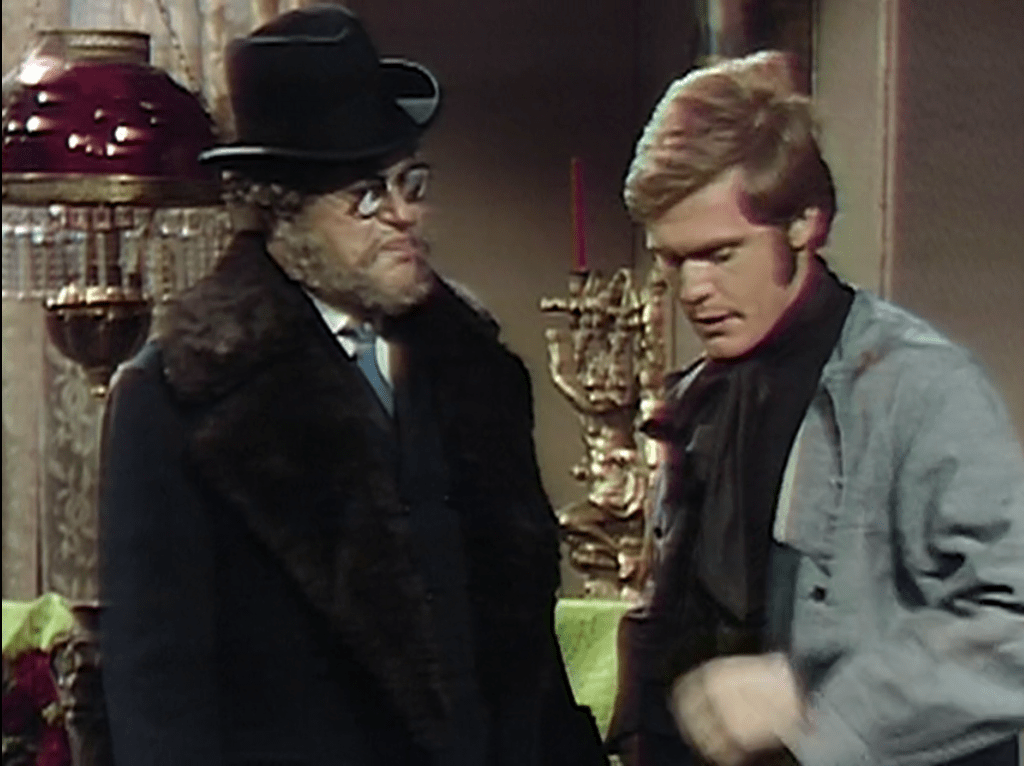


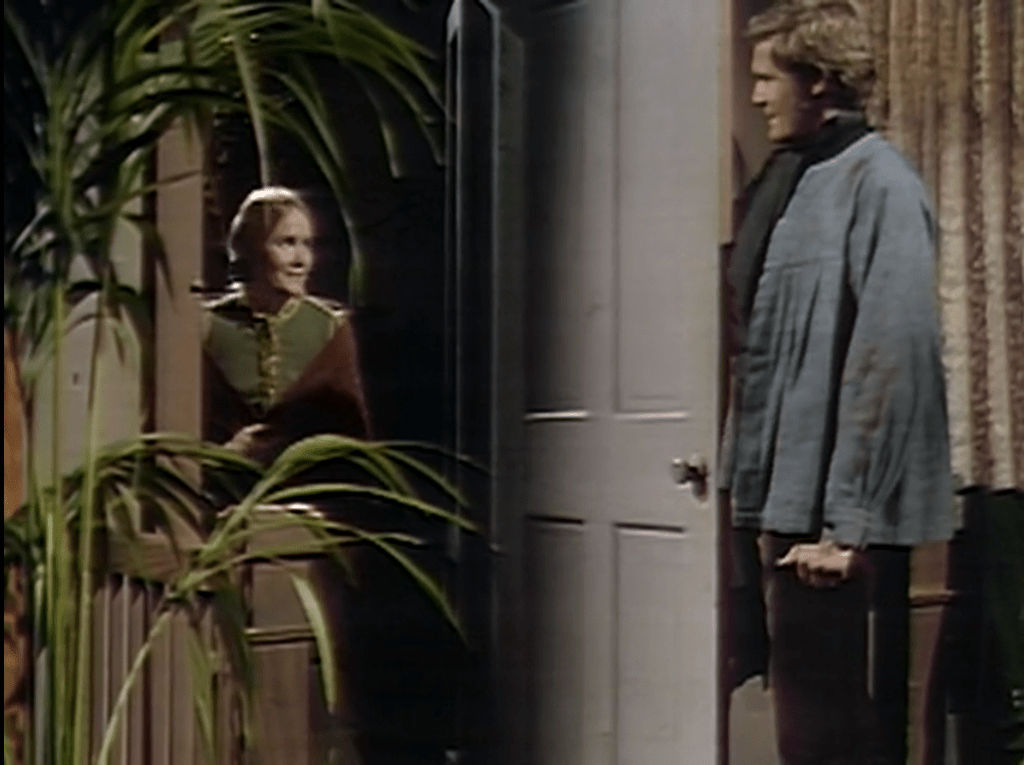
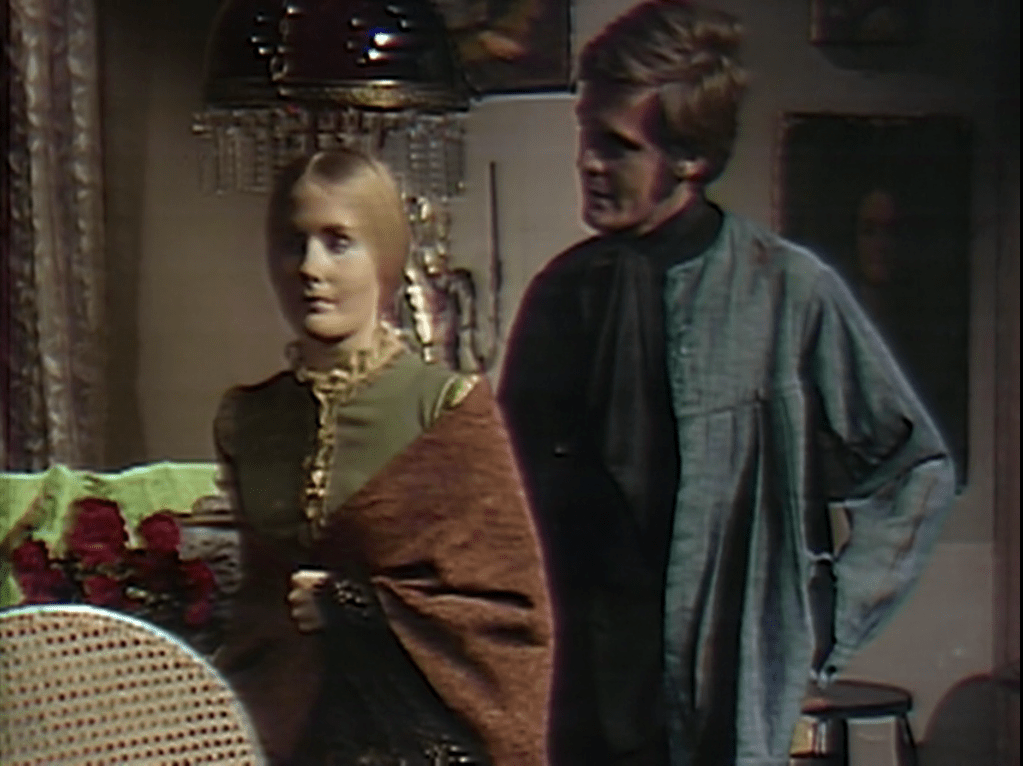
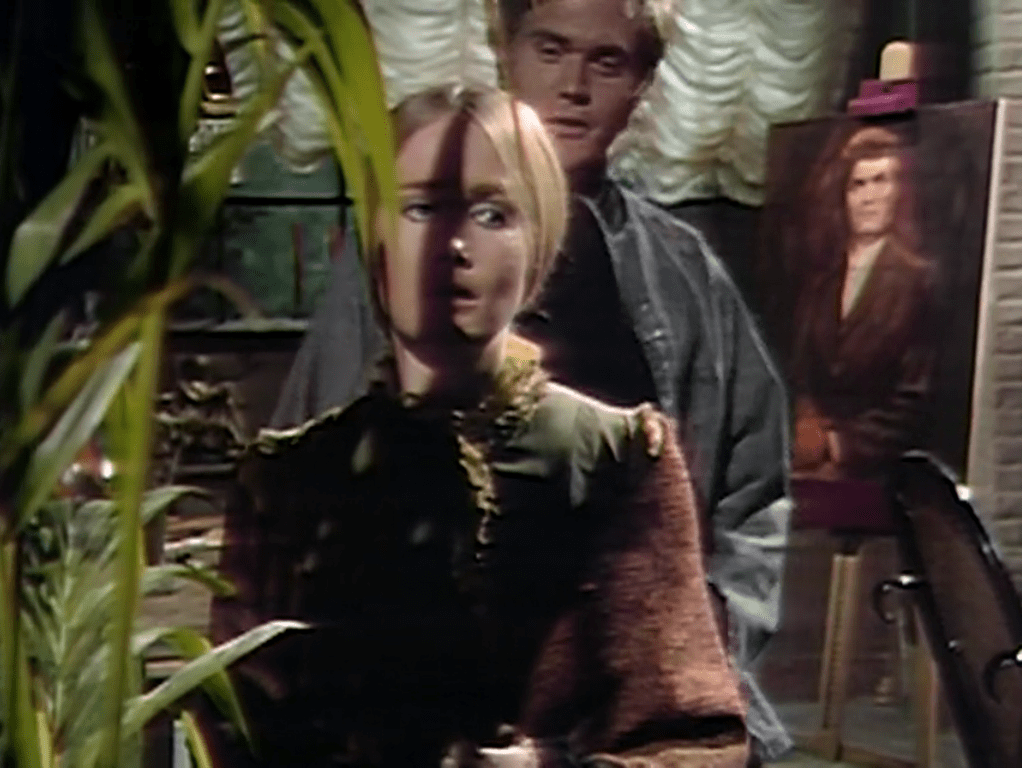


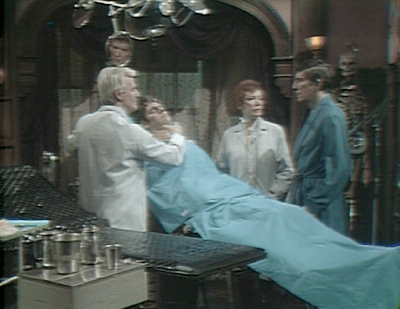


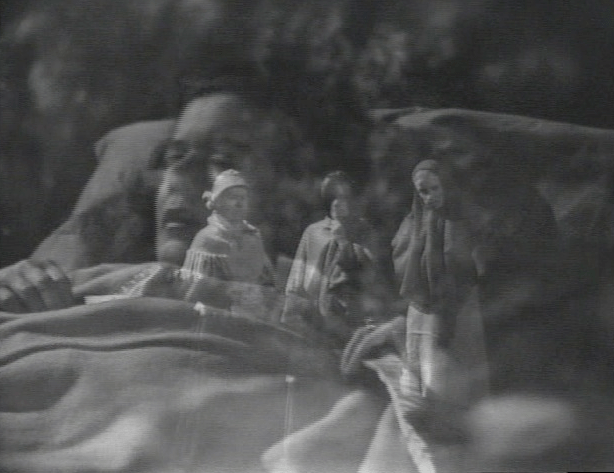
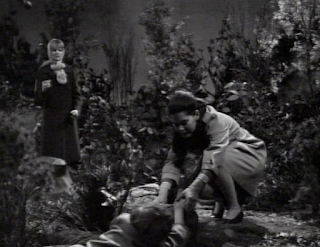


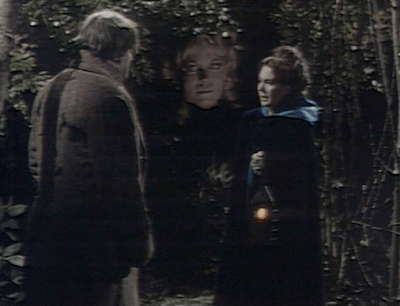
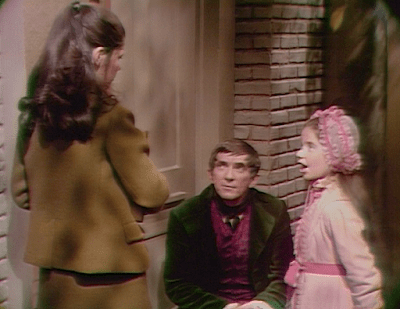

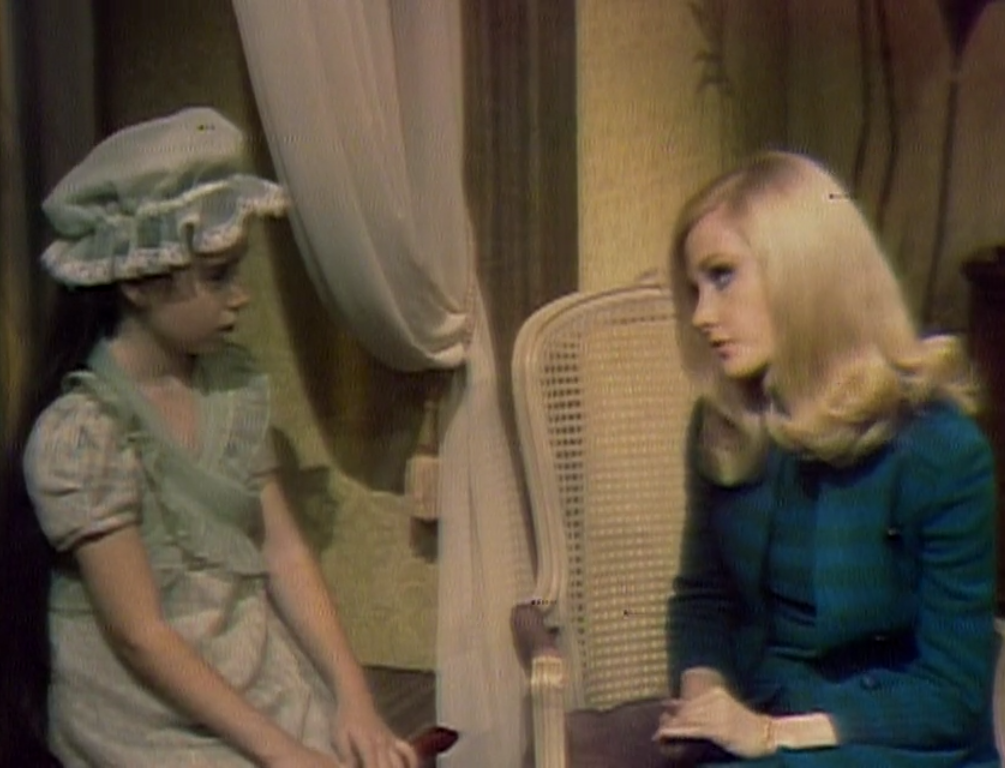
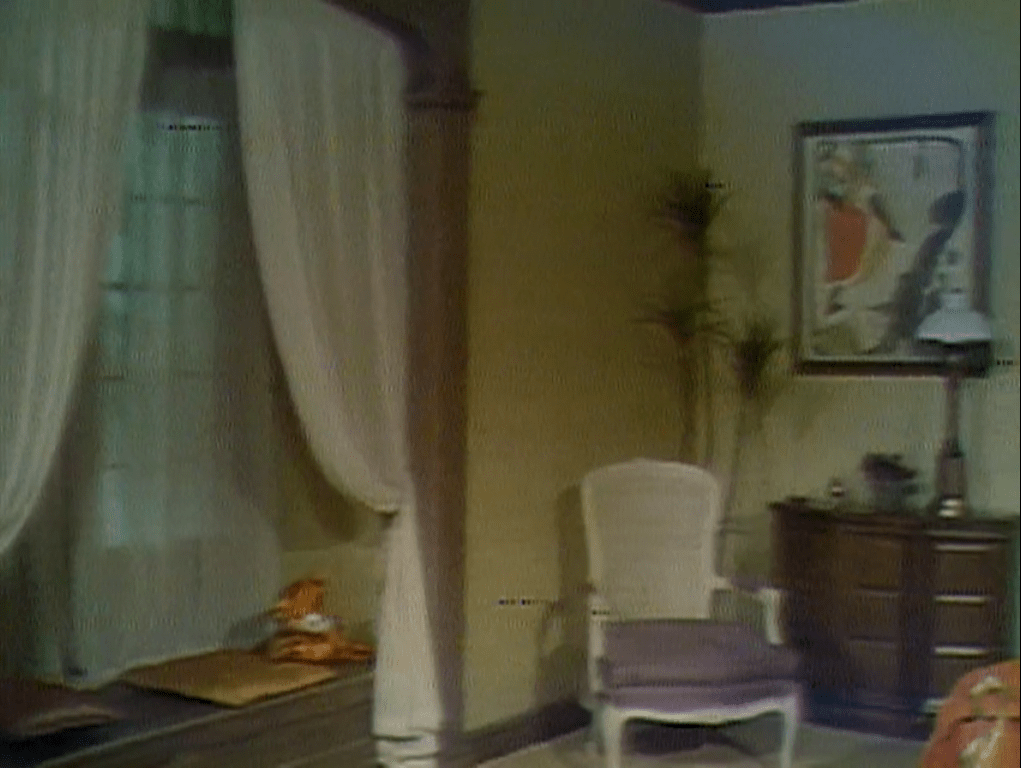
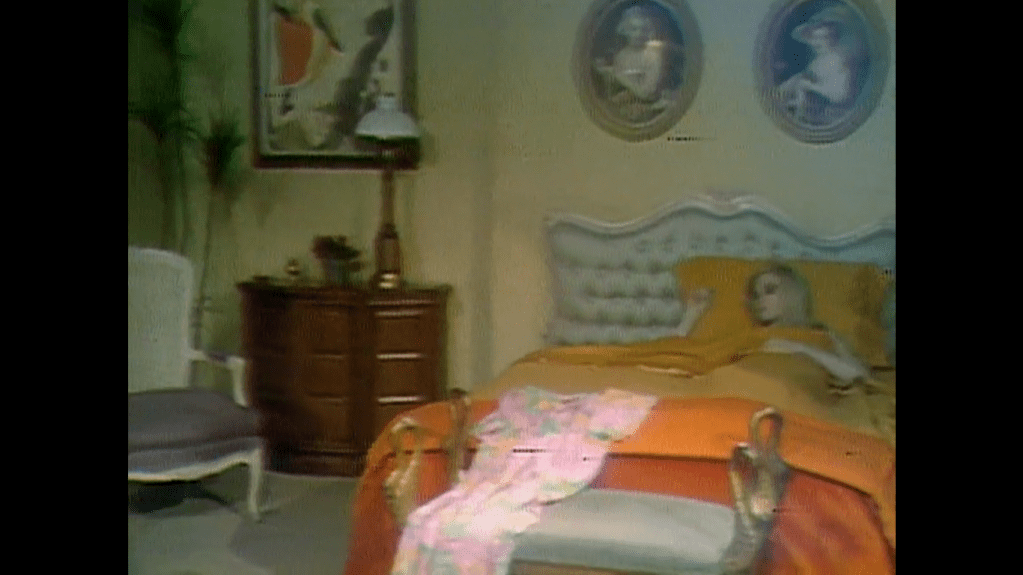
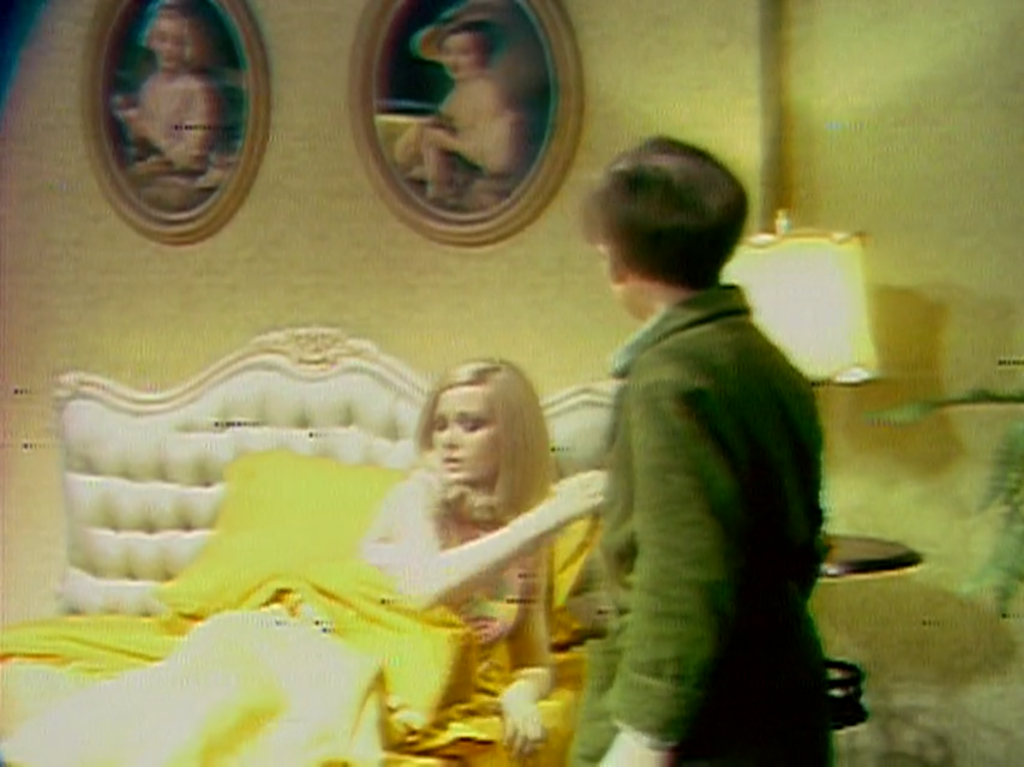


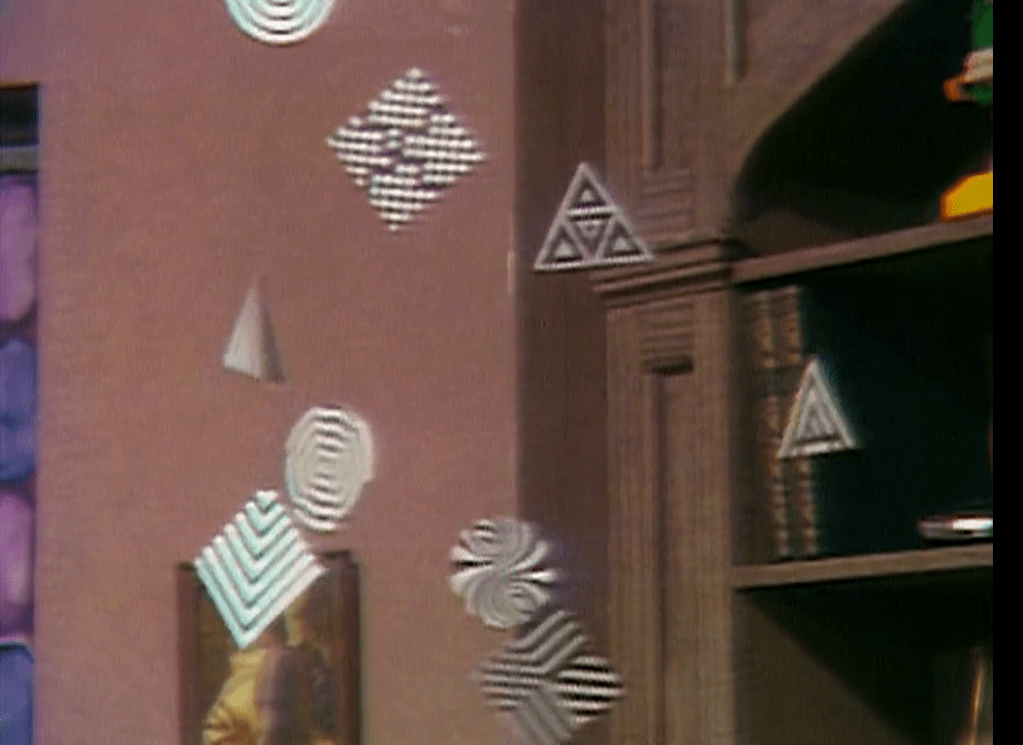


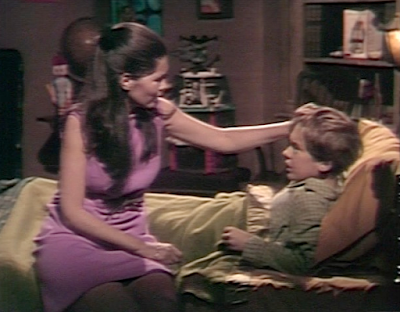




 Dark Shadows Commentary
