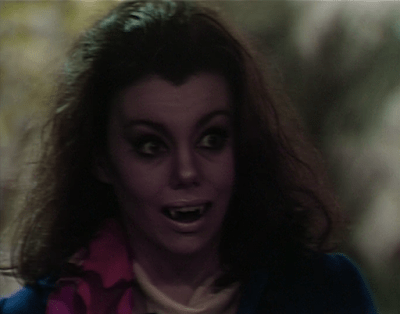
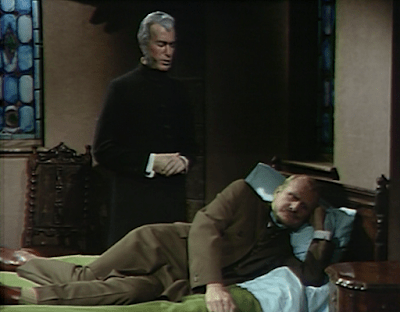
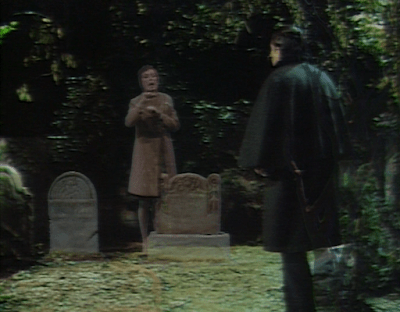
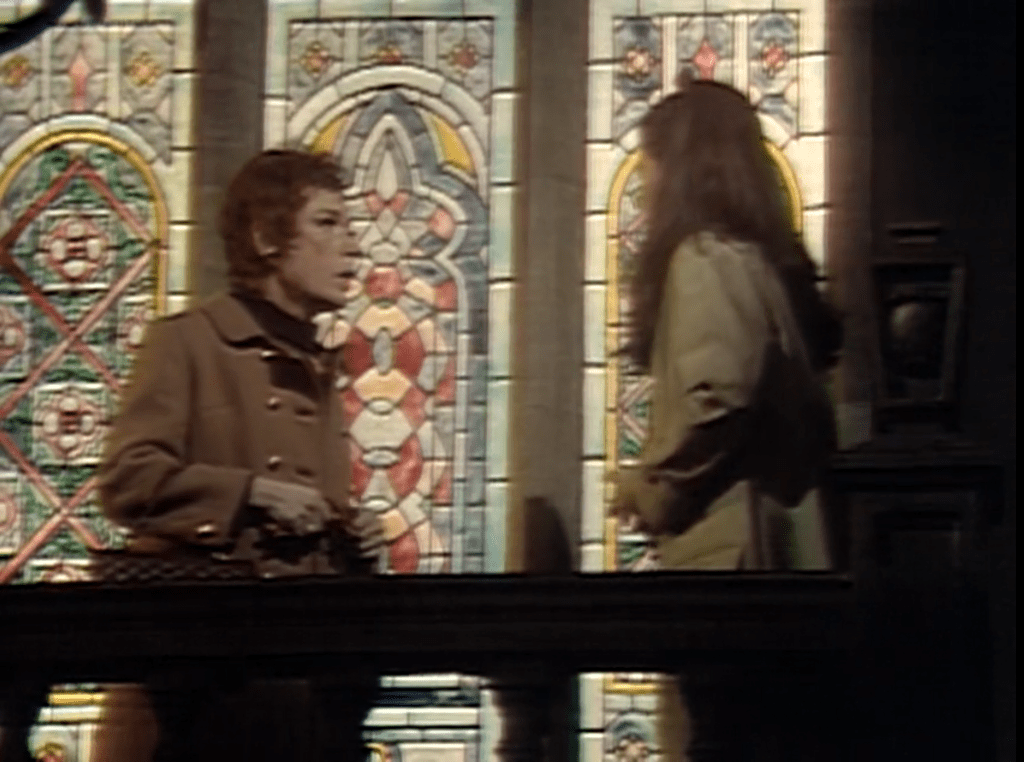
In #797, the ghost of Rroma maiden Julianka appeared and placed a curse on her fellow grievous ethnic stereotype, Magda Rákóczi. Julianka blamed Magda for her death, and decreed that everyone Magda loved would die. Today, Magda is trying to prevent Julianka’s curse from taking the life of her desperately ill infant niece Lenore, daughter of her late sister Jenny. Magda goes to Lenore’s crib in company with Lenore’s father, Quentin Collins. Magda and Quentin try to conjure up Julianka’s ghost to plead for Lenore’s life, but instead they get the ghost of another Rroma woman- Jenny.
Jenny assumes physical form. She picks up Lenore and sings the lullaby “All the Pretty Little Horses.” We’ve heard Jenny sing this almost every time she has been on the show. It appears to be the only song she knows. For his part, Quentin has a phonograph and only one record, which he plays obsessively over and over. When they lived together, their home must have been a pretty grim place, playlist-wise.
Jenny lifts Lenore’s illness, and says that if Quentin looks into his heart he will know what he must do to ensure that Lenore has a bright future. She vanishes, and Quentin mutters dismissively at the idea that his heart will be a source of useful information.
Later, Quentin will have a dream while sleeping in the drawing room at the great house on the estate of Collinwood. Jenny visits and tells him that he must have nothing to do with Lenore and that she must grow up far from Collinwood. So far, dream sequences on Dark Shadows have always represented visits from the supernatural, but this one might be an exception. Jenny did say that the information Quentin needed to help Lenore was already in his heart. He is clearly not the stuff of which good fathers are made, and as Jenny explicitly says in the dream no one has ever been happy at Collinwood. So the advice she gives does seem to be correct. Perhaps this is just Quentin’s own knowledge taking a shape he can recognize.
Quentin goes on dreaming that his brother Edward is choking him. He wakes up to find that Edward is in fact choking him. This might seem like a prophetic dream, but it too might just be a natural expression of Quentin’s own unprocessed knowledge. Edward, because of a magic spell not directly connected with today’s events, is under the mistaken impression that he is a valet formerly in the service of the Earl of Hampshire. Quentin has followed the Collinses’ long-established protocol for dealing with mentally ill family members, and locked Edward up in the room on top of the tower in the great house. He knows this makes Edward miserable, and it is reasonable to suppose that he would expect Edward to express anger about it. Strangulation is Quentin’s own preferred method of expressing anger, especially towards members of his immediate family, so it can’t have been hard for him to see that coming.
Edward’s motivation is not as simple as Quentin’s would be if their positions were reversed. The evil Gregory Trask has been visiting Edward in the tower room, and has told him that Quentin is determined to keep him imprisoned in that room forever. He asks him to kill Quentin. Edward apparently has decided to comply.
Earlier in the episode, Edward had been more punctilious about cooperating with Trask. Trask presented him with a document to sign, promising that by signing it he would secure his freedom. Edward read the document, even after Trask very loudly insisted that it was unnecessary to do so. When Edward saw that it involved making Trask guardian of his son, Edward protested that he had no son. Trask said that this did not matter, but Edward would not be moved. Edward later tells Quentin about this encounter.
The tower room is a re-dress of the set used as the bedroom of strange and troubled boy David Collins in the parts of Dark Shadows set in the 1960s. Today it includes the bed from that set, and we see Edward trying to sleep in it. This is a powerful image for longtime viewers. Louis Edmonds plays Edward in this costume drama segment and David’s father Roger in contemporary dress. Edward is the father of Jamison, who like David Collins is played by David Henesy. Not only has the spell robbed Edward of the memory of Jamison and of his role as a father, it has reduced him to curling up in a bed made for a boy rather than a man.
Roger was, for the first year of Dark Shadows, a spectacularly bad father. He openly hated David and exploited David’s miseries to try to manipulate him into doing his own criminal dirty work. He was indifferent to the family’s name and the fate of its businesses, would go to any lengths to hide from the consequences of his actions, had killed someone, and was an alcoholic. Edward shares none of these shortcomings. On the contrary, he goes to the opposite extreme. He is as brave as Roger is cowardly and tenderly loves his children, Jamison and Nora. But he is also stuffy, name-proud, and money-grubbing. The contrast with Roger shows these failings, not simply as negatives, but as the overgrowth of the virtues that separate Edward from Roger. Though Louis Edmonds and Jerry Lacy are such accomplished comic actors that Edward’s scenes with Trask are funny enough to be worthy of a staging of the Jeeves and Wooster stories, Edward’s loss of his identity as father of Jamison and Nora is a genuine tragedy.
Quentin is fond of Jamison, and once he learns that his children exist he seems to wish them well. Nonetheless, he shares most of the other vices of early Roger. As Edward shows us what Roger might have been had he had stronger moral fiber, Quentin is Roger with his vices magnified by black magic. When Jenny tells Quentin that he must not raise Lenore, longtime viewers remember Roger as he was when first we knew him, and remember how grim David’s future seemed at that time. It was only after well-meaning governess Vicki became the chief adult influence in his life that we could have hopes for David. So we cannot doubt that Jenny is right.
This is the last of 21 episodes of Dark Shadows directed by executive producer Dan Curtis. When Curtis first took the helm in #457, he had no experience as a director, and it showed. But he learned very quickly. This one looks great and the scenes play very smoothly. He would later direct the feature films House of Dark Shadows and Night of Dark Shadows, as well as six episodes of the 1991 prime time revival of Dark Shadows and many other productions.
Strange and troubled boy David Collins and nine year old Amy Jennings are falling under the sway of the evil spirit of the late Quentin Collins. Quentin has been gaining strength gradually; at first he was confined to a small chamber hidden behind a wall in a storage room in the long deserted west wing of the great house of Collinwood, and was dependent on Amy and David to do his bidding elsewhere. Now he can move around the estate and do things for himself. He is still able to control only one of the children at a time, though, and when Amy found out that Quentin had poisoned her brother Chris she made up her mind to fight him.
Today, David goes to the west wing to tell Quentin that Amy will cooperate with him if he promises to leave Chris alone. When David puts this to Quentin, he nods in agreement. If Quentin is still weak enough that he must give in to Amy on this point, he is still weak enough to be stopped before he does any great harm. That builds suspense- the show has invested so much time in building up the threat Quentin poses that it would feel like a cheat if he were defeated now, but we can look forward to seeing him survive a series of close calls between now and the time when his storyline approaches its climax.
David was not the only one who went from the main part of the house to the west wing. Governess Maggie saw him go there, in direct defiance of her orders that he stay in his room. Maggie followed David down the corridor and saw him go into the storage room. By the time she entered that room, David had gone into Quentin’s secret chamber and closed the panel behind him, leaving Maggie baffled as to where he could be. She went back to the main part of the house to wait for David.
In David’s room, Maggie sits in the armchair by the wall. She is still there when David comes back. This recreates a pair of scenes in #667, when David sat in the chair and was still there when Amy entered. That was supposed to be a power move, and it worked, more or less. David asserted his role as Quentin’s spokesman, and Amy acquiesced.
But Maggie can’t pull it off. She doesn’t give in to David when he denies everything, tells her her eyesight must be failing, claims that she doesn’t have the right to punish him, and yells at her that he will “get even.” But her visible nervousness encourages him to try each of these tactics. It’s only when she reminds him that he had his flashlight with him when he went into the west wing and says she will look for it in the storage room that she shuts him down, and then only for a moment.
David protests his innocence to Maggie, but he tells us that the sky is falling.
Maggie goes back to the west wing, where she sees Quentin. David looks directly into the camera and recites the epigram “I do not love thee, Dr Fell.” In the first months of the show, David was the only character who made eye contact with the audience. He stopped doing that late in 1966, when he stopped being a menace, and several other characters have been called on to do it since. It’s good to see him revisit the technique, and he is quite effective at it today.
Closing Miscellany
As my screen name may have led you to suspect, I make my living as a Latin teacher. So I would be remiss if I did not mention that “I do not love thee, Dr Fell” is a translation of a piece often used on the first day of introductory Latin classes, Martial’s Epigram 32:
Non amo te, Sabidi, nec dicere possum quare.
Hoc tantum possum dicere: non amo te.
When poet Tom Brown translated the epigram in 1680, he changed the name “Sabidius” to “Dr Fell” in memory of the dean of the Oxford college which he had briefly attended. A literal translation should enable you to figure out the meaning of each of the Latin words: “I do not love you, Sabidius, and I cannot say why. I can say only this: I do not love you.”
In a conversation with housekeeper Mrs Johnson, matriarch Elizabeth Collins Stoddard says that “David is twelve years old.” This is the first time in a while David’s age has been specified explicitly.
Liz orders Mrs Johnson to take David’s dinner to him on a tray and sit in his room while he eats. Longtime viewers may remember that when Mrs Johnson started working in the house in #77 and #79, David was afraid she would be his “jailer”; in #189, she actually did sit in his room and function as his jailer for a little while. She is reluctant to do that again today, because she has caught on that David and Amy are involved with something uncanny and she is afraid of them.
Danny Horn devotes his post about this episode on his great Dark Shadows Every Day to a tour of the props and decor of David’s room. It’s a lot of fun. One of his commenters, “Jayson O’Neill,” links to a 2014 post on the Dark Shadows News blogspot page focusing on David’s posters; another, “John E. Comelately,” points out that famed rock and roll band The Turtles released a track in 1967 called “Chicken Little Was Right.” I made a comment myself finding fault with the acting and blaming director Dan Curtis for it; I don’t agree with that anymore, but you’re welcome to read it if you want.
Time-traveling fussbudget Barnabas Collins has completed the task he set for himself when he went to the year 1796, and has to find a way to return to 1969. He decides to deliberately subject himself to the process by which he was originally transferred from the 1790s to the 1960s. He is, at the moment, a vampire. He orders his servant Ben to chain him in a coffin hidden in the secret room in the back of the Collins family mausoleum, and hopes that he will be released from it in a period when he is human again.
On a sunny morning in 1969, Barnabas’ former blood thrall Willie and his best friend Julia have figured out his plan and gone to the secret room. Julia is a medical doctor; she is at once the best physician in the world, capable of assembling a human body from dead parts, bringing it to life, and thereby lifting the effects of the vampire curse from Barnabas, but simultaneously very unsteady on the question of whether any given patient she is examining is alive or dead. For example, matriarch Liz is entombed at the moment because Julia mistakenly declared her dead twice in a couple of months. Once he has opened the coffin, Willie demands Julia examine Barnabas’ body and tell him whether he is alive, and therefore human, or dead, and therefore condemned to rise at nightfall and prey upon the living. Before she can answer Willie’s question, Julia has to spend quite a bit of time going over Barnabas with a stethoscope, during which time we see his eyelids flutter and his chest move.
While Julia is trying to determine Barnabas if is alive, he sits up and starts talking. Julia and Willie urge him to lie back down, apparently concerned that if he is too active Julia won’t be able to arrive at a clear result. After a break, we see him out of the coffin, telling them about his experience in 1796. After quite a bit of back and forth, they arrive at the collective decision to continue the conversation back home, in the Old House on the great estate of Collinwood.
Barnabas, Julia, and Willie have emerged from the secret room into the publicly known part of the mausoleum and are starting to close the panel behind them when they hear the voices of people approaching. One might expect them to finish closing the panel and to greet whoever is coming as fellow pilgrims paying homage at the graves of Joshua and Naomi Collins and their daughter Sarah. After all, everyone knows that Barnabas is a direct descendant of Joshua and Naomi, that Julia has a lively interest in the past of the Collins family, and that Willie is Barnabas’ servant. They have as much right to be there as anyone.
Instead, they scurry back into the secret room and shut themselves in. They are a bit too slow. Entering are heiress Carolyn and child Amy. Amy sees the panel swinging shut. Carolyn, behind her, did not see this happen, and dismisses Amy’s claim that she did. They tap on the panel, and Amy decides that it is so solid that she may have been mistaken. The mausoleum is so dim that one can imagine a trick of the light causing a person to believe that the wall had moved, so this reaction of hers is plausible enough.
Dimness is not an exclusive property of the outer part of the mausoleum. The trio hiding in the secret panel embody dimness as they do an outstanding imitation of the Three Stooges. Willie is Larry, the universal victim; Julia is Moe, the self-appointed leader who is as lost as either of the followers; and Barnabas is Curly, the chaos agent. Willie left his bag of tools perched precariously on the steps immediately behind the panel; after Amy and Carolyn tap, the bag falls and makes a sound. Julia does not address Willie as “ya porky-pine!” and poke him in both eyes, but it would fit with the flow of the action if she did.
Carolyn and Amy both hear the sound. They puzzle over it. Carolyn suggests that the wind must be blowing a limb from a nearby tree against the outer wall. Amy can’t think of anything else it could be, and accepts the suggestion. They leave, having placed flowers on the sarcophagi.
The flowers are themselves interesting to longtime viewers. Early in the episode, we saw Carolyn arranging them on the writing table in the drawing room of the great house of Collinwood. The last time we saw someone handling flowers over that table was in #346. Barnabas grabbed those flowers out of Julia’s hand. In those days he was still a vampire, and they were enemies. After a few seconds in his grip, the flowers died. When Julia and well-meaning governess Vicki saw this, Barnabas looked embarrassed, for all the world as if he had broken wind. The analogy tends to raise a laugh, but it is apt- when he was a vampire, it was a natural function of Barnabas’ body to do things like that, and he would be expected to control that function so that others would not be aware of it. So when they show us flowers on this spot, they are telling us we ought to be in suspense as to whether Barnabas will be a vampire again.
Carolyn and Amy go back to the great house, where strange and troubled boy David is sulking. Again, longtime viewers might find this suspenseful. David found his way into the secret room in #311 and in #334 tried to show it to some adults. Barnabas had locked the panel, so they disbelieved him. If Amy tells David what she saw, he may well put two and two together and revive the stories that were in progress in those days.
But Amy doesn’t breathe a word of it, and David isn’t interested. He is preoccupied with the evil spirit of the evil Quentin Collins, who is gradually and evilly taking possession of him and Amy and, evil as he is, driving them to do something or other that has not yet been explained, but which will undoubtedly turn out to be evil. Quentin is still confined to a small room hidden in the long-deserted west wing of the house, and can only take full control of one child at a time. Today it is David who is acting as his agent; Amy flatly refuses when David tells her that Quentin wants them to “play the game.” In response, he twists her arm. Carolyn walks in on that act of violence, and orders David to go to his room and stay there for the rest of the day.
Amy speaks up for David and even asks to go to his room with him, but Carolyn stands her ground. She does leave the children alone together while she goes to tell housekeeper Mrs Johnson to take David’s meals to him on a tray.
David fumes and tells Amy that it is her fault that they won’t be able to “play the game” today. He is declaring his intention to “get even with Carolyn!” when Barnabas appears in the doorway.
Evidently David’s declaration did not bother Barnabas, because his only response is “Why so serious?” Barnabas has been pushing a plan to send David and Amy to boarding schools in Boston. Under Quentin’s influence, they have tried to thwart this plan by pretending to be all for it but secretly hanging clothes in the wrong closets. This apparently foolproof method has somehow failed, so they resort to another expedient. They tell Barnabas they would rather not go. He says that’s fine with him, and drops the whole thing.
Alone in his room, David looks angry. He throws a book to the floor. Carolyn comes in, and David tells her that he is sorry and she is right to punish him. She sees immediately that he is lying, and tells him so. The resulting brief scene is far and away the best of the episode.
Later, Amy slips in, and finds David sitting in a chair in a dark corner. In their post about the episode on Dark Shadows Before I Die, John and Christine Scoleri point out that the effect of this shot of David is a bit different on an audience now than it would have been before 1972, since it makes David look very much like Don Vito Corleone in the opening scene of The Godfather.
David is still furious about the whole situation. He tells Amy that they will “play the game” after all, and that Carolyn will play with them. The ominous music on the soundtrack is enough to tell us that this means they will try to kill Carolyn.
This episode shows something about the importance of directors in television drama. Actor Joel Crothers appeared on Dark Shadows for the last time yesterday; in an interview he gave to a fan magazine shortly after leaving the show, he complained that the directors had become so busy managing the special effects and practical effects that they didn’t have time to work with actors. Furthermore, the show never had more than three writers on staff, so scripts were sometimes delivered too close to taping for the actors to do much rehearsal on their own.
Today, each actor finds a note and sticks with it, but few performances mesh with each other sufficiently to seem to be part of the same scene. Denise Nickerson is calm and relaxed even when Amy’s arm is being twisted, David Henesy is angry and confrontational even when Barnabas is falling for David’s pretense that everything is normal, and Nancy Barrett is stern and impatient even when Carolyn is taking Amy’s claim to have seen the panel move seriously. Each of these performances is good, and Mr Henesy stands out when he gets to play “creepy.” But clearly no one gave them an idea of what they should work together to get across to the audience.
Aside from the scene where Carolyn sees that David is lying, there are just two exceptions, and they don’t really help. Committed fans may find it endearing to see the preposterous threesome hiding in the secret room of the mausoleum, but first-time viewers are likely to be put off by that scene of low comedy in the midst of an otherwise heavy and somber melodrama. Jonathan Frid is warm and inviting with the children, which does make sense when Barnabas is talking with the relaxed Amy, but their two-scene about whether he will ask Carolyn to let David out of his room is such a low stakes affair that unexcited actors cannot hope to hold our attention.
The director today was executive producer Dan Curtis. Curtis was a titanic personality and would later direct many TV movies and some features, but he seems never to have directed as much as a school play when he first took the helm of Dark Shadows for a week in 1968. This stretch of episodes marks his second time in the director’s chair. His extreme inexperience as a director of actors may well explain why the cast does not come together more cohesively.
In January 1969, old world gentleman Barnabas Collins learned that governess Vicki Winters had traveled through time to the year 1796, where she and her boyfriend Peter Bradford were hanged for their many crimes. Barnabas decided to follow Vicki to that year in order to save her and Peter. Barnabas himself lived in the 1790s, and is alive in the 1960s because for 172 of the years between he was a vampire. Once he made his way back to 1796, Barnabas reverted to vampirism.
Yesterday, Barnabas killed a streetwalker named Crystal. After he watched her corpse sink in the bay, he went home to the great house of Collinwood to get to work on his main occupation, feeling sorry for himself. To his shock and bewilderment, he found that Crystal’s body had materialized in an armchair in the study.
Today, Barnabas calls his servant Ben Stokes to help him dispose of Crystal’s body. We have seen that when characters go from the foyer to the study, they walk past the camera, exiting stage right. Once, it seemed the camera might follow a character into the space beyond the foyer. That was in #196, when matriarch Elizabeth Collins Stoddard took several steps towards the camera while telling seagoing con man Jason McGuire that if he wanted to stay at Collinwood he could use a room that direction. Jason called Liz back before she went too far, and insisted on a room upstairs. This time, Barnabas leads Ben all the way off the set. They walk through some darkened space for a couple of minutes before entering the study.
Barnabas and Ben leave the set.
The camera is tight on the two of them throughout this sequence, concealing the fact that there is no set decoration behind them. The episode was directed by executive producer Dan Curtis. Barnabas and Ben’s walk through the void bears Curtis’ directorial signature. Curtis was extremely audacious in everything he did, but had very little experience as a visual artist. He wanted to create the illusion that Collinwood was a big place, but the tight closeup results in a static composition and leaves the audience guessing where Barnabas and Ben are supposed to be. Moreover, making the sequence work at all requires that half the studio be plunged into darkness, creating problems throughout the episode.
In the study, Barnabas and Ben find that Crystal is gone and Barnabas’ ex-wife, wicked witch Angelique, is sitting in the chair. Angelique and Barnabas send Ben away so they can talk privately. Barnabas hasn’t tried to explain to Ben that he is on a return trip to the eighteenth century after 20 months in the 1960s; he hasn’t even told Vicki that he is the man she knew in her own time. But he recognizes that Angelique is not a continuation of her 1795 self, but is a fellow time traveler from 1968. Once Ben is gone, he asks her why she has returned to the era.
Barnabas and Angelique play out their big scene in the lighting dictated by the walk through the nonexistent hallway.
She explains that after she failed to advance the plot in 1968, her demonic masters punished her by sentencing her to remain in “this time forever.” It is not at all clear what that means. Will she relive the year 1796 over and over, like Bill Murray in the 1993 movie Groundhog Day? Or will she just go on living forever and experience time in the usual linear fashion? In the latter case, she would rejoin the 1960s in episodes to be broadcast in the 2130s. Not only would that negate all the timelines we’ve heard about and establish a whole new continuity, it would also mean that Lara Parker had secured the longest-term contract in the history of professional acting.
Angelique tells Barnabas she will help him free Vicki if he will agree to stay and resume their marriage. He is appalled by the notion, but she asks if he can save Vicki without her. He says that he cannot. This is a bit of a puzzle. Barnabas’ vampirism comes with a wide array of powers he could use to break someone out of jail. He could bite the jailers and establish control over them sufficient to force them to let Vicki out. If he isn’t thirsty, he has great physical strength, and is invulnerable to most weapons, so he could just force his way in to the gaol and carry Vicki off. He might not even have to bother with the front door. In #242, Barnabas ripped the iron bars out of the windows of a doctor’s office, and Vicki’s cell at the Collinsport gaol has a window with bars that can’t be much stronger than those were. But I suppose he is worried about distorting the course of subsequent history if he does something spectacular, and he certainly doesn’t want Vicki to find out that he is something other than a human. So he makes a deal with Angelique.
The idea is that Vicki will go to the gallows, appear to drop dead before the hangman does his thing, and that after Barnabas and Peter take Vicki’s body back to Collinwood Angelique will revive her. Both Peter and Ben are horrified at the idea of trusting Angelique, but Barnabas seems to think he has no choice. He insists that Vicki and Peter both wait patiently for Angelique to accomplish her part.
The hanging goes ahead as scheduled. Peter is enraged that Barnabas let Angelique cheat them out of the chance to thrash around and scream during the execution. They take the body to Collinwood and lay it out in the study, a few feet from where Crystal’s body had been at the beginning of the episode. They leave it alone, and Angelique appears. Evidently she does intend to bring Vicki back to life, but she vows that Vicki will be under her power from now on.
Sometime vampire Barnabas Collins tells his best friend, mad scientist Julia Hoffman, what happened on the night in the 1790s when his father chained him in his coffin, not to be released until 1967. This story is told to the audience by a series of clips taken from episodes 456-460, with voiceover narration by Barnabas.
Barnabas wants to travel back in time to prevent one of the disasters that took place that night, the hanging of well-meaning governess Victoria Winters. He tells Julia that when he first lived through the events, he wasted his time murdering roguish naval officer Nathan Forbes. If he can get back, he will let Nathan live, but force him to help save Vicki.
At the end, Barnabas feels that he is being pulled to the past. He steps away from Julia and strikes a pose fitting for someone who is about to fade from the screen. He does not fade, but Julia and her surroundings do. We zoom in for a closeup. As we do, we hear the sound of dogs howling. Barnabas opens his mouth, and we see that he is once more a vampire.
Barnabas is surprised to see that Julia, not he, figures in the special effect. Screenshot by Dark Shadows Before I Die.
Vicki’s presence in the 1790s was the result of her own displacement from 1967 beginning with episode 365. She traded places with the original governess, a woman named Phyllis Wick. Barnabas saw Phyllis and recognized her when she appeared in Vicki’s place, and after Vicki’s return he was bewildered by her story. But today he tells the story of the fateful night as if he remembers Vicki. Perhaps the same things happened to Phyllis, and he is just filling in Vicki’s name.
As a clip show, this is the first to feature two names in the closing credits under “written by.” It should feature three- Gordon Russell and Sam Hall get credit for the clips from episodes 456, 457, and 458, but it also includes material from 459 and 460, written by Ron Sproat. The credits also fail to mention that Jonathan Frid played Barnabas, and for that matter the opening title doesn’t appear until after the closing credits, so I suppose Sproat was in good company.
Dan Curtis often said that the idea for Dark Shadows came to him in a dream about a girl with long black hair taking a journey by train. When he persuaded ABC-TV to let him make a pilot for a series, the most difficult part of the casting process was finding the actress who would embody that girl, whose name came to be Victoria Winters. Alexandra Isles, then still known as Alexandra Moltke, finally emerged as the one person who combined the right physical appearance with a mysterious, otherworldly quality that suggests a figure from a dream.
From Episode 1: The girl on the train. Reflected in the window behind her is Burke Devlin, her original love interest.
Mrs Isles’ casting had an immediate effect on the underlying story in Art Wallace’s original series bible, Shadows on the Wall. Wallace projected a puzzle about Vicki’s origins that would be resolved when it was revealed that she was the child of an extramarital liaison between Paul Stoddard, the long-missing husband of matriarch Elizabeth Collins Stoddard, and some unknown woman. Liz’ guilty feelings about Paul would explain her concern for Vicki and her decision to bring her to the great house of Collinwood as governess for her nephew, strange and troubled boy David Collins. Since Vicki would not be a blood relative of the Collins family, it would also leave an option for Vicki to develop a romance with David’s father, Liz’ brother Roger.
From Episode 1: The front doors of Collinwood open for the first time. Liz and Vicki come face to face, and each sees her own reflection in the other.
Wallace did include a note saying that if it was more story-productive, it could turn out that Liz was Vicki’s mother. Liz was played by Joan Bennett, whom Mrs Isles strongly resembled. When Bennett first saw Mrs Isles, she famously mistook her for her own daughter. From the first episode on, the show heavily signaled that Vicki was Liz’ daughter by a man other than Paul. Liz soon treats Vicki so much like a daughter that the only events that would follow from confirming the relationship would be to make some changes to Liz’ will. Since the business aspects of the characters’ lives ceased to generate action after the first few months, that would have been a severe anti-climax. So they wound up dropping the question altogether.
For the first 39 weeks of Dark Shadows, Vicki was its main protagonist. Not many of the storylines worked in those days; the only scenes that reliably clicked were those between Vicki and David. Even though their dialogue was as dreary as anything else in those early scripts, Mrs Isles and David Henesy managed to use their physical movements and the spaces they occupied to tell the story of a young woman persuading a boy to trust her. That version of the show ended with #191, when David ran from the mother who was trying to lure him to his death and flung himself into Vicki’s arms. That completed their story, and left neither character with a clear path forward.
From Episode 191: David turns from his mother and death, embracing Vicki and life.
After #191, the show was on course for the introduction of vampire Barnabas Collins. Vicki kept trying to get close to Barnabas; she even invited herself to spend the night at his house in #285 and #286. But he wouldn’t bite her, and she couldn’t get a foothold in the A-story otherwise. There was an odd meta-fictional side to Vicki in this phase. In-universe, she didn’t know that Barnabas was a vampire, and she certainly didn’t know that she was a character on a soap opera that was coming to be all about him. But her behavior made sense only if she did know those things and was making an effort to reestablish herself as a central figure in the action. I don’t know whether Mrs Isles or any other particular person was lobbying the writers to present her that way, or if it was a response to fan mail. It happened so often and led to so little that it did seem to be coming from somewhere outside the usual creative process behind the scripts.
In November 1967, Vicki came unstuck in time and found herself in the year 1795. She took the audience with her, and for several months the show was a costume drama set in the late eighteenth century. On balance, the result was a triumph. By the time Vicki and the show came back to contemporary dress in March 1968, Dark Shadows had become a real hit, and Barnabas had become one of the major pop culture phenomena of the 1960s. But Vicki did not benefit from that success. When the costume drama insert started, fans had every reason to expect it would revive her character. Barnabas spent most of his time in 1967 scrambling to impersonate a native of the twentieth century; Jonathan Frid would always say that it was in that scramble that he found Barnabas, and that he thought of him first and foremost as a liar. When Vicki turns up in Barnabas’ original period, we look forward to seeing her doing what he did, and trying to pass as his little sister’s governess. Remembering how well Mrs Isles did during the 39 weeks she carried the show on her shoulders, we look forward to her showing us what Vicki can do when she has to think fast.
But that was not to be. Instead, Curtis and his staff chose to write Vicki as an intolerable moron. She introduced herself to every new person by telling them that they are being played by actors who had other parts in the first 73 weeks of the show. Tedious as that habit was, it was compounded when she made one inexplicably idiotic decision after another as she failed utterly to adapt to her new surroundings. That would have been a difficult role to make appealing even if she had shared her screen time with a partner as capable as David Henesy. It became utterly impossible when Vicki made the least intelligible move of all and fell in love with her jailer/ lawyer/ boyfriend/ accomplice Peter Bradford, played by the abusive and shouty Roger Davis. Marooned in scene after scene with Mr Davis, Mrs Isles withered and Vicki became a cipher. By the time the court sentenced Vicki to be put to death for her many crimes, half the audience was on their side.
Shortly after Vicki returned to the 1960s, Barnabas finally bit her. Each of Barnabas’ victims reacted to his bite differently; Vicki’s reaction was perhaps the most unexpected, and certainly the funniest. She was just sort of chill about the whole thing. She showed up when Barnabas summoned her and didn’t object when he told he her she would become his vampire bride for all eternity, but first she had some errands to run, and she was irritated with him when he tried to get her to skip them. When a doctor saw the bite marks on her neck, she did not react with the fear or defensiveness of other victims, but innocently asked “Why are they bad?” She seemed to regard them as just another hickey, the result of Barnabas’ peculiar make-out technique.
Unfortunately, Peter came back to life and ruined Vicki’s relationship with Barnabas. He jumped out in the road in front of her car while she was driving off with Barnabas, causing her to crash. Vicki and Barnabas were taken to the hospital. There, one of the doctors turned out to be a mad scientist who cured Barnabas of vampirism. Once the cure took hold, Vicki forgot all about her time as Barnabas’ victim, and she sunk into a relationship with the irredeemably repellent Peter. Every time we’ve seen her in recent months, she has dragged Peter back to our attention. Mrs Isles has found ways to liven up Vicki’s scenes; she always projected a forceful personality when she was standing near the clock in the foyer of the great house of Collinwood, and she has even managed to coax Roger Davis into playing a couple of scenes competently. Mr Davis never had quite as much to offer as did the clock, but when Mrs Isles could raise her voice and fix him with a steely stare it does seem to have come back to him that he had had a lot of acting lessons and could deliver dialogue interestingly.
Today is Mrs Isles’ last day on the job. We open with a reprise of the end of yesterday’s episode, when Vicki finds the corpse of a strangled woman in the closet in Peter’s room. Peter assures her he doesn’t know how the corpse got there. She tells him they have to call the police. He says he needs time to figure out what happened before they can involve the police; she points out that delaying will only make him look guiltier in their eyes. He tells her that she should leave so that her name won’t be connected with the case; she tells him it is too late for that. We can see why Vicki has faded- she is thinking like a rational person from our world, not like anyone you would meet in Soap Opera Land.
Vicki goes home to Collinwood and tells permanent houseguest Julia Hoffman that Peter is in jail, suspected of murder. She explains that the dead person is a woman Peter knew only as Eve. Julia reacts with shock to the name; Vicki asks if she knew Eve. Julia says of course not, and Vicki tells her she will go wake Roger and ask him to help arrange bail for Peter. She goes into the door leading to the bedrooms, never to be seen again.
In her final appearance, Vicki talks with Julia, her successor as the principal audience-identification character.
Viewers who have been with the show from the beginning will see a loop closing in the idea of Vicki going to Roger’s bedroom while he sleeps. In #4, Roger had tried to let himself into Vicki’s bedroom at night, only to be caught with his hand on the doorknob by Liz. In response to Liz’ threats, Roger told her not to bother him about his “morals,” a choice of words that made it clear that his intentions with regard to Vicki were of a sexual nature. Later in the episode, he and Vicki bantered flirtatiously after he offered her a snifter of brandy; for the first and last time, Vicki sounded like what she was supposed to have been, a street kid from NYC. Roger has long since been stripped of all his villainous qualities; in #585, he and Vicki even shared a scene in her bedroom while she was in her nightgown, and it was all perfectly innocent. In that scene, we not only saw that the old menacing Roger was gone forever, but that Vicki was also reduced to such a humdrum status that a man can enter her bedroom at night without raising an eyebrow. Now that Julia sees nothing out of the ordinary in Vicki dropping in on Roger while he sleeps, that humdrum status is reinforced.
When Vicki first arrived in the village of Collinsport in #1, she met her original love interest, dashing action hero Burke Devlin. Burke told her she had found her way to “the beginning and the end of the world.” We are reminded of the beginning of the world since we know that the man who killed Eve was named Adam. This Adam and Eve are no one’s parents; they share nothing but hostility and death. The episode ends with the wicked Angelique trying to summon up the Devil, a symbol of the end of the world. She herself disappears, apparently destroyed. Burke’s description is finally fulfilled.
The part of Vicki will be recast twice in the months ahead, but those actresses never had a chance to breathe any life into her. The character had lost any reason to be on the show long before Mrs Isles’ departure. In #87, David had trapped Vicki and left her to die; wondering where she was, Roger said, “She came to us from nowhere, and now it seems she has disappeared into nowhere.” And so, at last, it has come to be. The long-haired girl from Dan Curtis’ dream, the image that started it all, has vanished, never to be seen again.
Episode 509 of Dark Shadows did not air on ABC-TV as scheduled on 6 June 1968. The network instead broadcast news coverage related to the assassination of US Senator Robert F. Kennedy.
At this point, one of Dark Shadows’ storylines was a loose adaptation of Frankenstein. Five years later, Dan Curtis, the show’s executive producer, would bring another adaptation of the novel to the small screen, as part of ABC-TV’s late night programming that ran under the umbrella title Wide World of Mystery.
Originally presented in two parts, each filling a 90 minute window, Dan Curtis’ Frankenstein is now available on Tubi in a 2 hour, 6 minute cut. It is more faithful to Mary Wollstonecraft Shelley’s original novel than were any previous adaptations, a point Curtis frequently made.
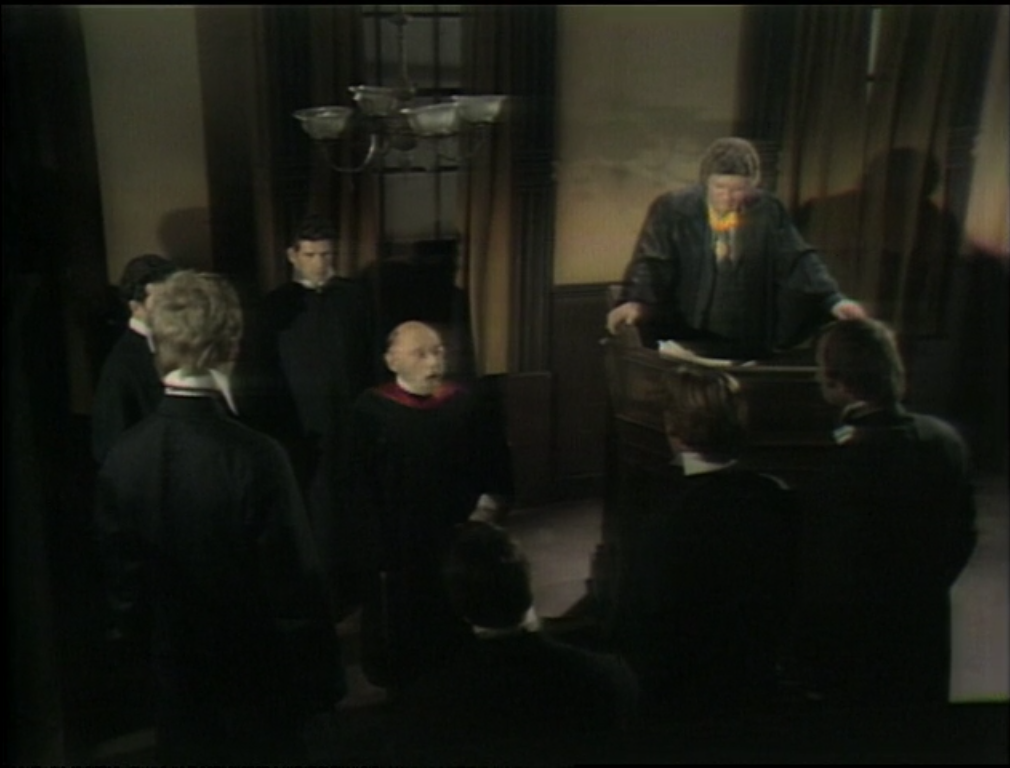
The main theme is made clear in the opening. Dr Victor Frankenstein is supposed to give a talk to a classroom of students in white coats, but they keep shouting him down. The professor identifies Frankenstein* as the winner of an academic prize and urges his unruly pupils to give him a hearing. That gets Frankenstein enough time to tell the class that they don’t understand what he has been saying, to make a little speech about the scientist’s obligation to create a superhuman life form in the laboratory, and to look frustrated when they walk out on him. The professor stays behind and tries to reason with Frankenstein, who doesn’t seem to be listening to a word he says.
Frankenstein can’t get a hearing.
No communication occurs in that scene, and very little occurs in any scene that follows. That’s a natural basis for a drama about the Frankenstein story. The mad scientist is disconnected from any voices of sanity, and the being he creates does not initially understand any language and has no frame of reference in common with anyone he might meet.
Frankenstein goes to his laboratory, where his friends Hugo and Otto are wearing funny hats and preparing to celebrate the prize he won. Hugo and Otto quickly gather that Frankenstein is uninterested in a party, but the heavy, ominous music on the soundtrack** tells us that more is going on in Frankenstein’s mind than his friends know.
Frankenstein insists that the experiment go on, an idea Otto resists. Otto wants to stop “while there is still time”; Frankenstein says that they have already passed the time when stopping was possible. Frankenstein seems to be talking about the danger that the body they have assembled will decompose, while Otto seems to be talking about the consequences of continuing to forage for organs and of bringing the body to life. Again, neither man reaches the other.
Frankenstein, Hugo, and Otto go shopping in the graveyard, where the caretaker shoots Hugo. Frankenstein and Otto get Hugo back to the laboratory. Frankenstein wants to call for help, even if it means prison, but Hugo insists that he and Otto use his heart to complete the experiment. He dies. Frankenstein decides to honor his wish. They will tell people that Hugo went climbing in the mountains, and after a while searching for his body people will simply give up. So Frankenstein and Otto will tell a false story, on the basis of which people will make and follow pointless plans. They then prepare to complete the experiment.
The preparations are interrupted when unexpected visitors arrive. They are Alphonse, father of Frankenstein; Elizabeth, fiancé of Frankenstein; and Henry, brother of Elizabeth and friend of Frankenstein. Frankenstein greets them, flustered, and says that they have come at a bad time and must stay at the inn. Alphonse and Henry wonder why Frankenstein did not receive Elizabeth’s note informing him of the date of their arrival; Elizabeth sees the note, unopened, on a table. Yet again, the emphasis is on a lack of communication.
Frankenstein and Otto resume the experiment. After a long display of flashing sparks, they cannot get any vital signs from the body. Frankenstein declares that the experiment has failed and orders Otto to burn “all the books, every journal!” They are out of the room when the body starts to move. Frankenstein comes in by himself, sees what’s happening, and says, in a voice too quiet to be heard outside the door, “He’s alive.” This unheard “He’s alive” is an obvious contrast with Colin Clive’s manic cry of “It’s alive!” in the 1931 film, emphasizing that while Clive’s Frankenstein may have been alienated from others by his obsessions, Robert Foxworth’s is simply unintelligible to the people he knows. The aftermath of the experiment is a recreation of the equivalent scene in episode 490 of Dark Shadows, but the idea of destroying the records of the experiment is added to show that Frankenstein is fighting against communication as such.
Once Frankenstein and Otto realize that the big guy has come to life, they help him up off the table. The experimenters handle their creation with a gentleness and good cheer that makes a striking contrast with the extreme callousness patchwork man Adam received from his self-pitying creators in Dark Shadows, and comes at a moment when both the immediate aftermath of the experiment and John Karlen’s presence as Otto have brought that story to the forefront of our minds.
Frankenstein and Otto are surprised that the big guy doesn’t have the memories of the professor whose brain they implanted in his head. Frankenstein speculates that the electric shocks they used to animate him may have wiped out his memories, but also thinks that those memories might eventually come back. Their attempts to communicate with him, therefore, are based not so much on listening as on an effort to conjure up the late Professor Lichtman. Still, Frankenstein is happy to note that the big guy has the reactions, not of a newborn, but of a four year old.
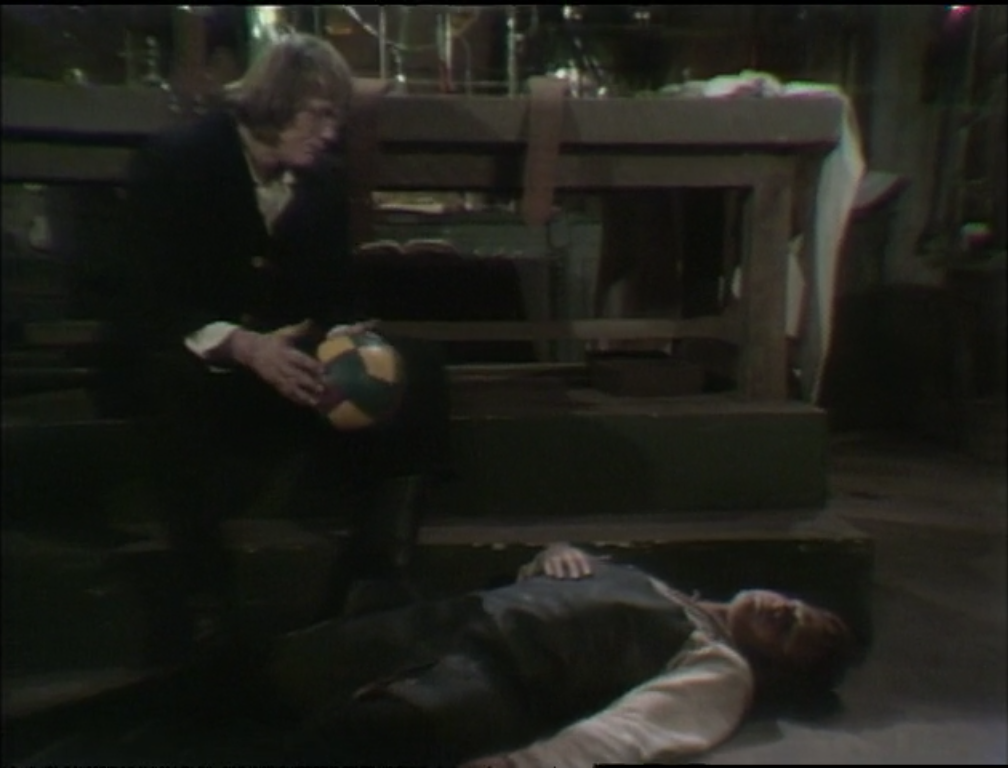
Frankenstein leaves Otto alone with the big guy while he goes off to placate his father, Elizabeth, and Henry. Otto teaches the big guy to play catch. Delighted with this, the big guy hugs Otto. He doesn’t know his own strength, nor does he understand what Otto means when he gasps out “Stop!” When Frankenstein comes back to the lab, he finds the big guy standing over Otto’s corpse, pleading “Play, Ot-ta, play!”
The big guy begs Otto to play
Frankenstein takes out a pistol, but cannot bring himself to kill the big guy. Instead, he orders him to get back on the table. He readily complies, and Frankenstein straps him in place. He takes Otto’s body from the lab. As soon as Frankenstein has left the room, the big guy easily breaks the straps and goes to the door. Finding it locked, he smashes some lab equipment.
Frankenstein takes Otto’s body to his room above what appears to be a tavern. He sets up Otto’s telescope by an open window and drops his body to the ground. By the time he returns to the lab, the big guy is gone.
The big guy wanders about and has some poignant moments when children see him and react with fear. He makes his way to a house occupied by the de Laceys, a blind girl named Agatha and her elderly father. He hides unnoticed in a closet there for, apparently, several months. Shortly after he takes up residence, Agatha’ brother, a sailor, drops his fiancée off at the house. She speaks only Spanish, and Agatha and her father speak only the language of Ingolstadt, which in this movie is identified explicitly as “inglés,” even though Ingolstadt is in Germany. In one of the first English lessons Agatha gives her sister-in-law to be, she says that the storm outside is “a summer rain”; in a later scene, while the big guy is still undetected in the closet, she mentions that October is almost over. Both the dramatized difficulties of language teaching and the unremarked failure of Agatha and her family to detect a huge man crouching a few feet away from them for so long stress the theme of non-communication.
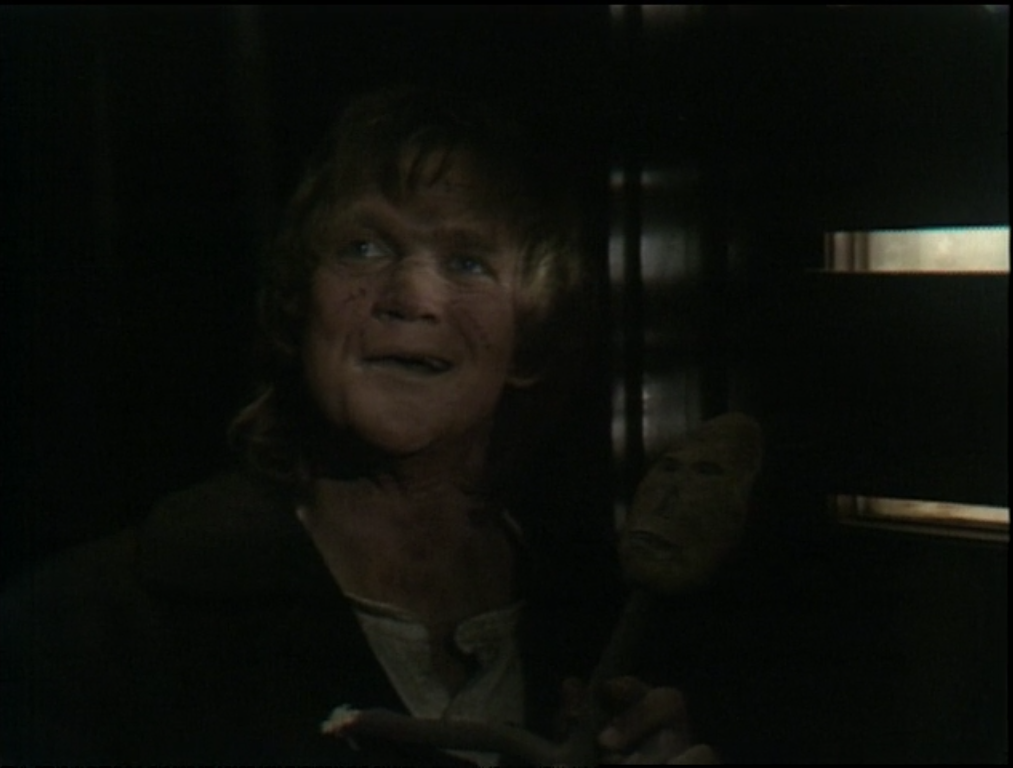
The big guy makes a crude doll and talks to it while Agatha gives her sister-in-law English lessons. He speaks quietly, but not so quietly that it isn’t absurd that they fail to notice him. I suspect that absurdity is as intentional as is the doll’s inability to talk back.
The big guy and his doll.
One autumn night, the big guy comes out of his closet and walks around the vacant living room. He starts talking. He maintains a warm smile throughout, uses sophisticated grammatical constructions and a wide variety of phrases, and acts out a scene full of pleasantries, apologizing for the roughness of his manner and explaining that he has known little kindness from people. He catches a glimpse of himself in a mirror, the first time he has seen such a thing. He recoils from his face, and exclaims “Ugly!”
In the morning, he goes outside and knocks on the front door. When Agatha enters, he tells her he is “a friend you do not know.” She is puzzled by this expression, but lets him in anyway. She jumps to the conclusion that he is a traveler; he tells her that he wishes the whole world were blind. He may have become capable of speech, but now he is terrified of nonverbal communication. The conversation goes quite well until she wants to touch his face. He refuses. She insists, and chases him around the room. At that moment, her father, brother, and sister-in-law to be enter. Misunderstanding, they jump to the conclusion that the big guy is the one chasing Agatha. They fight him, and he injures her brother.
Mr de Lacey, with Agatha and his daughter-in-law to be in tow, brings the injured young man to Frankenstein’s house. When Frankenstein hears their description of the big guy, he mutters a few words about how to tend the patient’s wounds, and sets out with a gun to hunt his creation. They are bewildered that the doctor has rushed off after giving them so little information, and Elizabeth is left to try to smooth things over with them.
That night, Frankenstein catches a glimpse of the big guy and shoots him in the forearm. The big guy gets away. He has no idea who Frankenstein is or why he would shoot him. He finds himself on the grounds of Frankenstein’s house. Frankenstein’s little brother William is outside. They meet at the fountain there. William is unafraid of the big guy and makes a tourniquet to stop the bleeding from his gunshot wound. The big guy and William are quite happy together until William sees Elizabeth and decides to call her over. The big guy tells him not to call anyone, but William ignores him. Panicked, the big guy covers William’s mouth. He still doesn’t know his own strength, so he accidentally breaks William’s neck, killing him instantly. Unlike with Otto, the big guy now knows what he has done, and so his plea is not “Play!” but “Don’t be dead!”
Frankenstein finds William and realizes what has happened. He resumes his hunt. When he finds the big guy, he fails to kill him. The big guy asks Frankenstein who he is and why he hates him. Frankenstein explains enough to draw the big guy’s full rage. He is furious that he was created to be alone, and complains that “I don’t even have a name.” He insists that Frankenstein create a mate for him. When Frankenstein demurs, the big guy threatens to kill everyone who crosses his path. This again echoes Dark Shadows, where Adam insisted that Barnabas and Julia build a “Friend” for him and responded to their protests with a similar threat. Unlike Adam, who was put up to demanding a bride by warlock Nicholas Blair and who didn’t appear to have any idea what sex was, the big guy has seen Frankenstein and Elizabeth together and says that he wants what Frankenstein has.
Frankenstein tries to comply with the big guy’s demand. He has built a womanly body, put it on his table, and hooked it up to wires that will conduct the charges from an electrical storm raging outside. Henry, furious that Frankenstein has paid so little attention to his sister, barges into the lab and sees the body of the Bride. Before he can tell anyone about it, the big guy kills him.
Frankenstein tries to complete the experiment. The big guy lets himself in and watches as the lightning makes the Bride arch her back, open her eyes, and scream. This is far more activity than the big guy showed before Frankenstein and Otto disconnected him, but Frankenstein leaves the Bride hooked up while the electric charges surge into her. She dies on the table. The big guy says that Frankenstein deliberately killed her. He doesn’t bother to deny it, but says that his conscience wouldn’t let him repeat the misdeed he committed in bringing the big guy to life. At that, the big guy vows to stalk Frankenstein for the rest of his life. He tells him that he will be there on his wedding night.
Frankenstein finally tells Elizabeth the truth. She resolves to stick with him regardless. They leave town. They check into an inn, where the innkeeper brings his friend the Burgomaster over to perform a wedding ceremony. The innkeeper and the Burgomaster explain that Frankenstein must go across the square to sign the registry to make the marriage legal. For some reason Elizabeth must remain in the room by herself while he does this. He resists, but Elizabeth and the Burgomaster insist it will be all right. Of course Elizabeth is dead when Frankenstein returns to the room a few minutes later.
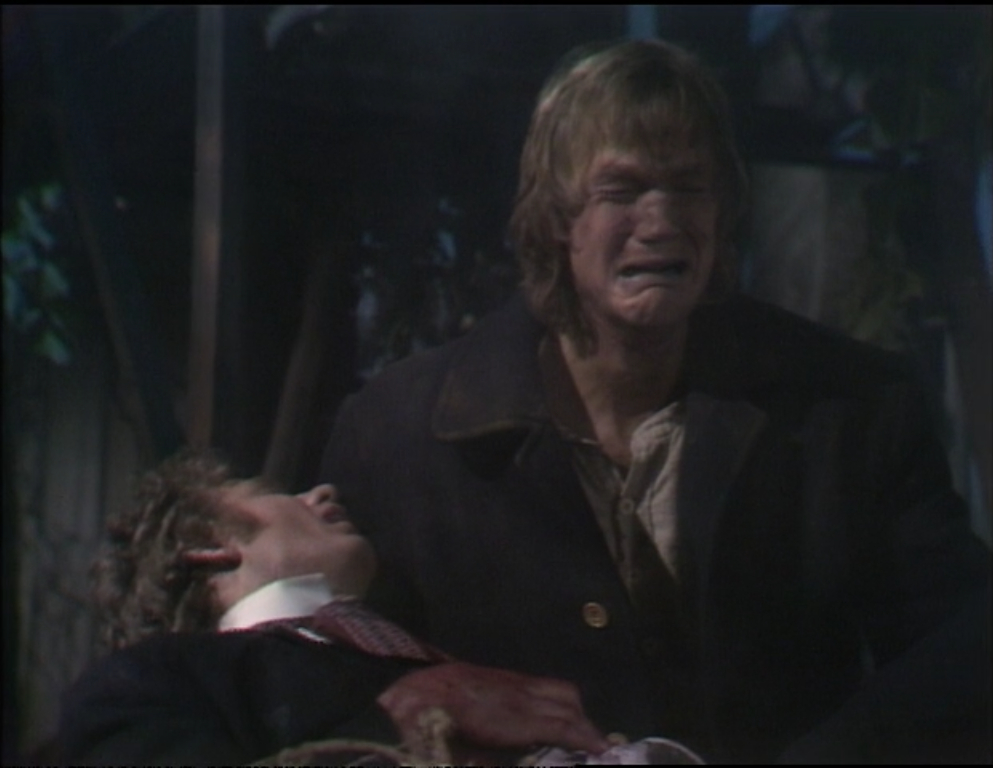
Once more Frankenstein takes his gun to hunt the big guy; once more he fails to kill him. This time the big guy kills him. Frankenstein winds up dying cradled in the big guy’s arms, in a Pietà pose, while the big guy expresses his remorse for his killings. He speaks of “the pain I felt when I killed little William, the hate I felt for myself when I left Elizabeth dead,” and begs Frankenstein not to die. He does anyway, and the big guy walks off, encountering some policemen who shoot him to death.
The big guy wants forgiveness.
For a quarter century before this movie was made, feature films had spent a great deal of time exploring non-communication. Filmmakers like Michelangelo Antonioni, Jean-Luc Godard, and above all Alain Resnais had made dozens of movies about people who simply could not get through to each other. The result was a pervasive sense of tentativeness, as potential relationships were outlined but could not develop and potential events were envisioned but could not occur. The same tentativeness dominates this movie.
*Throughout the movie, people call the scientist “Frankenstein,” while his creation is known only as “The Giant.”
**Recycled from Dark Shadows and other collaborations between Curtis and composer Robert Cobert, as is nearly all the music.
Naomi Collins (Joan Bennett) has learned that her son Barnabas, whom she knows to be dead, gets out of his coffin at night and kills people. At the end of yesterday’s episode, she saw Barnabas bite his second cousin Millicent on the neck and suck her blood.
The year is 1796, and Naomi has never heard of vampires. She is in a daze about the whole thing. It is clear to her that her husband Joshua has been keeping the truth about Barnabas from her. Though Joshua’s habit of concealment has led to one disaster after another, Naomi accepts that in this case it was his way of expressing love, and she embraces him. She asks Joshua to explain what has happened to their son; he says he doesn’t really understand it, and isn’t sure it would help if he did.
Naomi is hiding bewildered time-traveler Vicki. In the parts of Dark Shadows set in the 1960s, Joan Bennett plays matriarch Liz. The show has been hinting heavily since episode #1 that Vicki is Liz’ unacknowledged daughter. They never make that point explicit. They have no reason to. Liz so completely treats Vicki like a daughter that nothing of any importance would change if the biological relationship were confirmed. Nor would any particularly exciting story possibilities open up if it turned out Vicki were not Liz’ daughter. In the early days of the show, there were a few hints that Vicki might have a doomed romance with Liz’ brother Roger, but they’ve long since made it abundantly clear that no such thing was in the cards,* and nothing else about Vicki would change if she turned out to have a different mother.
Naomi’s attitude to Vicki echoes Liz’ maternal affection. Naomi stood up to the tyrannical Joshua, apparently for the first time ever, to insist that he retain Vicki as governess to their daughter Sarah. She defied Joshua again to testify on Vicki’s behalf during her trial for witchcraft. Now Vicki is a fugitive from justice, escaped from gaol and facing a death sentence, and Naomi insists on harboring her. When Naomi decides that Barnabas’ condition leaves her no choice but to commit suicide, she goes first to Vicki and then to Barnabas, speaking to each in the same motherly tone and giving each the same motherly embrace. Throughout the eighteenth century flashback, the characters have served as mirrors of those played by the same actors in the contemporary segments, and in Naomi’s effective adoption of Vicki we see a clear reflection of Liz.
Naomi’s suicide also harks back to Liz. Naval officer/ sleazy operator Nathan Forbes is using Barnabas’ condition to blackmail the family, and that blackmail is one of the things that pushes Naomi hardest towards self-destruction. From March to July of 1967, Liz was blackmailed by another maritime scalawag, seagoing con man Jason McGuire. In her despondency over what Jason was doing to her, Liz three times had to be kept from throwing herself to her death from the cliff on Widow’s Hill.
Closing Miscellany
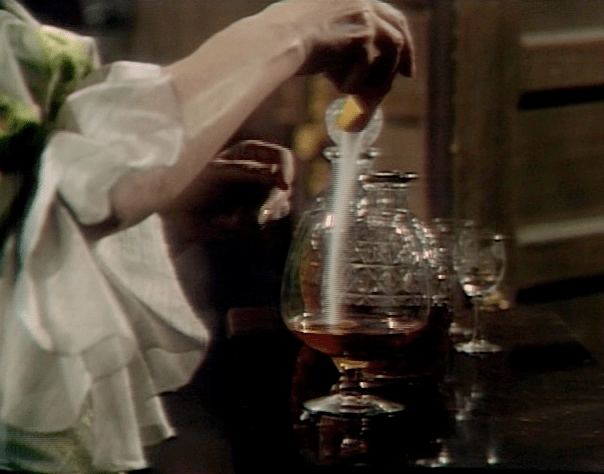
Whatever poison Naomi has decided to take must not be very potent. She pours about a cup of it into her brandy and is still able to stroll over to visit Barnabas and have a long conversation with him before she dies.
What is that, enough salt to cause a life-threatening case of high blood pressure? Screenshot by Dark Shadows Before I Die.
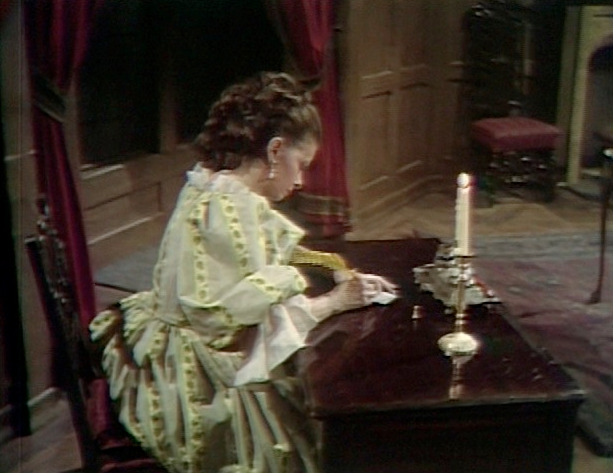
Naomi writes a suicide note and leaves it for Joshua. This raises a question. When did Naomi become literate? When first we saw her, in #366, the show went out of its way to make sure we knew that she could not read even the simplest text, but now she dashes off what appears to be a substantial message in calligraphic script. Naomi has been growing more assertive as time has gone on, but we haven’t seen her learning to read and write, as we saw Barnabas giving much put-upon servant Ben a writing lesson in #375.
When Naomi is taking poison, there is some music that I don’t remember. I’m not sure if it is new, or if we just haven’t heard it played in full for a while. It features some pretty impressive theremin playing.
*Much to the dismay of Vicki/ Roger shippers like Tumblr user WidowsHill, creator of fine artworks such as these:
Images and text by WidowsHill, posted on tumblr 17 March 2024.
This is the first episode of Dark Shadows credited to a director other than Lela Swift or John Sedwick. It is also the first production of any kind directed by Dan Curtis, the series’ creator and executive producer. Curtis’ inexperience shows at several moments when the camera is in an awkward spot or the actors are unsure what to do, and in his post about the episode on Dark Shadows Every Day Danny Horn documents several of the more egregious examples with screenshots and detailed analysis. The impossible deadlines and tiny budget on which Dark Shadows was produced meant that even Swift and Sedwick, who were seasoned professionals and ambitious visual artists, sometimes had to turn in work that wasn’t much better than what first-timer Curtis manages today, and longtime viewers of the show will take even his worst stumbles in stride.
At the top of the episode, it is daytime, and much put-upon servant Ben Stokes (Thayer David) finds the lady of the house, Naomi Collins (Joan Bennett,) standing at an open coffin that holds the corpse of her son, Barnabas. Ben knows that Barnabas is a vampire who will rise at night to prey upon the living. Naomi has never heard of vampires. All she knows is that Barnabas is dead, and that his coffin has been moved from the family mausoleum to a room atop a tower in the mansion. Ben pleads with her to leave the room and to go with him back to the main part of the house.
Naomi questions Ben. Ben tells her that Barnabas has a “sleeping sickness,” and has been in a coma ever since the night he apparently died. Ben does not like to lie to Naomi, but her husband, haughty overlord Joshua, has judged that the truth would kill her, and Ben is governed by that assessment. He does tell her that the “sleeping sickness” is a symptom of a curse, that the wicked witch who placed the curse was Barnabas’ sometime wife Angelique, and that Joshua is in Boston trying to find someone who knows how to lift it.
Ben asks Naomi how she came to be in the tower room. She tells him that naval officer/ sleazy operator Nathan Forbes told her that Barnabas was being kept there, and also that Barnabas was responsible for the series of murders that had recently taken place in the town of Collinsport. At that, Ben vows to kill Nathan. To his chagrin, Naomi forbids him to do this.
In the part of Dark Shadows set between August and December of 1966, Bennett played reclusive matriarch Elizabeth Collins Stoddard and David played her fanatically devoted handyman Matthew Morgan. When well-meaning governess Vicki came unstuck in time and arrived in the late 1790s, she at first mistook Naomi for Liz and Ben for Matthew. This scene takes longtime viewers back to the days when Matthew was always on the lookout for someone who represented a threat to Liz’ interests and she was always sternly prohibiting him from murdering anyone for her sake.
Ben is a far saner man than Matthew ever was; the contrast between them shows the effect that growing up in Collinsport, a town suffering from the consequences of a curse that has been working its way for many generations, has had on Matthew’s personality. While Ben is a brave, kind-hearted fellow whose fierce loyalties sometimes overpower his good sense, Matthew is a paranoid ogre who kills Liz’ friend Bill Malloy and tries to kill Vicki. It isn’t just one family that will be warped by Angelique’s curse. It will breed monsters everywhere the Collinses’ influence prevails.
Naomi then turns her attention to the B-plot. Nathan has married fluttery heiress Millicent Collins, only to find that Millicent has signed her share of the Collins fortune over to her little brother Daniel. Nathan responded to that news by crafting a plot to murder Daniel. His first attempt failed when Noah Gifford, the henchman he hired to abduct Daniel and drown him, fell afoul of Vicki. Vicki found Noah strangling Daniel near the place where she was hiding, having escaped from gaol, and shot him to death. After that, Daniel and Vicki went back to the mansion and told Naomi what they knew. Naomi recognized Daniel’s description of his attacker as a man she had seen with Nathan earlier, and realizes that Nathan is trying to murder the boy. So she orders Ben to take Daniel into town to stay with the Rev’d Mr Bland, a clergyman who looks like a duck.
Naomi confronts Nathan, who keeps telling her that whatever Barnabas might look like during the day, he gets up at night and goes out to murder people. She tries to shut him up, but later she is still wondering whether she should go back to the tower room after dark to check his story out.
She sees Millicent standing in the foyer, staring at the portrait of Barnabas that hangs there. The portrait of Barnabas first appeared under the closing credits in #204, and from #205 on it figured as a means through which Barnabas could communicate with the living. Barnabas bit Millicent the other day, and she hears him summoning her.
Among the 1960s characters who receive their commands from the vampire while staring at the portrait is Liz’ daughter Carolyn, who like Millicent is played by Nancy Barrett. Millicent at times evoked an early version of Carolyn. Until the spring of 1967, Carolyn was tempestuous and irresponsible, sometimes friendly to point-of-view character Vicki, sometimes hostile to her. Millicent is as timid and overly dependent as that version of Carolyn was headstrong and self-centered. One way or another, each is a Spoiled Heiress, and evidently that’s a favorite meal of Barnabas’.
Naomi follows Millicent to the gazebo on the grounds of the estate. There, she sees Barnabas. She is stunned that the son whose corpse she was looking at just a few hours before is up and moving. He bites Millicent, and Naomi lets out a scream. Barnabas looks up, and realizes that his mother has caught him in the act.
The vampire’s bite affects each victim differently. The first victim we saw was Willie Loomis, whom Barnabas’ bite transformed from a dangerously unstable ruffian to a sorely bedraggled blood thrall. Willie was at first gravely ill, then ran to Barnabas like an addict desperate for a fix, and eventually settled into life as a sorrowful servant who could not run away from Barnabas but could resist him to the point where Barnabas occasionally found it necessary to keep him in line with beatings.
The second victim we saw was Maggie Evans, The Nicest Girl in Town. She reacted very much like the first victim in the 1790s segment, gracious lady Josette, who, like Maggie, was played by Kathryn Leigh Scott. At first, those two were alternately blissful and snappish, happy to be under Barnabas’ power and defensive with anyone who might interfere with it. But each recoiled from him by the time it became clear he planned to kill her and make her into a vampire herself. Each escaped from him to the shore below Widow’s Hill- Maggie by running through an underground tunnel that rose to the shoreline, Josette by flinging herself to her death from the top of the cliff.
Later, Barnabas bit Carolyn. She initially contemplated his most gruesome crimes with pure glee and showed great energy as his protector and enforcer. Soon her conscience reappeared, but she was still doing his dirty work faithfully when Vicki disappeared into the past.
Millicent differs from all those others in that she simply continues to go about her business in between Barnabas’ meal-times. Granted, she was already deeply disturbed by that point, so that her business was conducted mostly in show-stopping mad scenes. But it’s still odd that she can talk to Nathan as if their marriage were the main thing in her life.
When we finished watching this one, my wife, Mrs Acilius, wondered if these differences were simply the result of the victims’ personalities coming through or if the vampire can pick and choose how to apply the pressure. He wanted Willie as a slave, and the reaction he produced gave him that. He wanted to turn Maggie into a reincarnation of Josette, and wound up getting the same reaction from Maggie that he had got from Josette. He bit Carolyn in a moment of desperation, with no plan in mind, and her reaction is complicated and volatile. He bit Millicent to keep her quiet, and her reaction is remarkably inconspicuous. Maybe we’re just supposed to think that Barnabas is fabulously lucky, but there is an opening there to tell a story about how him deciding what he wants to do to a person when he sucks their blood.
Gordon Russell’s script contains an interesting scene. A psychiatrist brought in to examine strange and troubled boy David Collins gives a little speech attributing David’s fear of his cousin Barnabas to various unresolved traumas he has recently experienced. This speech sounds very plausible to the adults who listen to it, and might go some way towards explaining the appeal of Dark Shadows to its audience. But we know that David’s fears are entirely rational and that Barnabas really is a vampire. When the psychiatrist mentions that Barnabas had fangs in one of David’s dreams, family doctor Dave Woodard catches up with us and realizes that Barnabas really does have fangs and that he used them to inflict bite marks on some of his patients.
Episode 335 of Dark Shadows was a scab job done during the October 1967 National Association of Broadcast Employees and Technicians strike. In March of that year, at a time when Dark Shadows was at rock bottom in the ratings, the actors stayed out in support of the announcers and newscasters when they went on strike, and the show survived even though it went dark by the time the strike ended. Now, the vampire story is pulling in more viewers every week, making it a valuable property to ABC. But it is at this time that executive producer Dan Curtis told the cast that he would pay their union fines if they crossed the NABET picket line, and most of them did, with network executives and their stooges handling the equipment.
Sad to say, only two cast members did the right thing by the technicians. Robert Gerringer, who played Woodard, was one of those. Even if he had been a good actor, the scab stealing food from the mouths of Robert Gerringer’s children wouldn’t have been able to deliver on the moment when Woodard figures out that Barnabas is a vampire- we need Gerringer for that. He is the person we’ve grown used to seeing in the part, and his self-consciously soap operatic style of acting sets him apart from the rest of the cast and highlights the weirdness of this story playing out on a daytime serial in 1967.
But the scab isn’t a good actor. His most memorable moment comes when Joan Bennett, as matriarch Liz, bobbles a line, and he corrects her. She flashes a look of anger, but what does she expect? What she is doing is no better than what he is- if anything, it’s worse, because she was a big star and could have called a halt to the whole filthy disgrace if she’d lived up to her obligations as a member of AFTRA.
I’m writing this in September 2023, month three of the SAG-AFTRA actors’ strike and month five of the Writer’s Guild of America strike, so I’m even angrier about the whole thing than I usually would be. But I always find it hard to watch material produced under these conditions.
The character of Maggie Evans wasn’t in any of the episodes produced during the strike, so Kathryn Leigh Scott wasn’t involved in breaking it. She is walking a picket line today, and in her column she wrote about the particular issues at stake in the 2023 strikes. Different matters hung in the balance in 1967, but it’s always true that we live in a society, for the love of God, and if working people don’t stick together they don’t have anything.