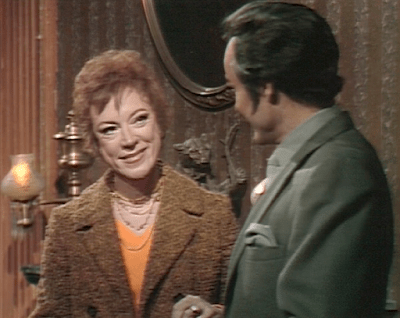
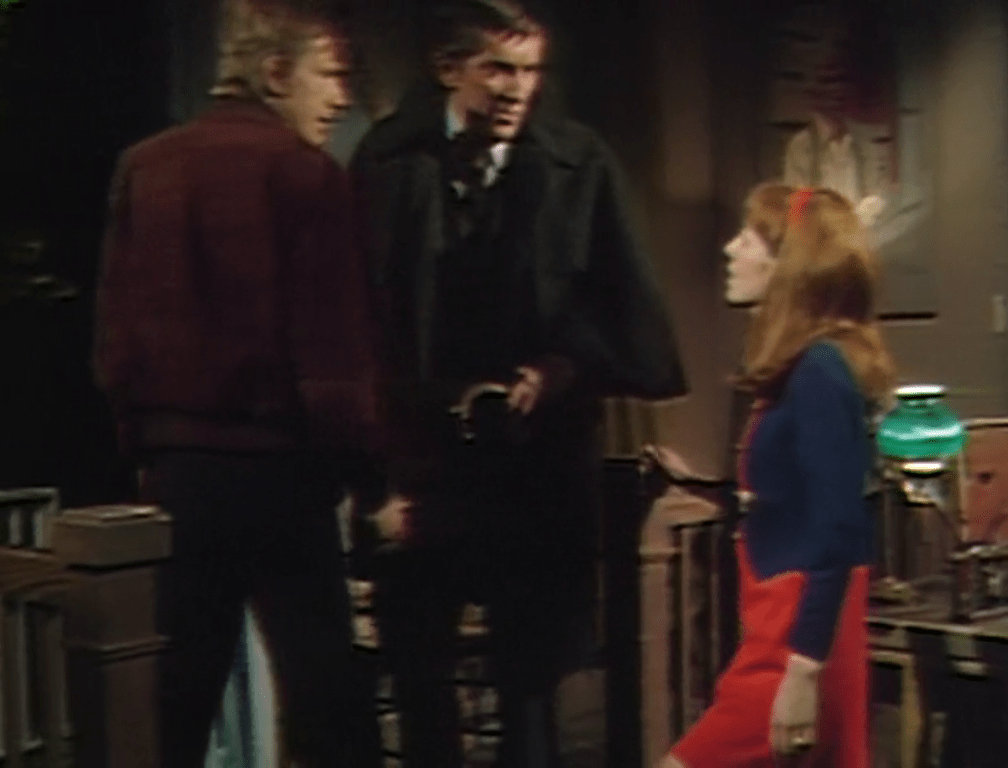
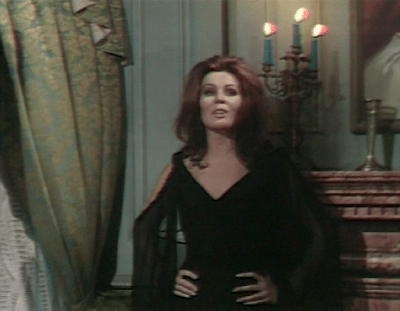
An experimental procedure has killed one woman and brought another to life. Yesterday someone identifying herself as Leona Eltridge turned up out of the blue and volunteered to be the “life force” donor who would help animate a bride for Frankenstein’s monster Adam. Mad scientist Julia and old world gentleman Barnabas capitulated to Adam’s insistence and went through with the procedure. Leona died, but the Bride, whom Adam has taken to calling Eve, is alive.
After a few minutes in a daze, Eve starts talking. This surprises Julia, Barnabas, and Adam. When Adam came to life, he didn’t know any words or anything else. They puzzle over the difference. Even after Eve starts alluding to her previous existence, they do not remember the original plan when Adam was created. Barnabas was Adam’s “life force” donor, and it was expected his body would die and his spirit would awaken in Adam. Evidently this is what has happened with Eve. Her memory comes back in bits and pieces; she is bewildered to find herself in Barnabas’ basement, and is quite anxious for an explanation as to how she got there. Eve faints, and Adam takes her to the upstairs bedroom. Julia examines her there, and concludes that she will be all right.
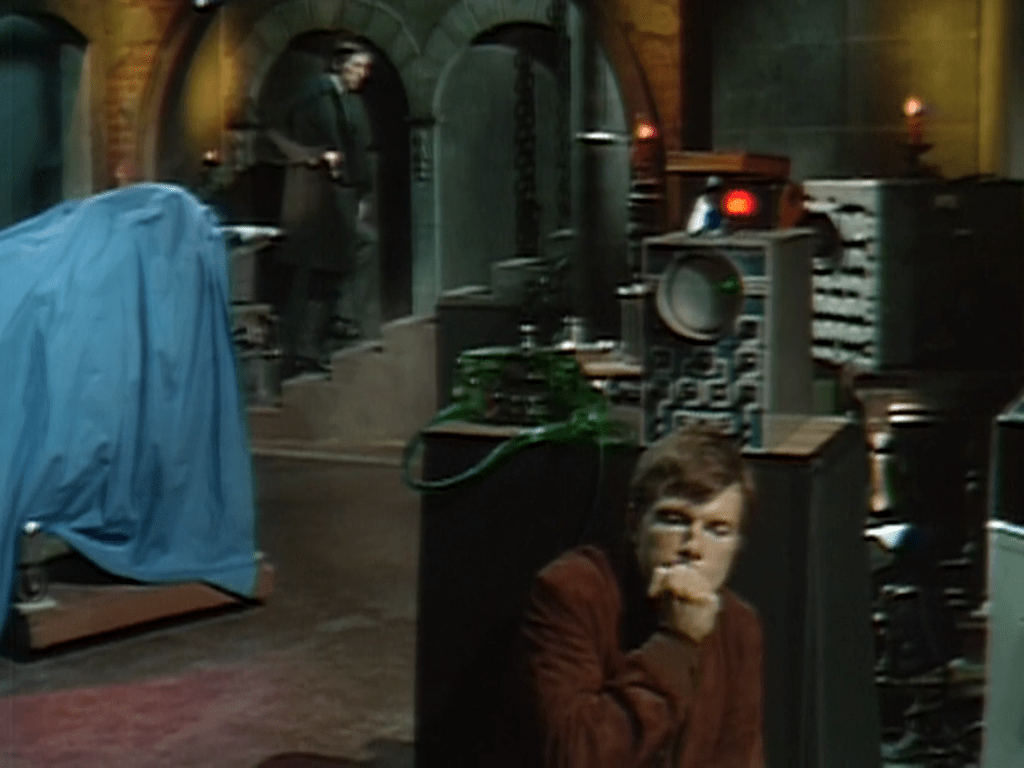
Meanwhile, occult expert Timothy Eliot Stokes has come to the house. In Friday’s episode, he reacted to the name “Leona Eltridge” by rushing off to do something terribly important. Today, we see that what he had to do was reenact a scene from Rosemary’s Baby. In that film, released 12 June 1968, Rosemary uses Scrabble tiles to figure out that two names are anagrams of each other. In this episode, recorded 30 September 1968, Stokes uses alphabetic refrigerator magnets to figure out that “Leona Eltridge” is an anagram of “Danielle Roget,” the name of an eighteenth century homicidal maniac. Barnabas and Julia don’t get to the movies much, so they don’t realize that this is proof positive that Eve is now the reincarnation of that hyper-violent personage.
In the upstairs bedroom, Eve demands a kiss from Adam. He is shy at first, but obliges. After he leaves her alone to go downstairs and confront Barnabas, Julia, and Stokes, spooky music plays, wind blows the bedroom door open and lifts the window treatments, and we hear chimes. Eve is standing in front of a portrait of gracious lady Josette, who like Danielle Roget was a Frenchwoman of the late eighteenth century; when Eve reacts to the ghostly manifestations by saying “I remember you!” we might think that Josette’s ghost, a major presence in the first year of Dark Shadows, has returned to do battle with an old foe. Eve rules this out when she addresses the ghost as “mon petit,” not “ma petite.”
As soon as Marie Wallace starts delivering lines, it is obvious she is going to be on the show for a while. She is firmly in command of a larger than life acting style of the sort the directors liked, and she dominates every shot she is in. She also solves another riddle. Thursday and Friday, Erica Fitz played Danielle/Leona. A technical description of Miss Fitz’ approach to that role would be quite similar to one of Miss Wallace’s approach to Eve. Each woman speaks her lines one word at a time, often giving a special inflection to a particular word in the middle of a sentence. Their posture and basic facial expressions are also similar. But while Miss Fitz did a stupefyingly bad job, Miss Wallace holds the audience’s attention easily, and leaves us with the sense that we are seeing a character with a coherent set of motivations. I suspect Miss Fitz must have seen Miss Wallace rehearsing, and made a woeful attempt to mimic her style.
Miss Wallace’s prominence in this episode adds a special piquancy to the reference to Rosemary’s Baby. In a comment on Danny Horn’s Dark Shadows Every Day, “Rob Staeger” points out that “Marie was in Nobody Loves an Albatross — which is actually one of the plays Rosemary’s husband had in his credits in Rosemary’s Baby!” Which is true- Rosemary says that Guy “was in Luther and Nobody Loves an Albatross and a lot of television plays and commercials.” That only two titles are given makes it quite a coincidence that one of the thirteen members of the opening night cast of one of them has her first lines in an episode that references the movie.
(I should mention that Barnard Hughes, a very distinguished actor who appeared in #27, was also in Nobody Loves an Albatross. I don’t know if he and Marie Wallace ever ran into each other and compared notes about their subsequent work on Dark Shadows.)
Friday’s episode ended with Frankenstein’s monster Adam in the act of strangling well-meaning governess Vicki as she lies in her bed at the great house on the estate of Collinwood. In today’s opening Adam goes on throttling Vicki for quite a while. At length heiress Carolyn and recovering vampire Barnabas mosey into Vicki’s room. Adam is long gone, and Vicki is still alive. Permanent houseguest Julia is a doctor, and we hear a report of her prognosis that Vicki will be all right. Carolyn has been hiding Adam in a spare room; suave warlock Nicholas shows up and does some damage control. He suggests to Carolyn that Adam might not be guilty of the attempted strangulation, then goes to Adam’s room to talk with him while they wait for Carolyn to come. By the time she gets there, Adam and Nicholas have their story straight. Carolyn accepts Adam’s denials. At that point, everyone loses interest in Vicki and what happened to her.
Nicholas had put Adam up to demanding that Barnabas and Julia build him a mate. Adam had threatened to kill Vicki if they did not comply. Yesterday, he concluded that they were not taking him seriously, and that was his motive for the murder attempt. At the end of today’s episode, Barnabas goes back home to the Old House on the estate and finds Adam waiting for him. Adam tells Barnabas that he has decided they should use Carolyn as the donor of the “life force” that will bring the mate to life.
Adam’s attack on Vicki was Friday’s week-ending cliffhanger. It might have generated substantial suspense, as it has been so long since Vicki has had much to do on the show that it is possible we might be seeing the last of her. But, as Danny points out, they botch the scene badly:
I mean, there is obviously no way that she could have survived this attack. Adam is an enormous Frankenstein creature; it’s been established that he can bend steel bars just by giving them a stern look. Even for a soap heroine, there’s no way that Vicki could maintain structural integrity under these circumstances. She’s just not built for it.
It’s quite a grisly little scene, actually, because it happens so quickly. She doesn’t really get a chance to react. She was sleeping, and then Adam put his hands around her neck, and now she’s dead, and she doesn’t even know what’s going on…
By the time Carolyn returns to the scene of the crime, Julia’s already been and gone — the invisible off-screen soap doctor who doesn’t actually appear in this episode.
Barnabas tells Carolyn that Vicki’s alive, but she’s in shock. I am too, actually; our lame Frankenstein monster can’t even kill a governess at point-blank range.
Danny Horn, “Episode 586: The Invisible Woman,” posted 17 February 2015 on Dark Shadows Every Day.
Danny revisits this point later in his post:
Problem number one is the lack of consequences. They actually opened the week with the murder of a main character — and ten minutes later, everyone’s back to starting positions. Vicki’s not dead, and Adam’s not even being blamed for the assault.
Now, I’m not complaining that Adam hurt somebody and isn’t expressing any noticeable remorse. It’s true that today’s felony places Adam squarely in the villain column, but that’s fine. Fantasy-adventure stories need villains, and villains are supposed to do villainous things.
The consequences issue is that Adam basically just killed Vicki, and it hardly even registers as a plot point. There’s no investigation, no confession, and no character development; it’s just a thing that happened, and we can all forget about it.
Danny Horn, “Episode 586: The Invisible Woman,” posted 17 February 2015 on Dark Shadows Every Day.
Adam’s threat to kill Vicki never seemed to fit with his personality, but considering that he accidentally killed his friend Sam because he didn’t know his own strength, we could at least imagine that he might inadvertently carry it through. And as Danny says, the brevity and simplicity of the scene add to its force if we think it might actually show Vicki’s death. She was the show’s protagonist for its first 38 weeks and an important part of it for a long time after, and for her life to end so abruptly that she doesn’t even have a chance to scream, for the sake of a plot point that isn’t even her killer’s own idea, would be shocking in the pointless, unsatisfying way that violent deaths are shocking in real life. But if Adam can shake Vicki by the neck from the opening teaser through the first scene without seriously injuring her, he clearly isn’t going to kill anyone, and Barnabas and Julia may as well go off and do something else.
Nicholas is Dark Shadows’ main villain at this point; he is supposed to seem so powerful that we can’t imagine how the other characters will overcome him, and so wicked that we will forgive them for any expedient they can find that will work against him. This is currently the show’s main source of suspense. As Danny explains, they do serious damage to that today:
Nicholas is supposed to be the real mastermind behind this operation, so Adam still ends up reduced to being the dumb muscle, rather than a strategic thinker.
Unfortunately, Nicholas’ management skills are also kind of questionable at the moment. We see him scolding Adam for trying to kill Vicki, but where has Nicholas been for the last couple weeks?
It’s up to Adam to fill Nicholas in on the latest plot development — that Barnabas has chosen Maggie to be the sacrificial victim in their Bride of Frankenstein mad science experiment, giving her “life force” so Adam’s new mate can live.
Nicholas has a crush on Maggie, so he’s furious about this, but it’s a hollow moment. If Nicholas is the manipulative wizard running the show, then he should have known that they spent a good chunk of last week discussing this.
Dude, you have a magic mirror that can show you anything that’s going on at the Old House. You should have been on top of this. It’s just irresponsible.
Danny Horn, “Episode 586: The Invisible Woman,” posted 17 February 2015 on Dark Shadows Every Day.
A third major flaw with the episode comes with Carolyn’s role. Danny explains:
I know that it’s odd to say, “This storyline about creating a female love-slave for a violent psychopath isn’t particularly strong on women’s issues,” but Dark Shadows isn’t just a fantasy-adventure story, where you can marginalize all the female characters and move on to the car chase. It’s also a soap opera, and soap operas are supposed to be about women, and women-related subjects like feelings and consequences.
But here we are, watching an episode of daytime television that begins with strangling a woman who doesn’t struggle or even cry out, and then the rest of the time is mostly Carolyn talking to a series of men who lie to her and boss her around.
This is a real problem, and it’s going to come up again. The Bride of Frankenstein story has turned into a reverse beauty pageant, where the guys get together and argue about which woman they’re going to sacrifice on the altar of mad science. This hot potato is going to be tossed around between Carolyn, Vicki and Maggie all week.
Julia is the one female character in the story who actually has agency of her own, but she’s kind of sidelined too — mostly just turning the knobs and flipping the switches while the guys decide whose life force they’re going to extract. The fact that they can have this whole episode with Julia off-camera pretty much says everything.
Danny Horn, “Episode 586: The Invisible Woman,” posted 17 February 2015 on Dark Shadows Every Day.
Danny goes so far as to say that the gullibility Carolyn has to display when Adam and Nicholas lie to her “actually threatens to break the show,” and he is right. The failure to take female characters seriously not only disrespects the show’s core demographic, but specifically makes it harder to tell a suspenseful story. We can see why when Carolyn asks Barnabas why he believes Adam attacked Vicki. At this point Barnabas knows that Carolyn is hiding Adam, and he believes that Carolyn, like everyone else in the great house, is in danger from him. He therefore has every reason to confide in her, and since she can’t go to the police, no reason to hold back even the parts of the story that would incriminate him. But he flatly refuses to tell her anything at all. Ever since March 1967, the rule on Dark Shadows has been that only the villains are allowed to know what is going on. That cramps the action seriously, and when they add further restrictions on who can participate, it limits the possible outcomes of any situation so severely that it becomes all too predictable.
The scene in which Barnabas refuses to tell Carolyn what he knows brings up yet a fourth problem, one Danny does not mention. Barnabas takes such an indefensible position that he winds up seeming ridiculously weak. The main villain already looks weak, so when the principal protagonist does too, we have little reason to hope for an exciting story.
What keeps this episode from the “Stinkers” bin is Robert Rodan’s performance as Adam. In his early days, when Adam knew only a few words, Rodan managed to play on our sympathies, but had little opportunity to do more. Now the character speaks fluently and the actor delivers his lines with remarkable precision. Danny calls it a blooper when, during the three-scene in Adam’s room, Nicholas tells Carolyn that Adam is growing used to being blamed, and he responds by shouting all but the last word of “I am not used to… it.” I disagree. The dropping of his voice shows that there is a great deal Adam is not used to and does not plan to get used to, more than he can put into words.
The final scene in Barnabas’ house is also a fine turn for Rodan. Barnabas finds Adam waiting for him in his front parlor. We had seen Adam there in his first weeks as an inarticulate, raging creature; now he is well-spoken and very much in control of himself as he presents Barnabas with an impossible demand implicitly backed by a horrifying ultimatum. The contrast is chilling. I particularly relished Rodan’s rendering of this little speech:
Barnabas, please sit down.
When I first knew you,
I never thought I could be the gentleman that you are.
You are a very imposing man, Barnabas.
I still find it difficult not to be frightened by your manner.
Adam does not make threats in this scene; he creates a frightening situation simply by the imperturbable calm with which he issues his commands. It is Rodan’s finest moment so far.
Nicholas tells Carolyn that he is concerned about what happens on the estate of Collinwood since “I live here too.” When he first moved into the house he now rents from the Collins family, it was on the other side of the village of Collinsport from their home. A week or two ago, the opening voiceover referred to it as “another house on the estate,” and we’ve been hearing people around Collinwood refer to it as “very near.” So that’s a retcon. Since Adam has been coming and going between Collinwood and Nicholas’ house without being seen, I suppose it is a logical one, but it does make you wonder what they were thinking when they originally made it so clear it was some distance away.
Barnabas asks Carolyn if there is a way into Vicki’s room than her locked door. He knows very well that there is, since he himself used a secret passage to get into that room twice when Dark Shadows was a costume drama set in the 1790s and the gracious Josette slept there.
Some time ago, mad scientist Eric Lang promised Barnabas Collins that he could cure him of vampirism. His cure involved building a Frankenstein’s monster and draining Barnabas’ “life force” into it. Lang expected that this experimental procedure would end with Barnabas’ body dead and his consciousness awakening inside the newly constructed creature.
Lang died before he could complete the experiment. Barnabas’ friend, Dr Julia Hoffman, picked up where Lang left off. To their surprise, both Barnabas and the new man lived. Barnabas was freed of his curse, but he and Julia turned out to be the worst parents conceivable. They took the new man, whom they named Adam, to the prison cell in the basement of Barnabas’ house and kept him chained to the wall, alone for all but a few minutes a day, with nothing to stimulate his mind. Adam eventually escaped, and quite understandably hates Barnabas.
Adam has fallen under the influence of suave warlock Nicholas Blair. Nicholas persuaded Adam to go to Barnabas and threaten to murder well-meaning governess Vicki and everyone else Barnabas cares about unless he provided him with a mate. Barnabas enlisted Julia to take charge of the process and his servant Willie to steal dead bodies to use for parts. Now there is a constructed female corpse on a table in Barnabas’ basement and an apparatus to use in its animation. All that is missing is a woman to donate her “life force.”
Yesterday, Barnabas’ servant Willie overheard Barnabas telling Julia that he wanted her to hypnotize Maggie Evans, The Nicest Girl in Town, so that she would submit to the procedure. When Barnabas was a vampire, he took Maggie as his victim, keeping her in the cell where Adam would later be chained. After Maggie escaped from Barnabas, Julia hypnotized her to forget her ordeal. She now believes that Barnabas is just peachy.
Today, Maggie is on the terrace at the great house of Collinwood. She is having coffee with Vicki. The two of them are lamenting the fact that their fiancés have both become strangely distant lately, leading to the end of their engagements. Some of the fan-sites mention that both Kathryn Leigh Scott and Alexandra Moltke Isles have moments during this sad scene when they seem to be stifling laughter. In the years since the show ended, several of the actresses have said that Louis Edmonds had a habit of making wickedly hilarious remarks to them immediately before a taping that would involve a deeply serious scene, and that it would take everything they had not to burst out laughing at the worst possible moments. Edmonds’ character Roger Collins isn’t in this episode, but maybe he was on set for some other reason.
Barnabas shows up and talks with each woman separately. While Vicki is away getting a cup for Barnabas, Maggie tells him she might be leaving town soon. He is distressed to learn she may not be available for the crimes he is planning against her. After Maggie leaves, Vicki mentions that her charge David just left on a camping trip, and “It was quite something getting him off.” On Danny Horn’s Dark Shadows Every Day, a commenter named “Chris” remarked on this:
During the outdoor coffee scene after Maggie leaves Vicky with Barnabas, is the funniest blooper ever…….
Vicky, paraphasing: “I was getting David ready for his trip to Boston.”
Actual finish: “It was quite something getting him off.”
And then, she buries her face in the coffee cup, knowing that everyone is holding back laughter, and the awkward pause goes on forEVER.
Comment left by “Chris” at 7:57 AM Pacific time, 21 March 2016, on “Episode 583: Every Woman We Know,” by Danny Horn, on Dark Shadows Every Day (12 February 2015.)
To which I replied, “Vicki, no, he’s only twelve!”
When Mrs Isles is trying not to laugh, she bites her upper lip. She visibly does that before lifting the coffee cup to cover as much of her face as she possibly can, and the pause does go on a long time. So it could be that “Chris” is correct. I can only imagine Edmonds saying that now we know why they stopped showing the audience what goes on when Vicki and David are alone together.
While Maggie was Barnabas’ prisoner, Willie came to be very fond of her. Barnabas eventually framed Willie for his own crimes against Maggie; Willie was sent off to the mental hospital Julia is in charge of. After a few months, he was released. Willie came back. Since his return, Willie has been firmly convinced that Barnabas is his friend. Willie is also in love with Maggie. These attitudes thrust Willie into a crisis when he learns of Barnabas’ cruel plan for Maggie.
At first Willie tries to persuade Julia to refuse to bring Maggie into the experiment; she will not. Then he tries to stab the constructed body. Barnabas caught him before he could plunge the knife in, and threatened to kill him if he tried again.
Later, Willie goes to Maggie’s house and tries to persuade her to leave town immediately because “people” will hurt her if she doesn’t. When she asks what people, he with great reluctance tells her that “Barnabas, he’s involved… Now look, it’s not his fault- but he’s in it whether he likes it or not.” When Maggie expresses disbelief that Barnabas could be a part of any plan to hurt her, Willie says “I’ve got my loyalties to Barnabas, because he’s been good to me. And I’m being as loyal to him as I can be.” Even first-time viewers who do not know that Barnabas was a vampire who fed on Willie, beat him unmercifully, killed his friend Jason and forced him to dispose of the body, etc, will remember the opening of today’s episode when Barnabas greets Willie with a death threat. When we see that Willie sincerely believes that Barnabas has been good to him, we know that we are seeing a man who is as utterly lost as he can be.
After he fails to talk Maggie into getting on the next bus out of town, Willie goes back to the lab and steals a bottle of chloroform. He knocks over a stool; the noise brings Barnabas. Barnabas glances around the room, concludes that he is alone, and leaves. We see Willie cowering behind a table. Barnabas’ brief visit to the lab makes Willie seem even more pitiable. Barnabas doesn’t know where Willie is, does know that he has access to the lab, and has seen him trying to sabotage the experiment. Even so, he has so little regard for Willie’s ability to take action that he doesn’t see any need to do a real search. We hear his thoughts in voiceover as he thinks “There’s no one here.” Seeing Willie making himself small, we might suspect that Barnabas would have the same thought even if he were looking directly at his onetime slave.
Willie hiding.
Meanwhile, Barnabas encounters Adam on the terrace at the great house. Adam says that he will murder Vicki tonight unless Barnabas returns to the lab and gets back to work.
Willie breaks into Maggie’s bedroom. She awakens to find him pressing a cloth to her mouth. She screams, he apologizes, and the chloroform takes effect. He hears Barnabas let himself into the house and call for Maggie; when Barnabas comes into the bedroom, he finds the room vacant and the French windows open. We first saw this room in May 1967, when Barnabas was a vampire taking Maggie into his power. In those days, her father Sam and fiancé Joe were horrified to find that she had disappeared from it, leaving the windows open. That was because she was answering Barnabas’ call. Now Sam is dead and Joe is estranged from Maggie, and it is Barnabas’ turn to find that Maggie is gone. When he does, Adam’s threat to kill Vicki replays in his thoughts.
Vampire Angelique wants to take part in an experiment. The experiment is modeled on one in Hammer Studios’ 1967 film Frankenstein Created Woman. A mate will be created for patchwork man Adam by a process that involves draining the “life force” from a person into a female body made up of parts salvaged from several cadavers. Angelique wants to be the “life force” donor.
Angelique knows that when Barnabas Collins donated his “life force” to Adam, he not only survived the process but emerged cured of the vampire curse she had herself placed on him 172 years before, when she was a wicked witch. She is hoping that if she follows his lead, she too will be freed to walk in the daylight.
Angelique has been snacking on an unpleasant man named Peter who prefers to be called Jeff. Peter/ Jeff is working on the experiment as a lab tech. She keeps demanding that he run the experiment with her as the “life force” donor. He keeps explaining that he’s just there to set up the equipment and has no idea how to operate it. The only person qualified to do that is mad scientist Julia Hoffman. Angelique says that no one else must be involved, and gives Peter/ Jeff 24 hours to become an expert on the process.
Meanwhile, Adam visits heiress Carolyn in her bedroom. He describes their relationship in terms that show a far greater maturity than she has seen from him before, and she calls him an “amazing creature.” The word “creature” wounds him. We hear his thoughts in a voiceover monologue, the first time Dark Shadows has used this device in mid-conversation. It is quite unnecessary; Robert Rodan’s face tells us everything we need to know about Adam’s feelings. Carolyn certainly sees that she has hurt Adam, and scrambles to make up for it.
Carolyn gives Adam a bright green sweater, and he bursts into tears. He says that no one has ever given him a gift before. Carolyn does not know about Adam’s origin, and is puzzled by this remark. He tells her no one is as nice as she is, that he wants to be her friend forever and never to hurt her, and rushes out of the room, overwhelmed by his emotions.
The experiment to build a female Frankenstein’s monster began after Adam told Barnabas that if he were not given a mate, he would murder everyone in the great house of Collinwood, including Carolyn. The scene in Carolyn’s room shows that this threat is a hollow one. On Friday, Adam dropped in on suave warlock Nicholas, who put him up to extorting Barnabas and Julia, and told him he loved only Carolyn and was ready to tell Barnabas to forget about the experiment. Nicholas talked him out of that, promising him that he would make it possible for him to have both his mate and Carolyn if only he would do everything he told him to do.
Angelique returns to the lab. Peter/ Jeff isn’t there, but Adam is. She tells Adam that he is breaking his word to Nicholas. Nicholas did not in fact tell Adam to stay away from the lab, but he did give Angelique that command. Adam is skeptical of Angelique, but he has no reason to stay in the lab or to throw her out. So he leaves her there.
Soon Peter/ Jeff is back. He keeps trying to explain to Angelique that he has no idea what he is doing, but she puts herself on the table and insists he start right away. While he throws switches, she moans.
Danny Horn’s post about this episode on Dark Shadows Every Day details the similarities between this scene and the way TV variety shows of the period presented “psychedelic” rock and roll acts such as The Doors. Danny’s commenter “PrisoneroftheNight” (a.k.a. Marc Masse of the intermittently available blog Dark Shadows from the Beginning) points out that The Doors themselves were likely aware of the similarity, as witness a voice that can be heard at the eight second mark of track 11, disc 2, of the CD release of The Doors in Concert calling similar visual effects “Dark Shadows time!”
Danny doesn’t say anything about Lara Parker’s rendering of Angelique’s experience on the table. On Dark Shadows Before I Die, John Scoleri says that Angelique “seemingly enjoys the experiment (because we’ve seen her shriek in pain, and this definitely was not the same),” to which his sister Christine adds that Peter/ Jeff “seemed to be pressing all the right buttons.” When we were watching the episode, Mrs Acilius noticed Peter/ Jeff’s uncomprehending reaction to Angelique’s moans and remarked “Yeah, yeah, we know you’ve never heard a woman make those sounds.”
Two of the four actors in this episode, Nancy Barrett and Roger Davis, are still alive as of this writing. I believe it is the first episode to have a cast that all survived as late as 2021. Robert Rodan died in that year, and Lara Parker in 2023. I don’t know if there are any episodes that still have all-surviving casts. (UPDATED: #751 does!)
Well-meaning governess Vicki is engaged to marry an unpleasant man named Peter who prefers to be called Jeff. Vicki knows that Peter/ Jeff has some kind of job that keeps him busy during the day. She does not know that he has been spending all night working at a second job. He is helping to build a Frankenstein’s monster. This second job is unpaid; his incentive is that if the monster is not built, an already existing Frankenstein’s monster named Adam has said that he will kill Vicki and everyone else in the great house of Collinwood.
As we open today, Peter/ Jeff is bitten by vampire Angelique. After Peter/ Jeff regains consciousness, Angelique starts giving him orders. He ignores them, and she bites him again. After that, he seems dazed and agrees to do whatever she commands. She wants him to hook her up to the body under construction and to use her “life force” to animate it. He tells her that he doesn’t know how to do that, and that the body isn’t ready to come to life in any case. Turns out she needn’t have bothered.
Meanwhile, Vicki gets some news. Roger, brother of matriarch Liz, tells her that he wants to send Peter/ Jeff on a six-week training program along with two junior executives from the Collins family business, and that if he works out there will be a job for him at the end of it. Vicki is dazzled by the offer.
Peter/ Jeff comes by. Roger meets him alone in the drawing room to make the offer. Peter/ Jeff can neither leave the Frankenstein project nor tell Roger about it. He has to turn the offer down without explanation, leaving Roger offended. Vicki then asks Peter/ Jeff what he was thinking, and he can’t explain the situation to her, either. She is frustrated that she tells him everything about herself, but she can’t get any information from him. She says that the offer must have represented a “family decision” on the part of the Collinses, implying that Peter/ Jeff’s refusal will reflect badly on both of them in their eyes.
When Dark Shadows started in June 1966, Vicki was its chief protagonist, Roger its most menacing villain, and the Collinses’ business interests a major part of the story. Vicki receded to the margins after her most interesting storyline, her difficult relationship with her charge David, was resolved in March 1967, and by that time Roger had become harmless and the business had long since ceased to be a source of interest. When we hear Roger talking about a job for Peter/ Jeff, for a moment it seems that he and the business might once again be important, and that Vicki might again have something to do with the plot. Vicki’s disappointment in her beau reminds us that the character doesn’t really have a place on the show any more.
Upstairs, Liz is taking clothes out of her closet and talking about them with her daughter Carolyn. They jar longtime viewers when they look at a particular dress and reminisce that they bought it on a trip to Boston. For the first 55 weeks of the show, Liz was a recluse who hadn’t left home since Carolyn was an infant. I suspect Liz had worn that dress during that period, and wish I’d looked for it when we were on those episodes during this watch-through. There certainly hasn’t been enough time since then for the trip to Boston to evoke the nostalgic tone in which they describe it, or for the dress to have fallen so far out of fashion that the ladies agree it is time to throw it away.
The Liz-is-a-recluse story was never exciting, and once they ditched it the show was quick to give us scenes of Liz happily going out. It is sometimes said that Dark Shadows is what Star Trek would have been if they had replaced space travel with agoraphobia, and Liz’ seclusion was the first exploration of this topic. Following the deep cut into the early days of the show in Roger’s offer to Peter/ Jeff with a moment when such a prominent part of its first year is simply forgotten is so typical of this period’s episodes that I wonder if some of the dialogue was written by uncredited contributors who weren’t up to date on bygone story points.
Carolyn is glad that Liz, who just recently escaped from a mental hospital, is taking an interest in her wardrobe. Liz lets her down hard when she says that she wants to get rid of as many belongings as possible in the short time before her death. Carolyn tries to tell her that she isn’t dying, but Liz refuses to listen. She demands that Carolyn promise to have an open casket at her funeral.
Liz was in the mental hospital because of a psychological disturbance with which Angelique afflicted her some months ago. When she did that, Angelique was a witch. Since then, Angelique has been stripped of her witchly powers, killed, and brought back to the world as a vampire. You might think Angelique’s spells would all have been broken when she was de-witched; that has been the pattern on Dark Shadows previously. For example, when blonde fire witch Laura vanished in #191, the spell she had cast that caused Liz to mope around and be obsessed with death until she was sent off to a hospital was broken. Longtime viewers wonder if Liz’ continuing obsession with death and her paranoid fear of being buried alive are natural symptoms of the trauma Angelique put her through, and if she just needs better therapy than she was getting in the hospital.
Liz has a dream. It opens with Angelique looking directly into the camera. Angelique is wearing the same costume she wore in the scene with Peter/ Jeff and laughing. When Liz knew Angelique, she never dressed that way, she wore a black wig, and so far as the audience knows she never let Liz hear her signature evil laugh. So it seems that Liz’ current troubles are indeed a part of Angelique’s ongoing spell.
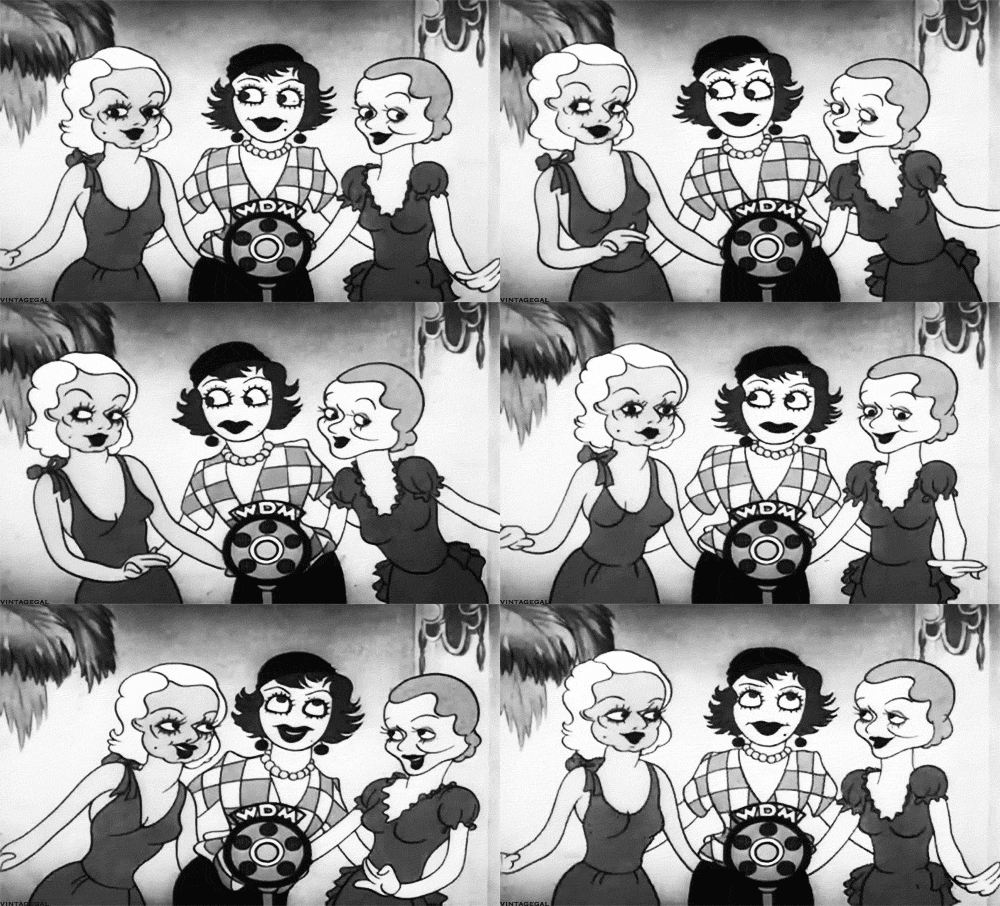
Facing us, Angelique tells Liz that she will be plagued by her obsessions until she dies. This is enough to trigger PTSD flashbacks in regular viewers. Twenty weeks ago, in #477, Angelique was looking at us when she described “The Dream Curse,” an abysmally repetitious, ultimately pointless storyline that dragged on for months. Joan Bennett was a fine actress and a great star, but there was only so much even she could do with a character who just mopes around and talks about death, and Dark Shadows has already made her do it more than once. In a comment on Danny Horn’s post about this episode, I wondered if Angelique couldn’t have cast a spell on Liz that isn’t just a retread of one we’ve seen before, and suggested one that would give her “a compulsion to put on a top hat and tails and sing and dance.” Here’s an animated gif of a cartoon showing Joan Bennett’s sister Constance dancing with Jean Harlow and Joan Crawford; it has more entertainment value than did the entire Dream Curse, and might serve as a consolation to those of us left shaking by Angelique’s threat to clog up the story again:
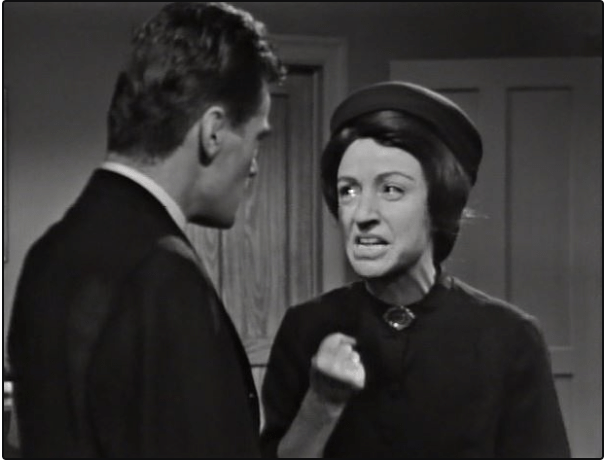
When housekeeper Mrs Johnson was first on Dark Shadows in September 1967, she was hyper-intense, determined to exact vengeance on the ancient and esteemed Collins family for the death of her longtime employer, Bill Malloy. In #69, she told the Collinses’ nemesis, dashing action hero Burke Devlin, that “I believe in signs and omens!” and that the signs and omens she could see showed that reclusive matriarch Elizabeth Collins Stoddard and her family had Bill’s blood on their hands.
“I believe in signs and omens!” Mrs Johnson with Burke Devlin in #69.
As the storyline centered on Bill’s death petered out, Mrs Johnson forgot about her hostility to Liz and her family, and became their devoted retainer. Her new personality was that of a friendly old busybody who kept advancing the plot by blabbing all the information she has to whoever can use it to make the most trouble. Since Mrs Johnson opened the front door to the great house of Collinwood in #211 and admitted Barnabas Collins, she has become an intermittent presence on the show, but Clarice Blackburn plays her with so much style that her occasional appearances are always a highlight.
Today, Mrs Johnson lets suave warlock Nicholas Blair into the house. She informs Nicholas that Liz has escaped from Windcliff, the mental hospital where she has been staying for the last nine and a half weeks. She gets very worked up as she declares that Liz’ aberrations are no ordinary psychiatric problem, but are the product of a hostile supernatural force that plagues the Collinses. Her voice is fearful and she shies away from eye contact with Nicholas, a contrast with the anger and boldness she had shown with Burke Devlin 100 weeks ago, but she again underlines her point with exaggerated hand gestures and facial expressions.
For regular viewers, it is surprising that Nicholas doesn’t seem to have known about the details of Liz’ trouble. His subordinate, the wicked witch known variously as Angelique and Cassandra, had sent Liz mad by placing a spell on her shortly before he arrived on the scene. He’s still keeping Angelique/ Cassandra around his house- he stripped her of her powers, turned her into a vampire, and has been using her to attack various men he wants to silence. You’d think he would at some point have asked her what happened to the lady who owns the town he has settled in. But, evidently his curiosity did not extend that far.
Liz’ brother Roger comes home and invites Nicholas to join him for a brandy. As they are headed for the drawing room, permanent houseguest Julia Hoffman enters. She is pale, unsteady on her feet, and talking with great distress about her inability to find Tom Jennings. Roger points out that Tom is dead, and Julia faints.
Nicholas carries Julia to the couch in the drawing room. While she lies on it unconscious, he sneaks a peek under her scarf and finds bite marks on her neck. Thus he learns that Tom, whom Angelique turned into a vampire at his direction, has been feeding on Julia.
Liz has not been an active part of any major storyline since #272, when it turned out that her belief that she had killed her husband was mistaken and she did not in fact have any terrible secrets to conceal. So Nicholas’ lack of interest in her might just be a sign that he doesn’t want to waste time on irrelevant details. But Julia is indispensable to Nicholas’ plan to found a new race of artificially constructed human beings. She is a medical doctor, and is the only person Nicholas can coerce into building a mate for the Frankenstein’s monster she recently helped bring to life. She hasn’t been able to work on the project since Tom bit her, and apparently won’t be able to resume work until she is freed of his influence. If Nicholas lets his projects get in each other’s way to this extent, one can draw no conclusion other than that he is a bad manager.
Julia recovers and refuses to see a doctor. She goes to bed, and Roger tells Nicholas he thinks Liz might be on the grounds of the estate. The two of them go out to look for her. Of course Liz is there; of course she sees Tom; of course it is only when Roger and Nicholas approach that Tom vanishes and she is spared his bite.
It has been established that Windcliff is about 100 miles north of Collinsport; in #294, the ghost of Sarah Collins performed one of the most stupendous of her many feats when she transported Maggie Evans, The Nicest Girl in Town, from Windcliff to Collinsport on foot in about an hour. Liz has had 24 hours since she went missing from her room, and people used to hitch-hike in those days, so it wouldn’t necessarily have required a supernatural agency to get her home in that time. It still would have been quite a trip for an escaped mental patient to make by herself, without bus fare, as the subject of a state police all points bulletin, on the roads running through the woods of central Maine.
Back in the house, Liz makes it clear that she is not herself when she only gradually recognizes Mrs Johnson. She is also obsessed with a fear of being buried alive. Roger concludes that she has to return to the hospital, and goes off to get the car. Julia comes downstairs, and Mrs Johnson asks her to keep an eye on Liz while she goes off to telephone the hospital.
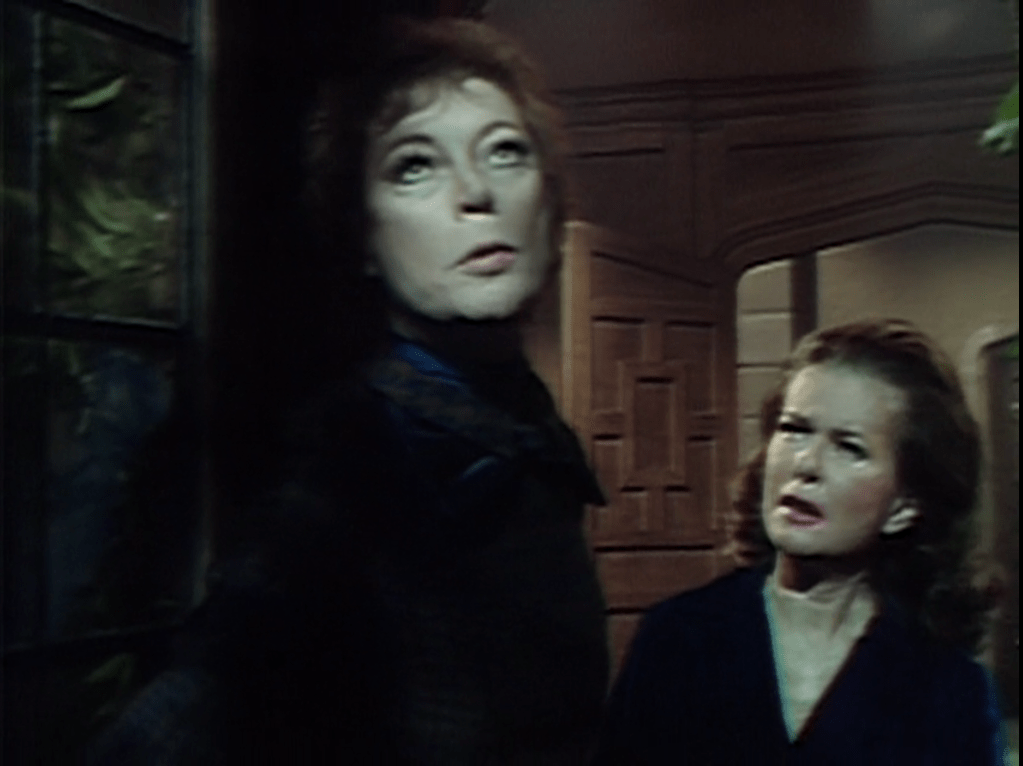
Liz asks Julia, who is the nominal director of Windcliff and a qualified psychiatrist, to examine her and see that she is sane. As she is about to respond, Julia hears dogs howling outside and goes into a trance. She opens the window and stares out into the night, saying that the dogs are calling to her and that she must go to “him.” While she does this, Liz asks her what she’s talking about, but clearly still wants her to serve as the standard of sanity. The first time we saw Liz, in #1, she was standing where Julia stands in this shot, looking out the window with Roger behind her. Liz reprised that pose many times in the first year of the show, and it became her signature. It is incongruous to see Julia in Liz’ customary place as Liz looks on. The whole encounter is so funny that I suspect the humor must have been intentional.
Liz begins to doubt that Julia will be able to help her.
Julia rushes from the house; Liz follows her out. Julia goes to the crypt where Tom’s coffin is kept; evidently Tom’s hunger is getting the better of him, and he has decided to DoorDash it tonight. Liz follows her in. Julia sees Liz and demands that she leave. Liz sees the coffin and asks if it the one in which she will be buried alive. Julia tells her it has nothing to do with her, and repeatedly yells at her to “Get out!” She complies. Tom appears, and opens his mouth to bite Julia.
Julia’s expulsion of Liz from the crypt is an effective turn, but it is also a sad one for longtime viewers. When Dark Shadows started, the presence of Joan Bennett in the cast was probably its single biggest ratings draw, and all the way through her name appears at the beginning of the credits under the word “Starring.” But for a year now, the show’s whole attitude towards Liz has been one of active hostility. They simply will not let her be involved in the action. When Julia shouts “Get out, get out, get out!,” she is speaking with the voice of the story conference.
Danny Horn’s post about this episode on Dark Shadows Every Daydetails how Liz has been pushed to the margins and kept there as the show has evolved. Danny makes a point of not discussing the first 42 weeks, when Liz was enough of a part of the action that Joan Bennett had some chance to show what she could do, but in this post at least he seems to realize that the makers of Dark Shadows were squandering a considerable resource.
In May 1967, seagoing con man Jason had for long months been blackmailing matriarch Liz into letting him stay at the great house of Collinwood. He told Liz that people in the village of Collinsport were starting to talk about the presence of an unmarried man in her house. He informed Liz that they would solve this problem by getting married. She laughed in his face, but he pressed his threats to expose her terrible secret, and they were in the middle of a wedding ceremony when Liz broke down and announced her secret to everyone. It then turned out that there never really was a secret- the whole thing was a sort of misunderstanding. A few days later, Jason was dead, and he hasn’t been mentioned since March 1968.
Today, Liz’ brother Roger shows up at the Old House on the estate, home of their distant cousin Barnabas. He is looking for Julia, a permanent houseguest who settled in at the great house a few weeks after Jason disappeared. Barnabas, a bachelor, tells him that Julia is staying with him for a few days. Roger’s startled response makes it clear that the mores Jason mentioned in #243 have not changed. But Roger is not in a position to insist on propriety, and he has come on an urgent matter. Liz has escaped from Windcliff, the mental hospital of which Julia is the nominal director, and he wants her to come back with him at once to the great house so that she can consult with her staff on the telephone.
Roger is momentarily stunned to learn that Julia is sleeping at Barnabas’ house.
Barnabas tells Roger that Julia is ill and cannot help him. He insists, so Barnabas goes up to her bedroom. Not only does he tell her about Roger and his news, but he also informs her that he earlier found an unpleasant man named Peter who prefers to be called Jeff in the basement. Since the basement houses a lot of technical equipment and a stolen corpse which they are planning to use as material for a Frankenstein’s monster, Julia finds this alarming. But Barnabas has talked Peter/ Jeff into helping them with their little arts & crafts project, and he assures her that he has Peter/ Jeff under control.
Julia is in fact ill, and she tells Barnabas she cannot see Roger. Julia has been bitten by a vampire named Tom. Barnabas, a recovering vampire himself, plans to use her as bait to lure Tom into the bedroom tonight so that he can shoot him with a silver bullet. He explains to her that he took a candlestick to the local silversmith earlier this morning and that the silversmith melted it down and forged five silver bullets. No wonder people are reluctant to leave Collinsport, even much bigger places don’t have same-day service like that.
We cut to the basement, where Julia is wearing her lab coat. Barnabas tells her it is 5 PM. There is no sign they have been working on the project; for all we can tell, they waited around her bedroom all day and decided to get to work shortly before sundown. Peter/ Jeff enters and reports for work. They tell him to work on a particular piece of equipment. Barnabas takes Julia back up to her bedroom, leaving Peter/ Jeff alone with the corpse. Since he was just recruited for the project, this shows a remarkable degree of confidence in his loyalty.
Julia is sitting in a chair and Barnabas is hiding in the closet when Tom materializes. Julia puts herself between Barnabas and Tom, and Tom vanishes. Julia apologizes; Barnabas knows enough about the compulsions that afflict the vampire’s victim that he does not seem to be really upset with her. He frets that they will never have such a good shot at Tom again now that he knows to be on his guard. He looks out the window and thinks he sees Tom on the lawn. He turns, and finds that Julia, too, is gone. He realizes that she must now be alone with Tom.
In his Dark Shadows Daybook post about this episode, Patrick McCray makes some apt remarks about the acting. As Barnabas, Jonathan Frid starts the episode with an unusually self-assured tone in his confrontation with Peter/ Jeff. That’s what the scene calls for, since we need to believe that Barnabas’ force of personality is sufficient to overpower Peter/ Jeff’s aversion to the gruesome project. But it all falls apart about halfway through, when Frid has some line trouble, and as a result we wind up listening to the arguments with which Barnabas defends his position. Patrick doesn’t say anything about those arguments, but on Dark Shadows Every DayDanny Horn does a fine job explaining how utterly unconvincing they are.
Playing Julia as an addict needing a fix, Grayson Hall falls far short of her usual standard, but Patrick doesn’t blame her: “These are the heavy blinking, o-mouthed, head vacillating performances that critics of Hall use against her. I don’t call it bad acting… there’s only so much you can do with a cartoon. But seeing Julia like that is always evidence of a questionable match.” I like the tenderness Barnabas and Julia show each other in their scenes yesterday and today; for me, Barnabas’ earnest concern for Julia and her quiet trust in him outweigh the deficiencies in Frid’s memory for dialogue and Hall’s attempt to show Julia’s weakness. But those deficiencies are impossible to overlook, unfortunately.
This episode features the first appearance on Dark Shadows by an actor of color, and the only speaking part any non-White performer ever had. (CORRECTION: Mr Nakamura, played by Sho Onodera in #903, has a couple of lines.) This fact is made even more depressing because that performer fits so perfectly into the show that a first time viewer would assume she had been a major player from episode #1.
Beverly Hope Atkinson plays an unnamed nurse who meets suave warlock Nicholas Blair when he is trying to make his way into a hospital room occupied by Tom Jennings, a victim of one of Nicholas’ evil schemes. She firmly refuses him admittance. When Maggie Evans, The Nicest Girl in Town, enters and asks to see Tom, the unnamed nurse smiles brightly and says “Of course, Maggie!” in a tone that makes it sound like they’ve been friends all their lives. She then shuts the door before Nicholas can follow. He asks her why Maggie can go in and he cannot, and she tells him sternly that Maggie has permission from the doctor.
I have a fanfic idea about Atkinson’s nurse that I originally posted as a comment on Danny Horn’s Dark Shadows Every Day. I can’t find it there, but here is a copy of it:
In the first 42 weeks of the show, when the supernatural was in the background and the stories were slow, it would have been easy to have a couple of tea party scenes at the Evans cottage where Maggie and her lifelong friend, Unnamed Nurse, recap whatever is going on. Those scenes could have led to a whole exploration of the tension between the working-class people in the village and the jerks in the big house on the hill. That in turn could have led to the introduction of Unnamed Nurse’s family, headed by Unnamed’s parents, Mr and Mrs Nurse, including her brothers, Young Mr Nurse and Master Nurse, and her sister, Moody Miss Nurse. We could then have seen the ancestors of the Nurse family in each of the flashback segments and analogues of them in Parallel Time.
At some point in my musings about this idea, I decided the family should be named “Wilson” (if I had a reason for this, I’ve forgotten it, but I now think of Atkinson’s character as Nurse Wilson,) and that in a flashback segment we should learn that they are descended from free persons of color who settled in Collinsport before the Civil War and were the first proprietors of the Collinsport Inn. Some wicked deed by a member of the Collins family knocked them out of the entrepreneurial class long ago, and they’ve been working their way back up the socio-economic ladder ever since.
We met Maggie in #1 as the waitress at the diner in the Collinsport Inn. She, her late father Sam, and her fiancé, hardworking young fisherman Joe Haskell, have been Dark Shadows‘ main representatives of the people in the village. Her house, the modest counterpoint to the mansions on the Collins family’s great estate, has been familiar to us from the beginning, and is the place where we have seen most vividly what the Collinses’ doings have meant for the people who work for their businesses and live in their town. So, as a frequent visitor there, the nurse could have given a whole new dimension to the drama, showing that it isn’t just one family whose lives hang in the balance, but that a whole community is exposed to the consequences of what happens on the hill.
The Blue Whale
Joe is sitting alone at a table in the Blue Whale tavern, and he looks terrible. He’s pale and fidgety, looking around and periodically jumping up to peek out the window.
Maggie comes in and joins Joe. At first she is angry with him- he stood her up last night, without so much as a telephone call. She sees how upset he is and her anger is mixed with worry. He pounds on the table while the camera is tight on her. Her startled reaction reminds us of the early months of the show, when Sam was a self-pitying drunk and Maggie was a sophisticated portrait of an Adult Child of an Alcoholic.
After that moment, Maggie gets very quiet. When Joe says with alarm that it is getting dark, she responds that “It usually does, at this time of day.” It’s inherently funny to hear someone make that kind of matter-of-fact statement in response to an inexplicably intense remark, but also poignant to those of us who remember Maggie’s early interactions with Sam. From childhood on, simple rationality must have seemed to Maggie like a joke in the face of the overpowering irrationality at the center of her life.
As it happens, Joe is indeed exhibiting addicted behavior. But he isn’t hooked on alcohol. Instead, he is under the power of a vampire. Angelique, who was once the wicked witch who first made Barnabas Collins a vampire, found herself reduced to bloodsucker status when she displeased Nicholas. At Nicholas’ direction, she bit Joe the other day, and now Joe is desperate to hear her summons and report for another bite. She does call, and he does dash out, leaving a bewildered Maggie behind.
It was at the Blue Whale that we first met Joe, back in #3. Then, he was an upstanding young man who indignantly rejected the attempts of one of the Collins family’s sworn enemies to bribe him into spying against them. We’ve seen him in the tavern many times since then, always as the doughty representative of the wholesome and intelligible world against the sinister and supernatural. For example, in #215 it was a deeply troubled Joe who brought the news to Maggie and others at the Blue Whale that the cows on his uncle’s farm had been somehow drained of blood, news which turned out to be the first sign of vampirism in the area. This is the first time we’ve seen the Blue Whale since #358, back in November, and the first time a scene has closed with the formerly very familiar Blue Whale jukebox dance tunes in even longer than that. Longtime viewers see a loop closing. Joe leaves the place where he has most often shown himself as one who dwells in the daylight and goes down to the deepest dark.
Once Joe is gone, Nicholas enters. He engages Maggie in conversation, and talks his way into the seat Joe vacated. Soon he is doing magic tricks for her and she is agreeing to have dinner with him. He brings up the idea of staying out all night, and she seems amenable. Where is her old friend the nurse when you need her?
The Fix
Joe lets himself into Nicholas’ house, a place by the sea that he is renting from the Collinses. Angelique is there. Joe laments his dependency on her, and asks if she was the one who attacked Tom, whom he identifies as his cousin. Perhaps the son of the uncle whose cows fell victim to Barnabas long ago! She doesn’t bother to deny it. She tells him that they will both visit Tom tonight. She bites Joe.
Joe visits Tom, who has emerged from the coma in which Angelique’s first bite left him. He tells Joe all about Angelique’s attack on him. He says he knows how bizarre the story sounds, but that he hopes that if he has Joe to vouch for him he will be able to make the police take it seriously. Joe gives Tom a few perfunctory assurances, then opens the window. Joe explains that he is doing this because it is hot in the room. Tom does not agree that it is hot, but Joe insists, and Tom is too ill to argue long.
Joe leaves, and we jump forward to 2 AM. The window is still open- apparently no nurse was on duty. Perhaps the hospital thought Beverly Hope Atkinson’s character did such a good job on the day shift that the patients could just cruise along through the night. We hear a bat squeaking, and Angelique appears. She bites Tom.
In Barnabas’ first weeks on Dark Shadows, the show made heavy use of the idea that vampires can enter a lodging only when they have been invited. For example, he went to the diner after hours so that Maggie would have to invite him in, and later went to her house and stood just outside the front door for a noticeably long time before she explicitly asked him to enter. They haven’t done anything with that idea in a long time, but neither have they very clearly contradicted it. Perhaps Joe’s opening of the window is the invitation Angelique needs to make her way into the hospital.
Suave warlock Nicholas is studying a mirror in his parlor. His subordinate, vampire Angelique, enters and comments on his vanity. He invites her to look at the mirror and tell him what she sees. “Only your reflection,” she replies. But the audience also sees the reflection of her hair and forehead. Her line, coupled with the fact that we do not see her whole face, suggests that her reflection was not supposed to be visible. In #288 the idea that vampires do not cast reflections was a crucial plot point. When old world gentleman Barnabas was a vampire, he several times cast the sorts of reflection Angelique casts today, usually as the result of Jonathan Frid missing his mark. Perhaps Lara Parker simply took half a step too many in this scene.
Nicholas’ mirror is no simple reflector. It functions as a closed circuit TV. He uses it to show Angelique the room in the attic where well-meaning governess Vicki is being held prisoner. He lets Vicki go, casts a spell to cause her to forget her captivity, and then tells Angelique that he will be going out.
Angelique asks what she is supposed to do while he is gone- sit in her chair and get bored? He says he couldn’t have put it better himself. When he returns, she is in fact in the chair, sitting still. It’s hilarious that she doesn’t pace, or get a book, or try to see if the mirror gets any other channels.
Nicholas was away visiting Maggie, The Nicest Girl in Town, on whom he has a crush. Maggie’s fiancé Joe dropped in while he was at her house. He tells Angelique that Joe is to be the next victim of her vampire’s bite.
Act One consists of recovering vampire Barnabas and mad scientist Julia standing around Barnabas’ front parlor recapping various ongoing storylines.
Danny Horn devotes his post about this episode to a detailed analysis of this scene. He shows that Jonathan Frid’s performance and Grayson Hall’s are open to many objections. They fall short in such technical categories as “knowing their lines” and “standing on their marks” and “having the slightest idea what is going on.” But they are fascinating to watch nonetheless. Danny declares that “[t]he point of these scenes is to see how long two adults can stand around in a room saying preposterous things to each other.” Frid and Hall operate at such a high level of tension that the prospect of either of them breaking character generates enough suspense to keep us on the edge of our seats.
Patrick McCray wrote two separate posts about this episode. In the one that went live 13 September 2017, he too focuses on the performances in Act One. He writes:
Poor Jonathan Frid. He must have had a rough night. I am usually oblivious to his infamous (and completely understandable) line trouble, but in this one, it is so palpable that I totally understand why he retired from TV after DARK SHADOWS left the air. In his early dialogue with Grayson Hall, you can see sheer terror in the eyes of both performers as Barnabas haltingly recalls a trip to the hospital. This is followed by the “Frid Surge,” where Barnabas becomes far more committed and energetic when he turns to face the teleprompter. Of course, this gives him that great sense of vulnerability that was the secret to Barnabas’ success.
This is the only post on the Collinsport Historical Society tagged “Frid Surge”; that’s too bad, I’d like to see that phenomenon tracked throughout the series. I should also mention that Patrick goes on in this post to express his “confidence that Frid could have acted the doors off the collected ensemble had the poor guy just been given another frickin day to study his sides.”
Barnabas and Julia’s recap scene ends when an unexpected visitor barges in. He is an unpleasant man named Peter, who prefers to be called Jeff. Peter/ Jeff is fiancé to well-meaning governess Vicki, whom Barnabas and Julia know to have been abducted by Frankenstein’s monster Adam. Adam came to Barnabas’ house yesterday and threatened to kill Vicki unless Barnabas and Julia created a mate for him.
Peter/ Jeff was assistant to Eric Lang, the mad scientist who created Adam, and he knows that Barnabas and Julia were connected to the experiment. He does not know for sure that Adam is Lang’s creation, that Barnabas and Julia brought Adam to life after Lang’s death, or that Adam has abducted Vicki. He does, however, have grounds to suspect that each of these things might be true. In this scene, he announces his suspicions to Barnabas and Julia. They huddle in one corner of the room while he shouts his lines in his singularly irritating voice. They deny all three of his points. One of the commenters on Danny’s post, “Straker,” summed up their reaction admirably:
Frid and Hall were too professional to show it but I sensed they were both annoyed when Roger Davis marched in and started yelling. It’s kind of like how you feel when you’re at a party and the host’s five year old son throws a tantrum. Sort of an embarrassed tolerance.
Comment left by “Straker” at 6:21 am Pacific time 31 July 2020 on “Episode 557: A Race of Monsters,” by Danny Horn, Dark Shadows Every Day, 1 January 2015
Roger Davis as Peter/ Jeff, in one of the most subtle moments of his performance. Screenshot by Dark Shadows Before I Die.
After Peter/ Jeff’s scene, it is Barnabas’ turn to be an unwelcome guest. He calls on occult expert Timothy Eliot Stokes. Barnabas and Julia suspect that Stokes may be the evil mastermind who has turned the previously gentle Adam toward evil plans. When Stokes hears Barnabas knocking on his door, he looks up and rasps to himself “Go away… No one is home…” This is one of my favorite lines in the whole series. Stokes was quite cheerful when he first involved himself in the strange goings-on, but as he has found himself drawn deeper and deeper into the unholy world of Collinsport he has come to regret his decisions.
Stokes is quite impatient with Barnabas’ demands that he tell him what he knows and his refusal to reciprocate with information about himself. It is only because Vicki is in danger that Stokes tells Barnabas anything at all.
Stokes already knows how Adam came into being, and Barnabas tells him about Adam’s conversation with him. This brings up a question about the scene with Peter/ Jeff. Why couldn’t Barnabas and Julia have trusted Peter/ Jeff with as much information as Barnabas here gives Stokes? Peter/ Jeff can no more go to the police than Stokes can, he will not tell Vicki anything about Lang’s experiment, and Barnabas and Julia have no reason to suspect him of being behind Adam’s turn to evil. These questions don’t come to mind during the scene with Peter/ Jeff, partly because he is so disagreeable a presence that we want him off screen as soon as possible, and partly because it has long been Barnabas’ habit to tell his enemies everything he knows while he zealously guards his secrets from potential helpers.
Patrick McCray’s second post about this episode, published 30 July 2018, includes an analysis of Thayer David’s portrayal of Stokes:
Professor Eliot Stokes gains fascinating dimension in 557. Normally, jovial and helpful, we see his protectiveness of Adam reveal an irascible and sternly just man within. Anton LaVey extolled “responsibility to the responsible,” and there are few other places where Barnabas gets both barrels of that. Stokes is perhaps the most inherently good man in Collinsport since his fellow freemason, Bill Malloy, took his last diving lesson. (Ironically, at the hands of Thayer David’s first character.) Stokes’ prime reason for siding with Adam and not Barnabas? The former vampire and Julia have withheld vital information for months. Yes, they have necessary trust issues, but this is Stokes we’re talking about. Adam may be a wildly unpredictable man-beast, capable of leveling Collinsport to sand before breakfast, but he’s also (until later in the episode) a prime graduate of Rousseau’s Finishing School for Noble Savages. He’s nursed greedily on the milk of morality that spurts abundantly from the ripe and straining teat of of Eliot Stokes’ moral tutelage. It takes a Nicholas Blair — so often Stokes’ foil — to teach him the less savory lessons in humanity. Stokes knows that there’s only so much danger in which Adam can find himself… Victoria Winters is another matter.
Barnabas passes the baton to Stokes, who becomes the third character in the episode to pay an unwelcome visit. He goes to Adam. He asks the big guy who has taught him to be cruel and amoral, and gets nothing but lies in return. He tries to persuade him that he must not hurt an innocent person, and Adam angrily declares that it is “fair” for him to make Barnabas watch him kill Vicki if Barnabas will not make a mate for him.
In Patrick McCray’s 2017 post, he praises Robert Rodan’s performance as Adam:
Robert Rodan issues a highly cerebral, emotionally packed performance. Rodan never receives the credit he deserves. Much of Adam’s stint on the show finds him equipped with an eloquent, even sesquipedalian command of the language. His inner conflict is as existential as it gets… Where do you turn? Rodan balances this absurd chimera of conflicts with effortless aplomb that makes Cirque du Soleil look as clumsy as a Matt Helm fight scene.
Robert Rodan is an unsung hero of an actor, delivering his existential angst with passion and truth. It’s a shame that his identification with an eventually unpopular character was probably a factor in Rodan not being recycled by Dan Curtis, despite being the dark-haired, blue-eyed “type” that typified the ruggedly handsome, DS norm (such as Selby, Lacy, Crothers, George, Ryan, Prentice, Storm, Bain, etc.)
While I always found the sight of Conrad Bain a guarantee of a fine performance, I can’t say it ever occurred to me to class him as “ruggedly handsome” in the way that one might class the other men Patrick lists. There’s no accounting for taste, I suppose.