The reigning chief villain on Dark Shadows is a shape-shifting monster from beyond space and time. He refuses to shift his shape, since he likes being a tall young man. He isn’t interested in any part of space or time not connected with heiress Carolyn Collins Stoddard, with whom he has fallen in love. He can’t persuade anyone to call him by his preferred name, “Jabe,” so has resigned himself to going by “Jeb.”
As we open, Jabe is raising four men from the dead. That he can do such a thing might suggest that he is a formidable menace, but the introductory voiceover explains that he has no choice about it, since he is “unable to trust one living human being.” Whatever powers he may have, Jabe is surrounded by enemies whom he can battle only by resorting to the most desperate means. We are left wondering how much longer the show can keep the storyline going if it depends on such a feeble menace.
Jabe and one of the zombies are peeking through the window of the Old House on the estate of Collinwood, home to vampire Barnabas Collins, a distant cousin of Carolyn’s. Jabe sees Barnabas’ best friend, mad scientist Julia Hoffman, giving him an injection. He realizes that Julia is trying to treat Barnabas’ vampirism.
Jabe goes to the great house on the estate and orders Carolyn’s mother, matriarch Elizabeth Collins Stoddard, to keep watch over Barnabas’ blood thrall Megan Todd. Liz is one of Jabe’s few remaining followers. He is crude and abusive towards her; she protests that they are in her house, and when he responds to this with a sneer she gives him a look of disbelief. First-time viewers can understand how Jabe came to be so isolated.
When Barnabas was first on the show, from April 1967 to March 1968, Liz never figured out that he was a vampire. The show depended on keeping Liz in the dark about Barnabas’ curse, because she was too civic-minded to let him stay in a house on her estate if she had known that he was an abomination risen from the depths of Hell to prey upon the living, even if he was her cousin. In those days, the show seemed determined to keep Liz on the shelf lest she be stained by contact with the main story, and so they took care to give Barnabas’ adversaries reasons to keep from telling Liz about him.
Now, Liz is under the control of the forces Jabe represents. She is already hostile to Barnabas, and has told Jabe she would try to evict him from Collinwood if that is what he wants her to do. Jabe does not have any reason to withhold from her the fact that his enemy is a vampire.
Moreover, Liz is no longer the symbol of lawful goodness she was two years ago. In #956, she told eleven year old Amy Jennings that she hoped Jabe wouldn’t murder Maggie Evans, The Nicest Girl in Town. Her first reason for not wanting this to happen was that it would remind people of the other murders Jabe has committed. The second, and more important, was that it would tend to exonerate the person they have framed to keep the heat off Jabe. It seems likely that Jabe will soon defeated and Liz will be released from the spell under which she has been laboring, but if she comes out of that remembering what Barnabas is she will also remember that she herself is complicit in some pretty serious felonies, all of them well-known to Barnabas. Since Liz knows that Barnabas is invested in her position in the community and puts a high priority on protecting it, the show wouldn’t have a hard time explaining why she keeps him around, and she would be available to take part in whatever stories they might have going.
Liz is sitting with Megan. She can see that Megan is ill and goes to fetch her a glass of water. When she returns, Megan has gone. We see Megan at Barnabas’ house. Barnabas is intensely hungry. But he does not want to bite her. He knows that if he does so, she will die. She insists, and he gives in.
Julia enters and pronounces Megan dead. Barnabas is in a panic; he had earlier lied when Julia asked him if he had bitten anyone, and he flies directly into hysteria, accusing Julia of implying that he acted deliberately. She keeps her cool and assures him she does not see it that way. Usually Julia’s quickness to make excuses for Barnabas’ murders is an opportunity for Grayson Hall to amaze us with the spectacle of a brilliant woman rationalizing the behavior of a hopelessly evil man, but this scene is a showcase for Jonathan Frid. So they have taken care to establish that Barnabas was overpowered by the need for blood and have shown him taking steps to avoid biting Megan, allowing us to take Julia’s behavior more seriously and focus on Barnabas’ panic.
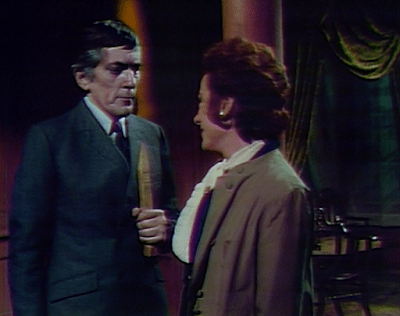
Barnabas tells Julia that to prevent Megan rising as a vampire they will have to drive a wooden stake through her heart. Previously Barnabas has simply strangled his victims or broken their necks after they died, and that has kept them from coming back. He did this as recently as #951, when he fed on Jabe’s would-be devotee Nelle Gunston. Regular viewers will know that the trip he and Julia make to the basement to fetch a stake is just a setup for them to return and find Megan already gone. Before that happens, there is a strange moment when Barnabas and Julia have the stake and are talking about driving it through Megan’s heart. Barnabas wants to spare Julia that horror, but she smiles warmly as if assuring him that it is her pleasure to join in the act.
Jabe dispatches his four zombie henchmen into the great house, saying that he has given them their orders and now it is time to “Carry them out!” Julia lives in the great house, and is working with some test tubes in her bedroom. It’s the first time we’ve seen Julia’s room in years, and the first time we have seen scientific apparatus of any kind there. One of the zombies knocks on her door, another emerges from behind the curtains, and a third comes up and slaps her in the face. Perhaps remembering Jabe’s words as he sent them into the house, they carry her out.
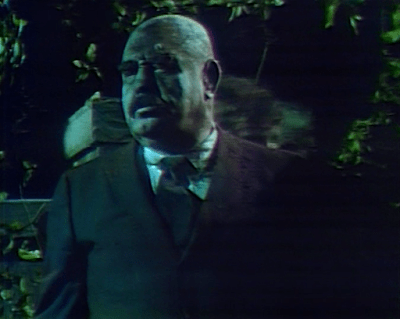
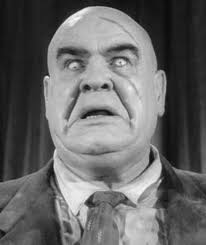
One of the zombies is named Thomas Findley. Longtime viewers will remember Madame Janet Findley, a psychic who made a big impression in three episodes in December 1968, and Margaret Findley, who was one of the ghostly Widows who were prominent in the show’s supernatural back-world in its first 26 weeks. Another zombie is a large bald man who will remind many viewers of Tor Johnson in Plan 9 from Outer Space.
Danny Horn’s post about this one at his great Dark Shadows Every Day is a fascinating comparison of the episode with four issues of Gold Key’s Dark Shadows comic book. Other commentators have mentioned that the graveyard scenes often evoke the sensibility of EC Comics, particularly in the character of The Caretaker, but Danny’s in-depth discussion of what this episode has in common with those four issues is far and away the most substantive analysis I have seen of the overlap between the visual grammar of Dark Shadows and that of comic books.
The chief villain on Dark Shadows at the moment is a shape-shifting monster from beyond space and time who has decided the only shape he is interested in assuming is that of a tall young man. When he first appeared in this form, the monster asked people to “Call me Jabe.” Jabe is supposed to seize control of the Earth and eradicate the human race, but he couldn’t even get people to comply with this simple request. He’s been answering to “Jeb” for weeks now.
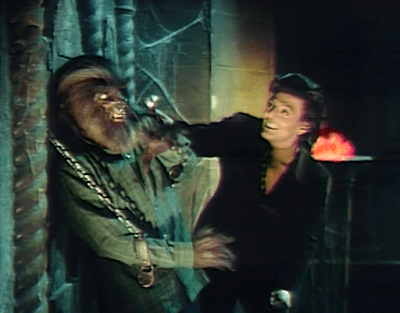
Several of Jabe’s followers, people who were completely down with the part about exterminating all humans, have found that his personality is just too much to put up with. Some of these are trying to destroy him. One of Jabe’s followers-turned-aspiring-assassins is a crazed sadist known only as Bruno. Yesterday, Bruno trapped Jabe with a werewolf, a creature to whom Jabe is vulnerable. Jabe escapes from the werewolf and confronts Bruno about his attempt to murder him.
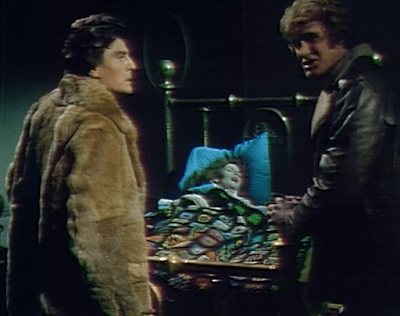
Jabe is unconvinced by Bruno’s paper-thin excuses, but is shocked when Bruno tells him that Megan Todd, who was once Jabe’s foster mother and his most devoted follower, has been bitten by vampire Barnabas Collins and is now helping Barnabas in his own battle against Jabe. When Jabe finds a sleeping Megan calling out for Barnabas to summon her and sees the bite marks on her neck, he blames himself. Barnabas, too, used to be one of Jabe’s followers, and when he turned against him Jabe made him a vampire. He refuses to let Bruno kill Megan, and instead puts him in charge of keeping her away from Barnabas.
Regular viewers would likely not have been surprised that Jabe survived yesterday’s closing cliffhanger- once he is gone, the current story will end, and they don’t yet have anything ready to go when that happens. But we would have expected Jabe to kill Bruno. That he not only does not do this, but keeps him around, shows just how precarious Jabe’s position has become. He is surrounded by enemies, many of whom know all of his secrets, and several of whom have supernatural powers. His grip on his few remaining allies is uncertain, and he does not seem to have the tactical sense to use his own powers effectively. So the writers have to slow the story way down to keep from running out of road.
Meanwhile, the werewolf is prowling through the woods. He meets his great-grandfather, Quentin Collins. It was a curse Quentin brought on himself that made him and his male descendants werewolves. The same magic spell that put Quentin’s own lycanthropy into remission immunized him against aging. The werewolf recognizes Quentin as one of his own kind and won’t attack him. When the sun comes up, the werewolf collapses and reverts to the form of Chris Jennings, who resembles his great-grandfather in that each of them is twenty-nine years old.
Quentin tells Chris that he wants to help him; Chris says that he ought to, since it’s his fault that he’s a werewolf. Quentin doesn’t have anything to say to that, nor is he willing to give Chris the help he asks for, which is immediate death. He asks Chris what he remembers; he says that the night before, Bruno was holding him prisoner, aided by the reanimated corpse of Sheriff Davenport. Chris wonders if he killed Bruno.
Quentin and Chris go to the old crypt where Bruno and Zombie Davenport had kept Chris. They find the shredded remains of Davenport’s defiled corpse, but no trace of Bruno. Quentin tells Chris that he didn’t kill any living person, that he only returned to death something that had already died, and rightly so. He advises Chris to avoid zombies from now on. When we heard Quentin offer this great-grandfatherly guidance, Mrs Acilius laughed out loud- what does Quentin think, that Chris spends his nights hanging out at the zombie bar?
It turns out Chris will have more trouble following great-granddad’s counsel than he might have thought. At the end, Jabe stands in a cemetery, by a row of four fresh graves of men each of whom died in his thirties, and prays to the “god of the Underworld” to raise them so that he can use them to kill five other people and send their souls his way forever. Whichever god he reaches apparently likes the terms of this deal, because a hand pops up through the dirt.
This post is something of a private milestone for me. I was inspired to blog about Dark Shadows by Danny Horn’s great Dark Shadows Every Day.As the title would suggest, Danny’s original idea was to post about an episode a day, but as he went his posts got to be more and more ambitious and less and less frequent. He posted a review of #1170 in October 2019, then gave up altogether for several months, not posting again until July 2020. Danny started with #210; since the makers of the show skipped some episode numbers, #1170 was the 946th episode he had covered. I started at the beginning, so #962 is my 947th episode.
My project is in no way comparable to Danny’s. I have his blog to consult, as well as other fine sites, especially John and Christine Scoleri’s Dark Shadows Before I Die, while he was usually the first to review the episodes he dealt with. And my posts are nothing like as ambitious as were his. So, if I have only a few stray remarks to make about an episode, I just make those remarks and call it a day. In that situation, Danny would write a detailed review of a novel or a board game or something else related to the show, or analyze an historical event connected with it, or compose a stunning prose poem, then append his remarks about the episode as a postscript. But modest as my aims are, I’m still haunted by the fear that I’ll run out of steam, so it’s reassuring to me that I’ve maintained daily posting beyond the point at which he took his long hiatus.
I have my eye on a couple of upcoming Danny-derived benchmarks. He posted about a total of 1018 episodes; I’ll reach that number with #1033 on 10 June. And of course #1170 itself has a cursed aura, I’ll be glad to get beyond that. Once I do, I’ll probably be counting down by percentages until I reach the end of the series with #1245 in April 2027.
After April 2027, I plan to review the feature film Night of Dark Shadows* in a post to go up on the 56th anniversary of its release, 3 August 2027, and Tim Burton’s 2012 film Dark Shadows at some point thereafter. I’m leaning towards reviewing the series that aired on NBC in primetime in 1991 and the pilot that Dan Curtis shot for the WB network in 2004. If I do write about those things, the posts will go up sometime after the one about Night of Dark Shadows and before the one about the Tim Burton movie. I probably won’t cover any of the novels or comic books or newspaper strips or other spinoffs. I did review Dan Curtis’ TV movie of Frankenstein on a preemption day in 2024, and if I review any of his other standalone adaptations of material that Dark Shadows mined it will be on upcoming preemption days, not as posts that appear after I’ve finished the original series.
*House of Dark Shadows was released 28 October 1970, while the show was still on. My post about it should go live on 28 October 2026, the same day as the one about #1132.
The Leviathan People, a race of Elder Gods, are planning to retake the Earth from humanity. Like all stories of Elder Gods, this one raises the question of why they lost the Earth in the first place. The answer seems to be clear. The first Leviathan to manifest himself is a shape-shifting monster who spends most of his time in the form of a tall young man who, when we were introduced to him, asked to be called “Jabe.” No one would call him that, so he settled for “Jeb.” The Leviathans have assembled a cult of people to serve them; Jabe’s personality has alienated many of them already, and seems likely to alienate more.
Among the ex-followers who were glad to join a plot to exterminate homo sapiens but who found Jabe too obnoxious to stomach are vampire Barnabas Collins and a crazed sadist known only as Bruno. Jabe’s onetime foster mother, Megan Todd, lost her allegiance to the Leviathans after Barnabas bit and enslaved her. Since Barnabas’ current bout of vampirism is the result of a curse Jabe placed on him during a tantrum, the cult’s loss of Megan is another strike against Jabe.
The Leviathans have two principal vulnerabilities. They can be destroyed by ghosts or by werewolves. Since they have chosen to start their campaign on the great estate of Collinwood, which is the world capital of both ghosts and werewolves, this would suggest that they are as bad at strategic planning as Jabe is at team-building.
Bruno has captured the current werewolf and lures Jabe to him. He also discovers that Megan is Barnabas’ blood thrall. Everything else today is filler, but it does give the actors a chance to show off. Bruno beats the werewolf with a whip to ensure that he will be angry enough “to rip a man to shreds!” He’s a werewolf, the whole idea is that he’s already disposed to rip anyone he meets to shreds, but as Bruno Michael Stroka puts so much zest into the whipping scene that we forget how ridiculous the furry rig Alex Stevens is wearing looks and feels sorry for the poor widdle doggie.
Barnabas summons Megan to his house and gives her some instructions that don’t make sense and that she won’t have the chance to follow. While she is there, she says she just wants him to suck her blood. He does. Marie Wallace plays Megan in this scene as if she is having a sexy dream.
Bruno left the late Sheriff Davenport, whom Jabe killed and then brought back as a zombie slave, to guard the werewolf. To keep the zombie from getting in the way of his plan to use the werewolf against Jabe, he tricks him into letting the werewolf destroy him. Davenport is the most garrulous zombie of all time; in his first postmortem appearance, when Jabe set him to hold prisoner Maggie Evans, The Nicest Girl in Town, Davenport rambled on and on about everything he saw and heard, at one point launching into an explanation of some things his wife used to do that annoyed him. Today he has to argue with Bruno, demanding to know whether he has authorization from Jabe to leave the werewolf alive and giving his opinion that it isn’t a good idea to take too much initiative. Ed Riley does as much as anyone could to overcome the ludicrous overwriting of his part. No one could make a chatterbox like Zombie Davenport seem like a partially reanimated corpse, but when he isn’t saddled with excessive dialogue Riley manages to create the impression that he is at least somewhat weird. It’s too bad he won’t be back.
When Dark Shadows began in June 1966, its most dangerous villain was high-born ne’er-do-well Roger Collins. Roger had squandered his half of the Collins family’s wealth and put his sister, the reclusive Elizabeth Collins Stoddard, in a difficult position by selling his half of the family business to support his extravagant lifestyle. He now worked in the business as Liz’ employee and, with his son, strange and troubled boy David, lived in Liz’ house as her guest. Roger schemed to cover up his past crimes, and was quite willing to add murder to them if that was the only way to preserve his cushy circumstances.
As played by Louis Edmonds, Roger was too much fun to be killed off as the original story bible foresaw. The show had not in those early days committed itself to the all-villain cast that has come to define it, so they decided that they could keep Roger around only by nerfing him. He became a sardonic gay uncle, amusing, lovable, and harmless. He has been on the margins for years now, often absent for long periods. When Dark Shadows turned to time travel and began to feature extended costume drama inserts, they could make use of Edmonds’ talents by casting him as other characters. His turn as haughty patriarch Joshua Collins made him the star of the 1790s segment that ran from November 1967 to March 1968, and as the stuffy Edward Collins he was among the highlights of the 1897 segment that took up most of 1969. Now that the show has returned to contemporary dress, Edmonds is Roger again, and he is the same afterthought he has been for so long.
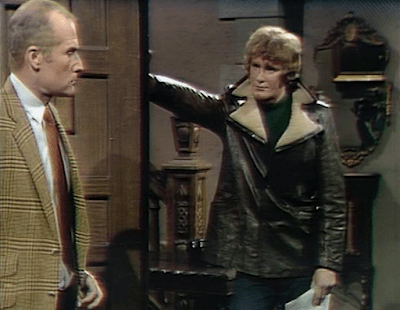
Today, a villain who introduced himself as Jabe but whom everyone calls Jeb walks into the house. Roger hears him, and protests that it is customary to knock. Jabe says that Liz gave him the run of the place, and tells Roger he has come to visit David. Roger forbids him to see David; Jabe says there is nothing he can do to stop him, and he goes upstairs to David’s room.
Roger picks up the phone and calls his distant cousin Quentin Collins. He tells Quentin he isn’t going to put up with any more of Jabe’s insolence, and that he doesn’t care how dangerous he is. He hangs up, and finds Jabe standing in front of him. Jabe asks if he is wondering how much he heard. Roger says that he doesn’t care if he heard all of it, that he wants him to leave the house at once. Jabe says that if it was Quentin he was talking to, he knows more about him than he had assumed. He also tells Roger that nothing Quentin may have told him about him and his associates was an exaggeration. If Roger defies them, he and everyone he loves will pay a terrible price.
When Roger was a villain, they sometimes made him sympathetic by having dashing action hero Burke Devlin threaten to take over the house and start ordering him around. Later, Liz was being blackmailed by seagoing con man Jason McGuire, who when he reached the zenith of his power acted like he owned the house and tried to order Roger around. Burke eventually peaced out, and Jason’s scheme led to his own death not long after he got openly aggressive towards Roger in the drawing room. So longtime viewers will look at this scene and find a reason to believe that Jabe’s menace is approaching its peak.
Jabe’s henchman Bruno has captured Chris Jennings, who is a werewolf. He has locked Chris up in the tomb of the Stockbridges, an old Collinsport family who are in a way related to Roger’s ex-wife. The full Moon will be rising tonight, and Bruno has chained Chris to a wall in the tomb. He has set the world’s most talkative zombie to guard Chris. The zombie was in life a law enforcement officer known as “Sheriff Davenport.” When Jabe raised him from the dead, we saw that his gravestone read “Sheriff Davenport,” so apparently “Sheriff” was his given name. Bruno gave Sheriff a revolver loaded with silver bullets and ordered him to shoot Chris if he started transforming.
Bruno went to Jabe to report that he had captured the werewolf. Before he could get a word out about that, Jabe was berating him about other matters. Jabe wound up hitting Bruno, then twisted his arm until he said that Jabe was born to lead and he was born to follow. After that, Bruno decided that he wouldn’t have Sheriff kill the werewolf after all. Rather, he would sic the werewolf on Jabe.
Jabe’s intolerable personality keeps alienating followers, and he has assembled an array of adversaries including not only people like Bruno who know all of his secrets, but also a vampire, a wicked witch, a mad scientist, and a man with a Dorian Gray-like magical portrait that gives him an immunity to physical harm. On top of all that, we saw yesterday and today that a ghost is after Jabe, and that Jabe is especially vulnerable to ghosts. Add the werewolf to that force, and it seems Roger will be sipping his brandy in peace any day now.
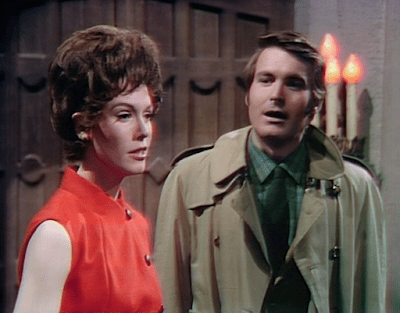
Heiress Carolyn Collins Stoddard talks her friend Sabrina Stuart into wearing a wig over her prematurely gray hair. Sabrina’s ex-fiancé Chris Jennings sees Sabrina with the wig and is suddenly attracted to her again. Sabrina knows that Chris is a werewolf. She disregards both Chris’ lycanthropy and the fact that he is more interested in her wig than in her and starts talking to him about renewing their engagement.
A villain named Bruno has evil plans for the werewolf. He knows that the werewolf is a man who is close to Sabrina, and when he sees her with Chris he realizes it is him. At the end of the episode, he abducts Chris at gunpoint.
The residents of the estate of Collinwood are divided. Matriarch Elizabeth Collins Stoddard, her nephew David Collins, and their distant cousin, eleven year old Amy Jennings, have been brought under the power of the Leviathan People, an unseen race of Elder Gods who mean to retake the Earth from humankind. Liz has invited the harbinger of the Leviathans, a shape-shifting monster who in his human form is a young man who once revealed he wanted to be known as Jabe, to live in the carriage house on the estate. Jabe’s onetime foster mother Megan Todd is living as Liz’ guest in the main house.
The main house is also home to mad scientist Julia Hoffman and governess Maggie Evans, who have ranged themselves against the Leviathans. Yesterday Jabe was about to kill Maggie when he saw something outside Collinwood’s Tower Room that scared him off. Wanting to know what it was Jabe was afraid of, Julia went to the scene to investigate, and found Jabe lurking there. Before he could attack her, the mysterious presence returned, and Jabe ran off. Today, we see the presence- it is a dark shadow. It makes perfect sense that a reminder of which show he is on would terrify Jabe. The writers keep painting his character into a corner so that he won’t be able to continue once the current storyline ends.
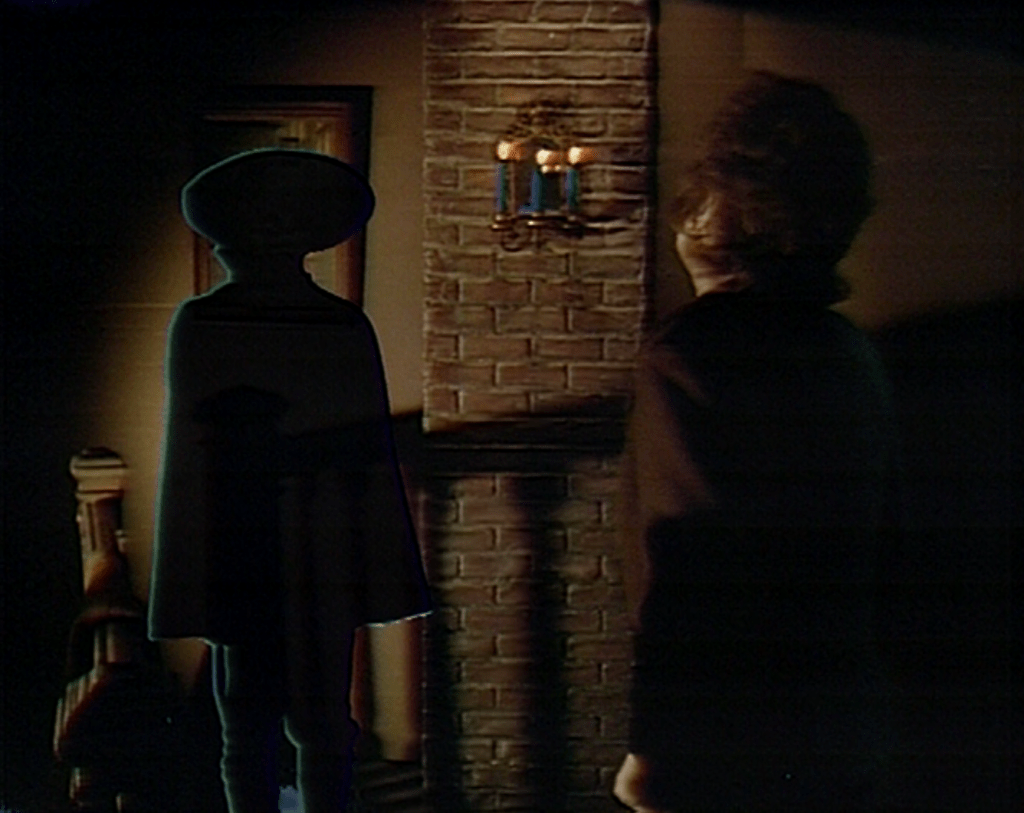
The shadow appears to be that of a slim man wearing a comically oversized hat and a cape. The only character who dressed that way was painter Charles Delaware Tate. Tate was killed by a werewolf in #922. It seems unlikely that Tate’s ghost would haunt Jabe, since werewolves and Leviathans are each other’s implacable enemies. Granted, the Leviathans are also hostile to humans, but Tate was always something of a post-humanist himself. For a while he had magical powers that he used to blur the boundary between humans and their portraits, and in his later years he tried to replace himself with a robot. Besides, Tate was always such a jerk to every individual person he met that it is difficult to imagine him taking much trouble to defend humanity in the mass.
Jabe has murdered three people so far. He raised one of these, Sheriff Davenport, from the dead. He made Davenport into a peculiarly garrulous zombie and forced him to do his bidding. I don’t know of any stories where the same person manifests after death as both a zombie and a ghost, but then I’m no expert on tales of the supernatural. So I guess the shade could be Davenport’s.
Jabe also murdered Paul Stoddard, Liz’ ex-husband and father of her daughter Carolyn. Last week Jabe was afraid Paul’s ghost would come after him, so he dug his body up and burned it. Today we hear that the village of Collinsport is buzzing with talk about the fact that Paul’s body went missing. So Paul is a possibility. The third victim, Maine state police investigator Lawrence Guthrie, was a one-time character. It would seem a bit late to start developing him now.
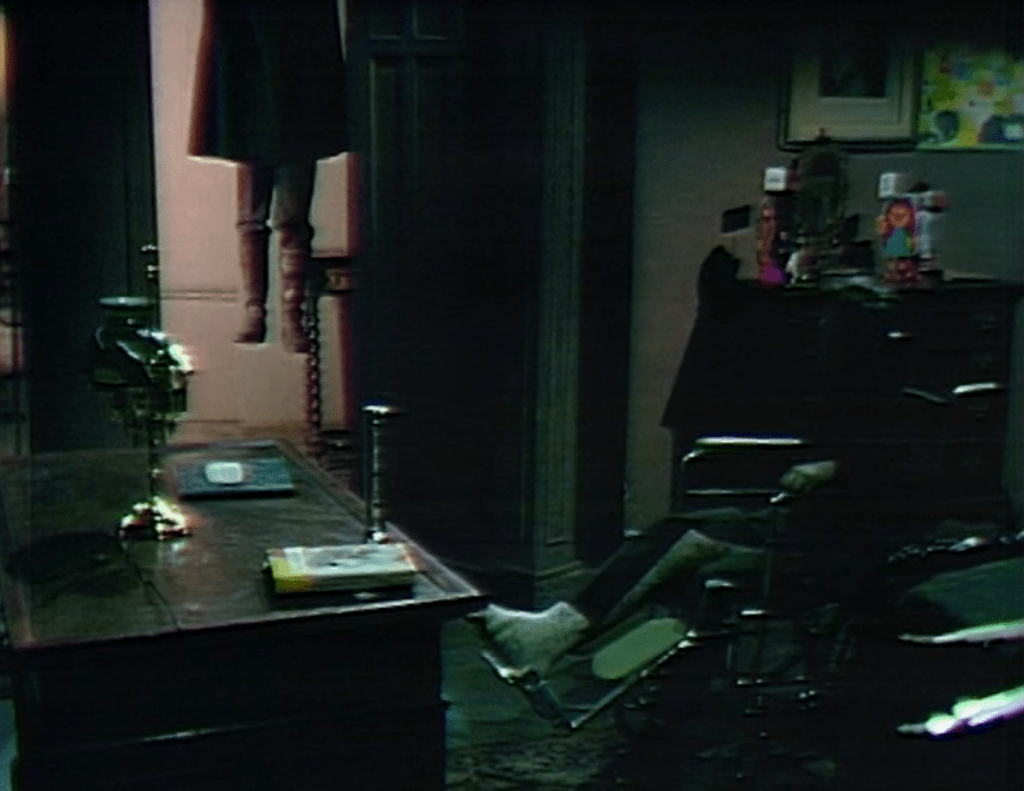
At the end of the episode, the ghost appears to David in the form of a man hanging from the ceiling. We get a clear look at the ghost’s trouser legs and boots. This rules out, not only Davenport, Paul, and Guthrie, but almost all characters from the parts of Dark Shadows set in contemporary times. The only women who have worn trousers were Carolyn, in a couple of 1966 episodes, and Megan. Both of them are still alive. The only man who wore boots was motorcycle enthusiast Buzz, who dated Carolyn for a little while in 1967. Those longtime viewers who remember Buzz might be amused if it were to turn out that he was the Leviathans’ mightiest foe.
This episode also features Roger Collins, who is Liz’ brother and David’s father. Roger meets his distant cousin Quentin Collins. From December 1968 to September 1969, Quentin was a ghost who haunted Collinwood, rendering the place uninhabitable and killing David. There was a time travel story going on for most of that period, and in September 1897 events played out differently than they had the first time through. The result of that difference was that Quentin did not die. The haunting broke and David came back to life on the anniversary of the change. Some magic spells cast on him have kept Quentin alive and apparently twenty nine years old ever since, but the haunting still happened and Roger’s memory of it gives him a shock when he sees the living Quentin. He quickly composes himself; he has already heard of Quentin’s claim to be his own great-grandson, and accepts it cheerfully.
Amy is Quentin’s actual great-granddaughter, and she is not so easily persuaded. Both as a living being in the 1890s and as a ghost in the 1960s, Quentin was obsessed with a phonograph recording of a sickly little waltz and inflicted endless replays of it on the residents of Collinwood. While Quentin and Roger are chatting in the drawing room, she starts playing the waltz. Amy asks Quentin if he likes it. He zones out, and after a long interval declares that he likes it very much. She says she is going to play it again, and Roger forbids her.
Amy says she doesn’t have anything to do. Roger puts his hand on her shoulder, tells her that the house is full of good books, and marches her off to find one. I had remembered this scene with David as the one Roger takes to the library, and moreover had remembered it as their last scene together. When the show started, Roger was a villain and David was a budding psychopath, so it would have been touching to end their story on this note of loving paternal firmness.
Later, Amy goes upstairs to David’s room. David has for several weeks been using a wheelchair because of a broken leg, but it hasn’t occurred to anyone to move him to one of the vacant rooms on the first floor. She tells him about Quentin, and he tells her to get the sacred book of the Leviathan people from its hiding place on the top shelf of his bookcase. They search the book for guidance. Just as they find something promising, they feel a ghostly chill. The book flies off David’s desk and bursts into flames. The ghost has done its work; David observes that “The chill is gone.”
David keeps ordering Amy around the whole time they are on together. This is quite a change from the beginning of Amy’s time on the show, in the early days of Quentin’s haunting, when they bickered like an old married couple and took turns being the one in charge. Since then, Amy has been in steep decline, absent from the cast and unmentioned for months at a time. Indeed, today is the last episode in which Denise Nickerson will appear only as Amy Jennings. Amy will make two brief appearances in upcoming episodes where Nickerson plays another character, but this is the end of the road for her as a significant presence on the show. She started so strong and Nickerson was so talented that it is very sad to see her go like this. The chill is gone, baby.
Roger doesn’t know about the Leviathans, but he has caught on that something very strange is going on. He goes to the Old House on the estate, home to his distant cousin Barnabas Collins. He finds Quentin there. Quentin tells him Barnabas is not in. Roger tells Quentin about the strange goings-on, and Quentin says that he can explain them. He warns Roger that the knowledge he is about to impart to him will put him in deadly jeopardy.
Once Roger has heard the story, he says he wants to take David and flee. Quentin tells him this will not work- the Leviathans will kill both of them if they try it. All they can do is fight them. Roger is unconvinced of their chances, but does not have a better idea.
Roger was one of the last characters to hold out against the evidence that the show had become a supernatural thriller. Even after he was forced to accept that he was up against uncanny forces of evil, he would snap back to “Surely there is a logical explanation!” mode the minute the danger had passed. That changed when Quentin’s ghost forced the family out of the main house in #694. When he accepts Quentin’s story today, we can see that it will no longer be Roger’s function to slow the story down. That is good news and bad news- Dark Shadows long had too many speed bumps, and like all of Louis Edmonds’ characters, Roger is too delightful to be related to such a lowly rank. But not since he ceased to be a villain in #201 have the writers come up with anything else for him to do. We may be losing Roger altogether before much longer.
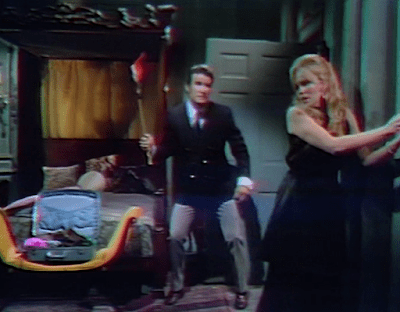
A woman is in a bedroom, packing a bag. A man bursts in with a flaming torch. She exclaims:
Sky, what are you doing?
SKY: I wanted it to work out. I really wanted you to be with me, and I’m sorry you can’t. Goodbye Angelique.
Sky then charges at Angelique with the torch, and we break for the opening title. When we return, Angelique is dodging the flames and they are quarreling. She takes a statuette and tightens a cloth around its neck. Sky begins choking. Angelique orders him to put the torch in the fireplace. He does. She continues tightening the cloth, and he collapses. The actions combine with the eerie music on the soundtrack to tell us that Angelique is casting a spell on Sky. Angelique kneels over Sky and talks about how their marriage was all wrong from the beginning. She takes on a calm tone while allowing that they are equally at fault really; “We both kept from each other our darkest secrets.” She tells Sky she really did love him and wishes it could have worked out between them. All the while she delivers this speech in her mature, thoughtful voice, she is pulling the cloth ever tighter, apparently strangling Sky to death.
We cut to a terrace, where a sinister looking man is silently calling for someone named Maggie to come to him. A young woman comes and tells the sinister looking man she felt she had to come to that spot. She is Maggie, and she calls him Barnabas. She says he doesn’t look like himself, and asks if he has been ill. He is distressed at her questions. She says that sometimes he seems very warm, and other times it seems she doesn’t know him at all. He gives her a ring, and tells her it is very dear to him and a token of their deep friendship. They embrace. He looks at her neck and opens his mouth. His canines are unusually long. A young man calls out a sharp “Excuse me!”
The young man marches up, addresses Maggie as “Miss Evans,” and apologizes for interrupting the moment. He insists on talking with Barnabas alone. When Maggie Evans has left them, the young man sternly observes that “I don’t have to ask what would have happened if I hadn’t arrived when I did.” He tells Barnabas that he must stay away from Maggie, because “In your present state you can only hurt her, you know that.” He says that it is almost sunup. Because someone named “Julia” has been unable to locate someone named “Willie,” he will accompany Barnabas home and will spend the day there.
We cut to the young man dozing in a chair. He is awakened by a knock at the door. He answers it, and finds Angelique. He reacts to the sight of her with shock. She greets him with “Well, don’t just stand there, Quentin. Kiss me.” After a commercial break, she repeats the command. Quentin gives a tiny smooch to a spot of air a few inches in front of Angelique’s lips, prompting her to remark that “You never meant it before, but you used to do a lot better than that.”
Angelique tells Quentin that since they last saw each other, “We’re both a great deal older, and I hope one of us at least is wiser.” Neither of them looks to be much more than 30, so one might assume that by “a great deal older” she means that they are in very different stages of life than they were in the few years of their separation. Quentin tells Angelique that “Barnabas said you hadn’t grown any older, and he was right.” She responds that he also looks exactly the same as when last they met. Since we saw in the first scene that Angelique has the power to cast magic spells, this exchange raises the possibility that they may be much older than they look.
Quentin wonders why Angelique has come back. She says “Oh, Quentin, don’t look so apprehensive. Actually, I came here hoping that I’d be able to see Barnabas, that I’d be in time, but obviously, I’m not.” Quentin guardedly asks “What do you mean obviously?” She says that she knows what has happened. Barnabas went to her house the previous evening and told her that her husband had betrayed him to someone called “Jeb Hawkes.”
Quentin is startled to hear this about Sky. Angelique explains. “Barnabas has told you all about the Leviathans, hasn’t he?… Sky was one of them, before I met him. I left him tonight and I’m never going back to him.” Whatever the Leviathans are, it seems genuinely to sadden Quentin that Angelique found out she had unknowingly married one. He asks if there is anything he can do to help her.
Angelique tells him there is nothing he can do. She goes on to explain: “The truth is my interest in you in the past was never more than a device intended to upset Barnabas. I was very good at devices, always have been. Perhaps, in spite of my feelings for Sky, Barnabas has always been my one true love.” Since Quentin was so unhappy to see Angelique and she told him that his kisses were never sincere, it is not too surprising that this confession does not seem to wound his ego in any way. He tells her that he is sorry it is too late for her to see Barnabas, and he sounds like he means it. He is quick to agree when she says she wants to spend the day in the house, and he suggests she take a nap in an upstairs bedroom.
Angelique says that “It feels good to be back in this house.” She reminisces about a time when she lived there and was happy. She says “I’ll sleep in Ang-… I’ll sleep in Josette’s room.” It sounds like the name she checked herself partway through saying was her own. Since she did live there, it would make sense that there would be a room that others would call “Angelique’s room,” but she does not refer to herself in the third person at any other point in the episode, so we are left wondering if the actress just slipped.
The next scene takes place in the same room. Again Quentin is by himself, this time reading the newspaper. Again he is disturbed by a knock on the front door. He gets up, mutters “All right,” and opens it. To our surprise, he finds Sky. It had looked like Angelique killed Sky in the first act, but here he is, without so much as a frog in his throat to show that he was strangled nearly to death this morning.
Sky tells Quentin that he believes his wife is in the house, and asks if he may come in. Quentin says that he would of course let him in if his wife were there, and before he can deny that she is, Angelique comes downstairs. Quentin asks Angelique if she wants him to stay; she says he can go.
Sky tells Angelique that he has spent the day with someone named “Nicholas Blair.” This Nicholas told him all of Angelique’s secrets. Angelique says Nicholas would have done better to tell Sky about her “before you almost got yourself killed.” Sky ignores this and says that things haven’t really changed between them- he still loves her. She points out that just a few hours ago, she had to choke him out to stop him killing her, not a common event in happy marriages. He says that Nicholas has agreed to let them live together if “you become one of us.” Evidently Nicholas, too, is a “Leviathan,” and is inviting Angelique to become one. She rejects this, saying that she wants nothing to do with Nicholas or the Leviathans and would be interested in Sky only if he broke free of them. They part.
Barnabas enters, a tense expression on his face. He tells Angelique that Quentin told him she was there. Angelique praises Quentin for his kindness and understanding and tells Barnabas that he was right about everything. Calling herself a fool, she says that what has happened to him is her fault. She thought she could trust Sky with Barnabas’ secret, and it was Sky’s betrayal that brought his current misfortune upon Barnabas.
Barnabas relaxes, and tells Angelique that she didn’t hurt him deliberately. She concedes this point, but says that she did do so “the first time.” He says that was long ago and is best forgotten. She embraces him, then says that it is “ironic, how it happened in the same identical way.” The more she talks about whatever it is she is referring to, the more visibly uncomfortable Barnabas grows. Finally she says that maybe this means that “we could become closer friends than we were before… Perhaps it means that we can start again. Start at the beginning as we did the first time.” That’s too much for him, and he turns away from her. She keeps going on about how they are “both outcasts,” and he looks like he wants to run screaming into the night.
She mentions Nicholas, and suddenly Barnabas’ eyes are fixed on her again. She hadn’t known he hadn’t known Nicholas was involved. He declares that he must tell Maggie that Nicholas has returned, because when Nicholas was around before he tried to kill Maggie. Barnabas tells Angelique to wait for him, and rushes out to tell Maggie about the new danger she is in. Angelique gives snippy responses to each mention of Maggie’s name, and looks jealous when Barnabas leaves.
Back on the terrace, Barnabas tells Maggie about Nicholas in a quiet, urgent voice. She assures him she knows how to take care of herself. He tells her that “you mean far too much to me” for him to be happy when she is in the kind of danger Nicholas represents. We see Angelique eavesdropping from the shadows, fuming.
In the next scene, Angelique is still on the terrace, still eavesdropping, but Maggie is inside the house with Quentin. They address each other as “Miss Evans” and “Mr Collins.” Quentin Collins is urging Maggie to stay away from Barnabas “for your own good and for his.” He tells her that “the people he was involved with” are “out to kill him,” and that “if they know you are seeing him, they may do it through you,” by using her as the bait for a trap. Maggie will not agree to stop seeing Barnabas.
At this confirmation that Maggie and Barnabas have been “seeing each other,” Angelique turns to the camera. “You asked if there was any way you could help me, Quentin. Well, there is. Only, you’ll never be aware of it. I am what I was and what I shall always be. I call upon the powers of darkness to help me once again. Make a flame where there was no flame before and let that flame transmit the power of love to those who look into it.” The fireplace in the room where Maggie and Quentin are talking to each other flares up and they look into it. Angelique does some more spellcasting, and all of a sudden Maggie and Quentin are calling each other by their first names, embracing, and talking about their mad love for each other. They look at their hands and notice each of them now sports a trident-shaped symbol that had not been there before.
What a Longtime Viewer Might See
Barnabas’ trouble, unspecified in today’s dialogue, is that the Leviathans have turned him back into what he was from the 1790s until March 1968, a vampire. Barnabas was one of the pop culture crazes of the 1960s, and Dark Shadows was known to millions who never saw a second of the show as the soap opera with a vampire. So even first time viewers were unlikely to need an explanation. But not mentioning it will bring fond memories back for some longtime fans, since Barnabas had been on the show for 40 weeks before the word “vampire” was uttered.
Maggie is the governess to the children at the great house of Collinwood. In 1967, Barnabas abducted her, tortured her, and tried to erase her personality and replace it with that of his lost love Josette. Her memory of that experience has been wiped several times, once by Nicholas, and now she thinks Barnabas is just peachy. They’ve been getting very cozy for the last several weeks. The ring that he gives her today is Josette’s.
Considering their past, it’s pretty weird Barnabas has a shot with Maggie, but it wouldn’t be any less weird if Angelique had a shot with Barnabas. Not only did she kill him and raise him from the dead as a vampire, she was also responsible for the deaths of the people he cared most about, including Josette, his mother, and his little sister. Her approach to him today reminds us that they have so much in common that it often seems as if Barnabas were not only cursed by Angelique, but possessed by her.
Maggie’s predecessor as governess was the well-meaning Victoria Winters. Vicki was Dark Shadows‘ original audience identification character, and drove most of the action in the 42 weeks before Barnabas debuted in April 1967. When Barnabas replaced Vicki as the show’s big attraction, she kept putting herself in situations where it would be difficult for him not to bite her. It was as if Vicki knew that she was a character on a show of which Barnabas was the star, and she was working to establish herself in the A story. The terrace set made its first appearance in one of those situations, in #299. Vicki hugs Barnabas and moves her neck as close as she can get it to his fangs, before a friend shows up and interrupts him, pushing Vicki back out of the plot. Quentin’s interruption brings that scene back to the minds of those who saw that episode.
Angelique and Quentin got to know each other when Barnabas had traveled back in time to 1897 and the show was, for eight months in 1969, a costume drama set in that year. By the end of that period, she was as monomaniacally fixated on Quentin as she had previously been on Barnabas. She didn’t even care that Barnabas was off chasing another woman. So we might wonder if she is putting on a brave face when she tells Quentin that she merely used him as a means of getting Barnabas’ attention.
From November 1967 to March 1968, Dark Shadows was set in the 1790s. That segment introduced Angelique as the witch who first made Barnabas a vampire. The spell she casts on Maggie and Quentin today is identical to one she cast on Josette and Barnabas’ uncle Jeremiah in 1795, right down to the tridents on their hands. Since Maggie and Josette are both played by Kathryn Leigh Scott, the connection will be hard for longtime viewers to miss.
First time viewers might be puzzled by Maggie and Quentin’s protestations that their attraction to one another does not make sense. Even if Maggie has been “seeing” Barnabas, she and Quentin are such a gorgeous pair of young people that it would be weird if they didn’t get together sooner or later. But those who saw #691 will remember that at that point, Quentin was a ghost who tried to strangle Maggie. During the 1897 storyline, history was changed so that Quentin didn’t die, but after the manner of time on Dark Shadows that difference only took effect on the anniversary of the event. The haunting still took place, and Maggie and the others affected by it remember vividly what Quentin’s ghost did.
The Leviathan People are an unseen race of Elder Gods who want to displace humankind and retake the Earth. To that end, they have assembled a secret cult of people who are under their control.
One of the most fervently devoted cultists is Megan Todd. Megan is standing on the terrace of the great house of Collinwood. Old world gentleman Barnabas Collins, former leader of the cult, appears. Megan tells Barnabas he is a traitor to the Leviathans. Barnabas tells her he is more than that- he has become a vampire. He bites Megan, breaking the Leviathans’ grip on her and taking her into his own power.
In the 1790s, Barnabas was briefly married to a wicked witch named Angelique. It was Angelique who, in those days, first made him a vampire. She has mellowed considerably since then. She has renounced the use of her powers and is living on an island off the coast of central Maine with her husband, a businessman named Sky Rumson. Barnabas turns up in Angelique’s bedroom and tells her that the Leviathans have made him a vampire again. He also tells her that Sky was the one who tipped off the Leviathans that he had become disaffected from the cult. She does not want to believe this.
Sky introduces Angelique to a man named Nicholas Blair. Sky tells Angelique that Nicholas is responsible for all his success. Angelique and Nicholas are surprised to see each other. He was her boss when she was working in Satan’s upper New England operation, back in 1968. Later, Sky will confirm to Angelique that he is a member of the Leviathan cult, and will tell her that his dearest wish is that she should also join it.
While Angelique is in her room packing to leave, Nicholas tells Sky that she cannot become a member of the cult, and gives him a flaming torch to use to kill her. Sky says that he really loves Angelique and doesn’t want to comply. Nicholas insists. We cut to Angelique. Sky bursts in, the torch in his hand, not noticeably shorter than it was when Nicholas gave him his orders. Evidently it didn’t take long for him to pick a side.
Dark Shadows never explicitly used the bit of lore that says vampires cannot cross flowing water, so I don’t suppose we can say it was an inconsistency for them to have Barnabas get himself onto an island and back to the mainland. I’m a bit disappointed they didn’t incorporate it into the story- it’s a familiar bit, and Angelique is so powerful that if she and Barnabas are going to be on the same side they need to put as many obstacles between them as they can to keep the suspense going. Otherwise she can just turn all of his adversaries into toadstools.
For most of 1968, Dark Shadows was a shapeless mess. The makers of the show had caught on that the audience liked monsters, so they kept tossing one monster after another into the mix, hoping to repeat the popular success they had had with vampire Barnabas Collins the year before. One of the storylines that ended up disappointing this hope most completely was that centering on 6’4″ Frankenstein’s monster Adam; another was the “Dream Curse” that was supposed to revive Barnabas’ vampirism after it had been put into remission by the mad scientists who created Adam.
Suave warlock Nicholas Blair was on the show in those days. Nicholas appeared to be a regional manager for Satan’s operations in upper New England. He found out about Adam and came up with the idea of using him as the progenitor of a new species that would displace humankind and win the Earth for his master. Adam met heiress Carolyn Collins Stoddard and fell hard for her. He also developed an interest in the writings of Sigmund Freud. But he never clicked with the audience, and Nicholas’ plan didn’t make any sense in the context of the show. So the plan flopped and Nicholas was called to the main office. He’s back today.
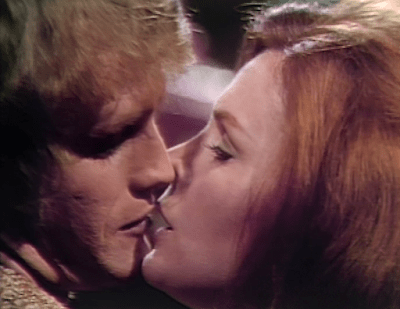
The A story for the last fourteen weeks has been the effort of the Leviathan People, a race of Elder Gods, to use a 6’4″ shape-shifting monster as the progenitor of a new species that will displace humankind and win the Earth for them. The monster, who once invited people to call him Jabe, met Carolyn and fell hard for her. The Leviathans want Jabe to take Carolyn as his bride and turn her into a creature like himself, but he would rather be human and take Carolyn out on dates. Jabe isn’t the reader Adam was. Adam might be interested in Jabe’s current projects, though. When he was growing into his adult form, Jabe’s foster parents were antique dealers Philip and Megan Todd. He has now arranged to kill Philip, and as we open today he is passionately kissing Megan.
The door opens, and Nicholas enters. He tells Jabe that he is his boss, and that the Leviathan takeover of the Earth was his idea. It is the same idea that didn’t work last time he was on the show, and when he tells Jabe that he failed that time he adds that he does not intend to be punished for failing again.
Nicholas bullies Jabe into going to his room and turning into the inhuman monster he really is. Henchman Bruno shows up to consult with Nicholas while Jabe is in the room. Nicholas tells Bruno it is his responsibility to see to it that Jabe doesn’t kill anyone else. Nicholas leaves, and Bruno goes into Jabe’s room. Less than a minute after Nicholas told him to keep Jabe from further killing, Bruno is standing before the monster, apparently about to be killed.
Bruno manages to get out of the room alive. Jabe returns to human form and follows him. Bruno gasps that Jabe was going to kill him. Jabe replies that he wasn’t, “it was.” Adam might have found significance in this remark. One of Freud’s central concepts was a division between the ego (from the Latin pronoun equivalent to the English “I”) and the id (from the Latin for “it.”) People repress their unacceptable urges and attribute them to something separate from themselves. So, I don’t want to kill my father and marry my mother, it does. Bruno tells Jabe that in the room, he is “it,” and moreover that he himself, as a devotee of the Leviathans, wants to become something like “it.” Evidently the Leviathans’ promise to their followers is that they will replace their ambiguous and divided personalities with pure unreasoning id.
Jabe tells Bruno that he wants to be human. Bruno is horrified by this, commanding “Don’t even say that!” Indeed, Nicholas had said that for the Leviathan People, wanting to be human is the ultimate sin. That suggests a backstory which, if developed, might make the Leviathans scarier than they are. All tales of Elder Gods who want to take the Earth back raise the question of how they lost it in the first place. If our remote ancestors figured out a way to take it from them, surely we, who can learn everything they knew and add to it knowledge they lacked, will be able to prevail against them at least as easily.
But if it was envy of early humans that wrecked the Leviathan world order, a couple of possibilities open up. It could be that some of them defected to join us, so that their final defeat was mostly a struggle between Leviathans with our forebears as helpless on-lookers. In that case, it would remain to be seen whether humans could beat Leviathans. It could also be that the Leviathans who joined the human side have descendants among humans today, and that some of those descendants are vulnerable to co-optation by the Leviathans who are trying to reclaim their former position. There is a hint today that this might turn out to be the case- Bruno asks Nicholas why the estate of Collinwood is so important, and Nicholas, looking uncomfortable, tells him that there is a reason, but that he cannot explain it. Perhaps the members of the Collins family have some Leviathan blood that makes them at once receptive to the appeals of their estranged kinfolk and peculiarly dangerous to them if they are antagonized.
Nicholas is a logical choice to represent the idea that the greatest weakness of the Leviathan People is the temptation to become human. At the zenith of his power in 1968, he would reprove his subordinate Angelique for her romantic feelings for Barnabas, sneering that they made her “so human.” His downfall began when he fell in love with Maggie Evans, The Nicest Girl in Town, and found himself being humanized. So if Jabe is going to meet his doom because his desire for Carolyn makes him renounce his Leviathan form, he is going to remind longtime viewers of Nicholas, and we may as well have Nicholas on the show.
They may have had another reason to want Humbert Allen Astredo back in the cast. Lara Parker used to say that none of her acting lessons really took, and that it was only when Astredo would explain various techniques to her between rehearsals of their scenes as Nicholas and Angelique in 1968 that it all finally clicked for her. I’m sure Parker was exaggerating to make a self-deprecating joke, but it is undeniably true that her performances improved greatly after she had been working with Astredo for a while. So maybe the producers were hoping that some of the less experienced actors in the cast would benefit from time with this outstanding teacher.
The Dream Curse involved more than a dozen repetitions of a sequence over a period of months while one character after another had the same basic nightmare. The sequence involved opening a bunch of doors and seeing enigmatic images. Each time another character had the dream a little bit was added. At the end, it turned out that the curse was not able to renew Barnabas’ vampirism, so there was no point to any of it. For some reason, this did not go over very well with the fans.
Lately, Carolyn has been having a recurring nightmare. We see it for the third time today. The first time she had it, Jabe told her all about himself, and she saw that he had killed someone. Not too long after she woke up, her distant cousin Quentin came by and told her that Jabe had murdered her father Paul. The next time she went to sleep, she had the dream again, and it was clearer that Paul was one of the people Jabe had murdered. This time she even opens Paul’s coffin. She can’t figure out what the dream means. Too bad Adam isn’t around, by now he must have read Freud’s Interpretation of Dreams and enough of the case studies to apply his technique. If she told him the dream, he would be able to explain to her that the dream means that she is an hysterical female who needs to keep coming to him at least twice a week.
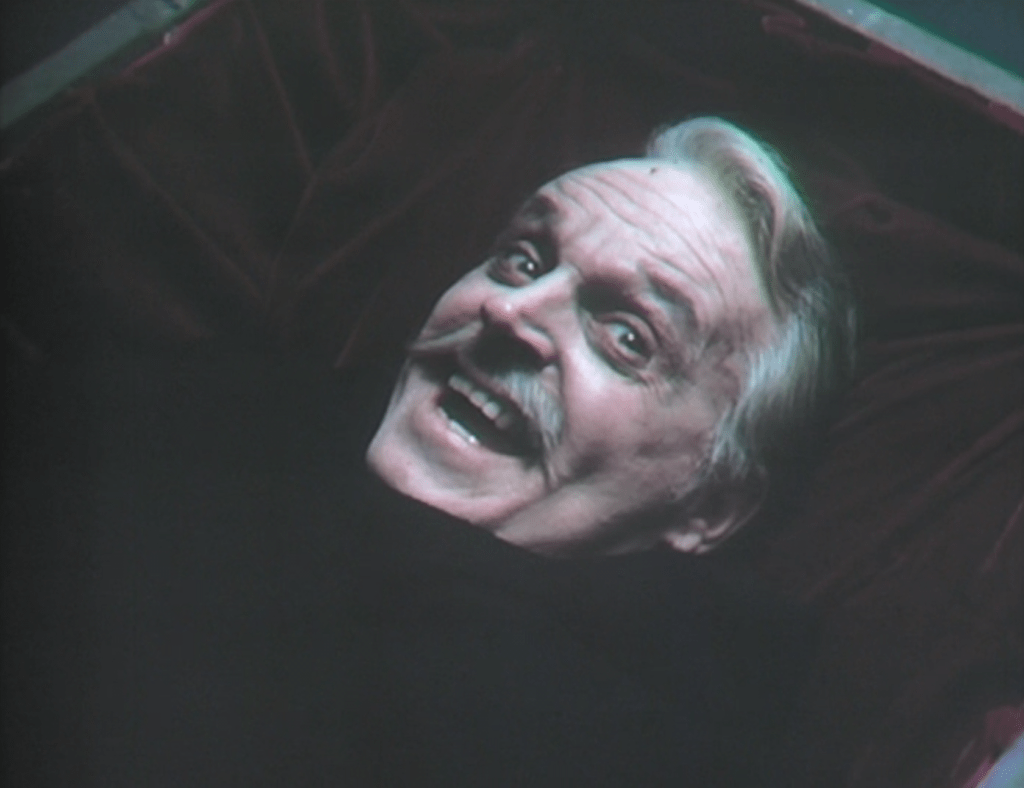
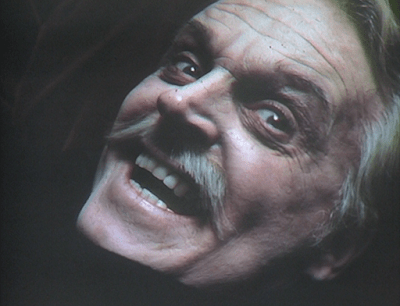
Jabe visits Carolyn, who tells him all about the dream. Not being trained in psychoanalysis, Jabe doesn’t tell her about her unresolved Electra complex or even send her a bill. He just rushes out to exhume Paul’s coffin. This leads to one of the most extraordinary images in Dark Shadows. They wanted to show that Paul’s body was there, but actor Dennis Patrick was by this time in California, producing and taking a role in the movie Joe. So they superimpose a photo of Patrick’s face on a still of a plush-lined box. The resulting image defies all description:
I’d remembered this as an image they flashed on the screen for a moment, but no, they hold it for quite a while. And then they go in for a closeup! Which is the last thing we see before the credits roll!
An old friend of mine has a brother who was hung up on Dark Shadows for a while, he apparently got the DVDs and watched them obsessively for months. When I told him that I was writing this blog, he claimed that this picture of Paul was the only thing he remembered about the show. I can believe it, really. I often try to figure out what they were thinking when they put the episodes together; as you can see with my speculation above about how the Leviathans lost the power they used to have over the Earth, sometimes I resort to some fairly elaborate fanfic to try to puzzle it out. But why they believed it was appropriate to put this image on national television, let alone to linger over it, cut back to it in closeup, and leave it as the climactic episode-ender, that stumps me completely.
We are in the fourteenth week of a story about the Leviathan People, a race of Elder Gods who are planning to retake the Earth from humankind. At first, old world gentleman Barnabas Collins was a zealous acolyte of the Leviathans and the faithful leader of a cult devoted to their service. The first chapter of the story came to an end when a shape-shifting monster from beyond space and time, the harbinger of the Leviathans’ return, ordered Barnabas to kill his best friend, mad scientist Julia Hoffman. Barnabas refused that order and became disaffected from the cult, held in line only by the Leviathans’ threats.
The shape-shifting monster has grown, and now spends most of his time as a young man whom everyone calls Jeb, despite his initial request to be called Jabe. Barnabas learned the other day that some of the threats the Leviathans had been making were empty, and so tried to smash a small wooden box that is important to them. Jabe stopped him, and punished the attempt by turning Barnabas back into what he was from the 1790s until 1968, a vampire.
Jabe’s home is a room above an antique shop owned by cultists Megan and Philip Todd. There is a lot of talk about this room as the only place where Jabe can change form. This is confusing to regular viewers. We saw him change from boy to girl while visiting the great house of Collinwood in #909, and in #946 and #947 he changed from his true, non-human, form into Jabe while at a house on an island many miles from the village of Collinsport. Today, Barnabas burns the antique shop down in order to destroy the room; Jabe says that he left the room through the window when the fire started, and changed from his true form into his human shape while outside. I keep trying to give them the benefit of the doubt about this, but at this point the whole theme of the “Chosen Room” falls apart completely.
Nonetheless, the antique shop sets and the troubled relationship between Philip and Megan have been signatures of the Leviathan story so far. Now the shop is gone, and Megan is gleeful that Philip is in jail, having confessed to three murders Jabe committed and unlikely ever to live with her again. So we can say that chapter two of the Leviathan story is over.
Barnabas’ re-vamping marks a transition in more than this storyline. He is the central character of the show and its main attraction; whether or not he is a vampire determines a great deal about what kind of show it is. You could periodize the show into segments depending on whether he is a vampire or not. I’ll risk a spoiler and tell you we have now begun a long segment of Barnabas-as-vampire.
Barnabas goes to the jail and has a conference with Philip. Jabe overtaxed Philip’s allegiance to the Leviathans, as he overtaxed Barnabas’. Philip has confessed to Jabe’s murders only because he loves Megan, believes she still loves him, and fears that if he does not do what Jabe commands he will kill Megan. Barnabas tells him that in fact Megan no longer cares about him at all, but is entirely devoted to Jabe.
In the real world, the state of Maine did away with capital punishment in 1887, a fact which applied to the universe of Dark Shadows in 1966. In #101, high-born ne’er-do-well Roger Collins disappointed his son, strange and troubled boy David, by mentioning it. But the prospect of a gallows is more melodramatic than is that of any prison sentence, however long, and so Philip announces that he is going to be hanged for Jabe’s murders.
Matriarch Elizabeth Collins Stoddard, owner of the great estate of Collinwood and of the businesses that employ most of the people in and around the village of Collinsport, is a devoted member of the Leviathan cult. Liz gives Jabe the carriage house on the estate to live in, telling him its back room will be suited to take the place of the now-destroyed Chosen Room. He tells her that Barnabas has betrayed the cult, but that she need not act against him yet. The carriage house was mentioned a few times in 1969, when Dark Shadows was a costume drama set in 1897 and the Collinses were still traveling by carriage. I believe this is our first confirmation that the carriage house still exists in the twentieth century.
Megan comes to visit Jabe at the carriage house. She is exultant that Philip is in jail. Jabe tells her he has no intention of resuming his true form; she is appalled. The plan has been that he will take Liz’ daughter Carolyn as his bride, and that she will then turn into the same kind of being he is. If he is going to be humanoid all the time, then he will just be taking Carolyn out on dates. Megan says that this was not the point. Jabe dismisses her objections, and tells her that their own relationship is different now than it was when he was first taking shape and she and Philip were his foster parents. He pulls her close to him and gives her a passionate kiss.
Jabe spent several weeks in the form of a succession of children. The children showed violent hostility towards Philip and remarkably little sense of boundaries in their relationship with Megan; the reference to the Freudian Oedipus complex was not subtle then, and the kiss he gives to Megan while he is setting Philip up for a judicial murder makes the connection explicit.