Sheriff Patterson, leading his deputies through the woods in search of a very tall man named Adam who has escaped from gaol, finds a scrap of Adam’s clothing on a tree. He looks ahead and sees the Old House on the estate of Collinwood. He remarks “That’s the old Collins house. Every time anything goes wrong around here, that’s where all roads seem to lead.” He takes his party toward the house. Once they are gone, Adam comes out from behind a tree, and goes in another direction. Unknown to the sheriff and his men, Adam is a Frankenstein’s monster. He is four weeks old and has a vocabulary of fewer than a dozen words, but he easily outwits Collinsport’s entire law enforcement community.
The Old House is home to Barnabas Collins, whom the audience knows to be a recovering vampire. The sheriff calls on Barnabas and recaps the story for his benefit. In his post about the episode, Danny Horn ridicules every part of this preposterous scene, getting half a dozen genuine laughs. I won’t compete with him, but I do want to point out that while in both Wednesday’s episode and yesterday’s, the sheriff said it took twenty men to subdue Adam and take him into custody, today he says it took six. Maybe by next week it will be down to one deputy and a mynah bird.
Adam has abducted heiress Carolyn Collins Stoddard. When he eludes the police, he goes to the abandoned structure where he has cooped her up. He had left her there to go look for food. That mission was interrupted by his arrest. Now, she asks to go home. He is carrying her back there when they meet the sheriff, his deputies, and Barnabas at the top of Widows’ Hill. From the second episode, we have known that people plunge to their deaths from this hill. We’ve heard stories about several such incidents, have seen a number of characters come close to falling from it, and in #425 we saw gracious lady Josette make the fatal leap. Carolyn slips from Adam’s arms to the edge of the cliff; the deputies see him pull her up. She runs into Barnabas’ arms, and Adam falls.
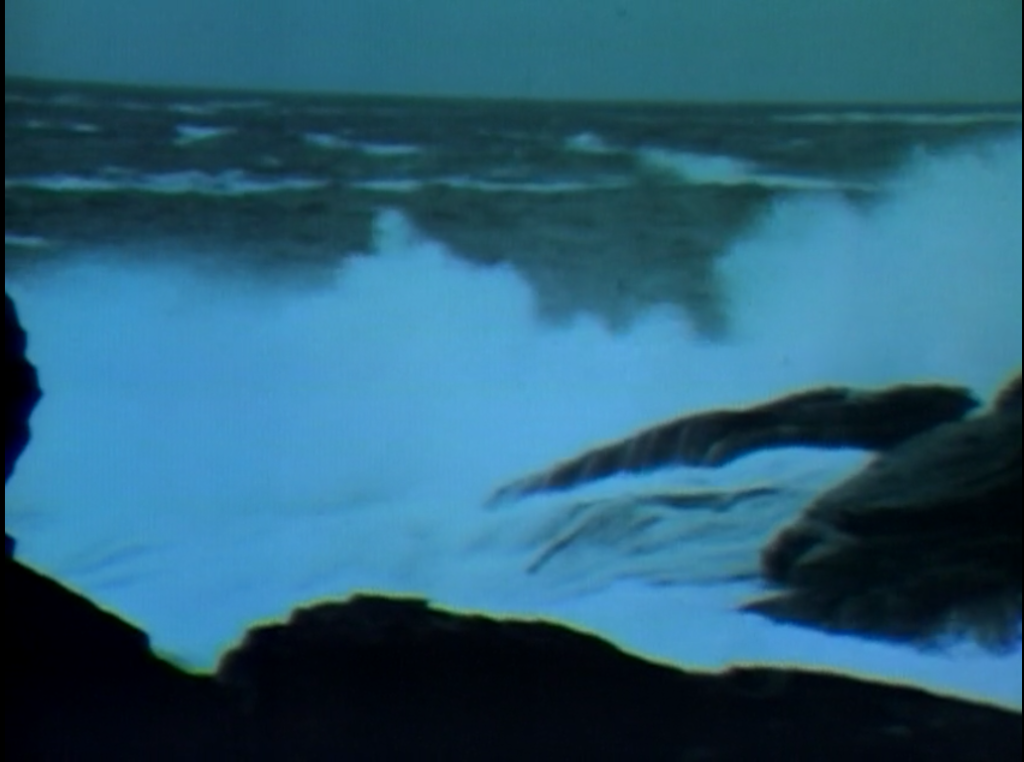
After Adam’s fall, we hear a message that is very familiar to us, but that Barnabas and his friends have never heard. Adam was created in an experimental procedure that was meant to relieve Barnabas of his vampirism. His creator, mad scientist Eric Lang, died shortly after recording an audiotape explaining that as long as Adam lives, Barnabas will be human, but that he will become a vampire again if he outlives Adam. This message plays out over images of the waves crashing into the rocks of the shore. It’s an effective visual complement to the message, a metaphor for the overwhelming power that will engulf Barnabas and the rest of them if Adam is in fact dead.
From #133, artist Sam Evans was compelled to paint a series of pictures that explained the evil intentions of undead blonde witch Laura Murdoch Collins, estranged wife of sarcastic dandy Roger Collins. In #146, Laura put a stop to Sam’s work by starting a fire that burned his hands so badly it seemed for a time he might never be able to paint again.
Sam shares his home, the “Evans cottage,” with his daughter Maggie, who is The Nicest Girl in Town and a waitress at the diner in the Collinsport Inn. Between her earnings there and the paintings Sam sells, the Evanses make a living, but it isn’t such a grand living that he can turn down any commissions, even very eccentric ones. Moreover, his work space entirely dominates the interior of the cottage. In the early days of the show, Sam’s old friend Burke Devlin often stopped by, and the conversation always turned to reminiscences of Burke’s youthful days of honest poverty. Nowadays the most frequent visitor is Maggie’s fiancé, hardworking fisherman Joe Haskell. Sam is delighted with the prospect of this upwardly mobile laborer as a son-in-law. When a representative of the moneyed world visits Sam or Maggie at home, as New York art dealer Portia Fitzsimmons did in #193 and old world gentleman Barnabas Collins did in #222, the contrast between their manner and the humble surroundings is meant to jolt us. The Evans cottage is therefore our window on the working class of Collinsport. When the troubles of the ancient and esteemed Collins family have an effect there, Dark Shadows is telling us that the whole town is dependent on the businesses they own and suffers as a result of their problems.
Yesterday, Barnabas came back to the cottage and brought Sam a very odd commission indeed. He presented a painting of a lovely young woman in eighteenth century garb and offered Sam $500* to paint over the image so that before morning the woman would look to be “about 200 years old.” Sam wasn’t in a position to refuse that much money, even though Barnabas wouldn’t explain why he wanted him to do such a thing.
If Sam knew what the audience knows, he would likely have turned the job down even if Barnabas had offered $500,000,000. The woman in the portrait is Angelique, and like Laura she is an undead blonde witch. In the 1790s, Angelique cursed Barnabas and made him a vampire. In #466, Barnabas’ vampirism went into remission. Shortly thereafter, the portrait made its way to the great house of Collinwood, where Roger became obsessed with it. In #473, Roger returned from an unexplained absence with a new wife. She is Angelique, wearing a black wig and calling herself Cassandra. From #366-#461, Dark Shadows had been a costume drama set in the 1790s; during this segment, we saw that Angelique was a far more dynamic and brutal menace than Laura ever was. Sam would hardly want to involve himself in a battle with this wiggéd witch.
For his part, Barnabas first appeared on camera in #210 and #211. But his portrait was first seen hanging in the foyer at Collinwood in #205, having been prefigured in #195. Dangerously unstable ruffian Willie Loomis became obsessed with the portrait of Barnabas. Willie could hear a heartbeat pounding from the portrait in #208 and #209, and followed its sound to the crypt where Barnabas was trapped in his coffin. As Roger’s obsession with Angelique’s portrait would bring her back to the world of the living, so Willie’s obsession with Barnabas’ portrait led to his return.
In the opening teaser, we see Sam working on the painting. He tells it that he can’t understand why Barnabas would want to disfigure such a pretty face, then resumes his task. The camera zooms in on the painting, as it had zoomed in on Barnabas’ portrait in #208 and #209, and the soundtrack plays the same heartbeat. Sam doesn’t react- he can’t hear it. It is addressed to the audience, especially to those members of the audience who remember the show as it was 13 months ago.
Angelique/ Cassandra is in the gazebo on the grounds of Collinwood. She is wearing a hooded cloak to conceal the aging she has already experienced as a result of Sam’s work. Her cat’s paw Tony Peterson, a local attorney, shows up, responding to her psychic summons. She entrances him with a flame and he tells her that the artist who has been in touch with the Collinses most frequently of late is Sam Evans. From this she concludes that Sam is aging her portrait at Barnabas’ bidding. Before Angelique/ Cassandra and Tony can go their separate ways, heiress Carolyn Collins Stoddard comes upon them.
Tony and Carolyn met in #357. In that episode, he was an instance of Jerry Lacy’s Humphrey Bogart imitation. A hard-boiled materialist, Tony had grown up in Collinsport as a working-class boy. He resented the Collinses and attributed all of their unusual characteristics to their wealth and social prominence. At that time, Barnabas was still a vampire and Carolyn was under his power. As a blood thrall, she knew that there was more to life than could be explained by Tony’s reductive logic, but she wasn’t free to offer any explanations. When Tony saw Barnabas biting Carolyn in #463, he interpreted their embrace as a sign of a sexual relationship.
Now their roles are reversed. It is unclear what Carolyn remembers from her time under Barnabas’ control; Nancy Barrett often plays the character as if she remembers everything, but the dialogue doesn’t give her much support for that, and in this scene she is as this-worldly as Tony was in the Autumn of 1967. She interprets Tony and Angelique/ Cassandra’s meeting at the gazebo as proof positive of an adulterous liaison, and declares she will report it to Roger. When Tony tells her that Angelique/ Cassandra has some mysterious power, Carolyn is dismissive, declaring that the Collinses are the ones who have all the power in this town. Tony tries to explain that the power Angelique/ Cassandra has is of an entirely different order from the power their ownership of capital gives the Collinses, and Carolyn responds with unconcealed contempt.
Angelique/ Cassandra knocks on the door of the Evans cottage. Sam opens the door. She ignores his objections and enters. While he keeps ordering her to get out of his house, she stands next to the portrait as he has aged it and points out her resemblance to it. He is astounded, but keeps telling her to leave. She says that she has no grievance against him and that no harm will come to him if he hands the painting over to her. He refuses. She heads out.
Angelique/ Cassandra has barely closed the door behind her when Sam has trouble seeing. After a moment, he realizes he has been struck blind. She comes back in, takes the painting, tells him she warned him, and leaves.
Over the years, several members of the cast said on the record that Sam’s blindness was actor David Ford’s idea. He thought that if he could wear dark glasses it wouldn’t bother the audience that he read all his lines off the teleprompter.
In 2022, a commenter on Danny Horn’s post about this episode on his blog Dark Shadows Every Day identified the portraits of Angelique as the work of ABC Art Department specialist Joseph Guilfoyle:
You asked if anyone knew who painted these portraits. I can verify that the portraits of Angelique were painted by Joseph Guilfoyle. He was an artist in the Art Department at ABC. He was my Godfather and his daughter remembers this very well as it made her a bit of a celebrity at the time. Portraits were not commissioned out but instead were created in the Art Department as it was filled with many talented artists.
Also worthy of note are the two facial makeups representing Angelique’s aging. It’s no wonder they didn’t have the personnel to make David Ford’s fake mustache look convincing when they were lavishing all the work on turning Lara Parker into two quite distinct old crones.
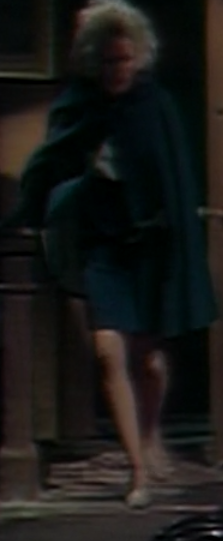
The costumers were involved in a famous production error in the final scene. Angelique/ Cassandra’s hooded cloak cuts off above her knees. There is no old age makeup on her legs, which are featured from every angle, making a ludicrous contrast with her face and wig.
For its first 38 weeks, Dark Shadows was the story of well-meaning governess Vicki and her attempt to make her way through life on the great estate of Collinwood. One by one, Vicki’s problems were either solved or forgotten. From week 43 on, the show has focused on vampire Barnabas Collins. Barnabas has refused to involve Vicki in his life, leaving her confined to B plots at best.
The current B plot is about Vicki’s relationship with a man named Peter, who keeps trying her patience and ours by pretending to be named Jeff. Peter/ Jeff’s shouting voice, which he uses by default, makes him sound like he is suffering from severe gastrointestinal distress. He has a habit of manhandling people around him, causing them obvious discomfort. These bad habits, and several others, are less the product of the writing or direction than they are symptoms of the casting of Roger Davis as Peter/ Jeff. Alexandra Moltke Isles, like all the other actresses, is so ill at ease when she is in proximity to Mr Davis that it is impossible to believe that Vicki is in love with Peter/ Jeff.
Peter/ Jeff had been connected to the A plot through his boss, mad scientist Eric Lang. Peter/ Jeff has total amnesia. Lang released him from a mental hospital and told him that he was suspected of strangling two women by the waterfront in Portsmouth, New Hampshire. He used Peter/ Jeff as his assistant in an experiment that is supposed to free Barnabas from vampirism. Now Lang is dead, and Peter/ Jeff goes to his house to search for the file on his own background.
There, he meets Barnabas. The two of them display hostility to each other, but the scene fizzles out as it becomes clear that Barnabas has no motivation to oppose Peter/ Jeff’s goals and wouldn’t be in a position to stop him if he did. Peter/ Jeff finds a paper which proves that Lang was lying, and he is not a murderer after all. With that, he and Vicki both lose whatever reason they had to be on the show.
His file from the mental institution had those three magic words: “No homicidal tendencies.” As something to be proud of, that’s a pretty low bar, but he seems happy.
Unfortunately, that basically nerfs Jeff’s entire storyline. He’s not working for Dr. Lang anymore, and the secret that Lang was holding over him — the idea that he might be a murderer — has just dissolved.
This is just throwing a story point away, rather than advancing anything, and Jeff is left at a loose end. He has no job, no family, and no real connection to a story. Now he doesn’t even have homicidal tendencies. It wasn’t much, but it was all he had.
Danny Horn, “Episode 487: Precious Moments,” Dark Shadows Every Day, 24 September 2014
Peter/ Jeff goes to share this news with Vicki. It’s a tribute to Mrs Isles’ acting ability that she makes us believe Vicki is bewildered that Peter/ Jeff thought he had homicidal tendencies. Mr Davis usually seems angry enough to kill someone, as for example at various points in today’s episode when Peter/ Jeff’s joy leads him to wrap his hands around Vicki’s throat, plant a rather painful-looking kiss on her, pick her up, and point her underwear at the camera.
The highlight of this episode is a scene between Julia Hoffman and Timothy Eliot Stokes. Julia is Barnabas’ best friend. She has decided to take over the experiment after the death of her fellow mad scientist Lang. Wicked witch Angelique is trying to prevent her helping Barnabas, and so Julia turns to Stokes, a sage in the ways of the occult.
Stokes is the second such character on Dark Shadows, after the ill-fated Dr Peter Guthrie. Vicki recruited Guthrie into her battle against undead fire witch Laura Murdoch Collins in #160 and Laura killed him in #185. We haven’t heard about Guthrie since the end of the Laura story, but the show went out of its way to remind him of us when it showed Lang’s death yesterday. Like Guthrie, Lang died as the result of an indiscreet word from housekeeper Mrs Johnson to an undead witch in the drawing room at Collinwood. Also like Guthrie, Lang is a paranormal researcher who is deeply involved with a tape recorder.
While these similarities served to remind us of Guthrie, they also reminded us of the radical differences between him and Lang. Guthrie was as sane and law-abiding as Lang is crazed and lawless. Seeing Stokes today, we recognize him as Guthrie’s successor, and wonder if his fate will be any different.
Julia is deeply troubled because of a dream she had last night. She was so very upset by it that she was up all night chain smoking.* It was no ordinary nightmare, but part of “The Dream Curse,” a piece of mental malware Angelique has sent to infect one character’s mind after another. Julia recaps the Dream Curse to Stokes while looking into a convex mirror. It’s a striking visual.
It doesn’t look good for Stokes. Angelique is a supercharged force of destruction, and Julia withholds several crucial pieces of information while recruiting him to the fight against her. Julia does not identify Angelique as the witch. She can’t tell him about Barnabas’ vampirism or about Lang’s experiment without incriminating herself in many felonies, including murder. When Vicki was recruiting Guthrie to the fight against Laura, a far less formidable adversary than Angelique, she held nothing back and ensured that her friends gave him their full support. If Stokes is going to survive, he will need more backing than Julia can offer him.
*Fans of Dark Shadows wince when they see Julia smoking; Grayson Hall had asthma.
The more efficient a means of communication is, the sooner it is likely to be choked with unwanted messages, some of them harmful to recipients who engage with them. We describe this tendency by saying that eventually, everything turns into email.
One of the most potent means of communication on Dark Shadows have been dream visitations from supernatural beings. As early as #10, matriarch Liz, who in waking life resolutely denied that any paranormal phenomena could be found on the estate of Collinwood, writhed as she slept in her armchair, muttering about ghosts. Since then, we’ve seen undead fire witch Laura Murdoch Collins and the spirit of the benevolent Josette send competing dreams to influence strange and troubled boy David; the mysterious Widows have beckoned Liz to a watery grave; the ghost of little Sarah Collins visited David and told him all about her big brother, then-vampire Barnabas; revenant Jeremiah Collins and phantom Nathan Forbes have given important information to well-meaning governess Vicki; and several characters have had vivid dreams of unspecified, but obviously supernatural, provenance.
Today, wicked witch Angelique visits Barnabas in a dream and tells him that she is launching a malware attack on the dreamers of Collinsport. It’s going to be sequential; it will take over each user’s wetware in turn, compelling them to forward it to someone else. With each iteration, the worm will become more complex, until it reaches Barnabas in a dream of his own. When he accesses it, he will revert to vampirism.
On his Dark Shadows Every Day, Danny Horn made a detailed comparison of Angelique’s explanation of the Dream Curse with the introduction to the 1931 film Frankenstein. He’s convinced me that the reference was intentional. Since there is a version of Frankenstein playing out on Dark Shadows right now, they are assuring us that the Dream Curse storyline will intersect with that one.
Angelique’s explanation only takes up the last act of the episode. There is a lot of other good stuff in the earlier parts, most revolving around Jerry Lacy’s character Tony Peterson. Tony was first introduced as a showcase for Mr Lacy’s famous Humphrey Bogart imitation; he has discarded that now. He still wears a brown suit and a tan overcoat, but sounds like Jerry Lacy.
Tony quarrels with heiress Carolyn about her relationship with Barnabas. She tells him that she and Barnabas have no romantic interest in each other, and tells him to go ask Barnabas if he doesn’t believe her. He goes to Barnabas’ house, and gives Jonathan Frid a rare opportunity to play intentional comedy.
Angelique, who, under the name Cassandra, has married sarcastic dandy Roger Collins and is living with him in the great house at Collinwood, steals Tony’s lighter and uses it to cast a spell on him. She needs a helper, and has decided to enslave Tony. Mr Lacy and Lara Parker are such fun together that, decades after the show, a company called Big Finish brought them back as Tony and Cassandra in a series of audio dramas. Called The Tony and Cassandra Mysteries, they were among the most popular of the Dark Shadows-themed plays Big Finish put out. I haven’t heard any of them- I’m too stingy to pay $37.41 to download an audio file- but if the scene the two of them play in the gazebo at Collinwood today is any indication, I’m sure they’re wonderful.
The very beginning of the episode is good too. Carolyn is coming back from a trip and has her hands full of luggage, so she knocks on the front door of the great house rather than look for her key. Angelique/ Cassandra answers. Carolyn has no idea who she is. When Angelique/ Cassandra identifies herself as Roger’s wife, Carolyn is shocked that Roger has remarried. She is even more shocked when Angelique/ Cassandra says that she and Roger had known each other only a day when they were married. Nancy Barrett is a high-energy actress, and a tightly-focused one. Her reactions to Angelique/ Cassandra’s successive announcements are like a laser light show on the theme of stunned disbelief.
Carolyn mentions that David decided to stay on in Boston for a few days. Since David is about ten years old, we might expect some explanation as to his lodging, but none is forthcoming. Some time ago we heard about an “Aunt Catherine” in Boston; I suppose he might be at her house, but hey, if the alternative is Collinwood he wouldn’t be any less safe if he were roughing it around Mass and Cass.
Recovering vampire Barnabas Collins receives a visitor in his home, Professor Timothy Eliot Stokes. Stokes agrees to lend Barnabas a twelfth century Sicilian talisman to ward off the power of a witch, and makes it clear he will not rest until he finds out why Barnabas needs it.
This scene is a tour de force for Thayer David as Stokes. I’ve already quoted Danny Horn’s remark in his post about it that David “plays to the balcony. Not this balcony, naturally; I mean the balcony in the theater next door.” David’s style works brilliantly in this context.
The rest of the episode is marred by some bad writing. When wicked witch Angelique, pretending her name is Cassandra, comes to call on Barnabas, he immediately calls her by her right name and tells her everything she could want to know in her campaign to restore his vampirism. This is a pattern of Barnabas’; he withholds information from people who would use it to help him, and blabs without inhibition to his deadliest enemies.
Barnabas takes the talisman to Dr Eric Lang, the mad scientist who has freed him of the symptoms of Angelique’s curse. Lang knows that Barnabas has been a vampire and knows that a curse made him one, but scoffs at the idea of witchcraft and refuses to touch the talisman. Jonathan Frid is a good enough actor that we can wonder if Barnabas has a reason for disclosing all his secrets to Angelique, but Addison Powell plays Lang so ineptly that there is nowhere to hide the fact that his skepticism makes no sense.
Angelique shows up in Lang’s office and casts a spell on him that is about to cause his heart to burst. He staggers to the desk, touches the talisman, and quickly recovers. He will not let her take it from him.
Barnabas comes back and asks Lang if he now believes that he must carry the talisman to protect himself from Angelique. He says he does not want to believe, and again walks off leaving the talisman on his desk.
Barnabas presses Lang for information on the final stage of the treatment that is supposed to end the curse once and for all. Lang takes him to the secret laboratory in his home. There, amid a lot of flashy equipment, is a partially assembled Frankenstein’s monster. Lang says that he will drain the “life-force” from Barnabas’ body and use it to animate the creature once it is completed. Barnabas’ old body will be dead, and Angelique will presumably believe that he no longer exists. But he will live in the new body.
Dark Shadows‘ first supernatural menace was undead blonde witch Laura Murdoch Collins, estranged wife of sarcastic dandy Roger. Laura was on the show from December 1966 to March of 1967. During that time, Laura tried to rebuild her relationship with her son by Roger, strange and troubled boy David. David’s well-meaning governess Vicki at first encouraged her charge to go to his mother, but eventually figured out that Laura posed a deadly threat to him. Vicki formed a coalition of characters to help her fight Laura, and eventually rescued David from his mother’s clutches at the last minute.
Now, Roger has come home to the great house of Collinwood after an unexplained absence that had Vicki, his sister Liz, and his distant cousin, old world gentleman Barnabas, terribly worried. Roger happily announces that he has taken a new wife, and presents her to the family.
As it turns out, Roger has a definite type. His new bride is also an undead blonde witch, though at the moment she is wearing a black wig that doubles as a physical representation of the concept “1968.” Her name is Angelique, although she pretends it is Cassandra.
Some critics say that the film 2001: A Space Odyssey would more aptly have been titled 1968: A Bad Year for Hats. As you can see, however, headwear in general was passing through a time of trial in that period. Screenshot by Dark Shadows Before I Die.
Vicki and Barnabas recognize Angelique immediately. Vicki came unstuck in time in #365, finding herself in the year 1795, and didn’t make it back to the 1960s until #461. During her nineteen weeks in the late 1790s, Vicki got to know the people who lived at Collinwood in those days, among them Barnabas and Angelique. She saw many horrible things happen to them, and only after being blamed for those catastrophes herself would she realize that they were the consequences of spells cast by Angelique. Due to Angelique’s curse, Barnabas would be a vampire from 1796 until the week after Vicki came back to 1968. Vicki has decided to believe that Barnabas is not the same person she knew in that period, but rather that he is the descendant of that Barnabas Collins. He does not want her to know that he ever was a vampire, and she has resolved not to know that either, even though he used to bite her on the neck and suck her blood.
The battle against Laura was a fairly exciting story, at least in its latter stages. Angelique is a far more dynamic adversary than Laura, and Dark Shadows is much faster-paced and better written than it was then, so a reprise of the structure of that conflict in this new setting would likely be very exciting indeed.
To wage such a battle, Vicki and Barnabas can have no secrets from each other. Many who have been with Dark Shadows from the beginning have been hoping that its original protagonist will eventually become aware of the principal storylines, and this is one of the obvious ways to do it. Vicki can learn that Barnabas was a vampire, can find out that he was the one responsible for all the terrible crimes committed against the women and men and cows of Collinsport in 1967, and can still align herself with him, because she needs his support against Angelique, a more urgent threat. By the time they have vanquished her, not only will the idea of handing Barnabas over to the authorities have lost its salience, but Vicki will doubtless be facing another urgent threat requiring Barnabas’ assistance.
Nothing we see today suggests that such a development is on the horizon. The episode began with Vicki, Barnabas, and Liz worrying about Roger. A couple of weeks ago, Vicki brought a portrait home from an antique store and it had bizarre effects on Roger. The other day, he took the portrait and disappeared.
We can tell that today is not going to be a win for the female characters when Barnabas reacts to Liz’ expression of concern by dismissing her from his presence and she leaves, even though he is in her house. Vicki can tell Barnabas knows more about the situation than she does, and each time he condescends to mete out a little information in response to one of her questions he ends by turning his back to her and explicitly refusing to share anything more.
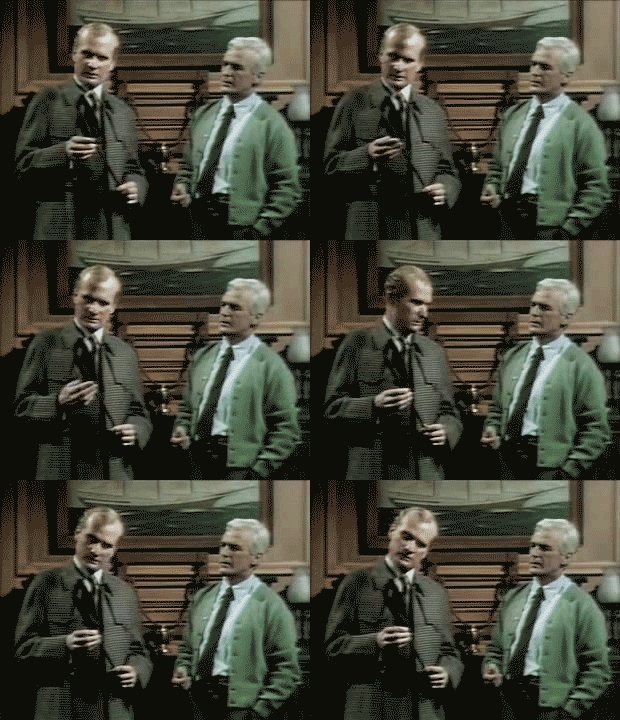
When Liz first leaves him alone with Vicki, Barnabas sourly remarks “I try to remember… that I must not reproach you for the reasons you’ve given not to marry me.” As Danny Horn shows in a series of screenshots in his post on Dark Shadows Every Day, their body language does not at any point support the idea that Barnabas wants to be with Vicki and she does not want to be with him. Quite the contrary; he withdraws from her, turns from her, and puts physical objects as barriers before her, while she looks at him, follows him, and leans towards him.
This has been Barnabas and Vicki’s dynamic for a long time. By #285, she went so far as to invite herself to a sleepover at his house. Barnabas was a vampire then; he entered the bedroom while she slept and bared his fangs, but couldn’t bring himself to bite her. Time and again, Vicki would all but draw a circle on her neck with the words “Mr Vampire, Bite Here!,” and Barnabas would tremblingly open his mouth, then recoil at the last moment. In #462, he finally sampled her bloodstream. By the end of #466, Barnabas’ vampirism had gone into remission, and that little storyline had evaporated. Now Vicki is vague and confused about what happened between her and Barnabas, and he is afraid he will relapse and bite her again.
Vicki is trapped between two blank walls. On one side Barnabas is excluding her from his life and therefore from active participation in the A story. On the other, she keeps having scenes with her old boyfriend from the 1790s, an unpleasant man named Peter who keeps demanding, for no apparent reason, that she call him Jeff. That habit of his was dead on arrival as a story point, and now that Angelique will be trying our patience by insisting her name is Cassandra, it will become impossibly tedious to have a second character doing the same pointless schtick. As long as she is in this position, Vicki’s prospects for contributing interesting material to Dark Shadows belong to a very low order of probability.
Sarcastic dandy Roger, possessed by the spirit of wicked witch Angelique, visits mad scientist Dr Lang. The village of Collinsport was once a whaling center, and Lang is mindful enough of that long-ago history that he collects harpoons. Roger appears to be fascinated by Lang’s collection. He holds one of the finer pieces, admires it, fondles it, and tries to kill Lang with it. At the last moment, the murder is prevented by recovering vampire Barnabas and Julia, who is a scientist as mad as Lang but infinitely more interesting. As is typical of supernatural beings on Dark Shadows, Angelique projects her power through a portrait of herself; the portrait also has some adventures today.
There is a lot of great stuff in this one, as other bloggers have well explained. The 1960s were the heyday of Freudianism in the USA, and in the first year of the show the influence of that school of thought could often be traced in the scripts of Art Wallace and Francis Swann. Patrick McCray documents in his post on The Dark Shadows Daybook that this was an episode where writer Gordon Russell allowed himself to cut loose and have fun with the sillier side of the Freudian approach.
On his Dark Shadows Every Day, Danny Horn focuses on the scene where Barnabas and Julia decide to go and stop Roger. He points out that it is the first conversation they have had about something other than themselves, the first time Barnabas shares with Julia the secret of how he became a vampire, the first time they take heroic action, and the first time they are recognizably friends. It is that friendship that will drive the action of the show from now on.
In their meticulously detailed summary of the action of the episode on their Dark Shadows Before I Die, John and Christine Scoleri capture the effect on the audience of the steady accumulation of one absurdity upon another as the episode goes on. Reading their unfailingly matter-of-fact description of the ever-mounting lunacies we witness in this half-hour is almost as exhilarating as it was watching them in the first place.
Barnabas calls Julia’s attention to the closing cliffhanger. Screenshot by Dark Shadows Before I Die.
Well-meaning governess Vicki and mad scientist Julia have gone to the Collins family mausoleum in the old cemetery north of town. Vicki wants to see whether her memory is correct and there is a chamber hidden behind a secret panel in the mausoleum, and Julia is trying to limit what Vicki can find. As they enter the mausoleum, Vicki shines a flashlight directly into the camera, then sees a man lurking in a dark corner of the mausoleum.
Vicki assures us that, no matter how much the show might have changed since last summer, it’s still Dark Shadows.
The man is Peter, an unpleasant fellow with whom Vicki unaccountably fell in love when she met him on an unscheduled journey through time to the 1790s. For no reason that will ever be of interest to the audience, Peter keeps insisting that his name is Jeff and that he is not a time traveler. Yet he is the one who finds the mechanism to open the secret panel and expose the hidden chamber where Vicki and Peter once found refuge. Even after that he keeps wasting our time with his pointless denials of the obvious facts.
While they inspect the chamber, Vicki realizes that Julia knew it was there. She confronts her about it, and Julia feigns ignorance. Vicki points out that Julia tried everything she could to keep her from going to the mausoleum and that when those efforts failed she insisted on accompanying her there. Vicki is taking a breath, apparently about to list further evidence supporting the same conclusion, when she glances at Peter and changes the subject.
Vicki remarks that the only way the room has changed since she was there in the late eighteenth century is that there is now a coffin in the middle of it. Julia knows that it is the coffin in which vampire Barnabas Collins was confined from the 1790s until 1967. Barnabas bit Vicki several days ago, but it didn’t really take, and he has since been cured of vampirism. So Vicki probably doesn’t know that Barnabas ever was a vampire, and certainly doesn’t know that it is his coffin. Peter opens the coffin. The empty interior of the coffin dissolves to Barnabas in his hospital bed.
Mid-dissolve.
Barnabas sits up by bending from the waist, showing that old habits die hard. He cries out for the doctor who rehumanized him, Eric Lang. A look of panic spreads across his face.
Terrified Barnabas
He is alarmed to hear hounds baying outside his window. He goes out on the terrace of his hospital room and touches its stone balustrade.
What, your hospital room doesn’t have a terrace with a stone balustrade?
Barnabas goes back inside and continues crying for Lang. When Lang shows up, he explains that the cure isn’t quite complete. There will be occasional relapses of varying intensity, and further treatments are necessary. Barnabas throws a tantrum in response to this news, pouting that if he has to keep taking medicine he may as well go back to being an undead abomination who preys upon the living. Lang talks him down, telling him that he is confident he will be able to effect permanent remission.
We see Julia standing in the rain beside a sign for the Collinsport Hospital, looking up at Barnabas’ silhouette in the window behind his balustrade. She walks away. We then see Lang at a desk in a large wood-paneled room. There is a knock. Lang gives a self-satisfied smirk as he looks at his watch, then opens the door to let Julia in. We see that the wood paneling continues in the corridor behind her. In later episodes we will learn this is in Lang’s house. In that case, the paneling in the corridor behind Julia makes it clear someone has already let her in. At this point, a viewer would naturally assume that it is Lang’s office in the hospital. Wood paneling may not be standard for doctors’ offices in hospitals, but neither are terraces with stone balustrades standard for patient rooms.
Julia looking innocent.
Julia had been treating Barnabas’ vampirism in 1967, and wants to reclaim the case. She and Lang sit across from each other and engage in a verbal fencing match. Lang uses many of the ploys we have seen Julia use to keep control of the situation. On his great blog Dark Shadows Every Day,Danny Horn speculates that the audience’s revulsion at the prospect of Lang replacing Julia was the intended reaction. It cements our sympathy for Julia as a trickster figure and as the de facto protagonist of the chief storylines.
I agree with Danny’s assessment of the scene’s effect, but I doubt it was fully intentional. When I imagine the scene played with Howard da Silva instead of Addison Powell as Lang, I see the audience conflicted and in suspense. We are invested in Julia and her relationship with Barnabas, and so we don’t want Lang to push her aside. But an actor like da Silva would be so intriguing that we couldn’t help but be curious how it would play out if he did. It is only the severity of Powell’s professional deficiencies that causes us to see Lang as nothing but a threat. Compared with the more complex reaction a da Silva could have generated, this scene falls flat.
As Julia is leaving Lang’s office, Peter barges in. Julia’s eyes widen when she sees that the two are connected. Lang realizes that she is likely to make good use of this information, and is furious with Peter for exposing it to her.
It becomes clear that Peter has been implicated in a homicide, that he is suffering from amnesia, and that Lang is blackmailing him into stealing body parts from a nearby cemetery. When Peter says he will no longer help Lang, Lang threatens to send him back to the institution for the criminally insane where he found him. He also forbids Peter to see Vicki again, telling him that Barnabas Collins wants to marry Vicki and that Barnabas’ happiness is important to his plans.
In yesterday’s episode, Peter talked to Lang about his hope that he might be able to learn something about himself from Vicki. This reminds longtime viewers of the first year of Dark Shadows, when Vicki’s motivation for staying in the great house of Collinwood was her hope that she would learn who her biological parents were and why she was left as a newborn at the Hammond Foundling Home. Peter even uses the same phrases Vicki had used in expressing the desire to learn more about himself. Moreover, Vicki, like Peter, has an important gap in her memory, having forgotten key details of her time in the eighteenth century.
That Lang has plans for Vicki was strongly suggested last time, when he told her that he expected her to have an extremely significant future. When we see what future he has decreed for a character who is in a position so similar to Vicki’s, and that the future he has in mind for her includes marriage to Barnabas, we can have little doubt that his plans for her are most evil.
The scene between Lang and Peter is a very efficient piece of exposition, but it is poorly executed as drama. Addison Powell keeps pulling funny faces for no apparent reason, does not appear to have any control over the volume of his voice, and alternately drifts off his mark and stands unnaturally still. Roger Davis is a highly trained professional actor, but he must have skipped the day when his acting teachers covered means of shouting without sounding constipated. The two of them together are not very easy to watch. I get through their scenes with a further bit of imaginary recasting, picturing a onetime Dark Shadows extra like Harvey Keitel as Peter opposite da Silva’s Lang.
In a room at the Collinsport Hospital, very loud physician Eric Lang (Addison Powell) opens the curtains to show his patient, old world gentleman Barnabas Collins, that it is a sunny afternoon. It takes Barnabas a moment to realize that this is Lang’s way of showing him that he has cured him of his longstanding affliction, vampirism. Once he figures it out, Barnabas is very happy to be human again.
Barnabas talks with Lang about the origins of his vampirism. At one point Lang says “Ah, so a curse was responsible.” You know how doctors are, always coming out with the same cliches. Lang does say something novel when he remarks on Barnabas’ “pulsebeat.” That specimen of Collinsport English will be back.
In the great house of Collinwood, Barnabas’ distant cousins Roger and Liz are at odds. Roger keeps having conversations with a portrait, in the course of which he loses track of the time. The correct time is 1968, and he keeps thinking it is 1795. When he does that, he mistakes himself for his collateral ancestor Joshua Collins and his sister Liz for Joshua’s wife Naomi. Today, Liz has to slap Roger to get him back to himself. Louis Edmonds’ alternation between Joshua and Roger is masterful, one of the outstanding moments of acting in the whole series.
The portrait is of Angelique, the wicked witch who made Barnabas into a vampire in the first place. At the hospital, it becomes clear that Angelique’s spirit is controlling Roger through it. He is cold and distant, staring out the window when Barnabas tells Liz he wants to take up gardening, refusing to say a word when Lang enters the room. When he takes his leave, Roger looks at Barnabas and declares “It’s not this easy.” We realize that he is a puppet for Angelique. Roger steals Lang’s cartoonish mirror-bearing headpiece.
We cut back and forth between Barnabas’ hospital room and the drawing room at Collinwood. At Collinwood, Roger shows the headpiece to the portrait and explains that it was Lang’s. He starts to twist it. In the hospital, Lang suddenly leaps up with a splitting headache. Roger stops twisting, and Lang says he’s better. He resumes twisting, and Lang resumes suffering. Roger tells the portrait he cannot obey its command to put the headpiece in the fire, and throws it across the room. In the hospital, Lang suddenly recovers from his headache. Barnabas tells him it was Angelique’s doing, and says that he will have to become a vampire again to spare Lang her attentions.
On his blog Dark Shadows Every Day, Danny Horn identified Addison Powell as “THE WORST ACTOR EVER TO APPEAR ON DARK SHADOWS.” I don’t agree with that. In yesterday’s episode, for example, Powell attained a level that could fairly be described as “competent,” a label that forever eluded figures like Mark Allen (Sam Evans #1,) Michael Currie (Constable/ Sheriff Carter,) and Craig Slocum (Noah Gifford and, later, Harry Johnson.) And there will be times when his ludicrous overacting lends just the note of camp that turns a scene from a tedious misfire to an occasion for chuckling. But he is pretty bad today. When an actor gets to be depressing to watch, I sometimes make his scenes bearable by trying to imagine what it might have been like if, instead of casting him, they had chosen someone else who might have been available.
So many members of the original Broadway cast of the musical 1776 appeared on Dark Shadows at one time or another that I tend to assume that any of them would have accepted any part on the show. Howard da Silva played Benjamin Franklin in 1776, and he is my imaginary Dr Lang.
You can see da Silva’s Franklin in the 1972 movie version of 1776, where he plays the Sage of Philadelphia with frequent chortles that suggest a mad scientist gleefully working to release a murderous nightmare on the world, which is more or less the show’s vision of the founding of the USA. That isn’t Franklin’s only note- he has occasion to speak earnestly about the British Empire’s mismanagement of its North American possessions, and sorrowfully about the need to leave slavery alone while concentrating on the fight for independence. Those who have seen da Silva play subtle and powerfully compassionate men in his other work, for example as the psychiatrist in the 1962 film David and Lisa and as the defense attorney in the 1964 Outer Limits episode adapting Isaac Asimov’s story “I, Robot,” will hardly be surprised that he could be effective in those moments.
So when Powell overdoes the shouting, I imagine da Silva in his place, going through his bag of tricks to show us a man who might be taking a maniacal satisfaction in his blasphemous labors, who might be profoundly devoted to the relief of suffering, and who might be both at once. Sometimes I get a pretty clear image of what that would have been like, and when that happens the show in my head is hard to beat.
At the end of Friday’s episode, the well-meaning Vicki Winters was driving her car and bickering irritably with her passenger, Barnabas Collins the vampire. Barnabas wants to elope with her, which she doesn’t object to doing. But first she insists on running an errand in his old neighborhood, the deserted cemetery north of town, and he hates that idea.
A pedestrian wandered into the middle of the road. To keep from hitting him, Vicki had to slam the brakes so hard she lost control of the car and crashed. At least she learned the lesson of the cowardly Roger, who ran over a pedestrian years before the show even started and as punishment was condemned to spend months looking for some guy’s fountain pen.
Today, Vicki and Barnabas are in the hospital. We see Barnabas in bed, moaning alternately for Vicki and his long-lost love, the late Josette. It doesn’t bode well for the planned elopement that in his delirium Barnabas gives Vicki only equal time to Josette. We then see Vicki in her bed, moaning for Peter, an unpleasant young man she got to know recently while visiting the late eighteenth century. She doesn’t mention Barnabas’ name at all.
Vicki comes to and finds Peter at her bedside. He denies that he is Peter, claiming merely to be a strange man who let himself into her room to watch her sleep. She recognizes him not only as her boyfriend from the 1790s, but also as the wayward pedestrian involved in the crash. He admits to this, but will not answer any of her questions.
A nurse enters and finally gets Peter to leave Vicki’s room. Perhaps he will let himself into other girls’ rooms and stare at them while they sleep. The doctor, a man named Lang, comes in.
Dr Lang asks Vicki if she knows Barnabas well. This is an interesting question. Before he bit her on Tuesday, Vicki definitely did not know that Barnabas was a vampire. Her behavior towards him since has been so blasé, not only by contrast with the behavior of his other victims but also by contrast with the eager friendliness and habitual deference she had always shown him in the many months they have known each other, that we can’t tell if she has learned that he is one even now. Indeed, we have no idea what Vicki thinks is going on between her and Barnabas, and as a result their scenes together have been pure comedy.
Vicki nibbles on her index finger and thinks for a moment about Lang’s question. Since they were going off to spend the rest of eternity together, it would be pretty embarrassing for her to admit that she doesn’t really have much understanding of Barnabas, so she says that she does know him well. As she does so, she glances away for a moment, and the light flashes off her eye, emphasizing her unease.
Vicki talking through her hand
Lang asks about Barnabas’ health before the crash. Vicki puts her hands down and stutters slightly as she says “He was in excellent health.” A note of uncertainty gives her voice a childlike quality. When Lang replies with “Really?,” her voice sounds even more childlike when she answers “Y-yes, have you discovered something Mr Collins didn’t know about?” Lang says that he thinks Barnabas knew about it.
Lang looks at Vicki’s neck and finds the marks of Barnabas’ bite. They are just two dark dots, not conspicuously different from the last stages of an ordinary hickey.
The bite marks.
When Lang asks about the marks, Vicki’s grogginess suddenly vanishes and she becomes hyper-alert. Since Vicki has been so bland about her experience with Barnabas, returning viewers might well expect her to answer Lang’s questions about the bite marks by saying that Barnabas gave them to her when they were making out. Instead, she gets defensive, at first denying that she remembers how she got the marks and then asking “What’s wrong with them? Why are they so bad, please tell me?” Alexandra Moltke Isles reads that line brilliantly. There is a touch of defiance in her voice, but also a sincere question- she genuinely does not see any reason she should have to hide the marks or explain them to anyone.
Early in the episode, the telephone rang at the great house of Collinwood, and long-term houseguest Julia Hoffman answered. It was the nurse, reporting that Vicki and Barnabas had been brought in after a traffic accident and that “Mr Collins is on the critical list.” Now Julia is in Barnabas’ room trying to arrange transport to his house. Lang comes in and is astounded at the thought of taking an unconscious patient, who is in critical condition, out of the hospital.
Lang and Julia have a showdown. Lang makes it clear that he knows that Barnabas is a vampire, and has deduced that Julia, who is a doctor doubly qualified to practice as a psychiatrist and a blood specialist, has been trying to cure him. Lang marvels that Julia has been treating “a legendary condition.” He asks to examine her neck; she never removes her scarf, surprising returning viewers who know that Barnabas has not bitten her. He continues to pose direct, well-informed questions, which she continues to parry with lies and evasions. She grits her teeth when he refers to Barnabas as “our patient.” At the last, she agrees to go, and he agrees to keep the room dark.
Barnabas awakens and sees Lang. He becomes agitated and demands to be released. Lang refuses. Lang tells him the time is nearly four o’clock. Dawn broke in central Maine at 4:33 on the morning of 8 April 1968, so Barnabas has little more than a half hour to get back home to his coffin. It is no wonder that Barnabas puts on his murdering face when Lang will not let him go. Lang backs away and says he must explain something Barnabas does not understand. Lang reaches the window. As he opens the heavy curtains, he intones, “Yes, it is four o’clock! But it is FOUR O’CLOCK- IN THE AFTERNOON!!” The sunlight floods the room. Barnabas screams and covers his eyes with his hands. But he does not turn to dust- he is no longer a vampire.
This marks the end of the epilogue to the 1795 segment, and with that the end of Dark Shadows 3.0. Unlike version 1.0, which ended with no unresolved story threads of any interest, and version 2.0, which ended at a moment when the only way forward was the annihilation of all the characters, they have cued up at least three major storylines. Eventually Peter will stop pretending to be someone else and something will happen between him and Vicki; Roger will bring wicked witch Angelique home with him; Lang and Julia will work together to manage Barnabas’ aftercare. There are several other characters available for story-building. We have met kindly eccentric Professor Stokes and expect him to contribute to some or all of these storylines. We do not know how Barnabas’ cure will affect his blood thralls Vicki and Carolyn. Carolyn’s relationship with Humphrey Bogart-esque lawyer Tony is in an awkward spot, and Tony is in a position to trigger a major storyline if he starts telling people what he thinks he knows about Carolyn and Barnabas.
On his blog Dark Shadows Every Day, Danny Horn often identified Addison Powell, who plays Lang, as “THE WORST ACTOR EVER TO APPEAR ON DARK SHADOWS.” I don’t think he deserves that title. In fact, he isn’t even the worst actor in this episode. I’m sure the Nurse was written to be pretentious and silly, but Katharine Balfour’s stiffness and relentlessly exaggerated vocal mannerisms are simply excruciating. Powell isn’t great, and will get much, much worse, but he is basically competent today. Mrs Isles, Jonathan Frid, and Grayson Hall all do excellent work in their scenes with him, and he never once gets in their way. But when Balfour is on stage, the others can do nothing but stop and wait for her to leave. She had an extensive stage career, so I suppose she must have played many parts well, but she is stupefyingly bad today.
After Lang’s big “FOUR O’CLOCK- IN THE AFTERNOON!!,” we cut to the closing credits. Under them is a set where a clock’s hands indicate four. From April 1967 to July 1968, ABC suggested its affiliates run Dark Shadows from 3:30 to 4:00 PM. There were a great many stations which insisted on showing it at 10:30 AM. While it was a hit by this point in the 3:30 slot, its ratings were always rock bottom where it was shown in the mornings, so the great majority of viewers would have seen the correct time as they read the names of the people who worked on the show.








 Dark Shadows Commentary