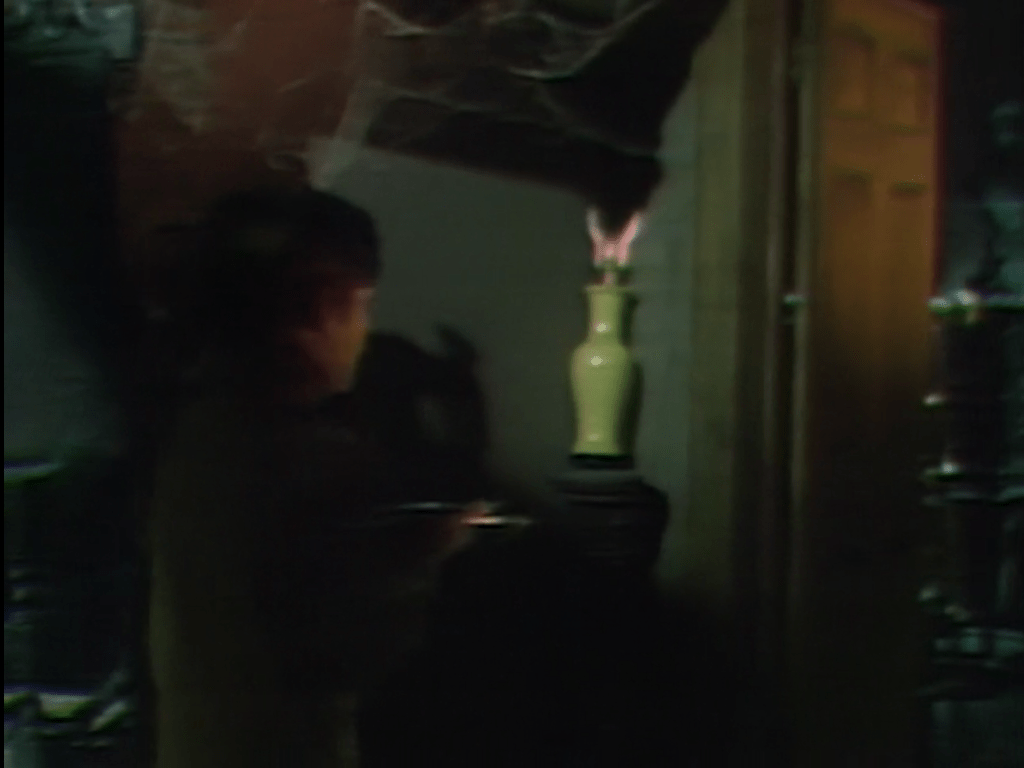
Episode 680: Chicken Little was right

Strange and troubled boy David Collins and nine year old Amy Jennings are falling under the sway of the evil spirit of the late Quentin Collins. Quentin has been gaining strength gradually; at first he was confined to a small chamber hidden behind a wall in a storage room in the long deserted west wing of the great house of Collinwood, and was dependent on Amy and David to do his bidding elsewhere. Now he can move around the estate and do things for himself. He is still able to control only one of the children at a time, though, and when Amy found out that Quentin had poisoned her brother Chris she made up her mind to fight him.

Today, David goes to the west wing to tell Quentin that Amy will cooperate with him if he promises to leave Chris alone. When David puts this to Quentin, he nods in agreement. If Quentin is still weak enough that he must give in to Amy on this point, he is still weak enough to be stopped before he does any great harm. That builds suspense- the show has invested so much time in building up the threat Quentin poses that it would feel like a cheat if he were defeated now, but we can look forward to seeing him survive a series of close calls between now and the time when his storyline approaches its climax.

David was not the only one who went from the main part of the house to the west wing. Governess Maggie saw him go there, in direct defiance of her orders that he stay in his room. Maggie followed David down the corridor and saw him go into the storage room. By the time she entered that room, David had gone into Quentin’s secret chamber and closed the panel behind him, leaving Maggie baffled as to where he could be. She went back to the main part of the house to wait for David.

In David’s room, Maggie sits in the armchair by the wall. She is still there when David comes back. This recreates a pair of scenes in #667, when David sat in the chair and was still there when Amy entered. That was supposed to be a power move, and it worked, more or less. David asserted his role as Quentin’s spokesman, and Amy acquiesced.

But Maggie can’t pull it off. She doesn’t give in to David when he denies everything, tells her her eyesight must be failing, claims that she doesn’t have the right to punish him, and yells at her that he will “get even.” But her visible nervousness encourages him to try each of these tactics. It’s only when she reminds him that he had his flashlight with him when he went into the west wing and says she will look for it in the storage room that she shuts him down, and then only for a moment.

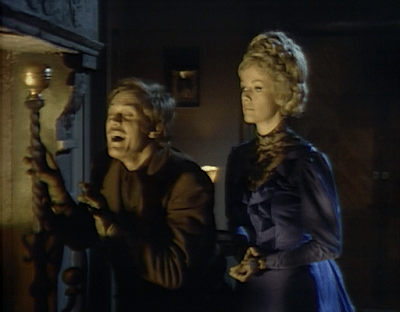
David protests his innocence to Maggie, but he tells us that the sky is falling.

Maggie goes back to the west wing, where she sees Quentin. David looks directly into the camera and recites the epigram “I do not love thee, Dr Fell.” In the first months of the show, David was the only character who made eye contact with the audience. He stopped doing that late in 1966, when he stopped being a menace, and several other characters have been called on to do it since. It’s good to see him revisit the technique, and he is quite effective at it today.

Closing Miscellany

As my screen name may have led you to suspect, I make my living as a Latin teacher. So I would be remiss if I did not mention that “I do not love thee, Dr Fell” is a translation of a piece often used on the first day of introductory Latin classes, Martial’s Epigram 32:

Non amo te, Sabidi, nec dicere possum quare.

Hoc tantum possum dicere: non amo te.

When poet Tom Brown translated the epigram in 1680, he changed the name “Sabidius” to “Dr Fell” in memory of the dean of the Oxford college which he had briefly attended. A literal translation should enable you to figure out the meaning of each of the Latin words: “I do not love you, Sabidius, and I cannot say why. I can say only this: I do not love you.”

In a conversation with housekeeper Mrs Johnson, matriarch Elizabeth Collins Stoddard says that “David is twelve years old.” This is the first time in a while David’s age has been specified explicitly.

Liz orders Mrs Johnson to take David’s dinner to him on a tray and sit in his room while he eats. Longtime viewers may remember that when Mrs Johnson started working in the house in #77 and #79, David was afraid she would be his “jailer”; in #189, she actually did sit in his room and function as his jailer for a little while. She is reluctant to do that again today, because she has caught on that David and Amy are involved with something uncanny and she is afraid of them.

Danny Horn devotes his post about this episode on his great Dark Shadows Every Day to a tour of the props and decor of David’s room. It’s a lot of fun. One of his commenters, “Jayson O’Neill,” links to a 2014 post on the Dark Shadows News blogspot page focusing on David’s posters; another, “John E. Comelately,” points out that famed rock and roll band The Turtles released a track in 1967 called “Chicken Little Was Right.” I made a comment myself finding fault with the acting and blaming director Dan Curtis for it; I don’t agree with that anymore, but you’re welcome to read it if you want.

Episode 679: Your make-believe people

The spirit of the late Quentin Collins is taking possession of children Amy Jennings and David Collins, and they now realize that Quentin’s plans for them are evil. David despairs of resisting Quentin; Amy tries to tell matriarch Elizabeth Collins Stoddard what is going on, but Quentin appears to Amy and stops her before she can say anything useful. I have some miscellaneous observations to make:

Quentin scares Amy and stops her telling Liz what is happening. Screenshot by Dark Shadows Before I Die.
  1. In a comment on Danny Horn’s post about this episode at Dark Shadows Every Day, I pointed out that it is unnecessary to call the story a “metaphor for child abuse” or “allegorical child abuse.” When adults terrorize kids into harming their loved ones, that simply is child abuse. Quentin is abusing David and Amy by means that don’t seem to exist in our world, but it is very definitely abuse and it can be expected to have the same consequences that would follow if he were using more realistic methods.

2. When Quentin interrupts Amy’s attempt to tell Liz what has been going on, the show is repeating a structure it used just a few days ago, in #675. Amy’s big brother Chris was about to confess to the sheriff that he was a werewolf when a telephone call from recovering vampire Barnabas Collins gave Chris an alibi and ended the sheriff’s interest in anything he might say. In each case a confession comes right to the point of terminating one of the two major ongoing storylines and is interrupted before it can do so.

3. Liz catches David twisting Amy’s arm, covering her mouth, and yelling at her. After Liz scolds David and sends him to his room, she tells governess Maggie Evans to discipline David by any means necessary. Several times in the last couple of weeks, the show has gone out of its way to demonstrate that Maggie is a hopelessly lax disciplinarian, no obstacle at all to Quentin’s designs on Amy and David. Now we see that even the other characters have started to catch on to this fact.

4. There are a couple of sequences of coming and going from David’s room. These feature a good deal of camera movement from the inside to the hallway outside. The show has been giving us a lot more of this kind of thing lately, laboring to suggest spaces connecting one room to another. There used to be scenes set in the village of Collinsport, and characters who lived there. Maggie lived in town then, and her house was a frequent set. But now she lives in the great house on the estate of Collinwood, and the only regular character who does not live somewhere on the estate is Professor Timothy Eliot Stokes, whom we have not seen since #660. If all the action is going to shrink to Collinwood, and most of it to the great house, it makes sense they would develop a strategy to make that house seem like a bigger place.

5. The show has a fondness for a particular shade of bright green at this point. You will notice it in the clothes that both Amy and Liz are wearing in the screenshot above. It also shows up towards the end of the episode. Maggie follows David into the long-deserted west wing of the great house; he is sneaking off to visit Quentin in his stronghold, a dusty little room there. The sequence again places an emphasis on the corridors. We have seen the west wing corridors several times. As before, they are draped with elaborate cobwebs but chock-full of objets d’art. There is a new one on display today, a lamp in that same bright green. It is in the center of the shot while David makes his way to the room. That helps to make the space seem bigger, as we measure David’s progress not by he slowness of his steps but by his steadily changing relationship to the lamp. The corridor is dark enough that only a brightly colored object could serve this function, but it is in focus for so long that we are left with a feeling that it must have some significance of its own.

The lamp gets its star turn.

6. When David is lying to Liz to keep her from making sense of what little Amy was able to tell her, he claims to have an imaginary friend named “Lars,” a giant who lives in “the house by the sea.” Collinsport is a coastal village, so there are lots of houses by the sea there, and for much of 1968 suave warlock Nicholas Blair lived in what was always called “a house by the sea.” But only one place has been called “the house by the sea,” a Collins family property that has been vacant since the 1870s. Well-meaning governess Victoria Winters and her fiancé Burke Devlin were interested in buying that house in September and October of 1967, but for legal reasons the sale turned out to be impossible. The business about The House by the Sea seemed very much like it was going to lead to a ghost story that would bring into view another branch of the Collins family and involve Burke and Vicki being possessed by evil spirits. Perhaps that was the intention when it was first dreamed up in the flimsies six months before, but it never went anywhere and was forgotten completely the minute it ended. This is the first reference to the house since #335. If that were at one time the plan, bringing up “The House by the Sea” today might be a way for the writers and producers to remark to each other on the fact that they are now making a story like the one they dropped back then.

Episode 665: Burn, witch, burn!

Vampire Barnabas Collins has traveled back in time to the year 1796 in order to save well-meaning governess Vicki Winters from being hanged. To his disappointment, she was hanged yesterday, and now appears to be dead. The audience knows that wicked witch Angelique intervened so that Vicki would survive the hanging and appear to be dead so that she can be buried alive. Angelique explains at the beginning of today’s episode that she will lift the spell once Vicki is in the ground so that she can die a slow, painful, terrifying death.

When Barnabas left 1969 on his mission of mercy, matriarch Elizabeth Collins Stoddard had been dealing with the effects of a curse Angelique cast on her in 1968 that caused her to be obsessed with a fear of being buried alive. In fact, Liz appeared to have died, and was in a coffin. That story was unexciting when it was introduced, and had been dragging on for months and months.

Regular viewers may sigh when they see that Angelique is still hung up on the idea of live burial, but this time the whole thing moves very swiftly. Angelique goes to Barnabas in the tower room of the great house of Collinwood. She tells him Vicki is still alive and that if he goes away with her she will save her. He disbelieves her, and signals his servant Ben to rush in with a burning torch and immolate Angelique. Lara Parker enjoys the part of the burning Angelique so hugely that I laughed out loud watching it, but that didn’t detract from the episode. On the contrary, the joy Parker took in performance was one of the most appealing things about her.

Angelique’s dying screams attract the attention of a long-term guest in the house, the Countess DuPrés. The countess goes to the tower room to investigate, and catches sight of Barnabas. The countess had seen Barnabas die, and is shocked that he appears to be alive. She talks with perpetually confused heiress Millicent Collins, who has also seen Barnabas and who has discussed him with her husband, roguish naval officer Nathan Forbes. The countess gathers from what Millicent says that Barnabas is a vampire. This doesn’t quite fit with the previously established continuity- Barnabas returned to a night sometime after the events of episodes 449-451, when the countess helped Barnabas’ father Joshua in an effort to free Barnabas of his curse. It seems rather unlikely that it would slip the countess’ mind that Barnabas is a vampire. At any rate, this time she vows to destroy him at the first opportunity.

When Angelique is destroyed, her spell is broken and Vicki revives. Barnabas goes to the drawing room of the great house and is astounded that Vicki is alive. We may wonder if he would have gone away with Angelique had he known she was telling the truth when she said Vicki was not really dead. He urges Vicki and her boyfriend, the irksome Peter Bradford, to go away as quickly as possible, as far as possible. Vicki asks for a few seconds alone with Barnabas; Peter leaves them, and she tells Barnabas that she will always feel close to him. She gives him a little kiss, and rushes off. Barnabas was hung up on Vicki for a long time; his facial expression as he watches her leave with another man suggests that he has for the first time managed to perform a selfless act. It’s a lovely moment. I only wish Vicki had been played by Alexandra Moltke Isles, who played the part for the first 126 weeks of Dark Shadows, instead of Carolyn Groves. Miss Groves wasn’t a bad actress, but if the goal is to give the character some kind of closure it is unsatisfying to see her as someone who only had the part for three episodes as opposed to the person who was there in 335.

Barnabas sees Vicki go.

Barnabas sees that the time has come to return to 1969. Ben does not know that Barnabas has traveled through time; as far as he knows, he was there all along. But when Barnabas announces he will be leaving, Ben insists on following him. Ben stands by and watches while Barnabas stands in a graveyard and calls out to his friend Julia. Ben does not know who Julia is, any more than he knows that Barnabas was standing on this same spot in #661 when he left 1969. Neither he nor Barnabas knows that the countess and Millicent are spying on them from the bushes.

Barnabas keeps calling out to Julia, but nothing happens. Barnabas decides that he will have to make the trip to the 1960s the same way he did before- as a vampire chained in a coffin hidden in the secret room of the Collins family mausoleum. He takes Ben to that room, and tells him to chain the coffin up after dawn. He tells him they will never see each other again. In its own way, this farewell is as poignant as the one Barnabas shared with Vicki. It is also shadowed with menace, as we see the countess and Millicent still watching.

The next morning, the countess comes to the mausoleum with Nathan. It is a bit puzzling to see Nathan. The night before, Barnabas bit Nathan and forced him to confess to many serious crimes; we last saw him in gaol. Yet here he is, not only free but wearing his federal coat with officer’s braid. The countess says that she got him out of gaol to stake Barnabas. Even in Soap Opera Land, this is a bit of a stretch. It’s an even bigger stretch that, having been under Barnabas’ power, Nathan is now able to stake him.

Nathan is holding the stake over Barnabas’ heart and raising the hammer when the lights go down. We hear a loud bang, and the episode ends.

In his post about this one at the Collinsport Historical Society, Patrick McCray outlines its slam-bang plot, full of sudden reversals and poignant farewells. Patrick does such a great job of capturing the verve and joy of this Genuinely Good Episode that I wondered whether I should even bother writing a post about it. At the opposite extreme, Danny Horn’s post on Dark Shadows Every Day was so full of irritable complaints about continuity problems and other imperfections in Ron Sproat’s script that I was inclined to write a long and impassioned defense.

But I will leave the debate to the two of them. I’ll just say that if anyone is curious about what Dark Shadows is like and wants to watch a single episode to get the flavor of the thing, this would be as good a choice as any.

Episode 660: Suppose I am from another century

A couple of weeks ago well-meaning governess Victoria Winters vanished into a rift in the fabric of space and time, traveling back to the 1790s to be with her husband, a loudmouthed idiot known variously as Peter and Jeff. Now evidence is accumulating that when Vicki and Peter/ Jeff were reunited, they were immediately put to death for their many crimes. Old world gentleman Barnabas Collins is determined to follow Vicki into the past and thwart the course of justice.

Barnabas and his best friend, mad scientist Julia Hoffman, call on occult expert Timothy Eliot Stokes. Barnabas pleads with Stokes to work the same mumbo-jumbo for him that enabled Peter/ Jeff to go back to the 1790s. Stokes says that the procedure would have no effect on Barnabas. He explains that it transported Peter/ Jeff only because Peter/ Jeff properly belonged to that period. It would do nothing to a person who was already living in his own time. Barnabas then asks “Suppose I am from another century?” Stokes replies “Then it’s one of the best-kept secrets in Collinsport, isn’t it?” while Julia coughs and looks panic-stricken.

Julia and Stokes react to Barnabas’ invitation to suppose that he is from another century.

In fact, Barnabas is a native of the eighteenth century. He finds himself in the 1960s because he was, for 172 years, a vampire. This is indeed one of the best-kept secrets in town. If any part of it leaks out he and Julia will be spending the 1970s and 1980s in prison, so it is no wonder she tries to shut him down before he can make any indiscreet revelations to Stokes. But it is an exciting moment for longtime viewers. As it stands, Julia is the only character who knows Barnabas’ secret, and therefore the only one who can speak freely with him or interpret new information in the light of what the audience already knows. Stokes is a highly dynamic character; if he joins the inner circle, there is no telling how fast the action might move or in what direction. It is a bit of a letdown that Barnabas decides not to come out to him.

Stokes makes a little speech that puzzles many viewers. He says that he has reached the conclusion that Peter/ Jeff really was two people. The spirit of an eighteenth century man named Peter Bradford must have come to the year 1968 and taken possession of the body of a living man named Jeff Clark. Now that Peter has returned to the past, Jeff must have regained control of his physical being and is out there in the world someplace. This theory does not fit with anything we have seen over the last several months, and it won’t lead to any further story development.

Peter/ Jeff himself suggested the same idea a few weeks ago, but he had so little information about himself that we could discount it. Stokes, though, is one of the mouthpieces through which the show tells us what we are supposed to believe.

Many science fiction and fantasy fans like to take the world-building elements of their favorite franchises as seriously as they possibly can, and treat every apparent contradiction or dead end as a riddle to be solved. That kind of analysis doesn’t get you very far with Dark Shadows, a narrative universe whose structure star Joan Bennett summarized by saying “We ramble around.” It is tempting to go to the opposite extreme, and to assume that they didn’t do any advance planning at all. But we know from an interview that writer Violet Welles gave to the fanzine The World of Dark Shadows in 1991 that they did the same planning exercises that other daytime soaps did. They would make up six month story forecasts called “flimsies” and fill those out with more detailed plans covering periods of 13 weeks. Welles explains the resulting difficulty:

The difficult ones were — we were in 13-week segments, and there were sometimes characters that didn’t work, and because they didn’t work, they didn’t use them as much, they weren’t part of the plot. So at the end of the 13 weeks, toward the end of the cycle, you’d have characters who were really not a lot of interest who had to play scenes with other characters who really didn’t have a lot of interest, dealing with things that basically didn’t concern them. Those were hard to write. But you never felt particularly overwhelmed.

Violet Welles interviewed by Megan Powell-Nivling, The World of Dark Shadows, issue #59/60, June 1991. Preserved by Danny Horn on Dark Shadows Every Day, 30 August 2015.

In other words, while the writers definitely did long-range planning, those long-range plans come into the audience’s view not a source of secret message to decode, but in the residue left over from stories that didn’t work out. During his months on the show, Peter/ Jeff spent a lot of time getting violently angry when people called him “Peter,” responding in his grating whine “My na-a-ame is JEFF! CLARK!” That disagreeable habit made up about 90 percent of Peter/ Jeff’s personality, and the other 10 percent was no picnic either. Coupled with this Goes Nowhere/ Does Nothing story about Peter appropriating the body of Jeff Clark, I would guess that in some early stage of planning they kicked around the possibility of having two Peter/ Jeffs. But it has long since become clear that one Peter/ Jeff is already one too many. That leaves them to fill out some scenes that would otherwise run short with material that may have seemed like a good idea when they made up the flimsies six months ago, but that is pointless now.

Also in this episode, children Amy Jennings and David Collins visit Eagle Hill cemetery and have questions. Amy suggests they go see the caretaker, a suggestion David derides. He declares that the caretaker is as old as the tombstones, and that he won’t answer any of their questions. Amy insists, and they go looking for him.

The caretaker appeared on the show four times when David’s mother, undead fire witch Laura Murdoch Collins, was the chief supernatural menace. He then made five more appearances early in Barnabas’ time as a vampire. As played by veteran stage actor Daniel F. Keyes, he was a delight, a boundlessly befuddled old chap who seemed to have strayed in from the pages of EC Comics. Sadly, David and Amy don’t find the caretaker today.

Eagle Hill cemetery itself was introduced as one of several burial grounds in the Collinsport area. It is the old graveyard north of town, and Barnabas and his immediate family were the only Collinses buried there. The rest of the Collins ancestors were interred in a private family cemetery, and there was also a public cemetery somewhere in or around the village of Collinsport. They stuck with this geography longer than you might have expected. But today Amy explicitly says that Eagle Hill is on the grounds of the estate of Collinwood, just outside the front door of the main house. This contributes to the effect, growing very noticeable lately, that the imaginary space in which the drama takes place is collapsing in on itself. The occasional excursions the show took to the town of Bangor, Maine in its early days are long gone, and now we barely even see the village of Collinsport. It’s often said that Dark Shadows is Star Trek for agoraphobes; it is starting to feel as if it is retreating into a very small cocoon indeed.

Episode 658: Joe’s rough night in

Hardworking young fisherman Joe Haskell has gone out of his mind. He is in a jail cell, where a sheriff and a psychiatrist ask him questions which he can’t answer. When his cousin comes to visit him, he becomes violently agitated and the psychiatrist has to give him a shot to knock him out. He has a series of dreams reenacting some of the more recent events that contributed to his madness. When he comes to, the sheriff and the cousin are putting him in a straitjacket while the psychiatrist is explaining he will be transported to the mental hospital in the morning.

So long, Joe. Screenshot by Dark Shadows Every Day.

This is Joe’s final appearance. He debuted in #3 as a doggedly virtuous good guy; it was a personal triumph of JoelCrothers’ that he kept him interesting to watch when there was so little doubt what he would do (always The Right Thing, natch.) From November 1967 to March 1968, Dark Shadows was a costume drama set in the 1790s; Crothers played roguish naval officer Nathan Forbes in that part of the show. Nathan was as complex in his motivations and as busy in the plot as Joe was one-dimensional and underutilized, and it was great fun to see what Crothers could do when he had a real part to work with. After the show came back to contemporary dress, Joe was victimized by a series of supernatural villains, and Crothers had the opportunity to depict various forms of anguish and dread. Today is a showcase for this talented performer, and next week there will be a flashback next week in which we get one more chance to see Nathan. At that point, Joel Crothers will bid adieu to Dark Shadows once for all.*

Crothers worked steadily in soaps for many years. In 1982 and 1983, he did some important work on Broadway and seemed to be on the point of a whole new career on stage when his health started failing. It turned out he had AIDS. He died in 1985, at the age of 44. Danny Horn’s post about this one involves a heartfelt and really lovely tribute to Crothers. It ends with this tearful bit, with which I too will close:

He should have been here with us all these years.

He should be goofing around with Kathryn and Lara at the Dark Shadows Festivals, shaking his head in amazement at the crazy, stubborn people still watching the silly spook show that he thought he’d left behind.

After a while, he’d probably be appearing a couple times a month on Days of Our Lives or As the World Turns — his sexy rascal character finally domesticated, giving advice to the 22-year-olds who are suddenly playing his grandchildren.

But at the Dark Shadows Festivals, everyone still thinks of him as the beautiful 27-year-old who lost his mind and went off to Windcliff. For one weekend every summer, Joel Crothers is young again.

Every year at the Festival, someone always asks the big question: Did Joe ever come back to Collinsport and reunite with Maggie? Joel meets Kathryn’s eye, and they both grin, astonished every time. These paper-thin characters that they played are still alive, on VHS and public TV.

He should have been here. He should have felt that.

I don’t know if Joel had a lover when he died, but I know he was loved. He was gorgeous and sweet, a successful actor in a popular genre, and a lovely guy. He must have left a trail of broken hearts, everywhere he went. And here they are, all these years later, still broken.

Danny Horn, “Episode 658: Did He Fall, or Was He Pushed?,” from Dark Shadows Every Day, 4 June 2015

*Thanks to commenter Percy’s Owner for helping me correct this paragraph.

Episode 654: After you see what happens, you will never be the same again

One of the duller storylines in the first several months of Dark Shadows was the relationship between hardworking young fisherman Joe Haskell and flighty heiress Carolyn Collins Stoddard. Carolyn and Joe were thoroughly bored with each other before we ever saw them, and we were treated to scene after scene of them having nothing to say while they were out on dates. They only kept going out to humor reclusive matriarch Liz, who was both Carolyn’s mother and Joe’s employer.

Eventually Joe and Carolyn went their separate ways, and Joe struck up a much happier romance with Maggie Evans, The Nicest Girl in Town. There were too few obstacles between Joe and Maggie to make for exciting drama. There were long stretches when the show had established that they wanted to get married and couldn’t give us a single reason why they didn’t. Occasionally one of them would be caught up in the strange goings-on, and then we would see the other being all anguished and determined to get to the bottom of all this. As Dark Shadows‘ principal representatives of the working class of the village of Collinsport, Maggie and Joe were appealing when they went into that mode, suggesting a whole community of people who struggle to make sense of the inexplicable disasters that continually emanate from the big house on the hill.

Joe is on his way out of the show now. Actor Joel Crothers has taken a part on another soap, and will be leaving any day. In recent months, supernatural beings have cast spells on Joe and Maggie that have caused each to think the other had fallen out of love. Yesterday they met at her house. He told her he would be leaving town soon, probably never to return. They agreed to part as friends.

This scene of parting was cut short when a telephone call came summoning Maggie to the great house of Collinwood. Joe drove her there, and was downstairs when Liz offered Maggie a job as governess to the two children living there, strange and troubled boy David Collins and Joe’s orphaned cousin Amy Jennings. Maggie accepted the job, which Liz stipulated would start immediately. Joe drove back to her house to get the things she would need to stay the night.

Joe had only been in the Evans cottage a moment when a window burst open and a werewolf entered in a shower of broken glass. We open today with Joe fighting the werewolf. He manages to stab the werewolf with a pair of scissors. The werewolf does not appear to be gravely wounded, but he does run away.

The werewolf drops in on Joe. Screenshot by Dark Shadows Before I Die.

Back at Collinwood, Maggie is worried that it is taking Joe so long to get her things. Old world gentleman Barnabas Collins suggests that Joe might be having trouble finding the items on the list she made; she rules that out, saying that it was a very short list. She calls home. Joe picks up the telephone and immediately passes out. This alarms Maggie. She stays at Collinwood while Barnabas goes to the cottage to investigate.

Barnabas finds an unconscious, bloodied Joe in the midst of the wreckage strewn throughout the Evans cottage. Joe comes to, and resists Barnabas’ offer to call a doctor.

Shortly after, Barnabas enters Collinwood, Joe leaning heavily on his shoulder. Barnabas went to the Evans cottage alone, and he cannot possibly have carried Joe all the way back. Later, it will come up that Joe’s car is still at the cottage. So Barnabas must have learned to drive and acquired a car at some point in the last several months.

In the drawing room, Joe receives medical attention from permanent houseguest Julia Hoffman, MD. When Julia asks if he is ready to talk to the police, she is surprised to find that he hasn’t called them, isn’t going to call them, and doesn’t want anyone else to call them. She and Barnabas try to reason with him. When Julia points out that the werewolf might attack someone else tonight, Joe asks if it did any good when Liz saw the werewolf and called the sheriff. Julia looks down and, sounding like a chastened child, says “No.” Regular viewers know that calling the sheriff’s office never does any good in Collinsport, and Julia’s reaction is so much that of a person who is aware of this fact that I suspect the humor is intentional.

Barnabas and Julia reluctantly agree not to call the sheriff. They leave Joe alone with Maggie, who says she feels guilty that this terrible thing happened to him while he was doing her a favor. He says he’s just glad it didn’t happen to her. She says “We keep on hurting each other, and it just isn’t right!,” apparently expecting to finish the parting-of-the-ways scene that was interrupted yesterday. He is not interested. She notices that he is clutching a strip of fabric, and asks him what it is. He says that it is “nothing at all.”

The next day, we see mysterious drifter Chris Jennings in his apartment. We hear his thoughts in voiceover as he worries that he may have killed his cousin Joe the night before, when he was the werewolf. This does not imply that Chris remembers what he did in his lupine form; he knew that a pentagram had been seen on Joe’s face, and that this marks the werewolf’s next victim.

Chris goes to Collinwood to see Julia. He had hoped she would give him a sedative powerful enough to make him sleep through his time as the werewolf. Had he told her his real problem, she would likely have been very helpful, since she specializes in treating patients who are based on monsters from Universal Studios movies of the 1930s, but all she knew when he came to her was that he was a hobo demanding narcotics. It’s against Julia’s nature to deny anyone sedatives, so she did give him a few pills, but they didn’t help.

Chris sees Maggie. She tells Chris that she just left his sister Amy playing at Barnabas’ house. She explains that she is the governess now, a fact in which Chris feigns interest for almost five seconds. “Oh, that’s… that’s really great, that’ll be great for her” he says. He then tells Maggie he has been looking for Joe. When she indicates that Joe was attacked the night before, he grabs her by the arms so hard he hurts her and shouts his questions in her face.

As it happens, Joe is also looking for Chris. At nightfall, Chris returns home to find Joe waiting for him. Joe had brought the strip of fabric that Maggie had seen him holding at Collinwood and matched it to a gap torn in Chris’ shirt. He confronts Chris, who tries desperately to get him to leave. When he realizes he cannot get rid of Joe, he tells Joe where he keeps his gun, and tells him to use it “when it happens.” Joe sees Chris turn into the werewolf and does empty the revolver into his chest, but it only slows him down. As the episode ends, the werewolf is closing in on Joe.

In his posts about this episode and the preceding one, Danny Horn remarks on Maggie and Joe’s inability to have an extended breakup scene as a sign that Dark Shadows is very different from other soap operas, and on Maggie’s inability to get anyone interested in her new job as a sign that Dark Shadows has changed- “This is not that kind of show anymore,” her writes. I would go further, and say that they amount to a programmatic statement. The first 38 weeks of the show were all about the well-meaning Victoria Winters’ attempt to find her place as a governess; Maggie can’t get us to pay attention to her thoughts about the position for 38 seconds. Carolyn and Joe’s months-long relationship amounted to about one-fifth of a breakup scene, the part where the former lovers realize they’ve said everything they had to say but neither wants to be the first to leave the room. But Joe and Maggie no sooner start talking about the end of their far more substantial relationship than it is time to rush off and do battle with a werewolf. That’s what Dark Shadows is about now, and they want us to know it.

Maggie’s brief remark to Chris that she left Amy playing at Barnabas’ house will also strike longtime viewers as a programmatic statement. That house, the Old House on the estate, was introduced in #70 as a haunted ruin. David’s habit of sneaking into it caused the adults no end of concern, especially after Barnabas moved into it in #220. Barnabas was a vampire then. That was a secret, but everyone could understand that he did not want to look up and find David in his house. In those days, the governess would never have dreamed of leaving her charge to play in Barnabas’ house.

That Maggie is now the governess adds an extra charge to this moment. In May and June of 1967, Maggie was Barnabas’ victim and he held her prisoner in the Old House. Julia used her preternatural powers of hypnosis to erase Maggie’s recollection of that ordeal, but several times since the show has teased the idea that her memory might come back. When Maggie so blithely mentions that she left Amy at Barnabas’ house, it is clear to use that Dark Shadows has no further plans for its previous storylines about the place.

I was puzzled as to why Joe suspected that the strip he tore from the werewolf’s shirt would match Chris’. There is nothing at all distinctive about Chris’ clothing even in the full light of day, and in a few moments of pitched battle in a dimly lit room there is no way anyone would have recognized the werewolf’s clothes as the ones Joe had seen Chris wearing earlier that evening. I think it would have been better if, when Joe saw Chris in his room in yesterday’s episode, Chris had spilled some brightly colored fluid or powder on his shirt. He could easily have done that, it is a small room and the two of them were both very upset. Joe could then have recognized the smudge during the fight, and that would have explained why he thought that it was his cousin under the fur.

Episode 648: Her name is Madame

This is the second of three episodes featuring Cavada Humphrey as Madame Janet Findley, a medium called in to investigate the strange goings-on at the great house of Collinwood. Humphrey’s performance so utterly dominates the segment, and I have so little to add to what I said about her style in yesterday’s post, that all I can do is make a series of more or less miscellaneous observations about its other aspects.

Today Madame Findley meets children David Collins and Amy Jennings. Amy and David are coming under the influence of evil spirit Quentin Collins. She questions them in the drawing room, and finds a hidden panel that leads to the long-abandoned west wing of the house. Over the children’s objections, she enters the secret passage. As soon as she is in, they hurriedly close the panel, locking her in. Evidently their objections were part of a ruse designed to lead her to Quentin’s stronghold. All too often on Dark Shadows, the audience knows too much about what characters are trying to do. This scene stands out, because they really do keep us guessing whether the children want Madame Findley to go into the secret passage. We don’t really know what their goals are until we see them shut her in.

Madame Findley goes into the darkness. Screenshot by Dark Shadows Before I Die.

Earlier in the episode, Amy’s brother Chris dropped in. He was very eager to see permanent houseguest Julia Hoffman, MD. Amy mentioned to Chris that there was another visitor in the house. When Chris asked who it was, Amy replied, “Her name is Madame- Madame something- at least that’s what they call her.”

I heard these lines in the voice of T. S. Eliot. The rhythm is reminiscent of a section of his poem The Waste Land, which in 1968 was an extremely familiar text to people with literary ambitions:

Madame Sosostris, famous clairvoyante,

Had a bad cold, nevertheless

Is known to be the wisest woman in Europe,

With a wicked pack of cards. Here, said she,

Is your card, the drowned Phoenician Sailor,

(Those are pearls that were his eyes. Look!)

Here is Belladonna, the Lady of the Rocks,

The lady of situations.

Here is the man with three staves, and here the Wheel,

And here is the one-eyed merchant, and this card,

Which is blank, is something he carries on his back,

Which I am forbidden to see. I do not find

The Hanged Man. Fear death by water.

I see crowds of people, walking round in a ring.

Thank you. If you see dear Mrs. Equitone,

Tell her I bring the horoscope myself:

One must be so careful these days.

It was indeed a mysterious Tarot card that prompted matriarch Elizabeth Collins Stoddard to call for help, and that call brought Madame Findley to the house. The card she interprets is the Tower of Destruction, which unlike the cards Eliot’s Madame Sostris describes actually appears in existing Tarot decks. She doesn’t have a cold, and she isn’t in the business of selling horoscopes door to door. On the contrary, as Humphrey plays her she is a dazzling presence.

Liz did not call Madame Findley directly. She telephoned occult expert Timothy Eliot Stokes, who introduced her to La Findley. At first sight, Stokes appears to be a stuffy academic with an impossible Anglophile manner, but as we get to know him he turns out to be very much at home in the bizarre netherworld in which the show takes place, so much so that his supernatural adversaries fear that he may have powers surpassing theirs. T(homas) St(earn)s Eliot was so much like T(imothy) Eliot St(oke)s in the first impression he made, so highly regarded by the sort of people who wrote Dark Shadows, and so generally famous in the 1960s that it is very likely that Stokes’ name was at least partly inspired by him.

It’s true that Madame Findley’s name lacks the exotic glamour Eliot gave his character. I suppose if you have all of Europe to choose from, you can take your stray Tarot cards to someone named “Madame Sosostris,” but if you are limited to central Maine, you have to settle for “Janet Findley.”

I made a remark about Madame Findley’s name in the comments on Danny Horn’s post about episode #647 on his great Dark Shadows Every Day:

It’s just delightful that they introduce an otherworldly, mystical character, played with an actress who brings a genuinely eerie note to her performance, and her name is… “Janet Findley.” It’s like Monty Python and the Holy Grail, when they meet the wizard who is known as “Tim.”

I wonder if there’s any connection between the name “Janet Findley” and the name “Janet Fisher,” whom Carolyn mentioned as a friend once of twice in the first season. Seems like a lot of Janet Fs. For that matter, I wonder if there’s a connection between Tim the Wizard from Monty Python and Tim(othy Eliot) Stokes, who a couple of episodes back had to tell Vicki that he isn’t a wizard.

Comment left by Acilius, 8 October 2020, on Danny Horn, “Episode 647: The Wire,” Dark Shadows Every Day, 12 May 2015

That remark drew a response from a commenter who posts as “Mary”:

Findley is a popular name on Dark Shadows. In addition to Janet, Margaret Findley is one of the ghostly widows, Thomas Findley is one of Jeb’s zombies in the Leviathan storyline and Findley’s cove is the location of Carolyn’s cottage in 1995.

Comment left by “Mary,” 18 February 2021, on Danny Horn, “Episode 647: The Wire,” Dark Shadows Every Day, 12 May 2015

When Madame Findley asks about the closed-off parts of the house, Liz tells her about both the west wing and an east wing. The phrase “east wing” had come up a couple of times in the first year of the show, but it always seemed to be either a case of the writers not having made up their minds which side of the house the deserted wing was on or a slip of the tongue by the actors. This is the first time the show makes it clear that the house really does have two deserted wings.

Humphrey was too perfect for Dark Shadows to play only one role. In a comment on Danny’s post about this episode, I indulged in a little fanfic about another part that would have been right for her:

Cavada Humphrey looks quite a bit like Jonathan Frid. I wonder what 1795 would have been like if Barnabas had had an older sister who bossed him around, stood around during his ridiculously childish fits of petulance, occasionally acted as his conscience, and time and again serve as his enabler and protector. It would have been funny to see Grayson Hall’s Countess express disapproval of such a relationship.

Heck, that older sister could have been Sarah. Just because she’s a child in her ghost form doesn’t mean she has to have died at that age. Maybe she comes back in the form in which her relationship to her brother took its permanent shape, when she was about nine and he was about seven. Of course, that possibility is foreclosed at Sarah’s first appearance, when she tells Maggie not to let her “big brother” know she saw her, but I suppose they could have retconned that away with a phony flashback where she says “little brother.”

Comment left by Acilius, 8 October 2020, on Danny Horn, “Episode 648: Astral Disturbances,” Dark Shadows Every Day, 14 May 2015.

I’m very fond of Sharon Smyth, and Sarah’s last appearance in the 1795 segment was so poignant it would have been a substantial loss for her not to have been in it. On the other hand, she had so much less to do when she was playing a living being than she did in the preceding months when Sarah was a ghost, and so much of what she did get to do was outside her rather sharply limited range, that it is not difficult to imagine a different kind of Sarah making the eighteenth century insert a more compelling drama.

Episode 647: Her own sensitivities

This is first of three consecutive episodes featuring Cavada Humphrey as Madame Janet Findley, a medium recruited to investigate the strange goings-on at the great house of Collinwood. Humphrey’s performance dominates these segments completely. Her style is more akin to pantomime than to anything native to spoken drama; she uses every muscle of her body to strike a series of exaggerated poses. Since that includes the muscles of the vocal tract, words occasionally come out in the course of her performance. The result is as bizarre as it sounds like it would be, and on Dark Shadows it is magnificent.

Granted, it is a shock when Humphrey reads the opening voiceover. Without seeing her, it is difficult to know what to make of her speech. When we watched it this time, I tried to make Mrs Acilius laugh by mimicking the poses a person might strike while speaking that way. So far from making the monologue sound silly, that just made it clear to us what Humphrey was doing, and left us both taking her performance seriously.

I’ll make a couple of random remarks about the non-Cavada Humphrey parts of the episode. Under the influence of the ghost of Quentin Collins, children David Collins and Amy Jennings have tried to murder David’s father Roger. Yesterday David took the lead in setting the trap that caused Roger to fall down the stairs while Amy showed reluctance in helping him. Today, the children see that Roger is not seriously hurt. David is relieved and wants to stop doing Quentin’s bidding, while Amy insists that they continue. Denise Nickerson delivers one of Amy’s monologues with her eyes fixed on the camera; the effect is unsettling in the extreme, suggesting as it does that Amy and David have taken leave of the other characters and are now in a dramatic space of their own where they may as well communicate directly with the audience.

Amy tells David and us that Quentin must be obeyed.

On his great blog Dark Shadows Every Day, Danny Horn derides David and Amy’s exchange of roles in their conspiracy. He says that the reason they take turns being “Executive Child” is merely sloppiness on the part of the writing staff:

You can handwave and say that seeing his injured father shocked young David out of his temporary hypno trance, but really the explanation is that Gordon Russell wrote yesterday’s episode and Sam Hall wrote today’s, and they didn’t really bother to synch up on David’s emotional throughline. It happens. This is the “good enough for rock ‘n roll” approach to soap opera dramaturgy.

Danny Horn, “Episode 647: The Wire,” posted 12 May 2015 on Dark Shadows Every Day.

I disagree. There’s nothing hand-wavey about an appeal to David’s motivation. However little attention Hall paid to yesterday’s episode, David’s visit to his father, during which he all but begs for a way to help him in his recovery, leaves no doubt that he meant for us to think that David was relieved that he failed to kill his father and that, having seen where Quentin’s spell would lead, he wanted to break free of it.

And the actual effect of seeing the children waver back and forth in the intensity of their subjection to Quentin, alternating between attempts to break free and turns as “Executive Child” enforcing Quentin’s will on the other, is to show us that we are early in the process of obsession and to create suspense as to whether it will progress all the way to possession. So far, Quentin can dominate only one of the children at a time, while he just tugs at the other. In Madame Findley’s intervention, and for that matter in David’s scene with Roger, we can see paths still open that would lead to breaking his power altogether before he grows strong enough to fully control Amy and David simultaneously.

There is a similarity between David and Amy’s relationship to Quentin at this point and Amy’s brother’s relationship to his curse. Chris has been a drifter for a few years, suggesting that he has been a werewolf for that long, but he is still looking for ways to keep himself from hurting anyone when the Moon is full. The supernatural menaces the show has presented up to this point were introduced as already fully committed to the destruction it was ordained they would cause. David’s mother, undead fire witch Laura Murdoch Collins, was an collection of several entities, some of them more purposeful than others, when she joined the show in December 1966, but it was always her fate to lure David to a fiery death. Vampire Barnabas Collins would eventually become a nuanced character and has now been freed of his curse and become human again, but when he first showed up in April 1967 he was all-in on being a creature of the night. Wicked witch Angelique started her murderous rampage shortly after her arrival in November 1967, and all of the various villains of the Monster Mash period that ran from mid-April to early December 1968 showed up loaded and ready to do their thing. But Chris’ curse has only drawn him halfway into monsterdom, as Quentin’s obsession has only drawn Amy and David halfway into his world of evil.

One inconsistency that may be most profitably explained by carelessness comes when Amy tells David that Quentin calls him by the name “Jamison.” Jamison was the name of David’s grandfather, who was Quentin’s nephew. Earlier, David had, under Quentin’s influence, told Amy to call him “Quentin.” It might have been better if they had decided in advance just who it was whose personality was supposed to overwrite David’s, though I don’t think it is a major flaw.

Episode 645: We’ll go downstairs and be ourselves again

The ghost of the mysterious Quentin Collins has trapped children David Collins and Amy Jennings in a storeroom in the long-deserted west wing of the great house of Collinwood. Unable to open the door to the corridor, David and Amy have found another room hidden behind a panel in the storeroom. A room inside another room is often referred to as a “closet,” and this is the perfect soap opera closet- there is literally a skeleton in it.

On Dark Shadows, a fashion-conscious skeleton is never seen without a wig. This one is no exception. It is seated in a chair that swivels towards the children, revealing its face. This swivel reminds us of one of the most famous reveals of a bewigged skeleton in cinema, that of Norman Bates’ mother in Alfred Hitchcock’s Psycho.

Amy and David conclude that the skeleton in the closet must be Quentin’s. The skeleton sits beside an antique gramophone that plays a sickly old waltz over and over; Amy wonders how it started playing. David has been living in the house for two and a half years, so his experience with ghosts is already very extensive, and the gramophone is the least of his concerns.

The adults in the great house have noticed David and Amy’s absence and have gone looking for them. Matriarch Elizabeth Collins Stoddard calls at the other residence on the estate, the home of her distant cousin Barnabas Collins. She tells Barnabas that she wonders if they may have slipped in while he was sleeping. Barnabas tells Liz that he locked all the doors before going to bed, to which she responds “Barnabas, a locked door never kept David Collins out.” In 1967, Barnabas was a vampire and David kept endangering himself by sneaking into his house. In those days, David’s father Roger once made a similar remark. Barnabas isn’t a vampire anymore, but everyone other than Dark Shadows‘ hardcore fans will always think of him as one. David’s inability to get out of the room where Quentin kept him and Amy would suggest that he too has changed, and is now at a loss before locked doors. But for Liz, her nephew will always be a master burglar.

Barnabas searches his house and does not find the children. He and Liz leave for the great house. Hiding nearby, the children see them go and sneak in. As per Quentin’s orders, they go upstairs and take a wooden cradle. Later, we will see them put the cradle in the room with the skeleton and interact with Quentin’s ghost there. Their activities in the room don’t make any sense to the audience; they clearly are not meant to. They come after Amy and David have agreed to “play the game,” using a phrase we hear for the first time today. Those familiar with the mysterious atmosphere of ghost stories can assume it will be some time before we will get enough information even to guess what sort of game it is.

For longtime viewers, the highlight of today’s episode comes when Amy meets Barnabas and gives him a hug. Amy has dominated the show since her first appearance in #632; Barnabas has been its undisputed star since he joined the cast in #211. It turns out that the two of them became friends when they were both patients at Windcliff, a mental hospital a hundred miles north of town.

Amy hugs Barnabas while Liz and David look on.

The director of Windcliff is Julia Hoffman, MD. For almost a year and a half, Julia has been a permanent houseguest at Collinwood; as 1968 has gone on, she has become Barnabas’ inseparable friend. She hugged Barnabas for the first time in #635, to his evident discomfort. But as we saw when he interacted with the ghost of his little sister Sarah in #364 and again when we saw him with the living Sarah in the extended flashback to the 1790s that ran from November 1967 to March 1968, Barnabas gets along well with little girls, so it isn’t such a surprise that he returns Amy’s embrace.

In #629, Liz told Julia that Barnabas was miserable at Windcliff. If Barnabas were still a vampire, it would be easy to imagine his evil overwhelming the scientific rationality at the heart of a psychiatric facility, as it has long since overwhelmed Julia’s professional ethics. But his curse is in abeyance now. They’ve had to work to keep us thinking that he is exotic and uncanny and dangerous; one look at him in a group therapy session would undo all that work so abruptly that we would never stop laughing. Of course we never see him as a patient there. It was daring of them even to include Liz’ line, inviting us to imagine him in such a mundane setting.

In a comment on Danny Horn’s great Dark Shadows Every Day, Stephen E. Robinson wonders about the image Amy conjures up when she says that she and Barnabas spent time together as patients at Windcliff:

There’s an implication that Barnabas and Amy hung out at Windcliff, because apparently exposing small children, in shock over the deaths of family members, to middle-aged mental patients is part of the healing process. The Barnabas/Amy scene makes me laugh at loud because it’s as if the writers think Windcliff is a vacation resort and Barnabas and Amy met by the pool.

Stephen E. Robinson, comment left 11 May 2015 at 6:59 AM Pacific time, on Danny Horn, “Episode 645: Spirited Away,” 10 May 2015, Dark Shadows Every Day.

Stephen is being generous- Barnabas was in the hospital because he had himself been the victim of a vampire, and Amy was there because her brother Tom had died. She did not know, but Julia did, that Tom had also come back as a vampire, and it was Barnabas who destroyed him, first by driving a stake through his heart, later by forcing him into the sunlight. I’m no psychiatrist, but with that history of closely related but non-discussable traumas I wouldn’t think the two of them ought to spend much time together.

But of course none of that matters. Barnabas and Julia are the show’s principal protagonists, and they ran out of story two weeks ago. Ever since Amy took over, we’ve been waiting to see how she will connect with them. Now that we know she is Barnabas’ substitute sister and Julia’s sometime patient, they are ready to rejoin the action.

Episode 643: Magda, whoever she is

The whole episode takes place within the great house of Collinwood. We start with conversations between heiress Carolyn Collins Stoddard, mysterious drifter Chris Jennings, and sarcastic dandy Roger Collins. They are trying to determine the significance of the events of a séance that took place yesterday, during which Carolyn was possessed by the spirit of someone named “Magda.” This name is unknown to anyone in the house.

Through Carolyn, Magda uttered a command to “Stop them!” because “My curse!” means that “He must stay where he is!” Returning viewers know that Chris’ little sister Amy and Roger’s young son David are in touch with the ghost of Quentin Collins, a great-uncle of Roger’s who lived in the late nineteenth century and whom the family history falsely records as having gone to France and died there. We can assume that Magda was a contemporary of Quentin’s, that he is the one who must remain where he is, and that she means the children when she says “Stop them!” But none of the adult characters knows what Amy and David are up to, and Magda’s words mystify them.

Roger is alone in the drawing room while Carolyn is showing Chris out of the house. He is about to take care of some work he brought home from the office when a book flies off the piano and lands on the floor. He finds a letter tucked in the book. Carolyn comes back, and he tells her what happened. He says that the letter is addressed to his father, Jamison Collins; this is the first time we have heard Jamison’s name. He says that it is dated 1887, when Jamison would have been a boy. And he tells her that it is signed “Quentin.” With a look of recognition, he says “We have a Quentin Collins as an ancestor. Actually, I didn’t know very much about him. I think he spent most of his time abroad.”

Roger reads the letter to her. The text is: “Dear Jamison, you must return to Collinwood. I need your help. You must intercede with Oscar. Only you can save me.” Considering how the book spontaneously leapt from the piano, Carolyn is sure that Magda’s ghost must have wanted them to read the letter, and that she is trying to warn them that someone in the house is in danger. It calls Quentin to their attention.

Roger goes upstairs to check on David. As it happens, Amy is in David’s room at the time, and they are about to go looking for Quentin’s ghost. They know that the adults will not tolerate this, and so David jumps into bed and Amy hides behind the door. There is some farcical business as Roger starts to go, Amy starts to come out, then he stops and she scurries back to her hiding place. Once his father is gone, David tells Amy that it was very unusual for him to drop in. “He never says good night to me.”

When Roger returns to the drawing room, Carolyn, who a few minutes ago announced that someone in the house- “It could be any one of us!”- was in imminent danger, asked Roger why he was “suddenly so concerned about David.” Even longtime viewers who remember Roger as the phenomenally bad father he was in the first 38 weeks of the show will think that this is overdoing it. After all, Magda’s warning to him and Carolyn came in the form of a letter addressed to a boy, and David is the only boy in the house. It is natural enough that the reference to Jamison would bring David to mind.

Amy had slipped into David’s room while he was sleeping. She woke him to say that Quentin was angry because “Something has happened.” She knows nothing about the séance or the conversations going on downstairs, and so cannot share our conjecture that Magda is an old enemy of Quentin’s and it is her activities that are disturbing him. David is at first reluctant to get up and irritated when Amy wants to contact Quentin. As he grumbles at her, they begin to sound like an old married couple, even though they only met on Monday and are eleven years old.

David grudgingly agrees to pick up the antique telephone through which he has heard Quentin’s breath and Amy has heard him speak. The breath is audible, and when he gives the receiver to Amy she hears Quentin says that “she would try to stop” them. He didn’t specify who “she” was, but Amy has drawn the conclusion that they should go to the room in the long deserted west wing of the house where they originally found the telephone and contacted Quentin. Every time David resists her ideas, Amy strikes exactly the note that will lead him to do what she wants. At one point, Amy tells David “You’re braaver than I am!” to which he bluffly replies “Because you’re a girl!” He then presses forward with the plan she had formulated.

You know how kids are, always on their phones. Screenshot by Dark Shadows Before I Die.

The children find that the door they had previously used to get into the west wing is now locked. David says that there is another way in, but that it is a secret very few people know about. He leads her to the door of the drawing room, only to find that Roger and Carolyn are still in there. They hide. Once the coast is clear, David leads Amy to a secret panel behind a chair next to the fireplace. We have seen this panel before, in #87. On that occasion, Roger had used it to sneak into the west wing unobserved and release well-meaning governess Vicki from the room to which David had confined her, hoping that she would die. It was unclear whether anyone other than Roger knew of its existence. We haven’t seen it since. Dark Shadows‘ ratings were very low in October 1966, and most of the people watching now hadn’t heard of it then. So when David says that very few people know about the secret panel in the drawing room, his words apply to the audience as well as to the characters.

David opens the panel. He and Amy go into the passage. When the panel is closed behind them, we see the chair move itself back into place in front of it, suggesting an occult power is at work.

David and Amy encounter various signs of supernatural opposition as they make their way to the room. At one point Amy sounds genuinely frightened and suggests turning back, but she has done her work too well- David is now determined to prove his courage. Once they are in the room, the door slams shut and they find that they are trapped. Longtime viewers who remember what David did to Vicki way back when will see an irony in his captivity in the west wing.

Skillful as Amy is in her management of David Collins, Denise Nickerson and David Henesy haven’t quite figured out how to work together yet. They had very different styles of acting, his coming from inside out as he uses his lines and stage directions to project the character’s feelings and intentions, hers coming from outside in as she throws herself into whatever the character is doing at the moment and finding her inner life through those. She is on top of her form right from the start, but he keeps getting thrown off, atypically mangling his dialogue several times and putting the emphasis in odd places in the lines he does get right. That won’t last long- soon David and Amy will be a “supercouple,” as fun to watch together as any other pairing on the show. But this episode is a bad day at the office for Mr Henesy.

Danny Horn’s post about this episode on his Dark Shadows Every Day takes the bits and pieces of information that will fit well with continuity months down the line, contrasts them with the bits and pieces that won’t, and focuses on a case that the writers didn’t have any plan in mind when they were writing the show. I think Danny simultaneously goes too far and not far enough with this point.

In a 1991 interview that Danny himself put online, writer Violet Welles confirmed that the writing on Dark Shadows, as on other soaps, began with a six month story projection that the writers would break down into “flimsies,” day by day outlines of how it might all play out. No one was going to force them to stick with those projections, much less with the flimsies, but creating them meant that the writers spent a lot of time kicking ideas around for possible plots and possible characters. They also meant that there were stacks of paper recording those ideas, so if someone suggests in November that Quentin might have been enemies with a witch named Magda, it won’t require a feat of memory to recall that suggestion in January. So it is going too far to dismiss all thought of a connection between what the characters say today and what we will see next year.

But he doesn’t go far enough when he suggests that the pressure the writers were under to crank out five scripts a week would have kept them from planning for events we wouldn’t see for several more months. They were indeed subject to impossible deadlines, and they did indeed have to improvise at the last minute. So much so that they did not know whether any given event would happen next week, next month, six months from now, or not at all. They may well have planned a story out in detail thinking they might need it soon, only to have it sit on the shelf until next summer.

I always try to write these commentaries as if I hadn’t seen any of the subsequent episodes, so when I mention foreshadowing I try not to say whether or how it will pay off. I also try to write from a perspective that would have been more or less possible for someone watching the show when it was originally broadcast, so when foreshadowing does pay off or when in other ways an episode echoes something we had seen earlier I try to note that echo first and to speculate about what it might mean later, confining any references to information that became public afterward to the bottom of the post. So I won’t quote the particulars of Danny’s argument, or of my comment on it. I hesitated to say as much as I have about Magda, but when I tried to make the same point without using names the results looked like algebra (“Let x be a ghost and y be a witch. Suppose that x and y lived in the same period; call this period P.”) Since the episode leans so heavily into the relationship between Magda and Quentin today, I resigned myself to the spoiler.