Episode 723: A mindless hulk

Quentin Collins is dead, his sister Judith would have you know. Their brother Carl is not so sure, but Carl is quite daft. So when high-strung governess Rachel Drummond reports that Quentin has taken a seat in the rocking chair in her bedroom, Judith is exasperated. She orders Carl to stop quivering and go into Rachel’s room himself to look at the rocking chair. Carl obeys Judith, and sees that the chair is vacant. Judith then orders Rachel to accompany her to the drawing room to see Quentin resting in his coffin. To Judith’s consternation, they see that the coffin is empty.

Judith and Rachel wonder who is playing morbid games with Quentin’s corpse. Of all the residents of the great house on the estate of Collinwood, Carl would seem to be the most obvious suspect. He is not only mentally unbalanced, but is also an inveterate prankster whose practical jokes are often disturbingly unpleasant. However, Carl is quick to break into maniacal laughter when he sees that the targets of his japes are uncomfortable, and he is not laughing now. He seems to be quite sincerely terrified. So Judith sends Carl upstairs to see if the body has been returned to Rachel’s room.

While the ladies are alone in the drawing room, Judith and Carl’s distant cousin Barnabas arrives. Judith tells Barnabas what has happened. When Judith expresses puzzlement as to how a dead body could be moved in and out of Rachel’s bedroom without using the door to the corridor, Barnabas mentions that there is a secret panel in the room. Judith is startled. She asks Barnabas how he, who only arrived from England a few weeks before, could possibly know about that panel. He claims that he read a “rare volume” by “the architect of Collinwood.” Judith does not seem entirely convinced, but she lets this explanation pass unchallenged.

Carl does not find the body in Rachel’s room, but he does notice something behind the drapes in the corridor. He pulls them apart to see Quentin. Carl screams. Quentin lumbers towards Carl and begins strangling him. Carl collapses, and Quentin leaves him on the floor.

Carl comes to in the drawing room. He tells Barnabas, Judith, and Rachel what happened. Judith cannot believe that Quentin has risen from the grave, and Barnabas takes it upon himself to tell her about zombies. He claims to have seen a zombie and to have witnessed ceremonies used to put them to rest while he was a young man on the island of Martinique.

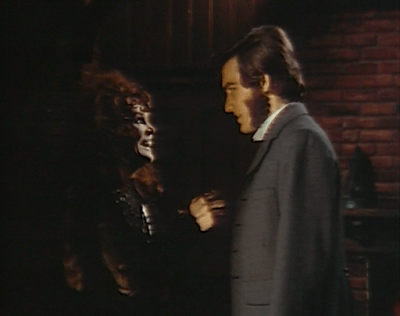
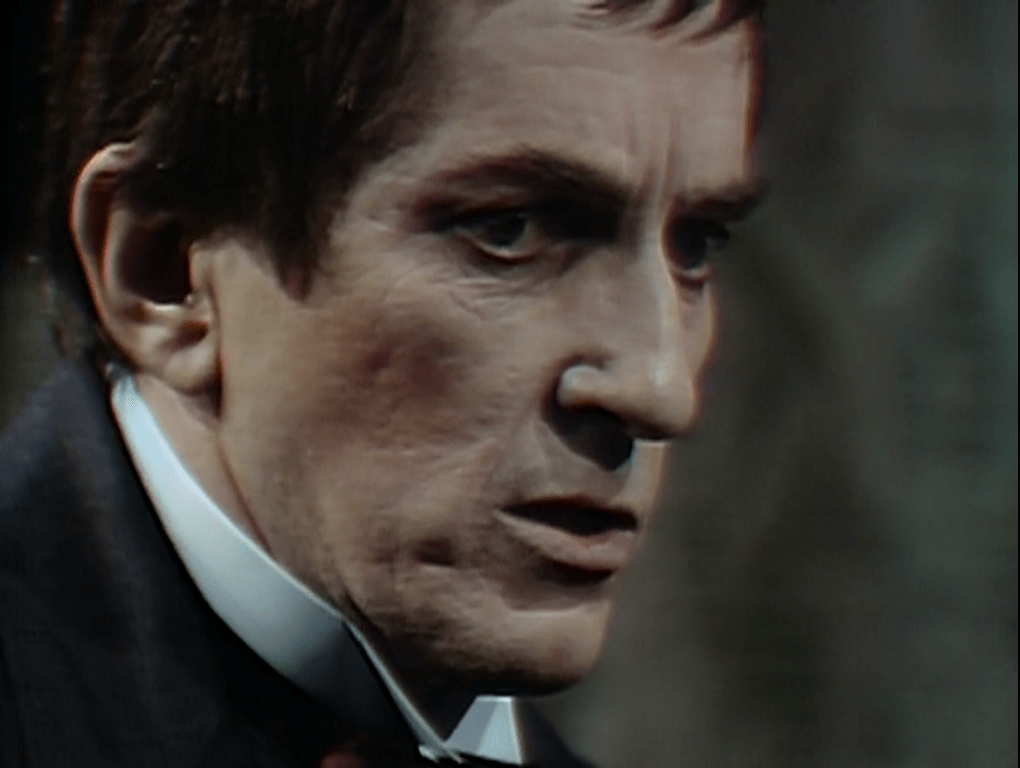
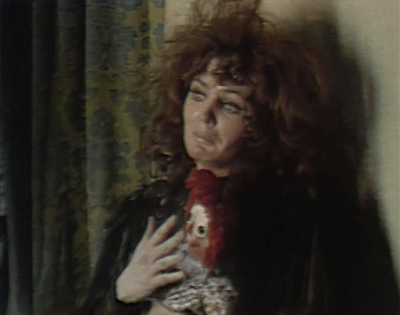
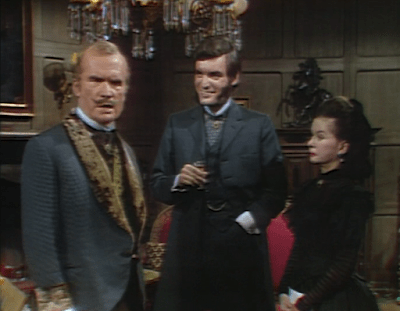
Barnabas shocks everyone with his arcane knowledge. Screenshot by Dark Shadows Before I Die.

Judith agrees to let Barnabas try his mumbo-jumbo. While the ladies are upstairs, Barnabas and Carl are in the drawing room, burning some potpourri next to Quentin’s coffin. Quentin comes lumbering in, and they withdraw to the shadows. The fun Jonathan Frid and John Karlen had working together is one of the most enjoyable things to see on Dark Shadows, but they get a little bit carried away in the moment when Barnabas and Carl hide. As they scurry off, they are so obviously a couple of kids playing that we are distracted from their otherwise outstanding performances.

Quentin comes back and resumes his place in the coffin. At Judith’s insistence, Carl and Barnabas bury the coffin on the grounds and pour cement over it. Judith assures Rachel that this means Quentin will not come back. Rachel is disappointed when Judith says she believes that Barnabas has gone back to the Old House on the estate, where he is staying. Since they have had such an exhausting night and it is almost dawn, Judith assumes that Barnabas will want to go to bed. Judith herself does retire.

Barnabas comes back and tells Rachel that he had to make sure she was all right. She thanks him, and says that during the day she will be leaving Collinwood, never to return. He asks her to reconsider. He says that he wants to see her again, but that he has to leave immediately and he cannot possibly return until the following night. He will not tell her why. Regular viewers know that Barnabas is a vampire and that he will turn to dust if he doesn’t get back into his coffin in a few minutes and stay there until sundown. Barnabas doesn’t seem to think that his relationship with Rachel has come to a point at which he can share secrets like that with her, so he evades her questions and rushes off. Rachel heads upstairs.

We see the doors open by themselves and hear the wind. Thinking Barnabas has returned, Rachel hurries down. Baffled that no one is there, she goes outside. She turns and sees Quentin. He plods towards her, and she faints into his arms. This impressively well choreographed movement brings us to a dramatic conclusion.

Episode 722: Too good-looking to die from old age

Another drab-looking outing from director Henry Kaplan, enlivened with some witty writing by Violet Welles and sprightly acting by John Karlen and David Henesy.

Daft prankster Carl Collins (Karlen) goes to the suite in the west wing of the great house of Collinwood recently occupied by his brother, the late Quentin Collins. Carl finds his nephew, twelve year-old Jamison Collins (Henesy) sitting by Quentin’s gramophone, listening to a sickly sweet waltz of which Quentin was fond. Carl mutters and rambles, claiming at one moment that Quentin is not really dead and at the next that he has a theory about who really killed him. Jamison just stares in response. Carl, agitated, demands that Jamison turn off the gramophone. When he does not answer, Carl declares that he is Jamison’s uncle. Jamison calmly replies that Carl is not his uncle, but his brother.

Carl comes back with his sister Judith. They question Jamison, who seems to know things only Quentin would know. Judith declares that “The child is possessed!” and flounces out of the room.

Jamison’s governess, Rachel Drummond, has a dream in which Jamison and Judith make her uncomfortable. She tries to go to the drawing room, only to find Carl blocking her way. He is wearing a railroad conductor’s hat and holding Jamison’s toy locomotive. He tells her it is too late to pass this point, and shows her a gigantic pocket watch to prove the point. She wakes up to find Quentin’s body sitting in a rocking chair next to her bed.

April first, a very important date! Screenshot by Dark Shadows Before I Die.

Episode 721: If he stays dead now

Well-meaning time-traveler/ bloodsucking fiend Barnabas Collins enters a cottage on the grounds of the estate of Collinwood to find thuggish groundskeeper Dirk Wilkins standing over the freshly stabbed corpse of the rakish Quentin Collins. Since Quentin’s cause of death is a long-bladed thrusting dagger, a weapon also known as a “dirk,” it would seem clear that Wilkins is the culprit. But as it happens, Barnabas saw Wilkins enter the cottage a moment before, so he can be fairly sure he did not kill Quentin.

Nonetheless, Barnabas threatens to go to the police and accuse Wilkins unless he answers “a lot of questions.” Barnabas doesn’t have any witnesses to back up his version of events, and though he claims to be a relative of the ancient and esteemed Collins family he only arrived in town a few weeks before. But Wilkins isn’t hard to intimidate, so he answers some of Barnabas’ questions about madwoman Jenny Collins. Most importantly, he tells Barnabas that Jenny is the estranged wife of Quentin, not of Quentin’s brother Edward as the audience had been led to believe in the four weeks leading up to Friday’s episode.

As Wilkins, actor Roger Davis has been getting very careless with his lines. Jonathan Frid always had a lot of trouble with his own dialogue, but he is clearly sticking with the script in an exchange like this:

Wilkins: Mr. Collins, you gotta understand that she’s crazy in the head! She could hurt herself — or somebody!

Barnabas: Who do you mean by “we”?

This comes to a head with one of Dark Shadows‘ most famous bloopers:

Barnabas: Tell them that you saw no one here.
Wilkins: Oh, that’s fine. What am I gonna tell ’em?
Barnabas: That you saw no one here!

Jenny is being kept in a cell in the basement of the great house on the estate. Wilkins and maidservant Beth were assigned to watch her. On Friday Jenny bashed Wilkins on the head with her dinner tray, unfortunately not hard enough to kill him and get the odious Mr Davis off the show. She did knock him out, though, and ran off to the cottage to stab Quentin. We cut to the cell, where Jenny is babbling to Beth. It gradually dawns on Beth that Jenny is telling her she stabbed Quentin and killed him. Beth locks Jenny in the cell and rushes off to the cottage.

In the cottage, Barnabas has summoned wicked witch Angelique and asked her to bring Quentin back to life. Angelique points out some of the flaws in Barnabas’ plan, and tells him that even if she does grant his wish the price for her services will be very high. They seem to be approaching a tentative agreement when Beth arrives at the door and Angelique vanishes.

Beth finds Barnabas in the cottage. He tries to keep her out. It has long since been established that, as a vampire, Barnabas is far stronger than any mortal man, yet Beth pushes past him without apparent difficulty. For that matter, we also know that he is as capable as Angelique of vanishing into thin air, yet he hangs around while Beth sees Quentin’s body. Barnabas insists she tell no one what she saw in the cottage, and he is staring at her with the same intensity that has sometimes exerted an hypnotic effect on people. This doesn’t work on Beth. She says that she will tell Judith Collins, the mistress of the estate, that Quentin is dead and that Barnabas was with him. Barnabas just watches Beth go. Evidently he has given up on using his vampiric powers. Terry Crawford’s literal acting style doesn’t win her much enthusiasm from the fans of Dark Shadows, but it does add a touch of humor to a scene like this. Vampire? What’s that? Sounds like bullshit, I’m gonna report this to the boss.

We cut to the drawing room of the great house, where Quentin’s body is laid out in a coffin with candles burning on high stands by its head and foot. Barnabas and Beth are there. Beth tells Barnabas she has not yet spoken to Judith. Apparently she just took Quentin’s body to the great house on her own? And found a coffin? And carried it into the drawing room where she put Quentin in it? And that’s how the family is going to find out Quentin is dead, by seeing him lying in state in the middle of the house?

I have questions. Screenshot by Dark Shadows Before I Die.

Barnabas and Beth exit, and Angelique enters. She tells the corpse that she will raise him from the dead, and that once she does Barnabas will really be sorry.

Episode 720: The big, bad wolf

From #701, the episode in which Dark Shadows first became a costume drama set in the year 1897, they have been strongly hinting that Jenny Collins, the madwoman locked in the room on top of the tower in the great house of Collinwood, is the estranged wife of stuffy Edward Collins. Today, Jenny gets loose, and confronts Edward’s brother, rakish Quentin. It is only then that we learn that she is in fact Quentin’s wife. All of the clues that had led us to the other conclusion take on new meanings in that moment, making it one of the most effective twists on the show.

Man and wife, reunited, til death do them part. Screenshot by Dark Shadows Before I Die.

Edward is the father of two children whom we have seen, twelve year old Jamison and nine year old Nora. Jenny has been preoccupied with some dolls she has with her in her prisons, which she calls “my babies.” She is afraid someone will take her “babies” from her.

We came to 1897 along with well-meaning adventurer/ bloodsucking ghoul Barnabas Collins, who in 1969 encountered the ghosts of Quentin and of maidservant Beth. Quentin’s ghost had made the great house uninhabitable and was in the process of killing strange and troubled boy David when Barnabas decided to resort to the mumbo-jumbo that has brought him back to this period. In 1969, Barnabas was not only trying to contain the damage Quentin’s ghost was doing; he was also trying to help drifter Chris Jennings, who was a werewolf. Beth’s ghost appeared to Chris and led him to an unmarked grave containing the remains of an infant wearing an amulet meant to ward off werewolves. This proved that there was a werewolf at Collinwood when Beth and Quentin were alive, and suggested that Chris’ curse was inherited from that person.

When Barnabas first met the living Beth in # 703, he asked if there were any children in the house other than Jamison and Nora. She said that there were not. He wondered if the newborn to whose grave Beth’s ghost led Chris had already died and been buried. But now that we know that Jenny is Quentin’s wife, we remember that in that same episode Quentin caught Beth with $300 and that in #707 we heard that she had taken the money to a “Mrs Fillmore” in town. Perhaps Jenny really did have babies who were taken from her, and perhaps Mrs Fillmore is taking care of them. Perhaps, too, the “Jennings” in Chris’ name indicates that he is a descendant of Jenny, and therefore of Quentin. We have already seen Quentin dabbling in black magic- perhaps he brings the curse of the werewolf on his descendants by means of it.

Jenny’s meeting with Quentin today does not come to a happy ending as far as he is concerned. She leaves him on the floor, with a dagger stuck in his chest.

While the search is on for Jenny, Beth tells another servant that Edward and Quentin’s sister Judith has searched the west wing and is now searching the east wing. This is only the second time the dialogue has made it unequivocally clear that there are two wings extending from the main house, and the first time it is established that the east wing exists prior to the twentieth century. There was a time when the writers had not settled on which side of the house the long-deserted wing lay; the first couple of appearances of the phrase “east wing” dated from then. Subsequently, there were slips of the tongue by actors who were supposed to say “west wing.” We may wonder when, if ever, the writers will find a use for this other part of the house.

Episode 719: Every person has a theme of music

Most of the characters in the part of Dark Shadows set in the year 1897 are villains of one sort of another, but we are supposed to take pleasure in watching them. One exception is the loutish Dirk Wilkins, groundskeeper on the estate of Collinwood. Dirk is humorless, unimaginative, violent, and surly. He is unpleasant to everyone, even his employers. When spinster Judith Collins, the owner of the estate, tells Dirk today that she has an opportunity for him to make some extra cash, he virtually sneers his acceptance. He says in so many words that all he cares about is money, and that he will do anything to get it.

The show didn’t really need to work so hard to make Dirk unlikeable. They’ve already cast instantly detestable actor Roger Davis in the part. But we can see why it was important to them that we have no sympathy for him. Judith hires Dirk to keep an eye on a madwoman named Jenny, whom she and her brother Edward are secretly keeping locked up in a cell in the basement of the great house. We know that Jenny is eagerly looking for someone to stab to death, and so we might be inclined to make excuses for her captors, no matter how screwy their approach. But when Jenny tricks Dirk into looking away from her and slams her dinner tray down on his head, she wins our enthusiastic support. We don’t particularly want her to kill anyone other than Dirk, but we cannot be satisfied with her situation.

Go Jenny go! Screenshot by Dark Shadows Before I Die.

The reason Dark Shadows is now a costume drama set in 1897 is that the evil ghost of Quentin Collins overwhelmed every plot point in 1969. So well-meaning time traveler/ bloodsucking fiend from beyond the grave Barnabas Collins did some mumbo-jumbo and brought us back here. Part of Quentin’s reign of terror in the late 1960s was causing a sickly little waltz to resound incessantly throughout the halls of the great house. It turns out the living Quentin is equally insistent on playing the same crepuscular tune on his gramophone to the annoyance of everyone around him. Today Judith declares that the waltz is driving her mad. Quentin apparently thinks he is on a prime-time show where every character has a dedicated musical cue, and declares that “every person has a theme of music” and this creaky jingle is his, so he refuses to stop running it into the ground.

Judith can’t do anything to stop Quentin from playing the waltz over and over, but she isn’t the only one whom it bothers today. The sound of the gramophone leaks from Quentin’s room down to Jenny’s cell, and drives her into the homicidal frenzy that will carry through from her assault on Dirk to the the end of the episode, when she will be holding Quentin’s dagger and wearing a blissful grin. Quentin is so much fun to watch that even his unrelenting playing of the waltz isn’t enough to make us want Jenny to kill him, but if she could chop up his record player that’d be great.

Episode 718: Spy school

The principal writer of the first seventeen weeks of Dark Shadows was Art Wallace, who was interested in characters as one another’s reflections. Many of his episodes were structured as diptychs, in which we would alternate between two small groups dealing with similar situations. In the comparison, we would see that people who were in some ways very different from each other or hostile to each other would make the same decisions when faced with the same circumstances.

Wallace left the show in October 1966, never to return, but his interest in mirroring comes up again and again. The current storyline centers on Barnabas Collins, who has traveled back to the year 1897. In the first months of 1969, the ghost of Quentin Collins was persecuting strange and troubled boy David, and it was to rescue David that Barnabas participated in a summoning ritual which, to his surprise, got him unstuck in time and brought him face to face with the living Quentin. It also turned Barnabas back into what he was for 172 years, a vampire.

This story is the inverted image of Dark Shadows‘ first costume drama insert, which ran from November 1967 to March 1968. In that period, well-meaning governess Vicki participated in a summoning ritual because she knew that some supernatural menace posed a mortal threat to David. She did not know who that menace was or in what way he was supernatural, but the audience knew that it was Barnabas the vampire. During the four months of that uncertain and frightening journey into the past, we learned how Barnabas became a vampire and that he could be interesting even if he were not one. Vicki didn’t learn anything, and would eventually be written out of the show.

Early in today’s episode, Barnabas is in the room on top of the tower in the great house on the estate of Collinwood. This room was introduced in the 1790s story as one of the places where Barnabas was hidden. In this period, a mentally ill woman named Jenny Collins is hidden there. Governess Rachel Drummond sneaked into the room because Barnabas’ unwilling associate, ethnic stereotype Magda Rákóczi, read Rachel’s palm and told her she had a deadly enemy who was hiding there, and that if she let that enemy choose the time of their first meeting she would have no chance of survival. Jenny sprang from the room, locked Rachel in it, went to the main part of the house, and set fire to the sheets of the bed in which the stuffy Edward Collins lay sleeping.

Barnabas heard about this from Rachel, who reminds him of his lost love Josette. He knows that Angelique, the wicked witch who turned him into a vampire in the first place, is operating in this period and that she has already targeted Rachel. He knows nothing about Jenny, and so he assumes that Angelique is lurking in the tower room. When he enters it, he opens an armoire and finds a doll’s head. The rest of the doll is not attached and the back of the head is caved in, but the face is undamaged. This is the first suggestion of a mirror, a device in which a face can be seen intact and functional even though it is separated from the rest of the person.

Barnabas calls for Angelique and she appears. Barnabas denounces Angelique’s crimes; Angelique brings up his. She asks what he sees when he looks in the mirror, then remembers that he casts no reflection. Angelique does not mention what we have seen ever since we first met her during the 1790s segment, that the vampire curse made Barnabas into her reflection. Today, for example, she gleefully taunts him with the murders he has committed, including those her curse compelled him to commit. This reminds longtime viewers of #341, when Barnabas pressured his friend Julia Hoffman into helping him kill a man named Dave Woodard and then gleefully taunted her with her new status as a murderer.

Angelique tells Barnabas that he has only to love her and she will cease to be his enemy. She makes it clear that she knows all about the mission that has led him to travel back in time from 1969, and offers to help him accomplish it. She suggests that it is his hatred for her that has led her to treat him and everyone around him so cruelly for so long. She says that she will return his love as abundantly as she has returned his hate. She claims to be his mirror, as we know he has long been hers, and offers to show him a pleasing reflection if he submits to her desires.

Barnabas angrily refuses, and Angelique conjures up an image of his impending destruction in the window. Barnabas will not look into this magic mirror, and when he seizes Angelique she vanishes from his arms.

Quentin is on his guard against Barnabas. In the course of an adorable scene in which Quentin and his twelve year old nephew Jamison pretend to be spies, he sends Jamison to steal something that belongs to Barnabas.

Spy school.

Jamison is leery of the whole thing; he says that Quentin doesn’t know any more about real spycraft than he does, forcing Quentin to admit that he was in fact a spy for the police in Egypt not so long ago. This too will get the attention of longtime viewers. Jamison is played by David Henesy, who in the parts of Dark Shadows set in the 1960s plays David Collins. Jamison and Quentin are in the groundskeeper’s cottage on the estate, which from December 1966 to March 1967 was home to David’s mother Laura Murdoch Collins. Laura often told the story of the Phoenix, usually setting the scene in an unnamed land which, she said in #140, “Some call… Paradise.” But she leans heavily enough on the existing mythology of the Phoenix that she reminds even readers who have never heard of Herodotus of ancient Greece and Egypt. Laura herself turned out to be a supernatural phenomenon consisting of several distinct beings reflecting themselves back to each other.

Quentin decides that Jamison must sneak into Barnabas’ house and bring his cane back to the cottage. After he does so, Quentin casts a spell that causes Jamison to speak with the voice of Ba’al, a title for various gods whose cults are remembered very unfavorably in Judaism, Christianity, and Islam. Among other grim associations the name of Ba’al brings to the minds of those who adhere to the great monotheistic religions is the practice of child sacrifice among the Phoenicians, a practice that often involved the burning of the body of the sacrificed child. Since “Phoenician” and “Phoenix” sound so much alike,* longtime viewers may well associate Ba’al with Laura.

Quentin has made a voodoo doll of Barnabas. Through Jamison, Ba’al says that only silver will work against Barnabas. Silver is of course used in making mirrors, and the piece of silver Quentin uses to inflict disabling pain on Barnabas is the head of Barnabas’ own cane. So once more Barnabas finds himself oppressed by a reflection, or perhaps by the absence of a reflection.

Barnabas is with Magda when he collapses under the pain Quentin is causing him. They discover that the cane is missing. Magda figures out what is happening, and rushes to the cottage. She confronts Quentin, jeering at his cowardice. Quentin is no man at all. He is using a child as a pawn in a black magic rite, and fighting an enemy using a doll. Magda looks at Quentin’s face and reacts with horror as the image of a skull is superimposed on it. She recognizes this as a sign that he will die soon.

Jamison has scenes with both Quentin and Magda today. David Henesy had such great chemistry with David Selby that it’s no wonder Mr Selby named his son “Jamison,” and Hall’s equally great chemistry with him leads me to suspect that if her son Matthew hadn’t already been born when she joined the show he might have been named for Mr Henesy as well. Hall and Jonathan Frid are always wonderful together, and today’s Barnabas/ Angelique confrontation is the best scene Frid and Lara Parker have shared so far. Angelique’s maniacal intensity has always set an upper bound to how responsive Parker could be to Frid’s performance. She is calm enough today that we see them for the first time really in the same space.

*As well they might- they both come from the ancient Greek Φοίνιξ, an adjective meaning “red.” Herodotus calls the legendary fire creature “red-bird,” and the Greeks named the northern Canaanites after the red dye they bought from them.

Episode 717: I know what color a lie is

A showcase for the actors today. We begin in the room on top of the tower at the great house on the estate of Collinwood. Madwoman Jenny Collins, who has been locked up in that room for some time, is threatening to stab her sister-in-law Judith with a large pair of scissors. Judith and her brother Edward have been hiding Jenny and trying to keep the rest of the family in the dark about her presence in the house. For services to this secret, they have been paying maidservant Beth Chavez and, we heard in #707, someone named Mrs Fillmore. Beth comes in just in time to distract Jenny with talk about her “babies,” and thereby to prevent her from killing Judith. Jenny turns to some baby dolls, and cuddles them happily.

Judith goes downstairs and encounters newly hired governess Rachel Drummond. Rachel has caught on the someone is living in the tower room, and the other day sneaked up there and let Jenny out. Judith reprimands Rachel for seeing and hearing things that don’t exist. Rachel is a neurotic intellectual. Her insecurities compelled her to investigate the question of the tower room, and also make it plausible that she might eventually cave in to Judith’s attempt to gaslight her into believing that she didn’t really see what she saw.

Rachel goes out, and Beth enters. Judith shows how frustrated she is with the whole situation. This scene is a bit of a letdown. As Judith, Joan Bennett was brilliant opposite Marie Wallace’s Jenny, and brilliant again opposite Kathryn Leigh Scott’s Rachel. But she falls to pieces alone with Terrayne Crawford as Beth. So many of the fansites feature so much grousing about Miss Crawford’s literalist style of acting that I hate to pile on, but it is true that she did not give Bennett anything to play off of. When Miss Crawford delivers a line, its meaning is the dictionary meaning of the words that compose it, no more and no less. She never leaves you wondering what else is going on in Beth’s mind. Sharing a scene with her would be like sharing a scene with a sign labeled “No Right on Red.” Later, Miss Wallace will have a two-scene with Miss Crawford, but as a character in a psychotic state she doesn’t need support. Her lines in that scene are flowery gibberish that don’t work at all, but neither actress is to blame for that.

The master class in acting resumes as we cut to the Old House on the estate. The mysterious Barnabas Collins has recently arrived at Collinwood and is staying in the Old House as the guest of his distant cousins in the great house. Rachel and Barnabas are attracted to each other, and she tells him what has happened. He says that he believes her, and goes on to say that no one at Collinwood is what they seem. She pleasantly replies “Except for you!” He hesitates before agreeing.

More than meets the eye.

In fact, Barnabas has more than five hundred episodes of secrets he is keeping from Rachel and everyone else. Jonathan Frid’s work prior to Dark Shadows was almost entirely on stage, but he used his face like a movie actor, keeping every part of it but his eyes virtually immobile. With that, he can isolate emotions, playing just one feeling at a time. All anyone can see by looking at him in his scenes with Rachel today is that he is anguished. Rachel interprets that anguish as a sign that he cares about her, and she is delighted to think that she has such a straightforward and reliable friend.

Returning viewers know that Barnabas is in fact the most dangerous person Rachel has ever met. That knowledge on our part frees Miss Scott to play Rachel’s relief at Barnabas’ friendliness as broadly as she likes. Her unrestrained display of good cheer brightens the episode’s otherwise somber emotional palette, but the irony the audience finds in a woman having this reaction to Barnabas keeps the dramatic tension high.

Barnabas walks Rachel back to the great house. They have made a plan that she will bring him the key to the tower room and he will go up there to investigate. She impulsively kisses him on the cheek. Rachel goes in the house and finds to her surprise that Judith is still awake. Judith detains Rachel in the drawing room with a glass of sherry and a lot of disconnected talk. Judith doesn’t make eye contact with Rachel during this scene; she doesn’t want a conversation. She is simply enjoying her new position as head of the household. Rachel cannot get away until Beth enters and Judith abruptly dismisses her.

Barnabas has been watching the windows of the tower room and has seen lights go on and off. Nervous, he considers letting himself into the room without a key; he has the means to do that, but he would like to keep Rachel from knowing about his abilities, and so he resolves to wait for her.

After Rachel brings Barnabas the key, he goes to the tower room and uses it to let himself in. No one is there. He picks up the damaged, severed head of a doll, one of Jenny’s “babies.” Suddenly, he hears someone enter. He turns, and reacts with shock.

Episode 716: Someone who is not going to come

Governess Rachel Drummond has figured out that her employers, the Collins family of Collinwood, are keeping someone locked in the room atop the tower in the great house on the estate. Rachel has seemed frightened ever since we first saw her, in #705, and this information has added to her fear considerably. Rachel recently came to the conclusion that some unknown person was trying to harm her. She then let Romani stereotype Magda Rákóczi talk her into believing that the prisoner in the tower room was that person, and that her only hope was to choose the time of their confrontation.

Today, Rachel opens the door to the room and goes in. We know that the enemy Rachel ought to fear is wicked witch Angelique, and we can tell that the person in the room is not her. Instead, she is a madwoman named Jenny, and she is tall with red hair. Jenny attacks Rachel, pushes her back in the room, and flees, locking the door behind her and trapping Rachel.

The show has been dropping broad hints that Jenny is the estranged wife of stuffy Edward Collins and the mother of Edward’s children, Rachel’s charges Jamison and Nora. Once she is on the loose, Jenny slips into Nora’s room and looks at a framed picture of Edward there, expressing her hatred for him. Nora has been outside; she had a dream that her missing mother came home, and she went out to look for her. When Nora comes back into the room, Jenny dares not show herself, but stays in the shadows and longingly caresses a doll.

Jenny, in 1897, with a Raggedy Ann doll, first made in 1918. Screenshot by Dark Shadows Before I Die.

A servant named Dirk Wilkins figures in the episode a couple of times. He finds Nora outside, picks her up, and with considerable roughness carries her into the house. Perhaps this roughness is only apparent, but actor Roger Davis was notorious for physically abusing his scene-mates on camera, especially women and children. He may well have been even harder on Denise Nickerson than Dirk is on Nora.

One of my ways of making the show tolerable to watch when Mr Davis is on camera is to imagine someone else playing his part. Dirk is supposed to be unlikable; he sneers at everyone, even his employers. In the part of Dark Shadows set in 1968, a character named Harry Johnson had a similar manner, and even wore a costume like Dirk’s. The first actor to play Harry was Craig Slocum, who was pretty bad, but the second, Edward Marshall, took the same personality and made it quite amusing to watch. Mr Marshall might have made a fine Dirk. Other accomplished performers had small turns as background players on Dark Shadows and surely would have been glad to accept speaking roles. Among these, Harvey Keitel (Dancer at Blue Whale in #33) and David Groh (Ghost of One-Armed Man in #544 and Hangman’s Assistant in #664) went on to do outstanding work playing ill-tempered men, so in either of their hands Dirk might have become a breakout star.

Episode 715: The grace to be curious

The first character Dark Shadows introduced was Victoria Winters. Vicki began her life as an infant in care at the Hammond Foundling Home in New York City. She grew up there, then “stayed on as a teacher.” For reasons no one would ever explain to her, Vicki was called to the great house of Collinwood to serve as governess to strange and troubled boy David Collins.

In those first months, the Collinses of Collinwood were running out of money, barely able to hold on to the estate and the family business. It was credible that if they were to hire a live-in tutor for David, they would have to settle for someone with Vicki’s slender resume.

By the time Vicki was written out of the show in its 126th week, Dark Shadows had long since forgotten all the stories about the Collinses’ straitened finances, and retconned them as boundlessly rich. So it took some explaining that they replaced Vicki with Maggie Evans. Maggie started off as a wisecracking waitress who introduced herself to Vicki in #1 by declaring that anyone who lived at Collinwood was a “jerk.” Her signature line, spoken in #128, was “Whaddaya hear from the morgue?” Long after Maggie morphed into The Nicest Girl in Town, there was never a sign that she had any formal education beyond high school or any interest in teaching at any level. She was the show’s chief representative of Collinsport’s working class, and her relationship to the Collinses was far from warm.

So when they want to get Maggie into the great house to be the besieged and uncertain new governess in an adaptation of The Turn of the Screw, they show us matriarch Liz in a tizzy over Vicki’s mysterious disappearance. Liz insists that David and his friend Amy must have a new governess immediately, that very night, and that since Maggie is available and the children both know and like her, Maggie it must be.

Now the show has become a costume drama set in 1897, when the Collinses are at the apex of their wealth. There are two young children in the great house, so there ought to be a governess. She is Rachel Drummond, and she was introduced in #705. Like Maggie, she is played by Kathryn Leigh Scott. Unlike Maggie, she was trained for the position, recommended by an agency, and brought to the estate by the children’s father. Rachel speaks with the precise elocution one might expect of a late-Victorian governess. Her talk is intellectually ambitious- today, she discusses a work of philosophy she once studied, and when we hear her make remarks such as “I should become a realist,” it sounds like she is saying that she ought to join some movement in literature or the arts. One of the things that has surprised me most on this watch-through of the show is what a capable actress Miss Scott already was so early in her career. Rachel is worlds away from the occasionally hardboiled, never bookish Maggie, and even further removed from the other role we have already seen Miss Scott play, the gracious and ghostly Josette.

The show calls our attention to the contrasts between Rachel, Maggie, and Josette today. Rachel goes to the Old House on the estate and meets with Romani stereotype Magda Rákóczi. Rachel looks at the portrait of Josette over the mantel and says “We’re supposed to look alike… at least he says we do.” The “he” in question, Magda’s boss Barnabas Collins, is a well-meaning time-traveler/ bloodsucking abomination from the depths of Hell who in May and June of 1967 abducted Maggie and tried to replace her personality with Josettte’s.

Magda takes some money from Rachel in return for reading her palm. Magda is played by Grayson Hall, who first appeared on Dark Shadows a week after Maggie escaped from Barnabas. At that time she was Julia Hoffman, MD, Maggie’s psychiatrist. Seeing her examine Rachel’s palm today and hearing her tell Rachel all about herself, we remember when Julia used to shine a light in Maggie’s eyes and probe for information about what happened to her. Knowing that Magda is in Barnabas’ service, we remember that Julia shifted her loyalties to Barnabas and used her powers of hypnosis to erase Maggie’s memory of what he had done to her. We might wonder if Magda will move in the opposite direction, and betray Barnabas for Rachel’s sake.

Expert examination. Screenshot by Dark Shadows Before I Die.

There is a scene today between Rachel and Edward Collins, father of her charges. Both Miss Scott and Louis Edmonds have trouble with their lines, and each of them breaks eye contact at inappropriate moments. These awkward bobbles coincide with a lot of noise that sounds like a newscast. That noise is most likely audio bleedthrough from what was on the videotape before they recorded the episode on it, but the actors’ signs of distraction coincide with it so exactly that it is hard to dismiss a suspicion that what we are hearing was audible in the studio.

Episode 714: The available ladies in the house

One day in the year 1897, Edward, Carl, and Quentin Collins hear their sister Judith read their grandmother’s will. Stuffy Edward and childlike Carl are shocked to find that Judith is the sole heir of their family’s vast holdings. Quentin stole the will and tried to forge a new one, so he is not shocked, but he is weirdly gleeful about the paragraph relating to him. He will receive no property and no income, but will be guaranteed a place to live in the great house of Collinwood forever. This enshrines his relationship with Judith as one of the clearest examples of Dark Shadows’ signature dynamic of Bossy Big Sister and Bratty Little Brother. No matter how atrociously Quentin may behave, no matter how loudly Judith may disapprove of him, she has no authority to punish him and her concern for the family’s good name will compel her to cover up his misdeeds and shelter him from their natural consequences.

Edward flummoxed, Quentin delighted, Judith in charge. Screenshot by Dark Shadows Before I Die.

Meanwhile, governess Rachel Drummond and ladies’ maid Beth Chavez are busy with a mystery concerning the room on top of the tower that stands in the middle of the great house. Rachel has seen lights in the room and suspects someone is being held prisoner there; contrary to the direct orders of Judith and Edward, and against Beth’s very strongly worded advice, Rachel is investigating this matter aggressively. She sneaks up the stairs to the top of the tower, listens at the door to the room, and sees Beth coming out of it with a tray.* She then goes to Beth’s room, where she interrupts Quentin sexually harassing Beth. When she tells Beth what she saw in the tower and asks about it, Beth is shocked that Rachel went into the tower. She denies everything.

Later, Rachel goes back to the top of the tower and again listens at the door. She hears a cradle rocking. We saw that cradle in #645, when Dark Shadows was set in contemporary times and Quentin and Beth were ghosts haunting children David Collins and Amy Jennings. They sent Amy and David to fetch the cradle from the attic of the Old House on the estate and to bring it to Quentin’s old room in the west wing of the great house. This is one of the first times in the 1897 segment when we explicitly close a loop opened during the “Haunting of Collinwood” story.

*At the beginning of the episode, we saw Beth approach the room with the tray and a baby doll. During that scene, we hear what I believe is new music. It has been quite some time since we have heard any new cues, so this stands out.