An information management day. Old world gentleman Barnabas Collins has told his distant cousin, Roger Collins, about a parallel universe that is occasionally visible in a room in the long disused east wing of the great house of Collinwood. Today, Roger tells his sister Elizabeth about the room. Liz owns the house. We might wonder if she will have questions about what effect the presence of a spare universe on the premises will have on her property taxes.
Roger talks about the phenomenon while standing in the room with permanent houseguest Julia Hoffman, MD. He is incredulous when he notices that Julia is not listening to him. She cannot tell him what has distracted her. Unknown to Roger and Liz, Barnabas is a vampire. Julia has devised a treatment that is supposed to put this curse in remission, but it is not working at all. She has given him the last of the injections, and the only difference in Barnabas is that he is getting sick and feeling an unusually intense bloodlust.
Caretaker Chris Jennings, another distant cousin, comes stumbling home to his cottage on the grounds of the estate. He finds his girlfriend and ex-fiancée Sabrina Stuart waiting for him. Chris is another patient Julia has been unable to help. He is a werewolf. There was a full moon last night. Sabrina tells Chris he killed a man named Bruno. Chris is distressed that he killed anyone, but Sabrina points out that Bruno knew of his secret and was trying to use him to kill others. He was holding her and a man named Rumson prisoner, and when the police searched Bruno’s premises after his death they found Sabrina and Rumson imprisoned there. Sabrina keeps telling Chris she wants to marry him. Most of the time they will live ordinary lives, but one night out of 28 she will just have to lock him up in a special cell. Chris won’t hear of this.
My wife, Mrs Acilius, is a great one for love stories and an admirer of actress Lisa Blake Richards. Chris and Sabrina have run out of road on Dark Shadows, and are obviously going to be written out soon. Mrs Acilius wishes they could ride off into the sunset accompanied by the sound of wedding bells. So when Chris refused to marry Sabrina, she exclaimed “Stupid man!” I pointed out something Chris knows but does not mention to Sabrina, that his curse is hereditary. Any male descendants he has will also be werewolves. Mrs A conceded that this does complicate matters.
Roger saw Chris at Bruno’s place when he rescued him and Carolyn shortly before moonrise last night. Chris was at that time in the throes that precede his transformation. Chris ran off before Roger or Carolyn could see what became of him. Roger comes to the cottage to check on him.
Chris is in the back changing out of his bloody clothes, so Sabrina answers the door. She tells Roger that Chris is there and that she was with him all night, watching over him because he was ill. After what he saw of Chris at Bruno’s, Roger has no doubt that Chris needed a nurse, and he tells Sabrina that he is glad he had such a charming one. The audience can understand that Sabrina wants to conceal Chris’ lycanthropy from Roger, but surely it cannot be wise for her to claim that she was in the cottage overnight. Not only are her true whereabouts known to everyone who was in or around the police station the night before, but since Roger was the one who found Bruno’s body and he found it on the grounds of Collinwood, even police as inept as the ones in Collinsport are likely to follow up with him. Besides, her imprisonment with Rumson is a sensational story, of interest to the press. Maybe we will move on to the next phase of the show before the facts come to light, but Sabrina can’t know that.
Sabrina is determined to persuade Chris to resume their engagement. She goes to the one person whose opinion Chris seems to respect, Barnabas. When she knocks on his door, Barnabas hides behind a partition. When Sabrina first arrived, she had seen Barnabas through the window of his front parlor, so she lets herself in. He finally gives up on hiding and pleads with her to leave. She ignores what he is saying and keeps talking. She plows ahead with her idea about how Barnabas can help her and Chris become a happy married couple. Barnabas struggles to resist his urge for blood, but cannot. He bites Sabrina, much to her surprise. Miss Richards’ understated exclamation of “Barnabas!” when he shows his fangs and goes for her neck is very nicely done, it really sounds like a woman puzzled that a trusted friend is violating her personal space.
Sabrina staggers back to Chris’ cottage. She collapses in his chair, and he sees the puncture wounds on her neck. They are much bigger than the marks we’ve seen on Barnabas’ previous victims. I suppose he really was a lot hungrier than usual. Chris doesn’t know that Barnabas is a vampire, and the cliffhanger leaves us wondering whether he can avoid finding out.
Probably the most memorable shot in the episode is a very impressive bit of videotape editing. Roger and Barnabas are standing at the door to the Parallel Time room, watching Roger’s counterpart interact with Liz’ and Chris’. Parallel Roger walks toward the door. He exits the room, not into the space Roger and Barnabas occupy, but into the hallway as it exists in Parallel Time. He vanishes from their view, and the effect also winks out in the room, leaving Roger and Barnabas looking into the bare, dark chamber it is in the house they know.
When Dark Shadows began, its most dangerous villain was high-born ne’er-do-well Roger Collins. Since the plan was to kill Roger off after his crimes were exposed, writer Art Wallace and actor Louis Edmonds were free to present him as gruesomely as they pleased. That turned out to be so much fun for all concerned that it soon became impossible to imagine the show without Roger, and the plan changed.
Once Roger was established as a permanent part of the ensemble, they toned his wickedness down. He still did and said awful things, but they would pull him back whenever he might risk alienating the audience. So, he at first openly expressed his hatred for his young son, strange and troubled boy David, and in #68 and #83 coldly exploited David’s mental health problems to manipulate him into trying to murder well-meaning governess Vicki. But when David got Vicki into a situation that might actually have resulted in her death, Roger rescued her. When Roger’s estranged wife Laura showed up and wanted to take David away with her, Roger was so delighted at the prospect of getting rid of the boy that he willfully ignored one sign after another that something was seriously wrong with Laura. But when Vicki finally proved to him that Laura was an undead fire witch who intended to incinerate David, Roger joined in the effort to save him, and was so shaken by the experience that he would never again be overtly hostile to David.
Nor was his attitude towards David the only sign of Roger’s pathological lack of family feeling. He had squandered his inheritance, selling his half of the family business to finance his extravagant lifestyle. His sister, reclusive matriarch Elizabeth Collins Stoddard, went deep into debt buying back what Roger had sold. When Roger ran out of money, Liz took him and David in at the great house of Collinwood. When in #41 Liz reproved Roger for the difficult position she had put him in, he proudly declared that he had “enjoyed” his inheritance, and twitted her for her dreary ways. Liz gave Roger a job in the business, but the only time we saw him visiting his office he answered his phone and told the caller that what he was asking was someone else’s job. When in #273 Roger found that seagoing con man Jason McGuire had tricked Liz into believing that she had a terrible secret that she could keep only by surrendering her whole fortune to him in blackmail payments, he admitted to his sister that if she had confided her troubles in him, he would probably have done the same thing.
When vampire Barnabas Collins succeeded Laura as Dark Shadows‘ supernatural Big Bad, Roger was pushed to the margins of the story. From that time on, he had two things to contribute. The first were sarcastic remarks, many of them very funny, that established him as the show’s sardonic gay uncle. The second, which gave him what little function he retained in the plot, were ostentatious refusals to believe the evidence piling up on all sides that the family was beset by a procession of bloodthirsty monsters. Since several other characters, Liz among them, also refused to face these facts, the show could go long periods of time without featuring Roger at all.
In November 1967, Vicki came unstuck in time and found herself in the year 1795. From then until March 1968, Dark Shadows was a costume drama set in that period. The segment was a hit in the ratings, and a triumph for Louis Edmonds, who was cast as haughty overlord Joshua Collins. Joshua was the opposite of Roger- as protective of the family’s position as Roger was careless of it, as committed to making money as Roger was thoughtless in spending it, as courageous in the face of physical danger as Roger was cowardly. The 1790s segment became The Tragedy of Joshua Collins, as we saw how Joshua’s best qualities led him to create the dark and twisted world in which his descendants would grow up to be weak, selfish men like Roger.
When the show came back from the 1790s, Roger was obsessed with a portrait painted in those days. The portrait’s subject was Angelique, the wicked witch who precipitated the disasters that annihilated Joshua’s family. Before long, Angelique herself returned, wearing a wig, using a false name, and married to Roger. The spell Angelique cast to win Roger occasionally caused him to think he was Joshua, and by the time that story ended Roger had become, if not the imperious tycoon Joshua was, certainly a hard-working, conscientious family man. He still had a languid manner and a way with a quip, but was otherwise unrecognizable as the show’s original Man You Love to Hate.
Evil spirits drove the Collinses out of the great house of Collinwood in #694. That episode marked the end of Roger’s function as one of the “There must be a logical explanation!” people. He was the last member of the family to insist that everyone else was being silly, but when he finally accepted the reality of the situation and was on his way out of the house, he turned to declare to the ghosts that the living would be back to reclaim what was rightfully theirs. From that moment on, Roger was no longer a narrative brake pad.
For most of 1969, Dark Shadows was set in 1897. In that year, we got to know Quentin Collins, who as a ghost would be chiefly responsible for the haunting that had driven the Collinses out of Collinwood. We saw that the living Quentin was a charming rogue, a spendthrift who cheerfully tells his sober-minded sister Judith that he can waste money faster than she can give it to him, inclined to violence when it serves his purposes and quick to run away when he is in danger of being called to account for his crimes. In short, he is what Roger originally was, only played by a younger, sexier actor, and with an unlimited future on a show that has discovered the characters won’t alienate the audience by being evil, only by being dull.
In the 1897 segment, Edmonds played Quentin’s brother Edward, who was not dull, but not evil either. Edward was stuffy and hypocritical. He was occasionally cruel, sometimes because of greed, sometimes because of prejudice, and sometimes because he flew into a panic in the face of an unexpected danger. But he was sincerely devoted to his children, and he had a sense of decency that would assert itself even after he had done awful things. For all his faults, Edward was ultimately one of the most lovable characters Dark Shadows ever created. If 1795 was The Tragedy of Joshua Collins, 1897 was largely the Comedy of Edward.
After 1897, Dark Shadows spent several months bogged down in an attempt to make a story out of some themes drawn from the tales of H. P. Lovecraft. Roger showed up in this part of the show just a few times. Quentin, brought into contemporary dress intact due to his great popularity in the 1897 segment, told Roger what was going on in #958. Rather than scoff as he would have in 1967 or 1968, Roger accepted Quentin’s account at once and helped him in the battle. Roger had by that point turned into Edward. His habit of denial was gone, and with it all of his languor and most of his wit.
Now the show is clearing out the last villains left over from the Lovecraft project and launching a story about a parallel universe that is occasionally visible through a doorway in the long-disused east wing of the great house. Roger is active in both of these plots today.
Even when he was a villain who cared nothing for his son, his sister, his family name, or Collinsport Enterprises, Roger very much enjoyed the company of his niece, Carolyn Collins Stoddard. On Friday, he was hugging Carolyn while she wept about the difficulties she was having in her new marriage; he called her “Kitten,” a term of endearment he has used with her since #4. In those early days, the show was heavy with hints that Roger and Carolyn’s relationship verged on incest. She often answered to “Kitten” in the moments when those hints were most insistent. But there was nothing unwholesome about Roger’s embrace of Carolyn on Friday, and he is irreproachably fatherly in his attitude towards her today.
At rise, Carolyn is in a trap. A man named Bruno, one of the leftover villains introduced while the show was dealing with the Lovecraft-derived material, has tricked her into entering a room where he has already imprisoned her old friend Chris Jennings. Bruno locked the door, and Carolyn saw that Chris was on the floor, writhing in pain. She asks him what is wrong, he won’t answer. Carolyn doesn’t know it, but Chris is a werewolf. The moon is rising, and his pains are the first stage of his transformation.
Bruno’s master wants Carolyn’s husband dead, and has decided that if the werewolf kills Carolyn he will lose the will to live. Since it would have been at least as easy to get the husband into the room as it was to get Carolyn there, and since one of the main things they have told us about the husband is that he is vulnerable to werewolf attacks, this scheme is unnecessarily complicated, marked for the audience as likely to fail. Indeed, since Bruno, his master, and Carolyn’s husband are all short-timers who don’t really need to be on the show anymore, while Carolyn has been a core member of the cast since #2, we can be quite sure it will fail, and if we have spent time over the weekend wondering about the cliffhanger, we’ve spent it wondering what will save Carolyn.
What saves Carolyn turns out to be well-timed intervention by her Uncle Roger. Roger was worried that she wouldn’t tell him why she was crying about her marriage, and followed her to Bruno’s place. He saw her enter, and after a few minutes let himself in. He confronted Bruno in his parlor, heard Carolyn and Chris in the back room, and found that the door to the back room was locked. When Bruno told him the door would stay locked, Roger hit him on the head with a candlestick, knocking him out. He took Bruno’s key, unlocked the door, and freed Carolyn. While Roger telephoned Collinwood to ask for permanent houseguest Julia Hoffman, MD, Chris jumped out of the back room’s window. Roger then decided that he and Carolyn should go home.
It may strike first-time viewers as odd that Roger calls Julia and not the police. Established fans will be unsurprised, knowing that the Collinsport Sheriff’s office is one of the world’s most useless organizations and that Julia is a mad scientist whose powers know few limits. Still, once Roger gets Carolyn home he does tell her they should call the sheriff. She refuses, and also forbids him to tell her mother Liz anything about what has happened.
Roger finds Liz moping in the drawing room. He strikes up a conversation about Carolyn’s troubles. He says that he and Liz both made unhappy marriages, and that it is disappointing to see that the next generation seems determined to repeat their mistakes. He says that he wishes Carolyn would confide in one of them. Liz says that all she knows is that someone or something is threatening Carolyn’s husband, and that she refuses to discuss it. The camera pulls back, and we see that Carolyn is right there. Director Henry Kaplan was pretty bad at moving the actors around and even worse at figuring out where to point the camera, but he deserves credit for this shot. When we suddenly see Carolyn standing there, we realize that Roger and Liz are so deep in their worries that they are oblivious to their surroundings.
Carolyn insists on going to the carriage house on the grounds of the estate to see her husband. Since Bruno is at large, Roger objects. He can’t mention Bruno in front of Liz, since Carolyn has decreed that her mother must not be told what happened earlier in the evening, so he is powerless to stop her going.
Bruno does catch up with Carolyn, and he tells her he is going to kill her. Before he can do so, the werewolf springs out, pushes Carolyn aside, and slashes Bruno. She goes home and tells Roger and Liz what happened. From Carolyn’s description, Liz recognizes the werewolf as the same creature they encountered in late 1968 and early 1969, and Roger rushes out.
Roger finds Bruno on the ground. He tells Bruno he will call a doctor. Bruno says it’s too late. He says a few words (“animal… not an animal…”) and loses consciousness.
Back in the great house, Roger says that the police are searching the grounds for the werewolf. He says it’s terrible that Carolyn should have met with such an incident on top of what has already happened to her. Liz asks what he means, and Carolyn glares at him, appalled at his indiscretion. He stammers out something about how she’s having marital problems, then announces he has to go because he promised to do something for Barnabas.
Roger and Liz never have figured out that Barnabas is a vampire, and though Carolyn was briefly his blood thrall she’s forgotten all about it. So far as the Collinses are concerned, their distant cousin Barnabas is just a night person. Several times now, Barnabas has looked into a room in the east wing and has seen, not the dark space, bare floor, and sparsely decorated walls that are there in his universe, but an alternative version of the room, brightly lit, fully furnished, and heavily decorated. He has seen people with the same looks, voices, and names as people he knows, but with different personalities and relationships. He has reported this to Julia and her friend, Professor Timothy Eliot Stokes, who have explained to him the many-worlds hypothesis.
On Friday, Barnabas told Roger about the room and about Julia and Stokes’ theory. The Roger of 1967 and 1968 would have jeered at Barnabas before he had spoken five words, but in 1970 he believed him readily enough. Barnabas expressed surprise at Roger’s openness to his outlandish account, and Roger acknowledges that “a year ago” he would have dismissed it. It was thirteen months ago that Roger turned and told the ghosts that the living would someday reconquer the great house; when he says “a year ago,” perhaps Roger is rounding down. Roger agreed then to come back and check the room.
When Barnabas showed Roger the room on Friday, it was bare. When Roger goes there himself today, he finds that the parallel universe is there. He cannot pass the invisible barrier in the doorway to enter it, nor can he communicate with the people there, but he can see them and hear them.
The first resident of the parallel universe Roger sees is Bruno’s counterpart. Astonished, he exclaims “I just saw him die!” Parallel Bruno is looking at the portrait of Parallel Angelique that dominates the room and telling it that the music he wrote for her will make her immortal. Roger does not appear to recognize the portrait’s resemblance to his second wife, much less to remember that he himself used to carry on similarly one-sided conversations with her eighteenth century portrait.
Parallel Liz enters and demands to know what Parallel Bruno is doing in the room. He says he belongs there. She tells him he is the only one who thinks so. She tells him that the master of the house, who is Quentin’s counterpart, will be coming home soon, and that he will never tolerate Bruno’s presence. Bruno says that he has heard that Quentin has remarried. When Liz says this is so, Bruno declares that Angelique will never allow another woman in the house. Liz is exasperated that people keep talking about Angelique as if she were still alive. Bruno exits.
Stunned by what he has seen, Roger looks away for a moment. He thinks of going to fetch Barnabas. His attention returns when he hears a conversation between Liz’ counterpart and his own.
Barnabas saw Parallel Roger on Friday; he was talking to the portrait in a way that suggested an obsession not so different from the one which the eighteenth century portrait had inspired in the Roger we knew. Today, Parallel Roger talks to Parallel Liz about Parallel Bruno in an airy, superior manner quite out of keeping with what we have had from our Roger today, but which sounds exactly like him as he was in 1967 and 1968.
PARALLEL ROGER: Was that Bruno, the terrible-tempered boy wonder I saw just now?
PARALLEL LIZ: Yes, he’s come back.
PARALLEL ROGER: Back to compose more of his morbid music and bore us with his tiresome memories of her? Well… It’ll be worth seeing the look on Quentin’s face when he finds out, won’t it?
Alliterative series such as “terrible-tempered” and “more morbid music” were characteristic of the old Roger’s verbal cleverness, as sarcastic expressions like “boy wonder” and complaints of boredom were typical of his habit of advertising his contempt for everyone and everything. Even Parallel Roger’s closing hope of “seeing the look on Quentin’s face,” as opposed to any thought of action he might himself take, is of a piece with the old Roger’s cowardice and laziness. Our Roger is horrified by the sight of his double.
Evidently the makers of the show have decided that Roger’s development has brought him to a dead end, and they are going to use the journey into “Parallel Time” to reintroduce the original villain. That Parallel Roger shares a scene with Parallel Liz suggests that we will again see the dynamic that their counterparts in the main “time-band” pioneered on the show, the conflict between Bratty Little Brother and Bossy Big Sister. This type of conflict is still one of Dark Shadows‘ signature elements, represented most prominently by Barnabas and Julia. The 1897 segment benefited from a similar conflict between Quentin and Judith; the 1795 segment lacked such a conflict, and in its absence they had to lean pretty hard on stories that put individual characters into isolation from the rest of the cast, burning them up one by one. Perhaps they plan to use the old standoff between Bratty Roger and Bossy Liz to keep the Parallel Time story spinning if the overall narrative hits some rough patches.
This episode marks the final appearance of the main “time-band” version of Bruno; the werewolf really did kill him. It is also the last time we will see the werewolf. Alex Stevens was billed as “Stunt Coordinator” when he played the werewolf. He will stay with the show as a stuntman, but won’t get his name in the credits again.
Vampire Barnabas Collins inadvertently killed his victim Megan Todd the other night, turning her into a creature like himself. Now his chief enabler, mad scientist Julia Hoffman, is browbeating his ex-blood thrall Willie Loomis into destroying Megan. Willie is horrified by the prospect of driving a stake through a woman’s heart, and Julia gives him a pep talk. She says that staking Megan is the only way to free her of the curse and to free her blood thrall, Barnabas’ distant cousin Roger Collins, from bondage. But it is necessary to finish Megan off “most of all, for Barnabas.”
The premise of Willie’s character at this point in Dark Shadows is that he regards Barnabas as a dear friend and valued patron. When Willie first knew Barnabas, from April to September 1967, Barnabas drank his blood, beat him savagely when he defied his fiendish commands, and framed him for his crimes. Barnabas had Julia fetch Willie back from the mental hospital she controls in May 1968, so he could use him to steal bodies to use in making a Frankenstein’s monster. Barnabas’ vampirism was in remission at that time, so he did not have any supernatural control over Willie. Willie’s attitude towards Barnabas then was rather insouciant, so he and Julia kept threatening to send him back to the ward for the criminally insane unless he obeyed them. Barnabas only seemed happy during this time once. That came in #560, when he saw the agony Willie went through when he persuaded him that it would be his fault if the monster murdered Maggie Evans, The Nicest Girl in Town. I suppose people do rewrite their own pasts to make them bearable, so it is understandable that Willie has chosen to believe that his abuser was really his best buddy. Still, it does seem a bit much for Julia to tell Willie that he should destroy Megan “most of all, for Barnabas.”
Julia accompanies Willie to Megan’s hiding place in the long-disused east wing of the great house of Collinwood. Willie breaks down outside the room where Roger is guarding her coffin, and Julia has to give him another motivational speech. She tells him he “mustn’t think of Megan as a person,” but as “a creature, an evil thing,” and besides that “You must help her to rest” and that staking is “the best thing for her.” While Willie struggles to hold back his tears, she warns him against waking Roger. By the time they enter the room, Roger is awake. He fights Willie and Julia to protect Megan, and Willie defeats him only by breaking a bottle over the back of his head.
Julia and Willie take Roger out of the room. Julia tends to Roger while we hear Megan’s screams. Once the staking is complete, Roger comes to, with no recollection of how he got to the east wing or what Megan did to him. This recovery tells us Megan is destroyed.
Later, Barnabas will tell Willie to bury Megan and all her belongings in a hole in the ground somewhere out in the woods. This shows longtime viewers that Barnabas has improved his post-murder game considerably. The first time he forced Willie into helping him cover up a killing came in #276. Barnabas had strangled Willie’s sometime friend, seagoing con man Jason McGuire. He had Willie help him bury Jason in the secret room in the old Collins family mausoleum, which would eventually cease to be much of a secret and which several people could connect with Barnabas. He also neglected to do anything about Jason’s belongings. Everyone thought Jason was leaving town and was glad to see him go, so there was no investigation. But in #277, Roger mentioned to his sister, matriarch Elizabeth Collins Stoddard, that all of Jason’s stuff was still in the room he had been occupying at Collinwood. He told Liz that even Jason’s razor was still there. It was strictly a matter of luck that no one asked any questions about Jason- had they done so, Barnabas would have been in trouble almost immediately.
This episode marks, not only the end of Megan’s career as a vampire, but Marie Wallace’s final appearance on Dark Shadows. Miss Wallace was one of the most exuberant practitioners of the Dark Shadows house style of acting, a hyper-vehement manner of performance previously unknown in the history of the dramatic arts. It can take a bit of getting used to. But once Megan became a vampire, she suddenly became quiet and subtle, almost understated. Miss Wallace explains that by saying that the dentures they gave her to wear as fangs didn’t stay in her mouth very well, so she had to go small to keep them from flying across the room. As a result, her last few episodes are a revelation. The first time we watched the show I was impatient with Miss Wallace’s ultra-intense technique; I can appreciate it now, but her miniaturizing approach to Vampire Megan is so very effective that I wish we could have seen a couple hundred more episodes of her doing that kind of thing.
Miss Wallace tells the story of the day they shot this episode. She got a telephone call from her agent that they wanted her for a part on a soap called Somerset. She was thrilled, since there was no new part planned for her after Megan’s demise. From the few surviving bits of video showing her on Somerset, it doesn’t look like she decided to become a miniaturist.
In With the New
Megan is left over from an exhausted story. The new one is starting in another room in the east wing. The Collinses cram all of the deserted rooms in their buildings full of stuff- vases, paintings, books, furniture of all sorts. This room outdoes all the rest, and contains a whole parallel universe.
Barnabas has been peeping in on the doings in the parallel universe room for couple of days, but there is an invisible barrier which prevents him entering it or communicating with the people he sees and hears there. At the opening today, he sees Julia’s counterpart and Liz’ continuing a quarrel they had been having when he observed them before; at the close, he sees Willie’s counterpart and Julia’s having a similar quarrel.
Parallel Julia wears a maid’s uniform, but is full of commands for Parallel Liz and Parallel Willie. Parallel Liz’ response to her commands shows that she is not the mistress of the house, and cannot control Parallel Julia. Parallel Willie wears an ascot and a smoking jacket, and regards Parallel Julia with amused contempt.
Parallel Willie finds a book in the room that he wanted; Parallel Julia takes it from him, and tosses it into the hallway. The book passes through the barrier, and lands at Barnabas’ feet. The doors to the room close. Barnabas opens them again, and finds that the room is empty, devoid of the people, furnishings, and lights that had been visible there a moment before. Carrying the book, he goes in.
The title and author of the book stun him. It is titled The Life and Death of Barnabas Collins; its author is William Hollingshead Loomis.
In #326, Willie had been shot by the police, who blamed him for some of Barnabas’ crimes. Barnabas grew anxious as the hours passed and Willie failed to die. He complained to Julia of Willie’s “leech-like persistence” in remaining alive. Julia tried to reassure Barnabas that Willie was unlikely to survive much longer, and in response he raged that Willie might just as easily recover from his wounds and “write his memoirs!”
That line found an echo in #464, when we learned that Barnabas’ eighteenth century servant Ben Stokes had indeed written a memoir, though the extant manuscript was missing some parts about Barnabas. In #756, undead blonde fire witch Laura Murdoch Collins heard that Ben had secrets about Barnabas which he “took to his grave,” so she dug the grave up and, by golly, there were the missing passages explaining that Barnabas was a vampire. Now the same line is going to give rise to another William Loomis, one who has written a book about his world’s counterpart of Barnabas.
Yesterday, Barnabas Collins went to the long-disused east wing of the great house of Collinwood to search for the coffin that vampire Megan Todd occupies during the day. Barnabas is himself the vampire who ended Megan’s human life, passing his curse along to her. When his friend, mad scientist Julia Hoffman, makes a characteristic remark and tells him “you must not feel personally about Megan Todd,” Barnabas asks “How can I feel any other way?” Most of Barnabas’ feelings, in this or any other matter, consist of pity for himself, but there is a trace of sympathy for Megan in there someplace, probably.
Now, Barnabas has taken Julia to a spot that he happened upon while looking for Megan. While Julia was in the carriage house on the estate with matriarch Elizabeth Collins Stoddard, Barnabas saw two women who looked and sounded exactly like them in a brightly lit, fully furnished, heavily decorated room behind a pair of doors in the otherwise dark and empty east wing. Julia’s double was wearing a French maid outfit and giving orders to Liz’, which is probably someone’s fetish but which is totally out of character for the women Barnabas knows.
In #351, Barnabas was without a blood-thrall. Julia offered to guard his coffin during the day. They were not really friends at that point, and he reacted to her offer warily. Among his objections was that it was not suitable for her, as a medical doctor, to fill such a position. She assured him that she was not volunteering “to be your maid.” Longtime viewers might remember that line when they see Parallel Julia in her livery.
There was an invisible barrier in the doorway that Barnabas could not cross, and he was unable to attract the attention of the women who were so near to him, even when he shouted what he supposed to be their names. The doors closed, and when they opened again the barrier was gone, but so were the doubles of Julia and Liz, along with all the furnishings and lights that had surrounded them.
Thinking of what Barnabas has told her about the room, Julia hesitates to enter it with him. She dismisses her concern as “silly.” Regular viewers will perk up at this- labeling a fear as “silly” is the surest way of marking it as the basis of an upcoming major story point. Once inside the bare room, Julia starts thinking out loud:
JULIA: I was at Eliot Stokes’ house one night, oh, last spring. We were having a brandy after dinner and he started talking about time… He was complaining that we all simply accept it. We don’t have much choice, I thought.
But Eliot had been reading a theory. It sounded insane to me. A theory of parallel time… we live on this universe in 1970, right? We accept the fact that our time is the only time that we can truly know. Suppose time is like a road and parallel to it there’s another road. On one we live the lives we know, but on the other road our lives are different because we’re in a different time-band* and we’ve made different choices. For example, in that other band of time I could’ve made a different choice when I was at college. Instead of being a doctor I could’ve married and had children.
Barnabas, you don’t actually think through some warp in the time band that you have actually seen us living other lives?
BARNABAS: I don’t know, there’s got to be a more rational explanation.
JULIA: Must there?
So, now we know that we are about to launch a new kind of time travel story. The show has taken us back in time for long costume drama inserts, most notably from November 1967 to March 1968 when it was set in the 1790s and from March to November 1969 when it was set in 1897. Now they are going to travel sideways in time, and take us to a parallel universe where Julia is a maid and Liz is not the lady of the house.
At the end of the episode, Barnabas sees the room change again. Parallel Time Liz and Parallel Time Julia uncover a portrait that hangs there, the portrait of a woman whom PT Liz insists is dead and PT Julia insists is still the rightful mistress of the room. Barnabas recognizes the subject as the Parallel Time counterpart of his ex-wife, wicked witch Angelique.
With this, the behavior of PT Liz and PT Julia falls into place. We’re about to see a story derived from Daphne Du Maurier’s Rebecca. PT Julia is Mrs Danvers, the housekeeper maniacally devoted to Rebecca, the late wife of Maxim de Winter. PT Angelique is the one whose death and continued ownership of the room have been a point of contention between PT Julia and PT Liz. We’ve seen a photograph of Parallel Time counterparts of Barnabas’ distant cousin Quentin Collins and strange and troubled boy David Collins, signed “Your loving husband, Quentin.” PT Quentin is the one whom we have heard Liz say is returning with a new wife. In the main “time-band,” Quentin is a penniless rogue with a long supernatural backstory, but his counterpart is the master of Collinwood, and Liz ranks somewhere below the uniformed domestics in the household hierarchy. The David we know is the son of Liz’ brother Roger and a blonde fire witch named Laura Murdoch, but evidently his Parallel Time counterpart is the son of the counterparts of Quentin and Angelique. We have had no indication of who Quentin’s new wife is to be.
This is not the first reference to Rebecca on the show. When Clarice Blackburn joined the cast as housekeeper Mrs Johnson in September 1966, she was supposed to model the character on Mrs Danvers. Mrs Johnson came to Collinwood as a spy for Collins family nemesis Burke Devlin, driven by her certainty that Roger was responsible for the death of her beloved former employer Bill Malloy. Bill, like Rebecca, had drowned under suspicious circumstances, though he didn’t have much else in common with her. By the time the “Death of Bill Malloy” story played out, Mrs Johnson had taken on a new function as an inveterate gossip who made narrative progression possible by blabbing everything she knew to everyone she met. Blackburn’s outstanding talents made her a significant part of the show for quite some time; it’s a shame she isn’t going to be part of the upcoming segment.
Rebecca was not the only Du Maurier novel to inspire a story on Dark Shadows. Dangerously unstable ruffian Willie Loomis first freed Barnabas to prey upon the living after David and Mrs Johnson told him the plot of Du Maurier’s Frenchman’s Creek and claimed that it happened to one of the Collins ancestors. Searching for the treasure the pirate gave to the lady, Willie stumbled upon Barnabas’ coffin. He opened it, earning a bite that made him the vampire’s slave.
Willie’s mistake was that he did not know what kind of show he was on. When Dark Shadows began, executive producer Dan Curtis and ABC vice president for daytime programming Leonard Goldberg** meant for it to be the television equivalent of the “Gothic romance” novels that were so popular in those days. Du Maurier’s novels were among the cornerstones of the Gothic romance genre, and if it were still that kind of show in April 1967 Willie would have been on solid ground in his expectation that there might be a lot of jewels hidden in an unmarked coffin in the old mausoleum. But when Laura was on the show from December 1966 to March 1967, her story subsumed all the major plot threads into a tale of the supernatural. Willie and his sometime friend, seagoing con man Jason McGuire, were on the show as in-betweeners to sweep up the last non-paranormal odds and ends and help introduce the next uncanny menace.
Now, the show is heading in the opposite direction, and Willie is back to help take us there. In Parallel Time, Dark Shadows will finally do the Daphne Du Maurier adaptation that didn’t work out in the Bill Malloy story and that was never meant to work out for Willie. But Megan has to be destroyed before Barnabas can decamp for Parallel Time, and he and Julia order Willie to destroy her.
It was not a foregone conclusion that Julia and Barnabas would want to stake Megan. At the moment, Julia is giving Barnabas injections meant to relieve him of the effects of the vampire curse. Similar injections had worked in 1968 and again during the 1897 segment. Julia shows Barnabas the cross she wears to ward Megan off, and he does not recoil from it. That suggests the injections are having some effect on him, even though he keeps complaining that they aren’t doing anything to curb his bloodlust. When Julia and Barnabas find Megan in the east wing, she refuses the injections. When they find that she is feeding on Roger, they conclude that she cannot be allowed to see another night.
Willie is horrified by the command to drive a stake through Megan’s heart. He protests that he doesn’t even know her. As Barnabas and Julia tell him of the nightmare that awaits everyone if he doesn’t do as they say, he starts to talk about his fiancée Roxanne and the secrets he has been keeping from her. He worries about the image she will have of him if she finds out that he is the former blood-thrall of one vampire and the destroyer of another. “I mean, she’s gonna be thinkin’ I’m weird or somethin’!” I suppose that would be an occupational hazard for blood-thralls.
Willie is worried Roxanne might get the wrong idea about him. Screenshot by Dark Shadows Before I Die.
There is an odd moment when Julia is asking Liz about the east wing. Liz tells her that Roger knows more about the legends of the house than she does. When Julia was first on the show, she was posing as an historian looking into the old families of New England. In those days, Liz mentioned that Roger knew far less about the Collins past than she did, which fit with the original keynote of Roger’s character, an extreme lack of family feeling. But by this point, Roger has merged with the roles Louis Edmonds played in the 1790s and 1897 segments, both of whom were dedicated to the honor of the Collins name.
*The first appearance of this bit of Collinsport English.
**Not to be confused with his then-boss, network president Leonard Goldenson.
On Dark Shadows, weddings are usually stopped when one of the couple makes a decision in the middle of the ceremony that leads to the exhumation of an empty coffin. In #270, the first wedding followed that pattern, when instead of saying her vows matriarch Elizabeth Collins Stoddard announced that she and her intended, seagoing con man Jason McGuire, had killed her first husband, Paul Stoddard. That led the sheriff to dig up the spot in the basement of the great house of Collinwood where Liz said Jason had buried Paul, only to discover an empty box. It turned out Paul wasn’t dead at all.
The next wedding we saw was in #397, set in the year 1796. Scion Barnabas Collins and wicked witch Angelique Bouchard managed to get through the ceremony, but before the night was out Angelique had been abducted by the late Jeremiah Collins, whom she had raised from the dead as a zombie. Jeremiah dug up his own grave, opened his empty coffin, and put Angelique in it.
In #625, well-meaning governess Vicki was supposed to marry an unpleasant man known variously as Peter and Jeff. Peter/ Jeff left the ceremony to dig up another grave, and find another empty coffin.
For sixteen weeks, Dark Shadows was dominated by an effort to take some themes from the tales of H. P. Lovecraft and build them into a story. We kept hearing about the Leviathan People, a race of Elder Gods who were trying to retake the Earth and destroy humankind. The Leviathan material never coalesced into a story, and they gave up on it last week.
The last event in the Leviathan segment was an attempted wedding between Liz’ daughter Carolyn and someone who appears to be a very tall young man, but is in fact a shape-shifting creature from beyond space and time. When he first assumed the form of the tall young man, the creature asked people to call him Jabe. That didn’t come off, so he answers to “Jeb” instead. The Leviathan plan has always called for Jabe to join himself with Carolyn in an unholy ceremony that would cause her to become the same sort of creature he is, and last Friday they stood by an altar in the woods while Nicholas Blair, the high priest of a cult devoted to the service of the Leviathans’ project, called on Jabe to take his place behind the altar. There, Jabe deviated from the rubrics of the ceremony. He smashed a small wooden box and called for Barnabas to rescue Carolyn. The wooden box was empty, but it was not exactly a coffin- it was the matrix from which Jabe first emerged, four months ago, when he was nothing more than a whistling.
After their traditional Collinwood non-wedding in #625, Vicki and Peter/ Jeff had a second ceremony in #637. They completed it, but shortly afterward the supernatural powers that allowed Peter/ Jeff to exist in the 1960s lost their grip and he vanished into a rift in time and space. Today Jabe and Carolyn also complete a second ceremony, but it seems their marriage is approaching a similar crisis. When Jabe smashed the box, Nicholas told him that his humanoid appearance was all that was left of him, and that it was only a projection from a true form that was destroyed with the box. He could not continue to exist as Jabe for very long. As Peter/ Jeff prolonged his time in the 1960s by force of will, Jabe has prolonged his own existence beyond what Nicholas had thought possible, but returning viewers will still expect him to vanish at any moment.
Moreover, Jabe has made many powerful enemies. One of them is Angelique. She has taken a cue from George MacDonald’s 1858 novel Phantastes and plagued him with a shadow that he does not cast but that follows him about. The shadow menaces Jabe a couple of times today, and each time it prompts him to shriek to Carolyn that they must flee. Since he won’t explain to her what is going on, we can only wonder if he will meet his demise before she concludes that he is an abject lunatic and files for an annulment.
Meanwhile, Barnabas and his friend, mad scientist Julia Hoffman, are on a vampire hunt. Barnabas is a vampire himself; Angelique turned him into one when their marriage didn’t work out, Julia and another mad scientist cured him of the effects of that curse in 1968, and then Jabe placed another vampire curse on him more recently. Barnabas has bitten a woman named Megan Todd and accidentally turned her into a vampire. One of Megan’s victims, a man named Sky Rumson, tips Barnabas and Julia off that her coffin is hidden somewhere in the long-disused east wing of the great house. Barnabas conducts a search there while Julia goes with Liz to inspect the carriage house on the estate, where Jabe has been staying.
In the first months of the show, they went back and forth on whether the great house had a vacant west wing or a vacant east wing. They eventually settled on a west wing, and the west wing was an important locale at various points. Once in a while actors would slip and refer to an east wing. It was not until #648 that the show made it unequivocally clear that the house had both east and west wings, and not until #760 that we had a look inside the east wing. This is the first reference to it since then.
Barnabas is walking through a dark, dusty corridor, thinking that no one had been down it in “years.” Double doors open, and Barnabas sees a fully furnished, brightly lit room. He tries to enter, and suddenly turns into a mime struggling to escape from an invisible cage. He sees a framed photograph on a table in the room. The photograph appears to show his distant cousin Quentin sitting next to Liz’ nephew, strange and troubled boy David. It is signed “Your loving husband, Quentin.” Barnabas knows that Quentin and David have not been photographed together, and Quentin’s only marriage ended when he murdered his wife long before David was born, so neither the photograph nor the writing on it make any sense to him.
Barnabas sees Liz enter the room from a doorway on the other side. She is wearing a completely different outfit than she had on when Barnabas saw her shortly before. She does not see Barnabas or hear him, even though he is standing only a few feet away and calling out to her. She opens a closet and examines some clothes.
Julia enters, wearing a French maid outfit. She demands to know what Liz is doing. Since Barnabas knows Liz as the owner of Collinwood and Julia as a houseguest there, albeit one of unlimited tenure and an overpowering nature, her tone is as inexplicable as her attire. She orders Liz to leave the clothes alone. They argue about a person to whom they refer only as “she.” Liz says that “she” is dead, Julia insists that “she” will return. Liz wants to prepare the room for someone else’s use, Julia declares that only “she” will ever possess it.
The doors close. Barnabas cries out to Liz and Julia. He opens the doors again, only to find that the room is entirely bare. It has no furniture, no carpeting, no lights, no decoration of any kind. It is as dark and as dusty as the rest of the east wing, and appears to have been unvisited for as long.
Barnabas returns to the main part of the house. He sees Liz and Julia returning through the front door, dressed as they had been before they left for the carriage house and talking to each other in the same relaxed, friendly manner. Flummoxed, he asks Julia if they went anywhere other than the carriage house. She says they did not. He tells her he did not find Megan’s coffin, and tries to explain what he did in fact see.
The Man Who Wasn’t There
It would seem that whatever phenomenon Barnabas is seeing when he looks into this room is going to mark the beginning of the next phase of Dark Shadows. When Jabe smashed the box, he ended the Lovecraft segment. But the show had not set up any story to follow it. For the last few days, we’ve passed the time watching him and some other characters left over from it flounder about helplessly. Peter/ Jeff’s ghost showed up and claimed to have a grudge against Jabe that dated from the 1790s. Since Jabe did not exist in those days, I suspect the tale Peter/ Jeff tells is a remnant of some story they planned long ago but never developed, with Jabe hastily put in the place of some character they projected but did not introduce.
I’m not sure what the untold story and never-introduced character were, but there may be a clue in this episode. Sky Rumson was at one point under the power of the Leviathans. Barnabas tells Sky that Jabe has smashed the box and everyone is now free of their power, which fits with what we have seen and with what Nicholas told his henchman Bruno. Sky is indeed disconnected from the Leviathans- he now figures only as Megan’s victim. But for no reason that has to do with today’s events, he denies that and says “My deal was with Mr Strak.”
In #899 and #900, there was a flashback to the year 1949. We saw that Paul Stoddard unwittingly sold his daughter Carolyn to the Leviathans that year, and that their agent was a Mr Strak. Strak was played by John Harkins, who had played a monster in several episodes not long before. The whole point of Strak as a character seemed to be that he was someone Paul could never find again, so that he was entirely helpless in the face of the deal he had struck. The casting of Hankins reinforced that for viewers who recognized him, since he was pretty obviously there to use up the last two episodes on his contract. It would seem to defeat the purpose to bring his name up again, yet Sky’s reference to Strak marks the second time we have heard his name recently. Doomed Leviathan cultist Nelle Gunston told Barnabas in #951 that Strak had recruited Bruno.
Nicholas’ association with the Leviathans is also hard to explain. He was on the show in 1968 as Angelique’s boss. At that time the show was taking a peculiar sort of Christian turn, and it was very clear that Nicholas was in the employ of Satan. Indeed, just last week he invoked Satan at the ceremony to join Carolyn and Jabe. But the Leviathans are rooted in Lovecraft’s resolutely non-Christian cosmology, and when Jabe himself performed an incantation to raise some dead men to serve him as zombies he called upon multiple “gods of the underworld,” not Satan. Moreover, we know that Nicholas was at Collinwood in 1968, and Nicholas tells Jabe that he has been confined to the underworld since then. It is therefore nonsensical when Sky treats Nicholas as his long-established supervisor in the Leviathan cult.
I suspect that Nicholas’ role, the references to Strak, and Peter/ Jeff’s complaint against Jabe are all traces of a single never-introduced character. They may have intended, in the early stages of planning the Leviathan segment, to bring in a second Leviathan, one who had been lurking on the Earth for a long time and had great powers, though he could not fill Jabe’s intended place as harbinger of the new age. This projected character would have been the main villain of the second half of the Leviathan segment, which would have involved another trip in time back to the late eighteenth century. When the ratings sagged, they often scrapped a lot of what they had written and everything they had planned to get to something fresh. Since the Leviathan segment was a flop, it certainly would not be surprising if they had chucked that new villain, along with the second half of the Leviathan segment and its time-travel story, plugging in Nicholas, the references to Strak, and Peter/Jeff’s complaint to Jabe to cover what they tore out.
Closing Miscellany
The clergyman who marries Jabe and Carolyn is called “the Reverend Brand.” The clergyman who married Barnabas and Angelique in 1796 was called “the Reverend Bland.” Those names are similar enough that I have to suppose there was some point to it. Perhaps an inside joke between writers Gordon Russell and Sam Hall.
The show has been ambiguous about the Collinses’ precise religious affiliation. In the 1790s, we saw that repressed spinster Abigail Collins was a very extreme sort of Congregationalist, but the other members of the family pointedly referred to “Cousin Abigail’s religion” as one of the things that set her apart from the rest of the family. As the name suggests, Congregationalists vary quite a bit from place to place, so the other Collinses’ differences with Abigail do not mean that they were not of that tradition in the 1790s. As upper crust New Englanders of an early vintage, they would likely have been Congregationalists at some point, though by the 1790s, they may well have been Unitarians or Presbyterians. By the 1960s they could have been just about any kind of Protestant without occasioning comment. Today, Liz mentions that the Reverend Brand has a “vestry meeting” to attend. Only Anglicans call the lay leadership of their parishes a “vestry,” and the only Anglican denomination the Collinses could plausibly have belonged to in 1970 was The Episcopal Church.
We see Jabe and Carolyn asleep in bed together on their wedding night. This is the first time we see a couple sharing a bed on Dark Shadows. What’s more, while most sleepers we have seen have been fully clothed under their bedsheets, even wearing shoes, Jabe is wearing only pajama bottoms, and those are tugged down noticeably below his waist when he first gets out of bed. You can say goodbye to the uptight Sixties, it’s the Seventies now, baby.
During the joining ceremony between Jabe and Carolyn, Bruno was in the carriage house. There was a magical room there where Jabe changed between his human form and his rugose, paleogean one. When Jabe smashed the box, Bruno saw that room suddenly engulfed in flames. Later, he and Nicholas examined the room, and could not find any sign there had ever been a fire there. Nicholas explained that the fire was a supernatural manifestation, and that what it consumed was not any of the material aspects of the room, but its character as Jabe’s changing station. But Liz tells Julia she is going to the carriage house to inspect fire damage, and when they come back they say that they have seen such damage.
Danny Horn’s post about this episode on his great blog Dark Shadows Every Dayis a particular delight. It’s so full of spoilers about the story that begins today that I can’t say much about it. I’ll tell you it is written from the perspective of a person who would be familiar with the versions of Liz and Julia that Barnabas encounters in the east wing, but not with him. Danny is writing from an imaginary world in which actor David Selby went into politics and was elected president of the United States in 2016.
In #808, set in the year 1897, the chief villain was sorcerer Count Petofi. Petofi’s henchman Aristide threatened an enemy with “the mysterious shadow he can cast, the shadow that isn’t your own that follows you.” That suggested a borrowing from George MacDonald’s once-famous 1858 novel Phantastes, one of the forerunners of the “fantasy” genre. MacDonald’s protagonist, Anodos (whose name comes from the Greek for “No Way,”) travels through Fairyland. Anodos falls afoul of an ash tree, which uses its magical powers to plague him with an autonomous shadow. The shadow comes and goes as Anodos makes his journey; at times he finds himself morbidly attached to it, at other times full of despair at the sight of it. In a climactic section, he is trapped in a tower, alone with the shadow and afraid he will remain solitary forevermore. He is freed of the shadow in the end.
Though MacDonald’s popularity faded as the years went on, he was still quite popular in some circles in the 1960s, a beneficiary of the enthusiastic endorsements of writers like C. S. Lewis, J. R. R. Tolkien, and W. H. Auden, who admired not only his manner of evoking a dream but also his intense Christian fervor. He still has a following today. Writer Meredith Finch and artists Christine Norrie and Andrew Pepoy adapted Phantastes into a graphic novel in 2022.
Shortly after the shadow is attached to him, Anodos happens upon a cottage in the woods. He enters, and meets a wise woman. She tells him what has happened:
The woman never raised her face, the upper part of which alone I could see distinctly; but, as soon as I stepped within the threshold, she began to read aloud, in a low and not altogether unpleasing voice, from an ancient little volume which she held open with one hand on the table upon which stood the lamp. What she read was something like this:
“So, then, as darkness had no beginning, neither will it ever have an end. So, then, is it eternal. The negation of aught else, is its affirmation. Where the light cannot come, there abideth the darkness. The light doth but hollow a mine out of the infinite extension of the darkness. And ever upon the steps of the light treadeth the darkness; yea, springeth in fountains and wells amidst it, from the secret channels of its mighty sea. Truly, man is but a passing flame, moving unquietly amid the surrounding rest of night; without which he yet could not be, and whereof he is in part compounded.”
As I drew nearer, and she read on, she moved a little to turn a leaf of the dark old volume, and I saw that her face was sallow and slightly forbidding. Her forehead was high, and her black eyes repressedly quiet. But she took no notice of me. This end of the cottage, if cottage it could be called, was destitute of furniture, except the table with the lamp, and the chair on which the woman sat. In one corner was a door, apparently of a cupboard in the wall, but which might lead to a room beyond. Still the irresistible desire which had made me enter the building urged me: I must open that door, and see what was beyond it. I approached, and laid my hand on the rude latch. Then the woman spoke, but without lifting her head or looking at me: “You had better not open that door.” This was uttered quite quietly; and she went on with her reading, partly in silence, partly aloud; but both modes seemed equally intended for herself alone. The prohibition, however, only increased my desire to see; and as she took no further notice, I gently opened the door to its full width, and looked in. At first, I saw nothing worthy of attention. It seemed a common closet, with shelves on each hand, on which stood various little necessaries for the humble uses of a cottage. In one corner stood one or two brooms, in another a hatchet and other common tools; showing that it was in use every hour of the day for household purposes. But, as I looked, I saw that there were no shelves at the back, and that an empty space went in further; its termination appearing to be a faintly glimmering wall or curtain, somewhat less, however, than the width and height of the doorway where I stood. But, as I continued looking, for a few seconds, towards this faintly luminous limit, my eyes came into true relation with their object. All at once, with such a shiver as when one is suddenly conscious of the presence of another in a room where he has, for hours, considered himself alone, I saw that the seemingly luminous extremity was a sky, as of night, beheld through the long perspective of a narrow, dark passage, through what, or built of what, I could not tell. As I gazed, I clearly discerned two or three stars glimmering faintly in the distant blue. But, suddenly, and as if it had been running fast from a far distance for this very point, and had turned the corner without abating its swiftness, a dark figure sped into and along the passage from the blue opening at the remote end. I started back and shuddered, but kept looking, for I could not help it. On and on it came, with a speedy approach but delayed arrival; till, at last, through the many gradations of approach, it seemed to come within the sphere of myself, rushed up to me, and passed me into the cottage. All I could tell of its appearance was, that it seemed to be a dark human figure. Its motion was entirely noiseless, and might be called a gliding, were it not that it appeared that of a runner, but with ghostly feet. I had moved back yet a little to let him pass me, and looked round after him instantly. I could not see him.
“Where is he?” I said, in some alarm, to the woman, who still sat reading.
“There, on the floor, behind you,” she said, pointing with her arm half-outstretched, but not lifting her eyes. I turned and looked, but saw nothing. Then with a feeling that there was yet something behind me, I looked round over my shoulder; and there, on the ground, lay a black shadow, the size of a man. It was so dark, that I could see it in the dim light of the lamp, which shone full upon it, apparently without thinning at all the intensity of its hue.
“I told you,” said the woman, “you had better not look into that closet.”
“What is it?” I said, with a growing sense of horror.
“It is only your shadow that has found you,” she replied. “Everybody’s shadow is ranging up and down looking for him. I believe you call it by a different name in your world: yours has found you, as every person’s is almost certain to do who looks into that closet, especially after meeting one in the forest, whom I dare say you have met.”
Here, for the first time, she lifted her head, and looked full at me: her mouth was full of long, white, shining teeth; and I knew that I was in the house of the ogre. I could not speak, but turned and left the house, with the shadow at my heels. “A nice sort of valet to have,” I said to myself bitterly, as I stepped into the sunshine, and, looking over my shoulder, saw that it lay yet blacker in the full blaze of the sunlight. Indeed, only when I stood between it and the sun, was the blackness at all diminished. I was so bewildered—stunned—both by the event itself and its suddenness, that I could not at all realise to myself what it would be to have such a constant and strange attendance; but with a dim conviction that my present dislike would soon grow to loathing, I took my dreary way through the wood.
The Visionary Novels of George MacDonald: Lilith and Phantastes, edited by Anne Fremantle (Noonday Press, 1954) pages 311-314*
Petofi never got round to casting the mysterious shadow on any of his enemies or doing anything else to remind people of MacDonald’s works. But today wicked witch Angelique picks up on Aristide’s suggestion. One-man wrecking crew Jeb Hawkes, alias Jabe, comes home to the carriage house on the estate of Colllinwood and finds Angelique waiting for him. She tells Jabe she blames him for something that happened to her husband. He denies responsibility. Ignoring his protests, she trims a piece of black construction paper into a crude figure. She places the figure on his chest and tells him it will spell his doom.
Jabe has no idea how this could be. Angelique thinks aloud for a moment about keeping him guessing, then decides she may as well tell him. She instructs him to look into the fire. When he does, he has a vision of himself asleep in bed (fully clothed, of course, it’s Collinsport) when a shadow in the form of Angelique’s cutout appears, engulfs him, and makes him scream. We cut back to the carriage house, where Jabe keeps telling Angelique that she while she may be able to make him have visions, she can’t cause such a thing to happen in reality. She assures him she can.
The carriage house is a cottage in the woods, so in this scene Angelique combines the roles of the wise woman who explains the shadow curse to Anodos and the ash tree that places it. The cutout is a much sillier visual than was the image Anodos saw in chapter four of Phantastes, when his curse began:
When [the Moon] shone out again, with a brilliancy increased by the contrast, I saw plainly on the path before me—from around which at this spot the trees receded, leaving a small space of green sward—the shadow of a large hand, with knotty joints and protuberances here and there. Especially I remarked, even in the midst of my fear, the bulbous points of the fingers. I looked hurriedly all around, but could see nothing from which such a shadow should fall. Now, however, that I had a direction, however undetermined, in which to project my apprehension, the very sense of danger and need of action overcame that stifling which is the worst property of fear. I reflected in a moment, that if this were indeed a shadow, it was useless to look for the object that cast it in any other direction than between the shadow and the moon. I looked, and peered, and intensified my vision, all to no purpose. I could see nothing of that kind, not even an ash-tree in the neighbourhood. Still the shadow remained; not steady, but moving to and fro, and once I saw the fingers close, and grind themselves close, like the claws of a wild animal, as if in uncontrollable longing for some anticipated prey. There seemed but one mode left of discovering the substance of this shadow. I went forward boldly, though with an inward shudder which I would not heed, to the spot where the shadow lay, threw myself on the ground, laid my head within the form of the hand, and turned my eyes towards the moon. Good heavens! what did I see? I wonder that ever I arose, and that the very shadow of the hand did not hold me where I lay until fear had frozen my brain. I saw the strangest figure; vague, shadowy, almost transparent, in the central parts, and gradually deepening in substance towards the outside, until it ended in extremities capable of casting such a shadow as fell from the hand, through the awful fingers of which I now saw the moon. The hand was uplifted in the attitude of a paw about to strike its prey. But the face, which throbbed with fluctuating and pulsatory visibility—not from changes in the light it reflected, but from changes in its own conditions of reflecting power, the alterations being from within, not from without—it was horrible. I do not know how to describe it. It caused a new sensation. Just as one cannot translate a horrible odour, or a ghastly pain, or a fearful sound, into words, so I cannot describe this new form of awful hideousness. I can only try to describe something that is not it, but seems somewhat parallel to it; or at least is suggested by it. It reminded me of what I had heard of vampires; for the face resembled that of a corpse more than anything else I can think of; especially when I can conceive such a face in motion, but not suggesting any life as the source of the motion. The features were rather handsome than otherwise, except the mouth, which had scarcely a curve in it. The lips were of equal thickness; but the thickness was not at all remarkable, even although they looked slightly swollen. They seemed fixedly open, but were not wide apart. Of course I did not remark these lineaments at the time: I was too horrified for that. I noted them afterwards, when the form returned on my inward sight with a vividness too intense to admit of my doubting the accuracy of the reflex. But the most awful of the features were the eyes. These were alive, yet not with life.
They seemed lighted up with an infinite greed. A gnawing voracity, which devoured the devourer, seemed to be the indwelling and propelling power of the whole ghostly apparition. I lay for a few moments simply imbruted with terror; when another cloud, obscuring the moon, delivered me from the immediately paralysing effects of the presence to the vision of the object of horror, while it added the force of imagination to the power of fear within me; inasmuch as, knowing far worse cause for apprehension than before, I remained equally ignorant from what I had to defend myself, or how to take any precautions: he might be upon me in the darkness any moment. I sprang to my feet, and sped I knew not whither, only away from the spectre. I thought no longer of the path, and often narrowly escaped dashing myself against a tree, in my headlong flight of fear.
The Visionary Novels of George MacDonald: Lilith and Phantastes, edited by Anne Fremantle (Noonday Press, 1954) pages 284-286
The only images of the sky we ever see on Dark Shadows are stock footage and stills; a massive translucent figure looming in front of the moon, an immense shadow itself casting a shadow on the ground below, is far beyond anything they have attempted. So we can understand why they decided to go to the opposite extreme, and try to build an initially unprepossessing prop into something powerful. Moreover, the show at this point has an audience consisting very largely of elementary school students, so the sight of a major character using scissors to trim a figure out of construction paper will be relatable.
The shadow that follows Anodos does not develop the ability to cause physical harm to him. It wears him down psychologically, and is the Reverend MacDonald’s allegory for anxiety resulting from sin. Jabe’s vision tells us that this story will deviate from the source material, and that his shadow will grow in size and intensity until it kills Jabe.
Of course, a story about a dark shadow involves the show making reference to its own title. Around the time Dark Shadows was on the air, it was a fad for teenagers in movie theaters to cheer whenever a character said the title of the film. I wonder if the appearances of Jabe’s unwanted companion prompted many members of the original audience to cheer.
Closing Miscellany
There is a moment that may not mean much to first-time viewers, but that will astonish confirmed fans. Jabe goes into the drawing room of the great house of Collinwood. Matriarch Elizabeth Collins Stoddard introduces him to Angelique, whom she knows only as a fellow rich lady. When Liz starts telling Jabe about Angelique’s stately home, Angelique volunteers that Jabe has been there and that he is close to her husband. Throughout the preceding 193 weeks, characters have been able to count on their enemies to keep their secrets for them. Disclosing information relevant to the plot to Liz is particularly inconceivable, even in the most desperate circumstances. When Angelique disregards these rules, she is going so far against the grain that my wife, Mrs Acilius, wondered for a second if Lara Parker had decided to throw the script away and blow up the show.
Today marks the final appearance of two actors on Dark Shadows. Roger Davis first appeared in #404 as an unpleasant man named Peter Bradford; today he is Peter’s ghost. Mr Davis played several other parts in the interval, all of them selfish, handsy men with an irritating habit of shouting their lines in a voice rising, not from the diaphragm, but from tightened rectal sphincters. Making matters even worse, Mr Davis is a highly trained, accomplished actor who is capable of doing excellent work. Once in a rare while, he deigns to put his skills to use on Dark Shadows, and he was part of one or two of the best scenes on the show. But most of the time, he chooses to put all of that aside and instead assaults his female scene partners on camera and subjects us to his unvarying anal screech. When Angelique dismisses him, we forgive her all her past misdeeds. Mr Davis will be back as the juvenile lead in the feature House of Dark Shadows, but at least we no longer have to dread 4:00 PM on weekdays.
Christopher Bernau also makes his departure as Philip Todd, Jabe’s onetime foster father. The part of Philip didn’t give Bernau much to work with, and he compounded the difficulties by playing him as if he were Jack Benny. But Bernau, too, was a very capable actor, and he was a true professional. A few times he has shown us what he can do, and he will be missed. Later in the 1970s Bernau achieved fame in two parts that harked back to Dark Shadows. He played Dracula on Broadway in 1977. That same year, he joined the cast of The Guiding Light as womanizing rogue Alan Spaulding, a part he played for several years until his death, of AIDS, in 1989. I reminisced about Bernau’s Alan Spaulding on Danny Horn’s great Dark Shadows Every Day:
I was a kid when Bernau joined GUIDING LIGHT. My mother watched that show, and I had several times attempted to watch it with her, but it always defeated me after 5 or 10 minutes. It just seemed like a window into the deepest level of Hell, the frozen cavern where absolutely nothing happens. But Bernau caught my imagination. I could watch entire episodes if he was in them.
Years later, when I watched DARK SHADOWS on the Sci-Fi Channel, I realized what made Bernau so compelling on GUIDING LIGHT. He was doing a Jonathan Frid imitation. Within moments of first seeing Barnabas, I exclaimed “Alan Spaulding!” It was only years later that I learned Bernau had been on DARK SHADOWS.
Comment left 10 December 2020 by Acilius, on Danny Horn, “Episode 888: Little Shop,” 26 June 2016, Dark Shadows Every Day.
Alan Spaulding was such a hit for Bernau that there can be no doubt a Jonathan Frid imitation was a better starting place for him than was a Jack Benny imitation, at least in daytime.
The closing credits run over a view of the landing at the top of the foyer stairs. We see this space straight-on, an unusual angle. Typically they tilt the camera way back and look up at it. Perhaps they are showing off some new equipment.
*I first heard of Phantastes from a January 2022 episode of God and Comics, a podcast that three Episcopal priests did until shortly after one of them flaked off and became a Roman Catholic. When they talked about Anodos’ shadow, I wished I had a Dark Shadows blog, so I could tell people about the connection to this story.
My copy of The Visionary Novels of George MacDonald is one I came across at a charity book sale in May of 2025. I’ve had it on the table next to the spot where I sit when I write these posts ever since. It isn’t my kind of writing. I usually enjoy dry, matter-of-fact prose, while MacDonald was rarely less florid than in the passages above. Besides which, MacDonald was a sometime clergyman whose evangelistic zeal led even the Reverend Misters hosting God and Comics to admit that his books reminded them too much of their day jobs for their taste. For my part, I say there’s a place for everything, and the proper place for MacDonald’s heavy-handed style of preaching is a pulpit in a church I don’t attend.
**As the saying goes, people who call Twitter “X” would have turned you in to the Stasi.
For sixteen weeks, Dark Shadows kept gearing up to tell us about the Leviathan People, a Lovecraftian race of Elder Gods who had a plan to retake the Earth and destroy humankind. During that time, the show gave us several good scenes, some striking images, a few thrilling moments, and many outstanding performances. But it never came together into anything that could be called a story. Today, they officially run up the white flag.
The harbinger of the Leviathans is a shape shifting monster from beyond space and time. The monster settled into the form of a tall young man, fell in love with heiress Carolyn Collins Stoddard, and decided he just wanted to be human and marry her. Nicholas Blair, high priest of the cult devoted to the service of the Leviathans, wants to join him and Carolyn, not in marriage, but in a ceremony that will turn her into the same kind of squamous, rugose, and paleogean creature the monster is when he is relaxed. The monster disrupts that ceremony, and suddenly the whole Leviathan project crumbles.
Nicholas tells the monster that he will die soon, since he can no longer change out of his humanoid form. The monster doesn’t understand what he means. Nicholas explains that the body through which he once invited people to “Call me Jabe” cannot live on its own. Since he can no longer shift shape, the monster’s future as Jabe is extremely limited.
Meanwhile, Nicholas’ henchman Bruno is hanging around the carriage house on the estate of Collinwood, where Jabe has been staying. He peels an apple and sits in a chair next to a zombie. We’ve seen plenty of zombies, but no one on the show has had anything to eat since the diner at the Collinsport Inn was a frequent set in 1966 and early 1967, so the apple is noteworthy.
In a different role, Michael Stroka visited the diner in its one post 1967 appearance, in #813. No one was being served that time, though.
Bruno finds that there is a fire raging in the back room, and orders the zombie to help him put it out. As he gives this order, the zombie’s flesh and clothing disappear. All that is left of him is a skeleton. Bruno goes to the woods and finds another skeleton, this one with eyes in its sockets and clothes around it. He sees Nicholas, and tells him that “All our dead have turned into skeletons!” Nicholas explains that the power of the Leviathans is broken, and their time is up.
Old world gentleman Barnabas Collins takes his distant cousin Carolyn back to her home in the great house of Collinwood. Barnabas tells Carolyn’s mother, matriarch Elizabeth Collins Stoddard, that Carolyn is in a trance. They take Carolyn upstairs and put her in bed.
Liz has been under the control of the Leviathans, a dedicated and ruthless member of their cult. She asks Barnabas what is going on, and he launches into a denunciation of the Leviathans. She responds with complete bewilderment. Barnabas realizes that Liz is not only free of the Leviathans, but that she does not remember them or anything she did for their sake.
This may disappoint longtime viewers. Throughout 1967 and 1968, the show kept Liz firmly shielded from any knowledge of the supernatural stories, let alone active involvement in them. For most of 1969, Dark Shadows was a costume drama set in 1897, and Joan Bennett played Judith Collins. Unlike Liz, Judith was allowed to know what was going on and to take part in the action. She was under mind-control when she shot governess Rachel Drummond to death, but when she was released from that control she remembered what she had done and was desperate to cover it up. In that desperation, she became a player in several plot-lines and we saw what Bennett could do when she had something to work with.
Liz hasn’t actually killed anyone, but she did lock governess Maggie Evans up to keep her from getting in Jabe’s way, and, when it looked like Jabe would kill Maggie, Liz’ greatest worry was that the resulting publicity would exonerate the man who has been framed for the murders Jabe had already committed. So if she came out of the cult remembering what she had done, Liz would be free to become a full participant in any story. Now, she snaps right back into her usual place, which is nowhere at all.
Jabe comes to Carolyn’s room. He orders Liz to get out of his way. As a cultist, she had responded to this sort of thing with dutiful obedience, but now she is quite properly indignant. Jabe is pleased to see that she has changed, but he keeps insisting she let him talk privately with Carolyn, and never thinks to say “please.” At Carolyn’s request, Liz finally agrees to this.
Jabe tells Carolyn that he will die soon unless he goes far away. He refuses to explain why this will happen, as he has consistently refused to answer any of Carolyn’s questions about him. But she somehow loves him anyway, so she agrees to marry him in the morning and leave town with him immediately after. Carolyn writes a farewell note to her mother, then falls asleep.
Carolyn has a dream in which she and Jabe go to the drawing room at Collinwood to get married. They find Nicholas there, and he starts in on the same Satanic invocation he had made before Jabe put the kibosh on the whole Leviathan segment. This was so incongruous that Mrs Acilius and I laughed out loud. Carolyn’s own shocked reaction absorbs the incongruity into the drama. Barnabas interrupts the ceremony and demands that Jabe admit that he murdered Carolyn’s father, Paul Stoddard.
Three times, Carolyn has had dreams in which Jabe made it clearer and clearer that he murdered Paul. Another distant cousin, Quentin Collins, came to her during waking hours and told her the same thing in so many words. But somehow it hasn’t clicked yet. In this dream, Jabe’s reaction to Barnabas finally gets the message through to her. Carolyn says she knows that Jabe killed Paul, and in response Jabe puts his hands around her throat and starts choking her.
Carolyn wakes up. She goes to the carriage house and tells Jabe she can’t marry him. She won’t explain why. Jabe is enraged by this. He puts his hands around her throat and starts choking her.
Christopher Pennock was a fine actor and a seriously nice guy, and in the last few days he has made us want to believe that Jabe has turned over a new leaf. But this closing makes it clear that he is still a no-goodnik. The Leviathan material is all they have had on the show lately; there are some other characters who have problems that could be developed into something, problems such as lycanthropy and vampirism, but those have been completely subordinated to the Leviathans and are in any case nothing new to Dark Shadows. So despite Nicholas’ assurance that Jabe can’t exist much longer, it is hard to see an end to a period when all they have to offer are Jabe’s tantrums.
When Jabe is choking Carolyn, the camera drifts a bit and exposes the “Property of ABC-TV” stencil on the side of the scenery:
The reigning chief villain on Dark Shadows is a shape-shifting monster from beyond space and time. He refuses to shift his shape, since he likes being a tall young man. He isn’t interested in any part of space or time not connected with heiress Carolyn Collins Stoddard, with whom he has fallen in love. He can’t persuade anyone to call him by his preferred name, “Jabe,” so has resigned himself to going by “Jeb.”
As we open, Jabe is raising four men from the dead. That he can do such a thing might suggest that he is a formidable menace, but the introductory voiceover explains that he has no choice about it, since he is “unable to trust one living human being.” Whatever powers he may have, Jabe is surrounded by enemies whom he can battle only by resorting to the most desperate means. We are left wondering how much longer the show can keep the storyline going if it depends on such a feeble menace.
Jabe and one of the zombies are peeking through the window of the Old House on the estate of Collinwood, home to vampire Barnabas Collins, a distant cousin of Carolyn’s. Jabe sees Barnabas’ best friend, mad scientist Julia Hoffman, giving him an injection. He realizes that Julia is trying to treat Barnabas’ vampirism.
Jabe goes to the great house on the estate and orders Carolyn’s mother, matriarch Elizabeth Collins Stoddard, to keep watch over Barnabas’ blood thrall Megan Todd. Liz is one of Jabe’s few remaining followers. He is crude and abusive towards her; she protests that they are in her house, and when he responds to this with a sneer she gives him a look of disbelief. First-time viewers can understand how Jabe came to be so isolated.
When Barnabas was first on the show, from April 1967 to March 1968, Liz never figured out that he was a vampire. The show depended on keeping Liz in the dark about Barnabas’ curse, because she was too civic-minded to let him stay in a house on her estate if she had known that he was an abomination risen from the depths of Hell to prey upon the living, even if he was her cousin. In those days, the show seemed determined to keep Liz on the shelf lest she be stained by contact with the main story, and so they took care to give Barnabas’ adversaries reasons to keep from telling Liz about him.
Now, Liz is under the control of the forces Jabe represents. She is already hostile to Barnabas, and has told Jabe she would try to evict him from Collinwood if that is what he wants her to do. Jabe does not have any reason to withhold from her the fact that his enemy is a vampire.
Moreover, Liz is no longer the symbol of lawful goodness she was two years ago. In #956, she told eleven year old Amy Jennings that she hoped Jabe wouldn’t murder Maggie Evans, The Nicest Girl in Town. Her first reason for not wanting this to happen was that it would remind people of the other murders Jabe has committed. The second, and more important, was that it would tend to exonerate the person they have framed to keep the heat off Jabe. It seems likely that Jabe will soon defeated and Liz will be released from the spell under which she has been laboring, but if she comes out of that remembering what Barnabas is she will also remember that she herself is complicit in some pretty serious felonies, all of them well-known to Barnabas. Since Liz knows that Barnabas is invested in her position in the community and puts a high priority on protecting it, the show wouldn’t have a hard time explaining why she keeps him around, and she would be available to take part in whatever stories they might have going.
Liz is sitting with Megan. She can see that Megan is ill and goes to fetch her a glass of water. When she returns, Megan has gone. We see Megan at Barnabas’ house. Barnabas is intensely hungry. But he does not want to bite her. He knows that if he does so, she will die. She insists, and he gives in.
Julia enters and pronounces Megan dead. Barnabas is in a panic; he had earlier lied when Julia asked him if he had bitten anyone, and he flies directly into hysteria, accusing Julia of implying that he acted deliberately. She keeps her cool and assures him she does not see it that way. Usually Julia’s quickness to make excuses for Barnabas’ murders is an opportunity for Grayson Hall to amaze us with the spectacle of a brilliant woman rationalizing the behavior of a hopelessly evil man, but this scene is a showcase for Jonathan Frid. So they have taken care to establish that Barnabas was overpowered by the need for blood and have shown him taking steps to avoid biting Megan, allowing us to take Julia’s behavior more seriously and focus on Barnabas’ panic.
Barnabas tells Julia that to prevent Megan rising as a vampire they will have to drive a wooden stake through her heart. Previously Barnabas has simply strangled his victims or broken their necks after they died, and that has kept them from coming back. He did this as recently as #951, when he fed on Jabe’s would-be devotee Nelle Gunston. Regular viewers will know that the trip he and Julia make to the basement to fetch a stake is just a setup for them to return and find Megan already gone. Before that happens, there is a strange moment when Barnabas and Julia have the stake and are talking about driving it through Megan’s heart. Barnabas wants to spare Julia that horror, but she smiles warmly as if assuring him that it is her pleasure to join in the act.
Jabe dispatches his four zombie henchmen into the great house, saying that he has given them their orders and now it is time to “Carry them out!” Julia lives in the great house, and is working with some test tubes in her bedroom. It’s the first time we’ve seen Julia’s room in years, and the first time we have seen scientific apparatus of any kind there. One of the zombies knocks on her door, another emerges from behind the curtains, and a third comes up and slaps her in the face. Perhaps remembering Jabe’s words as he sent them into the house, they carry her out.
One of the zombies is named Thomas Findley. Longtime viewers will remember Madame Janet Findley, a psychic who made a big impression in three episodes in December 1968, and Margaret Findley, who was one of the ghostly Widows who were prominent in the show’s supernatural back-world in its first 26 weeks. Another zombie is a large bald man who will remind many viewers of Tor Johnson in Plan 9 from Outer Space.
Danny Horn’s post about this one at his great Dark Shadows Every Day is a fascinating comparison of the episode with four issues of Gold Key’s Dark Shadows comic book. Other commentators have mentioned that the graveyard scenes often evoke the sensibility of EC Comics, particularly in the character of The Caretaker, but Danny’s in-depth discussion of what this episode has in common with those four issues is far and away the most substantive analysis I have seen of the overlap between the visual grammar of Dark Shadows and that of comic books.
Today we see Willie Loomis, much-put-upon servant of old world gentleman Barnabas Collins, for the first time since #696. We have heard no explanation of where he has been during the year in between. Long before his absence began, in #537, Barnabas’ friend Julia Hoffman had offered Willie a job at Windcliff, a mental hospital which she controls and where he was once a patient. Maybe he went off to work there.
Willie makes his first entrance today in conversation with Amy Jennings, a child who was herself a patient at Windcliff until she moved to the great house on the estate of Collinwood in #639. Willie knows Amy and expects her to know him, presumably from the time they overlapped on the estate, though perhaps they may have met at the hospital as well. Amy lets Willie in the house, but is in a hurry to go outside. He asks where she is going at such a late hour; she says that she left her bicycle outside and has to put it away before it starts raining.
Next we see Willie, he is on the telephone, making kissing noises. “Oh, oh, well you know, I can’t help it, precious. Oh, I mean your ol’ William, he wants to be with you so bad, but I just gotta wait. Well, sure I’ll hurry, I’ll get back as soon as I can.” Willie has always been much given to referring to himself in the third person, even in his first week on the show, when he was played by James Hall. This is the first time he has called himself “William,” and the first time we have had evidence that there is a woman anywhere in the world who reciprocates his romantic feelings.
Matriarch Elizabeth Collins Stoddard enters. Liz had unpleasant dealings with Willie in his early days, and like most other people in and around Collinsport believes that he abducted Maggie Evans,The Nicest Girl in Town, and held her prisoner in May and June of 1967. She is disgusted to see him in her house. He tells her that Barnabas and Julia asked him to come to Collinwood. He says that he went to the Old House on the estate, where Barnabas lives, and that he is not at home. He asks if Julia still lives in the great house; Liz says that she does, but that she isn’t in at the moment. Maggie is the governess at Collinwood now, and is in the minority of Collinsporters who don’t believe Willie was her kidnapper. She doesn’t know what happened to her in that period, since Julia used her magical power of hypnosis to wipe Maggie’s mind clear of the memories of the period to cover up the fact that Barnabas was the guilty party. Nonetheless, she is sure Willie was not to blame, and she considers him a friend. Willie asks to see Maggie, and Liz says that she, also, is out. He tells Liz he is getting married; she could not be less interested.
Liz and Amy meet in the drawing room and confer about Maggie. They have locked her in the room on top of the great house’s tower, because she is opposed to a conspiracy they are involved in. Amy says that she has told their leader about Maggie, and that he is on his way to take care of Maggie. The leader is a shape-shifting monster. Liz says she hopes he won’t come in the form he assumes when he is in his room, because that would involve killing Maggie. They have managed to frame someone else for the murders the monster has already committed, so if he kills Maggie it will reveal that that man is innocent.
Willie overhears the end of this conversation, and Liz and Amy realize he has overheard them. He sneaks up to the tower room to free Maggie. He gets into the room, but Amy closes and locks it, trapping them inside. Amy makes her signature move, looking directly into the camera and smiling at the audience. We hear the monster approaching, and Willie and Maggie clutch at each other.
Denise Nickerson was good at lots of things, especially playing Creepy Little Kid.
In May and June of 1967, vampire Barnabas Collins held Maggie Evans, The Nicest Girl in Town, prisoner. He drank her blood, tortured her, and drove her insane. When Maggie escaped, he turned his attentions to well-meaning governess Vicki Winters. Maggie’s imprisonment was the storyline that first made Dark Shadows a hit, but it was bleak and often difficult to watch, and if its horrors had shortly after been reenacted with Vicki as the victim many viewers would likely have given up on the show. So Barnabas decided that he wanted Vicki to come to him of her own will. That avoided the problem, but left the show stuck in a rut. For the next several months, Barnabas did not have a coherent goal. Since he was the main figure in the A story, that left Dark Shadows spinning in circles.
They escaped from that rut in November 1967, when Vicki went back in time to the 1790s. The audience followed her there, and we found out how Barnabas first became a vampire. He had fallen afoul of wicked witch Angelique. Angelique wanted Barnabas to love her. Since her enormous powers were explicitly shown to include the ability to make people fall in love with each other, we wondered why she didn’t simply use that ability on Barnabas. They answered that question by having Angelique declare that she wanted him to come to her of his own will. She tried to attract his love by casting a series of spells on everyone around him, spells that resulted in death and ruin for the people he most cared about. When Barnabas found out what was going on and tried to kill Angelique, she turned him into a vampire.
Now it is January 1970, and Barnabas’ vampire curse is in abeyance. A race of Elder Gods called the Leviathan People are trying to retake the Earth from humankind, and have threatened to reactivate the curse if he does not help them. The Leviathans control a group of people whom they have formed into a cult devoted to their service. The Leviathans have brought a shape-shifting monster to life, and it is written that the monster will marry Barnabas’ distant cousin Carolyn Collins Stoddard and turn her into a creature like himself.
Angelique has renounced her powers and is trying to live as a mortal woman. The other day, Barnabas asked her to help him protect Carolyn from the Leviathans. Angelique no longer wants anything to do with Barnabas or anyone else from the estate of Collinwood, but she understands the threat the Leviathans pose and is willing to help Barnabas against them, provided she can do so without losing what she has in her current life. Barnabas arranged for Carolyn and her mother, matriarch Elizabeth Collins Stoddard, to hide out at Angelique’s house while he tried to figure out a way of fighting the monster. Liz is a dedicated member of the cult, and believes Barnabas to be its faithful leader, so when Barnabas told her to take Carolyn to Angelique’s she complied at once.
Unknown to Angelique, her husband, hard-charging businessman Sky Rumson, is himself a member of the Leviathan cult. Thursday, he telephoned the monster and told him Carolyn was at the house; Friday he opened the door to the monster, and the monster went to Carolyn. Today, the monster decides that he will not impose the transformation on Carolyn after all. Instead, he will wait for her to come to him of her own will. This keeps the story from ending here, but it makes it unclear where it can go.
The monster’s decision poses a deeper problem for him as a presence on the show than the similar decisions did for Barnabas and Angelique. They pursued identifiable goals, and were influenced by thoughts and feelings they had while they interacted with others. The only goal the monster has is to take possession of Carolyn, and now it is unclear what that means. Nor is anything at stake for him in any encounter with another person. He keeps saying that he doesn’t need anyone, and that seems to be true- there is no reason to pay attention to him in any scene. He has, in short, been established not as a character at all, but simply as a function. All he has ever been is Threat. Now that he has decided to be nice to Carolyn, he will no longer even fulfill that function. His future would appear to be quite limited.
Sky also appears to be a short-timer. When Dark Shadows started, one of its most dynamic characters was hard-charging businessman Burke Devlin, played ably by the charismatic Mitchell Ryan. Despite all of Ryan’s magnetism, they could never come up with anything very interesting for Burke to do. Hard-charging businessman just isn’t a type they have much use for. They signal that Sky won’t be around long by casting Geoffrey Scott in the role. Scott was very handsome and would go on to a long career on screen, but in early 1970 he did not appear to have any skills of any kind as an actor. Not only does he deliver his dialogue as if he were reading a series of nonsense syllables aloud, but he is noticeably bad at hitting his mark. For example, on Friday Sky at one point backed away from Carolyn during a conversation. He took a step too far, with the result that his rear end was a few inches from a hearth with a vigorously burning fire. It was hard not to watch the seat of his pants and wait for it to ignite. There were times when they cast actors who still needed a lot of training and kept them around for quite a while, but Scott was at this point in his career so amazingly inept that it is hard to imagine they meant to use him for anything more than the decorative value his good looks offered.
Liz is at home in the great house of Collinwood when a man she has not seen before appears on the walkway above the foyer and starts giving her orders. He comes down and introduces himself to her by the name Bruno. He shows her that he is wearing a ring that identifies him as a member of the Leviathan cult. Liz says that he must have come to give her instructions. He confirms that this is so.
A howling resounds outside, and Bruno asks Liz about it. She tells him that she long ago met a wolf-like creature in the woods, and she suspects the howling comes from that creature. Returning viewers know that the Leviathans are vulnerable to werewolves and that the monster is terrified of them. Bruno knows this too, so he goes out to hunt for it.
The monster, in the form of a tall young man, comes to the great house to introduce himself to Liz. She is concerned when he tells her to stop taking orders from Barnabas, but delighted when he says that Carolyn has a future with “us.” Carolyn telephones from Angelique’s house, and Liz puts the monster on the phone.
Carolyn is all smiles when she is talking to the monster. They’ve met a few times, and he has been nothing but a jerk to her. She had objected to his behavior, and his responses had ranged from frightening to slimy. That she is all of a sudden attracted to him undercuts her character almost as badly as nerfing his threat to her undercuts his position on the show.
After the phone call, Bruno returns. He tells the monster he couldn’t find the werewolf. The monster declares that he will go to the Old House on the estate to confront Barnabas, whom he labels a traitor. Bruno points out that it is almost daybreak, and if he waits just a little while he will not be in danger from the werewolf. The monster says that it is too important to wait.
The werewolf chases the monster through the woods. By the time the monster gets to the Old House, he is shouting for Barnabas, the “traitor” he was planning to deal with, to come and help him. Barnabas is nowhere to be seen, and we end with the werewolf bursting through the window. The werewolf got a few closeups earlier in the episode, when he was nosing around in the woods. These always make him look like a cute widdle doggie. If they hadn’t given us those ridiculous images, his entrance through the window might have been a genuinely scary moment.
Carolyn’s scene at the beginning involves a couple of notable wardrobe-related points. She went to bed Friday fully dressed, even wearing shoes, and is still that way when she is back in bed today. Several times we have seen men go to bed shoes and all, but usually the women wear nighties. I think this is the first time we have seen a shod woman asleep in bed.
Carolyn falls on her back in the opening reprise. She is wearing a very short skirt, and this fall exposes her underwear. She is lying on the bed in several subsequent shots, and it must have taken some doing to keep the undies from making another unscheduled guest appearance.

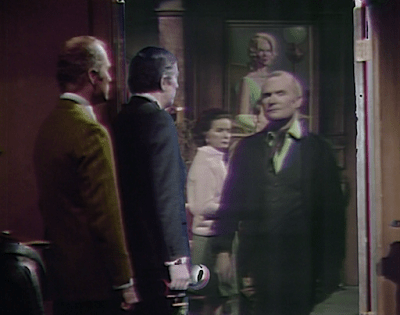
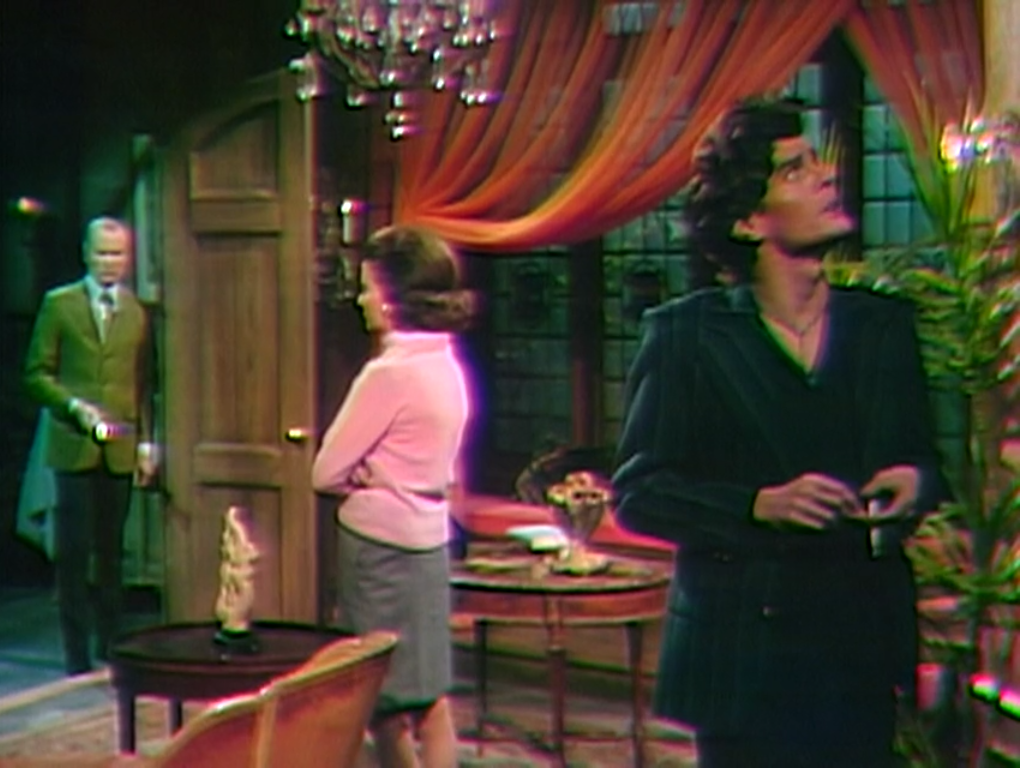
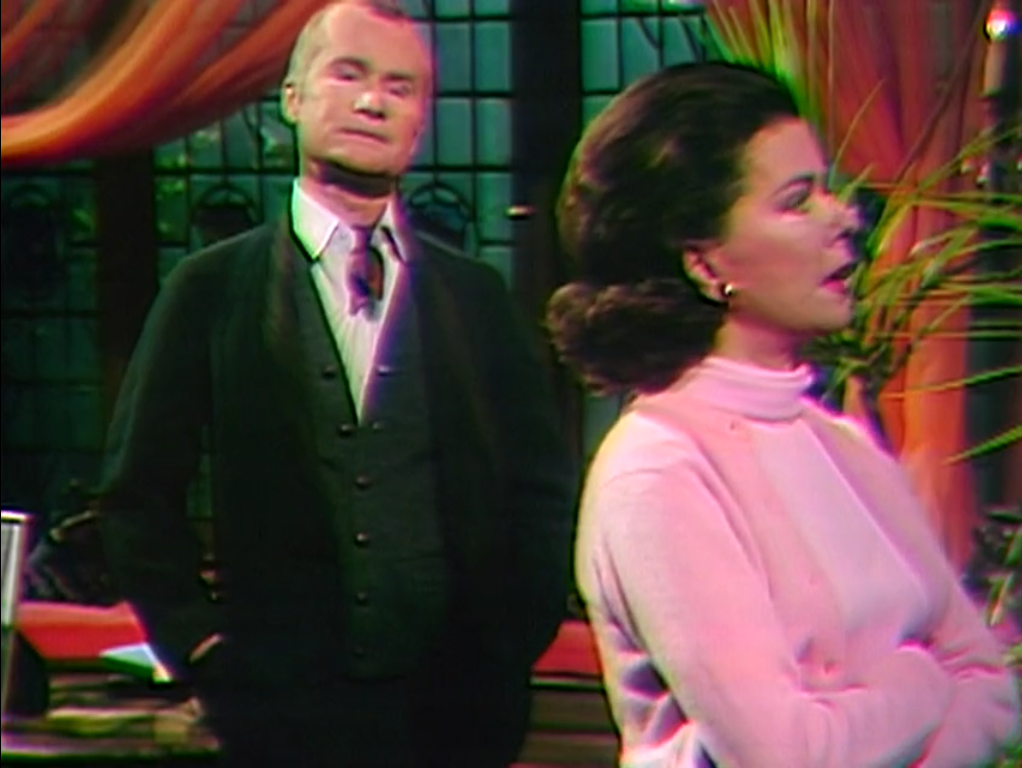
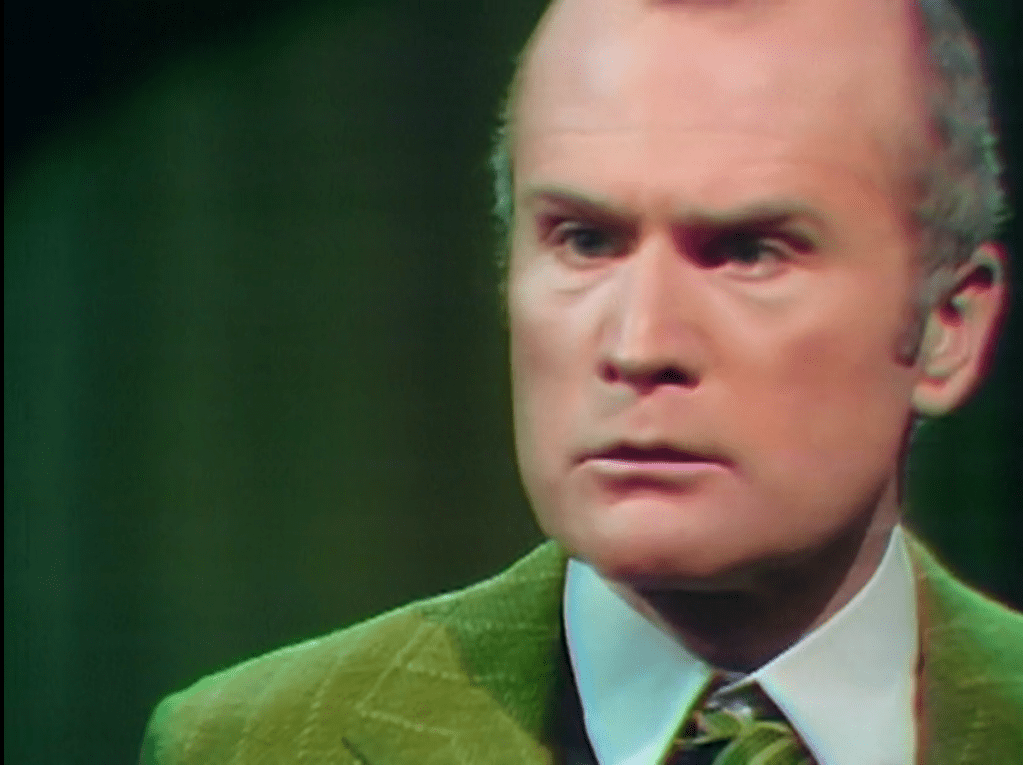
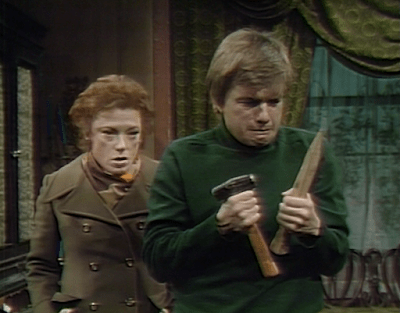
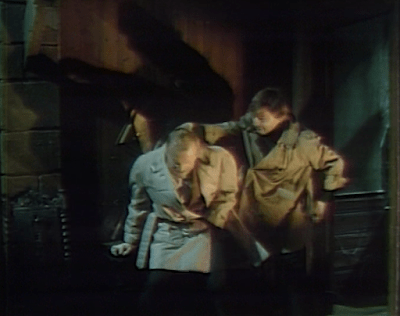
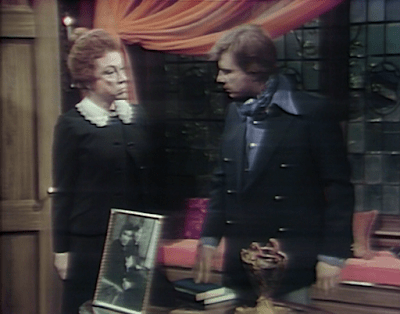
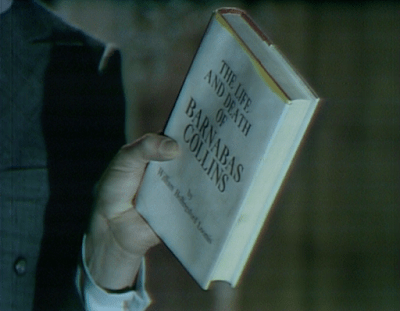
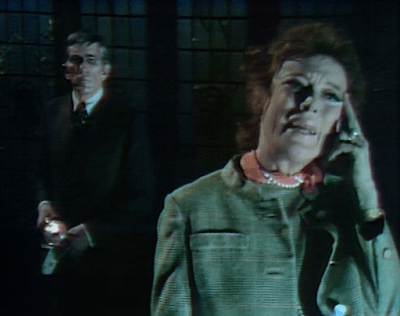
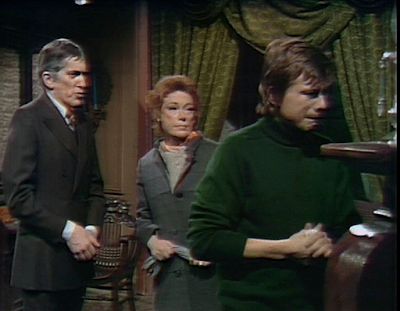
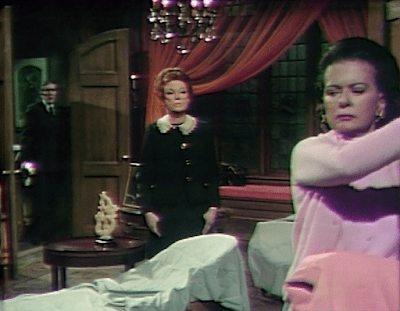

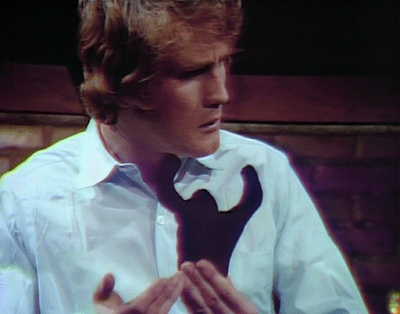
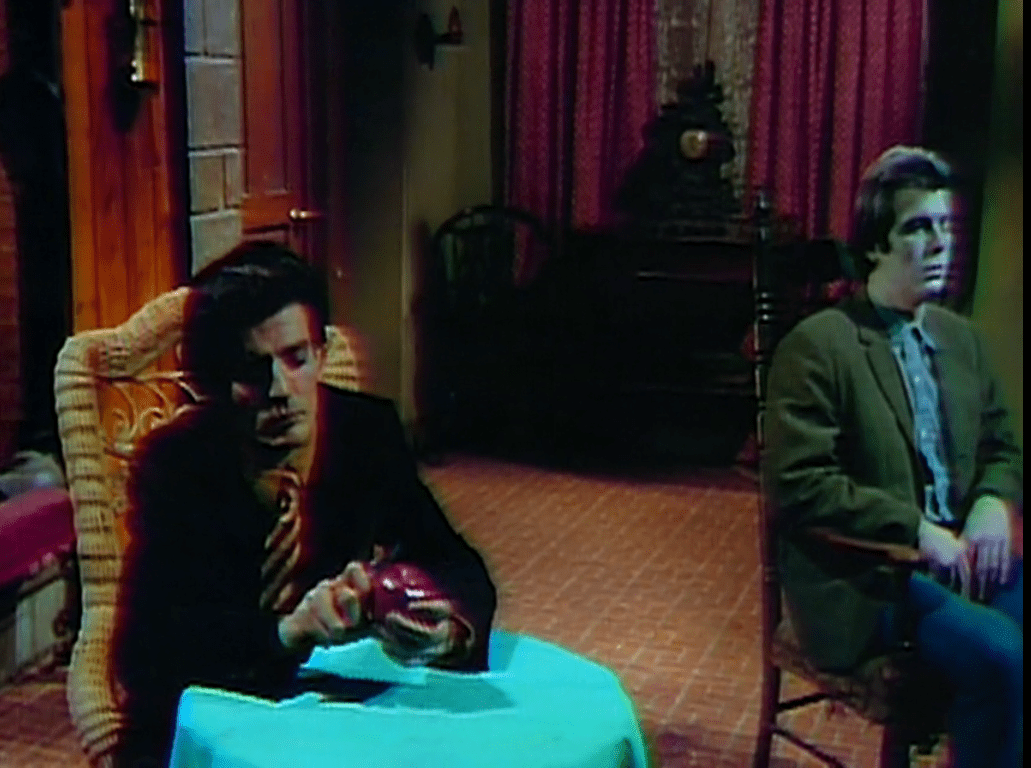
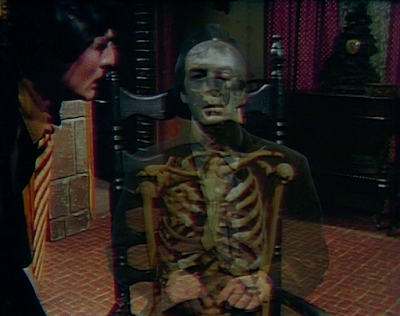
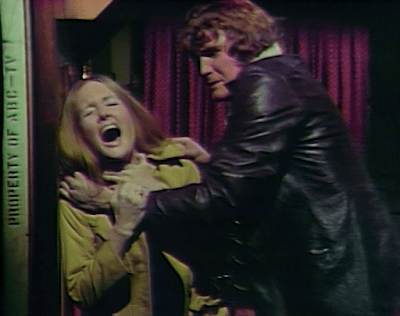
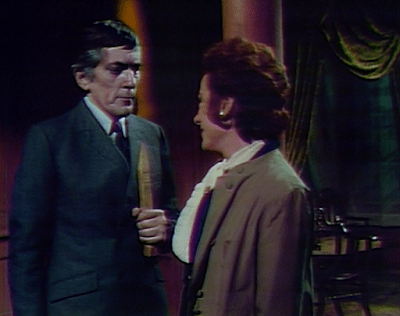
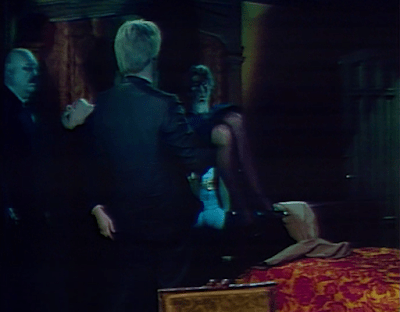
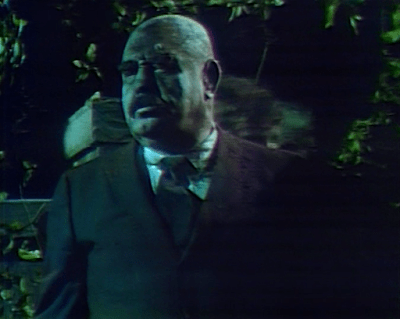
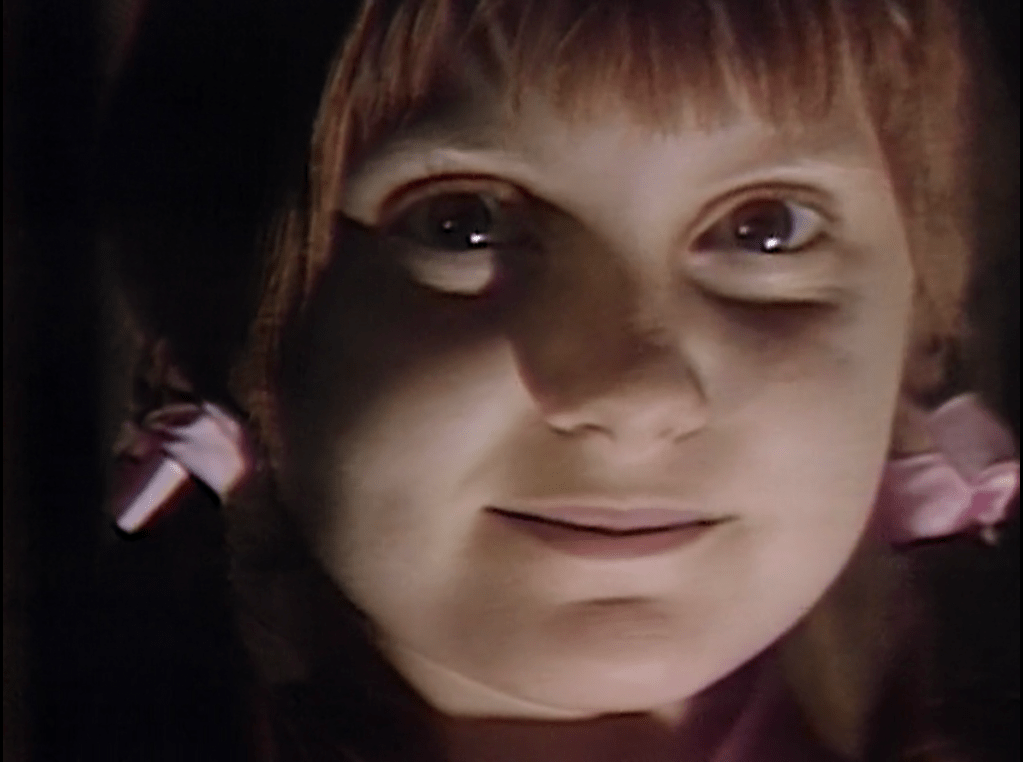
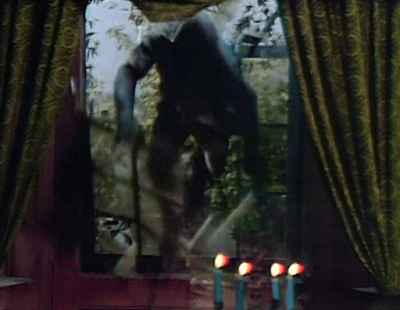
 Dark Shadows Commentary