
Well-meaning governess Vicki is on the terrace of the great estate of Collinwood. A man known variously as Peter and Jeff keeps clutching at Vicki’s arms so sharply that her biceps pulse, then holds her with one hand and paws her with the other as she stands rigidly still. First time viewers, knowing only that Dark Shadows features stories of monsters and crime, would think that the man had some power over the woman and that they were seeing him abuse that power. They would be right. Unfortunately, the man and woman are not Peter/ Jeff and Vicki, but actors Roger Davis and Alexandra Moltke Isles. Vicki is supposed to be in love with Peter/ Jeff and reluctant to part from him, but the instant she has spoken her last line she turns her face from him and runs away, without the slightest attempt to suggest that she wants to linger.
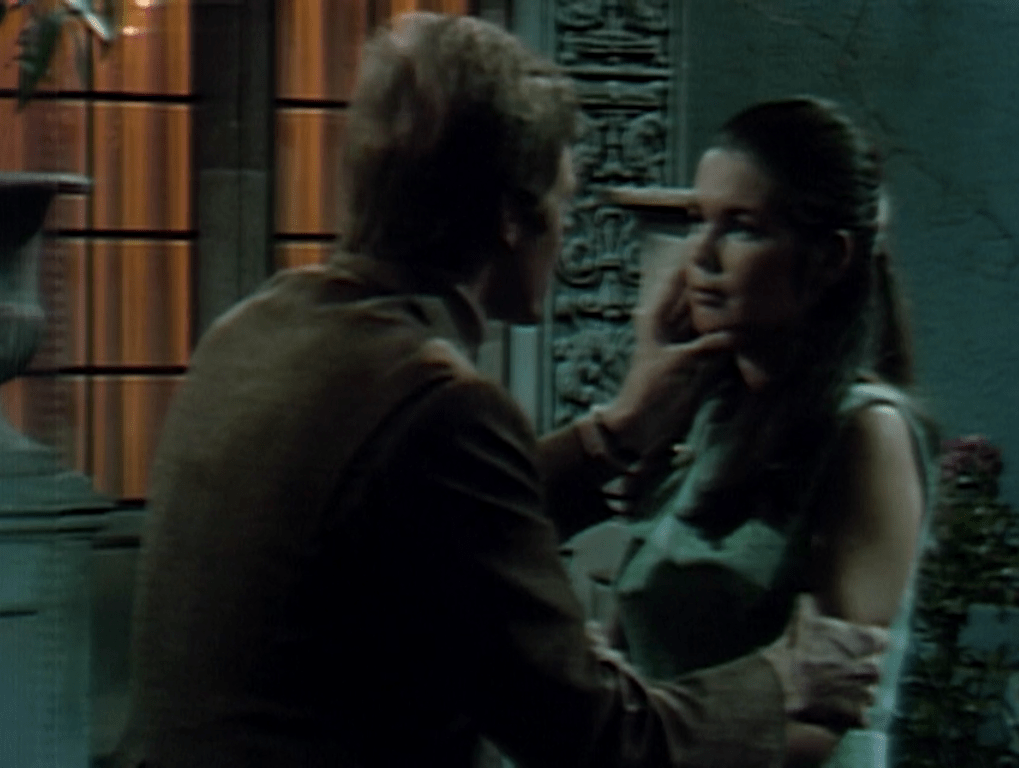
After Vicki escapes from Peter/ Jeff’s repellent attentions, a woman named Eve emerges from the bushes. Peter/ Jeff is angry with her. He grabs her roughly and throws her out of the frame. Peter/ Jeff then stalks off. Eve comes back into the frame. It’s a relief to see her upright and well-put-together- Mr Davis shoved Marie Wallace so hard she had to struggle to right herself as she spun out of view. It looked like she might have slammed her head against the floor.
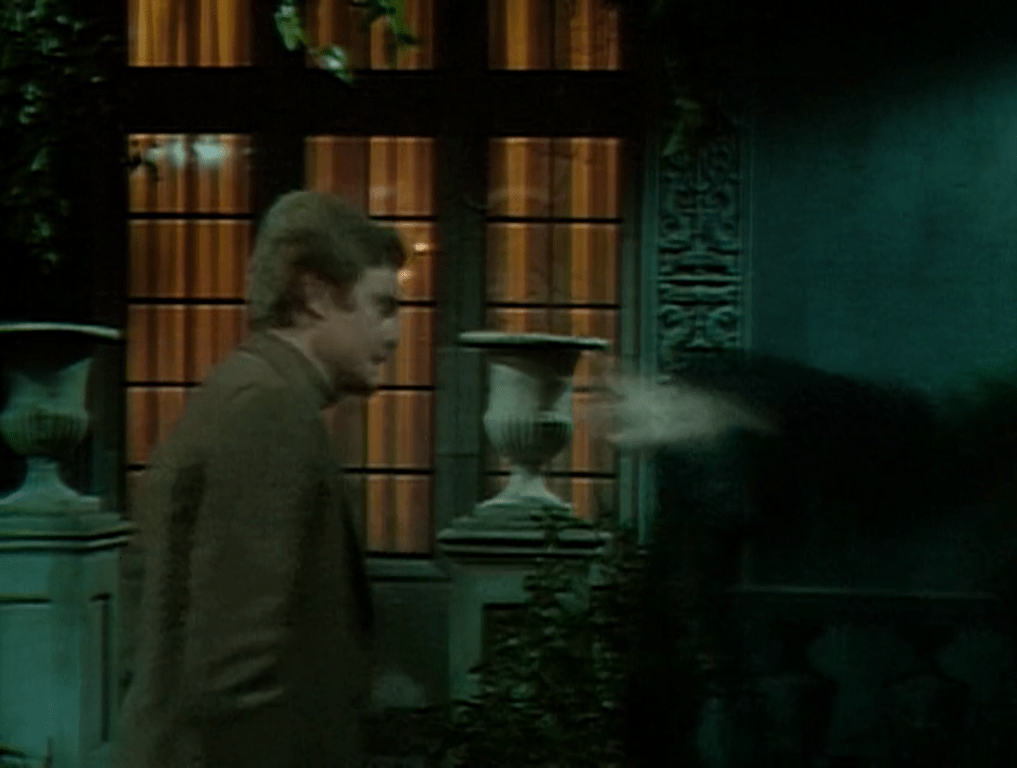
In a comment on Danny Horn’s post about this episode on his blog Dark Shadows Every Day, Marc Masse reports what happened when this scene came up at a panel discussion at a Dark Shadows convention many years later:
This was the episode where Grabby Davis got so overly excited in his scene with Marie Wallace on the terrace that he grabbed her by the arms and threw her completely out of frame. You see her struggling to remain on her feet as she stumbles off to the right. Some 20 years later at a fan convention (it’s in Dark Shadows 25th Anniversary Special from the disc set that has the last episode of the series), Marie Wallace brought this up as Roger Davis was telling the audience of how they (or rather he) would cut up and laugh and have fun while they were making the episode, and of how they would just laugh off their flubs. Wallace then broke in to remind Davis of episode 622 as she recalled, “Hey, Roger? I didn’t laugh when you threw me out of frame in that scene, on camera. Remember that? Several times?” She explained to the audience how all during dress rehearsal he’d never touch her and then when he’d done it on camera he’d come up to her and apologize profusely, but Wallace told him then and there at the convention that she never believed him.
Marc Masse, as “Prisoner of the Night,” in a comment left 8 April 2015 on “Episode 622: Heated Conversations on Somebody Else’s Lawn,” Danny Horn, Dark Shadows Every Day, 8 April 2015.
In a response to another post of Danny’s, Marc added that in the same video you can see actress Donna Wandrey’s appalled reaction to Mr Davis’ statement, and her increasingly visible disdain for him as Miss Wallace makes her case against him.
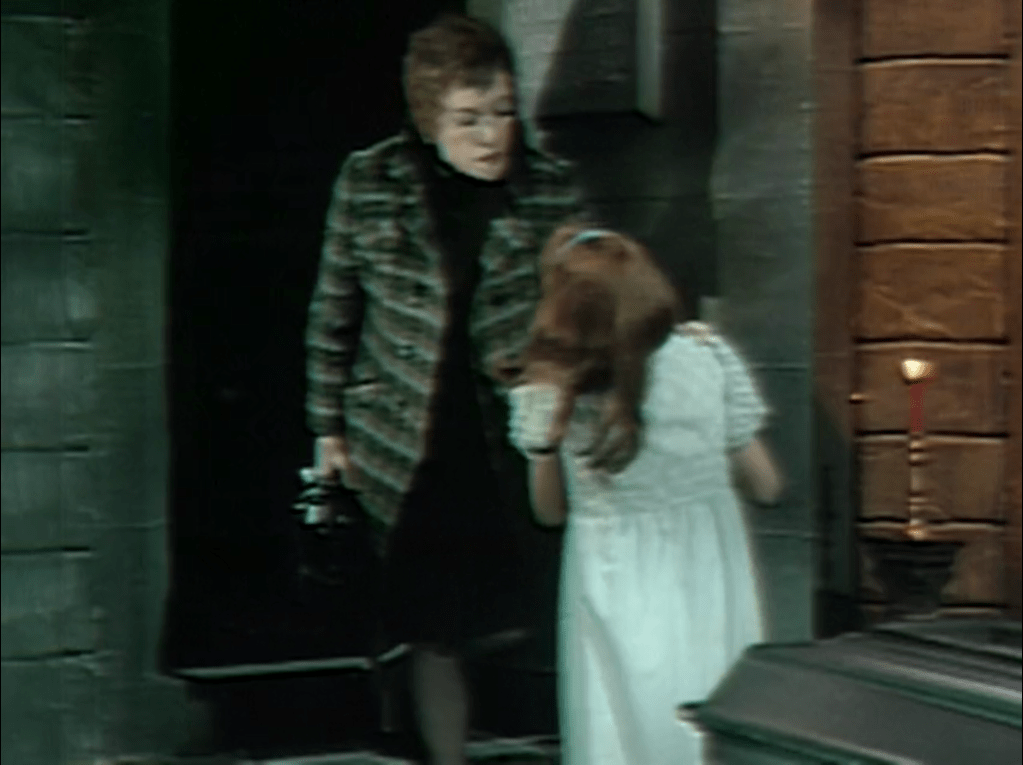
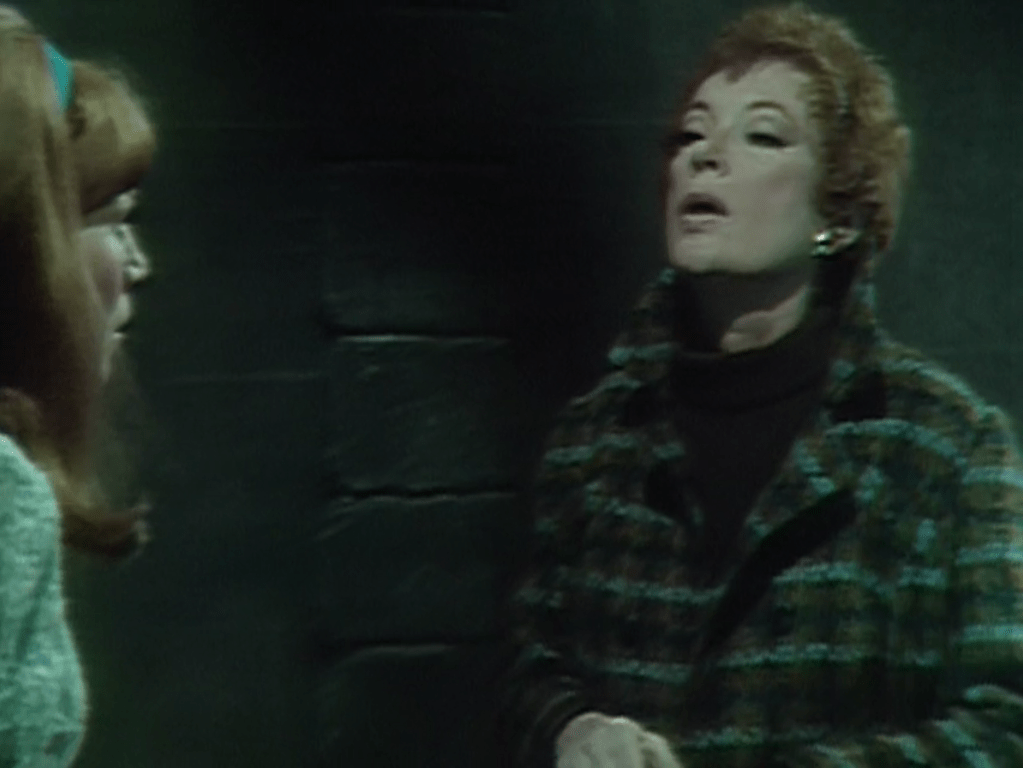
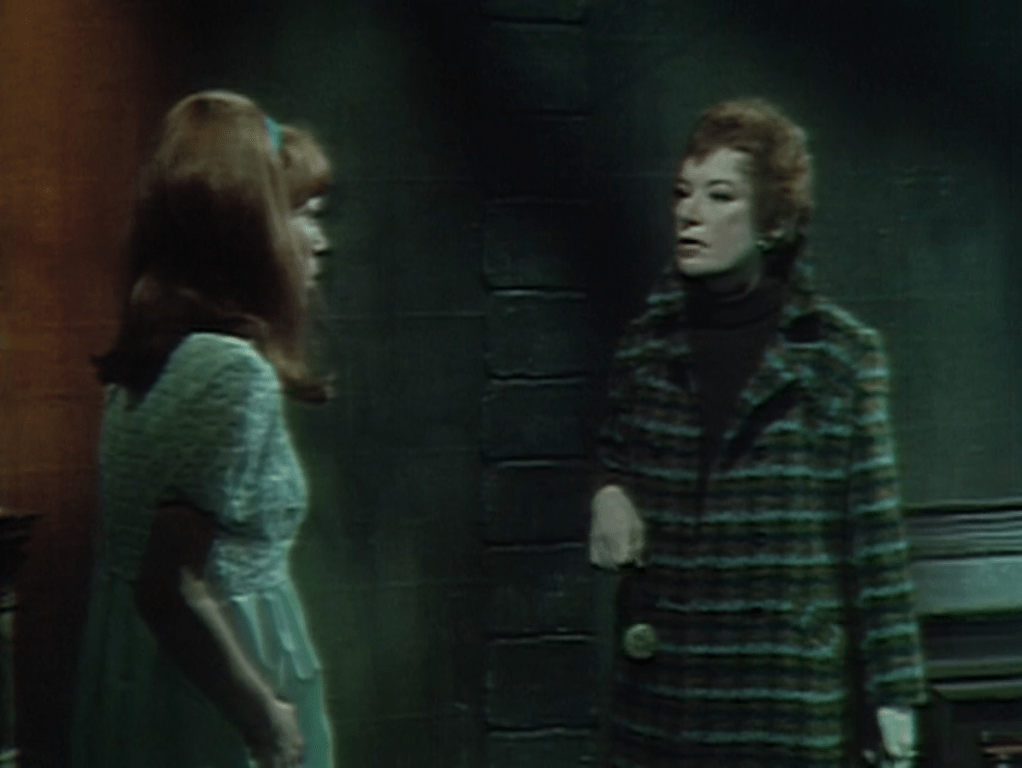
After Peter/ Jeff is gone, another visitor comes and addresses Eve by name. She is Angelique. Angelique is not a Roger Davis character, she is merely a vampire, so everyone can relax.
Regular viewers have been wondering what would happen when Angelique shared a scene with Eve. Marie Wallace’s style as Eve relies on many of the same techniques Lara Parker uses as Angelique. Both use an elevated style with many catches of breath, changes of volume in mid-sentence, and striking of oratorical poses. Each was capable of making this exaggerated method work, but no one could conceal its profound silliness, and a scene consisting of two characters both using it would be too ridiculous even to make a good joke in a cartoon. What actually happens is that Parker demonstrates the quietest possible version of the style, while Miss Wallace shows a more typically brassy version. Recognizing their approaches as two poles of the same axis, we are not only interested in their encounter, but also in what they show us about the craft of acting.
Angelique persuades Eve to join her in an alliance against warlock Nicholas. This might be an exciting development. Nicholas is the show’s chief villain at the moment, and between them Angelique and Eve just might be able to bring him down. It is also the first alliance we have seen take shape in a long time. Many characters have tried to control other characters, to deceive them, to imprison them, to enslave them, to brain-wash them. But the only group working towards a common end is made up of old world gentleman Barnabas, mad scientist Julia, occult expert Stokes, and servant Willie. That team formed long ago, has not managed to get anywhere lately, and is, at the moment, immobilized by Barnabas’ absence. Yesterday Julia tried to form an alliance with Nicholas against Angelique, but at the last minute his inability to talk with her forthrightly aborted that effort. So it is refreshing to see that the show is still capable of imagining a new alliance.
Danny’s post about this one is one of his very best, a composition in free verse weaving together quotes from the dialogue with retellings of the overarching narrative with meditations on a number of topics that the episode touches on. If you are a Dark Shadows fan and haven’t read Dark Shadows Every Day, this is a fine post to start with. It’s like a song- you may not understand all the lyrics the first time you hear it, but the sound of it will carry you along.
The comments below it include some great stuff too. I’ve already mentioned Marc Masse’s remark about Marie Wallace’s confrontation with Roger Davis. There are also two fanfic ideas about how the show might have resolved the question of who Vicki’s parents were. Someone posting under the name “William” had this plausible one:
My own theory: Victoria the daughter of Jamison Collins and Betty Hanscomb. So she’s Roger and Liz’s half-sister. Liz knows and Roger doesn’t.
Jamison aggressively seduces Betty, on whom Roger had teenage crush. He makes her pregnant and then coldly casts her out. A pregnant Betty shows up at Collinwood and tells Liz and Roger about what happened.
Roger confronts his father in a fit of rage in the Tower Room during one of Collinwood’s famous storms.
Jamison Collins has a heart attack during the confrontation, and Roger leaves him in the room to die. Roger staggers out, and Liz finds her father dead.
Roger has a complete breakdown and is sent to Windcliff, where Dr. Julius Hoffman, uncle of Julia Hoffman, wipes out his memory of that night in the summer of 1946.
Liz, with the help of new guy in town Paul Stoddard, pays off Betty Hanscomb to leave town and arranges for her half-sister to be raised at the foundling home in New York. Grateful to Paul for his help, Liz starts to fall for his charms …
(And this is why Liz is so fond of Victoria, but not like she is with Carolyn. And this is why she refuses to tell Roger anything about why she brought Victoria back).
–“William,” in a comment left 22 August 2016 on “Episode 622: Heated Conversations on Somebody Else’s Lawn,” Danny Horn, Dark Shadows Every Day, 8 April 2015.
That has a lot of potential. Liz doesn’t seem ever to have loved Paul, she did marry him shortly after her father’s death, and Roger’s attitude towards Vicki in the first months of the show was a strange mixture of extreme hostility and obvious attraction. “William’s” story would account for all of those things. But it doesn’t hold a pale blue candle to this theory posted by Pedro Cabezuelo:
Everybody, we’re missing the obvious! Vicki IS Betty Hanscombe!!!!! Somehow she managed to time travel AGAIN and ended up in Collinsport circa the 1940s and adopted the Betty Hanscombe identity, working her way as a servant at Collinwood. She had an affair with Paul Stoddard, gave birth to herself (at which point the adult Vicki ceased to exist) and THAT’S what caused all the irreperable harm to the time stream/parallel time/anything else you want to blame on Vicki.
Pedro Cabezuelo, in a comment left 10 April 2015 on “Episode 622: Heated Conversations on Somebody Else’s Lawn, Danny Horn, Dark Shadows Every Day, 8 April 2015.
I have my own fanfic idea about Vicki’s origin. I’ve shared it here before, and will again. But Pedro’s is so good I want it to be the last word today.









 Dark Shadows Commentary