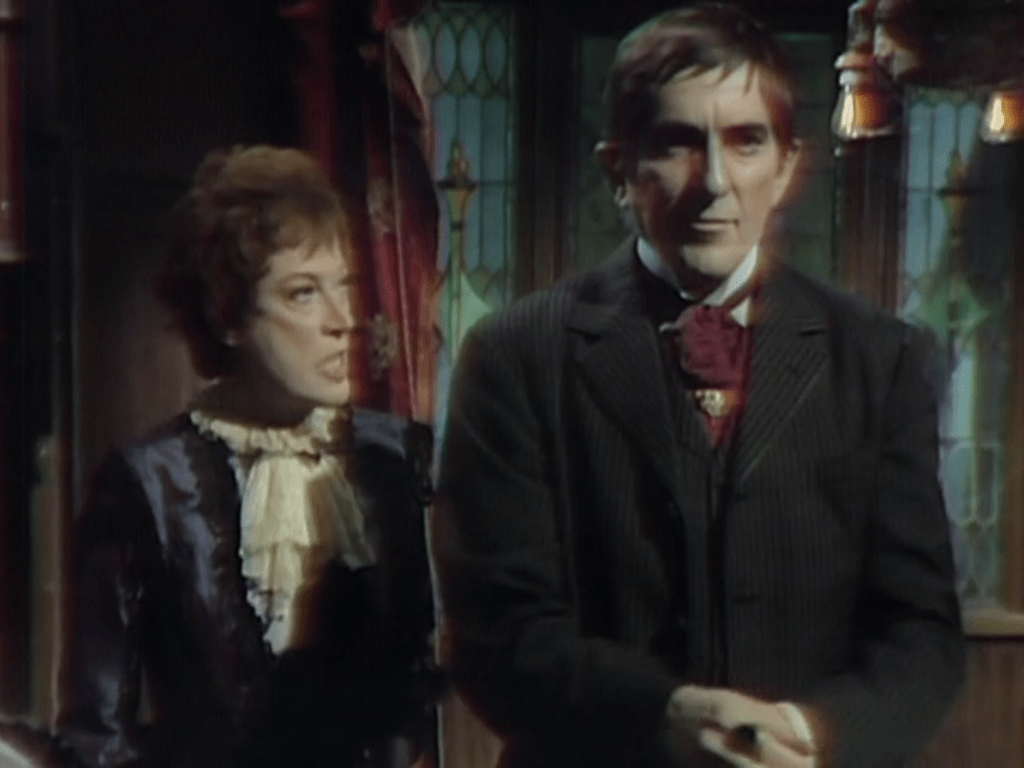
Old world gentleman Barnabas Collins has become the leader of a mysterious cult. Antique shop owners Megan and Philip Todd are members of the cult, and they have a magical baby who materialized after Barnabas gave them a sacred box. Inside the box was a book that is also of tremendous importance to the cult. Philip and Megan left the book on a table in their shop, so that it appeared to be for sale. Yesterday strange and troubled boy David Collins stole the book. In its absence, the baby has developed a high fever. When Megan and Philip found that the book was gone, they flew into a panic and declared that they would have to kill the person who took it.
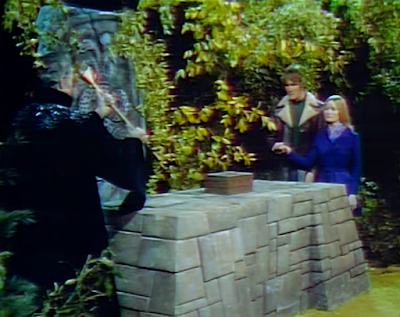
Many stories on Dark Shadows start with David, so it could be that the uncanny and sinister forces behind the cult want him to have the book. If so, Barnabas doesn’t know any more about it than do Philip and Megan. He finds out today that the book is missing, and takes Philip to a cairn in the woods. He tells him he will have to be punished for losing it.
When Philip first saw the cairn, he remarked that he had been that way before, but never noticed it. Barnabas explains that only people connected with the Leviathan cult can see it. This casts the minds of returning viewers to heiress Carolyn Collins Stoddard, Barnabas’ distant cousin. In #888, Carolyn saw the cairn and ran into a prowler there. The prowler refused to identify himself to her; the closing credits told us he was Paul Stoddard, Carolyn’s long missing father. We had seen him from behind the day before, when he saw the cairn materialize, then simply walked off. His blasé response told us that he expected to see what he saw, which can only mean he was connected with the cult. Carolyn doesn’t know anything about the Leviathans, but what Barnabas says to Philip today confirms that she is nonetheless associated with them in some sense. Indeed, Barnabas has been very solicitous of Carolyn’s well-being ever since he joined up with the Leviathans and keeps telling her that she has an extraordinary future.
There is also some business going on between Paul and Carolyn. On the surface it would seem to be a typical soap opera story, in which the daughter is trying to reintroduce her errant father into the family circle and has to keep secrets from her mother and young cousin to pull it off. Given what we know about Paul’s awareness of the Leviathans and their interest in Carolyn, we can see that it is in fact part of the supernatural A story.
There are no closing credits today, only the logo of Dan Curtis Productions. The Dark Shadows wiki says that this one was directed by Henry Kaplan. I am certain this is false. Kaplan was very clumsy with the camera, resorting to closeup after closeup and then to ever-more extreme closeups until you have scenes played by one actor’s left ear opposite another’s right nostril. Today, there is a scene between Carolyn, David, and Barnabas in the drawing room of the great house at Collinwood, a scene in which Carolyn presses David with questions about the book, that is so expertly choreographed that only Lela Swift could have blocked it. My wife, Mrs Acilius, marveled at the dance that Nancy Barrett, David Henesy, and Jonathan Frid execute so flawlessly.
This episode is double numbered to make up for a planned pre-emption, when the ABC television network showed football at 4 PM on the afternoon of Thanksgiving Day. Every Friday’s episode was supposed to have a number that ended with a five or zero, so that all you had to do was divide by five and you would get the number of weeks the show had been on. That didn’t work this time, because there was also an unplanned pre-emption when the network’s nes division took the 4 PM slot to cover the return of the Apollo 12 mission. They are producing episodes well ahead of their airdates at this point, in a couple of cases over five weeks ahead, so it will be a long while before they can get back in sync.
In October 1897, the hypocritical Rev’d Mr Gregory Trask is married to the vastly wealthy Judith Collins, owner of the estate of Collinwood and of the Collins family businesses. For more than thirteen weeks, everything seemed to be going Trask’s way. He had gaslighted Judith into a mental hospital and had almost free rein over all of her assets. In her absence, he invited the lovely and mysterious Amanda Harris to stay in the great house on the estate, and set out to seduce her.
Piece by piece, Trask’s little corner of paradise fell apart. First, 150 year old sorcerer Count Petofi orchestrated a series of events that led Trask to sign a confession to the murder of his first wife, and no matter how many times he destroyed the confession new copies of it kept materializing. Then Petofi erased the personality of Trask’s daughter and enforcer Charity, replacing it with that of late Cockney showgirl/ mentalist Pansy Faye. Later, Amanda fell in love with Judith’s brother Quentin, told Trask off, and wound up leaving for New York by herself. Now, Judith has returned from the mental hospital, all sane and deeply suspicious.
The front door of the great house is Trask’s enemy today. No sooner does he enter it than he finds Pansy in the foyer, singing her song. He demands she stop and tells her he is her father. She laughs at this claim, and reminisces about the late Bertie Faye. Trask goes into the drawing room, and to his horror sees a large oil painting of Amanda on an easel. We saw Pansy setting it up earlier in the episode, and saw her buy it a few days ago. But Trask didn’t see those things, and when she tells him she doesn’t know anything about it, he seems to accept her denials. She exits upstairs.
The front door opens again, and Judith’s brother Edward enters with two other men. One appears to be Quentin, but is in fact Petofi in possession of Quentin’s body. The other appears to be time-traveling vampire Barnabas Collins.
Trask and Edward both believe that Petofi is Quentin; since he is played by David Selby, I call him Q-Petofi. The man who appears to be Barnabas is very weak. He says that his name is indeed Barnabas Collins, but that he is not the vampire. He claims to have arrived from England, to have been attacked by a vampire who looked just like him, and to have little memory of what happened after.
In #845, Pansy went into a cave and found a coffin containing what appeared to be Barnabas. She drove a stake through his heart. When Edward and Q-Petofi met this weak Barnabas yesterday in the doctor’s office, they were skeptical of his story. They took him to the cave, opened the coffin, and saw the body Pansy had staked inside, the stake still lodged in its heart. Since they could see the two of them side by side, Edward could only conclude that the weak man is different from the vampire, and that his story is therefore true. Q-Petofi, well aware of the many magical and science-fictional entities in Barnabas’ orbit, is not at all convinced.
Trask sees the weak Barnabas and is enraged that Edward and Q-Petofi have brought the vampire back from the dead. While Q-Petofi takes the weak Barnabas upstairs to a bedroom, Edward tries to reason with Trask. This is seldom a fruitful exercise. When Edward finally points out that it is broad daylight and the weak Barnabas is alive and moving, Trask is left speechless.
Alone with the weak Barnabas, Q-Petofi tries to trick him into believing that he is Quentin and that he can trust him. When Q-Petofi goes on about all the secrets that Barnabas and Quentin have shared, the weak Barnabas responds only with bewilderment.
Q-Petofi goes back to the cave and sets the coffin on fire, acting on the hypothesis that the destruction of the staked Barnabas will have some kind of effect on the weak Barnabas. We cut back to Collinwood and see that it has none. Trask lets himself into the bedroom. After some small talk, he thrusts a large wooden cross at the weak Barnabas’ face and stands silently for a moment. The weak Barnabas looks up from his bed and asks if Trask is all right. He hurriedly says that he only brought the cross to help him pray for his recovery. The weak Barnabas observes that this is very kind, and closes his eyes while Trask kneels beside the bed.
My wife, Mrs Acilius, points out that not only the actor Jerry Lacy, but the character Gregory Trask, seems to enjoy himself very much when there is something to be righteously indignant about. Not only does Trask have a whole set of self-aggrandizing mannerisms and techniques for silencing everyone else when he is furious, but as a con man an atmosphere of crisis provides him with an opportunity to think on his feet and devise new schemes for bilking people out of whatever they have that he wants. Mr Lacy’s joy in performance runs throughout the whole episode, but Trask’s goes through wild fluctuations, peaking each time he thinks he has found a new way to present himself as the champion of The Almighty and plummeting each time his understanding of the situation is deflated. In his first several appearances, Trask was so overwhelmingly evil and so frequently successful that he was hard to watch. When we see him repeatedly brought up short in an episode like this, all of the discomfort of those early days pays off.
In the drawing room, Edward tells Pansy that there is a sick man in a bed upstairs who looks like the vampire Barnabas and is named Barnabas Collins, but is not the man she staked. She is horrified at the thought. Barnabas was indirectly responsible for the death of Pansy as a physical being, and later murdered her fiancé, the childlike Carl Collins. He also took Charity as one of his victims for a time. Besides, in her manner of dress, quantity of makeup, working-class accent, and brashly friendly manner Pansy is the representative of all the “girls at the docks” upon whom Barnabas has fed down the centuries. So no one has more reason to fear Barnabas than does Pansy in the form of Charity. Edward reassures her as best he can, then goes up to look in on the patient.
Pansy absorbs the news that another Barnabas Collins is in the house.
The scene between Pansy and Edward will remind longtime viewers of the characters the same actors played between November 1967 and March 1968, when Dark Shadows was set in the 1790s. Nancy Barrett was fluttery heiress Millicent Collins, while Louis Edmonds was haughty overlord Joshua Collins. In #450, Millicent had discovered the horrible truth about Barnabas and it had proven to be too much for her rather fragile grip on sanity. She decided that the vampire was not her cousin, but an impostor, and she told Joshua that it was wrong of him to have “That man who says he is Barnabas” in the house.
Not only is Pansy’s horror at the thought of a man who says that he is Barnabas staying at Collinwood reminiscent of Millicent, but her relationship to Charity also reflects the development of Millicent throughout the 1790s segment. Millicent’s transformation from a lighter-than-air comedy character to a darkly mad victim, first of her wicked husband Nathan, then of Barnabas, marked the transition to the climactic phase of the 1790s segment. Charity’s replacement by Pansy in #819 came at a time when the show was flashing many signals that the 1897 segment was nearing its end. Those signals may well have reflected an earlier plan, but 1897 was such a hit that they kept passing by the off-ramps back to the 1960s and restarting the uncertain and frightening journey into the past. Now it seems they really are getting ready to move on, and Pansy’s prominence reminds us of just how radically different a place Collinwood is now than it was when we arrived in this period in #701, at the beginning of March.
Pansy is still quaking at the thought of another Barnabas Collins when Q-Petofi enters and closes the doors of the drawing room behind him. Pansy hasn’t quite figured out his true identity, but she knows that he is not really Quentin, and that he does not mean her well. She is terrified and says she will scream unless he opens the doors.
Regular viewers have reason to believe Pansy will do more than scream. In #829, she tried to stab Quentin. And those who have been with the show for a long time will remember what happened in #204, broadcast and set in April 1967. Heiress Carolyn Collins Stoddard, another Nancy Barrett character, found herself in the drawing room with dangerously unstable ruffian Willie Loomis. When Willie closed the doors and refused to open them, Carolyn didn’t bother screaming- she pulled a loaded gun on him.
Q-Petofi has magical powers that neither Quentin nor Willie could match, so he is not in mortal jeopardy as they would be were they to put themselves in his position. But he has created a volatile situation, and unless he resolves it within a few seconds he is likely to find himself with a huge mess on his hands. Rather than falling back on his occult talents, Q-Petofi takes a page from Quentin’s book and charms Pansy into cooperating. He tells her that he is as frightened of Barnabas as she is. That intrigues her sufficiently that she starts listening to him. He tells her that only she can discern whether the man in the sick bed upstairs is what he claims to be. A moment later, Q-Petofi has persuaded Pansy to go with him to see the weak Barnabas. The episode ends with Pansy looking at the weak Barnabas lying in bed, her eyes widening in a strong but unspecified reaction. We will have to wait until tomorrow to find out whether she is terrified at the sight of her nemesis or amazed to see an innocent man wearing the hated face.
Kitty Soames, a young American woman who is the dowager Countess of Hampshire, is gradually turning into Josette DuPrés, who has been dead for 101 years. Kitty is staying at the great house on the estate of Collinwood. Also among the houseguests is Angelique, the immortal, time-traveling wicked witch who was responsible for Josette’s death.
Kitty has been getting information about Angelique, apparently from Josette’s ghost. She interrogates Angelique’s fiancé, rakish libertine Quentin Collins. Quentin does not give her any useful information about Angelique. When Kitty asks if Angelique has ever lived in England, Angelique herself enters and says that she has not. Kitty asks Angelique if she was ever a servant. Angelique made it quite clear yesterday that she knows perfectly well what is happening to Kitty, but she regards the transformation as a nuisance and does not want to help it along. She chooses to pretend that Kitty is being a snob, and says that Quentin is not marrying beneath his station. With that, Kitty has nowhere to go but back to her room.
Angelique has made an alliance with Julia Hoffman, MD, a fellow time-traveler from the late 1960s. Julia followed her friend and the object of Angelique’s lunatic obsessions, vampire Barnabas Collins, to 1897. Barnabas is now believed to have been destroyed, but we’ve already seen that Julia is continuing work replicating the experimental procedure that put his vampirism into abeyance for a little while in the spring of 1968. Today, Angelique brings some medical supplies to Julia in her hiding place, and Julia asks if she can come a little earlier the next day.
The two women sit down and have a friendly chat. Longtime viewers will find this breathtaking. Angelique was at Collinwood in 1968, wearing a black wig, calling herself Cassandra, and functioning as Julia and Barnabas’ bitterest enemy. Now that Angelique has turned to Quentin and has let go of her drive to dominate Barnabas, she and Julia have made an alliance against sorcerer Count Petofi. Their animosity set aside, they can commiserate about the difficulty of a life yoked to Barnabas.
“Ugh, vampires, all the good ones are either obsessed with recreating their dead ex or gay.” Screenshot by Dark Shadows Before I Die.
Angelique wants to liberate Quentin, whom Petofi has enslaved. Julia is horrified today when Kitty, in Josette mode, bursts into her hiding place and demands to see Barnabas. Quentin follows her in and hears her ask why she is keeping Barnabas in the next room. Neither Kitty nor Quentin believe Julia when she keeps insisting that Barnabas is no more. If Quentin knows that Barnabas is still around, Petofi will soon know it as well, and that can only be bad news.
Petofi is not content keeping Quentin as a slave. He wants to abuse him even more totally. We saw the other day that Petofi wants to swap bodies with Quentin as his means of escaping from his deadly enemies, the Rroma people. Petofi visits Quentin in the drawing room at Collinwood this evening and gives him a scalp massage. Quentin notices Petofi’s ring, and agrees that he would like a new life. He falls asleep, then wakes up to find Petofi’s ring on his finger. To his alarm, he cannot take it off. My wife, Mrs Acilius, called out to the screen to suggest he spray some Windex on his finger, but that wasn’t invented until 1933 and the dramatic date is 1897. Presumably the transfer of the ring is the first step towards Quentin’s eviction from his own body and his replacement in it by Petofi.
Closing Miscellany
Danny Horn’s post about the episode at his great Dark Shadows Every Dayis a study of Kathryn Leigh Scott’s facial expressions. His thesis is that Miss Scott is imitating Grayson Hall, who plays Julia. Later in the series there will be a moment when Miss Scott imitates Hall in a scene they play together; Hall’s reaction then will be hilarious.
Kitty sees the portrait of Barnabas Collins hanging in the foyer on the spot by the front door. She Josettifies and becomes fascinated by it. Stuffy but lovable Edward Collins had the portrait removed when Barnabas was exposed as a vampire some time ago, and is shocked to find that it has returned. Presumably whatever supernatural agency is Josettifying Kitty put it there. Longtime viewers, who remember how active Josette’s own ghost was at Collinwood before Barnabas first appeared on the show, will think she is the likeliest suspect.
When Kitty/ Josette is kneeling beside the grave of Josette’s husband Jeremiah Collins (spelled “Jerimiah” on the marker,) Edward shows up and tells her that she was married, not to Jeremiah, but to the late Gerald Soames Earl of Hampshire. That was the first time it dawned on me that both Josette and Kitty married guys named Jerry.
Angelique’s intrusion into the scene between Quentin and Kitty might have been more effective if the camera hadn’t swung wide and shown her standing outside the door waiting to make her entrance. We don’t see Angelique eavesdropping, but Lara Parker standing well upstage waiting to make her entrance.
Julia Hoffman is miserable. She has followed her friend, vampire Barnabas Collins, and traveled back in time to the year 1897 on a mission to prevent terrible things that were happening in 1969. She has managed to come up with a treatment that is similar to one that briefly cured Barnabas of vampirism in March and April 1968, and is giving him regular injections in the course of that treatment. She is in hiding with him in an abandoned building, and has survived kidnapping and attempted murder. And what is her reward for all that? He is back on the same bullshit he was involved in when she first learned of his existence in 1967. He has met a girl and made up his mind to throw away all of their plans in an effort to convince her that she is the reincarnation of his lost love Josette. It’s no wonder Julia is so furious with him that she looks like she is the one with fangs.
Barnabas in danger.
Making matters worse, this time it seems Barnabas might be on to something. He pays a visit to his distant cousin, Quentin Collins, and asks who the girl is. Quentin says that she is Kitty Soames, widow of the late Earl of Hampshire, returned to her native USA after her husband’s death. When Barnabas starts in with his lunacy about Josette, Quentin becomes excited. He tells him that Kitty looked at the spot where his portrait hung until he was exposed as a vampire and asked what had become of it. When Quentin asked how she knew about that, since she had never been to the house before, she laughed and said that of course she knew the portrait, of course she was familiar with Barnabas. After a few seconds, she said she knew nothing of any portrait or of anyone named Barnabas.
Barnabas takes this as proof positive that Kitty is Josette returned to life, and that her memories of the 1790s are coming back to her. He asks Quentin to meet him at his hiding place so that they can arrange for him to meet her. He tells him where the hiding place is. Quentin agrees. Barnabas gives Quentin an enigmatic look before he exits.
Quentin is miserable. He is under the power of sorcerer Count Petofi, who has ordered him to kill Barnabas. Now that he knows where Barnabas keeps his coffin, there is nothing to stop him obeying. He will have to go there at dawn and stake his friend.
Barnabas has confronted Quentin about his subjection to Petofi, whom he knows to be his deadly foe. He has several times shown his distrust of Quentin. So people who started watching the show in the last year or so will be puzzled when he tells Quentin where to find him when he is helpless. Those who have been in the audience longer know that Barnabas not only has a habit of telling his enemies exactly what they need to know, but that he also loses all semblance of rationality where Josette is concerned. It is all too believable that he may have done this. Still, there is that look back at Quentin, suggesting that Barnabas knows that he is giving information to his enemies.
Quentin is in the drawing room of the great house, waiting for the dawn to bring with it his obligation to kill his friend. A woman who used to be Miss Charity Trask enters. Petofi erased Charity’s personality some time ago. Her body is now home to Pansy Faye, Cockney showgirl, mentalist, and onetime fiancée of Quentin’s late brother, inveterate prankster Carl Collins.
Pansy is miserable. Pansy is cross that Quentin did not go to see her perform at the Blue Whale, a local tavern where she is doing her old act. But what really has her down is that it is exactly three months since Barnabas murdered Carl, and she is the only one who seems to remember him. When Kitty and Quentin spoke of Carl yesterday, they were the first characters other than Pansy to mention his name since the immediate aftermath of his death. She is irritated with Quentin for getting drunk, angry that Barnabas is still at large, and sorrowful that while the dawn means a new day for most, for people like her and Quentin it just means reliving the same day time and again. Quentin perks up when Pansy lists the many good reasons why someone ought to kill Barnabas, and for a moment it seems like he is going to tell her where he is and invite her to do it. She recognizes this, and keeps asking questions after he stops himself. The whole scene is beautiful from beginning to end, one of the highlights of the series. If they had had Daytime Emmys in 1969, it is the tape they should have sent to the voters to get the acting awards for Nancy Barrett and David Selby.
Dawn comes, and Quentin does go to the cave where Barnabas’ coffin is. He has a stake and mallet with him. He opens the coffin, sees Barnabas, places the stake over his heart, and raises the mallet. That’s as far as he can go. He throws the weapons aside and leaves the cave, vowing that if Barnabas can face whatever he has faced, he too can face his own destiny.
Shortly after, we hear footsteps. Pansy enters. She sees the coffin and opens it. She finds the mallet and stake. She drives the stake into Barnabas’ chest. Blood spurts out around the wound and out of his mouth. It would seem that Barnabas Collins is no more.
Quentin is a villain, but he is charming, and at this point David Selby is a breakout star to rival Jonathan Frid as Barnabas. Earlier, it had seemed Pansy might kill Quentin, and many fans hated her for that. No one seriously expected her to kill Barnabas, since he was a pop culture phenomenon familiar even to people who never saw the show. To this day, Dark Shadows is known (to those who know it at all) as “the vampire soap opera from the 1960s.” So having her kill Barnabas is certainly a twist worthy of ending a week.
Most of the episode revolves around the fact that Julia Hoffman cannot speak. Grayson Hall uses a whole new set of acting techniques playing a mute character than we had seen in her appearances as the most talkative human beings imaginable, and the result is absolutely fascinating. I’d have been glad to watch the episode again as soon as it ended.
We open in the basement of the Old House on the estate of Collinwood. Julia is sitting at a table in front of a set of I Ching wands. These wands are still in the pattern recovering vampire Barnabas Collins cast several months ago, when he was trying to contact the malign ghost of Quentin Collins. Barnabas meditated on them, and his “astral body” went back in time to 1897. Since his physical body was also in 1897, confined to the coffin in which he was at that time trapped, he became a resident of that year, and met the living Quentin.
Julia has decided that she, too, must travel to 1897. So she meditates on the wands. She tells herself that she must visualize them on a door, and she tells herself to “Empty your mind of everything else.”
She follows this injunction only too well. After passing through a series of doors, she collapses outside the great house at Collinwood in 1897. When stuffy Edward Collins takes her into the drawing room and questions her, she can respond only with a blank stare. Quentin comes in and finds a letter from Barnabas in Julia’s pocket. He asks her if she is the Julia addressed in the letter and why she has a letter from Barnabas. She does not recognize her own name or Barnabas’.
Quentin has become Barnabas’ friend, and his brother Edward has become his enemy. When he reads the letter Julia brought, Quentin realizes that Edward has locked Barnabas in the prison cell in the basement of the Old House. When dawn comes, Barnabas will not be able to get back to his coffin. Since he is a full-fledged vampire in 1897, that means he will disintegrate into dust.
Quentin leaves Edward with Julia and goes to Barnabas’ rescue. Quentin knows that Barnabas is a vampire and that he is trying to help him, and he knows that if things keep on as they are going he might become a family-annihilating ghost at Collinwood in 1969. But it is only while talking to Barnabas about the letter that he learns that he has come to 1897 from that year. The pieces start falling into place in Quentin’s mind as he absorbs this information.
Barnabas goes to hide in “the old rectory on Pine Road.” Quentin takes Julia there. Barnabas can’t get any information out of her, but he is sure that she knows how to save Quentin’s life. He is also sure that if they don’t find out what she knows, Quentin will be killed on this night, 10 September 1897.
The basis of Barnabas’ certainty regarding this latter point is a vision that a woman had. This woman used to be the repressed Charity Trask, but has now by supernatural means been transformed into the late Cockney showgirl/ psychic Pansy Faye. Pansy’s psychic act was fake until she came to Collinwood in #771. In the spirit-laden atmosphere of the estate, even her phony mumbo-jumbo called up real voices from the great beyond. Pansy’s stunned reaction when she actually contacted a ghost reminded longtime viewers of #400, when Charity’s ancestor, the fanatical witchfinder the Rev’d Mr Trask, conducted an exorcism to drive a witch out of the Old House and showed delight and not a little astonishment when the person he believed to be the witch came running out at the climax of the ceremony. Perhaps Pansy reminded the writers of Trask as well, and that was where they got the idea of having her spirit take possession of Charity.
Charity/ Pansy is in today’s episode. She’s the one who finds Julia, and she tells Edward that Julia “has death written all over her face!” She also says that she has a job. She is working at the tavern in the village of Collinsport, the Blue Whale. Presumably she is doing Pansy Faye’s old act there, singing, dancing, and doing psychic readings. We can imagine what Charity’s father, the hypocritical Rev’d Gregory Trask, must think of that.
There once was a woman named Miss Charity Trask. Charity was desperate to please her father, the hypocritical and overwhelmingly evil Rev’d Mr Gregory Trask. She faced the world as Trask’s enforcer, and was herself so fiercely repressed that she drained the joy out of every group she joined.
There is no longer such a person as Miss Charity Trask. Sorcerer Count Petofi caused the spirit of the late Pansy Faye, Cockney showgirl and fake psychic, to take up residence in Charity’s body. Charity/ Pansy still lives in the great house of Collinwood, of which Trask has established himself as master, but since her only functioning mind is that of the deceased Pansy, she doesn’t understand why people insist on livenaming her.
Charity/ Pansy enters the drawing room and finds Amanda Harris. Amanda greets her as “Miss Trask,” alienating her at once. Charity/ Pansy demands to know what Amanda is doing at Collinwood. Amanda says that she lives there as Trask’s guest. Charity/ Pansy calls for Trask. She leans out the door of the drawing room and in the loudest, harshest voice Nancy Barrett could manage shouts “Hey, Trask! Trask!” It takes Trask a moment to answer, perhaps because Jerry Lacy had the same trouble we had while watching and couldn’t stop laughing. It is one of the top ten intentional comedy moments in the series, maybe top five.
“Hey TRA-A-ASK! TRASK!”
Charity/ Pansy can see that Trask has designs on Amanda, as can everyone else. But she doesn’t care about that. She is convinced Amanda has come to the house to seduce rakish libertine Quentin Collins, whom she herself is determined to marry.
Amanda had no such plans when she first came to the house, but she meets Quentin today, and a few minutes later they are locked in a passionate kiss. Trask surprises them, and declares that he will protect Amanda from her weaknesses.
For his part, Quentin is busy trying to figure out what is happening to him. He is a werewolf, and there is a full Moon tonight, yet he did not transform. He finds a portrait in his room. It bears a plate with his name and the current year- “Quentin Collins, 1897.” But it depicts him as he is when he is in his lupine form. He knows that it is the work of artist Charles Delaware Tate, and goes to confront Tate in his studio in the nearby village of Collinsport.
Quentin handles Tate roughly and demands to know why he painted a wolf on the canvas with his nameplate. Tate says that Charity saw the painting and thought it looked like a wolf, but that when he looked at it himself he saw only Quentin’s face. Quentin takes Tate to his room and shows him the painting; Tate is shocked to see that it is, indeed, the wolf.
Tate gets another shock before he leaves the house. He meets Amanda, and Trask asks him to paint her portrait. Tate has never seen Amanda before, but he has painted her many times. Returning viewers know that Tate’s painting abilities are a gift from Petofi, and that with them comes the power to conjure into existence that which he paints. Amanda is Tate’s creation.
Tate doesn’t want to accept this fact, and so he flees the house. He rushes back to his studio, and tries to take his mind off what is happening by sketching a still life. He adds an imaginary vase to the arrangement of fruit on the table before him. To his dismay, the vase materializes.
Tate painted Amanda into existence two years prior, and has been working steadily as a visual artist since. So you might wonder why he is only now noticing that things pop into being when he draws or paints them.
One possible explanation that comes to mind is about Petofi, the source of Tate’s abilities. Petofi’s right hand was cut off a hundred years ago, in 1797, and most of his power went with it. He was just recently reunited with the Hand. It once more grows from his wrist, and he is restored to his former might. Perhaps when Petofi first gave Tate his abilities, he could give him just enough to create Amanda and a great deal of commercial success. But now he is stronger, and perhaps Tate is stronger too. Petofi had better hope Tate doesn’t think of painting a picture of an avenger putting him to death for the many crimes he has committed against the Rroma people.
For some time after the Rev’d Mr Gregory Trask first appeared in #725, he projected an intense evil that overshadowed everything around him. Trask’s daughter Charity debuted in #727. Charity was Trask’s enforcer, and was herself so intensely joyless that her mere presence could drain the life out of anyone she disapproved of. The Trasks are triumphs of acting by Jerry Lacy and Nancy Barrett, but they are so intense they threaten to overload the show. So even as devoted a fan as my wife, Mrs Acilius, chose to skip many of the Trask-driven episodes on this watch-through.
In #771, inveterate prankster Carl Collins brought Cockney showgirl Pansy Faye home to the estate of Collinwood. At that point, Dark Shadows was quite somber; when Pansy starts singing and dancing, she seems to have wandered in from another universe altogether. Pansy bills herself as a mentalist; when she tries to do her act at Collinwood, an actual message from the supernatural interrupts her, much to her astonishment.
Pansy was killed by a vampire named Dirk Wilkins the very night she arrived at Collinwood, leading us to assume that the note of brightness she represented was at an end. But strangely, she has now returned. Charity and Pansy never met; when Carl was looking for Pansy in #772, he asked Charity if she had seen her, and the sheer idea of the two of them sharing a scene was enough to raise a chuckle. But now they share more than that. Sorcerer Count Petofi has cast a spell causing Pansy’s spirit to take up residence in Charity’s body. Now, Charity’s personality seems to have faded away altogether, and all that’s left is Pansy.
Charity/ Pansy has a scene with Trask that blasts away the excessive tension he once introduced. He keeps demanding that she behave as he is used to seeing Charity behave, and she keeps singing, dancing, and making fun of him. Miss Barrett and Mr Lacy are both highly accomplished comic actors, and this scene is among their finest achievements in that field.
It also includes a serious moment that further confirms Charity really is channeling Pansy, not acting out some kind of delusion. At one point she becomes very still and prophesies the circumstances of Trask’s death. As she completes this pronouncement, she says that it is different now when she speaks of things unseen. It used to be a game, but now she hears another voice and reports what it tells her. This picks up on Pansy’s astonishment at her own success in #771, something Charity could not possibly have known about.
Vampire Barnabas Collins, werewolf Quentin Collins, and broad ethnic stereotype Magda Rákóczi hold a séance to contact the spirit of Rroma maiden Julianka. This is the thirteenth séance we have seen on Dark Shadows. It deviates from the previous ones in three important ways. First, no one objects in the middle of it and has to be sternly hushed by the séance-leader. Second, it doesn’t matter that the physical contact among the participants is broken- previously it had been a fatal error if anyone stopped touching the fingers of the people on either side of them, but this time Quentin jumps up and runs out and it’s no problem. Third, Julianka does not choose one of the participants as a medium and speak through them, but manifests as a ghost.
Perhaps because they are rewriting the rules of the Dark Shadows séance, they make a reference to an earlier milestone in the show’s development. The séance is held in the parlor of the Old House on the estate of Collinwood. That isn’t unusual; séances have been held there on three previous occasions, including the second and in some ways most dramatic one, held in #186. What makes the location noteworthy is Julianka’s movement when she first appears. She comes in as a green screen effect hovering somewhat above floor level, then takes several steps down an unseen staircase.
We have seen that same movement on this same set. It was in #70, when the ghost of the gracious Josette was the first supernatural being to become visible to viewers of Dark Shadows. Aside from the reuse of that footage, we have not seen a ghost move that way since. Compared with the changes that began when Josette walked down from her portrait in #70 and brought the supernatural back-world that had been implicit in the show from its first week into the foreground, these changes to the rules for séances are small potatoes.
Barnabas and Magda hoped to persuade Julianka to give them some information they needed to lift the curse from Quentin and cure his lycanthropy, but she isn’t interested. She blames them for her death, and will not even let them ask questions, let alone answer them. They try to protest that they weren’t the ones who killed her, but she ignores them. So far from helping them end Quentin’s curse, she places a new curse, this one on Magda. She decrees that everyone who loves Magda will die. That was the same curse wicked witch Angelique pronounced on Barnabas in #405 when she made him a vampire. Longtime viewers will be unsure how Julianka’s curse will operate- Magda doesn’t seem likely to become a vampire, but perhaps they are suggesting she will turn into a monster of some other kind.
Unfortunately, Julianka’s appearance today is the last time we will see Diana Davila. In her approach to the role, Miss Davila concentrated very much on her eyes. She kept them open wider than I would have imagined a person could open her eyes, did not blink, and when she looked from side to side she did not turn her eyes in their sockets, but instead turned her head. This dictated a rigidity of movement for the rest of her body and a narrow range of inflection for her voice. Taken as a unit, these mannerisms made for a perfectly logical way of expressing Julianka as a strange, unreachable person, an emissary not only of the tribe of King Johnny Romana, but of another world altogether. In practice, this style had a drawback given the conditions under which actors had to work on Dark Shadows. In the three episodes where Julianka was a living being, Miss Davila did not have quite enough time to learn her lines. She did better than did most cast members, but the particular illusion she was trying to create could be shattered by the slightest bobble. This time, though, she is letter-perfect, and as a result the scene with Julianka’s ghost is one of the most effective in the series.
Vampire Barnabas Collins has stashed his coffin in its old hiding place, the hidden chamber inside the mausoleum where his parents and sister are buried. As dawn approaches, he tells his reluctant sidekick, broad ethnic stereotype Magda Rákóczi, that this is the last day he will have to leave the coffin there. The suspicions that had recently surrounded him have cleared, and he will move the coffin back to the basement of Magda’s home, the Old House on the estate of Collinwood, when he next arises.
The graveyard is immersed in a heavy fog. As Barnabas approaches the mausoleum, a familiar voice calls to him. His old nemesis and ex-wife, wicked witch Angelique, implores him to come with her and leave the year 1897. She warns him that he must return to 1969 now, or it will be too late. Barnabas tells Angelique that he has not accomplished the goals for which he came to the past, and that he will not leave until he has done so.
Longtime viewers may be puzzled when Angelique tells Barnabas that she has helped him before. In #757, Angelique did prevent her fellow undead blonde fire witch, Laura Murdoch Collins, from staking Barnabas, but that did not seem to be intended as a service to Barnabas. Rather, it recalled #417, in which Angelique prevented Barnabas’ friend Ben Stokes from staking him and freeing him of the effects of the vampire curse she had placed upon him. She told Ben that she wanted Barnabas to suffer forever, and nothing she says to Laura indicates that she has changed. Indeed, the only time she ever seemed to act out of goodwill towards Barnabas was in #410, when Barnabas was about to rise as a vampire for the first time and she, regretting the curse, tried to stake him herself. Perhaps there is a retcon coming up, in which it will be made possible for Barnabas and Angelique to join forces against some new enemy.
It certainly seems that the show is about to take a new turn of some kind. The major storylines with which the 1897 segment began are all approaching their natural conclusions, and a number of major characters have already been killed off. Longtime viewers will recognize an acknowledgement of these facts, not only in Angelique’s explicit statement that the proper time for Barnabas’ stay in the late nineteenth century is almost up, but also in the doings of another character in the graveyard.
Inveterate prankster Carl Collins suspects Barnabas of being a vampire, and in a dream visitation his late fiancée Pansy directed his attention to the mausoleum. Lurking outside it, he sees Barnabas open the secret panel and go into the chamber where the coffin is kept. Carl declares that “We’ll get him tonight! We’ll get cousin Barnabas… TONIGHT!”
Carl is played by John Karlen, who first appeared on Dark Shadows as the luckless Willie Loomis. It was Willie who, in a misbegotten attempt at jewel theft, inadvertently freed Barnabas to prey upon the living in #210. In consequence, Barnabas bit Willie and enslaved him. When Willie first served him, Barnabas would control him not only by the usual vampiric practices of blood-drinking and telepathic summoning, but also by frequent heavy beatings with his cane. Later, Willie would come to feel that Barnabas was his friend; it was never clear that Barnabas reciprocated this feeling.
Carl first met Barnabas in #706. He introduced himself by holding a gun to Barnabas’ head and threatening to shoot him if he did not admit that his story of being a long-lost cousin from England was a lie. The gun turned out to be loaded with a flag labeled “FIB,” and the whole thing was Carl’s idea of a joke. Barnabas’ icy response, starting with his incredulous tone while asking if “YOU are a COLLINS?,” set the tone for all of his subsequent dealings with Carl, in which his attitude ranged from undisguised contempt to barely disguised contempt. Yet Carl remained convinced that he and Barnabas were going to be great friends, and he even asked Barnabas to be the best man at his wedding to Pansy. Carl is much more enthusiastic about his supposed friendship with Barnabas than Willie is about his, and Barnabas is far more open about his hostility towards him, making the Carl/ Barnabas relationship a spoof of the Willie/ Barnabas one.
Ever since Pansy’s death, Carl’s thoughts about Barnabas have taken a darker cast. When we see him in the mausoleum, watching the panel open, we know that his plan to “get cousin Barnabas” will take him into the chamber where Willie forever lost his freedom. We know, too, that Willie’s misfortune revolutionized the show; when it puts this actor on this set, Dark Shadows is promising to make major changes.
We cut to the drawing room of the great house on the estate. Rakishly handsome Quentin Collins is talking with Magda. As Angelique cursed Barnabas to be a vampire, so Magda cursed Quentin to be a werewolf. Angelique placed her curse because she was upset that Barnabas did not love her and was under the impression she was about to die. Magda placed hers because Quentin had married and then murdered her sister Jenny. Magda did not know then that Jenny had borne twins to Quentin, a son and a daughter. Since the curse is hereditary, Magda has been trying desperately to reverse it ever since she learned of the children’s existence.
The children are still secret from Quentin, and so he does not understand why Magda is trying to help him. When he demands she tell him, she says “I. Did. Not. KNOWWW!” in exactly the same intonation she had used when she first heard about the children in #763. First time viewers don’t know any more than Quentin does what she is talking about- the children are not mentioned today. Magda makes up an obvious lie, saying that she hadn’t known how much Jenny loved him. That isn’t meant to fool the audience, and doesn’t fool Quentin. But when Carl enters, Quentin drops the subject and leaves new viewers in suspense about what Magda now knows that they do not.
Carl knows that Magda lives with Barnabas, and refuses to talk in front of her. She teasingly asks “Mr Carl” if he “don’t like me any more,” and walks out with a bold stride, suggesting that Carl may at some point have shown signs of liking her rather too avidly for her husband’s comfort. Once she is gone, Carl tells Quentin that there is a vampire in their midst. Quentin dismisses this out of hand, telling him that their brother Edward staked a vampire named Dirk and told him about it in vast and gory detail. Carl asks who made Dirk a vampire; Quentin says that it was Laura. No, says Carl, Barnabas made Dirk a vampire, and Barnabas is a vampire himself.
Quentin begins to laugh, but within seconds realizes that there is a great deal of evidence in plain sight to support Carl’s assertion. He agrees to go with Carl to the mausoleum, but we hear his thoughts as he reflects that Barnabas’ efforts to help him are the only hope he has of release from the werewolf curse.
In the mausoleum, Carl wonders aloud where Barnabas came from. Quentin supposes that he was there all along. Carl is horrified at the thought that he is “the real Barnabas- our ancestor! Oh God, that makes it worse!” Quentin orders Carl to open the panel, and Carl obeys. As my wife, Mrs Acilius, points out, John Karlen once again plays the servant’s role.
In the hidden chamber, the brothers open the coffin, finding the diurnally deceased Barnabas. Quentin tells Carl to hand over the gun he has brought; Carl obeys. Quentin asks Carl if he knows how to get out of the chamber. When Carl says that he does not, Quentin turns the gun on him and forces him to stay. Quentin shuts his brother up in the chamber with the vampire.
In #384, set in the 1790s, Barnabas shot and killed his uncle Jeremiah. Barnabas and Jeremiah were about the same age, and had been very close; they were often compared to brothers. Barnabas was not yet under a curse when he committed that fratricide; it was an act entirely of his own will. Angelique was also partly responsible; she had cast spells on Jeremiah and on Barnabas’ fiancée Josette, causing them to conceive a mad passion for each other and to run off and get married. Enraged, Barnabas broke from the customs of New England and challenged Jeremiah to a duel. Consumed with guilt, Jeremiah deloped and let Barnabas kill him.
Barnabas’ killing of Jeremiah was murder under the laws which prevailed at the time in Maine, which was until 1821 part of Massachusetts. Indeed, Massachusetts’ anti-dueling act of 1730 provided that anyone who had either been killed in a duel or been put to death for winning a duel would “be given an unchristian burial at a gallows or crossroads, with a stake driven through their body.” Since the audience knows that Barnabas is fated to become a vampire, there is a chilling irony in seeing him volunteer for a staked burial.
Dark as was the shadow the duel cast over the subsequent history of the Collinses, at least Barnabas’ act showed a kind of twisted courage. But when Quentin uses Barnabas as a weapon to kill his brother, he is acting from the most abject cowardice. In the century that they have been subject to black magic, the Collinses have sunk from tragic grandeur to infantile squalor.
Quentin goes to the Old House and tells Magda what he has done. Magda is horrified at another murder. “No! Too many people are suspicious now. We’ve got to stop it or we’ll all be found out!” Since Magda is not a member of the Collins family, she is often the straight man reacting to revelations of their misdeeds and monstrosities. And since she is played by the charismatic Grayson Hall, the audience tends to adopt her point of view. So it is easy for us to forget that she is a functional sociopath. Despite all the killings we know to have resulted from her actions, it is still startling that Magda’s only objection to Quentin’s attempt to murder his brother is that she is afraid of getting caught.
We cut to another scene on the same set. Magda has summoned Angelique to the front parlor of the Old House. She asks Angelique to erase Carl’s memory so that Barnabas will not choose to kill him. Angelique taunts Magda as an “amateur” in the occult arts, and declares that she is done helping Barnabas. Magda says that she has read the Tarot, and that the cards tell her that Angelique loves Barnabas. She renews her plea to prevent the killing of Carl, but Angelique will not yield.
The reference to the Tarot rings a bell for longtime viewers. In the 1790s segment, Hall played the Countess DuPrés, Josette’s aunt. Angelique was introduced in that segment; she was the countess’ maidservant, and appeared to be a beginner in witchcraft. The countess was oblivious to Angelique’s sideline, and in #393 declared her to be an uninteresting woman whom she had known ever since she was an uninteresting child. The countess spent most of her time in the front parlor of the Old House reading the Tarot. That Angelique speaks so haughtily to the Tarot reader and “amateur” witch Magda on the same set highlights the reversal of roles in this segment.
Meanwhile, Carl searches the hidden chamber for a way to escape. He finds that one of the stones in the steps slides and reveals a lever. He turns the lever, opening the panel. He runs out and vows to destroy Barnabas, in the process almost knocking over a large tombstone that wobbles as if it were made of Styrofoam.
In episodes #310-315, made and set in 1967, strange and troubled boy David Collins was trapped in the hidden chamber for a whole week. He never did find the release lever- the ghost of Barnabas’ little sister Sarah finally took pity on him, materializing and showing it to him. The show avoids the implication that David is drastically dumber than his great-great uncle Carl by showing that the stone concealing the lever is already slightly ajar.
Vampire Barnabas Collins is about to leave his house with his thrall, maidservant Beth Chavez, to look for Dirk Wilkins, a dimwitted servant whom he inadvertently turned into a vampire and let go. They are stopped when Barnabas’ distant cousin, inveterate prankster Carl Collins, comes in and insists on telling him about his recent trip to “Atlantic City, New Jersey, the Queen of the Boardwalk cities!”
Carl offers Barnabas some saltwater taffy, only to find that the tin is empty. He frets that “she” must have eaten it all on the trip back- “You know how women eat when they are nervous.” This leads to Carl’s second order of business, introducing Barnabas to Miss Pansy Faye. Carl met Pansy on the train, and he intends to marry her.
Carl opens the door, then stands before Barnabas and Beth and announces in his most booming voice “Presenting! Direct from her triumphs before Her Imperial Majesty, Queen Victoria of England, that world-famous mentalist and most beguiling songstress, Miss Pansy Faye!” Pansy enters, singing and dancing. In a vaguely Cockney accent, she intones:
I’m gonna dance for you! Gonna dance your cares away. I’ll do the Hoochie Koo, and the Ta Ra Boom De Ay! I’ll sing a happy song, as we dance the whole night long! When the music begins, I’ll give you some spins, I’ll even invent a step or two! So, on with the show! You’ll love it, I know! Oh, I’m going to dance for you!
Pansy’s dance is not particularly elaborate; it is performed almost entirely below the waist, and ends with her bending over and thrusting her rear end upward. That is followed by a cut to Barnabas wearing a look of stupefaction that all the black magic and demonic intrusions he has witnessed over the centuries have not elicited. He turns to Beth, who is visibly struggling to keep a straight face.
Against the backing track of Dark Shadows super-solemn music, this scene is hilarious. Longtime viewers will savor it even more than others. Carl is played by John Karlen, who in the parts of Dark Shadows set in the 1960s plays the luckless Willie Loomis, Barnabas’ first blood thrall. When Barnabas first enslaved Willie in the spring and summer of 1967, the show was at its bleakest. Barnabas was able to fool his distant relatives in the great house into regarding him as a living being and letting him occupy the Old House, but that was only because they had been isolated and embattled for so many months before. When we saw Barnabas and Willie on this set in those days, Barnabas was as grim as death itself, beating Willie with his heavy cane whenever he dared do more than whimper. That Karlen is now here as the man who is introducing a character as exuberantly and preposterously alive as Pansy and that Barnabas’ current thrall is suppressing a laugh takes the despair of that period and packs it with joy.
The despair reasserts itself at the close of the episode. Pansy will go out into the woods, Dirk will take her as his first victim, and Barnabas will come home to discover her body propped up in a chair in the parlor. But the comedy in between is so strong that we can be confident that this will not be the last word. Carl tries to persuade his sister, spinster Judith, to accept his marriage to Pansy. He tells her that he is a new man thanks to Pansy’s influence; he has actually managed to go 48 hours without playing a practical joke. Judith is impressed by this new record, but still will not believe that Pansy is fit to become a Collins. She controls all the family’s wealth, and threatens to cut Carl off without a penny if he goes through with the marriage. He reacts with a series of facial expressions that the Three Stooges would have admired.
While Barnabas and Carl are out, Pansy stays in the Old House with Beth. Beth offers her a cup of coffee; Pansy says she would prefer sherry. Beth goes to look for sherry, and Pansy is caught off-guard that Beth doesn’t live there. When Beth says that she is based at the big house on the property, Pansy asks how big it is. Beth says that it is very big indeed; Pansy says that Carl had told her it was like a palace, and Beth confirms that it is indeed on that scale. Pansy is surprised that Carl was telling her the truth. She takes the drink at a single gulp. With Carl, Pansy was acting a part, and she was a terrible actress indeed. Alone with Beth, she drops the act. The Cockney accent is still not too well-developed, but Kay Frye is much more convincing as a hard-boiled working class woman than Pansy is in any of her roles.
Carl persuades Judith to sit still in Barnabas’ parlor while Pansy does her mentalist act, trying to locate Dirk. Pansy actually goes into a trance and announces that Dirk is dead and his murderer is in the room. When she comes to, Pansy is as surprised as anyone at what happened. Judith is demanding an apology, and Pansy is shocked when Barnabas tells her that she accused someone in the room of murder. A moment later, she is alone, wondering what came over her and lamenting that she “mucked that one up.”
The Old House is a dangerous place to be a fake practitioner of supernatural arts. In #400, set in the 1790s, fanatical but inept witchfinder the Rev’d Mr Trask performed an exorcism of the Old House, and was visibly delighted when that exorcism seemed to work. That time it was the intervention of wicked witch Angelique that gave Trask his apparent success, but now it seems that Pansy is simply getting it right for the first time.
That Dirk leaves Pansy in a chair in Barnabas’ front parlor is also something that will bring back memories for longtime viewers. In the 1790s segment, another brassy dame on the make brightened up the show for a little while before meeting a grisly demise on this spot. She was Suki Forbes, estranged wife of untrustworthy naval officer Nathan Forbes. Barnabas strangled Suki in #423, after she had discovered his secret. Suki took until #424 to die, but did not manage to disclose what she knew about Barnabas.
An even closer parallel is to #530. In that one, Frankenstein’s monster Adam hates Barnabas for making him what he is. Adam attacks a man called Joe Haskell and thinks he has killed him. At the end of the episode, Barnabas finds that Adam has planted Joe’s body in the front parlor. Any doubt that Adam was trying to frame Barnabas for Joe’s murder would be removed by consulting the novel Frankenstein, in which the Creature frames another character for the murder of his creator’s brother. Dirk knows that Barnabas made him into a vampire, and so has the same motivation to pin a murder charge on Barnabas that Adam had.
Adam was just a few months old when he tried to frame Barnabas for murder, and Dirk is a simpleton. Neither of them had the skills to get the police interested in Barnabas, no matter how many dead bodies they add to the decor of his house. On the other hand, Barnabas himself once very nearly managed to make such a plan work. In #440 and #441, part of the 1790s segment, Barnabas left the corpse of his victim Maude Browning in a bed belonging to Trask. It was only Nathan Forbes’ timely intervention that kept Trask from the gallows that time.