A terrible script, full of repetitious language and recycled story points, but each member of the cast is in top form. They almost make it feel like we haven’t seen all of this before.
In May and June of 1967, vampire Barnabas Collins imprisoned Maggie Evans, The Nicest Girl in Town, and tried to brainwash her into thinking she was his his lost love, the gracious Josette. After Maggie escaped from Barnabas, she was in a state of total mental collapse for several weeks. By the time her memory came back in August, Maggie’s psychiatrist, mad scientist Julia Hoffman, had become Barnabas’ accomplice. Julia has a preternatural power of hypnosis, and she used it to block Maggie’s memories before she could expose Barnabas.
Now, Barnabas and Julia are conducting an experiment to build a female Frankenstein’s monster. Once constructed, the new woman is to be the mate to patchwork man Adam. They need an existing woman to donate her “life force” to animate their creation. They were planning to use Maggie. Barnabas’ servant Willie has a crush on Maggie, so when he learned of their intentions he abducted Maggie before they could get at her.
Willie stashed Maggie in the hidden chamber of the old Collins family mausoleum. As it turns out, Barnabas had taken Maggie there to torture her when she was his prisoner, so when she found herself in that setting her memories came back. Maggie made that clear at the end of yesterday’s episode; she and Willie spend most of today’s talking it over. Kathryn Leigh Scott plays Maggie’s horror and John Karlen plays Willie’s panic with admirable intensity.
Barnabas is visiting the great house of Collinwood when his distant cousin Roger tells him that heiress Carolyn Collins Stoddard has left the house to spend several days in Boston. Adam is threatening to kill various people unless the experiment is completed soon and Carolyn donates the life force, so Barnabas is alarmed by this news.
Barnabas goes home to the Old House on the estate. He finds Carolyn waiting for him there. She tells him she knows all about the experiment and is eager to serve as the donor. Barnabas is bewildered by her enthusiasm. As Carolyn, Nancy Barrett plays this scene with such gusto that she is electrifying to watch. When Barnabas finds her standing in his front parlor looking at him with total self-assurance the show has what is, as far as I am concerned, its sexiest moment so far.
Suave Nicholas Blair, a middle manager in Satan’s terrestrial operations, has met with considerable success in his efforts to corrupt Frankenstein’s monster Adam. Today, Nicholas finds that Adam has abducted well-meaning governess Vicki Winters as part of his effort to force old world gentleman Barnabas Collins to create a mate for him. Nicholas praises Adam’s plan, and persuades Adam to let him take Vicki from his hiding place in the west wing of the great house of Collinwood. Nicholas says that he can keep Vicki far more securely in his own house.
Nicholas gives Adam a vial full of drugs and tells him to put them in Vicki’s drink when she comes to so that she will be easier to handle. In #528, Nicholas described himself as “much too talented to spend my time drugging drinks.” Perhaps he is, but the writers have to pump out five scripts a week, so whaddaya gonna do.
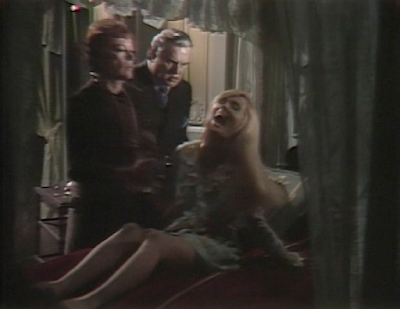
When Vicki wakes up, she pleads with Adam to let her go. She asks what reason he has for abducting her, and he immediately says “No reason!,” then scrunches up his face and says “No, I have a reason.” He won’t tell Vicki what that reason is, but he is interesting to listen to. Vicki makes a run for the door; he grabs her and puts her back on the bed. He asks her, with genuine concern, whether he hurt her. She assures him he did not. He gives her the drugged drink.
Nicholas comes to take Vicki. We cut directly from Vicki unconscious on Adam’s bed to her unconscious on a bed in Nicholas’ house. I don’t think this is the first time Dark Shadows has used a jump cut, but we certainly haven’t seen it often. Abrupt editing is so much at odds with the stately visual grammar of the show that it qualifies as a special effect. Unfortunately, it is an effect that does not make any particular point here, and so is wasted.
The other day, the corpse of Nicholas’ subordinate, wicked witch Angelique, disappeared. We then saw a coffin in Nicholas’ basement. Nicholas talked to the coffin, calling it “Angelique,” indicating that her body was inside. Yesterday, there was a vampire attack. We didn’t see the vampire, but there couldn’t be much doubt that it was her. That is confirmed in the final shot of today’s episode, when we see Angelique in the coffin, her fangs showing.
When Dark Shadows began in the summer of 1966, its most intelligent character was also its most dangerous, strange and troubled boy David Collins. David twice came within an inch of committing the perfect murder, first when he sabotaged his father Roger’s car, then when he trapped his governess Vicki in a room in the long-deserted west wing of the great house of Collinwood.
The only story that consistently worked in those days was the relationship between David and Vicki, and that was solely due to actors David Henesy and Alexandra Moltke Isles. While the writers gave them terrible dialogue- at one point having Vicki read aloud to David from a reference book on the geography of Maine- they used their faces, voices, and movements to show us what was going on inside the characters. Mr Henesy always looked like an angry boy who was grimly determined to keep hating his governess even though he couldn’t help but like her, while Mrs Isles always looked like a fearless young woman who was determined to befriend a boy who might make an attempt on her life at any moment. As David relented from his hatred, we could see a friendship budding between them, even if the words were still no good.
The story of Vicki and David had its climactic phase from December 1966 to March 1967, when his mother Laura Murdoch Collins was on the show. Laura was Dark Shadows’ first supernatural menace, an undead fire witch who planned to incinerate herself and David so that she could attain a new life. When David ran from the burning Laura into Vicki’s arms in #191, he chose her and life over Laura and death. She thus became his new mother, and their story was complete.
Since then, the show has found very little for David to do. Yesterday, he was wandering around the house with a tape recorder. He told his stepmother Cassandra that he couldn’t figure out how to play a tape. The preoccupied Cassandra sent him away, and he asked his cousin Carolyn to help him. Carolyn made it clear that all you do is press the button labeled “Play.” Two years ago, David could sabotage a brake cylinder to fail at precisely the spot on the road where it would be likeliest to lead to a fatal crash, but now he can’t grasp the concept of “Press play to listen to the tape”?
Longtime viewers will see a missed opportunity here. Cassandra is a wicked witch, also known as Angelique. In #492, Angelique/ Cassandra cast a spell that caused David to forget some incriminating information about her, so we know that he is subject to her power. Vicki knows a great deal about Angelique/ Cassandra; they could easily give us a series of scenes in which Vicki tries to warn David about his stepmother, but his mind is clouded. Instead, we never see Vicki and David alone together during this phase of the show, and Angelique/ Cassandra rarely does anything more with David than display irritation and order him to go away.
David eventually played the tape for Angelique/ Cassandra. She reacted with great excitement, since it included a message that explained why she failed in her attempt to restore the vampire curse she once placed on David’s distant cousin Barnabas Collins. She sends David away and keeps the tape recorder.
Angelique/ Cassandra won’t let David take the tape recorder back to his room. Screenshot by Dark Shadows Before I Die.
Angelique/ Cassandra informs her supervisor, suave warlock Nicholas, that she can re-vamp Barnabas if she kills Frankenstein’s monster Adam. Fascinated by the idea of an artificially constructed human being, Nicholas loses interest in Barnabas and instructs Angelique/ Cassandra to find out more about Adam.
In #532/533, Nicholas met Maggie, The Nicest Girl in Town. Nicholas was obviously smitten with Maggie, putting the lie to his taunting of Angelique/ Cassandra for her ability to feel an emotional attachment to Barnabas and his own claim to be motivated solely by a devotion to evil for its own sake. After he gives Angelique/ Cassandra her orders, Nicholas goes to Maggie’s house. Ostensibly this is to find out if she knows where Adam might be, but she so obviously does not that it is clear he just wants to see her. He asks her about her hospitalized fiancé Joe, admires her late father’s paintings, and offers to buy one of them at a high price and lend it back to her. Maggie seems to be quite charmed by him. Nicholas’ “Evil, be thou my good” schtick can be fun to watch for short periods, but if he is going to be a major character for any length of time he will need a more complex inner life. His attraction to Maggie is a step towards giving him one.
David goes to Barnabas’ house. He tells Barnabas’ friend Julia that at least twice this evening he has listened to a message on a tape recorder that had something to do with Barnabas and Adam, but he can’t remember any of the details. He does remember that Angelique/ Cassandra got excited when he played it for her, but that’s it. If Angelique/ Cassandra had cast a spell on David, his forgetfulness would be understandable. If Vicki and Angelique/ Cassandra were locked in battle for David’s allegiance, it could be dramatic. But as it is, the show has chosen simply to present David as an abject moron, and that is infuriating.
Julia and David go back to the great house, where they find Nicholas and Angelique/ Cassandra with the tape recorder. Nicholas and Angelique/ Cassandra leave, and Julia and David play the tape. It no longer has the original message, but instead has the witches’ sabbath portion of Berlioz’ Symphonie Fantastique. David furrows his brow, then comes up with the bright suggestion that Angelique/ Cassandra, who has been in possession of the tape the entire time, may just possibly be the one who made the change. Again, since we have not seen Angelique/ Cassandra cast a spell to confuse David’s thinking, this incredible stupidity can do nothing but exasperate the audience.
They don’t even have the excuse that the current writing staff doesn’t know that David used to be interesting. The gimmick of replacing important information on a reel-to-reel tape with an audio signature suggestive of the culprit is a callback to #172, when Laura thwarted parapsychologist Dr Peter Guthrie by replacing an audio recording of a séance with the sound of fire crackling. If they can recall that bit, surely they can remember that David used to have a functioning brain.
In the early days of the show, Vicki was on a quest to find out who her parents were and why they left her at a foundling home when she was an infant. In #60, Vicki stumbled upon a portrait Maggie’s father Sam painted twenty years before of a woman who looked just like her. Vicki wondered if this woman, whose name was Betty Hanscombe, might have been her mother or aunt. Sam gave Vicki the painting then, but it is back in Maggie’s house today, and Nicholas picks it up at one point. We don’t get a very good look at it, but you can buy a reproduction of it on canvas for $25.99 plus shipping from someone on Etsy, it looks nice.
Roger Collins is on the telephone in the foyer of the great house of Collinwood. He is assuring the caller that it will be fine if Maggie, whom returning viewers know to be The Nicest Girl in Town, comes to stay. He says that he and Cassandra will be glad to have her for as long as she wants to be with them, and that he is sure Liz will approve. First time viewers thus learn that Roger has a wife named Cassandra, and that they live as guests in a house belonging to someone called Liz. A moment later, Liz enters, and is too distracted to hear anything Roger says to her.
Roger ends the phone call, and follows Liz into the drawing room. She stares out the window and makes a gloomy remark about death. He says he understands she must be very upset about Sam Evans. Returning viewers know that Sam was Maggie’s father, and that he died in yesterday’s episode. Roger goes on about how it is natural to be grieved at the loss of a friend like Sam, but soon learns that Liz’ mood has nothing to do with Sam’s demise- it’s news to her that he is dead.
Roger’s lines will startle longtime viewers. For the first 40 weeks of the show, Roger and Sam were united by a deep and abiding mutual hatred, and since then they have had no contact at all. Roger’s words about Sam as a family friend are so far from what we have previously seen that they should be considered a retcon.
Liz and Roger spend several minutes in the drawing room. She keeps going on about the all-pervasive reality of death, and he keeps urging her to see a doctor. There isn’t much to their lines, but Joan Bennett and Louis Edmonds were such extraordinary screen performers that it’s always fun to watch them together. This scene might be a particular pleasure to longtime viewers, who have rarely seen Roger as the responsible adult in any encounter.
We dissolve to a bedroom where a young woman in a black wig is sifting through some powders, looking directly into the camera, and telling Liz that her obsession with death will become even worse than it already is and will have dire consequences. Liz will believe that she is someone else, a woman who lived and died in another century, and may die by the same poison that killed that person.
There is a knock at the door. It is Roger. The woman hides her powders and lets him in. He addresses her as Cassandra and asks why the door was locked. Thus first-time viewers learn that she is his wife, that this is their room, that she is a witch, and that Liz’ problem is the result of a spell she has cast.
Cassandra tells Roger that she locked the door because David kept pestering her about Sam’s death and she wanted a moment to herself. With that, first-time viewers find out that David is Roger’s son, that Cassandra is his stepmother, and that she expects Roger to consider locking him out of the room an appropriate response to his grief about Sam.
Roger does not so consider it, and is bewildered by what Cassandra tells him. He tells Cassandra that Liz is in a bad way, and he is worried about her. Cassandra says she did not know that Roger was so concerned about his family. Baffled by this, Roger says that of course he is concerned, Liz is his sister. This tells first time viewers both what Roger’s relationship to Liz is, and that Cassandra has so little sense of family that she cannot imagine how other people feel.
Regular viewers will learn more. In the first year of the show, Roger’s keynote was his lack of loyalty to the family. That has now been set aside once and for all, and his normal attachment to his son and his sister provide a contrast with Cassandra’s apparently sociopathic coldness. Further, we saw a great deal of Cassandra from November 1967 through March 1968, when the show was a costume drama set in the 1790s and she was called Angelique. We saw then that Angelique had no conception of family or friendship, and that her idea of love begins and ends with her control over a person.
Cassandra promises to join Roger downstairs for a game of bridge in half an hour. He leaves, and she gets back to work spellcasting. As she does so, a figure in a black cassock materializes behind her. She turns, and the figure vanishes. In a quizzical tone, she says Roger’s name, revealing that she did not see the figure or realize that it is a supernatural presence. Together with her locking the door, scrambling to hide her magical paraphernalia when Roger knocked, lying to cover what she was doing, and failing to understand what a person with a reasonable amount of human empathy would consider acceptable behavior, her puzzlement shows that whatever her powers may be, they have definite limits.
Back in the foyer, another young woman with black hair lets a man into the house. She calls him Joe, and he calls her Vicki. Joe and Vicki talk about Sam’s death and about Maggie. Joe says that he wants to marry Maggie as soon as possible and to move away. Vicki is all for their marriage, but does not want them to go. Joe talks about how close he and Sam were. Longtime viewers will remember that when Sam and Roger were enemies, Sam was the town drunk. Even then, Joe was always happy to help him in whatever way he could, and did not see his condition as any obstacle to marrying Maggie.
Liz enters and angrily addresses Joe as “Lieutenant Forbes.” Joe has never heard of Lieutenant Forbes, and cannot understand why Liz, who knows him well, would not recognize him. Vicki clearly does know who Liz is talking about, and manages to calm her down. After Liz apologizes and hastens away, Vicki answers Joe’s questions only by saying that Forbes is someone from “the past.” Since we heard Cassandra talk about Liz taking on the personality of someone who lived in “another century,” this suggests that Vicki, too, has an unnatural familiarity with that same century.
Joe wants to go upstairs to the room where Maggie is sleeping so that he will be the first person she sees when she wakes up. Vicki is about to lead him to Maggie when Cassandra insists she join her in the drawing room to talk about David. Vicki tells Joe which door to open, and complies with Cassandra’s directions. This shows that Vicki is a member of the household staff whose responsibilities have to do with David. Regular viewers know that she is his governess, and that they are very close.
Cassandra tells Vicki that David has been asking about Sam’s last words. Vicki says that he addressed them to Maggie, not to her, and implies that she did not hear them. When Cassandra continues probing, Vicki protests. She asks if Cassandra can’t see that she is upset. Considering how clueless Cassandra was about human feelings in her conversation with Roger, it is entirely possible that she cannot. Vicki tells her that Liz is deeply depressed; Cassandra feigns ignorance. Vicki says in a cold voice, “You wouldn’t know anything about that,” then leaves.
Longtime viewers know that it was Vicki who came unstuck in time in #365 and took us with her to the 1790s. During her nineteen weeks in the past, Vicki came to know not only Forbes, but Angelique. She knows perfectly well that Angelique and Cassandra are the same person, that she is a witch, and that she is a deadly menace to everyone. She likely suspects that Liz’ depression is the consequence of one of Cassandra’s spells, and the tone of her parting remark would suggest that she does. Further, those who saw the show yesterday know that Vicki is lying about Sam’s last words. They were addressed to her, and she heard them clearly. She is choosing not to repeat them to Cassandra lest Cassandra use them for her nefarious purposes.
Cassandra is alone in the drawing room for only a few seconds. She is joined there by the same figure who had appeared in her room. This time she sees him. He confronts her.
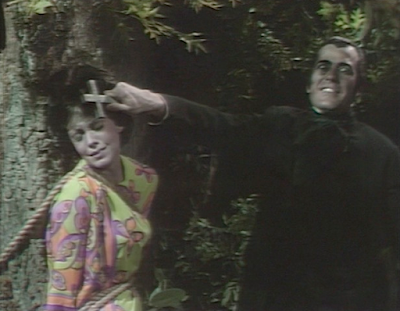
Regular viewers know that the figure is the Rev’d Mr Trask, a fanatical witchfinder who mistook Vicki for the witch in the 1790s and sent her to the gallows. He tells Cassandra that he now has the opportunity to correct that error. He shows her a cross, from which she recoils. We cut to a scene in the woods. Trask has tied Cassandra to a tree and performs an exorcism on her. This is Trask’s go-to technique; he tied Vicki to a tree in #385 and performed an exorcism on her in #386. Since Cassandra actually is in league with the devil (or as Trask would say, THE DE-VILLL!!!,) he has more success this time. Cassandra vanishes and leaves the ropes hanging on the tree.
A first-time viewer might take this climax as an indication that Dark Shadows is a Christian show and Trask is its hero. Not only is Trask going after the right target, he is clearly making some headway. He says all the right things about casting the evil out of Cassandra and saving whatever good is left in her. His delivery of his lines is so fervent that Mrs Acilius, a vigorous Christian, cheered him on. In fact, Trask’s wild incompetence throughout the 1790s segment led to one disaster after another, and was of a piece with the show’s light regard for religion. Not until #450 did a cross provoke a reaction from a monster; that was the first suggestion the show gave that there might be anything to Christianity, and the scenes between Cassandra and Trask today are the second.
Dark Shadows borrows story points freely from all sorts of books, plays, movies, and folklore. So far, it has steered clear of Christianity as a source. For obvious reasons- most of the audience is at least nominally Christian, and Christianity is, in one way or another, a live option for the rest. So it’s a topic that can take over very quickly once it is introduced. I suppose a specifically Christian version of Dark Shadows could have worked, but I can’t imagine that the staff they had would have been particularly interested in making a show like that. So when it looks like they are going to let Trask have even a temporary win, we see the show running one of its boldest risks yet.
Mad scientist Julia Hoffman has summoned sage Timothy Eliot Stokes to the Old House on the great estate of Collinwood, home of her friend, recovering vampire Barnabas Collins. Julia and Stokes talk about the ongoing Dream Curse, a distributed attack on the mental software of a series of people who are more or less connected with Barnabas. The curse takes the form of a nightmare that afflicts one person after another. When Julia declares that Stokes must stop the dreams, he says that she makes it sound like he is responsible for them. She replies that in a way, he is- he was the one who introduced Cassandra Blair to Roger Collins. Roger married Cassandra, giving her a home in the great house on the same estate. Stokes does not dispute the assumption that Cassandra set the curse, but he does deny that he had any influence over Roger’s decision to marry Cassandra.
In #488, Barnabas told Stokes that Cassandra is the witch, and his reaction to Julia’s remark shows both that Julia knows that Stokes is aware of this fact and that he has accepted it. Yet when Julia refers to the witch as “she” later in the episode, Stokes responds as if this were jumping to a conclusion.
Stokes puzzles us again when he says that in the eighteenth century, Josette DuPrés was “a love of Barnabas Collins.” We’ve known that for some time, since Barnabas keeps dwelling on his experiences in the 1790s. But Barnabas doesn’t let on about his past when Stokes is around, nor did his relationship with Josette make it into any written records or any of the legends that circulate in the town of Collinsport. How does Stokes know about it?
The obvious explanation would be that Stokes has been talking with well-meaning governess Vicki. Vicki came unstuck in time in #365 and was marooned in the 1790s until #461. She saw in those days that Barnabas and Josette had been lovers, a fact which Barnabas had inadvertently revealed to her in #233. Neither Vicki nor Stokes has been on the show much lately, leaving them plenty of time for off-camera consultations.
Vicki could also be a source of another piece of information Stokes surprises us with. So far as Stokes knows, the Barnabas of the 1960s is a descendant of another man with the same name. Vicki believes this too, even though she has seen a great deal of evidence that he was a vampire, as for example when he used to bite her on the neck and suck her blood. She did notice that the Barnabas of the 1790s looked, sounded, and moved exactly like his namesake of the 1960s. Today Stokes says that the two Barnabases are “interchangeable” in appearance and behavior, just what Vicki would have told him.
Vicki might possibly have contributed to another bewildering proclamation of Stokes’. He tells Julia that when Barnabas is under great stress, the dream comes to a person who is very close to him, while it settles on people who have no particular connection to him when he is relaxed.
This theory doesn’t work at all. The dreamers whom Stokes classifies as “comparative strangers” to Barnabas are Maggie Evans, The Nicest Girl in Town; Mrs Johnson, housekeeper in the great house; strange and troubled boy David; and an annoying man named Peter who keeps insisting people call him “Jeff.” Of these, only Peter/ Jeff is less than essential to Barnabas. Maggie was the first victim Barnabas sought out. It was his abuse of Maggie that defined Barnabas as a monster the audience should fear, as a lonely guy the audience can feel sorry for, as a bridge between past and present who is pulling the show deeper into the supernatural and towards time travel, and as a figure who will drive stories that bring the residents of Collinwood together with the townsfolk of Collinsport. Mrs Johnson was the first person we saw speak to Barnabas and was the one who invited him into the great house, at a time when the show was putting heavy emphasis on the idea that vampires can enter only where they are invited. David was the first we heard speak Barnabas’ name, and Barnabas was obsessed with killing him for eleven weeks, an obsession that led directly to Vicki’s trip back in time.
Vicki doesn’t know anything about the vital roles these three characters have played in shaping Barnabas’ relationship to the audience and to the structure of the show’s universe, so if Stokes were dependent on her for his information he may have believed they were “comparative strangers” to him. The most puzzling thing is Julia’s reaction. Julia has taken over the function Vicki had at the beginning of the series as the audience’s point of view. She knows what we know and learns what we need to learn. Julia is also supposed to be super-smart, so that when she reacts to Stokes’ theory with excited agreement the show is telling us that he is right.
Barnabas’ servant Willie had the dream the other night, and is supposed to pass it on to heiress Carolyn. He was foiled in his effort to do so yesterday, when Carolyn bit him before he could tell her how it went. Willie got off easy- the last time he was aggressive with Carolyn was in #204, when she pulled a loaded gun on him. He did manage to get enough through to her that she has the first minute of the dream, and she is filled with dread of it from the time she wakes up.
Today, Carolyn is in the Old House with Julia and Stokes. She doesn’t want to have the dream, Stokes believes that if she does he can take control of it and break the curse, and Julia mediates between them. Carolyn goes along with the plan, and it looks like it might succeed. That’s the whole story, which doesn’t add up to much, but Nancy Barrett, Grayson Hall, and Thayer David are all superb actors, and they maintain a fierce intensity that makes it work.
Some people have conversations relating to the ongoing witchcraft trial of bewildered time traveler Vicki Winters. The trial itself is a waste of time, so a half hour listening to people talk about what might happen during the trial is a grim prospect. Indeed, none of today’s scenes is necessary to the overall development of the plot or of any major themes. Still, they give the actors an opportunity to show us what they can do, and four of the five members of the cast turn that opportunity to good advantage.
The exception is of course Roger Davis as Vicki’s defense attorney Peter Bradford. Mr Davis was usually tolerable when he delivered his lines in a normal conversational tone, but when he had to raise his voice, as characters on Dark Shadows have to do very frequently, the results were painfully bad. Voice teachers sometimes tell their students to sing from way down in their bodies; the more indelicate among them have been known to tell boys’ choirs that “The music escapes from the testicles.” Such a teacher would be displeased with Mr Davis. When he raises his voice, the muscles he is tensing are not those around the pelvic floor, but the sphincters in his buttocks, with the result that he seems to be having difficulty evacuating his bowels. I realize this is rather a distasteful discussion, but the topic is impossible to avoid when you listen to Davis going through one sentence after another, in each case building up to one word and grunting it out loudly. Yesterday, young Daniel Collins mentioned that repressed spinster Abigail’s personality was that of someone suffering from indigestion, and when today we hear Peter ask untrustworthy naval officer Nathan Forbes (Joel Crothers) “Why did you LIE!” or tell him “You already DID!” he sounds so much like someone struggling with constipation that we can think of nothing else.
The episode opens with a long scene between Peter and Nathan. One of Crothers’ great strengths as an actor was his ability to relax. He stays loose and moves fluidly, never stiffening in response to Mr Davis’ muscular tension, much less reacting to his straining sounds with either a giggle or a misplaced expression of disgust.
Nathan and Peter’s scene involves a fistfight, the first we have seen on Dark Shadows since dashing action hero Burke Devlin fought dangerously unstable ruffian Willie Loomis in #207. The fight is well-choreographed and Crothers does a good job falling down and looking like he has been beaten, but that result stretches credibility. Not only was Crothers the taller man, but his easy physicality would have given him a great advantage in hand-to-hand combat against someone as rigid and awkward as Mr Davis.
We cut to the drawing room of the great house at Collinwood, where Naomi Collins (Joan Bennett) wants to talk to her husband, haughty tyrant Joshua Collins (Louis Edmonds.) Joshua is moping after the death of his sister Abigail, and doesn’t want to talk to Naomi or anyone else. At first they exchange a few words about Abigail. Naomi doesn’t try to hide her dislike of her late sister-in-law, saying that she led a senseless life. This of course offends Joshua, but Naomi stands her ground.
This part of the conversation includes two lines that are interesting to fans who are curious about the details of the characters’ relationship to their society. When Naomi says that it was because Abigail had too few responsibilities that she became a religious fanatic and a dangerous bigot, Joshua says that she did have some things to do. “She had her church,” he says. Not “the church,” not “our church,” but “her church.” This is not the first indication we have had that Abigail differed from the rest of the family in religion, but it is the most definite confirmation. As aristocratic New Englanders of the eighteenth century, presumably the family would be Congregationalists. Abigail might just have gone to the another, stricter meeting within the Congregationalist fold, or she might have joined a different group.
The other line marks Naomi as a remarkably advanced feminist for her time and place. She says that Abigail was “Like a businesswoman with no business to run.” The concept of “businesswoman” was hardly familiar in the days when this episode is set. Even the word “businessman” was not widely known then- the earliest citation of it in The Oxford English Dictionary dates to 1798, two years after this episode is supposed to be taking place, and its first appearance in the modern sense came several years after that. The same dictionary can find no use of “business-woman” until 1827, and then in only a strongly pejorative sense. But the audience, seeing Joan Bennett on this set, will think of her character matriarch Elizabeth Collins Stoddard, who in the parts of Dark Shadows set in the 1960s runs the family’s business enterprises from this room. Naomi is looking towards the future, and she sees Liz.
Edmonds and Bennett are both wonderful in this scene. She is steady and authoritative throughout; he is alternately gloomy, irritated, and sullen. It is as compelling to watch her hold her single mood as it is to watch him navigate from one to the other. Joshua at no point concedes anything to Naomi, and he ends by turning his back on her and going away. But he is not at all in command today, as he has always been in command before. He is hurting too deeply to give orders and compel obedience by the force of his presence.
In the village of Collinsport, Nathan meets with the Rev’d Mr Trask (Jerry Lacy,) visiting witchfinder. The other day, Nathan capitulated to Trask’s blackmail and testified against Vicki. Now he wants Trask to intercede with Joshua and to talk him out of informing the Navy of his many crimes. He tries to sell Trask a bill of goods, claiming that all the things he did wrong were simply the result of his pure and innocent love for fluttery heiress Millicent Collins. The audience knows that this is entirely false, but Trask doesn’t even let him start on it- he responds that “Physical love is beyond my comprehension.” Mr Lacy is an accomplished comic, and he doesn’t fail to get a laugh with this line. Trask realizes that Nathan’s testimony would lose much of its persuasiveness if he were exposed as the scoundrel he is, Trask agrees.
Joshua comes to meet with Trask. Mr Lacy is a great shouter, and Trask is always on full volume. When he insists that Joshua meet with Nathan and forswear his plan to send a letter to the Navy, he builds Trask into a tower of hypocrisy and repression, and we remember all of the scenes where Joshua has demolished people he disdains, Trask among them. But Joshua is not going to demolish anyone now, not while he is mourning everyone he ever loved. He mutters, frowns, and finally caves in to Trask’s demand. The contrast between the overweening Trask and the fusty Joshua is electrifying to returning viewers.
Joshua then consents to meet privately with Nathan. He tells Nathan that he will keep quiet on condition he secure a transfer to another port as soon as possible. Nathan tells some lies and makes some excuses that impress neither Joshua nor anyone who has been watching the show for any length of time, but again, the actors are fascinating to watch together. The chaos and evil Trask represents has turned the world upside down, weakening the strong Joshua and emboldening the degenerate Nathan.
More bad news awaits Joshua when he goes home. Unhappy as Joshua was with Naomi’s insistence on discussing the faults of his recently deceased sister, he is much more upset when she tells him she has decided to go to court and testify in Vicki’s defense. Joshua is appalled she would do this. He is sure Vicki is to blame for the deaths of both of their children, of both of his siblings, and of various other people, some of whom he cared about when they were alive. He threatens to lock Naomi up in her room to prevent her going to court, but she replies that if he does that she will escape, and he will never see her again. The children are dead and she has no work of her own; she has no reason to stay.
Blonde heiress Carolyn Collins Stoddard is under the power of her distant cousin, Barnabas the vampire. She begins today’s episode in the foyer of the great house of Collinwood. She stares at Barnabas’ portrait, lifting her scarf to bare the marks of his fangs to it. She is eager to comply with Barnabas’ commands. He has ordered her to do two things- stop strange and troubled boy David Collins from sounding the alarm about him, and induce well-meaning governess Vicki to become his bride.
Ever since she stopped being a vicious narcissist in February, Carolyn has spent her time trying to protect her family members against threats she didn’t quite understand. She’d been trying to protect David, a first cousin who has come to be something like a little brother to her, when she stumbled upon Barnabas in his lair and became his slave. Her glad willingness to help Barnabas do whatever it takes to silence David shows how complete her subjection to him is.
Today, Carolyn wakes David before 6 AM. David asks “Are you sick or sum’thin?” David Henesy had a real gift for comedy, and Mrs Acilius and I laughed out loud at this line. Carolyn tells David that she does not believe any of the things he has been saying about Barnabas, that she never saw the ghost of ten year old Sarah Collins, and that if he keeps talking about supernatural menaces he will have to be sent to a mental hospital.
David’s reaction will puzzle regular viewers. Last Wednesday, in #348, Carolyn told David she had seen Sarah and was inclined to believe him about the other things. He was horrified. He said that local physician Dr Woodard saw Sarah, believed him, and died as a result. He begs Carolyn to say that she doesn’t believe him and that she didn’t see Sarah, and when she can’t he sobs in her arms. On Friday, David overheard matriarch Liz telling Carolyn he might have to be sent away to an institution, to which Carolyn responded that she had seen Sarah and did not think David was mentally ill. Afterward, David invited Carolyn to believe that he was crazy rather than accept the stories he had told before Woodard’s death. So when Carolyn shows up and tells David that she has decided to disbelieve the things he was desperate she disbelieve, and that the only danger will come if he repeats stories he wasn’t going to repeat anyway, he ought to be happy.
But David goes to pieces. He is as upset by Carolyn’s newfound disbelief as he was a few days ago by her belief. The actors do such a good job with the material that I am reluctant to complain about it, but if people are going to be watching the show every day the writers really should keep track of what’s in each other’s scripts.
As David is the functional equivalent of a brother to Carolyn, so Vicki is the equivalent of a sister. In fact, Art Wallace’s original story bible for Dark Shadows, titled “Shadows on the Wall,” called for a story that would climax with the revelation that Vicki was Carolyn’s half-sister, the daughter of Carolyn’s father Paul Stoddard. Well before the show went into production, the part of Vicki had been cast with Joan Bennett-lookalike Alexandra Moltke Isles, setting up the hints that run heavily throughout the first 92 episodes that Vicki is Liz’ daughter by some man other than Paul. Whichever half of her genealogy Vicki has in common with Carolyn, Liz has been tacitly treating her as a daughter all along. Liz has referred to Vicki and Carolyn as “the girls” for a long time, and now she is even encouraging Vicki to restore the west wing of the great house, which sounds very much like a project a person undertakes on something she is set to inherit. For a time Carolyn showed some resentment and jealousy towards Vicki, but the last clear indication of that was in #263. Since then, Carolyn has been treating Vicki as if she had always known her as a sister.
The enthralled Carolyn is as happy serving Vicki up to Barnabas as she was betraying David for his sake. Or she would be, if she had the chance.
Barnabas’ co-conspirator, mad scientist Julia Hoffman, is staying in the house. Julia has been passing herself off as an historian studying the old families of New England while secretly trying an experimental treatment meant to cure Barnabas of vampirism. That treatment reached an impasse before Barnabas bit Carolyn, and he has decided to discontinue it. Yesterday, Julia persuaded Barnabas to let her stick around to help guard him when he lies in his coffin during the day.
A few days ago, in #347, Julia hypnotized Vicki and showed her Barnabas in his coffin. By a post-hypnotic suggestion, she kept Vicki from consciously remembering what she had seen, but left her with an emotional aversion to Barnabas. That hypnosis gag is reenacted today, with Julia taking Vicki to the room in Barnabas’ house which he has prepared for her when she becomes his bride. There, she tells Vicki the details of Barnabas’ plans for her. Again, she gives a post-hypnotic suggestion confining this knowledge to her subconscious mind.
The difference between #347 and today is that Carolyn is working for Barnabas now. In that one, Julia had free rein to take hypnotized governesses in and out of Barnabas’ house all day long, without a care in the world. But now, Carolyn is watching. Even before Julia did her thing with Vicki, Carolyn confronted her and asked a series of pointed questions. That scene set up an interesting take on the whole idea of a relationship triangle- Carolyn and Julia are in conflict over Barnabas’ attentions, though neither is going to be his lover in any conventional sense. Triangles are so important in soap operas that this clash calls our attention to how Dark Shadows is rewriting the rules of the genre.
Carolyn sees Vicki and Julia leave the house. After they have returned, she asks Vicki about the walk she and Julia took. Vicki doesn’t know what she’s talking about. Carolyn says that she saw them down by Barnabas’ house, implying that she followed them. Vicki is still baffled. In a recorded voiceover monologue, Carolyn wonders why Vicki would lie. She concludes that she wouldn’t, and that Julia must be up to some kind of hocus-pocus.
Carolyn then asks Julia about her walk with Vicki. Julia feigns ignorance. Carolyn says she saw them leave the house together. Julia is defensive, but Carolyn waits patiently for an answer. Julia claims that they just stepped outside the door for fresh air, and Carolyn leaves it at that. Julia exits, and Carolyn ends the episode as she began- staring at the portrait of dear cousin Barnabas.
The most interesting storyline in the first 39 weeks of Dark Shadows was the relationship between well-meaning governess Victoria Winters and her charge, strange and troubled boy David Collins. That story concluded when David chose life with Vicki over death with his mother, undead fire witch Laura Murdoch Collins. Vicki and David settled into a happy and uneventful friendship, and the show moved on. Now its core is vampire Barnabas Collins, and Vicki is trying to migrate into his orbit.
When we open, Vicki has made her way to Barnabas’ house as a storm was breaking. She had made a show of wanting to hurry home, only to find that it was raining so hard she had to stay with Barnabas overnight. The opening scenes take place in Barnabas’ front parlor, where Vicki is all wide-eyed innocence.
Vicki and Barnabas are both excited about the prospect of a sleepover. Screenshot by Dark Shadows Before I Die
Vicki asks Barnabas about the long-ago death of Josette Collins. Unknown to her, Josette killed herself because she feared Barnabas would turn her into a vampire, the fate he has in mind for Vicki now. As he tells the story, Barnabas shows more and more anguish. At the end, he suggests that the storm might be letting up and offers to take Vicki home. She says that the rain sounds worse than ever, and insists on staying. This is the first scene in which Barnabas plays the “reluctant vampire” we hear so much about in thumbnail sketches of Dark Shadows.
Vicki goes up to Josette’s restored bedroom. She lies on the bed and covers herself up, remaining fully clothed. She doesn’t even take her shoes off.
Downstairs, Barnabas’ sorely bedraggled blood thrall Willie brings a child’s ball he found in the basement by Barnabas’ coffin. For a moment they are afraid that David might have made his way to the basement during the daytime, but Barnabas concludes that they would have heard about it by now if that had happened. Willie brings up the little girl whom he and David both saw playing outside the house on separate occasions some weeks ago. He also reminds Barnabas that when he was keeping Maggie Evans, The Nicest Girl in Town, in the prison cell in the basement Maggie talked about a little girl who visited her there. Barnabas won’t listen to anything about Maggie, and is irritated when Willie keeps saying that he has the feeling that there is someone else in the house. But he does go to search the basement.
Meanwhile, Vicki is awakened by the sound of a child’s voice singing “London Bridge.” Returning viewers know that this is the little girl Willie spoke of, and that she is the ghost of Barnabas’ nine year old sister Sarah. Victoria lights a candle and searches the room, but finds nothing.
Willie is startled when Victoria comes down the stairs and calls him. Barnabas hadn’t bothered telling him she was around. We might be startled too. The diffident, girlish manner she had used with Barnabas earlier in the episode is gone; when she calls “Willie!” she is every inch the lady of the house summoning a servant. In their previous interactions, Willie has always called Vicki by her first name. Today she is “Miss Winters” to him, and that’s only to be expected- she retains an air of command even as Willie tries to warn her that she is in danger.
Barnabas enters and hears Willie urging Vicki to get out of the house at once. Willie takes a second to come up with a suitable lie, claiming that he was afraid spending the night in the house would get people talking about Vicki. She and Barnabas dismiss this concern. Vicki praises Willie’s generous offer to walk her home and shelter her from the rain, and Barnabas assures Willie that he will get what he deserves.
Vicki tells Barnabas that she heard a little girl singing “London Bridge.” Shaken by this report, he insists it is impossible for her to have heard any such thing. He says that he understands if she does not want to return to the room, implicitly repeating his offer to let her go, but she happily returns upstairs. In this conversation, she is not as loftily aristocratic as she had been with Willie, but neither does she revert to the diffident girlishness she had shown Barnabas in the first scene. She looks him in the eye, smiles, speaks briskly, and moves from her hips. She is a woman who knows what she wants and has made up her mind to get it.
Barnabas and Willie have an interesting talk after Vicki goes back upstairs. Willie asks about the little girl, and Barnabas hotly denies she exists. Barnabas is his usual menacing self at first, but then says he won’t punish him for trying to warn Vicki. He asks Willie to “talk to me.” Willie is startled by this, then Barnabas says he has a better idea- “don’t talk to me.” This generates a bad laugh. Some think this is Jonathan Frid trying to cover a misreading of a line, but I tend to think it is good acting exposing bad writing. After their talk, Barnabas sends Willie to his room, then goes upstairs and stares at Vicki while she sleeps, apparently contemplating the possibility of biting her.
Five scenes today, none of which advances any ongoing storylines, but each of which is effective in its own way.
In the great house of Collinwood, well-meaning governess Vicki and flighty heiress Carolyn bicker about reclusive matriarch Liz’ plan to marry seagoing con man Jason. Carolyn is disgusted by her stepfather-to-be and jealous of Vicki’s closeness to her mother. Since the show has been hinting heavily that Vicki is Liz’ biological daughter and dangling the prospect that the resolution of the Liz/ Jason story will reveal this to all the characters, it is intriguing when Carolyn tells Vicki that she has become her mother’s “second daughter- or should I say only daughter. You always wanted a family, and now you have one.”
We see artist Sam Evans in his cottage. Sam is part of a lamebrained scheme to protect his daughter Maggie from the unknown person who tried to kill her by pretending that she is dead, and he is on the telephone with one of his comrades in this plan when a knock comes at the door. It is Vicki come to console him. She talks about how Maggie was her first friend when she came to town, and Sam is so touched he almost breaks down and tells her the truth.
One of Sam’s comrades is Maggie’s boyfriend, hardworking young fisherman Joe. We see a location insert of a seagull, then cut to Joe eating his lunch nearby.
The shot of the gull and the docks makes a point about visual storytelling. Yesterday, Vicki was hanging out on the beach with hopeless schlub Burke Devlin* when she started describing footprints in the sand, a freighter on the horizon, etc. When Vicki stares off into space and tells us about them, we laugh out loud. If they had shown them to us instead, we would have accepted them as metaphors for the transience of life, as we accept these images today as metaphors for whatever they are supposed to be metaphors for.
Carolyn stops by. In the first months of Dark Shadows, Joe and Carolyn were a couple. By the time the narrative found them, they were bored with each other and there was no reason for them to stay together. Yet the process of their breaking up took up a considerable amount of screen time.
That remarkably pointless arc has been over for some time, but it keeps coming up when Carolyn and Joe talk to each other. In this scene, Carolyn starts off by expressing her condolences about Maggie, apologizes for having been cruel to Joe during their time together, and then the two of them talk about some other stuff that’s happening on the show. Joe has to work at keeping a poker face lest he give away the secret about Maggie. The result of his struggle is to make him look noble in Carolyn’s eyes. It’s quite a touching little encounter. I first saw it on the SciFi Channel, as it then was, in the 90s, and have remembered it quite clearly ever since.
Back at Collinwood, Vicki and Carolyn compare notes on their condoling trips and apologize to each other for their quarrel. Moments later, another quarrel is breaking out. Carolyn cuts it short by leaving.
In the Evans cottage, Sam and Joe talk about their meetings with Vicki and Carolyn. They assure each other that it is all-important that they stick with their plan and tell no one that Maggie is alive.
*The show used to feature Mitchell Ryan as dashing action hero Burke Devlin. Yesterday, Anthony George took over the role, and reinvented him as a hopeless schlub.
Vampire Barnabas Collins has taken up residence in the long-abandoned Old House on the grounds of the great estate of Collinwood and restored two rooms, leaving the rest of the mansion a shambling ruin. That image captures the current state of Dark Shadows. This episode, like many others we’ve seen recently, contains some scenes that are all right by themselves, but that do not contribute to any structure. The result is continual frustration and disappointment.
From its introduction in #70 until Barnabas claimed it in #212, the Old House was the stronghold of the ghost of Josette Collins and the playground of Josette’s darling, strange and troubled boy David Collins. We’ve seen Josette appear several times, and characters including David, well-meaning governess Vicki, and artist Sam Evans have interacted with her. Now, Barnabas not only seems to have silenced Josette’s ghost, but is holding Sam’s daughter Maggie and trying to turn her into a resurrected Josette by following the procedures Boris Karloff’s character Imhotep demonstrated in the 1932 film The Mummy. Regular viewers are growing impatient to see Josette emerge from her portrait and lead the battle against Barnabas, as she led the successful battles against crazed handyman Matthew Morgan in #122-#126 and against blonde fire witch Laura Murdoch Collins in #126-#191.
Today, David reflects our impatience. We see him at the Old House, knocking on the door, then peeping through the window. He sees a veiled figure in Josette’s white dress walking down the stairs. He returns to the door, which opens for him. No one is in sight.
We have assumed that the woman in white was Maggie wearing the dress Barnabas gave her, but the fact that she was out of sight by the time the door opened suggests that it might have been Josette’s ghost after all. David calls to Josette. When she does not answer, he goes upstairs to look for her.
David finds Josette’s restored bedroom, where her portrait now hangs. He talks to the portrait, not in the easy conversational tone he had used with it in #102, but in awkward shouts. He pleads and protests that he can’t sense her presence. When he came to the house in #223 and saw that the portrait was not in its old place above the mantle in the front parlor, he had wandered around whining that the portrait is lost and Josette is lost with it. Now that he has found the portrait, his perplexity deepens- she is still nowhere near.
Barnabas enters, and demands to know what David is doing deep in his house. After a moment, he sits and talks with the boy. He tries to present the idea of ghosts as absurd on its face, but David has seen too much to find that convincing. When Barnabas tells him that the door probably opened because of the warping of the wood, we know that it must have been the work of a paranormal being- a villain cannot say something so plausible unless it is false. Even if the figure David saw was Maggie, there is definitely some spectral presence in the house that Barnabas does not know about and cannot control.
Barnabas and David have a man-to-man talk, or should I say ghoul-to-boy.
Barnabas finally tells David to take a long, deep look at the portrait, and asks him if he still feels that Josette is there. David says that he does not have that feeling. Barnabas triumphantly declares that Josette is really gone.
Now, at last, we expect everything will start to come together. David will talk to Vicki, they will compare notes about their encounters with Josette, and will try to figure out how and why she has changed. There will be images building on the ambiguity about who David really saw through the window and who really opened the door for him. David’s father, high-born ne’er-do-well Roger, will try to revert to his usual denials that anything peculiar is going on, but will grudgingly admit that the events of the last several months have proven that Josette’s ghost is real, and will not be able to resist wondering what is going on with it now. That in turn will lead to a new understanding between Roger and Vicki, allowing Roger’s relationships with both her and David to become more dynamic. Barnabas will realize that, even if he can keep Josette from manifesting herself again, she has already revealed enough to the characters about the supernatural back-world behind the settings in which they operate that she has created a dangerous situation for him, and he will have to scramble to keep them from discovering that he is a vampire.
The script brings us right up to the brink of every one of those events, only to whisk us away and instead show us something dull and pointless. David does tell Vicki that he saw Josette’s ghost, that Josette is in some way he cannot explain different than she was when he saw her before, and that he could not feel Josette’s presence in her portrait. But Vicki does not draw on her many experiences with Josette and join David in trying to unriddle these mysteries. Instead, she behaves as she did in the first twelve weeks of the show, and treats David as if he is having a neurotic episode.
David tells Vicki that Josette’s face, as he saw it through Barnabas’ window, was “exactly the same” as it was when he saw her ghost before. We don’t see the face at all today, and when we’ve seen Josette before, the only look we had at her face were brief glimpses in #149, #165, and #184. In each of those episodes, she was played by stand-in Rosemary McNamara. Today, the performer wearing the dress is Dorrie Kavanaugh. Casting Miss McNamara and letting a bit of her face peep out for a fraction of a second would seem to be way of building on the ambiguity, especially since she resembles Kathryn Leigh Scott strongly enough that she could easily be taken for Maggie.
Though Miss Scott played Josette’s ghost in #70 and #126, this is the first we’ve heard that Maggie resembles Josette. Perhaps Barnabas chose Maggie, not only because she is an attractive young woman who works late and often has to walk home alone after dark, but because she really does look like Josette. If so, the parallel with The Mummy is stronger- Helen Grosvenor looked just like the Princess Ankh-esen-amun, and the movie hints that Imhotep may have been right to believe that she was her reincarnation.
Vicki doesn’t react at all to David’s observation. She simply grows more exasperated with him for his persistence in believing in ghosts and intruding on Barnabas’ privacy, and warns him that “your father and I” will have to become stricter with him if his behavior does not improve.
Meanwhile, Barnabas and Roger are talking in the drawing room. Roger speculates that David has gone back to his preoccupation with ghosts because everyone is so worried about the missing Maggie, then remarks that it is strange that the boy’s behavior should have created a connection between Maggie and the portrait of Josette. This line doesn’t make any sense in the script as written, but if we could believe that Roger remembers what he recently knew to be true about Josette’s ghost, its powers, and its connection to Maggie’s father, it would be a sign that he is on his way to making a crucial discovery. In that situation, Barnabas’ mounting dread as he listens to Roger would carry considerable dramatic force, as opposed to the meaningless throwaway it in fact is.
Barnabas absorbing what Roger has said
Vicki’s amnesia is especially depressing, because the only story that consistently worked in the first 39 weeks of the show was the relationship between Vicki and David. At first David hated Vicki and wanted to kill her. After he found out she’d seen a ghost, David proclaimed his love for Vicki, but that was a love that might quickly transform itself into a violent hostility. Gradually, a true friendship grew between them. The Laura arc was the climax of that story, ending with David turning away from the biological mother who wanted to kill him and embracing Vicki as a more acceptable mother figure.
Once David had adopted Vicki as his new mother, their story was complete. Alexandra Moltke Isles and David Henesy made so much of Vicki and David’s scenes together, often in spite of very bad writing, that we are eager to see a sequel to that story that will give us more victories over the stuff that dribbled out of the typewriters of Ron Sproat and Malcolm Marmorstein. One possible sequel would have been an arc in which Vicki and David have to work together to defeat the vampire. If Vicki has forgotten everything that’s happened on the show since October of 1966, when she saw the ghost of Bill Malloy in #85, she won’t be able to do that, or much of anything else for that matter. The show has been primarily a supernatural thriller for months now, and if Vicki is excluded from the supernatural stories her future on it is very limited indeed.
A possible non-supernatural storyline might have been a romance between Vicki and Roger. After all, if Vicki is acting as David’s mother and she lives in the same house as his father, it only makes sense that the two of them should become a couple. And indeed, there are moments today when that seems to have happened. She hesitates for a fraction of a second while delivering the line about “your father and I,” which does sound so much like something an impatient mother would say. She then goes on to have a quarrel with Roger about how to discipline David and what emotions it is proper to display in front of him, sounding like they’ve been married for years. After a lot of raised voices, they apologize to each other and leave together.
We’ve seen Vicki and Roger in date-like situations a few times, for example in #78 and #96, and each time it has immediately become clear that the two of them are wrong for each other. Besides, Roger has been turning into the actor who plays him, the obviously gay Louis Edmonds. So a relationship between Vicki and Roger would be doomed from the start.
Still, it would reactivate some dead storylines. The series started with Vicki on a quest to learn who her parents were, a theme that went nowhere. They’ve been hinting very heavily that Roger’s sister, reclusive matriarch Liz, is Vicki’s mother, so that an engagement between Vicki and Roger would put Liz in a position where she could hardly keep that secret any longer. Moreover, Vicki has gone on some dates with dashing action hero Burke Devlin, who is not directly connected to any ongoing storylines. Burke hates Roger and is attracted to Vicki, so a love triangle involving the three of them might bring him back into the show. But that fizzles out just as the other potentially interesting situations do, leaving us without much to look forward to.





 Dark Shadows Commentary