Episode 392: This great democracy of yours

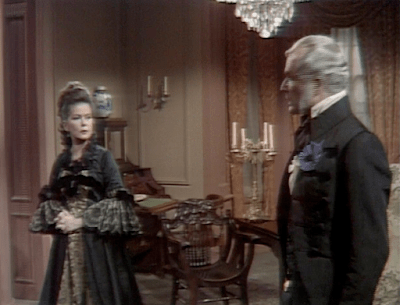
In episode 368/369 of Dark Shadows, haughty overlord Joshua Collins of Collinsport, Maine told his house-guest, the Countess DuPrés, that he was surprised she still chose to “affect a title,” since in this year of 1795 “France has followed our example and become a republic.” After the countess handed Joshua his head, he fumed to his wife Naomi that her snobbish Old World ways offended him, since he is such a devout believer in human equality.

It was immediately clear to any viewer that Joshua was being hypocritical. He tyrannizes his family and treats his servants as domestic animals that have unaccountably, and rather inconveniently, gained the power of speech. When he says that all men are equal, he means that he, personally, is the equal of anyone in a sufficiently lofty position, and the superior of everyone else.

Audience members who know something about the history of the late eighteenth century in the USA and France will find more to savor in Joshua’s preposterous position. By 1795, the French Revolution had gone through its most radical phases, and was anathema to everyone in the USA other than some of the nascent political tendency led by Thomas Jefferson, a tendency known in the southeast and New England as the Republican Party and in the middle states and the west as the Democratic Party. When Joshua says with great satisfaction that “France has followed our example and become a republic,” he is identifying himself with the most militant factions of the Jeffersonian party, and when he tells Naomi that “all men are equal” he is echoing the most famous passage of Jefferson’s most celebrated writing.

Ridiculous as it is to hear Joshua invoke the egalitarian rhetoric for which Jefferson was so well known, as a major landowner in a rural area far removed from the major cities he was perfectly typical of the most important backers of the Democratic/ Republicans. Jefferson himself was a member of this category, and he displayed both a remarkably sophisticated understanding of the leftwardmost theorists of the French Revolution, as demonstrated for example in the edition of the works of Destutt de Tracy that he prepared for publication in 1817, and a dismally cruel approach to his livelihood as a slave-holding planter.

When Dark Shadows was on the air in 1966-1971, the party that traced its origins to Jefferson was undergoing a revolution of its own. The coalition he forged between working-class groups in the north and rich slave-owners in the south had been an inspiration to the Democratic Party from the days before the Civil War right through the presidencies of Woodrow Wilson and Franklin Roosevelt. After World War Two, the African American freedom movement finally scrambled this unlikely coalition, winning Black southerners the vote and challenging the dominance the heirs of the slave-owners had long held in the Democratic Solid South. Thoughtful Americans, seeing this change, might well think back to the origins of the Democratic Party and to the ridiculous incongruity of Jefferson’s soaringly egalitarian words coming out of his and other oligarchic mouths.

At the top of today’s episode, Joshua is very thorough about betraying all of Jefferson’s ideals. He tells Naomi that the common folk of the town must not know that their son Barnabas killed his uncle Jeremiah in a duel. Naomi replies that everyone already knows; Joshua insists that they do not, and declares that they will believe what he tells them to believe.

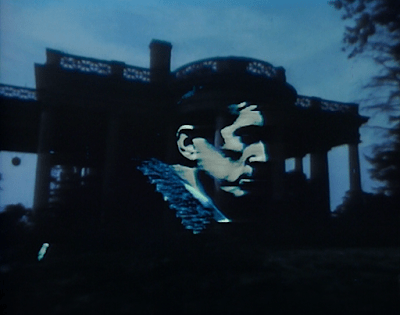
The philosophe in his salon. Screenshot by Dark Shadows Before I Die.

One of the major themes of Jefferson’s correspondence, as indeed of Destutt de Tracy and other Enlightenment philosophes, was what Karl Marx, a close reader of Destutt de Tracy, would call “false consciousness,” the tendency of the oppressed classes to see the world in categories generated by the ruling class, and that if false consciousness were erased the oppressed would rise up and sweep away all manner of social evils. Joshua’s determination to keep the working people of Collinsport in the dark about what is happening on the estate of Collinwood puts him at the opposite extreme from the beliefs his leader Jefferson professed. In his own life, Jefferson himself set about enforcing regimes of lies on more than one occasion, as for example when he used his office as president of the United States to cover up the crimes of General James Wilkinson. Even viewers who hadn’t read Jefferson’s letters and who were unaware of Jefferson’s less inspiring actions may well have known, in 1967, that the confidence which the Declaration of Independence expresses in what will happen if “the facts be submitted to a candid world” sat uneasily with the lies on which slavery in particular and white supremacy in general rests.

Joshua begins dictating to Naomi a fictitious story that sounds oddly familiar to regular viewers. Before well-meaning governess Vicki was plunged into her uncertain and frightening journey into the past, we had heard several versions of the Collins family history, none of which resembles the events that we have actually seen play out so far. As Joshua tells Naomi what he has decided people should believe, for the first time the outlines of the Collins family history published in the 1950s come into view. That history is not only sustained by false consciousness, but has its origins in a brazen lie.

Joshua is busy fabricating when Naomi interrupts him with more bad news. Barnabas has decided to marry Angelique, maid to the Countess DuPrés and to the countess’ niece, Barnabas’ former fiancée Josette. The great egalitarian Joshua is thunderstruck that his son would fall into the clutches of an “adventuress.”

Joshua sends Naomi to fetch Barnabas. He thunders his disapproval of the marriage, and Barnabas stands his ground.

Later, we see Josette in the cemetery, at Jeremiah’s grave. Barnabas spots her, and wonders whether he should tell her about his engagement to Angelique. He doesn’t want her to hear of it from someone else, as she surely will very soon. But the place could not be less appropriate. He approaches her; they have an awkward little talk, in the course of which he urges her to hate him for killing her husband. She says she cannot. She tells him not to say any more. He is helpless.

Angelique arrives and tells Josette that her carriage is waiting. Josette invites Barnabas to ride back to the manor house with them; he declines. Josette leaves the two of them alone for a moment; with a note of jealousy that belies her agreement to a sham marriage to a man who will always love Josette, she asks Barnabas if she interrupted something. He says that she did not. That’s true- he had already given up the idea of telling her about their engagement when Angelique joined them.

Back in the manor house, Joshua summons Angelique to the front parlor, where he offers her $10,000 to relinquish her claim on Barnabas and go back to the island of Martinique. It is difficult to compare prices between 1795 and 2023; to get a sense of proportion, we might remember that when Joshua offered Vicki a job as governess to little Sarah Collins in #367, he offered her a salary of $4 a week, and that this was rather a generous rate of pay for the position. So it would take even an upper servant 2500 weeks, that is to say almost fifty years, to earn the amount of money Joshua is offering Angelique.

Angelique refuses Joshua’s bribe. He says he is prepared to offer more, but when he sees that she is firm in her refusal he switches to threats. Naomi intervenes and says that she does not want to break ties. With Naomi’s promise of friendship, Angelique agrees to wait until the mourning period for Jeremiah is complete before marrying Barnabas.

What returning viewers know that Joshua, Naomi, Barnabas, the countess, and Josette do not is that Angelique is not only a maid, but is also a witch. It was under her spell that Josette, though in love with Barnabas, conceived a mad passion for Jeremiah, that Jeremiah, though a loyal friend to Barnabas, reciprocated that passion, and that the two of them, though they struggled with their consciences, eloped. That elopement prompted the jilted Barnabas to challenge his uncle to a duel, and his bewilderment at his own actions prompted Jeremiah to delope and let Barnabas kill him. Angelique and Barnabas had had a brief romantic fling before he became engaged to Josette, and she believed that once Josette was out of the way Barnabas would return to her.

It hadn’t quite worked out that way. In her frustration at Barnabas’ continued preference for Josette, Angelique cast a spell on Sarah, sickening her and threatening her life. When she saw how upset Barnabas was by his little sister’s illness, Angelique said that she could cure it, and extorted his promise to marry her if she did so. She released Barnabas from that promise in #390/391. When he told her that Josette would always come first for him, even though he knew there could never again be anything between them, she said she would marry him anyway. Apparently thinking he wouldn’t be likely to find another woman willing to enter a sham marriage on that basis, Barnabas proposed, and Angelique accepted.

In their conversation in the parlor, Joshua tells Angelique that he knows about the promise she extorted from Barnabas with her ability to cure Sarah. Evidently Barnabas told Naomi about that. There are those in the house who believe that witchcraft is afoot; indeed, Vicki is in hiding, having been accused as the witch. This story would seem to be proof positive that Angelique, not Vicki, is the guilty party, and she does widen her eyes when Joshua brings it up. But he and Naomi don’t make the connection.

Back in the graveyard, Angelique is holding a miniature coffin and casting a spell.

Where did she get that miniature? Screenshot by Dark Shadows Before I Die.

In her bedroom, Josette hears Angelique’s disembodied voice, saying that Jeremiah is not dead. She runs to the front door, where Naomi sees her. Unable to dissuade her from going out in the night, Naomi follows Josette to Jeremiah’s grave. Josette keeps hearing the voice; Naomi does not hear it. But when Jeremiah’s hand bursts out of the soil, both women see it.

Jeremiah waves to the ladies. Screenshot by Dark Shadows Before I Die.

In the parts of Dark Shadows set in the twentieth century, Joan Bennett played matriarch Elizabeth Collins Stoddard. Of all the major characters, Liz was the most reluctant to acknowledge the existence of supernatural forces, and she was the one who was least likely to see the evidence of such forces that abounded in the world around her. So when we see her as Naomi watching Jeremiah’s hand reaching out of his grave, it is the first time we have seen her react to an incontrovertible sign of the paranormal. It makes us wonder how far back in the Collinses’ past the roots of Liz’ denial extend.

Episode 154: Died by fire!

Eventually, Dark Shadows became the kind of pop culture phenomenon that even people who never saw the show couldn’t really avoid. Most such things spawn catchphrases that become widely familiar and remain so for years. Think of Star Trek with “Beam me up!” or “Warp speed.” To my knowledge, Dark Shadows was an exception to that, with no phrases or expressions spreading beyond its fans. But if it had already been a hit when today’s episode aired, I think a character we meet in it would have been the source of two catchphrases. That character is Cemetery Caretaker, played by Daniel F. Keyes.

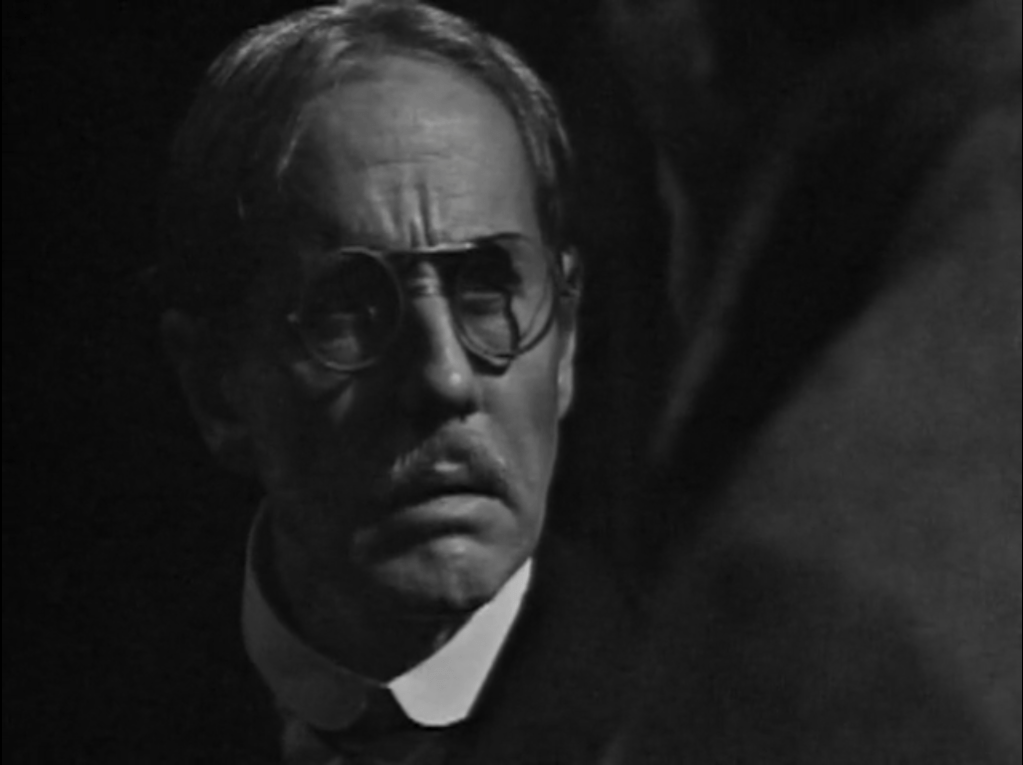
Under the influence of the ghost of Josette Collins, well-meaning governess Vicki has ordered her boyfriend, instantly forgettable lawyer Frank, to take her to a graveyard out in the country someplace. Vicki knocks on the door of a building there, and at length an aged figure in a celluloid collar and wire-frame glasses opens the door. He stands mute for the first minute Vicki and Frank talk to him. When he finally starts speaking, he asks them if they are alive.

Guy’s got star quality

Frank doesn’t show any surprise at the question. You wouldn’t really expect him to- with his personality, he must get that a lot. He assures the caretaker that yes, he and Vicki are alive. The caretaker explains that he often hears knocking at the door, but it is usually the unquiet spirits of the dead.

Some months from now, the caretaker will introduce his second memorable phrase, “The dead must rest!” At this first appearance, we learn why they must. If the dead aren’t resting, they’re going to be keeping him awake all night, and he has things to do in the morning.

Frank tells the caretaker that they are lost. Vicki contradicts him and insists that this is where she is supposed to be. Frank apologizes for bothering him and tries to go; Vicki insists on staying. The caretaker lets them into the building.

Inside, Vicki and Frank find a strange combination of archive and mausoleum. By the standards of Dark Shadows, it’s a big, elaborate new set, a definite sign that something important is happening.

The front room of the caretaker’s building
Vicki examines one of the bookcases
Entering the archive area
In the archive area

Vicki keeps talking about how fresh the air is, and how full of the scent of jasmine. The caretaker is bewildered by her words, and Frank says the only scents he can detect are must and mold. The audience knows that the scent of jasmine is a sign that the ghost of Josette Collins is trying to attract a character’s attention.

Vicki declares that the source of the scent is in a connected room. The caretaker is reluctant to let Vicki and Frank into that room. He says that it is the final resting place of those members of the illustrious Stockbridge family* who died particularly gruesome deaths. Vicki pleads with him, and he gives in. He does insist that while in the crypt, they must be very quiet- “So quiet, even they can’t hear.”

Entering the crypt area
Examining a plaque

The caretaker talks in a not-particularly hushed stage voice the entire time they are in the crypt, so he must not think the dead have such great hearing after all. He tells the stories of the crimes and accidents that took the lives of each of the people whose remains lie behind the large stone plaques on the wall. When he comes to the last of them, L. Murdoch Stockbridge, Frank interrupts him. “L. Murdoch! I’ve seen that name on legal documents around the office a hundred times!” Frank is handling the divorce of high-born ne’er-do-well Roger Collins from his mysterious and long-absent wife, Laura Murdoch Collins.

Examining THE plaque

Frank asks about L. Murdoch Stockbridge. The caretaker doesn’t know what the L. stood for. He does know that she was a woman, and he can describe the circumstances of her death. One night in 1767, a candle set the curtains around her bed ablaze, and she burned to death. Such remains as are in the niche are little but ashes. He says, and then repeats, “L. Murdoch Stockbridge died by fire! L. Murdoch Stockbridge died by fire!” Once Vicki learns about L. Murdoch Stockbridge, the scent of jasmine disappears and she is in the same dank musty space as Frank and the caretaker.

I heard she died by fire

It’s been three years since Mrs Acilius and I first saw these episodes, and I can still make her laugh by putting on an old man voice and saying “Died by fire!” Sometimes we find ourselves in situations where everyone is being very serious, and someone mentions that a person “died by fire.” I glance at her, and find her biting her lip to keep from laughing out loud. That’s why I say that if Dark Shadows had been at the peak of its popularity in January of 1967, “Died by fire!” would have been one of the great pop culture catchphrases of the period.

Back at the great house of Collinwood, wildly indiscreet housekeeper Mrs Johnson comes into the drawing room while Roger is at his usual station, leaning on the cabinet where the brandy is kept and draining a snifter. She asks him if she can bring him anything. Those are the words, but the voice spells out a stern sermon about the evils of alcohol. Roger goes to sit down, saying nothing of consequence but saying it in a way that makes clear he dislikes and resents her.

Laura enters. Roger sends Mrs Johnson off to make coffee. Alone in the drawing room, Roger and Laura argue about all the things they have been arguing about since she returned from her long absence. There is no new information in the dialogue, but it is good to see another side of Roger. Lately we’ve seen him almost exclusively as the bratty little brother of reclusive matriarch Liz, and his interactions with other characters are dominated by the narcissism that is most fully expressed in his scenes with Liz. When he is the unloving father of strange and troubled boy David, the unsettlingly flirtatious uncle of flighty heiress Carolyn, the cowardly foe of dashing action hero Burke Devlin, or the malign co-conspirator of drunken artist Sam Evans, we see vices that we can trace back directly to his certainty that Liz will always shelter him from the consequences of his actions, whatever they may be. When he stands up to Laura in this scene, we see that there is a semi-functional adult somewhere inside Roger.

Roger and Laura realize that Mrs Johnson has been eavesdropping on their conversation. They are worried about what she might have heard. They do not know what regular viewers know, that she is a paid agent of Roger’s enemy Burke, placed in the house to spy on the Collinses. They do know that she has a big mouth, though, and since the last words they spoke were about a crime they want to keep covered up that’s enough to give them pause.

Frank brings Vicki home to Collinwood. Standing outside the front door, they remark on the caretaker’s frequent muttering of “died by fire! Died by fire!”

Reviewing their visit to the caretaker

Vicki reviews all of the strange occurrences that have taken place since Laura’s return. She sums up the whole course of any story about people investigating the supernatural- “It seems connected- and yet so unconnected.” By the laws of nature as science describes them, by the ordinary logic of waking life, none of the events she lists means anything. It’s only after you accept the idea that uncanny forces are at work that they form a pattern pointing to Laura. The audience can accept that, because we can hear the theremin on the soundtrack. Vicki and Frank have a harder time.

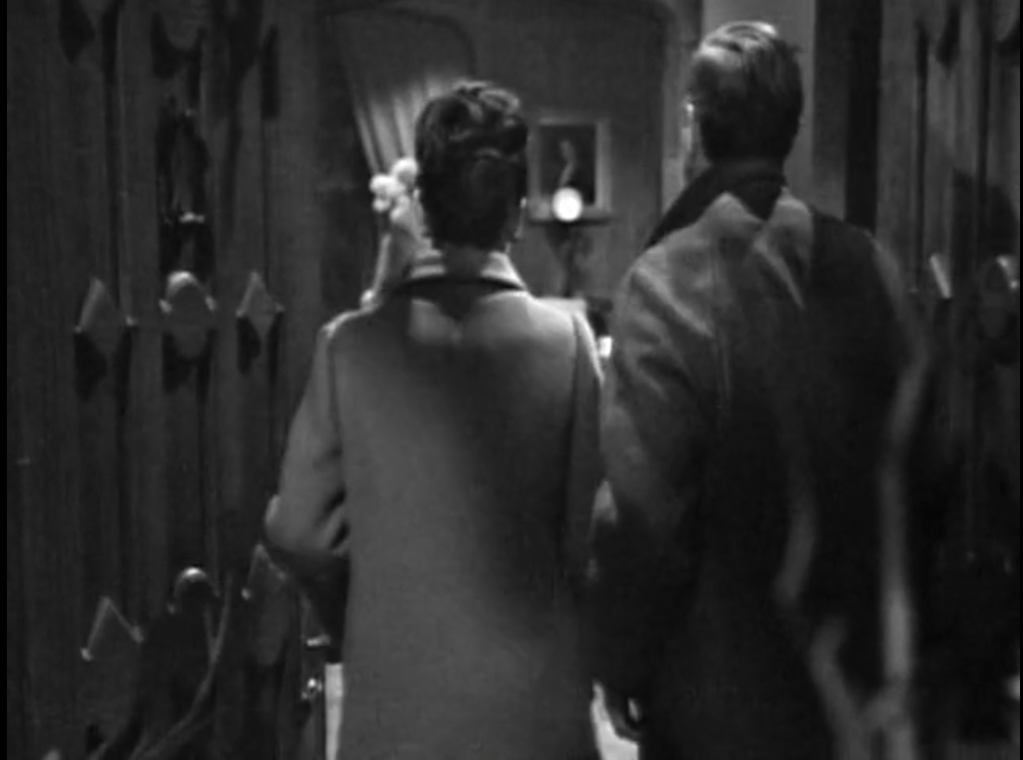
Frank tells Vicki he has to get home. She invites him in for a drink. He replies “You make it a stiff one, and you’re on!” That’s what you need before a long drive on dark, winding roads, to get tanked up on a lot of booze. They open the doors and walk into the house. The camera dwells on them as they make this procession. As they had gone through doors that led to L. Murdoch Stockbridge, now they go through the doors that lead to L. Murdoch Collins.

Entering the house

Vicki and Frank join Roger and Laura in the drawing room. The men drink brandy, the women sip coffee. Vicki asks Laura about her family background, claiming that David is curious about it. Laura responds merely that her family is a distinguished one and had been in the area for a long time.

Roger tells Frank that he will be hearing from Lieutenant Riley of the state police tomorrow. Laura objects that she doesn’t want to talk about Riley’s message, Roger says there won’t be any conversation- he will simply announce the lieutenant’s laughable news. The authorities in Phoenix, Arizona are convinced that a charred corpse found in Laura’s apartment there is hers, and that she died when the apartment building burned to the ground. Vicki looks at Laura, and with a strange smile says “Laura Murdoch Collins died by fire.”

“Laura Murdoch Collins died by fire”

*The caretaker was deeply versed in the lore of the Stockbridge family, and told Vicki and Frank that most of the graves in this eighteenth century cemetery were theirs. Yet he showed no glimmer of recognition when Vicki mentioned Josette Collins to him. That suggests that the Stockbridges were leading citizens of the area before the Collinses rose to prominence.

It might be interesting if someone would write a story in which the first Collinses were servants of the Stockbridges who got rich by doing their dirty work. Maybe the first and darkest shadow of all was that some colonial Collins scabbed on his fellow employees when they were trying to get a fair deal from the Stockbridges. I’m not up on Dark Shadows fanfic, for all I know there may be whole novels out there on this theme.

Episode 153: To be a dead woman

High-born ne’er-do-well Roger Collins had some bad news several weeks ago when he learned that his estranged wife, the mysterious and long-absent Laura, had come back to town. His consternation turned to joy when he learned that Laura wanted to divorce him and leave with their son, strange and troubled boy David.

The one obstacle in the path of the divorce is Roger’s sister, reclusive matriarch Liz. Roger has squandered his entire inheritance and has no inclination to make himself useful enough to anyone to earn a living. He therefore lives as a parasite on Liz, living as a guest in her house and drawing an income from a sinecure with her business. Liz distrusts Laura and sees in David the only hope that the family name will continue. She is determined to prevent Laura from taking David, and Roger has to appease her.

Today, Liz is disturbed that the authorities in Phoenix, Arizona keep insisting that Laura is dead. She lived in an apartment there which burned to the ground. The medical examiners in Arizona have now inspected the charred remains of a woman found inside, and the dental records are a perfect match for Laura’s. Lieutenant Dan Riley of the Maine state police shows up to inform everyone of this fact and to convey Arizona’s request that Laura submit to a physical.

Riley has some rather peculiar mannerisms. When Roger answers his knock to let him into the great house of Collinwood, he finds him standing at the door, staring off into space at a right angle to him. I’ve answered many a door in my day, and I don’t believe I have ever found anyone on the other side presenting his profile to me in this way. It is truly an odd thing to see. I suppose director John Sedwick must have told him to do that in order to make some kind of point, but I can’t for the life of me imagine what that point might be.

Lt Riley presents his profile to Roger

Roger is dismayed that the bizarre situation created by Arizona’s insistence that his wife is dead threatens to postpone his final farewell to Laura and David, but he does see the funny side of it. He and Liz take Riley to the cottage where Laura is staying. Before Riley can start talking, Roger asks Laura how it feels to be dead. The show has been giving us lots of clues that Laura is a revenant of some kind, and both Liz and David’s well-meaning governess Vicki have taken note of some of these clues. Laura’s shock when Roger puts that question to her strikes her silent for a whole commercial break. When they come back and we find him teasing her with the news from Phoenix, we might wonder if she’s about to betray herself- “I haven’t been dead for weeks, not altogether anyway!” But instead she just sputters and postures, behaving as if offended. Roger is puzzled by this reaction, and asks what happened to her sense of humor. Apparently his comments are the sort of joke that used to make her laugh.

Riley does not doubt that the Arizona authorities have made a mistake and that Laura in fact is the person everyone in the town where she grew up, including her husband, her ex-fiance, her disapproving sister-in-law, and the sheriff, has taken her to be. He simply asks them to play along and help his colleagues in Arizona to complete the routine tasks required of them. Among the questions she answers correctly is that it was her idea to name her son “David Theodore Collins.” Roger had wanted to name him “Charles Andrew Collins,” after some of his ancestors, but she insisted on calling him “David,” a name no previous Collins had ever borne. At Roger’s instance, Laura agrees to go to a doctor so that Riley will be able to send the Arizona officials the paperwork they need.

After Liz and the policeman have left Laura alone, Roger asks her what she isn’t telling about the fire in Phoenix. She is alarmed that he might attach some weight to the identification of the body as hers. He at once dismisses that as too ridiculous for words, but says that he is sure she knows more about the dead woman than she is telling. She won’t budge from her denials, and he tells her that while he will be glad to publicly support any lie it might be useful for her to tell, they really ought to share the truth in private.

That evening, Vicki is on a date with Roger’s lawyer, instantly forgettable young Frank Garner. She tells Frank she is glad that David is warming to Laura. He says that there are so many unanswered questions about Laura that he fears Vicki’s attitude towards her is excessively charitable. He does not think that Vicki or anyone else really knows enough about Laura to be sure that she ought to be trusted with David’s care.

After dinner, Vicki is a passenger in Frank’s car. We are introduced to this fact by a shot of a car’s headlights coming at us, a shot previously used in an early promo for Dark Shadows.

Car

While Frank is droning on about who knows what,Vicki looks off in the distance and smiles broadly. Frank sees this big smile, recognizes that nothing he is saying could elicit so vivid a reaction, and objects to her ignoring him. She says that the scent of jasmine is all around. He says he doesn’t smell anything.

The scent of jasmine has been established as the sign that the ghost of Josette Collins is present. Josette has been trying to warn everyone that Laura poses a threat to David, and Vicki is especially susceptible to communication from her. So regular viewers will know that Vicki is now acting under instructions from Josette.

Vicki starts issuing commands. She orders him to take the next right turn, then a left, and finally to stop in the middle of a field. When Frank asks whether she has ever been there before, she says no. When he asks if she knows where they are, she says no. When he asks why she keeps giving these orders, she says that “It is where I am supposed to be.” He realizes that they are in a cemetery.

Vicki jumps out of the car and runs up to the door of a small building. She knocks furiously at the door. Frank comes running after her, asking her what she is doing. Again, she will only say that it is where she is supposed to be. When she knocks, he tells her no one can possibly be in there. It is a chapel or some other kind of public building, there is no public event taking place in the cemetery, and it is long after regular business hours. Vicki listens to him and starts to move away from the door. Then, she sees the door handle turn. She and Frank watch as the door opens.

Vicki arrives at the building
Where she is supposed to be

Dark Shadows never had much of a budget for sets. Every time we see a new one, even one as modest as this, it is a sign that something important is about to happen.