Episode 363: Very honorable guy

When Dark Shadows debuted in June 1966, it was a Gothic romance in which characters sometimes equivocated about whether they were using the word “ghost” metaphorically to refer to present troubles caused by past conflicts or literally to refer to things that go bump in the night.

That version of the series ended with the story of undead fire witch Laura Murdoch Collins. In Laura’s months on the show, her arc absorbed such major plot elements as the conflict between high-born ne’er-do-well Roger Collins and local man Burke Devlin, the psychological problems of strange and troubled boy David, David’s relationship with his well-meaning governess Vicki, and the tensions between the ancient and esteemed Collins family and the working class people of the town of Collinsport. By the time Laura went up in smoke in #191 and #192, there was no life remaining in any open narrative thread, and Dark Shadows 1.0 was at an end.

Dark Shadows 2.0 launched in #193 with the introduction of seagoing con man Jason McGuire. Jason was an in-betweener who would tie up the loose ends remaining from the 25 weeks before Laura joined the gallery of characters and facilitate the introduction of Laura’s successor as a major supernatural menace, vampire Barnabas Collins. Jason kept himself busy blackmailing reclusive matriarch Elizabeth Collins Stoddard, his sidekick Willie Loomis accidentally released Barnabas, and the show kept dropping hints that when Liz finally stood up to Jason all of the original secrets would be laid bare.

The makers of Dark Shadows didn’t do much advance planning, so they kept Jason on the show for 13 weeks after Barnabas premiered while they tried to come up with some other way to fill the time. When Jason’s plan finally blew up in his face, they even left some of the old secrets still buried, most notably the question of where Vicki originally came from.

Barnabas finally killed Jason in #275, and he hasn’t been mentioned in a while. But he is not forgotten. As we open today, lawyer Tony Peterson has caught heiress Carolyn Collins Stoddard in his office, rummaging through his safe. Tony has been dating Carolyn and is clearly very much attracted to her. He invites her to tell him a story that will give him an excuse not to call the police. She has to think fast to come up with one, and what she settles on is a version of the story of Jason and Liz.

Tony knows that Carolyn was trying to steal a notebook that he had put in his safe. This notebook was the property of his newest client, Julia Hoffman, a permanent guest at the great house of Collinwood. Carolyn tells Tony that Julia was blackmailing Liz. The notebook, she claims, is a diary kept by a man with whom Liz had an affair, and it contains proof that the man was Carolyn’s father. Julia knew the man and knew that he was planning to come to Collinwood to squeeze money out of Liz in return for his silence, but he died before he could do so. Julia took the diary and picked up where he left off.

Since Tony’s professional ethics will not allow him to be a party to blackmail, this is the one story that could give him a plausible reason not to report Carolyn’s crime to the police. It also gives him a reason to feel sorry for the Collinses, whom he hated when we first saw him, removing an obstacle to the possibility he might fall in love with Carolyn.

The echo of the Jason/ Liz story in the image of Liz forced to accept a blackmailer as a member of the household offers a great deal more than narrative convenience to regular viewers. The audience knew what Jason was threatening to tell if Liz did not submit to his demands, but the characters did not. One idea that some among them seemed to suspect was that Jason was Vicki’s father and Liz was her mother. Indeed, the makers of the show did plan to explain Vicki’s paternity at the end of the blackmail arc, a plan they abandoned so late that the climactic episode runs some minutes short. When Carolyn brings up the idea of her mother being blackmailed to keep it secret that she bore a child out of wedlock, those of us who have been watching all along will realize that she was among those who suspected that this was the secret that gave Jason his hold over her.

The audience knows that there will be no romance between Tony and Carolyn, because we know that she is Barnabas’ blood thrall. Barnabas sent her after Julia’s notebook, because it contains the records of an experiment in which she tried to cure him of vampirism. It would expose him were it to fall into the hands of the authorities. Since Barnabas wants to rid himself of Julia, perhaps by killing her, perhaps by driving her totally insane, he cannot leave such a document out of his possession.

Dark Shadows has come to as much of a dead end now as it had when Laura’s arc was ending. None of the ongoing stories has room for more than a few steps of further development, and if they keep running through those steps at the current pace everything will be resolved in a couple of days. Bringing up Jason, whose introduction marked the beginning of Dark Shadows 2.0, leads us to wonder if they have something up their sleeves that will launch Dark Shadows 3.0.

Tony takes Carolyn home to Collinwood, where he confronts Julia. He tells her what Carolyn told him. She denies it, and says that she will write a letter entrusting the notebook to him to remain unread unless something happens to her, in which case he will read it and hand it over to the authorities. That satisfies him that he isn’t a party to blackmail, and he agrees to her terms.

For the last couple of days, Barnabas has been using black magic in an attempt to break Julia’s grip on sanity. Her clear thinking and calm demeanor in this scene prove that this attempt has failed. The only open question in the only ongoing conflict is, therefore, whether Barnabas will try to murder Julia. She is such a valuable character that it is hard to feel any real suspense about whether he will succeed in killing her, but there is a chance that he will make an attempt.

David and Vicki have come home from a trip to Boston. David enters the drawing room, sees Julia, and greets her. She can barely pay attention to him long enough to say hello. He asks if she is all right; again, she is clearly not at all focused on him. She excuses herself, saying she has to go to Barnabas’ house.

David’s relationships to the other characters were the engine that drove Dark Shadows 1.0, and when Barnabas began to pose a danger to David that same engine accelerated the pace of Dark Shadows 2.0. Julia has been central to the plot for some time; that she can’t be bothered to take any notice of David tells us that that engine has fallen apart. Whatever they are planning to do next week, David won’t be at the heart of it.

David leaves the drawing room. He gets as far as the foyer. There, he sees his friend, the ghost of Barnabas’ ten year old sister Sarah. He tells Sarah that he has been on a trip. She asks where he went. He says he went to China. “Oh,” she responds, blandly. “You’re not impressed?” “No, my father’s friends used to go to China on their ships.” “Well, I didn’t really go to China. I went to Boston.” “BOSTON!!!” Sarah exclaims. “I went to Boston once!” She’s electrified. It’s adorable beyond belief.

Suddenly, Sarah looks disturbed and says she has to go. David asks why, and she says there is trouble brewing at the Old House. Again, David has been sidelined. If there is going to be any more action, it will have to come from fresh sources.

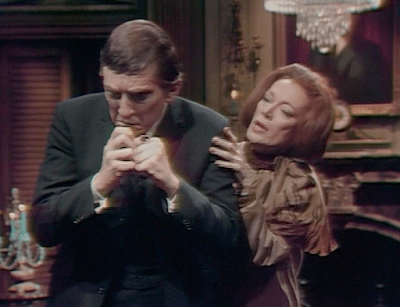
The Old House is Barnabas’ house, and that’s where we go next. We see Julia arriving there. She tells Barnabas that Vicki is back. He is mildly interested. She then tells him that she has seen Sarah. Barnabas longs to see Sarah, and is tormented that she will appear to others but not to him. He accuses Julia of lying. She insists that she is not, and taunts him with Sarah’s refusal to appear to him. He grabs Julia by the throat. He has done this before as a threat, but this time it looks like he really means to strangle her. Before he can, a wind blows the door open and the candles out, and Sarah walks in. She approaches her brother, glaring at him.

Sarah has had it with Barnabas. Screenshot by Dark Shadows Before I Die.

Episode 361: Julia’s rough night in

Writer Ron Sproat had his strengths, but was blind to what particular actors could and could not do. Grayson Hall, who played mad scientist Julia Hoffman, had one very conspicuous weakness- she could not control the tone of her voice when she raised it above a normal conversational level. She had asthma, and in the course of her performances she was often required to smoke. As a result, her screams, shouts, sobs, and cackles all came with a terrible croaking sound. This episode consists of very little aside from Julia’s raised voice, and it is a disaster.

Julia’s sometime partner in crime, vampire Barnabas Collins, has turned on her and cast a magic spell meant to drive her crazy. She sees some ghostly apparitions that may or may not be the result of this spell. It’s hard to be sure; at the beginning of the episode, she is in the Collins family tomb having an argument with the ghost of Barnabas’ little sister Sarah, whom regular viewers know to be real. So it’s not like we can say with confidence that anything is in her head.

Julia’s psychological stress gives Sproat an opportunity to adapt a script he wrote for the show that Dark Shadows replaced on ABC’s daytime schedule, a soap opera for teenagers called Never Too Young. The 18 April 1966 episode of that show was almost a one-woman drama, featuring Jaclyn Carmichael as Joy Harmon, who struggles to keep her sanity while home alone.* While nothing supernatural was going on in Never Too Young, Sproat left many elements intact- both start with confrontations reprised from the previous episode, in which the main character is alienated from the person who represented her last hope; each woman beats on a locked door and calls for someone who is absent to come and let her out; each plays Klondike solitaire; each receives a distressing telephone call; each is terrified at the end of the episode when she sees the doorknob turning. Evidently Sproat regarded the script as his finest work, and wasn’t going to allow Grayson Hall’s physical inability to play the part deprive him of the chance to remake it.

As the 22 minutes unfold, Julia progresses from the mausoleum, where she looks disturbed while we hear her speaking calmly in a recorded voiceover, to the drawing room of the great house of Collinwood, where she looks calm while she has a panicked tone in the recorded voiceover, to her bedroom upstairs in the great house, where she both looks and sounds panicked. She’s alone on camera for the great majority of the time, making hideous noises that bring bad laughs.

AAARRRRRGH!!!!! Screenshot by Dark Shadows Before I Die.

For over a week, Julia has been trying to escape Barnabas’ wrath. The other day, we heard her ask herself why she didn’t just leave town. There are some strong episodes in this period, but that is such an obvious question that it undercuts them all. This episode is far from strong, and throughout it we are reminded of just how unnecessary it all is. Barnabas decided to kill Julia because she obstructed his plan to seduce well-meaning governess Vicki by planting disturbing images of him in Vicki’s unconscious mind; he had been set on killing strange and troubled boy David because David had caught on to some of his secrets. Julia is alone in the house in part because Vicki and David have gone to Boston for a few days. For all Barnabas knows, David is this very minute telling Vicki everything he wants to hide from her. But as soon as they are off the estate and out of his sight, he stops worrying about them. So all Julia has to do is hop in her car, drive off someplace, and the drama is resolved.

The conflict between Barnabas and Julia is the only story going on Dark Shadows right now. Lawyer Tony Peterson is suing the Collins family business, but when they had a scene about that last week they played it off camera and used the actors’ voices as background noise to cover some of Julia’s doings. Clearly we are not to expect much from that. All Vicki and David have to do to be safe is go to Boston, Sarah is quiet unless murderers come to her tomb and bother her at home, and everyone else is settled in a sustainable situation. So if Julia leaves town, or reconciles with Barnabas, or is killed, it doesn’t seem that the show will have anywhere to go. By all appearances, we are heading directly for a blank wall.

*I learned about this episode from a comment left by “Robert Sharp” on Danny Horn’s Dark Shadows Every Day. He links to the video I embed above.

Episode 318: What can a little girl know?

In the outer room of the Tomb of the Collinses, Sam Evans and Dr Dave Woodard recap the story so far. In the hidden chamber on the other side of the wall, vampire Barnabas Collins and mad scientist Julia Hoffman eavesdrop on their conversation. When they hear how close Evans and Woodard have come to discovering their terrible secrets, Julia squirms and Barnabas looks shocked.

Busted.

When Dr Woodard mentions that Julia had used the word “supernatural” in a conversation with him, Barnabas nearly blows their cover. He grabs Julia by the throat and she lets out a yelp. Sam hears this, Woodard does not. Woodard suspects that there are ghosts at work in the area, but he cannot believe that Sam’s hearing is better than his, so he dismisses the idea.* He notices the plaque marking the burial site of Sarah Collins, 1786-1796, and says out loud that the little girl named Sarah whom everyone has been looking for lately is the ghost of that Sarah.

Evans and Woodard leave the tomb, and Barnabas resumes raging at Julia. He opens his old coffin and pushes her head into it, asking if she wants to spend eternity confined there. She talks him down with warnings of what would happen were he to kill strange and troubled boy David Collins.

Woodard goes to the great house of Collinwood, where he questions David. Woodard is much more forthcoming with what he knows than he has been in any previous conversation. David listens closely, trying to find out what he knows. But Woodard’s questions are all about David’s friend, Sarah. David doesn’t know that answers to many of Woodard’s questions, and Sarah has sworn him to secrecy about much of what he does know. So the only new piece of information Woodard learns from David is that Julia was lying to him the other day when she said that she hadn’t given much thought to Sarah. David tells him that she asks him about her all the time.

Julia comes in and tries to stop Woodard questioning David. He ignores her and asks another question, then warns him to stay away from the Tomb of the Collinses. When he tells David that whatever secret Sarah told him about the tomb is also known to someone else, and that that other person is very dangerous, David is horrified. When he was trapped in the hidden chamber last week, Barnabas and his servant Willie entered. David hid from them in Barnabas’ old coffin and eavesdropped on a conversation in which Barnabas dropped a huge number of clues about his secrets. Since Woodard started his questioning of David with a reference to the unknown person who has been terrorizing the area since April, David now has reason to believe that Barnabas is that person.

David leaves the room, and Woodard asks Julia what she was trying to prevent him from finding out. She refuses to answer any of his questions. She hears the sound of dogs howling, and knows that it means Barnabas is getting ready to kill someone. Knowing that she has very little time to try to prevent David’s murder, she cannot focus on Woodard’s questions. For once, she can’t think of any lies that will hold him off. Her reason for being in town, so far as Woodard is concerned, is that she is a doctor treating Sam Evans’ daughter Maggie, Barnabas’ former victim. When she won’t answer his questions, he takes her off Maggie’s case.

Julia goes to Barnabas’ house. She finds him on his way out the door, on a mission to kill David. She opposes him, and he declares that nothing can stop him. At that, the wind blows the doors open. It extinguishes some of the candles in the room. The strains of “London Bridge” begin playing, and Barnabas and Julia realize that Sarah, who in reality is the permanently nine year old ghost of Barnabas’ little sister, is in the room. Barnabas cannot leave. Julia says with satisfaction that nothing can stop him- “except one little girl.”

The whole episode is very strong from beginning to end. Julia is usually so much in charge that the only suspense is what she will choose to do, but throughout this one she is scrambling to bring Barnabas under control. When her final attempt fails, Sarah’s intervention comes as a thrilling surprise.

The performances of both Jonathan Frid and Grayson Hall stand out today. Hall is as powerful a presence playing a character who controls nothing as she usually is playing a character who controls everything. And few could match Frid’s ability to appall us with Barnabas’ plan to kill a ten year old and seconds later to elicit tears by calling out to his beloved little sister.

*My wife, Mrs Acilius, put it that way.

Episode 306: Private little investigations

Sarah Collins has taken her friend and distant cousin, strange and troubled boy David Collins, home with her. Since Sarah is a ghost, her home is in a mausoleum. She has decided to show David one of the most interesting features of the place.

As we open, David is following Sarah’s instructions. He is standing on the sarcophagus of her mother and pulling a metal ring in the mouth of a stone lion’s head. The ring comes forward and a panel opens, revealing a room that was hidden for more than a century and a half.

The lion’s head.
Pulling the ring
The panel opens

The first time we saw the panel open was in #210, when dangerously unstable ruffian Willie Loomis happened upon the ring and ended up releasing vampire Barnabas Collins from his coffin in the hidden room. Now that we see this gimmick again and see it in color, it’s starting to seem odd that all you have to do to open the panel is pull the ring. The ring stands out as the only piece of metal in the tomb. Anyone entering the space would be tempted to tug on it, if only to polish it. If you’re wanting to make sure your vampire doesn’t get loose, I’d think you’d install a more secure system. Maybe you could add two or three additional decorative doodads to the wall, one of which you turn, say, three quarters of the way to the left, the other of which you turn some other way, and between them they release the ring.

Be that as it may, Barnabas’ old coffin is still in the hidden room. Sarah announces they will be opening it, and David resists the idea. He debates with Sarah for a while before curiosity gets the better of him.

Sarah the psychopomp.
David wants to let the dead rest.
David’s resistance crumbles.

He is shocked to see that it is empty. David asks Sarah why an empty coffin would be put in such a place, and she happily tells him that it wasn’t always empty. There was someone in it once, but he got up and left. David protests that the dead don’t walk away, to which Sarah replies that “Sometimes they do.”

David is shocked.
Nobody’s home.

When David first met Sarah in #256, she was outside Barnabas’ house, puzzled that she couldn’t find her parents or anyone else she knew. Now it is starting to seem that she knows that she is a ghost haunting a time long after her own, but Sarah’s lines here are the first clear indication that she knows what is going on with her brother Barnabas.

David’s bafflement that the coffin is empty echoes #273. In that episode, matriarch Liz was shocked to find that the chest seagoing con man Jason McGuire buried in her basement did not contain the murdered remains of her husband. Liz kept asking “Why is there nothing there?” David seems almost as appalled as his aunt had been at the sight of some clean fabric unadorned with a rotting corpse. A few days after Liz found out Jason hadn’t really buried her husband in her basement, Barnabas killed Jason. Regular viewers will already have this story in mind, because in #276 Barnabas and his sorely bedraggled blood thrall Willie buried Jason in the floor of the very room David and Sarah are visiting at this moment. Clearly Barnabas would not be happy were he to find out that David knows about the room.

That wasn’t the first vacant grave in Dark Shadows. From #126 to #191, the show was mainly about David’s mother, undead fire witch Laura Murdoch Collins. As the Laura arc progressed, graves of various women named Laura Murdoch were revealed to be empty. Now Laura’s son is coming face to face with an unoccupied coffin, suggesting to loyal fans that he may yet learn something about his own origins.

To Sarah’s consternation, David says he has to go home. He tells her that if he does not, his governess, the well-meaning Vicki, will be upset with him. He simply refers to Vicki by name, as if Sarah already knows who she is. Regular viewers have reason to believe she does know who Vicki is, but it is not clear why David assumes that he can just say “Vicki” without explaining to Sarah who he means. Sarah swears David to secrecy about the existence of the room.

By the time David gets back to the great house of Collinwood, it is 9:30 PM and Vicki is indeed worried about him. Apparently no one else is at home; certainly, no one else has missed David. Vicki sits David down on a seat that’s been in the foyer from the beginning of the series, but which has only been used once or twice before. They have an earnest little talk that recalls the scenes they shared in the first 39 weeks of Dark Shadows, when their complicated relationship was the one storyline that consistently worked.

Rarely used seat.

David describes Sarah to Vicki. It finally dawns on her that Sarah is the little girl she saw on top of the stairs at Barnabas’ house in #280. When the light flashed in Vicki’s eyes, my wife, Mrs Acilius, shouted at the screen “Tell him!” Vicki and David again look like the fast friends they had become by #140, so we would indeed expect her to tell David that she thinks she has seen Sarah, and to tell him where and when she saw him. If she and David join their lines of inquiry and work together to find out about Sarah, the plot will move more quickly and on a much bigger scale than it can so long as everyone pursues their own questions in isolation.

Vicki catches on.

But, Vicki is also very fond of Barnabas, and reluctant to believe anything bad about him. Sarah has been seen in several places connected to the abduction of Maggie Evans, The Nicest Girl in Town. Vicki doesn’t want anyone to add Barnabas’ house to that list, so perhaps it is not a “Dumb Vicki” moment when she decides to keep the information to herself.

Meanwhile, Barnabas is at home. He is irritated with mad scientist Julia Hoffman. Julia is attempting to cure Barnabas of vampirism, and he is dissatisfied with the progress of the treatment. He is also irked that Sarah broke Maggie out of the mental hospital where Julia was keeping her locked up, and blames Julia for failing to ghost-proof the place. He declares that Julia is “a meddlesome and domineering woman,” and that he, as a native of a different century, has no intention of tolerating such a person.

Barnabas and Julia discuss Vicki’s depressing boyfriend Burke. Burke has been investigating Barnabas, and his operatives have come upon some information that would raise questions Barnabas would have a hard time answering. Julia agrees that Burke must be stopped, and urges Barnabas to let her handle the matter. He says that he will take care of it, and that he will do so with “finesse” of a sort unfamiliar to the loutish inhabitants of the twentieth century.

Barnabas’ masterful finesse consists of telling Vicki what Burke is doing and asking her to make him stop. Those eighteenth century guys must have been amazing, to come up with something so complex and subtle in just a couple of days.

Julia comes into the great house as Barnabas is leaving. She asks Vicki if David is back yet. Vicki tells her that he had been out playing with Sarah in some location he refuses to disclose. Barnabas tries to conceal his alarm with a laughing remark about leaving Vicki and Julia to investigate the mystery of David’s playmate.

David comes out of his room to ask for food. While Vicki goes to fetch the housekeeper for him, Julia meets him at the top of the stairs and they talk about Sarah. David points out that she is repeating questions she has asked in previous episodes. He tells her that he doesn’t mind questions and neither does Sarah, but cautions her that the answers Sarah gives don’t make much sense.

The stained glass windows at the top of the stairs look great in color, and it is a relief when David shares the audience’s awareness that we’ve heard Julia’s lines before. Even so, the scene is a disappointment. David and Julia were fun to watch in their previous scenes because they were so relaxed together. Perhaps that was because David Henesy and Grayson Hall understood each other right away. Not only did they have similar ways of working as actors, but her son Matthew is about his age, so she might already have been familiar with a lot of things in his life that the other adults on set wouldn’t have known about.

Today, though, they are both having trouble with their lines. That keeps them from making enough eye contact with each other to sell the scene. David Henesy keeps looking at the teleprompter, which he could evidently read from the top of the stairs with only a little squint; Grayson Hall couldn’t read from that distance, but she does tilt her head back and look up when she’s searching her memory for her next line. Since the characters aren’t looking at each other, we don’t feel an emotional connection between them.

Hall has to thread a particularly small needle in this scene. Julia is trying to make her interest in Sarah seem casual in the same way Barnabas affected a lack of interest in her, by delivering lines about her with a jokey inflection. We know that she is urgently concerned with finding Sarah, and her efforts have to leave David unsure whether she really is the easygoing adult he has so far taken her to be or whether she is trying to pull a fast one.

In the course of a friendly chat between two people who obviously like each other, onetime Academy Award nominee and frequent Broadway luminary Hall could certainly have accomplished all of this. But in the course of this awkward encounter, it all falls flat. Especially so with Julia’s last line to David. After he has told her how difficult it is to get a straight answer from Sarah, she puts on a goofy voice and says that she’ll keep that in mind if she ever meets her. Since she isn’t looking at him when says this, it comes off not as an affectionate gesture acknowledging that they’ve run out of things to say, but as a high-handed dismissal. Even though she pats him on the shoulder and he smiles after that line, it still doesn’t seem that David would come away from the interaction with as complex an emotional response as he is supposed to have. Most likely he would just be irritated with Julia, as indeed the audience is likely to be.

“I’lll kee-e-ep that in mind.”
Departure.

We end back at Sarah’s place. Barnabas is in the cemetery looking pathetic. He hears the strains of “London Bridge” coming from the mausoleum. We see Sarah sitting on her mother’s sarcophagus moving her fingers on her recorder far more rapidly than the music we hear would call for. She looks more like she’s playing a rock ‘n’ roll number.

Jammin’ with the Junior Funky Phantom of 1967.

Barnabas calls out to Sarah. He identifies himself as her brother and says that he has come to take her home. He goes into the mausoleum only to find that she has vanished. Wracked with sorrow, he pleads with her to come back, saying that he loves her and needs her. He touches the plate marking her grave. This underscores the futility of his desire to take her home. Leading him here, it is she who has brought him to what is in fact her home, and what ought also to be his.

Sad Barney.
The impassable barrier.

This shows us a Barnabas we can sympathize with, but it also sets him on a collision course with David. Barnabas has been so harmless lately that we might wonder if his part is going to be recast with a purple felt puppet counting “Vun peanut butter saand-veech!” If he sets out to kill a child, he’ll be back on track as a horrifying menace.

Besides, David is not just any child- as the last bearer of the Collins name, David’s survival has a great symbolic importance to the show. He was central to everything that happened on Dark Shadows in its first 39 weeks. So if Barnabas becomes a threat to David, it will be a case of conflict between the current main character and the previous main character. Since Vicki originally represented the audience’s point of view and is still a major character, the divided loyalties between Barnabas and David that we first see influencing her behavior today could create a high level of dramatic tension. Especially so if Barnabas turns her into a vampire, and she winds up like Lucy in Dracula, the “Bloofer Lady” who herself preys on children.

Episode 299: When darkness falls

Vampire Barnabas Collins creeps up on well-meaning governess Vicki from behind. He touches her neck, and she is startled.

Stifling a giggle

This scene plays twice. First, before the opening title sequence, then again immediately after. The first time around, Vicki stifles a giggle when she sees Barnabas. The second, she seems frightened.

Frightened

Barnabas does not bite Vicki. He apologizes for startling her. She says that no apology is needed, and she stands very close to him. They talk about the Moon and the night and about what incredible romantics they both are.

Incredible romantics

In #285 and #286, Vicki contrived to get Barnabas to invite her to spend the night in his house. In #293, she invited Barnabas to tag along on a date she was having with her depressing boyfriend Burke, and while Burke stood there she had eyes only for Barnabas. In this conversation, Vicki reluctantly turns down an invitation from Barnabas so she can go on some more dismal dates with Burke.

Mad scientist Julia Hoffman interrupts Barnabas and Vicki. After Vicki excuses herself to get ready for her date, Julia demands that Barnabas leave her alone. Barnabas says that he means her no harm. This is all too believable- twice before today, we have seen Barnabas enter a room where Vicki was sleeping and leave without biting her. It’s starting to seem unlikely that she will ever have a place in the vampire story. Since the vampire story is the only plot going on Dark Shadows, that leads us to wonder why she is still on the show.

This scene takes place on a new set, a courtyard with a terrace and a fountain. It looks very much like a set in the 1965 film The Sound of Music, the one where the Countess who is supposed to marry Captain von Trapp has the conversations that remove her from the love triangle and leave the path open for von Trapp to marry Maria. That movie was such a big hit that it seems likely that they had it in mind when they designed this set for scenes concerned with the love triangle involving Vicki, Burke, and Barnabas.

Julia’s intervention leads some to believe that there is another love triangle budding in which she will vie for Barnabas’ affections, but I don’t see any trace of that in Julia’s stern manner today. She simply seems to be concerned that Barnabas stop preying on people while she performs the experiments that are supposed to cure him of vampirism.

In later years, Grayson Hall would claim that she decided on her own initiative to play Julia as if she were in love with Barnabas. She said that by the time the writers and directors caught on to what she was doing, they had received so much enthusiastic fan mail that they had to let her go on doing it. In response to this story, Danny Horn makes some uncharacteristic remarks in his post about this episode on Dark Shadows Every Day:

It’s a great story, especially because it appeals to the audience’s secret belief that the actors really are the characters that they play. We love to believe that, especially for daytime soap opera characters, who we spend time with every day.

But really, everybody who watches television believes that the characters are real. That’s why we love to hear about unscripted moments that were invented during rehearsal. As intelligent adults, we understand that writers and directors and producers create the characters, and then the actors show up and say the words. But there’s a little child inside of us, who wants to be told that Julia Hoffman is real, and she lives inside Grayson Hall.

Danny Horn, “A Human Life,” Dark Shadows Every Day, 2 Jaunary 2014.

As the blog went on, Danny put more and more emphasis on the chaotic process by which Dark Shadows was created. I suspect this passage was something he wrote in haste. Even at this early stage, he had made it clear that he knew that it was not true that “writers and directors and producers create the characters, and then the actors show up and say the words.” By the time he finished in 2021, his main theme had long been that the real subject of Dark Shadows was “a team of under-resourced lunatics desperately struggling every day to make the most surprising possible show.” That team most definitely included actors padding their parts in ways they could do only because the show was done live to tape, with edits never done if not absolutely necessary, and often not done even when they were.

Julia visits Vicki’s room and helps her choose an outfit for her date with Burke. Julia urges Vicki to avoid Barnabas, because he has a crush on her and it would hurt him to encourage him in it. Vicki says that she has never seen any sign of such a crush. Nor have we- he has talked with his sorely bedraggled blood thrall Willie about a plan to take Vicki as his next victim. Aside from giving her an enchanted music box that is supposed to brainwash her, he has been remarkably leisurely about the whole thing. If anything, she is the one who has been pursuing him.

Vicki and Burke are out by the fountain. He remarks that she has been very quiet, and she refers to having a lot on her mind. This raises our hopes that she is thinking about what Julia told her and is going to ditch Burke and go to Barnabas. They start talking about their wretched childhoods. Previously, we had heard that Burke’s mother died when he was young and that his alcoholic father supported the family by making lobster pots; now Burke tells us that when he was nine his father left the family. It’s hard to see much point in this retcon; most likely the writers had just forgotten about the earlier story.

Vicki mentions that there was one nurse at the Hammond Foundling Home whom she liked. In the early days of the Dark Shadows, she would often reminisce about her ridiculously bleak experiences growing up in this fictional orphanage. Usually she would get a faraway look in her eyes and smile, then tell some story that started with an appalling horror and got worse and worse as it went. This time, she again stares off into the distance and smiles, so that viewers who have been watching from the beginning brace themselves to hear that the nurse turned out to be the worst abuser of all, or that she was murdered in front of Vicki while the other children laughed, or that she ran the kitchen the winter they ran out of food and had to resort to cannibalism. But no, Vicki is just sharing a pleasant little memory. The show is a lot less hard-edged now that it’s about a vampire.

Not that they’ve stopped presenting horrible images altogether. No, they show us Burke kissing Vicki.

When Burke was played by Mitch Ryan, he was a great kisser, a talent he displayed with Vicki among others. But Anthony George does not appear to have seen anyone kiss before he attempts it. As he points his lips at Alexandra Moltke Isles, she stiffens her neck, a move that may have suggested excitement if her partner were doing something recognizable as a sign of affection, but that in this context looks like she’s suffering from whiplash. After his first failed effort, he rests his head on her shoulder and looks miserable.

Attempted kiss
After the failure

We pull back from Burke’s fumbling and see Barnabas at the gate to the courtyard, looking forlorn. I’m sure the writer and director wanted us to take this image as a sign that Barnabas is feeling sorry for himself, but the scene he’s been watching with us is so dreary that we would all have the same look on our faces.

Barnabas has seen the sorry spectacle

Some attribute George’s phenomenally bad kissing to his sexuality. I don’t buy it. Joel Crothers was also gay, and we’ve seen Joe Haskell give convincingly sultry kisses to two actresses. Louis Edmonds was gay too, and when Dark Shadows finally gives him an on-screen kiss two years from now he will do just as well. And the actresses unanimously testified that Jonathan Frid was the best kisser in the cast. Furthermore, the other conspicuously inept kisser on the show was the emphatically heterosexual Roger Davis (whom we have yet to see.) So George’s failures in this department are his alone, and do not reflect on any demographic group of which he was a member.

In the house, Vicki and Burke continue their vain struggle to kiss. Julia walks in and apologizes for intruding. She does not leave, nor does she take her eyes off Vicki and Burke. That makes sense- after all, she is still an MD, and it would appear that whatever is wrong with Burke might require some kind of medical intervention.

Vicki excuses herself to go to bed, and Burke asks Julia to join him in the drawing room. There, he denounces Vicki for her “vivid imagination,” a terrible quality that must be stamped out. He tells Julia that Vicki has experienced two hallucinations recently. We know that these were not hallucinations at all, but actual visitations from the ghost of Sarah Collins. Burke doesn’t know that. However, he does know of another sighting which led him to angrily accuse Vicki of being insane, when she saw Maggie Evans, The Nicest Girl in Town, walking in a cemetery. At the time, everyone thought Maggie was dead, but now that it has been revealed she is alive, he removes the incident from his bill of particulars against Vicki.

Burke is furious with Vicki for having an imagination and wanting to be part of the story

Burke and Vicki, like most of the other characters, believe Julia’s cover story that she is an historian researching the Collinses for a book about the old families of New England. He asserts that helping Julia with her project is having a bad effect on Vicki, because she must “live in the present.” Julia asks if this means that she must live with him. Burke agrees that it does.

To Burke’s surprise, Julia agrees that Vicki should stop helping her and stay away from anything suggestive of past centuries. The two of them talk about how Vicki must be watched and controlled lest her imagination “run wild.” Julia is a mad scientist in league with a vampire, so this sort of talk is to be expected from her, but Burke is supposed to be on Vicki’s side. His frank intention to crush her imagination, expressed alternately with undisguised rage and airy paternalism, is as repulsive as anything we have seen from Barnabas.

Upstairs, Vicki is asleep. Barnabas opens the door and walks into the room. Again he thinks about biting her, again he doesn’t. He opens the enchanted music box, looks at her a bit longer, and leaves the way he came. If Barnabas doesn’t get off the dime soon, Vicki may marry Burke and become useless forever.

Episode 290: The work itself

It’s chiasmus week on Dark Shadows. Chiasmus is when the last thing that happens in a story resembles the first thing that happened. Usually that causes the audience to look back on that first thing in a new light. Sometimes chiasmus gets very detailed, and the first several things are mirrored by the last several things.

On Wednesday, we began with well-meaning governess Vicki asleep in vampire Barnabas Collins’ house on the estate of Collinwood. Barnabas crept into her bedroom and stood over her, but did not bite. Then it was morning, and Barnabas’ sorely bedraggled blood thrall Willie delayed Vicki as she was leaving the house. Vicki took our point of view with her to the great house on the estate, where we started to see events through the eyes of visiting mad scientist Julia Hoffman. That episode ended with Julia going to Barnabas’ house. Willie delayed Julia entering the house, and Barnabas and Julia met. Their scene was tense, but Barnabas did not use any of his powers against Julia. That chiasmus marked the transition from Vicki to Julia as the audience’s main character to identify with.

On Thursday, we began with Barnabas spying on Vicki through her window, then entering her bedroom and standing over her while she slept. He again left the room without harming her. We ended with Julia spying on Barnabas through his window, then entering his house, opening his coffin, and looking at him. The parallel is completed when we see today that she left the coffin room without harming Barnabas. That chiasmus showed that Julia is capable of turning the tables on Barnabas.

Today’s episode begins with a reprise of yesterday’s cliffhanger, showing Julia gasping when she opens the coffin. So returning viewers suspect that it is likely to end with Barnabas in Julia’s room, and the suspense comes as we try to figure out how he will get there and how she will escape his malign power.

We see Julia in the drawing room of the great house talking to her friend, addled quack Dave Woodard. Dr Woodard says that her failure to report to him on the progress she has made with their common patient, Maggie Evans, The Nicest Girl in Town, coupled with her presence at Collinwood, a hundred miles from the hospital where Maggie is, has forced him to remove Maggie from her care. Julia lies to him, claiming that she has no progress to report and that the whole thing is impossibly boring. This somehow convinces Dr Woodard to leave Julia on the case.

Julia is at Collinwood pretending to be an historian studying the old families of New England, and Vicki has volunteered to help her in her research. Now Vicki is terribly afraid that if she gets involved in what Julia is doing, she will become involved in things that are too interesting for her to handle, and she wants to withdraw before she forever loses contact with tedium and drabness.

Barnabas tells Vicki that she has nothing to fear from “the past,” which at this point on Dark Shadows means the plot. While he is reassuring her, the set catches fire. We hear fire extinguishers and other noises in the background, but Jonathan Frid and Alexandra Moltke Isles don’t break character for an instant. The scene is a dreary one, marking as it does the doom of Vicki as a major part of the show, and the lines are poorly written, but they are absolutely committed to their work.

Barnabas does not believe Julia’s cover story, and is quite sure she represents a threat to him. He meets with her in the drawing room to reiterate his refusal to cooperate with her project. When Julia says that she is particularly interested in his “namesake”- actually himself- Barnabas airily asserts that he was by all accounts a dull fellow. Julia may have been able to sell that line to Dr Woodard on this same set a few minutes ago, but Barnabas doesn’t make any impression on Julia with it. The two of them continue to argue as they pass from the drawing room through the foyer. The dialogue isn’t really any better than what Barnabas and Vicki had in the previous scene, but because Frid and Grayson Hall have a lively relationship to depict- two people who each of whom knows more about the other than they are willing to say, and each of whom knows that the other knows much of what they are holding back- they make their whole sparring match seem to glisten with wit and style.

Barnabas agrees to meet Julia at his house the next evening. After he leaves, Julia tells his portrait that she can’t wait that long for their next encounter, and she knows he can’t, either.

We cut to Julia in her bedroom. Vicki pays a visit, during which we hear another depressing conversation about Vicki’s newfound fear of narrative relevance. Julia assures her that “There is nothing for you to fear.” After Vicki leaves, Julia looks at her clock and sees it is a quarter to one in the morning. We dissolve to the foyer, where the hall clock reads 2:00. Barnabas appears in Julia’s bedroom and approaches the bed, where he prepares to uncover Julia. We then hear Julia greeting Barnabas by name. She emerges from the shadows on the other end of the room, and tells Barnabas she has been waiting for him a long, long time.

Julia greets her long-awaited visitor. Screenshot by Dark Shadows Before I Die.

Episode 283: The shock of recognition

Four and a half weeks ago, Maggie Evans, The Nicest Girl in Town, escaped from vampire Barnabas Collins. Barnabas managed to scramble Maggie’s brains sufficiently that she has amnesia covering her time as his victim and much of the rest of her life as well. She is now a patient at a mental hospital called Windcliff, where her care is supervised by Dr Julia Hoffman.

Maggie’s family doctor, addled quack Dave Woodard, is an old friend of Julia’s. He had recommended Maggie be sent to Windcliff. He had also come up with a cockamamie scheme to protect her from her captor by hiding her there and telling everyone in and around the town of Collinsport that she was dead. If he had known that the captor was a vampire, this might have made some kind of sense- no character on Dark Shadows has ever heard of Dracula, so they don’t know how to fight against vampires. But he doesn’t know that, so his plan is just a way for the writers to stall while they try to come up with more plot points.

Today we open with Woodard in Julia’s office, complaining that she isn’t communicating with him about Maggie’s case. She tells him that there have been no developments worth reporting. Returning viewers know that this is a lie, because in a session we saw yesterday Maggie remembered a lot of sense impressions from her time of captivity and Julia told her that they represented tremendous progress. Woodard tells Julia that a lack of new information is no excuse for her failure to return any of his last six phone calls. He says that she seems to be intent on hoarding any information she may glean from Maggie as her own private possession, an impression he describes as frightening.

Julia responds to this characterization with a display of offense, and Woodard apologizes. She then brings up an idea that occurred to her at the end of yesterday’s episode. She says that Maggie’s memory might improve if she takes her to visit Eagle Hill Cemetery, where she was found wandering early in her illness. Woodard objects strongly that Maggie’s condition, as Julia has described it, is so delicate that such a visit might do her permanent harm. Julia retreats and promises she won’t actually take Maggie to the cemetery. This is such a flagrant lie that the camera momentarily goes haywire, focusing on Woodard’s chair rather than his face.

Woodard leaves, and Julia calls Maggie in. She’s already wearing her coat. She asks where Julia is going to take her, and she tells her not to worry about that.

On the great estate of Collinwood, well-meaning governess Vicki is staring vacantly into space while listening to an antique music box Barnabas gave her as part of his plan to subject her to the same treatment he inflicted on Maggie. A knock comes at the door. Vicki closes the music box and goes to answer it. It is her boyfriend, fake Shemp Burke Devlin.

Burke is waging a determined battle against the story, and he is fighting dirty. He doesn’t want Vicki to have anything to do with Barnabas, or with the ghost of Josette Collins. When Vicki says she wants to lay flowers on Josette’s grave in the cemetery, where we know she will cross paths with Maggie and Julia, he resists furiously. When she reminds him that she has had dealings with Josette’s ghost, he says “Or you think you have.” In previous episodes, including yesterday’s and Monday’s, he knew she had, and in an earlier period of the show he knew that several other characters, including some of the most level-headed ones, had also encountered Josette’s ghost. When he starts belittling Vicki for believing in “the spooks of Collinwood,” it therefore comes off as an especially crude instance of gaslighting. The Mrs and I aren’t much for profanity, but we both cussed at the screen when Burke was disgracing himself this way.

Julia and Maggie are in the cemetery. I believe it is the first time we’ve seen the set in a daylight scene. You can see the shadows of the foliage on the soundstage walls, and the corners where the walls meet. I can’t believe the director meant for us to see those things, but I kind of like it- the situation needs a touch of unreality, and the obvious falsity gives it the feeling of a black box theater.

Some of the shadows on the wall that Art Wallace spoke of
Corner of the soundstage

Maggie is agitated. Julia tells her to calm down and that everything is all right. I’m no expert, but I kind of doubt that talk therapy involves a lot of “Calm down!” and “Everything is all right!” It reminded me of this Saturday Night Live sketch from the 90s, in which Patrick Stewart plays “Phil McCracken, Scottish Therapist,” a psychologist who won’t stand for any emotionalism from his patients.

Vicki and Burke see Julia and Maggie in the distance. When Maggie turns to face them, Vicki recognizes her. Julia whisks her away before Burke can see her. When Vicki tells Burke she saw Maggie, he immediately unloads on her with the same garbage he handed her at Collinwood. He declares that Maggie is dead, that Vicki knows she’s dead, that she can’t possibly have seen her, that “there is a resemblance, THAT’S! ALL!” When he asks “What’s wrong with you?” I stopped the streaming and shouted at the screen “She’s wasting her time with you, you ******* ********, that’s what’s wrong with her!” To that, Mrs Acilius said that we should just restart the show and get through the scene.

Part of what makes Burke’s behavior so infuriating is the writer’s fault. A first-time viewer, unaware that what Burke is telling Vicki are delusions that suggest she is crazy are in fact things he knows to be true, might think that he is being reasonable in dismissing ideas about ghosts and the like. But even that viewer will realize that a person ought to be nicer about it. When Vicki says she saw Maggie, Burke could easily have suggested that they go up to the woman and introduce themselves, thinking that a closer look will disabuse her of the notion. But actor Anthony George must also bear part of the blame.

George C. Scott famously told Gene Siskel that there are three things to consider in evaluating an actor’s performance: first is to make the audience believe that the person they are looking at is the sort of person who might do the things the character does. This is in turn dependent on casting- put the wrong person in the part, and all is lost. Second are the choices the actor makes in the key emotional moments. Performers have any number of options as to how they will use their faces, voices, and limbs to show a character’s feelings, and those who make a lasting impression are those who make choices that are at once totally unexpected and perfectly logical. Third is the zest of performance, the actor’s joy in the opportunity to create a character. If that doesn’t come through, nothing else is worth much.

As Burke, Anthony George fails all three of these tests. Burke would have been a difficult part for anyone to take over, both because the originator of the role, Mitch Ryan, was so memorable, and because the character had lost all connection to any ongoing storylines by the time Ryan left. And by his own admission, George knew nothing about soap operas and had no idea how to play a romantic interest on one when he joined Dark Shadows. That’s where he fails the casting part of the believability test.

As for the skill part, George has something going for him. He is always mindful of his physicality, moving only those parts of his body he needs to show us who he is and keeping the rest of himself admirably still. He also keeps his voice remarkably consistent, both by holding a steady level of volume and maintaining a simple, precise pitch. In these and other ways, he shows impressive levels of technical proficiency as an actor, but the result is a mannered, unconvincing performance. His Burke doesn’t seem to be a real person. As a cardboard figure, he becomes an abstract symbol of whatever he’s doing, and when he’s doing something bad he’s hard not to hate.

Since he makes one choice for each resource available to him and sticks with it unvaryingly throughout the episode, he doesn’t give the audience any surprises. Nor does he yield anything to his scene-mates. They always know exactly what’s coming from him. George’s eyes are always watching another actor intently, as he watches Alexandra Moltke Isles intently today, but nothing in her performance can divert him from his plan, not in the smallest particular. When Burke isn’t listening to the other character, as he isn’t listening to Vicki, George’s disconnection from the other actors makes Burke seem like an irredeemable jackass.

Nor does George show any zest for the part. He covers his discomfort with soap acting by plastering on a smile whenever the script allows it, but he is stiff when Burke ought to be loose, cool when he ought to be warm, and loud when he ought to speak with a quiet, nuanced voice. The result is just sad and awkward. When Burke is being pleasant, we can feel sorry for George, but when he has to play the scenes like the ones Burke gets today we just want him to get off the screen and leave us alone.

Compare George’s Burke with Grayson Hall’s Julia, and you will see how an actor can determine an audience’s reaction to a character. Julia is a terrible therapist. She lies repeatedly to Woodard in the beginning, denying the severe breach of ethics and disturbing disregard of public safety involved in covering up what she knows and suspects about Maggie’s experiences and running an unconscionable risk with Maggie’s mental health by taking her to the cemetery. She lies again to Maggie at the end, promising that they will duck into the Tomb of the Collinses only for a moment and then refusing to let her leave there when she starts to show a violent emotional reaction. Her methods are so unorthodox and so harsh that we suspect she is not interested in helping Maggie at all. Because we have known Maggie since episode #1, and Kathryn Leigh Scott’s performance as Maggie renews our fondness for her every time she appears, we ought to feel deep hostility towards Julia.

But we don’t. In fact, Julia quickly becomes (almost) every Dark Shadows fan’s favorite character. The George C. Scott tests tell us why. Hall’s manner is so intense that we can believe her as a mad scientist; her uninhibited use of every facial muscle, of the full range of her vocal output, and of subtle tricks of movement she learned from choreographers when she appeared in musicals may have produced a style that no acting teacher could recommend as a model, but they do mean that every moment she is on screen she is doing something we wouldn’t have predicted; and she’s clearly having a blast. She can do things vastly worse than what makes us hate Burke today, and we will still want her to come back again and again.

Closing Miscellany

The opening voiceovers aren’t usually the best-written parts of the show, but there is a particularly bad bit in today’s: “Hidden deep in the cliffs of Collinwood, the majestic, ancient rocks that separate the Earth from the sea, there is a tiny cove carved by a long-ago sea. No one at Collinwood has seen it, and no one will ever see it.” If no one ever will see it, why bother telling us about it? The narrator tells us that it is because “the Earth knows how to hide its secrets well. Sometimes men, too, must hide secrets.” Does this mean that “no one ever will” discover the secrets the characters are hiding from each other? That isn’t a very promising thing to tell the audience of a soap opera, a genre which is all about unsuccessful attempts to keep secrets and their aftermath.

Maggie tells Julia that she doesn’t recognize the name Collins. She has lived her whole life in the town of Collinsport, where most people are employed by Collins Enterprises, which is owned by the Collins family who live at Collinwood. That’s some pretty widespread amnesia she has.

The show has been going back and forth on the dates when Barnabas and Josette Collins originally lived and died. Today we get a long look at Josette’s tombstone, giving her dates as 1800-1822, and another at the plaque on Barnabas’ little sister Sarah’s resting place in the mausoleum, with the dates 1786-1796. Those dates fit with a remark Barnabas made to his sorely bedraggled blood thrall Willie in #271, that Sarah lived long before he met Josette, but not with his remark in #281 that Josette had been dead for “almost 200 years,” much less with a book we saw in #52 that gave her dates as 1810-1834.

Josette’s tombstone
Sarah’s marker

Episode 265: Unusual as doctors go

Maggie Evans, The Nicest Girl in Town, has escaped from vampire Barnabas Collins, but not before Barnabas put the zap on her brains. She is being treated at Windcliff Sanitarium, under the care of Dr Julia Hoffman.

Windcliff Sanitarium. Screenshot by Dark Shadows Before I Die

Dr Hoffman’s old acquaintance Dr Dave Woodard shows up with Maggie’s father Sam and boyfriend Joe. Woodard and Hoffman are Dark Shadows ‘ current versions of Bram Stoker’s Dr John Seward and Professor Abraham Van Helsing. As Seward called Van Helsing in when he needed help solving the mystery he encountered treating the victims of Count Dracula, so Woodard has called the expert Dr Hoffman in to help him solve the mystery he has encountered treating Barnabas’ victims. As Van Helsing refuses to answer any of Seward’s questions when they first start working together, so today Dr Hoffman refuses to answer any of Woodard’s questions about the case. There is one departure, in that Dr Hoffman combines Seward’s occupation as chief physician at a sanitarium with Van Helsing’s role as mysterious expert from out of town.

Dr Hoffman tells Dr Woodard that she believes it will be bad for Maggie to see Sam and Joe, but she consents to the visit as a way of discouraging them from trying to come back. When Sam and Joe join them in her office, she attends to her aquarium. In the post about this episode on Dark Shadows Before I Die, Christine Scoleri points out that this is a rather direct way of telling us that there is something fishy about Dr Hoffman.

Fishy doctor. Screenshot by Dark Shadows Before I Die

When Sam and Joe go to Maggie’s room, she has a mad scene. She starts singing “London Bridge,” gets to an obscure verse running “Take the key and lock her up,” and starts screaming “Lock her up!” over and over. It’s magnificently terrifying.

In his post on Dark Shadows Every Day, Danny Horn raves about Grayson Hall’s performance as Julia Hoffman. Rightly so, she will quickly make herself indispensable to the series. He includes a lot of screenshots of her face, showing the wide variety of expressions she uses. I have a more complicated response to this aspect of her style.

As many screenshots as Danny gives of Grayson Hall’s face in his post, I presented even more screenshots of Lovelady Powell’s face in my post about #193, where Powell plays art dealer Portia Fitzsimmons. What impressed me about Powell’s performance is that she takes one of the most basic rules of screen acting- choose one of your eyes and look at your scene partner only with it- and builds a whole character around it. Her left eyelid is all she needs to command the stage and leave an indelible impression.

Hall was at the opposite extreme. She ignores the one-eye rule, and virtually every other piece of guidance professionals give about how to create a character on camera. She uses every muscle at every moment. Her broad, stagy approach works well for Dark Shadows, and the three actors with whom she shares her shots today stay out of her way. Still, she does make me miss Powell’s dominating simplicity.

With Julia’s introduction, all of the actors in the photo I use as the header for this blog have joined the cast of Dark Shadows. There is also a version of the picture where the actors are frowning.

Gloom in the shadows

Here’s the smiley version. I’ve marked each player with the number of the first episode in which s/he appeared:

My usual themes: Bossy Big Sister/ Bratty Little Brother

In 281 of the posts that follow, I link to comments I made on Danny Horn’s blog, “Dark Shadows Every Day.”

Not all of these comments were absolutely unique. Several times it occurred to me that a Dark Shadows features a number of older sisters who clean up messes that their misbehaving younger brothers make, and that a variety of male-female relationships on the show take on the dynamic of a bossy big sister and her bratty little brother. Danny doesn’t cover the first 209 episodes of the show, when we learn that Roger Collins has managed to squander his entire inheritance, half of the family fortune, and that his older sister Elizabeth Collins Stoddard has gone deeply into debt to contain the damage that his irresponsibility has done to the family business. Elizabeth takes Roger into her house, and alternates between demanding that he reform his ways and enabling his ongoing bad conduct. She takes charge of the raising of Roger’s son David and puts Roger to work in the family business, setting bounds to Roger’s crapulence but also insulating him from its consequences.

My first remarks about this theme were in a comment on episode 565:

Watching this episode, I just realized the main relationship in DARK SHADOWS- Bossy Big Sister/ Bratty Little Brother. Liz and Roger are literally that, and each one’s struggle to safeguard their relationship by keeping the other in the dark about their shameful secrets is the background of every storyline in the first 209 episodes. Carolyn and David become the functional equivalent of a Bossy Big Sister and a Bratty Little Brother, and that’s the development that makes Carolyn a relatable character.

In Julia and Barnabas, we have the supreme example of such a relationship. They fall into it naturally; Julia is used to giving orders, and Barnabas is used to disobeying them. From the moment Julia lit her cigarette on the candles in the old house, she’s been Barnabas’ Bossy Big Sister, pursuing one plan after another meant for his own good. He’s been alternately pouting at her, raging against her, and clinging to her, at once resenting her demands on him and craving her validation for his narcissism. The climax of the episode, when they both know that a he-vampire is roaming about in search of a victim but it occurs to neither Julia nor Barnabas that Julia might be in danger, shows how deeply they have embedded themselves in these roles. Barnabas won’t even let Vicki walk to her car alone, and Julia, hearing the dognoise, understands why. But when Julia tells Barnabas that she will close up the lab and leave shortly after he goes out to join Willie, implying that she’s going to walk all the way back to the Great House by herself, he just leaves. Of course nothing will happen to Big Sis, she’ll always be OK.

That’s also why I don’t see how slashfic positing a sexual relationship between Barnabas and Julia can work. They are so much Bossy Big Sister and Bratty Little Brother that no matter how much time they spent telling themselves that they aren’t actually related, it would still be impossibly weird to try to be something else to each other.

I returned to the theme in a remark about episode 572, where Jonathan Frid gives a line-reading so pouty that I wonder if he was consciously trying to depict Barnabas as a bratty little brother to Julia:

I love the way Jonathan Frid pouts the line “I was afraid your visit would be pointless.” He’s every inch the bratty little brother upset that his big sister went out when he didn’t want her to go.

By episode 648, the idea has moved me to fanfic:

Cavada Humphrey looks quite a bit like Jonathan Frid. I wonder what 1795 would have been like if Barnabas had had an older sister who bossed him around, stood around during his ridiculously childish fits of petulance, occasionally acted as his conscience, and time and again serve as his enabler and protector. It would have been funny to see Grayson Hall’s Countess express disapproval of such a relationship.

Heck, that older sister could have been Sarah. Just because she’s a child in her ghost form doesn’t mean she has to have died at that age. Maybe she comes back in the form in which her relationship to her brother took its permanent shape, when she was about nine and he was about seven. Of course, that possibility is foreclosed at Sarah’s first appearance, when she tells Maggie not to let her “big brother” know she saw her, but I suppose they could have retconned that away with a phony flashback where she says “little brother.”

I revisited these points a few times- Danny’s blog consists of over a thousand posts, one each for episodes 210-1245, plus a few dozen about properties related to Dark Shadows, and each post has its own discussion thread. So it isn’t bad netiquette to repeat yourself a bit from one thread to another- there is always a chance someone who didn’t see a comment previously posted elsewhere will take an interest when you post a similar one. But I did try to keep from making a bore of myself to those who read everything.

I could have mentioned some other bossy big sister/ bratty little brother combos. In a comment on the 1897 storyline, I alluded to the relationship between Judith Collins Trask and her feckless younger brothers. Judith’s arc doesn’t really allow her to be a bossy big sister to any of her three bratty little brothers. But each of them does find himself attached to at least one woman who is stronger than he is, and who might well treat him as Elizabeth does Roger and as Julia does Barnabas.

It’s a shame Terry Crawford wasn’t a more accomplished actress in the 1960s- in the scripts Beth fluctuates between indulging Quentin in his every vice and insisting that he clean up his act. That’s the bossy big sister/ bratty little brother dynamic we’ve seen so many times, but unlike any previous pair who have enacted it Beth and Quentin are lovers and are not social equals. It would be interesting to explore the dynamic in that context, but Ms Crawford’s performance is so wooden that you sometimes have to think about her scenes after it is over and call to memory the dialogue and the visual composition before it strikes you what the point was.

Pansy Faye isn’t on the show very long, unfortunately but she’s clearly in the driver’s seat in her relationship with her thoroughly clownish husband Carl Collins. And Edward Collins is much the weaker personality in his connections with both his estranged wife Laura and with Kitty Soames. So each of those men was looking for a woman who was forceful enough to take charge of him, but indulgent enough to allow him to continue in all his established habits.

I also made only one brief reference to the bossy big sister/ bratty little brother dynamic in the discussions of the 1840 storyline. That’s rather odd- after all, in that one Julia actually presents herself to the family as Barnabas’ sister, and he is forced to go along with the pretense.

I did not refer to the theme in my comments on posts about “The Haunting of Collinwood” by the ghost of Quentin, and I made only a single reference to it in my comments on posts about the “Re-Haunting of Collinwood” by the ghost of mini-Quentin Gerard. Indeed, that single reference is to Julia’s failure to focus her bossiness on Barnabas. I dropped the ball there, I think- the relationship between David and Amy in the original “Haunting of Collinwood” is at its most interesting when it mixes elements of the bossy big sister/ bratty little brother dynamic with other types of interaction, while the bland, lifeless relationships between David and Hallie on the one hand and between Tad and Carrie on the other in the “Re-Haunting of Collinwood” could benefit from some kind of structure.

I also left the theme unmentioned in my comments regarding the show’s dying days, the 1841 Parallel Time storyline of episodes 1199-1245. That’s understandable- the show did not develop any bossy big sister/ bratty little brother relationships in that period. But there was an implicit one- Miss Julia Collins was the sister of Justin Collins, and she had functioned as head of the household during his years of madness. Justin dies a few episodes into the story, without sharing a scene with Julia, and she is left as a bossy big sister with no bratty brother to whom she can attach herself. Meanwhile, Bramwell is a thoroughly bratty man with no big sister. It’s rather sad for the loyal audience, having enjoyed so many scenes in which Grayson Hall and Jonathan Frid had enormous fun with the bossy big sister/ bratty little brother pattern, seeing them drift separately through these dreary episodes.

The closest we get to a bossy big sister/ bratty little brother scene in the dying days of the show is also the one genuinely irresistible moment of that segment. In episode 1215, Flora Collins (Joan Bennett) and her son Morgan (Keith Prentice) are walking through the woods on their way to Biddleford’s Creek. He whines about the pointlessness of the trip, she scolds him, and we get a brilliant little glimpse of what their relationship must have been like since he first learned to talk. That authoritative mother/ whiny son moment left me, not only wanting more such scenes between them, but also wishing it had been presented in contrast with a bossy big sister/ bratty little brother relationship elsewhere in the show.

Episode 299: A Human Life

A visual reference to The Sound of Music suggests that director Lela Swift had an idea about the way the show’s central relationships were going. 

Episode 299: A Human Life