It’s chiasmus week on Dark Shadows. Chiasmus is when the last thing that happens in a story resembles the first thing that happened. Usually that causes the audience to look back on that first thing in a new light. Sometimes chiasmus gets very detailed, and the first several things are mirrored by the last several things.
On Wednesday, we began with well-meaning governess Vicki asleep in vampire Barnabas Collins’ house on the estate of Collinwood. Barnabas crept into her bedroom and stood over her, but did not bite. Then it was morning, and Barnabas’ sorely bedraggled blood thrall Willie delayed Vicki as she was leaving the house. Vicki took our point of view with her to the great house on the estate, where we started to see events through the eyes of visiting mad scientist Julia Hoffman. That episode ended with Julia going to Barnabas’ house. Willie delayed Julia entering the house, and Barnabas and Julia met. Their scene was tense, but Barnabas did not use any of his powers against Julia. That chiasmus marked the transition from Vicki to Julia as the audience’s main character to identify with.
On Thursday, we began with Barnabas spying on Vicki through her window, then entering her bedroom and standing over her while she slept. He again left the room without harming her. We ended with Julia spying on Barnabas through his window, then entering his house, opening his coffin, and looking at him. The parallel is completed when we see today that she left the coffin room without harming Barnabas. That chiasmus showed that Julia is capable of turning the tables on Barnabas.
Today’s episode begins with a reprise of yesterday’s cliffhanger, showing Julia gasping when she opens the coffin. So returning viewers suspect that it is likely to end with Barnabas in Julia’s room, and the suspense comes as we try to figure out how he will get there and how she will escape his malign power.
We see Julia in the drawing room of the great house talking to her friend, addled quack Dave Woodard. Dr Woodard says that her failure to report to him on the progress she has made with their common patient, Maggie Evans, The Nicest Girl in Town, coupled with her presence at Collinwood, a hundred miles from the hospital where Maggie is, has forced him to remove Maggie from her care. Julia lies to him, claiming that she has no progress to report and that the whole thing is impossibly boring. This somehow convinces Dr Woodard to leave Julia on the case.
Julia is at Collinwood pretending to be an historian studying the old families of New England, and Vicki has volunteered to help her in her research. Now Vicki is terribly afraid that if she gets involved in what Julia is doing, she will become involved in things that are too interesting for her to handle, and she wants to withdraw before she forever loses contact with tedium and drabness.
Barnabas tells Vicki that she has nothing to fear from “the past,” which at this point on Dark Shadows means the plot. While he is reassuring her, the set catches fire. We hear fire extinguishers and other noises in the background, but Jonathan Frid and Alexandra Moltke Isles don’t break character for an instant. The scene is a dreary one, marking as it does the doom of Vicki as a major part of the show, and the lines are poorly written, but they are absolutely committed to their work.
Barnabas does not believe Julia’s cover story, and is quite sure she represents a threat to him. He meets with her in the drawing room to reiterate his refusal to cooperate with her project. When Julia says that she is particularly interested in his “namesake”- actually himself- Barnabas airily asserts that he was by all accounts a dull fellow. Julia may have been able to sell that line to Dr Woodard on this same set a few minutes ago, but Barnabas doesn’t make any impression on Julia with it. The two of them continue to argue as they pass from the drawing room through the foyer. The dialogue isn’t really any better than what Barnabas and Vicki had in the previous scene, but because Frid and Grayson Hall have a lively relationship to depict- two people who each of whom knows more about the other than they are willing to say, and each of whom knows that the other knows much of what they are holding back- they make their whole sparring match seem to glisten with wit and style.
Barnabas agrees to meet Julia at his house the next evening. After he leaves, Julia tells his portrait that she can’t wait that long for their next encounter, and she knows he can’t, either.
We cut to Julia in her bedroom. Vicki pays a visit, during which we hear another depressing conversation about Vicki’s newfound fear of narrative relevance. Julia assures her that “There is nothing for you to fear.” After Vicki leaves, Julia looks at her clock and sees it is a quarter to one in the morning. We dissolve to the foyer, where the hall clock reads 2:00. Barnabas appears in Julia’s bedroom and approaches the bed, where he prepares to uncover Julia. We then hear Julia greeting Barnabas by name. She emerges from the shadows on the other end of the room, and tells Barnabas she has been waiting for him a long, long time.
Four and a half weeks ago, Maggie Evans, The Nicest Girl in Town, escaped from vampire Barnabas Collins. Barnabas managed to scramble Maggie’s brains sufficiently that she has amnesia covering her time as his victim and much of the rest of her life as well. She is now a patient at a mental hospital called Windcliff, where her care is supervised by Dr Julia Hoffman.
Maggie’s family doctor, addled quack Dave Woodard, is an old friend of Julia’s. He had recommended Maggie be sent to Windcliff. He had also come up with a cockamamie scheme to protect her from her captor by hiding her there and telling everyone in and around the town of Collinsport that she was dead. If he had known that the captor was a vampire, this might have made some kind of sense- no character on Dark Shadows has ever heard of Dracula, so they don’t know how to fight against vampires. But he doesn’t know that, so his plan is just a way for the writers to stall while they try to come up with more plot points.
Today we open with Woodard in Julia’s office, complaining that she isn’t communicating with him about Maggie’s case. She tells him that there have been no developments worth reporting. Returning viewers know that this is a lie, because in a session we saw yesterday Maggie remembered a lot of sense impressions from her time of captivity and Julia told her that they represented tremendous progress. Woodard tells Julia that a lack of new information is no excuse for her failure to return any of his last six phone calls. He says that she seems to be intent on hoarding any information she may glean from Maggie as her own private possession, an impression he describes as frightening.
Julia responds to this characterization with a display of offense, and Woodard apologizes. She then brings up an idea that occurred to her at the end of yesterday’s episode. She says that Maggie’s memory might improve if she takes her to visit Eagle Hill Cemetery, where she was found wandering early in her illness. Woodard objects strongly that Maggie’s condition, as Julia has described it, is so delicate that such a visit might do her permanent harm. Julia retreats and promises she won’t actually take Maggie to the cemetery. This is such a flagrant lie that the camera momentarily goes haywire, focusing on Woodard’s chair rather than his face.
Woodard leaves, and Julia calls Maggie in. She’s already wearing her coat. She asks where Julia is going to take her, and she tells her not to worry about that.
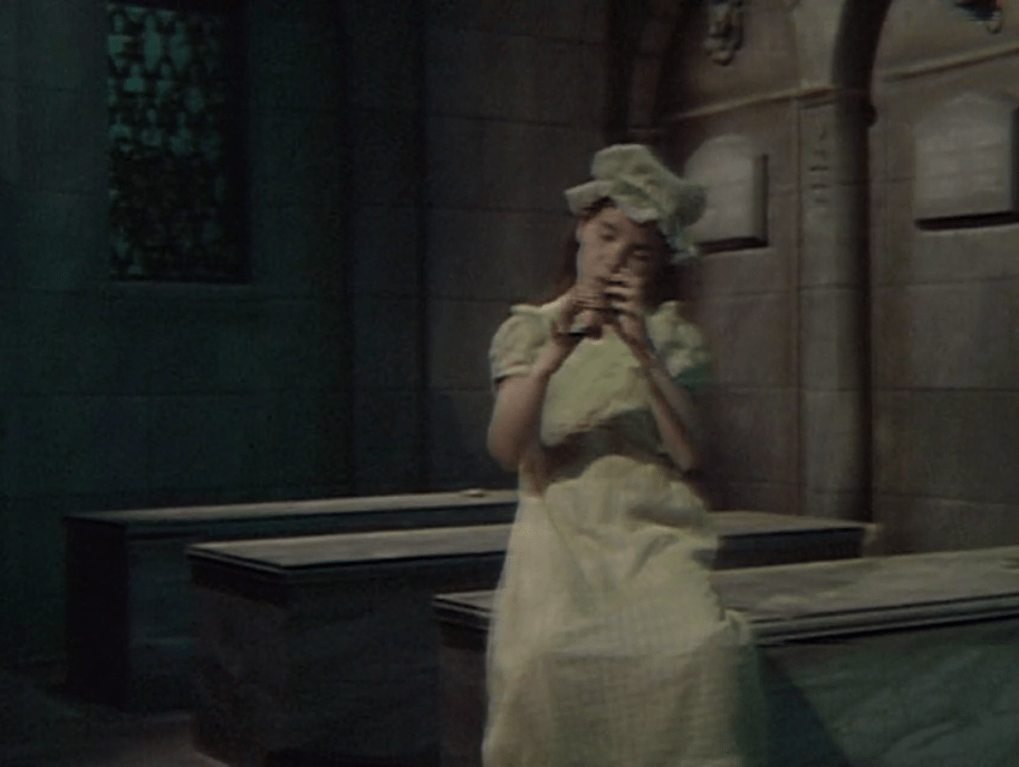
On the great estate of Collinwood, well-meaning governess Vicki is staring vacantly into space while listening to an antique music box Barnabas gave her as part of his plan to subject her to the same treatment he inflicted on Maggie. A knock comes at the door. Vicki closes the music box and goes to answer it. It is her boyfriend, fake Shemp Burke Devlin.
Burke is waging a determined battle against the story, and he is fighting dirty. He doesn’t want Vicki to have anything to do with Barnabas, or with the ghost of Josette Collins. When Vicki says she wants to lay flowers on Josette’s grave in the cemetery, where we know she will cross paths with Maggie and Julia, he resists furiously. When she reminds him that she has had dealings with Josette’s ghost, he says “Or you think you have.” In previous episodes, including yesterday’s and Monday’s, he knew she had, and in an earlier period of the show he knew that several other characters, including some of the most level-headed ones, had also encountered Josette’s ghost. When he starts belittling Vicki for believing in “the spooks of Collinwood,” it therefore comes off as an especially crude instance of gaslighting. The Mrs and I aren’t much for profanity, but we both cussed at the screen when Burke was disgracing himself this way.
Julia and Maggie are in the cemetery. I believe it is the first time we’ve seen the set in a daylight scene. You can see the shadows of the foliage on the soundstage walls, and the corners where the walls meet. I can’t believe the director meant for us to see those things, but I kind of like it- the situation needs a touch of unreality, and the obvious falsity gives it the feeling of a black box theater.
Some of the shadows on the wall that Art Wallace spoke ofCorner of the soundstage
Maggie is agitated. Julia tells her to calm down and that everything is all right. I’m no expert, but I kind of doubt that talk therapy involves a lot of “Calm down!” and “Everything is all right!” It reminded me of this Saturday Night Live sketch from the 90s, in which Patrick Stewart plays “Phil McCracken, Scottish Therapist,” a psychologist who won’t stand for any emotionalism from his patients.
Vicki and Burke see Julia and Maggie in the distance. When Maggie turns to face them, Vicki recognizes her. Julia whisks her away before Burke can see her. When Vicki tells Burke she saw Maggie, he immediately unloads on her with the same garbage he handed her at Collinwood. He declares that Maggie is dead, that Vicki knows she’s dead, that she can’t possibly have seen her, that “there is a resemblance, THAT’S! ALL!” When he asks “What’s wrong with you?” I stopped the streaming and shouted at the screen “She’s wasting her time with you, you ******* ********, that’s what’s wrong with her!” To that, Mrs Acilius said that we should just restart the show and get through the scene.
Part of what makes Burke’s behavior so infuriating is the writer’s fault. A first-time viewer, unaware that what Burke is telling Vicki are delusions that suggest she is crazy are in fact things he knows to be true, might think that he is being reasonable in dismissing ideas about ghosts and the like. But even that viewer will realize that a person ought to be nicer about it. When Vicki says she saw Maggie, Burke could easily have suggested that they go up to the woman and introduce themselves, thinking that a closer look will disabuse her of the notion. But actor Anthony George must also bear part of the blame.
George C. Scott famously told Gene Siskel that there are three things to consider in evaluating an actor’s performance: first is to make the audience believe that the person they are looking at is the sort of person who might do the things the character does. This is in turn dependent on casting- put the wrong person in the part, and all is lost. Second are the choices the actor makes in the key emotional moments. Performers have any number of options as to how they will use their faces, voices, and limbs to show a character’s feelings, and those who make a lasting impression are those who make choices that are at once totally unexpected and perfectly logical. Third is the zest of performance, the actor’s joy in the opportunity to create a character. If that doesn’t come through, nothing else is worth much.
As Burke, Anthony George fails all three of these tests. Burke would have been a difficult part for anyone to take over, both because the originator of the role, Mitch Ryan, was so memorable, and because the character had lost all connection to any ongoing storylines by the time Ryan left. And by his own admission, George knew nothing about soap operas and had no idea how to play a romantic interest on one when he joined Dark Shadows. That’s where he fails the casting part of the believability test.
As for the skill part, George has something going for him. He is always mindful of his physicality, moving only those parts of his body he needs to show us who he is and keeping the rest of himself admirably still. He also keeps his voice remarkably consistent, both by holding a steady level of volume and maintaining a simple, precise pitch. In these and other ways, he shows impressive levels of technical proficiency as an actor, but the result is a mannered, unconvincing performance. His Burke doesn’t seem to be a real person. As a cardboard figure, he becomes an abstract symbol of whatever he’s doing, and when he’s doing something bad he’s hard not to hate.
Since he makes one choice for each resource available to him and sticks with it unvaryingly throughout the episode, he doesn’t give the audience any surprises. Nor does he yield anything to his scene-mates. They always know exactly what’s coming from him. George’s eyes are always watching another actor intently, as he watches Alexandra Moltke Isles intently today, but nothing in her performance can divert him from his plan, not in the smallest particular. When Burke isn’t listening to the other character, as he isn’t listening to Vicki, George’s disconnection from the other actors makes Burke seem like an irredeemable jackass.
Nor does George show any zest for the part. He covers his discomfort with soap acting by plastering on a smile whenever the script allows it, but he is stiff when Burke ought to be loose, cool when he ought to be warm, and loud when he ought to speak with a quiet, nuanced voice. The result is just sad and awkward. When Burke is being pleasant, we can feel sorry for George, but when he has to play the scenes like the ones Burke gets today we just want him to get off the screen and leave us alone.
Compare George’s Burke with Grayson Hall’s Julia, and you will see how an actor can determine an audience’s reaction to a character. Julia is a terrible therapist. She lies repeatedly to Woodard in the beginning, denying the severe breach of ethics and disturbing disregard of public safety involved in covering up what she knows and suspects about Maggie’s experiences and running an unconscionable risk with Maggie’s mental health by taking her to the cemetery. She lies again to Maggie at the end, promising that they will duck into the Tomb of the Collinses only for a moment and then refusing to let her leave there when she starts to show a violent emotional reaction. Her methods are so unorthodox and so harsh that we suspect she is not interested in helping Maggie at all. Because we have known Maggie since episode #1, and Kathryn Leigh Scott’s performance as Maggie renews our fondness for her every time she appears, we ought to feel deep hostility towards Julia.
But we don’t. In fact, Julia quickly becomes (almost) every Dark Shadows fan’s favorite character. The George C. Scott tests tell us why. Hall’s manner is so intense that we can believe her as a mad scientist; her uninhibited use of every facial muscle, of the full range of her vocal output, and of subtle tricks of movement she learned from choreographers when she appeared in musicals may have produced a style that no acting teacher could recommend as a model, but they do mean that every moment she is on screen she is doing something we wouldn’t have predicted; and she’s clearly having a blast. She can do things vastly worse than what makes us hate Burke today, and we will still want her to come back again and again.
Closing Miscellany
The opening voiceovers aren’t usually the best-written parts of the show, but there is a particularly bad bit in today’s: “Hidden deep in the cliffs of Collinwood, the majestic, ancient rocks that separate the Earth from the sea, there is a tiny cove carved by a long-ago sea. No one at Collinwood has seen it, and no one will ever see it.” If no one ever will see it, why bother telling us about it? The narrator tells us that it is because “the Earth knows how to hide its secrets well. Sometimes men, too, must hide secrets.” Does this mean that “no one ever will” discover the secrets the characters are hiding from each other? That isn’t a very promising thing to tell the audience of a soap opera, a genre which is all about unsuccessful attempts to keep secrets and their aftermath.
Maggie tells Julia that she doesn’t recognize the name Collins. She has lived her whole life in the town of Collinsport, where most people are employed by Collins Enterprises, which is owned by the Collins family who live at Collinwood. That’s some pretty widespread amnesia she has.
The show has been going back and forth on the dates when Barnabas and Josette Collins originally lived and died. Today we get a long look at Josette’s tombstone, giving her dates as 1800-1822, and another at the plaque on Barnabas’ little sister Sarah’s resting place in the mausoleum, with the dates 1786-1796. Those dates fit with a remark Barnabas made to his sorely bedraggled blood thrall Willie in #271, that Sarah lived long before he met Josette, but not with his remark in #281 that Josette had been dead for “almost 200 years,” much less with a book we saw in #52 that gave her dates as 1810-1834.
Maggie Evans, The Nicest Girl in Town, has escaped from vampire Barnabas Collins, but not before Barnabas put the zap on her brains. She is being treated at Windcliff Sanitarium, under the care of Dr Julia Hoffman.
Dr Hoffman’s old acquaintance Dr Dave Woodard shows up with Maggie’s father Sam and boyfriend Joe. Woodard and Hoffman are Dark Shadows ‘ current versions of Bram Stoker’s Dr John Seward and Professor Abraham Van Helsing. As Seward called Van Helsing in when he needed help solving the mystery he encountered treating the victims of Count Dracula, so Woodard has called the expert Dr Hoffman in to help him solve the mystery he has encountered treating Barnabas’ victims. As Van Helsing refuses to answer any of Seward’s questions when they first start working together, so today Dr Hoffman refuses to answer any of Woodard’s questions about the case. There is one departure, in that Dr Hoffman combines Seward’s occupation as chief physician at a sanitarium with Van Helsing’s role as mysterious expert from out of town.
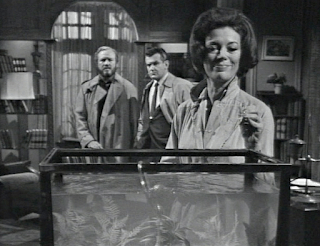
Dr Hoffman tells Dr Woodard that she believes it will be bad for Maggie to see Sam and Joe, but she consents to the visit as a way of discouraging them from trying to come back. When Sam and Joe join them in her office, she attends to her aquarium. In the post about this episode on Dark Shadows Before I Die, Christine Scoleri points out that this is a rather direct way of telling us that there is something fishy about Dr Hoffman.
When Sam and Joe go to Maggie’s room, she has a mad scene. She starts singing “London Bridge,” gets to an obscure verse running “Take the key and lock her up,” and starts screaming “Lock her up!” over and over. It’s magnificently terrifying.
In his post on Dark Shadows Every Day, Danny Horn raves about Grayson Hall’s performance as Julia Hoffman. Rightly so, she will quickly make herself indispensable to the series. He includes a lot of screenshots of her face, showing the wide variety of expressions she uses. I have a more complicated response to this aspect of her style.
As many screenshots as Danny gives of Grayson Hall’s face in his post, I presented even more screenshots of Lovelady Powell’s face in my post about #193, where Powell plays art dealer Portia Fitzsimmons. What impressed me about Powell’s performance is that she takes one of the most basic rules of screen acting- choose one of your eyes and look at your scene partner only with it- and builds a whole character around it. Her left eyelid is all she needs to command the stage and leave an indelible impression.
Hall was at the opposite extreme. She ignores the one-eye rule, and virtually every other piece of guidance professionals give about how to create a character on camera. She uses every muscle at every moment. Her broad, stagy approach works well for Dark Shadows, and the three actors with whom she shares her shots today stay out of her way. Still, she does make me miss Powell’s dominating simplicity.
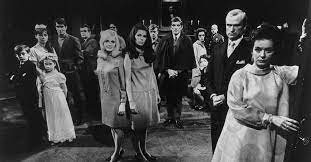
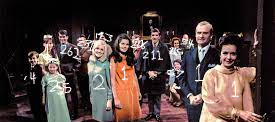
With Julia’s introduction, all of the actors in the photo I use as the header for this blog have joined the cast of Dark Shadows. There is also a version of the picture where the actors are frowning.
Gloom in the shadows
Here’s the smiley version. I’ve marked each player with the number of the first episode in which s/he appeared:
In 281 of the posts that follow, I link to comments I made on Danny Horn’s blog, “Dark Shadows Every Day.”
Not all of these comments were absolutely unique. Several times it occurred to me that a Dark Shadows features a number of older sisters who clean up messes that their misbehaving younger brothers make, and that a variety of male-female relationships on the show take on the dynamic of a bossy big sister and her bratty little brother. Danny doesn’t cover the first 209 episodes of the show, when we learn that Roger Collins has managed to squander his entire inheritance, half of the family fortune, and that his older sister Elizabeth Collins Stoddard has gone deeply into debt to contain the damage that his irresponsibility has done to the family business. Elizabeth takes Roger into her house, and alternates between demanding that he reform his ways and enabling his ongoing bad conduct. She takes charge of the raising of Roger’s son David and puts Roger to work in the family business, setting bounds to Roger’s crapulence but also insulating him from its consequences.
Watching this episode, I just realized the main relationship in DARK SHADOWS- Bossy Big Sister/ Bratty Little Brother. Liz and Roger are literally that, and each one’s struggle to safeguard their relationship by keeping the other in the dark about their shameful secrets is the background of every storyline in the first 209 episodes. Carolyn and David become the functional equivalent of a Bossy Big Sister and a Bratty Little Brother, and that’s the development that makes Carolyn a relatable character.
In Julia and Barnabas, we have the supreme example of such a relationship. They fall into it naturally; Julia is used to giving orders, and Barnabas is used to disobeying them. From the moment Julia lit her cigarette on the candles in the old house, she’s been Barnabas’ Bossy Big Sister, pursuing one plan after another meant for his own good. He’s been alternately pouting at her, raging against her, and clinging to her, at once resenting her demands on him and craving her validation for his narcissism. The climax of the episode, when they both know that a he-vampire is roaming about in search of a victim but it occurs to neither Julia nor Barnabas that Julia might be in danger, shows how deeply they have embedded themselves in these roles. Barnabas won’t even let Vicki walk to her car alone, and Julia, hearing the dognoise, understands why. But when Julia tells Barnabas that she will close up the lab and leave shortly after he goes out to join Willie, implying that she’s going to walk all the way back to the Great House by herself, he just leaves. Of course nothing will happen to Big Sis, she’ll always be OK.
That’s also why I don’t see how slashfic positing a sexual relationship between Barnabas and Julia can work. They are so much Bossy Big Sister and Bratty Little Brother that no matter how much time they spent telling themselves that they aren’t actually related, it would still be impossibly weird to try to be something else to each other.
I returned to the theme in a remark about episode 572, where Jonathan Frid gives a line-reading so pouty that I wonder if he was consciously trying to depict Barnabas as a bratty little brother to Julia:
I love the way Jonathan Frid pouts the line “I was afraid your visit would be pointless.” He’s every inch the bratty little brother upset that his big sister went out when he didn’t want her to go.
Cavada Humphrey looks quite a bit like Jonathan Frid. I wonder what 1795 would have been like if Barnabas had had an older sister who bossed him around, stood around during his ridiculously childish fits of petulance, occasionally acted as his conscience, and time and again serve as his enabler and protector. It would have been funny to see Grayson Hall’s Countess express disapproval of such a relationship.
Heck, that older sister could have been Sarah. Just because she’s a child in her ghost form doesn’t mean she has to have died at that age. Maybe she comes back in the form in which her relationship to her brother took its permanent shape, when she was about nine and he was about seven. Of course, that possibility is foreclosed at Sarah’s first appearance, when she tells Maggie not to let her “big brother” know she saw her, but I suppose they could have retconned that away with a phony flashback where she says “little brother.”
I revisited these points a few times- Danny’s blog consists of over a thousand posts, one each for episodes 210-1245, plus a few dozen about properties related to Dark Shadows, and each post has its own discussion thread. So it isn’t bad netiquette to repeat yourself a bit from one thread to another- there is always a chance someone who didn’t see a comment previously posted elsewhere will take an interest when you post a similar one. But I did try to keep from making a bore of myself to those who read everything.
I could have mentioned some other bossy big sister/ bratty little brother combos. In a comment on the 1897 storyline, I alluded to the relationship between Judith Collins Trask and her feckless younger brothers. Judith’s arc doesn’t really allow her to be a bossy big sister to any of her three bratty little brothers. But each of them does find himself attached to at least one woman who is stronger than he is, and who might well treat him as Elizabeth does Roger and as Julia does Barnabas.
It’s a shame Terry Crawford wasn’t a more accomplished actress in the 1960s- in the scripts Beth fluctuates between indulging Quentin in his every vice and insisting that he clean up his act. That’s the bossy big sister/ bratty little brother dynamic we’ve seen so many times, but unlike any previous pair who have enacted it Beth and Quentin are lovers and are not social equals. It would be interesting to explore the dynamic in that context, but Ms Crawford’s performance is so wooden that you sometimes have to think about her scenes after it is over and call to memory the dialogue and the visual composition before it strikes you what the point was.
Pansy Faye isn’t on the show very long, unfortunately but she’s clearly in the driver’s seat in her relationship with her thoroughly clownish husband Carl Collins. And Edward Collins is much the weaker personality in his connections with both his estranged wife Laura and with Kitty Soames. So each of those men was looking for a woman who was forceful enough to take charge of him, but indulgent enough to allow him to continue in all his established habits.
I did not refer to the theme in my comments on posts about “The Haunting of Collinwood” by the ghost of Quentin, and I made only a single reference to it in my comments on posts about the “Re-Haunting of Collinwood” by the ghost of mini-Quentin Gerard. Indeed, that single reference is to Julia’s failure to focus her bossiness on Barnabas. I dropped the ball there, I think- the relationship between David and Amy in the original “Haunting of Collinwood” is at its most interesting when it mixes elements of the bossy big sister/ bratty little brother dynamic with other types of interaction, while the bland, lifeless relationships between David and Hallie on the one hand and between Tad and Carrie on the other in the “Re-Haunting of Collinwood” could benefit from some kind of structure.
I also left the theme unmentioned in my comments regarding the show’s dying days, the 1841 Parallel Time storyline of episodes 1199-1245. That’s understandable- the show did not develop any bossy big sister/ bratty little brother relationships in that period. But there was an implicit one- Miss Julia Collins was the sister of Justin Collins, and she had functioned as head of the household during his years of madness. Justin dies a few episodes into the story, without sharing a scene with Julia, and she is left as a bossy big sister with no bratty brother to whom she can attach herself. Meanwhile, Bramwell is a thoroughly bratty man with no big sister. It’s rather sad for the loyal audience, having enjoyed so many scenes in which Grayson Hall and Jonathan Frid had enormous fun with the bossy big sister/ bratty little brother pattern, seeing them drift separately through these dreary episodes.
The closest we get to a bossy big sister/ bratty little brother scene in the dying days of the show is also the one genuinely irresistible moment of that segment. In episode 1215, Flora Collins (Joan Bennett) and her son Morgan (Keith Prentice) are walking through the woods on their way to Biddleford’s Creek. He whines about the pointlessness of the trip, she scolds him, and we get a brilliant little glimpse of what their relationship must have been like since he first learned to talk. That authoritative mother/ whiny son moment left me, not only wanting more such scenes between them, but also wishing it had been presented in contrast with a bossy big sister/ bratty little brother relationship elsewhere in the show.