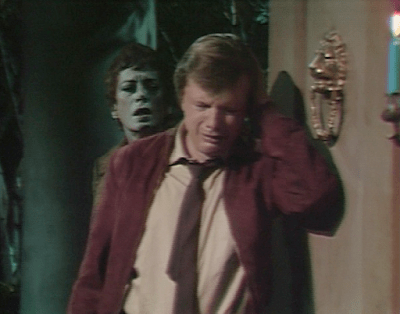
The wicked witch known variously as Angelique and Cassandra is standing in the drawing room of the great house of Collinwood, thinking evil thoughts. The camera zooms out and we see that her stepson, strange and troubled boy David Collins, is standing next to her. She starts to speak her thoughts out loud, saying “You will pay!” David asks “Who will pay?” Angelique/ Cassandra is startled to discover that David is there, and is flustered when she tries to change the subject. She so often delivers incriminating soliloquys while standing out in the open that the comic effect of this scene must be intentional.
Angelique/ Cassandra oblivious to David’s presence.
David asks Angelique/ Cassandra to help him figure out the correct operation of a tape recorder he received some time ago as a present from permanent houseguest Julia Hoffman. After Angelique/ Cassandra refuses to help, he goes upstairs and finds his cousin, heiress Carolyn Collins Stoddard, emerging from the long-deserted west wing of the house. He asks Carolyn what she was doing in the west wing. She asks him why he thinks she was in the west wing. When he says he saw her coming out of it, she drops her attempt to evade his question and tells him she was looking for some old family photos to show well-meaning governess Vicki. She has enough trouble remembering this story that it must be obvious to David that it is a lie, but he isn’t interested enough to follow it up. He just wants someone to help him figure out which buttons to push on the tape recorder.
On their Dark Shadows Before I Die, John and Christine Scoleri speak for longtime viewers of the show when they say that it is surprising David needs help with the tape recorder. When the show started, David was two years younger and had the mechanical skill to sabotage his father’s car in a very creditable attempt at patricide. All Carolyn has to do to get the tape going is read the label that identifies the play button. This apparent loss of cognitive function is of a piece with David’s massive loss of narrative function. For the first 39 weeks of Dark Shadows, David was the fulcrum on which every story turned, and actor David Henesy had abundant opportunities to show a level of professional skill that would be remarkable in a performer of any age. But he has been receding into the background for a long time now, and his extraordinary dim-wittedness today marks a low point for him.
Once the tape starts playing, Carolyn makes a hasty exit. David listens to a minute or so of Eine Kleine Nachtmusik, hoping it will end and he will hear “something spooky.” His wish is granted when the music abruptly stops, giving way to a voice addressing itself to Julia. The voice rambles about David’s distant cousin Barnabas Collins, saying that if both he and “my creation” live, Barnabas will be all right, but that if “Adam” dies, “Barnabas will be as he was before.” The name “Adam” should mean something to David. He shared a confused and frightening moment with a mysterious man of that name in #495. That man subsequently abducted Carolyn, and is still the object of a police search.
What only Julia, Barnabas, and Barnabas’ servant Willie know is that Adam is a Frankenstein’s monster created in an experiment that freed Barnabas of the effects of the vampire curse that Angelique/ Cassandra placed on him in the 1790s. The voice on the tape is that of Eric Lang, the mad scientist who began the experiment. Minutes before he died of the effects of one of Angelique/ Cassandra’s spells, Lang recorded this message for Julia. The audience has heard this message approximately a gazillion bajillion times, but until now, the only character to have heard it was Adam, and he could make no sense of it.
Angelique/ Cassandra recently made an unsuccessful attempt to renew Barnabas’ curse, and is desperately searching for the obstacle that prevented it from working. Carolyn’s actual task in the west wing was showing Adam to a hiding place there. So Angelique/ Cassandra is now under the same roof with both the information she needs to identify her obstacle and the person she can remove that obstacle by killing. Things are looking bad for Barnabas and for Adam.
While David is upstairs with the tape recorder, Vicki is sobbing in the drawing room. Suave warlock Nicholas, who is staying in the house in the guise of Angelique/ Cassandra’s brother, enters and asks her what’s wrong. She says that she has just learned that Barnabas is dead. His back to her, Nicholas smiles brightly when he first hears this news, then puts on a sad face and turns to her with sympathetic words. In response, Vicki reveals that she knows all about Angelique/ Cassandra and that she has little patience for Nicholas’ pretensions. Carolyn enters and doubts Vicki’s news. Angelique/ Cassandra is the last to enter. She says that she saw Barnabas alive and well after the time when he is supposed to have been dead. Vicki and Carolyn look at each other, and do not see Nicholas’ look of disappointment. They go upstairs, and Nicholas and Angelique/ Cassandra go into the drawing room.
Nicholas scolds Angelique/ Cassandra for her failure. He addresses her as “dear sister.” He suggests she may not hate Barnabas sufficiently to impose a curse on him. When she denies this, he leans to her ear and teasingly asks if she loves him. He threatens to send her back where she came from if she doesn’t re-vamp Barnabas by midnight, and to focus her mind replaces her arm with a fleshless bone.
Director John Weaver was not much of a visual artist, and in his post about the episode on Dark Shadows Every Day Danny Horn analyzes the dismally inept blocking of the scene between Vicki and Nicholas. Danny also has some unkind words for writer Ron Sproat, but I think those are unfair. It’s true the opening scene between Adam and Carolyn goes on too long, David’s helplessness with the tape recorder is dismal, and Vicki and Carolyn’s reaction to Angelique/ Cassandra’s report that Barnabas is still alive doesn’t make sense. That’s a long enough list of flaws that we might fairly classify Weaver and Sproat as the B-team, not on a par with director Lela Swift and writers Sam Hall and Gordon Russell.
But it is genuinely funny when we first see David standing next to Angelique/ Cassandra, David’s questioning of Carolyn is intelligently written, Lang’s message is for once an actual source of suspense, Vicki’s lines to Nicholas as Alexandra Moltke Isles delivers them show the character’s strength, Nicholas’ teasing Angelique/ Cassandra with her alleged love of Barnabas raises a laugh as it makes them sound like a couple of kids, and the final gag with the arm bone is at once goofy enough to keep up the humor in the episode and startling enough to be effective as a touch of horror. All in all, it’s an enjoyable episode, if not one that fans would be tempted to use to turn their friends on to the show.
A magical bat has bitten recovering vampire Barnabas Collins on the neck and Barnabas appears to have died. Barnabas’ friend Julia and his servant Willie have a conference to discuss their next steps. Barnabas had expected such an attack, knowing that the witch who made him a vampire in the first place has been working to renew her curse. Willie laments the situation, crying out, “Aw, now we’re gonna hear the dogs howlin’ again!” Evidently that’s the bad part.
Barnabas had directed Julia and Willie to drive a stake through his heart once it had stopped beating. They can’t do it. They decide to bury him in the woods instead. Willie mentions a cross; a silver cross inside the lid of his coffin had kept Barnabas immobilized for the 171 years before Willie inadvertently released him to prey upon the living in April 1967, so perhaps that’s how they plan to show mercy to their friend.
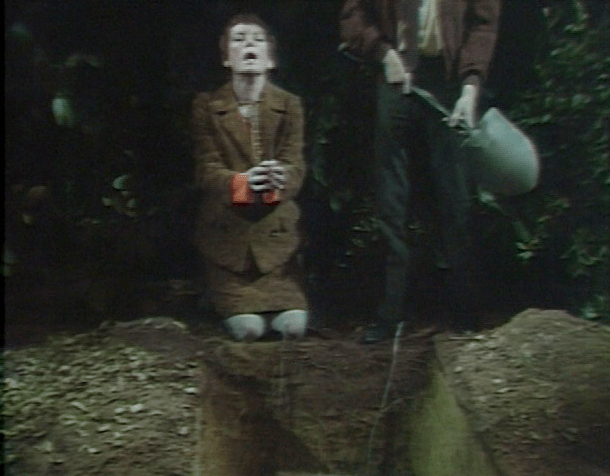
Once Willie has dug the grave and put Barnabas’ coffin in it, he and Julia decide to pray. She takes the lead, kneeling and throwing dirt, presumably including stones, onto the coffin. Dark Shadows avoided the topic of religion almost completely until repressed spinster Abigail Collins made her first appearance in #367; she and the Rev’d Mr Trask, introduced in #385, presented a wildly unfair, highly entertaining lampoon of eighteenth century New England Congregationalism. Recently the show has been lurching towards a vaguely friendly attitude towards Christianity. If Julia keeps strewing stones onto the grave once it is filled in, we might think that this friendliness extends to Judaism as well.
Meanwhile, a very tall man named Adam is having a bad time. Adam is a Frankenstein’s monster, and when he was created he drew the effect of the vampire curse from Barnabas. He does not feel the effects of that curse, but he does suffer pain when Barnabas is injured. When heiress Carolyn calls on Adam at the old shack in the woods where he is hiding, she finds that his neck hurts where Barnabas was bitten. When Julia declares Barnabas dead, we cut back to the shack, where Adam has stopped moving. Occult expert Timothy Eliot Stokes has joined Carolyn; he feels Adam’s wrist, and in a bit of Collinsport English that is becoming increasingly prominent on the show says that he can find no “pulsebeat.”
Barnabas was bricked up in a wall from #512 to #516, and Adam felt his pain during that period. So it is no surprise to returning viewers that Adam suffers along with Barnabas now. We also have heard countless repetitions of something neither Julia nor Willie has ever heard, an audiotape in which Eric Lang, the mad scientist who created Adam, explains that as long as Adam lives Barnabas will be free of vampirism. So we doubt that Barnabas’ curse will return, and hope that Adam’s suffering will be the clue that leads Julia and Willie to rescue Barnabas from being buried alive. Since Julia and Willie have no idea where Adam is and Adam hates them both, it’s as difficult to see how they could find out what he’s going through as it is to see how Barnabas could get out of the grave any other way. In that difficulty is the suspense with which the episode ends.
A stranger comes to the great house on the estate of Collinwood and introduces himself as Nicholas Blair, brother of Cassandra Blair Collins. Cassandra’s husband Roger Collins is shocked; Cassandra had never mentioned that she had a brother. Moreover, she has been missing for the last 24 hours, and Roger is convinced something terrible has happened to her. Roger’s distant cousin Barnabas Collins and Dr Julia Hoffman are also shocked, but for a different reason. They know that Cassandra is actually Angelique, a wicked witch who, in the 1790s, turned Barnabas into a vampire. She recently returned to the world of the living when Barnabas’ vampirism went into remission, and she tried to implement a plan to bring it back in full force. When Angelique/ Cassandra went missing, they hoped it meant that she had been defeated. Nicholas’ arrival replaces their hopes with the fear of new battles.
Nicholas at first assumed that Barnabas was Angelique/ Cassandra’s husband, and told him “I should have recognized you anywhere!” This is a sure sign of trouble- Barnabas, who was in fact briefly married to Angelique in 1796, has not been out of the state of Maine since 1795, and has never been photographed. Nicholas says that he has recently been on Martinique, where Barnabas first met Angelique in the eighteenth century, and that he is a “citizen of the world” with no fixed address. He assures Roger that it is Cassandra’s way to disappear abruptly, and that she is sure to return.
Roger, Julia, Barnabas, and Nicholas in the drawing room.
Roger takes Nicholas to the bedroom he and Angelique/ Cassandra share. He shows Nicholas a portrait of Angelique which returning viewers know to have a mysterious connection with Angelique/ Cassandra’s physical being. Roger leaves the room, and Nicholas talks to the portrait. He asks Angelique if she can hear him, and a musical cue associated with her plays on the soundtrack. The cue cuts out, and Nicholas follows up with another question. Dark Shadows stood out from the daytime soaps of the period in having an orchestral score instead of an organ accompanying the action. The meta-theatrical touch of a character who can hear that score is a major departure. It is something people at the time would have seen in animated shorts from Warner Brothers, but likely not anywhere else. Since the biggest and fastest-growing share of Dark Shadows’ audience at this point was children under the age of 13, there was a risk that adult viewers might take that association with cartoons as a sign that it was time for them to find something else to do with their mid-afternoons.
Back in his own house on the same estate, Barnabas finds his servant Willie Loomis holding a rifle. Willie says that he is afraid that man named Adam will come to the house. Barnabas dismisses that fear and orders Willie to put the rifle away. Willie objects. Barnabas repeats the command and leaves. Willie grumbles, but does as he was told. We see a face peering in at the window.
The face belongs to hardworking young fisherman Joe Haskell. Returning viewers know that Barnabas held Joe’s fiancée Maggie prisoner from May to June of 1967 and was extremely cruel to her. When the case was being investigated, Barnabas framed Willie for those crimes. Willie was sent to a mental hospital, and Barnabas had Willie released and brought him back to work for him some weeks ago. Joe thinks that Willie is the perpetrator, and has no patience with him. He knocks on the door and demands Willie let him in.
Joe insists that Willie tell him what he knows about Adam. Willie tries to evade his questions. When Willie says that Adam dislikes him, Joe responds”that means he knows you.” Joe twists Willie’s arm while repeating his questions. Once Joe releases him, Willie runs off and comes back with the rifle. He points it at Joe and orders him out of the house. Joe complies, but says that he will be back, and that he will be having words with Barnabas.
Later, Willie is in the basement. Some bricks are missing from a wall, exposing a skeleton hanging from the ceiling. Viewers who have been with Dark Shadows all along will recognize the basement of Barnabas’ house as a redress of the set that represented the basement of the main house in the first year of the show. The spot with the missing bricks was where a door stood that was always locked in those days. For the first 54 weeks of Dark Shadows, matriarch Liz thought that her husband’s corpse was buried behind that door. That belief turned out to be mistaken, but now we see that there are indeed human remains in the most similar possible spot. We might wonder what else Liz might have been less wrong about than at first sight appeared.
We watch Willie preparing to fill in the missing bricks, leaving the skeleton in place. After all, judging by Liz’ old way of thinking, that’s what ought to be in a space like that. We hear Willie’s interior monologue. He is making himself laugh with a pun on his own name when a stagehand wanders into the shot.
Uh, hello?
That moment of unintentional humor gives way to a scene rich in intentional comedy. Willie goes upstairs and finds that Nicholas has let himself into the house. Nicholas entrances him and extracts information from him. Willie tells him about a meeting with a ghost- “the one downstairs,” he specifies. Nicholas directs Willie to sit down, to remain in a blissed-out state until he leaves, and then to forget all about their encounter.
Nicholas goes to the basement, looks at the skeleton, and calls it “Reverend Trask!” Willie hadn’t given him this name; evidently he recognizes Trask the same way he recognized Barnabas.
A lot of wonderful acting in this one. We start off with Willie Loomis (John Karlen,) staggering into the cottage Maggie Evans (Kathryn Leigh Scott) shares with her father Sam (David Ford.) Yesterday, Maggie’s boyfriend Joe beat Willie up. Maggie invites Willie in, comforts him, tries to treat his wounds, and agrees to drive him home. Joe had excellent reasons for insisting Willie stay away from Maggie, and those reasons might lead returning viewers to react to the beginning of the scene with frustration. But Karlen and Miss Scott are so good together that they very smoothly defuse that frustration, and we soon find ourselves as absorbed in the scene as we were in the many scenes the same actors shared in May and June of 1967, when Maggie was the prisoner of Barnabas the vampire* and Willie, as Barnabas’ slave, was trying desperately to reduce her suffering.
A very tall man named Adam (Robert Rodan) comes to the open front door and announces “Willie bad!” Maggie has no idea who Adam is. Adam enters the cottage and clarifies his intention with a declaration of “Kill Willie!” Willie tries to talk Adam out of this plan, and reminds him of the good times they had together. Maggie tells Adam that Willie is hurt, and Adam looks concerned when he responds “Willie hurt?” Rodan gets the same flicker of light into Adam’s eyes that you might see in the eyes of a toddler who is intrigued to hear that someone is having feelings he wouldn’t have expected them to have. Before long, though, Adam is angry again. Maggie takes a hammer and tries to hit Adam, leading Adam to state a new plan- “Kill Maggie!”
Sam comes home. Sam befriended Adam during a trip Maggie recently took out of town. He tells Maggie to stand behind him. She does, and he talks to Adam about their friendship. Adam agrees that Sam is his friend and that he would never hurt him, but he refuses to agree when Sam tells him that Maggie is also his friend. Maggie makes a move that confuses Adam. Trying to get at her, Adam hits Sam very hard. Adam sees that he has knocked Sam down, and he runs away.
We see Adam in the woods, and for the first time hear his voice in a pre-recorded monologue telling us his thoughts. “Afraid! Adam afraid! Adam bad! Adam hurt friend!” Rodan’s acting is more than sufficient to enable us to figure out that this was what Adam was thinking even without the monologue, but he does such a good job of voice acting that I don’t really begrudge it. Crude as the lines are, Rodan simultaneously expresses fine shades of fear and guilt through them.
Willie and Maggie have another scene in the Evans cottage. She is stern with him now, demanding to know what Willie knows about Adam. Willie denies that he knows anything, and she points out that when he was trying to calm Adam he appealed to several facts from their previous acquaintance. Willie tells a story to cover that up, essentially the same story Barnabas made up to tell the sheriff in #505. Maggie is a lot smarter than the sheriff- that isn’t saying much, chewing gum is a lot smarter than the sheriff- and even he didn’t buy this line when Barnabas was pushing it. She tells Willie in a firm tone that she will continue to ask questions until she gets answers she can believe. She explicitly tells him she will ask Barnabas. Maggie’s firmness and Willie’s barely controlled panic make for another gripping encounter.
Willie goes back home to Barnabas’ house. Barnabas’ best friend Julia Hoffman (Grayson Hall) is there. Willie tells Julia they have to find Adam before the police do, since he now knows enough words to get them all in a lot of trouble. Usually when Julia and Willie have their staff conferences, she is firmly in charge and full of ideas. But she is at a complete loss today. She has no idea how to capture Adam, and she doesn’t know where Barnabas is.
What’s more, Julia has just seen a ghost. She heard sobbing coming from the basement, and when she went down there she saw a woman in white whom she recognized as Josette Collins, deceased. Josette dematerialized in front of her. Now the sobbing starts back up, and Julia accompanies Willie to the basement.
Josette is already gone when they get there. Julia tells Willie what she saw earlier. She figures out that Barnabas is bricked up behind the wall where Josette’s ghost had stood. She explains her reasoning in terms that viewers who have seen the last several episodes will be able to follow, but which don’t make a bit of sense to Willie. His sharp befuddlement and her vague certitude make for a laugh-out-loud funny scene.
In the early months of the show, several characters heard a sobbing woman in the locked room in the basement of the great house of Collinwood. It was strongly implied in a number of those episodes that the woman was the ghost of Josette. In #272, matriarch Liz said that she herself was the one who did the sobbing. That didn’t fit very well with what we had seen, but by that point the show had reconceived Josette as part of Barnabas’ story and stopped involving her ghost in the action. Longtime viewers have a strong reminder of the “Sobbing Woman” story today, since Barnabas’ basement is a redress of the set used for the basement of the great house and the alcove where he is walled up is in the same place as the door to locked room in basement of great house.
*Maggie has amnesia about all that, and thinks Barnabas is her friend. His vampirism is in remission now.
For nineteen weeks from November 1967 to March 1968, Dark Shadows was a costume drama set in the late eighteenth century. Among the more interesting characters introduced in that period were fanatical witchfinder the Rev’d Mr Trask; roguish naval officer Nathan Forbes; fast-talking con artist Suki Forbes; and streetwalkers Ruby Tate and Maude Browning. All five of these characters were murdered by vampire Barnabas Collins, and all five of them are among those who return today for an impromptu trial of Barnabas.
Barnabas killed Trask by luring him to his basement and bricking him up in an alcove, as Montresor did to Fortunato in Edgar Allan Poe’s 1846 story “The Cask of Amontillado.” Some other characters invited themselves to the basement yesterday and held a séance there. As a result of the séance, the bricks fell away and Trask came back to life. Now, Trask has confined Barnabas to the same alcove. He declares that he will give him a trial before he bricks him up.
In the eighteenth century, Trask was the prosecutor in the trial of time traveling governess Vicki Winters. Victoria was convicted of witchcraft and sentenced to death. Vicki’s trip from the 1960s to the 1790s inverted Barnabas’ displacement in time; as Vicki’s witchcraft trial was so chaotic it did not seem to follow rules of any kind, neither does the murder trial Trask improvises for Barnabas fit any conceivable model of procedure. Vicki’s trial stretched over two weeks, from #427 to #437; Barnabas’ begins and ends today, during the second half of the episode.
Trask conjures up Nathan, Suki, Ruby, Maude, and Barnabas’ first homicide victim, his uncle Jeremiah, to serve as a jury; he conjures up a man named Ezra Simpson, of whom we have never previously heard, to act as judge. Trask is the prosecutor, and Nathan is his sole witness. This court of “the damned!,” as Trask calls them, recalls the rogues who confront Jabez Stone as jurors and judge in Stephen Vincent Benét’s 1936 story “The Devil and Daniel Webster.” Unlike Jabez Stone, however, Barnabas does not have a right to counsel.
Trask asks Nathan how he died. After Nathan says that Barnabas strangled him, Trask asks him how Suki died. Barnabas objects that Nathan shouldn’t be allowed to speak for others; regular viewers sympathize with this, since Suki, played today as she was originally by Jane Draper, was sensational every second she was on screen, and when we saw Miss Draper again we were happy to think that she would have another chance to show what she could do. Barnabas also shouts at one point that he is innocent; this is less likely to attract the audience’s sympathy. Mrs Acilius and I certainly got a good laugh from it.
Barnabas asks to be allowed to present a defense. Trask invites him to question Nathan. He is about to do so when Nathan smiles at him, turns around, and vanishes. Trask explains that Nathan has already said all that needs to be said. Later, Trask looks at the recompleted wall and laughs with vicious glee, delighted at what is behind it.
Barnabas has neither the powers nor the limitations of a vampire now. The effects of the curse went into remission when mad scientists Eric Lang and Julia Hoffman created a man from parts scavenged from the cemetery and connected Barnabas to him as they electrified him and brought him to life. Barnabas named this man Adam.
Now Adam has escaped from the horribly abusive home Barnabas and Julia provided for him. He has found a friend in Sam Evans, an artist who was blinded when Barnabas enlisted him in one of his hare-brained schemes. Sam is teaching Adam to speak, and is so impressed with his ability to learn that he wonders aloud if he will be able to teach him to paint professionally.
Adam develops a sudden pain in his wrists. He moans “Barnabas! Hurt!” A shot of Barnabas hanging by his wrists in the basement alcove is laid over a closeup of Adam. Evidently the bond between them is such that Adam can sense Barnabas’ pain, even though they are miles apart. Apparently it is mid-1840s day on Dark Shadows; the scene in Barnabas’ house recalls “The Cask of Amontillado,” and the scene at Sam’s house is based on Alexandre Dumas’ 1846 novella The Corsican Brothers. “The Devil and Daniel Webster” was set in that decade or a bit earlier, and while Frankenstein was written in 1818 many adaptations of it, including the one Dark Shadows creator Dan Curtis would make in 1973, are set in the 1840s.
Adam becomes agitated. He cannot explain what is happening to him, no matter how patiently Sam asks. Sam’s son-in-law-to-be Joe Haskell comes in; Adam brushes against Joe as he runs out the door. Though Joe is a tall and sturdy man, Adam is so tremendously strong that this casual contact sends him flying.
It dawns on Joe that Adam is the man who abducted heiress Carolyn Collins Stoddard and then fell from the cliff on Widows’ Hill. Sam calmly replies that he had already figured that out. Joe is shocked that Sam hasn’t called the police; Sam replies that Adam is as disabled as he is, and that he means no one any harm. Joe is not at all convinced of the second of these points, and worries that “Barnabas! Hurt!” might not have reflected a fear that Barnabas is hurt, as Sam thinks it does, but might rather express Adam’s resolution to hurt Barnabas. Joel Crothers and David Ford bring out the full comic value of this scene; Mrs Acilius laughed at the blandness with which Ford’s Sam confirms that he knows who Adam is.
Joe goes to Barnabas’ house to warn him, but finds it locked and apparently empty. Later, Julia goes there too. She has a key, and lets herself in. She doesn’t see any evidence that Barnabas is or has been home; she goes downstairs, and is mystified to see that the alcove wall, which was broken when she was there for the séance, is now bricked up again.
Several times, Dark Shadows has contrasted Barnabas’ home, the Old House on the great estate of Collinwood, with the Evans cottage, a working class residence in the village of Collinsport. Today they draw this contrast in sharp relief. The basement of the Old House is always dark, but even the upstairs is lit by candles today; the scenes in the Evans cottage, taking place at the same time, are sunlit. The basement is the most haunted part of the most haunted house on the haunted estate, and eight characters in costume dress materialize from thin air there; the Evans cottage is a part of the modern world where Sam and Joe can use reason to arrive at agreement about facts, even if they make different judgments about the significance of those facts. When Julia and Joe go to the Old House, each wanders about alone, finding no one to talk to; at the Evans cottage, even Adam is able to have a conversation, and while there he can receive a message from Barnabas by some mysterious means. Trask seizes control of the basement of the Old House to make a parody of the criminal justice system and enact his vengeance on Barnabas; in the Evans cottage, Sam refuses to call the sheriff because he wants to shield Adam from punishment for the crimes he inadvertently committed.
Wicked witch Angelique has cast a spell on lawyer Tony, compelling him to do her bidding. Today he calls on her at the great house of Collinwood. He is starting to remember some of the things he did for her. He can’t remember why he did them, and is troubled. She commands him to meet her at the gazebo on the estate. Up to this point in the series, Angelique and all other characters referring to this structure have spoken the word “gazebo” in its usual North American pronunciation, as /gəzɪ́jbəw/ (“ga-ZEE-bo.”) When Angelique tells Tony to meet her, she directs him to the /gəzējbəw/ (“ga-ZAY-bo.”)
In the gazebo, Tony shares his vague recollections with Angelique. He says that he does not understand why he would obey her commands. She tells him to look at her. When we heard this line, Mrs Acilius and I both laughed. Lara Parker delivers it with a little smile and a relaxed voice that made it sound like she was about to say “Of course you can’t resist me, I’m gorgeous!” Instead, she puts the zap on him and gives him more orders. But after she releases him from his trance, he again says that he doesn’t understand why he keeps coming to her, and she does in fact say that he’s falling in love with her. They kiss.
Angelique took up residence at Collinwood just a couple of weeks ago. She had cast a spell on sarcastic dandy Roger Collins and married him. Roger’s son, strange and troubled boy David, has been on a trip to Boston the whole time. David is about ten, but evidently he’s been incommunicado. He comes back today, and is surprised to find that he has a new stepmother. His surprise turns to alarm when he walks in on Tony and Angelique kissing. Later, he announces to Angelique that he will tell his father what he saw in the gazebo. He too pronounces it /gəzējbəw/. Evidently this bit of Collinsport English is taking root.
Angelique strikes David mute. The last time we saw her use her powers to silence a potential witness against her, Dark Shadows was a costume drama set in the 1790s, and her victim was indentured servant Ben. Ben was barely literate, but was able in #401 to write the letter A to indicate that she was the witch. Angelique has learned since then, and also prevents David from writing.
There are also two scenes where Angelique tries to find out if housekeeper Mrs Johnson has had a nightmare. Her motivation is to do with the Dream Curse, a dismal storyline I won’t explain, but the scenes are hilarious. Mrs Johnson is as commonsensical and down-to-earth as can be, while Angelique is as intense and melodramatic as can be. The two of them are naturally funny together, and these scenes leverage Clarice Blackburn’s gift for comedy of manners.
Mad scientists Julia Hoffman (Grayson Hall) and Eric Lang (Addison Powell) are conferring in Lang’s lab. Lang is putting the finishing touches on a Frankenstein’s monster into which he plans to transfer the “life force” of recovering vampire Barnabas Collins. Julia, Barnabas’ best friend, has been opposed to this experiment, but now has accepted that she can’t stop Barnabas and Lang from going through with it. She volunteers to assist.
Lang is having trouble concentrating because of a nightmare he had last night. Unknown to him, the nightmare was part of the Dream Curse, a dead end storyline about wicked witch Angelique sending a dream that each of a series of people will have. When the last person has the dream, Barnabas is supposed to revert to full-on vampirism.
Lang tells Julia about his nightmare. He says that she was in it. When he tells her that she did not speak, she smiles comfortably and says that that was proof that it was a dream. This is not only a genuinely funny line as Grayson Hall delivers it, but it is an extraordinary moment of self-awareness from Julia, a character who usually exists at the outer edge of heightened melodrama. It’s a shame that Addison Powell doesn’t know how to get out of Hall’s way for the half second it would take for it really to land with the audience.
Barnabas and his ex-blood thrall Willie are at home in the Old House on the great estate of Collinwood. Willie is smirking and Barnabas is rigid with embarrassment while the dogs howl outdoors. Willie laughs a little as he makes a remark about how Barnabas hasn’t changed as much as he thought he had. This exchange reminds us of the moment in #346 when Julia and well-meaning governess Vicki noticed that some fresh flowers Barnabas touched had died and shriveled up. Like the howling of the dogs when Barnabas feels bloodlust, the shriveling of the flowers was a consequence of his vampirism, effectively a bodily function that he cannot control. He squirmed when Julia and Vicki looked at him then, and he is stiff and flustered when Willie laughs at him now.
Barnabas orders Willie to take a letter to matriarch Liz at the great house on the estate. It will explain that he is going away on a long trip, and that Adam Collins, a young cousin from England, will be coming to stay in the Old House. Willie is alarmed by this.
Willie asks what Barnabas will do if Liz won’t let him stay in the Old House when he is in the form of Adam. Barnabas is sure she will, and dismisses Willie’s doubts. This is an interesting sequence to regular viewers. The show has never made it clear whether Liz still owns the house or has signed it over to Barnabas. A whole year ago, in #223, Liz was talking to strange and troubled boy David as if the Old House and its contents were Barnabas’ legal property. Since then, there have been moments that tend to confirm that impression, as when Barnabas takes Liz’ keys to the house away from David and does not give them back to her, and other moments that conflict with it. Willie’s question and Barnabas’ response would seem to prove that the house still belongs to Liz.
Another question we might ask is why Barnabas doesn’t go to Liz himself. Certainly she will be unhappy that he went away without saying goodbye to her. Moreover, when he showed up at the great house in April 1967, Barnabas told Liz that he was the only survivor of the English branch of the family. Liz will be skeptical if another member of this imaginary branch presents himself and expects to take possession of a big mansion on her property. She has had unpleasant experiences with Willie, so much so that a letter he delivers seems unlikely to allay that skepticism.
When Willie gets to the great house, Angelique herself opens the door. She is living there under the name Cassandra. She has cast a spell on Liz’ brother, sarcastic dandy Roger, and married him so that she will have a residence at Collinwood while she works to restore Barnabas’ curse to its full potency. Showing his typical degree of strategic ability, Barnabas has not bothered to tell Willie about any of this.
Angelique/ Cassandra ushers Willie into the drawing room, sits him down, and chats with him. Willie answers her questions about Barnabas, not realizing that he has any more reason to be discreet with her than with anyone else. He tells her that Barnabas has been spending his days with Lang. Angelique/ Cassandra already knows that it was Lang who gave Barnabas the treatments that put his vampirism into remission and that Lang is preparing further treatments for him. Barnabas should know that she knows this, since she went to Lang’s house and tried to kill him. Willie also tells her that sometimes Barnabas doesn’t seem to have changed as much as you might expect. Angelique/ Cassandra’s reaction makes it clear this is new information to her, and that it might help her in her efforts.
The scene raises yet another question. Barnabas had expressed the hope that once the experiment was complete, Angelique would see that his old body was dead, would assume that meant that he no longer existed in any form, and that she would then go away and leave him alone. But he knows that she knows about Lang, and now he is planning to come back to Collinwood, where she lives, as another “cousin from England.” The question is this- how dumb does Barnabas think Angelique is?
Back in the lab, Lang and Julia are preparing for the experiment. Barnabas shows up. When he talks with the doctors, his face is reflected in the mirror above Lang’s creature. Not only does this suggest the idea of his personality moving into the creature’s body, it also reminds us that until Lang gave him his first course of treatment, Barnabas did not cast a reflection. The whole idea of Barnabas’ reflection will remind longtime viewers of #288, when Julia first confirmed her suspicion that Barnabas was a vampire by peeking at the mirror in her compact and not seeing him. That draws a contrast between Lang, whose initial success with Barnabas appears to be leading to disaster because his impersonal, hyper-masculine approach leaves him unable to recognize the threat Angelique poses, and Julia, whose own attempts to cure Barnabas of vampirism did not match Lang’s spectacular results, but whose femininity, as symbolized by the compact, represents a fighting chance against the forces that really govern this universe.
Barnabas takes his place on a bed. He tells Julia he is glad she is with him, and she smiles at him with the sad tenderness of someone saying a final farewell to a loved one. As with her self-deprecating joke in the opening part of the episode, this smile shows a new side of Julia. For a time in October 1967 she tried to launch a romance with Barnabas, and he rejected her. Hall played Julia’s unrequited love in the same larger-than-life style that the rest of her action called for. Her feelings seemed to be an outgrowth of despair- she was by that point so deeply entangled with Barnabas that there was little hope she could ever make a life with anyone else, so even though he was an active vampire, she had little to lose by committing herself to him. But this sweet little exchange is played so gently that it opens a window on a more complex inner life for Julia.
As Lang starts the experiment, we cut to Angelique in the drawing room at Collinwood. She is talking to a clay figure, calling it “Dr Lang,” and saying that it cannot overcome her powers, for they were a gift to her from the Devil himself. She jabs at the clay figure. In the lab, Lang writhes in pain, interrupting the experiment.
It was not until #450 that Dark Shadows let on that there might be anything to Christianity. In that episode, good witch Bathia Mapes held Barnabas at bay by showing him a cross. Up to that point, Barnabas had many times strolled comfortably through the old cemetery north of town, where half the grave markers are in the shape of the cross, and they hadn’t bothered him a bit. The only representatives of the faith who figured in the story were repressed spinster Abigail Collins and fanatical witchfinder the Rev’d Mr Trask, both of whom were fools whom Angelique easily twisted to her own purposes. Now we have a character named Adam, a New Adam through whom a resurrection is supposed to take place, and he is wearing a headpiece that is photographed to look like a crown of thorns. Angelique’s reference to the Devil suggests that she can be defeated only through the aid of a being more powerful than the Devil, and since we haven’t heard about Ahura-Mazda or any other non-Christian deities who represented a supreme principle of good pitted against an otherwise irresistible evil, it looks like we’re drifting Jesus-ward.
It is daring to take that direction, even if it is only for a little bit. Vampire legends are pretty obviously an inversion of the Christian story, in which a man comes back from the dead, not having destroyed the power of death once and for all, but only to die again every time the sun rises. While Jesus feeds us with his body and blood in the Eucharist and thereby invites us to share in his eternal life, the vampire feeds himself on our blood and thereby subjects us to his endlessly repeated death. That’s why Bram Stoker’s Dracula has all those crosses and communion wafers, because it is a religious story of the triumph of the promise of resurrection in Christ over the parody of that resurrection that the vampire has settled for. It also explains why Dark Shadows so studiously avoided Christian imagery for so long. Christianity is such a powerful part of the culture that once you let any of it in, it tends to take over the whole story.
There are many reasons the makers of the show would want to avoid that fate. Not least is the tendency of religions to fracture and stories based on their teachings to become sectarian. Dracula itself is an example of that; the vampire is a Hungarian nobleman from Transylvania, connected with the Szekely clan. There really was such a clan, and like other Hungarian nobles in Transylvania its members were Calvinists, supporters of the same version of Christianity that Abigail and Trask represented. Stoker was a Roman Catholic from Ireland, a country where most Protestants are Presbyterians, a tradition that grew out of Calvinism, and so his depiction of the vampire is clearly driven by sectarian animus. The Collinses have an Irish surname, settled in New England when that region was officially Calvinist, and did very well there. So it would be easy to present their troubles as a cautionary tale about Calvinism. That would seem to be a surefire way to shrink the audience drastically. Not only are there millions of Calvinists whom it would offend, there are billions of people to whom Calvinism means nothing at all, and they would be utterly bored by a denunciation of it.
The episode is daring in several other ways as well. When Barnabas and Willie were first on the show, ABC-TV’s office of Standards and Practices kept worrying that viewers might interpret their relationship, which was founded on Barnabas’ habit of sucking on Willie and swallowing his bodily fluids, as somehow homosexual. Not only is the scene between them at the Old House reminiscent of the scenes that attracted memos from that office in the spring and summer of 1967, but the whole idea of Barnabas draining his “life force” into the body of Adam would seem to invite the same concerns.
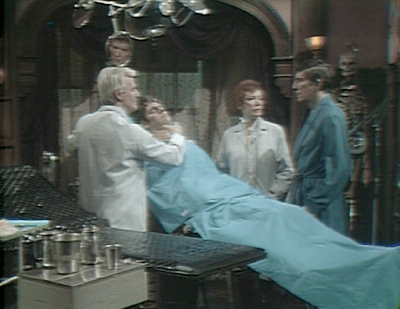
The experiment scene would only intensify such concerns. The experiment is a medical procedure that is supposed to bring a new life into the world, which by 1968 was how Americans usually thought of the process of birth. Barnabas is the patient, he is lying down, and the doctors sedate him. Thus he takes on all the medicalized marks of a mother-to-be. Julia asked Lang if the process would be painful for Barnabas; he does not disappoint, but ends the episode screaming in response to labor pains. Not only does turning Barnabas into Adam’s mother invert the expected gender performance, but it also introduces a homosexual side to Barnabas’ relationship with Lang, who is Adam’s other parent.
Somebody ought to be there telling Barnabas he’s doing great and urging him to push. Screenshot by Dark Shadows Before I Die.
Christian imagery and gender-nonconformity would have been rather a queasy combination for most Americans in 1968. That’s unusual, in historical terms. Before modern times, Christians didn’t hesitate to discuss ways that familiar gender roles break down in the relationship of humans to Christ. The “Fathers of the Church,” the prominent Christian intellectuals of the fourth and fifth centuries, talked about that all the time, going into depth not just with the image of the Church as the Bride of Christ but of each human soul, whether male or female, as one of Jesus’ wives, and of the physical contact between humans and Jesus in the Eucharist as a consummation of their marriage.
For their part, Calvinists tended to be skeptical of the physical aspect of the sacraments, but that didn’t mean that they shied away from conjugal metaphors to describe the relationship between the soul and Jesus. John Donne, like most priests in the Church of England in the 16th and early 17th centuries, was basically a Calvinist, yet his sonnet “Batter my heart, three-person’d God” is one of the most vivid and uncompromising statements of the ancient idea of an erotic dimension to Christian life that transcends the binaries between masculine and feminine, male and female. That tradition makes today’s conjunction of Christian and homoerotic themes all the bolder- imagine if Dark Shadows wrote itself into a corner where they had no choice but to explain nuptial imagery and mystical eroticism in the writings of Saint Ambrose. The whole audience could fit into a seminar room.
Closing Miscellany
Lang and Julia wear white lab coats. This is the first time Julia has worn a white coat. Her previous lab coat was light blue, which looks white on the black and white TV sets most households had in 1968, but now that the show is being produced in color they are buying costumes and props for color televisions.
The idea of a machine that would cause a person to go to sleep in one body and wake up in another was a big deal on TV in the 1960s. Just today I saw this screenshot from The Avengers on Tumblr:
This episode marks the first appearance of Robert Rodan. When Adam was a nameless heap of flesh under a blanket, he was played by a stand-in named Duane Morris. Rodan had a few small parts on TV shows in 1963 and 1964 and was in a couple of commercials between 1964 and 1968. Adam was his first, and last, recurring role on a series. In 1969, he appeared in a little-seen feature film called The Minx, then spent the rest of his life selling real estate in Southern California.
The more efficient a means of communication is, the sooner it is likely to be choked with unwanted messages, some of them harmful to recipients who engage with them. We describe this tendency by saying that eventually, everything turns into email.
One of the most potent means of communication on Dark Shadows have been dream visitations from supernatural beings. As early as #10, matriarch Liz, who in waking life resolutely denied that any paranormal phenomena could be found on the estate of Collinwood, writhed as she slept in her armchair, muttering about ghosts. Since then, we’ve seen undead fire witch Laura Murdoch Collins and the spirit of the benevolent Josette send competing dreams to influence strange and troubled boy David; the mysterious Widows have beckoned Liz to a watery grave; the ghost of little Sarah Collins visited David and told him all about her big brother, then-vampire Barnabas; revenant Jeremiah Collins and phantom Nathan Forbes have given important information to well-meaning governess Vicki; and several characters have had vivid dreams of unspecified, but obviously supernatural, provenance.
Today, wicked witch Angelique visits Barnabas in a dream and tells him that she is launching a malware attack on the dreamers of Collinsport. It’s going to be sequential; it will take over each user’s wetware in turn, compelling them to forward it to someone else. With each iteration, the worm will become more complex, until it reaches Barnabas in a dream of his own. When he accesses it, he will revert to vampirism.
On his Dark Shadows Every Day, Danny Horn made a detailed comparison of Angelique’s explanation of the Dream Curse with the introduction to the 1931 film Frankenstein. He’s convinced me that the reference was intentional. Since there is a version of Frankenstein playing out on Dark Shadows right now, they are assuring us that the Dream Curse storyline will intersect with that one.
Angelique’s explanation only takes up the last act of the episode. There is a lot of other good stuff in the earlier parts, most revolving around Jerry Lacy’s character Tony Peterson. Tony was first introduced as a showcase for Mr Lacy’s famous Humphrey Bogart imitation; he has discarded that now. He still wears a brown suit and a tan overcoat, but sounds like Jerry Lacy.
Tony quarrels with heiress Carolyn about her relationship with Barnabas. She tells him that she and Barnabas have no romantic interest in each other, and tells him to go ask Barnabas if he doesn’t believe her. He goes to Barnabas’ house, and gives Jonathan Frid a rare opportunity to play intentional comedy.
Angelique, who, under the name Cassandra, has married sarcastic dandy Roger Collins and is living with him in the great house at Collinwood, steals Tony’s lighter and uses it to cast a spell on him. She needs a helper, and has decided to enslave Tony. Mr Lacy and Lara Parker are such fun together that, decades after the show, a company called Big Finish brought them back as Tony and Cassandra in a series of audio dramas. Called The Tony and Cassandra Mysteries, they were among the most popular of the Dark Shadows-themed plays Big Finish put out. I haven’t heard any of them- I’m too stingy to pay $37.41 to download an audio file- but if the scene the two of them play in the gazebo at Collinwood today is any indication, I’m sure they’re wonderful.
The very beginning of the episode is good too. Carolyn is coming back from a trip and has her hands full of luggage, so she knocks on the front door of the great house rather than look for her key. Angelique/ Cassandra answers. Carolyn has no idea who she is. When Angelique/ Cassandra identifies herself as Roger’s wife, Carolyn is shocked that Roger has remarried. She is even more shocked when Angelique/ Cassandra says that she and Roger had known each other only a day when they were married. Nancy Barrett is a high-energy actress, and a tightly-focused one. Her reactions to Angelique/ Cassandra’s successive announcements are like a laser light show on the theme of stunned disbelief.
Carolyn mentions that David decided to stay on in Boston for a few days. Since David is about ten years old, we might expect some explanation as to his lodging, but none is forthcoming. Some time ago we heard about an “Aunt Catherine” in Boston; I suppose he might be at her house, but hey, if the alternative is Collinwood he wouldn’t be any less safe if he were roughing it around Mass and Cass.
The opening teaser is a reprise of the last scene of Friday’s episode. Dr Eric Lang is trying to convince his patient, recovering vampire Barnabas Collins, to participate in an experiment he wants to start. He addresses him as “Barnabas Barnabas.”
It had been a quirk of Barnabas’ previous physician, Julia Hoffman, to repeat Barnabas’ first name, and as Julia, Grayson Hall manages to put a fresh inflection on “Barnabas, Barnabas” every time she says it. But as Lang, Addison Powell simply says “Barnabas Barnabas” without a pause, as if he were saying a compound name like “Jean-Claude” or “Jim Bob.” He even calls him “Mr Barnabas” at his exit, as if he thinks his full name was “Barnabas Collins Barnabas.” This is by no means the worst thing about Powell’s performance, but it is such an obvious contrast with Hall that it is as if the makers of Dark Shadows are sticking a thumb in our eye and taunting us with his inferiority to her.
As if that weren’t bad enough, Powell has competition for the title of worst actor in this episode. Craig Slocum washes up in the role of ex-con Harry Johnson. Well-meaning governess Vicki is the first to see Harry; she immediately screams in horror and starts to sob, the correct reaction to the sight of Slocum in any role.
At least there is a silver lining to Harry. He is the son of housekeeper Mrs Johnson, played by the estimable Clarice Blackburn. From November 1967 to March 1968, Dark Shadows was a costume drama set in the late eighteenth century, and Blackburn played repressed spinster Abigail Collins. Abigail was a triumph, an irresistible comic villain who was the highlight of every episode she was in. Mrs Johnson’s scenes today are the first we’ve seen of Blackburn since the show returned to contemporary dress, and she is razor-sharp. She is intriguingly sheepish when she asks matriarch Liz if her son Harry can stay with her for a little while, and alarmingly quick to assure Liz that Harry won’t make trouble. When she hears Vicki scream, Mrs Johnson comes hurrying in, is unsurprised to see that Harry is the source of Vicki’s panic, and cuts Harry off before he can offer a defense. She takes Harry into the drawing room while Liz calms Vicki upstairs, and tells him that he is one false move away from going back to prison forever.
Blackburn is so much fun as the unillusioned mother that it is a terrible shame Slocum never manages to read a line or move a muscle in a way that a living person might in the given situation. She gets laughs in spite of him, but with a competent actor in his part the scene where Harry faces his mother would be some of the best intentional comedy in the whole series.
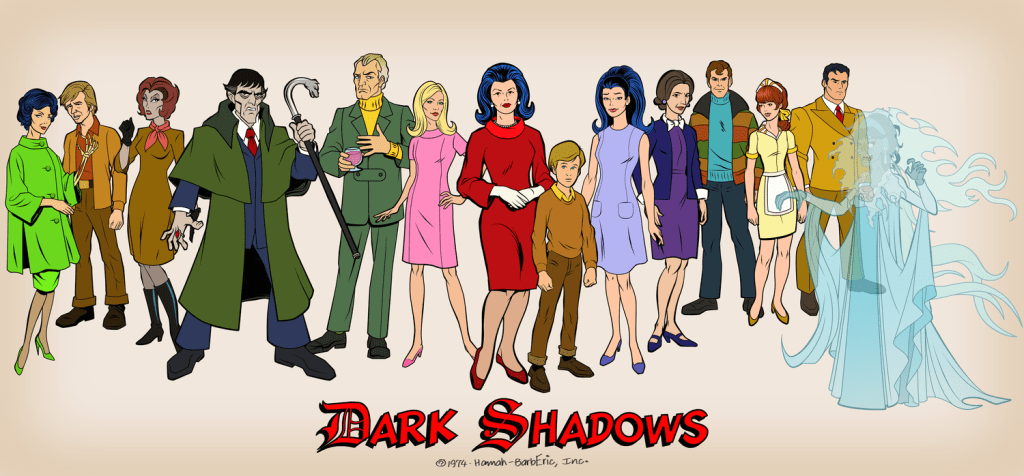
There is one other thing about Harry that makes me smile. On the blog of the Terror at Collinwood podcast, Danielle Gelehrter posted an article some time ago about some concept artwork Eric Marshall did for a hypothetical Dark Shadows animated show in the style of early 1970s TV cartoons such as Scooby Doo or Filmation’s adaptations of Star Trek or My Favorite Martian or Gilligan’s Island. The show Marshall imagines features Harry. Personally, I would have chosen motorcycle enthusiast Buzz, who dated heiress Carolyn for a couple of hilarious weeks in 1967, since his outlandish appearance makes him so much more obvious a choice for animation, but at least Harry’s presence suggests that had such a show been made Clarice Blackburn might have been in the cast and had the chance to do some comedic voice acting.
Eric Marshall’s proposed cast for an animated Dark Shadows that might have been made in the 1970- everyone but Harry. Posted at Terror at Collinwood. Eric Marshall reminds us that Mrs Johnson’s first name is supposed to be “Sarah.” Posted at Terror at Collinwood.
There is some nice stuff in the drawing room between Barnabas and his sometime victim/ fiancée Vicki. Vicki has figured out that the spirit of wicked witch Angelique is once more at work in the great house of Collinwood and that it will take a great effort to stop Angelique from finishing the destruction of the Collins family that she began in the 1790s. If Vicki ever knew that Barnabas was a vampire, she has forgotten it, and Barnabas cannot confess it to her now. He certainly cannot tell Vicki that it was Angelique who made him one. So he listens to her report, but cannot accept her help in the battle against Angelique.
Quite the contrary. Barnabas looks at the spot on Vicki’s neck where he used to take his meals and feels the old hunger coming on. He says he must go to see Lang. Vicki protests that he should stay and let her tend him while they wait for Lang to come to them, but Barnabas insists.
Barnabas goes to Lang’s house. Lang tells Barnabas that if he participates in his experiment, he will not only be entirely free of the vampire curse, but that he might also have the physical appearance of Peter Bradford, alias Jeff Clark, an unpleasant young man who is more or less Vicki’s new boyfriend. This intrigues Barnabas, but Lang will not explain what he means. Since we know that Lang is a mad scientist who is forcing Peter/ Jeff to steal parts from newly interred bodies, we can assume that he will eventually be constructing a Frankenstein’s monster. Presumably he means that the finished product will look like Peter/ Jeff, and Barnabas will somehow live inside it. Since the creature is being built from parts, to look like Peter/Jeff it would have to be finished with salvage from Peter/ Jeff’s corpse. How Peter/ Jeff will be converted from his present state of living and obnoxious to dead and recyclable is what awaits explanation.
The other day, vampire Barnabas Collins added well-meaning governess Vicki to his diet. Barnabas has bitten several people in the year he has been on Dark Shadows, and his victims have reacted to the experience in a wide variety of ways. Vicki’s post-bite syndrome is unique on the show, and as far as I know unique in vampire stories. Her reaction could most succinctly be summarized as “not feelin’ it.”
Barnabas had hoped to enslave Vicki with his bite, as he had enslaved others, and attributes her blasé response to the unseen presence of wicked witch Angelique. But it may be that Barnabas has himself to blame. Several times in 1967, Vicki went out of her way to make herself available to Barnabas for biting. She invited herself to his house for a sleepover in #285, pressed her neck towards his teeth while embracing him in #311, and has rarely missed a chance to be alone with him. There is a hilarious meta-fictional element to this theme, as Vicki tries to secure a place for herself in the main storyline by becoming the vampire’s thrall.
For his part, Barnabas has time and again looked at Vicki’s neck, shown his fangs to the camera, and then backed off. Even when he finally did bite Vicki in #462, he spent so much time and energy displaying his internal struggle that my wife, Mrs Acilius, commented “Barnabas is about to make himself sick.” Indeed, he took so long making that display that the episode ended before he sank his teeth into Vicki, and we had to wait until the next day to be sure he’d actually gone through with it. You hardly expect Vicki to be excited that such a reluctant suitor has at long last deigned to attach himself to her.
Vicki has recently returned from a long visit to the year 1795,* when the human Barnabas died and the vampire began his career. Barnabas fears she may have discovered his secret while in that period, a fear that deepens as her scattered memories return.
In fact, Vicki never discovered that Barnabas was a vampire. She does have some information that, coupled with what she and others have already found out, could lead to his exposure, but she isn’t thinking about that at all. Instead, her main focus is on an unpleasant man named Peter, whom she met and with whom she fell in love in the 1790s. On Wednesday, she learned that shortly after she left the eighteenth century Peter had been hanged for a killing she committed,** and she is frantic with guilt about it.
At the top of today’s episode, Barnabas sends Vicki a telepathic message that they will be eloping tonight. She accepts this without any visible emotion. Then her friend, hardworking young fisherman Joe (Joel Crothers,) comes to the door. In the 1790s segment, Crothers played naval officer/ sleazy operator Nathan Forbes, a villain who was responsible for many terrible crimes against Vicki and people she cared about. This is the first time we’ve seen Joe since the show returned to contemporary dress, and Vicki takes a while to adjust to the fact that it is her trusty old pal before her, not the detestable schemer who did so much to blight her time in the eighteenth century.
Joe has come to bring Vicki a charm bracelet that his girlfriend Maggie had given her. The charm bracelet turned up in the old courthouse in the village of Collinsport. The courthouse has been disused for years and is about to be torn down. Joe wonders when Vicki was there; she makes many cryptic remarks in reply, but can’t bring herself to tell such a sensible fellow that she was tried there for witchcraft and sentenced to death 172 years before, much less that his counterpart gave the testimony that condemned her to the gallows.
After Joe has gone, Vicki still isn’t motivated to do anything to prepare for her departure with Barnabas. Instead, she takes a nap in the drawing room. She has a dream in which she sees Peter in his gaol cell. She promises him that she will prove his innocence, and marches off. She finds Nathan dozing at a desk. She tells Nathan that he could prevent Peter’s execution if he were to tell the judges that he lied when he told them he saw Peter kill the man whom Vicki actually killed. Nathan cheerfully explains that he cannot tell the judges anything, since he is dead. He tells Vicki that she is dead, too- he was strangled, she was hanged.
Nathan, having a wonderful time in the afterlife, proposes a toast “to Death- the best of all possible worlds!” Screenshot by Dark Shadows Before I Die.
Nathan’s statement is proof that the dream is not simply a product of Vicki’s psychology, but a communication with Nathan’s spirit. Barnabas strangled Nathan, but his father Joshua Collins hid that fact from the world, and neither Vicki nor anyone else alive in 1968 has any way of knowing about it. Vicki wasn’t hanged, but she was about to be when she was whisked back to her own time, and Nathan would have no way of knowing she survived.
Vicki goes back to Peter’s cell and finds it empty. She turns and sees the gallows, on which Peter is hanged before her eyes. She wakes up calling out Peter’s name.
Vicki opens her eyes to see Barnabas standing in front of her. He asks her who Peter was; she says he was someone she knew long ago, and that it will be hard for her to forget him. He asks if she knew he was coming; she affirms that she did. If he knew about the contents of the very elaborate dream she just had, he would have all the more reason to ask such a question. The only action of Barnabas’ mentioned in it was Nathan’s murder, and Nathan doesn’t bother to tell Vicki by whom he was strangled. There are four speaking roles and a background player in the dream, and not only is Barnabas not one of them, no one mentions in it his name, sees his image, or comes into contact with any of his belongings. Barnabas has been dominating the show since he was first named in #205, and Vicki, whom he was under the impression he had enthralled, has lost all interest in him.
Barnabas tells Vicki it’s time to go. She says she has to do something else first. She wants to go to the old Collins mausoleum and see if there is a secret room hidden there. If there is, she will know she really did travel back in time.
Barnabas was trapped in his coffin in that secret room from the 1790s until 1967, and is anxious that no one should discover its existence. He is also eager to get going with whatever plan he has made for Vicki. But he finds himself powerless to oppose her. Not only is he not her dark and irresistible master, as he had been of his other blood thralls, he isn’t getting nearly as much deference from her as she had always shown him before he bit her.
We cut to a car, in which Vicki is driving Barnabas to the cemetery. Apparently it is Vicki’s car. This is the first time we have seen Vicki driving, and it brings up a bit of a riddle for viewers who have been paying close attention to Dark Shadows from the beginning. In the first 46 weeks of Dark Shadows, Vicki was continually asking to borrow heiress Carolyn’s car, getting rides from people, walking longer distances than others thought reasonable, trying to catch the bus, and wishing she had a bicycle. In #232, #233, and #259, it was implied that Vicki had a car of her own. They never explained how or when she came into possession of such a thing, but they stopped all the business of her trying to find a way to get around. As we watch Barnabas squirming in the passenger seat, we can believe he would rather be standing with her at a bus stop.
Barnabas keeps telling Vicki that he doesn’t think they ought to go to the mausoleum. She snaps at him that he was originally enthusiastic about going. The statement is entirely false, and the line is entirely convincing. We saw that Barnabas was appalled at Vicki’s interest in the mausoleum, and we saw that she was too absorbed in her own thoughts to notice his feelings. The two of them bicker about the need to get settled before sunrise, and they sound for all the world like an old married couple. Barnabas exercises exactly zero control over Vicki, and the result is hilarious.
The show so often puts Vicki in the role of Designated Dum-Dum, requiring her to facilitate the mechanics of the plot by doing things she would have no reason to do, that the show’s original protagonist is eventually swallowed up by Dumb Vicki. It’s always refreshing to see Smart Vicki put in an appearance. I don’t know if the woman we see today is a perfect example of Smart Vicki, but she certainly is Smart Alexandra Moltke Isles. Mrs Isles’ performance is so good that even a hater like Danny Horn had to admit in his post about the episode on Dark Shadows Every Daythat she is fun to watch. And the character is Strong Vicki, taking action in pursuit of her own objectives, making use of the information available to her, and bending Barnabas to her will.
The scene in the car will have an amusing echo for longtime viewers. From November 1966 to March 1967, instantly forgettable young lawyer Frank Garner kept telling Vicki how interested he was in her. Vicki went on some dates with him and accepted him as her sidekick in her struggle against undead fire witch Laura Murdoch Collins, but all in all was almost as cool towards him as she has been to Barnabas post-bite. In #153, Vicki was Frank’s passenger in his car. He thought they were going out for a glamorous evening, but she abruptly insisted that they go to the old cemetery north of town and visit an old crypt. Frank was about as pleased then as Barnabas is now. I suppose a fellow ought to know what he’s getting into when he and Vicki get into a car together.
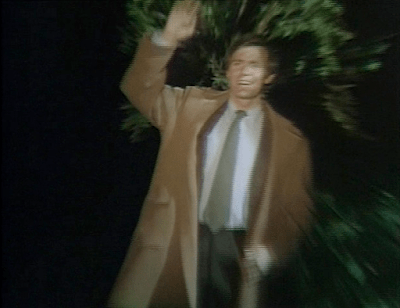
Barnabas sees a figure ahead and asks Vicki what it is. She looks and slows down. A man in contemporary dress who looks like Peter lopes into the road, smiles a big goofy grin, and waves. Even though Vicki’s movements and the sound effects told us she took her foot off the accelerator as soon as Barnabas said he saw something, the man is so close to the car that she slams on the brakes, the tires squeal, and she loses control of the vehicle. He must have wandered right in front of the car. That confirms for returning viewers that the man must be Peter. He always did the least intelligent and most dangerous thing, usually while grabbing at people and shouting in a petulant voice. Poor Vicki. Barnabas is a vampire and a cold fish, but she’s managed to get herself stuck with a guy who makes those shortcomings look minor by comparison.
*It was 1795 in #365, and in #413 they explicitly told us the new year 1796 had come. But after Vicki returns to the 1960s in #461, the only year they talk about is 1795.
**With justification- she shot a man who was trying to strangle a young boy.








 Dark Shadows Commentary