Episode 684: This is a funny house we live in

Dark Shadows has two ongoing storylines at this point. Mysterious drifter Chris Jennings came to town a couple of months ago and turned out to be a werewolf. Heiress Carolyn Collins Stoddard does not know of Chris’ curse. She has taken a fancy to him and set him up in the caretaker’s cottage on the estate of Collinwood. Old world gentleman Barnabas Collins and mad scientist Julia Hoffman do know that Chris is a werewolf, and they are working to help him. Barnabas has found a place to keep him confined on the nights of the full Moon, and Julia is trying to develop a medical intervention that will keep him in his human form.

Meanwhile, Chris’ nine year old sister Amy has taken up residence in the great house on the estate. She and her twelve year old friend, strange and troubled boy David Collins, are falling under the power of the evil spirit of the late Quentin Collins. At first Amy could communicate with Quentin more clearly than David could. This made David envious. In #640, David complained that Amy could hear his voice and he could not, even though “Quentin Collins is my ancestor.” That suggested to the audience that Quentin would turn out also to be Amy and Chris’ ancestor, joining the werewolf story with the Haunting of Collinwood.

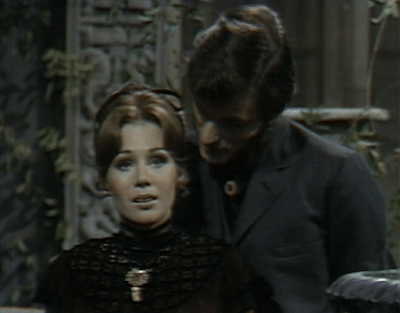
Today, Barnabas and Chris have dug up a spot on the ground to which the ghost of a mysterious woman had led Chris. They find a tiny coffin holding the remains of an infant. They discover that the infant was wearing a medallion in the shape of a silver pentagram. The sight of the dead baby shocks Barnabas right away; Chris keeps his composure at first, but seems close to tears a moment later. Quentin stands in the shrubbery and watches Barnabas and Chris.

Barnabas has not seen Quentin and does not know who he is. Others have seen him and described him to Barnabas and Julia. They and those others suspect that he is a malevolent ghost with designs on David and Amy. No one has yet made a connection between Quentin and the werewolf story, however.

Julia and Barnabas have also seen the mysterious woman who led Chris to the baby’s grave. They know that she is a ghost and that she has helped Chris, and they also know that her clothing is of the same vintage as is the clothing which Quentin wears. But they do not know what, if anything, the two ghosts have to do with each other. The audience knows that the female ghost’s name is Beth and that she was with Quentin in the little room in the long deserted west wing of the great house when the children first met him.

Barnabas tells Chris that the pentagram can only be a device to ward off a werewolf, so that there must have been a werewolf in the area when the baby was buried. He also tells Chris that the mysterious woman would not have led him to dig up the grave unless what they found in the coffin would be of help to him.

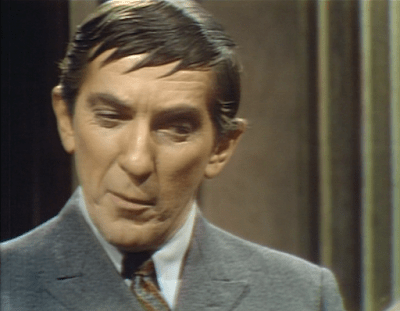
While Barnabas inspects the pentagram in the drawing room of the great house, David throws darts at a board propped up on a chair nearby. The audience knows that David is under Quentin’s control, so it is obvious to us that the dart playing is an attempt to distract Barnabas and keep him from figuring out the meaning of the pentagram. Lacking our knowledge, Barnabas is merely annoyed with David. Jonathan Frid and David Henesy expertly develop the comedy in Barnabas’ fast-burn reaction to David’s behavior.

Heiress Carolyn Collins Stoddard interrupts the scene. She notices what Barnabas is doing. He shows her the pentagram, and she recognizes the jeweler’s mark as that of Braithwaite’s silver shop in the village of Collinsport. While Barnabas telephones Braithewaite’s and arranges to take the pentagram there to see if the proprietor can give him any information about it, Carolyn tells David she wants to have a conversation with him about some cryptic remarks he made earlier. David refuses, saying that he has homework to do. Carolyn argues with him briefly, but finally gives up and leaves. Barnabas is still involved in his conversation with Mr Braithwaite when David hides the pentagram behind his dartboard.

Barnabas gets off the phone, and David resumes throwing darts. Barnabas asks him why he isn’t doing the homework he was just telling Carolyn presented such an urgent obligation that he could not talk with her. He launches into a shaggy dog story, the upshot of which is that he has to wait for Amy.

More exasperated than ever, Barnabas turns to the desk and sees that the pentagram is gone. He demands David return it. David denies having it. He says that it may have vanished on its own. After all, unaccountable things happen at Collinwood all the time, as Barnabas is in a position to know. The way he says “You should know that” reminds longtime viewers that David has more than once shown signs of figuring out more about Barnabas’ own connections to the supernatural than have any of his adult relatives. In #316, he pointed out that none of the Collinses really knows anything about Barnabas- “He just showed up one night.” And in #660, he told Amy that “Barnabas knows a lot of things he doesn’t tell anybody.” At moments like these, we wonder just how much information David really has at his disposal. Perhaps he secretly knows everything, and has just decided there’s no point in notifying the authorities.

David invites Barnabas to search him. He lists the contents of his pockets, and turns the right front pocket inside out. He tells him that he has a pack of chewing gum, which he got from Amy. He specifies that he traded her a box of raisins for it. As David Henesy delivers the line and Jonathan Frid shows us Barnabas’ reaction, this detail is laugh-out-loud funny. Barnabas surrenders and apologizes to David, fretting about the pentagram’s absence.

Barnabas takes a sketch of the pentagram to Braithwaite’s. In the first months it was on the air, Dark Shadows took us to New York City twice, to Bangor, Maine several times, and to Phoenix, Arizona once. But now that both stories center on characters all of whom dwell in one or another of the houses at Collinwood, it is as rare to leave the estate and go into the neighboring village as it was then to go on those remote excursions.

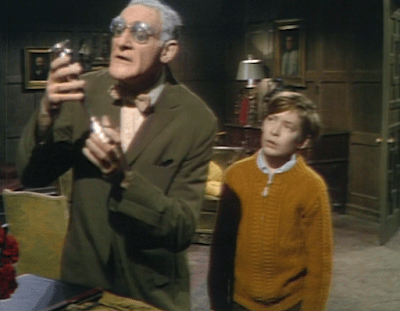
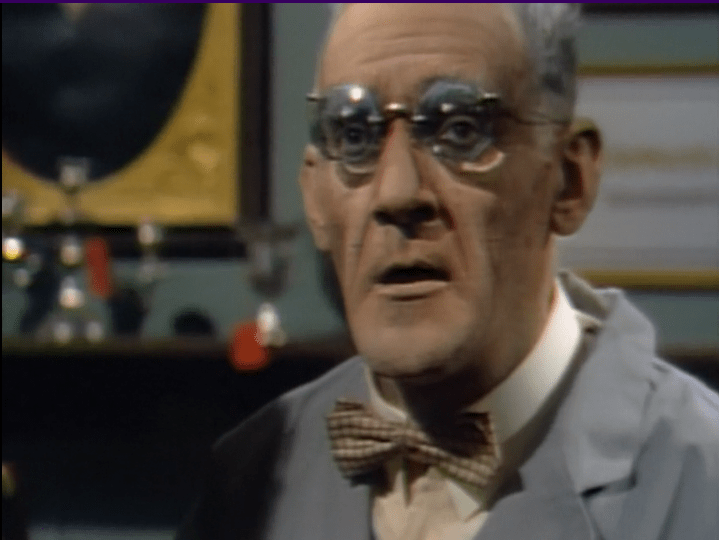
Old Mr Braithwaite tells Barnabas that the shop has been in operation since 1781 and has been providing fine silver to the Collins family the whole time. Regular viewers know that Barnabas was alive then, and lived in Collinsport. A curse made him a vampire in the 1790s, and he was under its power until he was freed early in 1968. So he must have been quite familiar with Braithwaite’s in its early years. What is more, in #459 we saw that in the first months of Barnabas’ career as a vampire his father Joshua learned of his curse and commissioned a local craftsman to make silver bullets with which he could put Barnabas out of his misery. That craftsman must have been one of the first Mr Braithwaites.

The incumbent Mr Braithwaite tells Barnabas he will consult his records as soon as the shop closes and telephone him if he finds anything. When the call comes, David answers. Mr Braithwaite tells David that he can’t imagine why he forgot about the pentagram since it was one of the very first he made himself, back in 1897. Quentin appears, takes the phone from David, and hears Mr Braithwaite say he will stop by Collinwood with the ledger shortly.

Mr Braithwaite almost remembers.

David protests that Quentin had no right to take the phone from him. Quentin turns to him, gives him a menacing look, and walks toward him. David backs away and and takes a place on the stairs, still objecting loudly to what Quentin did.

Closing Miscellany

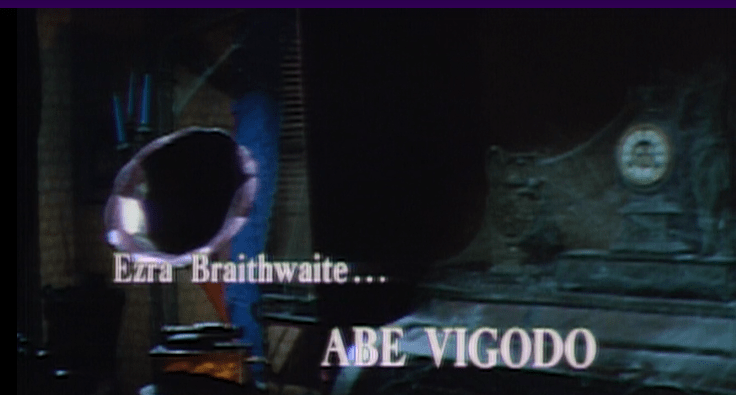
The closing credits list the actor who plays Ezra Braithwaite as “Abe Vigodo.” Perhaps in some parallel time-band there was a man of that name who played Tossio in The Good Father and Detective Fosh in Barney Moeller, but this is in fact Abe Vigoda.

“Abe Vigodo”

In his 1977-1978 ABC TV series Fish, Vigoda’s character was married to a woman played by Florence Stanley. Stanley was also a Dark Shadows alum, as a voice actress. She provided sobbing sounds heard in #4, #98, #515, #516, and #666. Vigoda once appeared on the panel at a Dark Shadows convention; his main statement was “I don’t remember much about it.” I can’t find evidence that Stanley ever appeared in such a setting. I would love to imagine that Vigoda and Stanley compared notes about their experiences on Dark Shadows between setups on Fish, but I would be astonished to learn that ever happened.

Vigoda always played old men. The second screen credit on his IMDb page is a 1949 episode of Studio One in which he took the role of “Old Train Passenger.” At that time, he was 28. Vigoda was a marathon runner, a form of exercise that tends to burn out all the fat under the skin of the face. And of course he was a very strong actor, easily able to convince us that he is of a great age. So even though Vigoda was only three years older than Jonathan Frid, and about 175 years younger than Barnabas, it isn’t quite as funny as it might be to hear him call Barnabas one of “you young people.”

Danny Horn devotes his post about this episode on his great Dark Shadows Every Day to three points. The first is his exultation that his least favorite writer, Ron Sproat, was credited with his final script yesterday, so that today is the first day of the Sproatless Dark Shadows. The second is that the show is finally joining the werewolf story with the Haunting of Collinwood. The third is a point I have some reservations about. He says that this is the first episode where Quentin “has a feeling,” and therefore declares it to be Quentin’s debut as a real character. “It’s nice to meet you Quentin. Welcome to the show,” he concludes.

It’s true that Quentin shows a wider range of feelings today than he had previously, but I think it is an exaggeration to say that we are only now seeing his feelings. For example, when in #680 Quentin agrees to Amy’s demand that he stop trying to kill Chris, he looks very much like a man humiliated to find that he has to capitulate to a nine year old girl. In the same episode he showed amusement and anger at appropriate points. Those three responses may not sound like much, but David Selby’s face is a magnificent instrument, one he plays it expertly. For him, they are more than enough to make Quentin into a real person.

Chris and Carolyn have a brief scene in the drawing room as they are getting ready to go on a date. Chris defuses a potentially awkward conversation about his previous failures to respond to Carolyn’s hints that she was interested in him by saying “Oh, I didn’t notice that” in the W. C. Fields imitation he had used with Amy in #677. She chuckles delightedly. This is not implausible. Not only can we imagine her being relieved that the topic didn’t ruin their evening, but W. C. Fields was very much in vogue in the late 1960s, so much so that a fashionable young woman might have chuckled when a man briefly imitated him.

David and Carolyn have an exchange that longtime viewers will find less plausible. He asks her if she has ever seen a ghost; she responds by asking if he has. But each of them knows perfectly well that the other has seen ghosts. David spent the first year of the show on intimate terms with the ghost of the gracious Josette, and he and Carolyn both saw and had substantive conversations with the ghost of Barnabas’ little sister Sarah. In #344, Carolyn told David that when she was a little girl her best friend was the ghost of a boy named Randy. It’s just trashing character development to retcon all that away.

Barnabas says something that will catch the ears of properly obsessed fans. When he is in the shop, he tells Mr Braithwaite that he will gladly drive back from Collinwood whenever he has any information for him. There have been some suggestions lately that Barnabas has learned to drive and has come into possession of a car, but this is the first definite confirmation of that point.

Episode 678: This time, I saved him

At the estate of Collinwood, two ghosts are at odds over the fate of a werewolf. Caught in the crossfire are a mad scientist, a recovering vampire, and a couple of kids.

The ghosts are the evil Quentin Collins and a weepy woman so far known only as Beth. The werewolf is Chris Jennings, who is staying in the caretaker’s cottage on the estate. The mad scientist is Julia Hoffman, MD, a permanent guest in the great house. The recovering vampire is Julia’s inseparable friend Barnabas Collins, master of the Old House. The kids are Chris’ nine year old sister Amy and strange and troubled boy David Collins, who live in the great house.

Yesterday, Quentin went to the cottage and put strychnine in Chris’ whiskey. Beth appeared to Julia and led her and Barnabas to the cottage in time to save Chris; today, they figure out that Beth is a ghost.

Quentin has been exercising power over David and Amy, at first with Beth’s cooperation. Beth appears to Amy in a dream visitation. While she guides Amy to images of Chris and David and to the realizations that Quentin means to kill Chris and that David has tried vainly to stop him, we hear Beth speak for the first time. She says everything twice, giving her dialogue a lyrical quality that could be quite lovely. Unfortunately, Terrayne Crawford’s limitations as an actress keep that loveliness from coming through.

Barnabas and Julia know that Chris is a werewolf and have persuaded him to accept their help. They question Chris and are satisfied that he did not poison himself. When he mentions that David visited him the previous morning, Barnabas decides to go interrogate David. Longtime viewers know that David has extensive experience with ghosts, a fact of which Barnabas has at times been most uncomfortably aware. Once Barnabas has learned that Beth is a ghost, it will strike us as reasonable that he will be interested in David’s connection with the matter.

Amy goes to the cottage and sees Julia tending to Chris. They tell her he just had an upset stomach and will be fine. She does not believe them, and says she had a dream that convinced her Chris was in mortal danger. This intrigues Julia, who presses for more details about the dream. Amy clams up, but now Julia and Barnabas, the show’s two chief protagonists, have figured out that David and Amy have something to do with ghosts, and that those ghosts in turn have to do with Chris. The Haunting of Collinwood story hasn’t made any real progress for several weeks, but that can now change.

Back in the great house, Barnabas questions David about his visit to Chris. He doesn’t get any more information out of him than Julia had got out of Amy. There is a bit of intentional humor when Barnabas tells David he thought it would be pleasant to share breakfast with him and Amy. David says it isn’t so pleasant at breakfast- housekeeper Mrs Johnson is in a bad mood in the mornings. Barnabas suggests they ignore her, and David replies that it is not easy to do that. David Henesy delivers this line with perfect comic timing.

Barnabas realizes David knows more than he is telling. Screenshot by Dark Shadows Before I Die.

Amy shows up and responds favorably to Barnabas’ self-invitation to their breakfast. After Barnabas leaves the room, Amy confronts David about Quentin’s attempt to kill Chris. David has despaired of opposing Quentin, and is terrified when Amy tells him she will go tell matriarch Elizabeth Collins Stoddard everything that has been going on. He is convinced Quentin will kill them if she does this. He is pleading with her to come back when the episode ends.

Episode 674: When there is a moon

Heiress Carolyn Collins Stoddard is attracted to mysterious drifter Chris Jennings, so much so that she has set Chris up in the caretaker’s cottage on the estate of Collinwood. Today, Carolyn’s friend Donna Friedlander is visiting her. The day’s main action is a classic farce plot. Donna wants Chris to drive her home to Bangor, Maine, but in order to keep a secret from her he makes a series of increasingly frantic attempts to avoid doing so. In the end Donna doesn’t get her ride, and Chris doesn’t keep his secret.

The episode deviates from the typical farce in that Chris is not a man trying to keep his or his roommate’s girlfriends from finding out about each other. He is a werewolf, and the Moon is full. If Donna is with him after dark, he will kill her, as he has already killed an unknown number of people in the last several years.

Donna is a student of interior design, and Carolyn is showing her around the great house. We first see her when Carolyn brings her into the study. Chris is in the room with his sister, nine year old Amy, who has been staying at the great house. Chris is distracted, abrupt, and rude with Donna. His manner grows even less inviting when he sees an inverted red pentagram on Carolyn’s face, typically the sign that the person will be the werewolf’s next victim. His eyes bug out, he breaks into a sweat, and turns his back on the ladies, stalking off to stare out the window.

Donna and Carolyn leave the room. In the hallway outside the study, Donna exclaims “Wow!” and exhales as if she were very worked up. She tells Carolyn that Chris is her type. She summarizes that type as “moody”; a more fitting description of what Donna saw of Chris’ behavior would be “not interested,” but hey, I’m not the sex police. If Donna gets excited by foul-tempered guys who ignore her and want her to go away, that’s none of my business.

Donna expresses her interest in Chris.

The little space in which Donna tells Carolyn she is attracted to Chris is a new set. We’ve been seeing a lot more of these tiny nondescript corners representing hallways lately, and Donna’s identification with interior design makes us conscious of this one. In #664, they even had actors walk from one set to another through some undecorated studio space that they tried to persuade us was a corridor. It seems they are developing a strategy to make us feel that the great house is a bigger place than they have managed to create in our minds just by cutting from one room to another.

Complicating matters for Chris are old world gentleman Barnabas Collins and mad scientist Julia Hoffman. Barnabas has figured out that Chris is the werewolf, and today explains this to Julia.

Barnabas uses the word “werewolf” as he is bringing Julia up to date. This represents a departure from the show’s previous practice. Barnabas was himself a vampire when he first came on the show in #211, but they didn’t use the word “vampire” for 40 weeks, until #410. They aren’t afraid of vocabulary anymore.

Julia doubts Barnabas’ interpretation of the facts, and he decides to demonstrate his thesis by putting Chris in an awkward position. He invites Chris, Carolyn, and Donna to join him and Julia for dinner at his home, the Old House on the estate. Chris excuses himself by claiming to have a business meeting in Bangor for which he must leave at once. At this, Donna asks for a ride to that town. Barnabas watches Chris’ discomfort with a smug grin, confident that he is being proven right.

Outside the front door of the great house, Chris tries to wriggle out of giving Donna a ride by saying that now he is getting a migraine and will have to cancel his meeting. He offers to give Donna his keys, suggesting she hide them under the front seat when she parks his car at the bus station in Bangor. She initially accepts this, but later comes to the cottage to say she has decided against it. She is there when he transforms, and runs away.

Back in the great house, Barnabas is telling Julia that werewolves are vulnerable to silver weapons, so he will be able to use the head of his cane to control Chris. Julia wonders if Chris may already have left with Donna. Barnabas airily dismisses this, assuring her that he knows Chris well enough to be sure that Donna is perfectly safe. In fact, Barnabas barely knows Chris at all, but he is so pleased with himself for having figured out who the werewolf is that we can see there wouldn’t be much point in reminding him of this. At his leisure, Barnabas sets out for the cottage, which he finds to be unoccupied and in disarray. Donna’s mauled corpse lies in the woods nearby.

We might wonder why Chris saw the pentagram on Carolyn and not on Donna during the scene in the study. Is the show telling us the pentagram is out of order as a warning system? If so, is it just breaking down from overuse, or is some other supernatural presence interfering with it? Or maybe it isn’t automatic, but is a message from some spirit that has guessed wrong this time? They don’t explain, and the pentagram has been a big enough part of the werewolf story up to this point that it produces a lot more confusion than you might expect.

Yesterday’s episode ended with a bewildered Chris finding Amy in the cottage. Amy was listening to a mysterious voice Chris could not hear. Chris’ bewilderment deepened when Amy obeyed the voice’s command to hurry away. He finally discovered that Amy lit a fire in his hearth and burned a shirt of his in it. Chris took us to the final blackout holding the scorched remains of his shirt, giving a look in the direction Amy had fled, and exclaiming “My shirt!” in a pained voice that would make anyone laugh.

Today’s episode opens with a reprise of that interaction, but it is played very differently. Instead of a light scene that ends with a note of comedy, we have a heavier confrontation that builds to a melodramatic shock. Chris is alarmed, not bewildered, to find Amy in his cottage, and his alarm mounts when she responds to the mysterious voice. When he goes to the hearth, he is forceful, apparently angry. He still exclaims “My shirt!” even though the wardrobe department did not provide a shirt, but his voice is not the high-pitched, defeated squawk that had made the end of yesterday’s installment so funny. This is a full-throated baritone shout. The more serious tone of the scene sets us up for an outing that is technically a comedy and is at several turns quite funny, but that finally concerns itself with a matter of life and death.

Donna is played by Beverly Hayes, in her only appearance on Dark Shadows. Miss Hayes’ IMDb page tells us that for a few months in 1965 she was a regular on a soap called A Flame in the Wind, that in 1968 and 1969 she had a recurring part on The Secret Storm, and that after her one shot on Dark Shadows she was absent from the screen for 41 years, returning in a 2010 production called Marathon. Since then she has been in other little-known independent films, including something from 2015 called House of Shadows, which sounds suspiciously like an imitation of Dark Shadows. She also has some writing credits. Donna is perfect as a one-shot, but Miss Hayes does such a good job with her I wish they’d cast her in other roles later on.

Episode 673: Urgent business

This episode rests squarely on the shoulders of eleven year old Denise Nickerson, playing the role of nine year old Amy Jennings. A performer of any age could take pride in the results.

We first see Amy in the predawn hours of a night when a werewolf is prowling the grounds of the great estate of Collinwood. The werewolf has attacked heiress Carolyn Collins Stoddard; old world gentleman Barnabas Collins is out hunting him. In the opening sequence, Barnabas fired a shotgun at the werewolf without result, then hit him with his silver-headed cane and drove him off. Barnabas is still outside, still tracking the werewolf. Barnabas’ friend, mad scientist Julia Hoffman, is nervously pacing in the drawing room of the great house.

Amy comes downstairs. Julia sees her and demands to know why she is up and dressed at such an hour. Amy says she must go to the caretaker’s cottage on the estate, where her grownup brother Chris lives. Julia forbids her to go out. Julia saw the werewolf attack Carolyn, but says nothing about the incident. She tells Amy only that it is dangerous in the woods at night. Amy says that she had a dream from which she drew the conclusion that “Something is happening to [Chris,] and it’s happening now!” Neither Amy nor Julia knows that Chris is the werewolf, but they both know that Amy has a paranormal sensitivity to whatever is going on with Chris. Julia offers to go to the cottage if Amy will stay in the house. Amy gladly agrees, and Julia gets a gun and goes.

This quarrel could have been quite annoying. Julia is withholding vital information from Amy, who is in her turn insistent on doing something she could not possibly expect to be permitted. The actresses make it interesting. Amy stands very still, locks her eyes on Julia’s, and enunciates each word carefully, showing every sign of an earnest attempt to persuade her. When she cannot, she does not display anger or frustration or irritation. The only emotion she projects is a sense of urgency. Unlike children throwing tantrums, who make conflicting demands because they are in the grip of conflicting feelings, Nickerson leads us to believe that Amy is pursuing a single coherent objective. We expect her to be part of action that will advance the story.

Grayson Hall emphasizes Julia’s attentive response to Amy’s words and her reluctance to physically restrain her. It is still inexplicable that Julia fails to tell Amy about the attack on Carolyn and about the fact that Barnabas is walking around with a gun ready to shoot at figures moving in the darkness, but those failures don’t bother us as much as we might expect them to do. We see her taking seriously information which we know to be accurate, and this gives us grounds to hope that she will do something intelligent.

Julia gets to Chris’ cottage and back without being eaten by the werewolf or shot by Barnabas. At the cottage, she finds that the furniture has all been overturned and Chris is not in. Back home, she smiles and tells Amy that she saw Chris and he was fine. Julia’s lies convince Amy. She brightens immediately and happily goes back to bed. This really is an amazing moment of acting on Nickerson’s part; Amy’s mood switches in a second from dread and gloom to a big glowing smile. Executing that lift on command is the equivalent of faking a loud laugh and having the result sound natural.

The next morning, Amy mentions to Julia that she and Carolyn have plans to go into town. That leaves Julia no choice but to level with Amy about the werewolf attack. Amy is shocked that Carolyn was hurt, and even more shocked that she might have been killed. Julia assures her that the wounds Carolyn did suffer were minor and that she will be all right after some rest, but Amy is deeply affected. She looks directly into the camera and tells the audience that she did not want Carolyn to be harmed.

Amy tells us she is sorry that Carolyn was hurt. Screenshot by Dark Shadows Before I Die.

In the first months of Dark Shadows, strange and troubled boy David Collins was the only character who looked directly into the camera. He did it several times in those days, and actor David Henesy’s talent for the role of Creepy Little Kid always made it pay dividends. He stopped looking into the camera in the autumn of 1966 when David Collins stopped being a menace, and various other actors have been called on to break the fourth wall from time to time since. Since Amy joined the show, eye contact with the audience has become her province, and Nickerson manages to deliver a jolt every time they have her do it.

First-time viewers won’t know why Amy is so eager for us to know that she did not wish Carolyn ill, but the way she addresses herself to us leaves no doubt that Julia is missing the point when she makes conventional remarks about how no one wanted anything bad to happen to Carolyn, no one could have prevented it, etc etc. The camera stays on Amy as Julia burbles through these lines, and the particular sadness on her face confirms what she indicated by looking at us, that she knows more about the incident that Julia imagines.

Returning viewers know that Amy and David are falling under the power of the evil spirit of the late Quentin Collins, and that Quentin ordered them to send Carolyn out the night before so that she would no longer obstruct his plans. We also know that Quentin, who had for many weeks been confined to the little room in the long-deserted west wing of Collinwood where David and Amy first saw him several weeks ago, was the other day able to manifest himself in Chris’ cottage. He is gaining strength, and Amy and Chris’ presence on the estate is part of the reason.

Amy talks Julia into letting her go outside. Again, this could be an annoying scene. As Julia points out, the animal that attacked Carolyn has not been captured, and Barnabas has not returned. Further, regular viewers know that Amy’s promise to stay within sight of the front door is worthless, since she and David have often broken similar promises. But Julia knows that Amy has an extraordinary awareness of the situation, and she knows also that in #639 the werewolf ran away when he saw Amy. So all Grayson Hall has to do is look at Amy with a searching gaze and talk to her in a hushed voice, and we get the idea that she has come to the conclusion that the child will be able to take care of herself.

Amy wanders deep into the woods, and comes to a spot where we earlier saw the werewolf transform back into Chris. When that happened, the camera caught the hem of a white dress and panned up to show the face of the woman wearing it. At first it was a puzzle who that might be. Wicked witch Angelique often wore white dresses, but she is not connected to the ongoing stories, and the last time we saw her she was killed in a way that suggests she won’t come back to life at least until this thirteen week cycle is over. The ghost of the gracious Josette was known in the first year of the show as “the woman in white,” but we saw her quite recently, and she doesn’t have anything to do with Chris and Amy.

The figure turned out to be the ghost of someone named Beth. We have seen her only once before, in #646. She was with Quentin, and like him could exist only in a little room in the long-deserted west wing of the great house. But now she, too, is able to roam about the estate. When Amy comes to the spot where Chris transformed, Beth appears to her. She begins crying. Amy sounds like any other sweet little girl when she urges Beth not to cry, and then suddenly becomes quite a different person. Her face goes blank, and she declares in a flat voice that she knows what she must do. This isn’t such a tricky transition as the one Nickerson achieved when Amy cheered up in response to Julia’s lie, but it certainly is effective.

Amy goes to Chris’ cottage. He is out. She finds his bloodstained shirt, puts it in the fireplace, and sets it alight. Chris comes in and sees her. She embraces him, and tells him she must be going. He asks why, and she seems genuinely surprised by the question. “Can’t you hear her?” Chris says he can’t, Amy says she can, and she hurries away.

Chris looks at the fireplace. One sleeve of his shirt is hanging out, a fire hazard; he puts it into the center of the hearth. He examines it, and with dismay exclaims “My shirt!” Don Briscoe delivers that line with the timing and inflection of Jack Benny, and it is hilarious. Mrs Acilius and I laughed long and loud at it; we are convinced that the humor must have been intentional, at least on the part of actor Don Briscoe, probably on that of director Lela Swift, and possibly on that of writer Ron Sproat as well. The episode belongs to Nickerson, but that final line leaves us with a strong memory and a deep fondness for Briscoe as well.

Episode 654: After you see what happens, you will never be the same again

One of the duller storylines in the first several months of Dark Shadows was the relationship between hardworking young fisherman Joe Haskell and flighty heiress Carolyn Collins Stoddard. Carolyn and Joe were thoroughly bored with each other before we ever saw them, and we were treated to scene after scene of them having nothing to say while they were out on dates. They only kept going out to humor reclusive matriarch Liz, who was both Carolyn’s mother and Joe’s employer.

Eventually Joe and Carolyn went their separate ways, and Joe struck up a much happier romance with Maggie Evans, The Nicest Girl in Town. There were too few obstacles between Joe and Maggie to make for exciting drama. There were long stretches when the show had established that they wanted to get married and couldn’t give us a single reason why they didn’t. Occasionally one of them would be caught up in the strange goings-on, and then we would see the other being all anguished and determined to get to the bottom of all this. As Dark Shadows‘ principal representatives of the working class of the village of Collinsport, Maggie and Joe were appealing when they went into that mode, suggesting a whole community of people who struggle to make sense of the inexplicable disasters that continually emanate from the big house on the hill.

Joe is on his way out of the show now. Actor Joel Crothers has taken a part on another soap, and will be leaving any day. In recent months, supernatural beings have cast spells on Joe and Maggie that have caused each to think the other had fallen out of love. Yesterday they met at her house. He told her he would be leaving town soon, probably never to return. They agreed to part as friends.

This scene of parting was cut short when a telephone call came summoning Maggie to the great house of Collinwood. Joe drove her there, and was downstairs when Liz offered Maggie a job as governess to the two children living there, strange and troubled boy David Collins and Joe’s orphaned cousin Amy Jennings. Maggie accepted the job, which Liz stipulated would start immediately. Joe drove back to her house to get the things she would need to stay the night.

Joe had only been in the Evans cottage a moment when a window burst open and a werewolf entered in a shower of broken glass. We open today with Joe fighting the werewolf. He manages to stab the werewolf with a pair of scissors. The werewolf does not appear to be gravely wounded, but he does run away.

The werewolf drops in on Joe. Screenshot by Dark Shadows Before I Die.

Back at Collinwood, Maggie is worried that it is taking Joe so long to get her things. Old world gentleman Barnabas Collins suggests that Joe might be having trouble finding the items on the list she made; she rules that out, saying that it was a very short list. She calls home. Joe picks up the telephone and immediately passes out. This alarms Maggie. She stays at Collinwood while Barnabas goes to the cottage to investigate.

Barnabas finds an unconscious, bloodied Joe in the midst of the wreckage strewn throughout the Evans cottage. Joe comes to, and resists Barnabas’ offer to call a doctor.

Shortly after, Barnabas enters Collinwood, Joe leaning heavily on his shoulder. Barnabas went to the Evans cottage alone, and he cannot possibly have carried Joe all the way back. Later, it will come up that Joe’s car is still at the cottage. So Barnabas must have learned to drive and acquired a car at some point in the last several months.

In the drawing room, Joe receives medical attention from permanent houseguest Julia Hoffman, MD. When Julia asks if he is ready to talk to the police, she is surprised to find that he hasn’t called them, isn’t going to call them, and doesn’t want anyone else to call them. She and Barnabas try to reason with him. When Julia points out that the werewolf might attack someone else tonight, Joe asks if it did any good when Liz saw the werewolf and called the sheriff. Julia looks down and, sounding like a chastened child, says “No.” Regular viewers know that calling the sheriff’s office never does any good in Collinsport, and Julia’s reaction is so much that of a person who is aware of this fact that I suspect the humor is intentional.

Barnabas and Julia reluctantly agree not to call the sheriff. They leave Joe alone with Maggie, who says she feels guilty that this terrible thing happened to him while he was doing her a favor. He says he’s just glad it didn’t happen to her. She says “We keep on hurting each other, and it just isn’t right!,” apparently expecting to finish the parting-of-the-ways scene that was interrupted yesterday. He is not interested. She notices that he is clutching a strip of fabric, and asks him what it is. He says that it is “nothing at all.”

The next day, we see mysterious drifter Chris Jennings in his apartment. We hear his thoughts in voiceover as he worries that he may have killed his cousin Joe the night before, when he was the werewolf. This does not imply that Chris remembers what he did in his lupine form; he knew that a pentagram had been seen on Joe’s face, and that this marks the werewolf’s next victim.

Chris goes to Collinwood to see Julia. He had hoped she would give him a sedative powerful enough to make him sleep through his time as the werewolf. Had he told her his real problem, she would likely have been very helpful, since she specializes in treating patients who are based on monsters from Universal Studios movies of the 1930s, but all she knew when he came to her was that he was a hobo demanding narcotics. It’s against Julia’s nature to deny anyone sedatives, so she did give him a few pills, but they didn’t help.

Chris sees Maggie. She tells Chris that she just left his sister Amy playing at Barnabas’ house. She explains that she is the governess now, a fact in which Chris feigns interest for almost five seconds. “Oh, that’s… that’s really great, that’ll be great for her” he says. He then tells Maggie he has been looking for Joe. When she indicates that Joe was attacked the night before, he grabs her by the arms so hard he hurts her and shouts his questions in her face.

As it happens, Joe is also looking for Chris. At nightfall, Chris returns home to find Joe waiting for him. Joe had brought the strip of fabric that Maggie had seen him holding at Collinwood and matched it to a gap torn in Chris’ shirt. He confronts Chris, who tries desperately to get him to leave. When he realizes he cannot get rid of Joe, he tells Joe where he keeps his gun, and tells him to use it “when it happens.” Joe sees Chris turn into the werewolf and does empty the revolver into his chest, but it only slows him down. As the episode ends, the werewolf is closing in on Joe.

In his posts about this episode and the preceding one, Danny Horn remarks on Maggie and Joe’s inability to have an extended breakup scene as a sign that Dark Shadows is very different from other soap operas, and on Maggie’s inability to get anyone interested in her new job as a sign that Dark Shadows has changed- “This is not that kind of show anymore,” her writes. I would go further, and say that they amount to a programmatic statement. The first 38 weeks of the show were all about the well-meaning Victoria Winters’ attempt to find her place as a governess; Maggie can’t get us to pay attention to her thoughts about the position for 38 seconds. Carolyn and Joe’s months-long relationship amounted to about one-fifth of a breakup scene, the part where the former lovers realize they’ve said everything they had to say but neither wants to be the first to leave the room. But Joe and Maggie no sooner start talking about the end of their far more substantial relationship than it is time to rush off and do battle with a werewolf. That’s what Dark Shadows is about now, and they want us to know it.

Maggie’s brief remark to Chris that she left Amy playing at Barnabas’ house will also strike longtime viewers as a programmatic statement. That house, the Old House on the estate, was introduced in #70 as a haunted ruin. David’s habit of sneaking into it caused the adults no end of concern, especially after Barnabas moved into it in #220. Barnabas was a vampire then. That was a secret, but everyone could understand that he did not want to look up and find David in his house. In those days, the governess would never have dreamed of leaving her charge to play in Barnabas’ house.

That Maggie is now the governess adds an extra charge to this moment. In May and June of 1967, Maggie was Barnabas’ victim and he held her prisoner in the Old House. Julia used her preternatural powers of hypnosis to erase Maggie’s recollection of that ordeal, but several times since the show has teased the idea that her memory might come back. When Maggie so blithely mentions that she left Amy at Barnabas’ house, it is clear to use that Dark Shadows has no further plans for its previous storylines about the place.

I was puzzled as to why Joe suspected that the strip he tore from the werewolf’s shirt would match Chris’. There is nothing at all distinctive about Chris’ clothing even in the full light of day, and in a few moments of pitched battle in a dimly lit room there is no way anyone would have recognized the werewolf’s clothes as the ones Joe had seen Chris wearing earlier that evening. I think it would have been better if, when Joe saw Chris in his room in yesterday’s episode, Chris had spilled some brightly colored fluid or powder on his shirt. He could easily have done that, it is a small room and the two of them were both very upset. Joe could then have recognized the smudge during the fight, and that would have explained why he thought that it was his cousin under the fur.

Episode 639: I’ve never heard of a Quentin Collins

The only story that consistently worked in the first year of Dark Shadows was well-meaning governess Victoria Winters’ quest to befriend her charge, strange and troubled boy David Collins. In #191, David’s mother, blonde fire witch Laura Murdoch Collins, was trying to immolate him and herself. At the climactic moment, David ran from the flames into Vicki’s arms. When David chose Vicki and life over Laura and death, their story was concluded, and Dark Shadows 1.0 came to an end.

Vampire Barnabas Collins would first appear on Dark Shadows in #211 and quickly become its main source of interest. The show never made up its mind how Vicki would relate to Barnabas’ story. The obvious move would have been to follow Bram Stoker’s Dracula and make Vicki the vampire’s first victim, rising from the dead like Lucy Westenra as “The Bloofer Lady,” a friend to children in life who in her undead afterlife feeds on the blood of children. In that case, Vicki would be destroyed as she was about to kill David. But Vicki had been an effective protagonist throughout the Laura story, which was itself in large part an adaptation of Dracula, and if as seemed likely the show was going to be cancelled with #265 they would have wanted Vicki to stake Barnabas at the end of that episode. So she was spared his bite, and instead he turned his fell gaze upon Maggie Evans, The Nicest Girl in Town.

With Vicki walled off from the vampire story, David’s contact with it was initially limited to the inconvenience he could make for Barnabas by sneaking into his house during the day. When Barnabas was keeping Maggie in his basement, a new character was introduced who would meet David and relate to him in a way that would bring him to the center of Barnabas’ concerns. This was the ghost of Barnabas’ little sister Sarah, a girl about David’s age.

David Henesy had been the only child actor on Dark Shadows until Sharon Smyth joined the cast as Sarah in #255. Miss Smyth had very little of the training and experience Mr Henesy brought to the show, but playing a ghost she didn’t really need them. Our main reaction to Sarah is puzzlement, puzzlement as to what she wants, what she can do, and whether she knows anything at all about herself and the world she finds herself in. Miss Smyth was just as puzzled as the audience about all of these questions, and that works to her advantage. In Sarah’s scenes with David Collins, Sharon Smyth’s feelings about David Henesy- a precocious crush mixed with fear of his propensity for playing rather nasty practical jokes on her- added a touch of urgency without erasing any of the character’s mystery. At the same time, Mr Henesy’s acting skills made it possible for us to believe that David Collins had gone a tremendously long time without catching on that Sarah was a ghost. Once David Collins finally did figure it out, David Henesy made the most both of scenes where he coolly presented skeptical adults with irrefutable evidence of Sarah’s true nature and of scenes where he became overwrought at his inability to convince them of the truth.

Sarah’s ghost hasn’t appeared since #364. A couple of weeks ago Alexandra Moltke Isles left the show and the part of Vicki was recast; Mr Henesy hasn’t shared a scene with the new actress, but he had barely shared a scene with Mrs Isles for a year. Throughout 1968, his appearances on the show have been few and far between. Today, for example, he makes his first appearance since #609, which was in turn only his second appearance since #541. That changes when he meets a new co-star who will change the trajectory of his character and of the show.

Amy Jennings is played by Denise Nickerson, whose preparation was fully equal to Mr Henesy’s. Her style was quite different from his- while he, like Mrs Isles, tended to play his characters from the inside out, figuring out what is in their minds and then using the dialogue and action to project that understanding, she tended to start with the action and find the character in the middle of it. Today she shows up on the grounds of the estate of Collinwood just as David’s aunt, matriarch Elizabeth Collins Stoddard, comes face to face with a werewolf. The werewolf was about to attack Liz, but he runs off at the sight of Amy. Liz takes her unlikely rescuer home with her to the great house on the estate.

There, Amy meets permanent houseguest Julia Hoffman, MD. Julia is the nominal head of Windcliff, a sanitarium from which Amy recently escaped. Liz describes the encounter with the werewolf, and Amy explains that she is looking for her brother Chris. Returning viewers know that Chris is the werewolf, but none of the characters knows this yet. The adults are mystified by Chris’ wandering ways and his refusal to take responsibility for his little sister, while Amy is convinced that he is ready to give that up and settle with her in the village of Collinsport.

Julia wants to ship Amy back to Windcliff at once, but Liz talks her into letting Amy stay the night. David strolls in; he meets Amy, and Liz sends the two of them to get housekeeper Mrs Johnson.

We see David and Amy looking out the window of a guest room during a storm. David is disappointed to hear that Amy won’t be staying through the next day, and talks about what they will do the next time she visits. He asks if the thunder and lightning frightens her, she says no, “It can’t hurt you.” To this he replies, “Sure can! Lightning can strike you dead.” After a brief pause, he adds “Well, if you’re not afraid, I guess you don’t need me.” That sequence of lines is so funny the humor must have been intentional.

Amy asks David to stay. They sit on the floor in front of the fireplace in her room, and at her suggestion they decide to explore the long-deserted west wing of the house. They go straight to a room in which they find an antique telephone. They decide to play a game in which they pretend to talk to the ghosts of the people who used to live in the house using the telephone. Amy actually gets through to one of them. David thinks she’s kidding him, and takes the phone. To his amazement, he hears breathing on the other end, even though the telephone’s line is cut.

David gets a really long distance call. Screenshot by Dark Shadows Before I Die.

David only heard the breathing, no words. Amy tells him that the voice identified itself as that of Quentin Collins. David, whose avid interest in Collins family history made it logical that he, in #205, would be the first character to mention the name “Barnabas Collins,” says he has never heard of Quentin.

Later, they return to Amy’s room and find Quentin’s picture in a family album. Liz comes in, and when David asks her about Quentin she tells him that he was her great-uncle, that he left for Europe when he was young, and that he died in Paris. Regular viewers will remember that when Barnabas became a vampire, the Collinses put about the story that he had gone to London, and when he came back in 1967 he introduced himself to Liz as a cousin from England. Thus the show suggests that Quentin may be its next attempt to match Barnabas’ breakout success.

Amy has taken the telephone to her room, and at the end of the episode she talks to Quentin again. He beckons her to return to the room in the west wing, and she goes. If Quentin is indeed going to succeed Barnabas as Dark Shadows‘ great supernatural menace, evidently it is Amy who is in danger of becoming his first victim.

In #636, occult expert Timothy Eliot Stokes remarked that he had never heard of a ghost communicating by telephone. During this period, the show was going through a lot of last minute rewrites; the Dark Shadows wiki reports on several flimsies and drafts that were cast aside and replaced with new scripts. So I can imagine that Stokes’ line may have inspired the idea of using the telephone to introduce Quentin, though perhaps it is likelier that they already had the prop and Stokes’ line was a private joke among the writers.

Episode 630: Held back by something that is over

Well-meaning governess Victoria Winters ran out of story at the end of #191, but they kept putting her on the show. Frustrated by her character’s uselessness, Alexandra Moltke Isles finally gave up and left Dark Shadows last week, but not even that sufficed to get the point across to its producers. Today they bring in one Betsy Durkin as a fake Shemp to postpone the character’s departure.

Vicki’s big scene today is a confrontation with suave warlock Nicholas about his plans to marry Maggie, The Nicest Girl in Town. In the course of it, Vicki says “I know you’re going to say it’s none of my business, and it isn’t. Except I’m making it my business!” In other words, Vicki has to meddle in other people’s affairs, since she is not involved in any ongoing story that the audience could possibly care about.

Vicki tells Nicholas everything she knows about him and everything she suspects, leaving the audience with no questions about what is in her mind. Nicholas points out that Maggie would laugh uproariously if Vicki repeated her speech to her. Vicki does not deny this, but nonetheless says she will to go to Maggie unless Nicholas breaks his engagement to her.

This blatantly empty threat draws a contrast between Vicki, who is powerless to change the direction of any story she might join, and mad scientist Julia, who in #619 faced Nicholas down in this same room. Julia also began by ignoring Nicholas’ display of geniality, stating the facts about his nature, and declaring her hostility. But Julia had information Nicholas didn’t have, and when she revealed it to him she knocked him off his guard and took charge of the situation. Vicki has no such cards to play, and comes out of the scene looking more foolish and helpless than ever. Considering these scenes side by side, it is no surprise that Julia has taken over as the audience’s main point-of-view character, a function Vicki served in the show’s first year.

Nicholas does not use his magical powers against Vicki, and after she leaves his house he wonders why he did not. Again the contrast with Julia shows why this is so bad for Vicki’s character. When Julia brought Nicholas news about trouble he did not know he was in, he couldn’t be sure he would not need her help to get out of it. That not only explained how she managed to get out of his house without being turned into a toadstool, it also helped cement her status as Dark Shadows’ most dynamic protagonist. But when the only explanation Nicholas can find for his failure to brush Vicki aside is that he is ceasing to be much of a villain, he is telling the audience in so many words that Vicki is not worth their time.

Nicholas decides that he really ought to do something with Vicki after all. He goes to his basement and rips the tiles out of the floor. Longtime viewers will remember #273, when the flooring in the basement of the great house of Collinwood was torn to reveal that no corpse was buried there. That brought one of the principal storylines of the show’s first year, matriarch Liz’ long seclusion in the great house, to a ridiculous anticlimax.

Now the result is rather different. Nicholas drags a coffin up out of the hole he makes in his basement floor, opens it, and exposes a body with a stake in its chest. It is the body of Tom Jennings, who became a vampire in #564 and was staked in #571. Tom’s body disappeared shortly after the staking, and Nicholas was in the area at the time, so we were warned that he may not have been truly destroyed. Today we find that Nicholas did in fact preserve Tom, when he pulls the stake out of Tom’s heart and declares himself to be his master. At the end of the episode, Vicki is in bed when Tom crawls in through her window and bares his fangs at her.

The unstaking feels like a cheat, despite the earlier warning Tom might return. It looks silly when Nicholas pulls the stake out. Vampires are important enough in the world of Dark Shadows that they really oughtn’t to be things you can turn on and off like an electric light.

Nicholas reaches for Tom’s power switch. Screenshot by Dark Shadows Before I Die.

But the shot of Tom crawling into Vicki’s room is pretty effective, suggesting that he is a feral beast. It makes a nice counterpoint to the scene of ex-vampire Barnabas crawling out of a cell in #616, when Barnabas was reduced to a very basic psychological condition. Barnabas disappeared after his crawl, but Don Briscoe follows Tom’s by wiggling his tongue at the camera in his final closeup, making it look like he is super-excited to drink Vicki’s blood.

Nicholas and Maggie have a funny scene. Yesterday his boss, Satan, ordered Nicholas to sacrifice Maggie in a Black Mass so that she could join him in Hell. Today, Nicholas shows her an ancient cup. He tells her it was made “before your Christ* was born.” Maybe Maggie knows Nicholas isn’t Christian, but certainly she doesn’t know that he isn’t human, much less that he is a minion of the Devil. So you might think that she would react to the bizarre formulation “your Christ,” but she doesn’t seem to pick up on it at all. When Nicholas uses the cup for a little fortune-telling trick and tells her she will have a long and happy life, she does notice that he sounds disappointed.

*The first mention of that title on the show. Dark Shadows is in a weird little quasi-Christian phase at this point.

Episode 605: Ordinary people like us

Recovering vampire Barnabas Collins has determined to let himself into a house occupied by suave warlock Nicholas Blair. He knows that Nicholas is harboring Frankenstein’s monsters named Adam and Eve, that Eve is the reincarnation of a homicidal maniac, and that Nicholas has sinister plans for the pair. Once in the house, he intends to kill Eve.

Most of the episode is taken up with Barnabas’ preparation for this mission. He works with his friends, mad scientist Julia Hoffman and occult expert Timothy Eliot Stokes, to ensure that Nicholas will be out of the house when Barnabas gets there. When he goes into the room where he expects to find Eve, Barnabas discovers that she is not there. Instead, he is greeted by his erstwhile wife, Angelique. Angelique is now a vampire. We end with her baring her fangs at him.

Beneath all the homicidal and fantastic elements is a classic situation of farce. A man sneaks into a house hoping to meet a young woman, only to come face to face with his ex-wife. There are several notes of intentional comedy. Keeping Nicholas distracted, Stokes gives him a long lecture about the history of the Collins family. When he starts in on the details of their shipping interests, Nicholas squirms, jumps up, and thinks of someplace else he ought to be. Stokes and Julia destroy that excuse, and Nicholas sinks sadly back into his chair, bracing himself to hear more.

It dawns on Nicholas he will have to listen to the rest of Stokes’ disquisition. Screenshot by Dark Shadows Before I Die.

When Barnabas first enters Eve’s room, he thinks he sees a figure in her bed, only to find that there are pillows piled up under the covers. Angelique pulled that on him in #403, and Julia did the same thing in #291. Longtime viewers are left wondering when he will fall for the same trick a fourth time.

I do wish writer Gordon Russell had called on his frequent collaborator Violet Welles for help with this one. There are four or five nice laughs, but the tone immediately subsides back to seriousness between them. Welles had a gift for glittering dialogue that could have kept us chuckling throughout.

Episode 577: I imagined we would discuss Freud

Heiress Carolyn came running when her mother, matriarch Liz, woke her with her screams. Liz was having a nightmare about being buried alive. She tries Carolyn’s patience and ours with her obsession that this will in fact happen to her.

Liz tries to call her lawyer, Richard Garner. Whoever answers the phone tells Liz that Garner is not available, hardly surprising since it is the middle of the night. She responds that if he doesn’t call back within the hour, he need never call again. Since we last saw Garner in #246, and his name hasn’t been mentioned since #271, it seems like he may as well get some sleep.

Liz then calls Tony, a young lawyer in town who used to date Carolyn. Tony comes over and Liz hires him to help with some changes to her will. She dictates excerpts from Edgar Allan Poe’s “The Premature Burial” by way of a codicil protecting her from being buried alive, and he tells her he thinks she’s being weird.

The most prominent reference to Poe on Dark Shadows up to this point was in #442, when vampire Barnabas reenacted the plot of “The Cask of Amontillado” by bricking the fanatical Rev’d Mr Trask up in an alcove in his basement. Like Tony, Trask was played by Jerry Lacy, so it is possible that the writers hope the audience will recognize the connection.

Poe wrote punchy little short stories each of which leaves the reader with a single horrifying image. “The Cask of Amontillado” worked well as the basis for an episode, and the bricking up of Trask is one of the most enduring images in all of Dark Shadows. “The Premature Burial” could have made for the same kind of success, had Liz’ obsession begun and ended within one episode. But it has already gone on longer than that, and there is no end in sight. Each time we come back to it, the situation becomes more familiar and less urgent.

Meanwhile, Carolyn takes a glass of milk and a sandwich to Adam, a Frankenstein’s monster she is hiding in the long-deserted west wing of the house. Adam has little to do but read, and he has become quite intellectual. He is playing both sides of a game of chess when Carolyn arrives, pretending that she is his opponent. When she comes, he attempts a joke, pretending she has left him alone so long he does not remember her name. She is distressed about Liz’ obsessive fear of being buried alive, and so does not recognize that he is joking.

Carolyn looks at the chessboard and asks Adam who he is playing. He says that he is pretending to play her. He is smiling and relaxed when he admits this, and he starts joking again as he tells her about their imaginary games. Adam’s pretending that he did not remember Carolyn’s name was a weak joke, but he is actually pretty funny when he tells her that when he pretends they are playing, she doesn’t do as well as he does. She still does not realize that he is kidding, and reacts with horror. She says she doesn’t play chess; in #357, her uncle Roger mentioned that she does, but that she usually loses to him. Perhaps in the 44 weeks since then, she has given up the game altogether.

Adam wants Carolyn to play with him for real. Screenshot by Dark Shadows Before I Die.

Adam shows Carolyn the book he has been reading, a volume of Sigmund Freud’s works, and is disappointed she has not already read it. When she tells him she is worried because of Liz’ condition, he invites her to sit down and says “Tell me about your mother,” suggesting that he is ready to set up shop as a psychoanalyst. Adam is being serious now, but this part of the exchange is hilarious.

Carolyn goes out to the terrace and looks at the night sky, wondering if Freud could help her understand what is happening with her mother. I live in the year 2024, and so I have difficulty imagining how people could ever have taken Freud seriously. But he was very very big in the 1960s, and in its first year Dark Shadows gave us a lot of heavy-handed Freudian symbolism and a number of storylines with obvious psychoanalytic themes. Longtime viewers will find it a reassuring sign of continuity that Freud is still around as the thinker “every twentieth century man should read.”

Tony joins Carolyn on the terrace. He greets her and sees that she has a book about Freud. “I don’t have to ask why you’re reading him,” he remarks. Carolyn asks if he is referring to her mother, and Tony’s response is so indiscreet he may as well spinning his finger around his temple and saying “Cuckoo, cuckoo!” It is clear enough that the concept of “confidential communication” is alien to the lawyers in Soap Opera Land, and now we see that “basic respect” is also very much on the optional list. Carolyn tells Tony to do whatever Liz asks, and starts crying.

I was startled by Carolyn’s crying turn, because it is the first time in the two hundred or so episodes she has appeared in thus far Nancy Barrett has given a subpar performance. The actors all had to work under virtually impossible conditions, so I rarely mention it when one of those who usually does well has a bad day at the office, but the 20 seconds or so she spends very obviously not crying in this scene mark the end of an extraordinary streak.

Tony embraces Carolyn and kisses her. Adam’s room in the west wing overlooks the terrace, and he spies on them while they kiss. After Carolyn excuses herself and goes back into the house, Adam comes up behind Tony, grabs him, forbids him to touch Carolyn, and throws him to the ground.

Episode 570: Are you being profound?

When we first met Willie Loomis in March 1967, he was a dangerously unstable ruffian who came to the town of Collinsport and eventually to the great house of Collinwood in the train of seagoing con man Jason McGuire. Willie was such a violent and unpleasant fellow in those days that it was difficult to see why even a villain like Jason would choose to be associated with him.

The next month, Willie inadvertently freed vampire Barnabas Collins from his coffin. Barnabas bit Willie and transformed him into a sorely bedraggled blood thrall. That version of the character was so heavily beaten down and so sincerely remorseful that it was easy to wish him well, but he was so thoroughly dominated by Barnabas that no one else could get close to him.

In March 1968, Barnabas’ vampirism went into remission. His other victims regained their old personalities and apparently forgot about their time under his power. It is unclear just what effect Barnabas’ re-humanization has had on Willie. In #483, his first episode after Barnabas’ cure, Willie ran through the whole range of behavior he had shown in the preceding year. For a time, it seemed he might not remember that Barnabas had been a vampire. During that period, Barnabas assumed that Willie remembered everything, treated him as if he did, and after a couple of weeks of that treatment Willie and Barnabas were having the same kinds of conversations they had in the old days. Perhaps Barnabas accidentally gave Willie the therapy he needed to get his memory back.

Today, we open with Barnabas and Willie bickering in the front parlor of Barnabas’ house. They have been out hunting Tom Jennings, a vampire who has been feeding on Barnabas’ friend Julia. Willie says Barnabas has a reason for being so concerned about Julia, and Barnabas says that of course he does. He describes Julia’s current functions in the plot, and Willie says that isn’t what he’s talking about. Barnabas gets flustered, then asks “Are you being pro-fouuuund?”

Jonathan Frid lingers on the second syllable of “pro-fouuuund” until the whole audience is likely to be laughing. The whole scene is funny, because it shows us sides of Barnabas and Willie that we always suspected existed, but that we never expected to see. As my wife, Mrs Acilius, pointed out, Barnabas has been so phenomenally selfish for so long that it is excruciatingly difficult for him to admit that he is willing to put a friend’s interests ahead of his own. And seeing Willie tease him about his feelings shows that the former slave and master are now buddies. Willie is neither menacing nor cringing, but is sympathetic enough and self-confident enough that anyone could enjoy his company. At long last, we know why Jason fell in with him, and what Willie lost, at first by his descent into criminality, and later as Barnabas’ victim.

Willie needles his old pal Barnabas. Screenshot by Dark Shadows Before I Die.

An unexpected visitor drops in. It is Elizabeth Collins Stoddard, mistress of Collinwood and escaped mental patient. Liz tells Barnabas that she saw Julia in a room with a coffin. Barnabas takes a while to put the pieces together, but it finally dawns on him that Liz is describing Tom’s lair. He goes there, and finds Julia unconscious on the floor next to the coffin.

Barnabas carries Julia into his house. Liz announces that Julia is dead. Barnabas assures her that she is still alive. Even though she is clearly breathing, Liz refuses to believe him.

Later, Liz goes up to Julia’s bedroom. She sits by Julia and tells her that she knows she was part of the conspiracy to bury her alive, but that she forgives her. The whole story of Liz’ fixation on this supposed conspiracy is pretty dull, but Joan Bennett was an extraordinary talent. When she has a scene like this, she can sell Liz as effectively as if she were at the center of an exciting arc.

Just before dawn, Barnabas and Willie go to Tom’s coffin with a mallet and stake. Willie keeps pointing out that the sun isn’t up yet, but Barnabas opens the coffin anyway. It’s empty. Willie panics and runs off. It’s unclear why Barnabas opened the coffin- maybe he turned in early in his time as a vampire, and assumed Tom would do the same. At any rate, the episode ends with a lot of rather awkward stage business as Barnabas and Tom wrestle and Tom bares his fangs. This poorly choreographed fight scene leaves us with a laugh as sour as the laughs from the intentionally funny scene between Barnabas and Willie at the opening were sweet.