Episode 804: He is a gem, isn’t he

The evil Count Petofi, a 150 year old sorcerer, has taken possession of twelve year old Jamison Collins and is wreaking havoc in the great house of Collinwood. Due to Petofi’s spells, Jamison’s father Edward thinks he is a valet recently separated from the service of the Earl of Hampshire. Edward’s brother Quentin tries to explain to him what is actually going on, but Edward merely concludes that he is Quentin’s valet now. When Quentin follows the Collinses’ long-established protocol for dealing with mentally ill family members and locks Edward in the tower room, Edward bangs on the door and protests that he won’t be able to do his job if he is locked up. “And I will do it!” he vows.

Charity Trask, disastrously uptight step-daughter of Quentin and Edward’s sister Judith, falls under Petofi’s influence and is possessed by the spirit of Cockney showgirl Pansy Faye. Pansy was on the show briefly in June. The childlike Carl Collins, brother to Judith, Edward, and Quentin, was engaged to marry Pansy before she was killed by vampire Dirk Wilkins. Pansy and Charity never met; when Carl asked Charity if she had seen Pansy, the scene was staged to make it seem absurd that the two women could exist in the same universe. Now, they exist in the same body.
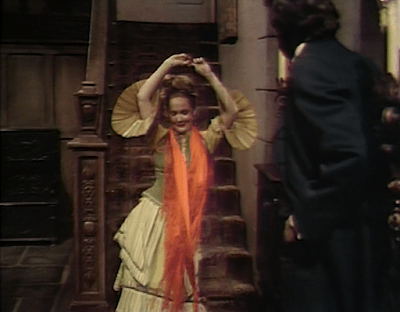
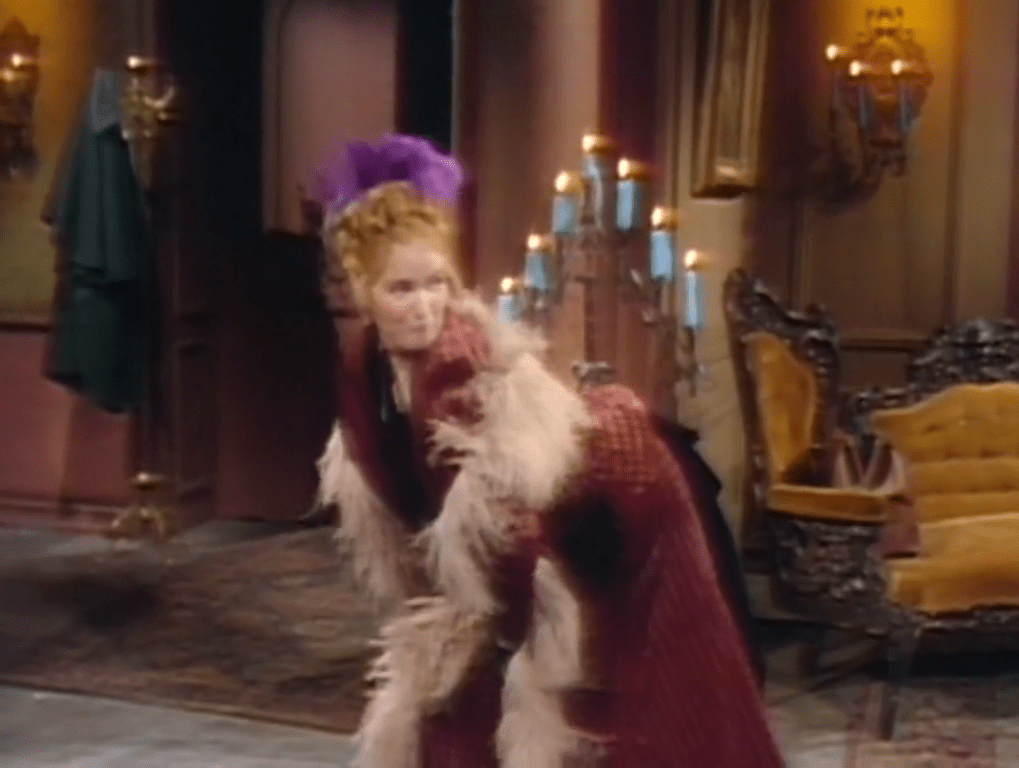
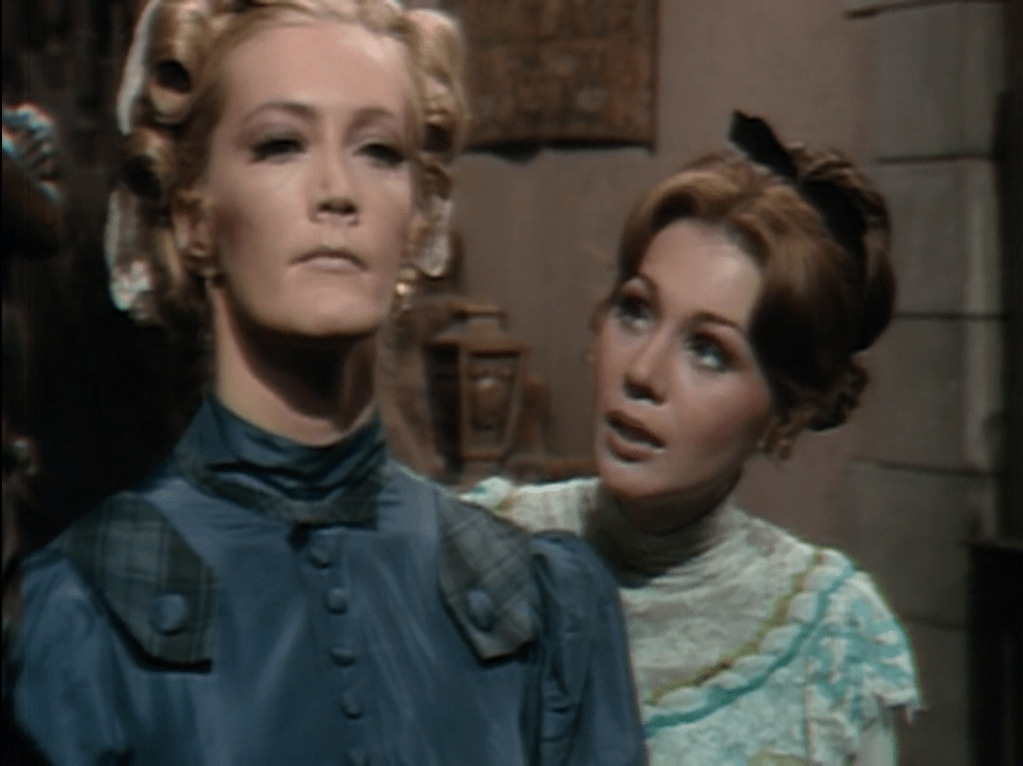
Ta Ra Boom De Ayyyy… Screenshot by Dark Shadows Before I Die.

If Petofi has caused startling changes in Jamison, Edward, and Charity, the change in Quentin is perhaps the most jarring of all. He has been a ghost, a homicidal maniac, a Satanist, a zombie, and a werewolf, but always and everywhere a source of total chaos, who destroys all recognized order and is perfectly at home in the midst of sheer madness. Today, Quentin keeps making earnest attempts to restore everyone to their right minds and reestablish the proper and respectable relations within the household.

First time viewers will immediately catch on that the preteen David Henesy is not the actor who would usually play a 150 year old Hungarian nobleman, and when Nancy Barrett suddenly takes on an East London accent and enters wearing a garish costume and doing a dance with lot of hip shaking and pelvic thrusts, they will know that Charity is turning into someone else. The dialogue in the scenes involving Edward explains what is happening to him. They may not know that Quentin is not supposed to be the defender of the status quo. That information is supplied in two scenes. Charity/ Pansy receives a psychic message from the world beyond telling her that Quentin was involved in the murder of Carl, and she announces this information. Also, Quentin calls for help, and the helper who materializes is his distant cousin, Barnabas Collins the vampire.

At the end of the episode, Barnabas lays hold of Jamison/ Petofi and drags him into the secret passage leading from the drawing room to the west wing. It is usually bad news when a vampire abducts a child and shoves him into a dark space, but David Henesy brings such joy to the role of Jamison/ Petofi that we can hardly doubt that what comes next will be equally fun to watch.

Meanwhile, a painter named Charles Delaware Tate has presented himself. Tate’s first appearance will cause a sinking sensation in longtime viewers; he is played by Roger Davis, a terrible actor who delivers much of his dialogue by shouting while clenching the sphincter muscles in his buttocks, and who routinely assaults the women and children in the cast while on camera. We may have hoped we had seen the last of Mr Davis when his most recent character, Dirk, was destroyed shortly after murdering Pansy. But evidently Pansy’s return in the form of another actress has come at the price of Mr Davis’ return in the guise of another character.

For much of 1968, Mr Davis played a man known variously as Peter Bradford and Jeff Clark. His approach to characterization consisted of shouting “My name is Jeff Clark!” When this technique was played out, he took to shouting “My name is Peter Bradford!” He doesn’t shout today, mercifully. But he does say the name “Charles Delaware Tate” quite a few times.

Today’s story about Tate is potentially interesting. Jamison/ Petofi finds him when he answers the front door. Tate asks to see Jamison Collins; Jamison/ Petofi confirms that despite his appearance, he is indeed the person Tate has come to see. Tate accepts this with a blandness that suggests that he knows he is dealing with a magical personage.

Jamison/ Petofi gives Tate a photograph of Quentin and says that he wants a portrait of him. When Quentin comes to the drawing room and finds Tate sketching, he asks who he is. Again, Quentin adopts a stern tone which suits someone defending the sanctity of private property against an unknown intruder. Tate introduces himself and shows him a handwritten letter which Quentin instantly accepts as the product of his grandmother Edith. He tells Tate that Edith has been dead for some time and that he is not interested in a portrait of himself. Tate says that he has already accepted the commission and the money that Edith sent with it, and so he will rent lodgings in the village of Collinsport and finish the job regardless. Quentin does what viewers have hoped everyone who shared a scene with one of Mr Davis’ characters would do, and throws him out.

The forged letter is a fascinating touch for returning viewers. Petofi made himself welcome as a guest at Collinwood by showing Edward forged papers creating the impression that he shared Edward’s friendship with the Earl of Hampshire. That he has also created papers that Quentin immediately accepts as coming from Edith, who died long before Petofi had any reason to come to Collinwood, suggests that his powers of forgery are very extensive indeed.

Tate not only seems to know that Petofi has magical powers; he also shows an acquaintance with Petofi’s henchman Aristide.* When Tate mentions Aristide, he calls him “Aristeedy,” a sort of pet name with a diminutive suffix. This is probably just a blooper on the part of Mr Davis, but since Petofi is continually telling Aristide how lovely he is and how he is more attractive when he doesn’t speak, it does remind us of the gay subtext that runs through their scenes together. We might suspect that Petofi and Aristide’s sexuality is in one way or another one of the reasons they are connected to Tate.

The script opens all of these questions about Tate. Had he been played by an actor who was capable of depicting depth and highlighting ambiguity, it could have been a lot of fun to speculate about just what their answers might be. In #137, future movie star Frederic Forrest was a featured extra on the dance floor at The Blue Whale tavern; it’s easy to suppose he would have taken a speaking part. So when the show puts Mr Davis in front of us, I like to make the time a little more tolerable by imagining what Forrest might have brought to the role of Tate.

*His name is spelled “Aristede” in the closing credits, but it was “Aristide” in the original scripts.
Episode 803: As soon as you’re finished with the mumbo-jumbo

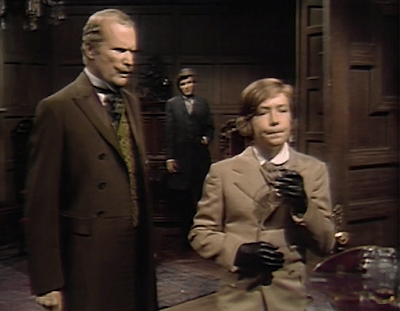
The spirit of evil sorcerer Count Petofi has taken possession of twelve year old Jamison Collins, much to everyone’s consternation. David Henesy spends most of the episode mimicking Thayer David’s Petofi, with hilarious results.

Jamison/ Petofi sipping a glass of “mineral water… for the digestion.” Screenshot by Dark Shadows Before I Die.

We see Jamison’s favorite uncle, Quentin the Satanist, trying to cast a spell to break Petofi’s possession of Jamison. As he always does when he is calling on the dark powers of the unseen realms, Quentin gets very fervent. We pan to Jamison/ Petofi, standing next to Quentin in a state of utter boredom, asking if Quentin will bring him a glass of mineral water once he’s “finished with all the mumbo-jumbo.”

Twice, Jamison/ Petofi pretends he is not possessed, but is his usual preteen self. He does this in order to trick people into letting him kiss them, which is how Petofi’s power spreads to them. This gives Mr Henesy the challenge of showing how Thayer David would play Petofi playing Jamison. That’s the sort of thing an actor needs a director’s help to pull off. Unfortunately, the woeful Henry Kaplan was at the helm today, so we discover that Petofi’s imitation of Jamison sounds exactly like the original, who is in turn uncannily like Jamison’s grandson David Collins and his great-great-grandfather Daniel Collins, who are also played by Mr Henesy.

Those whom Jamison/ Petofi kisses reveal their “true selves.” So maidservant Beth reveals that she was under the power of Jamison’s distant cousin, vampire Barnabas Collins. When Jamison’s father Edward passes this word along to Quentin, Quentin tells him is going to confront Barnabas. Edward has been hunting Barnabas, and by saying this Quentin implies that he knows where Barnabas is and that he has been helping to hide him. For some reason, Edward only smiles in response to this revelation.

Petofi wears a prosthesis in place of his right hand; Edward finds that Jamison’s right hand has also been replaced with a prosthesis. After this horrifying discovery, Jamison/ Petofi kisses Edward. Quentin returns shortly after, and finds that Edward does not recognize him or know the name of the house. Edward identifies himself as a newcomer to the area, and says that he would be glad of any work the family might hire him to do. Evidently his “true self” is a guy who needs a job. Since he has not inherited any assets or accumulated enough to live on, I don’t suppose we can disagree with whatever force it was that declared this to be Edward’s reality.

Episode 772: Apologies are the Devil’s invention

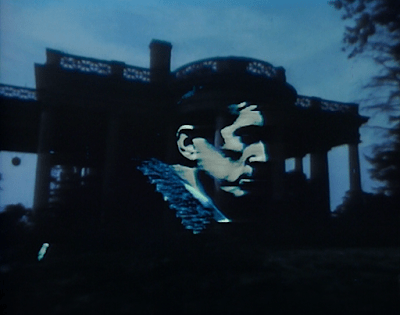
The opening voiceover plays over this image, a type of visual effect we have not seen before at the beginning of an episode:

A transparent sticker of Barnabas superimposed on the exterior of the Old House. Screenshot by Dark Shadows Before I Die.

Barnabas Collins has bitten dimwitted servant Dirk Wilkins, turning Dirk into a vampire like himself. Barnabas has been out all night, searching for Dirk’s hiding place. He hopes to expose Dirk and frame him for his own crimes.

Barnabas comes home to the Old House on the estate of Collinwood to find that Dirk seems to be trying to do the same thing to him. There is a blood-drained corpse in an armchair in his front parlor. It is that of Miss Pansy Faye, Cockney showgirl and Dirk’s first victim.

Barnabas’ distant cousins live in the great house on the estate. One of them, prankster Carl Collins, brought Pansy home with the intention of making her his bride. No sooner does Barnabas discover Pansy’s remains than Carl starts banging on the front door, shouting that he wants to speak with her.

Barnabas hides what’s left of Pansy in a secret chamber behind a bookcase, then lets Carl in. Grisly as the circumstances are, one person lying to another about the presence of a third nearby is a stock situation from farce, and John Karlen and Jonathan Frid play the scene with the particular brand of desperate seriousness that only works in farce. Barnabas persuades Carl to go away and search the grounds of the estate.

That takes a few minutes, starting from what the opening voiceover told us in so many words was “an hour before dawn.” In what remains of that hour, Barnabas takes Pansy’s body to a cemetery and buries her in a shallow grave between tombstones, telling her to “rest in peace.”

Barnabas buries Pansy. Screenshot by Dark Shadows Before I Die.

Barnabas comes home, and finds Carl, who has in the interval not only gone to the great house, the groundskeeper’s cottage, and a house on the estate which is currently occupied by a school, but has also gone into the village of Collinsport and made inquiries about Pansy. A speedy bunch, the Collinses.

Before Barnabas returned to the house, Carl had heard Pansy’s disembodied voice singing the song she had so memorably performed for Barnabas in yesterday’s episode. He had spoken to Pansy’s voice telling her that his grandmother’s will gave him a house to live in and that she could live there with him. This is puzzling for returning viewers. In #714, it was made perfectly clear that the will did not mention Carl at all. Edith Collins left her entire estate to Carl’s sister Judith, and the only one of the brothers who was mentioned was Quentin, who received no money or negotiable assets of any kind but who was guaranteed the right to stay at Collinwood as long as he pleased. Perhaps they are retconning that away, perhaps Carl is lying to Pansy, or perhaps Carl is losing his grip on reality.

Whether or not we are supposed to doubt Carl’s sanity, Barnabas talks Carl into suspecting that he might have hallucinated Pansy’s voice. Carl leaves, and Barnabas has time to return to his coffin before dawn.

The rest of the episode is taken up with doings at the school Carl had visited. We saw Carl questioning Charity Trask, daughter of the school’s master, the overwhelmingly evil Gregory Trask. The prim Charity was exasperated that Carl kept asking about Pansy after she had already denied having seen her. The scene is an interesting one- Charity and Pansy are such total opposites that it is a shame they never met. It would be amusing to see them juxtaposed.

Charity is engaged to marry Tim Shaw, a teacher at the school. Neither of them is happy about this situation. Tim was in love with Rachel Drummond, another of the teachers, and Charity is Barnabas’ blood thrall. But Gregory blackmailed Tim and bullied Charity into accepting the arrangement.

Charity’s mother, prudish Minerva Trask, does not like Tim or want him as a son-in-law. She urges Charity to set her sights on Carl. Charity says that she would rather marry Barnabas; Minerva says that her instincts are sound, but that she ought not to settle for a cousin of the rich Collinses when one of the brothers is available. Even if they have retconned Carl into owning a house, he is clearly not a rich man, so this reveals that Minerva knows as little about his financial position as she does about the curse under which Barnabas labors.

Charity tries to engage Tim in conversation, and is baffled that he is not willing to talk to her. Indeed, he does not seem like himself at all. Not only is he dismissive with Charity, but when Minerva confronts him he is bold and insolent, a far cry from the broken man we have seen interacting with the Trasks previously. When Charity tells him their engagement is off, he does not express the relief that she and we expect, but puts on a stagey voice we have not heard him use before and marches off to apologize to her mother.

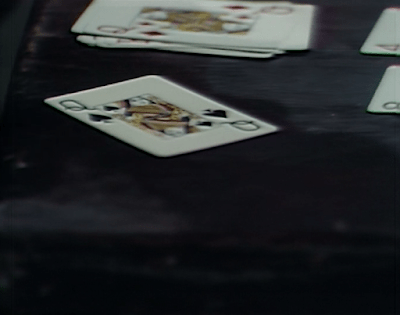
There is a reason for Tim’s behavior. Gregory enlisted warlock Evan Hanley to brainwash Tim so that he would kill Minerva. There is some business with the Queen of Spades, first when Tim mutters the phrase “Queen of Spades,” then when Evan sends him a note on which is scrawled “Queen of Spades,” and lastly when he walks in on Minerva playing solitaire and sees her turn up the Queen of Spades. Many viewers in 1969 would have remembered Richard Condon’s 1959 novel The Manchurian Candidate and its 1962 film version. In Condon’s novel, Raymond Shaw became a robot capable of murder when he saw the Queen of Hearts; in the film, the card was the Queen of Diamonds. Many first time viewers, seeing Tim Shaw’s reaction to the Queen of Spades, would have made the connection and understood why he ends the episode by poisoning Minerva’s tea.

Is this your card? Screenshot by Dark Shadows Before I Die.

Tim Shaw differs from Raymond Shaw in that he is under a spell for a long while, including the whole time we see him today, and he can talk and act independently while it operates on him. Raymond simply became catatonic when he saw the card and remained that way until he heard a command. He then executed the command and came back to himself once he was finished. Tim’s behavior may suggest a nod to another literary work, Pushkin’s story “The Queen of Spades.” That tale, which Tchaikovsky turned into an opera and which in 1949 was made into a feature film, is about a timid man who inadvertently kills a powerful woman and loses control of himself as a consequence. Like Tim, Captain Herman is coerced into marrying a woman he does not love. Presented with an opportunity to get out of the marriage, he finds himself making extraordinary efforts to go through with it, efforts which bring about his ultimate downfall.

Episode 771: When the music begins

Vampire Barnabas Collins is about to leave his house with his thrall, maidservant Beth Chavez, to look for Dirk Wilkins, a dimwitted servant whom he inadvertently turned into a vampire and let go. They are stopped when Barnabas’ distant cousin, inveterate prankster Carl Collins, comes in and insists on telling him about his recent trip to “Atlantic City, New Jersey, the Queen of the Boardwalk cities!”

Carl offers Barnabas some saltwater taffy, only to find that the tin is empty. He frets that “she” must have eaten it all on the trip back- “You know how women eat when they are nervous.” This leads to Carl’s second order of business, introducing Barnabas to Miss Pansy Faye. Carl met Pansy on the train, and he intends to marry her.

Carl opens the door, then stands before Barnabas and Beth and announces in his most booming voice “Presenting! Direct from her triumphs before Her Imperial Majesty, Queen Victoria of England, that world-famous mentalist and most beguiling songstress, Miss Pansy Faye!” Pansy enters, singing and dancing. In a vaguely Cockney accent, she intones:

I’m gonna dance for you! Gonna dance your cares away.
I’ll do the Hoochie Koo, and the Ta Ra Boom De Ay!
I’ll sing a happy song, as we dance the whole night long!
When the music begins, I’ll give you some spins,
I’ll even invent a step or two!
So, on with the show! You’ll love it, I know!
Oh, I’m going to dance for you!

Pansy’s dance is not particularly elaborate; it is performed almost entirely below the waist, and ends with her bending over and thrusting her rear end upward. That is followed by a cut to Barnabas wearing a look of stupefaction that all the black magic and demonic intrusions he has witnessed over the centuries have not elicited. He turns to Beth, who is visibly struggling to keep a straight face.

Against the backing track of Dark Shadows super-solemn music, this scene is hilarious. Longtime viewers will savor it even more than others. Carl is played by John Karlen, who in the parts of Dark Shadows set in the 1960s plays the luckless Willie Loomis, Barnabas’ first blood thrall. When Barnabas first enslaved Willie in the spring and summer of 1967, the show was at its bleakest. Barnabas was able to fool his distant relatives in the great house into regarding him as a living being and letting him occupy the Old House, but that was only because they had been isolated and embattled for so many months before. When we saw Barnabas and Willie on this set in those days, Barnabas was as grim as death itself, beating Willie with his heavy cane whenever he dared do more than whimper. That Karlen is now here as the man who is introducing a character as exuberantly and preposterously alive as Pansy and that Barnabas’ current thrall is suppressing a laugh takes the despair of that period and packs it with joy.

The despair reasserts itself at the close of the episode. Pansy will go out into the woods, Dirk will take her as his first victim, and Barnabas will come home to discover her body propped up in a chair in the parlor. But the comedy in between is so strong that we can be confident that this will not be the last word. Carl tries to persuade his sister, spinster Judith, to accept his marriage to Pansy. He tells her that he is a new man thanks to Pansy’s influence; he has actually managed to go 48 hours without playing a practical joke. Judith is impressed by this new record, but still will not believe that Pansy is fit to become a Collins. She controls all the family’s wealth, and threatens to cut Carl off without a penny if he goes through with the marriage. He reacts with a series of facial expressions that the Three Stooges would have admired.

While Barnabas and Carl are out, Pansy stays in the Old House with Beth. Beth offers her a cup of coffee; Pansy says she would prefer sherry. Beth goes to look for sherry, and Pansy is caught off-guard that Beth doesn’t live there. When Beth says that she is based at the big house on the property, Pansy asks how big it is. Beth says that it is very big indeed; Pansy says that Carl had told her it was like a palace, and Beth confirms that it is indeed on that scale. Pansy is surprised that Carl was telling her the truth. She takes the drink at a single gulp. With Carl, Pansy was acting a part, and she was a terrible actress indeed. Alone with Beth, she drops the act. The Cockney accent is still not too well-developed, but Kay Frye is much more convincing as a hard-boiled working class woman than Pansy is in any of her roles.

Carl persuades Judith to sit still in Barnabas’ parlor while Pansy does her mentalist act, trying to locate Dirk. Pansy actually goes into a trance and announces that Dirk is dead and his murderer is in the room. When she comes to, Pansy is as surprised as anyone at what happened. Judith is demanding an apology, and Pansy is shocked when Barnabas tells her that she accused someone in the room of murder. A moment later, she is alone, wondering what came over her and lamenting that she “mucked that one up.”

The Old House is a dangerous place to be a fake practitioner of supernatural arts. In #400, set in the 1790s, fanatical but inept witchfinder the Rev’d Mr Trask performed an exorcism of the Old House, and was visibly delighted when that exorcism seemed to work. That time it was the intervention of wicked witch Angelique that gave Trask his apparent success, but now it seems that Pansy is simply getting it right for the first time.

That Dirk leaves Pansy in a chair in Barnabas’ front parlor is also something that will bring back memories for longtime viewers. In the 1790s segment, another brassy dame on the make brightened up the show for a little while before meeting a grisly demise on this spot. She was Suki Forbes, estranged wife of untrustworthy naval officer Nathan Forbes. Barnabas strangled Suki in #423, after she had discovered his secret. Suki took until #424 to die, but did not manage to disclose what she knew about Barnabas.

An even closer parallel is to #530. In that one, Frankenstein’s monster Adam hates Barnabas for making him what he is. Adam attacks a man called Joe Haskell and thinks he has killed him. At the end of the episode, Barnabas finds that Adam has planted Joe’s body in the front parlor. Any doubt that Adam was trying to frame Barnabas for Joe’s murder would be removed by consulting the novel Frankenstein, in which the Creature frames another character for the murder of his creator’s brother. Dirk knows that Barnabas made him into a vampire, and so has the same motivation to pin a murder charge on Barnabas that Adam had.

Adam was just a few months old when he tried to frame Barnabas for murder, and Dirk is a simpleton. Neither of them had the skills to get the police interested in Barnabas, no matter how many dead bodies they add to the decor of his house. On the other hand, Barnabas himself once very nearly managed to make such a plan work. In #440 and #441, part of the 1790s segment, Barnabas left the corpse of his victim Maude Browning in a bed belonging to Trask. It was only Nathan Forbes’ timely intervention that kept Trask from the gallows that time.

Episode 747: Triumphant life behind a locked door

Madwoman Jenny, estranged wife of libertine Quentin Collins, is on the loose again, and she is the object of a madcap search by Quentin’s sister, spinster Judith, his girlfriend, maidservant Beth, and his distant cousin, secret vampire Barnabas. Quentin makes two contributions to the process. The less important is to serve as the bait in a cockamamie trap Barnabas and Judith lay for Jenny. The more important is to keep up a running commentary mocking the other characters for the silliness of their activities.

The trap itself involves a moment of intentional humor. Barnabas has returned to the year 1897 to prevent Quentin becoming a ghost who will ruin things for everyone on the great estate of Collinwood in 1969. One of the things Quentin did in that year that terrified the characters and tried the patience of the audience was to cause the strains of a sickly little waltz continually to resound from the walls of the great house. When the show became a costume drama and we got to know the living Quentin, we found that he too played a gramophone record of that same tune incessantly, annoying all and sundry. The trap requires Quentin to play the recording over and again until Jenny hears it and comes. After it has been going for half an hour, Barnabas tells Quentin that the plan didn’t work and they should stop playing the waltz. Quentin asks “Are you tired of hearing this music?” Barnabas speaks for all of us when he replies “Frankly, yes.”

Not only is this a successful comedy, it also gives the cast an opportunity for some of their best dramatic acting. As Judith, Joan Bennett at one point stops, looks at Barnabas, and asks “Can we trust you? Really trust you?” She apologizes for the bluntness of that question, then admits that she has long been busy putting a prettier face on the Collins family than the dark secrets Barnabas has discovered make plausible. “I’m not really very trusting. I try to pretend we’re nicer than we really are.” In the parts of Dark Shadows set in the 1960s, Bennett plays matriarch Liz, whose whole personality is about denial and the pretense that the Collinses are nicer than they really are. Liz latched onto Barnabas as soon as she saw him, and refuses to see any evidence that he is not quite normal. Nor does she ever really face her own habits of concealment and their implications. In this little exchange, we see Bennett playing a character whose superficial similarities to Liz point up her profound differences from her.

“Can we trust you? Really trust you?”

Joan Bennett had one of the most distinguished careers of any American actress of the twentieth century. Terrayne Crawford stands at something of the opposite pole, and her performance as Beth leads most fans to declare that she is the weakest of all the members of the cast of the portion of Dark Shadows set in the year 1897. I don’t really disagree with that, but she is fine today. Miss Crawford’s great limitation was that she could play only one emotion at a time, and she was on the show in a period when the scripts gave every character complex motivations in almost every scene. But today, all Beth has to play is Anguish, and Miss Crawford does a fine job.

Beth took care of Jenny during the year Quentin was away from Collinwood, and became very close to her. In the nine and a half weeks since Quentin’s return, she has fallen in love with him. In a scene at the close of today’s episode, Beth tearfully admits to Quentin that she wishes something would happen to Jenny so that he would no longer have a wife. Beth collapses into Quentin’s arms. Jenny has been hiding in a corner, eavesdropping; she comes out, holding a knife. There have been occasions when we might have rooted for Jenny to succeed in killing Beth, just to spare us the embarrassment of Miss Crawford’s flat, tedious performances. But this time, we want to see more of her, and the prospect that Beth might die makes for an effective cliffhanger.

Episode 738: The rest of the truth

This episode ends with one of the most thrilling moments in all of Dark Shadows.

The show’s first supernatural menace was undead blonde fire witch Laura Murdoch Collins, who was on it from December 1966 to March 1967. Its second was vampire Barnabas Collins, who first appeared in April 1967. Laura herself was presented with many tropes that conventionally mark vampires; for example, they laid great emphasis on the fact that Laura was never seen eating or drinking. And Laura’s story was structured very much like Bram Stoker’s Dracula, with well-meaning governess Vicki taking Mina’s role as the driving force behind the opposition to her. Presumably, if Barnabas had been staked and destroyed as the original plan envisioned, Vicki would have led the fight against him as well, and in #275 driven the stake into his heart. But Barnabas brought the show a new audience, and so Vicki was never called on to go to battle with him. Her character withered and was written out, and he replaced her as its chief protagonist.

In early 1967, Vicki learned that Laura had appeared at least twice before, and had died in strikingly similar ways each time. In 1767, Laura Murdoch Stockbridge was burned to death with her young son David; in 1867, Laura Murdoch Radcliffe was burned to death with her young son David; and in 1967, Vicki found Laura Murdoch Collins beckoning her young son David to join her in the flames consuming a wooden building. At the last second, Vicki broke through David’s trance and he ran to her, escaping the flames.

In November 1967, the show established that Barnabas lived on the great estate of Collinwood as a human in 1795, and that he became a vampire as a result of the tragic events of that year. If Barnabas were the same age in 1795 that Jonathan Frid was in 1967, he would have been born late in 1752, meaning that he would have been a teenager when Laura Murdoch Stockbridge and little David Stockbridge went up in smoke. The Stockbridges were a very wealthy family, so they would likely have been on familiar terms with Barnabas and the other rich Collinses of Collinsport, and the deaths of Laura and David would have been one of the major events in the area in those days. So longtime viewers have been wondering ever since whether Barnabas knew Laura, and if so what he knew about her.

Now Barnabas has traveled back in time to the year 1897, and there he meets another incarnation of Laura. He is thunderstruck at the sight of her. In her bland, enigmatic way, she expresses curiosity about his reaction, and he collects himself sufficiently to make some flattering remarks about her beauty. As soon as he is alone with his blood thrall, Miss Charity Trask, he declares that Laura has been dead for over a hundred years. So has he, but apparently when a woman rises from the dead to prey on the living that’s different, somehow. We saw this same old double standard a couple of weeks ago, when libertine Quentin Collins expressed shock at Laura’s return from the dead, when he himself had died and been a zombie just the week before.

If Laura did know Barnabas when she was as she is now and he was an adolescent, it is no wonder she does not seem to recognize him. She knows that there is a Barnabas Collins on the estate, and has heard that he is a descendant of the eighteenth century bearer of the same name. She would expect him to resemble the boy she knew, but would not necessarily know what that boy looked like when he was in his forties.

This is the first time we’ve seen Charity since Barnabas bit her in #727. She lives in the town of Rockport, which in the 1960s was far enough away from Collinwood that in #521 it was worthy of note that you could dial telephone numbers there directly. In 1897, when automobiles were rare and roads weren’t made for the few that did exist, a long-distance relationship between vampire and blood thrall would seem quite impractical. Still, in #732 we saw a character make two round trips between Rockport and Collinwood in a single evening, so I suppose it could be managed.

Barnabas’ recognition of Laura is a fitting conclusion to a fine episode. Much of it is devoted to a three-cornered confrontation between Laura, her twelve year old son Jamison Collins, and her brother-in-law/ ex-lover/ mortal enemy, Quentin. Danny Horn analyzes this in his post about the episode at Dark Shadows Every Day. I recommend that post highly. All I would add is that as it plays out today, the confrontation makes me suspect that the writers of the show may have done more planning than Danny usually credits them with. Jamison is the only person Quentin loves, and so far we have seen that Jamison loves Quentin back. When he learns that Quentin is his mother’s foe, Jamison turns against Quentin. Barnabas traveled back in time after Quentin’s ghost had made life impossible for everyone in 1969. The evil of Quentin’s spirit fell heaviest on David Collins, whom Quentin had possessed, turned into another version of Jamison, and was in the process of killing. Nothing yet has explained why Quentin’s ghost would focus its malignity on the image of Jamison. Actress Diana Millay used to claim that Laura was added to the 1897 segment at the last minute because she told Dan Curtis she wanted to work, but Millay famously enjoyed testing the credulity of Dark Shadows fans with outlandish remarks. I wonder if a falling-out between Quentin and Jamison over Laura was in the flimsies all along.

Charity makes her first entrance in the great house of Collinwood. Quentin is apologizing to her for some boorish behavior when he realizes she hasn’t been listening to him at all. She is completely absorbed in the eighteenth century portrait of Barnabas that hangs in the foyer. She excuses herself and wafts out the front door.

In Barnabas’ house, Charity says that he makes her feel beautiful, and that she wants to see herself in a mirror. Barnabas is a bit sheepish about the particulars of vampirism, and so he changes the subject. We cut from this exchange to Laura’s room in the great house, where she is with a servant named Dirk whom she has enthralled to serve as a source of body heat. That scene opens with a shot in a mirror, making the point that Laura’s relationship with Dirk is a reflection of Barnabas’ relationship with Charity. Earlier, there had been a clumsy attempt at an artsy shot of Laura reflected in Quentin’s sherry glass. That does show us that Laura casts a reflection and that her relationship with Quentin has been affected by his drinking, but it calls too much attention to itself to do much more than that.

The portrait in the foyer is hugely important to Barnabas. It made its debut on the show in #204, the day before his name was first mentioned and more than a week before he himself premiered. His thralls stare at it and receive his commands through it. He himself uses it as a passport, appealing to his resemblance to it as proof that he is a descendant of its subject and therefore a member of the Collins family. Today, Barnabas is surprised when Charity comes to his house; he wasn’t transmitting a message through the portrait summoning her. Instead, it was functioning as another mirror, in which Charity, who has become a part of Barnabas, could see the motivating force within her own personality.

Dirk is played by Roger Davis, a most unappealing actor. At one point he makes this face while Dirk is involved in some kind of mumbo-jumbo:

Screenshot by Dark Shadows Before I Die.

At one point today, Quentin tells Jamison that he shouldn’t be afraid of telling the servants what to do, since after all he will someday be the master of Collinwood. Jamison takes this altogether too much to heart, and spends the rest of the episode ordering everyone around. David Henesy is a good enough actor to extract the comic value from this. For example, when he turns to Quentin, says “I’ll talk to you later!,” and keeps walking, we laughed out loud.

Episode 735: Defenseless souls

The highlight of today’s episode is a confrontation between two of Dark Shadows‘ most effective villains.

Laura Murdoch Collins (Diana Millay) was on Dark Shadows from December 1966 to March 1967, when the show took place in a contemporary setting. She emerged from the supernatural back-world behind the action, and at first she was as vague and indefinite as are the beings who lurk out of our sight there. Eventually she took on a forceful enough personality that Diana Millay could display her gift for dry comedy, but that personality was only a mask that Laura wore. The real Laura was something entirely different, unreachable, unknowable. The visible Laura marks the boundary between the world we can hope to understand and one where humans would find no points of reference, no standards of comparison. As such, she represents the danger that we might lose our way and find ourselves in a place where our minds will be useless to us. That is to say, she inspired the fear that comes from a well-told ghost story.

Now the dramatic date is 1897, and another iteration of Laura is the mother of twelve year old Jamison and nine year old Nora. Laura’s estranged husband, the stuffy Edward Collins, and Edward’s sister, spinster Judith, have sent Jamsion and Nora to Worthington Hall, a boarding school which doubles as a particularly cruel cult. Laura’s plans for Nora and Jamison require them to be home on the estate of Collinwood, and so she sets out to release them from Worthington Hall.

The headmaster/ cult leader of Worthington Hall is the vile Gregory Trask (Jerry Lacy.) Trask is at the opposite pole from Laura. She is terrifying because we can never understand her or the realm whose existence she implies; he is an overpoweringly oppressive presence because he is so thoroughly comprehensible. It is perfectly obvious what Trask has done, what he plans to do next, and why he wants to do it, but knowing all that is of absolutely no use in stopping him.

In today’s opening scene, Trask confronted fugitive teacher Rachel Drummond, whom he is extorting into coming back to work at Worthington Hall. He kept sidling up to Rachel and touching her, telling her that perhaps the two of them were destined to change each other. He could not make it clearer that he wants to exploit his power over Rachel to coerce her, not only into returning to her old job, but into a sexual relationship.

Trask has been in a position of authority over Rachel since she was a small child, suggesting that his unrelentingly punitive approach to his students and the undisguised joy he takes in being cruel to them are also sexual in their origin. Rachel even used the word “sadist” to describe Trask the other day, a word coined only in 1892. Someone using it in 1897 would certainly have seen it in its original clinical context, and the neurotic intellectual Rachel undoubtedly understood it very well in its technical sense.

We see Laura on a dark set. She looks at a candelabra. She points at its three candles, one by one. As she points at each candle, it lights. Thus first time viewers learn that Laura is a supernatural being with a relationship to fire.

At Worthington Hall, Nora wanders into a room where a fireplace is alight. Nora can hear her mother’s voice urging her to look into the flames, but cannot see her. She is afraid until she looks into the flames and sees Laura’s face. Nora begins to enter a deep trance. Before she can, a teacher finds her and interrupts her. We cut back to Laura, who is pleading with Nora not to look away from the fire. Nora does, and the candles on Laura’s candelabra go out.

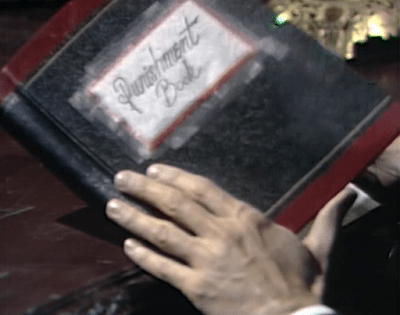
We see Trask in his study, browsing through a Bible. He returns that to his bookshelf and finds more congenial reading. He picks up a ledger and brightens. We see its cover, on which is taped a label reading “PUNISHMENT BOOK.” Trask smiles blissfully and sits down to examine its contents.

The volume that takes Trask to his happy place. Screenshot by Dark Shadows Before I Die.

A knock comes at the door, pulling Trask out of his sun-kissed dream of past cruelties. Irritated, he demands to know who it is, but receives no answer. When the knocking continues, he opens the door and sees Laura.

LAURA: Are there no servants at Worthington Hall? I’m not accustomed to letting myself in.

Longtime viewers will remember that when Laura was first on the show, they made a big deal out of the fact that she never ate or drank. So much so that they had the next uncanny menace, Barnabas Collins, drink a cup of coffee in #221. Even though Barnabas was a vampire and Laura was not, they had used up the traditional indicator of vampirism. non-consumption of food or drink, on Laura. Laura’s inability to open the door herself may be another borrowing from the same stock of imagery, from the idea that the vampire cannot cross a threshold without being invited.

TRASK: Who are you?

LAURA: I am Laura Collins and I come for my children. You are Mr. Trask, of course.

TRASK: Reverend Trask!

LAURA: Anyone can call themselves anything. I knew a woman in Brooklyn, once. Insisted she was a countess.

This is an inside joke. There was quite a well-known fashion correspondent-turned-executive in Brooklyn in 1969 named Mabel Wilson Gross. Mrs Gross’ first husband was a Danish nobleman named Count Carl Adam von Moltke, known to his friends as “Bobby.” Mrs Gross was known professionally as “Countess Mab Moltke.” She and “Bobby” were the parents of Alexandra Moltke Isles, who appeared in 333 episodes of Dark Shadows as well-meaning governess Vicki. I don’t believe Mrs Isles has ever used the title “Countess” herself, though under the laws of Denmark she would have the right to do so. Since it was Vicki who led the battle against Laura in 1967, a remark from Laura twitting Mrs Isles and her family might raise quite a laugh from longtime viewers who get the reference.

LAURA: (Goes to Trask’s desk and leafs through the “Punishment Book.”) But you are Trask. Yes, there’s no doubt about that.

TRASK: But you could be anyone as far as I’m concerned, anyone at all. I have too much respect for the defenseless souls in my charge.

LAURA: Oh, please, don’t be dreary.

TRASK: Dreary, Madam?

LAURA: Surely you know the word. Simply have my children brought down here, if there’s anyone to bring them.

TRASK: And how am I to know that you are their mother?

LAURA: Oh, what a trusting man you are.

TRASK: There is no question of the children leaving the school.

LAURA: Jamison possibly. Nora will leave here tonight. I’m willing to take them one at a time.

TRASK: As far as I know, Madam, their mother is away.

LAURA: You should keep more in touch.

TRASK: My wife returned from Collinwood this afternoon. She made no mention of your return.

LAURA: Hmm. How odd. I thought her a great gossip.

TRASK: Minerva? Madam.

That Minerva appeared to be “a great gossip” will also amuse longtime viewers. She is played by Clarice Blackburn, who in the parts of Dark Shadows set in the 1960s played housekeeper Mrs Johnson. After a brief period in which Mrs Johnson was supposed to be a spy planted in the house by an enemy of the Collins family, she settled into the role of a benevolent but excitable woman whose chief function was to blab everything she knew to the character likeliest to use the information to advance the plot.

LAURA: Now, will you have Nora sent down.

TRASK: I will not. Not without proper orders from Miss Judith Collins or Mr. Edward Collins. I shall call Collinwood and verify your strange appearance.

LAURA: Do.

(TRASK picks up the telephone receiver. Shows pain and drops it.)

LAURA: What’s wrong, Mr. Trask?

TRASK: It burned my hand.

LAURA: I’ve always thought the telephone an instrument of the devil, haven’t you?

TRASK: I have not!

Many times on Dark Shadows, as recently as this week, we have seen men forcibly intervene to stop a woman from talking on the telephone. I believe this is the first time we have seen a woman turn the tables and do this to a man.

TRASK: What a ridiculous conversation. I don’t know what I could have been thinking of to call Mr. Edward Collins. We have rules at Worthington Hall, Madam.

LAURA: Ah, rules are made to be broken.

TRASK: Not here. The children are asleep. They shall remain asleep. We do not encourage visits even from members of the immediate family unless of course it’s an emergency.

LAURA: Then you won’t reconsider?

TRASK: No.

LAURA: Not wise. Not wise at all.

TRASK: Are you threatening me?

LAURA: My children will not spend one more night in this school.

Laura remains perfectly calm throughout this conversation. Even her closing threat is delivered in a light tone, with an easy smile. Trask is agitated at the outset, and becomes ever more so as he realizes he cannot intimidate Laura. Since Diana Millay and Jerry Lacy are two of the most capable comic actors on Dark Shadows, the result is hilarious.

We first saw the effect of Laura’s imperturbability on an earnest interlocutor in #183 and #184, when she confronted a profoundly different character. In those installments, visiting parapsychologist Peter Guthrie called on Laura at the same cottage where she is staying in 1897. He introduced a new word to Dark Shadows‘ lexicon when he told her that he had concluded that she was “The Undead.” He said that he knew of her evil intentions, and said that if she abandoned them and turned to good, he would make every effort to help her live a different kind of life. Guthrie’s offer meant exactly nothing to Laura, and she responded to it with the same sardonic indifference Trask elicits from her today. Her next act was to cast a spell that caused Guthrie to crash his car and die in a ball of flame.

Trask gets off easier. Laura just sets his school on fire. The closing shot shows Nora apparently surrounded by flames. Laura does not want to burn Nora to death, at least not yet, but she is not one of your more detail-oriented otherworldly menaces. It will not surprise longtime viewers that she is blithely assuming that her children will somehow escape alive from the blaze she has started.

Episode 724: There has to be truth to make a story

Ethnic stereotype Magda Rákóczi is at home in the Old House on the great estate of Collinwood when Rachel Drummond, governess to the children in the great house on the same estate, comes to the door. Rachel says that the late Quentin Collins has risen from the dead and attacked her. Quentin was about to bury Rachel in his own disused grave when Magda’s husband Sandor showed up. Sandor fought Quentin, enabling Rachel to escape. Rachel cannot satisfactorily answer Magda’s questions about whether Sandor survived the fight, and Magda will not honestly answer Rachel’s questions about how Sandor knew to come to her aid.

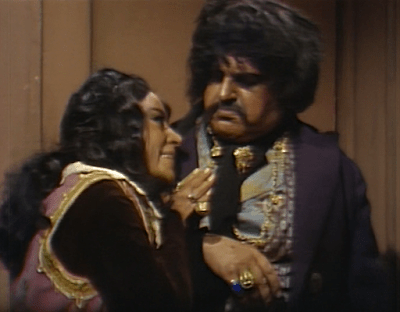
Sandor makes his way back. Magda is overjoyed to see him and throws herself at him with undisguised affection. He responds with his usual grumpiness. At the end, she remembers that they are not alone, and she reverts to their usual form of pretend-quarreling. Their dialogue is great fun, and Grayson Hall and Thayer David make the most of every laugh line:

Magda overjoyed to be reunited with Sandor. Screenshot by Dark Shadows Before I Die.

Magda: Oh, the hero!

Sandor: I am all right.

Magda: Oh, my big, bad, bold hero.

Sandor: Oh, shut up. I cannot hit you. My arm is too sore.

Magda: Oh, what a brave man you are.

Sandor: Yes.

Magda: What a brave man to fight a zombie, a brave, foolish man.

Rachel: He is a brave man. Thank you, Sandor.

Sandor: I don’t like to see a beautiful lady getting buried before her time.

Magda: But you could have been killed.

Sandor: Yes, that at least would have made you cry. Get me some hot water. My wrist is beginning to swell.

Magda: Oh, so now, I have to nurse you. It is better he should have finished you!

Sandor and Magda are the first happily married couple we have seen on Dark Shadows, and this scene shows them at their very happiest. It is not only a good bit of comedy, it is quite lovely.

Rachel is bookish and intellectually ambitious, very much the sort of young lady you might expect to find in charge of the education of the children in a wealthy family in the late Victorian age. She tells Sandor that she cannot accept that Quentin has risen from the dead and is roaming about as a zombie, even though she has encountered as much evidence of the fact as anyone could want. When Sandor urges Rachel to believe what she has seen, she asks what she will have to believe in next- “Ghosts? Witches? Werewolves?” Sandor affirms that he believes in all of those things, and Rachel replies that she cannot.

Well might Sandor believe in such beings. He is under the power of the new master of the Old House, Barnabas Collins, a vampire. Barnabas rises from his coffin in the basement at dusk, when Rachel is upstairs sleeping. Barnabas knows that Angelique, the same witch who made him into a vampire in the 1790s, is controlling Quentin and persecuting Rachel. When Quentin turns up in the basement, Barnabas remembers a ceremony he saw on Angelique’s home island of Martinique that reunited a zombie’s soul with his body and made him once more a living man. He sends Sandor to the attic to retrieve a packet of letters he wrote to his uncle Jeremiah in those days, describing the ceremony.

Jeremiah’s name will jolt longtime viewers. Angelique raised Jeremiah from his grave as a zombie in #393. Over the next five episodes he initially did Angelique’s bidding, then turned on her. They never did tell us that Jeremiah had returned to his grave, in spite of Angelique’s phenomenally vehement exhortations to him to do so. It’s too bad Barnabas didn’t remember these letters then, he might have been able to un-kill Jeremiah.

Or perhaps not. The ceremony is a total failure today, so maybe Barnabas just doesn’t have what it takes to reunite a soul with a body.

When Sandor and Quentin are fighting in the graveyard, we see a tombstone labeled “Laura Murdoch Radcliffe, born 1840.” The Oxford English Dictionary doesn’t have any examples of the phrase “Easter Egg” meaning hidden content of special interest to devotees until 1986, and for that matter this episode aired a few days before Easter began in 1969. So it is doubly premature to call this an Easter Egg. We learned in #181 that a woman named Laura Murdoch Radcliffe died (by fire!) in 1867, with her young son David in her arms; other Laura Murdochs have died that way in other years, and in #187 the residents of the great house decide that Laura Murdoch Collins is likely to take her own young son David to the same fate. The show has been dropping reminders of the Laura story lately, and any longtime viewers who can read this tombstone will appreciate the reference.

I suspect that the original audience for this particular Easter Egg was pretty nearly limited to the set decorators. The inscription is on screen for less than a second, and it is as clear as it is in the capture above for only a small fraction of that time. It’s hard to see even on a modern television; on a 1960s-vintage TV set tuned to an ABC affiliate, many of which had the worst reception in their markets, it must have been totally illegible to something like 99% of the audience. Moreover, it comes at the end of the fight scene, when most eyes were focused on Sandor’s falling figure. Not very many of the few thousand people who might have had a good enough picture to read the inscription would have been looking at it. And most of the audience who were tuning in at this point had joined the show after Barnabas was introduced, the month after Laura went up in smoke, her name unmentioned since. But in the age of streaming and DVDs, we can all appreciate the reference.

Episode 713: The heart of the room

Vampire Barnabas Collins returns to his coffin at dawn to find it already occupied. Governess Rachel Drummond is resting there, and is under the impression that she is Barnabas’ lost love Josette. He exclaims that only his old enemy, wicked witch Angelique, could be “monstrous enough” to put Rachel in this position.

Longtime viewers remember that in #248 Barnabas forced Maggie Evans, who like Rachel is played by Kathryn Leigh Scott, into this coffin because she refused to submit to his attempt to brainwash her into thinking she was Josette. So we know that Angelique is not all alone in the ranks of the sufficiently monstrous. On the other hand, we also know that it was Angelique who made Barnabas a vampire in the first place, and that like others who labor under Angelique’s curses he is in many ways a reflection of her. So perhaps his remark is not so preposterous an example of lack of self-awareness as it initially seems.

Shortly after, Rachel comes to in the front parlor of Barnabas’ home, the Old House on the estate of Collinwood, and is puzzled to find herself there with him. She has no idea how she got to the Old House, and certainly has no memory of the coffin in its basement. Barnabas tells Rachel he found her wandering in the woods. She goes to pieces, overwhelmed that she is not in control of her actions. He talks soothingly to her. Rachel collects herself, but is still struggling not to let Barnabas see her cry. He offers to walk her home to the great house on the estate. This offer is sheer bravado on his part- the sun has been up for some time, and he cannot possibly expect to survive outdoors all the way to the great house. Luckily for Barnabas, Rachel declines his offer. Unable to keep her emotions in check any longer, she hurries out the front door, walking herself home.

At the great house, Rachel sees maidservant Beth enter the foyer carrying a baby doll. Rachel says that her charge Nora will like the doll very much. Beth sputters at this remark, and spinster Judith Collins summons Beth to the drawing room. Rachel eavesdrops while Judith scolds Beth for her carelessness. Returning viewers know that Beth is helping Judith and Judith’s brother Edward keep someone prisoner in the room atop the tower of the great house, and that it is hugely important to Judith and Edward that no one knows about this. Beth’s sputtering response to Rachel told us also that the doll is not for Nora, but for this mysterious prisoner. Rachel does not have all the information about the matter that we do, but she has enough to suspect something very much like the truth, so we wonder what she gets out of the conversation she overhears.

Later, Rachel meets Beth in the foyer and urgently pleads with her for information about Edward’s wife, the mother of Nora and of her other charge, Jamison. Beth tells her what Edward has already made abundantly clear, that the topic is utterly forbidden. Rachel sidles up to Beth, bends her head at an angle, and speaks in an urgent whisper, something we have not seen from either Maggie or Miss Scott’s other role, Josette. Indeed, Rachel is quite a fresh character, impressively so from an actress whom longtime viewers already seen for so many hours.

Rachel pleads with Beth for more information.

Judith overhears Rachel’s questioning of Beth and Beth’s response that Rachel should leave the matter alone. Judith dismisses Beth and talks to Rachel, telling her that Beth has given her very good advice. Judith has figured so far as a stern and menacing figure; it is something of a surprise that she does not fire Rachel on the spot, and even more of a surprise that she indicates she will not report the conversation to Edward.

The opening voiceover will tell us in a couple of days that Rachel’s reckless curiosity is “spurred on by her own fears.” Miss Scott has been playing this motivation all along. When we first saw Rachel, she and Edward were in a train station. He was being courteous to her, but she was stiff and awkward, clearly very much afraid of something. She is often seen reading, and her dialogue is both filled with signs of intellectual ambition and delivered with a frantic edge, suggesting that her studiousness has its roots in her attempt to defend herself against some danger. We have no idea as yet what that danger was or how it formed Rachel before we met her, but we know that her reaction to the evidence that she has found that someone is being held prisoner in the tower room at Collinwood is a deepening of her long-established fears, not the sudden appearance of new fear.

For her part, Judith’s main concern is finding her late grandmother’s missing will. The late Mrs Collins kept the provisions of her will secret, and it was stolen shortly after her death by some people who wanted to forge a new will and get the estate for themselves.

A woman named Magda Rákóczi shows up at the house, claiming to be able to help Judith find the will. Judith is violently prejudiced against Magda for her Romani ethnicity, and dismisses her offer of help out of hand. But Magda persists. Knowing that her grandmother had a fondness for Magda, Judith lets her into the drawing room and sits behind her while she reads the tarot. Judith keeps protesting that the previous cases Magda cites as evidence that the tarot can tell the future prove nothing, and that in her interpretations of them she is “making no sense whatsoever.”

Magda then says that the arrangement of the cards means that the will is hidden in the room where Judith’s grandmother died, in “the heart of the room.” In an entirely different voice than she has been using so far, Judith asks “What is meant by the heart of the room?” With that, Magda knows that she has Judith in the palm of her hand, and she starts to ham it up. “The hearrrt of the roooom… is a booook! A book that was very important to your grandmother! A very, very oooolld booook!” Judith decides this must be the family history, and she tells Magda that she will look through it at once.

Magda goes over the top. Screenshot by Dark Shadows Before I Die.

In fact, Barnabas found the will and hid it in the family history. He has sent Magda to tell Judith where to find it. It comes as no surprise to us when Judith comes downstairs with the will and is jubilant to find that she is the sole heir of her grandmother’s vast holdings. After all, Barnabas wants the original provisions of the will to be enacted, and the only way to ensure that result is to see that it comes to the hand of the person who is its chief beneficiary.

We end with Beth standing at the door to the tower room, holding the doll and addressing the person inside as “Jenny.” We learned in #701 that Beth was originally maid to a lady named Jenny, that everyone thinks Jenny has gone away, and that it is surprising Beth has stayed on at the house in Jenny’s absence. Now it is confirmed that Jenny is the prisoner in the tower room. The obvious inference is that Jenny is Edward’s estranged wife, and that she has become the sort of crazy lady who appreciates baby dolls.

Episode 712: A pawn in this cruel game

Dark Shadows first developed its conception of the supernatural in depth when undead blonde fire witch Laura Murdoch Collins was on the show from December 1966 to March 1967. Laura was not so much one person as she was a complex of at least three distinct beings. There was a charred corpse in the morgue in Maricopa County, Arizona; a phantom that Laura’s son, strange and troubled boy David Collins, can sometimes see through his window as she flickers above the lawns of the estate of Collinwood; and a living woman who carries on conversations with people but is never seen eating or drinking. People who encounter Laura also experience dream visitations that resemble her and unaccountable compulsions to do things relating to her, but it is never clear which of those psychic phenomena come from Laura and which from her arch-nemesis, the ghost of the gracious Josette. It is clear that the various parts that make up Laura are not always aware of each other, and sometimes work at cross-purposes with each other.

Laura’s successor as Dark Shadows‘ chief supernatural menace was vampire Barnabas Collins, who joined the show in April 1967. Like Laura, Barnabas comes in several parts, not all of them working together harmoniously. For example, sometimes doors slam shut when he is in a house, and only he can open them. This is never shown as something he deliberately makes happen, and it does not always serve any intelligible purpose of his. Also, when he is active dogs start howling. Sometimes that immobilizes his targets with fear and confusion, but just as often it costs him the element of surprise and foils his plans. So whatever uncanny forces cause these things to happen are clearly not subject to Barnabas’ will. They accompanied him out of the darkness.

Shortly after Barnabas’ arrival, the show retconned Josette as his lost love and cast her as Princess Ankh-Esen-Amun to his Imhotep in a remake of the 1932 film The Mummy. In that film, the undead man tried to remake contemporary woman Helen Grosvenor in the image of the ancient Ankh-Esen-Amun. Taking that role in Barnabas’ attempt to recreate Josette was Maggie Evans, The Nicest Girl in Town. As in the 1932 film Zita Johanns played Helen in the contemporary scenes and Ankh-Esen-Amun in a flashback to ancient Egypt, so in #70 and #126 had Miss Scott already played the ghost of Josette.

While Barnabas pursued his crazed and evil plan to Josettify Maggie, the ghost of his little sister Sarah showed up. Sarah befriended Maggie and helped her escape from her “big brother.” Sarah did more and more, ultimately sending well-meaning governess Vicki back in time so that from November 1967 to March 1968, Dark Shadows was a costume drama set in the 1790s, when Barnabas and Sarah were alive.

Like Laura and Barnabas, Sarah may have looked like single person, but was in fact a complex of independent beings. In #325, she visits David in a dream and gives him information only she would have. In #327, David sees Sarah during waking hours and tells her about the dream, and it all comes as news to her. This daylight Sarah makes it clear to David that she does not want him to have the information the dream version of her gave him so shortly before.

Moreover, child actress Sharon Smyth was instructed to play Sarah as Barnabas’ conscience. When Barnabas is freed to prey upon the living, he unknowingly pulls Sarah out of the supernatural back-world behind the action of the show, the unseen realm where Josette’s ghost, the “Widows,” the ghost of Bill Malloy, and the rest of them lurk, and brings her with him into 1967. Sarah, however many of her there are, is part of the same complex that includes Barnabas and the forces that surround him.

In the 1790s portion, we met wicked witch Angelique and saw her place the curse that turned Barnabas into a vampire. Like the other supernatural forces, Angelique was a complex of multiple beings, some of which were opposed to each other. In her case, spellcasting was a matter of breaking off little bits of herself that took on lives of their own. Angelique was obsessed with the idea that Barnabas would fall in love with her. She could easily cast a spell to make him do that, but insisted to her helper that Barnabas must come to her “of his own will.” Those were the exact words Barnabas used when talking to his own thrall about Vicki, who succeeded Maggie as the object of his gruesome fantasies. When we heard Angelique take the same line, it dawned on us that the Barnabas we saw from April to November 1967 was not merely cursed by Angelique, he was possessed by her. His thoughts were her thoughts, his plans were her plans. When Barnabas fights Angelique, it is one of her replicas of herself coming back to oppose her, as the zombie version she created of Barnabas’ uncle Jeremiah came back to bury her alive in #396.

Now, Barnabas has traveled back in time to 1897. He has met governess Rachel Drummond, who is played by Kathryn Leigh Scott and whom he recognizes as a double of Josette. Angelique has also come to 1897, conjured up by some Satanists whom Barnabas has antagonized for no apparent reason. Angelique peered through the windows of the great house of Collinwood just in time to see Barnabas giving Rachel Josette’s music box. Dismayed, she went to the Old House on the estate, looked at Josette’s portrait, and declared “I am Angelique, and I hate you!” She, like Barnabas, looks at Rachel and sees another Josette.

Angelique’s motivation in the 1790s segment was ostensibly about her desire for Barnabas, but it was her hatred for Josette that drove her at every turn. Now we see that Barnabas is compelled to create another Josette whom he can love; Angelique is just as powerfully compelled to create another Josette to hate. Since Barnabas’ “love” involves killing its object and raising her as a vampire, it would seem to be as hateful as is Angelique’s overt hostility.

After Angelique proclaimed her hatred to the portrait, she took a cloth doll representing Rachel and strangled it. Rachel herself collapsed, unable to breathe. Angelique mouthed words; Rachel spoke them, leading Barnabas to believe that they were a message from Josette.

Today, Rachel is in the drawing room at the great house, recovering from her choking episode. Barnabas is holding her and looking longingly at her neck when stuffy Edward Collins enters. Edward demands to know what is going on, and Barnabas explains that Rachel had trouble breathing and fainted. Edward becomes concerned and wants to call a doctor; he becomes suspicious when Rachel, who he just met a few days ago, does not want to see a doctor. Barnabas manages to distract Edward from his suspicions with some chatter about the circumstances under which Rachel fainted.

In the groundskeeper’s cottage on the estate, Angelique casts a spell to summon Rachel. Back in the great house, Rachel suddenly looks up, her eyes wide open and focused at a point in the middle distance. She stands up and walks with her neck very still, moving like a wind-up doll. She announces to Edward and Barnabas that she will be going outside for a breath of fresh air. She refuses Barnabas’ offer to accompany her. Edward and Barnabas watch her wonderingly as she marches out with her robotic gait.

Barnabas and Edward wonder what has got into Rachel all of a sudden

Rachel arrives at the cottage and finds Angelique. Angelique calls Rachel “Josette.” When she protests that her name is Rachel, Angelique echoes the Barnabas we first knew and tells her that, when she wills it, her name will be Josette. She tells Rachel that she will not understand what is happening to her, but that Barnabas will soon understand very well.

Back in the great house, a servant tells Edward that he found a woman in the cottage. Barnabas is there, and he reacts to the description with alarm. He goes to the cottage, clearly afraid that he will find Angelique there. Before he can complete a search, a rooster crows and Barnabas hastens back to his coffin in the basement of the Old House on the estate.

Barnabas opens the coffin, and finds Rachel lying in it, unconscious. This sets up a comedy of manners. He hardly knows her well enough to lie down with her, and he can’t very well wake her and ask her to make way for him. We end with him facing this problem in etiquette.

We may also remember #248, when Barnabas expressed his frustration with Maggie’s refusal to turn into Josette by forcing her into his coffin. Perhaps Angelique knows that he did that, and is taunting him with a memory of which he has since shown an ability to be ashamed. If so, the point of the taunt is that he is not different from her. Angelique called Rachel a “pawn” in the “cruel game” she is playing with Barnabas. Angelique, who when we first saw her in the 1790s segment was so monomaniacally devoted to her goals that she could not see events from any perspective other than her own, can now understand that what she is doing to Rachel is horrible. That’s why she is doing it, to show Barnabas that he is part of the same horror as herself and that he can never transcend it.