Episode 725: Imagination, properly channeled

In April 1967, Barnabas Collins showed up at the great house of Collinwood, home of Elizabeth Collins Stoddard and her family. Liz (Joan Bennett) was isolated, embattled, and under the control of a blackmailer. When a courtly gentleman claiming to be a distant cousin from England showed up, apparently wanting nothing from her but her friendship, she quickly accepted him, even giving him the Old House on the estate to live in. As Barnabas’ eccentricities became ever more difficult to ignore and bizarre and terrible events piled up around him, Liz steadfastly refused to entertain the idea that Barnabas might be anything less than perfectly trustworthy. Since Barnabas was in fact a vampire escaped from his grave to prey upon the living, this refusal tended to push Liz further and further to the fringes of the story.

Now Barnabas has traveled back in time to the year 1897. Joan Bennett again plays the mistress of Collinwood. Like Liz, spinster Judith Collins has agreed to let Barnabas stay in the Old House and do some work on it, presumably at his own expense. Unlike her, Judith is not desperate for friendship, and she is not at all sure Barnabas is someone she should trust.

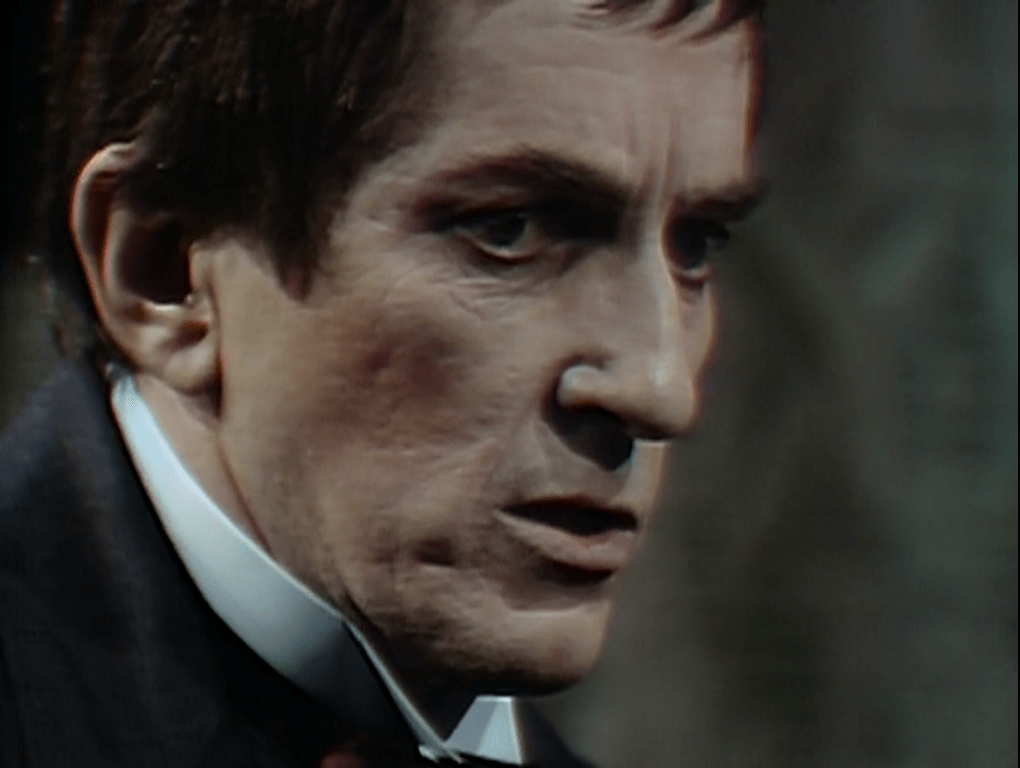
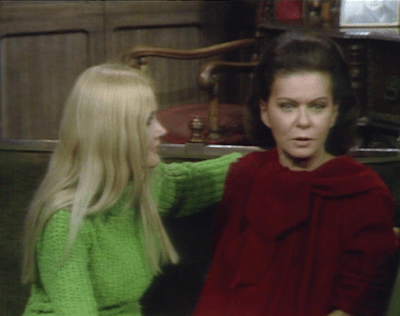
Today, Joan Bennett is in closeup while a recorded monologue in her voice tells us what Judith thinks of Barnabas:

What is happening to all of us? Until Barnabas arrived, everything seemed the same. But what has Barnabas to do with it? Something, something, I’m sure. He knows too much, he’s involved himself so quickly, as if he were the center of it.

Judith trying to figure out Barnabas. Screenshot by Dark Shadows Before I Die.

Had Liz ever thought in those terms for one second, Barnabas would have been exposed and destroyed and Dark Shadows would have gone back to telling stories about the Collins family cannery. But 1897 is a more dynamic setting, in which no one has much time to wonder where Barnabas goes during the daylight hours or why he keeps his cellar door locked.

Today’s great crisis concerns Judith’s brother Quentin and her twelve year old nephew Jamison. Quentin died the other day, which you might expect to mark an ending of sorts. But as it happens, his body is roaming about as a zombie and his spirit has taken possession of Jamison. Yesterday Judith permitted Barnabas to do some mumbo-jumbo that lured Quentin back to his coffin, and, with the help of Judith’s surviving brother Carl, Barnabas buried Quentin and filled the grave with cement. But before the episode was over, Quentin had made his way out of the ground and abducted governess Rachel Drummond. For his part, Jamison is still possessed.

Today, Barnabas announces to Judith that she must let him take Jamison to Quentin’s grave, where he will perform another ceremony. Judith is appalled, as one might expect her to be, but yields to him. By the time Barnabas and Jamison come back to the great house, Judith is entertaining a visitor. He is the Rev’d Mr Gregory Trask.

When longtime viewers see Jerry Lacy wearing a cassock, they will expect to hear Trask’s name and title. Mr Lacy played another Rev’d Trask from December 1967 to March 1968, when Dark Shadows was set in the 1790s, the period when Barnabas first became a vampire. That Trask was a fanatical witchfinder whose zeal was matched only by his ineptitude. Wicked witch Angelique was able to manipulate Trask for her own purposes, and he earned Barnabas’ most cordial hatred.

When Barnabas sees Gregory Trask, he blurts out his surname. Puzzled, Trask asks if they have met. Barnabas does not answer, but immediately begins to display his hostility towards the newcomer. Barnabas is a poor tactician who has a habit of volunteering to his enemies exactly what he thinks of them. His interactions with the first Trask were a case in point, and we see him falling into the same pattern with this second.

Trask has come to Collinwood at the invitation of Judith’s brother Edward, father of Jamison and of nine year old Nora. Just four weeks ago Edward brought Rachel to the great house to be Nora and Jamison’s governess; last we saw, in #715, Edward was optimistic Rachel would work out well in her position. But now he has called Trask to come and take the children away to a school he operates, eliminating the need for a governess.

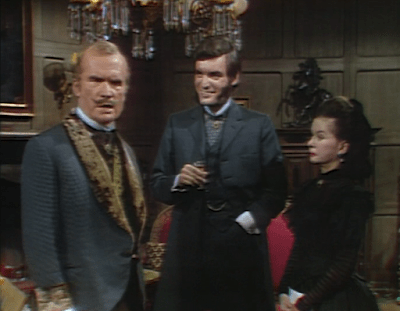
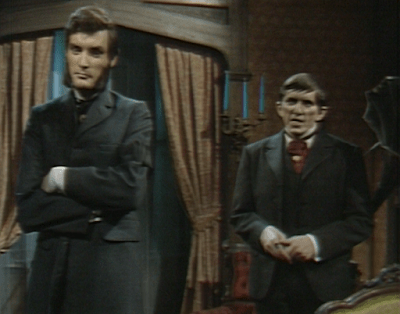
With Quentin lumbering around the house and Jamison spouting off about his possession, Judith and Barnabas cannot keep Trask from figuring out what is going on. He sits Quentin in a chair, intimidates Jamison into kneeling, sends Barnabas and Judith out of the drawing room, and starts praying for help. When Barnabas tries to enter, Trask tells him he can do nothing but help the devil, and slams the doors in his face. Judith and Barnabas are left standing in the foyer, wondering what will happen.

Episode 717: I know what color a lie is

A showcase for the actors today. We begin in the room on top of the tower at the great house on the estate of Collinwood. Madwoman Jenny Collins, who has been locked up in that room for some time, is threatening to stab her sister-in-law Judith with a large pair of scissors. Judith and her brother Edward have been hiding Jenny and trying to keep the rest of the family in the dark about her presence in the house. For services to this secret, they have been paying maidservant Beth Chavez and, we heard in #707, someone named Mrs Fillmore. Beth comes in just in time to distract Jenny with talk about her “babies,” and thereby to prevent her from killing Judith. Jenny turns to some baby dolls, and cuddles them happily.

Judith goes downstairs and encounters newly hired governess Rachel Drummond. Rachel has caught on the someone is living in the tower room, and the other day sneaked up there and let Jenny out. Judith reprimands Rachel for seeing and hearing things that don’t exist. Rachel is a neurotic intellectual. Her insecurities compelled her to investigate the question of the tower room, and also make it plausible that she might eventually cave in to Judith’s attempt to gaslight her into believing that she didn’t really see what she saw.

Rachel goes out, and Beth enters. Judith shows how frustrated she is with the whole situation. This scene is a bit of a letdown. As Judith, Joan Bennett was brilliant opposite Marie Wallace’s Jenny, and brilliant again opposite Kathryn Leigh Scott’s Rachel. But she falls to pieces alone with Terrayne Crawford as Beth. So many of the fansites feature so much grousing about Miss Crawford’s literalist style of acting that I hate to pile on, but it is true that she did not give Bennett anything to play off of. When Miss Crawford delivers a line, its meaning is the dictionary meaning of the words that compose it, no more and no less. She never leaves you wondering what else is going on in Beth’s mind. Sharing a scene with her would be like sharing a scene with a sign labeled “No Right on Red.” Later, Miss Wallace will have a two-scene with Miss Crawford, but as a character in a psychotic state she doesn’t need support. Her lines in that scene are flowery gibberish that don’t work at all, but neither actress is to blame for that.

The master class in acting resumes as we cut to the Old House on the estate. The mysterious Barnabas Collins has recently arrived at Collinwood and is staying in the Old House as the guest of his distant cousins in the great house. Rachel and Barnabas are attracted to each other, and she tells him what has happened. He says that he believes her, and goes on to say that no one at Collinwood is what they seem. She pleasantly replies “Except for you!” He hesitates before agreeing.

More than meets the eye.

In fact, Barnabas has more than five hundred episodes of secrets he is keeping from Rachel and everyone else. Jonathan Frid’s work prior to Dark Shadows was almost entirely on stage, but he used his face like a movie actor, keeping every part of it but his eyes virtually immobile. With that, he can isolate emotions, playing just one feeling at a time. All anyone can see by looking at him in his scenes with Rachel today is that he is anguished. Rachel interprets that anguish as a sign that he cares about her, and she is delighted to think that she has such a straightforward and reliable friend.

Returning viewers know that Barnabas is in fact the most dangerous person Rachel has ever met. That knowledge on our part frees Miss Scott to play Rachel’s relief at Barnabas’ friendliness as broadly as she likes. Her unrestrained display of good cheer brightens the episode’s otherwise somber emotional palette, but the irony the audience finds in a woman having this reaction to Barnabas keeps the dramatic tension high.

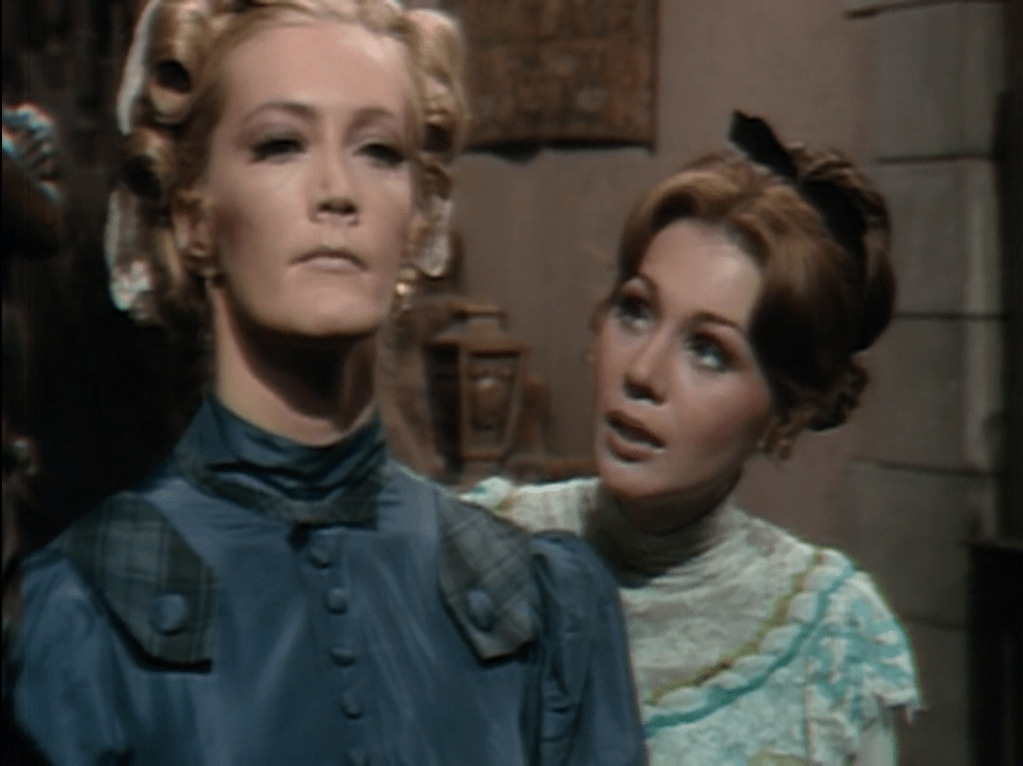
Barnabas walks Rachel back to the great house. They have made a plan that she will bring him the key to the tower room and he will go up there to investigate. She impulsively kisses him on the cheek. Rachel goes in the house and finds to her surprise that Judith is still awake. Judith detains Rachel in the drawing room with a glass of sherry and a lot of disconnected talk. Judith doesn’t make eye contact with Rachel during this scene; she doesn’t want a conversation. She is simply enjoying her new position as head of the household. Rachel cannot get away until Beth enters and Judith abruptly dismisses her.

Barnabas has been watching the windows of the tower room and has seen lights go on and off. Nervous, he considers letting himself into the room without a key; he has the means to do that, but he would like to keep Rachel from knowing about his abilities, and so he resolves to wait for her.

After Rachel brings Barnabas the key, he goes to the tower room and uses it to let himself in. No one is there. He picks up the damaged, severed head of a doll, one of Jenny’s “babies.” Suddenly, he hears someone enter. He turns, and reacts with shock.

Episode 714: The available ladies in the house

One day in the year 1897, Edward, Carl, and Quentin Collins hear their sister Judith read their grandmother’s will. Stuffy Edward and childlike Carl are shocked to find that Judith is the sole heir of their family’s vast holdings. Quentin stole the will and tried to forge a new one, so he is not shocked, but he is weirdly gleeful about the paragraph relating to him. He will receive no property and no income, but will be guaranteed a place to live in the great house of Collinwood forever. This enshrines his relationship with Judith as one of the clearest examples of Dark Shadows’ signature dynamic of Bossy Big Sister and Bratty Little Brother. No matter how atrociously Quentin may behave, no matter how loudly Judith may disapprove of him, she has no authority to punish him and her concern for the family’s good name will compel her to cover up his misdeeds and shelter him from their natural consequences.

Edward flummoxed, Quentin delighted, Judith in charge. Screenshot by Dark Shadows Before I Die.

Meanwhile, governess Rachel Drummond and ladies’ maid Beth Chavez are busy with a mystery concerning the room on top of the tower that stands in the middle of the great house. Rachel has seen lights in the room and suspects someone is being held prisoner there; contrary to the direct orders of Judith and Edward, and against Beth’s very strongly worded advice, Rachel is investigating this matter aggressively. She sneaks up the stairs to the top of the tower, listens at the door to the room, and sees Beth coming out of it with a tray.* She then goes to Beth’s room, where she interrupts Quentin sexually harassing Beth. When she tells Beth what she saw in the tower and asks about it, Beth is shocked that Rachel went into the tower. She denies everything.

Later, Rachel goes back to the top of the tower and again listens at the door. She hears a cradle rocking. We saw that cradle in #645, when Dark Shadows was set in contemporary times and Quentin and Beth were ghosts haunting children David Collins and Amy Jennings. They sent Amy and David to fetch the cradle from the attic of the Old House on the estate and to bring it to Quentin’s old room in the west wing of the great house. This is one of the first times in the 1897 segment when we explicitly close a loop opened during the “Haunting of Collinwood” story.

*At the beginning of the episode, we saw Beth approach the room with the tray and a baby doll. During that scene, we hear what I believe is new music. It has been quite some time since we have heard any new cues, so this stands out.

Episode 713: The heart of the room

Vampire Barnabas Collins returns to his coffin at dawn to find it already occupied. Governess Rachel Drummond is resting there, and is under the impression that she is Barnabas’ lost love Josette. He exclaims that only his old enemy, wicked witch Angelique, could be “monstrous enough” to put Rachel in this position.

Longtime viewers remember that in #248 Barnabas forced Maggie Evans, who like Rachel is played by Kathryn Leigh Scott, into this coffin because she refused to submit to his attempt to brainwash her into thinking she was Josette. So we know that Angelique is not all alone in the ranks of the sufficiently monstrous. On the other hand, we also know that it was Angelique who made Barnabas a vampire in the first place, and that like others who labor under Angelique’s curses he is in many ways a reflection of her. So perhaps his remark is not so preposterous an example of lack of self-awareness as it initially seems.

Shortly after, Rachel comes to in the front parlor of Barnabas’ home, the Old House on the estate of Collinwood, and is puzzled to find herself there with him. She has no idea how she got to the Old House, and certainly has no memory of the coffin in its basement. Barnabas tells Rachel he found her wandering in the woods. She goes to pieces, overwhelmed that she is not in control of her actions. He talks soothingly to her. Rachel collects herself, but is still struggling not to let Barnabas see her cry. He offers to walk her home to the great house on the estate. This offer is sheer bravado on his part- the sun has been up for some time, and he cannot possibly expect to survive outdoors all the way to the great house. Luckily for Barnabas, Rachel declines his offer. Unable to keep her emotions in check any longer, she hurries out the front door, walking herself home.

At the great house, Rachel sees maidservant Beth enter the foyer carrying a baby doll. Rachel says that her charge Nora will like the doll very much. Beth sputters at this remark, and spinster Judith Collins summons Beth to the drawing room. Rachel eavesdrops while Judith scolds Beth for her carelessness. Returning viewers know that Beth is helping Judith and Judith’s brother Edward keep someone prisoner in the room atop the tower of the great house, and that it is hugely important to Judith and Edward that no one knows about this. Beth’s sputtering response to Rachel told us also that the doll is not for Nora, but for this mysterious prisoner. Rachel does not have all the information about the matter that we do, but she has enough to suspect something very much like the truth, so we wonder what she gets out of the conversation she overhears.

Later, Rachel meets Beth in the foyer and urgently pleads with her for information about Edward’s wife, the mother of Nora and of her other charge, Jamison. Beth tells her what Edward has already made abundantly clear, that the topic is utterly forbidden. Rachel sidles up to Beth, bends her head at an angle, and speaks in an urgent whisper, something we have not seen from either Maggie or Miss Scott’s other role, Josette. Indeed, Rachel is quite a fresh character, impressively so from an actress whom longtime viewers already seen for so many hours.

Rachel pleads with Beth for more information.

Judith overhears Rachel’s questioning of Beth and Beth’s response that Rachel should leave the matter alone. Judith dismisses Beth and talks to Rachel, telling her that Beth has given her very good advice. Judith has figured so far as a stern and menacing figure; it is something of a surprise that she does not fire Rachel on the spot, and even more of a surprise that she indicates she will not report the conversation to Edward.

The opening voiceover will tell us in a couple of days that Rachel’s reckless curiosity is “spurred on by her own fears.” Miss Scott has been playing this motivation all along. When we first saw Rachel, she and Edward were in a train station. He was being courteous to her, but she was stiff and awkward, clearly very much afraid of something. She is often seen reading, and her dialogue is both filled with signs of intellectual ambition and delivered with a frantic edge, suggesting that her studiousness has its roots in her attempt to defend herself against some danger. We have no idea as yet what that danger was or how it formed Rachel before we met her, but we know that her reaction to the evidence that she has found that someone is being held prisoner in the tower room at Collinwood is a deepening of her long-established fears, not the sudden appearance of new fear.

For her part, Judith’s main concern is finding her late grandmother’s missing will. The late Mrs Collins kept the provisions of her will secret, and it was stolen shortly after her death by some people who wanted to forge a new will and get the estate for themselves.

A woman named Magda Rákóczi shows up at the house, claiming to be able to help Judith find the will. Judith is violently prejudiced against Magda for her Romani ethnicity, and dismisses her offer of help out of hand. But Magda persists. Knowing that her grandmother had a fondness for Magda, Judith lets her into the drawing room and sits behind her while she reads the tarot. Judith keeps protesting that the previous cases Magda cites as evidence that the tarot can tell the future prove nothing, and that in her interpretations of them she is “making no sense whatsoever.”

Magda then says that the arrangement of the cards means that the will is hidden in the room where Judith’s grandmother died, in “the heart of the room.” In an entirely different voice than she has been using so far, Judith asks “What is meant by the heart of the room?” With that, Magda knows that she has Judith in the palm of her hand, and she starts to ham it up. “The hearrrt of the roooom… is a booook! A book that was very important to your grandmother! A very, very oooolld booook!” Judith decides this must be the family history, and she tells Magda that she will look through it at once.

Magda goes over the top. Screenshot by Dark Shadows Before I Die.

In fact, Barnabas found the will and hid it in the family history. He has sent Magda to tell Judith where to find it. It comes as no surprise to us when Judith comes downstairs with the will and is jubilant to find that she is the sole heir of her grandmother’s vast holdings. After all, Barnabas wants the original provisions of the will to be enacted, and the only way to ensure that result is to see that it comes to the hand of the person who is its chief beneficiary.

We end with Beth standing at the door to the tower room, holding the doll and addressing the person inside as “Jenny.” We learned in #701 that Beth was originally maid to a lady named Jenny, that everyone thinks Jenny has gone away, and that it is surprising Beth has stayed on at the house in Jenny’s absence. Now it is confirmed that Jenny is the prisoner in the tower room. The obvious inference is that Jenny is Edward’s estranged wife, and that she has become the sort of crazy lady who appreciates baby dolls.

Episode 709: You are the ghost

Vampire Barnabas Collins has traveled back in time to the year 1897 where he hopes to prevent his distant cousin, libertine Quentin, from becoming a ghost who will ruin things for everyone in 1969. Barnabas knows that if events play out as they did originally, Quentin will die soon. He tells him today that it is his understanding that people become ghosts when they leave unfinished business behind them. He does not know what business Quentin originally left unfinished, or how he can keep him from dying without finishing it on this iteration of the timeline. So you might think that his first priority would be to get as close as possible to Quentin and learn as much as he can about what he wants.

Instead of doing this, Barnabas has gone out of his way to antagonize Quentin by accusing him of stealing his grandmother Edith’s will. Quentin and his siblings are all frenziedly searching for the will, but it is of no concern to Barnabas. Edith cannot possibly have left him any money, and he knows that the original timeline worked out so that the Collins family assets wound up in the hands of people who were oblivious to his sinister nature and happy to let him make his home on their estate. Showing interest in the will can do nothing but raise suspicions as to who this stranger really is and why he showed up when he did.

Barnabas confronts Quentin. Screenshot by Dark Shadows Before I Die.

Quentin did in fact steal the will. Edith’s ghost may be at work in the house- her glove mysteriously shows up in the corridor near Quentin’s room, the furniture in the room is turned upside down, and before the end of the episode Quentin alone can hear the pounding of an enormously amplified heartbeat emanating from the walls of his room. But Quentin accuses Barnabas of planting the glove and disordering his room, and in #538 we saw that Barnabas is capable of making people with guilty consciences have hallucinations of just this kind. Barnabas is also frequently seen reading, and it is certainly possible he might have read Edgar Allan Poe’s “Tell-Tale Heart” and decided to make it come to life. He may not even have needed to read the story- we saw in #442 that in 1796, early in his career as a vampire, he bricked up an enemy of his in the style Poe would describe in his 1846 story “The Cask of Amontillado.” Evidently his imagination and Poe’s ran along similar lines.

Barnabas meets governess Rachel Drummond. He is immediately attracted to Rachel, unsurprising since she is played by the lovely Kathryn Leigh Scott. He tells Rachel that she strongly resembles the portrait of Josette Collins, and he relates some facts about Josette’s life and death that did not make it into the family history. Indeed, Miss Scott played Josette in the part of Dark Shadows set in the 1790s.

Yesterday, Barnabas met unethical lawyer Evan Hanley, played by Humbert Allen Astredo. His reaction to Evan was not inappropriate, but the same reaction would also have been fitting had Barnabas thought Evan was Astredo’s previous character, warlock Nicholas Blair. This may have reminded longtime viewers of the 1790s segment, when time-traveling governess Vicki alienated the audience by time and again telling the characters that they were being played by actors who had other parts in the first 73 weeks of the show. Do the characters not look alike to Barnabas, or does he simply have the presence of mind not to waste everyone’s time with tedious drivel about who used to be who? We now know that in Rachel’s case, at least, it is the latter.

Quentin has a scene with his sister Judith in which he tells her that he did not like to play with her when they were children, because she was a “scaredy-cat.” Joan Bennett was 31 years old when David Selby was born, a fact of which the original audience would have been well aware since she was already a major star of motion pictures at the time. Indeed, her father Richard Bennett had been so big on Broadway that her birth was announced on the front pages of the New York papers, so that she never bothered to be coy about her age. But she and Mr Selby are such strong actors that it doesn’t raise an eyebrow when we hear that Judith and Quentin were children together.

Not everyone we see today merits such high praise, alas. Executive producer Dan Curtis was friendly with a man called Roger Davis, and he often let Mr Davis come on the set of Dark Shadows and assault the actors while they were trying to work. Unfortunately this happens today. Mr Davis is usually presented as if he were himself an actor playing a part. His idea of acting is simple enough. For example, he was once supposed to play a character named Jeff Clark, and his approach involved shouting “My name is Jeff Clark!” every episode or two. More recently, he was credited with a role called Ned Stuart, and he went around saying “My name is Ned Stuart!” That’s one way of attempting characterization, I suppose.

Today he is supposed to be someone named Dirk Wilkins. Regular viewers keep waiting for him to yell “My name is Dirk Wilkins!,” but he neglects to do so. He has a mustache, perhaps he thought that was sufficient. He finds Terry Crawford playing maidservant Beth Chavez, grabs her and yells in her face. Mr Selby interrupts this encounter. In character as Quentin, he makes some flip remarks and walks away, and Mr Davis resumes abusing Ms Crawford. Later he finds Ms Crawford on another set and grabs her again. Finally he walks into the set representing Quentin’s room while David Selby is trying to show us Quentin’s panicked response to the sound of the heartbeat. Mr Davis makes some nasty remarks, and when Mr Selby tries to involve him in the scene by tussling with him as Quentin might under those circumstances, it looks like Mr Davis gives him a real punch in the midsection. Mr Selby goes on acting, but the assault takes the audience out of the story. The ABC network really should have posted security guards outside the studio to keep this sort of thing from happening.

Episode 672: And it was my mother’s voice

Today, everyone has the memory of a goldfish. Heiress Carolyn receives a telepathic message from her mother, the apparently-dead Liz, urging her to go home to the great house of Collinwood and stay inside in order to escape a terrible danger. A few minutes later, she has apparently forgotten the content of this message, as she goes back outside to check on Liz in her coffin.

During her brief stay in Collinwood, Carolyn talked with permanent houseguest Julia. Julia keeps telling her that Liz is dead and that the dead cannot communicate with the living, suggesting that she too has become a goldfish. Julia is a doctor, and Liz is entombed because she mistakenly declared her dead. She had made the same mistake about her several weeks before, and learned nothing from that experience. But she has also attended several séances, built two Frankenstein’s monsters, seen a number of ghosts, and spent a year and a half carrying on a one-sided romance with recovering vampire Barnabas. She also knows that in #592 and #593, Carolyn herself died and came back to life. So it is bizarre that she goes on about the finality of death and the impossibility of communication between the living and the dead.

Carolyn goes back to her mother’s crypt and is attacked by a werewolf. Liz knew she would be buried alive, and so insisted her coffin be equipped with a button that would ring bells everyone at Collinwood could hear. While Carolyn is confronting the werewolf, Liz overcomes her paralysis sufficiently to push this button. That brings Barnabas and Julia.

The werewolf paused in his attack on Carolyn when he saw her silver bracelet; that gave Julia and Barnabas time to arrive while Carolyn was still alive. Barnabas strikes him with the silver head of his cane, causing him to run off. When Carolyn tells of the werewolf’s fascination with the bracelet, Barnabas mentions that the head of the cane is also silver; he grows very thoughtful, apparently realizing that silver has a power over the werewolf. Yet later, when he goes to hunt for the werewolf, he takes a gun but nearly leaves the cane behind. He finally takes it, but his long hesitation shows that he, too, is suffering from goldfishism.

While still in the crypt, Julia had looked at Liz’ body and insisted she was dead. She wrote off the ringing of the bells as a coincidence, perhaps caused by some jostling during Carolyn’s encounter with the werewolf. Later, Liz gets out of the coffin and goes home to Collinwood. There, Julia, Barnabas, and Carolyn are astonished to see her. Julia examines her. After she finds that Liz has what is in Collinsport English called a “pulsebeat,” she seems willing to concede that she might be alive. She then starts giving orders which everyone willingly follows, because she is such a good doctor.

Liz remembers. Screenshot by Dark Shadows Before I Die.

Liz is the one character whose brain seems to be in working order today. She can remember that her trouble started when her brother Roger’s wife Cassandra cast a spell on her. Barnabas and Julia know that Cassandra was in fact a wicked witch named Angelique, and that Barnabas has just returned from a trip back in time during which he destroyed Angelique. They assure her that Cassandra will never return. They can’t tell her why they are sure of this, because they, like the producers of Dark Shadows, have decided that Liz must never know what is really happening around her, lest she become an active participant in the plot. So all they can say is that they just know, and she is of course unconvinced.

It is a relief to wrap up the “Liz will be buried alive” storyline; that was dull from the beginning, and just got duller as it went. It didn’t help that we have seen Liz immobilized by depression twice before. This isn’t even the first time she has been rendered catatonic as the result of a curse placed by an undead blonde fire witch.

It’s also encouraging that Julia and Barnabas have met the werewolf and are engaged with him. They are the show’s chief protagonists, and nothing can really move without their involvement. Now that they are involved with the werewolf, we can stop spinning our wheels.

Episode 671: We promised Maggie we’d be good children

An extraordinarily uneventful outing. In yesterday’s episode it looked like heiress Carolyn would go to visit Chris the werewolf as he is in the middle of a transformation and would be attacked. But she didn’t go. Governess Maggie did go to Chris’ cottage, and at the end of the episode it looked like she might be attacked. As we open today, she is there and he is about to change, but she leaves and gets home safely while he is still in human form.

It again looks like Carolyn might be attacked when she walks through the woods to visit the mausoleum where her mother, matriarch Liz, is entombed. Liz was alive when she was mistakenly buried and is still alive now. Liz is unable to move or speak, but she somehow shares the audience’s thought that Carolyn might possibly be attacked. We see her in her coffin and hear her interior monologue as she thinks about the “terrible danger” her daughter is in.

As it happens, Carolyn makes it home fine. Later she goes out again; we see the werewolf prowling nearby, again raising the theoretical possibility that she will be attacked. But Carolyn hears Liz’ voice in her head, a telepathic warning that she should hasten off. The werewolf also reacts as if he can hear Liz’ voice, and he goes off in another direction. The screen goes dark and the credits start rolling. The werewolf hasn’t attacked anyone and no one has learned anything about him.

It appears that the werewolf is trying to figure out where Liz’ voice is coming from.

It’s kind of interesting that Liz can transmit telepathic messages now. She could use a supernatural power or two if she’s going to get into the swing of things on the show. It’s also interesting that the werewolf seems to be able to overhear the messages Liz sends to Carolyn. Chris’ little sister Amy lives in the great house of Collinwood now, and along with strange and troubled boy David she is falling under the power of the evil ghost of Quentin Collins. Quentin communicated with Amy before he could get through to David. David was miffed by this, since “Quentin is my ancestor.” That suggested that Quentin will turn out to be Amy’s ancestor as well, making her and Chris members of the Collins family. If so, that might explain why Chris, even in his lupine form, was able to pick up a telepathic transmission Liz directed to her blood relatives.

There is a wardrobe malfunction in this one of a type that showed up several times in the first year of the show. When Carolyn makes her first entrance, she walks down the stairs in the foyer. At each step, Nancy Barrett’s chest thrusts into her sweater with results that would probably not have made it on the air had anyone from the ABC network’s office of Standards and Practices been watching the show. In the early days, they put the actresses into very form-fitting tops often enough that I thought they were challenging the audience to take an adult attitude towards female anatomy, and so I did my best to rise to that challenge by leaving it unremarked when we could see the exact shape of their breasts. But it’s a rare occurrence now, so I think we have to list it among production faults.

Episode 662: The course of history

Vampire Barnabas Collins has traveled back in time to the year 1796, where he plans to change what happened on one crucial night.

Yesterday’s episode was a clip show excerpted from #456-#460, the last full week of a period when Dark Shadows was a costume drama set in the 1790s. Today’s consists largely of reenactments of those scenes. It all pays off in the last minute, when a confrontation between Barnabas and roguish naval officer Nathan Forbes ends differently than it had the first time round. As before, Nathan loads a crossbow with a wooden bolt and waits for Barnabas to come to him, hoping that he will shoot the bolt through Barnabas’ heart and thereby achieve the same effect as a wooden stake. The first time, Nathan missed Barnabas’ heart and Barnabas killed him. Unlike the first time, Barnabas knows what Nathan is planning. So he opens the door, but does not enter the room. Nathan can hear Barnabas’ voice, but cannot see him. Finally Barnabas jumps Nathan from behind, evidently biting him.

Barnabas originally killed Nathan as revenge for Nathan’s role in his mother’s death. This time he is willing to let Nathan live. He wants to take control of him and force him to tell the authorities that he lied when he testified against governess Victoria Winters and her boyfriend, an unpleasant man named Peter. Victoria is herself a time-traveler, and Barnabas got to be quite fond of her in her original period, the 1960s. She is scheduled to be hanged tonight for her many crimes, and Peter is also condemned to the gallows. Barnabas has come to rescue them.

During the opening title sequence, Thayer David announces that “Today the part of Victoria Winters will be played by Carolyn Groves.” When we first see her, Victoria is asleep in her cell at the Collinsport gaol, and her face looks very much like that of Alexandra Moltke Isles, the original Victoria.

A rude awakening for Vicki C. Screenshot by Dark Shadows Before I Die.

Barnabas wakes Victoria. She is puzzled to see him. He has never told her that he was a vampire; even when he was biting her on the neck and sucking her blood for a week in March 1968, she didn’t seem to catch on. She just seemed to think he had a particularly aggressive make-out technique. She thinks that the Barnabas she knew in the 1960s was a descendant of the one she knew in the 1790s, and that the one from the 1790s is dead. Barnabas would rather not get into the weeds about his personal history, such as the countless murders he has committed, and gives Victoria a truncated account of how he, the man from the 1790s, is laboring under a curse that made it seem that he was dead. He doesn’t explain how he got into her cell, how he knows who Peter is, or how he plans to free the two of them from their death sentences. He asks her to take all of that on faith.

Miss Groves plays Victoria as so happy to see Barnabas she smiles all through her account of her imminent and, she believes, inevitable execution. That’s odd to see, but it fits so perfectly with the delight Victoria always took in Barnabas’ company that it shouldn’t bother longtime viewers.

Mrs Isles was cast as the original Victoria in large part because she looked so much like Joan Bennett that Bennett famously mistook her for her daughter when she first saw her. In the Collinsport Historical Society’s 30 December 2017 post for this episode, Patrick McCray not only tells us that Miss Groves appeared in a play with Joan Bennett in 1960, but provides a still of the cast in which the two women look like they could be mother and daughter:

Screenshot from The Collinsport Historical Society, 30 December 2017.

The show spent much of its first year hinting heavily that Victoria was the unacknowledged daughter of Bennett’s character, matriarch Elizabeth Collins Stoddard. They never collected those hints and built them into a story, and the question of Victoria’s parentage was left as one of Dark Shadows’ most annoying loose ends. Perhaps Miss Groves’ casting is a sign that the failure to resolve that question bothered the makers of the show as much as it did the audience.

Episode 644: Well that was a waste of time

There is some reason to believe that writer Ron Sproat was disaffected from the rest of the production staff at this time. Today’s script is so unbelievably bad that it is tempting to think he wrote it as an act of protest.

Children Amy and David have gone looking for the ghost of Quentin Collins and are now trapped in a room in the long deserted west wing of the great house of Collinwood. David’s father Roger, his aunt Liz, and his cousin Carolyn are moving about the house in a conga line trying to find them.

Quentin’s ghost is keeping the children locked up; the ghost of someone named Magda is trying to lead the adults to rescue them. At one point the adults watch a mirror while letters appear on it spelling out “Jamison,” the name of Liz and Roger’s father. This is plainly a supernatural manifestation, but it advances neither Magda’s goal nor Quentin’s. Perhaps Jamison’s ghost can’t rest with all the racket Quentin and Magda are making, and he just wants to say hello.

Hi, kids, it’s grandpa! Screenshot by Dark Shadows Before I Die.

In the locked room, David bangs on a wall, finds it is hollow, and speculates about what is on the other side. Amy protests “We can’t go through a wall!” In response, he again bangs on the wall, again finds it hollow, again speculates about what’s on the other side, and Amy again protests “We can’t go through a wall!” Later in the episode, they start this scene a third time, but they stop before Amy has another chance to say “We can’t go through a wall!” It’s just as well she does stop short of saying this a third time. By the end of the episode, they’ve found a crowbar, which enables them to pry the paneling open and go through the wall quite easily.

Meanwhile, the adults have progressed to the drawing room, where they argue about whether to search the west wing. They troop upstairs and find the door to that part of the house locked. This leads them to conclude that David and Amy can’t have gone in there, and the parade goes back to the drawing room. There, they again argue about whether to search the west wing. They again troop upstairs, this time unlocking the door and conducting the search. After they fail to find the children, they return to the drawing room again, where Roger speaks for all of us when he says “Well, that was a waste of time.”

When the adults were shuffling around huddled in their little clump, I found it hard not to look at Liz’ face and see Joan Bennett thinking that she used to be a big movie star and now she’s reduced to this stage business that would have embarrassed the Three Stooges. This week’s episodes were directed by a mysterious figure billed as “Penberry Jones”; whoever Jones was, I don’t think s/he was to blame for the weird little parade the adult characters keep making through the house. The script calls for the actors to talk with each other constantly while walking together through narrow, awkward spaces such as stairways, darkened corridors, and a cluttered store-room, and so it would have taken more time than they had to choreograph a more fluid set of movements.

David and Amy hear a waltz. It has a creaky sound to it, as though it were being played on an old gramophone. This is introduced as a special effect. Unfortunately, Dark Shadows introduces special effects by ramping up the background music, so when the children first talk about the waltz we can barely hear it. After a commercial break, the background music calms down and the waltz is more audible. We will hear it a great many times over the next several months, so often that it will be ironic to think that there was a time when we wanted to hear it but could not. I suppose Penberry Jones probably did have the discretion to tone down the accompaniment, so that would be one strike against him or her.

Longtime viewers will notice a small deviation from continuity when David tells Amy that ghosts come out only at night. In the first year of the show, David often saw the ghost of the gracious Josette in the Old House of Collinwood during the day, and from June to November 1967 he and the ghost of nine year old Sarah played together in the sunlight several times.

Episode 638: Red Riding Hood

Maggie Evans, The Nicest Girl in Town, is visiting the great house of Collinwood to sit with her sick friend Vicki. There, she meets mysterious drifter Chris Jennings. Maggie is furious with Chris, because he refuses to stay in Collinsport and take his little sister Amy in. Ever since their brother Tom died, Amy has been living at Windcliff, a mental hospital 100 miles north of town. Chris won’t explain to Maggie or anyone else why he keeps moving.

Julia Hoffman, MD, is the director of Windcliff, and she has been a permanent houseguest at Collinwood since last summer. Julia comes downstairs, and finds Maggie still reading the Riot Act to Chris. When she tells Maggie that Vicki is ready to see her, Maggie looks contemptuously at Chris, exclaims “Good!,” and stalks out.

Julia picks up where Maggie left off. Chris tells her he came to Collinwood to give her some money to pass on to Amy; Julia gives the money back to him, and says “She doesn’t need money, she needs you!” Chris won’t tell Julia where he is going or why. She asks if he will at least stop at the hospital on his way out; he says he will not.

In #632, we saw Chris visit Amy at Windcliff. Also in that episode, it became very clear that Chris is a werewolf. Returning viewers who remember that about him also know that Julia is an expert in vampires and Frankensteins with secondary interests in ghosts and witches, so if Chris came clean with her she might well have a prescription for him. But wherever Chris has been wandering, it isn’t a market where the ABC affiliate runs Dark Shadows, so he misses his opportunity to seek specialist medical attention.

Vicki has some symptoms that require Julia’s attention. On her way upstairs, she asks Chris not to leave before she comes back, since she has some more scolding to do. When Julia does come back down, she gets a telephone call from Windcliff. Amy has run away. She asks where Chris is, only to find that he did not comply with her request.

Matriarch Liz decides to go to the Old House on the estate, home of her distant cousin Barnabas. She explains that Barnabas and Vicki have always been close, so that she thinks he might be able to help calm her. Julia apologizes that she can’t accompany Liz on the walk through the woods, explaining that she has to wait by the telephone in case Windcliff calls again.

Liz is wearing a bright red dress we haven’t seen before, and as she leaves the house she puts on a bright red coat that is also new. This striking ensemble makes her look very much like Red Riding Hood. We see Chris skulking in the woods as Liz is walking nearby; he isn’t wearing character makeup, but is bending down and panting, suggesting The Big Bad Wolf. Liz hears him and calls out, asking who is there. She is looking into the camera, a look of alarm growing on her face, while we zoom in on her. Growling, snarling noises play on the soundtrack, suggesting that our point of view is that of the attacking werewolf. Liz has been a major character since episode #1; also introduced in #1 was the keeper of the Collinsport Inn, Mr Wells, whom we saw the werewolf brutally kill in #632. The show has been dropping major characters from the story and important actors from the cast recently, so it is not in fact impossible that this might really be the death of Liz.

Red Riding Hood from the Big Bad Wolf’s point of view. Screenshot by Dark Shadows Before I Die.

When I was a teenager and first started reading long books, page 638 was always a milestone for me. When I’d read page 638, I was always sure I would make it to the end, no matter how many pages were left. Ever since, 638 has been my lucky number. I can’t claim to be certain I will carry this blog all the way to #1245-WordPress has been getting steadily buggier lately, blogging itself is an increasingly old-fashioned pastime, and who knows what might happen to me between now and April of 2027- but it does give me a boost to have reached this point.