Vampire Barnabas Collins has traveled back in time to the year 1897 where he hopes to prevent his distant cousin, libertine Quentin, from becoming a ghost who will ruin things for everyone in 1969. Barnabas knows that if events play out as they did originally, Quentin will die soon. He tells him today that it is his understanding that people become ghosts when they leave unfinished business behind them. He does not know what business Quentin originally left unfinished, or how he can keep him from dying without finishing it on this iteration of the timeline. So you might think that his first priority would be to get as close as possible to Quentin and learn as much as he can about what he wants.
Instead of doing this, Barnabas has gone out of his way to antagonize Quentin by accusing him of stealing his grandmother Edith’s will. Quentin and his siblings are all frenziedly searching for the will, but it is of no concern to Barnabas. Edith cannot possibly have left him any money, and he knows that the original timeline worked out so that the Collins family assets wound up in the hands of people who were oblivious to his sinister nature and happy to let him make his home on their estate. Showing interest in the will can do nothing but raise suspicions as to who this stranger really is and why he showed up when he did.
Quentin did in fact steal the will. Edith’s ghost may be at work in the house- her glove mysteriously shows up in the corridor near Quentin’s room, the furniture in the room is turned upside down, and before the end of the episode Quentin alone can hear the pounding of an enormously amplified heartbeat emanating from the walls of his room. But Quentin accuses Barnabas of planting the glove and disordering his room, and in #538 we saw that Barnabas is capable of making people with guilty consciences have hallucinations of just this kind. Barnabas is also frequently seen reading, and it is certainly possible he might have read Edgar Allan Poe’s “Tell-Tale Heart” and decided to make it come to life. He may not even have needed to read the story- we saw in #442 that in 1796, early in his career as a vampire, he bricked up an enemy of his in the style Poe would describe in his 1846 story “The Cask of Amontillado.” Evidently his imagination and Poe’s ran along similar lines.
Barnabas meets governess Rachel Drummond. He is immediately attracted to Rachel, unsurprising since she is played by the lovely Kathryn Leigh Scott. He tells Rachel that she strongly resembles the portrait of Josette Collins, and he relates some facts about Josette’s life and death that did not make it into the family history. Indeed, Miss Scott played Josette in the part of Dark Shadows set in the 1790s.
Yesterday, Barnabas met unethical lawyer Evan Hanley, played by Humbert Allen Astredo. His reaction to Evan was not inappropriate, but the same reaction would also have been fitting had Barnabas thought Evan was Astredo’s previous character, warlock Nicholas Blair. This may have reminded longtime viewers of the 1790s segment, when time-traveling governess Vicki alienated the audience by time and again telling the characters that they were being played by actors who had other parts in the first 73 weeks of the show. Do the characters not look alike to Barnabas, or does he simply have the presence of mind not to waste everyone’s time with tedious drivel about who used to be who? We now know that in Rachel’s case, at least, it is the latter.
Quentin has a scene with his sister Judith in which he tells her that he did not like to play with her when they were children, because she was a “scaredy-cat.” Joan Bennett was 31 years old when David Selby was born, a fact of which the original audience would have been well aware since she was already a major star of motion pictures at the time. Indeed, her father Richard Bennett had been so big on Broadway that her birth was announced on the front pages of the New York papers, so that she never bothered to be coy about her age. But she and Mr Selby are such strong actors that it doesn’t raise an eyebrow when we hear that Judith and Quentin were children together.
Not everyone we see today merits such high praise, alas. Executive producer Dan Curtis was friendly with a man called Roger Davis, and he often let Mr Davis come on the set of Dark Shadows and assault the actors while they were trying to work. Unfortunately this happens today. Mr Davis is usually presented as if he were himself an actor playing a part. His idea of acting is simple enough. For example, he was once supposed to play a character named Jeff Clark, and his approach involved shouting “My name is Jeff Clark!” every episode or two. More recently, he was credited with a role called Ned Stuart, and he went around saying “My name is Ned Stuart!” That’s one way of attempting characterization, I suppose.
Today he is supposed to be someone named Dirk Wilkins. Regular viewers keep waiting for him to yell “My name is Dirk Wilkins!,” but he neglects to do so. He has a mustache, perhaps he thought that was sufficient. He finds Terry Crawford playing maidservant Beth Chavez, grabs her and yells in her face. Mr Selby interrupts this encounter. In character as Quentin, he makes some flip remarks and walks away, and Mr Davis resumes abusing Ms Crawford. Later he finds Ms Crawford on another set and grabs her again. Finally he walks into the set representing Quentin’s room while David Selby is trying to show us Quentin’s panicked response to the sound of the heartbeat. Mr Davis makes some nasty remarks, and when Mr Selby tries to involve him in the scene by tussling with him as Quentin might under those circumstances, it looks like Mr Davis gives him a real punch in the midsection. Mr Selby goes on acting, but the assault takes the audience out of the story. The ABC network really should have posted security guards outside the studio to keep this sort of thing from happening.
Three of the residents of the great house of Collinwood in the year 1897 are spinster Judith Collins, her brother, libertine Quentin Collins, and their grandmother, nonagenarian Edith Collins. At the opening of today’s episode, Judith walks in on Quentin strangling Edith in her bed. She tells him to stop it and leave the room. He complies, with a sulk. Edith shakes off her annoyance with Quentin, and she and Judith have a conversation about various matters.
One of Dark Shadows’ signature relationships is that between Bossy Big Sister and Bratty Little Brother. However serious the misconduct Bratty Little Brother commits in his disobedience to Bossy Big Sister, in the end she will cover it up and protect him from its consequences. Nothing at all will happen to Quentin as a result of his attempt on his grandmother’s life; Judith will just continue disapproving of him, as she has always done. Later in the episode, Quentin will remark to his recently arrived and quite mysterious distant cousin Barnabas Collins that Judith “gets carried away by delusions of authority. The fact is, she has no authority whatsoever.” Judith overhears this and objects to it, but Quentin’s presence in the house suffices to prove that her manner is not an expression of authority, but simply childlike role-playing.
Quentin’s motive for his attack on dear old grand-mama was his demand that she tell him the family’s “secret.” Edith has declared that she will pass this secret on only to Edward, who is Judith and Quentin’s eldest sibling. Edward is away, and Edith is terribly afraid she will die before he returns. After Judith shoos Quentin out of Edith’s room, she herself tries to wheedle Edith into telling her the secret. Edith tells Judith she is better off not knowing, but Judith does not seem to be convinced. Quentin has said in so many words that his only desire is to take control of the family’s wealth, and Judith is focused on preventing him from doing that. So we can assume that their frantic eagerness to learn the secret is rooted in the belief that the person who knows it will inherit the estate from Edith.
We see Edward. He is not at Collinwood, or even in the village of Collinsport. If I recall correctly, this is the first time the show has taken us anyplace out of town other than the mental hospital since we visited Phoenix, Arizona in #174, more than two years ago.
Edward is in a train station, impatient and irritable, talking with a young woman whose rigid posture and blank facial expression show that she is exceedingly uncomfortable. Her name is Rachel Drummond, and she is to be the new governess for Edward’s son and daughter. He says that he means for her to use her own judgment in making up their curriculum. Rachel says she will have a clearer idea of what her approach will be once she has met the children and Edward’s wife. Edward freezes, and says that he has no wife. Rachel apologizes for her assumption; he says that she has no need to do that, as he had given her no way of knowing about the situation. In a soft voice, Rachel asks about Mrs Collins’ death; Edward replies that “Mrs Collins no longer exists” and that is all he will be saying about the topic. Rachel asks how she should respond if the children ask about their mother; Edward tells her to say that she is away, nothing more.
Back at Collinwood, a recently arrived visitor named Barnabas Collins comes calling with a gift for Edith. It is a piece of jewelry that he inherited from Naomi Collins, whom he identifies as his great-great-great-grandmother. Judith accompanies him to Edith’s bedroom.
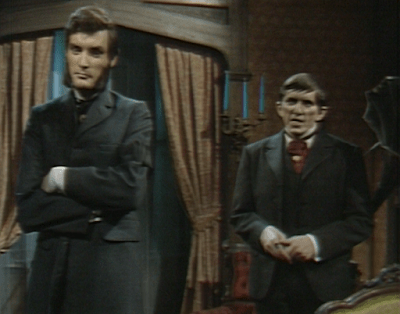
Meanwhile, Edward lets himself and Rachel in the front door. He is carrying their bags and grumbling about the lack of servants. Quentin enters. Edward is shocked that his ne’er-do-well brother has returned to the house from which he was banished a year ago, he hoped forever. He has little to say as Quentin teases him and Rachel, saying that she is too pretty to be either the new governess or Edward’s new wife. He asks if she is Edward’s mistress, angering him and making the already unhappy Rachel quite miserable. She says she is the new governess. Quentin asks if she is married. Edward erupts with “Would it make any difference to you if she were?” In the wake of the painful exchange about Edward’s wife no longer existing, this carries a suggestion that makes Rachel’s position even more difficult. Edward realizes what he has said and falls into a horrified silence.
Edward asks Rachel to excuse him and Quentin while they have a private talk. She has nowhere to go; she has not been shown around the house or told which areas she is free to enter, so all she can do is sit quietly in the foyer. Still, that would appear to be an improvement over the endless cascade of awkward exchanges she has had so far, and so she agrees without protest.
While Edward reads Quentin the Riot Act in the drawing room, Judith shows Barnabas into Edith’s room. The room is darkened so that only the outlines of their figures are visible. Judith opens the curtains to let the moonlight in, and sees Edward’s carriage outside. She hurries down to fetch Edward, leaving Barnabas alone with Edith.
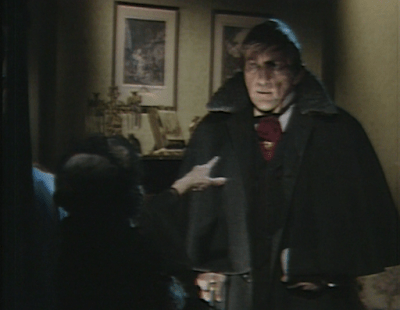
Edith asks his name. When he says that he is called Barnabas Collins, she is startled. She sits up and uneasily asks him to step into the light so she can see his face. She reacts with horror. “You! You are the secret!” she exclaims. “Passed down from one generation to the other! You were never to be let out! We have failed! We have failed!” He approaches her. “Don’t come near me! I know what you are!”
When Dark Shadows premiered, the Collinses of 1966 had three big secrets. Matriarch Elizabeth Collins Stoddard had summoned a young woman who had never heard of her or of Collinwood, Victoria Winters, to be governess to her nephew David. Vicki was trying to find out who her biological parents were and why she was left at a foundling home as an infant; the show hinted heavily that Liz was her mother, but dropped that without any resolution. Also, Liz hadn’t left the house for 18 years. That turned out to be because she thought she killed her husband and that his body was buried in the basement. After 55 weeks of that story, it turned out she hadn’t killed him at all, and within days they forgot about the whole thing forever. The third secret was about Liz’ brother Roger. A man named Burke Devlin thought Roger had framed him on the manslaughter charge that cost him five years in prison, and vowed to destroy the Collinses in revenge. After 40 weeks, Burke forced Roger to confess that his suspicions were correct, but by that time Burke had decided to let bygones be bygones and that story also vanished with barely a trace.
With that record, all the talk about “the secret” that we hear when we first arrive in 1897 might make longtime viewers apprehensive that there will be another interminable guessing game that peters out with little or no resolution. But the show has changed. This secret is not only revealed to us within a week, it is a forceful and elegant solution to a major problem.
Barnabas is a time traveler from the 1960s. He has come back by means of some mumbo-jumbo to prevent Quentin’s ghost from haunting Collinwood and making life impossible for the Collins family in the year 1969. He is also a vampire. He originally lived in the 1790s, and Naomi was his mother, not his great-great-great-grandmother. A would-be thief accidentally freed him to prey on the living in April 1967; he managed to conceal his true nature from his living relatives, and in March 1968 he was freed from the effects of the vampire curse. When he came to this period, he found himself once more an undead abomination.
Barnabas has no idea why Quentin’s ghost has become such a problem in 1969, no idea how to investigate the question, and no idea what, if anything, he will be able to do to correct matters if he somehow does manage to find the answer. Since events are moving very fast in 1897, everyone there is deeply and intricately involved with everyone else, and Barnabas is a stranger, there is a distinct possibility that he will be sidelined. That happened to Vicki when she left November 1967 and found herself in the year 1795; by the time the show returned to contemporary dress four months later, she had been an ineffectual ninny for so long that she had lost the loyalty of the audience, never to regain it. As a vampire, Barnabas could make his way to the center of the story by killing everyone, but that would tend to create a narrative cul-de-sac. So Dark Shadows is taking an enormous risk with its star by putting him in this situation.
When Edith tells Barnabas that he is the secret, at one stroke she puts him at the center of the story, connects the part of the show set in 1897 with that set in 1795, and raises a whole set of questions about how the events of those two periods led to what we have seen in the parts set in the 1960s. She electrifies the audience with the promise of an entirely new kind of show.
She also answers a minor, but potentially nagging question. From #204 on, we saw that Barnabas’ portrait hangs beside the entrance to the great house, and we are repeatedly told that it has been there as long as anyone can remember. The Collinses know that the man who sat for it was a cousin of their direct ancestor, and believe that he left for England in the 1790s, never to return. Why display the portrait of so distant a relative in so prominent a place for so long?
Edith’s recognition of Barnabas tells us why. She has studied the portrait for as long as she has known the secret, and when he comes into the light she can see at once that he is its subject. The portrait was therefore meant to help the keeper of the secret defend the family against Barnabas. It actually had the opposite effect. In 1967 and again on his arrival at the great house this week, Barnabas appealed to his resemblance to the portrait as evidence that he was a descendant of “the original Barnabas Collins,” and so persuaded the living members of the family to let him make his home in the Old House on the estate.
The opening voiceover today is the same we heard yesterday and the day before. I do not believe they had ever replayed an opening voiceover even once prior to this; I’m sure they had never done so twice. This one just tells you that Barnabas has traveled back in time, and it is now 1897. Repeating it doesn’t hurt anything, but I do wonder what they were thinking. Were they considering changing the nature of the voiceover, making them so simple that they could be reused routinely? Or was there some kind of problem, say a technical difficulty with the equipment or an issue with the actors’ contracts, which kept them from recording fresh ones?
We open with governess Maggie Evans entering the bedroom of strange and troubled boy David Collins. She had heard David’s screams and a man’s laughter coming from the room; the man is gone, and David is unconscious on the floor. He has a nasty burn on his arm, and as he is coming to he pleads with “Quentin” not to hurt him.
Once David is fully awake, Maggie asks who Quentin is. David frantically denies that there is any such person, and claims that the laughter she heard was his own voice as he was playing a make-believe game. She says that she knows he couldn’t have made those sounds. He points out that they are the only people in the room. Maggie does not even try to explain how anyone could have left the room unseen; she seems already to have concluded that Quentin is a supernatural being. Maggie identifies Quentin with a strange and frightening man she and housekeeper Mrs Johnson have both seen. David keeps trying to deny everything, and Maggie keeps telling him she wants to help. David sobs, and Maggie holds him.
Maggie holds David.
Quentin is indeed a ghost who is taking possession both of David and of Maggie’s other charge, nine year old Amy Jennings. With their help, Quentin has so far killed two people, tried to kill two others, and set about trying to drive everyone off the estate of Collinwood. Up to this point, Maggie has failed completely to represent any sort of obstacle to Quentin. She is a poor disciplinarian who lets the children run rings around her even when they are themselves, and is altogether at sea when they are doing Quentin’s bidding. This scene promises a breakthrough. Maggie is the first of the adult characters to learn Quentin’s name, she does not flinch from the evidence of his uncanny nature, she vows to fight him, and David finds comfort in her arms.
The breakthrough does not come today, however. After a moment, David declares that no one can help him, and he rushes out of the room. He goes downstairs to the foyer and hears a knocking at the door. He opens it and sees notoriously abusive actor Roger Davis standing there. He reacts to that sight as anyone might, running away without a backward glance.
Maggie follows David downstairs. There is again some question as to how much of the body language in the next scene is the blocking the director gave as an interpretation of Maggie’s response to the character Ned Stuart and how much is Kathryn Leigh Scott’s reaction to Mr Davis. Maggie tells Ned she can’t talk because she must go out in search of David; as she prepares to exit, she circles around with as much space as possible between her and him, never quite making eye contact but glancing back every time he moves towards her. This is not a pattern of movement we have seen before on the show, even when a character was dealing with a vampire or some other murderous foe. Miss Scott looks very much like a woman alone with a man whom she does not trust not to assault her. If he had, it wouldn’t be the first time he has physically abused a castmate on camera.
She keeps her eyes on his hands
A child’s voice is heard, singing the song “Inchworm.” It is Amy, and she is working a jigsaw puzzle in the drawing room. The drawing room brings out Amy’s musical side. She played “London Bridge” on the piano there in #656 and tapped a few random keys on the same instrument in #676. She is quite a good singer, perhaps not surprising since actress Denise Nickerson had been in the cast of the short-lived James Lipton/ Laurence Rosenthal Broadway musical Sherry! in 1967.
Ned enters and introduces himself to Amy. His lines are all perfectly polite and friendly. Amy is supposed to gradually sense that Ned is hostile to her big brother Chris and to become uncomfortable around him, but that is supposed to come at the end of their time together. As it plays out, she already seems uncomfortable when he first enters. A minute or so into the scene, Amy smiles at Ned. Nickerson was remarkably good at flashing quick smiles, but it doesn’t work this time. She looks like she is displaying her teeth to the dentist. When Amy is supposed to start edging away from him, Nickerson turns around and proceeds to her next mark at full speed. The camera pans back, but does not capture her movement- she has gone clean out of the shot, leaving Mr Davis alone in the frame.
She goes as far as she can as fast as she can.
Ned approaches Amy; he grabs her by the shoulders and pulls her back into the shot. Chris enters. Amy starts to warn him against Ned, and he tells her not to be afraid for his sake. Indeed, Chris is safe. It is only women and children who have to be afraid of Roger Davis.
Ned confronts Chris. Evidently something bad happened to Ned’s sister Sabrina. She can’t tell Ned what it was, but he thinks Chris is responsible and wants him to go with him to the Collinsport Inn to see her. Returning viewers know that Chris is a werewolf and that Sabrina saw him transform. He assumed that he had killed her while in his beastly form, and he is surprised to learn from Ned that she is still alive. Chris is a character we are supposed to sympathize with, so it is a bit disturbing that he does not seem particularly relieved to find that he did not kill Sabrina.
In the woods, Amy finds David. She learned some days ago that Quentin wants to hurt Chris, and she has been resisting Quentin’s influence ever since. She and David talk about ways they can work together to fight him. David says that he has decided to tell Maggie what has been happening; Amy objects that this is too dangerous. They seem to be getting somewhere when Quentin appears to them. They are terrified, and then resign themselves to their fate.
Later, the children are in the drawing room with Maggie. Amy is still working her jigsaw puzzle, and David is staring into the fireplace. Longtime viewers will remember that this is something his mother used to do. She was the show’s first supernatural menace and tried to lure David to his doom. Maggie’s predecessor, well-meaning governess Vicki, led the other characters in the campaign that saved David then. We wonder if Maggie will be able to match her success.
Maggie admires the puzzle and calls David over to look at it. David makes a show of being bored, leading Amy to remark airily that boys don’t like jigsaw puzzles. David complains that there is nothing to do. Maggie suggests the three of them sit down together for a heart-to-heart talk, an idea the children reject. They suggest a variety of games they might play. Maggie notices that their manner is quite different than it was earlier in the day. David is more assertive, Amy supercilious. She finally agrees to let them play dress-up.
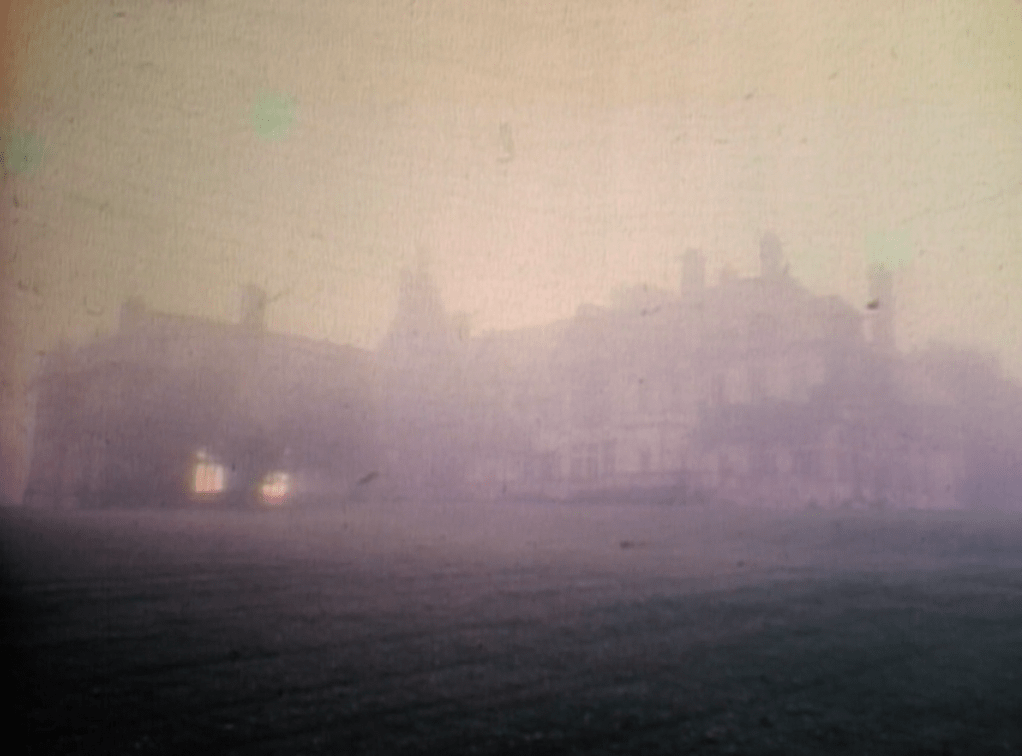
In the first year of the show, the opening voiceovers often involved a weather report. “A cold wind blows from the sea to the great house of Collinwood, but the fog still hangs heavy on its vast lawns” that sort of thing. They stopped doing that some time ago, but today they slip in an almost comically detailed bit about atmospheric conditions- “Soon dark, threatening clouds will gather over Collinwood, and long, ever-lengthening shadows will creep menacingly toward the great house. By late afternoon, rain will come, a rain that will begin slowly but steadily increase into a raging storm.” You expect them to go on with “Expect cooler temperatures and clear skies after 8 PM, with a chance of frost in the morning.” But the rain, at least, plays a part in the story. It explains why David and Amy have to stay indoors, and a roar of thunder gives Amy a chance to sneeringly ask Maggie if she is frightened. It also occasions the use of this still of the exterior of the house, one which I do not believe we have seen before:
We don’t usually see that much of the lawn.
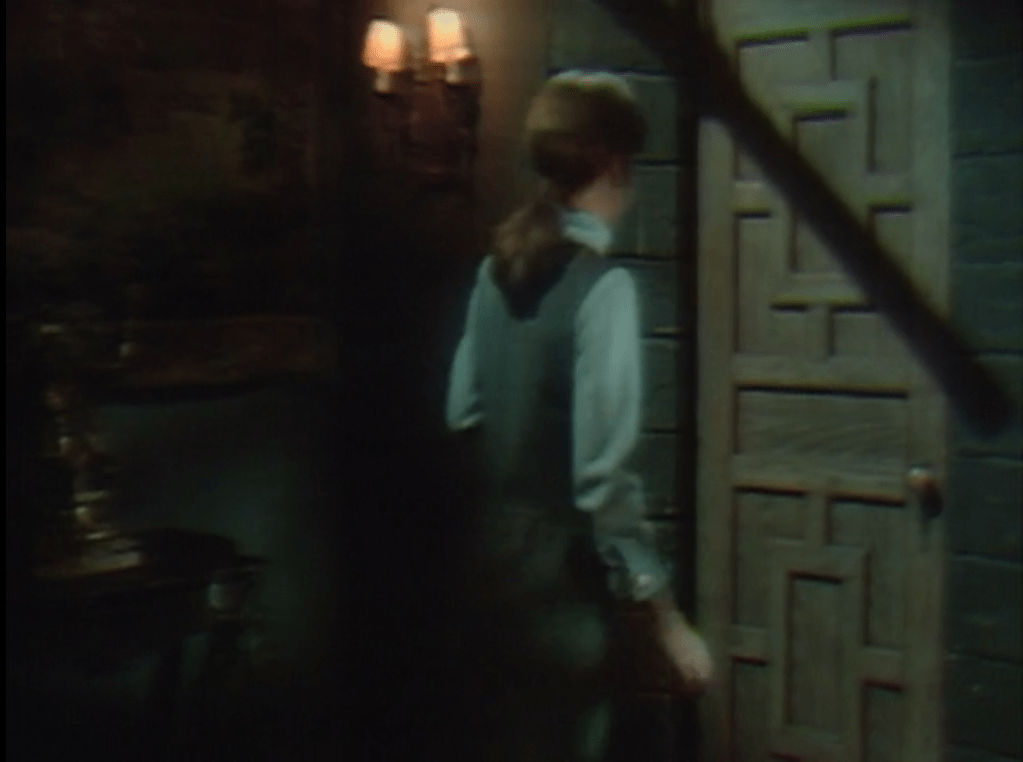
Later, Maggie goes to look for the children. She enters the study. This set has been familiar since early 1967, but today is the first time we see the outside of its door. Lately we have been seeing more of the little spaces that are supposed to join one room to another, part of a strategy to make the house seem like a bigger place.
The sequence before this suggests Maggie is heading into the long-deserted west wing, but once she goes through the door it is clearly the study.
Once in the study, Maggie hears Amy and David calling to her from no particular direction while Quentin laughs. She is bewildered, then the children join Quentin in laughing. His laughter is hearty, theirs is maniacal. Maggie goes out into the corridor, sees something frightening, and retreats into the study. She is only there for a moment when the doorknob starts turning. We end with Maggie staring directly into the camera, its lens representing the point of view of whatever it is that is terrifying her.
Maggie terrified.
This is the first of only two episodes credited to writer Ralph Ellis. Dark Shadows never had more than three writers on staff at any time. I often wish they had had many more. Ellis is one of those whom I would have liked to see as a senior writer on the show right the way through. The episode is well-paced, the characters are clearly defined, and the dialogue is smooth with just a touch of wit. If he had been in charge of, let’s say, every Monday’s script, the whole series would have been a cut above what it actually was. Since he only contributed two scripts, it is especially sad that Roger Davis had to crap on one of them, but even when Mr Davis is on camera you can still tell that Ellis did his job well.
Actor Roger Davis rejoined the cast yesterday, after an absence of not nearly long enough. He has an interminable scene with Grayson Hall and Jonathan Frid, during which he thrusts his arm onto the mantel immediately behind Hall, effectively putting his arm around her shoulders. She visibly flinches at this invasion of her personal space. When he exits she sighs “Oh, I thought we’d never get rid of him.” Frid says that he thought the same thing. They then get back into character and play out the scene in the script.
Roger Davis imposes himself on Grayson Hall and Jonathan Frid.
Later, Kathryn Leigh Scott is on a set representing the woods, and she sees Mr Davis. She reacts with a shout of “Don’t come near me! Stay where you are!” When she demands to know “Why have you come back?,” he reminds her that the camera is on and he is playing a character named “Ned Stuart.” She goes into character and says her lines, keeping as much distance from him as the 4:3 aspect ratio of 1960s US television would allow.
The parts of the episode that are not ruined by Mr Davis’ odious presence tell a story about ghosts and werewolves. Frid and Hall play Barnabas Collins and Julia Hoffman, friends of werewolf Chris Jennings. The other day Barnabas and Chris dug up an unmarked grave and found that it contained the remains of a baby wearing an apotropaic device meant to ward off werewolves. We saw the ghost of Quentin Collins watching as they did so, a sad look on his face. Later, we learned that Quentin paid for the apotropaic device, proving that there was a werewolf in the area when he was alive and that he had some connection with the baby.
Strange and troubled boy David Collins is under Quentin’s influence. After Quentin imposes himself on him, David writes a story about a werewolf who tried to keep from hurting anyone by locking himself in a room, but who was let out of that room and killed by a hunter. Barnabas has indeed locked Chris in the secret room of the old Collins family mausoleum.
Julia finds the story and shows it to Barnabas. They fear that David has somehow learned of Chris’ secret. As Barnabas and Julia are aware, David is one of the few people who know about the secret room. And indeed, at the end of the episode, we see him about to open the panel that leads to it.
But that may not be the story’s whole meaning. Regular viewers know something that Julia and Barnabas do not. David and his friend, Chris’ nine year old sister Amy, first came into contact with Quentin when they made their way into a room hidden behind a wall in the long-deserted west wing of Collinwood. They found a decayed skeleton seated in a chair there, wearing Quentin’s clothes. Evidently Quentin was locked in that hidden room, and Amy and David let him out. Perhaps the story David wrote is a suggestion that Quentin was a werewolf, and that by letting him out he and Amy exposed him to hunters.
The only story that reliably worked in the first 38 weeks of Dark Shadows was the attempt of well-meaning governess Vicki Winters to befriend her charge, strange and troubled boy David Collins. Its success was less to do with the writers than with the actors. When we saw Vicki in David’s room giving him his lessons, her dialogue was as bad as anything else the actors found in the scripts, including one moment when she had to read a description of the coastline of Maine to him from a geography textbook. But Alexandra Moltke Isles and David Henesy used everything other than the words to show us a young woman and a hurting boy learning to trust each other. Their use of space, of body language, of facial expressions, of tones of voice, all showed us that process step by step, and it was fascinating to watch.
Vicki and David’s story reached its conclusion in #191, when David’s mother, undead blonde fire witch Laura Murdoch Collins, tried to lure David to his demise in a burning shack while Vicki tried to rescue him. At the end, David ran from the shack into Vicki’s arms. When he chose Vicki and life over his mother and death, there was nowhere left for their relationship to go. We saw a few more tutoring scenes in the spring and summer of 1967, when vampire Barnabas Collins was first on the show, but have seen none since. Mrs Isles left Dark Shadows in November, and the recast Vicki made her final appearance a week ago, in #665.
The new governess in the great house of Collinwood is Maggie Evans, who was introduced in #1 as a wisecracking waitress and a hardboiled representative of the working class of the village of Collinsport, but whom actress Kathryn Leigh Scott shortly afterward reinvented as The Nicest Girl in Town. The town barely exists anymore, so when Vicki disappeared into a rift in the fabric of time and space it was almost a foregone conclusion Maggie would move into Vicki’s room upstairs in the great house. After all, the room was first occupied in the 1790s by the gracious Josette, whom Miss Scott played in the parts of the show set in that period.
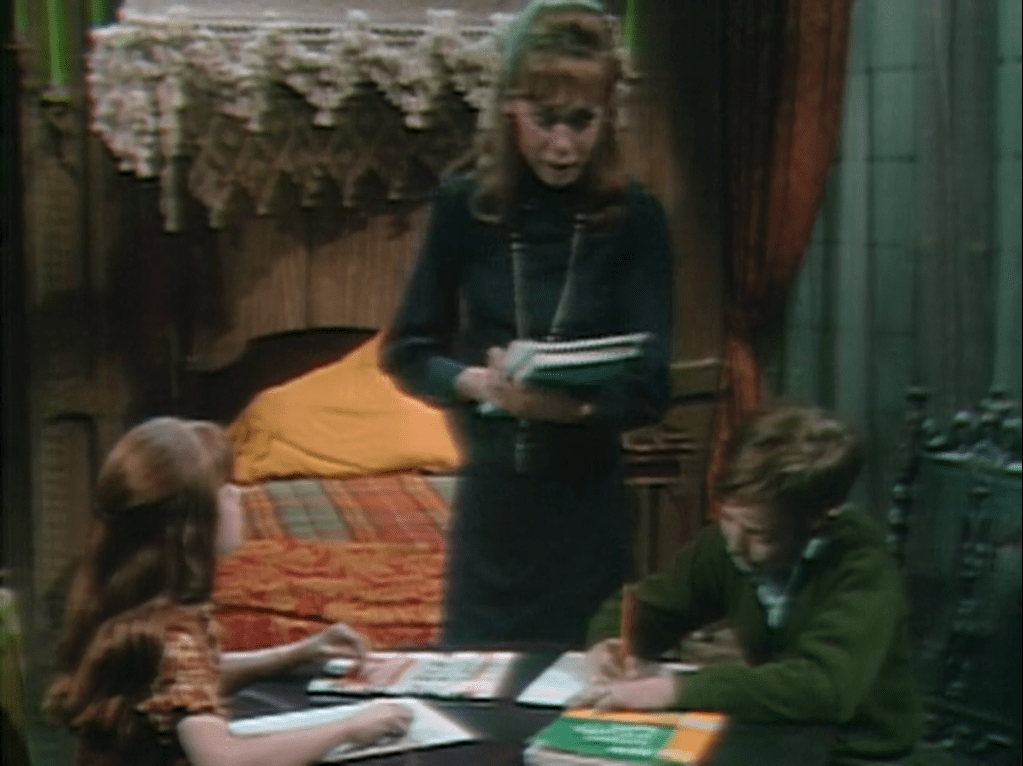
Today, we see our first tutoring scene in over a year and a half. David isn’t Maggie’s only charge; he has been joined by permanent houseguest Amy Jennings. Yesterday and the day before, we saw evidence that Maggie is a poor disciplinarian. We see further such evidence at the beginning of the tutoring scene, when the children complain about their lessons and Maggie quickly starts to explain herself and bargain with them. Amy and David are coming under the influence of the evil spirit of the late Quentin Collins. If the adult who is employed full-time to supervise David and Amy were up to her job, they wouldn’t be much help to him. So it’s no wonder the show three days in a row tells us that Maggie is a squish.
Maggie on the job.
To advance a plan of Quentin’s, Amy pretends to be ill and to faint during the lesson. David Collins is almost as subtle an actor as is David Henesy; when he is pretending to see signs of illness in Amy’s face, he looks at her with one eye and speaks with a most convincing note of concern. By contrast, Amy’s performance is exaggerated, showing none of the easy fluency Denise Nickerson brought to her roles. My wife, Mrs Acilius, chuckled at Amy’s fake faint and at some of the fussing she and David do when they are left alone together. She said it was refreshing to see that David and Amy are still kids. It certainly adds to the poignancy of what we are seeing Quentin do to them when we think of them as real children whose innocence he is exploiting for his evil project.
Amy’s fake faint convinces Maggie, and it leads to a lot of running around, ending with Maggie going to the cottage on the estate where Amy’s big brother Chris is staying as a guest of heiress Carolyn Collins Stoddard. Chris is a werewolf and is about to transform, and Quentin’s goal was to get Carolyn to go to the cottage. David has been making terrible pronouncements to Amy about how Carolyn will never bother them again, and the two of them are distressed to hear that Maggie rather than Carolyn is going to see Chris. So we are supposed to take it that Quentin knows about Chris’ situation and wants him to attack Carolyn.
No episode of Dark Shadows debuted on ABC-TV 56 years ago today, since that was Christmas Day. So in place of an episode commentary, I’ll share a link to Smartphone Theatre’s 2022 production of “The Gift of the Magi,” starring Kathryn Leigh Scott and David Selby.
Suave warlock Nicholas has had bad news. His boss, Satan, will be recalling him to Hell, and does not plan to send him out to the world of the living again. Satan gave Nicholas two tasks to complete before his time runs out. He is to perform a Black Mass during which he will sacrifice Maggie, The Nicest Girl in Town, and afterward take her to Hell with him as his bride. He is also to complete the project he has been working on, forcing mad scientist Julia and old world gentleman Barnabas to resurrect Eve, the mate of Frankenstein’s monster Adam. Yesterday, we saw that Nicholas plans to make Barnabas and Julia use Maggie as the donor of the “life force” that will bring the mate back to life. It was entirely unclear how Maggie could both be sacrificed on Nicholas’ altar and used as the “life force.”
We open today with a reprise of yesterday’s closing sequence, showing Nicholas performing a rite while Maggie lies on his altar. We then cut to the basement of Barnabas’ house, where Eve’s body lies on a bed in a laboratory full of mad science equipment. Barnabas vows to Julia that this is the last time they will ever go through the vivification procedure; she asks “What’s the point of saying that? We’re at Nicholas’ mercy.” The other day, Barnabas confronted Nicholas with some demands, threatening to stop cooperating with his project unless he complied. Nicholas gave some ground in response, suggesting there might yet be some dramatic tension left in his relationship with Barnabas and Julia. But when Julia sounds this note of total defeat she is telling us that their conflict with Nicholas is exhausted, that the Frankenstein story has nowhere to go, and that Barnabas is therefore right and this is the last time we will see them run the experiment.
Julia looks at the body and expresses sympathy for “poor motherless Eve.” “There’s a poem about that,” she says. Indeed there is, and it is an apt reference here. Nicholas’ attachment to the ingenuous Maggie has always been jarringly out of character for him; Ralph Hodgson’s 1913 poem “Eve,” with its juxtaposition of the innocent Eve with the crafty serpent, not only tells a story that is as broadly melodramatic as any episode of Dark Shadows, but also dwells on the incongruity of Eve and the serpent, the sheer strangeness of the fact that they coexist at all. “Here was the strangest pair/ In the world anywhere.”
Yesterday we caught our first glimpse in a long time of a character who, like Maggie, was introduced in the first episode. He was Mr Wells, the innkeeper. Maggie has been with us through all of the show’s transformations, but we hadn’t seen Mr Wells since #61, when Dark Shadows was all about what went on among people while they were drinking coffee together. Seeing him again puts that 1966 show side by side with this dramatization of “The Monster Mash,” and that contrast is as jolting as anything Hodgson manages.
Visitors let themselves into the lab. First comes Nicholas. He is trying to seem cheerful. He comes down the stairs with a bounce in his step and greets Julia and Barnabas with a jokey “Why are my conspirators so reluctant?” He might be trying to evoke the same unholy jollity that we see at the end of Hodgson’s poem, “Picture the lewd delight/ Under the hill tonight/ ‘Eva!’- the toast goes round-/ ‘Eva’ again.” But the imminent prospect of his return to Hell has Nicholas in no jolly mood, and his mask of good cheer falls away the moment Barnabas complains of his untrustworthiness.
It is true that Barnabas’ complaint strikes Nicholas at a most sensitive spot. He tells him that “You seem to specialize in second chances” and gripes that he revived vampire Tom Jennings and left him to do the dirty work of ensuring Tom would never rise again. Giving second chances was the very habit for which Satan reproved Nicholas in #629 when he told him he would soon be returning to Hell. Stung by the echo of his master’s words in Barnabas’ mouth, Nicholas retorts that destroying a vampire must have been “traumatic” for Barnabas, who was until recently a vampire himself. Because of some magical business, Barnabas will revert to that condition if Adam dies, and it is Nicholas’ threat to kill Adam that has compelled him and Julia to assist in his diabolical plan. Having reminded Barnabas and Julia of the source of his power over them, Nicholas composes himself, agrees with Julia that there is no time for quarrels, and leaves the room.
A moment later, Adam enters. Adam hates Barnabas and Julia, believes that Nicholas is his friend, and looks forward to Eve’s resurrection. Barnabas tells Adam he doesn’t want him there, but Nicholas enters with the command “He stays, Mr Collins.” A third visitor follows and shocks Julia and Barnabas even more deeply. It is Maggie.
The rite on the altar dedicated Maggie to Satan, but it did not involve her death. When Julia and Barnabas see that Nicholas has brought Maggie, they declare that they will not go ahead with the procedure. But Maggie declares that she is there of her own free will. Quite calmly, she looks around the laboratory in Barnabas’ basement, and says “I’ve been here so often.” Indeed she has- in May and June of 1967, Barnabas was still a vampire, Maggie was his victim, and he kept her imprisoned in a cell here. Julia used her extraordinary hypnotic abilities to make Maggie forget her ordeal, but this line suggests that she now remembers what Barnabas did to her, and that she is, terrifyingly enough, happy about it.
When Maggie was Barnabas’ prisoner, he was trying to erase her personality and replace it with that of his lost love Josette. Later, the show took us back in time to the year 1795, where we saw Josette when she was alive and realized that she wasn’t on board with Barnabas’ plans then any more than Maggie was in 1967. But it looks like Nicholas has succeeded where Barnabas failed and remade Maggie as a companion fit for a demon. Barnabas is already miserable at being forced to toil in Satan’s cause, and now he goes nuts with jealousy.
Barnabas loudly protests that he will not be a party to the experiment. Nicholas silences him by causing Adam’s heart to beat dangerously fast. Their magic bond gives Adam and Barnabas the connection Alexandre Dumas’ Corsican Brothers had, so that Barnabas also suffers the pain. Julia was originally introduced as Maggie’s doctor, but she long ago betrayed her patient for Barnabas’ sake. She pleads with Maggie to stop Nicholas, but Maggie just smiles and asks “Why should I?” Julia tells her that otherwise Nicholas will kill both Adam and Barnabas. Perfectly relaxed, Maggie responds “Then you stop him. Do what he wants.” Julia capitulates, saying “We’ll use her.”
This glimpse of Evil Maggie is breathtaking for longtime viewers. In #1, Maggie premiered as a wisecracking waitress who was, in the words of the original series bible, “everybody’s pal and nobody’s friend.” Soon, we saw her with her father Sam, the town drunk, and she emerged very clearly as a classic Adult Child of an Alcoholic (ACoA.) In #20, Maggie left behind the short blonde wig she had worn in her first appearances, and from then on she was The Nicest Girl in Town.
When Barnabas first bit Maggie, she went through the phases the vampire’s victim usually experiences, including snappishness towards her loved ones when they try to get between her and the ghoul on whom she is becoming dependent. During her time in Barnabas’ house, her level-headedness and warm-heartedness reasserted themselves, and even when she was in the mental hospital as a psychological wreck after escaping from him she was never far from a display of kindliness. In the eighteenth century flashback, Kathryn Leigh Scott took on the part of Josette. Josette was so unfailingly virtuous that not even Miss Scott could find a way to make her interesting. This brief moment of a Maggie utterly indifferent to the value of human life, even her own, is such an extreme departure that we can immediately see a world of possibilities opening up for her as a character and for Miss Scott as a performer.
Maggie is strapped to a table and Julia and Barnabas get to work. We have seen the procedure often enough that it is far from fresh, but in-universe it is still highly experimental. The equipment doesn’t work as Julia and Barnabas expected; gauges indicate higher readings than they want, and the adjustments that are supposed to bring them down just make them go even higher.
Maggie cries out that she is dying; Eve barely moves. The readings get even worse; Barnabas shuts the apparatus down. Nicholas tries to cast a spell to immobilize Barnabas; he struggles against Nicholas’ power at first, but still smashes the equipment, and soon is free of the spell altogether. Nicholas calls out to his master and pleads “Don’t desert me now!” His powers gone, he runs to Adam and starts trying to choke him, but Adam brushes him aside easily. Nicholas runs away; Barnabas runs after him, saying that he will take the opportunity to kill Nicholas.
Adam is shocked that Nicholas attacked him. He and Julia find that nothing is left of Eve’s body but a skeleton with a wig. Adam sobs, declaring that now he has no one. Adam decides that Barnabas is to blame for Eve’s destruction. He goes upstairs, tells himself that Barnabas “doesn’t deserve to love,” then leaves the house. Later, we see him in the great house of Collinwood. Regular viewers know that Adam has in the past thought of punishing Barnabas by murdering well-meaning governess Vicki, in whom Barnabas does not actually take much interest but whom he frequently claims to love. So we can expect that Friday’s episode will involve some apparent danger to Vicki.
Julia is too busy with Maggie to take any notice of Adam’s doings. The last time Julia ran the experiment, the “life force” donor died. Julia is frightened when she cannot get Maggie to respond to any stimulus. She gives her a shot, and Maggie opens her eyes.
Longtime viewers wonder what Maggie will be like now. If Satan has lost interest in Nicholas, it seems unlikely that the heartless Maggie of a moment ago will stick around. If she returns to her usual sensibilities with her memories of Barnabas’ crimes restored, the show will no longer be able to use the sets representing the houses at Collinwood since Dark Shadows will become a prison drama about the activities of Barnabas and Julia on their respective cell blocks. If she just snaps back to the way she was before she got involved with Nicholas, it will feel like a cheat.
What they actually choose to do is to give Maggie total amnesia. She does not recognize her own name or Nicholas’, refuses to believe she has ever met Julia, and has no idea where she is. Julia tries desperately to reactivate Maggie’s memory. She takes her up to Barnabas’ living room. In a moment longtime viewers will find impossible to believe, Julia takes a music box and plays it for Maggie. She tells her that it once belonged to Josette and that Maggie has heard it many times. Indeed she has- Barnabas forced her to listen to it incessantly during the weeks when he was trying to Josettify her. Julia, who has gone to such great lengths to bury Maggie’s memory of what Barnabas did to her, is now trying to dislodge her recollection of his very worst crimes. When Maggie does not remember the music box, Julia takes her up to Josette’s bedroom, where Barnabas kept her for much of her time as his prisoner. It is simply impossible to imagine what Julia could be thinking at this point.
Meanwhile, Barnabas is skulking in the foliage near the peak of Widow’s Hill. He is eavesdropping on Nicholas, who is pleading with Satan to give him another week to get the Frankenstein project back on track. He dissolves into a process shot depicting flames, and Barnabas smiles the most evil grin anyone has ever managed.
Even though poor motherless Eve is on screen for only a minute or two, doesn’t open her eyes, has no lines, and moves only a couple of fingers and those just barely, they brought Marie Wallace back to play her. That was $333 well spent. Miss Wallace’s presence on screen convinces us that Eve is really dead and that she will not be back. Combined with Maggie’s amnesia, that leaves Nicholas without any connection to an unresolved storyline. The only former underling of his still at large is witch-turned-vampire Angelique, and she had broken from him decisively a couple of weeks ago. When he vanishes, we can accept it as a line drawn under the part of the show in which he was the principal villain.
Eve’s decomposition and Nicholas’ damnation are not the only departures today. This was the final episode directed by John Walter Sullivan. As “Jack Sullivan,” he was credited as an associate director on a great many episodes, from #15 to #549. When John Sedwick left the show in the summer of 1968, Sullivan took over his share of the directing duties, alternating with Lela Swift. He directed a dozen episodes as “Jack Sullivan,” from #504 to #580. He then took the name “Sean Dhu Sullivan,” and directed 50 more. Sullivan was not as accomplished a visual artist as either Swift or Sedwick, and the camera operators had more trouble keeping his episodes in focus than they did either Swift’s or Sedwick’s. But his scenes were never any more confusing than you would have expected, considering the ridiculously convoluted stories the scripts gave him to work with, and he seems to have been as good a director of actors as either of them. The period when he was helming segments happened to be the one when the show had its most explicitly Christian elements, which you might say made him a Sean Dhu for the Goyim,* but I doubt he had anything to do with that.
*This is my only chance to make this joke, please just let me have it.
Occult expert Timothy Eliot Stokes is searching the room in the long-deserted west wing of the great house of Collinwood where heiress Carolyn has been hiding Frankenstein’s monster Adam since #539 in July. Strange and troubled boy David Collins saunters into the room and greets him with a casual “Hello, professor.” When a flustered Stokes makes up a story about Carolyn sending him to the room to look for some old books, David calmly replies, “Oh, I thought you might be looking for Adam.”
We haven’t seen David since #541. The only time we saw him interact with Adam was when they crossed paths in the woods in #495, and in none of the countless scenes featuring Adam cooped up in this dusty little room has David been mentioned. Yet today he tells Stokes that he visited Adam there many times, and that the two of them became great friends. I take that to mean that Ron Sproat, writer of today’s script, wanted to show us a lot of conversations between David and Adam and was overruled by the producers. It’s a major disappointment Sproat didn’t get his way. David Henesy and Robert Rodan would have been a wonderful pairing. David Collins tells Stokes that Adam told him last night that he would be leaving Collinwood before morning, and that he would never return.
Carolyn enters the room and tells David to go. He eavesdrops on her conversation with Stokes. He hears Stokes acknowledge that he is in the room without her permission, confirming that he was lying when he claimed Carolyn sent him there. He stays long enough to hear that Stokes is anxious to find Adam because he is afraid he is in danger. He goes off to look for the big guy.
During Carolyn’s conversation with Stokes, it becomes clear that she does not remember the events of the previous night. Since that night stretched over 13 episodes, that is quite a gap. During it, a mate was created for Adam; Carolyn participated in the first attempt at that procedure as the donor of the “life force.” She did that under the influence of suave warlock Nicholas Blair; Nicholas later enlisted her in another task, after which he erased her memory. Perhaps she forgot everything she did while his spell was upon her. That would explain why she doesn’t remember anything about Adam’s mate or about his passionate goodbye kiss. The show was so much more interesting during the little interval when Carolyn knew what was going on that it is almost as big a disappointment to learn of this mind-wipe as it is to hear that we were denied a chance to see a friendship develop between David and Adam.
David goes to Eagle Hill cemetery to look for Adam. He sees Willie Loomis, bedraggled servant of David’s distant cousin Barnabas Collins, emerge from the old Collins family mausoleum. David hides behind a tombstone until Willie is gone.
David wonders what Willie was doing in the mausoleum. He goes inside, and decides to open the panel to the hidden chamber. There, he finds Maggie Evans, The Nicest Girl in Town, bound and gagged. He calls her by name, and we cut to commercial.
This situation will be familiar to longtime viewers. In #124, David found his governess, the well-meaning Vicki Winters, bound and gagged in a secret room in the Old House on the estate. That time, he panicked and left Vicki still restrained.
After the commercial break, we spend some time with Willie and Stokes in the Old House, where Barnabas now lives. Thayer David plays Stokes. In #124, he played Matthew Morgan, the crazed handyman who was holding Vicki prisoner. Seeing him in this house with Willie at this point in the episode ensures that those of us who saw it will remember #124 and wonder how David’s response to the situation with Maggie will compare to his failure to help Vicki.
Willie then goes back to the mausoleum and finds David sitting on one of the coffins in the publicly known part. He asks David what he is doing there. David answers in a roundabout way. We start to wonder if he may have reverted to his old form and left Maggie where she was. But he eventually gets around to describing how Maggie behaved when he was untying her. Willie is terribly upset to find that Maggie is gone.
Willie abducted Maggie and locked her up in the mausoleum because Barnabas and mad scientist Julia Hoffman were planning to impose the role of “life force” donor on her. While there, she remembered that in May and June of 1967 Barnabas was a vampire who fed on her, imprisoned her, tried to replace her personality with that of his lost love Josette, and tortured her when she resisted. Willie doesn’t see any way to let her out when she has information like that. In the middle of today’s episode, Kathryn Leigh Scott and John Karlen have a big scene in the mausoleum as Maggie defies Willie and he begs her to be nice to him. They do an excellent job, but it is quite a relief to be out of that dungeon.
A terrible script, full of repetitious language and recycled story points, but each member of the cast is in top form. They almost make it feel like we haven’t seen all of this before.
In May and June of 1967, vampire Barnabas Collins imprisoned Maggie Evans, The Nicest Girl in Town, and tried to brainwash her into thinking she was his his lost love, the gracious Josette. After Maggie escaped from Barnabas, she was in a state of total mental collapse for several weeks. By the time her memory came back in August, Maggie’s psychiatrist, mad scientist Julia Hoffman, had become Barnabas’ accomplice. Julia has a preternatural power of hypnosis, and she used it to block Maggie’s memories before she could expose Barnabas.
Now, Barnabas and Julia are conducting an experiment to build a female Frankenstein’s monster. Once constructed, the new woman is to be the mate to patchwork man Adam. They need an existing woman to donate her “life force” to animate their creation. They were planning to use Maggie. Barnabas’ servant Willie has a crush on Maggie, so when he learned of their intentions he abducted Maggie before they could get at her.
Willie stashed Maggie in the hidden chamber of the old Collins family mausoleum. As it turns out, Barnabas had taken Maggie there to torture her when she was his prisoner, so when she found herself in that setting her memories came back. Maggie made that clear at the end of yesterday’s episode; she and Willie spend most of today’s talking it over. Kathryn Leigh Scott plays Maggie’s horror and John Karlen plays Willie’s panic with admirable intensity.
Barnabas is visiting the great house of Collinwood when his distant cousin Roger tells him that heiress Carolyn Collins Stoddard has left the house to spend several days in Boston. Adam is threatening to kill various people unless the experiment is completed soon and Carolyn donates the life force, so Barnabas is alarmed by this news.
Barnabas goes home to the Old House on the estate. He finds Carolyn waiting for him there. She tells him she knows all about the experiment and is eager to serve as the donor. Barnabas is bewildered by her enthusiasm. As Carolyn, Nancy Barrett plays this scene with such gusto that she is electrifying to watch. When Barnabas finds her standing in his front parlor looking at him with total self-assurance the show has what is, as far as I am concerned, its sexiest moment so far.
Recovering vampire Barnabas and mad scientist Julia are under pressure to create a female Frankenstein’s monster. The process they are using requires draining the “life force” from a woman into a constructed corpse. The other day, Barnabas announced they would force the role of donor onto Maggie, The Nicest Girl in Town and one of his former victims. When Barnabas’ servant Willie heard of this plan, he was horrified. Willie has a crush on Maggie, and is determined to spare her this fate.
Now, Willie has abducted Maggie and is hiding her from Barnabas and Julia. Barnabas is worried about what will happen if they cannot find another woman to use in the experiment. Julia says “If worse came to worst, I could do it.” Barnabas points out that only she is prepared to operate the equipment, and that she could not do that if she were serving as donor. She makes a feeble suggestion that their onetime lab tech, an unpleasant man named Peter who prefers to be called Jeff, might run the equipment. Barnabas says that Peter/ Jeff does not have her training. In any case, Barnabas had to fire Peter/ Jeff because he had reason to believe he was trying to sabotage the experiment, so he can scarcely trust him now.
This is not the first time Julia has offered to solve a problem by destroying herself, only for Barnabas to turn her down. In #350, when Barnabas was still a vampire and was desperately thirsty for blood, Julia volunteered herself as his victim. Barnabas was sufficiently moved to address her for the first time as “Julia” rather than with a distinctly contemptuous pronunciation of the title “Doctor,” but he still said the reason he was refusing was that he had use for her medical expertise. Barnabas’ cruel plan for Maggie suggested that he isn’t really any nicer now than he was as a vampire; this echo of that moment would suggest that he hasn’t even stopped seeing Julia, who after all loves him, as a kind of higher servant.
Willie has taken Maggie to the hidden chamber inside the old Collins family mausoleum. It was in this chamber that Barnabas was trapped in his coffin from 1796 until Willie inadvertently freed him to prey upon the living in #210. When she was his prisoner in #248, Barnabas took Maggie to that chamber and shut her up in the coffin there. While Willie tries to assure Maggie that she will be safe as long as she is with him, the memories that Julia used her preternatural powers of hypnosis to erase start coming back.
We see a flashback, not to Maggie’s time at Barnabas’ mercy, but to #283, when she was Julia’s patient at Windcliff Sanitarium. Julia took her on a trip to the old cemetery north of Collinsport, and they went into the mausoleum. Julia did not know about the hidden chamber, and did not understand why Maggie became upset when they were in the publicly known part of the mausoleum. Maggie remembers visiting the mausoleum with Julia, and cannot remember why it frightened her to be there. But the fact that she recognizes the chamber as part of the mausoleum means that her memory of what Barnabas did to her is coming loose.
This creates a truly suspenseful situation. Maggie is an audience favorite with connections to several other characters, and so it seemed unlikely anything Barnabas and Julia did would result in her leaving the show. But if she remembers what they did to her and tells the police about it, they will go to prison. Since Barnabas and Julia are the source of all the action on Dark Shadows, that would mean the end of the series. So her memory coming back sets up a crisis that might be resolved with a significant change.
Perhaps Barnabas and Julia will force Maggie to donate her “life force” with the consequence that her body dies and she wakes up in the newly created woman, who just so happens to look exactly like her but to have a drastically different personality. That seems plausible, since the long-running storyline of her romance with hardworking young fisherman Joe seems to be over, the minor theme of her relationship with her hard-drinking father Sam had been resolved long before Sam died a few months ago, and we have reason to expect her to move out of her house, which has long served as our window into the working class of Collinsport. If Maggie is running out of story, they may very well decide to keep Kathryn Leigh Scott on as another character.
Closing Miscellany
The flashback is not made of tape cut from #283. It couldn’t be- the show was in black and white then, and is in color now. So they recreate it. It’s kind of adorable to see Julia in her old wig.
This was not the episode they intended to shoot. It was the dress rehearsal. Shooting the flashback scene put them so far behind schedule they didn’t have time to do the episode, and they had to send this footage to the network. I believe that is the only occasion they ever resorted to that desperate expedient. The camera is out of focus much of the time and occasionally does not seem to be pointed in the right direction, the microphones are misplaced so that it sounds at one point like Julia is referring to Maggie as “Greg,” booms and other equipment intrude into the shots, and the actors frequently blow their lines. In other words, it is in no way different from any other episodes.






 Dark Shadows Commentary