This is the first episode to feature a scene in the restaurant at the Collinsport Inn since #227 in May 1967. The show was in black and white then; apparently the restaurant set cannot be seen in color, since this one, set in the year 1897, survives only in kinescope.
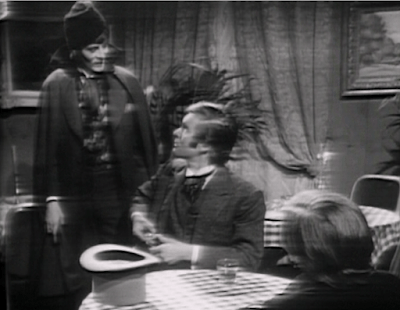
Aristide, Tim, and Jamison/ Petofi in the restaurant at the Collinsport Inn. Screenshot by Dark Shadows Before I Die.
Schoolteacher turned adventurer Tim Shaw is at a table in the restaurant when he is joined by twelve year old Jamison Collins, a former student of his. Unknown to Tim, Jamison’s body is currently a vessel for the spirit of 150 year old sorcerer Count Petofi. Tim is startled to see Jamison, and tells him he had heard he was ill. Jamison asks where he heard this. Tim pauses, then claims that he telephoned Jamison’s home, the great house of Collinwood. He says that Jamison’s nine year old sister Nora answered the phone and told him of his illness. Tim tells Jamison that he is waiting for a young lady, and that after she arrives he would like to be alone with her.
A man enters and talks with Tim. After he goes, Jamison asks who he is. Tim says he has only met him once, and that he knows almost nothing about him beyond the fact that his name is Aristide. We have seen Aristide in the woods with Jamison/ Petofi, and know that he is Petofi’s servant. Jamison/ Petofi told him in that scene that he felt weak and had only a few hours left if he did not recover “The Hand.”
We also saw Aristide in Tim’s room with Amanda, the young lady Tim is waiting to meet. He confronted Amanda, roughed her up, and threatened her with a prop representing a dagger with a curved blade. He wanted Amanda to tell him where “The Hand of Count Petofi” is. Amanda asked if “The Hand of Count Petofi” was a piece of jewelry or something. She had no idea it is literally a severed hand, cut from the wrist of Count Petofi 100 years ago. Aristide questioned her and learned that Tim took a box from the Inn earlier that night and returned without it.
Tim excuses himself, saying that he will go to the front desk to ask if Amanda left a message there explaining why she is so late. Jamison/ Petofi meets Aristide back in the woods. When Aristide tells him that Tim took a box from the Inn and returned without it, he remembers that Tim said he had talked on the telephone with Nora. He deduces that Tim actually talked to Nora in person when he took the box to Collinwood and enlisted Nora’s help hiding it there.
Jamison/ Petofi goes to Nora’s room and wakes her. He tricks her into telling him that Tim was there, but she refuses to tell him where the box is. He twists her arm until she does so. In the parts of Dark Shadows set in the 1960s, David Henesy played strange and troubled boy David Collins, and Denise Nickerson played nine year old Amy Jennings. David and Amy were intermittently possessed by Jamison and Nora in late 1968 and early 1969, and when Amy/ Nora resisted David/ Jamison in #667 and #679, he twisted her arm. When we see the same violent act here, we see a dramatization of a cycle of abuse. We may also wonder if they are going to retcon that “Haunting of Collinwood” segment to include Petofi as a driving force.
Jamison/ Petofi takes the box from Nora’s armoire, opens it, and holds up the Hand. Regular viewers can expect Petofi to return to his own physical form, reattach the Hand to his wrist, and increase his magical powers greatly.
All of the male cast members have trouble with their dialogue today, even the usually line-perfect David Henesy. I wonder if writer Gordon Russell was late finishing the script. Mr Henesy and Michael Stroka manage to give good enough performances that their bobbles don’t really matter, but Don Briscoe is just bad today. When Tim is talking with Nora in the teaser, his intonations are bizarre, and in his later scenes he is flat and lifeless, including a long stretch when he is openly reading off the teleprompter. Perhaps that’s because of his acting style- he worked from the inside out, finding his character’s motivations and developing those first, adding the dialogue last. Give an actor like that less time than he needs, and he might not have anything at all to offer.
One unfair criticism that Briscoe gets from many of the fans who post comments online is that Tim does not have romantic chemistry with any of the women he is paired with. He isn’t supposed to have romantic chemistry with them! At first we see him linked with neurotic intellectual Rachel Drummond. Tim and Rachel were students together at the boarding school run by the sadistic Gregory Trask. When Jamison and Nora are sent to the same school, Tim and Rachel illustrate the horror that lies in store for them. If Tim and Rachel were a hot and exciting couple, they would send the message that kids subjected to Trask’s abuse can grow up to be happy adults, muffing the whole point of the story.
The second woman attached to Tim was Trask’s daughter Charity. Nora points out to Jamison today that Tim and Charity never got along with each other, and regular viewers remember that this is true. Trask forced them to get engaged, a situation that made them both miserable, and then led them both to believe that Tim had murdered Charity’s mother. Again, the whole point of the relationship is to demonstrate how cruel Trask is.
Now Tim is traveling with Amanda. We met Amanda yesterday, and saw that she is impatient with Tim and tolerates him only because he has a lot of money and keeps spending it on her. As possessor of the Hand of Count Petofi, Tim has managed to get rich quick and turn into a tragic version of the character W. C. Fields played in vaudeville routines and stage plays and films set in the Gay Nineties. Amanda is the sort of woman Fields’ characters invariably failed to impress. Again, the last thing you would want would be for Amanda to seem actually to be attracted to Tim.
Though Michael Stroka, in spite of his line bobbles, does a good job as Aristide, there is one moment today when he does make a bad mistake. Aristide makes a big deal out of his dagger, which he initially called “The Dancing Girl.” The prop is obviously just a flat piece of wood, which we might be able to accept if we don’t have to look at it for an extended period. But when he is threatening Amanda today, he holds “The Dancing Girl’s” blade in the palm of his hand, squeezes it, rolls it around, and caresses it. If there were a sharp edge anywhere on it, his hand would be bleeding profusely. They really are not making it easy for us to believe Aristide is going to cut anyone.
The 150 year old evil sorcerer Count Petofi has taken possession of twelve year old Jamison Collins. Jamison/ Petofi has been casting spells to make the various residents of the estate of Collinwood reveal their true selves. Jamison’s distant cousin, Barnabas the vampire, has locked Jamison/ Petofi in the prison cell in the basement of the Old House on the estate. When Barnabas says that he will let Jamison out once Petofi has vacated his body, Jamison/ Petofi replies “If that is what you intend to do, Mr Collins, I’m afraid that you are stupid and incompetent.” There is no need to cast a spell on Barnabas- Maker of Stupid and Incompetent Plans is his true self, and we love him for it.
The great house on the estate is currently under the legal authority of the evil Rev’d Gregory Trask, husband of Judith Collins, who is a patient in a mental hospital. Jamison/ Petofi’s spell has caused Trask’s daughter Charity to be intermittently possessed by the spirit of Cockney showgirl Pansy Faye. Trask is horror-stricken by the makeup, clothes, and hairstyle Charity wears when Pansy is in charge of her, and her East London accent, insouciant attitude towards him, and tendency to sing and dance escalate this horror further. Nancy Barrett and Jerry Lacy are both talented comic actors, and their scenes as Charity/ Pansy and Trask are hilarious.
Collins family lawyer Evan Hanley is at home. Barnabas appears in Evan’s drawing room and asks for some information which Evan denies having. Evan tells Barnabas he has renounced his former interest in black magic and Satanism. Barnabas is skeptical, and Evan replies that his latest forays resulted in a gruesome disfigurement of his face. This disfigurement was later relieved, how we (frustratingly) do not know. But he wants nothing more to do with the occult, since he values the ability to look at himself in the mirror. Barnabas reminds Evan that he cannot see himself in a mirror, implying that he will use his vampire powers against him if he does not cooperate.
Trask comes to Evan’s house. He asks him to draw up papers that will complete his plan to seize control of all the Collins family’s assets. He mentions in passing that Jamison thinks he is Petofi. Evan knows enough about Petofi to be terrified. He tells Trask that neither of them has a chance in a battle with Petofi, and refuses to draw up the papers. Trask responds contemptuously.
Alone in the cell, Jamison/ Petofi decides to have some fun with Evan. We see Evan dozing in his armchair. He has a dream in which Jamison appears. Jamison kisses him; it is by his kisses that Petofi spreads the “true self” spell. Later, Evan goes to the great house at Collinwood and presents Trask with a paper to sign. Trask signs it eagerly, assuming it is the document he asked Evan to bring him. Instead, Evan has prepared a full confession to the murder of Trask’s first wife Minerva. The two of them plotted this murder together, and Trask is horrified when he sees his signature on it. He throws the paper in the fire; after he leaves the room, it rematerializes on the desk, complete with signatures.
During Trask’s confrontation with Charity/ Pansy Faye, the picture suddenly changes from color to sepia tone. After about a half a minute, it changes back. Evidently there was a fault in the videotape master at this point, and an excerpt from the kinescope was used to patch it. The color comes back right after Trask slaps Charity/ Pansy, causing Pansy to release Charity for a bit. It creates the eerie feeling that Trask somehow fixed our TV set by slapping her.
Dark Shadows continually comments on itself as it goes along. In the early days, all the episodes were scripted by Art Wallace. Wallace’s favorite method of composition was a sort of diptych, in which two sets of characters faced similar situations and responded to them differently, highlighting the contrast between their personalities. Petofi’s “true self” spell is of course another way of creating similar contrasts between characters played by the same actor.
As the show came to focus on time travel stories, they could cast actors as characters who represent alternative versions of parts they played in other periods, again putting characters played by the same actors in contrast with one another. And as Wallace would juxtapose similar situations within a single episode, the multiple times periods allowed them to take themes that had been developed in one way in a story set in one year and develop them differently in a story set in another. So Jamison/ Petofi’s contagious curse is a reworking of the “Dream Curse,” which dragged on from April to July 1968. The Dream Curse involved a lot of repetition and very little variety of tone. Jamison/ Petofi’s spells all get right to the point, and are sometimes scary, sometimes bizarre, and often quite funny. So the second time is definitely the charm here.
At one point Charity holds a recorder and tells her father she wants to learn how to play it. The first time we saw this prop was in #260. That episode was set in 1967, and Barnabas was holding Maggie Evans, The Nicest Girl in Town, prisoner in the cell where Jamison/ Petofi is today. The ghost of Barnabas’ little sister Sarah befriended Maggie, and materialized in the cell playing “London Bridge” on that recorder. Over the next several months, the recorder came to be a symbol of Sarah, one that she occasionally left behind as a sign that she had been in a place. Longtime fans will likely remember that, and see it as an indication that what is happening to Charity is going to have permanent consequences, as Sarah’s haunting had permanent consequences.
Vampire Barnabas Collins, werewolf Quentin Collins, and broad ethnic stereotype Magda Rákóczi hold a séance to contact the spirit of Rroma maiden Julianka. This is the thirteenth séance we have seen on Dark Shadows. It deviates from the previous ones in three important ways. First, no one objects in the middle of it and has to be sternly hushed by the séance-leader. Second, it doesn’t matter that the physical contact among the participants is broken- previously it had been a fatal error if anyone stopped touching the fingers of the people on either side of them, but this time Quentin jumps up and runs out and it’s no problem. Third, Julianka does not choose one of the participants as a medium and speak through them, but manifests as a ghost.
Perhaps because they are rewriting the rules of the Dark Shadows séance, they make a reference to an earlier milestone in the show’s development. The séance is held in the parlor of the Old House on the estate of Collinwood. That isn’t unusual; séances have been held there on three previous occasions, including the second and in some ways most dramatic one, held in #186. What makes the location noteworthy is Julianka’s movement when she first appears. She comes in as a green screen effect hovering somewhat above floor level, then takes several steps down an unseen staircase.
We have seen that same movement on this same set. It was in #70, when the ghost of the gracious Josette was the first supernatural being to become visible to viewers of Dark Shadows. Aside from the reuse of that footage, we have not seen a ghost move that way since. Compared with the changes that began when Josette walked down from her portrait in #70 and brought the supernatural back-world that had been implicit in the show from its first week into the foreground, these changes to the rules for séances are small potatoes.
Barnabas and Magda hoped to persuade Julianka to give them some information they needed to lift the curse from Quentin and cure his lycanthropy, but she isn’t interested. She blames them for her death, and will not even let them ask questions, let alone answer them. They try to protest that they weren’t the ones who killed her, but she ignores them. So far from helping them end Quentin’s curse, she places a new curse, this one on Magda. She decrees that everyone who loves Magda will die. That was the same curse wicked witch Angelique pronounced on Barnabas in #405 when she made him a vampire. Longtime viewers will be unsure how Julianka’s curse will operate- Magda doesn’t seem likely to become a vampire, but perhaps they are suggesting she will turn into a monster of some other kind.
Unfortunately, Julianka’s appearance today is the last time we will see Diana Davila. In her approach to the role, Miss Davila concentrated very much on her eyes. She kept them open wider than I would have imagined a person could open her eyes, did not blink, and when she looked from side to side she did not turn her eyes in their sockets, but instead turned her head. This dictated a rigidity of movement for the rest of her body and a narrow range of inflection for her voice. Taken as a unit, these mannerisms made for a perfectly logical way of expressing Julianka as a strange, unreachable person, an emissary not only of the tribe of King Johnny Romana, but of another world altogether. In practice, this style had a drawback given the conditions under which actors had to work on Dark Shadows. In the three episodes where Julianka was a living being, Miss Davila did not have quite enough time to learn her lines. She did better than did most cast members, but the particular illusion she was trying to create could be shattered by the slightest bobble. This time, though, she is letter-perfect, and as a result the scene with Julianka’s ghost is one of the most effective in the series.
This one survives only in a black and white kinescope. That format serves the story quite well. Five of the characters sound like they would generate fast-paced, high-pitched action- Barnabas Collins is a recovering vampire, Julia Hoffman is a mad scientist, Chris Jennings is a werewolf, Quentin Collins and his associate Beth are ghosts. But today is all about Barnabas, Julia, and Chris trying to figure out whether Quentin and Beth really are ghosts and wondering if they have something to do with Chris’ nine year old sister Amy and Amy’s twelve year old friend David Collins. They have to spend their time painstakingly chewing over the few wisps of evidence they have managed to collect. That slow story depends entirely on atmosphere and suggestion to connect with the audience, and the visual simplicity and abstraction of black and white images gives it the best chance it could have of working.
Barnabas and Julia go to Chris’ place to ask him if he knows anything about Beth. Julia hypnotizes him to make sure he isn’t blocking any memories of her; he isn’t. They leave, he goes outside alone, and he meets Beth. She points to a spot on the ground, then vanishes. He goes to get Barnabas and tell him about this encounter. They go to the spot she had indicated and find that a shovel has materialized nearby. They dig there, and turn up a child’s coffin. Barnabas is puzzled by this. He hasn’t buried any children in unmarked graves on the grounds lately, and there is nothing distinctive about the coffin itself. So he suggests they open it. The episode ends with the lid of the coffin filling the screen.
This was the last of hundreds of episodes written by Ron Sproat. When Sproat joined the show in the fall of 1966, he sorted through the storylines, discarding some that couldn’t possibly go anywhere and tightening the focus on those that seemed to have potential. He was an able technician who did a great deal to make sure that new viewers could figure out what was happening on the show. He shouldered the heaviest share of the writing burden in the period when the vampire storyline began and Dark Shadows suddenly leapt from the bottom of the ratings to become a kind of hit, and was a workhorse through the months when the show was a costume drama set in the 1790s and emerged as one of the major pop culture phenomena of the 1960s. He was the one who pushed his Yale classmate Jonathan Frid for the role of Barnabas, and he was the first person connected with the show to go to the conventions the show’s fans organized, laying the foundation for a community that brought them together with members of the cast, crew, and production staff.
Vital as his contributions were to the show and its afterlife, the brutal conditions under which Dark Shadows‘ tiny writing staff worked made it impossible to ignore Sproat’s weaknesses. When there were never more than three people involved in creating scripts for a hundred minutes a week of drama, scripts which were often produced verbatim as they came from the writer, there was nowhere to hide. So it is clear to us that Sproat’s imagination was not an especially fertile source of plot development. On his great Dark Shadows Every Day, Danny Horn frequently complained of Sproat’s habit of locking characters up in various forms of captivity so that the story would not progress and he would not run out of flimsies to fill in. Danny called these captivities “Sproatnappings.” Sproat probably should have found a different job several months ago, and certainly should have been part of a larger group of writers.
Still, we will miss him when he’s gone. Alexandra Moltke Isles played well-meaning governess Vicki from #1 to #627; for the first year, she was the main character on Dark Shadows, and she continued to be a core member of the cast until she left. Nowadays, Mrs Isles remembers that a few months after her departure she found herself free at 4 PM and tuned into the show. She couldn’t make heads or tails of what was going on. She wasn’t the only one. The staff that will take the show through its next several months- Sam Hall, Gordon Russell, and Violet Welles- would do brilliant work, on average far and away the best the show ever had, but none of them spared a thought for any but the most regular of viewers. For much of 1969, missing one episode will leave you bewildered- missing several months, well, Mrs Isles may as well have been watching a different show altogether.
Most episodes in the first 66 weeks of Dark Shadows ended with ABC staff announcer Bob Lloyd’s voice in the closing credits telling us that “Dark Shadows is a Dan Curtis production.” We hear that announcement during today’s closing credits for the first time since #330. That isn’t because they’ve brought Mr Lloyd back, but because they were using an old tape for the theme music and didn’t realize his voice was on it. You can tell it wasn’t on purpose, since the announcement comes in the middle of the credits, not in its usual place at the end when the Dan Curtis Productions logo appears.
Unloved Frankenstein’s monster Adam has survived a plunge from the cliff at Widow’s Hill and made his way into the home of blind ex-artist Sam Evans. Sam realizes that Adam is badly hurt and cannot speak much English; with great kindness, he tries to clean and bandage Adam’s wounds.
Sage Timothy Eliot Stokes comes in. Adam, who in his few weeks of life has had little but hostility from humans, is alarmed by the sight of another one, and flees. Stokes explains to Sam who Adam is, and Sam’s sympathy for the big guy only deepens. This retelling of the creature’s encounter with the blind hermit in The Bride of Frankenstein is affectingly done.
Wicked witch Angelique, calling herself Cassandra, has made her way into the apartment of local man Tony Peterson. Tony is agitated by the presence of Angelique/ Cassandra and keeps telling her he wants her to go home to her husband and leave him alone. She tells Tony he is “Quite a Puritan,” reminding us that when Dark Shadows was a costume drama set in New England in the 1790s, actor Jerry Lacy played the Rev’d Mr Trask, a fanatical but utterly inept witchfinder who inadvertently served Angelique’s darkest purposes. Mr Lacy plays Tony quite differently than he did Trask, but Angelique/ Cassandra told Tony in #481 that she chose him as her cat’s paw because he reminded her of Trask. She gets him to strike his cigarette lighter, sending him back into the trance in which he can deny Angelique/ Cassandra nothing.
Well-meaning governess Vicki has made her way to Stokes’ apartment. It was Vicki who took Dark Shadows back in time to the 1790s, when she came unstuck in time during a séance in #365. It seemed at the beginning of the costume drama segment that Vicki would regain the position she held in the first months of the show as our point of view character, that she would again provide the emotional anchor of the show in her scenes as governess alone with the young children of the house, and that she would drive the action as she had to think on her feet and come up with plausible lies to secure a place in an unfamiliar century. As it happened, she did none of those things. She was shut out of all the main action, was never seen giving a lesson to either of her charges, and when she was on camera spent her time telling everyone she met that they were played by an actor who had another part in the first 73 weeks of the show. Long before Vicki came back to the 1960s in #461, the character had become all but insupportable.
The action now revolves around recovering vampire Barnabas Collins, and Barnabas steadfastly refuses to include Vicki in his life. Faced with that blank wall, Vicki has spent some time hanging around with a man named Peter whose only story point is that he wants to be called Jeff. This does not make for much drama. Vicki learned a great deal in the 1790s, and recognized Angelique/ Cassandra as soon as she showed up in 1968. But she can’t fight her by herself, and so she has responded to Barnabas’ aloofness by trying to forget what she knows.
Stokes has called Vicki to his apartment to enlist her help against Angelique/ Cassandra. Longtime viewers will remember that Vicki led the fight against Dark Shadows’ first supernatural menace, undead blonde witch Laura Murdoch Collins, and that for support in that battle she was the one who recruited the services of the show’s first sage, parapsychologist Peter Guthrie. This much diminished Vicki is now subordinated to the sage. He calls her in, he commands her to tell her story, he tells her that her story is true, and he requires her services. He shows her a silhouette of Trask and insists she overcome her reluctance to look at it. When a knock comes at the door, he even sends her out the back way and tells her that his next visitor must not know of her connection with him, as if he were dismissing a prostitute.
Stokes tells Vicki he can’t afford to be seen with her.
Oddest of all, Stokes already seems to know everything Vicki does before they talk. In #507, he laid out a theory that would be plausible to someone who knew exactly what Vicki knows about the strange goings-on, but not to anyone who knows one thing more or less than she does. Yet today we see that he is talking with Vicki about them for the first time. It is unclear what he could learn from her, or what contribution she could make to his efforts.
The visitor from whom Stokes wants to hide Vicki is Tony, giving his name as “Arthur Hailey,” perhaps in honor of the novelist whose Airport was topping the bestseller lists when the episode was made. Stokes is quite relaxed around Tony, offering him first brandy and then cheese. Tony accepts both. He exclaims “I like cheese!” in an awkward voice that makes it clear we are listening, not to Jerry Lacy’s acting, but to Tony’s. While Stokes is out of the room fetching the cheese, Tony sprinkles a powder Angelique/ Cassandra gave him into Stokes’ glass. Tony looks away from the table before they take their drinks. When they do, it is Tony who chokes and collapses, not Stokes.
This is the second time we’ve seen that staple of farce, “The Old Switcheroo.” In #402, Barnabas tried to poison Angelique, and had to think fast when she passed her glass to his mother. That use of the trope confirmed that, while Barnabas is undeniably a villain, he is a comic villain who endears himself to us as we watch him scramble through one failed scheme after another, while Angelique is a menace to be taken seriously. Now, Angelique has settled in for the long term, and the show will quickly run out of characters if she maintains the kill rate she had in the eighteenth century. They have to dial her threat level down considerably. One way of doing that is to give her a henchman who is, most of the time, unaware of her power over him, and who is consistently luckless when she activates him; another is for her to use comically unreliable means to pursue her evil ends. She does not yet cut the Wile E. Coyote-esque figure that Barnabas does, but neither is she in imminent danger of vaporizing the whole story and leaving ABC with thirty minutes of dead air on weekday afternoons.
This was the first episode directed by John Weaver. Except for one week in March 1968 when executive producer Dan Curtis took the helm, directing duties for the first 497 episodes of Dark Shadows alternated between Lela Swift and John Sedwick. Now Sedwick is about to leave the show. Associate director Jack Sullivan stepped up to direct #504 and will direct dozens more; Weaver, an associate director on some early episode, will only be credited as director four times before leaving in July. Several more directors will have similarly brief stints as fill-ins before Henry Kaplan joins the show as Swift’s alternate in December.
Bewildered time traveler Vicki tells her lawyer/ gaoler/ boyfriend/ accomplice/ therapist/ assailant Peter that her time in the late eighteenth century seems like a nightmare. She then does something she often did in the early months of Dark Shadows, reminiscing about her childhood as an inmate of the farcically horrible Hammond Foundling Home. She says that she had so many nightmares when she was there that she became a connoisseur of nightmares. When she realized she was having a bad dream, she would choose to remain asleep right up to the moment she was about to be killed so that she could see how the whole thing would play out. I suppose that might have been useful training for a career as a character in a horror story, but if so Vicki has not benefited from it. She’s done nothing but make matters worse for herself since she arrived in the year 1795, and she is now in her last day as the defendant in a witchcraft trial which has been going very badly for her.
During this scene, Vicki gets very upset. Peter demands that she calm down and slaps her in the face when she doesn’t. That was a time-honored form of treatment for anxiety in fiction back then. It’s always gross to see, but is especially bad when the actor administering the slap is Roger Davis. Mr Davis was, shall we say, uninhibited in his physicality when dealing with his female scene partners. In his post about the episode on Dark Shadows Every Day, Danny Horn includes screenshots of 10 distinct moments in this episode when Mr Davis aggressively rubs himself all over Alexandra Moltke Isles. Later in the series, he would, in separate incidents, hurt both Terrayne Crawford and Joan Bennett while on camera. His fake slap does not make contact with Mrs Isles today, but his sense of personal boundaries is so severely underdeveloped that we can hardly blame her for visibly ducking to avoid his hand.
Vicki takes the stand and says that she is a native of the twentieth century, whisked back in time by what force she knows not. Cross-examined by visiting witchfinder/ fanatical bigot/ prosecuting attorney Rev’d Trask, Vicki admits that her last memory of 1967 was when she was at a séance, and that this was not the first séance she had taken part in. Trask declares that this is an admission of witchcraft, which, if you think about it, it is. Vicki becomes upset, and we cut directly to a commercial break without a musical sting. This is a technique the show very rarely uses, and it is always effective when it does.
One of the witnesses against Vicki, untrustworthy naval officer Nathan, has a scene alone with Trask while they are waiting for the verdict. Nathan tells Trask he never thought he would meet a preacher whose specialty was blackmail. Trask denies that he blackmailed Nathan into testifying against Vicki. He has a point- it was more a matter of extortion, followed up with bribery. Anyway, actors Jerry Lacy and Joel Crothers were sensational together. Mr Lacy is exciting to watch when he’s wound up tight, the usual condition of a character on Dark Shadows, and Crothers always moved loosely and fluidly. The two of them strike an ideal balance.
The episode ends with the judges finding Vicki guilty and sentencing her to hang by the neck until dead. If we take her recollection of her childhood nightmares as a programmatic statement, we should expect her to mount the gallows and stick her head in the noose, then immediately find herself back at the séance.
In 1966 and 1967, supernatural menaces Laura Murdoch Collins and Barnabas Collins would often be seen staring out the windows of their houses on the great estate of Collinwood, sending psychic energy towards the targets of their sinister plans. In 1795, Barnabas is neither supernatural nor menacing, but we already see him peering out one of those windows. He is not projecting bad vibes into the world, but is worried about his beloved fiancée, Josette DuPrés. She is supposed to arrive soon, in fact was supposed to arrive some time ago. Now there is a storm, and he hopes she is not at sea.
The audience’s main point-of-view character in 1966 and for most of 1967 was well-meaning governess Vicki. Now Vicki has come unstuck in time, and found herself in this extended flashback to the eighteenth century. Since she will know Barnabas and regard him as a close friend in the 1960s, she is at her ease talking to him now. Although she is a member of the staff in his family’s house in a period when it was customary for masters to summon their servants with bells and communicate with them only in direct commands, Barnabas is a remarkably genial and democratic sort who welcomes her casual manner.
Vicki has already annoyed the audience several times by blurting out information that makes it obvious to the other characters that she does not belong in their world. She does that again in this scene. Barnabas is worried something may have happened to Josette, and Vicki tells him that she will arrive safely. He is surprised by the assurance with which she delivers this prediction, and asks if she is clairvoyant. She realizes that she has been indiscreet, and denies that she is. He is unconvinced.
Barnabas’ father, haughty overlord Joshua Collins, enters. He is appalled to find his son socializing with a servant. He dispatches Vicki to the nursery to look after her charge, his young daughter Sarah. He demands to know why Barnabas is not tending to his own duties at the family’s shipyard. They begin to quarrel, when a knock comes at the door.
Barnabas opens the door to find a woman named Angelique, whom he identifies as maid to Josette’s aunt, the Countess DuPrés. Angelique says that the countess was on her way to Collinwood, but that her carriage is stuck in the mud. Joshua orders Barnabas to send a footman to rescue her. Angelique is the first character we have met in 1795 who is not played by a performer we have seen in the first 73 weeks of the show.
Joshua goes to his wife, Naomi. Naomi is an alcoholic, a fact of which we are made aware because almost her every scene begins with a shot of her drinking alone. That’s what she is doing before Joshua finds her. He scolds her for her drinking; she complains that he doesn’t allow her to do anything else. She can’t even pass the time with a book- we saw Monday that Naomi is completely illiterate.
Naomi’s alcoholism is both a nod to the concern of first-wave feminism with the atrophy of the elite housewife, and a suggestive side-light on Barnabas as we knew him in the 1967 segment. Then, Barnabas abducted Maggie Evans, The Nicest Girl in Town, and tried by more or less magical means to replace her personality with that of Josette. For the first 40 weeks of Dark Shadows, Maggie’s father’s alcoholism had been a substantial story element, and she would always retain a number of classic Adult Child of an Alcoholic (ACoA, in the lingo of the recovery movement) characteristics, such as beginning utterances with a little laugh to prove that she is happy. Now that we know that Barnabas is also an ACoA, we can wonder if that shared experience was part of the reason he was drawn to Maggie.
The countess arrives. Since she is played by Grayson Hall, who also plays mad scientist Julia Hoffman in the parts of the show set in the 1960s, Vicki blurts out “Julia!” when she sees her. Hall had also been nominated for an Academy Award for her performance as Judith Fellowes in the 1964 film Night of the Iguana; if Vicki is going to keep the audience up to date on the cast’s resumes, it would have been more interesting if she’d exclaimed “Judith!” Vicki explains that the countess looks like someone she once knew who was named Julia, a remark which irritates the countess, who would like to think her appearance is distinctive. Vicki has certainly not made a favorable impression on this grand lady.
Joshua tells the countess he is surprised that “You still affect a title” when “France has followed our example and become a republic.” His pride in this development, after the Terror and in the bloodiest year of the wars in the Vendée, marks Joshua as a member of the Jeffersonian party in US politics. The Federalists and others had long since turned against the French Revolution by that year.
The countess tells Joshua that it is precisely because France has become a republic that she chooses to live on the island of Martinique. That answers a question that some fans ask about Angelique- why is she white? If the DuPrés family lives on Martinique and are major sugar planters there, they must hold a great many African people in slavery. When we hear that they are bringing a servant with them, we expect that servant to be Black. When we learn that the the countess is an emigré, we realize that she brought Angelique with her from France.
The countess may solve one puzzle for us in her exchange with Joshua, but she presents us with another. Josette’s father André is the countess’ brother, yet he is never referred to as a count. Indeed, when he appears, we will see him answer to “Mr DuPrés.” Perhaps he renounced his title, as many French aristocrats did during the Revolution.
Whatever the explanation, “DuPrés” would seem to represent a missed opportunity. When Josette was first mentioned, in the early months of Dark Shadows, her maiden name was given as “LaFrenière.” It would have been a nice touch to have kept that name for Josette and her father, and to have reserved “DuPrés” as the name of the countess’ late husband.
“LaFrenière” had been a perfect choice because of its class ambiguity for a show about an aristocratic family in the state of Maine- it was originally the family name of the barons of Fresnes, and could therefore be a sign of a senior order of nobility, but is also a very widespread name in Quebec. So “Josette LaFrenière” might either have been a French noblewoman who deigned to marry into the mercantile Collins family at the apex of their prestige, or a working class girl from the north who eloped with the boss’ son.
The choice of Martinique as Josette’s place of origin might add a new twist to this class ambiguity. The Empress Josephine grew up there as a member of the untitled but ancient Tascher family, who, like the fictional DuPrés family, owned an enormous sugar plantation on the island. The Taschers of Martinique went back and forth between Martinique and metropolitan France, and Josephine herself was living there in 1779 when she married her first husband, the Vicomte de Beauharnais. Josephine herself was in prison when the vicomte was guillotined in 1794, one of the last to die in the Reign of Terror, and she was freed just a few days later. The next year, she recovered her husband’s property, and a year after that married the young general Napoleon Bonaparte. It seems likely that the similarity between the names “Josephine” and “Josette” was writer Sam Hall’s inspiration for placing Josette’s origins on Martinique. Association with a figure who was at once a grand lady and an example of very steep upward social mobility could synthesize the two possible Josettes LaFrenière into a single figure.
Had they developed the story of the family’s relationship with the town of Collinsport more richly in Dark Shadows 1.0 and 2.0, they could have used this ambiguity to build up suspense that would be resolved today, in the third episode of Dark Shadows 3.0. Since they did so little with that theme in those days, when the story was moving very slowly and it would have been relatively easy to fit just about anything in, I suppose we shouldn’t be surprised that they drop it so completely at this period of the show, when the story is flowing at a breakneck speed.
The countess’ lofty aristocratic manner stings Joshua. Alone with Naomi, he loudly proclaims his belief that all men are equal. We already know enough about Joshua’s tyranny over his household that this absurd little speech must be an intentional spoof of the rich landowners who supported the Jeffersonian party in the early decades of the Republic. Again, this would be funnier and more poignant if the show had done more with social class in its first 73 weeks.
Barnabas sees the countess dealing out tarot cards. He tells her she is too sophisticated for them, and is reluctant to sit with her while she uses them to read his fortune. The moment she says that the cards suggest a connection between him and the concept of infinity, his skepticism evaporates instantly and he excitedly asks if that means he will live forever. The countess cautions that his jubilation at this idea may be misplaced. She notices the “Wicked Woman” card, and takes a significant look at Vicki. Evidently the audience is not alone in objecting to Vicki’s brainless nattering about what the show used to be like.*
Angelique comes to Barnabas’ room. It turns out the two of them had a brief affair when he was first on Martinique, and she expects to resume it. He is not at all pleased at her attentions.
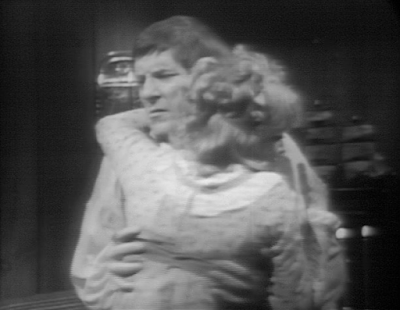
Not how every man would react to a passionate embrace from Lara Parker… Screenshot by Dark Shadows Before I Die.
Barnabas explains that he was already falling in love with Josette when he and Angelique had their fling, but that he didn’t really know her. He couldn’t believe that she would reciprocate his feelings, and consoled himself by dallying with Angelique. This explanation goes over with her about as well as you’d expect, and she storms out of the room, vowing that she will get her way in the end.
We know that the tarot cards are giving accurate information, because the show leans heavily on the uncanny and they wouldn’t have spent so much time on a gimmick that wasn’t meant to advance the plot. We also know that Vicki is not the Wicked Woman the countess is looking for. That leaves Angelique, and we can assume that her wickedness will express itself in some supernatural action taken to avenge herself on Barnabas. Since we know that Barnabas will become a vampire, we wonder if it is Angelique who makes him one.
Closing Miscellany
I usually refer to surviving cast members with courtesy titles and to deceased ones by surname alone. So Alexandra Moltke Isles is “Mrs Isles,” which has been her professional name for 56 years, David Henesy is “Mr Henesy,” Nancy Barrett is “Miss Barrett,” etc, while Jonathan Frid, Joan Bennett, Louis Edmonds, and Grayson Hall are just “Frid,” “Bennett,” “Edmonds,” and “Hall.” Until last month, I’d been looking forward to saying lots of things about “Miss Parker” and her portrayal of Angelique, but Lara Parker died on 12 October 2023. So she’s just going to be “Parker,” and I’m going to be sad about it.
Artist Teri S. Wood has created a number of short animations about Angelique and Barnabas. This one is based on their two-scene at the end of today’s episode:
Patrick McCray has a post about this episode that mystifies me. He writes that “After seven months of hearing about Angelique, today, she enters. So, no pressure Lara. You only have to live up to a half year of build-up.” Uh, what? There has been absolutely no reference to Angelique on the show before today. I can think of an interpretation of the story that might retroject Angelique into episodes #211-365, and I will talk about it next week. But I don’t think it is an interpretation Patrick would favor.
He also talks about David Ball’s method of reading plays from the ending back to the beginning and then from the beginning forward, so that the ending comes to seem implicit in everything else. He allows that Dark Shadows has more than one ending, but I would say he doesn’t go far enough. I’d say the series has ten endings. The first came in #191, when Laura went up in smoke while her son David found refuge in Vicki’s arms. That ending defined Dark Shadows 1.0 as the story of David’s escape from his evil, undead mother Laura, and his adoption of Vicki as his new, life-affirming mother. The second came in #364, when Barnabas met the ghost of his little sister Sarah, she commanded him to be nice to the living, and he went right on with his murderous plans. That ending defined Dark Shadows 2.0 as the story of Barnabas’ irredeemable evil.
Two of the other endings will feature Angelique dying in Barnabas’ arms, and Patrick suggests that those make the whole show the story of their relationship. I don’t buy it at all. Each of the ten parts is about what it is about, and even those two episodes with Angelique dying derive more dramatic charge from other moments.
*Making connections with the first 73 weeks is my job!
Blonde heiress Carolyn Collins Stoddard is under the power of her distant cousin, Barnabas the vampire. She begins today’s episode in the foyer of the great house of Collinwood. She stares at Barnabas’ portrait, lifting her scarf to bare the marks of his fangs to it. She is eager to comply with Barnabas’ commands. He has ordered her to do two things- stop strange and troubled boy David Collins from sounding the alarm about him, and induce well-meaning governess Vicki to become his bride.
Ever since she stopped being a vicious narcissist in February, Carolyn has spent her time trying to protect her family members against threats she didn’t quite understand. She’d been trying to protect David, a first cousin who has come to be something like a little brother to her, when she stumbled upon Barnabas in his lair and became his slave. Her glad willingness to help Barnabas do whatever it takes to silence David shows how complete her subjection to him is.
Today, Carolyn wakes David before 6 AM. David asks “Are you sick or sum’thin?” David Henesy had a real gift for comedy, and Mrs Acilius and I laughed out loud at this line. Carolyn tells David that she does not believe any of the things he has been saying about Barnabas, that she never saw the ghost of ten year old Sarah Collins, and that if he keeps talking about supernatural menaces he will have to be sent to a mental hospital.
David’s reaction will puzzle regular viewers. Last Wednesday, in #348, Carolyn told David she had seen Sarah and was inclined to believe him about the other things. He was horrified. He said that local physician Dr Woodard saw Sarah, believed him, and died as a result. He begs Carolyn to say that she doesn’t believe him and that she didn’t see Sarah, and when she can’t he sobs in her arms. On Friday, David overheard matriarch Liz telling Carolyn he might have to be sent away to an institution, to which Carolyn responded that she had seen Sarah and did not think David was mentally ill. Afterward, David invited Carolyn to believe that he was crazy rather than accept the stories he had told before Woodard’s death. So when Carolyn shows up and tells David that she has decided to disbelieve the things he was desperate she disbelieve, and that the only danger will come if he repeats stories he wasn’t going to repeat anyway, he ought to be happy.
But David goes to pieces. He is as upset by Carolyn’s newfound disbelief as he was a few days ago by her belief. The actors do such a good job with the material that I am reluctant to complain about it, but if people are going to be watching the show every day the writers really should keep track of what’s in each other’s scripts.
As David is the functional equivalent of a brother to Carolyn, so Vicki is the equivalent of a sister. In fact, Art Wallace’s original story bible for Dark Shadows, titled “Shadows on the Wall,” called for a story that would climax with the revelation that Vicki was Carolyn’s half-sister, the daughter of Carolyn’s father Paul Stoddard. Well before the show went into production, the part of Vicki had been cast with Joan Bennett-lookalike Alexandra Moltke Isles, setting up the hints that run heavily throughout the first 92 episodes that Vicki is Liz’ daughter by some man other than Paul. Whichever half of her genealogy Vicki has in common with Carolyn, Liz has been tacitly treating her as a daughter all along. Liz has referred to Vicki and Carolyn as “the girls” for a long time, and now she is even encouraging Vicki to restore the west wing of the great house, which sounds very much like a project a person undertakes on something she is set to inherit. For a time Carolyn showed some resentment and jealousy towards Vicki, but the last clear indication of that was in #263. Since then, Carolyn has been treating Vicki as if she had always known her as a sister.
The enthralled Carolyn is as happy serving Vicki up to Barnabas as she was betraying David for his sake. Or she would be, if she had the chance.
Barnabas’ co-conspirator, mad scientist Julia Hoffman, is staying in the house. Julia has been passing herself off as an historian studying the old families of New England while secretly trying an experimental treatment meant to cure Barnabas of vampirism. That treatment reached an impasse before Barnabas bit Carolyn, and he has decided to discontinue it. Yesterday, Julia persuaded Barnabas to let her stick around to help guard him when he lies in his coffin during the day.
A few days ago, in #347, Julia hypnotized Vicki and showed her Barnabas in his coffin. By a post-hypnotic suggestion, she kept Vicki from consciously remembering what she had seen, but left her with an emotional aversion to Barnabas. That hypnosis gag is reenacted today, with Julia taking Vicki to the room in Barnabas’ house which he has prepared for her when she becomes his bride. There, she tells Vicki the details of Barnabas’ plans for her. Again, she gives a post-hypnotic suggestion confining this knowledge to her subconscious mind.
The difference between #347 and today is that Carolyn is working for Barnabas now. In that one, Julia had free rein to take hypnotized governesses in and out of Barnabas’ house all day long, without a care in the world. But now, Carolyn is watching. Even before Julia did her thing with Vicki, Carolyn confronted her and asked a series of pointed questions. That scene set up an interesting take on the whole idea of a relationship triangle- Carolyn and Julia are in conflict over Barnabas’ attentions, though neither is going to be his lover in any conventional sense. Triangles are so important in soap operas that this clash calls our attention to how Dark Shadows is rewriting the rules of the genre.
Carolyn sees Vicki and Julia leave the house. After they have returned, she asks Vicki about the walk she and Julia took. Vicki doesn’t know what she’s talking about. Carolyn says that she saw them down by Barnabas’ house, implying that she followed them. Vicki is still baffled. In a recorded voiceover monologue, Carolyn wonders why Vicki would lie. She concludes that she wouldn’t, and that Julia must be up to some kind of hocus-pocus.
Carolyn then asks Julia about her walk with Vicki. Julia feigns ignorance. Carolyn says she saw them leave the house together. Julia is defensive, but Carolyn waits patiently for an answer. Julia claims that they just stepped outside the door for fresh air, and Carolyn leaves it at that. Julia exits, and Carolyn ends the episode as she began- staring at the portrait of dear cousin Barnabas.
Nancy Barrett’s acting style is to throw herself unreservedly into whatever the script calls for her character to be doing on any given day, without regard for what the character may have done in past storylines. This turns out to be the perfect approach to playing Carolyn Collins Stoddard. In the first months of the show, flighty heiress Carolyn was fickle, capricious, and self-centered, traits that were all the more disturbing in someone who never showed any particular awareness of what she had said or done as recently as the day before.
That all changed when Carolyn shouldered responsibility for the Collins family business while her mother, matriarch Liz, was away for several weeks in February and March of 1967. After that period, her chief motivation was an earnest concern for the family’s well-being, and her chief difficulty was incomplete information. In her frustration, she tried to save her loved ones by doing just the wrong thing. So when Liz was going to marry seagoing con man Jason McGuire, Carolyn figured out that Jason was blackmailing Liz into the marriage. She also deduced that Liz’ fear was that her secret, if exposed, would ruin Carolyn’s chance at happiness. But Carolyn did not know what the secret was. So, she first tried to ruin her own happiness by dating motorcycle enthusiast Buzz, then when the prospect of Buzz as a son-in-law did not suffice to prompt Liz to stand up to Jason, Carolyn brought a gun to the wedding and planned to shoot Jason dead while he was saying his vows.
By Friday, Carolyn’s concern centered on her young cousin, strange and troubled boy David Collins. David was in touch with the supernatural, and had said that distant relative Barnabas Collins was an undead creature who posed a terrible threat to everyone. Carolyn thought Barnabas a fine and pleasant fellow, but she knew that much of what David had said was true. Though the boy kept pleading with her to forget everything he has said lest she die as the previous adult to believe him, Dr Dave Woodard, died, Carolyn could not do so. She decided to slip into Barnabas’ house to investigate David’s claims. There, she found Barnabas’ coffin. When he bit her and sucked her blood, she learned that he was a vampire.
Miss Barrett’s style usually produces a hot performance, in which she flings the character’s emotions directly before the audience. Today, though, she is playing a vampire’s newly acquired blood thrall. That is a part for a cold actor, one who keeps the audience guessing at the character’s feelings and intentions. On Friday, Barnabas told his co-conspirator, mad scientist Julia Hoffman, that if he bit her she would no longer have a will of her own; having heard that line, returning viewers are supposed to be unsure whether Carolyn even has an inner life now.
Miss Barrett rises to the challenge admirably. In her scenes with Julia at Barnabas’ house and with her mother and her uncle Roger at the great house of Collinwood, she manages to sound faraway and disconnected without seeming bored or confused; in her scenes with Barnabas, she sounds a note of unquestioning devotion without seeming robotic. All of the actors have been doing exceptional work the last few days, and with this eerie turn Miss Barrett is on a par with the very best.
Barnabas gives Carolyn two instructions. First, he tells her to convince everyone that David is mentally ill and that everything he has said should be disregarded. Carolyn smiles readily and says that this will not be difficult to accomplish. Since we have over recent months come to know Carolyn as the determined if maladroit protector of her family, and since she has been so focused on helping David, this easy acquiescence in Barnabas’ wicked plans for David comes as a heartbreak to regular viewers.
Barnabas’ second command is for Carolyn to encourage well-meaning governess Vicki to discard her personality, replace it with that of his long-lost love Josette, and come to him willingly as his bride. Carolyn is a bit puzzled by the Josettification project, but just a couple of days ago Vicki was telling her that she is “more than fond” of Barnabas. Besides, Vicki really is fascinated with Josette, and her current personality hasn’t given her much to do on the show lately. So Carolyn smiles again and says that she will see to it that Vicki comes to Barnabas.
The original videotape of this episode is lost, and the kinescope is particularly gray and scratchy. That is a happy accident. The very cheapness of its look adds to the Late Late Show quality of a story about a beautiful young blonde under the power of a vampire. The abstractness of black and white imagery also takes us out of the literal, workaday world of color pictures, into a realm of dreams and fables where we might expect to encounter vampires.
Most important, the kinescope makes a sharp contrast with images we saw last week. In #348, we got a look at Carolyn’s bedroom. It was the most brightly decorated set we have seen so far on Dark Shadows, so much so that I had to squint for a second when Carolyn switched a lamp on. In color, Barnabas’ house is drab enough, but in black and white it is so severely bleak that the idea of the resident of that glowing bedroom ending up there should give us a shudder. While Barnabas is on his way upstairs to see Carolyn, the camera lingers a bit on this shot of melted candles; for me, that was the moment that particular shudder comes hardest.
Smoldering in the ruins
Of course, a vampire’s bite is a metaphor for rape; of course, Barnabas’ investment in presenting himself as a member of the Collins family makes his attack on Carolyn a metaphorical incest. Every other Dark Shadows blogger who has posted about this episode has explored that theme- Danny Horn (and several of his commenters) here; Patrick McCray and Wallace McBride here and here; and John and Christine Scoleri here. All I have to add to that chorus of voices is that Carolyn’s role as doughty if misguided protector of her kindred makes her a particularly poignant victim of an incestuous assault.
Strange and troubled boy David Collins is sitting on his bed. The ghost of his cousin Sarah is with him, playing “London Bridge” on her flute. She has told him that local physician Dave Woodard is dead, and he is depressed. She explains that she thought she had to tell him.
Sarah says she thinks that Woodard’s death was a terrible one and that it shouldn’t have happened. She denies knowing any more than that, and when David presses her for further information she becomes uncomfortable and vanishes.
David’s aunt, matriarch Liz, comes into his room to break the news to him about Woodard. She is startled to find that he already knows. She is distressed at his attitude of complete resignation. Woodard was the only adult who believed all of the facts about the supernatural menace looming over the great estate of Collinwood and the town of Collinsport that David and Sarah have shared with each other, and when David last saw him Woodard was trying to do something about that menace. David takes Woodard’s death as the end of all hope.
Downstairs, Liz meets her daughter Carolyn and well-meaning governess Vicki. She tells them how sad David is, and Carolyn goes up to see him. She starts talking about imaginary friends, and David asks if she means Sarah. Carolyn says that she doesn’t think Sarah is imaginary, and David replies “You don’t have to pretend. I don’t care.” He isn’t the least bit angry with her- he means exactly what he says when he tells her he doesn’t care how she feels about him.
Viewers who have been with the show from the beginning could see that reaction coming. For the first 24 weeks or so, Carolyn was a flighty heiress, a self-centered young woman who took no interest at all in her little cousin. Since then they have discarded that theme and Carolyn has become a mature and caring person. She and David have had some moments where she has seemed like a big sister. Still, she is still far less involved with him than is Vicki, and David doesn’t have any hopes that even Vicki will listen to him when he tells the truth about the strange goings-on. So when David says “I don’t care,” Carolyn is hit by a freight train that we’ve seen coming for a long time.
This new Carolyn won’t give up on David. She confides that when she was nine years old, she had a friend named Randy, a little boy who always wore a red sweater and who may or may not have existed. Carolyn admits that Randy may have been a ghost, and there is a moment when, as Danny Horn puts it on his Dark Shadows Every Day, “David stands up, and he looks at her, as if they’re really seeing each other for the first time in a long while.” The first time ever, I’d say- David and his father Roger only moved into the house a month or so before the show started, and by that time Carolyn was the character we first saw.
This isn’t the first time the audience has seen this side of Carolyn. In the opening weeks of Dark Shadows, she was one of several characters who had brief conversations with Vicki about the legendary ghosts of Collinwood, and she was the most persistent about laughing those legends off. But before the show had been on the air for five weeks, Carolyn admitted to Vicki that the legends were all true, and that she had tried to downplay them only because she liked Vicki and wanted her to stay.
That development is recapitulated in this scene. Where Vicki had reacted with confusion, telling herself that she ought to be concerned about Carolyn’s mental health but unable to quash a sickly feeling that she might be right, David reacts with wonderment. He is beyond trying to do anything about the horrors that he knows are in progress, let alone appealing to anyone to join him in fighting them, but we can see him absorbing the information that Carolyn is not at all the person she had led him to believe she was.
Once Carolyn stops pretending she does not believe in ghosts, we see why she and the other adults in the family are so insistent about keeping the door shut on the supernatural back-world behind the main action. “London Bridge” starts playing on the soundtrack; Carolyn and David can both hear it. As it goes on, David declares that something terrible is about to happen. It will be an accident- no one will cause it, no one wants it to happen. But it can’t be stopped. Carolyn asks how he knows, and he says he just does.
The little girl we saw in the opening is Sarah, but in this moment we realize she is not the whole of Sarah. The girl is only one manifestation of an unfathomably vast complex of phenomena. The world in which the action appears to be taking place is a tiny, fragile thing by comparison with forces like Sarah. If the characters stray from their little paths of denial and evasion the whole thing may at any moment dissolve altogether, thrusting the back-world into the foreground and leaving them adrift. After a few minutes of David’s soothsaying, Carolyn protests that “None of this is real, it can’t be!” But it’s too late- she knows that it is all too real, and the world of love affairs and hotels and motorcycles and dress shops and restaurants in which she has spent the last 69 weeks trying to find a place is a dream from which she is already starting to awaken.
Meanwhile, Vicki and her depressing fiancé Burke have declined Liz’ offer to live in the west wing of Collinwood when they are married. Liz had hoped to keep Vicki around so that she could help with David. When Burke asks if he should talk to David, Liz tells him not to bother. Carolyn already talked to him, Liz explains, and so far from calming David down she got herself upset too.
That response would suggest that Liz wants to tranquilize David, not to communicate with him. On the heels of the scene between David and Carolyn, it tells us more. Liz has lived in Collinwood longer than anyone, and she has struggled harder than anyone to keep the non-supernatural fore-world in operation. After Carolyn’s experiment in facing facts comes so close to sweeping the “logical explanations” away once and for all, we can see what Liz is trying to protect by keeping David quiet.
Burke is leaving the house, about to go on a business trip to South America, when David emerges from his room and says goodbye. David’s tone makes it clear that it is a final farewell. Burke keeps telling David that he will come back, but David is certain that Burke will die. Burke is shocked by David’s attitude, and says that perhaps they should live in the west wing after all. Vicki is thrilled by the idea.
Burke and Vicki go to a terrace outside the house. There, they hear the wind whistling through the rocks along the shore. On Vicki’s first night in the house, she heard from Liz’ brother Roger the legend of “The Widows’ Wail,” according to which this sound is a warning from the spirits of the widows who haunt the area. In those days, Vicki had little patience for ghost stories, and the “Widows’ Wail” seemed to be the easiest of all the legends to dismiss. But the wind blows every night, and she’s only heard it make that sound on a handful of occasions, usually right before something terrible happens. She’s also seen multiple ghosts, done battle with a humanoid Phoenix, and encountered what anyone with access to old movies would recognize as evidence that a vampire is operating in the vicinity. So she hears the Widows’ Wail the same way regular viewers of the show do, as the sound of the supernatural back-world blasting through and knocking everything else down.
When Vicki pleads with Burke not to go to South America, he replies “Don’t tell me you’re starting to believe all that stuff!” For months now, Burke has been gaslighting Vicki, pretending that she is crazy for believing in supernatural phenomena, including phenomena he himself witnessed and previously acknowledged. But hearing the Widows’ Wail, which was a prominent topic in the early days, and seeing the black and white imagery of the kinescope, we can remember a more appealing version of Burke. Back then, Burke was one of several longtime residents of Collinsport who used the word “ghost” figuratively in conversation with Vicki, each time prompting her to exclaim “Surely you don’t believe in ghosts!?,” to which he would reply that it was entirely possible that there were literal ghosts at Collinwood. For a moment, we see that Burke, and forget the gaslighting abuser. That moment lasts just long enough that we can share David’s sorrow and Vicki’s terror at Burke’s imminent death.








 Dark Shadows Commentary