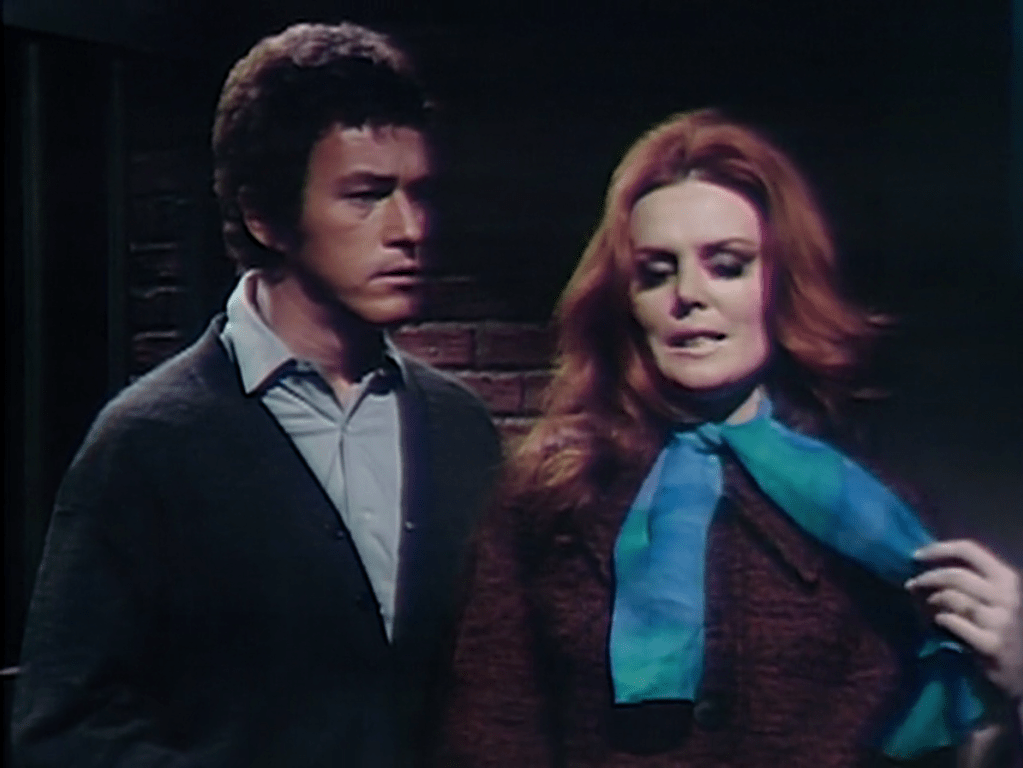
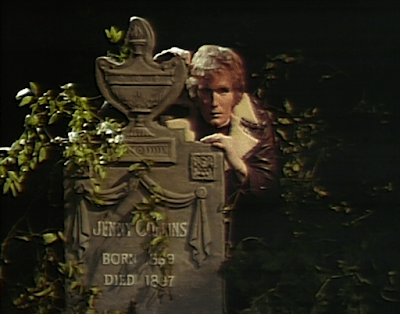
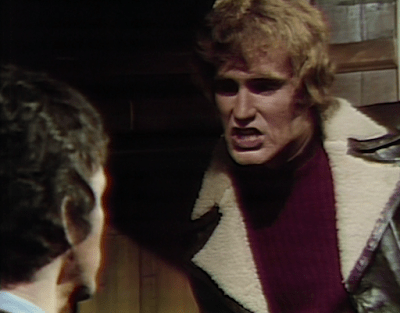
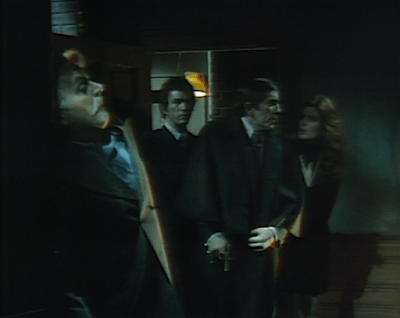
Episode 924: Afraid of the dark

Mad scientist Julia Hoffman finds that wicked witch Angelique has married a businessman who has a house on an island off the coast of central Maine. Angelique tells Julia that her husband’s love has freed her to live as a human being, and that for the sake of that love she has renounced her powers. In #882, set in the year 1897, Angelique said that she would soon have to return to the underworld unless she could find a man who would love her. The show has since returned to a contemporary setting, and she met her husband less than a year before, sometime in 1969. Evidently her time wasn’t running as short as she led us to believe it was.

In the 1897 segment, the show was quite clear that Angelique was aligned with Satan and that the underworld she was talking about was a Hell that Dante or Milton or other Christians would have recognized. The deal she described with her master therefore made little sense then. But Dark Shadows has drawn freely on the mythologies of many cultures and has made up stories about supernatural worlds of its own. The borrowings from the Christian tradition are a relatively minor part of the universe they have been patching together, and they have recently given us reason to suspect it is something they are backing away from. So I don’t think we are under any obligation to reconcile Angelique’s account of the lord of the damned with the teachings of any church.

Angelique is afraid that Julia has come to reenlist her in the cosmic battles surrounding the estate of Collinwood. In fact, Julia had no idea she would find Angelique. She went to the island because she had figured out that a painting she was looking for was there. It is a magical portrait of rakish Quentin Collins, obscured by a landscape painted over it. Quentin has amnesia, and Julia apparently thinks that if she shows him the portrait she will be able to jar some memories loose.

Angelique agrees to let Julia take the painting and expose Quentin’s portrait, on condition that the overpainting be exactly reproduced on another canvas and brought back to the house on the island before her husband knows it was gone. Julia suggests they tell him a lie that will give them more flexibility, but Angelique says he is “a very thorough man” and would ask too many follow-up questions if they gave him any information at all.

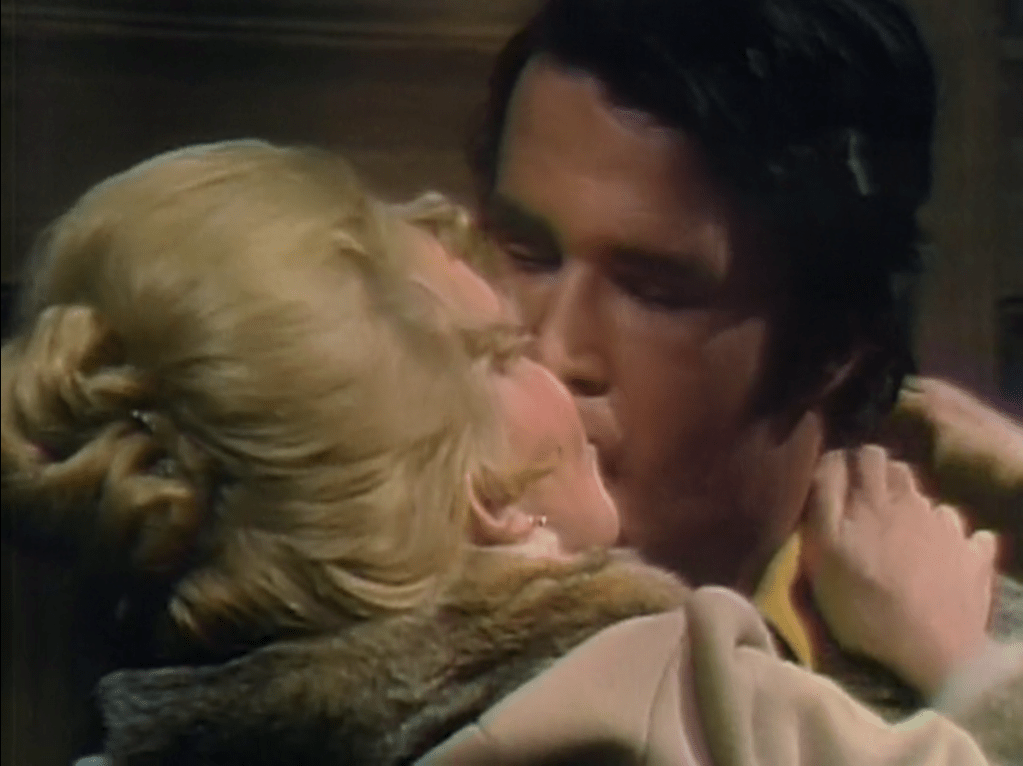
Before and after her scene with Julia, we see Angelique with her husband. The first scene begins with some very awkward kissing. The awkwardness is partly due to Geoffrey Scott’s total incompetence as an actor; he stands stiffly while Lara Parker simultaneously kisses him and nudges him to his mark, making it look like she is moving a couch. But part of the blame must rest with director Lela Swift, who set up the shot from an angle that puts the emphasis on the straining muscles in Parker’s neck and back. Perhaps Swift overestimated Scott’s abilities.

“Move three inches back and to the right, dummy, you’re supposed to be in the center of the frame!”

This scene is accompanied by some music for a small string ensemble; I don’t believe we have heard the track since the very early days of the show. It feels jarringly old-fashioned. All of Dark Shadows’ orchestral score strikes 21st century viewers as a relic of an earlier era, but it set it apart from other daytime soaps of the 1960s and early 70s, most of which had an organ playing on the soundtrack. Compared to the organ accompaniment, which today’s audiences would find simply intolerable, I suppose even these creaky old violins are relatively modern.

The second scene ends with a more successful kiss. It is accompanied by a woodwind piece that used to be associated strongly with well-meaning governess Vicki and her doomed love for dashing action hero Burke Devlin. Burke was written out of the show in 1967, Vicki in 1968, and this music cropped up occasionally in 1969 during sentimental moments. It is still noticeably more old-fashioned than the rest of the score, albeit more dynamic than the string serenade that went along with the first kiss.

Meanwhile, in the great house at Collinwood, strange and troubled boy David Collins is coming down with a cold. David’s governess, Vicki’s successor Maggie Evans, is trying to get him to take his schoolwork seriously. A boy known as Michael appears in the house and announces that he and David will be playing now. Maggie explains that it is not a good time, and Michael bullies both her and David into giving him his way.

Michael is not really human, but is a manifestation of a supernatural force that has subjugated David and many other people. Seeing Michael push Maggie around, we might remember May and June of 1967, when Maggie was the prisoner of vampire Barnabas Collins. Those episodes were bleak and at moments painful to watch, but they also drew a new audience and made Dark Shadows, for the first time, a hit.

Barnabas attracted a crowd, not simply because he was cruel to Maggie, but because we wondered how others would react to his evil deeds, because his motives were unbelievably zany, and because actor Jonathan Frid took a visible joy in playing him. He became a breakout star, familiar to millions who never saw a single episode of Dark Shadows or knew anything else about it, because he generated stories that allowed the whole cast to shine, followed his crazy ideas to the point where many of them became the realities of the show’s narrative universe, and had quirks that dovetailed perfectly with Frid’s strengths.

Michael has none of these things going for him. When he is nasty to Maggie, he does not produce any suspense as to what others will do. Not only do most characters assume that as a teacher she will be able to handle an obstreperous child by herself, but most of the people to whom she would likely turn for support are among Michael’s subordinates. There are no crazy ideas bursting out of him- he is just a little tyrant, who at no point seems to have any hidden motives or nuances of feeling. And Michael Maitland seems depressed the whole time he is on screen. As a result, Michael is as straightforward and tedious as Barnabas was luridly intriguing.

When Barnabas was holding Maggie prisoner, his blood-thrall Willie felt sorry for her. He occasionally made efforts to help her, none of which did anything but make her situation even worse. John Karlen’s portrayal of the feckless Willie brought him almost as much fan mail as Jonathan Frid received during that period. Today it is David’s turn to play Willie to Michael’s Barnabas, and he does not disappoint. Thirteen year old David Henesy plays David Collins’ conflicted feelings more subtly than Karlen had played Willie’s, and as a result we watch him very closely. Disappointed as we may be in Michael, Mr Henesy’s triumph in these scenes brings the episode to a strong close.

Episode 919/ 920/ 921: The giver without a gift

Centenarian Charles Delaware Tate, once a famous painter, is trapped in his parlor with a man who is threatening to kill him. The man is Chris Jennings. Chris tells Tate that there will be a full moon tonight, and he identifies himself as a werewolf. In 1897, Tate painted a portrait of Chris’ great-grandfather, Quentin Collins. That portrait had magical powers that immunized Quentin against both lycanthropy and aging, and Chris is demanding Tate do the same for him. Tate keeps telling Chris that he no longer has the ability to create such things, but Chris won’t listen. Tate does a sketch. He says that his work is finished and tells Chris to take it and leave. Before Chris can comply, he turns into the wolf and attacks Tate.

Chris had been in a secure room at a mental hospital controlled by his friend, mad scientist Julia Hoffman. He deliberately checked himself out and forced his way into Tate’s house because he wanted to use his condition as a weapon to coerce Tate. Julia is the audience’s chief point of view character these days, and she feels sorry for Chris. We also like two characters who care about Chris and don’t know that he is a werewolf. Heiress Carolyn Collins Stoddard is attracted to Chris and seems to have some lingering hopes that a romance might blossom between them, and Chris’ little sister Amy loves him and believes in him. Even one of Chris’ surviving victims, prematurely gray Sabrina Stuart, told Carolyn in #889 that while Chris is dangerous, “he is good.”

Despite everything these ladies are doing to help us like Chris, there can be no doubt that his attack on Tate is murder with premeditation and extraordinary cruelty. Roger Davis can usually be counted on to make us sympathize with anyone who is murdering one of his characters, but he plays Tate today with sensitivity and pathos, leaving us no way to avoid seeing a helpless old man locked up with a vicious killer. Chris’ future on Dark Shadows is limited for a number of reasons, chiefly his passivity in the face of his curse and his dependence on Julia and others to initiate action on his behalf. His abuse of Tate suggests that for whatever time he may have left on the show, Chris will be an unsympathetic villain.

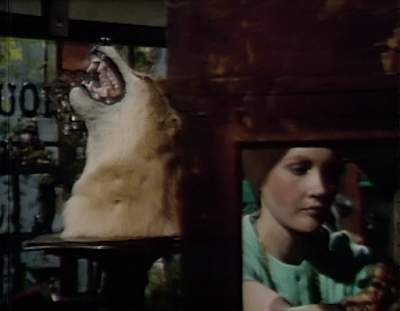
Meanwhile, Carolyn is spending the day working as an assistant in an antique shop owned by her friends Megan and Philip Todd. Our first view of the shop today features Carolyn reflected in a mirror, but the main part of it is the taxidermied head of a baying wolf, emphasizing the danger Chris poses to everyone in and around the village of Collinsport.

The Wolf is loose, Carolyn is boxed in. Screenshot by Dark Shadows Before I Die.

A pair of hands cover Carolyn’s eyes. When they are pulled away, she expects to find that they belong to Philip’s eight year old nephew Alexander, but instead discovers that a thirteen year old boy she has never before seen has introduced himself to her by creeping up behind her and grabbing her face. The boy tells her that his name is Michael, that he is another of Megan and Philip’s relatives, and that Alexander has gone away. He tries to give Carolyn a pendant, but she recognizes it as one Megan wears and says that Michael can’t very well make a gift of something that doesn’t belong to him. He becomes very stiff and screams “How dare you not believe me!?” He doesn’t get any more pleasant as the scene goes on.

Philip comes in and tries to establish some kind of control; Carolyn takes the opportunity to excuse herself. As Michael and Philip talk, it becomes clear that they are part of a secret group with sinister plans. Returning viewers know that Michael and Alexander are not really human children, but are two manifestations of the same supernatural force. As Alexander, this force was a joyless, hateful little tyrant; Michael is no more appealing.

Dark Shadows originally ran on the ABC television network five days a week, from Monday through Friday. The episodes were numbered in a sequence reflecting the order of their original broadcast. When for whatever reason the show did not air on a given day, they would skip a number to keep the episodes airing on Fridays associated with production numbers divisible by 5. That made it easy to figure out how many weeks the show had been on, which in turn made it easy to keep track of where the show was in the thirteen week cycle that governed its long-term planning and the network’s decision to renew it.

In the last months of 1969, the show was being taped several weeks in advance of airdates, in a couple of instances more than five weeks ahead of time. This was atypical, and it led to a problem with the numbering. They knew that no episodes would air on Thanksgiving Day, Christmas Day, or New Year’s Day, but did not foresee that the network would preempt #891 for live news coverage of the return of the Apollo 12 astronauts to Earth on 24 November 1969. Since they had already shot that episode and many following it with the original production numbers on the opening slate, it wasn’t until this one that they had the chance to get the numbers back in synch. That is why it is listed with the three numbers 919, 920, and 921. The only other time they had to skip two numbers was in November 1966, when coverage of football games on and after Thanksgiving Day blotted out #109 and #110. Since that disruption to the schedule was planned, the slate for the next episode was just marked #111. This is therefore the only episode regularly referred to with a triple number.

Episode 915: Emergency Leviathan Broadcast

In #701, old world gentleman Barnabas Collins traveled in time from 1969 to 1897. For the next eight months, ending in #884, Dark Shadows was a costume drama set in that year. On his way back to a contemporary setting, Barnabas took a detour to the 1790s, when he was a vampire. Before he left the 1790s, he was abducted by and absorbed into a cult that serves supernatural beings known as the Leviathans. At their behest, he took a small wooden box with him to November, 1969, and functioned as one of the leaders of the Leviathan cult in that period.

The first six weeks of the Leviathan story has had its strengths. Ever since Barnabas was first cured of vampirism in March 1969, he has been under the impression that he was a good guy and has been doing battle with various supernatural menaces. He was hopelessly inept at this, and created as much work for the other characters by his attempts at virtue as he formerly did in his unyielding evil. That has made him a tremendously productive member of the cast, but it does leave him with a tendency to seem harmless, even when he is trying to murder his way out of a problem. But Barnabas the Leviathan chief has been ice-cold and formidably efficient. Even though not much has yet been done to hurt anyone, seeing him in this mode adds a note of terror to the proceedings.

Moreover, the Leviathans have voided Barnabas’ friendship with mad scientist Julia Hoffman. Since the relationship between the two of them has been the heart of the show for over two years now, from the hostility of their early days to the close bond they formed in the summer of 1968, this reinvigorates the action. It is as interesting to see them fight with each other as it is to see them collaborate against a common foe, and their hate scenes gain an extra depth because we keep wondering about their eventual reconciliation. If they play their cards right, they should be able to keep this up for months.

Today, it all falls apart. Barnabas has drawn a huge following of very young fans who run home from elementary school to watch the show. The 1897 segment was a triumph in large part because it had a core of stories that could hold the attention of adults while also appealing to the preteen demographic. But the Leviathan arc has so far had little to offer anyone but grownups. Apparently the kids were writing angry letters, because this episode, rushed into production at the last minute and bearing signs of haste in every shot, turns Barnabas back into the would-be hero who was such a klutz that he couldn’t even stay in the right century.

The creature who emerged from the box Barnabas brought from the past now appears to be a 13 year old boy and answers to the name Michael. In the opening scene, Michael orders Barnabas to kill Julia. Barnabas declares that he will not, and goes home. There, he tells his troubles to the box, then falls asleep in his chair.

A hooded figure appears to him. This hooded figure says that he is a Leviathan, and tells Barnabas he must comply with Michael’s commands. The Leviathan is not named in the dialogue and there are no actors’ credits at the end, but reference works based on the original paperwork call him Adlar.

Adlar sets out to explain Barnabas’ position, much as Marley’s ghost did to Scrooge in Dickens’ A Christmas Carol. The shortened production schedule shows in inconsistencies that litter Adlar’s speeches. At one point he says that the Leviathans needed Barnabas to transport the box from the eighteenth century to the twentieth; at another, he claims that they are holding his lost love Josette prisoner in the eighteenth century and will inflict a new, far more horrible death on her than the one she died the last time Barnabas was in the 1790s, a threat they will be able to carry out only if they have their own means of traveling back and forth through the years. Barnabas doesn’t pick up on this or any of Adlar’s other inconsistencies; perhaps he is too distracted by the many jump cuts that make this episode look like the videotape was edited with a rusty butter knife.

Adlar threatens to make Barnabas a vampire again, then disappears. He does not tell him that he will be visited by three spirits, one representing his past, another his present, and the third the future he is risking by his present course of action, but this is in fact what happens. Barnabas goes outside, and sees a bat. It was a bat whom he first saw on this very spot who initially made him a vampire. Barnabas rushes inside, looks in the mirror, and does not see a reflection. He thinks of his mouth, and feels fangs growing there.

Next comes Megan Todd, a Leviathan cultist who with her husband Philip is fostering Michael in their home. Barnabas cannot take his eyes off Megan’s long white neck. Megan keeps telling Barnabas that he is the only one she can confide in about her concerns with the progress of the Leviathan plan; he keeps demanding ever more stridently that she leave at once. His bloodlust may explain why he doesn’t notice the continuity problem in the scene. They’ve made the point time and again that it is only while Barnabas is giving orders to her and Philip that Megan remembers that he is their leader. At other times, she thinks he is an outsider. But Megan is the only one who can tell Barnabas a story of family life in any way paralleling that which the Ghost of Christmas Present brings to Scrooge’s attention at the Cratchit house. Continuity has to go if the episode is going to fit into the form of A Christmas Carol.

Suddenly, Barnabas finds himself in an alley by the waterfront. A sign behind him says that he is next to the Greenfield Inn; we saw this sign in #439, set in the year 1796. Evidently the Greenfield Inn is a long-established, though not very reputable, place of lodging.

A woman approaches him. She is very aggressive about insisting he take her with him wherever he is going. He is reluctant at first, urging her to seek friends at the Blue Whale tavern, but she won’t take no for an answer. All of a sudden, he brightens and looks at her with desire. She says she is afraid of him. He asks if she wants to go, and she screws up her courage to declare that she will stay with him. He bares his fangs and attacks. The rough videotape editing adds to the violence of the scene. There is no sensuous bite, only a flash as he lunges at her and then is standing up again, protesting that he didn’t want to do it. When the camera zooms in on the bleeding marks on her neck, it is surprising to see that he didn’t rip her throat out altogether.

We cut back to Barnabas’ house. He is dozing in his chair, and the woman, displaying vampire fangs of her own, walks in through the front door. She approaches Barnabas. He awakens, and is horrified. Adlar tells Barnabas that “she is not up to your usual standards.” She’s standing right there, that’s pretty tactless. Also, she is future four-time Academy Award nominee Marsha Mason. The only other Oscar nominee Barnabas bit was Grayson Hall as Josette’s aunt, the Countess DuPrés, in #886. Hall was only nominated once, so if anything this woman is a step up for him.

Four time Academy Award Nominee Marsha Mason. Screenshot by Dark Shadows Before I Die.

Adlar makes the woman disappear, and shows Barnabas that he is not really a vampire again. With that, we see that she is a shade of a future that may come to be, not one that is already ordained. Adlar also tells Barnabas that it is not now necessary to kill Julia. But he does say that Barnabas will have to do something to ensure Julia’s silence, or else Josette will suffer. Barnabas hangs his head and says to the mirror that he has no choice to obey.

Episode 911: I might forget I’m dead

The Story So Far

In December 1968, children David Collins and Amy Jennings explored the long-deserted west wing of their home, the great house on the estate of Collinwood. They stirred up the ghost of Quentin Collins, who turned out to be David’s great-great uncle and Amy’s great-grandfather. For the next several weeks, Quentin steadily gained power and wrought ever graver havoc, until by the end of February the great house had become uninhabitable and David was hovering between life and death. At that point, David and Amy’s distant cousin Barnabas Collins did some mumbo-jumbo to try to contact Quentin’s ghost, only to come unstuck in time and find himself in the year 1897, when Quentin was a living being.

For the next eight months, Dark Shadows was primarily a costume drama set in 1897. Occasional glimpses of 1969 showed us that the haunting was continuing. In #839, we saw David lying dead before his father Roger, finally having succumbed to the effects of the haunting. But while Roger was lamenting him, David came back to life. The events in the part of the episode set in 1897 had changed the future, so that the ghost of Quentin found peace and Collinwood returned to its usual condition. But that took effect as of the anniversary of the change. Everyone’s memories of the ten months of Quentin’s haunting and of the eight months of Barnabas’ absence in the past are intact.

Not only is Quentin no longer a ghost, he isn’t even dead. In the altered version of 1897 that we saw, an artist named Charles Delaware Tate painted a portrait of Quentin that had the same magical effects on him that Dorian Gray’s portrait had in Oscar Wilde’s novel. Quentin looks, moves, and sounds exactly like he did when he was 28 years old. He has recently returned to Collinsport, and has amnesia. He was found carrying identity papers in the name of Grant Douglas. He’s open to the possibility that that may not be his right name, but when he finds Dr Julia Hoffman, MD trying to convince him he is the 99 year old Quentin, he is incredulous.

At Collinwood

We open today in Quentin’s old room in the west wing. Julia has persuaded Quentin to sit there and listen to his record player. In the unaltered timeline, he was obsessed with a sickly little waltz, listening to it over and over in 1897 and inflicting it on Collinwood when he was a ghost. Julia plays the record, and it doesn’t mean a thing to him. She becomes frustrated and accuses him of lying when he says that he doesn’t remember that he is Quentin.

The music does ring a bell for someone else in the house. The sound of it reaches David and wakes him. Alarmed, he makes his way to Quentin’s room. By the time he gets there, Quentin is hiding behind a curtain. Julia tells David she went in to look for a painting, and that she thoughtlessly started the record player. He accuses her of hiding Quentin. While she is denying it, he sees Quentin’s shoes sticking out from under the curtain.

Quentin’s shoes, as seen by David.

In 1963, philosopher Edmund Gettier published a little paper about the traditional definition of knowledge as “justified true belief.” He gave several examples of justified true beliefs that most people would not regard as knowledge. His examples were kind of far-fetched, but it is easy to come up with more plausible instances. For example, I first read Gettier’s paper when I was in college, and at the same time I was reading Anthony Trollope’s novel The Eustace Diamonds. The main point of that novel is that everyone believes that Lizzie Greystock has stolen some diamonds from her late husband’s estate. She has in fact done so, and they have good reason for believing that she did so, but those reasons are so mixed up with misunderstandings of Lizzie’s motives and other circumstances that we wouldn’t say any of them really knows anything about her. My epistemology professor was excited when I told her about the novel, since the example she gave to our class to show that Gettier’s contrivances were not the only cases illustrating his point was something overly elaborate about believing that you have recognized someone whom you have partially seen while he is hiding most of himself behind a curtain.

David’s claim that Julia is hiding Quentin is another Gettier case. He believes it, the sight of Quentin’s shoes in Quentin’s room provides compelling justification for believing it, and it is true. Yet the Quentin whom Julia is hiding does not have any of the characteristics that give David’s belief the significance that he draws from it. His presence is not a sign that the haunting has resumed and that David is back in mortal danger. He is not a ghost at all and is not a threat to David or anyone else in the house. So while David has a justified true belief that Julia is hiding Quentin, that belief is so deeply entangled with a severe misunderstanding of the situation that we wouldn’t count it as knowledge.

Once David is gone, Quentin emerges and demands answers from Julia. She tells him something about Quentin’s ghost; he already finds her insistence that he is 99 years old to be so preposterous that the additional detail that he used to be dead prompts a merry laugh. By the time he is at the front door ready to leave, he is stern and telling Julia that he expects a “full explanation” tomorrow. Lotsa luck on that- ghosts, time travel, magical portraits, and a universe where the present is a stew made up of the consequences of several mutually incompatible pasts? And those are just the elements you can’t avoid in the executive summary of the situation. A “full explanation” involves werewolves, vampires, a humanoid Phoenix bent on incinerating her children, demons conjured from the depths of Hell, a sorcerer who still misses his pet unicorn, and about a thousand other fantastical topics.

David eavesdrops on Quentin and Julia’s parting conversation. When he was a ghost, we never heard Quentin speak- he communicated telepathically with David and Amy, and they could apparently hear his voice on a particular telephone, but he never stood around and talked with anyone like this. So the mere fact of the conversation undermines David’s belief that the man he is looking at is Quentin’s ghost. When David hears Julia call Quentin “Mr Douglas,” he can see that whoever this person may be, he is not exactly Quentin, not as he knew him. He does recognize the name “Mr Douglas” as that of a man his cousin Carolyn Stoddard met at the antique shop in the village where she works and whom she visited in the hospital when he first had amnesia, so his attitude towards him changes.

In the Antique Store

Unknown to Julia or Carolyn, David has been assimilated to a cult that serves unseen supernatural beings known as the Leviathans. Carolyn’s mother, Elizabeth Collins Stoddard, has also been absorbed into the cult, as has Barnabas. Megan and Philip Todd, the owners of the antique store, are members too, and they are fostering a mysterious creature who currently appears to be an eight year old boy and answers to the name Alexander. Liz takes David and Amy to the antique store, where they interrupt an uncomfortable conversation between Alexander and Julia.

Liz suggests to Julia that they should leave Amy and David in the store to play with Alexander. Julia doesn’t think this is such a hot idea, but Liz insists.

We then have the first scene on Dark Shadows populated by three child actors. It was a breakthrough when the ten year old David played with the ghost of nine year old Sarah Collins in the spring and summer of 1967; their scenes, the first interaction between children on Dark Shadows, advanced it towards becoming a kids’ show. David had up to that point been the only child on the show. He was first a homicidal monster who threatened the adults, then a figure threatened by his mother Laura and in need of rescue. When we saw him with Sarah, the two of them built a relationship that was of importance in itself and that had consequences which grew to dominate the story, leading directly to the show’s first time travel segment in November 1967. In David and Sarah, the fans running home from elementary school to watch the show could see characters their own age driving the action.

The current phase has been very heavy in adult interest. This first three-scene among children might be expected to take us back to territory Sarah and David did so much to open, but it does nothing of the kind. The three children do not really interact with each other at all. David is under the control of the Leviathans, Alexander is a manifestation of their power, and Amy is at a loss to figure out what’s going on. The forces motivating the action are not on screen, any more than they would be if the boys’ parts were played by marionettes.

David, Amy, and Alexander

Amy finds that Alexander has a photograph of Carolyn as she was when she was eight. She realizes that he stole it from a photo album at Collinwood. She declares that she will take it back to the house. Alexander forbids her to do so, and David takes his side. Amy is puzzled by David’s attitude. David threatens to sic Quentin on her. That shakes her up, but she says that Quentin is gone. David says he isn’t, and he and Alexander force her to play hide and seek. Once she is out of the room, David tells Alexander to keep her away for a couple of minutes. He telephones “Grant Douglas” and asks him to come to the shop to pick up a book he left there.

Amy comes back just in time to see and recognize Quentin. She runs upstairs and goes into the room which belongs to Alexander. She hears a heavy breathing there and sees something that terrifies her. Returning viewers know that what she saw was some inhuman thing that is of the Leviathans.

For his part, David is quite calm with “Grant.” Though we saw at the beginning that his connection to the Leviathans has not removed his fear of Quentin, he has reached the conclusion that he doesn’t need to be afraid of “Grant Douglas.” Maybe he thinks that someone using the names of two such prominent Canadians can’t be all bad. He gives Quentin the book and assures him Amy will be all right.

Quentin accepts David’s assurance, but we cannot. Amy is absent from the cast for long periods, and is usually unmentioned during those intervals. The same was true of Nora Collins, the character Denise Nickerson played in the 1897 segment. The show seems to be deliberately telling us not to get used to having this fine young actress in the cast. And the Leviathans haven’t done anything truly horrible yet- they are due to murder a character we really like. So it is quite possible we will tune in tomorrow and find that Amy is dead. Again, the contrast with the David and Sarah story is telling. David Henesy was a core member of the cast from the first week of the show, and the ghost of Sarah was a key part of the show for months. Dark Shadows was as much their show as it was that of any of the adults on screen. Keeping both Amy and Denise Nickerson at the margins, they make it clear that the kids are going to be taking a back seat.

David Henesy and Denise Nickerson were both highly capable performers, but eight year old David Jay just stands on his mark and shouts his lines. That need not have been a problem. Alexander has only been in human form for a week or two, so we don’t expect subtlety from him, and to the extent that he sounds like a real child he is supposed to be a vicious little bully trying to figure out what he can get away with. Such children often do put on acts and sound awkward, so Mr Jay’s professional ineptitude dovetails with the requirements of his part. That’s similar to the way Sharon Smyth’s limitations fit with the part of Sarah. We were supposed to be unsure whether Sarah knew that she was a ghost, whether she knew what year it was, and what if anything she remembered from one appearance to the next. Since Miss Smyth* was, as she says now, “clueless” about the craft of acting, she did a great job keeping us guessing. Later we saw Sarah as a living being, and Miss Smyth’s performance was less satisfactory. We know that Alexander is likely to transform into a shape that is not compatible with David Jay soon, so his shortcomings aren’t a particular concern. But again, the fact that Alexander comes with an expiration date keeps us from regarding him as one of the main characters.

The Store Room

While the kids were alone in the antique shop, Liz took Julia to a store room in the west wing of Collinwood to show her some photographs she had been asking about. While there, they come upon a painting. Liz says that she bought it about a year before at a charity auction, and that when her brother Roger saw how lousy it was he said he hoped that it was a worthy cause. She took it directly to the store room. It is signed “Harrison Monroe” and dated 1968. We will learn tomorrow that it depicts a place called Indian Hill. Julia recognizes the painting as extremely similar to an equally undistinguished landscape she bought a few weeks ago.

Detail from “A View of Indian Hill,” Harrison Monroe, 1968.

That painting was the work of Charles Delaware Tate, executed about 20 years previously. That Tate had been alive and working as recently as that gave Julia the hope that he might still be around and able to help a friend of hers who has problems. Yesterday, an expert called on to remove the landscape and reveal the portrait underneath it said that Tate died in 1959. But this painting is apparently the product of the same hand. Julia hopes that “Harrison Monroe” is a pseudonym of Tate’s.

It has been clear to the audience ever since Julia found the first painting that Tate would be back. That can’t be welcome news to many people. Like all characters played by Roger Davis, Tate is a loathsome man who shouts his lines and assaults his scene partners. So this pseudonym, as strongly redolent of old Virginia as “Grant Douglas” is of twentieth century Canada, will bring a sinking feeling to much of the audience. Our reprieve that began when we left Tate in the nineteenth century five weeks ago cannot last much longer.

*Her name is Mrs Lentz nowadays, but that’s an odd title to give a nine year old. So I refer to her as Miss Smyth.

Episode 909: Beyond what I saw before

Paul Stoddard (Dennis Patrick) has been staying in his ex-wife’s home, the great house on the estate of Collinwood. At the end of yesterday’s episode, he found a boy known as Alexander hiding in his room. He chased Alexander out of the room. We saw Alexander go behind some curtains. In today’s opening reprise of that scene, Paul looks behind the curtain and sees, not Alexander, but a girl. The girl calls him “Daddy” and runs off. He looks at a photo album and recognizes her as his daughter Carolyn as she was at the age of eight. Since Carolyn is alive and well, the girl cannot be her ghost. He concludes that she must be something that the mysterious enemies whom he knows to be persecuting him have conjured her up.

Paul sees this pseudo-Carolyn a few more times, but no one else does. The last time he sees her, he chases her into a closed room.

Paul chases the pseudo-Carolyn into a closed room.

When Paul opens the door to the room and invites permanent houseguest Julia Hoffman to look inside, no one who could be mistaken for Carolyn is there. Alexander is, and he has the same book with him that the pseudo-Carolyn took into the room with her.

The foyer from a new angle.

Alexander is not the eight year old boy he appears to be. He is both a borrowing from H. P. Lovecraft’s The Dunwich Horror and a meta-fictional comment on Soap Opera Rapid Aging Syndrome. He began life a couple of weeks ago as a whistling sound coming out of a wooden box, spent a week as a newborn baby, then emerged in his current form. When he masquerades as the very young Carolyn, he doesn’t get any bigger or smaller, but he does shift his shape between male and female. Which, good for him (them?,) I suppose.

Many longtime viewers will be even more intrigued by another metamorphosis that we see today. The foyer set has always stopped a little bit downstage from the front door. The room into which Paul chases Carolyn/ Alexander lies beyond this line. Previously, when characters had entered that space they simply exited and were picked up elsewhere later. The only time the camera followed actors beyond the line was in #664, when time-traveling vampire Barnabas Collins and indentured servant Ben Stokes walked from the foyer to the study by way of an undecorated area of the studio. That area is decorated now.

New set.

In the picture of Julia, Paul, and Alexander above, we see a portrait in the foyer behind Paul’s left shoulder. That depicts Barnabas as he was in the 1790s, before he became a vampire. It first appeared in #204, when Dennis Patrick was on the show as Paul’s sometime friend, seagoing con man Jason McGuire. It was still being painted when Patrick joined the cast a few weeks before. When he first entered the great house in #195, there was a mirror on that spot. The mirror had been trading places with a metal doodad that was shaped like a coat of arms. At the moment Jason entered, the mirror caught a portrait on the opposite wall, making it look like there was a portrait there. On repeat viewings, that effect makes it clear that Jason’s purpose is to clear the decks of leftover story elements that will not be needed in the show’s future as a supernatural thriller.

When Jason first came to the house and insisted on staying, he and Liz stood in the foyer. She looked into a space beyond the camera, to the viewer’s left (=stage right,) and said that she supposed she could find a room for him there. Jason identified the imaginary part of the house Liz was facing as the servants’ quarters, and when in later episodes we saw servants going to their rooms that was indeed the direction they exited. So when they have Patrick on screen when they enlarge the performing space available in the foyer to include an area to the viewer’s right (=stage left,) they are picking up on that aspect of his iconography.

The Carolyn side of Carolyn/ Alexander is played by Lisa Ross, whose given name was Alyssa Mary Ross. In later years, she took her husband’s name and was known as Mrs Eppich. She was born in 1959 and died in 2020; her family put a very nice tribute page to her online, you should look at it.

Lisa Ross had brown eyes; Nancy Barrett, who plays the adult Carolyn, has brilliantly blue eyes. Since half the episodes of Dark Shadows in this period were directed by Henry Kaplan, a specialist in extreme closeup shots, no regular viewers can be unaware of this. For a single episode, #578, Miss Barrett was replaced as Carolyn by Diana Walker. That one was directed by Sean Dhu Sullivan, who was adept at a wider variety of setups than Kaplan and therefore did not shove the camera into the actors’ faces over and over. Miss Walker’s eyes might be brown, I can’t tell. If so, maybe it was her Carolyn whose juvenile form Alexander assumed.

Episode 908: Mollycoddle that monster

The current phase of Dark Shadows is focused on the threat to the human race posed by the Leviathans, unseen supernatural beings who have taken control of several characters on the show. Among their devoted servants are matriarch Elizabeth Collins Stoddard and her nephew, strange and troubled boy David Collins. Today, Liz and David welcome a boy known as Alexander to the great house of Collinwood. Alexander appears to be an eight year old boy, but is in fact an extreme case of Soap Opera Rapid Aging Syndrome. Last week he was an infant, and a few days before a whistling sound coming from a wooden box. Whatever Alexander may really be, he holds a key position in the Leviathans’ plan.

At times, Dark Shadows becomes so much a kids’ show that it loses much of its adult audience. The Leviathan story so far has gone to the opposite extreme. A scene in which Alexander orders the thirteen year old David to give up the transistor radio he had long wanted and that his father just gave him will probably get similar reactions from viewers of all ages, but when Alexander scolds Liz for asking questions and she apologizes, only those who remember Joan Bennett as the great star she was in the late 1930s and early 1940s will get the full force of the moment. In general, adults will probably feel the distress Alexander’s tyranny is supposed to induce, while the fans who are running home from elementary school to watch the show will likely be either annoyed with the kid or amused to see the grownups getting theirs.

Liz’ ex-husband Paul is being persecuted by the Leviathans and their human agents. Paul is staying at Collinwood, and he is outraged to find Alexander in the house. Paul carries on like a crazy man, prompting Liz to tell him that if he doesn’t compose himself he will end up in a mental hospital. He tells Maggie Evans, David’s governess, about his suspicions; she listens sympathetically until he catches Alexander eavesdropping and roughs the boy up. Maggie then freezes in horror, and Paul goes on shaking Alexander and yelling at him until Liz enters and puts a stop to it. While Liz and Maggie stand in the corridor and talk about Paul’s lunatic behavior, he paces in the drawing room, telling himself that he mustn’t “fly off the handle” again.

David enters and hands Paul a small photo album. He says that it has pictures of Paul and Liz’ daughter Carolyn when she was a child. Since Paul wasn’t around when Carolyn was growing up, David says it occurred to him that Paul might want to look through it. Paul thanks David for his thoughtfulness.

As Paul leafs through the album, we get a look at a picture depicting Carolyn as she was when she was about ten. We haven’t seen the model before. Dark Shadows had such a tight budget that regular viewers will be fairly sure they wouldn’t have brought a girl in only to pose for a single photograph, so we might start wondering when we will meet the ten year old Carolyn.

Child Carolyn. Screenshot by Dark Shadows Before I Die.

We may also be wondering when we will see another girl of about the same age. Denise Nickerson, twelve years old in December 1969, has been in the cast for a year at this point, and has made major contributions every time we’ve seen her. We saw in #893 and #896 that her character Amy Jennings is still living at Collinwood and is still David’s chief playmate. But as is usual in episodes where she does not appear, Amy is unmentioned today. Liz tells Paul that David spends entirely too much time surrounded by adults, as if Amy does not exist. They followed the same pattern during the eight months of 1969 when Dark Shadows was set in 1897 and Nickerson played nine year old Nora Collins. When Nora was in the episode, she was often its brightest spot, but when she wasn’t her name never came up. It’s unnerving that the show does so little to reassure us that it will continue to make use of such a talented and appealing young actress.

Alexander sits on the bench that has been in the foyer at Collinwood throughout the whole series. The Dark Shadows wiki says this is only the second time the bench has been used. I want to say it is the third- I remember David sitting there in #176, when Maggie’s predecessor Vicki told him he could have two desserts, cake and ice cream, but I seem to recall either him or someone else sitting there at some point around that time. I’m not going to go back through those episodes to check, but if you’ve been watching them I’d appreciate it if you’d leave a note in the comments.

Episode 905: My darling now

Heiress Carolyn Collins Stoddard has been hung up on mysterious drifter Chris Jennings for a while. Unknown to Carolyn, Chris is her third cousin, the great-grandson of her great-great uncle Quentin Collins. That is a distant enough relation that it needn’t be an obstacle to romance. But Chris is keeping another secret that presents a more definite obstacle. He inherited from Quentin a curse that makes him a werewolf.

From March to November 1969, Dark Shadows was a costume drama set in 1897. Old world gentleman Barnabas Collins and mad scientist Julia Hoffman traveled back in time from 1969 to that year, and befriended the living Quentin. They learned that Quentin had been freed of the effects of the werewolf curse when a magical portrait was painted of him. As long as the portrait remains intact, Quentin will not only retain his human form on the nights of the full moon, but will also be immune to injury, aging, and death. Julia and Barnabas know of Chris’ condition, and early in 1969 they were working together to cure him of it. Julia now hopes that another portrait can be painted to do for Chris what his great-grandfather’s portrait did for him.

Barnabas came back from the past wanting nothing to do with Chris. He has secretly been absorbed into a cult devoted to mysterious supernatural beings called the Leviathan people. When Barnabas first saw Chris after his return to 1969, he told him there was no hope for him. Since then, he has been cold and distant both to Chris and to Julia. He has urged Carolyn to forget Chris, and keeps telling her that she has a great future in store for her. We have had other indications that this future will involve a special role in the Leviathans’ plan to take over the world.

Now, Carolyn has met the living Quentin and become smitten with him. She does not know his true identity, but did tell Barnabas about him and that he was coming to meet her. Barnabas’ response was to run Quentin over with his car, claiming afterward that it was an accident.

Now, Quentin is in the hospital with a bandage on his head. He does not speak in today’s episode, but anyone who has seen a soap opera knows that a bandage wrapped around the head is a sure sign of amnesia. Indeed, when Julia addresses him as “Quentin,” he looks at her blankly.

Quentin wearing the amnesia badge. Screenshot by Dark Shadows Before I Die.

In his post about the episode on his great blog Dark Shadows Every Day, Danny Horn reminds us of another amnesia plot that followed a time travel story. That one dragged on for eight months, was never at all interesting, and ended with the two characters most directly involved being hustled off the show. Remembering it, longtime viewers will shudder at the sight of Quentin’s bandage. But amnesia stories are a staple of soaps, and Danny explains how they can work well by imagining a different version of that dismal flop:

Jeff Clark… might or might not have been a reincarnation of Peter Bradford, Vicki’s boyfriend from 1795. Somehow, they managed to spin that mystery out for a full eight months, until they finally decided that nobody cared, and then they wrote Jeff, Peter and Vicki off the show forever.

The real problem with the Jeff/Peter mystery — and this is important, for the Quentin/Grant Douglas conundrum — is that Jeff Clark was just an empty suit of clothes. Jeff had no memories, and he arrived on the scene with no family, and very little in the way of a storyline.

Worst of all, Jeff’s primary characteristic — being in love with Vicki — was also Peter’s primary characteristic, so it was a distinction without a difference. It didn’t really matter whether he was called Jeff or Peter, so they could just let it drift for month after month, with no appreciable impact on story progress.

Here’s how you do the amnesia story: Think of it as two people inhabiting the same body, and create a conflict between those people. If Peter’s in love with Vicki, then “Jeff” should be cold and distant. “Jeff” didn’t experience any of the events that brought Vicki and Peter together, so her clumsy attempts to revive his memory should upset and frustrate him.

At that point, you can take as long as you’d like to bring his memory back, because the longer this goes on, the more damage “Jeff” can do to Peter’s life. The ideal way to end that story is to have “Jeff” fall in love with Vicki’s worst enemy, and news of their engagement makes Vicki turn to someone new for support and understanding.

Then it should be obvious to everyone that his memory comes back on the day of his wedding, during or immediately after the vows. Suddenly, “Jeff” is Peter again, horrified to discover that he’s married to someone that he doesn’t like, and the love of his life is involved with somebody else.

That’s how you do the amnesia story.

Danny Horn, “Episode 905: Waiting for Quentin,” posted 27 July 2016 on Dark Shadows Every Day.

The sheer fact that Quentin is in a coma as a result of a collision with a car is a puzzle for attentive fans. In #844, sorcerer Count Petofi scraped Quentin’s cheek with a jagged piece of glass. That did not leave a mark on Quentin himself, but a scar appeared on the portrait in the place corresponding to the spot Petofi scratched. Since violence against Quentin leaves him as he was but marks the portrait, why is he hurt now? One of Danny’s commenters tackled this problem:


Yeah, why is he even hurt at all? The painting should have absorbed all the trauma of Barnabas’ reckless attempt at mayhem; the portrait should have amnesia. (Oh, but then it wouldn’t be protecting Quentin any more, since it wouldn’t remember who it’s a picture OF – which is why Quentin has the amnesia and injuries! How’s that for a fanwank?)…

Is it explained later just WHY Quentin thinks he’s Grant Douglas? Did he already have amnesia? And now he has double amnesia? (If I remember sitcom amnesia correctly, the second trauma should have reversed the first – but soap opera amnesia may be different.)

Comment left 29 December 2018 by “John E. Comelately” on Danny Horn, “Episode 905: Waiting for Quentin,” posted 27 July 2016 on Dark Shadows Every Day.

Later, Carolyn is at the antique shop where she has been working. The shop’s owner, Carolyn’s friend Megan Todd, makes a bunch of cryptic remarks about having discovered something greater than happiness. Carolyn wonders about the baby that Megan and her husband Philip have been looking after. She hears a ball bouncing in the upstairs room where the baby has been sleeping, and Megan orders her to ignore it. Eventually the ball comes rolling downstairs, and an eight year old boy follows it. Megan declares the boy to be her darling.

Returning viewers know that the baby was in fact some kind of creature associated with the Leviathans, and Megan has a scene in which Barnabas tells her that the creature is going to be undergoing a change. So we know that this boy and the baby are in fact one and the same.

That two consecutive men who attracted Carolyn turned out to be werewolves is interesting in light of the frequent references to the big plans the Leviathans have for her. The Leviathans have clearly not been giving their devotees a lot of background information about the tasks they make them perform, so that even if Barnabas did not know who Quentin was when he tried to kill him, the unseen forces manipulating him may have been well aware of that. Perhaps the show is suggesting that there is some kind of enmity between the Leviathans and werewolves.

Quentin’s ghost haunted the great house of Collinwood from December 1968 to September 1969 and wrought great havoc there. The haunting broke on the anniversary of an event in 1897 that went differently than it had originally because Barnabas and Julia had traveled back in time. But it was made clear when we returned to contemporary dress that the 1960s characters all remember the events of those ten months, and that Quentin’s ghost still frightens them. Carolyn was one of the few major characters who did not see the ghost, so I suppose it makes sense she isn’t afraid when she sees the living Quentin. But one does wonder what the reaction will be when the other residents of the great house meet him.

The Leviathan boy is played by David Jay, and is named in the credits as “Alexander.” Born in 1961, Mr Jay is the youngest person ever to have appeared on Dark Shadows. He acted off and on until the early 1980s. Evidently he is alive and well, but he never appeared at any of the Dark Shadows conventions and does not do the podcasts on which other cast members occasionally guest. Not one for the fandom, he.

Episode 901: In Collinsport, where your only hope lies

Heiress Carolyn Collins Stoddard thinks that her recently returned father, Paul Stoddard, is mentally ill. She knows that her mother Liz and Liz’ brother Roger are deeply hostile to Paul, and thinks that her distant cousin Barnabas is friendly to him.

We open in the Blue Whale tavern, where Carolyn has been pleased to discover Paul and Barnabas sitting together at a table. Barnabas says that Carolyn is her father’s most precious possession, and she happily agrees. Paul angrily denies that this is the case, and jumps up. He asks Carolyn to go away with him, and leaves the tavern.

Carolyn is bewildered by this reaction, and annoyed when Roger enters. She exits to follow Paul, and Roger goes to the table to warn Barnabas that friendship with Paul would mean trouble with Liz. Barnabas assures him they are not friends.

In Paul’s hotel room, Carolyn tells her father that his troubles are all in his head. She says that she will try to help him, and mentions Julia Hoffman, a psychiatrist who is permanently in residence at the great house of Collinwood. Paul insists that he really does have enemies, and pleads with Carolyn to join him in running far away. She refuses, and insists that he must solve his problems where he is.

Carolyn goes home to the great house. She and Roger have a confrontation. He gives her a check for $5000, payable to Paul. He tells her that the only reason Paul has come back is that he wants to get money out of the Collinses, and that if she gives him that check, he will leave again.

Carolyn goes to the antique shop where she has been working for her friends Megan and Philip Todd. Megan is holding a baby, whom she identified to Carolyn as her nephew Joseph, her sister’s son. Barnabas is with Megan and the baby. Carolyn apologizes to Megan for being late to work, and tells Barnabas she has been late many times. Megan says that it isn’t a problem, that she couldn’t have got away from the shop any earlier even if Carolyn had been there. Barnabas exits.

Carolyn tells Megan that is strange to be reunited with a father who left when she was a newborn. Megan says that she was close to her own father growing up, and that she was an only child. Carolyn furrows her brow, looks at the baby, and asks if he isn’t her sister’s son. Megan scrambles for a second, then claims that Joseph’s mother is her stepsister, one of two daughters of the widow her father married.

Megan takes the baby to his bedroom upstairs. Carolyn answers the telephone, and tells Philip that she will have Megan call him right back. She waits a moment, then goes upstairs. She hears a loud breathing sound coming from the baby’s room, as if a gigantic obscene telephone call were in progress.

Unknown to Carolyn, her father’s troubles are not imaginary, and Barnabas is not his friend. Between her two scenes in the antique shop, we saw Paul in his room. A true Collinsporter, he was in bed fully clothed, wearing even his tie and his shoes, but still he had difficulty sleeping. Barnabas entered the room and told him it was odd to sleep on such a sunny day. To demonstrate the day’s sunniness, he turns a light on. He also ruffles the window-shades, but does not open them. Evidently that would be a little too on-the-nose.

Paul aims a revolver at Barnabas and says that he will kill him if he doesn’t leave him alone. Barnabas says that if he kills him, someone else will be sent in his place. Paul says that he will also kill that person, and he squeezes the trigger several times. That only makes a clicking sound. Barnabas tells him that “we” knew about the gun, as “we” know about everything Paul might do before he does it, and that the ammunition was therefore removed. He also tells Paul that if he leaves Collinsport without permission from whomever it is Barnabas represents, Carolyn will suffer.

The telephone rings, and Barnabas orders Paul to answer it. It is Carolyn. He tells her that he is feeling better, and that he does not want to go away. Barnabas praises him for beginning to see things “our way.”

Paul telling Carolyn that everything is just great with him. Screenshot by Dark Shadows Before I Die.

Today’s closing credits are the first headed by “Starring Jonathan Frid as Barnabas Collins.” From now on, Frid will get the “Starring” designation unless Joan Bennett is in the day’s cast, in which case she gets “Starring” and he follows with “Also Starring.”

Episode 893: We serve him now

Heiress Carolyn Collins Stoddard is sitting at a table in the Blue Whale, a tavern. A man who refused to give his name when she caught him trespassing on her property invites himself to sit down with her. She objects to this. He identifies himself as her father, the long-missing Paul Stoddard. She objects far more strenuously to that. Not only did Paul leave the family when Carolyn was an infant, he and his friend Jason McGuire faked his death. Jason convinced Carolyn’s mother, Liz, that she had killed Paul and he had buried the corpse in the basement. In response, Liz immured herself in the house for nineteen years. Only after Jason came back and was blackmailing Liz into marrying him did the truth come out and Liz break free of her reclusive ways.

Paul tells Carolyn that he didn’t know Jason told Liz that she had killed him. Longtime viewers may suspect this is a lie, not least because Paul and Jason are both played by Dennis Patrick. Nonetheless, Carolyn falls for it. Soon she is agreeing to sound Liz out to see how she might react were she to hear that Paul had returned. He walks her home to the great house on the estate of Collinwood. He can’t go in, but gives her a goodnight kiss on the forehead.

Carolyn’s young cousin, strange and troubled boy David Collins, sees Paul kissing her. When she goes inside, he asks who her new boyfriend is. Carolyn is vexed. She refuses to tell David anything, and sends him to bed.

Carolyn’s friend Philip Todd comes to the door. He tells her that he and his wife Megan want Carolyn to work at their antique shop in the village. It may seem rather odd for the keeper of a little shop to go to a vast mansion and ask the daughter of its proprietor to take a job as his assistant, but Carolyn loves the shop and was volunteering there yesterday. She agrees happily, and mentions that a man might be leaving messages for her there.

In the shop the next morning, Carolyn sees that Megan has a baby. Megan says it is her sister’s son. Carolyn asks his name. Megan thinks for quite a while before coming up with “Joseph!”

Carolyn is alone in the shop when David comes in with his friend and fellow resident of Collinwood, Amy Jennings. We haven’t seen Amy since #835; that in turn was her first appearance since #700. For eight months, from #701 to #884, Dark Shadows was set in the year 1897, with only a few brief glimpses of the 1960s. In the 1897 segment, Denise Nickerson played Nora Collins, whose own final appearance was in #859. Both Nora and Amy had long absences from the cast, and were usually unmentioned while they were away. So we’ve been afraid that we wouldn’t see Amy or any other Nickerson character again. It’s good to have her back. She even pulls her signature move and gives a meaningful look directly into the camera at one point.

A Nickerson special.

Amy and David see a doll that longtime viewers will recognize as Samantha, favorite plaything of the late Sarah Collins both when we saw her as a living being in the 1790s from November 1967 to March 1968 and before that, when she was a ghost haunting Collinwood and its environs in 1967. There are also a couple of toy soldiers from “The Regiment,” which Sarah’s brother Barnabas played with when he was a young boy and which Sarah gave to people in 1967 as protection against Barnabas, who was at that time a vampire. Barnabas did sell a bunch of things to Megan and Philip the other day, but neither Samantha nor the members of The Regiment were in Barnabas’ possession when last we saw them. Presumably the camera lingers on the toys, not because we are supposed to know how Philip and Megan got them, but because we are supposed to be pleased with ourselves for recognizing them.

Paul comes into the shop. David recognizes him as the man he saw kissing Carolyn. Carolyn addresses Paul as “Mr Prescott,” sends him into a back room, and hustles the children out of the shop. She tells Paul who David is, and explains that he saw them together, complicating their plans.

When Carolyn was minding the shop yesterday, her friend Maggie noticed an old book on a table. Neither of them knew what it was, but viewers knew it was an object of great importance to a cult into which Philip and Megan have been inducted. It seemed inexplicable that they would leave it on a table in their shop, as if it were for sale. We get a hint today as to what they may have been thinking. In his room at Collinwood, David shows Amy that he has stolen the book. She asks why he would want it. He explains that Carolyn said that if they damaged anything in the shop, his father, Roger, would have to pay for it, and he creased a page in the book. David’s fear that his father would punish him drove several stories in the early months of the show. Roger has mellowed enormously since then, but evidently David is still so afraid of him that he will make a bad situation worse rather than face his wrath.

Indeed, many major storylines have begun with David. The 1897 flashback started because Barnabas was trying to keep a ghost from killing David, as the 1790s segment started when David’s governess Vicki participated in a séance meant to solve a mystery concerning him. For that matter, the whole show started when Vicki was summoned to Collinwood to take charge of David’s education. David doesn’t always have a lot to do in the stories, and when they are over it is often as not forgotten that he was in peril when they began. But he is so often the catalyst that we can suppose that David was supposed to find the book so that the current story could move into its major phase.

If that was the intention, Megan and Philip didn’t know about it. When they discover that the book is gone from the shop, they fly into a panic and declare that whoever took it must be killed. It may turn out that the mysterious forces behind the cult want David to become involved and that they created a situation in which he would find the book and take it with him, but if so, those forces are operating outside the cognizance of anyone in today’s episode.